I’ve discussed genres a lot here on Writing to be Read. I’ve done monthly genre themes, with author interviews and reviews of books included in each one. We’ve covered nonfiction, romance, western, fantasy, science fiction, young adult fiction, children’s fiction, horror, crime fiction, mystery, women’s fiction, Christian fiction, comic books and graphic novels, and the list goes on. Some genres were easy to find authors to interview and books to review. Others were a bit harder. Likewise, some attracted more readers than others.
Fantasy
Recently, there hasn’t been so many author interviews. I hit a bump in the road and was unable to fulfill my interview and review commitments. Now, I’m ready to jump back in the saddle and get things rolling again. As I contemplate what 2021 will look like for Writing to be Read, I’m wondering wether to keep the genre themes, or explore different areas in the craft of writing, and I would like your feedback. Chances are, if you’re a reader of this blog, then you are also a writer. Leave a comment and let me know which genre(s) you like to write in. Which genre(s) do you like to read? Which would you like to learn more about? Or should I trash the genre themes and concentrate on some other aspect? Which one? Let me know your thoughts.
Romance
I suppose there was a time when genres were more cut and dried, but in this day and age, genres don’t always fall into clear categories. Just take a look at the plethora of categories Amazon has for you to list your book under. When Delilah was published, I got a shock. I had written a western with a female protagonist, who was tough and gritty and made her way in the man’s world of the old west. Her character’s flaw was a lack of trust, and in order to get what she truly needed from the story, she had to have a love interest, so there was a thread of romance woven into the tale. It wasn’t the main story line, but my publisher had picked up on it and listed it as a “Frontier Romance”. Is that what I wrote?
Horror & Dark Fiction
Actually, it may have been a smart choice, even though it wasn’t my original intention. When we re-published the third edition with the new cover, I asked that they list it as a straight western, but it hasn’t helped with sales. Genre has as much to do with marketing as it does with craft. Readers of frontier romanace are a different group from those who read classic westerns.
Christian Fiction
The first group are mostly female and the second are mostly male, and they are looking for different things out of their stories. The women want romance, the men want rugged adventure, and it seems that maybe they want it to come from a big, burly mountain man or a rowdy cowboy. Men who read westerns don’t have the buy-in for a tough female character, but women who read romance have no problem with a female who is tough and gritty having the adventure, as long as she lets her gentler, feminine side show enough to fall in love.
Western
When I was working toward my M.F.A. in creative writing, I was told it was imperative to know who you are writing for, to form a mental picture of your ideal reader in your mind. But, I take an eclectic approach to most things, and writing is no different. I’ve tried my hand at many genres, some more successfully than others, and it can be seen from the example above that different genres have different readers. For me, I found I need to write what is in my head, and then figure out who to market to.
Children’s & Yound Adult Fiction
With the first WordCrafter Short Fiction Contest, in 2019, I chose to make the theme paranormal, because most people love a good ghost story. It got a good response and the Whispers of the Past anthology was born. Each entry had paranormal elements, and they were all the type of stories that would make readers think.
Whispers of the Past
For 2020, my thinking was that the old west has a lot of ghosts, and western was a genre I write in, so a western paranormal would be a natural combination, so that was the theme. But, just as not so many people read westerns, not so many authors write in the western genre, and I think I scared many possible entrants away. I had to convince author friends that they could write in the western genre just to get enough entries to create the Spirits of the West anthology, but it contains some very unique stories. Robbie Cheadle contributed two South African western paranormals, playing off South African history, but with western flavor, and Art Rosch contributed a science fiction western paranormal, of the likes you’ll not find anywhere else.
Spirits of the West
As with Writing to be Read, I’m looking toward the future for WordCrafter Press, and it’s time to think about the theme for the 2021 contest and anthology, but I’m at a loss. The paranormal theme worked well, and so did the western paranormal after I coerced some entries out of my author friends. But, one purpose for creating the WordCrafter Press contests and anthologies was to open up avenues to get your work published for new and aspiring authors, and another was to motivate established authors to think outside the box, or work outside their usual genres. It shouldn’t be a struggle to get entries, but it should still offer a challenge for the writer. So, I’m going to ask one more question of all of you. Please leave a comment to let me know, what genres of short fiction you would consider entering, were they the theme for a short fiction contest. i.e. “I would enter a short fiction contest if the theme were…”
Writing to be Read wouldn’t be where it is today if it wasn’t for you, my loyal readers. Some of you have stuck with me since the blog began, while others are new sign ons, but I appreciate you all. Please share your own thoughts on genres and help us carry on and move forward together. I’m looking forward to it. 🙂
Like this post? Let me know in the comments. You can be sure not to miss any of Writing to be Read’s great content by subscribe to e-mail or following on WordPress. If you found this content helpful or entertaining, please share.
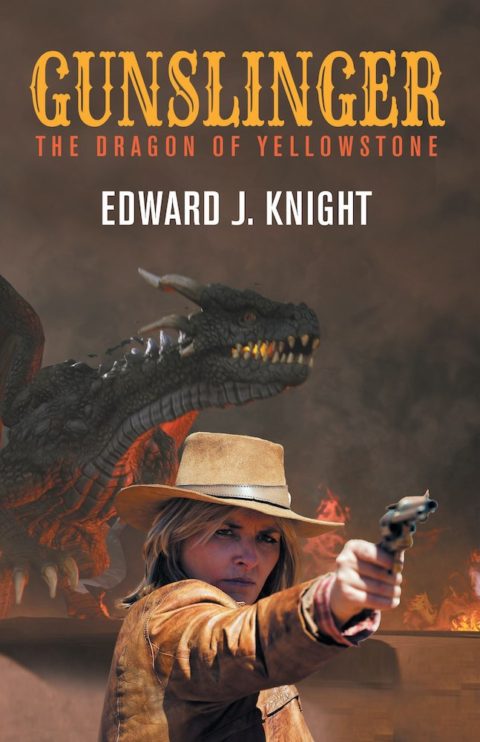
Gunslinger, by Edward J. Knight manages to combine two of my favorite genres, western and fantasy, into an adventure I won’t soon forget. Six guns, swords or sorcery, no weapon is off limits in this fantasy western landscape. And of course, there are a wide variety of villains to fight off, and Beth isn’t your typical female in the story world of Gunslinger created by Knight.
Taught by Wild Bill Hickock, she shoots like Calamity Jane, and sees her ghost. When an Arapohoe Indian spirit leads Beth and her friends on a quest to stop a dragon from wiping out the army outposts, will her gun be enough to stop the beast? Add dwarves being guided by an angry ghost who is out for revenge, hostile Indians and and a ghost guide with a personal agenda and you have a western fantasy adventure of the highest caliber.
Gunslinger is full of surprises and quite entertaining. I give it four quills.
Four Quill Rating
Kaye Lynne Booth does honest book reviews on Writing to be Read in exchange for ARCs. Have a book you’d like reviewed? Contact Kaye at kayebooth(at)yahoo(dot)com.
2020 saw the birth of the book I’m currently working on, and it was all inspired by music. In fact, the female lead character, Amaryllis is based on the music of Taylor Momsen and The Pretty Reckless. So, I had this great idea to set the tone and offer a glimpse into the thoughts of the pov character for each chapter with a snippet of lyrics; lyrics from The Pretty Reckless for Amaryllis, and lyrics from various artists for the male lead, LeRoy. It’s a time-travel story, titled The Outlaw & the Rock Star. The only catch is, an author has to be careful not to infringe on the copyright when using lyrics in her fiction.
Copyright, whether in the literary arena or the music industry, is serious business. Artists and writers protect that which they have created, as they should. As a writer, I can’t imagine the outrage I would feel, were I to learn someone else had infringed on my copyright. My words are my creation. They came from me. No one else on the planet can write them in just the way I wrote them, unless they steal them. And, let’s face it folks, theft is what copyright infringement is. So, I get why writers and artist want to protect their creations. I want my work to be protected, too.
According to Matt Knight on in “Using Lyrics in Fiction” (5 January 2019) on Sidebar Saturdays, obtaining copyright permission for song lyrics involves a ton of research into who actually holds the copyright, and then contacting them to request permission to use specific lyrics in your fiction, and pay the requested fee to obtain copyright permission. It can be both expensive and time consuming.
Knight offers a few ways around obtaining copyright permission, including only using the song title, since titles cannot be copyrighted, or using a small enough portion of the lyrics so that you can claim fair use, or choosing different lyrics from the Public Domain realm. Since this one of my characters is based on the music from one specific band, using Public Domain lyrics doesn’t seem to be an option. Since the lyrics are going to be used to set the tone of the story, using only titles wouldn’t really work. I really feel the story would loose a lot if I don’t include the lyrics, although I might be able to trim some of them a little.
So, I’m left looking at researching each individual song and contacting each copyright holder to gain permission to use their lyrics in my work, which seems like a lot of work. In the case of The Pretty Reckless, I will need copyright permission for multiple songs, so it may be an up hill battle, and it could get very expensive.
I can do the research and strive to obtain all the copyright permissions that are needed. I can’t say I’m looking forward to that part, or that I think it will be easy, but nothing good ever is. I’ve only written about six chapters, but my heart is already invested in these characters and their story. This is going to be more of a project than I realized when I concieved of the idea for this book. Here’s hoping this venture doesn’t cost more than I can afford.
I reviewed the first in this series, The Gamma Sequence, when it came out, so when a chance to review the third book, Terminal Sequence, I jumped at the chance. With this series, Dan Alatorre has created a horrifying conspiracy where, Hauser, one maniacle mind, holding genetic power over human life in his hand, tries to play God. Of course, he created a team of protagonists to combat this evil genius.
In Terminal Sequence, our heroes develop a computer virus with the ability to launch a terminal sequence into Hauser’s network and bring his operations to a halt. But injecting the sequence into the network is a challenge, and with Hauser’s operatives knocking off the good guys right and left, we also have to ask if there will be anyone left to do it. And if any of the team members do survive, can they accomplish the task before Hauser has a chance to complete his evil plan? They may succeed with some help from surprising allies, but you’ll have to read the book to find out.
Thrilling action from start to finish, Terminal Sequence, is one that you won’t want to put down. I give it five quills.
Writing to be Read
Kaye Lynne Booth does honest book reviews on Writing to be Read in exchange for ARCs. Have a book you’d like reviewed? Contact Kaye at kayebooth(at)yahoo(dot)com.
Halloween has always been one of my favorite holidays. We get to dress up and be anyone or anything that we want to be. As adults too big to trick or treat, we find one Halloween party or another to attend, so that we have a legitimate excuse for donning a costume and pretending to be someone or something else for a while. Or we turn our yards into graveyards to scare the kids who come to trick-or-treat, or maybe we channel or Halloween fantasies into the costumes we make for our children. But no matter how well we hide away our inner children, the longing to once again play make believe never really goes away.
But this year, things may be a bit different. The Covid 19 pandemic has turned the world upside-down, and trick-or-treating poses new threats to both us and our children. Social distancing is the new buzz word and large social gatherings are falling out of fashion. Although masks are in style, they aren’t the kind that will go well with our costumes. In fact, in many places trick-or-treating has been cancelled and other types of holiday celebrations are emerging in its place.
It’s sad, really. We may be seeing the destruction of many time-honored traditions which are no longer deemed ‘safe’ activities. Thanksgiving celebrations are being limited to maximum numbers, as well. Apparently, no holiday is safe.
2020 WordCrafter Halloween Book Bash
I hope all of you will join us for the 2020 WordCrafter Halloween Book Bash tomorrow evening. For the past two years, WordCrafter has hosted or participated in Halloween book events on Facebook, and this year is no exception. Many of the activities and events being used to replace traditional forms of celebration are of a virtual nature, so our celebration this year is probably trending. It is a short one this year, only three hours, from 6 p.m. MDT to 9 p.m. MDT, but we’ve got some great contests and games, and some fantastic book promotions and new releases. My co-hosts are authors Mark McQuillen, Ellie Raine, Jordan Elizabeth, and Amy Cecil. It’s my way of keeping Halloween traditions alive during tradition crushing times.
Spirits of the West
I think the thing that I’m most excited about though, is that WordCrafter will be promoting their newly released western paranormal anthology, Spirits of the West. This anthology contains eight unique stories with hints of paranormal and western flare. Contributing authors include myself, Roberta Eaton Cheadle, Jeff Bowles, Art Rosch, Tom Johnson, and the author of the winning story, “High Desert Rose”, Enid Holden. It’s an antholgy like no other and I am so pleased with how well it turned out.
However you choose to celebrate this Halloween, be safe and have fun.
Like this post? Let me know in the comments. You can be sure not to miss any of Writing to be Read’s great content by subscribe to e-mail or following on WordPress. If you found this content helpful or entertaining, please share.
Reading Tim Baker’s Fool’s Gold Rush was like a reunion with old friends. As in all of Baker’s books, Ike is the anti-hero the reader can’t help but like, and Brewski plays the role of the loyal sidekick. Already, the reader is guarenteed a great action adventure. And Fool’s Gold Rush delivers.
With a plot that takes more twists and turns than a winding mountain road, this tale will keep readers turning pages. While trying to help his sister get away from her abusive husband, Lee gets caught up in a scam to raise money for her hospital bills and pay off the gambling debt he owes to Ralph Denobian. When Ike and Brewski come to collect, they decide to lend a hand and end up in the middle of a kidnapping and a plot to steal Ike’s gold from the museum. When the kidnapper finds out about the gold, the deal changes and he wants to exchange the gold for Lee’s sister and her autistic son, Ronny, but when the thieves get away with the gold, making the exchange may not be possible. Ike knows nothing comes easy, and with every setback he bares down and regroups until he finds a way to make things work out in his favor.
Like all of Baker’s books, Fool’s Gold Rush is well-crafted and filled with plot twists, unique characters, and lots of surprises. I give Fool’s Gold Rush five quills.
Kaye Lynne Booth does honest book reviews on Writing to be Read in exchange for ARCs. Have a book you’d like reviewed? Contact Kaye at kayebooth(at)yahoo(dot)com.
Each month, writer Jeff Bowles offers practical tips for improving, sharpening, and selling your writing. Welcome to your monthly discussion on Craft and Practice.
How Well Can You Play Jazz?
In the grand scheme of things, there are some elements of storytelling that make a larger impact than others. Character, point of view, scene, dialogue, these are all textual, the brass nuts and bolts your readers will engage with directly. Then there are elements of craft that are more supportive, behind-the-scenes, the framework and scaffolding that keep your story together.
Worldbuilding falls into this latter category. No matter what you do as a storyteller, regardless of genre or narrative intent, you will have to build worlds for your characters to inhabit. If you’re a genre writer (sci-fi, fantasy, horror, etc.) odds are you’re in need of more of this scaffolding than, say, a writer of contemporary adult fiction, or really, anything set in a non-magical or non-hyper-technological world.
For instance, if I want to write a family drama set in Waco, Texas, I can most likely get away with using my imagination. A gas station in Texas is the same as a gas station here in my home state of Colorado. A bar is a bar, a home is a home, a restaurant is a restaurant. Now, if I I’m a very skilled and enterprising writer, I might actually travel out to Waco, especially if I’ve never been there before. I might walk the streets, soak in the ambience, listen to how the locals talk, how they interact with each other. Nice, right? Conversely, I could do it the lazy way and just use Google Maps. You know, worldbuilding for slugs.
Don’t worry, there’s no judgement here. I’m slug number one. Anything worth doing is worth doing the easy way, or so my habitual procrastination always tells me. Still, you may find it difficult to easily jot off scene details when your story is set on an intergalactic space station, or in a magical realm full of wizards and dragons, or perhaps in a unique and genre-bending setting heretofore unimagined by non-writing mortals. Like dragons tearing ass through awesome space stations. Bestseller material. I’m sure of it.
As with everything, novice writers tend to lean on advice found on the internet or in books on craft published thirty years ago. Take it from your local writing advice guy, there’s nothing wrong with that. We all need instructors, examples, positive influences to look up to, no matter how experienced we become. Worldbuilding advice from certain genre masters includes meticulous research, lots of thinking and planning, note-taking, mapmaking, character family lineage, alien astronomy, mythical world histories, languages built on complete working syntax and sentence structures.
And far be it for me to second-guess the masters. However, it must be noted that even they aren’t huge on taking their own advice. I once had a professor who picked the brain of Fantasy author George R.R. Martin on this very subject. When asked how it was he built such engrossing, immediately present and lush worlds, Martin didn’t rattle off dry advice like, “I draw up detailed maps,” or, “I don’t write a single word until I have the look and feel of every fork and every knife placed on each house dining hall table.”
Nope. It seems the creator of the Game of Thrones series likes to wing it. He said, simply enough, that if he wanted a character to have a fork in her hand, he’d describe it on-the-fly and then move on to the next thing. Dialogue, for instance, which can convey information about a world in subtle yet effective ways. He’d then need to describe a goblet or a roaring fireplace into which his character could spit the unwanted rind of a piece of old cheese. Was there a history behind that fireplace? Yeah, maybe. And in this way, his worlds build themselves automatically. In other words, for him the process is organic, unrehearsed, true to the spirit of conjuring stuff from fairy dust and raw intuition.
Not to suggest Martin eschews preparation in every case, because I’m sure he doesn’t. Never start a book without thinking about it at least a little. You know not to do that, right? Stephen King offers similar advice to Martin’s in his seminal autobiography/writing manual, On Writing.
“Description should begin in the writer’s imagination and finish in the reader’s.”
By which he means an economy of words and ideas is our best friend. After all, we don’t write fiction to glorify our own intellects. At least not all of us do. We write to entertain, edify, enlighten, shock, or otherwise affect our readers. Let them participate. Don’t overburden them with extraneous fluff.
Generally speaking, I don’t do much worldbuilding. Some writers come to see it as a crutch, but I don’t think that’s true. It’s a matter of comfort and personal style. There are many highly skilled authors who do take the time to establish their working narrative milieus in exacting detail before committing them to an initial draft. I can’t fault them for this. I’ll just say that for the majority of us, especially those of us who are just starting out, all that detail can become a liability. What’s to stop us from using it—all of it—to create infodumps of mythic proportions? You know what an infodump is, don’t you? It’s when a writer loses confidence and shoves a pile of overcooked world down my throat.
“Look! There’s story here! Don’t choke on my custom third-age elf lore, please. I made it just for you.”
It’s okay to play jazz a little bit, throw stuff at the wall and see what sticks. You never known what your narrative needs until it asks you directly. Trust me on this. Ever overprepare for a job interview? Caught off guard by unexpected questions, flustered now, rattling off hyperbole and corporate nonsense instead of real knowledge acquired through years of experience. Too much worldbuilding can become a mess precisely because we think we know what to expect yet never seem to.
Sometimes we fall into a rut and overprepare because it’s easier than the actual writing. It’s a different animal, playing with your characters in real terms. Everything you do up to that point is academic and therefor inert. Besides, improvisation as an author’s best friend. You may find over the course of your career it’s your saving grace. You’ve got instincts. I say use them. The best stories ever told have had an organic, unaffected, natural quality, don’t you find? Besides which, I like Jazz. It’s surprising, fresh, sometimes complicated, but never boring. Unless you like Country, and if that’s the case, I need you to stop reading this blog post and go develop a decent sense of music.
Joking. Only joking.
Well, that’s about it for Craft and Practice this month, folks. Drop me a line in the comments section below. Are you a meticulous worldbuilder? Do you find that a more improvisational approach is best? In November, we’ll take a look at a sister topic, character development. See you then!
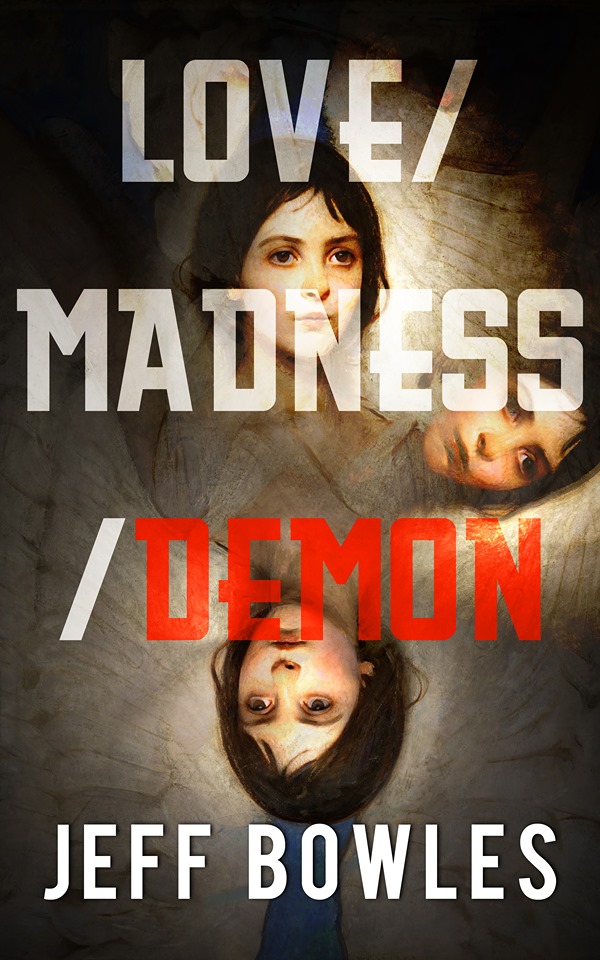
Jeff Bowles is a science fiction and horror writer from the mountains of Colorado. The best of his outrageous and imaginative work can be found in God’s Body: Book One – The Fall, Godling and Other Paint Stories, Fear and Loathing in Las Cruces, and Brave New Multiverse. He has published work in magazines and anthologies like PodCastle, Tales from the Canyons of the Damned, the Threepenny Review, and Dark Moon Digest. Jeff earned his Master of Fine Arts degree in creative writing at Western State Colorado University. He currently lives in the high-altitude Pikes Peak region, where he dreams strange dreams and spends far too much time under the stars. Jeff’s new novel, Love/Madness/Demon, is available on Amazon now!
Check out Jeff Bowles Central on YouTube – Movies – Video Games – Music – So Much More!
Want to be sure not to miss any of Craft and Practice with Jeff Bowles segments? Subscribe to Writing to be Read for e-mail notifications whenever new content is posted or follow WtbR on WordPress
I was having a conversation with my sister recently. Her younger son has recently been diagnosed with dyslexia and he finds reading difficult. He is an incredibly bright young man and I believe he is frustrated by his reading barrier. I experienced this same frustration with my younger son, Michael, who has an auditory processing learning barrier.
Our conversation led to a discussion about books and the fact that her son avoids reading as much as possible. He becomes difficult and even rude in an attempt to escape the hardship of having to try to read.
I recall similar behaviour by my son, so I am deeply sympathetic. It is incredibly difficult to remain patient and kind when your child is going against you at every turn.
Chapter books are wonderful, but they are longer and more complex, they have more characters and often include sub-plots. When a child is struggling to read due to a reading barrier, it makes their reading slower. They also have to expend a lot of energy and focus on understanding and interpreting each word. The result of this is that it is much more difficult for the child to follow the greater story as they are distracted by the word-by-word struggle. If the child can’t appreciate the story, he or she doesn’t learn to love the written word and enjoy the delights of reading. The storyline disappears in the battle to conquer each sentence.
My advice to Hayley was to chose age appropriate books which encompass a short story within each chapter and to read the story in tandem with her son with the goal of finishing one complete story every night.
I discovered that the child doesn’t have to read a huge amount to benefit. I started off with Michael reading a paragraph but even a few sentence was fine if he struggled. When he’d read a bit, I took over and finished that page and the next one. This helped the story to progress and engaged him in the plot.
He then had another turn. At the end of the story, we had achieved something great together. We had read and enjoyed a whole story. There is a great sense of accomplishment in that and Michael could remember the details of the story because I kept it moving along. He developed a love of reading.
He still likes to be read to, but at 15 years old, I am not always a fan of the books he’s interested in, so I buy him audio books. As a result, Michael enjoys and appreciates reading and books and has a good vocabulary.
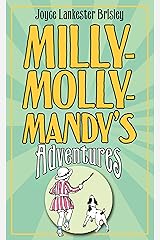
Some examples of books with a story per chapter are as follows:
Hello, my name is Robbie, short for Roberta. I am an author with seven published children’s picture books in the Sir Chocolate books series for children aged 2 to 9 years old (co-authored with my son, Michael Cheadle), one published middle grade book in the Silly Willy series and one published preteen/young adult fictionalised biography about my mother’s life as a young girl growing up in an English town in Suffolk during World War II called While the Bombs Fell (co-authored with my mother, Elsie Hancy Eaton). All of my children’s book are written under Robbie Cheadle and are published by TSL Publications.
I have recently branched into adult and young adult horror and supernatural writing and, in order to clearly differential my children’s books from my adult writing, I plan to publish these books under Roberta Eaton Cheadle. My first supernatural book published in that name, Through the Nethergate, is now available.
I have participated in a number of anthologies:
Two short stories in Spellbound, a forthcoming collection of horror stories edited by Dan Alatorre;
Two short stories in the forthcoming Spirits of the West, A Wordcrafter Western Paranormal Anthology edited by Kaye Lynne Booth;
Two short stories in #1 Amazon bestselling anthology, Dark Visions, a collection of horror stories edited by Dan Alatorre;
Three short stories in Death Among Us, an anthology of murder mystery stories, edited by Stephen Bentley;
Three short stories in #1 Amazon bestselling anthology, Nightmareland, a collection of horror stories edited by Dan Alatorre; and
Two short stories in Whispers of the Past, an anthology of paranormal stories, edited by Kaye Lynne Booth.
I also have a book of poetry called Open a new door, with fellow South African poet, Kim Blades.
Want to be sure not to miss any of Robbie’s “Growing Bookworms” segments? Subscribe to Writing to be Read for e-mail notifications whenever new content is posted or follow WtbR on WordPress.
I’m seeing a lot of promotions for anthologies these days. This excites me because short fiction anthologies are a wonderful way for rising authors to gain new readers. If you look for them, there are plenty of opportunities for short fiction submissions and contest entries, and many of those hold the possibility of having your short story featured in a new anthology.
All authors want to see their work published, but full length novels take months or even years to craft and polish before being ready to consider publication. And if an author is considering the traditional route of pitching their work until they find an interested publisher, they could be looking at that manuscript gathering dust on the shelves for a very long time. Short fiction offers a chance for authors to get their names out there on multiple works in a much shorter period of time than it would take to write and publish multiple novels.
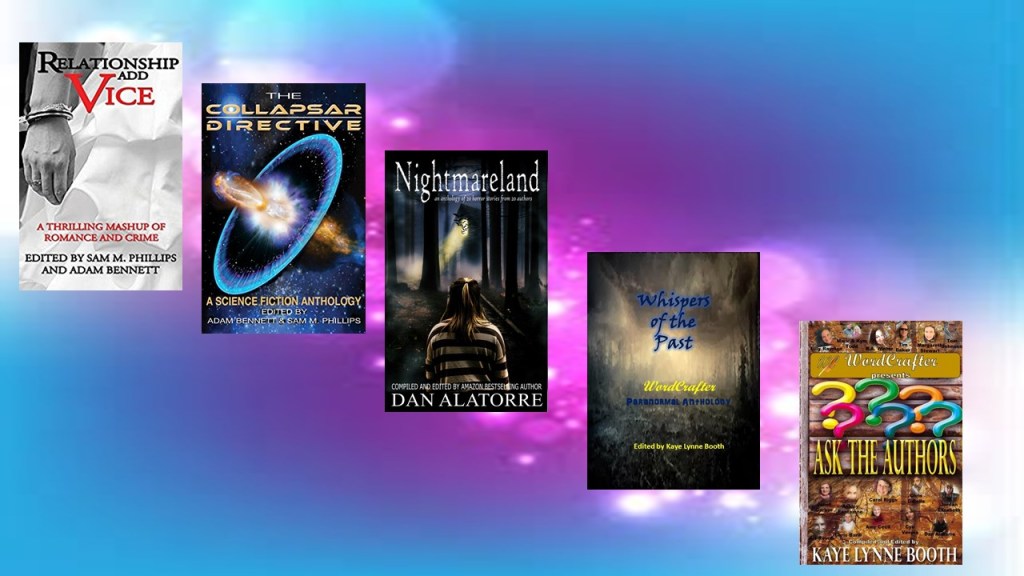
Even before I published Delilah, I had two short stories accepted for publication online. Then my story, “If You’re Happy and You Know It”, was accepted by Zombie Pirate Publishing and it appeared in their The Collapsar Directive anthology. I learned very quickly that one difference in having short fiction published in an anthology, as opposed to being published online, was the spirit of comraderie among all the authors featured. The other cool perk of being published in an anthology was the invitation to submit to the next planned anthology. Hence, my story, “The Devil Made Her Do It”, appeared in the next anthology ZPP put out, Relationship Add Vice.
The trick to getting into an anthology is to read the submission guidelines and submit a story that meets them. Most of the time, that may mean writing a story specifically for that submission call or contest. When I was invited to submit a story for Dan Alatorre’s Nightmareland, the guidelines were pretty general, “horror”, and I happened to have a piece of flash fiction that fit into the genre. All it required was a bit of polishing and my story, “The Haunting of Carol’s Woods”, was ready for submission and acceptance. But, many submission calls are more specific.
For the above mentioned submission to ZPP for Relationship Add Vice, submission guidelines required a story that contained elements of romance and crime fiction. Chances are that you don’t have a story sitting in your files with those elements and you would need to create a new story to submit to meet these guidelines. I did have the beginnings of one, as it happened, but that certainly isn’t always the case.
The submission guidelines are important. Read and follow them carefully. Other than the type of story, they may include specific formatting requirements and other submission instructions. Many publishers are strict about their guidelines and will put down a story without finishing it, if the story doesn’t meet even one of the specifications. Of course, that doesn’t apply only to anthologies. Every submission you make should conform to the given submission guidelines, whether we’re talking about short fiction, novel manuscripts, articles or poetry. Why read something if the submitting author can’t even follow directions?
With each of these anthologies, I got that same feeling of comraderie and networking with my fellow authors. I love that feeling. Because anthologies, by definition, have several different authors, they also carry with them the advantage of widening the pool of possible readers. Each author promotes the anthology to their reader audience, so it is possible to extend your own reach beyond your own reader following and gain new readers who read your work in the anthology and want to read more. It’s a win-win for all authors involved.
Naturally, when I started WordCrafter Press in 2019, the first undertaking was to launch a short fiction contest and compile and publish the resulting anthology, Whispers of the Past. The submission guidelines required a paranormal stort story and the contest winner received a $25 Amazon gift card.
Spirits of the West
For 2020, the contest submission call requested a piece of short fiction with elements of both the paranormal and western genres. It may have seemed a weird combination to some, but to me, it seemed only natural. The old west is filled with ghosts and spirits, and my first novel was a western. I think it was the western genre that threw potential authors off, but what resulted from this genre combination were some very interesting stories, including two South African ‘westerns’ by WtbR team member Robbie Cheadle, “The Thirstyland Journey” and “The Ghost in the Mound”, and a science fiction ‘western’ by WtbR team member Art Rosch, “Clouds in the West”. This author of this year’s winning story is Enid Holden, and she has two stories included in the anthology: the winning story, “High Desert Rose” and another paranormal western, “The Queen of Spades”. And my contribution is a story I wrote specifically for the occassion, “Don’t Eat the Pickled Eggs”. “Wenekia”, by last year’s contest winner, Jeff Bowles and “Gunsmoke” by author Tom Johnson are also included. This unique collection of paranormal westerns have been compiled into the Spirits of the West anthology and scheduled for an October release.
Authors can find calls for submissions or short fiction contests all over the internet these days. If you just look for them, you’re sure to find one that works for your writing style and preferences, or maybe one that offers a challenge and takes you into writing realms where you’ve never before ventured. In January, I’ll be announcing the theme for the 2021 WordCrafter Short Fiction Contest, so be sure to watch for that, too. If you want to get your name out there, grow your audience and have people read your work, short fiction anthologies are a great start, or they can be a supplement to already published books. Find one that suits you and submit a story today.
Some of the best advice I ever received on writing a novel length work came from one of my M.F.A. instructors, Russell Davis. He said, “Ass in chair, write the damn book”. And you know, he was right. If you don’t sit your butt in that chair and start writing every chance that you get, chances are that novel will end up unfinished, sitting on a shelf, collecting dust rather than on an Amazon bestseller list. No the only way to complete a novel is to just sit down and write.
Lately though, finding time to put my butt in the chair and keep it there has been a real challenge. All the strategies I had used successfully to create productive writing have fallen to the wayside since Covid came along and turned our worlds upside down and inside out. WtbR team member Robbie Cheadle made a good point when she said that lockdowns and quarentines have blurred the lines between work and personal lives. With many people working from home, the boundaries between work and personal time may not be as distinct as they were before. There is no commute on which to transition from work to home life, or vice versa.
That is kind of what happened with me. Although I’m back to the grind of commuting now, when I was staying at home, I threw everything I had into my writing. My personal life and relaxation were laid to the wayside. Then, when I went back to work, I was overwhelmed with work, school and all of the many projects I had started working on while at home.
Although my butt was in the chair, I found it difficult to focus on any one project and to prioritize which project I should be working on. My school work fell behind. Life circumstances changes that required more of my tijme and attention. My regularly scheduled blog posts weren’t getting written; I struggled to finish my short paranormal western story for the Spirits of the West anthology; and the book I had planned to write this year was just plain not happening. It doesn’t do a bit of good to place your butt in the chair, if all you do while there is stare at a blank screen.
So, I pulled back and prioritized all the different things that I needed to get accomplished. I regrouped, so to speak. Even though I am very close to earning a degree in marketing, I decided it would have to wait and I withdrew from my schooling. I went camping to give myself some ‘me’ time, and rediscovered the Colorado mountains that I’ve always loved, and my passion for writing, and found myself once more sitting down in front of my laptop and writing with purpose.
It was amazing, but once I started writing for the right reasons, because I wanted to write, not out of obligation, I was able to focus and the words fell onto the page. It just goes to show you that staying home and away from people doesn’t necessarily mean that you’ll be able to pump out the best writing that you ever have. Beside sitting your butt in the chair, focus is another necessary element.
Spirits of the West
In addition to getting this blog back on track, and doing a bit of restructuring on it, I finished the story for the Spirits of the West anthology, “Don’t Eat the Pickled Eggs”, and I’m currently working through the kinks in the publishing process, as well as working on my next novel length work, The Outlaw and the Rock Star. It is a time-travel western inspired by the music of The Pretty Reckless, and I have three and a half chapters so far. This is where my priorities lie and these projects are what I intend to focus on. Writing is where my heart is, and I feel like I’m back in the saddle again. Ass in chair, focus, and write the damn book.
Like this post? Let me know in the comments. You can be sure not to miss any of Writing to be Read’s great content by subscribe to e-mail or following on WordPress. If you found this content helpful or entertaining, please share.








![Mary Poppins: The Original Story (Mary Poppins series Book 1) by [P. L. Travers]](https://m.media-amazon.com/images/I/51fn80jRDYL.jpg)






















For the Love of Halloween
Posted: October 30, 2020 | Author: kayelynnebooth | Filed under: Book Event, Books, Commentary, Editorial, Fiction, Paranormal, Stories, Western, WordCrafter, WordCrafter Press | Tags: Book Event, Halloween, Spirits of the West, WordCrafter, WordCrafter Press, Writing to be Read | 4 CommentsHalloween has always been one of my favorite holidays. We get to dress up and be anyone or anything that we want to be. As adults too big to trick or treat, we find one Halloween party or another to attend, so that we have a legitimate excuse for donning a costume and pretending to be someone or something else for a while. Or we turn our yards into graveyards to scare the kids who come to trick-or-treat, or maybe we channel or Halloween fantasies into the costumes we make for our children. But no matter how well we hide away our inner children, the longing to once again play make believe never really goes away.
But this year, things may be a bit different. The Covid 19 pandemic has turned the world upside-down, and trick-or-treating poses new threats to both us and our children. Social distancing is the new buzz word and large social gatherings are falling out of fashion. Although masks are in style, they aren’t the kind that will go well with our costumes. In fact, in many places trick-or-treating has been cancelled and other types of holiday celebrations are emerging in its place.
It’s sad, really. We may be seeing the destruction of many time-honored traditions which are no longer deemed ‘safe’ activities. Thanksgiving celebrations are being limited to maximum numbers, as well. Apparently, no holiday is safe.
I hope all of you will join us for the 2020 WordCrafter Halloween Book Bash tomorrow evening. For the past two years, WordCrafter has hosted or participated in Halloween book events on Facebook, and this year is no exception. Many of the activities and events being used to replace traditional forms of celebration are of a virtual nature, so our celebration this year is probably trending. It is a short one this year, only three hours, from 6 p.m. MDT to 9 p.m. MDT, but we’ve got some great contests and games, and some fantastic book promotions and new releases. My co-hosts are authors Mark McQuillen, Ellie Raine, Jordan Elizabeth, and Amy Cecil. It’s my way of keeping Halloween traditions alive during tradition crushing times.
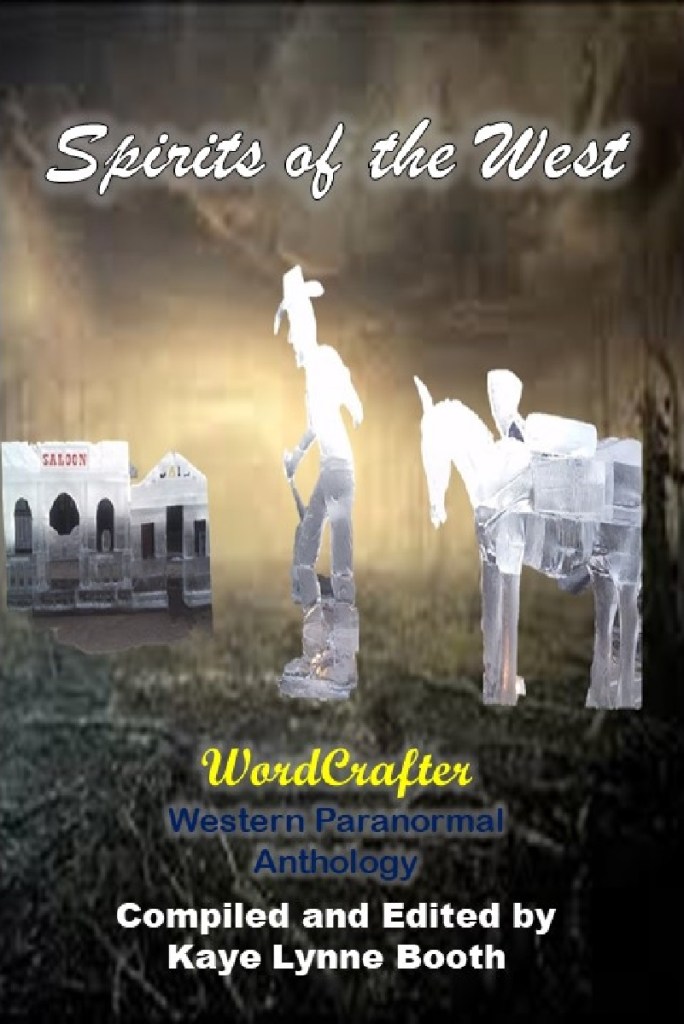
I think the thing that I’m most excited about though, is that WordCrafter will be promoting their newly released western paranormal anthology, Spirits of the West. This anthology contains eight unique stories with hints of paranormal and western flare. Contributing authors include myself, Roberta Eaton Cheadle, Jeff Bowles, Art Rosch, Tom Johnson, and the author of the winning story, “High Desert Rose”, Enid Holden. It’s an antholgy like no other and I am so pleased with how well it turned out.
However you choose to celebrate this Halloween, be safe and have fun.
Happy Halloween!
______________________________________________________________________________
Like this post? Let me know in the comments. You can be sure not to miss any of Writing to be Read’s great content by subscribe to e-mail or following on WordPress. If you found this content helpful or entertaining, please share.
Share this: