Ask the Authors 2022 is featured in KJA’s Writing Tools Bundle
Posted: October 1, 2022 Filed under: Anthology, Ask the Authors, Book Promotion, Books, Nonfiction, WordCrafter Press, Writing, Writing Business, Writing Challenge, Writing Inspiration, Writing Life, Writing Process, Writing Tips | Tags: Aisley Oliphant, Ask the Authors 2022, Kevin J. Anderson, L. Jagi LAmplighter, Mark Leslie Lefebrve, WordCrafter Press, Writer's Career Toolkit Bundle Leave a comment
Where can you find publishing industry experts willing to share their secrets?
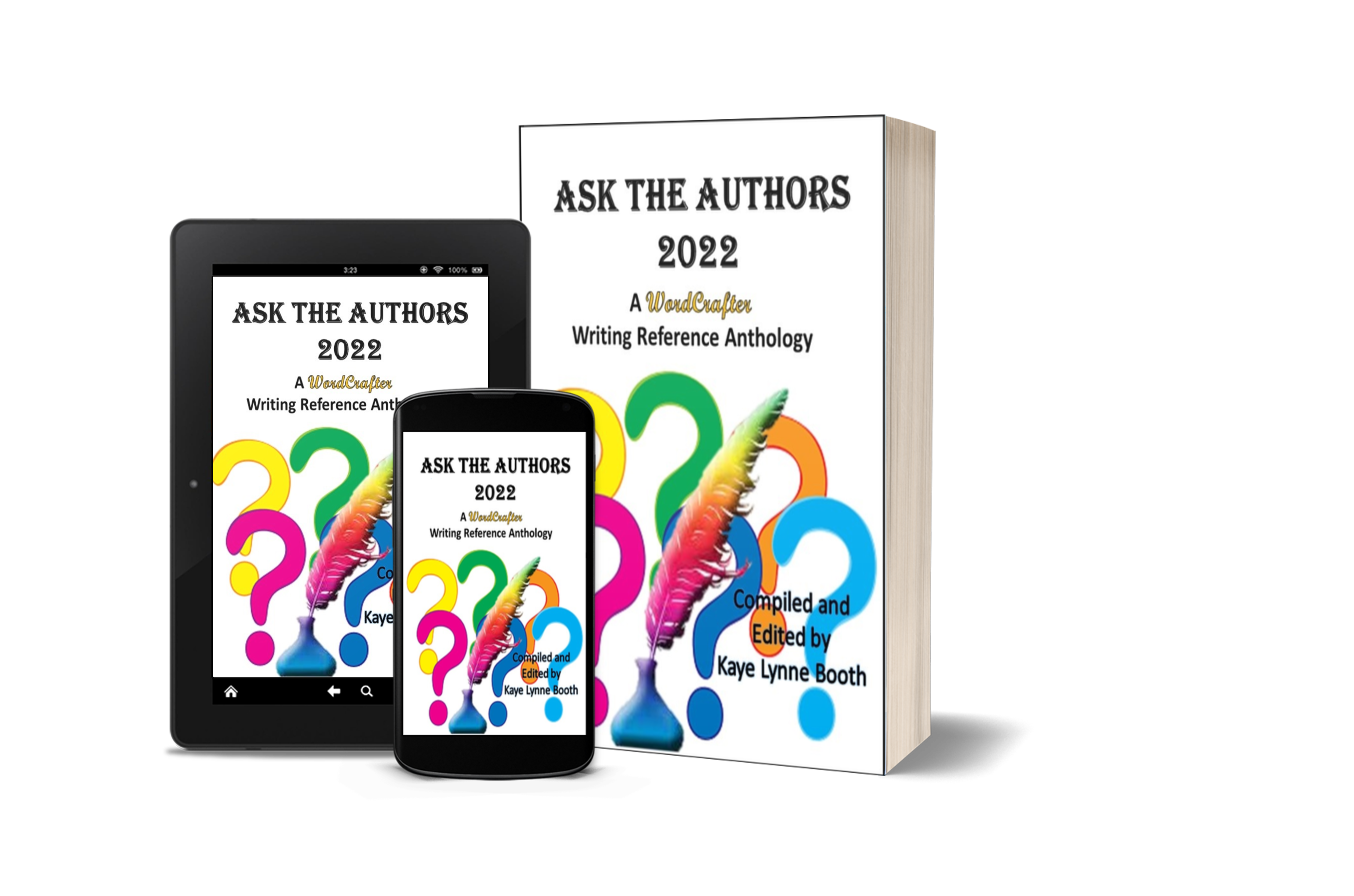
Ask the Authors 2022 is the ultimate writer’s reference, with tips and advice on craft, publishing and marketing. Eleven experienced and successful authors share what works for them and offer their keys to success in traditional publishing, hybrid, and indie. You’ll learn industry wisdom from Mark Leslie Lefebvre, Kevin Killiany, L. Jagi Lamplighter, Bobby Nash, Paul Kane, Nancy Oswald, Chris Barili, Jeff Bowles, Roberta Eaton Cheadle, Mario Acevedo and Kaye Lynne Booth.
This book offers up-to-date and tried-and-true ways to improve your craft, explores current publishing and book marketing worlds. Take a peek inside and find out what works for you.
________________________________________________________________
Every year, Kevin J. Anderson curates a Writer’s Career Toolkit Bundle in coincidence with NaNoWriMo, because we all know that those crazy writers who knock themselves out at this time of year to produce 50,000 words in 30 days, need all the help they can get.
This year, Ask the Authors 2022 is one of those books to be included in this useful bundle of books for writers! We are in great company. L. Jagi Lamplighter has a book of her own in the bundle, The Art and Craft of Writing and Mark Leslie Lefebrve has a book co-authored with D.F. Hart, MBA, Accounting for Authors. Also included are books by big name authors such as Joshua Essoe, Joanna Penn, Kevin J. Anderson, and David Farland. There’s even a book by one of my cohorts, Aisley Oliphant, Booked to the Gills, which is aimed at writers of 30 day writing challenges, and will be helpful to those preparing to participate in NaNoWriMo. (You can see my “Review in Practice” for Booked to the Gills, here.)

The Writer’s Career Toolkit Bundle – Curated by Kevin J. Anderson
This is the time of year when a lot of people turn their thoughts to writing. Challenges such as the National Novel Writing Month (November) and other writing groups and workshops encourage you to push your craft and productivity. So, each year I put together a big writing StoryBundle packed with insightful books on a wide range of topics relevant to writers, both newbies and old pros. I include craft books, basic advice, time management and productivity, careers planning, publishing, and marketing—the complete bag of tricks!
This year we have fifteen titles, enough to keep you busy planning your next project and your entire writing career.
For basics, I’ve included Kaye Lynne Booth’s comprehensive Ask the Authors 2022, the ultimate writing reference anthology, with writing tips and advice from eleven different authors on everything from pre-writing rituals, to character development and world building, editing and revision, publishing, book marketing and more.
L. Jagi Lamplighter’s sharply insightful The Art and Craft of Writing delves into the nature of storytelling itself to discover simple and practical steps that can bring our writing to the next level.
And if today’s most successful publishers, editors, and writers wanted to share the lessons they’ve learned, would you listen? Here’s your chance in Titans Rising: The Business of Writing Science Fiction, Fantasy, and Horror in the 21st Century by William Alan Webb and Chris Kennedy.
Next, if you’re ready to write that novel, Joanna Penn will get you started with How to Write a Novel, everything you need to write your book from idea to finished final draft.
David Farland’s Million Dollar Outlines is the seminal writing manual on outlining and structuring a book to make it reach the largest audience, written by well-known master and teacher.
And Kevin Ikenberry’s Mercenary Guide to Story Structure gives a great overview of your story: All stories have structure—learn the ins and outs of the most common modern structures and how they enhance your characters and thestories they inhabit.
And you can’t get anything done unless you learn how to find and organize your writing time. Booked to the Gills: How to Crush Thirty-Day Writing Challenges for Busy People teaches time management, workload distribution, and other skills for writers who feel they have no time to participate in writing challenges such as National Novel Writing Month. Now to more specific skills, depending on what you’re writing.
Joshua Essoe continues his series of Guides with Worldbuilding, written by an editor from the perspective of tackling all the most-common issues writers struggle with when creating worlds.
On Writing (and Reading!) Short by Ron Collins is a celebration of writing, reading, and living short fiction.
Interested in writing scripts? My own book of Clockwork Angels: The Comic Scripts contains nitty-gritty inside examples of how to write a comic script, all six complete scripts for the BOOM! Studios comic series from bestelling author and award-winning comic writer.
In The Non-User-Friendly Guide for Aspiring TV Writers by Steven L. Sears, a veteran successful TV writer shares tips and inside knowledge on how to break in to writing for TV.
Once you have your masterpiece completed, you need to turn your mind to the business. If you decide to go the indie publishing route, a vital guidebook is Chris Kennedy’s Indie Publishing for Profit: How to Get Your Book Out of Your Head and Into the Stores, which teaches both the craftand business of writing.
Sarah Painter’s Stop Worrying; Start Selling:The Introvert Author’s Guide to Marketing shows you how to take control of your success as an author and build your readership through authentic, low-stress marketing.
Christopher D. Schmitz sells thousands of paperbacks every year by identifying his fanbase and targeting where those folks go… and he shows you how to replicate his success in Sell More Books at Live Events.
And finally, you can’t forget about the numbers. Read Accounting for Authors by D.F. Hart and Mark Leslie Lefebvre. Regardless of how you are publishing, having a solid understanding of basic accounting principles allows you to make the most out of your author earnings and calculate your
pathways to success. With this StoryBundle, you’ll be well equipped for your writing and
publishing journey. – Kevin J. Anderson
For StoryBundle, you decide what price you want to pay. For $5 (or more, if you’re feeling generous), you’ll get the basic bundle of five books in any ebook format—WORLDWIDE.
On Writing (and Reading!) Short by Ron Collins
The Art and Craft of Writing by L. Jagi Lamplighter
Essoe’s Guides to Writing: Worldbuilding by Joshua Essoe
Indie Publishing for Profit by Chris Kennedy
Booked to the Gills by Aisley Oliphant
If you pay at least the bonus price of just $20, you get all five of the regular books, plus ten more books for a total of 15!
Million Dollar Outlines by David Farland
Clockwork Angels – The Comic Scripts by Kevin J. Anderson
The Non-User-Friendly Guide for Aspiring TV Writers by Steven L. Sears
Stop Worrying; Start Selling by Sarah Painter
Accounting for Authors by D.F. Hart, MBA and Mark Leslie Lefebvre
The Mercenary Guide to Story Structure by Kevin Ikenberry
Ask the Authors 2022 edited by Kaye Lynne Booth
How to Write a Novel – From Idea to Book by Joanna Penn
Sell More Books at Live Events by Christopher D. Schmitz
Titans Rising edited by William Alan Webb and Chris Kennedy
This bundle is available only for a limited time via http://www.storybundle.com .
It allows easy reading on computers, smartphones, and tablets as well as Kindle and other ereaders via file
transfer, email, and other methods. You get multiple DRM-free formats (.epub, .mobi) for all books! It’s also super easy to give the gift of reading with StoryBundle, thanks to our gift cards – which allow you to send someone a code that they can redeem for any future StoryBundle bundle – and timed delivery, which allows you to control exactly when your recipient will get the gift of StoryBundle.
Why StoryBundle? Here are just a few benefits StoryBundle provides.
• Get quality reads: We’ve chosen works from excellent authors to bundle together in one convenient package.
• Pay what you want (minimum $5): You decide how much these fantastic books are worth. If you can only spare a little, that’s fine! You’ll still get access to a batch of exceptional titles.
• Support authors who support DRM-free books: StoryBundle is a platform for authors to get exposure for their works, both for the titles featured in the bundle and for the rest of their catalog. Supporting
authors who let you read their books on any device you want—restriction free—will show everyone there’s nothing wrong with ditching DRM.
• Give to worthy causes: Bundle buyers have a chance to donate a portion of their proceeds to the Challenger Center for Space Education!
• Receive extra books: If you beat the bonus price, you’ll get the bonus books!
StoryBundle was created to give a platform for independent authors to showcase their work, and a source of quality titles for thirsty readers. StoryBundle works with authors to create bundles of ebooks that can be purchased by readers at their desired price. Before starting StoryBundle, Founder Jason Chen covered technology and software as an editor for Gizmodo.com and Lifehacker.com.
For more information, visit our website at storybundle.com, tweet us
at @storybundle and like us on Facebook . For press inquiries, please
email press@storybundle.com .
_________________________________________________________
The 2022 Writer’s Career Toolkit Bundle launched on September 29th and will be available thorugh the end of November. So, before you sharpen your pencils and limber up your fingers for the upcoming writing challenge, grab you bundle and warm up your brain cells to do your best writing ever!
_________________________________________________________
In celebration of this momentus event, eight of the contributing authors to Ask the Authors 2022 are getting together to tell us more about this great bundle and offer more writing tips and advice. Contributing author Mark Leslie LeFebrve will host myself, Bobby Nash, L. Jagi Lamplighter, Kevin Killiany, Roberta Eaton Cheadle, Nancy Oswald, and Mario Acevedo, on his Stark Reflections podcast. I’ll keep you posted as to when that podcast session will air.
Share this:

Review in Practice: Booked to the Gills
Posted: September 30, 2022 Filed under: Book Release, Book Review, Books, Nonfiction, Review, Review in Practice, Writing, Writing Tips | Tags: Aisley Oliphant, Booked to the Gills, Kaye Lynne Booth, Nonfiction, Review in Practice, Writing Challenge, Writing to be Read 4 Comments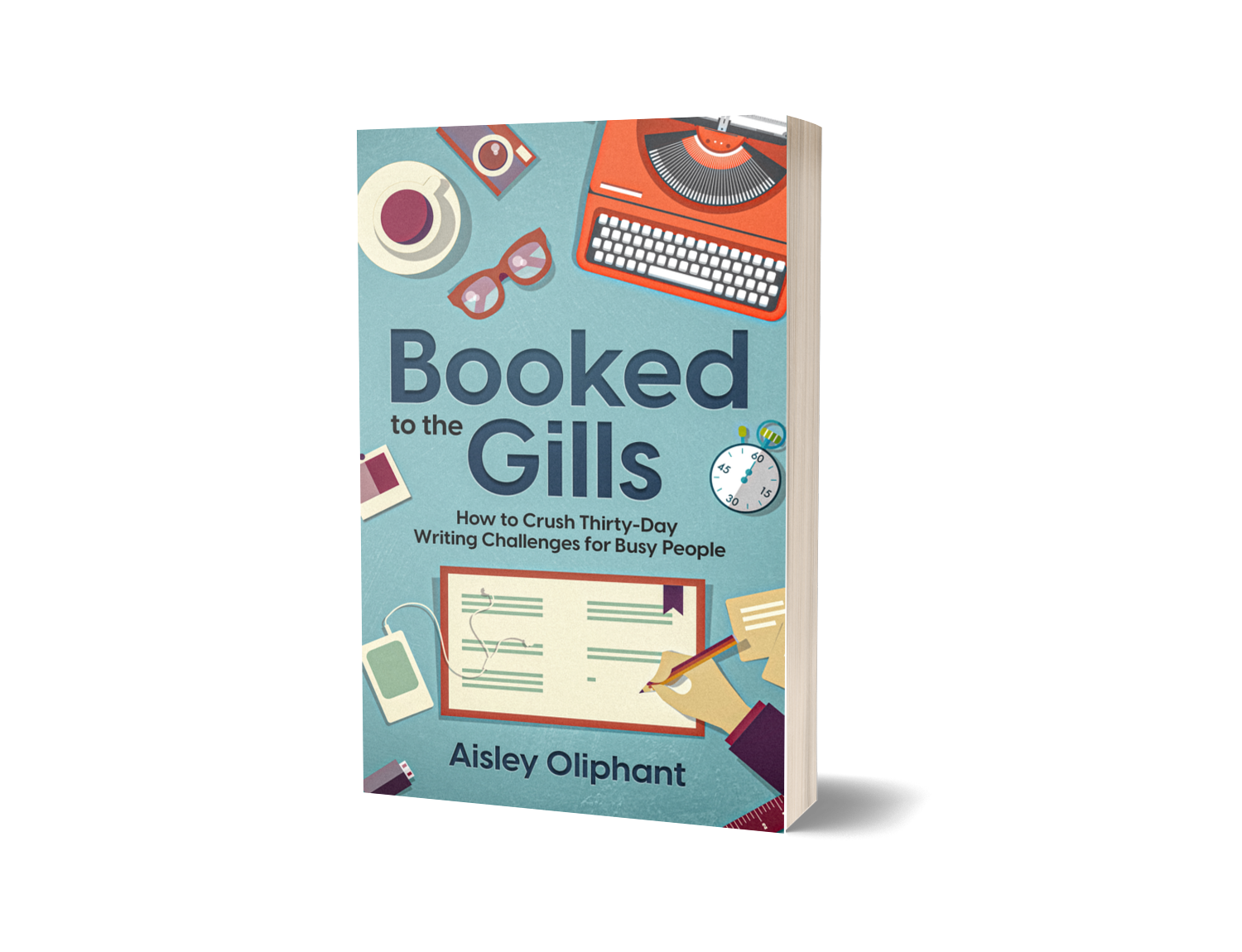
Purchase links: Barnes & Noble Amazon
Booked to the Gills by Aisley Oliphant is designed to help those participating in the National Novel Writing Month challenge to write 50,000 words in thirty days. Many writers who would like to be more prolific may find the advice and strategies outlined in this book to be quite helpful. In fact, many of the time management tips, such as time blocking, can come in handy for any writer who juggles several projects along with a day job, and relationships with family and friends, and ‘me time’.
For many of us, that ‘ me time’ is what is forfeited when things get to hectic. And the author openly admits that she has not a fun person to be around during previous NaNoWriMo challenges. For others, relationships might be strained when family and friends are put on the back burner and writing takes the forefront. And the author openly admits that she has not been a fun person to be around during previous NaNoWriMo challenges. This book is packed full of strategies to salvage relationships and keep your sanity, while still cranking up the word count.
Topics which are covered include time management, setting boundaries, adjusting wordcounts, prioritizing…
I have mentioned before that I am not a prolific writer. Authors such as Kevin J. Anderson, who can crank out right or ten books in a year, totally blow me away. But in these pages are strategies which will certainly be useful in increasing my writing output and helping me be a more productive writer, as well as giving me organizational tools that will be helpful in managing the numerous writing and publishing projects which I always seem to have going.
I attempted the NaNoWriMo challenge once, back in 2010, and failed miserably. When I picked up this book, doing this challenge was the furthest thing from my mind, but thinking about putting some of the strategies in Booked to the Gills to the test, I’m thinking it might be worth another try this year.
_______________________________________________________________________
Join Kaye Lynne Booth & WordCrafter Press Readers’ Group for WordCrafter Press book & event news, including the awesome releases of author Kaye Lynne Booth. Get a free digital copy of her short story collection, Last Call and Other Short Fiction, as a sampling of her works just for joining.
Share this:

WordCrafter News: Winners & Pre-Orders
Posted: September 26, 2022 Filed under: Anthology, Blog Tour, book marketing, Book Promotion, Book Release, Books, Fantasy, Giveaways, Science Fiction, Speculative Fiction, Urban fantasy, WordCrafter Book Blog Tours, WordCrafter News, WordCrafter Press | Tags: Haunted Halloween Holiday, Refracted Reflections, Visions, WordCrafter Book Blog Tours, WordCrafter News, WordCrafter Press 27 Comments
Good things happening with WordCrafter Press in October.
And the winners are:
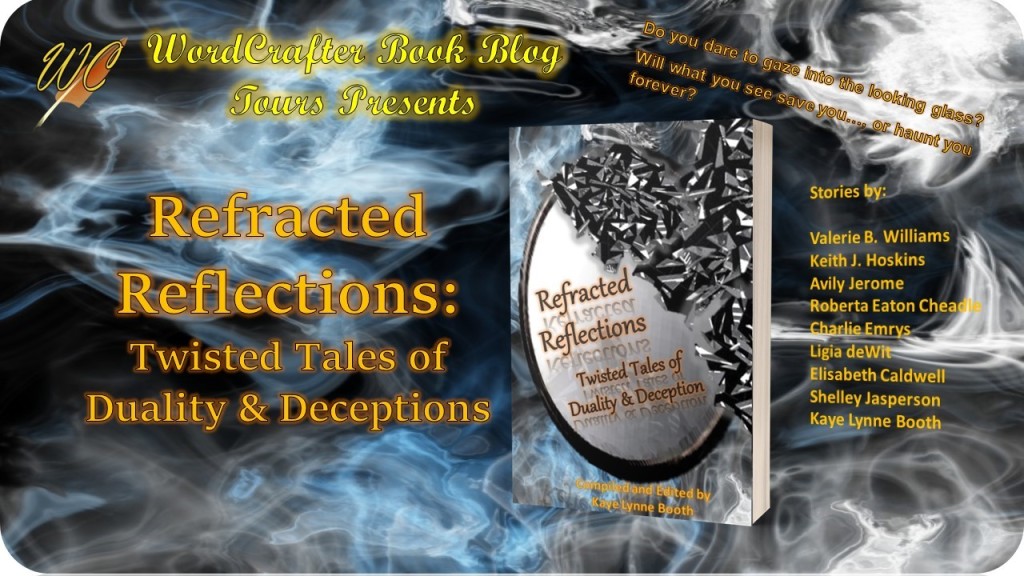
We had a great tour last week for Refracted Reflections including a fantastic giveaway for, not one, but three digital copies of the anthology. Congratulations to Kay Castenada, Christy B., and Mae Clair!
If your name appears above, please contact me at kayebooth@yahoo.com and let me know if you prefer PDF or epub. (Amazon will no longer convert mobi files.) Thank you all for joining in on the tour.
_____________________________________________________________________________
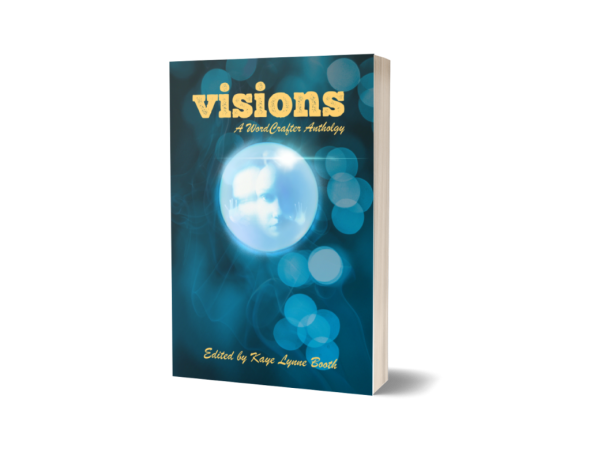
Visions is up for pre-order now!
The Visions anthology will be released on October 18 and is available for pre-order now.

Purchase and pre-order link: https://books2read.com/u/49Lk28
An author’s visions are revealed through their stories. Many authors have strange and unusual stories, indeed. Within these pages, you will find the stories of eighteen different authors, each unique and thought provoking. These are the fantasy, science fiction, paranormal, and horror stories that will keep you awake long into the night.
What happens when:
An inexplicable monster plagues a town for generations, taking people… and souvenirs?
A post-apocalyptic band of travelers finds their salvation in an archaic machine?
The prey turns out to be the predator for a band of human traffickers?
Someone chooses to be happy in a world where emotions are regulated and controlled?
A village girl is chosen to be the spider queen?
Grab your copy today and find out. Let authors such as W.T. Paterson, Joseph Carabis, Kaye Lynne Booth, Michaele Jordan, Stephanie Kraner, and others, including the author of the winning story in the WordCrafter 2022 Short Fiction Contest, Roberta Eaton Cheadle, tantalize your thoughts and share their
Visions
From Kaye Lynne Booth, editor of Once Upon an Ever After: Modern Fairy Tales & Folklore, Refracted Reflections: Twisted Tales of Duality & Deception and Gilded Glass: Twisted Myths & Shattered Fairy Tales.
____________________________________________________________________________
WordCrafter Visions Book Blog Tour – October 17 – 24

Visions Book Blog Tour
The WordCrafter Visions Book Blog Tour will run from October 17 – 24 with guest posts from eight contributing authors, two double stop days featuring an interview by me with the author of the winning story in the 2022 WordCrafter Short Fiction Contest, Roberta Eaton Cheadle and contributing author Sara Wesley McBride interviews me. So join us here on the 17th to follow the tour to enter the giveaway, or pre-order your copy today.
________________________________________________________________________
WordCrafter Haunted Halloween Holiday Book Blog Tour
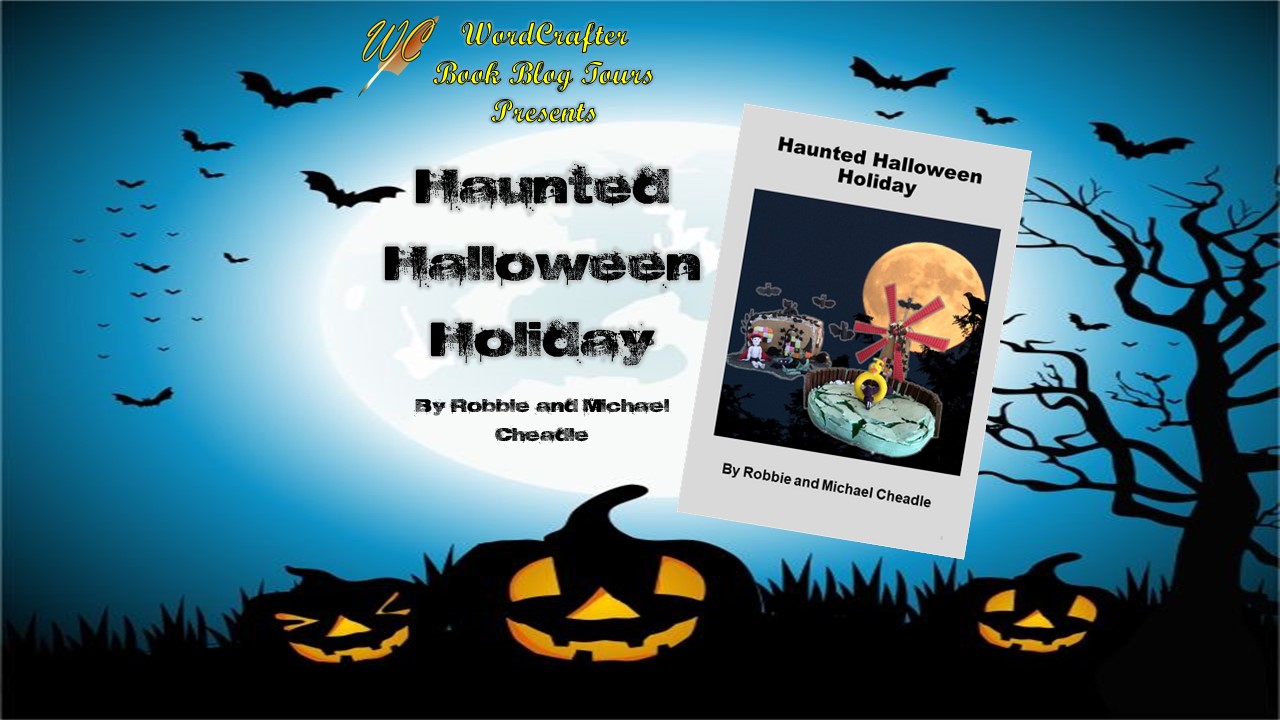
The WordCrafter Haunted Halloween Holiday Book Blog Tour will run October 3 – 7, featuring the latest children’s story in the Sir Chocolate series by Robbie and Michael Cheadle. Meet Robbie through her guest posts and a tour wide Q & A, when she answers two questions at each stop, and learn more about the book with five different reviews.
____________________________________________________________________
Book your WordCrafter Book Blog Tour today!
Share this:

Book Review: The Haunting of Chatham Hollow
Posted: September 23, 2022 Filed under: Book Review, Books, Fiction, Ghost Stories, Paranormal, Speculative Fiction | Tags: Book Review, Dual timeline, Ghost Stories, Mae Claire, Paranormal, Staci Troilo, The Haunting of Chatham Hollow, Writing to be Read 29 Comments
About the Book
A deathbed curse in 1793. A murderous charlatan in 1888. A town profiting from its legendary past in 2022. Residents of Chatham Hollow may not survive the evil they’re about to unleash.
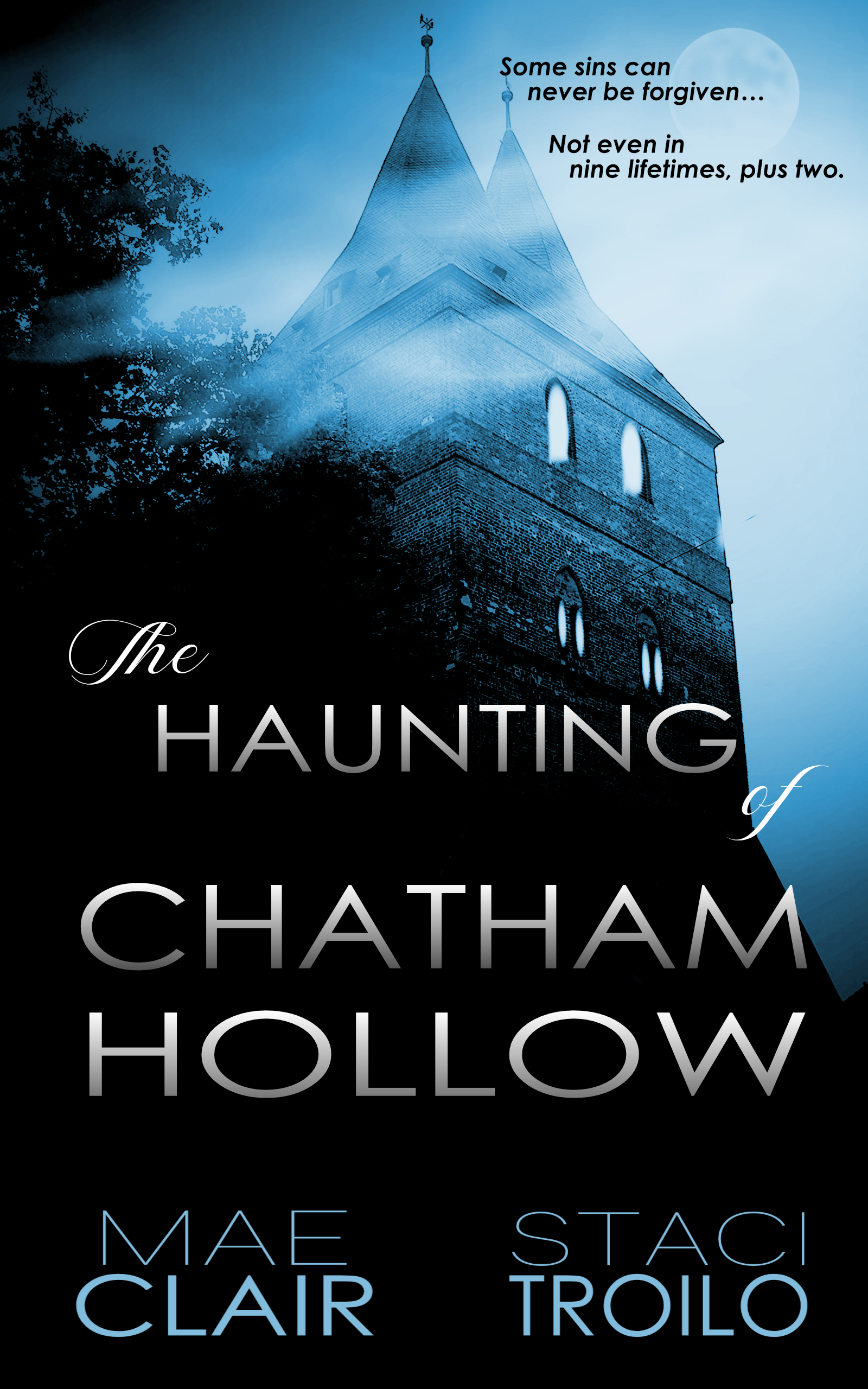
Purchase Link: https://books2read.com/STchathamhollowMC
My Review
I think I may have mentioned that I’m a sucker for a good ghost story. The Haunting of Chatham Hollow by Mae Claire and Staci Troilo is an engaging dual timeline story which fullfills that description and more. This story is exquistely crafted to weave not two, but three mysterious tales into one. Filled with mystery and intrigue, this tale offers up a variety of questions which compell the reader to keep turning pages.
It’s time for the yearly Founder’s Day Festival in Chatham Hollow and this year’s celebrations will have a television crew as their special guests, in an attempt to raisethe spirit of the founding father, Ward Chatham and learn the location of his rumored treasure. But as the story unfolds we learn that the founding father may not have been the upstanding citizen one might think, previous attempts have ended in disaster, and not everyone in town is who they seem to be. An evil curse, and age-old fued, a hidden treasure, and banished spirits who refuse to stay gone. Who could ask for more in a spooky, ghostly tale.
I couldn’t wait to reach the end and have all mysteries explained and questions answered. The tension was palpable and kept me turning pages. I give The Haunting of Chatham Hollow five quills.

_____________________________________________________________________________________
Kaye Lynne Booth does honest book reviews on Writing to be Read in exchange for ARCs. Have a book you’d like reviewed? Contact Kaye at kayebooth(at)yahoo(dot)com.
Share this:

Day 3 of the WordCrafter “Refracted Reflections” Book Blog Tour
Posted: September 21, 2022 Filed under: Anthology, Blog Tour, Book Promotion, Book Release, Books, Fairy Tales, Fantasy, Fiction, Giveaways, Guest Post, Science Fiction, Short Fiction, Stories, WordCrafter Book Blog Tours, WordCrafter Press | Tags: Anthology, Book Blog Tours, Elisabeth Caldwell, Fantasy, Refracted Reflections, Science Fiction, WordCrafter Book Blog Tours 9 Comments
Digital Giveaway
For a chance to win a free digital copy of Refracted Reflections, just leave a comment to show you were here. Follow the tour and comment at each stop for more chances to win. Three copies will be given away in a random drawing.
On today’s tour stop, we have a guest post by contributing author Elisabeth Caldwell, who talks about the inspiration for her story. Her’s is a unique tale about that starts off the anthology with a bang. So, without further ado, I’ll let her tell you about the inspiration behind “The Mirror Guardian”.
“Mirror Guardian” Inspirations
Several years ago, I was in the shower washing my hair and noticed multiple dark strands of hair wrapped around my hands and fingers. Everyone loses hair when they wash it. But this was too much hair. And it kept happening. After multiple visits to various doctors, a dermatologist declared I had female pattern baldness. I would never recover the hair I had lost, but minoxidil would, hopefully, help slow the balding process.
Terror struck me, and my mind raced. What if the medicine didn’t work? How much hair would I lose? How fast would it fall out? If I lost too much hair, what would I do? Would I shave my head?
Night after night these thoughts kept me awake, and I started to try to envision what it might be like to be bald. How would people see me? Would they look at me or avert their eyes? How would I see myself? Would I be afraid to look in the mirror? Would I bravely go out in the world? Or would I hide myself away like a princess in a tower? Would a prince come to save me? Or would I be strong enough to save the prince?
I was organizing my bookshelves right around the time a friend forwarded me the call for submissions for mirror-themed short stories, and I came upon my favorite fairytale book that I had saved from my childhood. These were the same fairytales I had read to my daughters – daughters who are now teenagers barraged by social media full of air-brushed beauty. My girls scroll through image after image of seemingly perfect people leading seemingly perfect lives and are saddened by their own imperfections.
I am old enough to know that no person and no life are perfect.
Sitting with that worn and weathered book in my hand thinking of Maid Maleen who sat for seven years in a tower waiting to be rescued, I realized my girls deserved a fairytale of female strength. I wanted to give them a heroine who didn’t fit the traditional mold of beauty. Who didn’t let everyday conceptions of what she should be and how she should act define her. A heroine whose beauty shone like moonlight on her bare head. A heroine who didn’t sacrifice her happiness because it was expected of her.
And from this came Kella. I hope you enjoy her story!
About the Author

Elizabeth Caldwell grew up a Philly (and suburban Philly) girl with thick glasses and her nose buried in a book. When she was 12, she fell into the yellowed pages of one of her grandmother’s Mary Stewart novels and has been obsessed with reading and writing ever since. She sees fairies in the trees, mermaids in the ocean, ghosts peeking out the windows of sprawling Victorians in Cape May, and a story behind every couple that walks by holding hands. She writes poetry, short stories and novels.
Elizabeth lives in Bucks County, PA with her three vibrant children, a husband who is her soulmate and best friend, and one very sweet, albino corn snake. She practices law by day, writes by night and daydreams every chance she can get.
About the Book

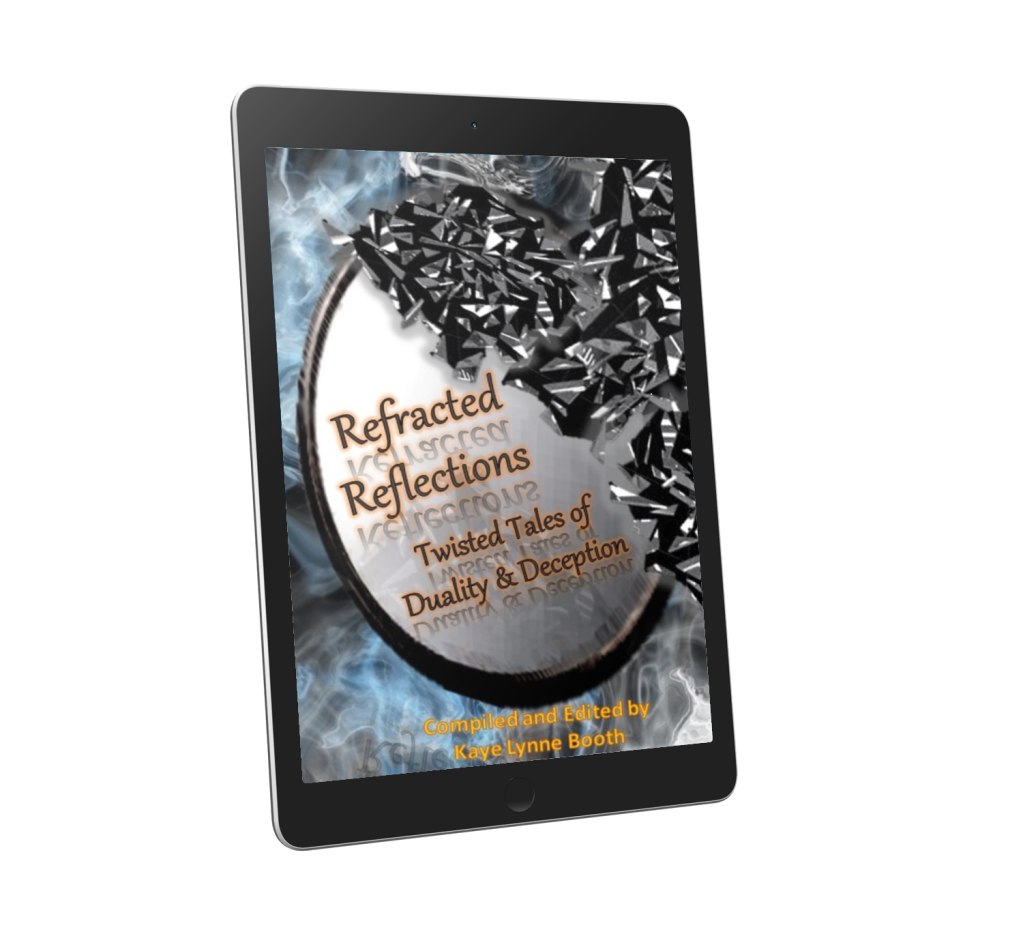
Refracted Reflections: Twisted Tales of Duality & Deception
Refractions and Reflections…
A reflection can be revealing or deceptive. What stares back at you when you glance into the mirror?
A prison, designed to trap you and take away all that is dear to you?
A portal to another dimension? Another time?
An evil twin, luring you to the other side?
Your loved ones with a fond farewell?
A distorted version of yourself? A person you no longer even recognize?
A protective savior?
Do you dare to gaze into the looking glass?
Will what you see save you…, or haunt you forever?
If you liked Gilded Glass and Once Upon an Ever After, you’ll like Refracted Reflections: Tales of Duality & Deception.
Purchase Refracted Reflections at your favorite book distributor here: https://books2read.com/u/3kPyxn
Thanks for joining us today for Day 3 of the WordCrafter Refracted Reflections Book Blog Tour. I hope you enjoyed meeting Elizabeth and learning more about her outstanding story. Follow the tour for a chance for a free digital copy of this exceptional anthology, Refracted Reflections: Twisted Tales of Duality & Deception, or pick up your copy at the link above. Below are the links to the previous stops, in case you missed them:
Monday – September 19 – Introductory post on Writing to be Read
Tuesday – September 20 – Guest Post by author Ligia de Wit & a review on Carla Loves to Read
I hope you’ll join us again tomorrow on Roberta Writes, with a guest post from Valerie B. Williams about the inspiration behind her story, “The Tinker’s Gift”. Until then, Happy Reading!
______________________________________________________________________________
Book your WordCrafter Book Blog Tour today!
Share this:

Growing Bookworms – Interactive books for children – Part 2: Digital books
Posted: September 14, 2022 Filed under: Books, Interactive Books, Literacy, Parenting | Tags: Growing Bookworms, Interactive Books, Literacy, reading education, Robbie Cheadle, Writing to be Read 66 Comments
Last month, I discussed physical interactive books for children and their benefits. You can read this post here:
This month, I am sharing the pros and cons of digital interactive books for children.
Firstly, what is an interactive eBook?
An interactive eBook is an ebook that has elements with which the reader can directly interact. This type of ebook has a lot of touchpoints where the reader can interact with videos, audio recordings, links and other content.
I read several articles about the benefits of eBooks for children and the experts believe that reading print books to toddlers and small children results in a better reading experience for the child. Research shows that children and parents/caregivers interact more frequently with one another when they are reading a paperback book and turning pages, and the quality of their interactions are better. This translates into better language development, literacy and bonding with caregivers.
The above being said, there are benefits to eBooks. Enabling children to learn new words and improve their fine motor schools are two of the more obvious benefits. The ability to engage with the storyline and possibly make choices, teaches children to weigh up options and improves their decision making abilities.
For reluctant readers, animated sounds, actions and special effects in books makes them more interesting and helps develop an interest in books and reading.
For economically disadvantaged children or children in settings that do not allow for borrowing books from public libraries, eBooks are a cheaper option. Parents can accumulate a digital library for their children at a fraction of the cost of a physical book. eBooks are also a more environmental friendly option as they do not use as many natural resources.
Children whose parents work long or unusual hours and can’t read to their children, benefit from having stories read to them by a digital reader. eBooks also provide for parents to read to their children when they are not in the same location. Parents and children can synch their ipads or iphones so they can interact on their screen in real time while holding an audio conversation. This is beneficial for parents whose jobs involve travel.
The down side of eBooks in this context is that to many sounds, actions and special effects can distract the child from the story as they don’t focus on it, but rather on the interactive features. There is a concern among experts that many eBooks available commercially are targeted towards amusement and emphasis multimedia, colours, sounds and other interactions and do not encourage literacy and language development. Studies have concluded that multimedia elements that enhance an understanding of the text benefit children, while those that draw the child’s attention away from the story, are non-beneficial.
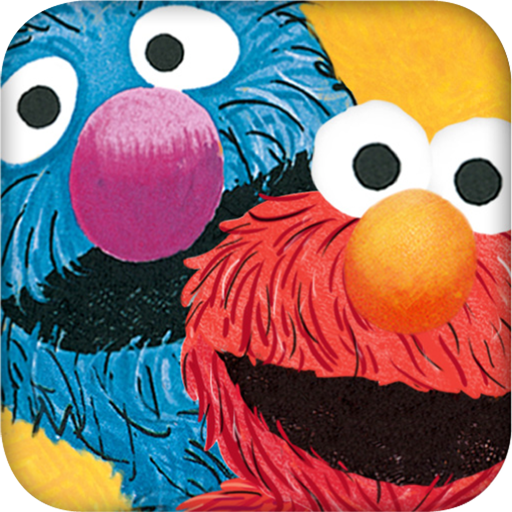
If you are interested in having a look at what is available for children in the eBook line, Amazon does stock them. Here is a link to one such book called Another Monster at the End of This Book…Starring Grover & Elmo! https://www.amazon.com/dp/B00B7S5FDG. There are a number of interesting reviews for this particular book.
What do you think about eBooks? Have you tried them? Do you think they are the future of children’s books?
About Robbie Cheadle

Robbie Cheadle is a South African children’s author and poet with eleven children’s books and two poetry books.
The eight Sir Chocolate children’s picture books, co-authored by Robbie and Michael Cheadle, are written in sweet, short rhymes which are easy for young children to follow and are illustrated with pictures of delicious cakes and cake decorations. Each book also includes simple recipes or biscuit art directions which children can make under adult supervision.
Robbie and Michael have also written Haunted Halloween Holiday, a delightful fantasy story for children aged 5 to 9 about Count Sugular and his family who hire a caravan to attend a Halloween party at the Haunted House in Ghost Valley. This story is beautifully illustrated with Robbie’s fondant and cake art creations.
Robbie has published two books for older children which incorporate recipes that are relevant to the storylines.
Robbie has two adult novels in the paranormal historical and supernatural fantasy genres published under the name Roberta Eaton Cheadle. She also has short stories, in the horror and paranormal genre, and poems included in several anthologies.
Robbie Cheadle contributes two monthly posts to https://writingtoberead.com, namely, Growing Bookworms, a series providing advice to caregivers on how to encourage children to read and write, and Treasuring Poetry, a series aimed at introducing poetry lovers to new poets and poetry books.
In addition, Roberta Eaton Cheadle contributes one monthly post to https://writingtoberead.com called Dark Origins: African Myths and Legends which shares information about the cultures, myths and legends of the indigenous people of southern Africa.
Robbie has a blog, https://robbiesinspiration.wordpress.com. where she shares book reviews, recipes, author interviews, and poetry.
Find Robbie Cheadle
Blog: https://www.robbiecheadle.co.za/
Blog: robbiesinspiration.wordpress.com
Twitter: BakeandWrite
YouTube: https://www.youtube.com/channel/UCVyFo_OJLPqFa9ZhHnCfHUA
Facebook: Sir Chocolate Books
______________________________________________________________________________________________
Want to be sure not to miss any of Robbie’s “Growing Bookworms” segments? Subscribe to Writing to be Read for e-mail notifications whenever new content is posted or follow WtbR on WordPress. If you found it interesting or entertaining, please share.
Share this:

Book Review: Canadian Werewolf in New York
Posted: September 9, 2022 Filed under: Audiobook Review, Book Review, Books, Fiction, Opinion, Speculative Fiction, Werewolf fiction | Tags: Audio Books, Book Review, Canadian Werewolf in New York, Mark Leslie, Paranormal, Speculative Fiction, Supernatural, Werewolf, Writing to be Read 7 CommentsWhen I picked up Canadian Werewolf in New York, by Mark Leslie, I must admit, I had visions of one of my favorite werewolf movies. But Leslie’s wolf isn’t one plagued by the spirits of his victims, as are the American versions. It was a pleasant surprise to find that I was wrong on that note.
Mark Leslie’s werewolf uses his more beastly senses like superpowers to come to the aid of the damsel in distress, making this story a cross between a pulp story and a werewolf cozy, as his writer turned wolf character goes about solving mysterious disappearances for the woman he loves, and fighting crime in a classic hero’s journey. Quite entertaining.

His main character, Michael, is a Canadian writer, trying to make it in the big apple, but of course he’s also a werewolf. The appearance of his old flame asking for his help finding out what her fiance is up to throws him into a mystery, calling his sleuthing skills into play. At the same time, there’s another wolf in town, and he must use all of his heightened wolf senses to sniff out his rival and protect the girl.
As an author, I know it can be very effective to use the senses to help put the reader in the story, but I also know it can be tricky writing in details of the senses other than those we use and think about most. But, Leslie has managed to skillfully craft in and use the sense of smell throughout this tale, taking the reader on an olfactory adventure like none I’ve had before. Brilliant!
I listened to this tale in the audio book form, and I must say that the narrator, Scott Overton, does a fantastic job, never once stumbling on difficult character nicknames like “Mr. Hyper-halitosis”. He also did a fabulous job with a Yorkshire accent and the female voice.
I truly enjoyed listening to Canadian Werewolf in New York. I found it fresh and entertaining, and I give it five quills.
___________________________________________________________________
Kaye Lynne Booth does honest book reviews on Writing to be Read in exchange for ARCs. Have a book you’d like reviewed? Contact Kaye at kayebooth(at)yahoo(dot)com.
Share this:

Review in Practice: Fearless Author
Posted: September 5, 2022 Filed under: Book Promotion, Book Review, Books, Nonfiction, Review, Review in Practice, Self-Publishing | Tags: Ashley Emma, Fearless Author, Kaye Lynne Booth, Nonfiction, Review in Practice, Self-Publishing, Writing to be Read 7 Comments
Fearless Author, by Ashley Emma, is a self-publishingbook launch Plan and checklist, which was not as valuable to me as I had hoped, because nowhere did it say that this was an Amazon author exclusively, so I did not realize what I was getting. Don’t get me wrong. This was a free book, so I’ve wasted nothing but my time, and it was not a total waste. For those who don’t understand why the advice of an exclusive author might be of lesser value to a wide author, such as myself, let me paint a word picture of the state of the independent publishing industry currently, as I see it.
In order to be a KDP author and have your books featured in Kindle Unlimited, Amazon requires an author to download directly to thier site, (you can’t use a third party aggregator to publish your book and they demand exclusivity. Kindle Unlimited can be a substatial income stream for authors, because page reads add up to comprable sales, and some authors, in genres with voracious readers, earn more from page reads than they do from actual sales. I can see why some authors might feel that to be a fair trade for exclusivity, but that exclusivity means that you can’t sell your book anywhere else, including on your own website. That’s why I chose to publish wide. I didn’t want to give up that much control over my books. It is up to me where my books will be sold, which allows me more opportunities to reach more potential readers.
And tactics like rapid release, or free or .99 cent first in series, may not be as effective with other distributors as they are on Amazon, because other distributors don’t use the same algorythyms that Amazon does. For example, Ms. Emma recommends utilizing Amazon’s free days, which are only available to KDP exclusive authors. That is why I didn’t find Ashley Emma’s Fearless Author to be of more value. While her advice for launching and taking a book quickly up to bestseller status may be quite valuable to an Amazon author, but many options are only available to exclusive authors.
All of that to say that Fearless Author might have been more helpful by indicating in the description the fact that Ashley Emma is an Amazon author, offering useful tip to be used with KDP and Kindle Unlimited. At least then I would have known what to expect when I downloaded the free book. There were some tactics which could be of value to all authors, even those who publish wide, like myself.
The lesson learned from this experience: the importance of accurate book descriptions which don’t mislead potential readers. Although I may use some of the advice found in Fearless Author, I would probably not download more of Ashley Emma’s books, even though I might find portions of it useful and I found no fault with her writing.
_______________________________________________________________________

For Kaye Lynne Booth, writing is a passion. Kaye Lynne is an author with published short fiction and poetry, both online and in print, including her short story collection, Last Call and Other Short Fiction; and her paranormal mystery novella, Hidden Secrets. Kaye holds a dual M.F.A. degree in Creative Writing with emphasis in genre fiction and screenwriting, and an M.A. in publishing. Kaye Lynne is the founder of WordCrafter Quality Writing & Author Services and WordCrafter Press. She also maintains an authors’ blog and website, Writing to be Read, where she publishes content of interest in the literary world.
________________________________________________________________________
Join Kaye Lynne Booth & WordCrafter Press Readers’ Group for WordCrafter Press book & event news, including the awesome releases of author Kaye Lynne Booth. Get a free digital copy of her short story collection, Last Call and Other Short Fiction, as a sampling of her works just for joining.
Share this:

Mind Fields: Coltrane’s Dead
Posted: September 2, 2022 Filed under: Biographies, Books, Excerpt, Fiction, Mind Fields | Tags: Arthur Rosch, Confessions of an Honest Man, Mind Fields, Writing to be Read 2 Comments
This is an excerpt from my novel, Confessions Of An Honest Man:
The men get into the car and Zoot steers it carefully across the bridge. “Still need a Pissngas?” Zoot inquires mockingly.
“I forgot I had to pee,” says Aaron. “Now I got to pee really really bad.”
“Well shit, get out and pee, we about fifteen minutes from the Steelville turnoff.”
Aaron goes out behind a bush and relieves himself. He hears the sound of his own stream against a world that has gone supernally silent. There is no wind, no bird song. The sky is a weird shade of pink. As soon as he is finished the rain begins to fall again. The drops are huge, heavy, laden with silt. Covering his head, Aaron races back to the car.
After driving for ten minutes in silence, a black and white road sign appears. The trapezoidal shape of the state of Missouri encloses a number four. Fifteen yards past this sign there is a green board with white letters and an arrow pointing to the right. Steelville, eight miles, it indicates. At this one-sided intersection is a little gas station and a tiny grocery store skirted by a wooden plank walkway. Zoot pulls into the station. He gestures to Aaron to stay in the car. This part of Missouri isn’t explicitly segregated, but it has the taint of old rebellion. Zoot asks a black attendant to fill the tank, and Tyrone jumps through the rain towards the store, looking for another pack of cigarettes. Aaron watches the Schlitz Beer sign flicker, rolls the window down to smell the storm-soaked earth. He knows this country, too. He has come here for vacations with his family. They have gone to Bagnell Dam, Lake of the Ozarks, Wildwood Resort. In a childhood with a paucity of happy memories, this country means peace, relief, respite, jumping from a pier into the lake, riding horses, mom on her best behavior, dad relaxed and having fun.
Zoot chats with the station attendant about the twister, informs him that the Willens Creek Bridge is no longer covered.
“Be damned,” the man says, “twister blew the top the bridge away? No shit?”
“No shit, almost blew us away too, turned this here Lincoln Continental hundred eighty degrees backward but left a cigarette in the ashtray, still lit and ready to smoke.” Zoot’s dialects always reflect his circumstances. He pronounces “this here” as “thissheer”.
Hurriedly finishing the transaction to get out of the rain, the attendant takes Zoot’s money and rushes back into the shelter of the store.
A moment later, Tyrone comes walking out, holding a newspaper limply in his hand. His mouth is hanging open, his eyes have a staring and shocked quality, as if he has just survived a terrible battle. He opens the passenger’s door , throws the newspaper towards Aaron in the back seat and slumps abruptly on the plush leather, one leg hanging out the side.
“You look like you just got terrible news,” Zoot observes with concern.
Tyrone nods and points towards the newspaper.
“Coltrane’s dead,” he says mournfully. “It’s in the paper. He died yesterday.”
There is a stunned silence. Aaron feels as if he has just taken the first plunge on a roller coaster ride, his stomach goes up through his chest.
“No,” Zoot says. “No.”
Tyrone has the paper folded out to the entertainment section. It is the St. Louis Post-Dispatch. There is a big article about Barbara Streisand, a review of the new James Bond movie, a review of the Led Zeppelin Concert at Kiel Auditorium. Down in the far right corner of the page is a two-paragraph squib. ‘Jazz Musician John Coltrane Dies,” it says. There is sketchy information about the jazz giant succumbing suddenly to liver cancer.

Aaron puts his face in the paper and squeezes himself with it, crumbling it around his cheeks. “He is forty years old!” He wails. “Forty years old! What is happening? Why are jazz musicians dying? Why Coltrane, of all people, Trane? “
Desperately, he claws at Zoot’s shoulder. “We’re all professional jazz musicians, Zoot. Is this my future? Is this Tyrone’s? Are you going to die on us, too? Why can’t we survive? What are we doing to ourselves?”
Zoot stares straight ahead, seeing nothing. He reaches across his shoulder and pats Aaron’s hand, squeezing it.
“You’re just beginning to see what it’s like,” the old musician says. “It’s dangerous to be a genius. That’s why I stay in this chitlin circuit groove, play the college campuses, keep my mid-stream profile. And this is hard enough. You think Coltrane can be inspired every night? You think he can get up there and reach down into his guts and deliver a brilliant set five nights a week, be a genius?”
A core of bitter reflection stains Zoot’s voice. These are things he generally keeps to himself. As he speaks, his anger grows and his voice scrapes with frustration and old pain.
“You have to use something, like Bird, like Lester, you have to use something to get to that place where you even feel like playing at all, let alone be great. Then you raise the standard, people turn out and expect to be transformed, to hear an oracular performance, night after night. I smoke my weed, that’s how I do it. And I don’t ask too much of myself. That’s why I’m sixty-three and still playing. I know how much I can give. Men like Coltrane, they don’t know moderation, they can’t know moderation, they have to keep pushing the limits or the critics jump on their ass, the fickle fans get restless, the talk on the street starts goin’ ‘round, ‘Trane’s lost it, Bird’s lost it, Jackie’s lost it, Prez’s lost it, Bud’s lost it! You have a couple bad nights and all these assholes who can’t play a note go talking, he’s lost it, lost it, getting’ tired, man, runnin’ out of steam, his great days are behind him, what a shame, used to be a great musician.”
Zoot pauses for a moment, looking at his sidemen, at his disciples in the mystic art of music. Then he spits a long gobbet out the window and says, with a lengthy and contemptuous drawl, “Sheee-it! Son of a fucking bitch!”
He turns backward to look at Aaron. Cobra-like, he shifts his body, glancing at Tyrone beside him. He is seething, indignant. “That’s why genius musicians die. They have to die! Ain’t no choice! Once they get a reputation as a genius, they have to be a genius every night. They use it up! Then they’re gone!”
He turns on the engine and drives about a hundred yards down the road. He pulls onto the shoulder and scrunches the emergency brake with his foot. He puts his large hands in front of his face, then leans into them and begins to weep.
It is contagious. These three friends, of different ages, races, different backgrounds, are not afraid to show their feelings to one another. The three jazz musicians, on their way to a gig, taking a short cut through the back roads of Missouri, pull onto the side of the country lane and weap for John Coltrane.

Purchase Link: https://www.amazon.com/Confessions-Honest-Man-Arthur-Rosch-ebook/dp/B01C3J0NK2
___________________________________________________________________________________________________

Arthur Rosch is a novelist, musician, photographer and poet. His works are funny, memorable and often compelling. One reviewer said “He’s wicked and feisty, but when he gets you by the guts, he never lets go.” Listeners to his music have compared him to Frank Zappa, Tom Waits, Randy Newman or Mose Allison. These comparisons are flattering but deceptive. Rosch is a stylist, a complete original. His material ranges from sly wit to gripping political commentary.
Arthur was born in the heart of Illinois and grew up in the western suburbs of St. Louis. In his teens he discovered his creative potential while hoping to please a girl. Though she left the scene, Arthur’s creativity stayed behind. In his early twenties he moved to San Francisco and took part in the thriving arts scene. His first literary sale was to Playboy Magazine. The piece went on to receive Playboy’s “Best Story of the Year” award. Arthur also has writing credits in Exquisite Corpse, Shutterbug, eDigital, and Cat Fancy Magazine. He has written five novels, a memoir and a large collection of poetry. His autobiographical novel, Confessions Of An Honest Man won the Honorable Mention award from Writer’s Digest in 2016.
More of his work can be found at www.artrosch.com Photos at https://500px.com/p/artsdigiphoto?view=photos
____________________________________________________________________
Want to be sure not to miss any of Arthur’s “Mind Fields” segments? Subscribe to Writing to be Read for e-mail notifications whenever new content is posted or follow WtbR on WordPress. If you find it interesting or just entertaining, please share.
Share this:

WordCrafter News
Posted: August 29, 2022 Filed under: Advertising, Anthology, Ask the Authors, Book Promotion, Book Release, Book Review, Books, essays, Fairy Tales, Fantasy, Fiction, Giveaways, Mythology and Legend, Nonfiction, Science Fiction, Short Fiction, Stories, WordCrafter Book Blog Tours, WordCrafter News, WordCrafter Press, Write it Right Editing, Writing, Writing Reference | Tags: Anthologies, Ask the Authors 2022, Book Promotion, Editing, Giveaway, Once Upon an Ever After, Refracted Reflections, WordCrafter Press, Write it Right Quality Editing Services, Writing Reference 7 CommentsAnd the Winners Are….

I have an announcement to make.
We finished up the WordCrafter Once Upon an Ever After Book Blog Tour on Saturday, and I do hope you all joined in. It was a great tour and we held a giveaway for three digital copies of Once upon an Ever After, and every comment earned an entry.
Now, I am pleased to announce that the three winners of the anthology giveaway are Liz Gauffreau, Annette Rochel Aben, and Sara W. McBride!
(I need to make contact with each of you to find out which digital format you prefer. If you don’t hear from me, please contact me at Kayebooth@yahoo.com.)
You can get your copy of this wonderful anthology from your favorite book distributor here.
___________________________________________________________________________________________________________
Nice Reviews
Ask the Authors 2022 has received a lovely review from Alex Norton on the Likely Story blog.
” I found it to be both interesting and useful, answering questions I didn’t even know I had and giving me different perspectives to ponder as I move forward on my own writing journey.”
You can find Alex’s full review here. I hope you will check it out.

Get your copy of this unique writing reference anthology from your favorite book distributor here.
___________________________________________________________________________________________

.The first review is out on Goodreads, from Madelon’s Reviews. Madelon does a nice job of making a brief statement about each story, as well as a review of the overall anthology, which states in part:
“Overall, REFRACTED REFLECTIONS provides a glimpse into the writing styles of authors you may want to read again.”
Refracted Reflections: Twisted Tales of Duality & Deceptions
Refractions and Reflections…
A reflection can be revealing or deceptive. What stares back at you when you glance into the mirror?
A prison, designed to trap you and take away all that is dear to you?
A portal to another dimension? Another time?
An evil twin, luring you to the other side?
Your loved ones with a fond farewell?
A distorted version of yourself? A person you no longer even recognize?
A protective savior?
Do you dare to gaze into the looking glass?
Will what you see save you…, or haunt you forever?
If you liked Gilded Glass and Once Upon an Ever After, you’ll like Refracted Reflections: Tales of Duality & Deception.
Scheduled for release September 20, 2022. Now available for pre-order from your favorite book distributor here.
Don’t miss the WordCrafter Refracted Reflections Book Blog Tour September 19 – 23 for a deeper look into this unique anthology.
_____________________________________________________________________________________
Write it Right Quality Editing Services is currently open to new clients

See Write it Right‘s affordable rates and get a quote for your editing needs here.