Stories I Stole from Lord Byron’s Bastard is a collection inspired by Venetian history. The fictional character, Alexis Lynn, wrote these stories in the novel Will Write for Wine by Sara W. McBride, but they are fun stand-alone adventures to be enjoyed with an excellent glass of Italian wine.
Today’s tour stop comes with a fun interview with author Sara W. McBride in addition to her guest post. So kick back a while and enjoy the tidbits offered here as you learn more about Sara and her wonderful books.
Introduction
Sara W. McBride, like many modern-day biological researchers, invents new swear words to sling at million-dollar machines while locked in a dark hole of a decaying academic hall. This has caused her to witness ghosts and create a romantic fantasy life within her head, which she now puts down on very non-technological paper with her favorite Jane Austen style quill pen.
Her first novel in the Alexis Lynn series, Will Write for Wine, and the companion short story collection, Stories I Stole from Lord Byron’s Bastard, both set in Venice, Italy, were recently released by Puck Publishing. She’s hard at work on the second Alexis Lynn novel, a Regency mystery series, and a haunted play. She strongly feels the world needs more haunted plays.
Don’t forget the awesome giveaway Sara is running on this tour, with a digital copy of each book up for grabs. You can enter the give-away for a chance to win at the link below:
Image of Lazzaretto Vecchio Credit: Wikipedia, Lazzaretto Vecchio Island, Plague Hospital
Interview with author Sara W. McBride
Why do you write?
Sara: To be immortal! Just kidding. It’s my fabulous mental escape into worlds and lives that I wish I could live.
Please tell us a bit about your publishing journey?
Sara: In 2014, I organized, edited, and published the first two NaNoWriMo Los Angeles anthologies. Then I helped with the next three. The group is still producing an annual anthology. It was a great way to learn the logistics of self-publishing and how to shape short stories. This year, my husband and I launched Puck Publishing, and we’re hoping to publish something every month.
Over the past twenty years, I’ve written fourteen bad novels that I’m glad I never published. LOL!
What made you decide to self-publish?
Sara: In the late 1990s, I was an assistant to a Hollywood book agent and I learned the ins and outs of traditional publishing and movie book deals. The agents and publishers were so parasitic on the author, it gave me the willies. In those days, traditional publishing paid high advances, but the treatment of the authors still put a bad taste in my mouth.
Today, they rarely pay above a $10,000 advance to a new author, they expect the author to do all the marketing, and then the publisher keeps the copyright and sells it off whenever they like, to whomever they like, and the book goes out of print.
I’ve seen too many friends get screwed by traditional publishing.
Will Write for Wine takes place in the artistic and romantic setting of Venice. Have you explored the physical locations for your books in the flesh, in order to get the details right when writing about these locations? Have you been there? Have you lived there? Why did you choose this setting?
Sara: I’ve had five research trips to Venice, totaling about five weeks. I’ve been in almost every church and museum of Venice, and a few places I probably wasn’t supposed to enter. I apparently don’t understand the meaning of yellow caution tape or closed doors.
Most of the Venice locations in the book are real places, but Manu’s osteria is fictional. However, I stole menu items from many of my favorite osterias in Venice.
I think Venice is one of the most magical and haunted cities in the world. Many people describe it as a floating museum; the entire city is trapped in the Renaissance. But if you simply sit still, sip a glass of wine in a campo or piazza, listen to the opera singers, and watch the people and pigeons, there’s a vibe that sinks into you. Every part of the city is simultaneously dead and alive. It is that barrier, that thin line between life and death that pervades every stone, stench, and serenade of Venice. Delicious!
Stories I Stole From Lord Byron’s Bastard involves Venetian history. What is the fasciation of this area for you?
Sara: I’m a history nerd! Venice is one of those cities that drips with history, but not just through architecture and museums, through the people, the food, the many generations that still live in the same house, the ghosts that are accepted as common place, and the street signs. Ponte del Diavolo, the Devil’s Bridge is bound to inspire a story in anyone. Gheto Novo, or the New Ghetto, caused me to question the history of the Jewish community within Venice.
It’s difficult for me to walk from one piazza to another in Venice without my mind percolating a story based purely on the sights, sounds, and smells. And I love the smells of Venice. Both the good and the bad. Only Venice can induce an entire story purely through its smells. I’ve learned to navigate the labyrinth of Venice by sniffing the air. How is that not a story!
Is there anything unique or unusual about your writing process?
Sara: I don’t know the end until I get there. I just write into a dark void and somehow it all works out. It keeps the process magical and fun. I used to outline, but I always got bored with the book before I finished it. Outlining turned writing into work. Ick! Writing needs to be fun for both the writer and the reader.
Is your writing process plot driven or character driven?
Sara: Character driven! Definitely.
Do you write with music, or do you prefer quiet?
Sara: Quiet! Or the hubbub of a coffee house crowd, hotel lobby, airplane terminal.
Atmosphere is important. What do you do to get into the writing zone?
Sara: There’s a zone? How do I find that? I want a writing zone. I just go about my day and jot down paragraphs, dialogue, and then type them in when I’m next at my computer.
How much of the story do you know before the actual writing begins?
Sara: NONE! Okay, maybe the opening scene. But usually not even that. Just a character in a place, who is feeling something.
Wine plays a big role in your character, Alexis Lynn’s life. What is the attraction?
Sara: I love wine! I also love beer, whisky (Scottish spelling), Compari cocktails, and most dishes cooked with truffles. However, to preserve my liver, I typically only drink once-a-week, so it’s a big event for me. I cherish my weekly glass of wine and how it complements my meal. Alexis drinks way more than I do. Fictional wine can’t damage a fictional liver.
Are you a wine connoisseur? What is your favorite wine?
Sara: I love wine! I once dreamed of becoming a wine sommelier. Isn’t my favorite wine obvious? Soave! Like Alexis Lynn, I also discovered Soave on my first trip to Venice. It’s been a favorite ever since, but difficult to find in America. Hence, more motivation to travel!
What’s something most readers would never guess about you?
Sara: My husband and I got engaged four days after we met. Unlike Alexis Lynn and her marital troubles, my husband and I have had a relatively easy, adventurous, crazy, happy and supportive marriage. This summer, we’re celebrating out twenty-five year anniversary. But I don’t know how we’re celebrating. Any suggestions?
You’ve got a scientific background, like your character. How much of Alexis Lynn is you?
Sara: Um … She’s totally me! Are authors allowed to confess that?
What time of day do you prefer to do your writing? Why?
Sara: Morning, if given a choice. But it happens all day.
What’s the hardest part of the story for you to write: beginning, middle or end?
Sara: I write chapters as if they are short stories, and then I arrange them into a book when I think I’ve developed something that has a beginning, middle or end. Is that weird? I don’t write chronologically. And I have chapters/stories that didn’t make it into this book that will be in the next one.
Alexis Lynn has a conversation and wine tasting with Casanova. Would you like to talk a bit about the inspiration for that scene?
Sara: I was enjoying my weekly glass of wine while reading the memoirs of Casanova and thought, “Man, this guy would give horrible marriage advice!” Then I grabbed my computer.
Besides Casanova, which author, poet or artist, dead or alive, would you love to have lunch with?
Sara: Lord Byron, or course! He’s bloomin’ brilliant, but people only remember him as a seducer. Sure, he seduced a few women, usually married ones, and has some famous bastards; the famous mathematician, Lady Lovelace, is one of his illegitimate children. But he also wrote the first English-Armenian dictionary, and was a very, charming, intelligent debater. His letters are filled with wisdom and humor. In an incredibly elegant manner, almost complimentary, he was able to inform someone of their idiocy. I would love to have lunch with Lord Byron, even if he spent an hour politely insulting me.
Besides writing, what are your favorite things to do?
Sara: Travel! I also love hiking, playing board games, reading every genre, watching cheesy Hallmark Christmas movies in the middle of summer, and learning Italian so I can one day move to Venice.
What is the biggest challenge of being a writer?
Sara: Pulling together a bunch of short stories into a cohesive novel and then figuring out what scenes are missing.
It was funny with Will Write for Wine, my husband included a little gondola and gondolier on the cover, and I suddenly realized that I didn’t have any gondola scenes in the book. Both the gondola scenes were the last scenes I wrote.
If writing suddenly made you rich and famous, what would you do?
Sara: Move to Venice and write more!
What’s the most fun part of writing a novel or short story/screenplay? What’s the least fun part?
Sara: Most fun? Dialogue! I’m originally a playwright, so I love dialogue.
Least fun? Killing a character I like. Killing a nasty character is delightful, but killing a kind character, or a character I’ve spent years with, is heart-wrenching.
How much non-writing work, (research, marketing & promotion, illustrations & book covers, etc…), do you do yourself for your books?
Sara: I do everything myself, but my husband does the cover art and most of the website maintenance. We have fun working together.
If your book was made into a film, who would you like to play Alexis Lynn?
Sara: Oh! Juicy question. Reese Witherspoon. Yep, definitely Reese Witherspoon. Mid-40s, cute, and like Alexis, she exudes positivity even when her world is falling apart.
What goals do you set for yourself in your writing?
Sara: Don’t plan ahead. If I don’t know what’s going to happen, neither does the reader. This is really funny because I’m writing a murder-mystery right now and halfway through the book, my murderer, who I didn’t know was the murderer, just totally confessed to the murder. So, um, geez, I guess that book is going to be a different style of murder mystery. LOL! So, I guess my goal in writing is to always be surprised.
As you can see, Sara is an author who loves what she does ad is pretty comfortable in her own skin. Now, let’s hear about her inspiration for the fourth story in Stories I Stole From Lord Byron’s Bastard, “Lazzaretto Vecchio: A Dowry for Saffron”.
Guest Postby Author Sara W. McBride
Inspiration for “A Dowry for Saffron”
What inspired the story, “Lazzaretto Veccchio: A Dowry for Saffron?”
“Sia laudato il signor Iddio non ci sono stati morti.”
Bless the Lord, there have been no deaths [today].
December 24, 1630, in Sant’Eufemia, Venice.
* * *
This quote is from the opening of a Nature paper, “A digital reconstruction of the 1630-1631 large plague outbreak in Venice,” by Gianrocco Lazzari, et al. Published Oct. 20, 2020.
* * *
I’ve always been fascinated by the European plagues, but when I read the above Nature paper, the effects of the 1630-31 plague on Venice consumed my mornings for several weeks. This especially seemed relevant while living through a new global pandemic, thankfully with much lower mortality rates.
In 1348-49, bubonic plague killed one-third of the European population, up to 25 million people, and Venice, as a crossroads for international trade, lost half its residents. Imagine living in a bustling city of 100,000 people, and half of them die within 18 months. It would be horrifying and haunting.
In response to the devastating plague of 1348-49, Lazzaretto Vecchio was established in 1423 as the first quarantine island in the Mediterranean region, and was used to separate the healthy from the sick during Venetian plagues. Lazzaretto Nuovo was established shortly afterward as a place where ships suspected to carry sickness among their passengers or crew were anchored for 40 days. English acquired the word “quarantine” from the Italian term for 40 days, quaranta giorni. The lagoon island of Poveglia also became a quarantine outpost sometime in the 15th century. It’s rumored that half the soil of Poveglia is human ash from burned plague corpses. Then it became a mental hospital from 1922-1968. No wonder the place is one of the most haunted locations in Europe.
Considering the 15th century world had no idea how disease was spread, the idea of quarantining the sick or foreigners arriving from plague stricken areas was very innovative.
The story, “Lazzeretto Vecchio: A Dowry for Saffron,” takes place during Venice’s plague of 1630-31, which killed a third of the city’s population. Both plague islands were used to isolate and treat the sick, however, caregivers were needed to work at the island hospitals, mostly because, I assume, workers kept dying of plague.
The Italian city of Ferrara had a long history of successfully avoiding plagues that ravaged other parts of Italy. They closed their city gates and screened all arrivals for any signs of disease. They insisted that Fedi, proofs, identification papers from a plague-free zone must be presented. Ferrara, starting as early as medieval times, engaged in public sanitation campaigns, sweeping away garbage and liberally spreading lime powder on any surface that had come into contact with an infected person.
When an Italian physician, Girolamo Fracastoro, published a text in 1546 describing the “seeds of disease” as something that could stick to clothes and objects, Ferrara increased their sanitation practices during plagues and burned the clothes of any infected people. Removing garbage, spreading lime powder and burning infected clothing probably reduced the flea pestilence that actually carried Yersinia pestis, the bacterium that causes plague.
Many natural remedies were prescribed for protection against the plague, but a medicinal oil designed by a Spanish physician, Pedro Castagno, was written into Ferrara’s, “Reggimento contra la peste,” regimen against the plague. The oil, called Composito, was recommended to be applied to the body.
“Before getting up in the morning, after lighting a fire of scented woods (juniper, laurel and vine shoots), warm the clothes and above all the shirt, rub first the heart region, near the fire to ease balm absorption, then the throat. [Afterwards], wash hands and face with acqua chiara (clean water) mixed with wine or vinegar of roses, with which sometimes all the body should be cleaned, using a sponge.”
Ferrara city’s regimen against the plague
The contents of Composito was never fully disclosed, but researchers examined the records of materials ordered by Castagno and determined that the oil contained venom from scorpions and vipers, and myrrh and Crocus sativus, which is a saffron flower from which the filaments produce the golden spice saffron. Both myrrh and saffron are known to have antibacterial properties, as does scorpion venom with the bonus that it’s also a pain reliever. So basically, Composito was an early antibiotic and pain reliever combo. Pretty nifty!
According to census records, Venice’s population was around 140,000 in 1624. By 1633, that number had fallen to 102,000. More than 43,000 deaths were recorded over just three years, with nearly half of them taking place between September and December 1630. The city of Venice began several public works projects, like the grand Baroque church, Santa Maria della Salute, greeting guests at the entrance to the Grand Canal. The church’s construction began in November 1630 with the goal of keeping citizens employed and maintaining art and labor skills.
The city of Venice also purchased food for the quarantined, both in the city and on the plague islands. It is logical to speculate that in the early months of 1631, Venice might have asked Ferrara, a city with success at conquering the plague, if their convents could be paid in order to encourage volunteers to work at the plague islands. My story is fictitious, but the stage was set for the events I describe in the story. I also talked about pirates in the story. Yes, there were pirates at this time: mercenary pirates and government deployed pirates (particularly from England).
My story focuses on a group of nuns who have been “volunteered” by their convents, and how they sacrifice one nun into a marriage in order to secure their much needed ingredient of saffron for Composito, their only hope for survival on the plague islands. The politics and finances of Venice in 1631 created a world where this story could have happened. There’s a lot of history not recorded in text books, and this is a story that no one would want recorded.
Something fun for readers:
In my research of the plague islands, I was surprised by the lack of ghost ship stories haunting the Venetian lagoon. If you know of any, please write me at sara@puckpublishing.com. If you’ve ever visited the eerie lagoon island, Poveglia, the plague island, turned insane asylum, turned old-folks home, which now stands empty—less the chilling screams on foggy nights—I want to hear about it.
According to the oral tradition, the Gods created man, man created Godling, Godling ruled over man until man decided genocide was in fact the worst case ever made for machines ruling anything. Godling’s own subjects–the Ancient Spacefarers–overthrew and imprisoned him on the remote grasslands planet of Isolinius, there to dwell in perpetual confinement under the watchful eye of the monastic Divine Order of Battles Won.
Eons came and went. Human beings lost their drive for exploration and personal cosmic growth. They segregated themselves onto small worlds. After a sum of almost 5,000 years, the prison complex’s abbot warden, Renaldo Timekeeper, 126th in the Order’s line of such individuals, approached the god machine with a demand.
“I have two young friends, prisoner. They need help, and no one else on this planet will provide it. They will have an audience with you. In truth they’re already here, and their cause is as just as any.”
Godling studied Renaldo closely. Though he was intelligent and often keen in his worldly perceptions, the abbot warden was short, bald and foppish, preferring colorful robes and jeweled affectations, an annoying resplendent tone in his conversations and meandering arguments.
“I should very much like to kill you, abbot warden,” Godling said. “Have I told you this lately?”
“You have,” said Renaldo. “Repeatedly.”
“Then we understand each other. They bribed you, didn’t they? These friends of yours?”
Renaldo hesitated. He ran a gloved hand over his huge bald spot, saying, “If indeed it matters in any way, prisoner, the girl’s father–”
“Yes, the girl. Flush with love. That’s trouble to begin with. Their cause is romance, isn’t it? You clearly deserve to die, abbot warden. You don’t mind doing it yourself, do you? I seem to have lost the use of my hands, oh, 5,000 years ago.”
Godling’s enormous body had been constructed of an ultra-resilient Darkwork alloy. His brain contained a multitude of mechanisms and tissue chips, and his heart was made entirely of inky liquid circuit matter. The Ancient Spacefarers had neatly severed him into six parts in their rush to dethrone him: head, arms, torso, legs. They’d entombed and imprisoned these parts deep within Claustrum Mons, the highest mountain on Isolinius.
Godling’s head now rested in what was known as the Orange Room, there upon a pedestal, with his eyes pointed at the orange ceiling. From the base of his head–the severed end of his alloy neck–ran a thick, fibrous red line like rope. The line stretched, straight and taut, to the far wall of the room, disappearing there and linking with his other body parts in the other rooms of the prison.
“Prisoner,” Renaldo said, “you have neither the authority to command my death nor the time to see it through. As long as the rulers of this world regard you as an inexhaustible adviser–”
“Ah! Aha! Now we’ve struck it!” Godling bellowed. “Inexhaustible advisor. Your words, abbot warden, not mine. They come and go all day long. But this girl, and this boy. Hmm, trouble.”
Through a healthy slathering of a special and vibrant orange sensory-paint, the like of which Golding had invented himself, he observed the two young people as they made their way farther and farther down the long tunnel that burrowed deep into the side of the monstrous alpine slope of Claustrom Mons. They were barely more than teenagers, perhaps nineteen or twenty. Through the orange paint, Godling took the full measure of them. He lived in paint now. A special kind composed of a fine poly-organic blend of neural wireless transmitters and perception receptors/dispatchers. Orange for sensory, purple for locomotion, green for touch. He could inhabit anything and everything coated in the stuff, and so, he made the entire prison his body.
“They’re nearly at the blast doors, Renaldo,” Godling fumed. “Who opened the doors for them?”
“I did.”
“Just like that? Because you can? How I shall begin, abbot warden?”
Renaldo cleared his throat. “Perhaps, god machine, you should begin by introducing yourself.”
Yes, perhaps. Then again, perhaps Renaldo’s brain might be better employed as a protein-rich piston lubricant. Love and lovers. Hmph. Godling withdrew all perception from the Orange Room. In a flash, he nestled himself within a long patch of orange sensory-paint in the blast door safety chamber, the size and span of which fairly dwarfed the boy and girl. He spoke a dozen decibels louder than he intended, his voice harsh from the buzz of his concealed, quivering vibrathreads.
“Children, I can see you.”
The girl shrieked and the boy jumped back.
“I don’t mean to startle you.” Godling said, “Only to announce my presence. Hello. This is an announcement. Here I am.”
The girl’s eyes darted around the chamber.
“Here?” she said. “Where’s here?”
“And who’s I?” said the boy. “I mean, who are you?”
Godling watched them closely. He studied the manner in which they held each other, clutched, clung, fresh excitement and fright brightening their cheeks and warming their skin. Godling sniffed them, tasted their scents. Pheromone levels high, anxiety toxicity enough to choke a rabid pneumatic horse. Taste of fear, smell of sex. Oh but they were so deep in it.
The boy looked the brazen, heroic sort. The kind Godling had long ago loved to crush beneath his massive clawed feet. Dark hair, dusky complexion, full, expressive lips. Crush, crush, crush, crush. And the girl …
The girl was a beastly thing. A creature any smart machine knew well enough to leave alone. Beautiful; gorgeous, even. Biologically … rather perfect. And did she look like…?
No, of course not. No woman alive looked like her. Nobody could ever come close.
“Who are you? Where are you?” the boy said.
“Ah, a man of action,” Godling said. “I do not like that. I should very much like to kill you. Universe takes all kinds, I suppose. I am Godling. Also known as the god machine. Also known as the god king. Also knows as the truest king of all. Also known as–”
“The monster king,” said the boy.
The girl’s face lit up. “The machine who ruled humanity for five centuries, ushered in an unprecedented era of peace and prosperity, permitted humans to travel the stars, and who took for himself the name Godling, because he truly was a god among men.”
“This is all true,” said Godling.
The boy cocked his head. “The same machine who debased himself for the love of a woman, lost his mind to rage, and who, without any warning at all, slaughtered millions of his own subjects.”
“This is true as well,” said Godling. “I also like to sing. Did you know that? Come along, now.”
He left the patch of orange in the safety chamber and flashed to the receiving room beyond.
“Well come on,” he called to the lovers when they moved not an inch. “Wouldn’t you like to see what your bribe has bought you?”
The boy and girl exchanged a nervous glance, and then as one, they stepped through. Godling made certain to close the doors behind them with two deafening clangs.
“Wouldn’t want any monster kings making a run for it,” he said pleasantly. “Off we go, then.”
*****
“Ressia,” said the girl. “My name’s Ressia.”
“Brennan,” said the boy.
Godling smiled inwardly. “There, isn’t that better? Good to be on a first-name basis, hmm? Now about your bribe …”
“Please, hallowed one,” said Ressia, “I don’t want you to get the wrong idea about us.”
The lovers followed Godling from one patch of sensory-paint to the next. The reception wing, the common, foot tunnel row, all the while, disturbing and unnerving monks wherever they went.
“Don’t mind them,” Godling said. “Not used to such lowly figures roaming their hallowed halls. Now child, about this wrong idea business. Surely you must know I am incapable of getting wrong ideas. Why, the rulers of this world–”
“Seek your counsel every week,” said Ressia. “Yes, we know.”
“That’s why we’re here,” said Brennan. “You see, her father–”
“Fathers,” Godling said. He moved further up the foot tunnel. “I am not concerned with fathers, nor am I interested in progenitors of any kind. The emperor of the entire Northern Continents seeks my counsel every third pseudo-day of each second cycle. And Delinius, the neo-liege, personally visits my Orange Room every time he has a crisis of faith. Do you have any idea how often a neo-liege has crises of faith?”
“No,” said Brennan, “but you see, her father–”
“And then there’s the trouble between King Marshal of Sevrum and Stevrik III of Quaratania.” Godling flashed into the security firezone antechamber, the room that stood directly outside the prison proper. “Don’t get me started on them. Some silly thing concerning Stevrik’s daughter. She desires, I’ve been told, to forsake her betrothed and marry her lover who … ah … ah, I see. You are Stevrik’s daughter, aren’t you?”
“I am,” Ressia admitted.
“But this is wonderful.”
“It is?”
“Yes. Don’t you see? You have come here for no good reason. You will leave my prison desperately disappointed, and I shall not be bothered with your nonsense a moment longer.”
Brennan scowled. “If you have no intention of hearing what we have to–”
“No intention? Never said that. Who said that? Never said it.”
Godling, in fact, had every intention of hearing what the lovers had to say. For if they hoped to gain a thing from him, he now hoped to gain something back. A plan began to form in the outer-regional processes of Godling’s mind. Oh, but he was a devious, calculating, beast of a machine. And if he had his way, young Ressia and Brennan would soon come to know it.
“Please,” Godling said, “step into my prison.”
With the merest of thoughts, he deactivated and slid back the eighteen locking pins of the prison’s purple security door. It swung open slowly, groaning on its massive hinges.
“The first things you shall see, children,” Godling began, “are the razor-sharp claws of a genocidal mad-machine who feels no remorse at all.”
“My god,” Brennan gasped. “That … leg. It’s so large. And the room’s so….”
“Purple,” said Godling. “Yes, I know.”
The purple room, or more accurately, Purple Room One. Orange for sensory, purple for locomotion. Godling had the power to move anything coated in it. He had, at different points throughout the centuries, experimented with moving these very walls and this ceiling as a means of escape. In fact, of the 927 escape plans Godling had initiated in the past five millennia, Purple Rooms One and Two had been directly involved in 156.
Too bad those 156 plans had all proven failures. Along with the other 771.
“What is that there?” Brennan asked. “That red rope coming from the wall?”
“Ah, you’ve notice the bloodwire. Contains no blood at all, of course. Yet it does keep my body powered down at all times.”
“And just how tall are you, hallowed one?” said Ressia.
“Oh, I am a sight. The height of three men. Four if I care to feel insulted. Of course, if I were to feel insulted, I’d probably use those claws there to shred your skin and internal organs to long, sopping strips. Shall we?”
He quickly ushered them into Purple Room Two, and then, into Green Rooms One and Two. There, his arms rested upon their pedestals. Thick as ancient tree trunks, fingers spread wide like the wings of carrion gorgers. Green was for touch-paint, used throughout the prison precisely so Godling could feel, as if with his own Darkwork alloy fingers, a soft pillow or a damp cloth or the warm touch of a–
Godling’s memory banks refreshed. He saw her with the precision and exactitude of second sight. Auburn hair, like the sunset, wisest brown eyes. And the twisting, fiery agony they’d endured together….
“Hallowed one?”
Her image had a death grip on Godling’s primary visual tasking matrix. 5,000 years and he still couldn’t comprehend everything he’d lost.
“Hallowed one? Godling?”
Godling’s focus returned to his Green Room, to the boy, Brennan, and to the girl. No, she couldn’t compare at all. Blonde, not auburn. Beautiful, yes, but not nearly so exotic.
“The Orange Room,” Godling said, doing his utmost to quarantine the affected memory pathways. “To the room and to my counsel.”
Brennan shook his head. “But that’s only five rooms. The history vids say there’re–”
“Six. Yes. The black room is off limits, child. I will surely kill you for just the thought of it.”
*****
“You see, my father is King Stevrik III.”
“Yes….”
“And I do not wish to marry that horrible, despicable, lazy-”
“Please, child, before I corrode.”
A chance to escape. That’s what Godling hoped to gain from the boy and girl. To finally break free of this infernal prison once and for all. The fact the girl was Stevrik’s daughter simply added defensive sheen-varnish to the protractile warblade cake. Oh but Godling was a sly, cunning, fiend of a machine.
Escape plan number 928 initiated. Proceed with escape plan 928.
He’d gathered the humans together, the young lovers and the oafish abbot warden, Renaldo Timekeeper. Renaldo sequestered himself in the corner of the room, content to fiddle with his white administrator gloves. No other personalities to contend with or further agendas to factor. No more perfect tools to employ than this young man and this young woman. Simple, effortless. Easy as ripping arms from sockets.
“Stevrik’s sworn enemy is King Marshal,” said Brennan. “The betrothal was meant to unite their thrones. But she loves me. We are meant to be together.”
“Yet it would seem Ressia’s betrothed swears otherwise,” Godling said, his large alloy head upon its pedestal glinting hazy green in the solvent battery lighting. “He is a prince, child, someday to be a king. What have you to offer this woman?”
“My mind, of course,” said Brennan. “My life, if necessary.”
“Money?”
“Some.”
“Job?”
“I’m a writer.”
“Oh dear, it’s worse than I thought.”
Keep them talking. That was the key. That was step one of escape plan 928. Yes, and what was step two? Renaldo most certainly had to be dealt with in step two.
“Well, Renaldo?” Godling said. “You’ve been rather quiet. Wasn’t it you who sold my time to these wretched romantics?”
“I didn’t sell them a thing. They simply required your help and I was willing to offer it. Use your influence to sway their fathers. Their cause is just. The war, you see …”
“The war?”
“The war,” said Ressia. “Because I have chosen not to marry the prince, Marshal has declared war on Quaratania, our city, our people.”
“Is that so?” Godling said.
Hmm. Quaratania to the East, at war with Sevrum to the West. And Claustrum Mons in the middle. Yes, perhaps the best time to escape. And Renaldo was in deeper than Godling had surmised. Deep enough he should champion their cause. He had to be dealt with, and of course, over the years Godling had considered many options for such an eventuality.
“Renaldo, if you wouldn’t mind terribly joining me in my black–”
A violent quake impacted the mountain and dropped Renaldo, Ressia, and Brennan to the floor. Claustrum Mons, and the prison within it, grumbled and groaned. Godling’s vibrathreads hummed in response.
Renaldo shouted, “Faith preserve us! What was that?”
Godling spread himself outward. He flashed to every patch of orange, everything green, every purple surface he could manipulate and move. He had the answer in less time than it took the rumbling aftershocks to wave and ripple their way through the complex.
“Detonation,” Godling said, returning full consciousness to the Orange Room. “A precise, constrained explosion equivalent to fifteen megatons.”
“Detonation?!” said Renaldo. “Where?”
“Outside the monastery. The blast doors have been blown apart. They’re coming for you, children.”
Another voice sounded from his vibrathreads. Quite unlike the voices of the three humans, and very much distinct from Godling’s. The god machine was in complete control of all his many faculties, and yet this voice, singular and crystal-clear, had the utter nerve to announce itself over his own synthetic vocal chords.
“I am General Praebus of his majesty King Marshal of Sevrum’s third mounted army. This is a raid designated lawful under the decrees of engagement set down by the Ancient Spacefarers. Give us what we want, monks, and no harm will come to you.”
The vibrathreads crackled a few times, and then went silent.
“Oh but this is terrible, Brennan!” said Ressia. “What are we going to do?” She pressed herself against her love and began sobbing.
“Now’s not the time to panic, my love,” said Brennan. “The god machine will help us.”
He would? Really? Godling hadn’t said he would. Perhaps he might have lied about helping them, but the boy and girl were sure to be killed. In needing to escape, they needed Godling, and in needing Godling, the monster king might finally leave this place. Of course, he told himself, that’s what he’d wanted all along. But now that it actually came to it …
“I can’t,” said Godling. “I’m sorry. I don’t feel like it.”
Brennan frowned. “You what?”
“I don’t feel like it. My body, it would take too long to free, you understand. We’d have to fight them off by ourselves and … Oh, hold on a moment, are you aware the monks have a private arsenal? De-atomizing submachine guns and other various nasty anti-doomsday deterrents, and if they see you trying to set me free–”
“They’ll do nothing, Godling,” Renaldo said. “They’ll stand down and impede neither General Praebus’ men nor the four of us.”
Ressia let out a moan. “Oh, he won’t help us, my love! He won’t help!”
“Ressia,” said Renaldo, “don’t you think it’s time we dispense with the pretenses? The wolves are nipping at our heels, my dear.”
Ressia silenced herself. She scowled at Renaldo, pulled away from Brennan, and then she straightened her dress and uttered, “It’s called commitment to an objective.”
“Objective?” said Godling. “Why are you talking about objectives? You don’t actually intend to release me, do you?”
“Most humbly, hallowed one, it was the only way to get inside,” Ressia said. “Rest assured, I am Stevrik’s daughter, and Brennan and I are in love, and Marshal’s men really are here–”
A second explosion shook the Orange Room. The overhead lighting flickered a few moments, then the low groan of the backup power sources steadily thrummed to life.
“They’ve hit the solvent batteries,” said Renaldo. “They must have engaged my brethren, despite assurances otherwise. Stay on guard, my young friends. We made plans for this.”
Godling shouted, “What are you talking about! What plans? Just what in the hells is going on here?!”
“A prison break,” said Renaldo. “One now rather short on time.”
He dug into his robe and removed a small metal canister with a thin, needling projection brush.
“Brennan, Ressia, your clothes, if you please,” he said.
The two lovers began dropping every last stitch of clothing. After squirming from their undergarments and shoes, they stood there naked. The abbot warden approached and used the projection brush to block them out into even sections. He projected three solid colors–green, purple, and orange–until overlapping layers covered every square inch of them. In less than half a minute, Brenan and Ressia looked like sad glistening mud people.
“Nicely done, abbot warden,” Godling said, bothering in no way to clear the condescension from his tone. “I fail to see the purpose, however. Am I now meant to inhabit this paint? I couldn’t possibly. Not without seeing what I touch and moving what I hear. The thought is rather mind-numbing.”
Renaldo shrugged. “Would it matter if I told you?”
“It would not. They shall all get shot to tiny, mud-colored pieces, and I shall have to spend weeks reconstituting my personality inside this big dumb head of mine.”
“You won’t leave?” Renaldo asked. “You’ve made up your mind?”
“I will leave. On my own terms. When the time is right.”
Renaldo smirked. “You’re a terrible liar, Godling. If you’d wanted to escape, you would’ve done so millennia ago.”
“That’s a complete misrepresentation of the facts,” Godling said. “I’ll have you know, I had a very, very, reasonably well-thought-out plan this time. Step one, keep them talking. Step two, deal with the oafish abbot warden. Step three–”
“Plan? What are you up to now? Nine hundred twenty-eight? Godling, people who escape prison only ever need the one plan. Has it ever occurred to you that you don’t actually want to leave?”
Godling had no response for this. None at all.
“Come with us, god king,” Renaldo pleaded. “Don’t waste away in here another five thousand years. Take back what once was yours, if not for yourself, then for all humanity. Resume your role as truest king of all.”
“It’s rude to nag, abbot warden,” Godling said, and then he sent the precise amount of noise through his vibrathreads to simulate a definitive conversation-ending crackle.
Renaldo frowned, as did Brennan and Ressia. Another explosion rocked the complex. The lights dimmed again, and this time, set themselves into a troublesome flicker.
“My friends, I give you the stubbornness of a machine,” the Timekeeper said. “The door is open. I have overridden his commands. I say again, the door is open.”
Brennan and Ressia shared a glance. The boy gave her a curt nod, and then both of them spun on their heels and rushed out the door.
“Where are you going?” Godling said.
“Wolves at our heels, god machine,” said the Timekeeper
“What door did you open, Renaldo?”
But the abbot warden wouldn’t say. Godling spread himself outward, finding them instantly. There, they headed for the Black Room. Oh no. Godling flashed across the prison to the large black door and tried to force it shut. He set all his processing power to the task. Another quake hit the complex. The lights cut out completely. He pushed, pulled, threw every iota and byte at it. Renaldo’s overrides were crude but effective.
In the darkness, Ressia and Brennan bashed into each other and fell into the room. It felt to Godling like a violation of the highest order. He hadn’t permitted anyone inside in over six hundred years.
“Is that it?” panted Ressia. “Is that all we have to do?”
Yes, that was all they had to do. And no, that wasn’t it, there was more. Unlike the other five rooms, the Black Room wasn’t named for the color of a paint. The black was something else, something deeper, so personal and interior to Godling it may as well have been his soul.
A loud crack split the silence. The giant chest piece of an ultra-resilient Darkwork alloy body broke in two. A deep, ruddy light shone from the chest and illuminated the room and Godling’s torso upon its pedestal. The black spilled over. It gurgled up through the alloy and blubbered and splashed onto the floor. Lunging for Ressia and Brennan, the black attached itself to them, covered all the muddied color of their bodies.
They screamed, writhing on the floor in abject agony. Godling felt the pull. It was inescapable, magnetic. He vanished from his sensory-paint at the door, flashed to the black, felt himself split in two. Green, purple, and orange, the three colors represented essential facets of a functional, conscious being. But every being needed a heart, or if one was a machine, a liquid circuit matter core. Godling felt the connection to the inky stuff, the attraction and resonance he had for the children and their paint. In engineering terms, his mental architecture had always been slaved to hardware. After the wars and terror and the annihilation of millions, it was said of Godling his heart was black as night. Here, in truth, was incontrovertible proof.
Continued Next Month!
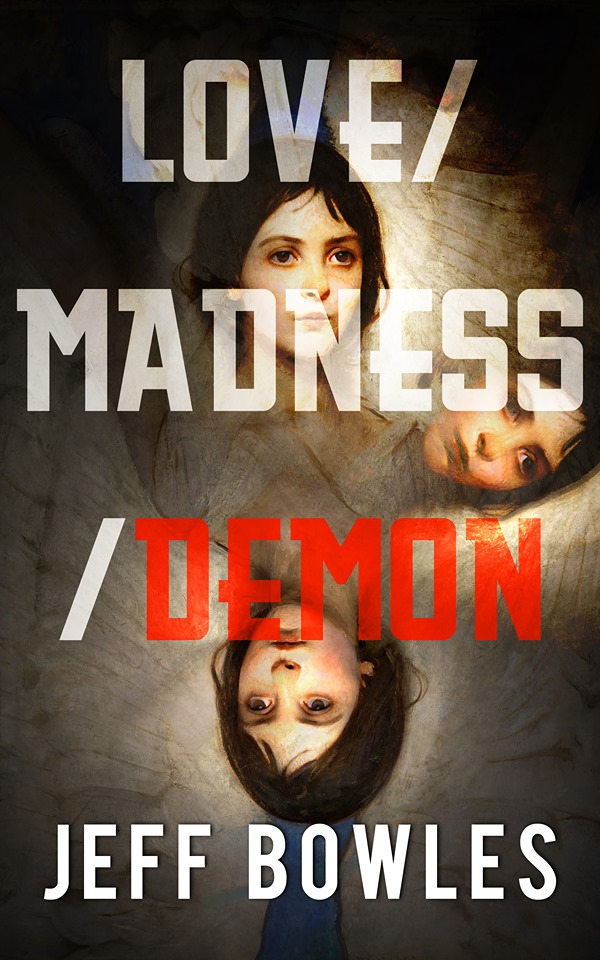
Jeff Bowles is a science fiction and horror writer from the mountains of Colorado. The best of his outrageous and imaginative work can be found in God’s Body: Book One – The Fall, Godling and Other Paint Stories, Fear and Loathing in Las Cruces, and Brave New Multiverse. He has published work in magazines and anthologies like PodCastle, Tales from the Canyons of the Damned, the Threepenny Review, and Dark Moon Digest. Jeff earned his Master of Fine Arts degree in creative writing at Western State Colorado University. He currently lives in the high-altitude Pikes Peak region, where he dreams strange dreams and spends far too much time under the stars. Jeff’s new novel, Love/Madness/Demon, is available on Amazon now!
Check out Jeff Bowles Central on YouTube – Movies – Video Games – Music – So Much More!
Dr. Julianus Techt’s Five Easy Steps to Building a Better You
by Jeff Bowles
You are an absolute horror show. You are a wreck and ruin of a human being. I can’t even stand the sight of you anymore. You’re weak. Feeble. Go on and do it. Go on and rid the universe of your wretchedness once and for all. Sound familiar? Hi, friends. Dr. Julianus Techt here. Life got you down? No friends? No significant love interests? No point in living one more excruciating, soul-crushing day? Believe me, I know the feeling. Congratulations on your purchase of Dr. Julianus Techt’s 5 Easy Steps to Building a Better You. This book, and the accompanying materials and spells companion crate, are each designed with the lowlife in mind. Contained within these pages, friends, are the answers you are looking for. Not happy with the man/woman you have become? Why not simply build a better you? The methods, magics, and matriculations I am about to divulge are time-tested and fool-proofed. I know exactly what it’s like. I was once in your shoes. My PhD is in world-class suffering. I earned my doctorate at the school of hard knocks. Now I am a new man entirely. Come along with me and discover the secrets to self-love, self-respect, and self-actualization. Your glorious, resplendent days in the sun are just 5 Easy Steps away….
Easy Step 1: Back to Basics
Why is it you hate yourself so much? Why is it you’re so despairingly, disconsolately desperate to become a better human being? Is it because, like me, you’ve let down every last friend, family member, and lover who’s ever cared about you? Or do you, like me, simply find life painful, disappointing, a series of valleys–each deeper and darker than the last–without even a passing glimpse of a single peak or shred of hope? Ha ha. Well, you were sharp enough to buy this book. So at least you’ve got that going for you. I want you to imagine what the better you will look like. Now I want you to open your materials and spells companion crate and make it happen. Inside the crate you will find, One (1) man-sized sheet of multi-colored construction paper Five (5) century-aged cherry wood logs, each weighing approximately twenty-five (25) lbs. One hundred seventy-five (175) lbs. of premium oil-based plastilina modeling clay. One (1) ancient scroll of Black Soul-Shard enchantments. And last, but not least, One (1) complimentary Pizza Barn coupon, buy 1 slice, get the second half-off. Arrange your materials and spells in whatever manner that best allows for ease-of-access and attenuation with the life-force powers of the universe and the forsaken black domain of the damnation/animation god, Frülik. Ready to begin? Good. I was hoping you’d say that.
Note: Dr. Julianus Techt’s 5 Easy Steps to Building a Better You is, if nothing else, a trial-and-error process. Steps 2-4 will enable you to produce 3 different soul-shard versions of yourself. If at any time you become satisfied with a soul brother or sister, please feel free to skip to step 5, There, isn’t That Better? Similarly, if at any time you feel threatened or are attacked by your soul brothers or sisters, please discontinue use, flee your house or place of residence, and immediately cash in your complimentary Pizza Barn coupon as you await police/emergency medical technician intervention.
Easy Step 2: Frülik
From your kitchen, retrieve one (1) large knife, serrated; one (1) cereal bowl; one and one-half (1 1/2) teaspoons of iodized table salt; one (1) sticky bandage, extra-large; and one (1) lb. of leftover meat to offer as supplication to Frülik, the damnation/animation god. Retrieve your ancient Black Soul-Shard scroll and refer to enchantment #12 as you perform the following: Sit down on the floor with your legs crossed. Pour the salt into the bowl and set it in your lap so that it can catch the copious amounts of blood about to gush from the palm of your hand. This next part may sting a little. Slice open your hand and hold it over the bowl. As you howl in agony, notice that your blood runs red. This will change as you begin to recite the enchantment, the one which begins, “Oh mighty Frülik! I offer you my blood and meat! Cleave my astral self in twain! Take from me now that which you desire most!” Notice that three things occur. The first is that your blood turns black. Don’t be alarmed. This is simply an indication you have just sold your soul for something far purer than you can possibly imagine. Notice, too, that the air around you has suddenly grown approximately 50° cooler. Your breath puffs frost. You snort in the cold like a castrated bull. You should probably be aware that the damnation/animation god, who will be arriving shortly, cannot abide warmth. It reminds him the living still thrive in the world beyond his forsaken realm, and that for him, all hope for love, passion, and earthly pleasures are lost, lost, lost. Anyway, the last thing you will notice is that a 10-foot tall, bone-armored, entrail-covered, cloven-footed demon god will scratch and claw his way from the cereal bowl filled with salt and your precious blood. Once he’s standing over you, with the edge of his massive Broadsword of Deepest Lacerations resting precipitously against your neck, he will squeal like a cancerous boar. He will then say something to the effect of, “Woe unto you! Woe! Your soul is damned to the bleakest pits of horror and suffering! Pestilence! Rotten, fetid, malodorous flesh! I shall feast on your severed scrotum each mealtime for a thousand lives of men!”*
*Please note that based on your gender, Frülik may or may not in fact use the word “scrotum.”
The damnation/animation god will now use his broadsword to cleave your head from your shoulders. Do not be alarmed, this is simply an astral projection of your head and nothing more. Unfortunately, the pain you feel is entirely real and will no doubt haunt you for years to come. Frülik is consumed by his own lust for spiritual power. He will snort and stomp and pull exactly three (3) individual shards of your soul out through your neck. His desire, of course, is to eat them and thereby enslave you for all time as his personal Concubine of Nightly Anguish. It is now appropriate to offer him the one (1) lb. of supplication meat. “Meager vittles!” he will bellow, but he will nevertheless proceed to stuff the meat into his face and forget all about the severed pieces of your spiritual essence hanging from your throat. Please refer to enchantment #16 on your ancient scroll. Recite and repeat until the damnation/animation god is banished, moaning and cursing your name, back to his profane realm. “Mighty Frülik!,” you will say. “Return to blackness! Mighty Frülik! A caelo usque ad centrum!” Once Frülik is gone, and his howls of abject agony and rage have finally subsided, you will feel the urge to pass out and slip into the Sleep of Ages. This is completely normal, a side-effect of doing business with a demon god, and I must tell you, feels rather nice after a nightcap of chamomile tea and vodka. Before you sleep, pull the three soul shards from the astral wound in your neck and lay them out, as best you can, with the rest of the materials from your companion crate. When you awaken in exactly twelve (12) days and nights, we will finally create your soul brothers/sisters. Won’t that be fun?
Easy Step 3: The Better You Emerges
Twelve (12) days and nights have now passed. Are we back in the land of the living? Excellent. Quick, what is fragile, tenuous, rough around the edges, and excruciatingly, mind-numbingly easy to reduce to cinder? No, it’s not Dr. Julianus Techt’s four failed marriages. It’s paper, friends. Simple, well-crafted, infinitely pliable commercial paper. Your next task is to create a soul brother/sister from the man-sized sheet of multi colored construction paper you’ve retrieved from the materials and spells companiontjngsopjojgs kijipsgmijijithinign ijisrjomoejoig Frülik fhsko sohoihionofihisniohi Frülik shinjpspsom Frülik shions Frülik loves Techt Frülik loves Techt Frülik luvs Techt Frülik has Techt Frülik has Techtmpr Say goodbye, Techt Say goodbye, Techgtnikjigjopop
Managing Editor’s Note: And this is the last thing he wrote for the project, people. The police entered his home last week to find the place torn to pieces but otherwise empty. They found on his workstation a single Tupperware dish containing a full pound of rotting meat. Due to the highly volatile and disturbed nature of this manuscript–and of course, in light of Dr. Julianus Techt’s mysterious disappearance–One-Hill Prairie Publishing hereby suspends all production plans for Five Easy Steps to Building a Better You until further notice. We have also mandated the immediate destruction of all mockup materials and spells companion crates. Our number one priority is to keep the particulars of this project from reaching the public. Can you imagine what’d happen if some poor fool actually attempted any of this?
Post-Script: We realize that working with Dr. Techt these past weeks and months has been trying, and at times, freakishly horrifying. Free mental health screenings and complimentary Pizza Barn coupons to all who apply.
END
Jeff Bowles is a science fiction and horror writer from the mountains of Colorado. The best of his outrageous and imaginative work can be found in God’s Body: Book One – The Fall, Godling and Other Paint Stories, Fear and Loathing in Las Cruces, and Brave New Multiverse. He has published work in magazines and anthologies like PodCastle, Tales from the Canyons of the Damned, the Threepenny Review, and Dark Moon Digest. Jeff earned his Master of Fine Arts degree in creative writing at Western State Colorado University. He currently lives in the high-altitude Pikes Peak region, where he dreams strange dreams and spends far too much time under the stars. Jeff’s new novel, Love/Madness/Demon, is available on Amazon now!
Check out Jeff Bowles Central on YouTube – Movies – Video Games – Music – So Much More!
They had the tumbleweed ambassador on the news a month before the big battle. The news guy and news girl said he was intelligent, and then a local representative of the Plains and Wildlife Service translated for him because tumbleweeds can’t talk and must sign everything by rolling and hopping and what not. “We mean your people no harm,” said the Plains and Wildlife Service guy. He spoke kind of slow and choppy. I guessed he wasn’t actually, what do you call it? Fluent in tumbleweed? He said, “The war has started, whether you realize it or not. The Prairie Queen has an army of deer, antelope and coyotes. She’s got the power of fire. She murdered our Wizard Father and made her castle from our dead tumbleweed brothers and sisters. The crazy bitch!” I winced at this last word. I’m only twelve years old, after all. My dad used to talk real rough like that. He used to cuss and laugh and say to me, “Don’t repeat that to your mother, Amie Masterson. I don’t want to fight no little girl.” Then we’d roughhouse a bit. My dad died last year, though. Some kind of cancer. Mom never told me which. I don’t usually watch the late news. I’m supposed to be in bed. But Mom passed out on the sofa early. I laid a blanket over her and picked the empty wine bottle off its side so it wouldn’t drip on the carpet. The Plains and Wildlife Service guy said, “Have you not noticed her spot-fires outside your city? We want to kill your precious girls!” The tumbleweed popped up into the air and spun angrily. Plains and Wildlife Guy said, “Oh, I’m sorry, I’m sorry. We want to utilize your precious girls. We have no defenses. We need soldiers. The Prairie Queen cannot stand against the wealth of your girls. Or so we believe.” There was some more talking. I was getting sleepy. The news guy said, “And of course we know the city has been expanding into the Queen’s prairieland at an exponential rate.” And the news girl said, “Right you are, Tom. In retrospect, that may have been a huge mistake. Oops.” And then a commercial for local heating and cooling repair came on. I went to kiss Mom on the forehead. She moaned softly, smiled for a second, and then settled into a noisy, listless snore. Mom is a good mother, but I think Dad dying did some stuff to her. I guess that’s normal. She never used to drink wine. There was a knock at the door. I was scared for a second, but only because Mom said never to open the door to strangers at such a late hour. There was another knock. “Mom,” I said, “someone at the door.” Mom didn’t wake up. I nudged her, shook her, but still nothing, all snores, drool dribbling from the corner of her mouth. I went to the door, looked through the peephole. There was nobody there. “The heck?” I said. I slid back the deadbolt and opened the door. A tumbleweed sat on our welcome mat. It had a leather glove duct-taped to its scrawny, scratchy limbs. It was kind of a big tumbleweed. The color of autumn wild grass. It leaned in to, like, look in our house. “Is this because I’m a precious girl?” I said. The tumbleweed shook. “And you’re recruiting all the girls and that means me, right?” It shook again. “Only thing is I can’t leave. Mom’ll be super pissed. Oops. Mom’ll be super angry.” The tumbleweed rolled, over and over, until the glove and duct tape came undone and stuck and sat limp and kind of sad on our porch. The tumbleweed wiggled and bent toward the glove. I shrugged and picked it up. There was a big rock inside. There was also some red dirt. I brought the dirt to my nose to sniff it. It smelled salty, briny, kind of like how I imagine the ocean smells, like vast rotting shipwrecks beneath the waves where porpoises and turtles swim and play. “What’s this stuff?” I said. The tumbleweed smashed into my leg. My hand jerked, the dirt flew, a bunch of it went up my nose. I sneezed. Someone said, Me entiendes? I sneezed again. A big cloud of red flew from my nostrils. Someone said, Ne me comprenez-vous? “Huh?” I snorted. “S’that even English?” Oh, English, English! Oh, of course! Yes, how sally of me. “What? Sally?” I wriggled my nose and wiped allergy tears from my eyes. Silly! Silly! Of course! Stupid Dumb-Dust. I’m dumb, you know? All tumbleweeds are dumb. Call me Aaron. Aaron Sisymbrium Altissimum. Don’t worry about that last part. That’s my family name. Are you ready to be a soldier, girl? “Soldier?” I said. “You mean to fight the Prairie Queen?” That’s precisely what I mean. Time is short. Matters are barbiturate. “Barbiturate?” Aaron twitched. Desperate! Desperate! If we don’t stop her now, she’ll kill all the tumbleweeds, and then, girl, she’ll kill all the humans, too. I looked over my shoulder. Mom was still snoring away on the couch. Wine makes adults snore. That’s something I learned. Come on, soldier, said Aaron, no more dilly dallying. Don’t you want to make your fellow humans proud?
I learned a lot of things in Tumbleweed Army. I learned how to march, how to roll up into a little ball to protect myself. Learned how to say, “Yes, ma’am!” like I meant it. Most of all, I learned coyotes and deer and antelope were really scary because they could eat the tumbleweeds and break the wizard’s spell and use their shoulder-mounted flamethrowers to burn everything. The Prairie Queen had the power of fire. She wanted to burn it all, burn the world, which I guess included my home and my mom, which is why I stayed. There was a girl there called Jade. She was an older girl. Really pretty, with deep almond skin and bright green eyes. We’d be in the middle of flamethrower-dodging exercises, and she’d come up to me and look at the way I was darting and dodging around, and she’d say, “Looking real good, Masterson. Looking real sharp.” The tumbleweeds didn’t do any of the teaching or drilling themselves. They only knew tumbling. They left it to all the thirteen and fourteen-year-olds to teach us everything we needed to know. Maybe they should have asked for the real army, the adult army. Even they seemed weirded out by a little girl army, and sometimes they acted like they didn’t know how they’d ended up with us at all. If the adult army was looking for us, they never found us, secret and hidden away on the outskirts of the city like we were. Also the tumbleweeds had this special concealing magic. The last thing they had left of their Wizard Father. Aaron told me, Our Wizard Father was a great man. He granted us intelligence and the freedom we so cherish. But the concealing magic’s fading. We can’t stay hidden from the Queen forever. I was like, okay, you’re fine, the older girls know everything. They’ve designed this whole thing and know everything there is to know. That’s probably why our uniforms were pink and sparkly, and why our flags carried pictures of Justin Bieber and Lady Gaga, and why even though the cutoff age was fourteen, you could tell they were serious and skilled and were girls on a mission, girls ready to kill. I missed my mom. I’m not going to lie about that. I missed her so bad it didn’t matter to me she didn’t listen anymore when I talked to her about school, or that I always saw her crying first thing in the morning, or that everything Dad made her promise when he was in the hospital sort of, well, just went forgotten and we didn’t talk about it. I was in that army for four weeks, then we had the big battle, but I never forgot Mom, and I guess she never forgot me, but I couldn’t say goodbye to her just in case I might die, because the tumbleweeds were real, real strict about enemy code breakers and antelope misinformation squads.
One night as I was laying down to sleep in my tent, Jade came and undid the tent flap and she and a few girls brought in a little white cupcake with a single candle flickering and hopping kind of like a tumbleweed. “What’s this?” I said sleepily. “It’s your birthday, Masterson,” said Jade. “My birthday?” She nodded and said, “Make a wish.” I wished to kiss a boy, but knew it probably wouldn’t come true because there were no boys for miles and miles. Me and the girls shared the cupcake, but the cupcake was made out of mashed potatoes, because the tumbleweed galley only had potatoes because Aaron told us all you eat is potatoes in the army and we didn’t argue. “Jade,” I said, choking down my last bite. “Do you think things will go back to normal after this? I mean, after we kill the Prairie Queen and all? Do you think all us girls can go back to how we were?” Jade thought about this. She nodded. “Yes, I think we can. At least I hope we can. Wizards and Queens and Dumb-Dust, all that stuff shouldn’t exist. I think it only exists because the world needs stuff to make you wonder. You know what I mean? My Dad always says, ‘Boy it really makes you wonder’. I think that sort of thing is really important.” “Why?” I said. One of the other girls chimed in. “Because everything would be so boring otherwise.” “Boring’s not bad,” said Jade. “Boring’s only bad if you get used to it. There’s always people stepping on other people. Trying to take things that don’t belong to them, you know? Because people get used to that, too. Like that spot where our city and their world meet up….”
So there was this spot where our city and their world met up. For miles and miles, our buildings rose high, and interstates ran, and traffic lights blinked red, yellow, green, red, yellow, green. But on this spot, there were a few loose suburban fingers of little houses that looked nice but that also all looked the same, and those fingers kind of stretched out, and then they ended, and their world was beyond, the prairie world, high grass and rolling hills, pretty wildflowers and peaceful vistas. The wind could rustle through, and it could carry a dry, dusty scent, and maybe there’d be pollen on the wind, but there were no honking car horns or televisions blaring. People didn’t shout at each other. There were no people. The city wasn’t there yet. Maybe it would be someday. Of course it would be. The city just kept growing and growing and growing, and nobody bothered to ask the Queen if it was okay. Nobody stopped to think it might be a bad thing if the prairie world got swallowed up, got paved over, with houses and restaurants and, you know, post offices and stuff built all over it. We had the battle on that spot. It was time. No more hiding. Me and all the girls—thousands of girls—we lined up at the fence line of that last wandering suburban finger. The hot mid-afternoon sun beat down on us. Smell in the air like columbines. We came in our pink sparkly uniforms, with our flags waving. The grenade girls all had purple caps. Girls with rifles had big red badges on their chests. There were also film-crew girls, who’d appointed themselves to the rank, who held up smartphones and snapped selfies with the battlefield-to-be in the background. I was light infantry, just like Jade, and that meant we had no weapons, only pig-tails and three-ring binders, because the tumbleweeds had chosen girls for a reason, and we all figured we’d be even scarier all dressed up for school. Prairie Queen’s afraid of school girls. Prairie Queen’s afraid of school girls. We kind of told each other that over and over again, sort of like a, what do you call it? A mantra? Prairie Queen’s afraid of school girls. Prairie Queen’s afraid of school girls. And we said it again and again, and it made us less afraid, even though we knew we might die that day. The ground beneath our feet trembled. Far off across the field, over the rise and fall of grassy hills, we saw the first ranks of animals and their flamethrowers. The coyotes were the fastest and lightest, and they ran ahead of the herd, belching fire, scorching earth, I guess to scare us. They howled and yipped at the antelope and deer. You kind of figure antelope and deer don’t make noises, but they do. This strained, desperate, sharp kind of screaming noise. And when there are thousands of them—and there were thousands—it comes off like a banshee wail, like a great roaring throat sound loud as jet engines. I don’t know why, but the sound made us cry. It was so loud. The screaming, the yipping, the flames and flames and flames. I cried like I knew a soldier should never cry. But it was okay, because Jade cried, too. Maybe I felt like running home to my mom, and maybe Jade did also, but she didn’t, she stood there like she was the bravest crying girl in the world, and she called back to us through her tears, “Steady, now! Wait until you see the whites of their eyes!” And I didn’t know what that meant, because animals don’t have white eyes, but I stood my ground all the same, even though my legs trembled, even though the tears drenched my uniform and my tongue felt stuck to the roof of my mouth. The tumbleweed commanders came rolling out to marshal our forces. I saw Aaron there with Commander Johnston Salsola Kali. Commander Johnston waved a scraggly little twig-limb and said through the Dumb-Dust, Today you do your species proud! Today you are not girls, but women! Human women of distinction, finery, and absolute quality. We have no idea how it is you came to defend us, but be not afraid, dear human beings! For though you may die—yes, you may die, yes, yes!—for though that may be so, remember, one and all, that the Queen may take your lives, but she shall never take your Sweden! In unison, the thousands-girl army said, “Huh?” Commander Johnston said, Bother! Freedom! Freedom! Freeeeeeedom! The army roared. Girls fired rifles in the air. They said, “Freeeeeeedom!” Even though freedom wasn’t really the thing, but getting trampled and burned up, but a cry of freedom was enough, and I said it, too. Jade told us to stand at the ready. We did. She told us to march ahead at the quick step. We did that, too. I think the older girls had watched old war movies before the battle, so everything they were telling us to do was really smart and accurate for what soldiers are supposed to do in battle. We marched at the quick step. The rifle girls and grenade girls were right behind us. The rifle girls fired rounds over our heads. This was smart because the animals kind of flinched and froze at the noise. Bang! Bang! Bang, bang, bang! And anyway, it wasn’t the animals we were after, but the Queen, who, tumbleweed intelligence told us, would be in the middle of her formations, in the mobile command station made of dead tumbleweed bodies all stuck together. “Double-time, march!” said Jade. We picked up the pace. Coyotes snapped and howled at us. The deer and the antelope shot steady burning jets of fire. We began our dodging maneuvers, still in ranks, still in line, but dodging that fire like crazy. A girl beside me—Kirsten—went down screaming. Our standard bearer went up in flames, but the next girl in line—a film-crew girl—picked up the smoldering flag and soldiered on, still bravely snapping selfies and snagging footage of the whole bloody mess. And it occurred to me that the world was a crazy place. It made you wonder. Really made you wonder, you know? Girls weren’t supposed to be soldiers. Were they? Were girls supposed to be soldiers? I bent over Kirsten. Girls weren’t supposed to be soldiers, were they? Little girls? Kids and teenagers? I froze to the spot. I tried to touch her. Girls weren’t supposed to be soldiers. She was too hot, too bubbling, too much melted Kirsten. Girls weren’t supposed to be soldiers. They weren’t, were— Jade slapped me. “Snap out of it, Masterson!” she said. “The command station! Look, it’s right there!” And it was right there. It looked like a castle on wheels. Made of tumbleweeds. Thousands upon thousands of poor dead tumbleweeds. Burn the world! Burn it all! Nobody else would die! Nobody! Jade and I and the remnants of our unit—all told, seven girls—we darted in and out of flames and animals. Grenades exploded all around us. Dying things, dying from bullet wounds, dying from the burn. We mounted the ramp of that mobile command station. We tried to punch through the tumbleweed walls, but the Queen had cast a spell, and the walls were solid as steel. Jade told us to begin the chant, the mantra. We began it. “Prairie Queen’s afraid of school girls! Prairie Queen’s afraid of school girls! Prairie Queen’s afraid of school girls!” The mobile command station rolled to a stop. “Prairie Queen’s afraid! Prairie Queen’s afraid!” The animals stopped. Their roaring streams and jets and flames. They stopped their screaming. The coyotes stopped howling and yipping and yapping. “Prairie Queen’s afraid of school girls!” And our army stopped, too. Nobody told them what to do if the animals quit fighting. Nobody expected that. The battlefield went silent, all but the wind, and the flickering and popping of little grass fires here and there, and us seven girls, and our chanting, our mantra. “Prairie Queen’s afraid of school girls! Prairie Queen’s afraid—” “The Prairie Queen fears nothing!” The voice boomed and echoed across the field. It was low, brassy, not human at all. The command station exploded. I went flying. I hit the ground. The air rushed from my lungs. Tumbleweed shrapnel bit at me, scratched me up. I felt the pain of it, but I couldn’t breathe, couldn’t breathe at all. The voice came again. With a kind of wispy whipcrack to each syllable. “The Prairie Queen fears nothing! Nothing!” Like the blast of a shotgun, my breath came back to me. I sucked in air like it was a thick milkshake, like the best chocolate milkshake I’d ever tasted. Hands took hold of me, lifted me, jerked me up. My feet didn’t touch the ground. “You, girl! Do you think I fear you?” It wasn’t hands that had a hold of me. And it wasn’t a nasty old Queen hovering inches from my face. I expected a scary old lady. The Prairie Queen was a blade of wild grass. Just a single, tall, stout blade of wild grass, with no face, no mouth, no eyes. Split from her body, willowy grass arms, with little willowy grass hands. She shook me. She said, “What stupidity! What inane musings! To think I could fear this dull creature! This girl. You people. You take so much. I will take from you!” And then she threw me to the ground and started whipping me with her green grassy hands. It stung. It slivered and sliced. I started bleeding. The girls just watched. The animals watched. Stunned. “Help!” I said. “Help!” “You will not take from me,” screeched the Queen. “You will not take from me.” She whipped me. Welts and cuts and lacerations and ripping, tearing skin. I curled into a ball, like the older girls had taught us, but the whipping kept coming and kept coming and kept coming. A little ball of fire started circling her wild grass head. The Queen said, “Burn the wizard. Burn the weeds. Burn your city to the ground!” The ball grew and grew, and it circled faster and faster and— Movement in the field. A tumbleweed rolled and hopped over me and smashed into the Queen. The ball of fire circling her head exploded. The tumbleweed ignited. The Queen ignited, too. “Masterson!” Jade was moving now. She tossed me a grenade. I pulled the pin and flicked it at the Queen. The burning tumbleweed was in the way. I rolled behind an antelope carcass.
Mom found me bleeding on the sofa the next morning. There was a collection of wine bottles in our living room. And also a bunch of notebooks and pens and candy wrappers. And also pizza boxes because adults like whole pizzas and whole bottles of wine. That’s something I learned. Mom was drinking from a fresh bottle, sort of stumbling down the hall. She spotted me and said, “Oh my God, Amie?” “Hi, Mom.” She dropped the bottle. Wine splashed our white carpet. She flung herself at me and started kissing me all over and crushing me. “Ow!” I said. “Ow, Mom! I’m hurt. I’m bleeding.” “Jesus Christ, you’re bleeding!” “I know.” “Band-Aids! Hydrogen Peroxide!” Mom patched me up as best she could. We both agreed I should go to the hospital, though. War’s like that I guess. Sometimes people die. Sometimes they have to go to the hospital. I watched the television as she fawned over me and poured peroxide over all my wounds. It bubbled and itched and burned. I still watched TV. The Plains and Wildlife Service guy translated for Tumbleweed Commander Johnston. I didn’t need him to, though. Commander Johnston said, This day, this VQ day, this victory over the Queen, we shall remember it always, just as we shall remember and honor anew a bond of brotherhood between weed kind and humankind. Let it never be said your people backed down when all free folk everywhere fell under the flaming, fiery yoke of prairie oppression. “It’s absolutely crazy,” said my mom. “It’s crazy you girls had to do this.” Commander Johnston said, Your girls are our heroes. We don’t know why you sent them to us. All we know is we’re glad you did. At this, Plains and Wildlife Guy paused, and, loud enough for the studio microphones to pick him up, he said, “What do you mean? You specifically said girls. Precious girls. You took them from us before we even—” Commander Johnston quivered. No, the girls were your idea. You’re the ones who kept saying girls, girls. We asked for pearls. Thousands of precious pearls. As a means of currency. You know, to buy the aid of Southeast Asian mercenaries. Plains and Wildlife Service Guy looked into the camera. He shook his head. He sighed and rubbed his temples. Regardless, said Commander Johnston, it was the bravery of two—one weed, one girl—who gave us our victory, who stopped the wicked Queen and her lust for death and destruction. Aaron Sisymbrium Altissimum. Amie Masterson. My mom paused. We owe our lives to you. And then they showed the moment. The moment I don’t think I’ll ever forget. Aaron went rolling and hopping. It was Aaron. It was his death all over again. He smashed into the Queen. They both ignited. Jade threw me the grenade. I flicked it, rolled away. The screen went white for a moment. Big boom. And that was the end of the war. “Dear God, Amie.” My mom’s voice was soft, barely above a whisper. “You did that?” I nodded, staring at the screen, watching the replay, feeling all those grassy whip lashes again and again, feeling that impact, the way it hit the antelope carcass. Smell of gunpowder. Shrapnel in my leg. Antelope meat in my hair and in my mouth. “You did that?” my mom said again. “I did. I did do that.” “But you’re just a little girl.” I put my hand on hers. Squeezed it. “Mom?” I said. “Yeah?” “Too many wine bottles. Less wine, okay Mom?” Mom hesitated. She nodded and said, “Okay, less wine.” “And Mom?” “Yes, honey?” “It was my birthday last week.” “I know.” “Can I have a cake? A real cake? Not a potato cake.” “What’s a potato cake?” “It’s what you eat on your birthday when you’re in the army. Don’t you know anything about the army?” Mom stared at me. She glanced at the TV, the footage, the whipping, the fire, the explosion. She shook her head. “No,” she said, “I guess I haven’t the slightest clue.”
THE END
Jeff Bowles is a science fiction and horror writer from the mountains of Colorado. The best of his outrageous and imaginative work can be found in God’s Body: Book One – The Fall, Godling and Other Paint Stories, Fear and Loathing in Las Cruces, and Brave New Multiverse. He has published work in magazines and anthologies like PodCastle, Tales from the Canyons of the Damned, the Threepenny Review, and Dark Moon Digest. Jeff earned his Master of Fine Arts degree in creative writing at Western State Colorado University. He currently lives in the high-altitude Pikes Peak region, where he dreams strange dreams and spends far too much time under the stars. Jeff’s new novel, Love/Madness/Demon, is available on Amazon now!
Check out Jeff Bowles Central on YouTube – Movies – Video Games – Music – So Much More!
Jeff Bowles has been a member of the Writing to be Read team since March of 2017, as well as being a talented science fiction and horror author with his own unique style. He’ brought us blog series such as “Jeff’s Pep Talk”, “Words to Live By”, “Craft and Practice”, “Jeff’s Movie Reviews” and Jeff’s Game Reviews”. He’s been on haitus for several months, but now he’s coming back with a fantastic new blog series, “Bowlesian!: Short Stories from the Brink”, which will feature some of his amazing short fiction each month. You can catch it on the first Wednesday of every month starting… tomorrow, March 2, 2022. You won’t want to miss it!
__________________________________________
Jeff Bowles is a science fiction and horror writer from the mountains of Colorado. The best of his outrageous and imaginative work can be found in God’s Body: Book One – The Fall, Godling and Other Paint Stories, Fear and Loathing in Las Cruces, and Brave New Multiverse. He has published work in magazines and anthologies like PodCastle, Tales from the Canyons of the Damned, the Threepenny Review, and Dark Moon Digest. Jeff earned his Master of Fine Arts degree in creative writing at Western State Colorado University. He currently lives in the high-altitude Pikes Peak region, where he dreams strange dreams and spends far too much time under the stars. Jeff’s novel, Love/Madness/Demon, is available on Amazon now!
Check out Jeff Bowles Central on YouTube – Movies – Video Games – Music – So Much More!
Even traditionally published authors need to have their work edited. In the past, authors who were traditionally published could count on their publishers for certain benefits, including help with marketing, editing, cover art, etc… But with the rise of independently published authors, those benefits can no longer be taken for granted and today, some publishers don’t provide any more, is editing. In their article “Why your publisher won’t edit your manuscript – and what to do about it”, (https://withoutbullshit.com/blog/why-your-publisher-wont-edit-your-manuscript-and-what-to-do-about-it), Writing Without Bullshit claims that publishers in 2021 are looking for ‘publishable as is’ manuscripts. That means that they are expecting your manuscript to be ready to publish, requiring at the most, minimal copy editing before sending it through the publication process.
If traditionally published authors still need to have their work edited, then it goes to figure that it’s just as vital for an indie author. Independently published authors once carried a bad rep, because of a flux of new authors, or want-to-be authors, who flooded the market with poorly written and badly edited, if edited at all, books with the new lack of gatekeepers which came with the rise of independent publishing. While self-publishing became more affordable and accessible to aspiring authors, there were not the quality buffers of traditional publishing, leaving gaps wide enough to allow a plethora of poor-to-horrible quality books out into the market.
Independently published authors have managed to overcome that initial bad rep for the most part, but only by putting on the work and creating books of excellent quality, which are professionally edited, with covers that are professionally designed, at some expense to the author. But of course, we all want are books to be the best that they can be. Right? Right.
So why are some authors tempted to skip the editing step in the writing process? Maybe they think that as writers they know all the rules so they can edit it themselves just as well. But another set of eyes can pick up things that editing with author’s eyes may not. It’s true. And even if you use a critique group, beta readers, or even relatives or friends to look over your story or book draft, chances are, they will pick up mistakes that you have missed.
No matter the reason, what it all comes down to though, is that editing is expensive, and many aspiring authors, who haven’t hit the bestseller lists yet, can’t afford to pay a professional editor. I know I certainly can’t. I do have my fellow authors, who are kind enough to help me out, (authors really are a great group, aren’t they?), give my manuscripts and stories a going over, but authors are busy people and editing takes time; time that could probably be used better writing, so it is not an ideal arrangement.
That’s why when I founded WordCrafter Quality Writing & Author Services, and added Write it Right Editing Services to those available, my motto was “You should not have to mortgage your house to have your book edited.” So, I tried to make Write it Right Editing‘s rates affordable, especially for those who haven’t risen to the top, or made it into the six figure authors club yet.
If you don’t want to spend a fortune to have your book edited, or you just want a quick proofread to be sure your work is ready for publication, maybe it would be worth your time to drop over to the WordCrafter website and give Write it Right Editing a look. I’ve been editing since 2010 and I am currently part of the Mirror, Mirror editorial team for Kevin J. Anderson and the Western State Colorado University‘s publishing cohort, as well as my editing duties for WordCrafter, so I have plenty of experience editing novels, anthologies, poetry and non-fiction. I’ll be taking on new clients in 2022, as I move my writing business into the full-time realm. If you’d like to learn more about Write it Right Editing Services, visit the WordCrafter website here.
Kaye Lynne Booth lives, works, and plays in the mountains of Colorado. With a dual emphasis M.F.A. in Creative Writing, writing is more than a passion. It’s a way of life.
She’s a multi-genre author, who finds inspiration from the nature around her, and her love of the old west, and other odd and quirky things which might surprise you. She has short stories featured in the following anthologies: The Collapsar Directive (“If You’re Happy and You Know It”); Relationship Add Vice (“The Devil Made Her Do It”); Nightmareland (“The Haunting in Carol’s Woods”); Whispers of the Past (“The Woman in the Water”); and Spirits of the West (“Don’t Eat the Pickled Eggs”). Her western, Delilah, her paranormal mystery novella and her short story collection, Last Call, are all available in both digital and print editions.
In her spare time, she keeps up her author’s blog, Writing to be Read, where she posts reflections on her own writing, author interviews and book reviews, along with writing tips and inspirational posts from fellow writers. She’s also the founder of WordCrafter. In addition to creating her own imprint in WordCrafter Press, she offers quality author services, such as editing, social media & book promotion, and online writing courses through WordCrafter Quality Writing & Author Services. When not writing or editing, she is bird watching, or hiking, or just soaking up some of that Colorado sunshine.
Like this post? Let me know in the comments. You can be sure not to miss any of Writing to be Read’s great content by subscribing to e-mail or following on WordPress. If you found this content helpful or entertaining, please share.
Well, we’ve all made it through another year and now have a whole new year ahead of us. I’m not into making resolutions that will just be broken, probably before the month of January has come to a close, but it seems like this time of year always brings about changes, so I thought I might share with you the changes planned for 2022, some of which are already in process.
Writing to be Read
On Writing to be Read, we have a few changes to the line-up. Jeff Bowles will only be doing one blog series, “Words to Live By”, on the first Wednesday of every month. Art Rosch will be doing “Mind Fields” and “The Many Faces of Poetry” bi-monthly, alternating every other Friday. Robbie Cheadle will still be offering all three of her monthly blog series. While “Growing Bookworms” and “Dark Origins” will keep their spots on the second and fourth Wednesday of each month, but “Treasuring Poetry” will be moving from it’s Saturday spot to the third Wednesday of each month.
My new series, “Writer’s Corner” will appear once a month on Mondays, as will my reviews, including any “Review in Practice” posts. I was considering making my monthly “Chatting with the Pros” series into a podcast, but I think that will have to wait, since I have so much on my plate already for 2022. So, what I’m wondering now, is does anyone miss this series and would like to see me bring it back on the blog? If you do, or you would, I’d love to hear about it in the comments. It will help me to decide whether or not this series is worth reviving.
Author Kaye Lynne Booth
Back in May, for the 2021 WordCrafter New Beginnings Virtual Writing Conference, Anthony Dobranski, author of Business Class Tarot, did a workshop on the use of the cards he created. We didn’t have a great turn-out in 2021 and there were numerous set-backs, including my loss of internet causing me to miss out on a full day of the conference I was hosting, so when no one showed up for this wonderful workshop, Anthony was kind enough to do a reading for me. It was a lot of fun and I was surprised at how accurate to my own life his reading was. One of the things that was revealed was that I was trying to do too much and I needed to enlist others to take a part of the load on me, because I have always tried to be a one woman show and do all the various tasks involved in being an independent author and publisher. (You can see the video of the full reading here.)
Acting on the revelations from that reading, as I ramp up to transition into a full time writing career, with several releases planned for 2022, I realized I needed beta-readers and reviewers, and others to just help spread the word on social media, and so the Kaye Lynne Booth & WordCrafter Press Street Team group was born. It’s a great group with members who support my writing endeavors and want to be a part of the process. Members have exclusive access to behind the scenes information, opportunities to weigh in on scene and cover creation, and early access to new releases and book events, in exchange for their support as beta-readers and reviewers, or their help in spreading the word through their social media channels.
I’m also reviving my newsletter after letting it fall by the wayside for over a year. Newsletter recipients will receive early notice of new releases and book events, and sometime news of works by other authors bi-monthly. You can sign up for my newsletter here.
My first release for 2022 is scheduled for June, with the re-release of Delilah, in an edition that is the story I originally intended to tell. (You can find out more about the decision for this change here.) The current edition of Delilah will come down from the Amazon shelves sometime in April, and the new edition will be released wide, so it will be found not only on Amazon, but on Kobo, Barnes & Noble, Apple, Baker & Taylor, Bibliotheca, Borrow Box, Overdrive, Scribd, and other selected digital book outlets because WordCrafter Press publishes through D2D. (I’m a member of their affiliate program. Sign up for your own D2D account here.)
In the past, I told you about my science fantasy series, Playground for the Gods. The first book in that series was my thesis project when I was earning my M.F.A. at Western State Colorado University, back in 2016, so the it has been finished since then, yet you’ve never seen the implied promise of publication come to fruition. In 2022, I plan to release not just Book 1: The Great Primordial Battle, but also Book 2: In the Beginning, and Book 3: Inanna’s Songsometime toward the end of the year, but release dates for these haven’t been set yet.
WordCrafter Press & Author Services
WordCrafter Press has some great releases coming in 2022 as well. An updated version of the writing reference, 2022 Ask the Authors, is scheduled to be released in March. The original Ask the Authors, was taken from a Q&A blog series I ran in 2018. While the much of the advice offered from the 17 different authors who participated in that project is still valid today, this edition will address the changes in the publishing industry since the original edition was published and will feature an anthology of essays on craft and publishing in addition to the Q&A advice. This edition will feature advice from 13 authors, including Bobby Nash, Mark Leslie Lefebvre, Roberta Eaton Cheadle, Nancy Oswald, Christopher Barili, Mario Acevedo, L. Jagi Lamplighter Wright, Kevin Killany, Paul Kane, Jeff Bowles, Enid Holden, Christa Planko, and myself, Kaye Lynne Booth.
The call for submissions for the 2022 WordCrafter Short Fiction Contest posted on January 3rd. However, in 2022, WordCrafter Press will be putting out not just this one anthology, but a total of three short fiction anthologies. In addition to the Visions anthology, which contest submissions may be included in, that will be released in August, there will be two by invitation only anthologies: Slivered Reflections, which will be released in September, and Once Upon an Ever After, which will be released in November.
In 2021, we released the first edition of Poetry Treasures poetry anthology, featuring the works of Robbie Cheadle’s 2020 “Treasuring Poetry” poet guests on Writing to be Read, and we’ve decided to do it again. 2022 Poetry Treasures will feature the works of the 2021 “Treasuring Poetry” guests for a spectacularly unique poetry anthology, and will be released April to celebrate National Poetry Month.
WordCrafter Quality Writing & Author Services
Last, but not least, Write It Right Quality Editing Services is open to new editing clients in 2022. If you’re looking for affordable quality editing, Write It Right could be the editing service you’ve been looking for. A part of WordCrafter Quality Writing & Author Services.
I’m looking forward to 2022. I hope you’ll all join me in the coming year, as it promises to be a good one.
____________________________________________
Like this post? Let me know in the comments. You can be sure not to miss any of Writing to be Read’s great content by subscribing to e-mail or following on WordPress. If you found this content helpful or entertaining, please share.
Short fiction doesn’t sell well. – That’s what I keep hearing. Anthologies are hard sells. So why would you even write short fiction, if it is so difficult to sell?
What many authors need to realize, is that while an anthology may be harder to sell than a novel, when you have work featured in an anthology, it is a project involving many authors, each with their own following which they bring to the table, creating a much bigger marketing network than you would have for a novel. Being a part of an anthology expands your marketing reach exponentially by the number of authors involved, which could actually make the marketing and promotion of the anthology easier and allow marketing to a much larger audience.
For the past few months I’ve been exploring short fiction and short fiction markets from the other side of things, as I worked to compile two separate anthologies. My solo project for my masters in publishing is The Best of Weird Tales 1926-27, which meant reading twenty-four issues of Weird Tales and selecting what I felt were the best stories to represent the publication, then compiling them into a single collection. It had to be a careful selection process, because much of what was socially acceptable in 1926 & 27, is far from acceptable in 2021.
The other project required for my degree involves being on the editorial team for the Mirror, Mirror anthology. You may have seen the call for submissions posted here on writing to be Read back in July. And there’s a chance that you even submitted to it, since we had over 600 submissions. That’s a lot of short stories to read. But I learned some valuable lessons from the experience:
It pays to get your submission in early. The early submissions get fresh eyes and open mind. But those submitted closer to the deadline, are seen by eyes that are tired by minds that have read so-o-o many stories, many of which are similar in theme or concept, if you wrote to the submission guidelines.
Follow the submission guidelines. This experience drove home to me how important this one really is. Going into this, my instructor and mentor, Kevin J. Anderson drilled in the importance of following the submission guidelines and took great care to make them clear in the call for submissions. It called for proper manuscript formatting, something every author should be familiar with, but just in case, he also included a link to a site that defined and explained what proper manuscript formatting is, and still we got manuscripts that were not formatted properly. Toward the end, I know improperly formatted manuscripts got set aside without a full read, because it hurt my tired old eyes too much, so this is really an important one, but many authors just didn’t get it. Publishers don’t want to work with authors who cannot follow simple instructions and format their manuscript properly or follow the guidelines, because this hints that they might be a pain to work with.
Only submit a story that fits what the call is looking for. I was surprised how many stories we got that didn’t have a mirror in them at all; not even a compact for the character to check their make-up. Who sends a story without mirrors to an anthology titled Mirror, Mirror that requests a mirror be central to the story. I’m told that last year someone submitted Christmas cards for the call for submissions for Unmasked, last year’s anthology, which may evoke a chuckle when you hear it, but for editors overwhelmed with submissions, reading through a story that doesn’t even come close to meeting the guidelines or match the theme, it feels like a big waste of time. Editors have feelings, too. Be kind and only submit stories that meet the theme and guidelines, instead of trying to cram your story into a frame that doesn’t really match.
In today’s market, busy editors are looking for something that is close to being publishable as is, so be sure your manuscript is polished. I feel like I shouldn’t have to state this one, but with as many seemingly unedited submissions, I guess it needs to be said. I was expecting it toward the end, when authors were rushing to meet the deadline, but even early on there were manuscripts that were riddled with misspellings and typos. Many of these may have been good stories, some even written to guidelines, but they were passed by because they would have required too much editing to ready them for publication. It would have required more time than my class of student editors would be able to give. So, I strongly urge having another set of eyes give a critical look over all stories prior to submission. Turning in a clean manuscript will strengthen the chances of your submission being accepted, or at least read clear through for a fair evaluation.
Choosing favorites is much harder than I thought it would be. We were cautioned that last year’s anthology received over 500 submissions, with more than 100 received in the last week of submissions. Mirror, Mirror received over 600 and so many of them were truly excellent stories that choosing the few that we had the budget for was really difficult, especially since not everyone had the same favorites. In the end, we ended up with a heck of a selection of stories for this anthology. I think it will be great!
Although all of my personal favorites couldn’t be included, I did find a way to make 2022 a great year for anthologies at WordCrafter Press, with two by invitation only anthologies in addition to the annual short fiction contest and anthology. I gave you a sneak preview for the submission call for the annual anthology, which will be titled Visions, here. The official call for submissions will be posted in January, so stay tuned.
Like this post? Let me know in the comments. You can be sure not to miss any of Writing to be Read’s great content by subscribing to e-mail or following on WordPress. If you found this content helpful or entertaining, please share.
You are reading this, so chances are good that you are familiar with me and my writing, as well as WordCrafter Press and its books, because I talk about all of these things a lot. Since you are hanging out here, reading my posts and those of my wonderful blog team members, there’s also a good chance that you are interested in my work, so you will be interested in this opportunity, as well.
Being a multi-genre author creates the need to reach multiple target audiences. I write western, paranormal, science fiction, dark fantasy & vampires, and maybe even a little bit of romance. Although unpublished, I’ve even written a children’s series. That makes it more difficult to hit my target market and find readers who enjoy the kind of book I write, but I’m learning that I’m just not a write to market kind of girl. I have to write what my heart says, and it refuses to remain in a single genre.
I’ve decided to build a street team to help spread the word about new releases and release events. So, I’ve created a private Facebook group “Kaye Lynne Booth & WordCrafter Press Street Team” group, where you can help by becoming a beta reader and providing feedback prior to release, or reviewer, or just an enthusiastic fan, sharing new release and release event information on social media to help get the word out.. This is a group for those who want to help create, promote or just support me and my books, and find opportunities to free books, for an extra perk. As a member of the group, you will be privy to news regarding works-in-progress, new releases and upcoming book events, as well as early cover releases and sneak previews.
I hope that you will click on the link above and join us, as 2022 looks to be a exciting year, with between 7 and 12 new releases coming!
WordCrafter Press will be putting out, not just one, but three anthologies this year, including the resulting anthology from the annual short fiction contest. The call for submissions for the 2022 WordCrafter Short Fiction Contest will be posted in January, this year’s anthology will also feature the stories by invitation, which will not be included in the contest, but will be included in the Visions anthology. The other two anthologies will be by invitation only, Once Upon an Ever After, and Slivered Reflections. WordCrafter Press will also be doing a new edition of the writer’s reference, Ask the Authors and a new edition of Poetry Treasures. For my own books, I will be dropping my contract with Dusty Saddle Publishing and publishing a special edition of Delilah myself, and publishing at least the first three books of my science fantasy Playground for the Gods series, and possibly the fourth.
If you join my street team group, you’ll be privy to all the latest news about all these great releases and more! Bring your enthusiasm and help me make my writing dreams come true. And don’t forget the free books and other perks. See you there!
Thank you for joining us for Day #5 of the WordCrafter Lingering Spirits Whisper Book Blog Tour. In case you missed any of the posts from earlier in the week, you can find them all right here on Writing to be Read, and you can visit the author interviews on Un dawnted , but you can only leave comments on Writing to be Read.
Today we have a guest post by author Christa Planko about the inspiration behind her winning story, “Olde-Tyme Village”, which is featured in Where Spirits Linger.
“Where Spirits Inspire: The Inspiration Behind ‘Olde-Tyme Village’”
By Christa Planko
A stroll through a Victorian shore town during off-season leaves enough to the imagination to raise goosebumps and stir the creative mind. The brightly painted homes with their steeply pitched roofs and ornate gables give the sensation of having stepped into a time machine. With summer’s tourists packed and gone, the streets lie practically barren. The exception is the few living beings taking in the autumn air and architecture—and the spirits who may be joining them unseen.
That was the inspiration behind my story, “The Olde-Tyme Village.” It was an October trip to historic Cape May, NJ that fed my imagination. Wandering through the quiet town, I marveled at the elaborate homes, many of them vacant. I couldn’t help but fancy I saw a curtain move in a window or a grey face peering through a dusty pane. A shift of wind carried a moan that could have been the spirit of a woman watching from a widow’s peak for her husband to return from sea. Mind trick or imagination?
Certainly, many of the homes have a long-standing history. The peninsula was originally inhabited by the Lenni-Lenape tribe before Cornelius Mey purchased the land in 1621. It soon developed into a prosperous fishing and whaling industry for English colonists. Later in the 18th century, Cape May began its development as a resort town for enjoying the ocean and fresh seafood. The town saw its share of pleasure, prosperity, and promiscuity over the years. It saw an equal share of tragedy. Surviving wars and devastating fires, residents’ emotions must have run deep. The wealth of books and oral accounts of Cape May’s ghostly occupants suggest that many tormented souls were left to linger.
Was “Olde-Tyme Village” based on any researched history? The answer is yes and no. Like my October stroll through Cape May, the story was fueled by pure imagination. It takes place at a fictional resort remote from modern society. The “historic residents” and guests of the village are made up as well. The research I did do was to learn about Victorian architecture and industries that prospered during this era in order to ground the descriptions and backgrounds in historic fact. The story’s mood and time-warp occurrences were exaggerations of my own experiences in Cape May.
A final question may be: Do I believe in ghosts? While I enjoy a spooky story around a campfire or during Halloween season, I can’t say that I ever truly believed in ghosts. I did have an unexplained experience at a historic site near my hometown a few years ago. That experience—or possible encounter—has since opened my mind to the possibility. I’ll spare the details until I have the chance to do some further research on the area and possible tragedies. I sense a future story on the horizon!
To see my bio and a list of published works, please visit:
Christa is a professional writer with a passion for creative expression. She has had her poetry and short stories featured in several publications, including River Poets Journal, Wingless Dreamer, Tanka and Haiku Journals, Rune Bear, Jitter Press, and Every Day Fiction. When she’s not writing, she is likely bicycling, kayaking, or dancing. She currently resides in South Jersey with her 4 feline muses.
Lingering Spirit Whispers paranormal anthology set
Thanks for joining us on the WordCrafter Lingering Spirit Whispers Book Blog Tour! I hope that you’ve enjoyed Christa’s guest post here on Writing to be Read, and the Un dawnted author interviews earlier in the week. If you missed any, the links can be found at the top of this post to go back and catch them all.
As a reminder, tomorrow will be Sonoran Dawn’s Autumn Wonders Book Event on Facebook, so be sure to drop in. Contact the host, D.L. Mullen and Sonoran Dawn Studios, if you’d like to reserve an author slot for promotion of your work. WordCrafter has a slot in the event, so you can find more about this anthology set, as well as other WordCrafter Press books there. Come and join in the fun.