Book Review: Slings & Arrows and Gone
Posted: April 28, 2023 Filed under: Books, Fantasy, Fiction, Memoir, Memoir, Nonfiction, Review | Tags: Book Review, Fantasy, Gone, Julie Elizabeth Powell, Memoir, Slings & Arrows, Writing to be Read Leave a comment
About Slings & Arrows
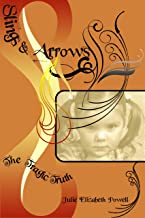
Nobody expects to lose a child but when it happens what can we do? In the sea of grief that seizes the soul how can we swim against the tide? But when that loss is compounded in each minute of every day, what do we do then?
Slings and Arrows is a story about the consequences of a moment, a moment, which separates a mother and daughter in ways impossible to imagine.
It charts their parallel lives, each suffering, one knowing, one not.
It is brutally honest; an account filled with bewilderment, guilt, anger and pain yet it also holds the key to hope. That whatever happens, the bonds of love can never be broken.
My Review: Slings & Arrows
Having lost a child of my own, it is not surprising that Slings & Arrows, by Julie Elizabeth Powell drew my interest. I have to say that I was not disappointed. The details of the loss of my son are very different from Ms. Powell’s loss of her daughter, but she offers up her story in a straight forward manner, with a brutal honesty which couldn’t help but touch my heart. Tears filled my eyes as I read Powell’s words time and again, as she is torn by conflicting emotions as she awaited her daughter’s body following a spirit which it appeared had departed.
Slings & Arrows is a brutally honest depiction of the stress, confusion, loss and grief which comes with watching a loved one slowly waste away long after their ‘life’ has ended. Kudos to Powell for baring her soul so openly in this tale of a loss that lingered on for years, consuming everything she has to give, and taking all that she has left. A tragic tale which hits close to home for me. I give Slings & Arrows five quills.

About Gone
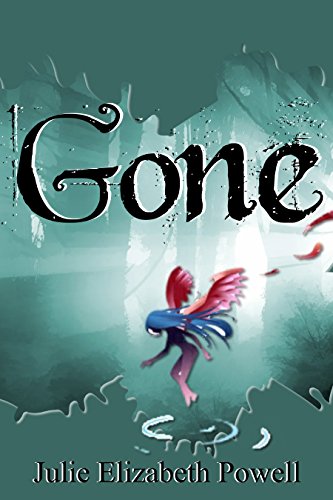
Is Charley crazy, delusional or dead?
Follow her amazing, emotional journey and emerge into the battle with her nemesis – herself.
This inspirational fantasy will take you into realms otherwise unknown, turning your world upside down while you’ll be wondering what is real and what is not. It’s an adventure, a mystery and an imaginative fairytale for adults.
Gone was a story motivated by a true event.
Purchase Link: https://www.amazon.com/Gone-Julie-Elizabeth-Powell-ebook/dp/B005MAAE0Y
My Review: Gone
Gone, by Julie Elizabeth Powell, is a journey searching for answers to the unanswerable question of where we go when we are gone from here. Powell offers one possible scenario in a crazy world where her character, Charley, meets Jenny, the daughter that she lost and hopes she has the answers Charley has been looking for. To learn whether or not Jenny has those answers, you’ll have to tag along and visit this sometimes confusing, often surprising place and find out for yourself.
Having read Powell’s first book, Slings & Arrows, which is a heart-wrenching memoir where she bares her sole over the loss of her daughter and the time leading up to her death, when she was alive and suffering, it is difficult not to relate to the experiences in this fictional tale, as a way to find answers for Powell herself. Where we go when we’re gone from here is an age-old question, one we will all have to face, but Powell goes beyind that, in trying to answer “Why?” I hope Powell found at least some of the answers she was looking for in the writing. I think the answers are different for everyone, but it was fun to take the journey. I give Gone four quills.

___________________________________________________________
Kaye Lynne Booth does honest book reviews on Writing to be Read in exchange for ARCs. Have a book you’d like reviewed? You can request a review here.
Share this:

Dark Origins – The creepy true story behind Alice in Wonderland #DarkOrigins #AliceinWonderland
Posted: April 26, 2023 Filed under: Books, Children's Books, Classics, Dark Origins, Fantasy, Fiction | Tags: Alice in Wonderland, Children's Books, Classic Children's Literature, Dark Origins, Lewis Carroll, Robbie Cheadle, Writing to be Read 76 Comments
Alice in Wonderland is one of my favourite childhood books. I love it so much, I have seven different copies, one of which is vintage.
The book, Alice in Wonderland, starts with a young girl, Alice, sitting on a bank and watching her sister read a boring book with no pictures or conversations. Seeing a white rabbit passing by, she follows it down a rabbit hole. The rabbit walks and talks and has a pocket watch. Alice falls down and down the rabbit hole, all the while having an interesting conversation with herself, and ends up in a large entrance hall. There is a small door beyond which is a beautiful world, but Alice is to big to pass through it. She experiments with eating and drinking various items until she is finally small enough to gain entry to Wonderland.
Wonderland is a strange and mysterious world filled with unusual creatures and people. It is summed up by this quote: “If I had a world of my own, everything would be nonsense. Nothing would be what it is, because everything would be what it isn’t. And contrary wise, what is, it wouldn’t be. And what it wouldn’t be, it would.”
You can obtain a free copy of Alice in Wonderland from Gutenberg here: https://www.gutenberg.org/ebooks/11

About the author
Lewis Carroll was a pseudonym for Charles Lutwidge Dodgson, who was born in England in 1832. At the age of 18, Dodgson left home to attend Oxford University, where he studied and worked for the next 20 years. He was a student and then a professor and a mathematician.
Dodgson created the Lewis Carroll pseudonym while he was at Oxford, in order to write children’s books that would not be connected to his academic career. He was well known for developing close friendships with children but very few relationships with adults. He befriended the children of his colleagues and acquaintances and spent a lot of time with them, even writing them letters.
“Extra thanks and kisses for the lock of hair,” he wrote to a 10-year-old girl. “I have kissed it several times — for want of having you to kiss, you know, even hair is better than nothing.”
When Henry George Liddell became the Dean of Christ Church at Oxford, Dodgson became friends with his three young daughters: Lorina, Edith and Alice.
The story, Alice in Wonderland, came into existence in 1862 when Dodgson and a colleague took the three girls out on a picnic and rowing trip along the Thames. In order to keep the trio entertained, Dodgson started telling the story that would become Alice in Wonderland which was published in 1865.

Dodgson was also a keen photographer and it is known that he took photos of nude and semi-nude children – including a full-frontal nude shot of Alice’s sister Lorina.
Dodgson wrote:
“I confess I do not admire naked boys in pictures. They always seem to me to need clothes: whereas one hardly sees why the lovely forms of girls should ever be coverd [sic] up!”
In 1863, Dodgson’s friendship with the Liddell family came to a sudden end and he never again spent time alone with their daughters.
There’s no record of why Dodgson’s relationship with the family ended, but there is a theory that he proposed marriage to Alice. This wasn’t that unusual in the mid 1800s as the age of consent was 12 years old and some men did marry young girls.
Before even examining the deeper meaning and themes of Alice in Wonderland, its author and the creation of this story are cast in rather a creepy light.
Deeper meaning and themes of Alice in Wonderland
The Tragic and Inevitable Loss of Childhood Innocence
The theme of growing up is central to Alice in Wonderland. The author is credited with enjoying the innocence with which children approach the world. The multitude of physically changes Alice goes through in Wonderland are believed to be symbolic of puberty and the many changes that take place during that period of a person’s life.
Alice finds these changes disturbing and traumatic and she struggles to find a comfortable size, reverting eventually to her original size.
Relevant quotes:
“I wonder if I’ve been changed in the night. Let me think. Was I the same when I got up this morning? I almost think I can remember feeling a little different. But if I’m not the same, the next question is ‘Who in the world am I?’ Ah, that’s the great puzzle!”
“It was much pleasanter at home,” thought poor Alice, “when one wasn’t always growing larger and smaller, and being ordered about by mice and rabbits. I almost wish I hadn’t gone down the rabbit-hole–and yet–and yet–…”
“I knew who I was this morning, but I’ve changed a few times since then.”
Alice is also confused about who she is and her role in the world around her, namely, Wonderland.
“It’ll be no use their putting their heads down and saying “Come up again, dear!” I shall only look up and say “Who am I then? Tell me that first, and then, if I like being that person, I’ll come up: if not, I’ll stay down here till I’m somebody else”–but, oh dear!’ cried Alice, with a sudden burst of tears, ‘I do wish they WOULD put their heads down! I am so VERY tired of being all alone here!”
Life as a Meaningless Puzzle
As Alice travels through Wonderland, she encounters a series of situations and circumstances which she cannot make sense of and which have no clear solutions. This is symbolism for how life throws frustrating curveballs and problems that cannot be solved or unraveled in the expected way. Often, lateral thinking is required to circumvent issues and, sometimes, problems have no solution in life.
Relevant quotes:
“One day Alice came to a fork in the road and saw a Cheshire cat in a tree. ‘Which road do I take?’ she asked. ‘Where do you want to go?’ was his response. ‘I don’t know,’ Alice answered. ‘Then,’ said the cat, ‘it doesn’t matter.”
“Mad Hatter: Would you like a little more tea?
Alice: Well, I haven’t had any yet, so I can’t very well take more.
March Hare: Ah, you mean you can’t very well take less.
Mad Hatter: Yes. You can always take more than nothing.”
“The March Hare took the watch and looked at it gloomily: then he dipped it into his cup of tea, and looked at it again: but he could think of nothing better to say than his first remark, ‘It was the best butter, you know.’ Alice had been looking over his shoulder with some curiosity. ‘What a funny watch!’ she remarked. ‘It tells the day of the month, and doesn’t tell what o’clock it is!’ ‘Why should it?’ muttered the Hatter. ‘Does your watch tell you what year it is?’ ‘Of course not,’ Alice replied very readily: ‘but that’s because it stays the same year for such a long time together.’ ‘Which is just the case with mine,’ said the Hatter. Alice felt dreadfully puzzled. The Hatter’s remark seemed to have no sort of meaning in it, and yet it was certainly English. ‘I don’t quite understand you,’ she said, as politely as she could. ‘The Dormouse is asleep again,’ said the Hatter, and he poured a little hot tea upon its nose. The Dormouse shook its head impatiently, and said, without opening its eyes, ‘Of course, of course; just what I was going to remark myself.’ ‘Have you guessed the riddle yet?’ the Hatter said, turning to Alice again. ‘No, I give it up,’ Alice replied: ‘what’s the answer?’ ‘I haven’t the slightest idea,’ said the Hatter. ‘Nor I,’ said the March Hare. Alice sighed wearily. ‘I think you might do something better with the time,’ she said, ‘than waste it in asking riddles that have no answers.’ ‘If you knew Time as well as I do,’ said the Hatter, ‘you wouldn’t talk about wasting it.”

Death as a Constant and Underlying Menace
Over and over again, Alice finds herself in dangerous situations that suggest that death is lurking just around the corner. Although death never manifests in the book, the reader senses it and so does Alice. At the end of the book she comes to realise that despite the ridiculous circumstances in Wonderland, death could be a very real outcome and that is when she wakes up and the reader comes to understand the entire book is a dream.
Relevant quotes:
“Well!” thought Alice to herself. “After such a fall as this, I shall think nothing of tumbling down-stairs! How brave they’ll all think me at home! Why, I wouldn’t say anything about it, even if I fell off the top of the house!” (Which was very likely true.)”
“The executioner’s argument was that you couldn’t cut of something’s head unless there was a trunk to sever it from. He’d never done anything like that in his time of life, and wasn’t going to start now.
The King’s argument was that anything that had a head, could be beheaded, and you weren’t to talk nonsense.
The Queen’s argument was that if something wasn’t done about it in less than no time, she’d have everyone beheaded all round.
It was this last argument that had everyone looking so nervous and uncomfortable.”
Characterisation
Alice meets a plethora of characters that have become well known. It is believed that many of these characters, including Alice herself, suffer from mental health disorders. This is a list of some of the most famous characters with a description from Spark Notes (https://www.sparknotes.com/lit/alice/characters/)
The White Rabbit – “The frantic, harried Wonderland creature that originally leads Alice to Wonderland. The White Rabbit is figure of some importance, but he is manic, timid, and occasionally aggressive.” The White Rabbit suffers from an anxiety disorder and is in a constant state of panic.
The Queen of Hearts – “The ruler of Wonderland. The Queen is severe and domineering, continually screaming for her subjects to be beheaded.” The Queen of Hearts is completely self absorbed and has a narcissistic personality disorder.
The Cheshire Cat – “A perpetually grinning cat who appears and disappears at will. The Cheshire Cat displays a detached, clearheaded logic and explains Wonderland’s madness to Alice.” The Cheshire Cat is schizophrenic.
The Caterpillar – “A Wonderland creature. The Caterpillar sits on a mushroom, smokes a hookah, and treats Alice with contempt. He directs Alice to the magic mushroom that allows her to shrink and grow.” The Caterpillar is a drug addict who smokes a hookah and gives Alice a mushroom with mind and body-altering capabilities.

The Mad Hatter – “A small, impolite hatter who lives in perpetual tea-time. The Mad Hatter enjoys frustrating Alice.” The hatter is simply mad.
Have you read Alice in Wonderland? Did you spot these underlying themes and meanings?
Share this:

Treasuring Poetry – Meet author and poet, Marcia Meara, and a book review #poetry #readingcommunity #TreasuringPoetry
Posted: April 19, 2023 Filed under: Book Review, Books, Interview, Poetry, Review, Treasuring Poetry | Tags: A Boy Named Rabbit, Marcia Meara, Poetry, Robbie Cheadle, Summer Magic, Treasuring Poetry, Writing to be Read 90 Comments
Today, I am delighted to welcome poet and author, Marcia Meara, as my April Treasuring Poetry guest. Marcia is sharing some of her thoughts about poetry and poems and I am sharing my reviews of A Boy Named Rabbit: Wake-Robin Ridge Book 2 and
Why do you write poetry?
I’ve written poetry since I was 5-years old, when I filled legal tablets with page after page of verses about cowboys and horses. (As imagined by a little girl who’d seen a few movies.) I really can’t remember when I didn’t love writing, and poems were what got me started. The rhythm and musicality of poetry is what I love most, and the main reason I still write poems today.
Do you think poetry is still a relevant form of expressing ideas in our modern world? If yes, why?
I think poems are very relevant, indeed. Poetry speaks of beauty and love and hate and danger and betrayal and every other human emotion, need, or failing. Do I think it’s as popular as it once was? No. Nor does it sell as well as novels and other works of fiction. But neither of those has any bearing on the actual relevance of poetry, and the more readers we poets manage to attract, the more likely folks are to understand exactly that.
Which poem by any other poet that you’ve read do you relate to the most and why?
That’s difficult to say, since I’ve been reading poetry for 75 years or so, including most of the greatest ones from poets like Edgar Allan Poe, Emily Dickinson, William Wordsworth, Amy Lowell, Elizabeth Barrett Browning, Robert Browning, Edna St. Vincent Millay, John Keats, Alfred Lord Tennyson, Henry Wadsworth Longfellow, Percy Bysshe Shelley, Walt Whitman, Dylan Thomas, Carl Sandberg, T. S. Eliot, Sara Teasdale, Ogden Nash, and on and on. You get my drift, I’m sure. It’s very hard for me to choose a favorite, but one poem I have always loved and never tire of is Poe’s The Raven. It’s long, I know, but the rhythm is so perfect, and the painful sadness of the subject, so very, very POE.
The Raven
Edgar Allan Poe – 1809-1849
Once upon a midnight dreary, while I pondered, weak and weary,
Over many a quaint and curious volume of forgotten lore—
While I nodded, nearly napping, suddenly there came a tapping,
As of someone gently rapping, rapping at my chamber door—
“Tis some visitor,” I muttered, “tapping at my chamber door—
Only this and nothing more.”
Ah, distinctly I remember it was in the bleak December;
And each separate dying ember wrought its ghost upon the floor.
Eagerly I wished the morrow;—vainly I had sought to borrow
From my books surcease of sorrow—sorrow for the lost Lenore—
For the rare and radiant maiden whom the angels name Lenore—
Nameless here for evermore.
And the silken, sad, uncertain rustling of each purple curtain
Thrilled me—filled me with fantastic terrors never felt before;
So that now, to still the beating of my heart, I stood repeating,
“‘Tis some visitor entreating entrance at my chamber door—
Some late visitor entreating entrance at my chamber door;—
This it is and nothing more.”
Presently my soul grew stronger; hesitating then no longer,
“Sir,” said I, “or Madam, truly your forgiveness I implore;
But the fact is I was napping, and so gently you came rapping,
And so faintly you came tapping, tapping at my chamber door,
That I scarce was sure I heard you”—here I opened wide the door;—
Darkness there and nothing more.
Deep into that darkness peering, long I stood there wondering, fearing,
Doubting, dreaming dreams no mortal ever dared to dream before;
But the silence was unbroken, and the stillness gave no token,
And the only word there spoken was the whispered word, “Lenore?”
This I whispered, and an echo murmured back the word, “Lenore!”—
Merely this and nothing more.
Back into the chamber turning, all my soul within me burning,
Soon again I heard a tapping somewhat louder than before.
“Surely,” said I, “surely that is something at my window lattice;
Let me see, then, what thereat is, and this mystery explore—
Let my heart be still a moment and this mystery explore;—
‘Tis the wind and nothing more!”
Open here I flung the shutter, when, with many a flirt and flutter,
In there stepped a stately Raven of the saintly days of yore;
Not the least obeisance made he; not a minute stopped or stayed he;
But, with mien of lord or lady, perched above my chamber door—
Perched upon a bust of Pallas just above my chamber door—
Perched, and sat, and nothing more.
Then this ebony bird beguiling my sad fancy into smiling,
By the grave and stern decorum of the countenance it wore,
“Though thy crest be shorn and shaven, thou,” I said, “art sure no craven,
Ghastly grim and ancient Raven wandering from the Nightly shore—
Tell me what thy lordly name is on the Night’s Plutonian shore!”
Quoth the Raven “Nevermore.”
Much I marvelled this ungainly fowl to hear discourse so plainly,
Though its answer little meaning—little relevancy bore;
For we cannot help agreeing that no living human being
Ever yet was blest with seeing bird above his chamber door—
Bird or beast upon the sculptured bust above his chamber door,
With such name as “Nevermore.”
But the Raven, sitting lonely on the placid bust, spoke only
That one word, as if his soul in that one word he did outpour.
Nothing further then he uttered—not a feather then he fluttered—
Till I scarcely more than muttered “Other friends have flown before—
On the morrow he will leave me, as my hopes have flown before.”
Then the bird said “Nevermore.”
Startled at the stillness broken by reply so aptly spoken,
“Doubtless,” said I, “what it utters is its only stock and store
Caught from some unhappy master whom unmerciful Disaster
Followed fast and followed faster till his songs one burden bore—
Till the dirges of his Hope that melancholy burden bore
Of ‘Never—nevermore.'”
But the Raven still beguiling my sad fancy into smiling,
Straight I wheeled a cushioned seat in front of bird, and bust and door;
Then, upon the velvet sinking, I betook myself to linking
Fancy unto fancy, thinking what this ominous bird of yore—
What this grim, ungainly, ghastly, gaunt and ominous bird of yore
Meant in croaking “Nevermore.”
This I sat engaged in guessing, but no syllable expressing
To the fowl whose fiery eyes now burned into my bosom’s core;
This and more I sat divining, with my head at ease reclining
On the cushion’s velvet lining that the lamp-light gloated o’er,
But whose velvet violet lining with the lamp-light gloating o’er,
She shall press, ah, nevermore!
Then, methought, the air grew denser, perfumed from an unseen censer
Swung by Seraphim whose foot-falls tinkled on the tufted floor.
“Wretch,” I cried, “thy God hath lent thee—by these angels he hath sent thee
Respite—respite and nepenthe, from thy memories of Lenore;
Quaff, oh quaff this kind nepenthe and forget this lost Lenore!”
Quoth the Raven “Nevermore.”
“Prophet!” said I, “thing of evil!—prophet still, if bird or devil!—
Whether Tempter sent, or whether tempest tossed thee here ashore,
Desolate yet all undaunted, on this desert land enchanted—
On this home by Horror haunted—tell me truly, I implore—
Is there—is there balm in Gilead?—tell me—tell me, I implore!”
Quoth the Raven “Nevermore.”
“Prophet!” said I, “thing of evil—prophet still, if bird or devil!
By that Heaven that bends above us—by that God we both adore—
Tell this soul with sorrow laden if, within the distant Aidenn,
It shall clasp a sainted maiden whom the angels name Lenore—
Clasp a rare and radiant maiden whom the angels name Lenore.”
Quoth the Raven “Nevermore.”
“Be that word our sign in parting, bird or fiend!” I shrieked, upstarting—
“Get thee back into the tempest and the Night’s Plutonian shore!
Leave no black plume as a token of that lie thy soul hath spoken!
Leave my loneliness unbroken!—quit the bust above my door!
Take thy beak from out my heart, and take thy form from off my door!”
Quoth the Raven “Nevermore.”
And the Raven, never flitting, still is sitting, still is sitting
On the pallid bust of Pallas just above my chamber door;
And his eyes have all the seeming of a demon’s that is dreaming,
And the lamp-light o’er him streaming throws his shadow on the floor;
And my soul from out that shadow that lies floating on the floor
Shall be lifted—nevermore!
Which of your own poems is your favourite and why?
I could say whichever one I’m writing at the time, but that wouldn’t be fair. Nor likely true, either, though I do think each one is a favorite at least during the moments of creation. However, instead of going that route, I’m going to choose the poem which most depicts large portions of my own life, spent canoeing on the wild and scenic rivers and creeks of Central Florida. Fittingly, it’s called On the River, and is included in my book, Summer Magic: Poems of Life & Love.
An extract from On The River by Marcia Meara
“Crystal green flows beneath me,
Leafy arches rise above,
Dip, glide.
Dip, glide.
Slide.
Duckweed parts as I float by.
I wonder where they went,
Those ducks?
Gone overnight, it seems.
Another parting, another loss,
And I slide by,
Under all that green.
Dip, glide.
Dip, glide.
Just there, in deepest shade,
Sleeping emeralds cling.
Tree frogs rest in their
Smooth, damp skins,
Waiting for the sliver moon.
They’ll open their eyes for the silver moon.
Sleeping now,
I pass him, too.
And on I go.
Dip, glide.
Dip, glide.”
Is writing poetry easy for you compared to prose or do you do a lot of editing and revision of your poems?
Oddly enough, I seldom do much, if any, editing on my poetry. When I’m “in the zone” the words I want seem to come to me, sometimes surprising me by fitting together exactly the way I like. This is definitely not true when I’m writing prose. Then, I spend a lot of time cleaning up, tweaking, and cutting before sending it off to an editor for more of the same. With poetry, if I’m in the mood, the words seem to flow much more smoothly and easily.
What mode (blog, books, YouTube, podcasts) do you find the most effective for sharing your poems with poetry lovers and readers?
I’ve actually never done any real marketing with my work, be it poetry or prose, and that’s something I do hope to change soon. But all I did with my book of poetry was publish it on Amazon and share poems now and then on my blog, The Write Stuff. NOTE: This is NOT how I would recommend new writers get the word out, no matter what their genre or style might be!
My review of Summer Magic: Poems of Life and Love by Marcia Meara

This book comprises the most beautiful freestyle poetry by Marcia Meara. The poetry is divided into two sections, the first is about the magic of life as experienced by a ten year old boy and the second is about love.
I loved both sections of the book but the poems about the joys and experiences of a ten year old boy were particularly poignant and meaningful for me as I have two sons who were ten years old in the not that distant past.
The two poems in this section that I enjoyed the most are, firstly, The Rope Swing which depicts the freedom and joy of swinging on a hot summer day. The depiction of a young boy of ten is very accurate and brings back lovely memories for me.
My second favourite poem is entitled Moccasins and describes the lovely and understanding relationship moms have with their sons.
The Rope Swing
The first stanza goes as follows:
“Sailing up, up into
Blue summer sky,
Hot rope rough against his hands,
He shouts with joy, and lets go.
For a crystal moment,
He hangs suspended,
Frozen in time
Like a fly in amber.”
Moccasins
“His dad smiles.
Moms are like that, Mac.
Moms always know what
Their children want most.
And Moms always want
Their children to have their
Heart’s desires.”
The poem I enjoyed the most in part two of the book describes the beauty of young love and the joy of watching small children play and develop.
The Sound of Dreams Coming True
“Listen, she says,
Kissing his fingers,
As a little girl laughs,
Chasing butterflies
With her big brother.”
Purchase Summer Magic: Poems of Life and Love by Marcia Meara here: https://www.amazon.com/Summer-Magic-Poems-Life-Love-ebook/dp/B00FNBLIPC
My review of A Boy Named Rabbit: Wake-Robin Ridge Book 2 by Marcia Meara
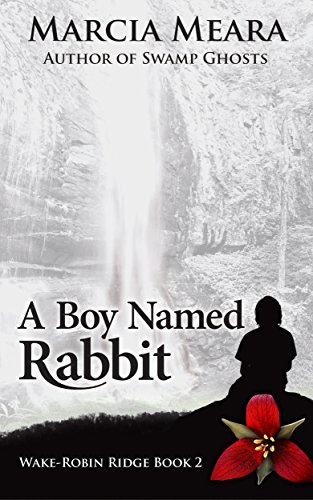
Sarah Gray and MacKenzie Cole from book 1, Wake-Robin Ridge, are now married and living in Mac’s lovely home built near the top of the mountain. Sarah is pregnant with their first child and Mac is happy and managing to keep his deep anxiety following the deaths of his ex-wife and son, Ben, under control. Mac’s emotional state is still delicate and he is desperately determined to keep his wife and their baby safe.
Ten-year old Rabbit has grown up in the mountains under the guidance and care of his grandparents who have taught him survival skills. The trios lifestyle is rough and ready with Gran living in a makeshift tent and the young boy and his grandpa generally sleeping outdoors in all weathers. At Grandpa’s insistence, the family has nothing to do with any people who are all designated as ‘bad people’ by Grandpa.
Gran has a progressive lung illness and Grandpa leaves his wife and Rabbit on their own one morning to travel into town and purchase medicine for her. He never returns. Gran continues to decline and, knowing she is dying, tells Rabbit that all people are not bad. She explains that contrary to Grandpa’s comments, there are also good people and Rabbit needs to find the good people, in particular, a man with winter blue eyes and hair like a crow’s wing. Gran dies and Rabbit is left on his own in the wilderness. With no other option, Rabbit packs up his belongings and sets off to find the man with the winter blue eyes.
Rabbit is well depicted as an old soul with a high intelligence despite his lack of book learning. His upbringing has provided him with survival tools and also the ability to assess situations and react in a clear headed and calm way. He is very endearing to the reader with his interesting way of looking at situations while still retaining the need for love and emotional immaturity of a young boy. He is very loving and giving and the reader can’t help routing for a good outcome for Rabbit.
Mac’s character continues to grow in this second book as he is faced with having to face up to his fears and deal with unexpected and unplanned events and circumstances despite his fears and anxieties. It is an intriguing journey to watch Mac struggling internally to move forward despite his anxiety and it is impossible not to be delighted by his progress and small victories.
Sarah is even more generous and loving than I remembered from book 1, and is the perfect wife to Mac. It is obvious she has a huge heart which is big enough for Mac, her unborn child, and Rabbit.
As with all lives, especially in fiction, the trio are faced with adversity and obstacles which they need to try to overcome. The storyline is engaging and entertaining and brings out the best in the various characters.
Purchase A Boy Named Rabbit here: https://www.amazon.com/Boy-Named-Rabbit-Wake-Robin-Ridge-ebook/dp/B00SQ4PID6
About Marcia Meara
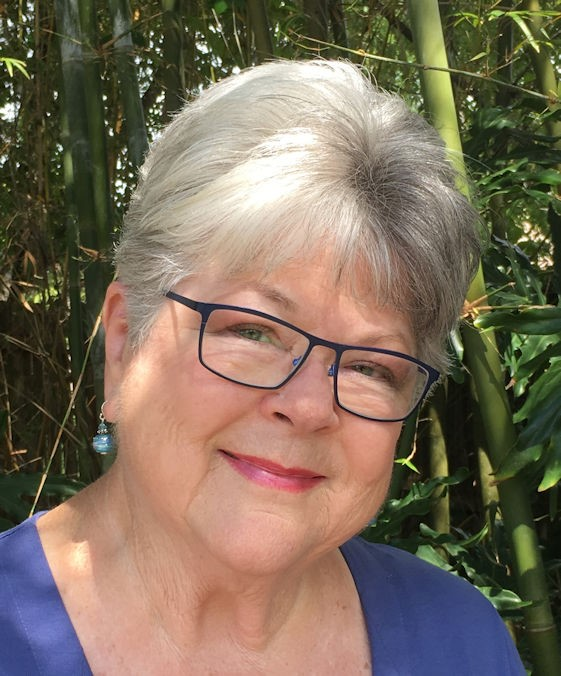
Marcia Meara lives in central Florida, just north of Orlando, with her husband of over thirty years and four big cats.
When not writing or blogging, she spends her time gardening, and enjoying the surprising amount of wildlife that manages to make a home in her suburban yard. She enjoys nature. Really, really enjoys it. All of it! Well, almost all of it, anyway. From birds, to furry critters, to her very favorites, snakes. The exception would be spiders, which she truly loathes, convinced that anything with eight hairy legs is surely up to no good. She does not, however, kill spiders anymore, since she knows they have their place in the world. Besides, her husband now handles her Arachnid Catch and Release Program, and she’s good with that.
Spiders aside, the one thing Marcia would like to tell each of her readers is that it’s never too late to make your dreams come true. If, at the age of 69, she could write and publish a book (and thus fulfill 64 years of longing to do that very thing), you can make your own dreams a reality, too. Go for it! What have you got to lose?
Purchase Marcia Meara’s books
Novels
Wake-Robin Ridge: Book 1
A Boy Named Rabbit: Wake-Robin Ridge Book 2
Harbinger: Wake-Robin Ridge Book 3
The Light: Wake-Robin Ridge Book 4
Swamp Ghosts: Riverbend Book 1
Finding Hunter: Riverbend Book 2
That Darkest Place: Riverbend Book 3
Riverbend Spinoff Novellas
The Emissary 1
The Emissary 2 – To Love Somebody
The Emissary 3 – Love Hurts
Poetry
Summer Magic: Poems of Life and Love
Reach Marcia on Social Media Here:
Blog: The Write Stuff
Facebook
Email: marciameara16[at]gmail[dot]com
About Robbie Cheadle
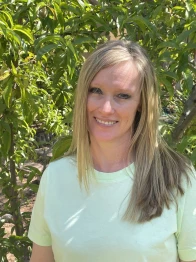
Award-winning, bestselling author, Robbie Cheadle, has published thirteen children’s book and two poetry books. Her work has also appeared in poetry and short story anthologies.
Robbie also has two novels published under the name of Roberta Eaton Cheadle and has horror, paranormal, and fantasy short stories featured in several anthologies under this name.
The ten Sir Chocolate children’s picture books, co-authored by Robbie and Michael Cheadle, are written in sweet, short rhymes which are easy for young children to follow and are illustrated with pictures of delicious cakes and cake decorations. Each book also includes simple recipes or biscuit art directions which children can make under adult supervision.
Robbie’s blog includes recipes, fondant and cake artwork, poetry, and book reviews. https://robbiesinspiration.wordpress.com/
Share this:

Growing Bookworms – Meet children’s author and blogger, Norah Colvin, creator of Readilearn #childrensfiction #childrenseducation #Growingbookworms
Posted: April 12, 2023 Filed under: Children's Books, Growing Bookworms, Interview | Tags: Children's Books, Growing Bookworms, Let's Move, Nora Colvin, Robbie Cheadle, Wombat Digs In, Writing, Writing to be Read 127 Comments
Today, I am delighted to introduce you to children’s author, Norah Colvin. Norah is a retired teacher and runs a marvelous educational site called Readilearn which is packed with wonderful teaching aids and ideas for promoting learning among children. Welcome Norah!
I have read and enjoyed a few of your children’s pictures books. They comprise of delightful age appropriate stories and lovely illustrations. Is there any particular children’s book author whom you admire and consider to be a role model for your writing?
Robbie, thank you so much for inviting me here to talk about my books and favourite authors. There are so many authors whose work I love, it’s hard to know where to start, but I guess if I had to pick just one, I’d have to say Mem Fox.
Mem has written so many wonderful picture books that touch my heart. Each one is a gem. She is enormously prolific and writes in many different styles. Possum Magic, her first picture book, was published in 1983, too late for my son and a few years before my daughter was born. I fell in love with this book and Mem as soon as I read it. But I love so many others of her books too, especially Koala Lou (I can’t read it aloud with tearing up), and Whoever You are (same thing). For others of her books that I love, it’s best to just go to her website and check out her full list. I love them all!
One book of Mem’s that I found especially inspiring was her memoir Mem’s the Word. I had always wanted to be a published writer but had never been successful in having any of my submissions accepted. In the memoir (great name for a book about Mem, eh?) Mem revealed that she’d had her first book published when she was forty or almost forty. That gave me hope. I was not yet 40 at the time, only almost. Not only that, Possum Magic had been rejected nine times and had gone through many changes and edits before it was published. Possum had even started life’s journey as a mouse. I thought maybe there was hope for me yet. It took decades after that for me to have these little picture books published with Library For All, but I have been a published educational writer since the early 1990s (last century!)
Mem has also written a brilliant book for parents called Reading Magic. It is all about the importance of reading aloud to children and I just love it. Whenever I know someone who is becoming a parent for the first time, I gift them this book and one of Mem’s picture books as well, usually Ten Little Fingers and Ten Little Toes if I can find it, or Possum Magic. While I can talk (and write, which I often do) about the importance of talking with, reading to and playing with children, a message from Mem gives extra authority to the message. While we’re talking about Mem – although she is an Australian and was born here, she grew up in Africa, Zimbabwe, I think.
You can read more about Mem Fox on Norah’s blog here: https://norahcolvin.com/2015/09/25/a-celebration-of-australian-picture-books-mem-fox/
Where do you find inspiration for your children’s picture books?
This is a tough one to answer, though it should be easy, as stories are everywhere. One of my favourite sayings to children I was teaching, my own children and now my grandchildren is “There’s a story in that”. A story can arise from almost any situation, and be triggered by a thought, a word, a scent on a breeze, a sound. A story is taking a moment, a thought, and turning it into something magical that resonates with others. Of course, if I’d had more success with that latter part, maybe I’d have more stories published and would be more confident in answering this question. But I guess, in fact, children are my inspiration. I love spending time with young children. They are just the most amazing, joyful, full of wonder wonderful little humans with huge hearts. When I’m writing stories for or about children, I try to capture what it means to be a young child and release the six-year-old that still resides within me.
How do you go about ensuring the language and flow of ideas in your children’s books are appropriate for the target age group?
I hope the language and flow of ideas in my stories is appropriate for the young children in my target audience. I have spent a lot of time with young children. I was one once myself and am still a six-year-old at heart (see above). I was a teacher of 5 – 7 year-olds for almost 30 years, had two children of my own, and two grandchildren. A day never went by in the classroom or at home when I didn’t read at least one (often many more) stories to my children. I think all these things – talking with children, spending time with children, and reading stories and books to them (and to myself) – have helped me write in language that is age appropriate.
Do you include specific messages for young children in your picture books? What are your aims with these books?
I try to not be didactic in my stories but to allow messages of empowerment come through the events and character development, encouraging children to love themselves, to be confident, to be friendly towards and respectful to others, to be courageous and curious and try new things, and … I often consider my stories to be ‘a slice of life’, an incident that could occur in any family, an incident that children may identify with. I avoid the darker emotions and try for something lighter. There’s too much darkness. Let there be light, I say. Learning and life are meant to be fun after all.
Your books are part of the Library for All initiative. Could you please share a bit about the objectives of Library for All and why you are a participant in this project.
I’m so pleased you have asked about Library For All (LFA). It is Library for All that has published these first picture books of mine that you have mentioned. I am absolutely delighted and feel extremely honoured to be able to contribute to the Library For All collection. It is such an amazing organisation with a mission that is close to my heart – to make knowledge and books accessible to all equally. Authors and illustrators donate their stories and illustrations to LFA. It’s a great way to be able to support their work. I have fifteen books published with LFA. The first one to be published Wombat Digs was written in a workshop run by LFA with the aim of expanding their titles. I was lucky to have this story written and accepted in that workshop. Most of my stories are nonsense phonics stories written at the request of LFA. Two of the stories have been translated, one for Timor-Leste and one for Kiribati. I was so surprised to receive the one for Kiribati this week. I didn’t know it was being translated. How exciting. You can see all the titles on my Amazon author page. While I receive no income from sales, I’m delighted that the funds contribute to the good work of LFA.
You have a website, Readilearn, Digital Resources for Teachers. Please tell us a bit about your objectives with this website and how teachers and other caregivers can benefit from your digital resources.
Readilearn has been a labour of love. When I was teaching, as most teachers do, I spent many hours away from the classroom preparing lessons to not only encourage learning but to make learning fun. I was/am never in favour of handing out worksheets just to keep children busy. I’ve never considered that respectful of their intellect or a good use of time. I believe that children learn through trying things for themselves and through discussions with the teacher and each other.
When I left the classroom, I wanted to support teachers by doing some of the preparation for them, preparing lessons that were ready for them to teach, lessons that gave the children opportunities to interact with and discuss what they were learning. I wanted to make the lessons a bit more fun and meaningful than just filling out numerous worksheets filled with repetitive exercises. I also wanted to make it affordable so that teachers didn’t have to spend a lot of their hard-earned money (as most of us, especially early childhood teachers, do) on quality resources.
As most of my teaching days were spent working with 5 – 7-year olds, that’s the age group I’ve targeted. Teachers of children in that age group don’t have to scroll through oodles of resources to find something age appropriate. However, as I said, they are lessons ready for teachers to teach (including home-schooling parents). They are not designed for children to use on their own. It is the interactions and the discussions that are important. This is especially so for the interactive lessons which are accessed online. While there are some downloadable worksheets (many of them free), they usually provide follow-up support for the online lessons or provide other teaching ideas. Teaching is an amazing job. It has enormous rewards, but it has its challenges too. If I can make a teacher’s day a little easier and learning a little more fun and meaningful for the children, I’m happy.
Thank you, Norah, for being a wonderful guest and sharing all this amazing information about your writing and Readilearn.
My review of Wombat Digs In by Norah Colvin
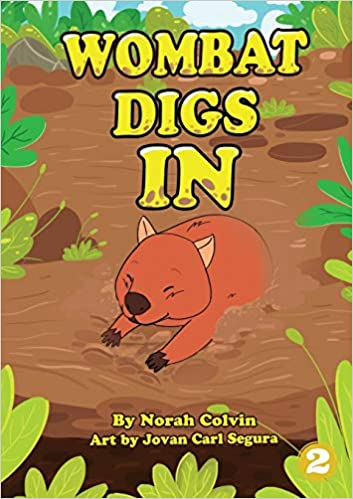
This is an adorable book for small children about a wombat who is struggling to keep up with some of the other animals including the kangaroos who can bounce, the possums who can climb, and the fruit bats who can fly. Wombat is feeling a little dejected, but when Baby Koala falls out of the tree, Wombat’s own special skill of digging comes to the forefront. This little book is illustrated with simple and bright pictures that small children will love.
Purchase link:
Amazon Au: https://www.amazon.com.au/gp/product/192596003X
Amazon US: https://www.amazon.com/Wombat-Digs-Norah-Colvin/dp/192596003X
My review of Let’s Move by Norah Colvin

This is a delightful little book for teaching very young children about animals and movement. The illustrations are adorable and I particularly liked the snails that slide and the snakes that slither.
Purchase link:
Amazon Au: https://www.amazon.com.au/gp/product/1925960064
Amazon US: https://www.amazon.com/Lets-Move-Norah-Colvin/dp/1925960064
About Norah Colvin
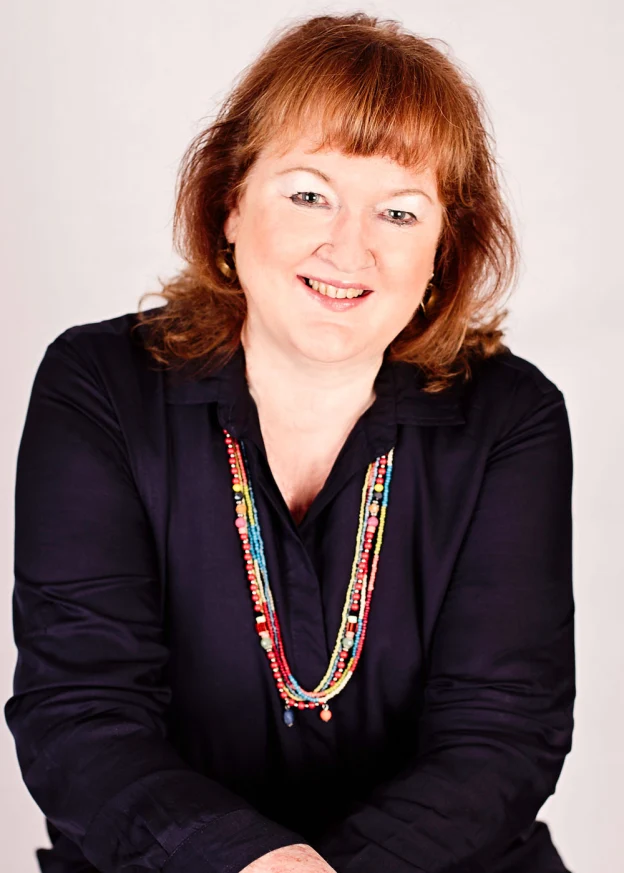
Norah Colvin is a passionate educator and writer.
She is a published educational writer and freelance author for publishers such as Jacaranda Wiley, Greygum Software, Blake Education, Pascal Press, MacMillan and ITC Publications.
She has two children’s books published with Library For All, a ballad included in the Share Your Story Tell ‘Em They’re Dreaming anthology and flash fiction in the Carrot Ranch Rough Writers Anthology Vol 1. She loves to write picture books manuscripts for the six-year-old in her own and others’ hearts.
She belongs to the following writers’ groups:
SCBWI
Queensland Writers Centre
Book Links
Write Links
Writing NSW
Creative Kids Tales
and other Facebook writing groups.
She blogs at www.NorahColvin.com and produces teaching resources for her educational website www.readilearn.com.au.
About Robbie Cheadle
Award-winning, bestselling author, Robbie Cheadle, has published thirteen children’s book and two poetry books. Her work has also appeared in poetry and short story anthologies.
Robbie also has two novels published under the name of Roberta Eaton Cheadle and has horror, paranormal, and fantasy short stories featured in several anthologies under this name.
The ten Sir Chocolate children’s picture books, co-authored by Robbie and Michael Cheadle, are written in sweet, short rhymes which are easy for young children to follow and are illustrated with pictures of delicious cakes and cake decorations. Each book also includes simple recipes or biscuit art directions which children can make under adult supervision.
Robbie’s blog includes recipes, fondant and cake artwork, poetry, and book reviews. https://robbiesinspiration.wordpress.com/
Share this:

Book Review: Bundle of Fears and Frights
Posted: April 7, 2023 Filed under: Audio Books, Book Review, Books, Fiction, Review, Speculative Fiction, Urban fantasy, Werewolf Fiction | Tags: A Bundle of Fears and Frights, Audio Books, Book Review, Canadian Werewolf, Fear and Longing in Las Angeles, Fright Nights Big City, Mark Leslie, Scott Overton, werewolves, Writing to be Read 9 Comments
About the Book
THERE’S NO ESCAPING THE EVIL THAT RISES WITHIN OUR OWN HEARTS.
On a work trip to Los Angeles, Michael Andrews stumbles upon the rising underground movement of the Proud Fighters for America, a white-supremacist group hell-bent not only on vanquishing any outside their predefined definitions of the one pure race, but also on leveraging long-buried paranormal experiments conducted by Nazi Germany to create an army of super soldiers.

But this group isn’t confined to the west coast. Their numbers have also spread to New York, Michael’s home stomping grounds.
Michael has to determine if a mysterious woman he is falling in love with who has ties to the PFA and a unique paranormal ability of her own can be trusted, and if the two of them, along with another supernatural creature and an occult scholar, are enough to take down the growing legion of evil.
FEARS AND FRIGHTS combines the complete texts of the two-book story arc that unrolls in the novels FEAR AND LONGING IN LOS ANGELES and FRIGHT NIGHTS, BIG CITY into a single digital bundle.
Purchase Links:
Amazon/Audible: https://www.amazon.com/Bundle-Fears-Frights-Canadian-Werewolf/dp/B0B7V2ZY2J
Chirp: https://www.chirpbooks.com/audiobooks/a-bundle-of-fears-and-frights-by-mark-leslie
My Review
I listened to the audio book, Bundle of Fears and Frights, by Mark Leslie, and narrated by Scott Overton. As he has through the whole series, Scott Overton does a smashing job of bringing Leslie’s characters to life.
This is a two book bundle which includes Fear and Longing in Los Angeles and Fright Nights, Big City, which are, I believe, books 2 & 3 in Lefebvre’s Canadian Werewolf series. Together, they make nine hours of audio book entertainment, and characters which you can’t help but invest into.
My first thoughts when learning about book 1, Canadian Werewolf in New York, was that it might be similar to the movie, American Werewolf in London, which I enjoyed enough to watch two or three times. My second thought was that the werewolf thing has been soooo overdone, as have vampires, and zombies. As it turned out, Lefebvre’s werewolf different from that movie in several ways. And his character, Michael Andrews is not like any other werewolf that I’ve heard of. I mean, how can you not like a werewolf superhero? Not a role you’d expect to see a werewolf in, right? No, I find Lefebvre’s werewolf to be fresh and original, and I’ve never regretted picking up that first audio book, which was also narrated by Scott Overton. You can read my review of that book here.
Bundle of Fear and Frights takes Lefebvre’s werewolf to Las Angeles and back to New York, in his human form as Michael Andrews, of course, to battle a white supremacists domestic terrorist group. As a human, Michael is vulnerable like the rest of us, and he’s trying to come to terms with the loss of his true love, Gail, and move on to a new chapter in his life.
In Fear and Longing in Las Angeles, Michael finds a new love interest, Lex, but his supernaturally enhanced wolf senses and strengths offer advantages, and he can never walk away from someone in need. He just can’t seem to help himself. Before he knows it, he also finds himself battling the PFA, a domestic terrorist group involved in the occult, which has supernatural powers to rival his own wolf senses and strength. All, while trying to navigate his love life and his writing career. To make matters worse, strange things are happening with his wolf senses, which he doesn’t fully understand, but he grasps at the chance to once again have a normal life with Lex.
In Fright Nights, Big City, he’s back in New York with Lex, but trouble follows them, or at least, the PFA does. In L.A., Michael had decided to walk away and let the professionals deal with them, but now, in New York, it looks like they have no choice but to try and stop them from carrying out their evil plot to take over the city. Together with Lex, his new girl, and Gail, the girl he can’t seem to get over, they battle occult forces of evil to save the city, and themselves.
Mark Leslie’s Michael Andrews is one of the most likeable werewolves I’ve ever met. I love that he weilds his enhanced powers like a superhero, because of his compassion for others, which is a very human trait. I give a Bundle of Fears and Frights five quills.
________________________________________________________
Kaye Lynne Booth does honest book reviews on Writing to be Read in exchange for ARCs. Have a book you’d like reviewed? You can request a review here.
Share this:

Writer’s Corner: Revisiting Poetry – A Look Back
Posted: April 3, 2023 Filed under: Books, Collection, Poetry, Women's Fiction and Poetry, word play, WordCrafter Press, Writing | Tags: Kaye Lynne Booth, Poetry, Poetry Collection, Writer's Corner, Writing to be Read 7 Comments
It All Started with Poetry
When I first started writing, I wrote poetry. In fact, my first sale of my writing, back in 1996, was for a poem. I wrote on a manual typewriter and submitted via snail mail, (I know. I’m dating myself terribly.). My poem, “A Prayer for Guidance” was published in a small poetry magazine called Dusk & Dawn, which is no longer in publication, and I made a whole $5 from it, but boy, was I ever proud of that sale.
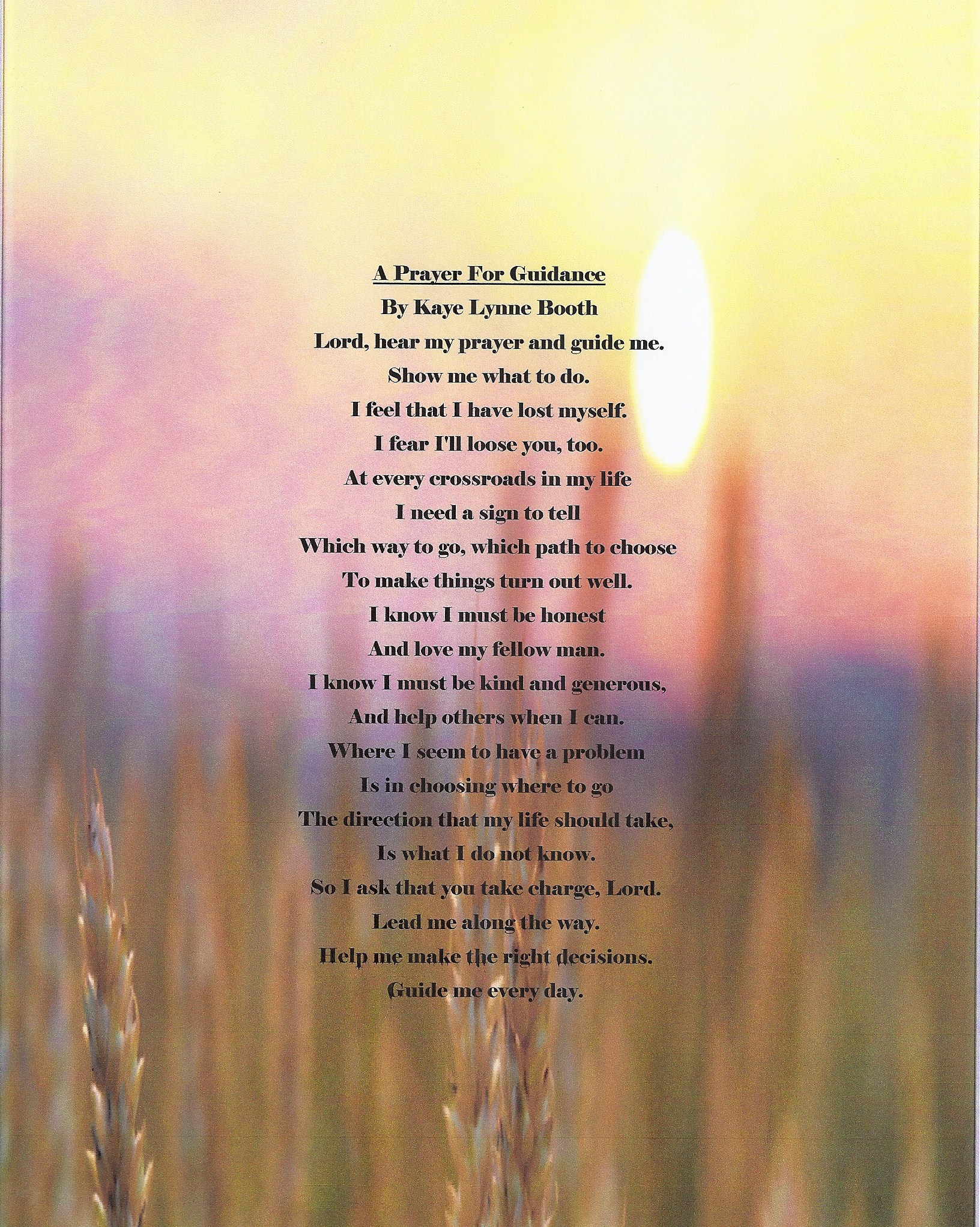
I put my poetry on backgrounds, like the one above for my very first writing event. It was a local event that a friend saw advertised in the paper and said, “You should see if you can get a table. I called and got a table at the event, then realized I had nothing to offer at my table. I hadn’t yet published a book or anything, so I printed up my poetry on backgrounds , which I sold at my table for $5 a piece, and made almost $100.
For that event, I had a poem called “Voices” about the different voices that speak in my head, and as I was searching for backgrounds, I came across a painting of the same title, that I knew was the perfect background for this poem. So I poked around on the internet until I found a way to contact the artist, Mitchell Barret, and sent him an email, requesting to use his painting as my background. I was more than surprised when I recieved a phone call from him all the way from England. You must understand that this was right at the beginning of the internet era, and I still had a land line with long distance charges, so a call from another contentent was a pretty big deal to me, and I absolutely adored his English accent, although I had to ask him to repeat himself a couple of times during the call. He gave me permission to use his painting for the writing fair, and we conversed for a while, sparking up a friendship that was one of my first internet networking experiences.

Poetry & Art
In a later contact, Mitch said he was working on a series of paintings and he would like to include some poetry with them. He sent me the sketches for the paintings, and I wrote a poem for him. “Intimacy and the Harliquin Dance”. To my knowledge only one of those paintings ever came to fruition, but he did use a portion of my poem in his painting, which he titled “Intimacy”. The painting was on display and was sold at the Keliedescope Gallery, in Battle Sea Park, London in 2010.

After Michael
When my son died in 2009, I wrote poetry almost constantly. When I wasn’t physically putting words to page, I was putting my feelings to verse in my head. I wrote enough poetry about Michael and my loss of him to fill a chapbook. It was my way of processing my grief, I think. I don’t know if any of it was really good, but I felt it to be some of the most powerful writing I’d ever done.
Most of my poetry was rhyming, and by this point, I had taking some creative writing courses, where my poetry professor informed me ryhming poetry was no longer in vogue. Because of the rhyming, sing-song style of my poetry, it was evaluated by one critic as childish. And perhaps it is a bit childish. Rhyming poetry is fun to write. I’m a big fan of Sid Shelden and Dr. Suess, after all.
When I enrolled at Western State Colorado Unversity to earn my M.F.A. in Creative Writing, my focus shifted away from poetry and I began writing fiction, which has taken up my energies ever since, but I’ve never lost my love for poetry. I still submitted poetry here and there, even getting a few published in magazines such as Colorado Life Magazine, and anthologies such as Manifest West #5: Serenity and Severity. I just wasn’t writing anything new in the poetry realm.
Renewed Interest
A couple of years ago, I came across a book by Colleen Chesebro, WordCraft Prose & Poetry: The Art of Crafting Syllabic Poetry, which delves into the art of syllabic poetry. I couldn’t read this book without dabbling with the different forms myself, reviving my love for poetry all over again. (See my “Review in Practice” of WordCraft Prose & Poetry here.) And I used my newfound poetry skills to answer a creative challenge posed on the blog of Teagan Riordan Geneviene with a Shadorma poem with an image.

Now that my M.A. in publishing is completed, I find a have more time in which to ponder the words which I place on the page, and play with poetry. For that is what poetry ultimately is – play with words. I don’t mean that it shouldn’t be taken seriously, but that creating with words, no matter the form it takes, should be fun and satisfying for the creator, and poetry offers a wider license for this than do other forms of writing. This is known over at Colleen M. Chesebro’s WordCraft Poetry blog, where every Tuesday brings a #TankaTuesday challenge involving syllabic poetry, introducing readers with all kinds of new poetic forms. And so, I’ve been revisiting poetry once again, playing with sllybic poetry and rhymes. (I still love rhyming poetry, even if it is out of fashion.)
A New Poetry Collection on the Horizon
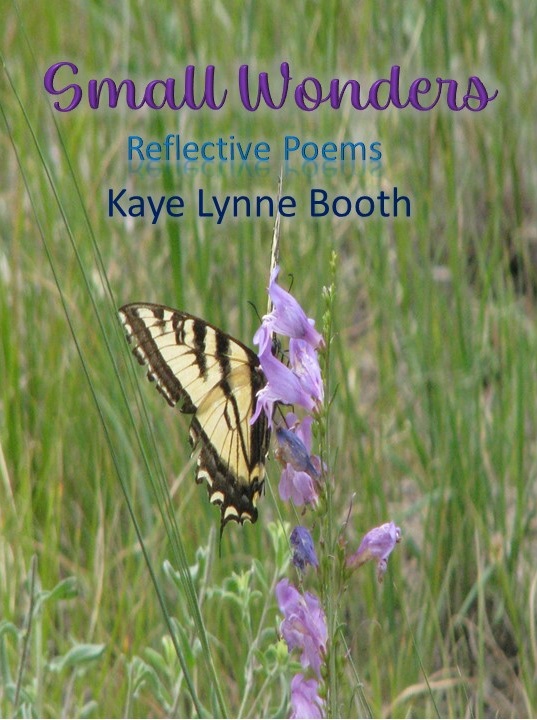
As I look through the poetry I’ve done in the past, I’m finding a plethora of poetry that needs to be shared. So, in addition to the two novels, and two anthologies which I had planned to publish through WordCrafter Press in 2023, I’m going to publish my first collection of poetry, some old, some new; some rhyming, some syllibic, and maybe even some freestyle to be included. It will take me down an old road to go through the poetry already written, and over a new road to experiment with forms of poetry both new and old, and the process of compiling the collection will be fun. Heck, it may even get me an invitation to be a guest on “Treasuring Poetry” with Robbie Cheadle.
To me, poetry is word play at its finest. What does poetry mean to you?
____________________________________________________________
Poetry Treasures 3: Passions in April
April is National Poetry Month here in the U.S., so it is fitting that the release of the annual Poetry Treasures anthology, from WordCrafter Press comes sometime in April each year. This year’s volume will be Poetry Treasures 3: Passions. It will be released on April 18, 2023, and is available now for preorder.
Preorder Link: https://books2read.com/u/b5qnBR

Passions treasures within.
Open the cover
and you will discover
the Poetry Treasures
of guests on
Roberta Eaton Cheadle’s
2022 “Treasuring Poetry” blog series
on Writing to be Read.
Included are treasures from:
Patty Fletcher, D. Wallace Peach, Yvette Prior,
Penny Wilson, Colleen M. Chesebro, Abbie Taylor,
Yvette Calliero, , Smitha Vishwaneth,
Chris Hall, Willow Willers, Rosemerry Wahtola Trommer,
and Roberta Eaton Cheadle
_______________________________________________________

For Kaye Lynne Booth, writing is a passion. Kaye Lynne is an author with published short fiction and poetry, both online and in print, including her short story collection, Last Call and Other Short Fiction; and her paranormal mystery novella, Hidden Secrets. Kaye holds a dual M.F.A. degree in Creative Writing with emphasis in genre fiction and screenwriting, and an M.A. in publishing. Kaye Lynne is the founder of WordCrafter Quality Writing & Author Services and WordCrafter Press. She also maintains an authors’ blog and website, Writing to be Read, where she publishes content of interest in the literary world.
___________________________________________________________
Want exclusive content? Join Kaye Lynne Booth & WordCrafter Press Readers’ Group for WordCrafter Press book & event news, including the awesome releases of author Kaye Lynne Booth. She won’t flood your inbox, she NEVER will sells her list, and you might get a freebie occasionally. Get a free digital copy of her short story collection, Last Call and Other Short Fiction, just for joining.
Share this:

WordCrafter Press Celebrates National Poetry Month
Posted: April 1, 2023 Filed under: Anthology, Book Promotion, Books, Collection, Poetry, Promotion, WordCrafter Press | Tags: Arthur Rosch, Behind Closed Doors, Feral Tenderness, National Poetry Month, Poetry, Poetry Anthology, Poetry Collection, Poetry Treasures, Poetry Treasures 2: Relationships, Robbie Cheadle, WordCrafter Press 3 Comments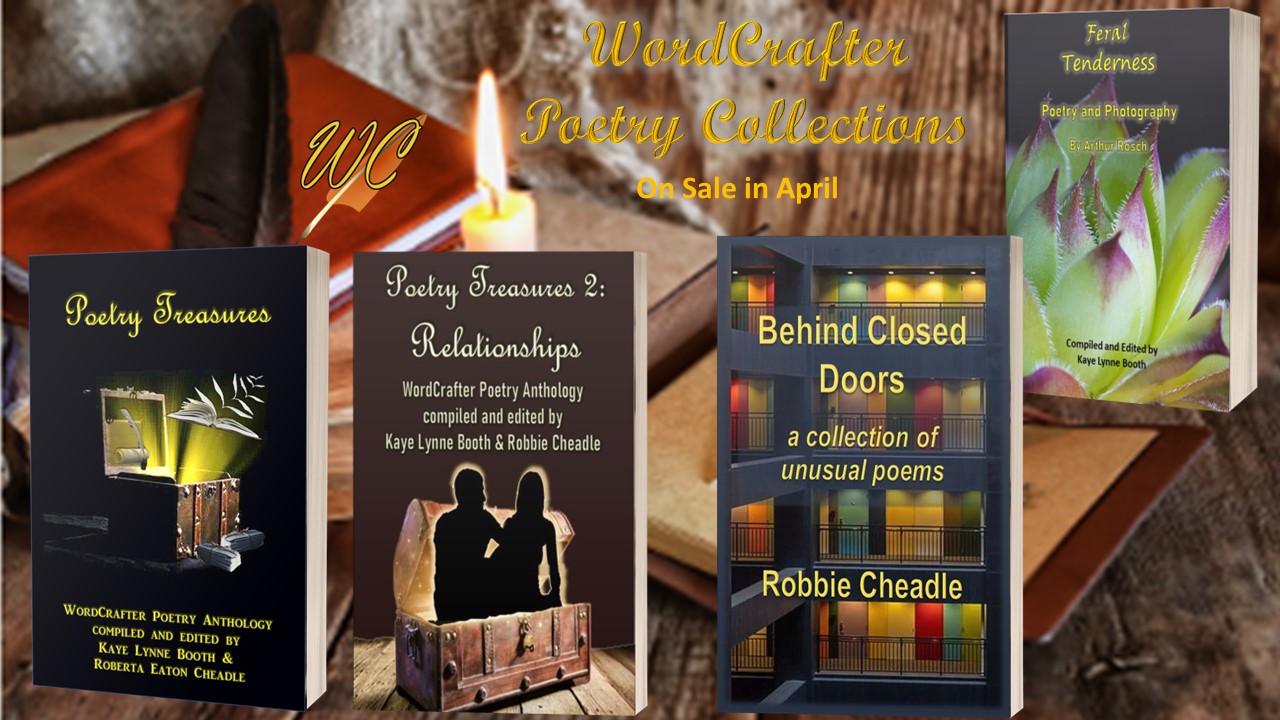
Celebrating National Poetry Month
April is National Poetry Month here in the U.S. and WordCrafter Press is celebrating the joy of the written word by putting four WordCrafter Press poetry books on sale for the whole month! You can get your copy of your favorite from your favorite book distributor.
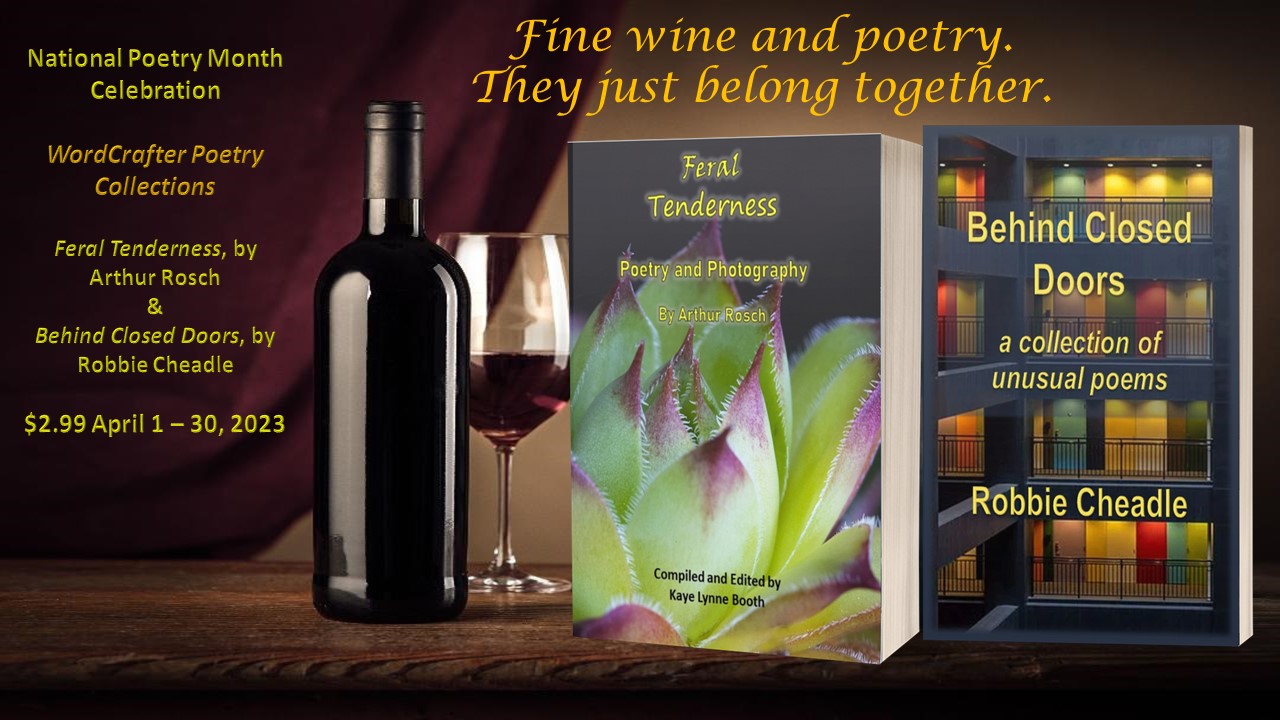
Behind Closed Doors, by Robbie Cheadle

Poetry Treasures 2: Relationships anthology
Share this:

Book Review: Blood Tingling Tales
Posted: March 31, 2023 Filed under: Book Review, Books, Fiction, Horror, Review, Short Fiction, Speculative Fiction, Stories | Tags: Blood Tingling Tales, Book Review, horror, Scary stories, Steve Hudgins, Writing to be Read 2 CommentsThe Book

Over 15 Tales of Terror told in a true story style that will send chills down your spine.
THE ROSWELL INCIDENT – This is what really happened!
STRANDED – He thought breaking down in the desert would be the worst part of his day…then he accepted a ride.
MY HAUNTED HOUSE – He hears someone walking around upstairs…but he’s home alone!
STAY ON THE TRAIL – You’re not supposed to step off of the mysterious trail. But what happens if you do?
SNUFF FILM – A gritty private detective is hired to find the origin of a snuff film. What he discovers is chilling!
SERIAL KILLER – A serial killer makes a shocking discovery at a summer camp!
GRAVE ROBBERS – What would it take for you to be buried alive?
DETOUR – A man is forced to make a detour that takes a terrifying turn.
These and other creepy short stories are waiting for you!
I am here to satisfy your scary short story anthology needs!
Purchase Link: https://www.amazon.com/Blood-Tingling-Tales-Vol-1-ebook/dp/B0BK3S96QT
My Review
Blood Tingling Tales, by Steve Hudgins are anything but blood tingling. Although some of these stories had the potential to be truly creepy, there was way too much telling and not nearly enough showing. These tales remind me of the ones we used to tell around the campfires or on sleepovers as kids, with not enough detail to be truly frightening or freaky.
While entertaining enough, the stories included in Blood Tingling Tales we’re not very scary. I give them three quills.

_____________________________________________________________
Kaye Lynne Booth does honest book reviews on Writing to be Read in exchange for ARCs. Have a book you’d like reviewed? You can request a review here.
Share this:

WordCrafter News
Posted: March 27, 2023 Filed under: Anthology, Book Release, Books, Dark Fantasy, Fiction, Ghost Stories, Giveaways, Horror, Open Submissions, Poetry, Speculative Fiction, Treasuring Poetry, WordCrafter Book Blog Tours, WordCrafter News, WordCrafter Press | Tags: 2023 Short Fiction Contest, Anthology, Deadline, Delilah, Giveaway, Open Submissions, Poetry Treasures 3: Passions, Winners, Women in the West adventure series, WordCrafter Book Blog Tours, WordCrafter News 10 Comments
Open Submissions Deadline Approaching

Submissions are open for the 2023 WordCrafter Short Fiction Contest, but the deadline of April 30th is fast approaching. This year I’m looking for the scariest story. So, send me your monsters, your zombies, your ghosts and your ghouls. Make me sweat. Keep me awake at night. Make me tremble in fear. And most importantly, make me think about your story long after I’ve put it down. The winner gets a $25 Amazon gift card and a guaranteed spot in WordCrafter’s annual anthology. You can find the full submission guidelines here.
April Release: Poetry Treasures 3: Passions
Each year WordCrafter Press puts out a poetry anthology, featuring the works of the previous year’s “Treasuring Poetry” blog series with Robbie Cheadle, which features poet/author guests from all around the globe. We release the anthology in the Poetry Treasures series in April each year, as a nod to National Poetry Month here in the U.S. This year’s anthology features the poetry of Robbie Cheadle, Smitha Vishwanath, Abbie Taylor, Chris Hall, Yvette M. Calleiro, Willow Willars, Rosemerry Wahtola Trommer, Patty Fletcher, Yvette Prior, Judy Mastrangelo, Penny Wilson, Colleen M. Chesebro and D. Wallace Peach. If you follow the blog series, I know you’ll agree that this line-up of poets comprises an all star cast of contributors.

Poetry Treasures 3: Passions will be released in April, in celebration of National Poetry Month, here in the U.S. Watch for updates on the release here,on Writing to be Read.
Delilah Tour Giveaway Winners

We had a great tour to celebrate the release of Delilah with most of your favorite distributors last week. You all gave it a great send off. I want to give a big round of applause for the hosts on this one; Robbie Cheadle, Miriam Hurdle and our brand new host, Kay Castenada, who did a fabulous debut tour stop. Also thanks so much to all those who participated and followed the tour. And now, the part of the tour where I get to give back a little. For this tour, we are giving away two digital copies and one signed print copy of Delilah.
So, without further ado…
The winners of the WordCrafter Delilah Book Blog Tour Giveaway are
The two digital copies go to Mae Clair and Jennie.
Jacqui Murray will recieve a signed print copy of Delilah.
All winners need to contact me at kayebooth@yahoo.com to claim their prize.
Congratulations to the winners!
_____________________________________________________________________
Want exclusive content? Join Kaye Lynne Booth & WordCrafter Press Readers’ Group for WordCrafter Press book & event news, including the awesome releases of author Kaye Lynne Booth. She won’t flood your inbox, she NEVER sells her list, and you might get a freebie occasionally. Get a free digital copy of her short story collection, Last Call and Other Short Fiction, just for joining.




















Writer’s Corner: Accessibility = More Readers
Posted: May 1, 2023 | Author: kayelynnebooth | Filed under: Accessibility, Adaptive Technology, Blog Content, Books, Commentary, Reader Platform, Writer's Corner, Writing | Tags: Accessibility, Adaptive Technology, Kaye Lynne Booth, Patty Fletcher, Print Disabilities, Visual Impairment, Writer's Corner, Writing to be Read | 89 CommentsDid you know that there is a large audience of readers, which many authors are overlooking with their books? It’s true. Visually impaired and those with other disabilities are limited in the availability of reading materials which they can access, and authors are limiting themselves if they exclude this vast potential audience.
As a publisher, I have worked with several print disabled authors, who have helped to educate me on the why making my content accessible is important and how to better reach the members of this very large community of potential readers. Patty Fletcher is a visually impaired author who works hard to make her blog content and books accessible to the visually impaired community of readers, and she advocates to educate her fellow authors on this important subject. She points out that the size of this potential audience is immense, “with millions of impaired or disabled readers, who would read if they could access the content.” (Patty Fletcher, email March 24, 2023).
As an author, I want to get my books in front of as many potential readers as possible. That’s why I publish wide and offer my works in as many different formats that I can. But here, right under my nose, is this huge group of potential readers that I was overlooking. And I know that many of my fellow authors do, too. As authors, it makes good sense to be concious of this large group of potential readers, and do what we can to make our own online content and books accessible to them. What a great way to extend your author reach and grow your reader platform.
In order to reach out to this audience of potential readers, we must have some understanding of what visual impairment and other types of print disabilities are like and how they affect the lives of those who must deal with these issues every day. Ann Chiapetta is visually impaired due to retinal disease, which she acquired later in life. In her article, “The Print Barrier“, she talks about how she has adapted to her visual impairment, and how it has changed the way others percieve her, and the frustration of trying to work with people who just don’t get it. Being visually impaired doesn’t mean no longer “doing”, but it does mean adapting so that “doing” is possible.
My grandmother was blind from diabetes, so her disability also came to her later in life. I’m told that when I was born, she could see me as a shadow, but whether she could see me or not, she helped to raise me. She took care of me during the day when I was little, while my mother, who was a single parent, was at work. When I started school, she was who got me off each day. I wore a side-ponytail long before it came into fashion because my grandmother was who fixed my hair. Some of the kids teased me about it, but I always thought it made me special and unique. I’ve never been one to do what everyone else is doing. My grandfather was a doctor, so my grandmother ran the household. She could move through the house alone, with the aide of a cane; she cooked by feel, and she got her entertainment from television, radio, and talking books. I often wonder what she would think of the internet and modern adaptive technology.
Patty Fletcher uses a screen reader, as do many visually impaired and print disabled individuals, as a means to access online content. Technology that wasn’t thought of or needed in my grandmother’s day. Patty recommends “The Importance of Alt Text for Screen Reader Users: A Guide to Best Practices and Accessibility by Virtual Tech Advisor and Research Assistant Casey Mathews” for a good place to go for understanding what the technology is and what it does, and how you can make your content more accessible for people using screen readers by adding alternative text to your images.
This is not a difficult thing to do, but it does take time. This is a work in progress for me here on Writing to be Read, because the site is very image heavy, but the recent release of Poetry Treasures 3: Passions had alternate text added to all of the images in that book. It was the first WordCrafter Press book to have alt text, and I was pleased to accomplish the feat. I feel strongly that it was worth the time it took, to not exclude those who access content differently from the way that I access it, visually.
While your book and your site should be accessible to all, including those with disabilities, it can’t stop there. We live in a world where much of our communications with the world, including advertising and promoting your brand and your book, is done through social media. If a potential reader can’t access the promotion to receive your message, they won’t be a potential reader for long. Patty Fletcher’s “Life of a Blind Girl: Your A-Z Guide to socail media accessibility“, touches all the important points on accessiblity. This article lays out ways to make content accesible that every author should be thinking about, and areas where we can do this that might be overlooked if you are not aware of readers or potential readers with disabilities. I’ve been focused on creating proper headings and adding alt text to my images. After reading Patty’s article, it seems my next step will be learning how to add captions to videos, so that I can reach hearing impared individuals.
It’s a lot to learn and can’t all be done overnight. My site is a work in progress on this front, but I’ll keep at it, because I believe it is important to make muy content accessible to all. I will also continue to work on making my books and social media content more accessible as I go. If you would like to learn more about making online content accessible to visually impaired and print disabled individuals, beyond the aboove articles, Content for Everyone, by Jeff Adams and Michele Lucchini, is a good book of reference. They discuss not only why accessible content is necessary, but ways that you can make your content more accessible for many types of visual disabilities. You can read my “Review in Practice” for this book here.
It’s a large potential audience, which could turn into readers of your work. How far will you go to make sure they can all access your content?
___________________________________________________________________
About Kaye Lynne Booth
For Kaye Lynne Booth, writing is a passion. Kaye Lynne is an author with published short fiction and poetry, both online and in print, including her short story collection, Last Call and Other Short Fiction; and her paranormal mystery novella, Hidden Secrets. Kaye holds a dual M.F.A. degree in Creative Writing with emphasis in genre fiction and screenwriting, and an M.A. in publishing. Kaye Lynne is the founder of WordCrafter Quality Writing & Author Services and WordCrafter Press. She also maintains an authors’ blog and website, Writing to be Read, where she publishes content of interest in the literary world.
______________________________________________________________
Want exclusive content? Join Kaye Lynne Booth & WordCrafter Press Readers’ Group for WordCrafter Press book & event news, including the awesome releases of author Kaye Lynne Booth. She won’t flood your inbox, she NEVER sells her list, and you might get a freebie occasionally. Get a free digital copy of her short story collection, Last Call and Other Short Fiction, just for joining.
Share this: