Treasuring Poetry – Meet poet, Ray Whitaker, and a review
Posted: September 9, 2026 Filed under: Collection, Poetry, Treasuring Poetry | Tags: Animals, Author Interview, Book Review, Poetry, Ray Whitaker, Robbie Cheadle, Writing to be Read 27 Comments
Today, I am delighted to welcome poet and editor of Masticadores Canada, Ray Whitaker, as my September Treasuring Poetry guest. You can find Masticadores Canada here: https://masticadorescanada.wordpress.com/ and the general submission guidelines are here: https://masticadorescanada.wordpress.com/submissions-guidelines/.
Tell us a bit about Ray Whitaker and your journey to becoming a poet.
All writers and poets are writing out of “the Self” however there are directions that the self speaks into, that change. Now Ray’s writing is to put foremost in his work, just who he is writing for. He intends on writing for the everyday man and woman. He firmly believes that poems need to reach into the everyday person’s pictures in their minds, and engage with those. This is where he aims to make a difference in his creative writing. He’s fulfilled when he sees that his work is provoking thought in his readers. Ray has six books published, and two chapbooks. His work has been published in fourteen different countries. He’s working on two new manuscripts now.
Ray was a Delegate to both the 2023-24 Writer’s International Panorama Festival in January, and is a Delegate to the 2025 Festival He participates regularly with several zoom poetic events worldwide. Among them, he has been spotlighted on a US National Poetry broadcast from Quintessential Listening Poetry Online Radio In April, ’24; and also an International Poetry Recital hosted by The Fertile Minds out of India this past April 19th, 2025. In May ‘26 he was the reading featured poet in David Leo Sirois’ Spoken Word Online, associated with Spoken Word Paris. He was a one of the featured Poets on Mayori Literature associated
with Poetry Global Network this past August. He is Moderator for Michael Lee Johnson’s FB “My Voice,Your Words- Poetry In Action” page; and Editor for Masticadores Canada Journal.
Can be found at FB: Whitjr1, his personal website is “raywhitakerpoet.com” and at Masticadores Canada. wordpress.masticadores.canada.com
What is your favourite style for writing poems and why?
I have to say that my favorite style, or form, of poetry writing is American Freestyle. I do not stick to a particular form, which is how I have lived my life as well. Being rather disciplined about being un-disciplined, I have continually engaged this “form” as a Poet.
I have written poems in several different forms. However, do not consider the sonnets I have written to fine examples of that form. Haiku is another form, that I feel my works are pretty good.
If I ever take a Masters degree in Creative Writing, it is possible that that educational endeavor will expose me to the many other forms of Poetry. Here, I must also say that I have a difficult time considering myself as a “Poet”. I am well-read in preceding poets, altho there are many I still intend to read the work of. I am continually humbled by the Men and Women Poets that have walked before me. There is a part of me that resides in comparison with these acclaimed individuals, and I always wonder how history will judge my work.
Which of your own poem is your favourite?
Ahh, this is a hard Q to answer.
I have a handful of poems that I consider especially near and dear. You want one to suffice to answer this Q. So I will attempt to choose one!
After much soul searching, here are two [I simply cannot choose one!]:
The first piece, NO WAR, is a honest memorial to my own Father. Written many years ago. He was my hero, as I was coming along, and even to this day. His examples still resides in me, those of courage, determination, resilience and ability.
The second piece, BLACK BISON, is a current favorite of mine. Written last month, in August. It reflects a couple of my loves:
–my memories of dreams, that I write down every morning after waking.
–my love for Nature and it’s remarkable diversity, my awe of God’s creations.
NO WAR
My Father did not plant fruit trees
or a garden with any sort of vegetable,
like a tomato plant, or peppers.
It was I that planted, harvested all of that.
His example did not lodge with me
never having flown down from the sky
wrapped in a fighter plane
machine guns blazing towards a ground confined enemy
they there, trembling in fear, hiding from
his bullets and bombs thrown while in God’s bubble.
I loved him so, yet my path differed
the healing arts chose me as sure as water churns in rapids
born unafraid of cleaning up lacerations, wiping blood from torn flesh
when someone’s life was seeping away
staunching the flow
with giving a damn ever present, it was
acceptable risk to be in combat with purulent infection
.
He was a great man even having never planted a plum tree
his bravery and deciding loving family decisions made
did lodge with me, so it is now that he is gone
as it was when he, my best friend, was still here amongst us
his courage tempered my abundant compassion
like the wind rippling the fall colors
in an autumn high plains field.
I can’t fly a fighter plane
or command a tactical sortie in dive bombing a bridge
I have come home with blood on my scrubs tho
bearing stains from other’s wounds, having worked
like a mule plowing furrows, towards healing Life’s casualties
and I have planted plum trees, some were for him
his face peering out from the green leaves
feeling his hands on the shovel with mine.
BLACK BISON
Out of the grey mists of dreams
he approached me
friendly, stepping carefully
to stand silently beside
nuzzled me in friendship
no words were spoken
even so, there was a communication
on these green grassy plains
daylight, now under a blue sky
few clouds going where they will
a sudden gentle breeze blew
while we were standing together.
I put my arm around his great neck
a loving embrace
like between two friends,
a closeness unrivaled
beast and human
not threatening
as in a natural place
without fear.
Black bison then spoke to me
out of the times and places
his story was quite clear
about the millions of his clan murdered
for skins and bones,
of the mountains of skulls piled,
and the shock
of The First Peoples.
Then we spoke about the strength of endurance
the hidden qualities of independent self reliance
the answered prayers when abundance appeared
of prosperity
a sign of depth
a grounding for the unknown future.
There was no longer a mist about,
dapper sunlight beat down
upon our faces.
A sense of purpose
towards the highest
those hunting grounds of the conscious,
the resilience of the qualities of twoness
our eyes met, again
speaking, Human
told Bison of the path
toward that place
where thoughts were as a dream
when The Peace was sought and found
there Human and Bison lived together
and did not have
the hypocrisy of carelessness
of the weakness producing impatience
of oversensitive intolerance
where prayers were for the tremendous events
within the Great Mystery.
Which poem by another poet is your favourite?
Another difficult Q to answer. Did you stay up nights dreaming up Q’s that were incredibly rich, for folks like us to answer?
I have around 150 books of Poetry on my library shelves. There are many from The Dead Poets Society [credit given to Robin William’s movie by the same name], as well as the flock of remarkable Poets writing today. I really love many of them.
Among them, I should mention a few of my “Poet Heroes.” These are the Poets I really love, their many works, and are the ones I am going to choose that answer to this incredibly difficult Q. They are The Irishman Seamus Heaney, the American Billy Collins, the Swede Tomas Transtormer, the Native American N.
Scott Momaday, the American Woman Mary Oliver…. are but a few.
You really are going to make me choose one…. hmmm….
I recently lost a Dear Cousin, and was asked to read a poem at her funeral. This is the one, by Tomas Transtormer:
THE HALF FINISHED HEAVEN, by Tomas Transtormer
from his book by the same name, 2001, Greywolf Press, pp 23.
Cowardice breaks off on its path.
Anguish breaks off on its path.
The vulture breaks off in its flight.
The eager light runs into the open
even ghosts take a drink.
And our paintings see the air,
red beasts of ice-age studios.
Everything starts to look around.
We go out in the sun by hundreds.
Every person is a half-open door
leading to a room for everyone.
The endless field under us.
Water glitters in the trees.
The lake is a window into the earth.
What’s next for Ray Whitaker?
I have discovered a new true love in my late sixties. It isn’t a Woman; I have been lucky enough to have two real loves with significant Women in my Life. Both of them are gone now. Now in my seventies, it is the writing of poems. In my mantra of undisciplined discipline, I choose to do something creative every day.
So, look for a new book of poems most every year, a regular highlighting of other Poets worth reading, and a developing interest in getting out there -Globally- with my own Poems.
My review of Animals by Ray Whitaker
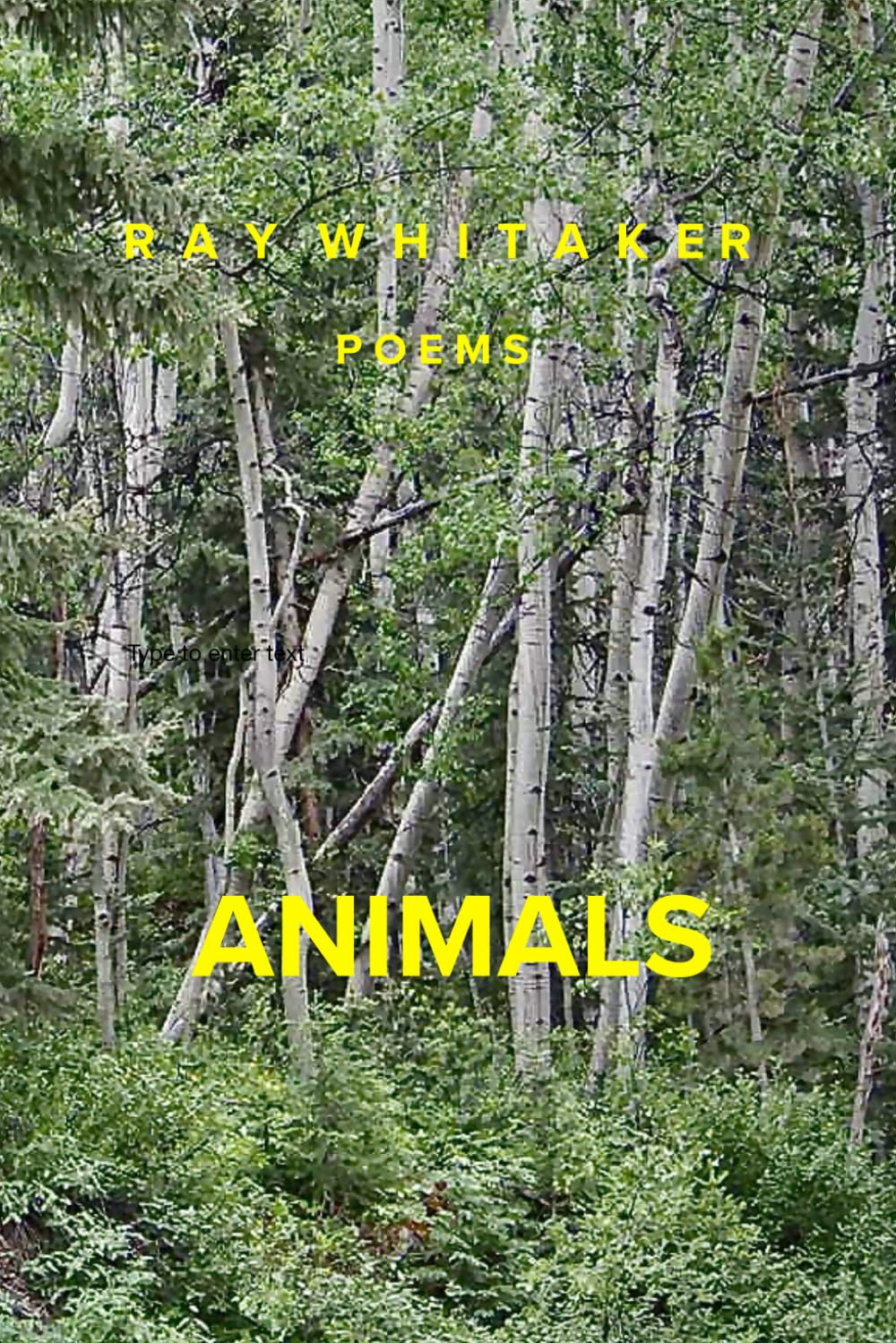
I have enjoyed some of this poet’s writing on-line so I was pleased to see he had some published collections. When I saw the title and blurb for Animals I was thrilled as I am a huge animal lover. I was not disappointed as this book is packed full of wonderful tributes to the fauna that inhabits Ray Whitaker’s world. The collection also features glorious word pictures of the landscapes comprising the eastern range of the Rockies in Colorado. I have never visited this part of the world but the poet’s descriptions left me feeling as if I was experiencing it all in person.
The poems cover a wide range of experiences of the natural kingdom from rare and shy wild animals to domestic pets and also working animals. One of the poems about the amazing relationship between a dog and his human that has stayed with me is Warrior Loves a Dog. This is a short extract from this powerful poem:
“he and his dog sense
they could be, just perhaps
are but one in the present
and also in the past,
bridging a Love so absent
in those red enemy skies”
On the other side of the coin of the animal world are wild creatures in the wilderness. This extract is from a poem called In a Tent on the Bear Preserve and captures the joy of camping in a bear preserve and experiencing a bear in its natural environment from a close proximity:
“The Black Bear walked nearby on the lake’s rocky shore,
Careless in moving stones about
her tracks distinguish, define
there are no fish to catch in this place.
The tracks move away from where the waves lap
vanishing as silent as a leaf falling in the wood.”
Other poems pay tribute to the rivers and mountains. One such poem is Two Rivers which describes the power of two rivers meeting and joining forces becoming “one mighty flow.”
There are also some reflections on the benefits of engaging with nature and embracing its harmony and peace. Walking That Old Road Again is one such poem and I loved this verse:
“You can sit on the place of the broad, open bank
with your feet in the water
sunlight and water splashing on wet toes, it’s just sterling
wondering where next is it you need to go,
to continue to grow,
which path is there, to take you to destiny cares.”
A beautiful collection that will bring peace and gratitude into your heart and soul.
Purchase Animals by Ray Whitaker from Amazon US here: https://www.amazon.com/ANIMALS-Poems-Ray-Whitaker/dp/B0F3TYTCFN
About Ray Whitaker

I have long aspired to be a writer since I was young. Throughout my writing journey, I struggled with finding my voice. When I wrote my first fantasy book Dragon’s Breath I discovered my voice for the first time. Writing fantasy for young adults has become a passion of mine. I hope to create more work in the future that people can enjoy. With enough hard work and effort, anyone can archive their goals.
About Robbie Cheadle

South African author and illustrator, Robbie Cheadle, has written and illustrated sixteen children’s books, illustrated a further three children’s books, and written and illustrated three poetry books. Her work has also appeared in poetry and short story anthologies.
Robbie also has two novels and a collection of short stories published under the name of Roberta Eaton Cheadle and has horror, paranormal, and fantasy short stories featured in several anthologies under this name.
You can find Robbie Cheadle’s artwork, fondant and cake artwork, and all her books on her website here: https://www.robbiecheadle.co.za/
________________________
Did you know you can sponsor your favorite blog series or even a single post with an advertisement for your book? Stop by the WtbR Sponsor Page and let me advertise your book, or you can make a donation to Writing to be Read for as little as a cup of coffee, If you’d like to show your support for this author and WordCrafter Press.
__________________________
This segment of “Treasuring Poetry” is sponsored by WordCrafter Press and the Poetry Treasures series.
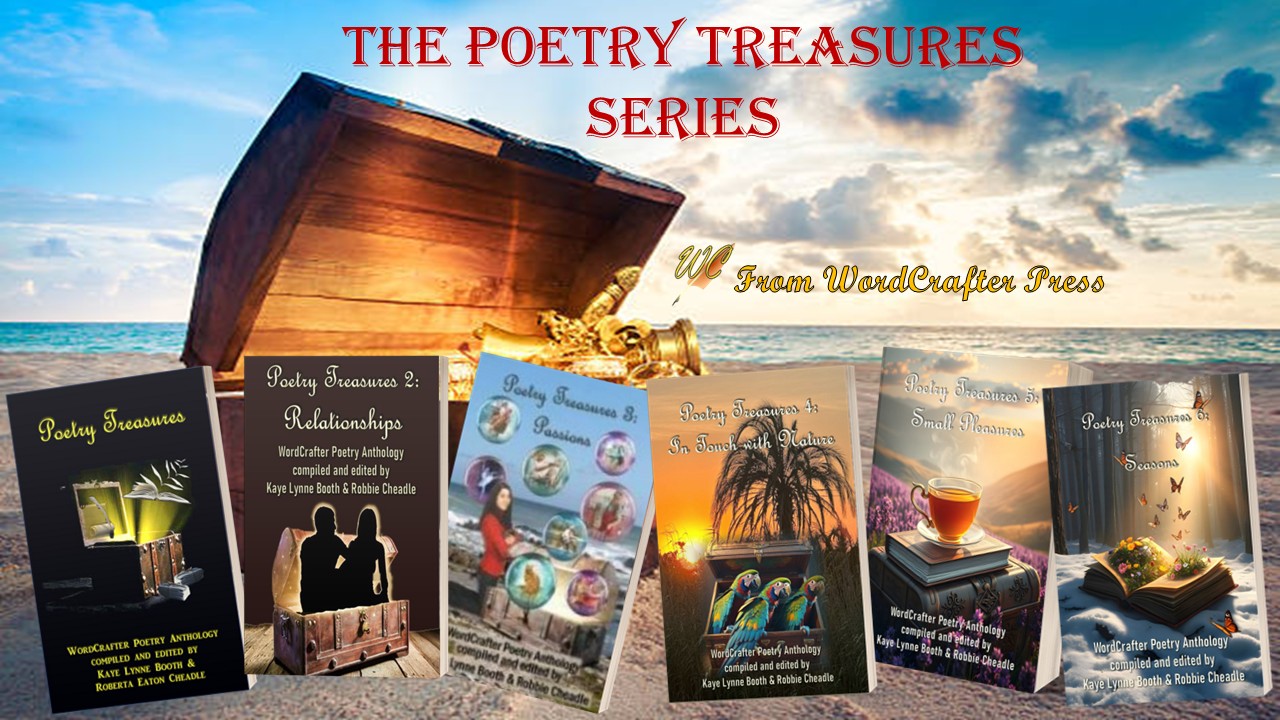
Get Your Copy Today!
Poetry Treasures: https://books2read.com/PoetryTreasures
Poetry Treasures 2: Relationships: https://books2read.com/PT2-Relationships
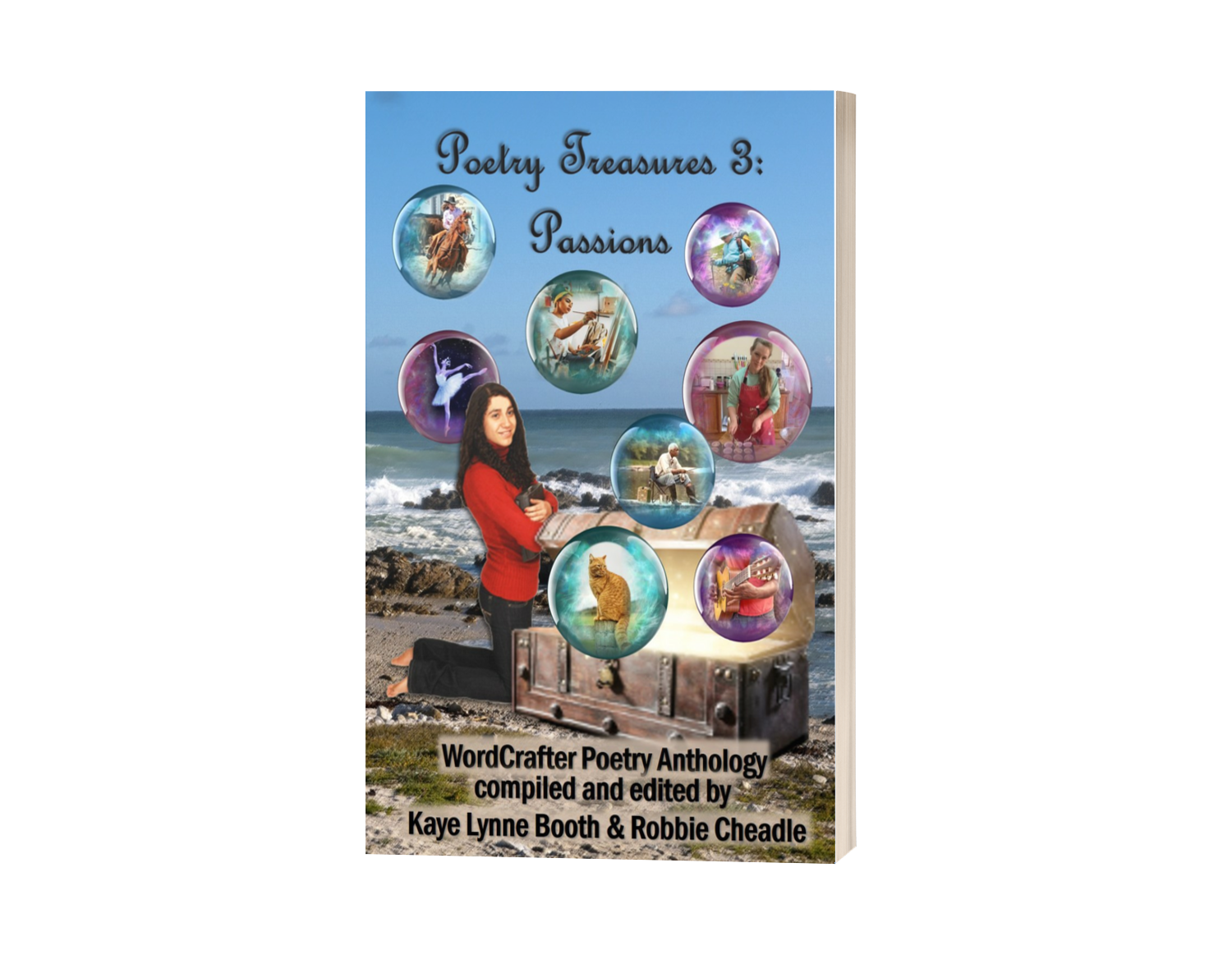
Poetry Treasures 3: Passions: https://books2read.com/u/b5qnBR
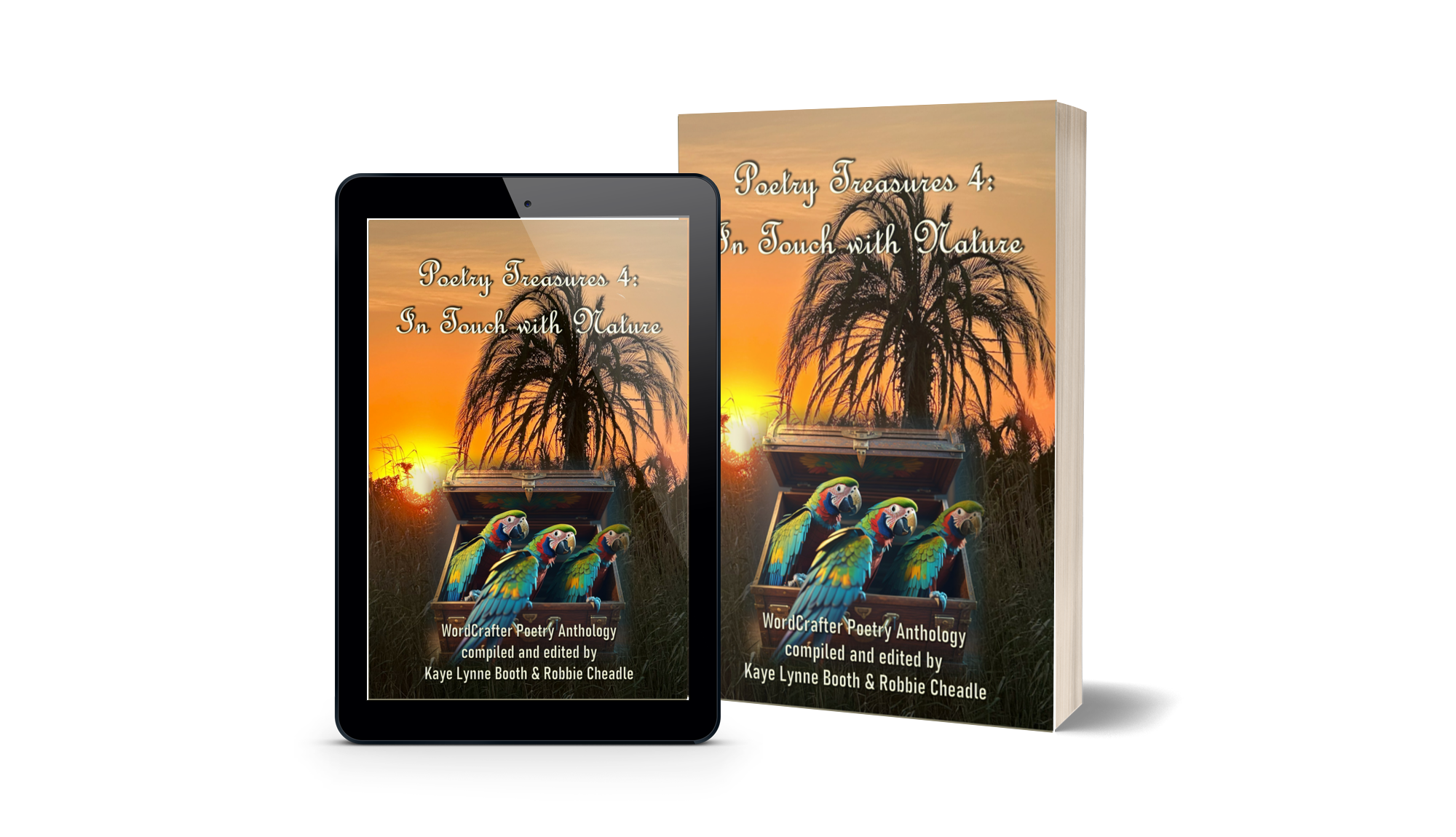
Poetry Treasures 4:In Touch With Nature: https://books2read.com/PT4-Nature
Poetry Treasures 5: Small Pleasures: https://books2read.com/PT5-SmallPleasures
Poetry Treasures 6: Seasons: https://books2read.com/PT6Seasons
Share this:

LINDSEY’S WRITING PRACTICE: A Review
Posted: September 2, 2026 Filed under: Book Review, Books, Collection, Lindsey's Writing Practice, Poetry, Review | Tags: Backstories, Book Reveiw, Lindsey Martin-Bowen, Lindsey's Writing Practice, Maryfrances Wagner, Poetry, Writing be Read 1 Comment
Backstories Poems by Maryfrances Wagner A REVIEW by Lindsey Martin-Bowen
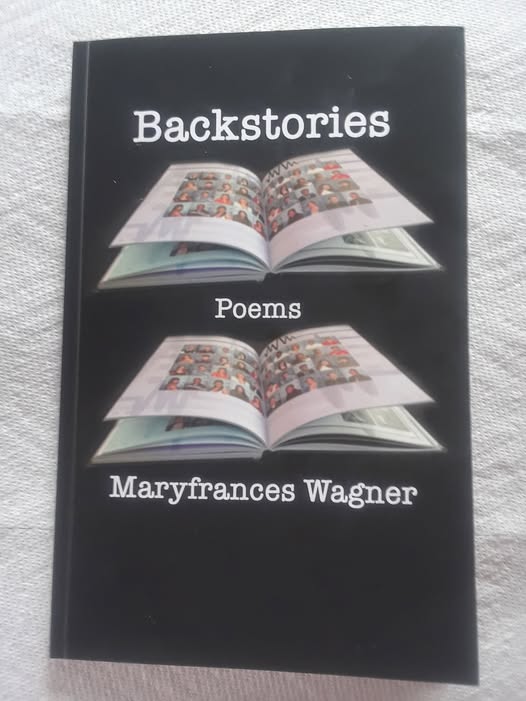
No doubt, this collection by established teacher and poet Maryfrances Wagner reveals
stories may rightfully appear in the form of poetry, too. Certainly, these 52 poems evoke laughter, tears, and definite insights to the chaotic world of high school students from the late 1960s though the 2000s.
For Wagner, teaching was a lifelong quest. “In third grade, I told my family I wanted to be a teacher,” she recalls. Thus, Wagner requested a desk for Christmas, and received a fine roll-top. The next year, she requested a chalk board and received one.
Then, she asked for books, “so I could start creating lessons.”
By sixth grade, she employed these tools to teach neighborhood children a week of “Bible school.”
“The passion never ebbed, I walked into my first year of high school juniors as
though I’d been teaching for years,” she recalled. “After all, I had, but what I didn’t know was how much I would learn about my students, myself, human nature, and inequality during the years I taught.”
The section of poems about—and sometimes written by—her students, opens with “Chuck,” a student in one of her high school classes, who
“. . .takes a seat so close he taps my desk.
Every day a Polo, dress pants, buttery loafers . . .
He’s 18, I’m 21. He doesn’t treat me as his teacher
ready to discuss Lord of the Flies. Behind his silky
voice and Gucci shoes, I see his mean. He instigates
fights and whacks small boys, particularly Juan—”
The poem entails what happens when the bully Chuck attacked the scholarly Juan (somewhat equivalent to “Piggy” in Lord of the Flies) in the restroom, resulting in an ambulance arriving at the high school. Wagner’s poem notes that when “the gurney arrived, Juan
was unconscious. Chuck earned his last credits
on Homebound. Juan’s parents moved to Texas.
A door had opened into a new darkness. . .”
Yet, such a traumatic experience didn’t stop Wagner from pursuing her dream. In her journals, she never quit, but documented these and other events, which she later transformed into poems.
Obviously, most of the poems don’t contain such violence, and the collection includes humorous events, sorrowful, and ironic passages in four sections, interlaced with collages Wagner created, among them, “Future?” “That Fault in Ourselves” (which includes a photo of Julius Caesar’s bust”), “Up a Tree,” containing a photo of the cover for A Separate Peace, “Hope,” including Dickinson’s line ‘hope is the thing with feathers,” “Homework,” which centers around a profile of a youth with the word “Promise” across its forehead.
Indeed, the humorous and thoughtful poems especially caught my attention, such as in, “My Sophomores View the Eclipse,” wherein the class “set aside Brutus’s soliloquy” (from Julius Caesar) “to poke pinholes into paper, tear a second sheet for viewing. . .” and “Worthy of her role as Casca, Emily stabs her paper five times.”
Plus, Wagner includes a found poem that evokes chuckles, “The Sophomores Study Grammar: A Found Poem,” containing such delightful lines as
“Why do we have to study grammar? We already
know how to speak and understand each other.
“You expect us to learn all this in one unit?
I’ve never heard of a verbal in all my life, only gerbils.”
One of the most fascinating sections of this collection includes “The Detention Suite,” comprising poems written solely by students during detention. Here, Wagner reveals she was a teacher “ahead of her time.” How so? Rather than using the school’s standard detention room, she designed her own detention, wherein, in lieu of punishment, student were encouraged to explore why they “acted out.”
I endorse such wisdom: Perhaps by learning how to understand and better meet their emotional needs, “problem” students may more easily grow into adults in lieu of into narcissists, who must—and often cruelly—demand center stage. And not only that, reading these poems by students evoked many chuckles. These are the openings of
some of my favorites:
“Brandon Langford Talks Through Detention”
“. . . I don’t even understand why I have detention.
You tell us to say what we think. I spoke
my thoughts, and that’s my right. My dad
does it all the time, freedom of speech,
and we cheer. Well, we did. He’s a combat vet,
but now he’s in prison for child porn
and hitting my mom. She’s glad he’s gone. . . ”
“Danielle Dances in a Mosh Pit”
“What did you do
last weekend?
You probably
sharpened pencils
or bought
new red pens.
I’m only
kidding.
Me and Carly went
to a headbanger
and danced
in a mosh pit.
We were the only
girls in there. . .”
“Niki Comes in Complaining”
“I still don’t why I’m here. I’m one of your best
students, I turn in my work, and I read the dreadful
literature you assign us like it means something
to me. I probably should zip my mouth before I say
what I think, but how can I relate to Hester Pryne? . . .”
“Scott Whittington II Stoops to Detention”
“I should not have to be here.
Do you know who my father is?
He has a street named after him.
He could get you into so much trouble.
At the least, you can expect a call. . .”
“Holly Keeps on Talking through Detention”
“Well, here I am, nd I’m gonna try not to talk
nonstop since that’s the reason I’m here, but
you know me. Mostly, I can’t help myself like
when Jeff Bell was nominated for homecoming
queen. That was big news. . .”
“Libby Steps in for Her Brother Connor”
“Hey, I know I’m not the one who’s
supposed to serve detention, but I’m
Connor’s proxy today. He has to work
a baseball game. He’s one of the lucky
ones who got a job with the Royals.
He’s been busy looking up sources
for hemp for his research paper. Your
class is one of the few he attends. He wants
that college credit even though he’s late.
After all, it’s first hour. He has a to
of excuses for missing other classes. . .”
“Brian Baker Dishes Out”
“Do you wonder at all why I hide in the hall
or want passes to the bathroom? I hate
working in groups. They hand me questions
and say, You’re the one, man, like that’s going
to make me wanna help them. Anything I say
hangs in the air like a comic bubble. I’m
in the wrong place. I like to read Aristotle,
and everyone looks at me like I’m trying
to suck up. Who would I be sucking up to?
You never assigned Aristotle. I read
Homer and Shakespeare, too, and I don’t
need your help. You should leave me alone
and be happy that I am busy learning. . .”
“Carlos Martinez Has His Say in Detention”
“Some teachers overlook little things,
like talking or not having homework. I laugh
in the face of homework, and I’m not giving
back this pencil I borrowed because you gave me
detention, It’s mine now. You expect too much,
and those emails you send my mom do no good.
She shows them to me, and we laugh. . .”
Finally, as another teacher (albeit, never for high school), I can especially
relate to one of the poems Maryfrances Wagner wrote in the final section of Backstories, entitled, “Grading,” from which I included most lines—not all—to avoid violating copyright laws:
“We’ve watched
the moon sag
into tomorrow,
ready to set down
our pens. . .
They argued
their case,
we ours—
more detail,
another example,
better verbs. . .
Ink glides its
well-oiled
ball bearings,
eager to praise
a phrase,
to find
a moment
of thought.
Along with serving as Missouri’s Sixth Poet Laureate from 2021-2023, Maryfrances Wagner was the 2020 Missouri Individual Artist of the Year. She serves as a co-editor of I-70 Review and as president of The Writers Place board and programming chair. He poetry collection Red Silk, recently re-issued by BookMark Press. Won the Thorpe Menn book award and was first runner up in the Eric Hoffer Legacy Award 2024 and short-listed for the Grand Prize Poetry. Her poems have appeared in many notable poetry journals nationwide, including New Letters, Midwest Quarterly, Laurel Review, Main Street Rag, Rattle, Voices in Italian Americana, and Unsettling America: An Anthology of Contemporary Multicultural Poetry (Penguin). More than nineof her poetry collections have been released by various publishers.
Thank you, Maryfrances Wagner, for penning such an engaging collection.
—Lindsey Martin-Bowen
About Lindsey Martin-Bowen
On Halloween 2023, redbat books released Lindsey Martin-Bowen’s 7th poetry collection, CASHING CHECKS with Jim Morrison. Her 4th collection, Where Water Meets the Rock, was nominated for a Pulitzer; her 3rd, CROSSING KANSAS with Jim Morrison was a finalist in the QuillsEdge Press 2015-2016 Contest. In 2017, it won the Kansas Writers Assn award, “Looks Like a Million.” Writer’s Digest gave her “Vegetable Linguistics” an Honorable Mention in its 85th Annual (2017) Contest. Her Inside Virgil’s Garage (Chatter House Press 2013) was a runner-up in the 2015 Nelson Poetry Book Award. McClatchy Newspapers named her Standing on the Edge of the World (Woodley Press/Washburn University) was one of the Ten Top Poetry Books of 2008. It was nominated for a Pen Award.
___________________________________________
Did you know you can sponsor your favorite blog series or even a single post with an advertisement for your book? Stop by the WtbR Sponsor Page and let me advertise your book, or you can make a donation to Writing to be Read for as little as a cup of coffee, If you’d like to show your support for this author and WordCrafter Press.
____________________________________________
This segment of “Lindsey’s Writing Practice” is sponsored by Undawnted.

Step Into the Undawnted Universe
Some authors write in one lane. DL Mullan builds worlds — and then dares you to walk into every single one of them.
Welcome to Undawnted, where imagination is fearless. Whether you’re craving a slow-burn paranormal romance, a bone-chilling horror story, a mind-bending sci-fi thriller, or songs/lyrical poetry that lingers long after the last line- there’s a feeling here waiting to pull you in.
Fall for the forbidden. In Nocturnal Redemption trilogy, mythology professor Ryan Blackburn has spent her life studying the legend of humanity’s protectors — never expecting to meet a pack of werewolves and a vampire on his nightly rounds. Her family’s myths weren’t myths at all. As she’s drawn into the vampire’s hidden world, one thing becomes clear: no one is as they appear.
Fear what’s waiting in the woods. Kurst asks a simple, terrifying question: what could go wrong when you inherit a cabin in the woods? The answer involves a sasquatch, skinwalker, and medicine man — and readers have called it a masterclass in horror with “a good dark secret” at its heart. It’s part of the acclaimed Midnight Garden anthology, a dark fiction collection praised for delivering “the printed version of jump scares.”
Chase the multigenerational curse. Fans of atmospheric enigmas will want to dive into the Salt Pines Mystery series, where a family curse spans generations and secrets refuse to stay buried.
Go beyond the ordinary. In the sci-fi novelette The Reality Hackers, reality itself isn’t as constant as you think. And for readers who want an ongoing saga, DL Mullan’s multi-book Legacy Universe — a supernatural superhero series — is currently in the works, promising an expanding mythology for readers who like to get lost in a world for the long haul.
Need something lighter? The Town Santa Forgot brings warmth and holiday charm for readers who want romance with a side of magic, while DL Mullan’s poetry collections — including The Descent, Impetus, Effloresce, and Phantastic — offer a darker, Poe-and-Dickinson-inspired verse for poetry lovers who like their beauty a little haunted.
Why readers keep coming back: DL Mullan isn’t just a writer — she’s a classically trained musician, award-winning digital artist, and lifelong storyteller who designs her own book covers and builds entire creative universes around each release. That range shows: every story carries the fingerprints of someone who thinks in full sensory perception, not just plots.
Your next favorite book is waiting. Whether you want to be swept into romance, spooked by horror, hooked by mystery, or moved by poetry, Undawnted has a story with your name on it. New releases, exclusive updates, and giveaways are just a subscription away.
Visit www.undawnted.comto explore the growing library, read excerpts, listen to soundtracks, and find your next obsession.
SIgn up for the Undawntable Newsletter.
Like/Comment/Subscribe to Undawnted’s YouTube channel.
Undawnted: Read. Feel. Discover.
Share this:

Treasuring Poetry – Meet poet and author Jan Sikes and a review
Posted: August 12, 2026 Filed under: Book Review, Books, Collection, Interview, Poetry, Review, Treasuring Poetry | Tags: Book Review, Interview, Poetry, Robbie Cheadle, Treasuring Poetry, Writing to be Read 97 Comments
I’m delighted to welcome author and poet, Jan Sikes, as this month’s Treasuring Poetry guest. Jan is the author of a significant number of novels, novellas and short stories and she has recently published a collection of short stories and poems including contributions from her late husband, Rick Sikes, and her granddaughter, Sydney.
Welcome Jan
What is your favourite style of poetry?
My favorite style of poetry is free-form, but I do like rhyming and while I don’t know the exact terminology for this type of poetry, it follows a lyrical rhyming pattern of 1,3,5,7 etc. In other words, the first and third lines will rhyme, alternating that way throughout the poem. That’s the easiest for me to write as well. Another way I love to write is alternate rhyming 1&2, then 3&4 like we see in the Frost poem below.
What is your favourite poem?
My favorite poem is from Robert Frost – Nothing Gold Can Stay
Nature’s first green is gold,
Her hardest hue to hold.
Her early leaf’s a flower;
But only so an hour.
Then leaf subsides to leaf.
So Eden sank to grief,
So dawn goes down to day.
Nothing gold can stay.
What inspired you to publish Fringes, heartstrings and lyrics?
The inspiration started with looking at all the short stories I’d published in obscure anthologies throughout the years. I wanted to bring them all together in one book. I also wanted to include some of my late husband’s earliest poems from the 1960s and then as the project came together, my granddaughter shared some of her poetry with me and I was gobsmacked! In the process of gathering material, I found some my own poems that had never been shared anywhere, so I included them as well.
What is the meaning behind fringes in the title?
Since some of the short stories were dystopian or ‘dark’ the Fringes in the title is meant to depict that section. Sometimes what happens on the fringes is powerful and moving. That was the intent for using that word in the title.
What is your favourite poem in this collection?
I have several favorites, but if I had to choose only one, I’d choose “Society” written by my granddaughter. It is very deep for a fourteen-year-old girl. It is truth!
Welcome to society
We hope you enjoy your stay
You can do anything you want
As long as you do it our way
You can like any guy
As long as he’s 6 foot 2
He must have ocean blue eyes
And a six-figure business too
Here in society, people are the same
‘Cause if you’re different you’re weird
You’ll sit at a table all alone
Kids will laugh and point and sneer
Our government sucks but you can’t revolt
There’s this cage we call a jail
You just have to sit and suffer
So try not to slip up and fail
And please feel free to be yourself
As long as it’s in the right way
Because in society, things work differently
Every single day
Welcome to society
We’ve got one last trick up our sleeve
The last important rule here
Is that you can never leave
My review of Fringes, Heartstrings and Lyrics by Jan Sikes
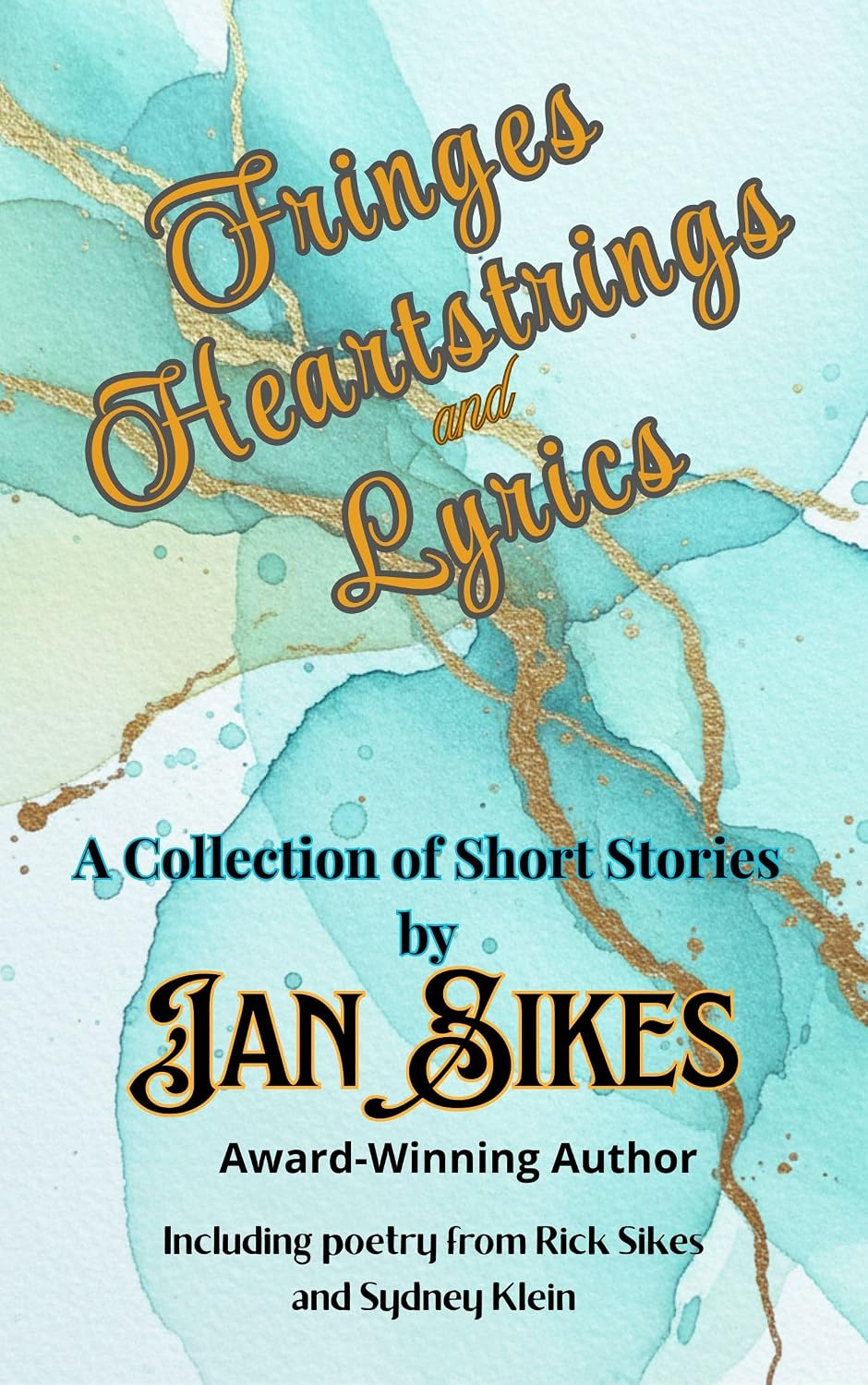
This is a varied and interesting collection of short stories and poems by Jan Sikes with poetry contributions by her late husband, Rick Sikes, and her Granddaughter, Sidney. The stories transition from darker tales to lighter ones with the first grouping being mainly bleak dystopian outlooks where love and kindness are the only remaining hope.
Each of the three poets contributes thought provoking and beautiful poems about life, love, and human perspective. I enjoyed each and every poem.
An overview of three of my favourite stories follows:
The Forgotten – This is an imaginative and unique story about a race of people, the Egluna, on a planet that has not seen the the sun for many moons. The people have become as wasted and colourless as their planet and have lost hope. New hope returns in the form of two vibrant and colourful creatures, one male and the other female, called ‘Fresh Ones’. The pair have powers and are able to reinvigorate the dying plant life on the planet. Will the couple be able to rejuvenate hope in the future for the Egluna too. I enjoyed this interesting take on climate change and its potential consequences.
A Promise Broken – A Promise Kept – While this story stands alone, it is also the backstory for a character who reappears in one of the author’s novels. I have read the relevant novel and was delighted to come across this character in her younger years and learn about her past and how it shaped her present in that novel. Charlotte’s story is one of strength, resilience and maturity.
When Love isn’t Enough – This is another story about difficult decisions arising from rebellion due to an overbearing and inflexible father. Riley is fortunate as she has a friend she can confide in and get good advice from but ultimately she has to make the right decision herself. This story has an interesting and unexpected ending.
The poem that resonated with me the most is called Too Dark and is by Sydney. This poem tells of the reaction of the poet’s mother and family to a dark poem that she is proud of. Her family are shocked at the poems darkness. I related to this because my son writes poetry and it is also very dark. I am always a bit shocked by the darkness of his views and thoughts on life and society. I think all the negative social media and press is having a negative impact on youngsters and making them feel hopeless. It is something the older generations needs to be aware of. We need to avoid complaining about what a bad state we think the world is in as it has a bad effect on our children and grandchildren.
An interesting collection that is well worth the time investment.
Purchase Fringes, Heartstrings and Lyrics from Amazon US here: https://www.amazon.com/Fringes-Heartstrings-Lyrics-Jan-Sikes-ebook/dp/B0GRWQC3SH/
Find all of Jan Sike’s books on Amazon US here: https://www.amazon.com/stores/Jan-Sikes/author/B00CS9K8DK
About Jan Sikes
I’ve been an avid reader all my life. There’s nothing I love more than losing myself in a story.
Oddly enough, I had no ambition to be a writer. But I wound up in mid-life with a story that begged to be told. Not just any story, but a true story that rivaled any fiction creation. Through fictitious characters, the tale came to life in an intricately woven tale that encompasses four books. Not satisfied to stop with the books, I released music CDs of original music matching the time period of each story segment. In conclusion, to bring the story full circle, I published a book of poetry and art. I was done.
Wrong!
The story ideas keep coming, and I don’t intend to turn off the creative fountain. I have now written numerous short stories, a series of paranormal romances and a series of historical fiction.
I love all things metaphysical and often include those aspects in my stories.
I am an dedicated fan of Texas music and grandmother of five beautiful souls. I reside in North Texas.
About Robbie Cheadle
South African author and illustrator, Robbie Cheadle, has written and illustrated sixteen children’s books, illustrated a further three children’s books, and written and illustrated three poetry books. Her work has also appeared in poetry and short story anthologies.
Robbie also has two novels and a collection of short stories published under the name of Roberta Eaton Cheadle and has horror, paranormal, and fantasy short stories featured in several anthologies under this name.
You can find Robbie Cheadle’s artwork, fondant and cake artwork, and all her books on her website here: https://www.robbiecheadle.co.za/
________________________
Did you know you can sponsor your favorite blog series or even a single post with an advertisement for your book? Stop by the WtbR Sponsor Page and let me advertise your book, or you can make a donation to Writing to be Read for as little as a cup of coffee, If you’d like to show your support for this author and WordCrafter Press.
__________________________
This segment of “Treasuring Poetry” is sponsored by WordCrafter Press and the Poetry Treasures series.
Get Your Copy Today!
Poetry Treasures: https://books2read.com/PoetryTreasures
Poetry Treasures 2: Relationships: https://books2read.com/PT2-Relationships
Poetry Treasures 3: Passions: https://books2read.com/u/b5qnBR
Poetry Treasures 4:In Touch With Nature: https://books2read.com/PT4-Nature
Poetry Treasures 5: Small Pleasures: https://books2read.com/PT5-SmallPleasures
Poetry Treasures 6: Seasons: https://books2read.com/PT6Seasons
Share this:

Treasuring Poetry – Meet poet and blogger Nigel Byng and a review
Posted: July 8, 2026 Filed under: Book Review, Books, Collection, Interview, Poetry, Review, Treasuring Poetry | Tags: Book Review, Interview, Nigel Jerome Byng, Poetry, Robbie Cheadle, The Drifter The Prodigal The Last Son, Treasuring Poetry, Writing to be Read 81 CommentsToday I am pleased to introduce you to prolific poet and supportive blogger, Nigel Byng. In addition, to writing his own poetry and collaborating with other poets, Nigel has a series where he reads poems by poets in the WP community in his amazing voice. They are a real treat to listen to and you can access his reading of one of my poems on his blog here: https://hytsdaily.com/2026/06/13/exploring-poetry-a-weekly-reading-series-ep-22-dressing-for-battle-by-robbie-cheadle/
Welcome Nigel
Tell us a bit about Nigel Byng and his poetry journey
My poetry journey started in the UK, surprisingly. Heartbreak was at the core of every piece I wrote. It was dark, bitter, humorous at some level, and certainly not something I would have ever dared publish. I had given up on poetry for two decades, until Terveen Gill accepted a piece for Masticadores India. Then David Bogomolny invited me to engage with his W3 prompt, and I began to enjoy the weekly writing challenges. I still have a lot to learn about poetry, and I still consider myself primarily a storyteller.
What is your favorite style of poetry to write?
I enjoy a good limerick, but my favorite style would have to be narrative poetry. The storyteller in me needs room to be expressive, and narrative poetry allows me to write with a compelling arc or even have a central character in the piece. Concise writing and ambiguous verses have proven to be a challenge. Hence, I have taken to studying the art form and writing about it for Exploring Poetry. Some people have the gift for it and make it look easy, but it still takes a lot of work to get to that level of writing. I sit back and bask in their supreme talent. I have a long way to go.
What is your favorite of your own poems?
Ghetto Salvation, first shared on Masticadores Philippines, is perhaps my favorite poem. I enjoy my collaborations with the talented authors on WP, but my personal favorite is definitely Ghetto Salvation. For several reasons, the piece just felt like my most profound, emotionally perceptive, and socially conscious piece. It was written in the spur of the moment, and in a language that I think everyone could relate to. I did not want victimhood and depravity to be what everyone felt when they read it; I wanted them to sense defiance, a part of society where culture thrives, where a community was pursuing its own salvation, and so I began the piece with the line, “There is music coming from the ghettos.” A close second would be the central poem in my book, Prodigal.
Ghetto Salvation by Nigel Byng
There is music coming from the ghettos,
rising above poverty and the rumble of hungry bellies.
Of whelping babies hanging from a single-armed warrior
who stirs a pot of rice and beans
to feed an army.
***
A music fueled with resistance.
Of clefs that drift off the page,
and notes that lay siege to a barricaded salient city.
Where children with
swollen bellies,
ashen knees and dusty feet
play soccer to a rhythm only poverty can dance to.
***
Armored cars patrol the slums, armor-piercing rounds
perforate walls,
while shrapnel becomes playthings
of toddlers yet to walk.
Where nightlight
is the ambient glow of distant cluster bombs,
stargazing a hazardous hobby
as missiles create ghostly shooting stars.
***
A single horn blows the sound of freedom
and plastic buckets tap the rhythm of salvation.
Children huddle under the broken light
above the church door
and women swat at mosquitoes
as babies suckle for their very existence
nutrients devoid of sustenance.
***
Here, God has built a poor man’s tabernacle
in opposition to the revelry of neon palaces,
opulence and gluttony,
tempered glass temples to Moloch.
A greed that is impossible to satiate,
they thirst for more, more, and still more.
***
Yet, they smile.
***
Children whose future can be measured in 9mm increments.
Fathers who know not their progeny,
young mothers who know not their fathers,
adolescents, raising boys who dream of becoming soccer stars.
***
One day, the world will applaud them,
and this music will be taken to the synagogues of entertainment.
Gladiatorial servitude to the masses
as these child warriors will be immortalized in their pantheon,
lauded as Gods,
if only for a moment
© Nigel Byng, 2026. ALL Rights Reserved.
What was the inspiration for your new book of poems, The Drifter, The Prodigal, The Last Son?
Life sat me down after a freak accident at work, and it was all the inspiration I needed to put pen to paper. On a more personal level, the old lady is 92 this year, and it’s been one of her wishes that her son be a published writer. So she is happy about that.
What’s next for Nigel Byng?
My long-overdue collection of short stories, which should be out next year or before that if I can get all my ducks in a row. Finishing up my project with Melissa Lemay is perhaps the most pressing and time-sensitive project. I also have an illustrated children’s story with my long-time artist, JohnntoMcDaniel, and God willing, and time allowing, a mind-bending, bone-chilling series with Lesley Scoble. Caribbean Folklore is something I wish to add to my portfolio, on a broader and contemporary level. So, there is a lot on my schedule for the next six months.
My review of The Drifter The Prodigal The Last Son by Nigel Byng
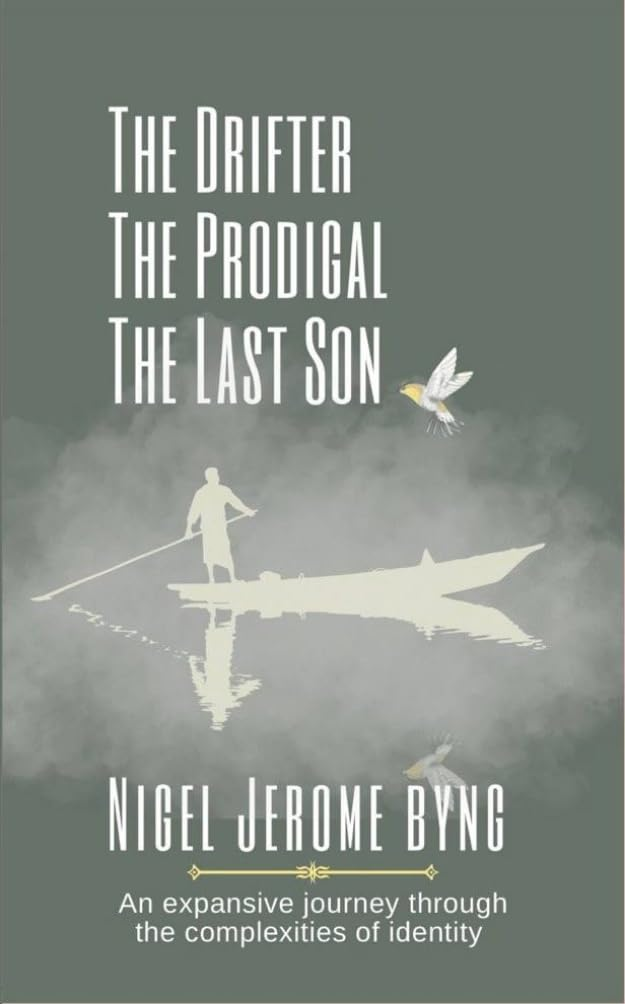
This inaugural book of poetry by Nigel Byng contains some extraordinary and moving poems ranging from the poet’s youth and journey to manhood, the tumultuous years of intense love and lust, difficulties. hurts and losses encountered along life’s path, and building a relationship with God. Poems relating to each of these four phases of life are collected into each of the four sections of this book.
The poet’s use of language is exceptional and truly conveys the strong emotion that inspired the poems. It is not easy to convey the spirit of the language used in any way other than by sharing a few extracts that I especially liked.
From Companion
“When the world hissed and turned against me, You were unmoved,
You have attended to me in every adversity.
Self-loathing greeted me on my pillow,
as the shadow of death lingered by my bedside.
But in every affliction, you were there.”
Little People
“Akin to a uniform horde of solider ants to forage for knowledge
following the sound of an enchanted flute.
What is this bedeviling mysticism
which snatches a child away from the bosom of its mother,
the protection of its father,
only to follow the breadcrumbs to their doom?
If you like beautiful and deep poetry, you will enjoy this book. My only negative is that I could not access the ebook using Speechify or another reading app. I also could not search the book using the search button and the contents page is not linked to the poems so you have to scroll through the entire book if you want to reread any specific poem.
Purchase The Drifter The Prodigal The Last Son from Amazon US here: https://www.amazon.com/Drifter-Prodigal-Last-Son-ebook/dp/B0H1987R65/
About Nigel Byng
Writer, poet, storyteller, Byng’s words move from quiet domestic moments to global, socially conscious truths. His stories and poems explore love, memory, morality, and the human experience with lyrical precision and emotional punch. Contributor to top anthologies and creator of the Exploring Poetry series, his debut collection, The Drifter, The Prodigal, The Last Son, is one to watch.
About Robbie Cheadle
South African author and illustrator, Robbie Cheadle, has written and illustrated sixteen children’s books, illustrated a further three children’s books, and written and illustrated three poetry books. Her work has also appeared in poetry and short story anthologies.
Robbie also has two novels and a collection of short stories published under the name of Roberta Eaton Cheadle and has horror, paranormal, and fantasy short stories featured in several anthologies under this name.
You can find Robbie Cheadle’s artwork, fondant and cake artwork, and all her books on her website here: https://www.robbiecheadle.co.za/
________________________
Did you know you can sponsor your favorite blog series or even a single post with an advertisement for your book? Stop by the WtbR Sponsor Page and let me advertise your book, or you can make a donation to Writing to be Read for as little as a cup of coffee, If you’d like to show your support for this author and WordCrafter Press.
__________________________
This segment of “Treasuring Poetry” is sponsored by WordCrafter Press and the Poetry Treasures series.
Get Your Copy Today!
Poetry Treasures: https://books2read.com/PoetryTreasures
Poetry Treasures 2: Relationships: https://books2read.com/PT2-Relationships
Poetry Treasures 3: Passions: https://books2read.com/u/b5qnBR
Poetry Treasures 4:In Touch With Nature: https://books2read.com/PT4-Nature
Poetry Treasures 5: Small Pleasures: https://books2read.com/PT5-SmallPleasures
Poetry Treasures 6: Seasons: https://books2read.com/PT6Seasons
Share this:

LINDSEY’S WRITING PRACTICE: Interview with Author & Poet Robbie Cheadle & A Review
Posted: June 3, 2026 Filed under: Books, Collection, Interview, Lindsey's Writing Practice, Poetry, Review | Tags: Book Reveiw, Interview, Lindsey Martin-Bowen, Lindsey's Writing Practice, Lion Scream, Nature, Poetrty Collection, Robbie Cheadle, South Africa, Wildlife, Writing to be Read 50 CommentsHow do I define Robbie (a/k/a Roberta) Cheadle?
In essence: Amazing. This multi-talented, empathetic, creative woman displays talents in many areas.
Further, she pens words that she hopes will move others to help protect our world.
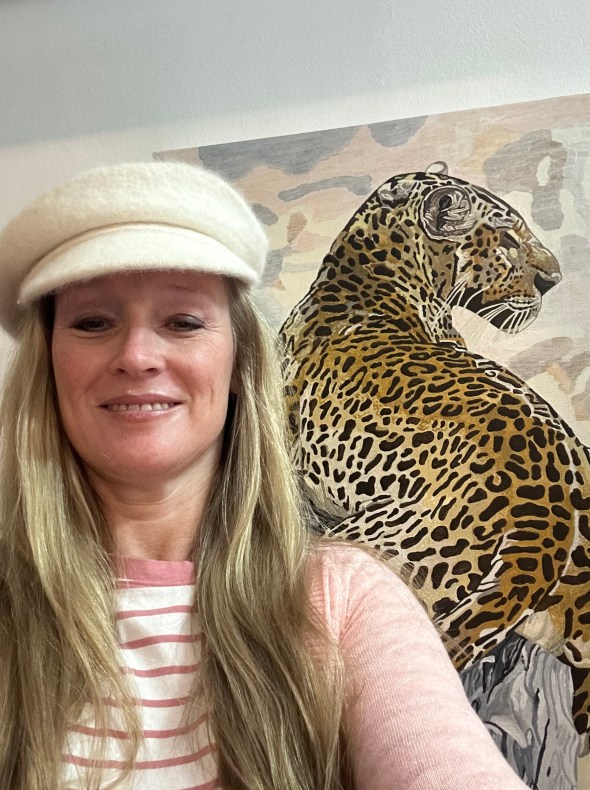
Along with writing poetry books, novels, short stories, and children’s literature, Robbie Cheadle not only decorates some of her pages with exquisite, professional photos that she shot—and even more amazing, she fashions cakes with sculptures of lions and other African wildlife, and flowers that accompany her writings.
Here’s a chance to peer into the mind of this remarkable woman. Enjoy!
About Roberta Eaton (Robbie) Cheadle
Roberta Eaton Cheadle, is a South African writer and poet specialising in historical, paranormal, and horror novels and short stories. She is an avid reader in these genres and her writing has been influenced by famous authors including Bram Stoker, Edgar Allan Poe, Amor Towles, Stephen Crane, Enrich Maria Remarque, George Orwell, Stephen King, and Colleen McCullough.
Roberta has two published novels and a collection of short stories and has horror, paranormal, and fantasy short stories included in several anthologies. She is also a contributor to the Ask the Authors 2022 (WordCrafter Writing Reference series).
Roberta is also the author and illustrator of seventeen children’s books, illustrator to a further three children’s books, and the author and illustrator of four poetry books published under the name of Robbie Cheadle, and has poems and short stories featured in several anthologies under this name.
Roberta’s blog features discussions about classic books, book reviews, poetry, and photography. https://roberta-writes.com/.
My Interview with Robbie Cheadle
How did you come to write poetry?
From a young age (4 years old), I read a great deal. Television was very limited in South Africa when I was a child and my first sister was only born when I was 4 years old. Catherine was born prematurely and my parents moved to a cottage on a farm in the country to try to protect her from germs. I didn’t attend school during this time, and I had to entertain myself. I did that by reading. I grew to love the L.M. Montgomery books, especially her lesser-known series, Emily of New Moon. In the books, Emily’s late father was a poet and writer. Emily tries her hand at poetry as a way of keeping his memory alive. I was inspired by Emily to
write short poems and descriptive pieces and did this throughout my senior primary school and high school years. English and History were my favourite subjects at school, and I excelled at both of them. I have been writing poetry ever since. It has evolved into a diary of my life.
What is your favourite poem by another poet?
When I was in primary school, about ten years old, we had to learn several poems by heart. Ever since then I have loved The Listeners by Walter de la Mare. The poem is full of mystery and delight.
The Listeners
By Walter de La Mare
‘Is there anybody there?’ said the Traveller,
Knocking on the moonlit door;
And his horse in the silence champed the grasses
Of the forest’s ferny floor:
And a bird flew up out of the turret,
Above the Traveller’s head:
And he smote upon the door again a second time;
‘Is there anybody there?’ he said.
But no one descended to the Traveller;
No head from the leaf-fringed sill
Leaned over and looked into his grey eyes,
Where he stood perplexed and still.
But only a host of phantom listeners
That dwelt in the lone house then
Stood listening in the quiet of the moonlight
To that voice from the world of men:
Stood thronging the faint moonbeams on the dark stair,
That goes down to the empty hall,
Hearkening in an air stirred and shaken
By the lonely Traveller’s call.
And he felt in his heart their strangeness,
Their stillness answering his cry,
While his horse moved, cropping the dark turf,
’Neath the starred and leafy sky;
For he suddenly smote on the door, even
Louder, and lifted his head:—
‘Tell them I came, and no one answered,
That I kept my word,’ he said.
Never the least stir made the listeners,
Though every word he spake
Fell echoing through the shadowiness of the still house
From the one man left awake:
Ay, they heard his foot upon the stirrup,
And the sound of iron on stone,
And how the silence surged softly backward,
When the plunging hoofs were gone.
I like this poem so much I did a recording of it for my YouTube channel: https://youtu.be/gy_7mM2RcuI?si=Gmf2kfXkwrCoBnjp
What is your favourite of your own poems?
Currently, this is my favourite of my own poems:
Life on the Water (Tanka story)
medley of cool shades
cerulean and turquoise
lightened or darkened
depending on water’s mood
and artist’s vision
***
painstaking brush strokes
capturing shadows and light
frothy, foaming crests
enhanced with metallic white
dancing across blue
***
water shifts and sighs
subtle movements captured in
careful ripple lines
swiftly flowing currents caught
in muted aquamarine
***
sand laden wavelets
curl sluggishly around rocks
smothered by sweet caress
of ocean’s heaving bosom
with its rhythmic rise and fall
***
houseboat moves onwards
temple to unconstrained thoughts
colours meld as one
in swirls, rises, and deep troughs
impermanent no longer
***
dreams, soft and wispy
condensation trails through sky
subtle as sunlight
transferred to stark, white canvas
soft splashes ricocheting
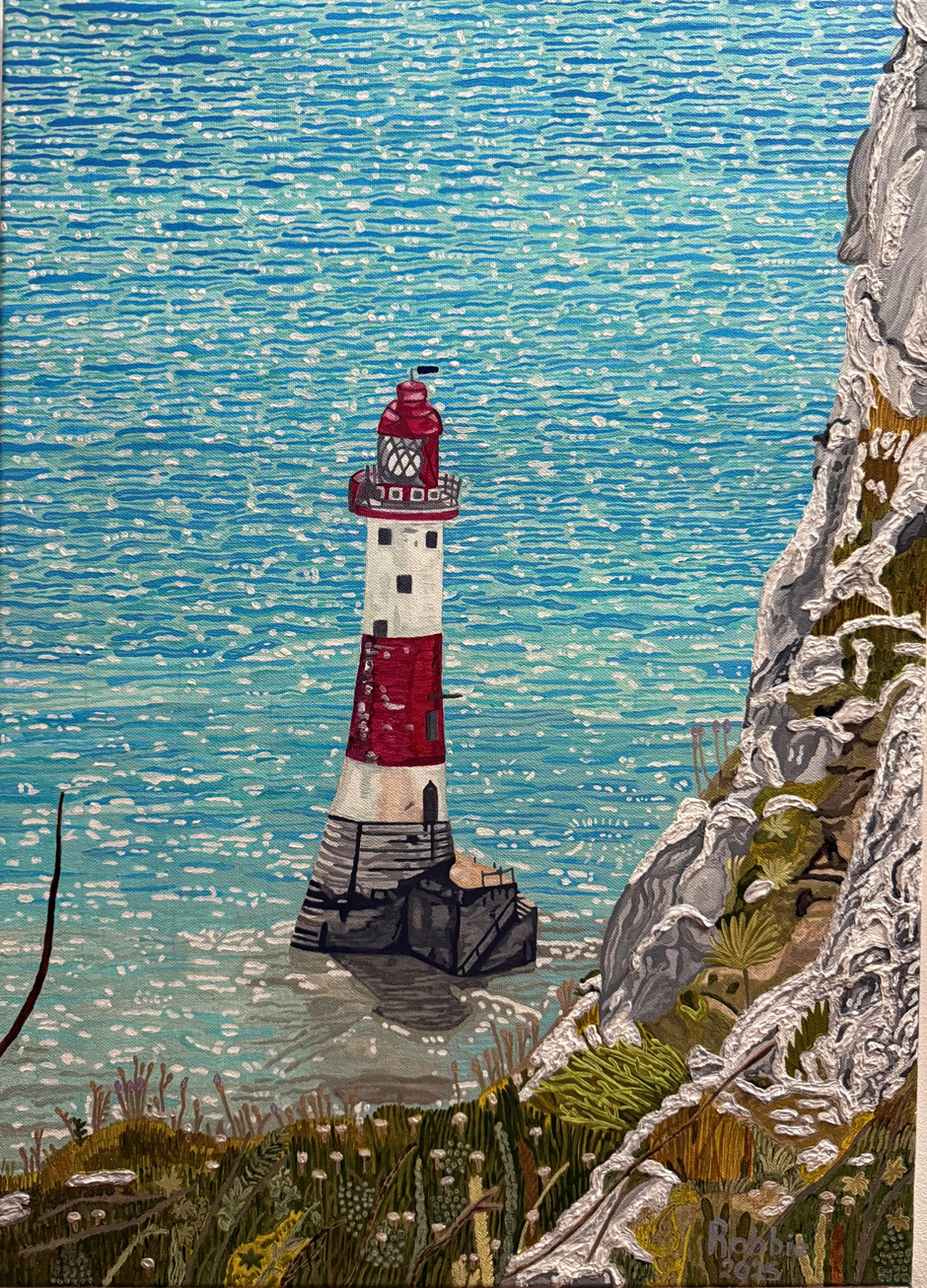
Picture caption: My acrylic painting called Fyrtorr which means beacon in Old English.
Tell us a bit about the inspiration for Lion Scream
Here’s an extract from Lion Scream:
The initial idea for a book of poetry that taught people about the numerous amazing creatures of southern Africa and highlighted their plight in the face of the Sixth Mass Extinction, came to me during a visit to Ukutula Lodge & Game Reserve (“Ukutula”).
Ukutula is also a conservation facility specializing in genetic mammal research and predator conservation.
On my return home, my brother-in-law gifted me a print of Edvard Munch’s famous painting, The Scream.
According to a diary entry by Munch, the inspiration for this painting was as follows:
“One evening I was walking along a path, the city was on one side and the fjord below. I felt
tired and ill. I stopped and looked out over the fjord – the sun was setting, and the clouds
turning blood red. I sensed a scream passing through nature; it seemed to me that I heard
the scream. I painted this picture, painted the clouds as actual blood. The color shrieked.
This became The Scream.”
Based on The Scream, I created a cake I titled Lion Scream – Nature’s Response to the Sixth Mass Extinction and Global Warming, which depicted a lion, made from fondant, clasping its face and screaming, while standing on a bridge above a river of blood. Behind the lion, is an erupting volcano.
This cake was intended to be an artistic depiction of the natural world’s reaction to
continuous land development by humans, resulting in the loss of habitat for the creatures
which share this earth with us, and the increasing impact of global warming on humanity
and the greater planet.
Lion Scream: Nature’s Response to the Sixth Mass
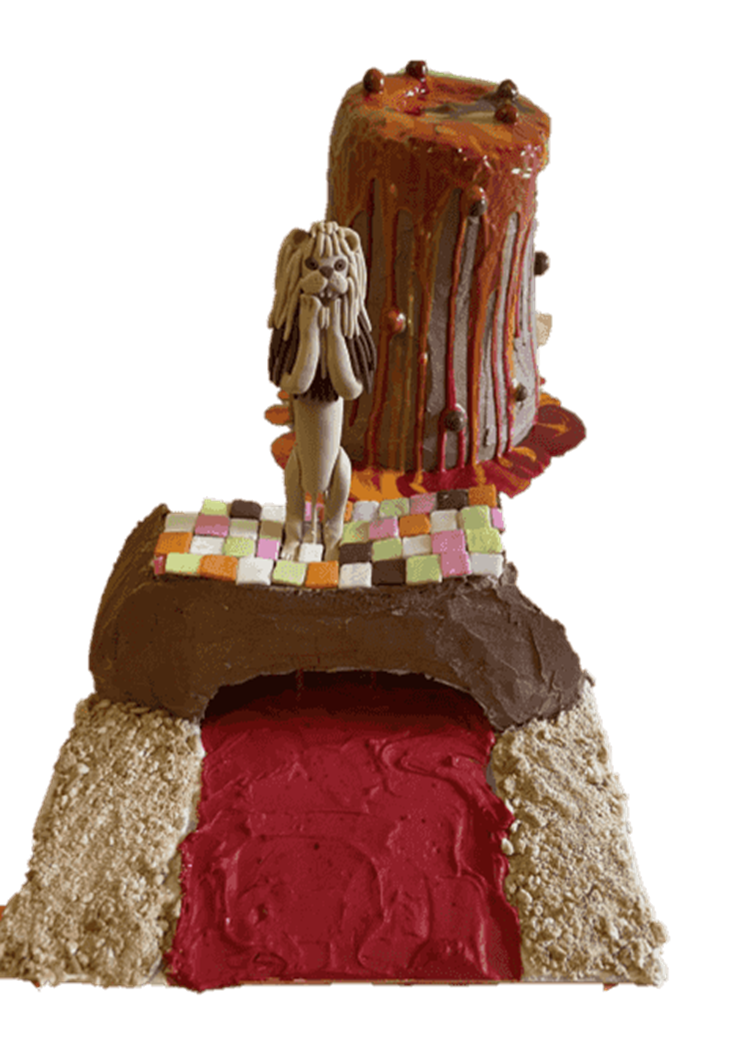
Picture Caption: Extinction and Global Warming Cake Art by Robbie Cheadle
Have you witnessed the killing of an African animal which acted as a trigger for your interest in animal conservation?
When I was 21, I met a man who hunted animals for sport. Prior to this, I had never had much interaction with wild animals other than in zoos. My mother grew up on a cattle farm and had little interest in engaging with animals in the wild. Interestingly, I’ve noticed she shares this disinterest with other people I know who also grew up on farms. Anyhow, this man invited me to go to Kimberley with him and his friends. They were going hunting, but they were also going to visit the ‘big hole’ in Kimberley which is an interesting feature of South African history. I agreed to go because I wanted to see Kimberley. The hunting trip was a complete horror show for me. I hadn’t really thought about what a hunting trip meant, and the men attempted to kill an antelope. It was a common antelope, what I call “lion snacks” as they keep the stock of impalas high in game reserves because they are food for the
big cats. The shooter’s shot went wide, and he ended up wounding a baby impala. Aside from any other aspect, it was not the right season for hunting as the mother antelopes had small calves. The baby ran making the most terrible high-pitched sound, and the men had to go after the poor little thing. Eventually, they did put it out of its misery. I was completely horrified. After this trip, I ended the relationship and became involved in wildlife conservation. This has developed into my poetry books and paintings featuring southern African wildlife.
What’s next?
Currently, I am busy with the final edits to a collection so South African inspired short stories and poems. The book is called The Last Man, South African History, Legends, & Poetry. This book will be published through TSL Publication in the United Kingdom. I am also working on several new poetry collections and the second book in the Something Fancy book collection. This second book, Chocolate & Treats, should be ready for publication in early November this year. I always have a lot of projects on the go. I am also painting. My latest painting is of a Vervet Monkey and is part of my Into the Light series of painting. I am planning to paint an African Painted Dog next. It will be a much bigger project. I do a small one in between the larger ones so that I can practice drawing more often. The big paintings take me three to four months to complete.
Thank you for this lovely interview opportunity, Lindsey. I appreciate your interest in my work.
Lindsey’s Review of LION SCREAM Syllabic Poetry about Southern African Wildlife
by Robbie Cheadle
Not only is Robbie Cheadle (a/k/a Roberta Cheadle) an excellent, engaging poet and fiction writer, she’s a woman with a mission—a crucial mission for not only the future of our planet and the wildlife on it, but for humanity itself. Plus, in this 163-page collection, her method of persuasion includes not only facts and figures about the demise of many of our planet’s creatures in Africa, it delights the reader with superb—and righteous, at times biting, poetry and fiction.
Most delightful is Cheadle’s use of the constraints of syllabic structure in unrhymed forms that recreate the tension between wild beasts and the fragment of society pushing them off their native environments. For example, the book’s opening poem, “Lion Scream” is a perfectly structured tanka (one of my favorite forms). I perceive the tanka as a haiku with more depth. As opposed to the 17-line poem, tankas are structured in five lines with the syllabic form: five, seven, five, seven, seven, which Cheadle does in “Lion Scream”:
There is no jungle
Only acres of smooth stumps
There is no jungle
No habitat, no food source
Hopeless lion screams tonight
(Cheadle credits “The Lion Sleeps Tonight” in Disney’s The Lion King with inspiring this
tanka.)
Although the collection contains other tankas, most of the poems are set in the Double Enneal format, far more complex. A Double Ennead comprises three stanzas of five lines each. Thus, the syllabic count for each stanza is 6/5/11/6/5, (33 syllables per stanza) i.e., each stanza is set as:
six syllables
five syllables
eleven syllables
six syllable
five syllables
Again, each of those syllabic counts are repeated in the second and third stanzas, totaling ninety-nine syllables for each poem.
In the collection’s introduction, Cheadle explains why she uses this format most frequently throughout the book:
“I selected this form of syllabic poem for LION SCREAM for two reasons . . . because I love syllabic poetry and the short dramatic statements it enables me to make through a few carefully chosen words.”
Her second reason concerns her mission: “. . . due to the importance of nature conservation to me, and my desire to share insights about the impact of habitat loss, hunting, and poaching on the wild animals of southern Africa, I decided that 99 syllables gave me more, a little more scope to make my specific points.”
Further, Cheadle photographed all but three of the photos in the book. After perusing the collection she shot —on par with those in National Geographic, depicting several species of wildlife, I felt as if I’d viewed a video of Africa, particularly in those sections about lions, elephants, and zebra, creatures especially close to my heart.
I admit my first encounter with elephants and camels was in the Kansas City Zoo, where we children rode those captive creatures. This book brought back those memories from an era wherein most persons believed such wildlife would continue to stroll the earth indefinitely.But Cheadle reveals that is no longer a future many experts anticipate.
Along with her own photos, the collection offers links to many of Africa’s animals. For instance, in the section, “My Experiences with Rhinos,” she includes four links to videos she took of rhinos, after noting, “My most recent sightings have largely been of dehorned animals, which I always find jarring. It is strange to see a rhino without its famous horn.”
Having grown up in South Africa, she first saw horned rhinos, and she questions, “I wonder if my grandchildren will know rhinos have horns. If the fight against poaching is unsuccessful, my grandchildren will only experience rhinos through pictures in history books.”
From the number of Double Enneads she included for elephants and lions, it appears they may be her favorite beasts. Along with those long poems and marvelous photographs, she includes sections, “About African Elephants, “My Experiences with Elephants,” “My Experiences with Lions,” and “More Experiences with Lions.”
Then, she wraps up the poetry section with photos of the African landscapes. A Double Ennead, “The Romance of the Sunflowers” and an explanation about how sunflowers feed the environment in “Sunflowers and the Environment” precede photos of African landscapes of mountains, plains, and striking sunsets, interlaced, of course, with more poetry.
Cheadle wraps up this collection with a short story, “The Nutcracker,” which deals primarily with how the changing environment causing the loss of wildlife can impact the human species, too. She follows that piece with her inspiration and explanation of the story. I rate this collection with FIVE STARS. Thank you, Robbie, for sharing it.
—Lindsey Martin-Bowen
About Lion Scream
Do you rely on Earth for your survival?
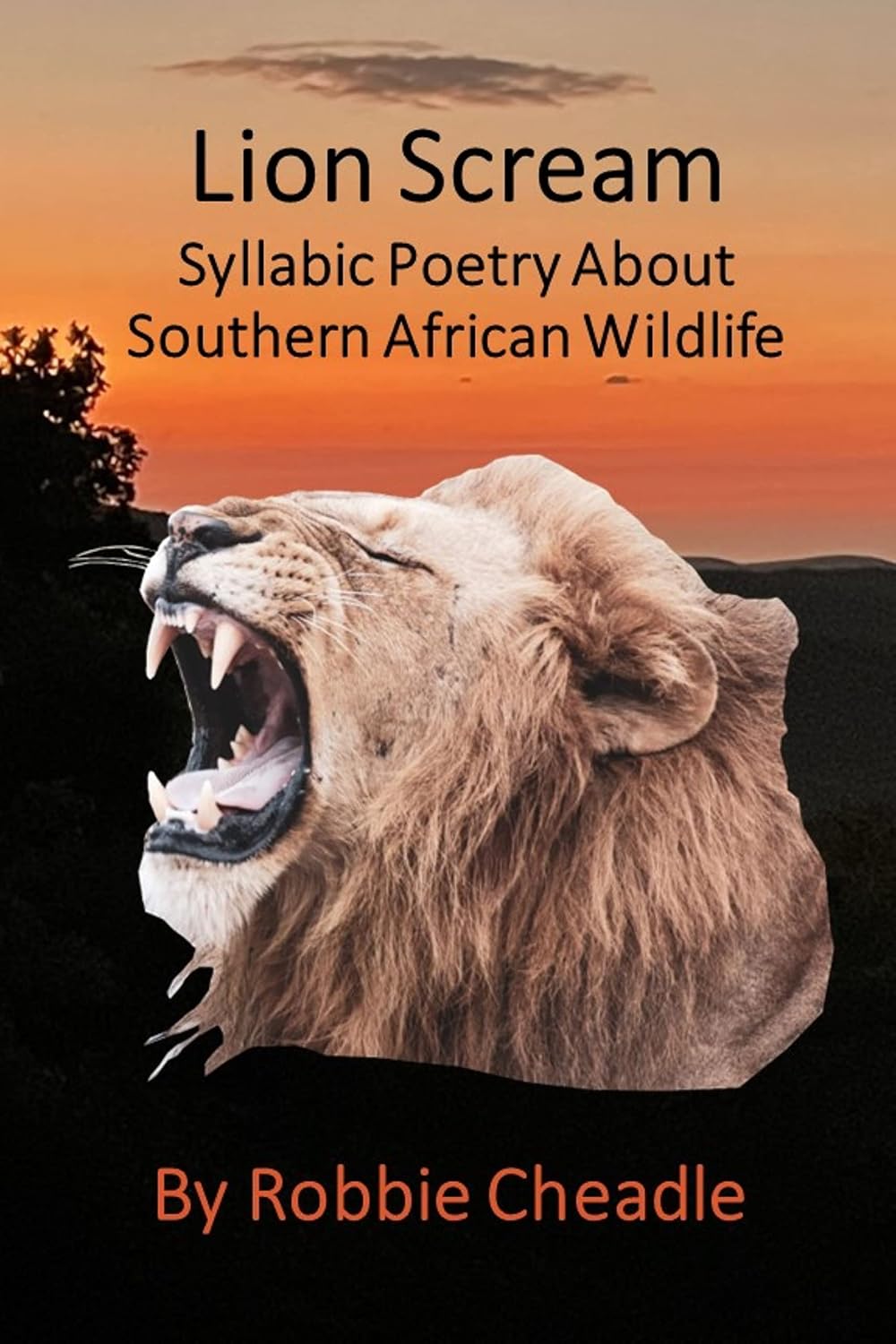
Lion Scream is a graphic collection of poetry and prose. The book portrays the author’s experiences with South African wildlife and the growing impact of the Sixth Mass Extinction and Climate Change on the natural environment.
Lion Scream
There is no jungle
Only acres of smooth stumps
There is no jungle
No habitat, no food source
Hopeless lion screams tonight
Purchase Link: https://www.amazon.com/Lion-Scream-Syllabic-Southern-Wildlife-ebook/dp/B0BXP5N766
About Lindsey Martin-Bowen
On Halloween 2023, redbat books released Lindsey Martin-Bowen’s 7th poetry collection, CASHING CHECKS with Jim Morrison. Her 4th collection, Where Water Meets the Rock, was nominated for a Pulitzer; her 3rd, CROSSING KANSAS with Jim Morrison was a finalist in the QuillsEdge Press 2015-2016 Contest. In 2017, it won the Kansas Writers Assn award, “Looks Like a Million.” Writer’s Digest gave her “Vegetable Linguistics” an Honorable Mention in its 85th Annual (2017) Contest. Her Inside Virgil’s Garage (Chatter House Press 2013) was a runner-up in the 2015 Nelson Poetry Book Award. McClatchy Newspapers named her Standing on the Edge of the World (Woodley Press/Washburn University) was one of the Ten Top Poetry Books of 2008. It was nominated for a Pen Award.
_______________________________________________
Did you know you can sponsor your favorite blog series or even a single post with an advertisement for your book? Stop by the WtbR Sponsor Page and let me advertise your book, or you can make a donation to Writing to be Read for as little as a cup of coffee, If you’d like to show your support for this author and WordCrafter Press.
________________________________________________
This Segment of “Lindsey’s Writing Practice” is sponsored by WordCrafter Press and The Dark Horse Waits in Boulder, by Lindsey Martin-Bowen.
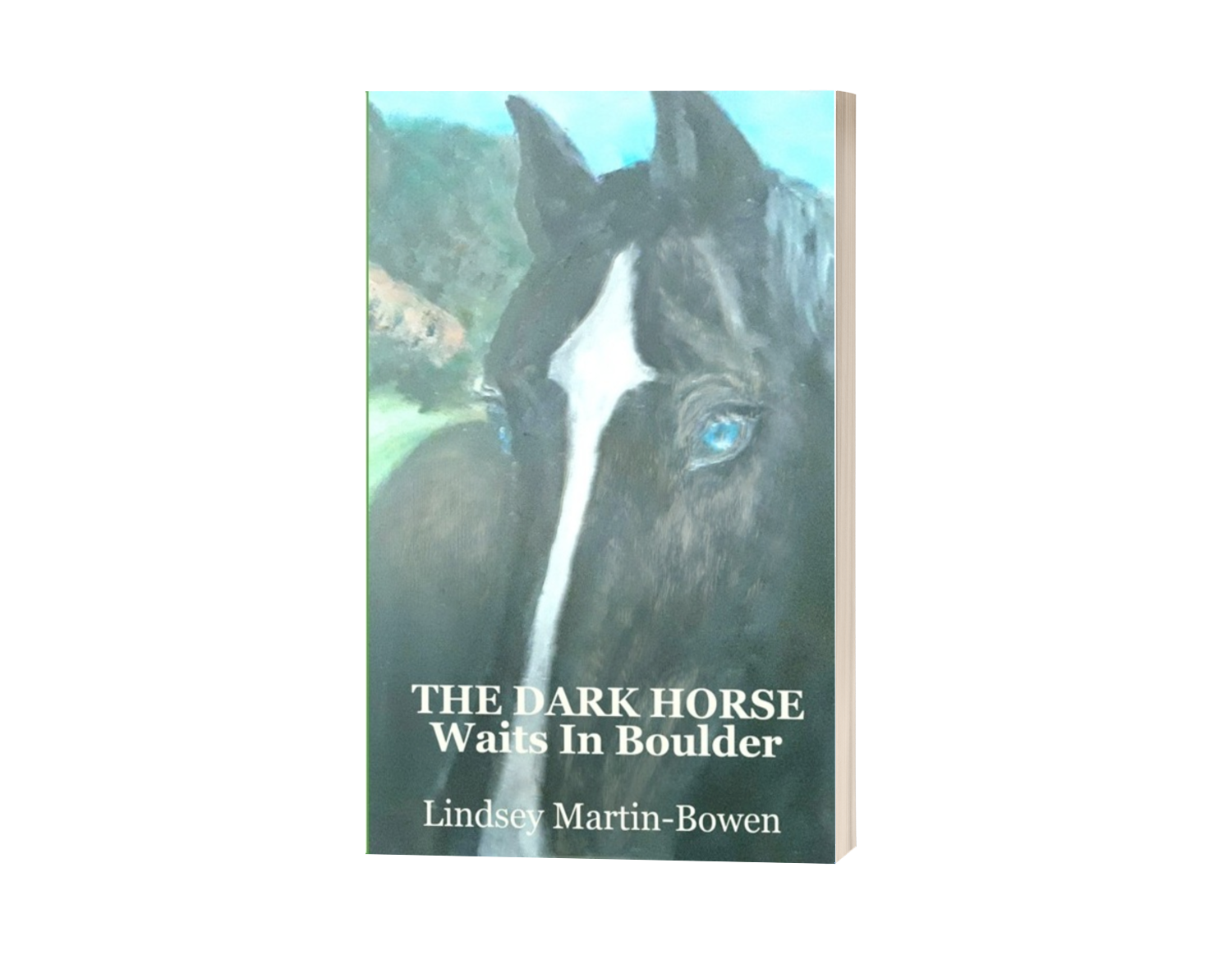
Recently divorced Charli Erickson arrives in Boulder, Colorado during the 1970s—a wild time for that city—where she hopes to develop her “rock poet” talent and find the perfect mate. Instead, she links up with the imperfect Ched Lyons, a Boulder native who leads her in a multitude of adventures, including scaling a mountain and a 1,200-mile motorcycle ride to southeastern Utah. While she intermittently envisions a black stallion with blue eyes, who puzzles and enchants her, she also strives to make sense of its appearance.
Through Charli’s snarky humor recounting her tales, readers will enjoy this Rom-Com doubling as a woman’s adventure story and may relate to scenes from the wild, zany era that followed the serious, revolutionary 1960s.
Get your copy today: https://books2read.com/The-Dark-Horse-Waits-in-Boulder
Share this:

Book Review: “25 Fires” & “In This Burning World”
Posted: April 24, 2026 Filed under: Apocalyptic, Book Review, Books, Collection, Poetry, Review | Tags: 25 Fires, Book Review, Eric S. Hoffman, In This Burning World, Mary Mackey, Poetry, Poetry Collection, Writing to be Read 5 Comments
About 25 Fires: A Call to What Comes Next
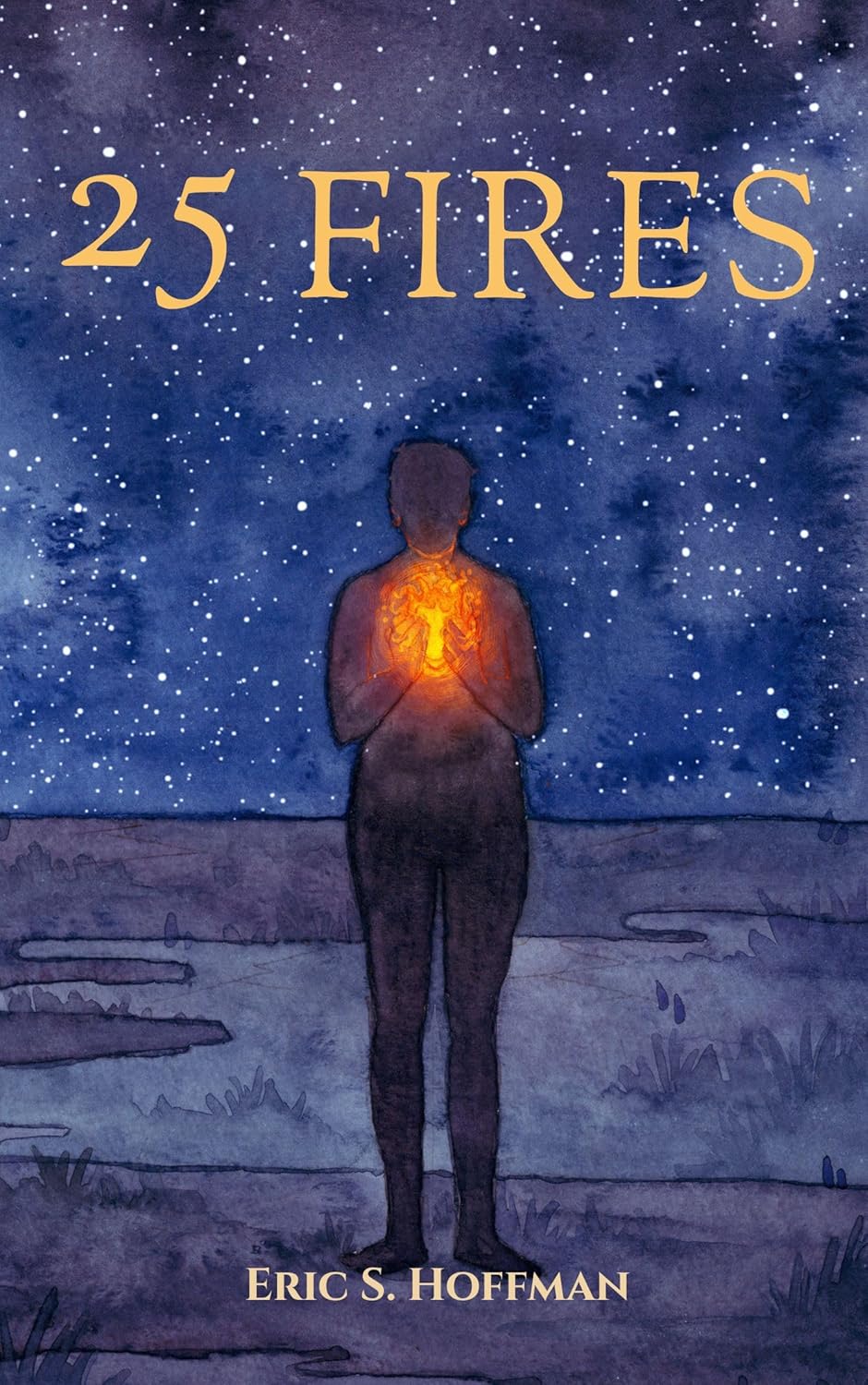
A book for anyone frustrated with the present – but unwilling to give up on the future.
25 Fires confronts a fractured world and asks: What comes next?
Told across 25 short, incendiary chapters, it traces an arc from the glittering cosmos to the choices of a single life.
Fierce and poetic.
Clear-eyed and human.
A book you can read in one sitting.
A fire you can carry for years.
Purchase Link: https://www.amazon.com/25-Fires-Call-What-Comes-ebook/dp/B0GNHJK9KT
My Review of 25 Fires
I received a digital copy of 25 Fires, from the author, Eric S. Hoffman, in exchange for an honest review. All opinions stated here are my own.
25 chapters of poetic verse make up this short book. It begins in the first section, titled “Inferno”, laying out the poet’s bleak vision of the world as we know it
“Our institutions are crumbling.
Schools are running on fumes.
Democracy sells to the highest bidder
And insulin costs more than your car.
We’re better than this.”
In the second section, titled “Smoke”, and deals with the desperation of dealing with life in today’s world. Chapter 7 depicts life in our world.
“is there anybody out there?
Is anyone actually home?
I wonder sometimes.
I scroll past all these comments and conversation.
I swipe through photos and updates about your dog.
But it all feels… empty.
And although many of these are a cry of woe, amongst the predictions of doom, there lies a message of hope, like in chapter 24, in the section titled Sparks:
“The shift has already started.
The new world is already being built.
Not by the biggest armies,
Or the deepest pockets,
Or the loudest mouths.
But the rest of us.
Getting our minds in order.
Putting our hands to work.
The single mom hunched behind a laptop.
The grandfather up at 3 a.m.inhis garage.
Little fires.
Scattered in the dark.
We may not see each other,
But together we’re illuminating what comes next.”
One must ponder which is more captivating, the verse or the message which it carries? This short volume is easily read in a single sitting, but you may want to go back and go over it again to absorb the full impact.
Poetic verse with an important message. I give 25 Fires four quills.

About In this Burning World
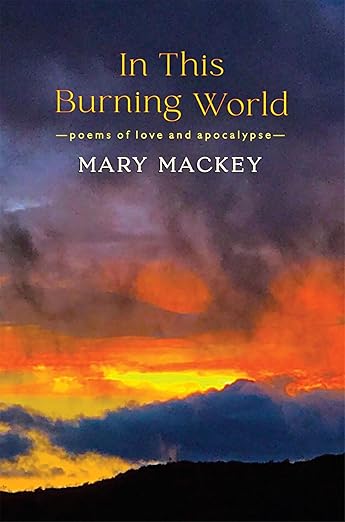
Poetry for a planet in crisis: Love, loss, and hope in a burning world.
In In This Burning World, Mary Mackey offers a powerful collection of poems that unflinchingly confront the realities of climate change. Through vivid imagery and emotional depth, Mackey explores themes of apocalypse, love, and resilience, inviting readers to find hope and connection in the face of environmental destruction.
These poems capture the beauty of a world on the brink, while also celebrating the enduring power of human relationships. Perfect for readers seeking:
- Poetry that addresses climate change
- Inspirational verses about love and loss
- A hopeful perspective on the future
Purchase Link: https://www.amazon.com/This-Burning-World-Poems-Apocalypse-ebook/dp/B0DYWXW9Z9
My Review of In This Burning World
I received a copy of In This Burning World: Poems of Love and Apocalypse from the author, Mary Mackey, in exchange for an honest review. All opinions stated here are my own.
Poems of love and apocalypse. It seemed to me a curious combination. I had to check out this poetry collection.
True to the title, there are poems depicting both. Poems of apocalypse bring vivid images of destruction and ruin.
When Mirrors Are Reversed
When mirrors are reversed
we will walk together through skeleton forests
along rivers that boil like molten glass
behind us ghost panthers
will stalk us through the dust of our cities
gathering up our unborn children
and unraveling our dreams
the skies will be filled with fish
and the oceans will be filled with crows
our mouths will be filled with dust
and we will not drown
we will smother
Poems of love evoke feelings of pleasure and contentment.
Walking Toward the Largo do Machado
when the smell of jasmine
flows through the streets of Catete like a warm fog
when the scent is so liquid you can
breathe it in get drunk and stagger
I think of all the years I have loved you
and all the years I will go on loving you
I think of how we protect each other from pain and betrayal
how each night we wrap ourselves around each other
and peace floats above our bed like a canopy of white petals
Somehow, they all fit together perfectly to form a tapestry of anticipation and hope.
A unique collection of poetry about climate change, life and love. I give This Burning World five quills.
About Kaye Lynne Booth
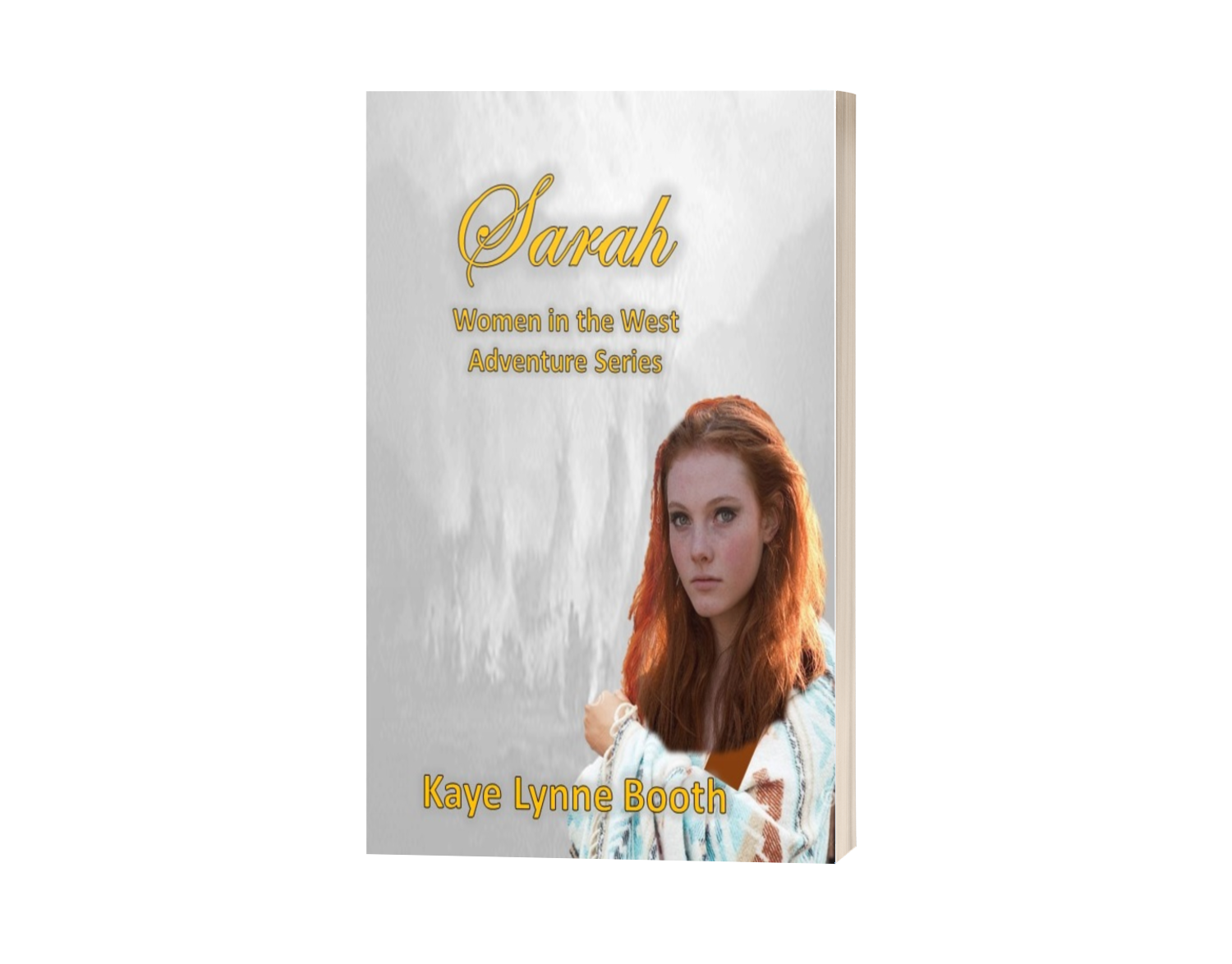
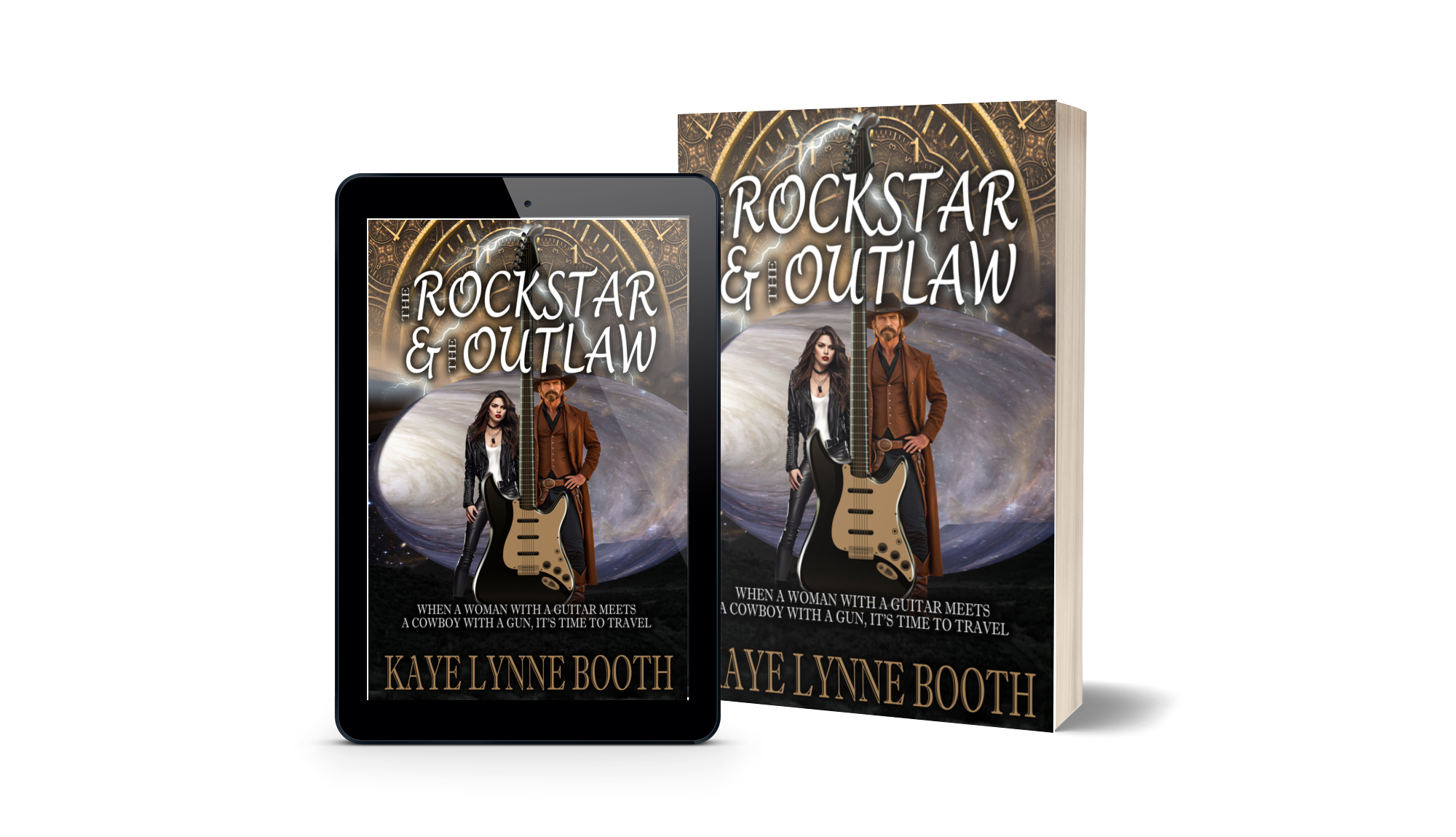
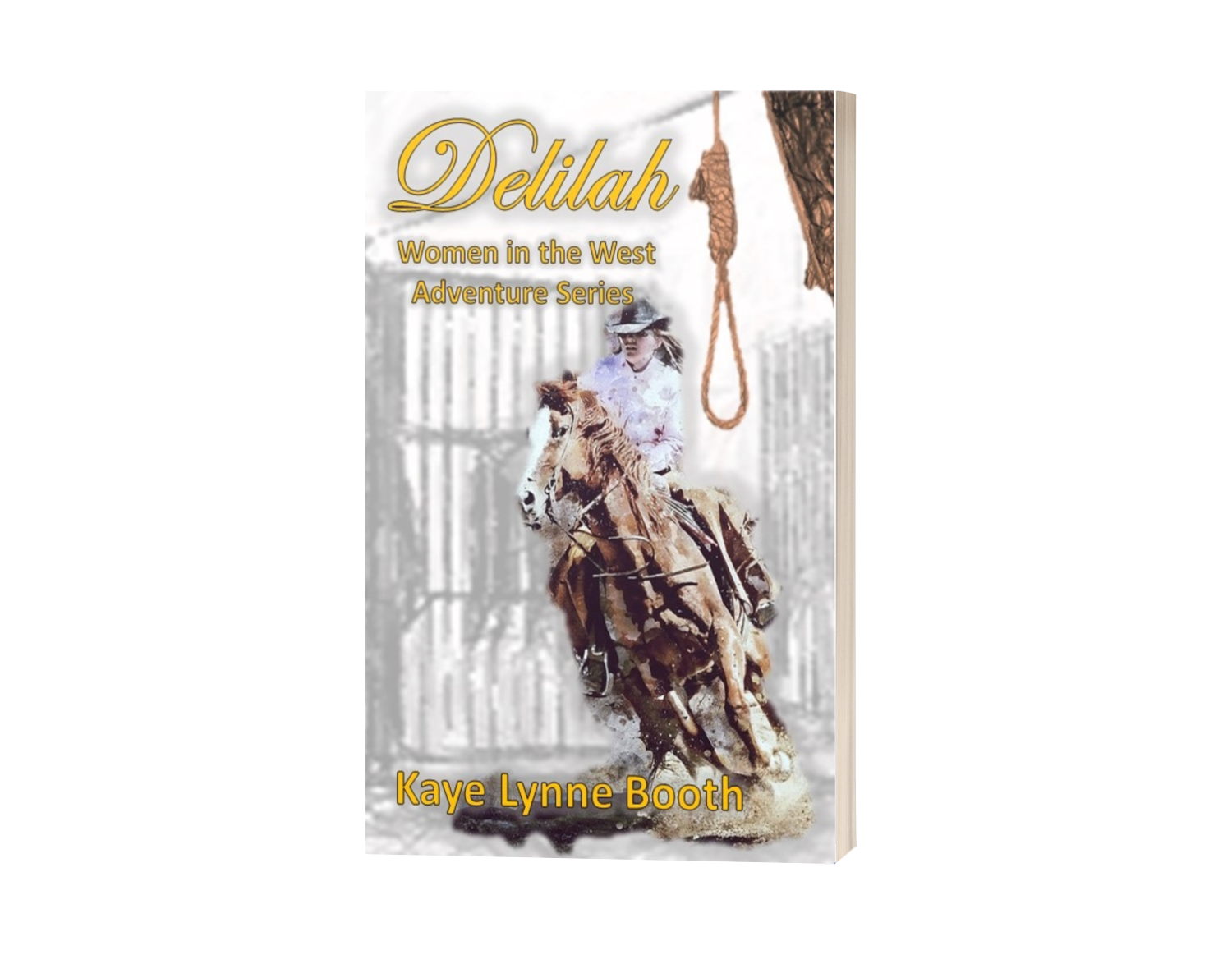
For Kaye Lynne Booth, writing is a passion. Kaye Lynne is an author with published short fiction and poetry, both online and in print, including her short story collection, Last Call and Other Short Fiction; and her paranormal mystery novella, Hidden Secrets; Books 1 & 2 of her Women in the West adventure series, Delilah and Sarah, and Book 1 in her Time-Travel Adventure series, The Rock Star & The Outlaw, as well as her poetry collection, Small Wonders.
Kaye holds a dual M.F.A. degree in Creative Writing with emphasis in genre fiction and screenwriting, and an M.A. in publishing. Kaye Lynne is the founder of WordCrafter Quality Writing & Author Services and WordCrafter Press, where she edits and publishes two short fiction anthologies and one poetry anthology every year amidst her many writing projects. She also maintains an authors’ blog and website, Writing to be Read, where she publishes content of interest in the literary world.
_____________________________________
Kaye Lynne Booth does honest book reviews on Writing to be Read in exchange for ARC digital copies, (she also accepts print copies). Have a book you’d like reviewed? You can request a review on the Book Review tab above.
Share this:

Celebrating National Poetry Month with Poetry Sales
Posted: April 7, 2026 Filed under: Anthology, Book Sales, Collection, Poetry, WordCrafter Press | Tags: #Poetrycommunity, Arthur Rosch, Behind Closed Doors, Book Sale, Feral Tenderness, Kaye Lynne Booth, Poetry Sale, Poetry Treasures Series, PoetryCollections, Robbie Cheadle, WordCrafter Press 6 Comments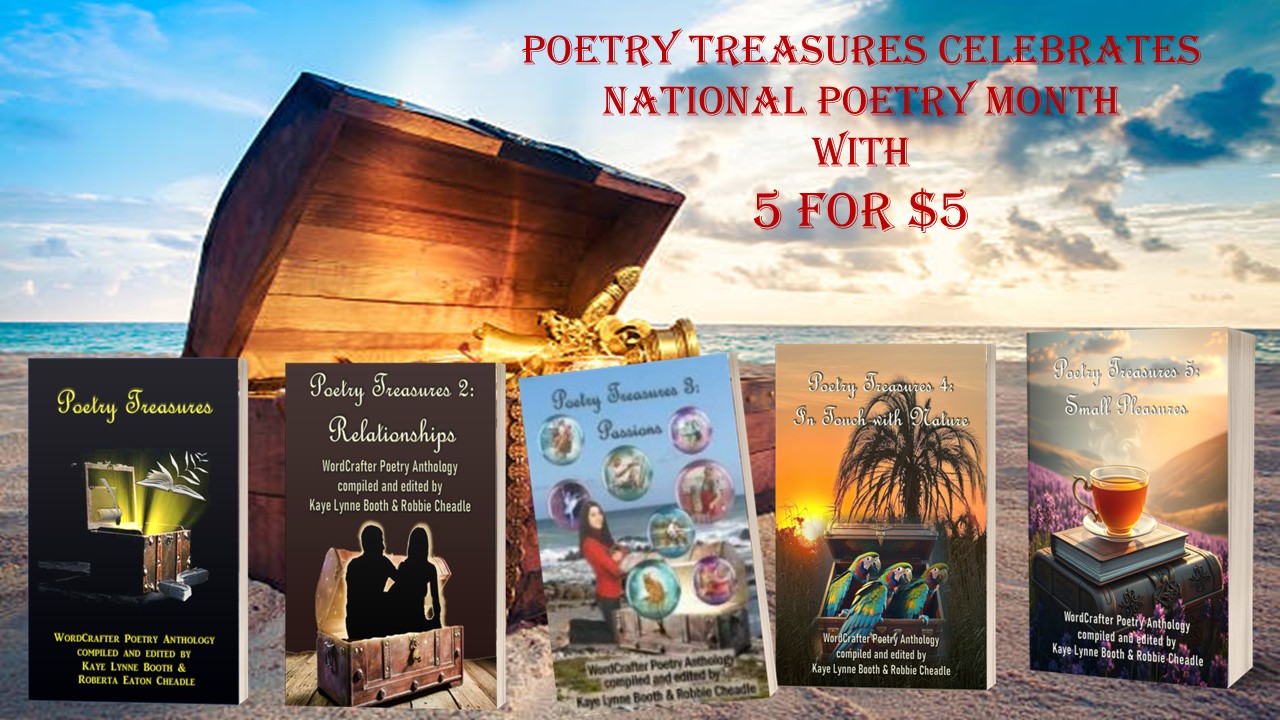
Exclusive on WordCrafter Press during the month of April.
Purchase the 5 for $5 bundle on the Poetry Treasures Series page.
In celebration of National Poetry Month, WordCrafter Press is offering the first five Poetry Treasures volumes for $5 only at the link above. And I’ve dropped the price on all individual WordCrafter poetry collections all month, as well.
All WordCrafter Poetry Collections – $1 off
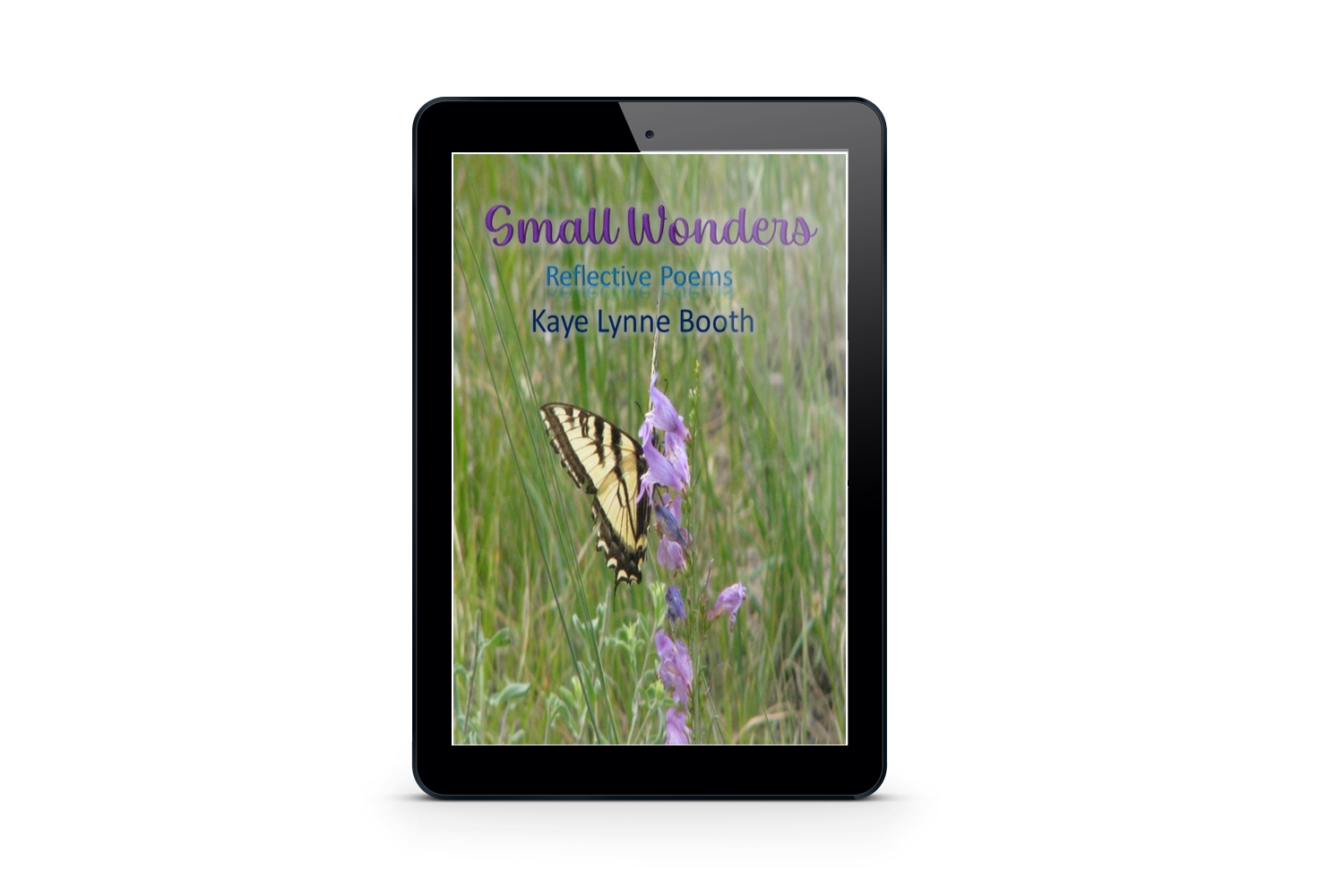
Small Wonders: Reflective Poems, by Kaye Lynne Booth – $2.99
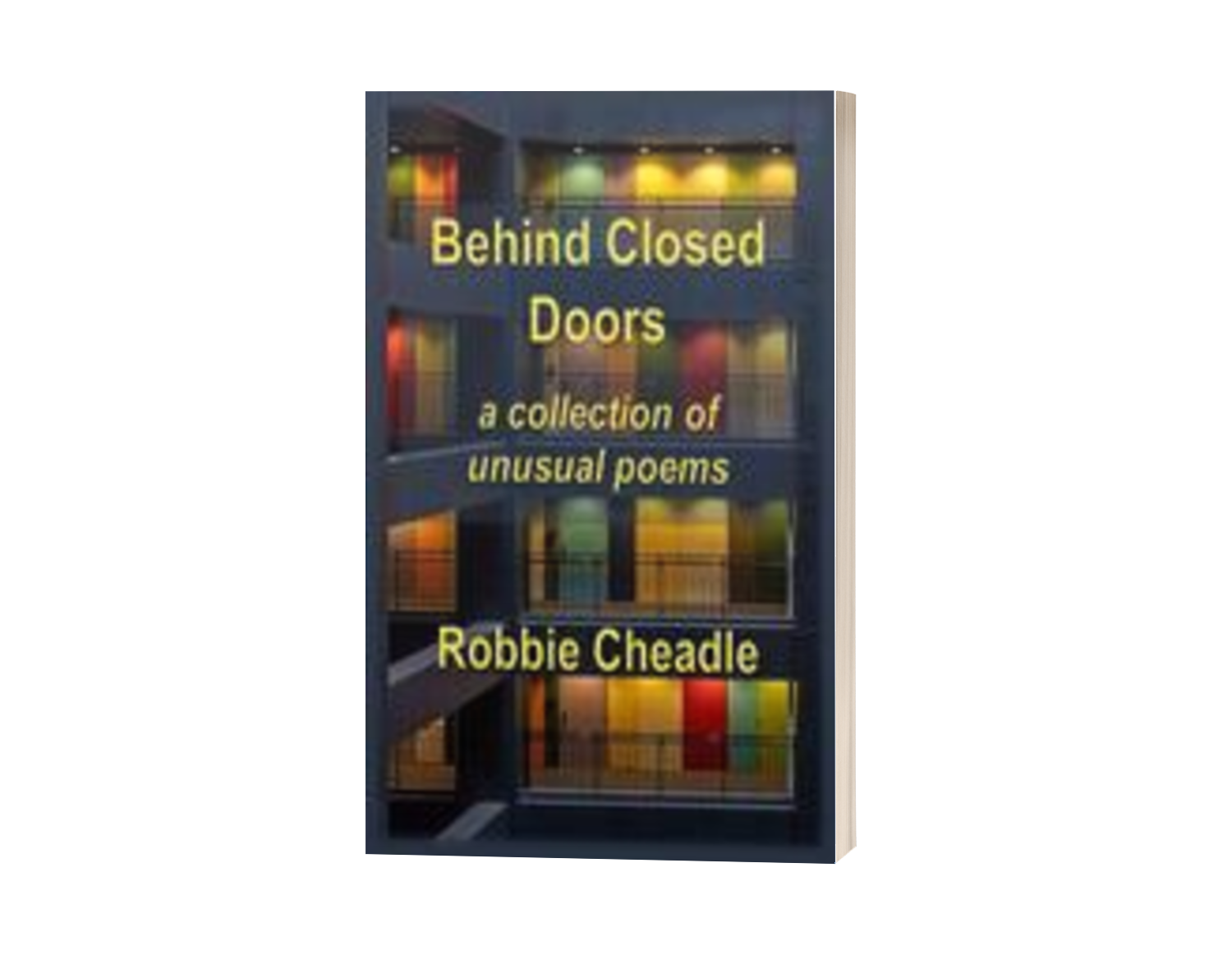
Behind Closed Doors: A Collection of Unusual Poems, by Robbie Cheadle – $2.99
Feral Tenderness: Poetry and Photography, by Arthur Rosch – $2.99
Grab your copies while you can!
Share this:

WordCrafter News: April Release – National Poetry Month, Release of “Poetry Treasures 6”, Winners of the “Double Visions” Giveaway & Approaching Submission Deadline
Posted: March 30, 2026 Filed under: Blog Tour, Book Release, Book Sales, Books, Collection, Giveaways, Nature, Poetry, Treasuring Poetry, WordCrafter Book Blog Tours, WordCrafter News, WordCrafter Press, Writing Contest | Tags: Call for submissions, Deadline, Giveaway Winners, Midnight Madness, Poetry, Poetry Treasures 6: Seasons, The Rock Star & The Outlaw 2 Double Visions, WordCrafter News, WordCrafter Press 16 Comments
WordCrafter Celebrates National Poetry Month
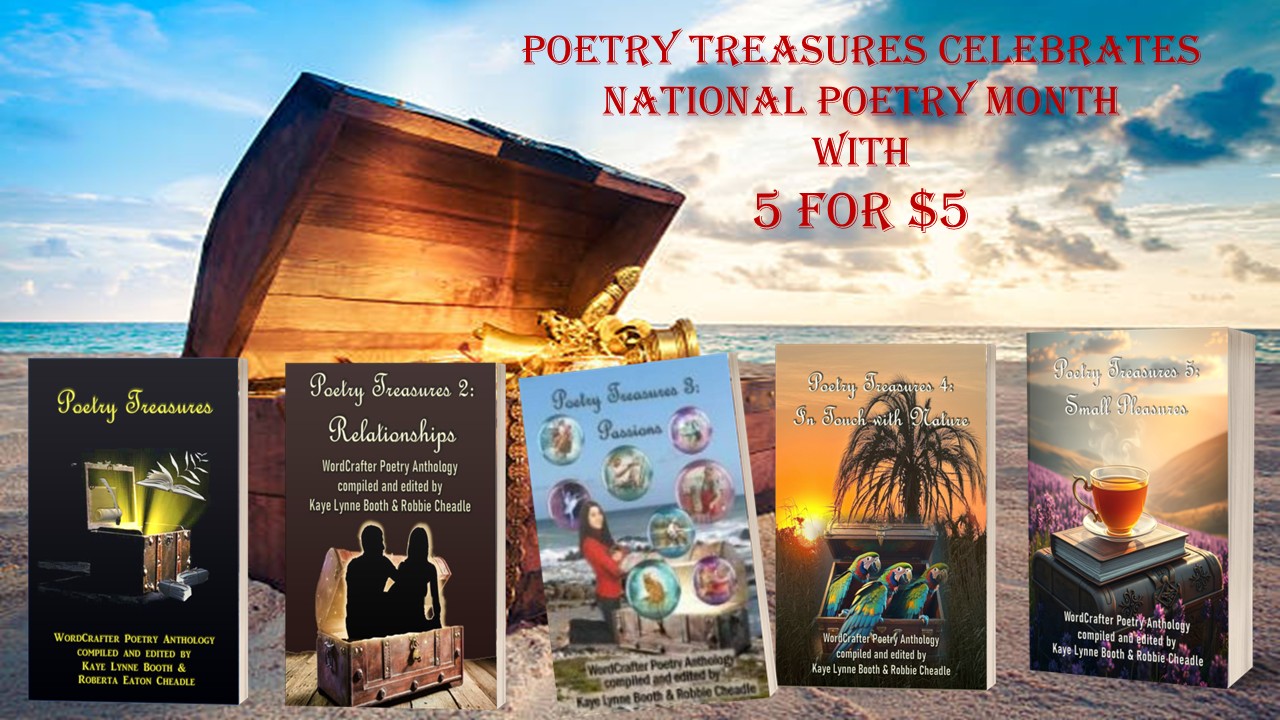
Only on WordCrafter Press during the month of April. Purchase the 5 for $5 bundle on the Poetry Treasures Series page.
In celebration of National Poetry Month, WordCrafter Press is offering the first five Poetry Treasures volumes for $5 only at the link above. And I’ve dropped the price on all individual WordCrafter poetry collections all month, as well.
All WordCrafter Poetry Collections – $1 off
Small Wonders: Reflective Poems, by Kaye Lynne Booth – $2.99
Behind Closed Doors: A Collection of Unusual Poems, by Robbie Cheadle – $2.99
Feral Tenderness: Poetry and Photography, by Arthur Rosch – $2.99
Grab your copies while you can!
New Release: Poetry Treasures 6: Seasons
Poetry Treasures 6: Seasons will be released April 21st.
This year’s volume will include works by Robbie Cheadle, Cindy Georgakas, Freya Pickard, V.M. Sang, Michelle Ayon Navajas, Marsha Ingrao, Nolcha Fox, Joy Neal Kidney, Kevin Morris, Jean-Jacques Fournier, Melissa Lemay, and Colleen Chesebro.
Winners of the WordCrafter Double Visions Book Blog Tour Giveaway
We had a great tour last week and met the $500 Kickstarter goal with a couple of days to spare. A big thank you goes out to Michelle Ayon Navajas, Kay Castenada, and Carla Johnson-Hicks for doing such a wonderful job of hosting.
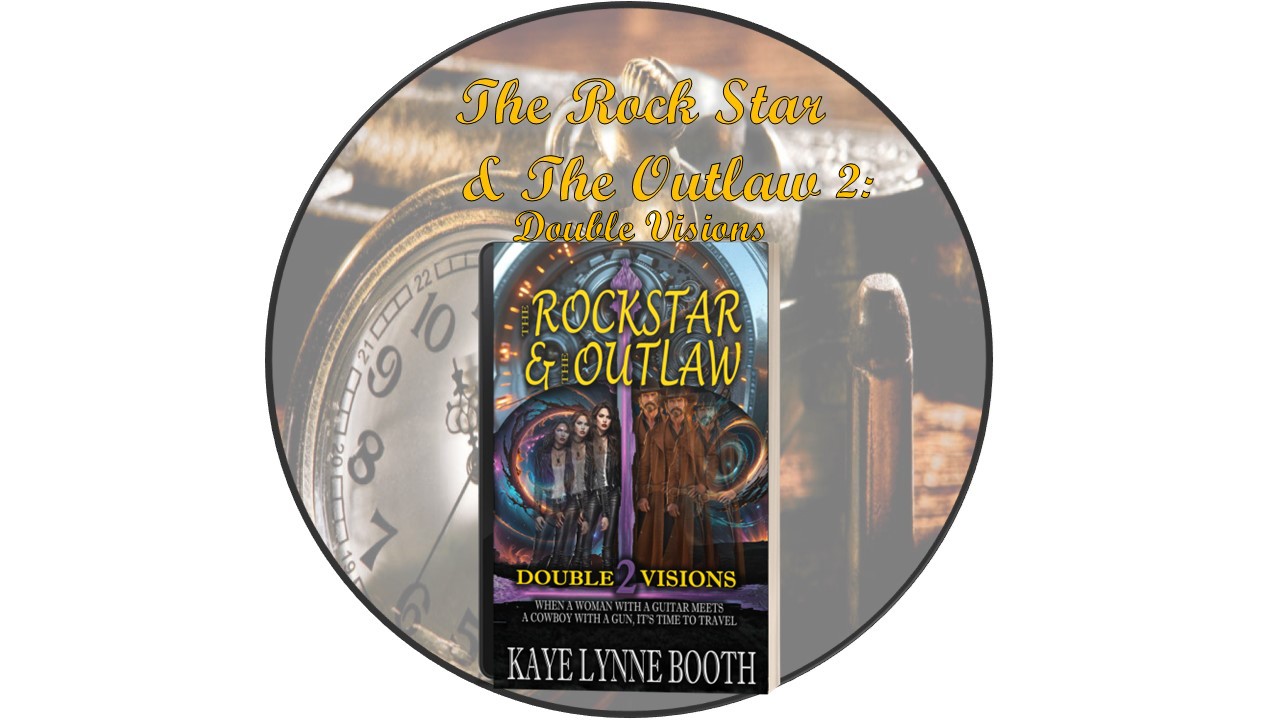
Now it’s time to announce the winners of the Double Visions Giveaway. Each time someone commented on one of the tour stops, they were entered into the giveaway for a chance at one of three digital copies and one signed print copy of The Rock Star & The Outlaw 2: Double Visions. So, I put all the names in my trusty hat and randomly drew out four names. (Yep, I really do pull them out of my hat.)
And the winners are…
(Drumroll please)
- Robbie Cheadle (Book Places)
- Selma Martin (Masticadores Phillipines)
- Joni Caggiano (Hotel by Masticadores)
- Cindy Georgakas (Hotel by Masticadores) – Signed Print Copy
Congratulations to the winners!
If you are on the list above and haven’t heard from me yet, please contact me at kayebooth(at)yahoo.com to collect your copy of The Rock Star & The Outlaw 2: Double Visions.
Reminder: Submissions Deadline Approaching
April 30th is the deadline for the 2026 WordCrafter Dark Fiction Contest.
Don’t let it sneak up on you. Get those submissions in now.
You can find submission guidelines here.
Kickstarter for The Rock Star & The Outlaw 2: Double Visions Fully Funded!
Maybe
About Kaye Lynne Booth
For Kaye Lynne Booth, writing is a passion. Kaye Lynne is an author with published short fiction and poetry, both online and in print, including her short story collection, Last Call and Other Short Fiction; and her paranormal mystery novella, Hidden Secrets; Books 1 & 2 of her Women in the West adventure series, Delilah and Sarah, and Book 1 in her Time-Travel Adventure series, The Rock Star & The Outlaw, as well as her poetry collection, Small Wonders.
Kaye holds a dual M.F.A. degree in Creative Writing with emphasis in genre fiction and screenwriting, and an M.A. in publishing. Kaye Lynne is the founder of WordCrafter Quality Writing & Author Services and WordCrafter Press, where she edits and publishes two short fiction anthologies and one poetry anthology every year amidst her many writing projects. She also maintains an authors’ blog and website, Writing to be Read, where she publishes content of interest in the literary world.
______________________________________
Did you know you can sponsor your favorite blog series or even a single post with an advertisement for your book? Stop by the WtbR Sponsor Page and let me advertise your book, or you can make a donation to Writing to be Read for as little as a cup of coffee, If you’d like to show your support for this author and WordCrafter Press.
_____________________________________
This post sponsored by WordCrafter Quality Writing & Author Services.
Whether it’s editing, publishing, or promotion that you need, WordCrafter Quality Writing & Author Services can help at a price you can afford.
Stop by and see what we have to offer today: https://writingtoberead.com/readings-for-writers/wordcrafter-quality-writing-author-services/
Share this:

Treasuring Poetry – An introduction to the poetry of Lindsey Martin-Bowen and a review
Posted: March 18, 2026 Filed under: Book Review, Collection, Interview, Poetry, Review, Treasuring Poetry | Tags: #poetry, #RobbieCheadle, #TreasuringPoetry, Book Review, Interview, Lindsey Martin-Bowen, Treasuring Poetry, Where Water Meets the Rock, Writing to be Read 25 CommentsToday, I am delighted to host talented poet Lindsey Martin-Bowen as my March Treasuring Poetry guest. Lindsey is a fellow contributor to Writing to be Read and you can read her latest post here: https://writingtoberead.com/2026/03/04/lindseys-writing-practice-out-of-this-world-writing-exercise/
Interview with Lindsey Martin-Bowen
My poetry journey: How I became a poet
I must admit as a child, I wrote more stories than poetry. And the poems I wrote then were sentimental and trite. (During grade school (from third or fourth through sixth grade), I compiled annual Christmas books containing “Christmas” stories I wrote—but each year, the manuscript also included a Christmas poem (or one about winter) and a Christmas tale from Readers Digest (which influenced me to compose Christmas books). I also illustrated the books with colored pencils the first year and I gradually moved to water color illustrations (which I sometimes marked with felt-tip pens). My sixth-grade teacher (Mrs. Ferguson) introduced us to Robert Frost and Carl Sandburg, whom I liked, but I liked Emily Dickson the best when I attended elementary school—and I still consider her one of my favorites today. (Unfortunately, at the time, I was too naive to pickup on her style (and skills).
Being the nerd I was in high school, I opted to take a journalism classl. There, for the Christmas issue (of our high-school newspaper), I wrote a humorous Christmas poem from the staff, which I illustrated with an ink sketch of Santa , his gift-filled sleigh (which included B/W head-shot photos of each new-staff member )
and eight reindeer flying through skies above my sketches of Victorian two-stories. (Even then, I preferred old homes to the contemporary ranch styles where most my classmates and I lived.)
Also in high school, I continued writing in my diary, which I used to create short stories (from events in that diary). And I submitted those stories in English classes when a teacher requested them. But my poems were overly sentimental and personal. And basically about teen angst. (For example, one was entitled “Alone.”)
In fact, during my senior year in high school, my English composition teacher enjoyed my short stories and offered encouraging comments. I wouldn’t have shared my poetry, but she’d asked to see it. So I submitted the dreary poems I’d written (mainly centering on unrequited love). She read them and returned them without comment. I mean—absolutely NO comments. No encouragement. So I figured I was no better poet than I’d been a violinist. Sigh.
Thus, my true poetry journey did not take flight until my sophomore year at the University of Missouri-Kansas City, when fellow student Robert (“Bob”) Haynes and I became close friends. Even then, he was an excellent poet—and he boosted me along the journey to poet-hood. He shared not only his poems, but pointed out many contemporary experts who’d been gaining attention in the early 1970s, , such as W.S. Merwin, Galway Kinnell (both born the same year as my father: 1927), Lawrence Ferlinghetti, and Alan Ginsburg, popular in the late 1960s.-and who gave a reading at UMKC. Bob also introduced me to surrealists Kenneth Patchen and Kenneth Koch, who inspired my frenzies, (which I didn’t write until fifty years later.) I discovered James Tate, who I’d include as a “surrealist,”too. Shortly thereafter I enrolled in the university’s poetry writing classes taught by professors Dan Jaffe and David Ray, who introduced me to an array of well-known contemporary poets, including Diane Wakoski (whom Dan Jaffe brought to UMKC to give a reading), James Dickey, Etheridge Knight, Denise Levertov, John Berryman, David Ignatow, Randall Jarrell, William Stafford, Robert Lowell, Thomas Merton, Later, I also started reading Adrienne Rich, Denise Low, and Mary Oliver.
And, I did improve—enough that my senior year, Dan Jaffe asked me to read a few of my poems at a poetry reading on the UMKC campus for the public. He also published two of my poems in an anthology he compiled, one that included many professional poets.
Favorite poem by another poet
O my goodness—I’ve read so many poets and poems, this one is a tough question. Along with the previous set of poets I mentioned, I’ve always admired Emily Dickinson’s style and work, along with William Butler Yeats (especially his “The Second Coming.” And T.S. Eliot: His “Wasteland” is remarkable, but far too long to include here. And the sounds in that poem make it come alive so much that it’s best to listen to a recording of it. Even his “The Love Song of J. Alfred Prufrock” is a bit long to include. Thus, I’ll share Yeates’s “The Second Coming,” which not only inspired one of my poems that I’ll share later, but also remains relevant to our current world situation (a century later).
The Second Coming
Turning and turning in the widening gyre
The falcon cannot hear the falconer;
Things fall apart; the center cannot hold;
Mere anarchy is loosed upon the world,
The blood-dimmed tide is loosed, and everywhere
The ceremony of innocence is drowned;
The best lack all conviction, while the worst
Are full of passionate intensity.
Surely some revelation is at hand;
Surely the Second Coming is at hand.
The second Coming! Hardly are those words out
When a vast image out of Spiritus Mundi*
Troubles my sight: somewhere in sands of the desert
A shape with lion body and the head of a man,
A gaze blank and pitiless as the sun,
Is moving its slow thighs, while all about it
Reel shadows of the indignant desert birds.
The darkness drops again; but now I know
That twenty centuries of stony sleep
Were vexed to nightmare by a rocking cradle,
And what rough beast , its hour come round at last,
Slouches toward Bethlehem to be born?
1920-1921
Favorite style of poetry and why
Although I love my surreal frenzies, I also like other forms of poetry, including sonnets, when they come “naturally.” (The two times I’d written sonnets but didn’t realize it until I re-examined them, tweaked them here and there, and voila! I’d written two sonnets without trying—the best for me). Those two appeared n my second published poetry book (the first full collection) Standing on the Edge of the World (Washburn University/Woodley Press 2008).
I’ve also fallen in love with the Japanese tanka form. (Haiku doesn’t allow enough syllables for my poems. 😉 ) Thus, I created a section of tankas in my last collection, CASHING CHECKS with Jim Morrison (redbat books 2023). More about that later.
Moreover, I generally write in “free verse” with sounds and rhythms and internal rhymes (not at the end of a line), that flow so smoothly, the rhyme doesn’t “hiccup” or stop the reader. Why is this usually my favorite form? As I’ve mentioned in a number of my bios, “poetry is my way of singing.” Thus, in most poems I write, I strive to use sound so they have somewhat the same effect that a song does.
Favourite poem of my own
O so many poems—so little time. I cannot name one favorite poem. But three of them come to mind. First, here’s my response to “The Second Coming,” which I wrote in response to the violence occuring in Ferguson, Missouri:
Re-reading “The Second Coming’ by W.B.Yeats
after Ferguson, Missouri\
No one listens anymore. No one works
in tandem. No horses pull this cart.
Now trembling, it falls apart.
The center hub’s blown, exploded.
Rioting in city squares—rioting along beaches.
Is this anarchy—or something more?
The blood of victims rushes onto shores.
Innocents no more, their lungs fill
till they can’t speak—can’t breathe.
Their passions now sneseles, uneasy—
bringing the strange revelation:
the Second coming lies on the horizon.
It’s the day, it’s the day—
O yes, it’s the holy day—
it’s the Day of the Dead.
A wide-winged beast rises above—
eyes black and gleaming, onyx
glistening through bone.
O Momma, Momma,
come back, come back
again. The world’s too cold.
No lion-bodied beast alouches
toward Bethlehem. It’s a creature
with a jackal’s head, a jackal’s soul.
Where Water Meets the Rock, p. 30 (39 WEST PRESS 2017)
Two other poems I must also count as favorites, because they seemed to write themselves.
The words came to me without me planning them. It was if they suddenly appeared in my brain, and I had to scramble to pen them onto paper before they evaporated.
The first, I wrote during the months that revealed my father was not to stay much longer on this earth. (This was when the frenzies started coming to me. Many of the frenzies are absurd—but comical. This one’s more serious. (And I’ve included it in three of my books: It must be a favorite.)
It’s Never Like the Movies—
for my father
this dying, no background chords
rising to a crescendo,
no adagio of strings.
You watch these ants instead,
trickle across peonies
They disappear. And you
can’t keep your grip
on that granite wall of reason
but slip downstream
into some wild current
till you run aground .
There, you search
for the deserted place, a Holy Land,
where Ekijah met God.
Even if you’re hiking
the Appalachian Trail, up
Standing Indian Mountain,
you watch vultures circle
in and out of clouds festering
into some murky, yellow soup.
And when lightning hits,
Father Davis says Hail Marys—
and there, on the horizon,
you see wovoka whirl
in his dance of ghosts.
Standing on the Edge of the World, p. 85 (Washburn U/Woodley Press, 2008)
Inside Virgil’s Garage, p.52 (Chatterhouse Press, 2013)
The Book of Frenzies, p. 76 (Pierian Springs Press, 2022)
And “From the Emerald City to the Mountain of Quaff” is special to me because it came to me in pieces—often as I was awaking from sleep. At the time, it seemed to be one of the most imaginative poems I’ve written. Perhaps that’s why one of my former poetry professors, David Ray selected it to run in an anthology he assembled (Whirleybird Anthology of Kansas
City Poets, 2012).
From the Emerald City
to the Mountain of Quaff
(or This Must Be Kansas)
Go out and get that long face lost, you say,
Bury me in Jerusalem, I reply.
I want to be one of the first to rise,
like yeast on a rock in the desert,
among iron stones, hills filled with brass,
in a land of olive oil and honey—
wrapped in silver and gold,
where water eats fire
and fire drowns water, and the angel
of the presence outlasts them both.
Or, if poetry must be delirious and weird,
or even a prophetic frenzy,
then bury me in absurdia,
where the lemons bloom.
Inside Virgil’s Garage, p. 7 (Chatter House Press 2008)
Kansas City Voices (October 2007)
Whirlybird Anthology of Kansas City Poets, Whirlybird Press (2012).
The BOOK of FRENZIES, p. 66 (Pierian Springs Press 2022)
About CASHING CHECKS with JIM MORRISON
This book has a strange history. Although it resulted in being a sequel to CROSSING KANSAS with JIM MORRISON (Paladin Contemporaries 2016), it wasn’t exactly planned. I wrote the first collection in about six months. It was odd, too, because it took two years for me to write and revise the book’s initial poem entitled “Crossing Kansas with Jim Morrison, which, of course, became the book title. Yet—once that poem came together, I wrote the rest of the book within six months and entered it into the 2015-2016 QuillsEdge Chapbook Contest, Although it didn’t win, it was a finalist. Concurrently, Thorny Locust literary magazine ran three poems from the collection, and Amethyst Arsenic, another lit mag, took one more.
And the Jim Morrison poems kept coming to me. So I added them and others that fit into the collection, to make a complete book, which Paladin Contemporaries published that summer. On Amazon, the book made it to number 23 or so on the top 100 Poetry Books by Women list—and stayed there most of the following year. (Inside Virgil’s Garage was on that same list concurrently, but it didn’t rise as high Crossing Kansas w/JM did.
About two years later after Where Water Meets the Rock was published, I put together CASHING CHECKS, designed around the themesof actual money becoming obsolete. (Checks, along with credit cards, debit cards, and other contemporary methods of payment don’t include actual money, correct? It money going the way of the manual—or even electric typewriter?) That collection, of course, included other sectons centering around the tanka form and the frenzies. (At present three of my collectons include a section of “frenzies,” and of course, The BOOK of FRENZIES contains solely frenzies, some less zany than others).
In short, after accruing more Jim Morrison poems—I mean, Jim just wouldn’t hush, but kept popping words into my brain—I considered merging the new Jim Morrison poems with the CASHING CHECKS book.
When I submitted both versions to redbat books, both the publisher and her editor preferred the collection containing Jim Morrison. So that’s where we went with it.
What’s next?
What’s next? I’m now working on a manuscript, named for a 10-stanza poem (which can be set in five pages or in in ten, whichever works best) that’s appeared in three publications. I’ve been adding to it and hope to complete a full collection within a few months. The DARK HORSE WAITS in BOULDER, my fourth novel (third on Amazon) is scheduled to be released this spring—so that will precede the poetry book release. At present, I have one more poetry collection I’ve started but don’t see it going anywhere for a year or more. That one may be my last poetry collection, too. (Three more novels and one short story collections are ahead of that poetry collection.) And then, what may be my last novel—now in a VERY ROUGH state-of-being—just may allow the likely last poetry collection to supercede it .But who knows? Rock star archetype Jim Morrison may hop into one or the other manuscript and upset the entire scene.
My review of Where Water Meets the Rock
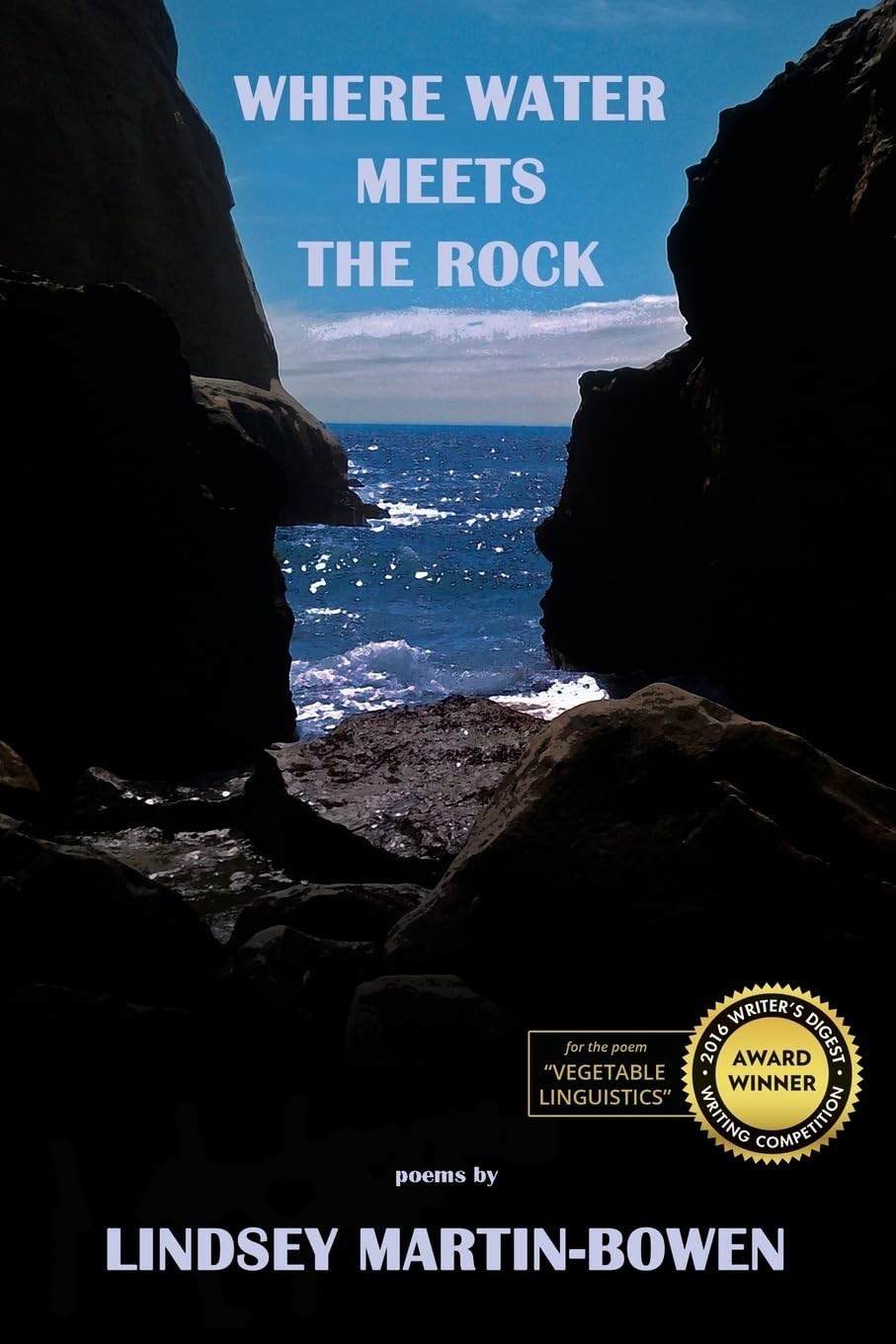
I enjoy reading poetry collections that include a common thread that links all the poems together. The common thread for this collection is loss and recuperation. This theme is relatable to everyone as we all suffer loss in various forms throughout our lives and we are forced to recuperate whether we want to or not.
The collection is divided into three sections: Erosion which explores the slow build up to loss; Frenzies which seeks to unravel the immediate chaos and emotion that follows loss; and On the Shore which delves into the slow path to acceptance and continuation.
The poems are unique and make use of various techniques to either exaggerate or bring out the humorous side of deep emotion and complex thought patterns relating to loss.
A poem that resonated strongly with me in Erosion is titled Psyche in the Suburbs. For me, this poem exposed the conflicting emotions of love, resentment, and self sacrifice that arise when caregiving for aging relatives.
This is the final stanza in this poem:
“Now, lavender scents fill the air,
sending me to the Aegean Sea.
When I step onto the asphalt,
I remember the bottled water.
I must go back. Without it,
the world will know her face
grows old. And she’ll blame me.”
Another poem in this section I especially related to is entitled My Bones are Glass. I have often thought this same thing when dealing with the elderly and aging. The poet includes an apology to Mark Strand, one of my favourite poets, so the style also worked very well for me.
Section 2: Frenzies, includes a lot of humour relating to people’s eccentricities and wants in their final moments. The poems also touch on the need for the observers to fulfil every desire and make the passing easier – perhaps to alleviate the guilt of survival. I enjoyed the poems although humour in poetry is not my personal favourite style. This section lifts the tension in death and loss and will appeal to most readers.
Section 3: On the Shore was very compelling for me. It explored inevitable change and endings coupled with new beginnings of a different sort. I reminded me that we move from one phase to another in our lives without even realising it until we look back and the end and beginning stand out in stark reality. The poem I enjoyed the most in this section was Two Mothers with Kids in Winchell’s. Perhaps because my children are now adults and have both finished school so I can understand and appreciate this poem through the lens of a soon to be empty nester.
This is one stanza in the poem that I strongly related to:
“The Winchell’s mothers nod, talk in buzzing hums,
eye their toddlers, who hop, slide on linoleum.
The kids scratch glass, balance on window ledges.
The pregnant one smooths seersucker. “Guys,” she says,
“They don’t like that here. Come, be quiet, Sit down.”
Like seatbelts, her words rein them in. I frown,
wonder how she renders her voice firm but not loud.”
As a mother who always worked, this stanza fills me with thoughts about what might have been had my own path taken me along a different path. What kind of mother would I have been had I not always been struggling to balance work and home demands. A writer who can introduce such reflections has to be great.
I highly recommend this compelling collection.
Where Water Meets the Rock is available from Amazon US here: https://www.amazon.com/Where-Water-Meets-Lindsey-Martin-Bowen/dp/1946358053
Lindsey Martin-Bowens Amazon Author page is here: https://www.amazon.com/stores/Lindsey-Martin-Bowen/author/B00JA31KW0
About Lindsey Martin-Bowen
Lindsey Martin-Bowen’s CASHING CHECKS with Jim Morrison has just been released this fall (2023) by redbat books (a La Grande, Oregon publisher) as part of its Pacific Northwest Writers series. She serves as a Literary Consultant for Pierian Springs Press, which published The BOOK of FRENZIES in April 2022 (hardback copy in December 2022–BEFORE she became its Literary Consultant). She has taught Criminal Law and Procedure (online) at Blue Mountain Community College, Pendleton, Oregon since January 2019. Until August 2018, she taught writing, literature, and Criminal Law at MCC-Longview and taught literature and writing at the University of Missouri-Kansas City 18 years.
A Pulitzer-Prize nominee, her fourth full-length poetry collection, WHERE WATER MEETS THE ROCK (39 West Press 2017) contains “Vegetable Linguistics,” which received an Honorable Mention in the Non-rhyming Poetry category of Writers Digest’s 85th Annual Writing Competition (2016). Her third collection, CROSSING KANSAS with Jim Morrison, won the “It Looks Like a Million” Award for the 2017 Kansas Authors Club competition. The book is an expansion of her chapbook named a finalist in the 2015-2016 QuillsEdge Press Chapbook Contest. “Bonsai Tree Gone Awry” from INSIDE VIRGIL’S GARAGE (Chatter House Press 2013) was nominated for a Pushcart Prize. This collection was also runner-up in the 2015 Kansas Authors Club Nelson Poetry Book Award. Woodley Press (Washburn University) published her first full-length collection, STANDING ON THE EDGE OF THE WORLD, which McClatchy newspapers named one of the Ten Top Poetry Books of 2008. Paladin Contemporaries released her novels RAPTURE REDUX (2014), HAMBURGER HAVEN (2009) and CICADA GROVE (1992). Her work has appeared in NEW LETTERS, I-70 REVIEW, THORNY LOCUST, FLINT HILLS REVIEW, PORTER GULCH REVIEW, SILVER BIRCH PRESS, COAL CITY REVIEW, PHANTOM DRIFT, TITTYNOPE ZINE, BARE ROOT REVIEW, , AMETHYST ARSENIC, THE SAME, THE ENIGMATIST, ROCKHURST REVIEW, BLACK BEAR REVIEW, LITTLE BALKINS REVIEW, KANSAS CITY VOICES, LIP SERVICE, 21 anthologies, and others.
With Dennis Etzel, Jr., she edited GIMME YOUR LUNCH MONEY: Heartland Poets Speak out against Bullies (Paladin Contemporaries 2016). She holds an MA in English (creative writing emphasis) and a Juris Doctor degree.
Before focusing upon teaching and writing poetry and fiction, she served as a full-time journalist and magazine editor for THE LOUISVILLE TIMES, the Johnson County SUN, MODERN JEWELER Magazine, and THE NATIONAL PARALEGAL REPORTER. She also worked as a legal editor for the Office of Hearings and Appeals (USDI) in Washington, DC.
She has two brilliant children and contends with super Chihuahuas Chia Maria La Rue and Chico the Man, her canine companions. And often, she spars verbally with poet Carl Rhoden.
About Robbie Cheadle
South African author and illustrator, Robbie Cheadle, has written and illustrated sixteen children’s books, illustrated a further three children’s books, and written and illustrated three poetry books. Her work has also appeared in poetry and short story anthologies.
Robbie also has two novels and a collection of short stories published under the name of Roberta Eaton Cheadle and has horror, paranormal, and fantasy short stories featured in several anthologies under this name.
You can find Robbie Cheadle’s artwork, fondant and cake artwork, and all her books on her website here: https://www.robbiecheadle.co.za/
________________________
Did you know you can sponsor your favorite blog series or even a single post with an advertisement for your book? Stop by the WtbR Sponsor Page and let me advertise your book, or you can make a donation to Writing to be Read for as little as a cup of coffee, If you’d like to show your support for this author and WordCrafter Press.
__________________________
This segment of “Treasuring Poetry” is sponsored by WordCrafter Press and the Poetry Treasures series.
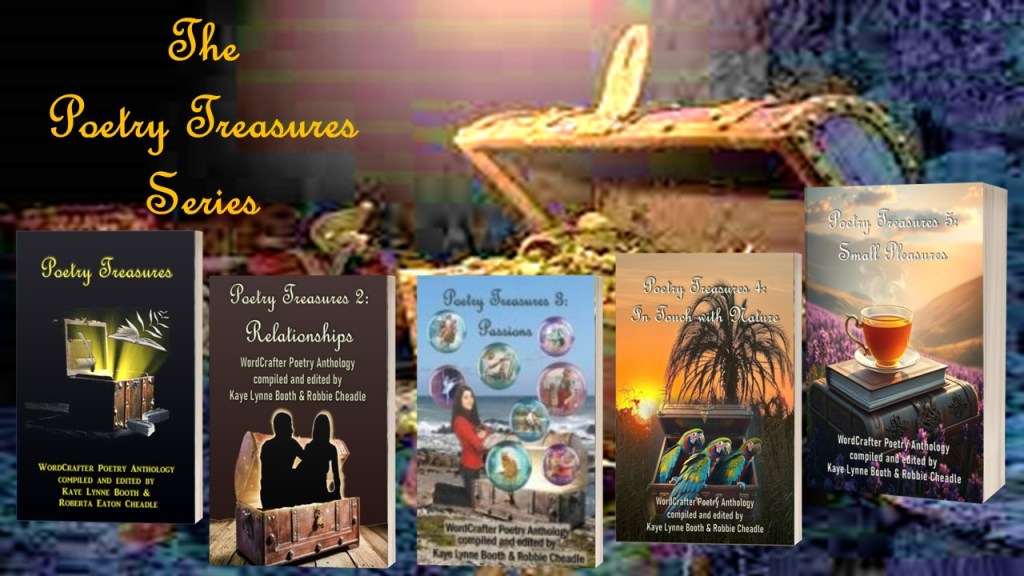
Get Your Copy Today!
Poetry Treasures: https://books2read.com/PoetryTreasures
Poetry Treasures 2: Relationships: https://books2read.com/PT2-Relationships
Poetry Treasures 3: Passions: https://books2read.com/u/b5qnBR
Poetry Treasures 4:In Touch With Nature: https://books2read.com/PT4-Nature
Poetry Treasures 5: Small Pleasures: https://books2read.com/PT5-SmallPleasures
Share this:

Treasuring Poetry – Meet poet and author, Laura Lyndhurst, and a review
Posted: February 18, 2026 Filed under: Book Review, Books, Collection, Interview, Poetry, Review, Treasuring Poetry | Tags: #RobbieCheadle, #TreasuringPoetry, Book Review, Interview, Laura Lyndhurst, Poetry, Robbie Cheadle, Social Climbing and Other Poems, Treasuring Poetry, Writing to be Read 31 CommentsHi everyone, today I’m thrilled to introduce you to Laura Lyndhurst. Laura is an accomplished author and poet and is also a new member of Story Empire blog which is a great resource for writers. You can read Laura’s first Story Empire post here: https://storyempire.com/2026/02/10/sowing-the-seeds-of-a-story/
Welcome Laura!
Tell us a bit about yourself and your poetry journey. How did you come to be a poet?
I never intended to write poetry. At school it was my least-favourite of the three prose-poetry-drama disciplines, and I didn’t like many of the poems that we studied. It was the same at university, when I finally got there in my forties. I was obliged to study Romanticism for my first-year core module, and I hated it. Wordsworth, Coleridge, Shelly; I wasn’t keen on them, although I was okay with some of Keats’s work. In the second year I couldn’t help but study more poetry, and I didn’t mind John Donne at all.
As to my own work, it was when I joined a Facebook writing group that it started. The group leader decided to post a picture every day for the month of October, inviting the group members to write a few paragraphs of prose around them. I sat with the first picture, thought, wrote—and what came out was poetry. The leader and members liked it, and thereafter I challenged myself to write poem every day from the picture prompt. At the end of the months I decided to publish them in a book, to claim copyright on them as much as anything. I called it October Poems, after the month in which I wrote them, and three more little collections followed in the next year or two.
What is your favourite poem by another poet and why?
That’s difficult. I like poetry more now than I used to, and there are several poets whose work appeals. I tend to listen to Leonard Cohen’s songs more than I read his poems, but he does have a way with lyrics; I mean, ‘the place is dead as Heaven on a Saturday night’ is so great. Hardy’s ‘The Darkling Thrush’ is up there, along with ‘This Be The Verse’ by Phillip Larkin. ‘Pity me not because the light of day’ by Edna St. Vincent Millay and ‘Rubbish at Adultery’ by Sophie Hannah attract, from the serious and the not-so as well. Choice for today, however, has to be ‘Refugee Blues’ by W.H. Auden. It never gets old, unfortunately, and although it’s written around one specific ethnic refugee group it can be applied to the myriad groups in existence before and since it was written; and now, in the 2020s, it feels massively relevant. You can find it here: https://allpoetry.com/refugee-blues
What is your favourite style of poetry and why?
Another difficult question. I don’t have a favourite style as such. I’ll read many different poems, some I’ll like and some I won’t, but the style of writing doesn’t have much bearing on why I like them or not. I do have an author friend, Thomas Leverett, who writes extensively in haiku form, and I loved his E Pluribus Haiku, which feels like travelling around the USA in haiku form. It’s on the link below, if you’re interested.https://www.amazon.com/Pluribus-Haiku-Anthology-3487-ebook/dp/B08X2YRQB2
Which is your favourite of your own poems?
I love them all, some more than others, it has to be admitted. I’ll choose the last one I wrote, however, because it is the last one and about ‘the end’. It’s from Social Climbing and Other Poems, and inspired by Clive Thompson’s photo of the altar of a Greek Orthodox Church.

Due Process
Your case has been a lengthy one; eighty-four years it’s taken, to
observe your less-than-perfect deeds and gather evidence to
aid the prosecution. But now you’ll have your day in court and
the jury gathered here, the Twelve, will finally decide, for or
against, whether you stay righteous here or whether you go down.
You wish to conduct your own defence? No, really, that won’t do, you’ll
be given representation. One of these saintly suits here gathered,
yes, that’s right, the ones with haloed wigs, will intercede for you.
Sorry for the delay; we understand that it’s a real nerve-wracking time for
you, but we can’t begin until His Honour gets here to take His place there,
in the big chair. The witnesses are here for you, plus jury, twelve good men
and true, not to forget the female sex, the immaculate, to try to push
your sins aside and hide you ‘neath their garments of compassion.
But nothing can occur until the God-Father is here; He’s judge
and jury all in one, Divine Justice in person. So please don’t fret,
or maybe do, for He knows you as well as you, and maybe better.
This whole set-up is just for show, to satisfy the need to see the
wheels of justice set in motion; your sentence fixed already,
your judgement day is here.
And here Our Father approaches now.
The court will rise …
Tell us a bit about your book, Social Climbing and other poems – what is the inspiration for the collection?
At the time I was friends with a photographer, Clive Thompson, and one of his pictures inspired a poem – ‘So This is Christmas’, which I recently published on my blog. Clive then allowed me to put together a book of my poems written to the prompts of some of his pictures.
What’s next for Laura Lyndhurst in the world of writing?
No more poetry, I’m afraid; nothing planned, at any rate, but if something occurs then I’ll be putting it together. At present I’m editing my latest novel, a whodunnit of sorts; a new departure for me, sort-of, because although I like adding a bit of a mystery to some of my stories this will be the first time I’ve brought the police in to investigate. It’s more focussed on before the murder, the personalities involved and their potential motivations. After that I’ll see what else occurs to me.
Many thanks for interviewing me. I’ve enjoyed it very much.
My review of SOCIAL CLIMBING: and Other Poems
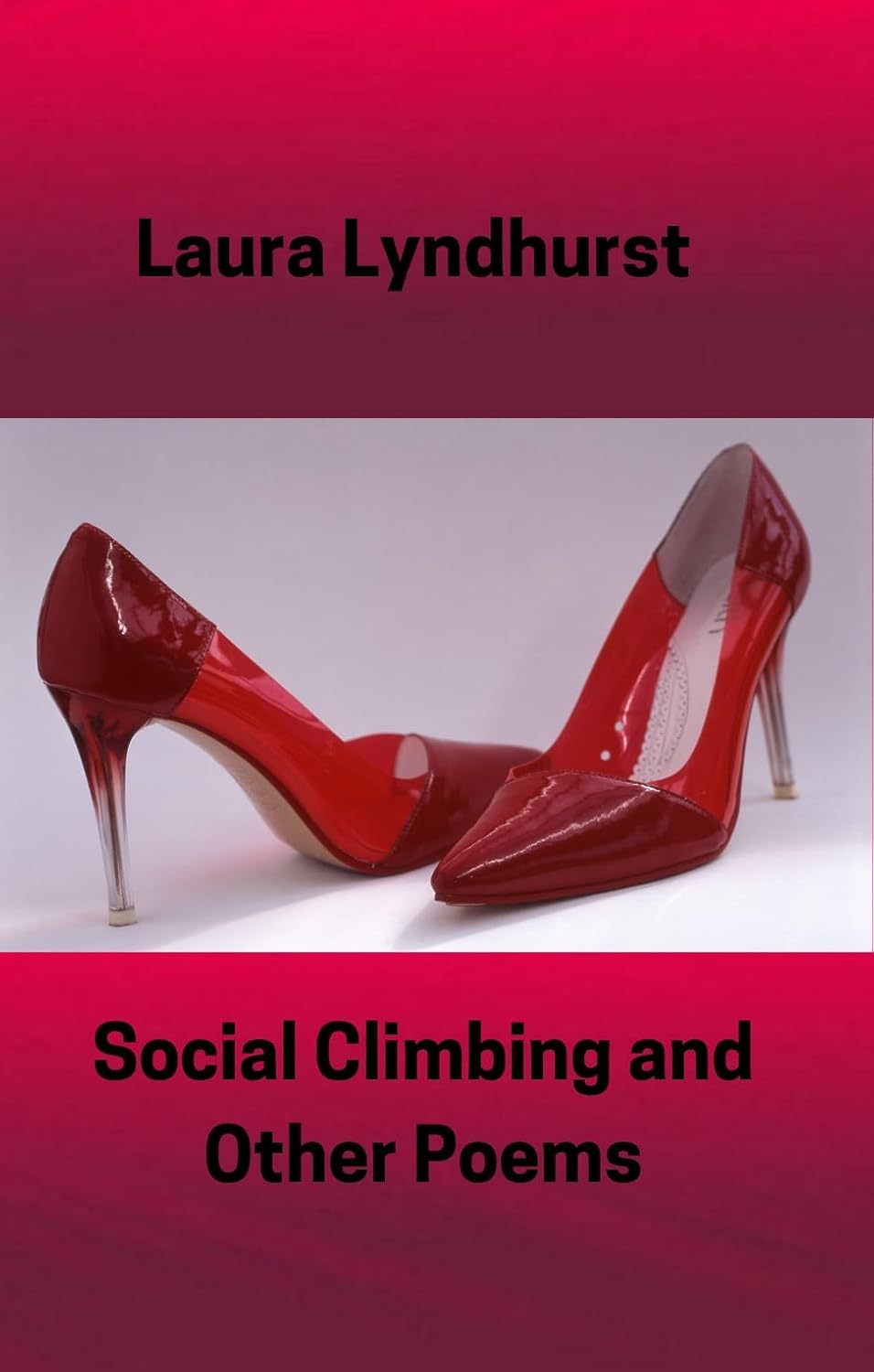
When I saw the cover of this collection, the shiny, red high heeled shoes against a white background, it reminded me of the movie, The Devil Wears Prada featuring Merril Streep and I was completely fascinated. I was not disappointed as this interesting collection of freestyle poems is a head on collision with an array of social situations, many of which are uncomfortable.
“The sit inside and watch the show, these Parisian fans of opera; but we,
lacking the means to buy the tickets for the red-plush, well-upholstered
seats and ornate murals, gilt-decked swirls and whirls of rococo decor,
prefer to take our entertainment in quite another way. Out here in the street”
from Street Theatre
Laura slices to the heart of human emotions and frustrations and these poetic expressions resonated with me. One poem I particularly delighted over is “I don’t know much about art but I know what I like”.
“So I’m breaking out of normalcy,
gone so very Modernisth,
this El Greco’s got his paintbox out
and given life a twist.”
Honestly, this poem made me laugh until I cried. Fantastic!
Each poem is introduced with a beautiful colour photograph by photographer, Clive Thompson.
Do yourself a favour, purchase this collection and allow Laura to put your life in perspective for you.
About Laura Lyndhurst
Laura Lyndhurst was born and grew up in North London, England, before marrying and travelling with her husband in the course of his career.
When settled back in the UK she became a mature student and gained Bachelor’s and Master’s degrees in English and Literature before training and working as a teacher.
She started writing in the last few years in the peace and quiet of rural Lincolnshire, and published her debut novel, Fairytales Don’t Come True, in May 2020. This book forms the first of a trilogy, Criminal Conversation, of which the second is Degenerate, Regenerate and All That We Are Heir To the third. Innocent, Guilty, the first of another trilogy, continues the story told in these three books and leads on to The Future of Our House, which is followed by Uphill, Downhill, Over, Out as the sixth and final book to end the series. An Honourable Institution was published as a stand-alone novel in January 2025, as was The Guilty Party in September 2025.
Laura also developed a taste for psychological suspense, which led to the writing and publication of You Know What You Did, to which What Else Did You Do? is the sequel.
Laura has also published four small books of poems, October Poems, Thanksgiving Poems and Prose Pieces, Poet-Pourri and Social Climbing and Other Poems.
Find Laura Lyndhurst
Website: https://booksthatmakeyouthink2.co.uk/
Facebook: https://www.facebook.com/laura.lyndhurst (personal profile)
Facebook: https://www.facebook.com/lauralyndhurstauthor/ (author profile)
Amazon: https://www.amazon.co.uk/stores/Laura-Lyndhurst/author/B088QFJJ3Q
Goodreads: https://www.goodreads.com/author/show/20336562.Laura_Lyndhurst
Instagram: https://www.instagram.com/lyndhurstlauraauthor/
Pinterest: https://uk.pinterest.com/lyndhurstlaura/
Tiktok: https://www.tiktok.com/@alectrona47
About Robbie Cheadle
South African author and illustrator, Robbie Cheadle, has written and illustrated sixteen children’s books, illustrated a further three children’s books, and written and illustrated three poetry books. Her work has also appeared in poetry and short story anthologies.
Robbie also has two novels and a collection of short stories published under the name of Roberta Eaton Cheadle and has horror, paranormal, and fantasy short stories featured in several anthologies under this name.
You can find Robbie Cheadle’s artwork, fondant and cake artwork, and all her books on her website here: https://www.robbiecheadle.co.za/
________________________
Did you know you can sponsor your favorite blog series or even a single post with an advertisement for your book? Stop by the WtbR Sponsor Page and let me advertise your book, or you can make a donation to Writing to be Read for as little as a cup of coffee, If you’d like to show your support for this author and WordCrafter Press.
__________________________
This segment of “Treasuring Poetry” is sponsored by WordCrafter Press and the Poetry Treasures series.
Get Your Copy Today!
Poetry Treasures: https://books2read.com/PoetryTreasures
Poetry Treasures 2: Relationships: https://books2read.com/PT2-Relationships
Poetry Treasures 3: Passions: https://books2read.com/u/b5qnBR
Poetry Treasures 4:In Touch With Nature: https://books2read.com/PT4-Nature
Poetry Treasures 5: Small Pleasures: https://books2read.com/PT5-SmallPleasures