See the WordCrafter New Beginnings Character Development Panel Discussion.
Posted: June 29, 2021 Filed under: Character Development, WordCrafter Press, Writing, Writing Event, Writing Tips | Tags: 2021 New Beginnings Virtual Writing Conference, Character Development, WordCrafter Press, writing advice, Writing Tips, Writing to be Read 4 Comments
The 2021 Wordcrafter New Beginnings Virtual Writing Conference did not turn out as well as I had hoped, by any means. This year, we had a two-day event with a pre-event promotional and social day on Facebook to launch it. If you happened to attend any part of the event, I want to thank you for your support. For those of you who did not attend, and that is probably most of you as attendence was way down from the 2020 conference. I’m sure the pandemic had a lot to do with both last year’s and this year’s turn-outs.
Whatever the reason for the poor turn-out in 2021, I think we all still had fun just getting together and talking about the craft. We had a great group of authors, who jumped in and carried on without me when I experienced an internet outage, causing me to miss one full day of the conference. Let me tell you, as the host, that was really frustrating, because I didn’t know if things had continued on without me, or simply fallen apart, and I had no way to find out until I moved to another location where I knew I would have internet access for Day 2. But most of this great group of authors just picked up the ball and ran with it, even without their host to guide them. I guess it’s true that the show must go on.
It would be a shame to let all the hard work that myself and all of the wonderful authors who were kind enough to volunteer their time to present this conference go to waste. So, I made the keynote address by horror author, Paul Kane, available from the Conference Page, here on Writing to be Read or on WordCrafter’s YouTube page, immediately following the conference, and although the editing of the conference recordings has been slow, they will all eventually be released, as well.
The first of these has recently been posted to YouTube and can be accessed both there and on the Conference Page, as well as through the link below. It is the Character Development Panel Discussion, with authors Jim Nesbitt, Ellie Raine, Paul Kane, Chris Barili, and Mario Acevedo. It’s an interesting discussion, one that you’ll want to be sure and sit in on. You can even weigh in with your own thoughts on character development in the comments. And the best part is, it’s free!
________________________________________________________________________________
Like this post? Let me know in the comments. You can be sure not to miss any of Writing to be Read’s great content by subscribing to e-mail or following on WordPress. If you found this content helpful or entertaining, please share.
Share this:

Treasuring Poetry – If by Rudyard Kipling and The Listeners by Walter de la Mare
Posted: June 19, 2021 Filed under: Poetry, Treasuring Poetry | Tags: Poetry, Poetry Collection, Poetry Treasures, Robbie Cheadle, Treasuring Poetry, Writing to be Read 51 Comments
This month I am featuring my own favourite poems and a poem and picture from my forthcoming poetry book, Behind Closed Doors. I hadn’t intended to feature my own work this month, but sometimes life happens and so I am making the best of it.
If by Rudyard Kipling
I love the poem If by Rudyard Kipling because it is so inspiring and uplifting. The objective of the poem was to give his son advice and instruction on how to live a happy and successful life. I relate strongly to this advice possibly because I have two sons.
My favourite lines are as follows:
“If you can bear to hear the truth you have spoken
Twisted by knaves to make a trap for fools,
Or watch the things you gave your life to, broken,
And stoop and build ’em up with worn-out tools.”
The first two lines above warn that his son must learn to endure his own words twisted by dishonest and harmful people in order to serve their own agendas. The second two lines explain the importance of being able to cope with failure and pick yourself up and carry on, even if what you fail at has been your life’s work.
Both of these situations are ones that everyone comes across in life – people who are willing to walk on you in order to serve their own purposes and failure. How we deal with the resulting disillusionment and disappointment has a huge bearing on our lives going forward.
I like to re-read this poem as a reminder to myself to stay strong and on my chosen path in life.
You can listen to my recital of this poem here:
The Listener by Walter de la Mare
In summary, this poem is about a traveler who comes to a house on a moonlit night and knocks on the door. He demands that the door be opened but he receives no answer.
We discover that the traveler has made a promise to return to the occupants of the house, but he has been prevented from doing so until the current time. It is too late and the occupants are gone. He clearly feels some guilt because he cries “Tell them I came, and no one answered, That I kept my word…”
I love this poem because of its supernatural undertone. There is a mystery that runs through the poem and you feel the whisper of ghosts in the imagined echoes of the listener’s words.
You can listen to my recital of this poem here:
Which of these two poems do you like best?
This is a poem from my poetry book, Open a new door.
The Thunderstorm
A deluge of rain tumbles from the sky
like a bucket turned upside down
the beggars impervious to its ferocity
faces impassive, no fear or frown.
***
Young boys stand on the roadside
eyes smoldering with hunger’s pain
need forcing them to continue standing
despite the lightening and drenching rain.
***
One holds a bedraggled cardboard sign
the other a tattered polystyrene cup
each hoping a passerby will pause
and give something to eat or sup.
***
A young mother stands shivering
an old umbrella sheltering her child
his eyes huge and frightened
he’s never laughed or even smiled.
***
In the middle of an intersection
an old man stands bent and alone
his head bowed in supplication to the torrent
he doesn’t complain, sigh or moan.
***
It’s rare to see the elderly on the street
poverty means many don’t live that long
my heart fills with a wrenching pain
for this anguished society to which I belong.
***
At the traffic light outside my offices there are a collection of beggars and window washers. One old man stands in the middle of the intersection. It is hard to extend any aid to him as it is not a good place to slow down. This motely crew is there every day, come rain or shine.
I have a new poetry collection coming out soon. Here is the cover, designed by the amazing Teagan Riordain Geneviene

About Robbie Cheadle

Robbie Cheadle is a children’s author and poet.
The Sir Chocolate children’s picture books, co-authored by Robbie and Michael Cheadle, are written in sweet, short rhymes which are easy for young children to follow and are illustrated with pictures of delicious cakes and cake decorations. Each book also includes simple recipes or biscuit art directions which children can make under adult supervision.
Robbie has also published books for older children which incorporate recipes that are relevant to the storylines.
Robbie writes a monthly series for https://writingtoberead.com called Growing Bookworms. This series discusses different topics relating to the benefits of reading to children.
Robbie has a blog, https://robbiesinspiration.wordpress.com/ where she shares book reviews, recipes, author interviews, and poetry.
Find Robbie Cheadle
Blog: https://www.robbiecheadle.co.za/
Blog: robbiesinspiration.wordpress.com
Twitter: BakeandWrite
Instagram: Robbie Cheadle – Instagram
Facebook: Sir Chocolate Books
Want to be sure not to miss any of Robbie’s “Treasuring Poetry” segments? Subscribe to Writing to be Read for e-mail notifications whenever new content is posted or follow WtbR on WordPress.
Share this:

Mind Fields: Scammed Like An Idiot By Hackers
Posted: June 18, 2021 Filed under: Commentary, Mind Fields, Opinion | Tags: Arthur Rosch, computer glitches, hackers, Mind Fields, ransomware, tech support, Writing to be Read 5 Comments
Scammed Like An Idiot By Internet Hackers Vol 3a
“This is completely crazy!” I shouted at my smartphone. I was on the verge of a panic attack. The man at the other end, in his classic Mumbai accent, replied, “No no sir, it is not crazy. Your computer is badly infected. Do you see all these people who are using your private information?”
He pronounced Private with a “W”. Priwot.
My mouse pointer moved while my hands rested in my lap. The Command Window opened and showed an ominous list of white notations scrolling down the black background. Mumbai Man had control of my computer. I could see repeated iterations of the word “Trojan”
“See there,” he said. “See, see? See how many!” I had been fighting him for at least an hour and he was losing his composure. I was stubbornly refusing to capitulate. Is this what’s called Ransomware? So it seems. I couldn’t get rid of the guy. I couldn’t regain control of my computer until I paid five hundred dollars. Needless to say, I was upset. And I brought it upon myself by doing a stupid thing.
I had already been softened up. A week ago a demanding white pop-up window informed me that my computer had contracted a virus. In order to fix it I must call Microsoft at an 800 phone number. Riiight! And there are elephants on the moon. The pop up wouldn’t go away. No restart, no Task Manager, nothing. I shut down my computer by pulling the plug. When I rebooted I got on a treadmill of Windows fix-it bubbles that went nowhere.
After a couple hours of futzing with various remedies, including a non-functioning backup program, I realized that I had to reformat my computer. That was three days of work. Such work included ransacking all of my closets and bins looking for software. Labor intensive!
Everything was fine after the reformat, my computer worked for a week. Then that same white pop up window appeared and I knew I was in trouble. I didn’t want to reformat again! Like an idiot I called the phone number. Thus an ordeal began that went on for hours. Mumbai Man insisted that he represented Microsoft. He gave me an I.D. number. He gave me a phone number for…uh..Microsoft. I got another phone and punched that number. At the first ring a man with a Mumbai accent answered. “Microsoft Customer Service” he cheerfully announced.
The voice of Mumbai Man #1 created a bizarre feedback loop because as he spoke to me on MY phone, his voice sounded one desk removed on the phone that I had used to call…er…Microsoft.. I went through the motions, juggling two cell phones. I was assured by Mumbai Man #2 that Mumbai Man #1 was a legitimate Microsoft employee. His name was…uh… Sam Taylor. I wasn’t buying it but I was losing my grip on reality. These guys were slick! They had an answer for everything. They talked and talked and their reasoning was insane. Slowly they dragged me into the upside-down world of internet thieves. They could demonstrate to me how badly messed up was my computer. They told me that even if I bought a new computer the same thing would happen because hackers lurked in my network. They told me that every computer I ever bought from this day forward would be infected if I didn’t pay five hundred dollars.
“Sir, why are you having a broblem with this?” asked..uh.. Sam Taylor, as if this were a perfectly reasonable situation.
“A broblem?” I shrieked. “A broblem? Five hundred dollars and my computer held hostage is a broblem!. I can buy a new computer for five hundred dollars!”
“Oh, but sir, the new computer will also have the same broblem if you do not take care of this right away.”

Listen, I love the accent of Indians, be they from Mumbai, Kalikot or Kerala. I love the way they sound like they have three marbles just inside their lower lip. I have adored Indian culture my entire life. However these fellows conformed to a stereotype, this was happening in the real world and in the real world most Americans expect their tech support to speak with that lilting accent. Weirdly, it added a gloss of credibility to what was blatantly incredible.
“I’m sixty two years old,” I told the thief. “Does your mother know what you do for a living? That you rob old people on Social Security?”
“Oh, sir, you are a senior citizen? Let me talk to my supervisor and see what I can do about getting a discount.”
Hmmm hmmm count to five. “Oh yes sir, my supervisor tells me that we can make the rebairs for three hundred forty nine dollars and ninety five cents.”
I gave in. I let them install their shit on my computer. Their spyware, malware, ransomware buggy shit on my computer. I gave them my credit card number. I still don’t believe I did that. Sam Taylor had turned me over to Steve Smith who worked in Billing, and Steve Smith had then given control of my computer to Richie Logan. I watched my screen as program after program was installed, operated, then uninstalled. It was spooky! I was afraid to pull the plug on the modem and shut them out. By this time I didn’t know what to believe and I had the futile hope that these guys were actually fixing my computer.

My lovely spouse had a terrible virus experience once and contacted a reputable repair company who charged her a hundred dollars to remotely fix her computer. I phoned them while my computer chattered away, rolling files across the monitor screen.
“Unplug your modem right now!” This was the order from Jeffrey Everard in Austin, Texas. He works for OneSupport. They handle situations such as the mess I found myself in. I trust them. I think.
Jeffrey worked for an hour on my computer and charged me a hundred bucks.
Barclay Bank shut down my credit card and promised to mail me a new one with a new account number. Mumbai Men had yet to run the charge and they were not going to get my money. I called all my credit card vendors. I called the bank.
This was a horrible experience. Be careful. These crooks are skillful and incredibly persistent. They are glib, slick and ruthless. They are from India, Ukraine, Thailand, Poland, Belorus and the USA. They find your knowledge level with regard to computers and they know how to convince you that they’re not lying. They twisted my head so badly that I couldn’t locate reality after spending a couple of hours in their company. Did a little alarm go off at Microsoft Headquarters notifying them that my computer was infected? I posed this vision sarcastically and they said, “Yes that’s exactly what happened!”
I am now afraid to do any browsing on my computer. I’m afraid that any program I purchase to fight malware might be the vehicle bringing malware to my computer.
I made a mistake, a dumb mistake and it could have cost me much more. It will be a while before I can relax and use my computer normally. If ever.
My hands are still shaking.
_____________________________________________________________________________________________________________

Arthur Rosch is a novelist, musician, photographer and poet. His works are funny, memorable and often compelling. One reviewer said “He’s wicked and feisty, but when he gets you by the guts, he never lets go.” Listeners to his music have compared him to Frank Zappa, Tom Waits, Randy Newman or Mose Allison. These comparisons are flattering but deceptive. Rosch is a stylist, a complete original. His material ranges from sly wit to gripping political commentary.
Arthur was born in the heart of Illinois and grew up in the western suburbs of St. Louis. In his teens he discovered his creative potential while hoping to please a girl. Though she left the scene, Arthur’s creativity stayed behind. In his early twenties he moved to San Francisco and took part in the thriving arts scene. His first literary sale was to Playboy Magazine. The piece went on to receive Playboy’s “Best Story of the Year” award. Arthur also has writing credits in Exquisite Corpse, Shutterbug, eDigital, and Cat Fancy Magazine. He has written five novels, a memoir and a large collection of poetry. His autobiographical novel, Confessions Of An Honest Man won the Honorable Mention award from Writer’s Digest in 2016.
More of his work can be found at www.artrosch.com
________________________________________________________________________________________________________________________
Want to be sure not to miss any of Art’s “Mind Fields” segments? Subscribe to Writing to be Read for e-mail notifications whenever new content is posted or follow WtbR on WordPress. If you find it interesting or just entertaining, please share.
Share this:

Announcing the winner of the 2021 WordCrafter Short Fiction Contest
Posted: June 16, 2021 Filed under: Fiction, Ghost Stories, Paranormal, Stories, Writing Contest | Tags: 2021 WordCrafter Short Fiction Contest, Where Spirits Linger, Winner, WordCrafter Press, Writing to be Read 6 Comments
The winner of this contest was supposed to be announced by the end of May, but as I explained in my last post of the month, all contest submissions were asked to make some revisions and I couldn’t determine a winner until that was done, so I’d have the revised stories to choose from. However now, that has happened. I have all the stories back with revisions and the time has come to reveal the winner.
And the winner is…
I’m happy to announce that the winner of this year’s contest is Christa Planko for her story “Olde-Tyme Village“. The winning story will be featured in this year’s paranormal anthology, Where Spirits Linger and Christa will receive a $25 Amazon gift card.
Share this:

Growing Bookworms: Handwriting skills for children, Part 1
Posted: June 9, 2021 Filed under: Growing Bookworms, Parenting, Writing | Tags: Growing Bookworms, Handwriting, Handwriting vs. typing, Robbie Cheadle, Writing to be Read 106 Comments
Why handwriting is still important
As technology becomes increasingly important in our modern lives, writing by hand with a pen has become less common. Writing on a computer is easy and allows us to move text about, delete and add text, and save sections in a separate place for future use. We are also able to access our writing from a number of devices. I access my email and blogs from all three of my laptops, both of my iphones, and my ipad. This all makes writing so much simpler, so why do our education systems still focus on handwriting? Why not let the children use laptops and ipads to write?
Cognitive benefits
Writing notes by hand improves language skills. Writing by hand takes longer than typing and forces the writer to slow down their thought process and consider the words more. When you write by hand you spend more time thinking about the structure of the writing, the spelling of words, and they way you are using them.
Writing information down also aids our memory. I knew this without consulting the research confirming that writing creates unique pathways in the brain causing people who take notes by hand to remember the content better than those who type up their notes. Like me, my oldest son, Gregory, came to this realisation on his own and writes copious and detailed notes. His effort and dedication reflects in his academic results.
Creative writing benefits
A lot of writers still use notebooks to record and flesh out their ideas by hand. When we write longhand our ideas flow better and we are less distracted by the need to keep editing our work as we go along. When we write by hand we follow the flow of the idea and leave the editing until later.
I write most of my poetry by hand, but I do type up my prose so I know the above is true. I just can’t stop myself from continuously editing.
My son, Michael, writes by hand. He has a book in which he writes down his thoughts and ideas when the spirit moves him. When it comes to school assignments, he writes his stories on a laptop and I am always amazed at how many more mistakes and errors he makes when using a laptop than when writing by hand.
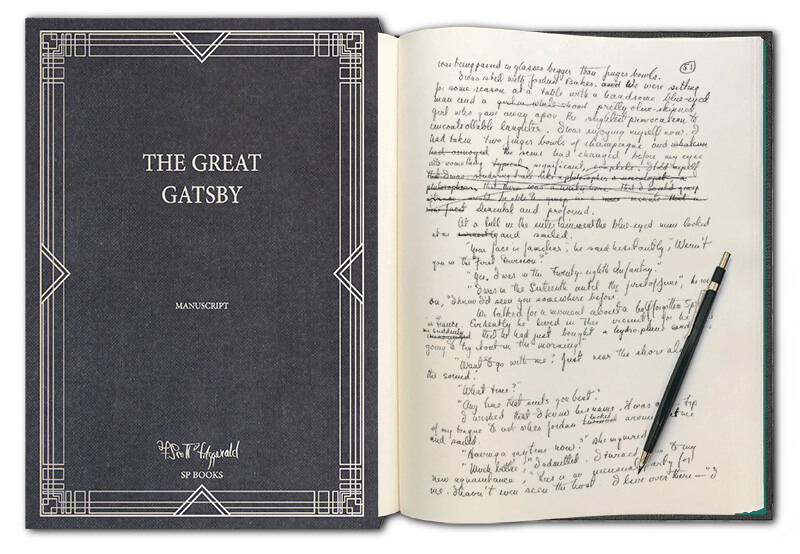
Picture credit: https://www.spbooks.com/67-the-great-gatsby-9791095457428.html
Handwriting is less restrictive
This point links to the one above about writing by hand freeing our minds and creative processes from the need to edit. I don’t write my prose by hand but I do record my frameworks and basic ideas by hand. I like to use mind maps which set out my story process. I have noticed that Michael does the same when plotting.
Again, I must emphasis that using and electronic devise to brainstorm is fraught with distractions. These are our own fault as we have our social media, email, and other notifications coming through on our devices. Every time I get an email or notification from Facebook, it pops up on my screen and my eyes automatically go to the pop up and read it.
Handwriting is part of our identity and our culture
Our handwriting is unique to us and forms a part of our identity. Even people like me whose writing is difficult for others to read, still put our personal stamp on handwritten work (my writing is difficult to read because I cannot resist adding curls and whirls all over the place; my writing is a work of art).
Writing is also an important part of our culture and our development as a species, it is the foundation of our learning and progress.
If you are interested in learning a bit more about the role of handwriting in our lives and culture, Rebecca Budd has a lovely podcast entitled The Trio on Letter Writing which discusses this topic in detail.
Quotes about writing
I think of my drawing style like handwriting: it’s a mix of whatever handwriting you’re born with, plus bits and pieces you’ve pilfered from other people around you. – Roz Chast
Poets don’t draw. They unravel their handwriting and then tie it up again, but differently. – Jean Cocteau
Somehow I started introducing writing into my drawings, and after a time, the language took over and I started getting very involved with the handwriting and then the look of the handwriting. – Patti Smith
About Robbie Cheadle
Robbie Cheadle is a children’s author and poet.
The Sir Chocolate children’s picture books, co-authored by Robbie and Michael Cheadle, are written in sweet, short rhymes which are easy for young children to follow and are illustrated with pictures of delicious cakes and cake decorations. Each book also includes simple recipes or biscuit art directions which children can make under adult supervision.
Robbie has also published books for older children which incorporate recipes that are relevant to the storylines.
Robbie writes a monthly series for https://writingtoberead.com called Growing Bookworms. This series discusses different topics relating to the benefits of reading to children.
Robbie has a blog, https://robbiesinspiration.wordpress.com/ where she shares book reviews, recipes, author interviews, and poetry.
Find Robbie Cheadle
Blog: https://www.robbiecheadle.co.za/
Blog: robbiesinspiration.wordpress.com
Twitter: BakeandWrite
Instagram: Robbie Cheadle – Instagram
Facebook: Sir Chocolate Books
_____________________________________________________________________________________________________________________
Want to be sure not to miss any of Robbie’s “Growing Bookworms” segments? Subscribe to Writing to be Read for e-mail notifications whenever new content is posted or follow WtbR on WordPress.
Share this:

When I Was You: A thriller that will keep you guessing
Posted: June 7, 2021 Filed under: Book Review, Books, Fiction, Mystery, Suspense, Thriller | Tags: Book Review, Mnka Kent, mystery, Suspense, Thriller, When I Was You, Writing to be Read 1 Comment
When I Was You, is a well-crafted thriller by Minka Kent that will keep readers guessing to the very end. This story has all the twists and turns of a good thriller, and just when you think you know what is going on, the plot doubles back for you to realize how wrong you were. I’m not sure how to review this book without giving away spoilers, because it does keep you guessing.
Brienne Dougray was attacked and robbed, putting a jolt in her self-confidence, making her feel afraid and vulnerable. To make matters worse, all of her friends have turned their backs on her and she has no idea why. It seems the only one she can rely on is Niall, a busy oncologist who is her tennant, whom she is developing feelings for. She begins to feel as if her life is not really her own when she learns there is another woman who is living her identity and Niall may not be the man she thought he was. These odd occurances have her doubting her sanity and she has to wonder if she really knows who she is. To solve the mystery of what is really going, is the only way to figure out who she really is and get her true life back.
Suspense and mystery keeps the pages turning in this well-crafted thriller. I give When I Was You five quills.

Buy Link: https://www.amazon.com/When-Was-You-Minka-Kent-ebook/dp/B07PCR7SYF
_______________________________________________________________________________________________________
Kaye Lynne Booth does honest book reviews on Writing to be Read in exchange for ARCs. Have a book you’d like reviewed? Contact Kaye at kayebooth(at)yahoo(dot)com.
Share this:

Mind Fields: The Apocalypse Of YouTube
Posted: June 4, 2021 Filed under: Mind Fields, Visual Media, Vlogging | Tags: Arthur Rosch, Mind Fields, Visual Media, Vlogging, Writing to be Read, YouTube 2 Comments
April 19, 2021
I Love YouTube
April 19, 2021
The Apocalyptic Age Of YouTube
YouTube blows my mind. It’s GOD, it’s SHIVA, it’s…ummm..you know. Effing SUPERB! So much for the capital letters. I love YouTube. I love all the video platforms, from Godtube to Vimeo. We are living in an extraordinary time. The tools for creativity have multiplied so that billions of people have access to recording devices. Phones, vidcams, DSLRs, we now have quality gear to produce clean videos. It’s Content Heaven, and the content is whatever you want to make of it. I like discovering and studying things, like music, archaeology, astronomy. I go to school every day and it’s on the internet.
I think I’ve learned more in the last year than in all my previous life. YouTube has taught me more than many years of school taught me. I hated school…so there you go. I wasn’t about to learn anything from a place I hated. On YouTube, I’ve acquired skills from the most patient and benevolent teachers. Many providers of content do so out of their own generosity. They don’t make money, they don’t advertise.
The advent of the Vlog, or video blog, is a major development. I found the travel vlog Baldandbankrupt.com by accident. An adventurous Brit travels the world. We only know his name, Benjamin. He doesn’t tell us much else. As a guide he’s superb. He’s simple but entertaining, and his erudition is inconspicuous. He’s just one of us, “one of the guys”. He has a knack for languages. He does passably well in Russian and Hindi. What else does he speak? Who knows?
On the southern perimeter of the ex-Soviet Union there are a dozen nations, all of whom speak Russian. Consider that a gift of the Soviet past. It endowed all of Asia right up to the borders of China with a common language. As we can see through Ben’s travels, the cultures and heritages of the erstwhile Russian Empire are relatively intact. Whether it’s in Ukraine or Kalmykia, those peoples remember their legacies from The Silk Road and the steppes. In essence Bald Ben follows The Great Game, that competition between the British and the Russians that took up so much of the 19th Century. They competed in Afghanistan, Uzbekistan, Azerbaijan and Turkestan. They confronted one another across vast swathes of central Asia. They were full of Imperial ambition. The geography is immense. If Ben wants to be in the middle of nowhere, there are plenty of nowhere places to go. Especially in the once proud Soviet Union.
Back to YouTube, the Guru, The Miracle Baba. It gives tirelessly. It’s our creation, ours. I wanted to learn piano and I didn’t feel that I could afford a teacher. YouTube’s piano teachers are legion, and I’ve fastened on a few piano mentors to help me master the instrument. After nine months of practice I can run scales, play and recognize most of my chords, and perform a few songs. When was this possible, before the internet? When I took trumpet lessons as a kid the dreaded Mister Haspiel came to our house weekly to instill in me the love of the instrument. It turned out that I was a drummer, and trumpet wasn’t so much a mistake as it was my mother’s design to thwart me as a drummer. I hated the trumpet! My mother hated it too, she hated my creativity. She once threw my trumpet down the basement steps. My dad had to buy me another. I got an upgrade: a shiny Selmer to replace that funky old Buescher. Thanks, Dad! And thanks again, departed father, for tolerating my drums after I had pestered you so much that you had to buy me drums to shut me up! I became a pretty good drummer. I can still paradiddle and double paradiddle with the best of them.
Mother’s long gone and YouTube offers free piano lessons, or cheap piano lessons, whatever…I can buy a course for a hundred bucks. If I can tell you anything, it is this: learning is fun. I’m an old man and I’m still learning. I’m still perfecting skills. How cool is that? Don’t get bored. Don’t be boring. Feed your spirit, especially with music.
Additional Notes:
YouTube is so freewheeling a form that it is possible for you to meet yourself online. Get into someone’s video or make your own. When Ben “Bald” wanders the Ukraine he runs into people who are watching his travel vlog. Now they’re IN his vlog. The loopy nature of this appeals to me. The skills for video making are evolving, but the toolkit is replete with every kind of Fade, Swipe, Roll, Caption, Insert, Delete. The skill with the camera involves knowing exactly when to turn on a subject, how to walk, narrate, greet people in foreign tongues, deter thieves and touts, and when to shut up and be quiet. One does these things simultaneously. It’s a flow, a rhythm and it’s impossible to fake. Vloggers are like musicians learning their chops as they record. A good vlog narration is a consummate filmic device. Not all vloggers are equal. And not all vloggers are as independent as Benjamin Rich on baldandbankrupt dot com.
The YouTube/video post phenomenon has spawned whole new industries. There are video “factories” where buildings are divided not into offices but studios for the recording of videos of all stripes from science to porn. The miniaturization of gear and the lowered cost of production have moved videos into the mainstream.
This is the Golden Age of Content. More people are doing more things with video than has ever been possible.
__________________________________________________________________________________________________________

Arthur Rosch is a novelist, musician, photographer and poet. His works are funny, memorable and often compelling. One reviewer said “He’s wicked and feisty, but when he gets you by the guts, he never lets go.” Listeners to his music have compared him to Frank Zappa, Tom Waits, Randy Newman or Mose Allison. These comparisons are flattering but deceptive. Rosch is a stylist, a complete original. His material ranges from sly wit to gripping political commentary.
Arthur was born in the heart of Illinois and grew up in the western suburbs of St. Louis. In his teens he discovered his creative potential while hoping to please a girl. Though she left the scene, Arthur’s creativity stayed behind. In his early twenties he moved to San Francisco and took part in the thriving arts scene. His first literary sale was to Playboy Magazine. The piece went on to receive Playboy’s “Best Story of the Year” award. Arthur also has writing credits in Exquisite Corpse, Shutterbug, eDigital, and Cat Fancy Magazine. He has written five novels, a memoir and a large collection of poetry. His autobiographical novel, Confessions Of An Honest Man won the Honorable Mention award from Writer’s Digest in 2016.
More of his work can be found at www.artrosh.com
________________________________________________________________________________________________________________________
Want to be sure not to miss any of Art’s “Mind Fields” segments? Subscribe to Writing to be Read for e-mail notifications whenever new content is posted or follow WtbR on WordPress. If you find it interesting or just entertaining, please share.
Share this:

Sought out by ghosts at the Hotel St. Nicholas
Posted: June 2, 2021 Filed under: Ghost Stories, Paranormal | Tags: Cripple Creek, Ghost Stories, Ghosts, history, Hotel St. Nicholas, Paranormal, Writing to be Read Leave a comment
Since WordCrafter Press holds a paranormal short fiction contest each year, I’m always on the lookout for a good ghost story, and since this year’s anthology, Where Spirits Linger, revolves around settings, haunted places have been of particular interest to me. According to paranormal investigator, Connor Randall, in his csindy.com inteview (May 12-18, 2021) with Heidi Beedle, “In terms of ghosts, liminal places are key,” he says. “A liminal place being a location that is in between… They’re places that are locations of transition…”, which “seem to attract more haunting energy.” Which is why hotels are common locations of ghost hunts. To my thinking, a hotel which was originally a hospital would be even more likely to be a liminal place.
Said to be one of the most haunted places in an old mining town that is reputed to have its fill of ghosts, my stay at the Hotel St. Nicholas, in Cripple Creek, Colorado featured a few occurances that may have been close encounters of the ghostly kind. There are rumors of hauntings all over Cripple Creek, but when I saw the 120 year old Victorian building perched on a hillside, I was convinced that ghosts roam its halls, just from looking at it. This is the kind of place where ghost stories are born. (You can read a full history of both Cripple Creek and the Hotel St. Nicholas on the Hotel St. Nicholas website.)
I’m not a professional ghost hunter, but I’ve had my share of ghostly encounters in my lifetime. I don’t have a bunch of fancy apps and special ghost finding equipment. Also, I didn’t want my experience to be influenced by the tales that went with the hotel, so I waited to do my research until after I had spent a night in Room 12.

The hotel itself has a quiet, relaxed atmosphere with many authentic Victorian furnishings throughout. I went there during the off-season, so there were only a handful of other guests and I was able to wander through the halls and peek into the unoccupied rooms, as each room is unique in this boutique B&B.
The building was originally a hospital run by The Catholic Sisters of Mercy, a group of nuns who offered medical care to the mining community, so many of the rooms have been converted to accomodate individual bed & bath. (There are actually two rooms that have private baths across the hall.)

On the lower level of this three story Inn, you’ll find The Boiler Room Tavern, which is open on weekends and sporadically during the week. The accompanying parlor area features a bar, a sitting area with table and chairs from the Victorian era, fireplace, piano and billiards table. I didn’t feel or smell or hear anything odd while enjoying this unique boutique atmosphere, but someone or something was helping me with billairds, because I kept winning.
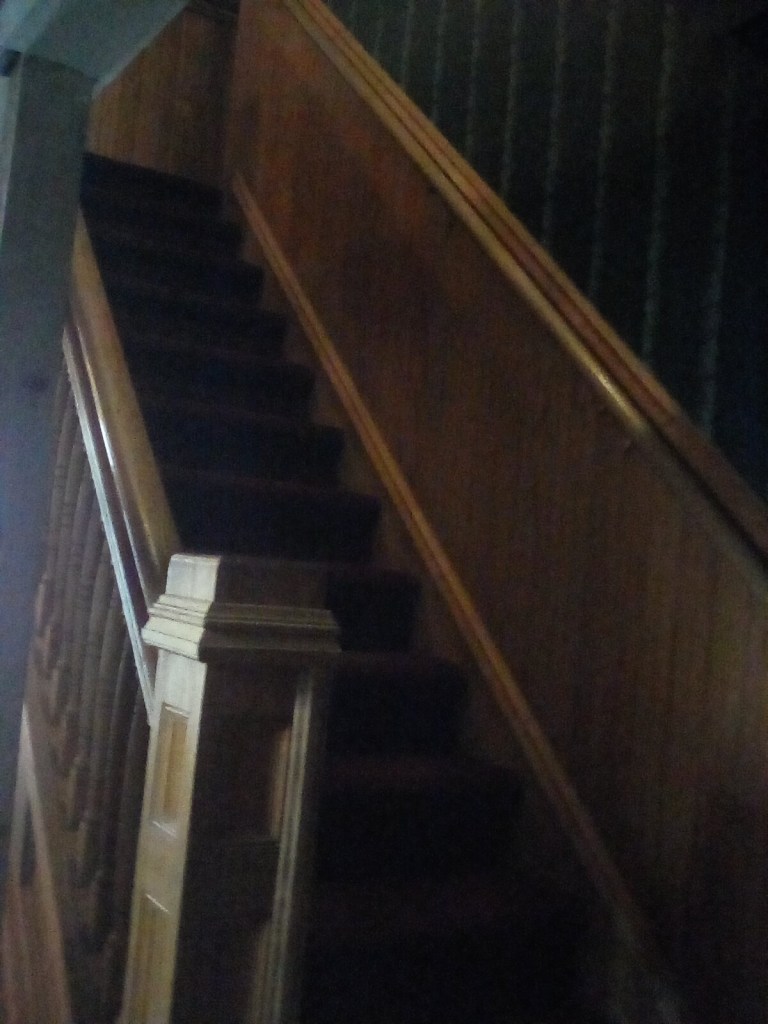
The lights above the bar may have given of a few mysterious flickers that could easily have been written off as faulty wiring, but just looking up the back staircase, raised the hairs on the back of my neck. I later learned that this staircase area is where a ghost called “Stinky”, due to the raw sewage smell that accompanies his manifestation, is reported to be encountered the most. I believe that I met Stinky, although my room was on the third floor, and the back stairs only go to the second floor, as I smelled a rather rank smell several times throughout the night. (On a later date I stayed in Room 1, which is right at the top of the back stairway, on the second floor, but neither Stinky nor any other spirits came out to say, “Hello”, on that visit.) According to Legends of America, Stinky may also be seen as an old miner with no upper body, as well as the ghost of a small boy named Petey, who is often thought responsible for “stealing ciggarettes and moving objects about”. Good thing I quit smoking.

In addition to experiencing unexplainable olefactory encounters with Stinky, while lying in bed whispers were also heard outside the door of Room 12, accompanied by a feeling of shame, as if I’d been caught in a state of undress and told to cover myself, although the actual words could not be made out. When I later learned that the nuns occupied the third level of the building, with patient rooms on the lower floors, this experience seemed to make a lot more sense. In addition to its original use as a hospital, the building has been used as a boarding house or stood vacant until it was opened as the Hotel St. Nicholas.
Both of my visits to the Hotel St. Nicholas were enjoyable experiences, with or without the ghosts. But, keep in mind that I wasn’t really looking for ghosts when I decided to stay there, and I only connected any odd experiences to the ghosts reputed to haunt there after the fact, because I didn’t do any research until the following morning. Maybe that is why they made their presence known to me, because I had no expectations. It’s not surprising that I had no encounters on my second visit either, because my expectations had changed on that visit. I mean, think about it. If you were a ghost, would you want to appear on demand when ghost hunters show up with all their fancy apps and gadgets, like you were some sort of circus sideshow? I know I wouldn’t.
____________________________________________________________________________________________________________
Like this post? Let me know in the comments. You can be sure not to miss any of Writing to be Read’s great content by subscribing to e-mail or following on WordPress. If you found this content helpful or entertaining, please share.
Share this:

Jeff’s Game Reviews – Resident Evil Village
Posted: May 28, 2021 Filed under: Jeff's Game Reviews, Review, Video Games | Tags: Jeff's Game Reviews, Resident Evil Village, Video Games, Writing to be Read 3 Comments
Reviewed on Xbox Series X – Also available on Xbox One, Xbox Series S, PS4, PS5, and PC
The Resident Evil game series has been around now for twenty-five years. Most people associate it with shambling zombies, but in fact, developer Capcom more or less nixed the walking dead way back in 2005 with the release of Resident Evil 4. Ever since then, each new main-entry game has had some pretty interesting baddies to offer. That’s still the case with Resident Evil Village, which is a good thing, because without them, there might not be much there, there.
This newest RE game is actually Resident Evil 8, but you’d be forgiven for missing that fact based on the awkward way Capcom jammed roman numerals into the promotional artwork. After the genuinely frightening events of Resident Evil 7: Biohazard, new series protagonist Ethan Winters is forced back into the fray when his wife and daughter are kidnapped right from under his nose. Traveling to a decrepit Romanian village (which, by the way, has a MASSIVE gothic castle sitting on its northern side), Ethan must battle everything from werewolves to amorphic super-monsters in order to save his family.
The story goes to some pretty gonzo places after that, but no point spoiling it for you. The great news is that in true Resident Evil fashion, all the main boss characters steal the show in a big way. The lynchpin is a frightening matriarchal figure by the name of Mother Miranda, but she’s just the tip of the iceberg. Psychotic machine maker Heisenberg, the freakish and pitiful Moreau, Donna Beneviento and her murderous living doll.
The new fan favorite, Lady Dimitrescu, is a ten-foot tall vampire lady dressed as elegantly as any starlet from the golden age of cinema. The internet has already modded and discussed her to the nth degree, and that’s the best sort of praise a game character can receive. She lumbers through the castle, screaming your name, your only recourse to evade her at all costs. Some gamers have commented on a certain strange sex appeal when it comes to the Lady. Her burning cigarette, elegant nature, and bountiful… you know… stature. I just wanted to get the hell away from her whenever she appeared. Enough time to gawk? I don’t think so. To each their own, I suppose. Phew.

The gameplay of Resident Evil Village is more or less identical to what Capcom created from scratch for RE 7. First person perspective, lots of shooting and evasion, slowly picking your way through this or that lush location, finding rare items, solving puzzles. Actually, Village borrows a few things from the past, most notably from RE 4. Fans of that game may be happy to learn this newest entry is much more action heavy. This series has been around so long, it’s got a multitude of different flavors, and Capcom certainly knows when and how to tug at our nostalgic heart strings.
Ultimately, Village’s story is short and just a tad confusing, but that doesn’t stop it from being fun. An average gamer should expect the campaign to last eight to ten hours, which is anemic compared to most other AAA video games release these days. A multiplayer portion has been included, but it’s not all that enjoyable. Nope, for better or worse, Village is the star of the show.
Played on one of the new game consoles released late last year (Xbox Series X, Series S, or PS5), the game is a wonder to behold. Almost photorealistic at times, pretty snazzy. It still looks good on older platforms, so don’t sweat it if you can’t run out and buy the latest and greatest. Where would you run to anyway? Online retailers have been in and out of stock since November.
Regardless, this game is surprising, beautiful, and very often thrilling. It’s clear horror is still alive in 2021, and Capcom once again proves they are king of the hill. Resident Evil Village is focused on giving players a pulse-pounding experience unlike any other. That it misses the mark every now and then is no big sin.
Jeff’s Game Reviews gives Resident Evil Village an EIGHT out of TEN
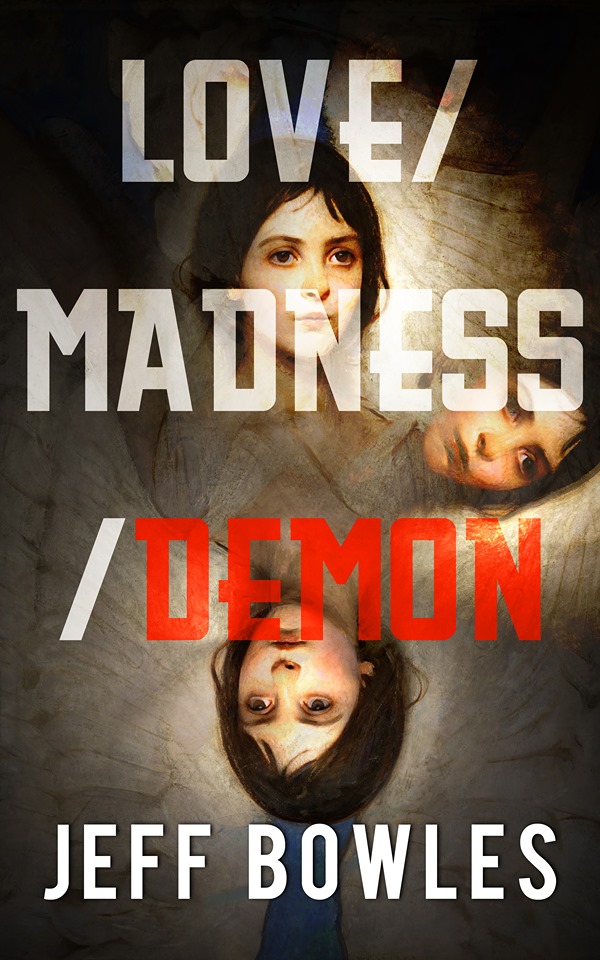
Jeff Bowles is a science fiction and horror writer from the mountains of Colorado. The best of his outrageous and imaginative work can be found in God’s Body: Book One – The Fall, Godling and Other Paint Stories, Fear and Loathing in Las Cruces, and Brave New Multiverse. He has published work in magazines and anthologies like PodCastle, Tales from the Canyons of the Damned, the Threepenny Review, and Dark Moon Digest. Jeff earned his Master of Fine Arts degree in creative writing at Western State Colorado University. He currently lives in the high-altitude Pikes Peak region, where he dreams strange dreams and spends far too much time under the stars. Jeff’s new novel, Love/Madness/Demon, is available on Amazon now!
Check out Jeff Bowles Central on YouTube – Movies – Video Games – Music – So Much More!
__________________________________________________________________________________________________
Want to be sure not to miss any of “Jeff’s Game Reviews” segments? Subscribe to Writing to be Read for e-mail notifications whenever new content is posted or follow WtbR on WordPress. If you found it useful or entertaining, please share.














Why do I do it?
Posted: June 22, 2021 | Author: kayelynnebooth | Filed under: Commentary, Nature writing, Photography, Writing Inspiration | Tags: Bears, Birds, Colorado, Flowers, Images, Inspiration, Mountains, Photography, Writing to be Read | 29 CommentsLiving in a rural area in the Colorado mountains provides a unique set of obstacles to be dealt with, including a forty-five mile commute, one way, on winding mountain roads which can be treacherous in winter weather conditions and clogged with tourist traffic in the summer that can turn a forty-five minute drive into and hour and a half. It can be nerve wrecking and even hair raising at times. And the wear and tear on my vehicles – proper maintenence and tires, etc… – due to all the mileage I put on them gets downright expensive!
I hate that commute and for several years now I’ve been asking myself why I do this live in this remote place. Three years ago, I hit black ice and rolled my car over on its side, totaling the car and raising my insurance, even though I had broken no traffic laws or violated the rules of the road. I hadn’t been driving too fast or being reckless. It was simply the road conditions that caused me to wreck. The cop almost landed on his derierre when he approached to issue me the ticket because the road was a sheer sheet of ice.
But it’s not just the commute. There are other unique difficulties that come with living off-grid, like hauling water and keeping generators and solar systems functioning, and chopping wood for winter fuel. Only in such remote locations does one have an internet outage during the writing conference that your hosting, causing you to have to stay at a hotel and miss one full day of events, as it happened during this year’s WordCrafter virtual writing conference. It can be tough when you don’t have the simple ammenities that many people take for granted.
Yesterday, as I was driving home from work, I saw something that reminded me of why I live where I live, in spite of the need to do that often treacherous and all too frustrating commute. As I turned off the highway and headed up the dirt road that I live off of, I came around a corner and saw a patch of brown, almost hidden in the meadow grasses below a heavily forested hill. At first I thought it might be a cow or perhaps a horse, as the folks who live just over the hill keep livestock, but it didn’t stand tall enough above the grasses to be of the equine or bovine persuasions. I slowed down to get a better look, and the sound of my car must have drawn the as yet unidentified animal’s attention, causing it to look up and allowing me a good look, as well.
I hit my brakes and then threw my car into reverse, backing to a spot off the road, where I had a fairly decent view of a large brown bear which was now watching me to see what I was up to. The bear watched me for a couple of minutes, as I dug in my computer case for my Kindle, the only device with a camera that I had available. Then, he must have decided I didn’t pose much of a threat and went back to whatever he had been doing in the grass before I came along. The grass still hid him partially, but I was able to snap several photos of him before he lost interest and decided to head back over the hill. I had a much better view as he ambled away, so I slid out of my car and walked to the back of the car to snap a few more shots. He looked back to see what I was doing, but didn’t seem to concerned, as he turned and continued on his way.
That’s why I do it. That is why I make the commute, and why I make lists and keep things stocked up, so I don’t end up making extra trips, and do all of the other things that are kind of a pain, but are necessary to accomodate my chosen lifestyle. That’s why I work so hard to grow a following and make money from my writing and publishing skills, so I won’t have to make that commute anymore.
Because living where I live, I get to see things like that big brown bear and many other kinds of wildlife that city dwellers miss out on. The bear I saw yesterday was only one of many wildlife sightings that living here has offered me. Many are just glimpses, such as the two foxes playing in a drainage pipe at the side of the road, or the bobcat running through the trees, but on a few occasions, I’ve even been afforded the opportunity to capture them in photos and created the wonderful images I’m sharing here today.
The flora and fauna surrounding my Colorado mountain home are what makes it all worth it. Beside road side wildlife, my mountain home offers opportunities to view and often, photograph many species of birds and plant life. Beautiful wild flowers and and magnificent bird photos inhabit my photo library, where the images of a small fraction of all the magnificent species to which I have been witness to, have been captured. Many encounters that I wasn’t able to capture through the lens have instead inspired poetry or found their way into stories that I’ve written, or other writings.
All of this serves to remind me of the reasons why I do what I do, and live where I live, strengthening my resolve to keep doing what I’m doing. My motto has always been “Endeavor to Perservere”, or keep on keeping on, and that’s just what I’m going to do, but now I remember why I’m doing it.
_________________________________________________________________________________________________________
Like this post? Let me know in the comments. You can be sure not to miss any of Writing to be Read’s great content by subscribing to e-mail or following on WordPress. If you found this content helpful or entertaining, please share.
Share this: