Review in Practice: Booked to the Gills
Posted: September 30, 2022 Filed under: Book Release, Book Review, Books, Nonfiction, Review, Review in Practice, Writing, Writing Tips | Tags: Aisley Oliphant, Booked to the Gills, Kaye Lynne Booth, Nonfiction, Review in Practice, Writing Challenge, Writing to be Read 4 Comments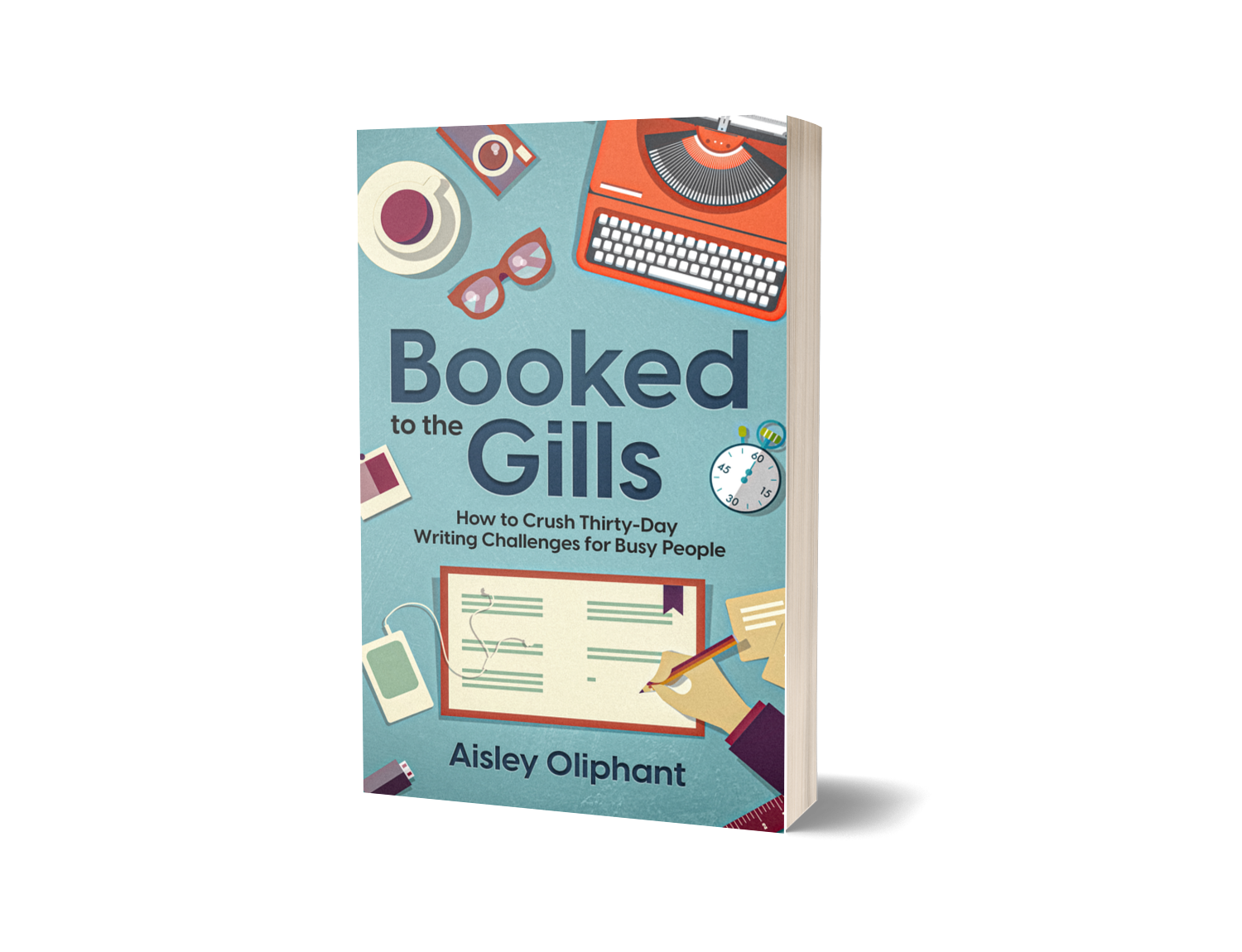
Purchase links: Barnes & Noble Amazon
Booked to the Gills by Aisley Oliphant is designed to help those participating in the National Novel Writing Month challenge to write 50,000 words in thirty days. Many writers who would like to be more prolific may find the advice and strategies outlined in this book to be quite helpful. In fact, many of the time management tips, such as time blocking, can come in handy for any writer who juggles several projects along with a day job, and relationships with family and friends, and ‘me time’.
For many of us, that ‘ me time’ is what is forfeited when things get to hectic. And the author openly admits that she has not a fun person to be around during previous NaNoWriMo challenges. For others, relationships might be strained when family and friends are put on the back burner and writing takes the forefront. And the author openly admits that she has not been a fun person to be around during previous NaNoWriMo challenges. This book is packed full of strategies to salvage relationships and keep your sanity, while still cranking up the word count.
Topics which are covered include time management, setting boundaries, adjusting wordcounts, prioritizing…
I have mentioned before that I am not a prolific writer. Authors such as Kevin J. Anderson, who can crank out right or ten books in a year, totally blow me away. But in these pages are strategies which will certainly be useful in increasing my writing output and helping me be a more productive writer, as well as giving me organizational tools that will be helpful in managing the numerous writing and publishing projects which I always seem to have going.
I attempted the NaNoWriMo challenge once, back in 2010, and failed miserably. When I picked up this book, doing this challenge was the furthest thing from my mind, but thinking about putting some of the strategies in Booked to the Gills to the test, I’m thinking it might be worth another try this year.
_______________________________________________________________________
Join Kaye Lynne Booth & WordCrafter Press Readers’ Group for WordCrafter Press book & event news, including the awesome releases of author Kaye Lynne Booth. Get a free digital copy of her short story collection, Last Call and Other Short Fiction, as a sampling of her works just for joining.
Share this:

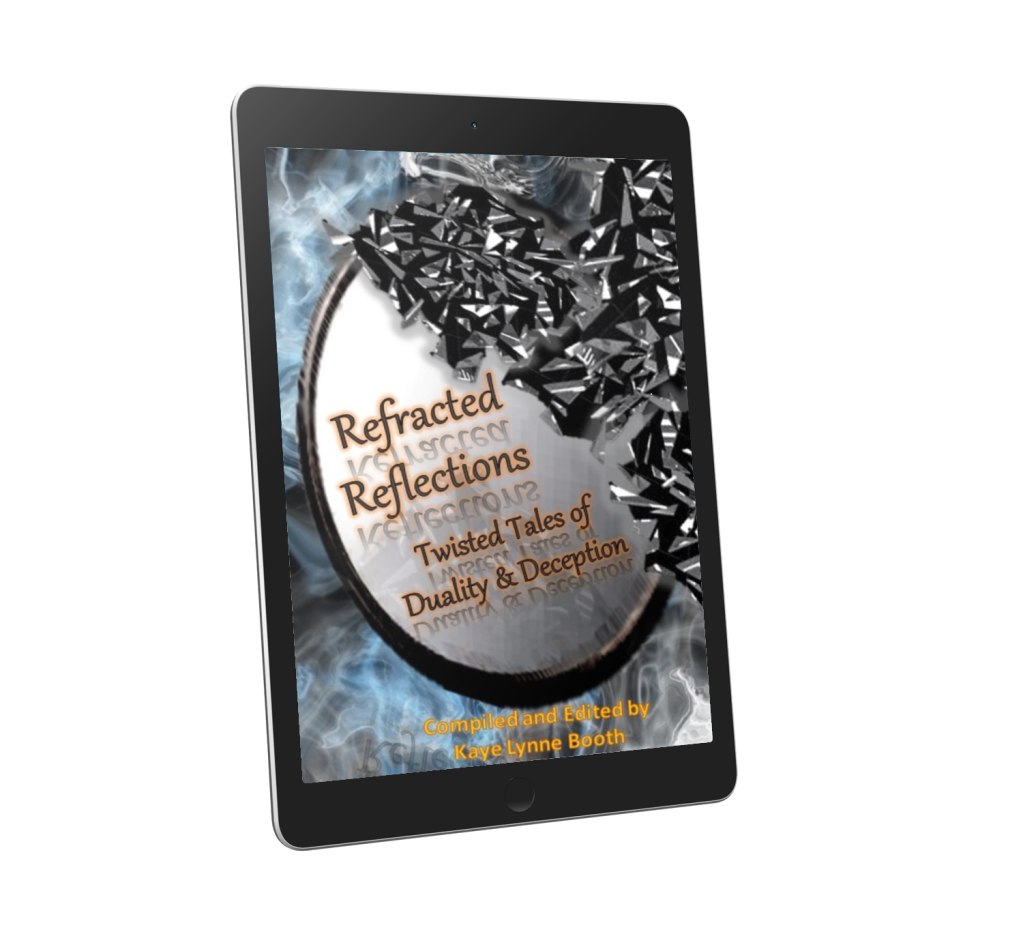
Welcome to the WordCrafter “Refracted Reflections” Book Blog Tour
Posted: September 19, 2022 Filed under: Anthology, Blog Tour, Book Promotion, Book Review, Fairy Tales, Fantasy, Fiction, Giveaways, Reflections, Science Fiction, Short Fiction, Stories, WordCrafter Book Blog Tours, WordCrafter Press | Tags: Anthology, Book Review, Kaye Lynne Booth, WordCrafter Book Blog Tours, WordCrafter Press 16 Comments
Welcome to the WordCrafter Refracted Reflections Book Blog Tour, where we will have reviews and guest posts from a few of the awesome authors who contributed to this unique and unsual fantasy & science fiction anthology. This is the second of three WordCrafter anthologies to include stories handpicked by me, mostly from the submissions which caught my eye when on the editorial team for Guilded Glass. This anthology was by invitation only and the stories contained within are exceptional. Today is the last day it will be available for pre-order, because the release is tomorrow!
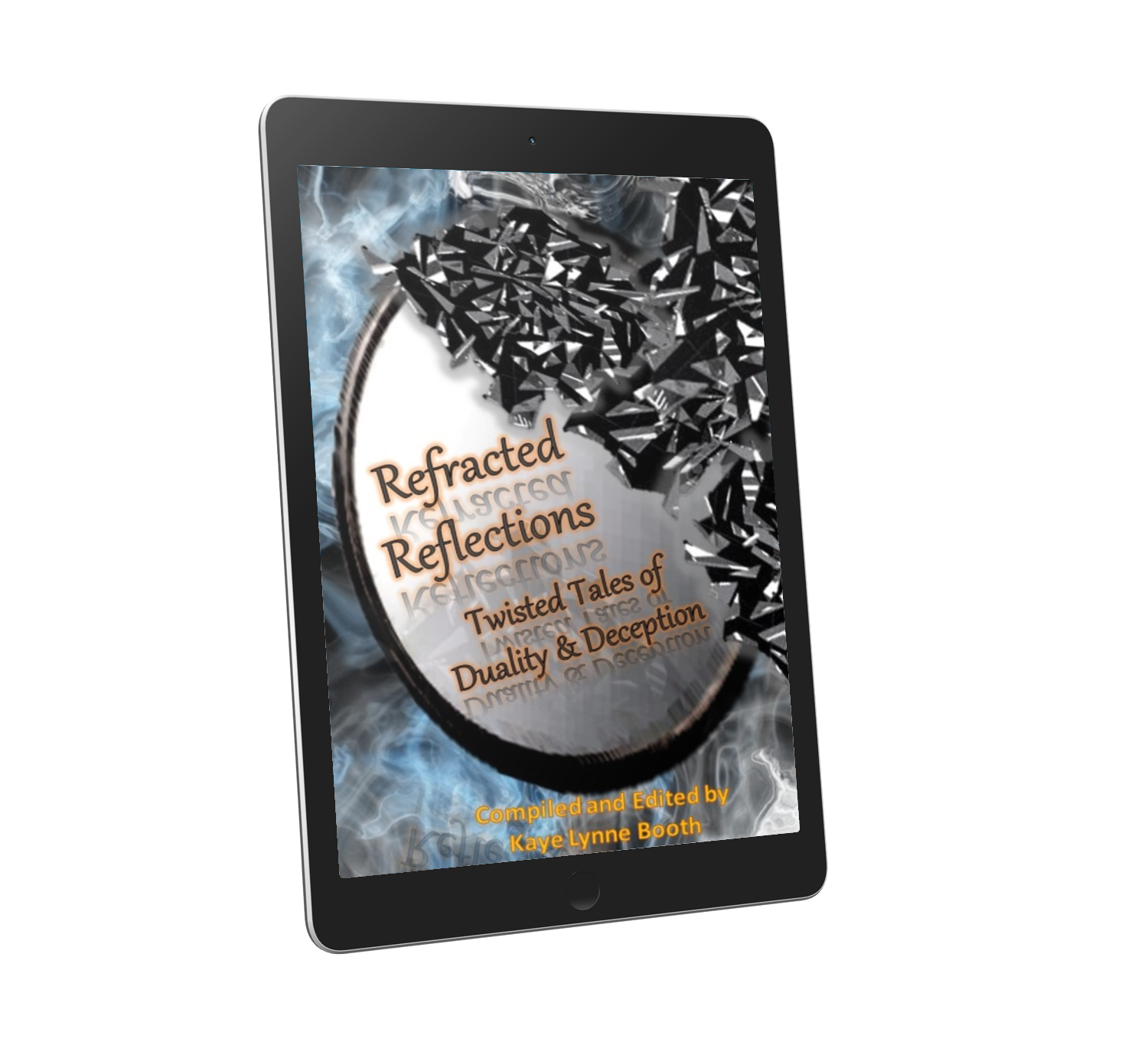
Reflections and Refractions…
One reveals truths, while the other bends light into varying shapes of deception.
Does a small camp mirror reveal hope… or death?
Is the warrior in the mirror a monster… or a protector?
Does a glimpse in the mirror reveal a young woman’s true self… or what someone else has shaped her into?
Does the mysterious portal to the future reflect what could be… or what must be left behind?
Are the dancers reflected in the water’s depth things of beauty… or evil?
This unique and imaginative collection of nine mind tantalizing fantasy and science fiction stories will appeal to readers who enjoy thought provoking tales with hidden meanings resting deep below the surface. These stories will keep you pondering long into the night.
If you liked Gilded Glass or Once Upon an Ever After, you’ll love Refracted Reflections.
We have a great tour planned for this week and I hope you will stick with us and follow the tour. We have a great giveaway, where you could get a free digital copy of the anthology, just by leaving comments. Today is a double tour stop day, with this post and a review by DL Mullan on Undawnted, so be sure to click the link below and check out her review. You may leave comments for her review here, as well.
(Note: Links in the schedule below will not work until the post goes live.)
Tour Schedule
Refracted Reflections – September 19 – 23
Monday – September 19 – Introductory post on Writing to be Read & Review on Undawnted
Tuesday – September 20 – Guest Post & Review – Ligia de Wit on Carla Loves to Read
Wednesday – September 21 – Guest Post – Elisabeth Caldwell on Writing to be Read
Thursday – September 22 – Guest Post – Valerie B. Williams on Roberta Writes
Friday – September 23 – Review & Guest Post – Roberta Eaton Cheadle on Zigler’s News
___________________________________________________________________________________
Digital Giveaway
For a chance to win a free digital copy of Refracted Reflections, just leave a comment to show you were here. Follow the tour and comment at each stop for more chances to win. Three copies will be given away in a random drawing.
___________________________________________________________________________-
About The Book
Each of the stories included in Refracted Reflections feature a mirror or reflection in some significant way. The reflections given are sometimes surprising, often fooling those who gaze upon them, because things aren’t often as they seem.

I have included two of my own stories, “The Devil Made Her Do It”, which is a reprinted story about a woman blinded by love and deceived by a man who just might be the devil, which first appeared in Relationship Add Vice, from Zombie Pirates Publishing; and an original fairy tale, The Not So Perfect Prince, about a prince who is so full of himself that he can’t see who he truly is.

But mine are only two among nine outstanding stories by eight talented authors, and we’ll be introducing five of the contributing authors on this tour: Valerie B. Williams, Roberta Eaton Cheadle, Ligia de Wit, Elisabeth Caldwell, and of course me, Kaye Lynne Booth.
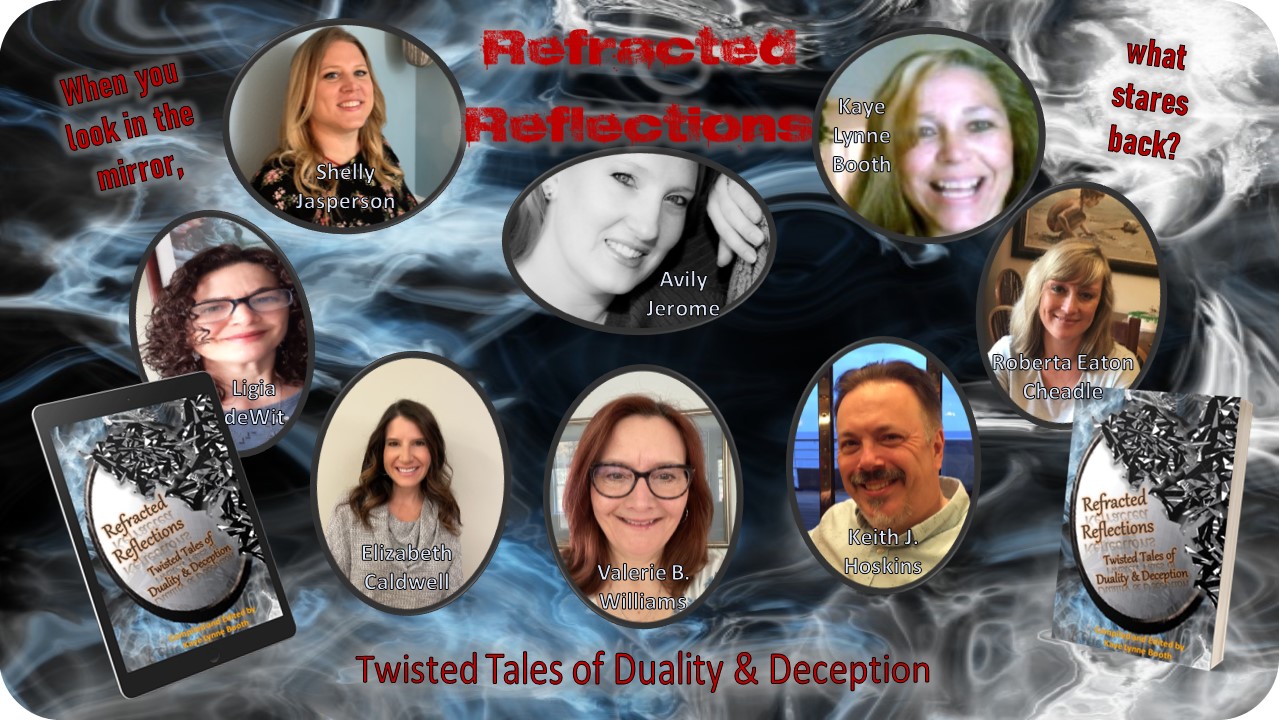
Follow the tour to learn more about Refracted Reflections: Twisted Tales of Duality & Deceptions, and for more chances to win a digital copy of your very own. Don’t forget to stop by Undawnted for DL Mullan’s review today, and you’ll find us over at Carla Loves to Read with a guest post from contributing author, Ligia de Wit and a review by Carla Johnson-Hicks.
About Kaye Lynne Booth

For Kaye Lynne Booth, writing is a passion. Kaye Lynne is an author with published short fiction and poetry, both online and in print, including her short story collection, Last Call and Other Short Fiction; and her paranormal mystery novella, Hidden Secrets. Kaye holds a dual M.F.A. degree in Creative Writing with emphasis in genre fiction and screenwriting, and an M.A. in publishing. Kaye Lynne is the founder of WordCrafter Quality Writing & Author Services and WordCrafter Press. She also maintains an authors’ blog and website, Writing to be Read, where she publishes content of interest in the literary world.
_________________________________________________________________________________
Book your WordCrafter Book Blog Tour today!
Share this:

Writer’s Corner: Writing Communities & Tribes and more…
Posted: September 12, 2022 Filed under: WordCrafter, WordCrafter Book Blog Tours, WordCrafter Press, Writer's Corner, Writing Communities | Tags: Kaye Lynne Booth, Writer's Corner, Writing Communities, Writing to be Read 2 Comments
I often say that I am a one woman show at WordCrafter Press, and for the most part, that is true. I write stories and books, edit, publish and promote. But if I’ve learned only one thing throughout all of my writing and educational endeavors, it’s that there is just too much for a single person to handle it all. Especially when you are as over-ambitious as I am, and try to produce three different anthologies simultaneously.
One thing that I’ve found to be great about the independent author community is that most everyone is willing to extend a helping hand to others who are on the same journey, if perhaps at different points along the way. I have admired this in other authors whom I’ve met along my own journey, and aspired to do the same in my own writing endeavors. I do it by offering reviews on my blog, by doing author interviews, by running a newsletter swap group where members promote other members work in their newsletters, and by offering affordable editing and social media book promotion services.
A lot of this is just a way to pay it forward, and I’m a firm believer that it all comes back to me, in one way or another. Kevin J. Anderson refers to his writing community, which is growing with every cohort he takes in at Western Colorado University, his tribe. I was a part of that tribe and I guess I still am, although at a distance.
As I and my cohort members hang up our student hats and go back to our own individual writing lives, that network that we built during our course studies relaxes and becomes much more loosely knit, but I know they are all still there. Heck, I’m still in contact with most of the members of my original cohort, from my M.F.A., and some of those from my second emphasis cohort, too. Some drift away in time, but others have been, or will be, incorporated into my own tribe, the tribe that I’ve created right here, on Writing to be Read and social media channels. You, my friends, are a part of the writing community that I’ve created over a decade.
And that’s not a bad thing. This is the writing community which I have worked to build and create, and it’s filled with some really great people, who always seem to be there when I need them. (And hopefully, they can say the same about me.) Let me tell you a little bit about my tribe and the great people that make up my own writing network. if you’ve followed me for a time, you may know or recognize many of them.
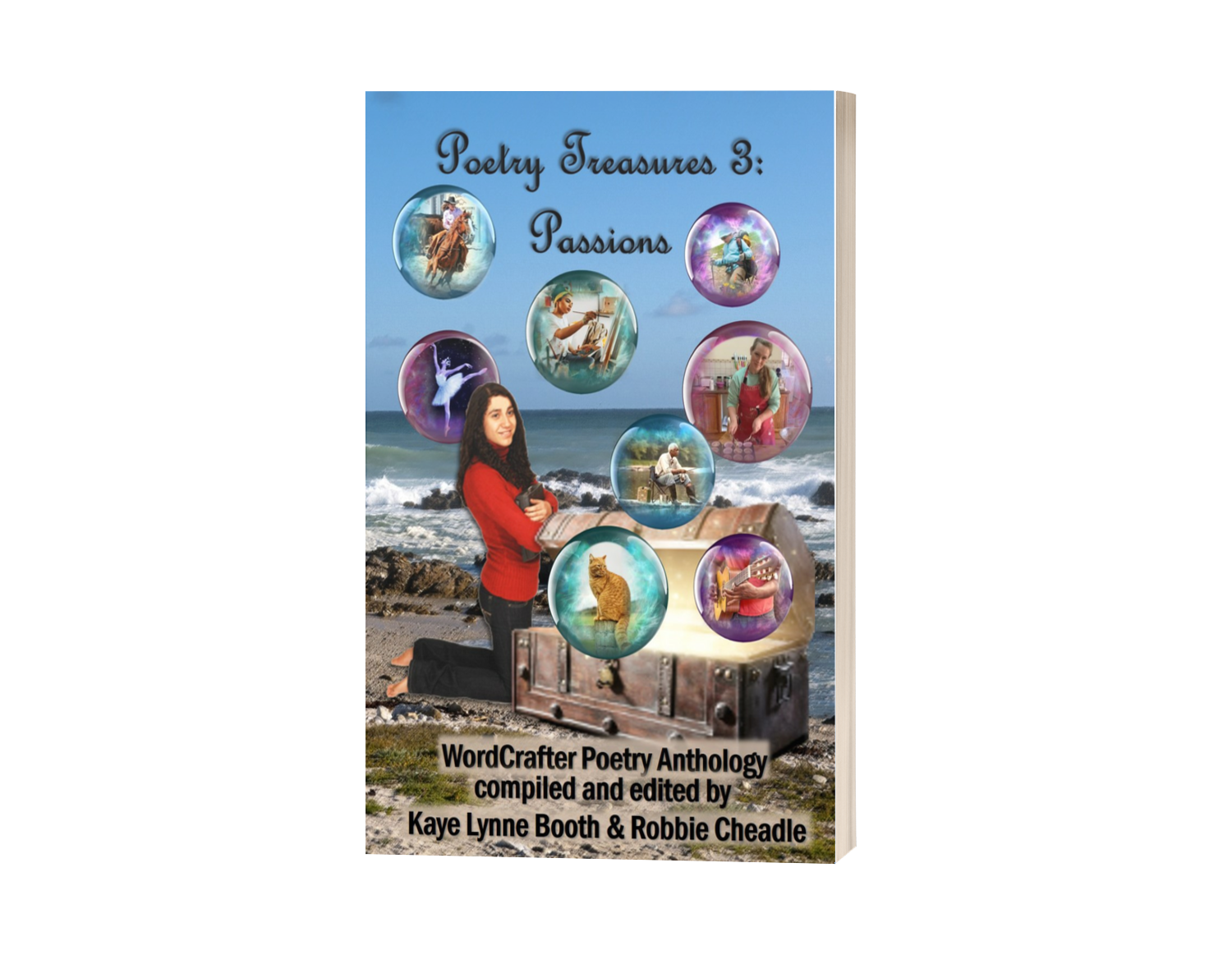
First on the list is Robbie Cheadle, who puts out three different blog series on Writing to be Read, and coedits the Poetry Treasures anthology each year, is always willing to host tour stops for WordCrafter Book Blog Tours, and participates in WordCrafter Press anthologies and the resulting blog tours, and occasionally finds time to edit some of my works.
Next, is Jeff Bowles, who was in my second emphasis cohort. Jeff currently runs one blog series, but he has produced several others on the past, and he’s always willing to throw up a fill in post in a pinch. He has also participated in WordCrafter Press anthologies and the resulting blog tours, and in WordCrafter writing events.
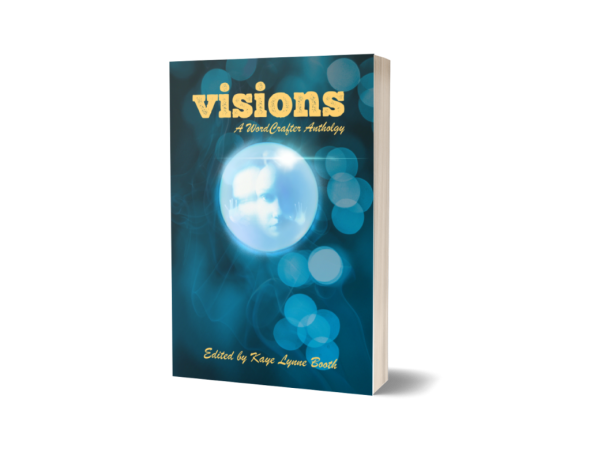
Arthur Rosch has been a member of my blog team for many years, has participated in WordCrafter anthologies. D.L. Mullan has provided cover design services and helps with WordCrafter book events, and currently hosts tour stops and provides reviews for WordCrafter Book Blog Tours and has a story featured in the up coming Visions anthology.
Just as I depend on my blog team, WordCrafter Book Blog Tours couldn’t exists without my wonderful hosts: Miriam Hurdle, Patty Fletcher, Annette Rochelle Aben, Victoria Zigler, Carla Hicks, Barbara Spencer, James Cudney, and Jessica Bakers, in addition to those mentioned above.
My tribe is growing. I’ve recently added new friends, including Mark Leslie Lefebvre, who graciously joined in as a contributor for Ask the Authors 2022, and Sara Wesley McBride, who has two stories featured in the upcoming Visions anthology, and got her husband, Wes McBride, to design the fabulous new cover for it. And I am blessed with the opportunity to work with some truly talented authors with every anthology WordCrafter Press publishes, and every writing or book event WordCrafter hosts. And if you are a follower of Writing to be Read, or someone who pops in occassionally to see what content is offered here… You, dear readers, are all a part of my tribe, too. Without you, there wouldn’t be a blog.
So, you see, while my claim of being a one woman show is true in one sense, I really couldn’t do any of this without the members of my writing tribe. The world of the writers and authors is filled with marvelous writing communities from which we can all build and grow our own tribes.
Who’s in your tribe?
________________________
Join Kaye Lynne Booth & WordCrafter Press Readers’ Group for WordCrafter Press book & event news, including the awesome releases of author Kaye Lynne Booth. Get a free digital copy of her short story collection, Last Call and Other Short Fiction, as a sampling of her works just for joining.
Share this:

Review in Practice: Fearless Author
Posted: September 5, 2022 Filed under: Book Promotion, Book Review, Books, Nonfiction, Review, Review in Practice, Self-Publishing | Tags: Ashley Emma, Fearless Author, Kaye Lynne Booth, Nonfiction, Review in Practice, Self-Publishing, Writing to be Read 7 Comments
Fearless Author, by Ashley Emma, is a self-publishingbook launch Plan and checklist, which was not as valuable to me as I had hoped, because nowhere did it say that this was an Amazon author exclusively, so I did not realize what I was getting. Don’t get me wrong. This was a free book, so I’ve wasted nothing but my time, and it was not a total waste. For those who don’t understand why the advice of an exclusive author might be of lesser value to a wide author, such as myself, let me paint a word picture of the state of the independent publishing industry currently, as I see it.
In order to be a KDP author and have your books featured in Kindle Unlimited, Amazon requires an author to download directly to thier site, (you can’t use a third party aggregator to publish your book and they demand exclusivity. Kindle Unlimited can be a substatial income stream for authors, because page reads add up to comprable sales, and some authors, in genres with voracious readers, earn more from page reads than they do from actual sales. I can see why some authors might feel that to be a fair trade for exclusivity, but that exclusivity means that you can’t sell your book anywhere else, including on your own website. That’s why I chose to publish wide. I didn’t want to give up that much control over my books. It is up to me where my books will be sold, which allows me more opportunities to reach more potential readers.
And tactics like rapid release, or free or .99 cent first in series, may not be as effective with other distributors as they are on Amazon, because other distributors don’t use the same algorythyms that Amazon does. For example, Ms. Emma recommends utilizing Amazon’s free days, which are only available to KDP exclusive authors. That is why I didn’t find Ashley Emma’s Fearless Author to be of more value. While her advice for launching and taking a book quickly up to bestseller status may be quite valuable to an Amazon author, but many options are only available to exclusive authors.
All of that to say that Fearless Author might have been more helpful by indicating in the description the fact that Ashley Emma is an Amazon author, offering useful tip to be used with KDP and Kindle Unlimited. At least then I would have known what to expect when I downloaded the free book. There were some tactics which could be of value to all authors, even those who publish wide, like myself.
The lesson learned from this experience: the importance of accurate book descriptions which don’t mislead potential readers. Although I may use some of the advice found in Fearless Author, I would probably not download more of Ashley Emma’s books, even though I might find portions of it useful and I found no fault with her writing.
_______________________________________________________________________

For Kaye Lynne Booth, writing is a passion. Kaye Lynne is an author with published short fiction and poetry, both online and in print, including her short story collection, Last Call and Other Short Fiction; and her paranormal mystery novella, Hidden Secrets. Kaye holds a dual M.F.A. degree in Creative Writing with emphasis in genre fiction and screenwriting, and an M.A. in publishing. Kaye Lynne is the founder of WordCrafter Quality Writing & Author Services and WordCrafter Press. She also maintains an authors’ blog and website, Writing to be Read, where she publishes content of interest in the literary world.
________________________________________________________________________
Join Kaye Lynne Booth & WordCrafter Press Readers’ Group for WordCrafter Press book & event news, including the awesome releases of author Kaye Lynne Booth. Get a free digital copy of her short story collection, Last Call and Other Short Fiction, as a sampling of her works just for joining.
Share this:

Writer’s Corner: Direct Selling on the Kickstarter Platform
Posted: August 15, 2022 Filed under: book marketing, Book Promotion, Kickstarter, Writer's Corner | Tags: book marketing, Direct Sales, Kaye Lynne Booth, Kickstarter, Writer's Corner, Writing to be Read 1 CommentKickstarter seems to be the latest platform for direct sales of your books. They aren’t new to the scene, but they have changed considerably since they first made their appearance. (Look here if you’d like to see a 2012 guest post about Kickstarter by author Tim Baker when they were first starting up.) Up until recently, Kickstarter has been looked upon like a platform where you would go ask for money from people, similar to Go Fund Me, but with , the spectacularly successful campaign that Bryan Sanderson did recently, which everyone seems to be talking about, it looks like that impression may be changing.
Platforms like Kickstarter and Patreon form what Joanna Penn refers to as the “creator economy”, which is similar to what artists did during the Renaissance to survive. (You can listen to Joanna’s interview with Bryan Cohen, author of the Sell More Books Show podcast, on the subjects of Kickstarter and multiple streams of income on The Creative Penn, here.) Renaissance patrons would fund artists and support them so that they could survive while creating their art. Likewise, authors today cannot be expected to survive on just their book income. Most of us would truly starve if we tried to do that. According to Joanna, there are readers out there who are not only willing, but eager, to support your work, you just have to find them.
No. Today’s creators must have multiple streams of income, and many have day jobs to support them, only indulging their craft on a part time basis. Kickstarter provides a platform designed for creatives, including authors, where we can sell our creations directly to our reading audience without the middlemen distributors, such as Amazon, and by selling direct, we receive more than our 70%, allowed by Amazon, or whatever percentage we get from other distributors, but there are a few things we need to prepare for a successful Kickstarter campaign.
Make no mistake. Kickstarter is not a platform where you beg for money, as some may believe. It’s method of direct selling, and when you run a Kickstarter campaign, you have to put in the work for your money. I learned this by following the Kickstarter campaign of Kevin J. Anderson from the operations side of things.
As his student, I was allowed an inside look into the workings of a Kickstarter campaign, and a quite successful one, at that. KJA ran a Kickstarter to fund his latest Dan Shamble Zombie Detective novel, Double Booked. He showed us how to set up the project overview, set your overall campaign goal, set up with Stripe and attach to your bank account so you can get paid, create a video to tell people about your project, set up incentives for the different tiers and stretch goals, etc… Let me tell you, there is a lot of work involved.
Kevin also gave the whole Dan Shamble series eye-catching new covers, which are absolutely fabulous. Then, once the Kickstarter campaign had run its course, the author must make good on their promises and provide the deliverables. For Kevin’s campaign, that involved doing print runs and signing each print copy of the book and mailing them out to his supporters at the appropriate level, (he actually ended up hiring someone to mail them all out, there were so many), as well as following up to be sure each supporter fills out and returns their Kickstarter survey.
KJA’s overall goal was $2,000, which he exceeded. He started at the $5 level, which provided a digital copy of Double Booked. This was the lowest tier of support, so anyone who subscribed to the campaign, at any level, received this. The tiers went all the way up to the $10,000 crazy super fan level, where Kevin promises to narrate an audio book, which he did anyway, then offered as a $25 add on during the campaign. I don’t know how likely it would be for him to actually get a $10,000 crazy super fan to jump on the campaign bandwagon, but either way he narrates his own audio book, and either way he makes money. (You can see just how well KJA did with this Kickstarter here.)
Advice from the hosts of the Six Figure Author podcast (https://6figureauthors.com/ Episode 048 – July 23, 2020) was to never do a Kickstarter for something which you can’t fund on your own, in case you don’t meet your goal. Kevin had Double Booked written before he began the Kickstarter. He knew he could deliver all the rewards promised at every tier. Doing this assures that none of your supporters go away disappointed. Satisfied readers are what is important here, because satisfied readers come back for more. They also suggest setting a lower goal at first, as low as $500, so you’ll be more likely to be able to meet the goal, then raising the bar for subsequent campaigns, building gradually.
Kevin’s campaign was not as crazy successful as Bryan Sanderson’s, which ran right around the same time, but both are examples of how an author can use Kickstarter to sell their work directly to their readers and make decent money. (You can see how crazy successful Bryan Sanderson’s Kickstarter really was here.) Granted, not all authors are Kevin J. Anderson or Bryan Sanderson. While some followers come from the Kickstarter community, it does help to have an existing following, people who already love and admire your work. I think it also helps if you are an established author with a decent backlist, otherwise you would have to make all the rewards new works, which would be even more work for the author.
U.S.A. Today bestselling authors Russell P. Nohelty and Monica Leonelle coauthored Get Your Book Selling on Kickstarter, which talks about reasons to sell direct through Kickstarter, how to sell books on Kickstarter, how to budget and market your Kickstarter project, and more. This book takes you step by step through setting up your Kickstarter campaign, and even though I watched KJA do it, I must admit I was intimidated by the sheer number of steps which must be taken and the things which should be included, and of course, it helps to illustrate everything visually, which adds even more to do. It is really a bit overwhelming. This book reinforces the idea that while Kickstarter does have a community of followers who are looking for campaigns of interest to support, your chances of success will be much improved if you already have a flowing to bring with you to to the platform.
From the author side, there’s a lot involved, but from the supporter side, it’s pretty cool because you get all kinds of goodies. For my support, I received a digital copy of Double Booked, plus a new short story in the series, “Bump in the Night”. As well as stretch goal rewards of digital copies of Kevin J. Anderson’s Selected Stories: Fantasy; from his most popular epic space opera series, Saga of the Seven Suns: Two Short Novels; and a government mystery thriller which he coauthored with Doug Beason, PhD, Virtual Destruction. I’ll be posting reviews for all of these down the road, but there were so many that it’s going to take me a while to get through them. (For now, you can read my review of his Selected Stories: Science Fiction here: https://writingtoberead.com/2019/03/01/kevin-j-andersons-selected-stories-science-fiction-volume-2-a-must-read-for-science-fiction-fans/)
______________________________________________________

For Kaye Lynne Booth, writing is a passion. Kaye Lynne is an author with published short fiction and poetry, both online and in print, including her short story collection, Last Call and Other Short Fiction; and her paranormal mystery novella, Hidden Secrets. Kaye holds a dual M.F.A. degree in Creative Writing with emphasis in genre fiction and screenwriting, and an M.A. in publishing. Kaye Lynne is the founder of WordCrafter Quality Writing & Author Services and WordCrafter Press. She also maintains an authors’ blog and website, Writing to be Read, where she publishes content of interest in the literary world.
____________________________________________________________
Join Kaye Lynne Booth & WordCrafter Press Readers’ Group for WordCrafter Press book & event news, including the awesome releases of author Kaye Lynne Booth. Get a free digital copy of her short story collection, Last Call and Other Short Fiction, as a sampling of her works just for joining.
Share this:

At the Movies: Red Riding Hood
Posted: August 12, 2022 Filed under: Movie Review, Movies | Tags: At the Movies, Fairy Tales, Kaye Lynne Booth, Movie Review, Movies, Red Riding Hood, Werewolf, Writing to be Read 3 Comments
I’ve been reading a lot of modern fairy tales lately, what with being on the Gilded Glass editorial team with a slush pile of over 600 submissions, and the two WordCrafter Press by invitation only anthologies to come out later this year which are fairy tale themed and are comprised of many of the stories that didn’t make GG, which I couldn’t quite let go of, Once Upon an Ever After and Refracted Reflections. So many modern fairy tales are simply retellings of age-old stories without adding anything new. So, when I saw the opportunity to watch a film rendition of Red Riding Hood (2011), I admit that I was a bit skeptical.
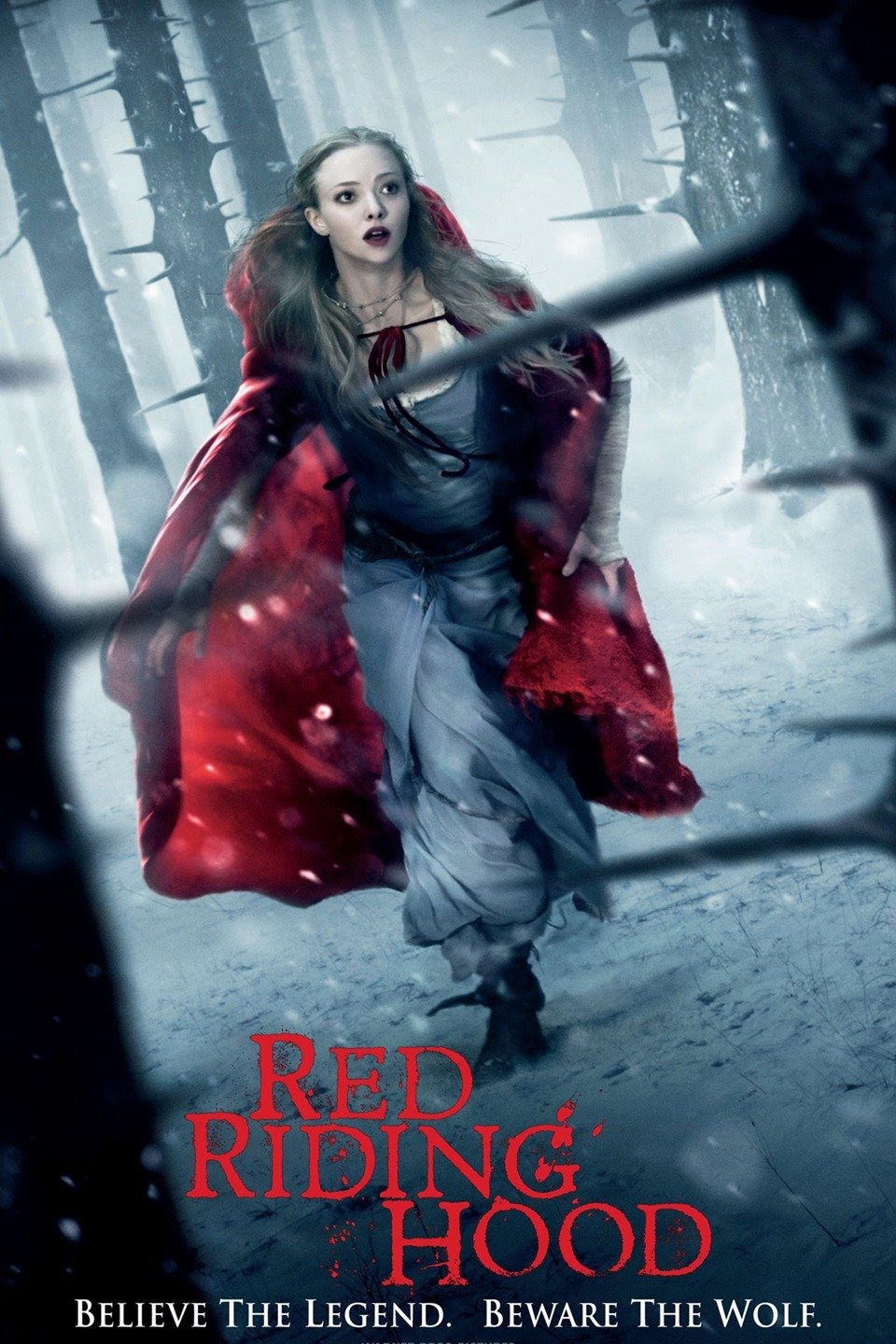
But this was no simple retelling of the classic fairy tale. This was more of a horror story, complete with a big bad werewolf, whose secret human identity allows him or her to hide among the residents of the medieval village and carry on daily activities undetected, killing innocent villagers by guise of night. It could be anyone. Anyone could be its next victim.
Mix in a young woman, Valerie (Amanda Seyfried), forced into a pre-arranged marriage with Henry (Max Irons), and the woodsman whom she truly loves, Peter (Shiloh Fernandez), for a classic love triangle. When a werewolf hunting priest with a personal vendetta shows up on the scene, suspicion is thrown in all directions and no one is safe from accusations. It could be Valerie’s creepy old grandmother (Julie Christie) who lives alone in the woods. It could be the village priest (Lukas Haas). It could be either of the two men vying for Valerie’s heart; each suspicious of the other; both determined to protect her when the werewolf claims her as his own.
Red Riding Hood was well executed, with just the right amount of fairy tale feel to it, and for me, it was a surprise when the werewolf was finally revealed. (No spoilers here.) It kept me engaged throughout. If you like fairy tales with a twist, I recommend that you see this movie.
___________________________________________________________________________

Kaye Lynne Booth lives, works, and plays in the mountains of Colorado. With a dual emphasis M.F.A. in Creative Writing and a M.A. in Publishing, writing is more than a passion. It’s a way of life. She’s a multi-genre author, who finds inspiration from the nature around her, and her love of the old west, and other odd and quirky things which might surprise you.
She has short stories featured in the following anthologies: The Collapsar Directive (“If You’re Happy and You Know It”); Relationship Add Vice (“The Devil Made Her Do It”); Nightmareland (“The Haunting in Carol’s Woods”); Whispers of the Past (“The Woman in the Water”); Spirits of the West (“Don’t Eat the Pickled Eggs”); and Where Spirits Linger (“The People Upstairs”). Her paranormal mystery novella, Hidden Secrets, and her short story collection, Last Call, are both available in both digital and print editions at most of your favorite book distributors.
When not writing, she keeps up her author’s blog, Writing to be Read, where she posts reflections on her own writing, author interviews and book reviews, along with writing tips and inspirational posts from fellow writers. In addition to creating her own very small publishing house in WordCrafter Press, she offers quality author services, such as editing, social media & book promotion, and online writing courses through WordCrafter Quality Writing & Author Services. As well as serving as judge for the Western Writers of America and sitting on the editorial team for Western State Colorado University and WordFire Press for the Gilded Glass anthology and editing Weird Tales: The Best of the Early Years 1926-27, under Kevin J. Anderson & Jonathan Maberry.
In her spare time, she is bird watching, or gardening, or just soaking up some of that Colorado sunshine.
______________________________________________________________________
Join Kaye Lynne Booth & WordCrafter Press Readers’ Group for WordCrafter Press book & event news, including the awesome releases of author Kaye Lynne Booth. Get a free digital copy of her short story collection, Last Call and Other Short Fiction, as a sampling of her works just for joining.
Share this:

Graduation
Posted: August 8, 2022 Filed under: Anthology, Book Release, Books, Fiction, Publishing | Tags: Book Event, Gilded Glass: Twisted Myths & Shattered Fairy Tales, Kaye Lynne Booth, Kevin J. Anderson, Mark Leslie Lefebvre, Publishing, Weird Tales: Best of the Early Years 1926-27, Western Colorado University 6 Comments
Yep. That’s me in the picture above with Kevin J. Anderson and Mark Leslie Lefebvre after my graduation ceremony. Obviously, I survived all the craziness of summer residency and graduated with an M.A. in publishing, but there were moments. Western’s summer residencies are always pretty intensive and this one was no exception. The whole week was a bit of a whirlwind. Classes began on Monday at Western State University, and I arrived on campus just in time for the first class at 9 a.m.


We each got publishing cohort tee shirts, which made us all the coolest cohort on campus. On the back it says, “A Rising Publisher Lifts All Books” with the image of a hot air balloon with the Western insignia on it. During the lunch break, I went and checked into my motel, before returning for the afternoon sessions, and it seemed like it was nonstop from there.

Wednesday evening, we held our big in person book launch at the Gunnison Arts Center. It encompassed all of my cohort’s solo projects, plus the launch of the group produced anthology, Gilded Glass: Twisted Myths & Shattered Fairy Tales, which includes stories by big name authors such as Michaelbrent Collins, Jonathan Maberry, Kristine Katheryn Rusch, Allen Dean Foster, and Sherrilynn Kenyon, along with many talented new authors, for an exceptional science fiction and fantasy anthology. It was also announced that the Weird Tales: Best of the Early Years volumes that Justin Craido and I put out with Jonathan Maberry will be republished through Weird Tales and Blackstone Publishing, which makes the volumes featured for the book signing limited editions which will only be available for a short time through WordFire Press. You can still get these books or any of the books of my cohort here: https://wordfirepress.com/gpcw/ . The signing did quite well, and we sold out all of the books we brought to the event, with sales which I consider to be phenomenal, $25,000. The proceeds go to the University to fund future publishing cohorts, which is very cool.


This was exciting for me, as it was my first book signing. I did do a poetry signing once at a all local writing fair, but it was nothing along the scale of this event. I was amazed when people came up to me, wanting my autograph on the books which I created. Wow!
Afterward, we celebrated at the Old Miner Steak House. We had the whole top floor reserved, but their grill broke, so they couldn’t cook any meals. So instead, we had the whole restaurant to ourselves. The staff did a bang up job of putting together a menu of salads and sandwiches for us, and I thoroughly enjoyed a delicious French dip.
I was almost totally brain dead by the time Friday rolled around, it was time for the commencement ceremony and time to say goodbye to my fellow authors and publishers. It was emotional as my instructor and mentor, Kevin J. Anderson, offered each of my cohort a special edition, embossed copy of his Clockwork Angels story collection, which he wrote with Neal Peart of Rush. He describes these stories as steampunk Canterbury Tales, and I can’t wait to read them, although I’m almost scared to open it, because it’s so beautiful.

I managed to make it through the graduation despite the heat sitting in cap and gown and mask. Of course, I was my usual, graceful self, bumbling awkwardly through my commencement. When I was announced by the program director, I started across the stage, but he added in my first M.F.A., which made me hesitate and stop in my tracks. As I was the only one to have such added information delivered, I felt I should allow him to finish before going into motion. That delayed start flustered me, so when I got over to Kevin to be hooded, I forgot to bend down, but he managed to get it over my head anyway. Realizing I had messed up flustered me even more and Kevin had to tell me to come back for a hug. But I made it through to the final photos without any more blunders.


Saturday, I arrived home to find that there were monsoon rains everyday while I was gone, and my yard and garden had exploded with greenery and other bright colors, including one monster cherry tomato plant, which grows in a large pot on my porch and a single gigantic mullein plant that I let grow in the front yard. Oh yes, and while I was gone, the bear which has frequented my neighborhood for as long as I can remember paid me a visit and scattered my garbage across my property. He’s a big brown bear and he pulled my garbage can over my wire fence, demolishing it. So, after unloading everything, I got to drag myself out and pick up trash before finally collapsing, exhausted. It had been a long and exciting week, but it was good to be home.
_______________________________________________________________________
Kaye Lynne Booth lives, works, and plays in the mountains of Colorado. With a dual emphasis M.F.A. in Creative Writing and a M.A. in Publishing, writing is more than a passion. It’s a way of life. She’s a multi-genre author, who finds inspiration from the nature around her, and her love of the old west, and other odd and quirky things which might surprise you.
She has short stories featured in the following anthologies: The Collapsar Directive (“If You’re Happy and You Know It”); Relationship Add Vice (“The Devil Made Her Do It”); Nightmareland (“The Haunting in Carol’s Woods”); Whispers of the Past (“The Woman in the Water”); Spirits of the West (“Don’t Eat the Pickled Eggs”); and Where Spirits Linger (“The People Upstairs”). Her paranormal mystery novella, Hidden Secrets, and her short story collection, Last Call and Other Short Fiction, are both available in both digital and print editions at most of your favorite book distributors.
In addition, she keeps up her authors’ blog, Writing to be Read, where she posts reflections on her own writing, author interviews and book reviews, along with writing tips and inspirational posts from fellow writers. Kaye Lynne has also created her own very small publishing house in WordCrafter Press, and WordCrafter Quality Writing & Author Services, where she offers quality author services, such as publishing, editing, and book blog tours. She has served as a judge for the Western Writers of America and sitting on the editorial team for Western State Colorado University and WordFire Press for the Gilded Glass anthology and editing Weird Tales: The Best of the Early Years 1926-27, under Kevin J. Anderson & Jonathan Maberry.
In her spare time, she is bird watching, or gardening, or just soaking up some of that Colorado sunshine.
______________________________________________________________________________
Join Kaye Lynne Booth & WordCrafter Press Readers’ Group for WordCrafter Press book & event news, including the awesome releases of author Kaye Lynne Booth. Get a free digital copy of her short story collection, Last Call and Other Short Fiction, as a sampling of her works just for joining.
Share this:

Review in Practice: Newsletters – Bonuses & Reader Magnets, Frequency and Auto-Responders
Posted: August 1, 2022 Filed under: book marketing, Book Promotion, Book Review, marketing, Newsletter, Review in Practice | Tags: Kaye Lynne Booth, newsletters, Reader Magnets, Reader Platform, Review in Practice, Writing to be Read 5 CommentsOne aspect of book marketing I’ve been delving into is newsletters, or reader’s groups, if you prefer. It sounds a lot better to say, “Join my Reader’s Group” than it does to say, Subscribe to my Newsletter”. This is a suggestion that Andrea Pearson of the Six Figure Author Podcast offers, and I like it. Andrea Pearson is like the newsletter queen, marketing her own books through her newsletter successfully and teaching others how to do the same. She offers courses on Newsletter marketing among others through her website, and I’ve been fortunate enough to have taken the basic course, and I also have her Publish Strong box set. You can read my “Review in Practice” for that set here.
Other things that Andrea recommends is emailing frequently, like once a week, and I believe Kevin J. Anderson also follows this practice. To me this sounds like a lot. I feel like I would have to really like an author to not be annoyed to receive emails that frequently from them. After signing up for KJAs newsletter and receiving his auto-sequence, I found that it was kind of cool, and because some of them included newsletter bonuses of free books, I didn’t mind receiving those frequent emails at all.
But, let’s face it. We’re all not as prolific as KJA, or even as prolific as Andrea Pearson. Especially if you’re just starting out, you may be lucky if you can produce a book a year. I realized a while back that I wasn’t prolific and wrote a post about that here. Just as you need a hook for your stories to make readers want to read more, you also need a sales hook in your newsletter to make them want to read other things which you’ve written so you can grow your fanbase and email list. If you don’t write fast enough to produce several books a year, and if you don’t have a big backlist to draw from, don’t overlook the value of a good short story. While it’s true that short fiction is tougher to sell than novels, when it comes to newsletter magnets, short fiction can be an author’s friend.
In order to better understand how to make a newsletter work for me, I’ve subscribed to the newsletters of several big name authors to see how they set up their reader magnets and auto-sequences.

The Case of the Vanishing Boy is a short mystery story by Kristine Kathryn Rush that I received for free for signing up for the WMG Grab a Book and Chill newsletter; what indie authors call a reader magnet, designed to draw in new readers. ‘They’ say short fiction is harder to sell, whether we’re talking single stories, collections or anthologies. As a creator of anthologies, I believe ‘they’ are right. But short fiction can be great to use for newsletter bonuses, and/or reader magnets. This little mystery story was just the right length for me to enjoy and to made me feel as if I’d received a good value in exchange for my email address
Kristine Kathryn Rusch and her husband Dean Wesley Smith are both hybrid authors who have been in this business for many years and are both masters of short fiction, so receiving this story really was a treat. It was a fun mystery that could be read in one sitting. It’s hard not to give away spoilers on short stories, and for mysteries, spoilers could mean death. So instead of giving the whole brief plot away, let me just say that it was a fun mystery that could be read in one sitting. It was well-written and entertaining, stirring up questions throughout and providing a satisfying ending, just as a mystery story should.

A much darker read is He Meant No Harm, by Dean Wesley Smith, which serves as a second reader magnet for the WMG Grab a Book and Chill newsletter. I guess they figure at least one of the two books will appeal to you. Again, I’m not obligated to review, but did enjoy this brief trip down memory lane with the protagonist, although it left me walking away with a very different feeling from the one I had after reading the Rusch story, so perhaps they are onto something by offering two very different stories. This story was very brief, so my complaint here was that I was disappointed that there wasn’t more to it, (but that might just be me). It did have a full story arc, I just would have liked to have a bit more before it ended, so I guess I felt a little cheated.
I can’t say that about the reader magnet for the WMG Newsletter, The Rusch Reader: A Newsletter Exclusive, however. Just the opposite in fact. This collection of short fiction provides a delectable sampling from Kristine Katherine Rusch’s various short fiction series and spans across her genres, of which there are many, written under various pen names, as well as her own. The Rusch Reader is a book length collection of short fiction, all well-written and entertaining, all quite enjoyable to read, some which were downright memorable. And when you read as much short fiction as I do, that’s saying a lot. But the thing that adds the most value for me was the last sample book, which wasn’t a story at all, but a short non-fiction book on how to negotiate, which is invaluable for authors everywhere. Signing up for the newsletter is the only way you can acquire this fantastic collection, a sampling that may turn you into a die-hard Rusch reader, you must subscribe to Kristine Katherine Rusch’s newsletter, which makes it a great reader magnet and well worth giving up my email address.
For signing up for the Kevin J. Anderson reader group, I received a copy of one of his Dan Shamble Novels, Working Stiff, which I had previously read and reviewed in his Zomnibus. (You can read my review here.) His Dan Shamble books are always entertaining and fun to read, so this is an excellent choice for a reader magnate. Although it is not typical of his science fiction or fantasy series, but it is a way to get readers to take a look at what else he has available.
His second email in his auto sequence delivers a link to listen to his Clockwork Lives audiobook for free, which is pretty cool and making me feel even more value delivered.

His second email in his auto sequence delivers a link to listen to an audio reading by KJA of “The Percussor’s Tale” from the Clockwork Lives steampunk novel, written with Rush drummer Neil Peart, for free. This is pretty cool and making me feel even more value delivered.
The fifth email in his auto-responder offers another free book, The Kevin J. Anderson Complete Booklist and Reader’s Guide. What a clever way to make things easy for his readers. I’m impressed.
The sixth offers another free ebook, Blindfold. Which all leads into an offer to join his “KJA Special Forces” street team in the eighth email to be delivered over a month’s time from when I subscribed.
Previously, I had let my newsletter fall to the wayside for more than a year, but this research endeavor has convinced me that my Newsletter is one of my most valuable marketing tools. The subscribers are added to your email list, providing you with a direct way to engage with your readers, and you own that, not some third party middleman.
When I went back into my Mailchimp account, I found that they’d made a lot of changes and I had difficulty finding my way around and locating my past newsletter campaigns. I have since revived my newsletter, but I’m still struggling to figure out the auto-responder and other technological stuff. I’ll get it eventually. For now, I’m emailing monthly and figuring it all out as I go. I’ve managed to change my reader magnet, so when you join, you receive a free copy of my short story collection, Last Call & Other Short Fiction, and set up a Book Funnel link to deliver it, (I think – If you decide to join, I’d appreciate feedback to let me know if it is working properly).
My subscribers are not growing very fast, but I figure that will come in time, too. Different genre books target different reading audiences, so it’s more difficult to market as a multi-genre author, but with time, I’ll figure that one out, too. My newsletter journey is just beginning. If you’d like to join my new reader’s group to receive updates on new releases from WordCrafter Press, myself and others, as well as upcoming writing events, you can join here: https://mailchi.mp/64aa2261e702/klb-wc-newsletter. You’ll receive a copy of my short story collection just for joining. I do hope you’ll all come along for the ride.
_______________________________________________________________
For Kaye Lynne Booth, writing is a passion. Kaye Lynne is an author with published short fiction and poetry, both online and in print, including her short story collection, Last Call and Other Short Fiction; and her paranormal mystery novella, Hidden Secrets. Kaye holds a dual M.F.A. degree in Creative Writing with emphasis in genre fiction and screenwriting, and an M.A. in publishing. Kaye Lynne is the founder of WordCrafter Quality Writing & Author Services and WordCrafter Press. She also maintains an authors’ blog and website, Writing to be Read, where she publishes content of interest in the literary world.
_______________________________________________________________
Join Kaye Lynne Booth & WordCrafter Press Readers’ Group for WordCrafter Press book & event news, including the awesome releases of author Kaye Lynne Booth. Get a free digital copy of her short story collection, Last Call and Other Short Fiction, as a sampling of her works just for joining.
Share this:

Writer’s Corner: What? I’m a business?
Posted: July 25, 2022 Filed under: Book Promotion, Indie Publishing, Promotion, Publishing, Self-Publishing, Writer's Corner, Writing, Writing Business | Tags: Independent authors, independent publishing, Kaye Lynne Booth, Publishing, Writer's Corner, Writing Business, Writing to be Read 6 CommentsOften it seems like everybody wants to be an author, and with the rise of digital publishing and print-on-demand, everyone pretty much can. After all, all it takes to write a book is an idea for a story, a general idea of story structure, and a basic knowledge of grammar and punctuation, right? Well… yes and no, but that is a discussion for a different post. For our purposes, we’re talking about writers who have what it takes to become an author.
However, many authors don’t realize how many non-writing tasks are involved in being an author. Because we aren’t just writing books, we want to sell them, too. And as soon as we start doing that, we become a writing business. That’s right. And we have market and sell our books, pay for websites so fans can find us, find reviewers, engage with readers, as well as putting out a newsletter and other types of advertising to sell our books. And we must keep track of expenses and earnings so we can properly pay our taxes. Yep. Authors really are a business.
As soon as you write your first book, (or story, or poem), you’ve created what they call IP (Intellectual Property), and you are faced with deciding how you want to handle it. In the past, an author would pitch their book to an agent or editor in the hopes of landing a traditional publishing deal, and if they were fortunate enough to land one, then they would sign a contract giving some, or all, of their rights in exchange for royalties, possibly with an advance of reasonable size against future royalties.
Traditional publishing is a traditionally slow business, so then, the author would sit back and wait from two to five years for their book to be published and then, wait even longer until their royalties are enough to pay back their advance, before receiving royalty checks, generally about 15% of sales, twice a year. So you see, by traditional publishing methods, most authors really were starving artists. Add to this that many traditional publishers required you to sign away rights that they never had any intention of using, but they just wanted to cover all of their bases, and would only allow their authors to put out one book a year, and you can see why many authors assumed pen names in other genres just to try and make ends meet.
Fortunately, with the rise of independent publishing, all that changed. Now days, authors who are more prolific and can produce more than one book per year, can write and publish as many as they want. And they can also sell or maintain whichever rights they want to. Independent authors are now dealing directly with book distribution platforms, or they can choose to give an additional percentage to an aggregator, who then places their book on the various distribution platforms, but they still receive a bigger percentage of their royalties than traditionally published authors do.
As explained in Dean Wesley Smith’s Magic Bakery, the IP for your creations are your products, which you can give away or sell in any way you wish, as long as you maintain control of your rights and manage them smartly. That is how successful authors today manage to keep their backlists working for them.
The flip side of this, is that independent authors don’t have publishers to edit and hone their books to perfection (editing), provide a cover (cover design), or get reviews (business) and market their books (marketing and promotion) for them. (I wrote a post about the many hats an author must wear today back in October of 2016 here, but I really had no idea at that time.)
So, these are other skill sets today’s authors must have or learn, or hire out and pay someone else to do them. If they chose to hire them out, then these things become additional business expenses. (The bold emphasis is to reiterate that authors are indeed, a business.) While much of the paid advertising works with numbers and data, authors better brush up on their math skills or hire someone to keep their books and figure their taxes, too. And when you chose to become an author, there are no employers to provide health or dental or vision insurance. The author is responsible for providing these things for themselves as a self-employed entity, because they are a business.
I hate to keep driving on that point, but it’s one which keeps slapping me in the face. Just when I think I’ve done my homework well and gained all the necessary skills to be a successful author, there it is again. At first, I thought that all I’d need was English, grammar and storytelling abilities. One I’d earned an M.F.A. in Creative Writing, I found that I needed marketing skills to peddle my wares. With almost a B.A. in marketing, and a M.A. in publishing, it looks as if may need a degree in business, as well. ( Okay, maybe not a full degree, but general business knowledge and a good understanding of the publishing industry are needed, because… yep, you got it, you’re a business.)
As a business, authors need to act as professionals, and do what they can to keep up to date on industry news and changes on social media channels and digital platforms which you use on promotions and advertising.
Another thing that I have learned is that even bestselling authors with a large backlist, need multiple streams of income to make their writing business work. It is just good sense in the rapidly changing world of digital technology, where the owners of digital platforms you use for promotion and distribution can change the rules without notice, to not place all of your literary eggs in one basket. The rapid changes to digital industry also mean that there is an abundance of helpful digital tools out there to help you in your writing business. But then, that just means that I need to learn new skills (tech skills) so I can use them!
And to think, I just wanted to write stories.
_________________________

Kaye Lynne Booth lives, works, and plays in the mountains of Colorado. With a dual emphasis M.F.A. in Creative Writing and a M.A. in Publishing, writing is more than a passion. It’s a way of life. She’s a multi-genre author, who finds inspiration from the nature around her, and her love of the old west, and other odd and quirky things which might surprise you.
Kaye Lynne Booth lives, works, and plays in the mountains of Colorado. With a dual emphasis M.F.A. in Creative Writing and a M.A. in Publishing, writing is more than a passion. It’s a way of life. She’s a multi-genre author, who finds inspiration from the nature around her, and her love of the old west, and other odd and quirky things which might surprise you.
She has short stories featured in the following anthologies: The Collapsar Directive (“If You’re Happy and You Know It”); Relationship Add Vice (“The Devil Made Her Do It”); Nightmareland (“The Haunting in Carol’s Woods”); Whispers of the Past (“The Woman in the Water”); Spirits of the West (“Don’t Eat the Pickled Eggs”); and Where Spirits Linger (“The People Upstairs”). Her paranormal mystery novella, Hidden Secrets, and her short story collection, Last Call and Other Short Fiction, are both available in both digital and print editions at most of your favorite book distributors.
When not writing, she keeps up her author’s blog, Writing to be Read, where she posts reflections on her own writing, author interviews and book reviews, along with writing tips and inspirational posts from fellow writers. In addition to creating her own very small publishing house in WordCrafter Press, she offers quality author services, such as editing, social media & book promotion, and online writing courses through WordCrafter Quality Writing & Author Services. As well as serving as judge for the Western Writers of America and sitting on the editorial team for Western State Colorado University and WordFire Press for the Gilded Glass anthology and editing Weird Tales: The Best of the Early Years 1926-27, under Kevin J. Anderson & Jonathan Maberry.
In her spare time, she is bird watching, or gardening, or just soaking up some of that Colorado sunshine.
_______________________________________________________________________
Join Kaye Lynne Booth & WordCrafter Press Readers’ Group for WordCrafter Press book & event news, including the awesome releases of author Kaye Lynne Booth. Get a free digital copy of her short story collection, Last Call and Other Short Fiction, as a sampling of her works just for joining.
Share this:

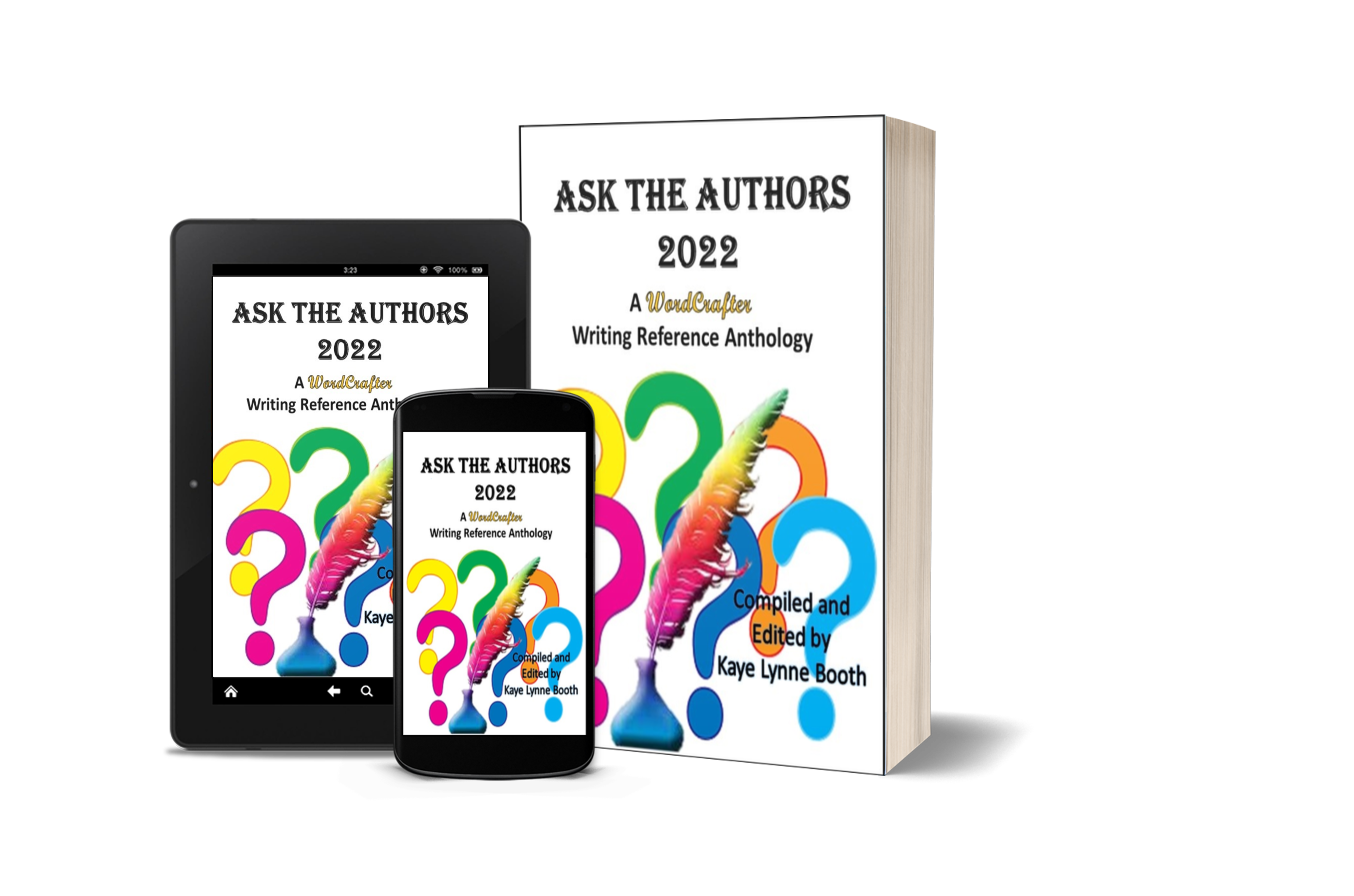
Ask the Authors 2022 Book & Blog Series: Book Marketing
Posted: July 9, 2022 Filed under: Advertising, Anthology, Ask the Authors, book marketing, Book Promotion, Book Release, Books, Branding, Fiction, Interview, marketing, WordCrafter Press, Writing, Writing Reference, Writing Tips | Tags: Ask the Authors 2022, Bobby Nash, Chris Barili, Jeff Bowles, Kaye Lynne Booth, Kevin Killiany, L. Jagi LAmplighter, Mario Acevedo, Mark Leslie Lefebrve, Nancy Oswald, Paul Kane, Roberta Eaton Cheadle, WordCrafter Press, writing advice, Writing Reference, Writing Tips, Writing to be Read 4 Comments
Welcome to the final segment of the “Ask the Authors 2022” blog series. This week, a final introduction for Middle Grade & Y.A. author, L. Jagi Lamplighter, whose essay contribution is titled “The Trouble with Troupes” and a Q & A session on book marketing will be finishing off this wonderful series.
I want to thank all the readers who chose to spend their Saturdays hanging out with us for the past ten weeks, as we give this unique writing reference a send off, and let all the authors out there see why they need the plethora of writing wisdom contained between the covers of Ask the Authors 2022 writing reference anthology. And now it’s time to get started with this final segment.
Meet L. Jagi Lamplighter

L. Jagi Lamplighter is the author of the YA fantasy series: The Books of Unexpected Enlightenment, the third book of which was nominated for the YA Dragon Award in 2017 and the fourth book of which won the first YA Ribbit Award. She is also the author of the Prospero’s Children series: Prospero Lost, Prospero In Hell, and Prospero Regained.
She has published numerous articles and short stories. She also has an anthology of her own works: In the Lamplight. She also edits for Superversive Press and teaches “The Art and Craft of Writing”. She was also a presenter and panel member for both the 2020 Stay in Place Virtual Writing Conference and the 2021 New Beginnings Virtual Writing Conference.
Website: Welcome to Arhyalon: http://www.ljagilamplighter.com/
And now for the Q & A.
Book Marketing
Mario Acevedo: Here are my thoughts on Book Marketing.
I never thought much about branding myself and wrote what I wanted. Fortunately, everything tended to be in related genres. As for book marketing, if I knew what the magic lever was that you could pull and hit the jackpot, I would keep it to myself. I’ve tried all kinds of methods and gimmicks, some which worked okay, others which never moved the needle. What works for someone else, might not work for you. What works now may not work tomorrow. Remember, those masters in branding and marketing, Disney and Coca-Cola, have their share of million-dollar flops. What I recommend is to keep your name out there in a variety of streams: social media, newsletters, conventions, interviews, podcasts.
Good book covers are essential. Whatever you do, don’t have one that looks Photoshopped by someone who didn’t know what they were doing.
Websites are necessary though really fancy ones (read expensive) are not worth the money unless you have a lot of traffic and sales. You want something catchy and one that you update regularly.
Everyone loves great reviews and people who leave one-star reviews tend to be acting out an agenda not related to your work. Don’t hate them for it, instead pray that they either find Jesus or a competent therapist.
Once upon a time, book trailers were the cat’s pajamas. And about as effective. Two of my book trailers got tens of thousands of views, which is extraordinary for book trailers, but I can’t say how significant they were to sales. Book trailers work best when you play them at a signing booth as when people ask, “What’s your book about?”
Keep in mind that the world doesn’t revolve around you so don’t be a dick to others. Don’t be a doormat either; and in all cases, keep yourself a class act.
How do you brand yourself and your works?
Paul Kane: I think that changes depending on what book it is. So the Paul Kane ‘brand’ – whatever that is – would be more tied into horror, post-apocalyptic fiction or whatever, so I might get invited to a horror convention to talk about that material. While the PL Kane ‘band’ is pure crime fiction, and you’re more likely to see me talking about that at a crime fiction event. But it’s all still just me, when all’s said and done. I try not to cross the streams if I can help it, and I haven’t really ‘branded’ myself as much as the publishers who’ve put my stuff out there have done it for me.
Bobby Nash: Bobby Nash is my brand. I am usually the first point of contact with readers, so I want to make sure meeting me makes you want to read one of my books. I also brand the books. My BEN Books crime thrillers share a universe, so they have similar branding. It helps. I also use branding on title and cover design in series. You know that the Snow books are part of a series, for example.
Robbie Cheadle: My children’s books are primarily a series about a little man called Sir Chocolate who lives in a world where you can eat everything. Each book contains a rhyming verse story for small children and 5 recipes for children to make under adult supervision. It is in essence a first baking book series and I market it that way.
My adult books are all historical and paranormal in nature and I am at this market. I use hashtags for my books on Instagram, Twitter, and Facebook. I write under my own name, using different variations to clearly separate my children’s and my adults’ books.
Nancy Oswald: I haven’t paid much attention to branding, but I think a brand is evolving based solely on my writing interests. With that said, the next book I want to write doesn’t fit the historical category, but I don’t want “branding” to stop me from doing it. I guess I’d prefer to write what my interests are than to worry about a brand.
What’s the most effective method of finding followers?
Paul Kane: I have no idea! I just keep doing the writing, promoting it on my social media accounts and seeing what happens. I think using humour on those is a good way to spread the word about yourself, and posting about other people’s work or what you might be reading, watching and so on, breaks up the sameness of just talking about yourself and what you’ve got out or coming out. I think genuineness comes across massively to people and maybe that gets you followers? I’ve only ever been myself online or at events, and I think people can see that. They can spot it a mile away if you’re fake.
Bobby Nash: Beats me. It seems to change from week to week. I try as many methods as possible to attract new readers.
Robbie Cheadle: A lot of my readers have come through my blog. I have two blogs: Robbie’s Inspiration which is for my baking, art work, and poetry, and Roberta Writes which is for my reviews of classic, horror, drama, science fiction, and other adult books. I also do a weekly prompt called Thursday Doors when I share pictures of my travels around South African and other places. I am an active blogger and have a lot of blogging friends who I have discussions with. Many of them have become friends who I email and correspond with.
Other social media I use are Facebook which is great for reading and writing groups, Twitter, and Instagram. I have a YouTube channel which I post to from time to time. I think being an active part of the writing and reading community is the best way of getting followers. Writers are also often reviewers while other readers usually don’t think to write reviews.
I understand that newsletters are a good way of staying in contact with your readership outside of social media. I have not as yet had the time to pursue developing a newsletter following or committing to a monthly or bi-monthly newsletter.
Have giveaways or social media book events been effective in bringing in followers?
Paul Kane: Publishers tend to handle all that side of things for me, so I can’t really say. You do see a spike in numbers when you do a giveaway I guess, or do a blog tour, so I guess they work. But if people don’t like your stuff, they won’t keep coming back no matter what you do. Keeping readers or followers is just as important as attracting them in the first place.
Bobby Nash: Short term, yes. Long term, not really. Some sign up for the giveaway then leave when it’s over. I do have a small fanbase and I try to grow it.
Robbie Cheadle: I do giveaways when I do book tours for the launch of new books. Living in South Africa, which is not a country of big readers due to the excellent weather, I market mainly to Australia, the UK, and the US and rely on social media to get the word out.
Giveaways certainly help bring in some reviews although not every free book has the desired outcome, enough winners do read and review the book to make giveaways a useful undertaking.
Social media events are generally not that well attended, in my limited experience, so I don’t think I pick up many followers that way. I am an opportunist though and will usually grab an opportunity for promotion even if a return is not guaranteed. I enjoy sharing about my books and the anthologies I’ve participated in.
Can you share your logo and the story of why you chose this to represent your brand?
Paul Kane: I don’t really have a logo as such. My main site is called Shadow Writer, after a story I wrote back in the late 1990s, and I chose that because it fits the kind of dark fiction I do as Paul Kane.
Bobby Nash: BEN Books is the name of my indie press. The name is simple. BEN is my initials. Bobby Edward Nash. I designed a simple design with a book and scratched metal half-moon coming out behind it to signify book pages flipping. I liked it. Years later, my friend, Jeffrey Hayes redesigned it for me and made the BEN Books logo look much more professional. I also use branding by putting genre under the logo. A BEN Books Thriller. BEN Books Pulp. That sort of thing. Now that crime thrillers is BEN Books’ main focus, I added a criminal’s mask to the logo. I like it.


Do you have a blog or website where you drive traffic? How effective do you feel it is?
Paul Kane: My SW site’s been going years and we’ve built up a good following on there. We get many unique visitors a month. One thing I did to help with that was to have a ‘Guest Writer’ slot; it was something I ‘borrowed’ from Simon Clark’s site. As with the social media posts, this stops things being just about me all the time, helps promote other people’s work that I like and also crosses over our readerships. People who are fans of their work might have a look around my site, while people who are fans of mine are reading whichever Guest Writer’s work is on there this month. It usually takes the form of a short story or extract from a novel. We’ve had some huge writers on there over the last couple of decades, including Stephen King, Charlaine Harris, Lee Child and Martina Cole.
Bobby Nash: I have a website for all things Bobby. It’s www.bobbynash.com and it has all of my books, art, acting, news, blogs, etc. It’s the hub for all things me.
www.ben-books.com is the home of BEN Books.
Abraham Snow has his own site. www.abrahamsnow.com has everything you need to know about the Snow series.
Lance Star: Sky Ranger also has a dedicated site. http://lancestar.blogspot.com
I like having dedicated websites. Websites are an easy to find way to keep up with things. Posts can easily get lost in the sea that is social media.
Do you have a blog or website where you drive traffic? How effective do you feel it is?
Robbie Cheadle: My blogs are my most effective marking tools, and my blogging friends often promote my work and posts by sharing them on other social media platforms and even on their own blogs. I also write posts for other bloggers sites, including 3 monthly columns for Writing to be Read. I always take opportunities to guest post and try to write engaging posts. I have enlarged by readership of both my books and my blog this way.
Can readers buy directly from you on your website, or must they go through third party venders such as Amazon, B&N, etc…?
Paul Kane: Through a third party. I don’t sell books through my site; as I say I’m not really a bookseller myself. The only thing I do sell on there is remarques, which are unique drawings I do inside the books sometimes for readers. I did a lot of those when Servants of Hell came out, drawing black & white pics inside the books of Sherlock Holmes and my Cenobite creations.
Bobby Nash: In addition to Amazon, Barnes & Noble, etc., I have an on-line store where readers can buy autographed books, art commissions, book box sets, etc. It’s located at https://bobbynash.square.site. Please check it out.
Robbie Cheadle: Readers can buy the majority of my books from TSL Publications in the UK. Anne sends my books to readers in Australia, Europe, and the USA. My books are also available as ebooks from Lulu.com and as print books from Amazon and Lulu.com. Only select books of mine are available as ebooks from Amazon. My poetry books are available from Amazon and other outlets as well as the ten anthologies I have participated in.
Nancy Oswald: Website, Amazon
How do you get reviews for your books?
Paul Kane: Usually the book is sent out via the publisher, or it appears on NetGalley, although I have been known to contact bloggers directly if it’s to set up a blog tour. Most people are quite friendly and open to being approached, though you do get the odd one or two who don’t care for it.
Bobby Nash: Not easily. I sometimes beg on social media, but that rarely works. Most of the time, you just hope for the best.
Robbie Cheadle: I have been fortunate and some of the purchasers of my books have written and posted reviews to Goodreads and Amazon. Some readers can’t post to Amazon because of their reviewing policies, but I am happy to receive reviews on Goodreads and also on TSL Publications’ website.
What are your thoughts on paid reviews? Have you ever used them?
Paul Kane: No, never. And never will. I think if you’re paying to have your book reviewed it kind of defeats the object of it being an objective review of your work. You’re paying for a service, rather than offering the book to reviewers for their honest opinion – good or bad – of it.
Bobby Nash: I do not like paid reviews. I do not use them. How can I trust them?
Robbie Cheadle: I have never paid anyone to review one of my books. I do include a paragraph at the end of my books asking readers to leave a review and share their opinion. I have had readers approach me on Twitter and Goodreads offering to review my books for a fee, but I haven’t accepted any such proposals as it is disingenuous.
Nancy Oswald: Yes, a couple of times. I don’t think they drive more sales, but there are times when a good quote or two is needed for publicity materials and they come in handy.
Different book formats appeal to different audiences. How do you market differently for the different formats your books are available in?
Paul Kane: I’m not quite sure what you mean here, do you mean do I market audios differently to print or whatever? I suppose you have to look at what prices are being charged for the product and that affects how your promote it, for example ebooks are quite cheap so you’re reaching a different kind of reader to the ones who buy a limited hardback because they want something special as a keepsake or to increase in value. Again, that’s more in the realms of bookselling than what I do.
Bobby Nash: When looking for places to market, I research. As a small press publisher, I try to make my BEN Books titles as easy to find in as many different formats as possible so readers can get the books in the way that works best for them.
Do you prefer online advertising or face-to-face events for marketing your books? Why?
Paul Kane: I think there’s a place for both, and if the pandemic has shown us anything it’s that we can also do events via Zoom and reach audiences that way. So sometimes it’s the only way you can reach people, because face-to-face is out. For me, personally, though I prefer getting out there and meeting readers who’ve enjoyed your fiction and signing copies of books for them. There’s no feeling like that in the world.
Bobby Nash: Both work, but I have found that I have better success with face-to-face events in terms of introducing my work to new readers.
Robbie Cheadle: I enjoy face-to-face events, but I haven’t found them to be particularly useful for books sales locally in South Africa. South Africans are not big readers as they prefer sports and outdoors activities, and our weather is good all year round which facilitates an outdoors lifestyle. In addition, there are 11 official languages in South Africa and the English-speaking community is a minority.
As a result, I mainly market my books through on-line advertising and marketing events and initiatives. I believe the face-to-face marketing is better if the environment is conducive to readers and I would do more in that line if I lived in the UK or USA.
Nancy Oswald: Face to face by far. It’s where I seem to sell more books, but it might be because I haven’t taken advantage of online marketing opportunists. I’m trying a few, now, but the jury’s out.
Do you use paid advertising or stick to the free channels? How effective have they been?
Paul Kane: I always stick to free. If it’s a paid advert, then it’s been paid for by my publishers – for instance I know there was a fair amount of promotion online on Facebook or Instagram for the PL Kane books, but that was down to HQ/Harper rather than myself.
Bobby Nash: I have a low budget, so I used paid advertising sporadically, but targeted. I try to take advantage of free promotion channels as often as possible.
Robbie Cheadle: I have run paid advertisements on Facebook, but I’ve not had a lot of success with them. I haven’t tried any other paid avenues for book sales.
Which book advertising platforms have you used: Bookbub, Fussy Librarian, Booktopia, Facebook, Amazon, etc…? Which have you found to be most effective?
Paul Kane: I’m on Bookbub, mainly because one of my publishers told me I needed to be on it to promote a specific book. And I’m on Facebook, Twitter, Instagram and so on. I think they all have their place and if I push a book through one, I tend to do it via all of them, so there’s no real way for me to see which one is working for the best. I just promote through them all.
Bobby Nash: I’ve used Facebook, Amazon, BookBub, and a couple of others. Effectiveness varies.
Do you have a newsletter? How effective do you feel it is?
Paul Kane: I do have a PL Kane newsletter, which has helped me reach more readers. It’s a place where I can share more of my news on a personal level, plus offer recommendations for things I’ve enjoyed reading or watching. To entice people in, I also write new fiction that’s exclusive to the newsletter so I feel like it works both ways. Readers are getting something out of it as well as me.
Bobby Nash: I do have a monthly newsletter. You can subscribe to Nash News at http://www.subscribepage.com/NashNews. I have about 230 subscribers. I don’t get a lot of feedback so I can’t say for certain how effective it is or how many sales result from the newsletter.
Do you use book trailers to market your books? How effective have they been for you?
Paul Kane: I haven’t personally used them, but some of my publishers have and obviously I’ve shared the trailers as and when. There was a great one for The Rainbow Man, which was my first YA novel, and I got a friend of mine Brad Watson to come up with one for Arrowhead when that came out. But generally speaking, I have no idea how much of an impact they have on sales or anything.
Robbie Cheadle: I have tried book trailers to market my books, but I don’t believe they have been at all effective. I don’t think many people bother to watch the video, even if it is short. I can tell from the average viewing time of the video that few people have watched until the end.
Have you ever tried using press releases for your books? How effective has that been for you?
Bobby Nash: I write press releases for all of my books, even if I am not the publisher. I want to get the information about the book out to the word, as well as how to contact me in case of interviews, quotes, etc.
Nancy Oswald: I typically get a press release out to all the local papers. Hard to relate to sales, but they’re free and add to reader recognition.
Do you have a street team or reader group that you use to get reviews? How well does that work?
Bobby Nash: I don’t have an official street team. I have some fans and friends that share my news and I appreciate each and every repost, retweet, and shout out.
Robbie Cheadle: I have a few blogging friends who always offer to read and review my books and they always post reviews. It is kind of them, and I am grateful for the support. I never ask people to read and review my books as it goes against my upbringing to ask people to things like that for me. I had a very strict and conservative upbringing, and some things are very difficult for me as a result. I read and review over 100 books a year and I beta read books for certain individuals too. I always try to help other writers when I can.
Nancy Oswald: For many of my books, I’ve asked other authors with a track record to read and write cover blurb material. I’ve also swapped Amazon reviews with other authors.
How do you handle marketing for multiple genres, since each one appeals to different audiences? Can a single brand encompass multiple genres or should they be marketed separately, with a different brand or pen name for each one?
Bobby Nash: I tailor my marketing based on the book’s genre. I don’t promote my crime thriller at the same sites where I promote my sci-fi epic. As an author, I only have the one brand. I don’t use pen names.
Robbie Cheadle: As mentioned previously, I market my children’s books and poetry separately from my horror, paranormal and historical adult fiction. I have two blogs, two Twitter accounts, to Facebook pages and I try to keep them as separate as possible. I have different followers on the two profiles and only a few follow me on both. That is what I was aiming for when I created the second profile. I wanted people who were interested in my children’s writing, art, and poetry to enjoy that aspect of my creativity without having to filter out my adult orientated interests and vice versa. I do believe it has worked quite well.
Do you use a pen name? Why or why not?
Paul Kane: I have a few, as you can probably guess from some of the other answers. I think it helps to differentiate between the kinds of fiction I write. So if you pick up a Paul Kane you’re likely to get horror, dark fantasy or the like, while PL Kane books are straight crime. Detectives or domestic noir. There can be some scope for crossover here, because I have fans of all my different kinds of books, and sometimes there are elements from my other work that slip over – The Family Lie is a crime book, but also deals with cults and has elements of folk horror too – but for the most part I try to keep things separate. It just makes it clearer for myself and my readership.
Robbie Cheadle: I do not use a pen name. I was going to because of my professional life, but my husband didn’t like the idea of my not using my married name. I publish my children’s books and poetry under Robbie Cheadle and my adult books under Roberta Eaton Cheadle. The names are linked, but sufficiently different for people to be able to differentiate between them and the different genres of my books.
Nancy Oswald: I used a pen name for my very first published book, but when people started asking me how they would remember and find my book under a different name I gave it up. This book went into a reprint, so I switched mid-stream. It was published by Scholastic Canada, so in this case it made very little difference in sales.
Are your books available in brick-and-mortar stores and libraries? What are the challenges with having your books in these outlets?
Paul Kane: Yes, certainly. At the moment, the challenges seem to be down to distribution, all the knock-on effects of Brexit and such, but I’m hoping that calms down in the future. I know some stores and libraries have had shortages lately because of all this. Luckily, I think most of my publishers are doing okay on that score. There always seem to be plenty of copies available to ship out to stores at any rate, which I’m very grateful for.
Bobby Nash: My books are available to them, though they are rarely shelved there due to the print on demand nature of my small press. You can order them in any brick-and-mortar store, but it’s doubtful they will be on the store shelves. Some libraries have stocked my books though.
Nancy Oswald: Libraries, I usually donate copies. Brick and mortar is a lot of leg work and there’s a difference in percentages and how you get paid—a lot of record keeping. But I do get sales through these outlets, so it’s worth it, and they collect tax which saves another headache or two. I like craft fairs for face-to-face sales, but I’m choosy about where I go.
Covers are important. They can be one of your best marketing tools. How do you come by your covers: DIY, hire professional cover designer, buy pre-fab covers?
Paul Kane: That’s all handled in-house by the publisher. An indie might ask me if I have a preferred artist, or I might say to them I like a particular image that fits the contents of the book – like Les Edwards’ painting for my Body Horror collection Traumas from Black Shuck Books – but more often than not I might not get a vote at all, especially if it’s a bigger publisher. I have to say I’ve been very lucky with them, though. There’s never been one I’ve absolutely hated in my entire career, and I hope there never will be. There have been some that have grown on me over time, but all in all I’ve been very happy.
Bobby Nash: I prefer to work with professionals because they know what they are doing and do it far better than I can. I do some design work, but not all covers are created equal. Evil Ways, Suicide Bomb, and the upcoming Evil Intent had a simple, design element. I handled those myself. Deadly Games! has a photo cover. I took the photo and designed the cover. The Snow and Sheriff Myers series have covers by Jeffrey Hayes and Dennis Calero. I’ve not used any pre-fab covers. I prefer to have the cover designed to fit the story.
Robbie Cheadle: I design the covers for my children’s books myself because I use my own fondant and cake artwork. I tried using a professional photographer, but that didn’t work that well for me, so I invested in a better camera and I take my own pictures.
I use a professional designer for my adult books. Tim Barber of Dissect Designs designed the covers of While the Bombs Fell, Through the Nethergate and A Ghost and His Gold. Teagan Riordain Geneviene has designed some of my newer covers. I worked well with both designers and am always very happy with my covers.
Nancy Oswald: I’ve been spoiled by my publisher who used an artist for most of my books. I hired the same artist for my latest book that I self-published to stay consistent with the covers in the rest of the series. I know it cost me more money to do this, but felt it was worth it.
Which marketing strategies do you use: rapid release, perma-free, reader magnets,.99 cent promos, etc…? Which have you found to be most effective?
Bobby Nash: Yes. I try everything. Some things work. Some don’t. I don’t know until I try. Plus, I’ve discovered that an effective method for one book might not prove effective for another. It’s an on-going, evolving experiment.
Nancy Oswald: I used to do postcards, but they were expensive, and to mail them was expensive. A few years ago, I switched to bookmarks only—two sided with general info about me on one side (contact info, bio, etch) and images of all my books on the back side. My newest bookmark only has the Ruby and Maude Adventure images with a list of my other books. (Space consideration.)
___________________
That was a great final Q & A session, with so much information. Of course, book marketing is a topic that could fill an entire book and then some. But that wraps up this week’s segment – and it wraps up this Saturday series.
Thanks to all of the contributing authors for their willingness to share their writing wisdom with us in both blog and book. They are who made this wonderful reference possible. I couldn’t have done it without them.
Thanks to all our readers for joining us. I do hope you readers gleaned some useful advice in this series, and if you missed any of the segments, you can find them all here:
Segment 1: Introductions for Kaye Lynne Booth & Kevin Killiany/Writing Life Q & A session.
Segment 2: Introduction for Bobby Nash/Pre-writing Rituals Q & A session.
Segment 3: Introduction for Roberta Eaton Cheadle/Plot & Storyline Q & A session.
Segment 4: Introduction for Paul Kane/Character Development Q & A session.
Segment 5: Introduction for Mario Acevedo/Action, Pacing and Dialog Q & A session.
Segment 6: Introduction for Nancy Oswald/Tone: Voice, Person, Tense & POV Q & A session.
Segment 7: Introduction for Chris Barili/ Setting & World Building Q & A session.
Segment 8: Introduction for Jeff Bowles/Editing & Revision Q & A session.
Segment 9: Introduction for Mark Leslie Lefebvre/Publishing Q & A session.
Segment 10: Oh, wait… This is Segment 10.
Well then, I guess that’s about it for this segment… And for the series. Again I thank you for sticking with us through all ten weeks.
_________________________________________________
Where can you find publishing industry experts willing to share their secrets?
Ask the Authors 2022 is the ultimate writer’s reference, with tips and advice on craft, publishing and book marketing. Eleven experienced and successful authors share what works for them and offer their keys to success in traditional publishing, hybrid, and indie. You’ll learn industry wisdom from Mark Leslie Lefebvre, Kevin Killiany, L. Jagi Lamplighter, Bobby Nash, Paul Kane, Nancy Oswald, Chris Barili, Jeff Bowles, Roberta Eaton Cheadle, Mario Acevedo and Kaye Lynne Booth.
This book offers tried-and-true ways to improve your craft and explores the many options in the current publishing and book marketing worlds. Take a peek inside and find out what works for you.

“Ask the Authors is an up-to-date and broad-based compendium of advice from today’s working writers, to help you with understanding your own writing career. Great information!”
—Kevin J. Anderson, New York Times bestselling author of Spine of the Dragon
The special promotional price of 3.99 is good through today, since this is the last blog segment in the series. Tomorrow, it goes back up to the regular price of 4.99. If you’ve been following, you may have already gotten a copy of Ask the Authors 2022. If not, be sure and grab your copy today.
Available from your favorite book distributor through the Books2Read UBL: https://books2read.com/u/3LnK8e
_______________________
Join Kaye Lynne Booth & WordCrafter Press Readers’ Group for WordCrafter Press book & event news, including the awesome releases of author Kaye Lynne Booth. Get a free digital copy of her short story collection, Last Call and Other Short Fiction, as a sampling of her works just for joining.