Book Marketing – What Works? (Part 6): Interview with author Chris Barili
Posted: October 9, 2017 Filed under: Books, Cover Art, Dark Fantasy, Fiction, Interview, marketing, Paranormal, Promotion, Publishing, romance, Self-Publishing, Speculative Fiction, Western, Writing | Tags: B.T. Clearwater, book marketing, Books, Chris Barili, Guilty, Hell's Butcher, Interview, Smothered 1 Comment
In Part 1, of Book Marketing – What Works?, dark fantasy author, Cynthia Vespia, shared her insights in social media vs. face-to-face marketing, and we heard from co-authors Mark Todd and Kym O’Connell Todd in Part 2. We’ve also about how they launched a digital media marketing strategy which they’ve found to be effective. YA author Jordan Elizabeth talked about her street team and social media marketing experiences in Part 3, and in Part 4, author Tim Baker talked about branding.
Today, I have the privilege of talking with my friend and cohort, author Chris Barili. I have reviewed all of his books here, on Writing to be Read: The Hell’s Butcher series and it’s prequel, Guilty, and his paranormal romance, Smothered. As a hybrid author, Chris walks both sides of the publishing line with works published independently, as well as a work published with a traditional publisher. Like many of today’s authors, Chris may be the picture of the prototype for the author of the future. Many authors who have been traditionally published successfully are now looking at the independent publishing route, because authors still left with bearing the bulk of the marketing and promotional burden.
Unlike the enthusiasm of last week’s guest, contemporary and historical romance author Amy Cecil for social media marketing strategies in Part 5, Chris doesn’t find it very productive, but I’ll let him tell you about that.
Kaye: Would you share the story of your own publishing journey?
Chris: I am a hybrid author, so I have two stories. The first is my traditional publishing journey with Smothered as B.T. Clearwater. That book was my MFA thesis, and when I finished it, I didn’t know what to do with it. Got no replies from a couple of major romance publishers, so when Winlock/Permuted press held a contest for their new supernatural romance line, I entered and I won! About four months later, the e-book hit the virtual world, and this past July, Simon and Shuster did a limited print run of 450 copies.
The second story is my self-publishing journey with the Hell’s Butcher series of novellas. I wrote Guilty, the pre-quel, as an assignment for my MFA, and submitted it to a themed anthology. While the editor praised the story, it didn’t quite fit their antho’s theme, so it was rejected. And rejected. And so on, until I finally got the idea to write a novella series based on Frank becoming Hell’s Marshal. Knowing there wasn’t much of market for novellas, and that weird westerns a smaller market anyway, I decided to self-publish. That meant hiring a professional editor, a cover artist, and a formatter, but I did it! There are three books in the series and more to come!
Kaye: What’s something most readers would never guess about you?
Chris: Readers of Smothered might not guess that I’m a guy? LOL. I think most wouldn’t guess that I have Parkinson’s Disease, as I try hard not to mention it in my writing. I do slip in the occasional hand tremor or other symptom, but I don’t mention the disease itself.
Kaye: You recently ran a free promotion, where you offered Guilty for free for a limited time. I’ve often wondered about the logic behind that type of thing. How does offering your book for free help increase book sales? Or does it?
Chris: I offered Guilty for free in hopes of pulling readers into the series, so they’d buy books one and two. Did it work? I don’t think so. I gave away something like 55 or 56 free copies of the book, and sold 13 paid copies. And while sales have been steady since then, I don’t think the free giveaway had anything to do with that.
Kaye: You’ve participated in book release events on Facebook. How did that work for you?
Chris: Not a fan. I have yet to see significant sales tied to online functions like that for any of my books. However, I know authors who swear by Facebook promos like blog takeovers, release parties, and so on. Maybe I’m just doing it wrong, but they never work for me.
Kaye: What works best to sell books for you, as far as marketing goes?
Chris: Hard f**king work. My highest paid sales month was October of 2016, when my good friend Amity Green and I decided to have a contest and see who could sell more books by Halloween. We used Amazon marketing campaigns, Facebook boosted posts, and our own social medial blitzes. We were pimping and fluffing and promoting our books like crazy. She ended up beating me by six copies, but that remains the most lucrative sales month for me, and I believe it is for her, as well. Problem is, you can’t maintain that pace of advertising for long, if you have a job/life.
Kaye: You have a traditional publisher for Smothered. How much non-writing work, (marketing & promotion, illustrations & book covers, etc…), do you do yourself for your book in comparison with what you do for your Hell’s Butcher series, which you self-published?
Chris: A little marketing. Winlock/Permuted had me do a blog, which I need to resume, and they tasked me with finding podcasts and reviewers. I’m still working on both of those items. For Hell’s Butcher books, I do it all. I pay for the cover, the editing, the formatting. All of it.
Kaye: Do you participate in KDP Select on Amazon? One of the requirements for the KDP Select platform is that you must agree not to use any other platforms, giving Amazon the exclusive. Do you feel this program is conducive to selling books?
Chris: I do for now, but I am dropping it as soon as Guilty is through it at the end of October. I don’t see a benefit. I’m getting it out there on Barnes and Noble, Kobo, and so on.
Kaye: What do you do for cover art on our self-published books? DIY, or hired out, or cookie cutter prefab?
Chris: I contract Michelle Johnson of Blue Sky Design. Look her up on Facebook. She offers a deal where she does the e-book cover, paperback wrap for Createspace, Facebook cover and profile, and Twitter cover and profile at a reasonable price.
Kaye: What do you see as the pros and cons of independent vs. traditional publishing?
Chris: Independent gives you more control, but requires a lot more work and usually won’t sell as well. Traditional is less work, but you also have less control and make much lower royalties.
Kaye: What’s the best piece of advice you were ever given?
Chris: Self-publish and go tradition. Hybrid is the future of authorship.
Kaye: Besides writing, what are your favorite things to do?
Chris: I am an avid mountain biker, and I do martial arts, both of which are fun and help me fight my disease. I also like to read, of course.
I want to thank Chris for being here with us on Writing to be Read and sharing his thoughts on marketing from both sides, independent and traditionally published. If you’d like to know more about Chris Barili, B.T.Clearwater or his books, visit his Amazon Author Page.
Be sure and catch Book Marketing – What Works? next week, when independent author DeAnna Knippling will share which marketing strategies have worked for her.
Like this post? Subscribe to Writing to be Read for e-mail notifications whenever new content is posted or follow WtbR on WordPress.
Share this:

An Excerpt from “Eternally Yours: Bloodlines” by Scerina Elizabeth
Posted: September 20, 2017 Filed under: Books, Dark Fantasy, Erotica, Excerpt, Fiction, Full Moon Bites, romance, Speculative Fiction, Uncategorized | Tags: Bloodlines, Dark romance, Erotica, Eternally Yours, Excerpt, Scerina Elizabeth, Speculative Fiction, vampires Leave a comment
This is not the first time this author has appeared on Writing to be Read as a part of a book tour. At the end of July I had the pleasure of interviewing Scerina Elizabeth as a part of her tour for Nocturnia and Spellbound. Today’s post is a part of the Full Moon Bites book blog tour for her most recent releases, Eternally Yours and Fangalicious Divas, with an excerpt from Ms. Elizabeth’s erotica vampire romance novel, Eternally Yours: Bloodlines. The content may be adult in nature, so this post is for those eighteen and over only.
Unlike my book reviews, where I tell you what I think and rate the work for you, an excerpt speaks for itself and lets the readers decide. So, without further ado…
We all looked at each other, waiting for either Chloe or William to explain it all. It was Chloe who started.
“We had been working for your grandmother for over ten years. I was her housekeeper while William was the groundskeeper. We were the ones who managed the estate when your grandmother fell ill and was unable to handle things on her own. She was a beautiful woman who was the sweetest thing and very generous. She allowed us to live on the estate just above the horse stables. When she was in the last stages of her illness, she told us all about you and your whereabouts. She also told us about your dark family secret which she instructed us to tell you about once you arrived.”
She continued, “Your dark family secret is something you would not believe so for you to truly believe and understand, we must show you.” As she said that, she got up and waited for us by the door that led down to the cellar.
We all followed her down to the cellar where she stood in front of a steel sliding door that was padlocked and chained where she asked me for the keys. Expertly she rifled through the keys to the right one, unlocked the padlock and pulled the chain from the doors. She tossed the chains to the side and stuck the padlock in her pocket. Both she and William pulled the heavy sliding door open. There in front of us was another set of stairs made of stone that looked much older than the house itself. She lit a torch on the wall. Once there was light and we could see better into the stairwell, it looked like something that you would find back in medieval times, like an old dungeon or something. The smell was stale and musty. You could tell no one had been down here in years. She led us down to the lower level of the cellar where at the bottom of the stairs was another heavy, steel, sliding door – chained and padlocked like the one upstairs. She opened the door as she had done before, she knew exactly what she was doing which washed away any doubt I may have had of her. She seemed to know her way around this house and knew much about my family.
The inner room lit up as soon as the doors opened. It looked like a mausoleum, very sterile and white with hints of gold and silver here and there. In the heart of the room, were three white marble slabs and on top of each slab was a coffin.
The one in the middle was an enormous gold coffin with a massive silver crucifix was inlaid with rubies and diamonds in the center of it. Along the sides were more precious gems and it had detailed artwork covering it. It was gorgeous.
The two smaller coffins were bronze with smaller gold crucifixes covered in emeralds and diamonds on them. Just like the center coffin, the two smaller ones had gorgeous detailed artwork.
At the very front of the room in the center, were two silver columns that looked like a doorway. I figured it was mere decorations since two silver columns were not only covered in detailed artwork but more precious gems and diamonds. Not paying much attention and figuring it was just a decoration, I continued to take in the room. It was a family mausoleum clearly and I could understand in a sense why the dark family secret would be kept down here but what I still didn’t understand was – what was it? I was just about to find out because William began to speak.
“What lies in these coffins is your family’s dark secret. From generation to generation your family has watched over and protected the contents of these three coffins. In the center lies your great-great-grandfather Jacob LaBau and in the two smaller coffins lies your great-grandaunts Latrelle & Charlamaine LaBau.
Now what am about to tell you, you will have trouble believing and you might want to have a seat for this next part.” He gestured towards a marble bench on the side of the room and we did as he said.

Share this:

Book Marketing – What Works? (Part 1): Interview with fantasy author Cynthia Vespia
Posted: September 4, 2017 Filed under: Books, Cover Art, Dark Fantasy, Fantasy, Interview, marketing, Promotion, Speculative Fiction, Super Hero | Tags: book marketing, Cover Art, Cover Design, Cynthia Vespia, marketing, promotion, Social Media Marketing 4 Comments
Frequently I rant about the time I have to spend marketing and promoting my writing instead of actually writing. It’s no secret that marketing is not my favorite author hat to wear, and I know a lot of other authors who feel exactly the same way. But the fact is, in today’s writing industry, the author must carry most, if not all, of the load when it comes to promoting their work and marketing their masterpieces.
Now, I’m a struggling author, just as many of you are, so I don’t have a big marketing budget and I can’t afford to hire someone to do my marketing for me. My promotions are limited mainly to social media marketing, usually the kind that’s free. Even when I have a little money to put into marketing, I don’t really know what avenues would be effective enough to be worth it.
A lot of the information about book marketing that is out there on the Internet today is geared toward marketing your non-fiction book, whether it be self-help, or how-to, or even a cookbook. These articles tell you how to show potential readers why they need your book, how your book can help them, which is great, except most of their strategies do not apply to marketing fiction.
As a result of this discovery, I’ve been doing some research of my own into the matter, but I’ve found that the effectiveness of any marketing strategy depends on many factors, and results vary from author to author. In this eight part series, we’ll take a look at my findings and interview seven different authors to learn what they’ve found to be effective in marketing their own work. All work and no play makes us all very dull writers, so we’ll get to know a little about each one of them and their books just for fun.
It’s my pleasure today to interview speculative fiction author, Cynthia Vespia. I have review several of her books, including her Demon Hunter saga: The Chosen One & Seek and Destroy and Hero’s Call, Lucky Sevens, and Life, Death and Back. In addition to her great storytelling, Cynthia is also a talented cover artist, designing most of her own covers, as well as working freelance.
Kaye: Would you share the story of your own publishing journey?
Cynthia: Once upon a time I was a young mind hungry for books. I’d read Piers Anthony; C.S. Lewis; and comic books (my favorite being The Punisher). Then one day I stumbled upon a book by Dean Koontz called Intensity. To make a long story short it got me hooked and I knew then I wanted to write. My first novel, The Crescent, was written after seeing a documentary about female gladiators narrated by Lucy Lawless. I self-published it back when self-publishing wasn’t cool. It was fun to see my book in print. Flash forward to today and that same story is in pre-production as a feature film.
Along the road I’ve written several more books and short stories, each of which I’m very proud of. I received a Best Series nomination in 2009 for Demon Hunter.
Kaye: What made you decide to go with self-publishing?
Cynthia: I was published by small publishing houses but I never really saw any benefit when I could do the same things they were doing and they weren’t even really promoting me much. So much like a lot of other authors I’ve gone the indie route.
Kaye: As a fantasy writer, what kind of research do you find yourself doing for your stories?
Cynthia: Honestly, the majority of my work is completely created in my head. Recently the type of research I’ve been doing is for superpowers, modeling, and locations for the Silke Butters Superhero Series. And for my upcoming apocalypse trilogy there was a lot of research regarding weapons and safe-houses.
Kaye: What’s the most fun part of writing a novel or short story/screenplay? What’s the least fun part?
Cynthia: The most fun part of writing for me is in the initial creation of the characters and their backstory. It’s like a sculptor molding clay. You breathe life into your subjects.
The least fun part is in the aftermath which is marketing and promotion. It’s so difficult to posture yourself out in front of a very large crowd of other writers all clamoring for attention.
Kaye: What is the strangest inspiration for a story you’ve ever had?
Cynthia: Probably Sins and Virtues. I was at Alcatraz in SF and I went inside one of the prison cells for a photo. Afterwards, I felt a heavy cloak of energy from what I could only feel was a former prisoner’s spirit.
While writing Sins and Virtues I started to see visions of prison escapes that I had no business knowing about. If you read the first chapter you’ll get a taste of what I mean. That feeling stayed with me throughout the entire novel. It only left when I was done writing.
Kaye: What’s the best piece of advice you were ever given?
Cynthia: I’ve heard quite a bit of good advice over the years. I seek it out, and write it down in my journal. Lately, I’ve been falling back on one from Arnold Schwarzenegger where he said “earn it so nobody can say they gave you shit.”
Kaye: What do you see as the pros and cons of independent/traditional publishing?
Cynthia: Sadly, the pros and cons are one in the same in that everyone can publish a book. There’s a lot of good work being published that would probably never see the light of day due to the politics of traditional publishing, but at the same time I’ve seen a lot of awful books out there too.
The other things I’ve been noticing is that it’s no longer about the writing. It’s become a numbers game. How many FB followers or Twitter followers do you have? How many likes did you get? How many reviews did the novel receive? How large is your fan base?
I struggle with that because I don’t have the time to spend all day on social media when I have other things that take up my time like earning a living. There’s people now who are even cheating the system with paid “likes” etc. to bump themselves up into the top spot. To me, that’s not what writing should be about. It’s about the story, not how much attention you can get for yourself. Sorry if I’m coming off very negative but I’ve been doing this for a very long time and the business model has changed so much now that I hardly recognize why I started writing in the first place.
Kaye: What do you do for cover art? DIY, or hired out, or cookie cutter prefab?
Cynthia: I always do my own cover art. That is one of the beauties of going indie, you can have complete control over your cover. Although, I do have to point out that the comic book look of the Karma character in my Silke Butters series was done by an artist named Ka Rolding, whom you can find on Deviantart.
I also create covers for other authors too, so if you’re in need of a custom cover please look me up at http://www.cyncreativeservices.com/authorstudio
Kaye: What’s your favorite social media site for promotion? Why?
Cynthia: None…lol. I’d rather do a face-to-face event than spend time on social media promoting. But if I have to choose I like Twitter because it makes you think and be clever with your 140 characters. BTW, you’re all using hashtags wrong!
Kaye: How much non-writing work, (marketing & promotion, illustrations & book covers, etc…), do you do yourself for your books?
Cynthia: All of it! I’m a one woman show. It’s honestly extremely exhausting. Like I said, I just don’t have the time needed to put in to make a dent. I even bit the bullet and hired a couple people this year and it still didn’t make a difference. But I’m trying every day. That’s all you can do is try, right?
Kaye: You participate in book events on social media often. How effective do you see Facebook release parties and cover reveals, etc… being?
Cynthia: It depends on the crowd and your time slot. I’ve had some that were very active (including my launch party for Karma) and then others where nobody interacted at all, or not until later on. I find them effective for exposure. I’ve actually gained quite a few new FB friends from events so I’ll continue to do them. But I will suggest going in with a game plan and do some interactive posts, don’t just ramble on about how your book is for sale.
Kaye: What works best to sell books for you, as far as marketing goes?
Cynthia: For me, I like face-to-face conventions. Because of the genre I write in I can easily blend into comic cons. I liken it to an actor doing a stage play over doing a movie. In that regard, they get immediate audience reaction when they are doing a play, rather than waiting for box office receipts from a movie. The same can be said about conventions. I get an immediate reaction from readers (some have even come back the next day to compliment my work) where as stuff online I don’t really see what is working and what isn’t. Also, during conventions I keep a tally on how many books are selling and my 2009 Best Series nominee Demon Hunter is still the biggest seller.
Kaye: Why do you think some authors sell well and others don’t?
Cynthia: Again, it’s all who you know. And a lot of that comes from great networking. There’s something to be said for word-of-mouth. I also believe some genres sell better than others, that’s just the way it goes.
Kaye: Which author, dead or alive, would you love to have lunch with?
Cynthia: J.K. Rowling or George RR Martin. I’m fascinated by the amount of detail they’ve both put into their respective worlds of Harry Potter and Game of Thrones.
Kaye: What kind of Chinese food do you order all the time?
Cynthia: I don’t always eat Chinese food but when I do I prefer orange chicken and lo mein.
I want to thank Cynthia Vespia for joining us and for sharing her marketing strategies with us. If you’d like to learn more about Cynthia, check out her author profile, here on Writing to be Read, or check out her website.
Be sure to catch Writing to be Read next Monday, for Part 2 of Book Marketing – What Works?, where I will interview the co-authors of the Silverville Saga books and Wild West Ghosts, Mark Todd and Kym O’Connell Todd, who will share their experiences in marketing and clue us in to which ones have been most effective.
Like this post? Subscribe to Writing to be Read for e-mail notifications whenever new content is posted or follow WtbR on WordPress.
Share this:

Interview with Author Kasi Blake
Posted: August 21, 2017 Filed under: Author Profile, Books, Dark Fantasy, Fiction, Interview, Speculative Fiction, Writing | Tags: Author Interview, Dark Fantasy, Kasi Blake, shape shifters, Speculative Fiction, vampires, werewolves, witches Leave a comment
I’m pleased to welcome speculative fiction author Kasi Blake to Writing to be Read today. Kasi likes to write about vampires and werewolves and witches, oh my! I invited Kasi to join us today because she’s doing something different with her 4-Ever Hunted series, which encourages reader participation. I thought was kind of clever, and I asked her to share her creative marketing idea with us. But first, lets learn a little about Kasi and her books.
Kaye: When did you know you wanted to be an author?
Kasi: When I was 12. I read The Outsiders in class and then started a short story. It slowly progressed from there.
Kaye: You have three series out. Would you like to tell us a little about each one?
Kasi: The Rule series is basically a YA Urban Fantasy series about a vampire boy who goes legit. Meaning, he turns mortal through a freak event and loses the fangs. This is great for Jack, because he hated being a vampire. He just wants to be normal, but then he falls for a werewolf hunter and discovers his true destiny.

The Witch-Game books are about teen girls with powers. They use them to play games at school beginning with one called Crushed. They enchant boys and compel them to do their bidding. Witch Hunt is more like hide-n-seek for witches. They both have romance and a bit of mystery.

Bait starts off the Order of the Spirit Realm series. The titles are a little strange here: Bait, Hunter, Warrior, Legend. These are the ranks the students at Van Helsing’s school receive as they work their way up the hunting ladder. Bay-Lee is his daughter, but she doesn’t get special treatment. In fact, the gorgeous hunter assigned to be her mentor hates her on sight. This series is set in New Zealand and has all the action, sweet romance, and monsters you could possibly hope for.

Kaye: In 4-Ever Hunted, you’re offering your readers a say in how the series turns out. This is a cool and unique thing to do in your writing. Would you like to tell us how that works?
Kasi: After you read 4-Ever Hunted, there is a link at the end explaining that you can choose Dani or Scarlet as his love interest. Read the book and at the end, there is a link to click on, which takes you to my 4-Ever Hunted Facebook page, where you can vote for the girl you’d like to see him end up with at the end of the series. This book is free with Kindle Unlimited, so no purchase is necessary to vote, but you do need to read the story.
Also, feel free to post and try to sway people to your side in the comments. You can change your vote until voting closes after I begin to write book three. Majority rules. I like both girls, so I know how to make either relationship work, depending on who is picked. Trick will wind up falling in love with and sharing a romance (not to mention action-packed adventure) in book three and four. Think of it as team Edward or team Jacob, with the readers in control. It’s all up to you, the readers.
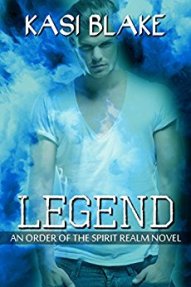 Kaye: Legend is your most recent release. Would you like to tell us a little about that?
Kasi: Legend is the final book in the Order of the Spirit Realm series and wraps up life at Van Helsing’s school for Bay-Lee, Nick, Mike, and the rest of the young hunters. Monsters from the other realm have found a way to blow the doorway between them wide open. It’s all-out war. Who will win? Who will survive?
Kaye: What are you working on now? What can we expect in the future from Kasi Blake?
Kasi: I am currently writing 4-Ever Cursed, book two in the 4-Ever Hunted series. I plan to do all four books in a row, if possible. Then, I have an exciting fairy tale series like none other coming your way. Cursed by a Grimm is a dark fairy tale about a fading faerie realm, the wicked Ivory Queen who will do anything to stay in power, and a strange creature hiding in the shadows. The Grimm will either help Shayne save the realm and find true love. Or he will lead her down the wrong path and destroy everything.
Kaye: How do you decide the titles for your books? Where does the title come in the process for you?
Kasi: The titles come from the books themselves. I usually don’t name them until the book is either done or the entire outline is at least finished. Vampires Rule is something Cowboy says to Jack all the time. He loves being a vampire; Jack loathes it. Then it goes from there. Werewolves Rule and so on. Crushed and Witch Hunt are named after the games the witches play. Bait, as I already said, was named after the ranks the hunters get.
4-Ever Hunted is unusual because it comes from the fact that Cowboy and Summer want a fourth for their group. Cowboy is obsessed with having four members. They make the mistake of setting their sights on a hunter though. The question is, will Trick become the thing he hates most in order to save his own life?
Kaye: Are you a plotter or a pantser? Why?
Kasi: Plotter. I feel like I need a map so I know where I’ll end up. I don’t understand pantsers. I would get lost without my map. Although, the outline does change several times during the process as I write. I leave room for character growth. Sometimes they do things that surprise me and turn my outline upside-down.
Kaye: You write about vampires and werewolves and shape shifters. What kind of research do you find yourself doing for your stories?
Kasi: I only research creatures that are new to me. Most of the mythology I make up so that it will be new and fresh like how vampires and werewolves were created by a faerie.
Kaye: What do you do for cover art? DIY, or hired out, or cookie cutter prefab?
Kasi: I started off doing them on my own, and they were not that great. Crushed and Witch Hunt were published by Clean Teen Publishing, so the covers were created by the awesome Marya Heidel. The Bait series and the vampire series were done by a woman just starting out in the business. I don’t even think she does it anymore. The awesome 4-Ever Hunted books are all by a great artist I found on Fiverr. Off the top of my head, I don’t remember her name, but she is listed at the front of the book as the designer.
Kaye: You have a blog, Supernatural Slant. How did that start?
Kasi: They say all authors need a blog, so this started off as a blog about writing, but I am obsessed with the show Supernatural. So, it went off more in that direction. I still blog about my books, sometimes books I like, but the blog is about Supernatural, the show, and shows like it now more than anything else.
Kaye: What time of day do you prefer to do your writing?
Kasi: I like to write late at night and early in the morning because there are no distractions then. I’m not getting phone calls, and people aren’t asking me to do favors for them or help them out or just wanting to talk. Plus, it is so peaceful when others are asleep.
Kaye: Besides writing, what are your favorite things to do?
Kasi: Reading, shopping, hanging with friends, and I love all my animals. I live on a farm, so taking care of them and watching them do silly things is always entertaining.
Kaye: Which author, dead or alive, would you love to have lunch with?
Kasi: I guess I would have to say JK Rowling, because I really want to know what it feels like to have your world made not only in movies but also in a theme park. I’d never want to go home.
 Kaye: My final question is one you may get asked a lot because of your Rule series, but you had to know it was coming. Who does actually rule, vampires or werewolves?
Kasi: I go back and forth on this. Sometimes I like vampires better, and sometimes I prefer werewolves. It depends on which character I’m writing at the time.
I want to thank Kasi Blake for joining us today, sharing about her books and letting us get to know her. If you want to know more about Kasi or her books, you can check out her website, or her author page on either Amazon or Goodreads.
Next week there won’t be a Monday post because I’m being interviewed on Authors Talk About It and I’ll be promoting that. Then, on Monday, September 4th, we’ll be treated to an excerpt form author Scerina Elizabeth, before delving into my seven part series Book Marketing – What Works? on Monday September 11th. So don’t miss it, on Writing to be Read.
Never miss a post on Writing to be Read again. Sign up for email to have notification of new content delivered right to your inbox, or Follow WtbR on WordPress.
Share this:

“Darkscapes”: Stories That Will Keep You Reading
Posted: August 11, 2017 Filed under: Book Review, Books, Fiction, Science Fiction, Speculative Fiction, Stories | Tags: Anthology, Book Review, Curiosity Quills Press, Darkscapes, Fiction, Science Fiction, Short Storie, Speculative Fiction 1 Comment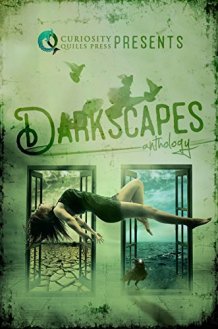
Darkscapes is a top quality anthology of short stories put out by Curiosity Quills Press. I must say, this anthology delivers on the promise of the premise. The title says that the stories within may be on the darker side of things, where danger lays hidden beneath the layers of the mind’s eye. The cover image tells me I’m in for some rather unusual stories, ones that go to places which may defy logic. And, having read many books produced by Curiosity Quills Press, the fact that they published this book says it’s a collection of good quality, well-written stories. And that my friends, is exactly what I got – all of the above.
There are twenty-one stories contained in this collection, too many to be able to discuss all of them here. So, I will give you a brief overview of the six, yes six, stories which I deemed to deserve a five quill rating, meaning the authors of these stories have done an exemplary job of storytelling. Keep in mind that these stories are the best of the best in this collection, but all of them are good reading.
The first story in the anthology, Exley Avenue, is an extremely well-written ghost story of sorts, with a surprise ending. Going between the 1920’s and the twenty-first century, storytellers Jordan Elizabeth and W.K. Pomeroy unravel the unsavory history of the stone castle on Exley Avenue, when several bodies are uncovered on the premises.
Further into the collection is a cute noirish story, with an unlikely P.I. for a protagonist, which is sure to keep you chuckling until the end is Skeleton Jim, by J.R. Rain. Noir with humor is the only way to describe this bizarre tale. But, rest assured, Skeleton Jim always gets his man, (and the girl, for some reason). Things are no different when the client, Lucy Newman, hires him to find out if she killed her abusive husband, and who is blackmailing her, Jim may have his work cut out for him. No bones about it. (Skeleton humor. Har, har, har.)
Then, there is The Giovanni Effect, by Robert J. Defendi, an extremely well-crafted story with excellent world building. Readers will live this one. On a desert outpost planet where sand and wind are constants, Allred and his wife and child are the planets only occupants. They’ve always known others might come, but when a ship lands on the planet Allred is forced to put their emergency plans to the test. The planet’s harsh atmosphere may be the death of him, or it might just be his savior.
The forth story, Landing a Job in the Private Sector, by Rena Rocford, kept the pages turning with the best of them. Furies are conditioned assassins, but when Boxy, an enslaved fury acquires an organic ship that is loyal to her, and becomes a rogue mercenary, she learns that everything is negotiable, even under pressure.
The fifth five quill story is Out of Sight, by Mathew S. Cox. Sima is a street kid, who wakes up to find she’s been relocated to another planet and her pod crashed. She all alone, with no supplies, no clothes and no idea where she is. But then she discovers three other children who were sent here, as well, and she has more to worry about than just her own survival.
The One You Feed, by Katie Young was the last story in this collection to fall into my best of the best list. This was a well-written werewolf story, which left me wanting more. Dupree is haunted by more than just werewolves. As he spins his tale for the cowboy he just hired on with at the last rodeo, we learn more about the ghosts who haunt his past, and the curse that controls his future.
The above mentioned stories are, in my opinion, the best stories in this collection. However, they are all entertaining tales. I wouldn’t rate any of the stories in this collection with less than three quills. They really are that good. The smashing cast of talented authors whose work appears in this anthology also includes: Richard Roberts, Ann M. Noser, Randy Attwood, Nathan Croft, Tegan Wren, James Wymore, J.P. Sloan, Andrew Buckley, Darin Kennedy, J.E. Anckorn, Piers Anthony, B.C. Johnson, S.E. Bennett, Mark W. Woodring, and Benjamin Sperduto.

Overall, I give Darkscapes four quills.
Kaye Lynne Booth does honest book reviews on Writing to be Read in exchange for ARCs at no charge. Have a book you’d like reviewed? Contact Kaye at kayebooth(at)yahoo(dot)com.
Share this:

“The Psychokinetic”: Good Story, Believe It or Not
Posted: July 28, 2017 Filed under: Book Review, Books, Fantasy, Fiction, Paranormal, Speculative Fiction, Young Adult | Tags: Grace M. DeLeesie, Speculative Fiction, The Psychokinetic, Young Adult Fiction Leave a comment
The Psychokinetic by Grace M. DeLeesie is Book 1 in her The Day Twelve Witches Burned series. If this first book is any indication of what’s to come, I might hesitate in reading the sequel books. There are many, many typos, missed words, and misspellings; the whole story is told, rather than shown; there is a lot of head hopping. But the biggest problem was an inability to suspend disbelief. I just couldn’t buy into the odd responses and behaviors of her characters.
Overall, the story line is a good one. Six teenage girls find themselves with extra-sensory powers which normal teens just don’t have. They feel they have been led to find each other, and they’ve bonded to form a tight knit group, who look out for one another, while they search for evidence of who or what they are. And before the first book is finished, we learn that there also exists an evil nemesis, who has followed them through many lifetimes, intent on destroying them. Which, is all pretty cool.
I spoke with the author, Grace M. DeLeesie about my concerns with this story, and she admitted she had some problems with a previous editor. She assured me many of the problems are already being addressed and a revised text will replace the current version. I have to say, I really like the story line, although it could have been written better. I still can’t buy into the story or its characters, but with the author’s assurance that at the least, the grammatical errors and typos will be corrected, I feel comfortable giving The Psychokinetic three quills.

Share this:

“Wolves for the Holiday 1.1” has potential to be more
Posted: June 9, 2017 Filed under: Book Review, Books, Erotica, Fiction, Paranormal, romance, Speculative Fiction | Tags: BookReview, Josette Reuel, Paranormal Romanace, romance, Wolves for the Holiday 1.1 4 Comments
Wolves for the Holiday 1.1, by Josette Reuel is a short story with the potential to be a longer supernatural romance. As with many short stories, it feels like there should be more. The ground work is laid for secondary characters to have relationships, providing plenty of subplot material that Reuel fails to take advantage of, and readers are left wanting more. This story has the potential to become a novel length work, if more fully developed.
When first three wolves, and then later, three naked men show up at a secluded mountain cabin, where three writer friends are taking a writer’s retreat, things promise to get a little weird. That’s where the problem lies, for three women in a secluded cabin just wouldn’t react the way these women do, so I had a hard time buying into the story. The premise is good. Actually, the premise is great, but Reuel fails to suspend my disbelief.
Then there is the romance element, which is good, and almost believable. However, having our heroine submit to the Alpha male makes her appear weak, conforming to typical female stereotypes. The males are stereotyped as well, but I could buy that because they are wolves, after all.
After our two protagonists have their romp in the hay, there is no follow through. The story just ends, leaving the reader feeling cheated. Relationships with her friends and his pack members are alluded to, but not shown. We can only guess what was happening in the rest of the cabin while the main romance is blossoming in the bedroom. I will say the bedroom scene itself was done tastefully.
Wolves for the Holiday 1.1 has a great premise, but fails to deliver, doesn’t carry through the full romance arc, has a weak female protagonist, but does include a well written bedroom scene. I give it two quills.

Share this:

There’s No Escaping Hell For “Hell’s Butcher”
Posted: May 19, 2017 Filed under: Books, Dark Fantasy, Fiction, Speculative Fiction, Western | Tags: Book Reviews, Books, Chris Barili, Dark Fantasy, Hell's Butcher, Hell's Marshal, horror, Reviews, Speculative Fiction, Western Leave a comment
I had the pleasure of reading the Hell’s Butcher series by Chris Barili, Hell’s Marshal and Hell’s Butcher. This series is refreshingly different, a combination of western, speculative fiction and super hero, and somehow, it all works.
Frank Butcher has been appointed Hell’s Marshal, sent back to the land of the living on the trail of killers escaped from hell, bent on wrecking havoc and changing history to aide in the rise of the south. In Hell’s Marshal, Frank and his posse of walking dad and their coyote guide are after the renegade soul of Jesse James before he can revive the confederacy and rise up once more against the union.
They travel on a stage pulled by hell’s steeds, which never tire and move at incredible speeds, and they carry weapons with the power to send souls back to hell, where they belong. But, it isn’t easy to pursue their prey in bodies that have been dead a long time, causing extra difficulties to the chase. The coach is driven by a mortal man with special gifts and they’re joined by an orphan boy with the power to see souls raised from the fiery pit.
In Hell’s Butcher, John Wilkes Booth is the renegade soul, back to build an army to finish the government takeover, the conspiracy around the assassination failed to complete, and Frank and his posse must send them back. In a chase filled with misdirection, and battles with demonic souls inhabiting living bodies, there is no way to triumph without further damning the posse members’ souls.
************************************Spoiler Below*********************************
I absolutely love these story lines and must say these books are well crafted. Barili does a smash up job of drawing the reader into his world, where condemned souls can walk among the living. My only problem with these books is the fact that Frank doesn’t seem to change much. Guilt and self-loathing are Frank’s fatal flaws as the protagonist, and although it doesn’t necessarily be resolved, there should at least be some evident change by the end of each story arc. Even by the end of the second book, although he reasons that people should not have to suffer for things they’ve done due to circumstances beyond their control, yet he still resigns himself to whatever punishment the judges dole out, feeling he deserves it, unable to apply the lesson to his own situation, and he is unable to forgive himself.
*******************************************************************************
Both books in this series, Hell’s Marshal and Hell’s Butcher are entertaining tales with refreshingly original story lines. Each book could be stand alone stories. Regardless of the one glitch found in the protagonist’s character arc, they are fun reads that keep the pages turning. I give them both four quills.

 If you like the Hell’s Butcher series as much as I did, you’ll want to be sure and grab the prequel, Guilty, which is now also available. Guilty tells the story the events in Frank’s life that brought him before the judges and put him in the position to serve as Hell’s Marshal. This book offers insight into Frank’s character, so we can see where all that self-loathing comes from, drawing the series together and giving it cohesion. It is a different, but wonderfully entertaining story line. I give Guilty five quills.

Kaye Lynne Booth does honest book reviews on Writing to be Read in exchange for ARCs at no charge. Have a book you’d like reviewed? Contact Kaye at kayebooth(at)yahoo(dot)com.
Share this:

“Weeping Willows”: A Ghostly Tale
Posted: April 21, 2017 Filed under: Book Review, Fiction, Paranormal, Speculative Fiction, Stories | Tags: B.J. Robinson, Book Review, Ghosts, Paranormal, Short Fiction, Short Story, Weeping Willows Leave a comment
Weeping Willows by B.J. Robinson has the potential to be a good ghostly tale. Unfortunately, Robinson didn’t take it quite far enough. All the elements are there, but they just don’t come together very well.
The story fails to set a tone scary enough to cause any real anticipation. The House of Usher, it is not. The one spirit that actually shows herself, isn’t very threatening, is actually rather helpful, providing all the needed information about the house’s history, so the story may proceed, thus removing any sense of mystery the story might have been carrying.
The plot is classic haunted house to the point of almost being cliché. Two couples enter into a contest where the couple who lasts the longest in the old house, which threatens to crumble and fall into the sea, wins a honeymoon in Hawaii, but of course, the house is haunted and the spirits don’t seem happy about its latest guests.
The circumstances often seem a little too convenient, as if the events occur at the convenience of the author, to get the story out. It feels like the characters do what is necessary for the story to unfold, but perhaps not what would be natural for their personalities, but that could be because the characters lack depth. Character development is always a challenge when writing short fiction due to the short amount of page space, but without it, it’s difficult to care about the characters.
Weeping Willows is a ghost story of fair quality. I give it three quills.

Kaye Lynne Booth does honest book reviews on Writing to be Read in exchange for ARCs at no charge. Have a book you’d like reviewed? Contact Kaye at kayebooth(at)yahoo(dot)com.
Share this:

Interview with author DeAnna Knippling
Posted: April 17, 2017 Filed under: Author Profile, Books, Fantasy, Fiction, Horror, Publishing, Science Fiction, Self-Publishing, Speculative Fiction, Writing | Tags: Author, DeAnna Knippling, Interview, Profile, Publishing, Self-Publishing, Writing 1 Comment
This week, I’m interviewing Colorado freelance writer, editor, author and book designer, DeAnna Knippling. I first met DeAnna through the Pike’s Peak Writers when I was still serving as the Southern Colorado Literature Examiner. What struck me about her was her enthusiasm and willingness to help where ever she can. She treats her writing as a business and goes at it with a high degree of professionalism, yet she is personable and willing to share what she’s learned from her own writing experiences.
DeAnna Knippling writes science fiction, fantasy, horror, crime, and mystery for adults under her own name; adventurous and weird fiction for middle-grade (8-12 year old) kids under the pseudonym De Kenyon; and various thriller and suspense fiction for her ghostwriting clients under various and non-disclosable names. Her latest book, Alice’s Adventures in Underland: The Queen of Stilled Hearts, combines two of her favorite topics–zombies and Lewis Carroll. It’s the story of a tame zombie who told a little girl named Alice a story that got them both in more trouble than they could handle. Her short fiction has appeared in Black Static, Penumbra, Crossed Genres, Three-Lobed Burning Eye, and more.
Kaye: You created Wonderland Press to get your books out there. What all is involved in creating a press for your work and what are the advantages of doing so? I mean, why would an author do this rather than just throwing their book out on Amazon or Smashwords?
DeAnna: This isn’t one of the fun answers. It’s stupid easy to make a “press.” It involves no special equipment. You look online, make sure nobody else has one of that name in your state, register a business name with your state or county (look up, “How to register a business name in [name of state]”), and Bob’s your uncle. You might want to get more complex with an LLC or something–but I recommend leaving that for later, unless you already have experience doing that. I am, of course not a lawyer and can’t give legal advice. When you want to start looking at an LLC or corporation, I believe, is when you start having to worry about taxes and tax brackets.
DeAnna: Just keep working. Everybody’s in a hurry to succeed. Success! Millions! Riches! Fame! But, in the end, it comes back to the basics. Did you read? Did you write? Did you learn something? Did you talk to other people in the writing community?
Like this post? Subscribe to Writing to be Read for e-mail notifications whenever new content is posted.



















