The Well-Fed Writer: How to make your writing pay
Posted: September 14, 2018 Filed under: Books, Copywriting, Nonfiction, Writing | Tags: Advertising, Book Review, Brochures, Commercial Copywriting, Emails, Flyers, Newletters, Peter Bowerman, The Well-Fed Writer, White Papers 4 Comments
As some of my friends and followers know, I’m determined to turn my writing into my full time job. With that in mind, I’ve been delving into the arena of commercial copywriters, because it’s something I can do from my home office, it involves my favorite activity of writing and allows me to make money from it, and it is something I can start out at part-time and move into full time as the money starts rolling in.
The Well-Fed Writer, by Peter Bowerman should be required reading for all freelance copywriters. Bowerman is himself a successful freelance commercial copywriter, sharing his knowledge and experience, as well as a collection of advice from other freelancers.
This book is a basic guide to building a lucrative freelance commercial copywriting service, covering everything from gaining and dealing with clients to the different types of copywriting skills there are to add to your repetoir. It offers advice from successful copywriters who are making their freelance businesses work for them and makiing their writing pay. Although it does not feature many examples of the different types of copywriting projects you might want to offer, it does give links where you can find samples and explore those avenues; from white papers, to emails, to newsletters, to brochures and flyers. And Bowerman offers suggestions for other useful books you may want as well.
The way I see it, this book is like a bare basics copywriter’s handbook, and no copywriter that is serious about his or her craft should be without it. I found The Well-Fed Writer to be very helpful in knowing which direction I need to go to get my own commercial copywriting service off the ground. I give it five quills.

Kaye Lynne Booth does honest book reviews on Writing to be Read in exchange for ARCs. Have a book you’d like reviewed? Contact Kaye at kayebooth(at)yahoo(dot)com.
Share this:

Wake Me Up When September Ends
Posted: September 10, 2018 Filed under: Books, Memoir, Nonfiction, Poetry, Writing, Writing Inspiration | Tags: Memoir, Michael Daniel Lee Booth, Mother's Grief, Nonfiction, Teen Suicide 9 Comments
September is a month that I’d prefer to skip over if I could. It is not an easy month for me and hasn’t been for the last ten years. My son Michael was born on September ninth, he died on September 21 at the age of nineteen, and he was buried on September twenty-eighth. Had he lived, he would have been 30 years old yesterday. Since his death the Green Day song, Wake Me Up When September Ends, has held a special personal meaning for me, because it would be preferrable to go to sleep and not wake up until September was over each year. But of course, that isn’t possible and so, I plod through the month, struggling with my emotions, and life goes on. I haven’t forgotten, and I don’t miss him any less as time goes on, but I am now able to prevent my loss from consuming my life, as it did at first.
After he died, I felt his story needed to be told, but I couldn’t bring myself to do it, even though most of what I wrote during the first two years concerned him in one way or another. The wounds were still too fresh and I couldn’t distance myself from the situation enough to write it. I always knew that it was a tale that needed to be told, and I knew I was the only person who could write it, so I saved all the files and the photos, as well as physical momentos and hand written stories and poems written by my son.
As I mentioned in a recent post, It’s All a Matter of Time, I’ve begun compiling the plethora of journals, stories, poetry and visual images I have accumulated in releation to my son, so tuning out the world and hoping September will go away is not going to work this year. I’ve gathered these materials over the past ten years since his death and they are my works, as well as his, and eventually, it will all be included in my memoir about his life and death, His Name Was Michael: How I Lost My Son to Teen Suicide. After a decade, it is time for his story to be told. The pre-writing preparations have begun and I hope to have it ready for publication by this time next year.
This September will be filled with many tears, as I read through all the materials I’ve gathered and/or written for this book. To put it all together I must read through every piece of writing and go through all the photos of him. I’m not saying that it will be easy for me, because it won’t. In fact, it will probably be one of the most difficult things I’ve ever written, but there is no one else who can do it. It’s all up to me and I feel it’s got to be written.
Michael’s story is many stories wrapped up into his tale. His story will tell the tale of an amazingly unique young man in love, who made some poor choices. It will tell who Michael Daniel Lee was and who he might have been one day, had he lived. It will tell of a mother’s grief and attempts at denial. It will tell of the coping mechanisms employed just to make it through each day after the loss of a child. It will tell of a son, who was also my best friend, and a sense of loss that is undescribable, unknowable, unfathomable. It will tell of an epidemic that sweeps through our world taking young people who have their whole lives ahead of them.
Below is the eulogy that I wrote, which I read standing before a mortuary filled with mourners for my son one week after his death. It’s one piece in the tapestry of writing that will be used to illustrate Michael’s brief time on this Earth. I hope it will pique your interest and encourage you to read the book when it comes out, hopefully by this time next year. If you’d be interested in pre-ordering the book, leave a comment letting me know and I’ll put you on the list, making sure you get your copy when the time comes. It would be great to know that someone is interested, and that I will be writing this for someone other than myself.

Michael Daniel Lee Booth
When Mike said, “I love you”, it was forever, and when he called you his friend, you knew you could depend on him to stand by you, no matter what. He loved to try new things, to explore and to learn. He had a love for life and for all that he held sacred. Mike strove for excellence in all that he did, and lived by a code of honor that was extremely tough to uphold. His Christian upbringing was intermixed with Hindu and Buddhist beliefs to make up the tapestry of his own personal belief system that was disciplined and unyielding. When he made mistakes, Mike was harder on himself than anyone else ever could have been.
When he got mixed up with the wrong people and things, he made some poor choices. He did not deny what he had done, but instead stood up and accepted the punishment that was given to him. He tried to make amends for his wrongs and was on his way to accomplishing that goal. He expressed great sorrow for his errors, and inflicted emotional punishment on himself over and above what the law could ever require of him.
He had a strong will and could accomplish anything that he set his mind to, including learning to speak Japanese and perform martial arts skillfully, all on his own. Mike had a love for Japanese culture and he could have lived off of green tea and sushi. His knowledge and skills were gladly shared with those who wished to learn. Mike had a love for nature and enjoyed all kinds of outdoor activities, including skiing, hunting, fishing and hiking. His imagination was endless and he created stories and drawings that reveal a talent far beyond his tender youth.
Mike was so much to so many people; a loving son, a dependable big brother, a doting little brother, a respectful grandson, a loyal friend and a devoted husband. He loved his dog, Zaar, who was a companion and loyal friend to him. Mike was sensitive, and hurt so easily and so deeply, yet he was too strong willed to ever let it show outwardly. Only through his writing, can we glimpse the love that he embraced or the pain that he felt. When he loved, he loved with all of his being. Mike was fun loving and enjoyed spending time with those that were important in his life. He had beautiful curls and the most wonderful smile, which could light up my heart whenever I saw it. Mike turned 19 three weeks ago. He had a whole life ahead of him. He was much too young to be called home to God.
Like this post? Subscribe to Writing to be Read for e-mail notifications whenever new content is posted or follow WtbR on WordPress.
Share this:

“Destiny’s Detour”: Not Really Romance
Posted: September 7, 2018 Filed under: Books, Memoir, romance | Tags: Book Review, Destiny's Detour, Mari Brown, romance Leave a comment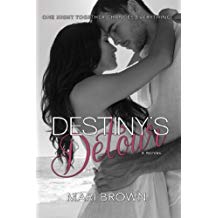
Although Destiny’s Detour, by Mari Brown, may contain a happily ever after, I can’t really classify it as romance, because their HEA is more of a happy all the way through. For me, part of the fun of romance, or any story really is finding out how the characters will resolve conflict and overcome obstacles which are preventing them from achieving their goal.
For romance, that goal is usually for the couple in question to build and maintain a romantic relationship. In Destiny’s Detour, the worst conflict I found was that the captain of the dance team doesn’t like Destiny, which really doesn’t cause a problem because it seems no one really cares what Buffy thinks anyway. Although her brother David doesn’t like the ‘mushy stuff’ when it involves his sister, he is supportive of her relationship with Troy, so there’s not a lot of tension there either.
Brown writes this story in first person, present tense, which can be difficult to do, but Brown pulls is off fairly well. Destiny tells us what happens and what she is feeling, but I’d like to see more of the action. Instead of telling me she’s excited, I’d like to feel her heart beating as if it were trying to come through her chest wall.
Destiny’s Detour is a cute feel good story. It just doesn’t have a lot of tension to make me want to keep reading. I give it three quills.

Kaye Lynne Booth does honest book reviews on Writing to be Read in exchange for ARCs. Have a book you’d like reviewed? Contact Kaye at kayebooth(at)yahoo(dot)com.
Share this:

Jeff’s Pep Talk: Always One More Story to Tell
Posted: September 5, 2018 Filed under: Inspirational, Pep Talk 2 Comments
Always One More Story to Tell
By Jeff Bowles
The first Wednesday of every month, science fiction and horror writer Jeff Bowles offers advice to new and aspiring authors. Nobody ever said this writing thing would be easy. This is your pep talk.
I’m good at giving pep talks. Sometimes I wonder if it’s not my life’s purpose to encourage others to success rather than to achieve a huge amount of it myself. If that’s the case, I think I’m okay with it. It’s not in my nature to divide or mislead people. I’ve got a slight carnival barker element to my personality, I suppose, but other than a little ill-timed self-promotion every now and then, it’s never gotten me into much trouble.
In this world, in this day and age, contention and cultural separateness are extremely popular trends. It seems folks today are primarily interested in defining themselves by what they are not and what they dislike, abhor, or disagree with. Maybe my personal philosophy comes from some other time, some other place. I’m more interested in the things that unite us, that remind us just how similar we are; I’d like to see people come together and acknowledge the good in life rather than the bad.
I’m an optimist by nature, even and especially when things in my own world seem askew. In grad school, I adhered to a certain ethos that served me pretty well. It became popular enough among my classmates I heard it repeated back to me more than a few times, especially as my academic cohort entered the home stretch of thesis prep. That ethos is simply this: there’s always one more story to tell. It actually applies to more in life than just writing, but for the purposes of this blog, I’ll narrow its definition to its most literal meaning.
There’s always one more story to tell means a good writer understands a career is not built on a single world, character, or narrative. It means no matter how hopeless or defeated you feel, your imagination and will to create are completely under your own power and can therefore sustain you through the hard months and years. There’s always one more story to tell implies none of us should ever stop dreaming. Dreams are the stuff of joy and expansion, not cold, hard, practical facts. Cold, hard, and practical wants you to see a slew of form rejection letters as a personal condemnation from the universe. “How dare you try to be a writer? Don’t you know you’re lousy at every single thing you do?”
I believe it’s possible to see through the illusions of life. Here’s the biggest illusion for writers who have yet to realize their goals: no one’s believed in me yet. It’s safe to assume no one ever will. Contrary to what you may have been told, belief is not required for success. There’s no secret recipe for super-stardom containing one part perspiration and nine parts yeah, but I believe so much. It’s not a badge of honor or a sign of a superior mind to keep the faith even when you’re feeling battered and bruised by every creative endeavor you’ve failed to launch. The truth is, there’s no room for belief in always one more story to tell. In fact, it’s antithetical to the entire basic philosophy.
Choose to be rather than to become. Were you born a human being or did you choose to become one? Did you draw your first breath naturally, or did it just seem the most prudent thing to do at the time? Oh, well I guess oxygen is a thing here in this hospital room. Didn’t seem to need my lungs down in that womb, but what the hell? I’ll play along with everyone and just breathe.
What is a writer? Honestly, have you ever stopped to ask yourself that? A writer is a person who writes. That’s it. You either are the thing or you aren’t. So in acknowledging you always have one more story to tell, you’re giving yourself permission to screw up a little. Or maybe even a lot. Man, that last story was a real loser. Well, so what? Remember that idea you had the other day while you were driving to work? The one about the race of rat-people who secretly control the international rat poison industry? Didn’t that excite you to think about? You know, excitement is the one and only key signifier of a creative avenue worth walking. Enthusiasm carries, after all, so ditch the last story that didn’t work and start crafting a new one. You’ve got to learn to harness your creativity before you can engage it with discipline. In a perfect world, a writing career would contain plenty of both, discipline enough to get the job done, creativity enough to ensure the stars in your eyes rarely dim.
So how does always one more story to tell work in practical application? For starters, don’t wait to start dreaming up your next masterpiece before you’ve finished with your current one. In fact, don’t ever stop dreaming, not if you can help it. Also, never stop watching, reading, playing, or listening to the types of stories that really get you going. Every single storyteller on the face of the planet was a fan before they were a creator. Never stop being a fan. You very well may become a huge success one day, which means you’ll meet some of your heroes. Don’t lose interest in their work once you discover they’re human, just like you. Know and understand the kinds of stories you enjoy most and devour them whenever you can. Don’t lose perspective. You’re a storyteller because you like being entertained and wish dearly to entertain others. That’s a noble goal. Really, it is. Writers are folks who allow others to be someone else for a while. We help people dream, just like other very noble writers helped us.
The dream is the thing that binds us. The dream is elemental and necessary. Rather than showing us who we aren’t, it defines us deep down to our very cores, who we are–or rather, who we’d be if we could take off our disguises and dance, as they say, like no one’s watching. I love to dance. You know how kids need no prompting when it comes to make-believe? It’s because no one’s taught them yet to avoid dancing at all costs. Above all else, writers are individuals who never fully integrated the lesson that adults do what they have to do 100% of the time and nothing else, no ifs, ands, or buts about it. And the world needs people like us. Perhaps now more than ever.
I recently went through a period in which I stopped writing completely. I had a few pretty major personal setbacks, and I needed time to recoup. I don’t regret it one bit. The me that worked my butt off in grad school would have told this other me to soldier on, work through the pain, never stop writing. That old me would’ve been dead wrong. Always one more story to tell also accepts the fact that sometimes there’s no story to tell right now, but that this won’t always be the case.
I always preach self-forgiveness to budding authors. I think it’s paramount. Writers are often a depressed bunch. Sometimes I think it must be the key to our tenacity, that we couldn’t do what we do without a little self-doubt. Writers are perpetually Linus clutching his security blanket. We need a hug and a little friendly reassurance from time to time. But then, well, who doesn’t? Be the storyteller who’s willing to cut herself or himself a break. You won’t forget how to write, not ever, not as long as you’ve still got a pulse. The lessons you’ve learned, the work you’ve put in, they won’t suddenly disappear overnight. Uncertainty will always be a factor. It’s probably best to get used to that. There are things you can control and things you can’t. C’est la vie, right?
Do yourself a favor and keep a running ‘story ideas’ notebook. I’m a digital guy, so I use an app called Evernote. It’s a pretty helpful tool, because it allows you to save and sync individual notes across all your mobile devices and then backs them up into the cloud. The next time you’re watching an old favorite movie and one line of dialogue gets you thinking about some great new concept, write it down and save it for a rainy day. You’ll be glad you did.
The best thing about collecting ideas is that the process is cumulative, which means one idea lends itself to another, lends itself to another. One good concept can change your life. Dr. Martin Luther King knew that and spoke highly of it when he told us about his dream. His vision of an America, a world, in which all people were truly thought of as equal was perhaps the best conceptualization in human history. It was so damn good it seemed like a no-brainer and still does, even if we’re still fighting to see it realized. I suppose that’s another thing. Bringing something new into the world will always be a fight. Remember, enthusiasm carries (as in, it can help carry your lazy butt to the door). Never underestimate your ability to conceive and create the future. MLK didn’t, and nor should you.
It’s natural to doubt yourself and your abilities sometimes. Everyone has done so at least once in their life. And really, the work of a creative soul is doubly hard, and fraught with personal perils deeper the the Grand Canyon and twice as cleft. “It’s not the years, honey, it’s the mileage.” Indiana Jones said that, and he hated snakes and had a thing for whipping the competition.… Okay, maybe that’s not the greatest motivational allusion, but you get the idea. Take a breath, do something fun for a while, come back to your work, start again, knowing with certainty you never really stopped anyway. Life’s a continuum, a big lopsided wheel bouncing through space. One day you’re on the bottom, sure, but guess what? That’s only a prelude to being back on top again.
You’re reading a blog post written by a guy who dislikes divisiveness. The pendulum, it seems, has swung in that direction. But it doesn’t mean any of us has to like it. It also doesn’t mean you have to accept it in your own creative endeavors. Competition is everywhere in the writing world. Don’t play that game. Honor the success of others, and feel and express gratitude for your own, no matter how humble it may seem. Sometimes choosing to sit down and put one word after another is the biggest victory you can claim. So celebrate your abilities and your work, and get excited for your future. Whatever you do, remember the following: there’s always one more story to tell, there’s always one more story to tell, there’s always one more story to tell.
Like the one about the garden fountain that pitches quarters at people to make wishes. Or the cybernetic super-being who wants to trade his metal heart for a plastic one that can break. Or the…
See what I mean? Until next time, people. ¡Viva la creación!
Check out Jeff Bowles Central on YouTube – Video Games – Music – Entertainment – So Much More!
Share this:

Social Media: What’s it good for?
Posted: September 3, 2018 Filed under: Books, marketing, Promotion | Tags: author platform, book marketing, Book Promotion, promotion, Reader Platform, Social media Leave a comment
I posted a link in my Writing to be Read Facebook group a couple of weeks ago. The article discussed the new changes made by Facebook which do not allow us to post promotional materials on personal Timelines. Under the new guidelines promotional posts are only allowed to be made on our Facebook Pages, which are designed to be set up for businesses. If you break the rules and make promotional posts on your Timeline, Facebook can ban you. This information caused quite a stir in my group, and I admit it caused me quite a bit of concern, as well. I came to the conclusion that, as with everything in life, we must learn to be flexible and accoodate change. I changed the title of my Kaye Lynne Booth Screenwriter page to Kaye Lynne Booth Author and Screenwriter and set my automatic posts from WordPress to post there instead of on my Timeline and hoped for the best.
One of the comments I received was a question toward one of the group members who was upset, viewing this as a ploy to force us to purchase paid advertising. The second member asked how using Facebook’s free advertising was going and asked if she had sold many books from it. While I don’t think this change prohibits making promotional posts as long as you make them through allowable channels, the conversation made me stop and think about what we authors are expecting to achieve through such posts.
Free promotion through social media is great. It offers us, as authors, an avenue to get the word out about our writing, without putting a dent on our wallets. For aspiring authors, who haven’t made it to fame and fortune yet, like myself, that’s great. But what results are we expecting?
If you’re thinking your book will rise to the top of the best seller lists, you’re dreaming. That’s not the way it works. The best seller lists, at least those on Amazon, work on algorithms, and if you’re only one of a smattering of books in a category, it may not take many book sales to place your book at the top of the list. Authors who write romance have it a lot tougher, because there are a whole slew of romances out there, a lot of competition, so even if your book is making sales, it may not be enough to launch you to the top because it’s based on the books which sell the most in that particular category.
Likewise, most of the folks who those promotional posts reach are other authors, not the people in your target audience. Authors may buy books, but basically they want the the same thing you do. They are out there to promote their own work. Social media isn’t designed to sell books, although their paid promotions may be quite effective, and anyone who is using free promotions to try and sell books, or anything else, may be sorely disappointed. Social media, my friends, is designed to promote connections, some of which may be quite valuable, but it’s not designed to sell merchandise, hence the word ‘social’. And that is what I get from my promotional efforts on Facebook and any other social media site I use. I grow my blog following and my email list. I find a few people who are willing to review my book. I meet people who can include me in their author services as an editor. I connect with artists who can create the book covers I need. While many are fellow authors, I tap into that as well, offering them interviews or reviews here on Writing to be Read. They get some free exposure and I great content for my blog. It works out great.
That being said, I’ve come to the sobering realization that nothing is free, and I’m going to have to invest some of my hard earned money if I want to boost my book sales. While I can’t afford paid promotion on Facebook or Amazon right now, there are affordable promotions out there.
- There are some affordable avenues of promotion out there. Most recently, I found a promotional site called I Like E Books, which has promotional packeages which range from free up to twenty dollars, which seems promising. They provide promotion on social media channels and other cool stuff, depending on which level od promotion you pay for.
- Although not a promotional site, per se, Book Bub is great for featuring your books under your favorites, so folks can see that they are available. You can follow your favorite authors and hopefully gain some followers of your own. It doesn’t cost anything to join.
- On All Author, you can have your book featured on their site for six months, with twitter promos, weekly mock-up banners, and review posting for a flat fee of $24.
- It’s also free to sign up for PromoCave, which is a site for ongoing promotion via social media sites. It helps on this site to post content fairly regularly, since it will bring readers to your profile.
- BMI Books is a global book marketing site where you can place and manage a book ad for free, although I’m unsure how this one works as yet.
- You may also sign up for free on Write Globe, which has a nice book promotion platform as well as supporting other types of creativity. This site was listed as number one in a list of “Top 7 Websites for Book and Author Promotion” by Alwin Gnanaraj on LinkedIn.
- Creative Designers & Writers is a free international classified site, where you can create and post an ad. It is supportive of other creatives as well and can serve as a platform for collaborative works with graphic designers and artists.
- Books Online Best also allows you to post a free ad in addition to other author services, such as book trailers and author interviews. You can also create a freelance site here.
One day, I’ll be able to afford to play with the big boys. For now, I will be grateful for the benefits I can get from social media, but I will approach it with reasonable expectations, being grateful for every follower I gain and counting any book sales that comes from it as an extra added bonus.
Like this post? Subscribe to Writing to be Read for e-mail notifications whenever new content is posted or follow WtbR on WordPress.
Share this:

“Kissed by Literature”: A YA collection of short fiction
Posted: August 31, 2018 Filed under: Book Review, Books, Fiction, Paranormal, Speculative Fiction, Stories, Young Adult Leave a comment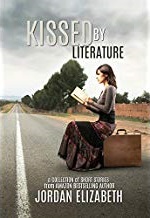
Like many authors, Jordan Elizabeth started out writing short fiction, and in Kissed by Literature, she offers us a generous sample of paranormal and speculative shorts. The trouble in writing short fiction comes in making the story feel complete, with a beginning, middle and end, using a minimal number of words. It’s not an easy thing to do, and while there are stories included that feel a little rushed in the pacing or end abruptly, as can only be expected in a collection of shorts of this size, those that do feel complete hit the mark and give readers goosebumps. Among them, my favorites include House of Sixty Bells, a ghostly mystery solved; Satin, a tale of paranormal friendship with ulterior motives; and Lock the Door, the story of a husband’s guilt following his wife’s murder.
A delightfully eerie collection of paranormal and speculative stories, I give Kissed by Literature four quills.

Kaye Lynne Booth does honest book reviews on Writing to be Read in exchange for ARCs. Have a book you’d like reviewed? Contact Kaye at kayebooth(at)yahoo(dot)com.
Share this:

It’s All a Matter of Time
Posted: August 27, 2018 Filed under: Books, Memoir, Nonfiction, Revision, Writing | Tags: Future, Last Call, Memoir, Michael: How my son became a teen suicide statistic, Non-fiction, Past, Time, Time travel, Writing 1 Comment
Time. It fascinates us, captures our imaginations with the possibilities of time and time travel, so much so that our literature and the entertainment industry are filled with stories and songs which follow that theme. There have been countless movies on the subject: the Back to the Future series; Time Cop; The Terminator; Groundhog Day; Planet of the Apes; Bill and Ted’s Bogus Journey; The Butterfly Effect; Land Before Time; and Timestalkers, to name a few. And of course, television series: Dr. Who; Quantum Leap; Sliders; Time After Time; Outlanders – not to mention series with one or more episodes that involve time travel. Books and stories about time travel include: A Connecticut Yankee in King Arthur’s Court, by Mark Twain; The Time Machine, by H.G. Wells; Rip Van Winkle, by Washington Irving; A Christmas Carol, by Charles Dickens; “The Langoliers”, by Stephen King (Four Past Midnight); Timeline, by Michael Crichton; Harry Potter and the Prisoner of Azkaban, by J.K. Rowlings; The Time Traveler’s Wife, by Audrey Niffenegger; and more recently, All Our Wrong Todays, by Elan Mastai. Even the music industry has gotten in on the theme: Fleetwood Mac can’t stop thinking about tomorrow; Tim McGraw deals with it in segments, so he only worries about the next thirty years; Bad Company is ready for love and figures better things are bound to happen looking forward; Jim Croche wants to save it in a bottle; Cindy Lauper comments on the repetitiveness of it, as things tend to happen time after time; and Stevie Nicks would do it all again, even though it’s not always a breeze. These lists don’t even scratch the surface. So, why is it that time so fascinates us?
I had a little Australian Shepherd named Dorchester. I got her when she was a pup. When she was young, she was agile and fast. Man, was she fast. She could smoke both the male Blue Heelers she grew up with to get a Frisbee. Then, she’d run off with it and wouldn’t give it back. She never was much for playing by the rules. But, as she got older, of course, she slowed. Age affects dogs in many of the same ways that it affects people: it gets harder to get up and down; movement is slower, more careful; the senses are not as accute as they once were, etc… Dorchester began to lose her eyesight first, even before her she lost her speed and her agility, so I had to become her seeing eye person. I began carrying a walking stick on our walks, thunking it down firmly on the ground with each step I took, so that she could hear where I was and follow. We walked this way for several years until eventually she was no longer able to go on walks with me anymore due to poor eyesight and other effects of aging.
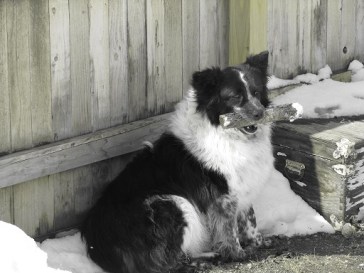
Dorchester isn’t with me anymore, but I still go on walks with both of the Heelers. We all walk a little slower these days. Our walks are shorter and there’s not a lot of rabbit chasing anymore, but they are are enjoyed, never the less. My son’s dog, Zaar, was Dorchester’s mate. They were the same age, each joining our family at about the same time. As Zaar ages, he is not only losing his sight, but his hearing, as well. He is very frightened of thunder and storms always gave him major anxiety attacks, so his not being able to hear so good hasn’t been a totally bad thing, but it does pose new problems on our walks. Zaar grew up walking on our property, so he thinks he knows where he’s going and doesn’t always pay attention to where his walking companions are headed. He gets into ‘the zone’, nose up, sniffing th air, and no matter how loud I yell, he doesn’t hear me, causing me to have to chase after him, touching him to get his attention and get him back on track. Zaar was also raised around a Heeler who was deaf, so he learned hand signs and once I have his attention, he will follow, but it’s getting his attention that’s the trick.

The exercise he gets from his walks is what keeps him healthy and mobile. As I watch him getting older, I feel a sense of urgency, knowing that time may be running short for our walks and I want to enjoy my time with him while I can. I guess I just don’t know how to be a seeing eye person for a dog that can’t hear. He doesn’t hear my stick. I must figure out how to adapt and rise to the challenge, because left to his own devices, Zaar would soon be lost, especially after dusk, when his eyesight is at its poorest. It seems none of us are as young as we used to be.
It’s easy to look back and see what we’ve lost. ‘Hindsight is better than foresight’, and all that. Looking to the past, all our regrets become vividly obvious, but we tend to embellish the good times, as well. I think happy moments may be remembered as euphoric, more so than what they actually were, because those are the times we wish to hold onto. When I look back, there’s a dividing line to my timeline, seperating my life before my teenaged son died, and post-death, signifying the time when he was no longer in my life. That’s my loss. The time when Mike was alive seems brighter, more vivid in my memories. He was my biggest fan, with aspirations and the ability to be a writer himself. He was a unique soul and a source of inspiration for me.
These days, I feel a sense of urgency to make this writing for a living thing work while I still have time to do so. I have certainly taken enough time making it happen. I was 52 when I finally earned my M.F.A. and 53 before I became a published author. I’m sure I have some good years left, but I have to wonder if there will be enough for me to realize my dream. I wish I could go back in time and do things differently, but of course that’s only possible in my fiction.
 Now, with time travel, there’s the possiblity of doing things over, making things turn out different. Granted, it doesn’t usually turn out well when you go messing around with time, but things can, on occasion turn out better. If you don’t believe me, just take a look at MY time travel short, Last Call. Things aren’t going good for Derek, but he finds a way to make his life better. Maybe I could go back and get started on this career path a lot earlier in life. That’s not Derek’s solution, but it could work.
I don’t live in Derek’s world and there is no Last Call bar for me. I know I can’t just sit back and wait for things to happen, so if I want to reach my dreams while I’m still alive to see it, I have to take action. I must market what I already have published, but even more importantly, I must keep writing. So, my plan is to just keep at it. Eventually, my efforts will pay off. I have to believe that.
So what if I didn’t earn my M.F.A. until I was 52 and wasn’t published until I was 53? I’m not the only one to get a late start on their dream. After all, according to an inspirational Facebook post by Karen Caron, Stan Lee’s first big comic came out at age 40, Morgan Freeman had his first major movie role at age 52, and Julia Child didn’t make her cooking show debut until age 51. That puts me in some pretty good company.
Young or old, all we can do is look to the future. (There’s that time thing again.)

With that in mind, I’ve begun the writing and compilation of my memoir about my son’s life and death, finally, after nine years. I’ve decided that it’s time to reunite the two time periods that divide my life and my thinking. After his death, I wrote poems and stories about him, pouring my grief out onto the page. I compiled all the photos of him into a slideshow for his memorial dinner. In addition to that, I plan to contact some of Mike’s friends and request them to contribute writings of their own about who Mike was for them. It’s going to be a massive amount of work, but his story deserves to be told and there is no one else who can tell it. It will be my first non-fiction work of book length.
I’ve always said that I never have less than three works in progress. Michael: How my son became a teen suicide statistic, will make the third one, as I’m also writing the first draft of the sequel to my western novel, Delilah: The Homecoming and I’m revising the first book in my science fantasy Playground for the Gods series, The Great Primordial Battle. Writing is an integral part of my life, past, present and future. I may be an old woman, but there is no other direction in which my life can go. Mike would be proud of my accomplishments so far and I think he would be glad that his story will finally be out. After nine years, it’s about time.
Like this post? Subscribe to Writing to be Read for e-mail notifications whenever new content is posted or follow WtbR on WordPress.
Share this:

DARE: The sex is the story line
Posted: August 24, 2018 Filed under: Adult, Book Review, Books, Erotica, Fiction | Tags: Adult Fiction, Book Review, DARE, Erotica, James Crow 1 Comment
Most erotic stories get categorized as romance, for obvious reasons, and many erotic stories read like a romance with erotic scenes tossed in here and there to spice things up. Or the opposite, so much erotica it’s hard to find the story line, it seems everyone in the tale is having random sex for the sake of having sex, and there doesn’t seem to be much point to the tale.
Neither can be said for DARE, by James Crow. A tale where I found that the sex scenes carried the story. At times the flashbacks out weighed the present scenes and multiple sexual encounters play out for us simultaneously, but they are all relevant to the main story line. But reader beware, DARE goes beyond the erotic and into the realm of very twisted kink, and is definitely aimed at very mature audiences. To be honest, I found the subject matter a little shocking, but the matter-of-fact British tone that discusses atrocities as if they were run of the mill, everyday occurances may have something to do with the shock factor.
I’m not sure how I feel about this story, but it is an interesting approach to story telling, with a surprise twist at the end, so I give DARE four quills.

Kaye Lynne Booth does honest book reviews on Writing to be Read in exchange for ARCs. Have a book you’d like reviewed? Contact Kaye at kayebooth(at)yahoo(dot)com.
Share this:

The Many Faces Of Poetry: The Poetry Of Love
Posted: August 22, 2018 Filed under: Poetry, The Many Faces of Poetry, Writing | Tags: Arthur Rosch, love poetry, Pablo Neruda, Poetry, The Many Faces of Poetry 1 Comment
When I was fifteen I fell obsessively, passionately in love with a girl named Kay. She was the kind of girl that my mother would hate. I’m sure that added great luster to my blonde goddess, this Schicksa (that’s a girl who isn’t Jewish). I did insane things in the pursuit of my goddess. I invaded a Bible Camp in Green Lake Wisconsin, just to be able to see her. That didn’t work out very well. Kay’s mother was there. She was on the camp’s administrative board. Kay was mortified and her mother was filled with wrath. Anyway, the greatest thing Kay gave to me was poetry. She was that tweedy sort of intellectual teen who read e.e.cummings and T.S.Eliot. Thus it happened that my career as a writer began.
I don’t have any of the poems I wrote for Kay, or any of the poems I wrote at that time, none at all. It’s no great loss. I’ve written thousands of poems and most of them are lost. Some of them were stolen or destroyed. A complete stranger stole three of my notebooks from a stage while I was performing. A pissed-off dope connection burned two of my manuscripts. Still, I have a big fat book of poetry bound at Kinko’s. And I have eight backups on eight hard drives, at the very least.

There are all kinds of love poetry because there are so many ways to love. When love poetry appears, we all know it.
Here’s Pablo Neruda. I’m sure it’s better in Spanish
I do not love you except because I love you;
I go from loving to not loving you,
From waiting to not waiting for you
My heart moves from cold to fire.
I love you only because it’s you the one I love;
I hate you deeply, and hating you
Bend to you, and the measure of my changing love for you
Is that I do not see you but love you blindly.
Maybe January light will consume
My heart with its cruel
Ray, stealing my key to true calm.
In this part of the story I am the one who
Dies, the only one, and I will die of love because I love you,
Because I love you, Love, in fire and blood.
Pablo Neruda

Here’s Arthur Rosch. I’m sure it would be worse in Spanish.
Last night I counted your breaths while you slept.
Towards morning, I lost count, but you soon awoke
so I rounded the number and privately recorded
your many thousands of sleeping breaths
in the journal of love I am making for you.
This entry:
the night I counted your breaths while you slept.
I wanted to have a secret way of loving you,
a place where love is always new and mysterious.
I know that you count my breaths while I am awake.
Somewhere, inside the busy pain of your mind,
you find a peaceful grotto, and there
you count my breaths, unaware of what you do.
Your love is so constant, it is a place where my fears vanish.
I must practice harder than you, to love.
I must lie awake and keep vigil
so that while you dream, I am doing something important,
being the clock of your breath,
helping you sleep.
I can do nothing more loving for you
than to help you sleep.
You always wanted someone to watch over you.
You felt abandoned and alone. With this secret, I heal you.
I count the long slow breaths, I catch at the sudden twitches,
I invent words to accompany your dream-mumbles.
I wanted this poem to be a secret but I know I’ll read it for you.
Tomorrow night, or the next,
I will do it again, or find another way to love you,
something only I could think of doing,
and only you could know why it was done.
A Midwesterner by birth, Arthur Rosch migrated to the West Coast just in time to be a hippie but discovered that he was more connected to the Beatnik generation. He harkened back to an Old School world of jazz, poetry, painting and photography. In the Eighties he received Playboy Magazine’s Best Short Story Award for a comic view of a planet where there are six genders. The timing was not good. His life was falling apart as he struggled with addiction and depression. He experienced the reality of the streets for more than a decade. Putting himself back together was the defining experience of his life. It wasn’t easy. It did, however, nurture his literary soul. He has a passion for astronomy, photography, history, psychology and the weird puzzle of human experience. He is currently a certified Seniors Peer Counselor in Sonoma County, California. Visit his blogs and photo sites. www.artrosch.com and http://bit.ly/2uyxZbv.
Share this:

So, How Do You Build a Reader Platform?
Posted: August 20, 2018 Filed under: Advertising, Books, Fiction, marketing, Nonfiction, Paranormal, Promotion, Reader Platform, Science Fiction, Western, Writing, Writing to be Read | Tags: book marketing, marketing, Reader Platform, Social Media Marketing Leave a comment
I’ve heard it asked if a reader platform is even necessary. So, let me ask you, as writers and authors, without readers what are we? Of course, we need to have a reader platform. All it is is a fan base equivilent, but it can make the difference between the success and the failure of our books. Without my readers, there would be no one to buy my books, read my books, recommend my books or review my books. So, how does one build a reader platform?
It’s a good question. And I’ve heard of many different methods of doing just that, and none of them require construction tools. Not even a screwdriver. All it takes is what we writers and authors do best: words, communication, contact.
 I started out with this blog, Writing to be Read, and the number of subscribers is climbing as I work to improve the content. The thing is, there was no way for me to capture those subscriber emails or reach out to them. So, I created a monthly newsletter, and added a sign-up pop-up, offering a free e-book as a thank you for subscribing. If you sign up for the newsletter, you get a free e-copy of my paranormal mystery novelette, Hidden Secrets, which isn’t available anywhere else.
The trick is to get people to read your work in the first place. You can’t have a fan or a reader unless they have read something you’ve written and liked it. Nobody will follow you, or write a review, or join your reader group, if they haven’t first, read your book. One way to do that is to identify your target audience and promote to them, offering them all the reasons why they will like your work.

Another, and probably the most important, is to be sure your writing is fun and entertaining, if you’re writing fiction. With non-fiction, you need to make the subject matter interesting and present it well. And humor never hurts, no matter what you write. Even dark works can have dark humor. In short, whatever you are writing, make sure that it is quality writing. This should go without saying, but they won’t become your loyal readers if they can’t make it through the book due to the poor quality writing.
After all, a reader platform is really just a fan base of those who are interested in your work, and by finding them and adding them to your mailing list, you are effectively building a reader platform. With this method, I had a big initial burst of subscribers following the launch of a marketing campaign, then it tapered off to a slower rate of growth. My list is growing slowly, but I’m gaining a few new subscribers every month.
Other authors I know start Facebook reader groups or ask fans to join their street teams. I don’t know how well they work, but it seems there’s always activity happening in these groups and they seem to have lots of members. I would think you would have to have a solid fan base to pull ‘groupies’ from, so perhaps this is just an additional step, rather than an alternative method. Most of the authors I know who have street teams or Facebook reader groups, swear they don’t know what they’d do without them, relying on them to spread the word on new releases, post reviews on release day, find reviewers for their books, and/or show up for support at book events. These authors are harnessing the power of their readers and directing it to where it is needed most. And I’m thinking they might be on to something.
Part of the problem may be that I’m a multi-genre author. To date, I’ve published a western novel, Delilah; a paranormal mystery novelette, Hidden Secrets; and a science fiction time travel short story, Last Call. I’ve also had a dystopian short story and a crime romance short story published in anthologies, as well as shorts and poetry online. Western readers, science fiction readers and paranormal readers are not all included in the same crowd. I’m also eclectic in my reading habits, but most folks want to read only their preferred genres. Now how do I find readers that are so hard core they want to read everything I’ve published?
My answer is, I don’t. I’m finding that I must seek out readers for each one seperately and build a seperate reader platform for each one. The western readers who liked Delilah will be interested in the sequel, The Homecoming, when it’s finished, but they may not be interested in the books for my science fantasy Playground for the Gods series, when the first book is released. And many of my readers are authors themselves and they may be interested in the content on Writing to be Read, rather than any of my fiction works. When I look at it in this way, the task at hand seems to be enormous, the goal so far away. I’m not sure where to start, but I’m determined to find out.
I think a good start would be to find out which of my works the readers I already have are interested in, so I’ve added a genre question to the pop-up for the newsletter sign-up, so that I can place readers on different lists and then new subscribers can receive notifications concerning those works that they are interested in.
All of this marketing stuff is new to me and I’m learning as I go, so if you do sign-up for my monthly newsletter, I’d love it if you’d drop me an email and let me know how the whole sign-up process went, and what worked for you and what didn’t. After all, I’m smart enough to know that without you, my readers, I wouldn’t sell any books. I appreciate the fact that you stand by me. Let me hear form you at: kayebooth(at)yahoo(dot)com.
Like this post? Subscribe to Writing to be Read for e-mail notifications whenever new content is posted or follow WtbR on WordPress.




















