“Brave New Multiverse”: A Short Story Collection
Posted: July 20, 2018 Filed under: Book Review, Books, Science Fiction, Screenwriting, Stories | Tags: Book Review, Brave New Multiverse, Jeff Bowles, Science Fiction, Short Fiction, Short Stories, Short Story Collection Leave a comment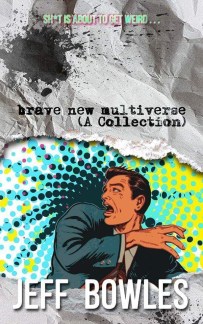
Brave New Multiverse is a collection of unusual and unique short stories by Jeff Bowles, in which there is never a dull moment. You may be amazed, amused, confused, or even a little disgusted, but you will not be bored with any of the stories in this collection.
Bowles combines the craft of short story with screenwriting to create an experimental writing style that somehow works. His descriptive power is phenomenal, if a bit graphic. The worlds he has created may be strange and difficult to define, but they are also different from worlds encountered by any other author. In Itsies, ids are called itsies and you don’t got to love them, even if they wear a teddy bear suit. In The Many Deaths of Lazarus Lad, comic book heroes never ever die. In Detective Robot and the Murderous Spacetime Schism, robots and gorillas are detectives solving the case of the deceased dropping from the sky. In Donald Carmichael’s Brave New Multiverse: A trip to five very odd ‘verses’, where nothing is as it appears, or is it? And in Snip, Snip: where they take bigotry to new levels and have hang ups about testicles.
His characters are as diverse and unique as the worlds he’s created, and he pairs them into unanticipated couplings: Gorilla Todd and Detective Robot, an investigative team that can solve the crime, even in the face of the dead falling randomly from the sky; Donald Carmichael and Max, who don’t know love until it reaches out and bites them in the ass; Lazarus Lad and his egocentric dad, who know no other life; Nelson and Jay, who just wanted to help their injured pooch; Tug and Petunia, rude and obnoxious itsies, who may even be dangerous, belonging to Tom and Pamela, who don’t know the meaning of tough love.
Want to explore strange new worlds which you’ve never encountered before? Take a trip into any one of Jeff Bowles’ stories from this collection. I give Brave New Multiverse five quills.

Kaye Lynne Booth does honest book reviews on Writing to be Read in exchange for ARCs. Have a book you’d like reviewed? Contact Kaye at kayebooth(at)yahoo(dot)com.
Share this:

“Undercurrents”: More Than Just a Collection of Tales From the Deep
Posted: February 2, 2018 Filed under: Book Review, Books, Horror, Stories | Tags: Book Review, Monsters, Sea Monsters, Short Fiction, Short Stories, The Deep, Undercurrents Leave a comment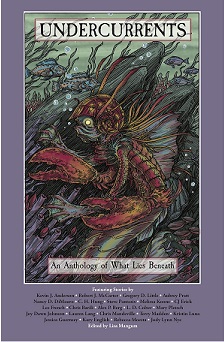
The twenty-three stories in Undercurrents are all about the mysteries of the deep, but beyond that they are as varied as it gets. Master story telling weves tales about monsters who dwell in the ocean depths and send chills down your spine. The monsters featured range from those of legendary status to those of the fantasy realm: krackens; sea dragons in Guardian of the Sea, by Kristin Luna; sirens in The Old Man and the Sea Siren, by Steve Pantazis; fairy horses in In the Water, by Jessica Guernsey; mermonsters in All Yours, by Melissa Koons; and the underwater cat in Underwater Cats, by Mary Pletsch – to those that are unidentified, as in Cold, Silent, and Dark, by Kary English; or spring from the recesses of the human mind, to inanimate objects as innocent as a pair of bookends in Bookend, by Chris Mandeville.
The points of view presented are varied, as well. As a reader, I was allowed to glimpse through the eyes of both hunted and hunter, getting the unusual P.O.V.s of things like a kracken in The Kraken’s Story, by Robert J. McCarter, a siren in The Siren’s Song, by Aubrey Pratt, a dragon in The Sea Dragon’s Tale, by Nancy D. DiMauro and a puffer fish in Mandala, by Jody Lynn Nye.
The stories in this collection explore more than just the waters of the deep. Sea Wind, by Kevin J. Anderson explores the idea of losing a brother to the sea. Four Billion Years of Solitude, by Alex P. Berg explores the oceans of distant planets. Eat Me, by Lauren Lang explores a revelutionary weight loss system involving antipods harvested from the sea. Songs to Sing and Stories to Tell, by L.D. Colter explores saying good-bye, and Lure, by Joy Dawn Johnson explores the connection between twins, and Sea Dreams, by Rebecca Moesta and Kevin J. Anderson explores the ties between friends. To Become, by C.J. Erick explores facing the unknown, while In the Garden of the Coral King, by C.H. Hung explores facing one’s own fears, and A Marsh Called Solitude, by Gregory D. Little explores self-sacrifice and altruism.
My personal favorites include Teens Teach Tech, by Terry Madden, where a teen tries to help an old woman face her fears of the past; Heroes of the Russian Federation, by Chris Barili, where an experimental bio-weapon escapes and goes out of control; and High Seas Burning, by Lee French, where the real monsters are of the human variety.
Best of all, all proceeds from this anthology go to the Don Hodge Memorial Scholarship to help students without the financial means to attend the Superstar Writing Seminar, a seminaar that addresses the business end of writing. The Superstars have been putting together anthologies, along with seminar attendees since 2015. Undercurrents is the fourth anthology to result from the Superstar Writing Seminar. In more ways than one, the Superstar Writing Seminar is quite special and the recipient of a scholarship is fortunate indeed.
News of this seminar was exciting to me because so many writing courses or workshops focus on the craft of writing and ignore the fact that there are some business skills required in order to be a successful writer. I’ve heard many authors gripe about not realizing they had to have marketing skills as well as writing skills, or complaining about the time they must put into marketing that could be used to write instead. The line-up of Superstars who offer their expertise include Kevin J. Anderson, David Farland, Eric Flint, Rebecca Moesta, James A. Owen and Brandon Sanderson. Each year they have additional guest instructors, chosen from the creme de la creme of the publishing industry. They all share their knowledge and expertise during the annual seminar, which is held in Colorado Springs, Colorado.
Well-crafted stories fill this anthology exploring the ocean depths and the depths of the human mind in Undercurrents, an anthology created by master story tellers. I give it four quills.

Kaye Lynne Booth does honest book reviews on Writing to be Read in exchange for ARCs at no charge. Have a book you’d like reviewed? Contact Kaye at kayebooth(at)yahoo(dot)com.
Share this:

“Doctrine of Indecency”: A Good Variety of Stories
Posted: January 26, 2018 Filed under: Book Review, Books, Dark Fantasy, Erotica, Fiction, Paranormal, romance, Science Fiction, Speculative Fiction, Stories | Tags: Anthology, Book Review, Doctrine of Indecency, Erotica, Short Stories Leave a comment
The trick to writing erotica is being able to write a fully developed story line and add just the right amount of erotic imagry to create a story which both entertains and arouses readers at same time. There is an almost poetic art to it, a delicate balance. A balance few of the stories found in Doctrine of Indecency: 18 Coveted Tales of Lust, edited by Virginia Lee Johnson and Kat Mizera, manage to achieve. Most of the stories, while not of the exceptional variety, were not bad stories and some were quite entertaining.
I must give kudos for the variety of the stories contained within this erotic anthology. There seems to be something for everyone. Some stories stretch genre boundaries, including tales of erotic horror, such as A Cabin… Somewhere, by Kyle Perkins; the paranormal erotica of Wings of Change, by Cee Cee Houston; the anti-hero erotica of Revenge, by Virginia Lee Johnson; the speculative erotica of The Succubus’s Sin, by Taylor Rose; and the science-fiction erotica of Suicide Mission, by Lila Vale; or Lunar Gets Some Loving: A Purian Empire Short, by Crystal Dawn. There are also those that are geared more toward the traditional erotic story lines which explore various sexual preferences such as the three-way fun of Apple Bite, by A.R. Von; or Welcome to the Dark Side, by Erin Trejo; the military erotica of Deployment – Dalliance, by E.J. Christopher; the grocery store erotica of Fruit, Veg. & Starfish, by T.L. Wainwright; the swingers erotica of 3, by Eden Rose; the S & M erotica of House of the Rising Sun, by L.J. SeXton; the stranger erotica Delayed Ecstacy, by Tiffani Lynn; and there’s even a tale of social media erotica in Yearning for Desire, by Amanda O’lone.
My three favorites: Pleasure Bite, by Brianna West is well written vampire erotica and Dangerous Desire, by Samantha Harrington is hot and steamy, yet has a decent plot. I’ve been doing a lot of playing with POV, so I was especially drawn to the stories which used mutliple character POVs. While Inferno, by Kat Mizera uses multiple POVs with some skill, Pepper’s Play Pen, by Mia Sparks uses multiple POVs and is crafted with expertise.
The variety of stories included is commendable, but since none are exceptional, nor are any terrible, but of more average quality, I give Doctrine of Indecency three quills.

Kaye Lynne Booth does honest book reviews on Writing to be Read in exchange for ARCs at no charge. Have a book you’d like reviewed? Contact Kaye at kayebooth(at)yahoo(dot)com.
Share this:

Starting Off the New Year with YA Author Jordan Hallak
Posted: January 1, 2018 Filed under: Books, Fiction, Gothic, Interview, marketing, Speculative Fiction, Steampunk, Stories, Writing, Young Adult | Tags: Author Interview, Gothic, Jordan Elizabeth, Jordan Hallak, Steampunk, Young Adult Fiction Leave a comment
I’m pleased to be able to start the New Year off with a YA author who I have interviewed for both my Book Marketing -What Works? series this past year, and my 2015 Pros and Cons of Traditional vs. Independent vs. Self-Publishing series. I’ve reviewed many of her novels, (Escape From Witchwood Hollow, Cogling, Treasure Darkly, Victorian, The Goat Children, Runners and Riders, The Path to Old Talbot, Wicked Treasure, Kistishi Island)as well as collections featuring her short stories, such as Darkscapes, Cast No Shadows, Under a Brass Moon, Chronology.
If you’re feeling a little confused right now, that’s okay, because all of the interviews and reviews were done for an author named Jordan Elizabeth, and in the very early reviews she was booked as Jordan Elizabeth Mierek. However, she’s starting off 2018 as Jordan Hallak, and we’ll hear an explanation for the different name soon. In addition to being the author of at least ten young adult novels and countless short stories, Jordan is a wife and mother, as well as often having a day job on the side. She runs a tight juggling act to keep it all balanced and still manages to craft some quality stories which are all quite entertaining. Join me in giving a warm welcome to Jordan Hallak today, on Writing to be Read.
Kaye: You’ve had a change to your last name. It threw me off and might throw of readers who know your work under the name Jordan Elizabeth. Were you recently married?
Jordan: I got married over a year ago, but I didn’t change my name right away. I still write as “Jordan Elizabeth,” but little by little I’ve been altering Mierek to Hallak. The most recent thing I changed was my name for my gmail account. Even though I signed things as “Jordan Hallak,” people were getting confused who Jordan Mierek was. I was getting documents for work to the wrong name!
Kaye: What are your secrets for juggling writing with family?
Jordan: Haha, I haven’t mastered it yet! Most nights now I’m too tired to do more than scroll through facebook. When I push myself, though, I have my husband watch the baby for an hour and I do all my writing. Once the baby goes to bed, then I do my marketing because it isn’t as emotionally draining. Writing leaves me breathless.
Kaye: Other than the last name, what do you think will be different for you in 2018, and why?
Jordan: My marketing budget is a lot different for this year. I’m only going to be using what I make off royalties. This might ruin my marketing plan, but we’ll see. 2018 is the first year where I won’t have a full time job starting out.
Kaye: What’s in store from Jordan Hallak in 2018?
Jordan: Other than my goal of landing a full time job, I want to write more novels and work on my marketing techniques. I usually fly by my seat for the year, but this time I want to concentrate on planning out all my marketing events. I’ve heard that’s better, so we’ll see.
Kaye: Is there anything unique or unusual about your writing process?
Jordan: I can’t plan. I start writing with a general sense of where the story will lead. If I try to plot, the book becomes a chore. It never follows the written storyline anyway.
Kaye: What is the working title of your latest book?
Jordan: My newest book will be Secrets of Bennett Hall. It is going to be a steampunk Gothic. I’ve always been entranced by Gothic novels, and I love the steampunk genre, so I decided to blend the two and see how it came out.
Kaye: How do you decide the titles for your books? Where does the title come in the process for you?
Jordan: The titles always come at the end. I usually call the book by the main character’s name as I’m writing, and then I see how it feels when I’m all done. Secrets of Bennett Hall started off as Adelaide. Adelaide is the main character who moves to Bennett Hall to work as a governess. Secrets from the past – both her past and the estate’s past – return to haunt her. Secrets of Bennett Hall had more of a Gothic ring to it.
Kaye: In my review of Runners and Riders, I identified the book as a part of your Treasure Chronicles Apparently, this isn’t the case, as it is the first book in a series of its own. Would you like to share how that came about?
Jordan: Runners and Riders features the same world as in the Treasure Chronicles. I called it a “companion” novel because of that, but it was mislabeled as a novella in many places. It is a full-length novel, and it was getting a lot of heat for being “misleading.” People who hadn’t read the Treasure Chronicles weren’t willing to give it a chance. It will now be book one in Return to Amston, with Secrets of Bennett Hall being book two. Secrets will be in the same world again, but with a new cast of characters.
Kaye: So, tell us a little about this second book in the Runners and Riders.
Jordan: Joseph from Treasure Darkly will make an appearance. Remember him as Amethyst’s spurned lover? I always felt bad about how things went down with the two of them and I wanted to give him his own story. As I started writing about Adelaide, he just fell into place as her love interest, and they are perfect for each other. He deserves a sweet, but strong, girl like Adelaide. In the novel, Adelaide loses her teaching job in Hedlund and finds a new position as a governess. Once she arrives at Bennett Hall, she meets its handsome occupant – Joseph – as well as some shady figures. People in the village warn her about the darkness on the estate, but it isn’t until she sees the Villain lurking in the forbidden wing that she begins to believe the rumors.
Kaye: A lot of your books are of the steampunk genre. What is it that appeals to you about steampunk?
Jordan: I love the nifty inventions paired with corsets and long skirts. I am obsessed with corsets and long skirts. You should see my closet!
Kaye: Most of your work has been published through Curiosity Quills Press, but it sounded like you might be striking out independently. Will this second book in the Runners and Riders series be independently published?
Jordan: Secrets of Bennett Hall will be published by Curiosity Quills Press. I haven’t decided to go the self-publishing route yet, but I might someday. I know people who have left their publishers to try self-publishing with great results. For now, I like having a publishing house behind me. The support I get has been awesome. I’m currently published by Curiosity Quills, CHBB, and Clean Reads.
Kaye: When will Secrets of Bennett Hall be available?
Jordan: Secrets releases January 30.
Kaye: What is the biggest challenge of being a writer?
Jordan: It is so hard to get your book out there. I know people are sick of me always talking about my books, but that’s the only way to spread the word.
Kaye: What’s the most fun part of writing a novel or short story? What’s the least fun part?
Jordan: The best part is actually writing it. I become lost in the setting and the characters become my best friends. I have an awesome time visiting this new world. The least fun part would have to be the marketing that comes after. When you have to push people to review and when you have to pay for ads, you start to doubt if your writing is worth it. Then you write a new story and remember how much it is worth it.
Kaye: If writing suddenly made you rich and famous, what would you do?
Jordan: I wouldn’t worry about money anymore! I would be happy being a stay-at-home mom and full-time writer. There would be a lot of traveling. I need fresh fodder for my stories.
I want to thank you, Jordan, for joining us on Writing to be Read to start the New Year off right. I wish you the best of luck in 2018, and I know Secrets of Bennett Hall will be a huge success.
Until next time, I want to wish you all a Happy New Year!

Like this post? Subscribe to Writing to be Read for e-mail notifications whenever new content is posted or follow WtbR on WordPress.
Share this:

‘Tis the Season to be Thankful
Posted: November 20, 2017 Filed under: Books, Fiction, Science Fiction, Speculative Fiction, Stories, Western, Writing | Tags: Collapsar Directive, Delilah, Relationship Add Vice, Thankful, Thanks, Thanksgiving, Writing to be Read, Zombie Pirate Publishing Leave a comment
Thanksgiving is upon us, and I always try to take the time this time of year to reflect on events over the past year and discover all I have to be thankful for. Although my life has been crazy busy in the most recent past, I want to share here all that I am thankful for, because you shoud never take your blessings for granted. So, the first thing I am thankful for is my Writing to be Read platform, because it allows me to share what’s on my mind.
You may have noticed that the posts on Writing to be Read have tapered off of late, and of course, you would be correct in saying so. The fact is, Writing to be Read, has gone through many changes over the past year or so, and it looks like there may be more in store in the near future. Both Robin Conley and Jeff Bowles have had to step away due to life issues. Life happens to the best of us, so we can’t fault either of them, only hope that their life issues turn out to be the good kind, the kind that takes them both onward and upward to bigger and better life experiences, so we can be thankful for them. And I’m thankful for the time we were blessed with their talent and their content.

I’ve had my own life issues, of the good kind. At least, they’ve been good for me and I am thankful for them in this season which is for the giving of thanks. When I went back to school for my Master’s degree, I never would have guessed that my next career move would bring me back to Western State Colorado University on the teaching end of the system. By a stroke of luck, that’s just what happened, and things have been moving pretty fast for me. I didn’t realize how much time I’d need to grade papers, but it’s a lot. As a result, my posts here, on Writing to be Read has suffered. I haven’t had the time I need to write, let alone read books for review from an already backlogged que. It was fortunate that I had sent out the interviews for the Book Marketing series before I morphed into Professor Booth. I already had a lot of that series in place, so you maybe didn’t notice my absence quite so much while it ran, even as my regular book reviews began to taper.
Over the past few weeks since the series ended, I’m sure you’ve noticed a lack of content, (one week there wasn’t even one post), which is unusual, since over the past couple of years my content has run fairly steady. And now you know why it hasn’t been lately. But I’m thankful for the wonderful opportunity which has taken my time away from Writing to be Read, even if I’m not so thankful for the lack of content and the drops in the number of visitors to the blog.
And, I am thankful that even as I dig myself out from beneath a mountain of essays, life on the writing front continues, almost without me, but not every endeavor can be a success. The Halloween release of my short “A Turn of the Tables” in the HallowErotica anthology was a bust. The publisher of the anthology got cold feet and backed out at the last minute. I didn’t mind that things didn’t work out, so much as I minded the fact that all the contributors had already been pounding on the promotion pretty hard. As short on time as I’ve been, I ran the Excerpt, and did social media promotion for the blog and the release event on Facebook, and I really felt like it had all been time wasted. But, you know what they say, “S**t happens”. I’d already had a few doubts about the quality of the publication, so it’s probably all for the best. I am thankful for the learning experience it provided, and it’s prompted me to consider more seriously doing a short story collection of my own. I think I’m going to go for it. At least that way, I will have control of the publication and promotion details.
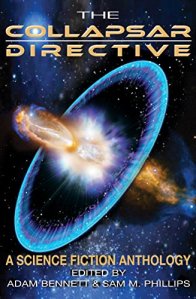
I’m also thankful that the above mentioned experience is so unlike my foray with Zombie Pirates Publishing, which I can only say has been a pleasure all the way. You may remember that my short science fiction story, “If You’re Happy and You Know It”’ appeared in their Collapsar Directive anthology last August? No? Well, it did and they did a bang up job on the publication and promotion of the anthology. It was a class A piece of work, featuring stories by some very talented authors.
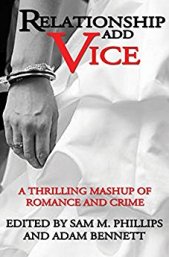
But now, I have another story, “The Devil Made Her Do It”, coming out in December in their next anthology, Relationship Add Vice, now available for preorder, and I’m really excited about it. The story is about a straight laced home town girl who finds herself unexplainably drawn to a strangely magnetizing man. I just finished with my part of the edits, because all contributors take part in the editing and promotion processes with ZPP, and once again, there are some really excellent stories in this collection. It makes me proud to know my work will be featured in a quality anthology. ***Warning: Shameless plug ahead*** The release date is in December, right before Christmas, and they’d make great Christmas gifts for all your literary friends.
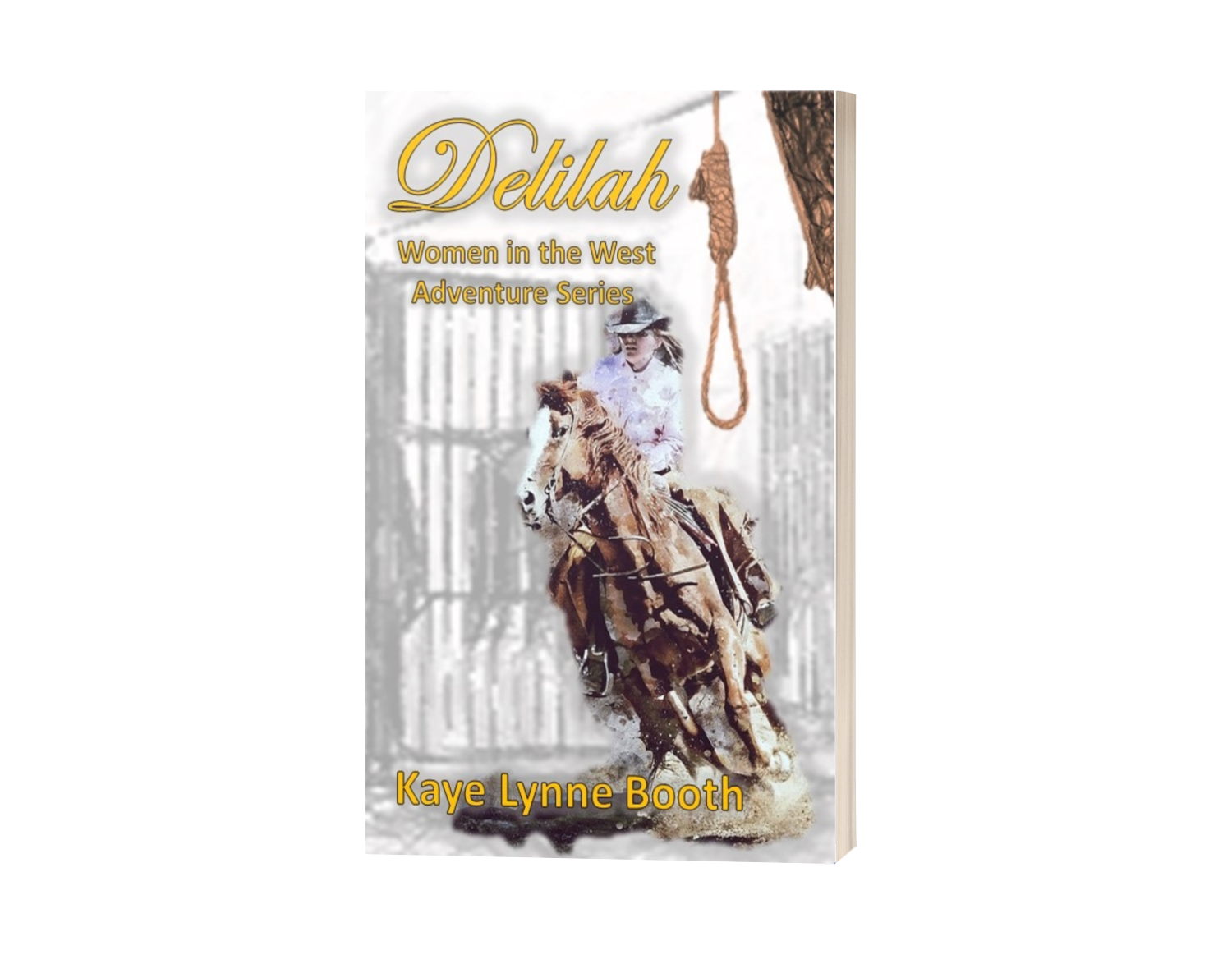
In the more distant past, I am thankful for finding a publisher for Delilah. It’s been an interesting experience and I learned a lot from it. The book is now available in both ebook and paperback. I’m also thankful for the wonderful reviews the book has received. In September, I got a royalty check. It wasn’t a lot, but it made me smile. People are reading my book. That’s so cool. I am definitely thankful for that.
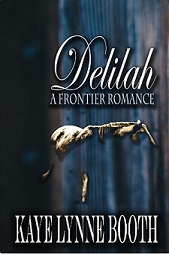
I started to get the sequel to Delilah down on the page, getting only a short way into the second chapter before professordom took its toll. I’ve been working on it, writing a sentence at a time if it’s all the time I can find to write. I am always thankful for every spare minute I can find to write. Although I haven’t had a lot of time to actually work on it, the plot line has been simmering in my head, and is close to being ready to emerge, so stay tuned for updates. I do have the first three chapters. And as always, I’m thankful that I’m able to put words to page in a meaningful and entertaining way.
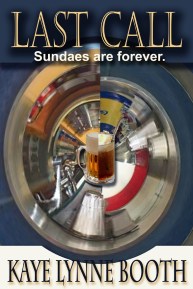
And of course, I’m thankful for my readers. That’s why I’m offering a free promotion of my short story, Last Call to coincide with the Cyber-Monday 2017 promotional event on November 27, which Sonoran Dawn Studios is hosting on Facebook. One more thing I am thankful for is my friend, D.L. Mullen, who runs Sonora Dawn Studios and acts as my P.A. and cover designer, helping me with a lot of my marketing needs. Her help has proved invaluable. I don’t know how I would do it wothout her.
Of course, this was only a reprieve to jot this blog post down. There’s always more grading to do, and I need to get to it, so I need to get this posted. Academic writing is historically a pretty stiff and rigid class, nothing a student would label as fun. I have tried to incorporate interesting material into my course with the help of Dr. Mark Todd, English professor, author, and paranormal investigator, and from the looks of my students’ most recent drafts, I think I may have captured the attention of many. Although the course is pretty structured, I’m finding that academic writing has more in common with writing fiction than I had previously believed. No matter the inkwell your writing springs from, the rules of good writing always apply. Maybe I’ll talk about that in my next blog post. I hope you’ll join me.
Until then, Happy Thanksgiving! What are you thankful for?
Like this post? Subscribe to Writing to be Read for e-mail notifications whenever new content is posted or follow WtbR on WordPress.
Share this:

“Short Stories Not Forgotten” may be too short
Posted: August 25, 2017 Filed under: Book Review, Books, Fiction, Stories | Tags: Book Review, Calvin Bender, Short Fiction, Short Stories, Short Stories not Forgotten Leave a comment
Short Stories Not Forgotten by Calvin Bender is a small collection of short fiction. As I’ve mentioned many times, a big problem with a lot of short fiction is that authors fail to get in a full story arc. With this collection four, that is a problem with every piece. In fact, these seem more like brief ideas, each being a good start for something, but none following through to make a complete story. Every one ended abruptly, with none feeling quite finished. If the author just would have given us more. In all honesty, I can’t give it more than two quills.

Kaye Lynne Booth does honest book reviews on Writing to be Read in exchange for ARCs at no charge. Have a book you’d like reviewed? Contact Kaye at kayebooth(at)yahoo(dot)com.
Share this:

Let’s Talk About Short Fiction
Posted: August 14, 2017 Filed under: Fiction, Science Fiction, Stories, Writing | Tags: If You're Happy and You Know It, Kaye Lynne Booth, Short Fiction, Short Stories, Short Story Collection, The Collapsar Directive, Writing, Zombie Pirate Publishing 2 Comments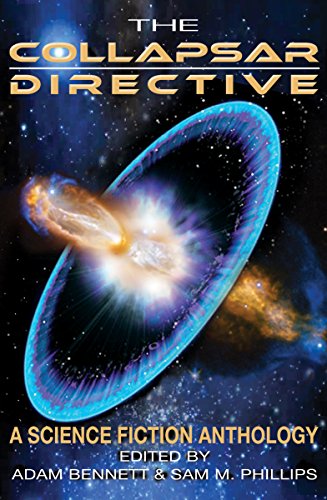
I have a story appearing in the newly released science fiction anthology from Zombie Pirate Publishing, The Collapsar Directive. It’s a dystopian tale titled, If You’re Happy and You Know It, set in a world where you’re only allowed to be happy on the weekends. I must give kudos to the editors, Sam Phillips and Adam Bennett for their selections for this anthology. The other stories featured in this anthology are all top rate, and my fellow authors are a talented bunch. I feel proud to be counted among them.
Zombie Pirate Publishing is pretty smart really, because they get their authors involved in the process – not really the actual publishing process, but with the final editing and, certainly in the marketing process. And having been involved in the process with this great group of writers, reading the stories of the others, which are all well written pieces, got me to thinking about what elements make up a high quality short story.
When I review a short story, I look for the same things I’d look for in a novel length work, with a few exceptions. I’d down my rating for the same type of things though: if it doesn’t read smoothly, if there are logic problems (which occur less in short fiction, but they do occur), excessive use of adjectives and unnecessary words, or if there are a lot of typos or spelling errors which bring my editors mind right out of the story.
Just as in a longer story, I want to see a well-written story, with a beginning, a middle and an end. But, this is where short stories often fall short. In a novel, it may take the author several chapters to wrap up all the loose ends and tie their story neatly into a bow. Short stories don’t have that luxury. Although, there is no set length as to how long a short story should be, other than word count limits set by those you are submitting to, it is even more important with short fiction to eliminate any unnecessary words and get to the point of the story. If you don’t, your story may end up becoming a novel. So, in short fiction, I look for stories that tell the tale without drawing it out unduly.
However, it can be difficult to get in a full story arc, without drawing out the tale, so I’ve come to expect this to be the case with short fiction. That way, instead of being sadly disappointed when a short story falls short (pun intended), I am pleasantly surprised when I come across short fiction which feels complete at the end of the story. It is even harder with flash fiction. The shorter the story, the less space you have to accomplish the task. I recently reviewed an anthology in which almost every story had a full arc, leaving me with a very satisfied feeling. (Catch my review of Darkscapes.)
All of the stories in The Collapsar Directive accomplish this feat, as well. All the stories featured seem to arc nicely, the beginning, middle and end are usually easy to identify in each one, and they all hold my attention to the end. That, of course, is the most important element in any story, long or short. It has to pull you in and hold you there from the first page to the last, regardless of the length of the story.
Like this post? Subscribe to Writing to be Read for e-mail notifications whenever new content is posted or follow WtbR on WordPress.
Share this:

“Darkscapes”: Stories That Will Keep You Reading
Posted: August 11, 2017 Filed under: Book Review, Books, Fiction, Science Fiction, Speculative Fiction, Stories | Tags: Anthology, Book Review, Curiosity Quills Press, Darkscapes, Fiction, Science Fiction, Short Storie, Speculative Fiction 1 Comment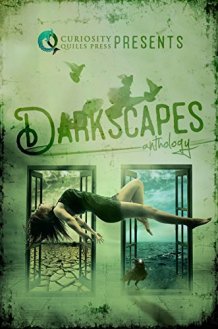
Darkscapes is a top quality anthology of short stories put out by Curiosity Quills Press. I must say, this anthology delivers on the promise of the premise. The title says that the stories within may be on the darker side of things, where danger lays hidden beneath the layers of the mind’s eye. The cover image tells me I’m in for some rather unusual stories, ones that go to places which may defy logic. And, having read many books produced by Curiosity Quills Press, the fact that they published this book says it’s a collection of good quality, well-written stories. And that my friends, is exactly what I got – all of the above.
There are twenty-one stories contained in this collection, too many to be able to discuss all of them here. So, I will give you a brief overview of the six, yes six, stories which I deemed to deserve a five quill rating, meaning the authors of these stories have done an exemplary job of storytelling. Keep in mind that these stories are the best of the best in this collection, but all of them are good reading.
The first story in the anthology, Exley Avenue, is an extremely well-written ghost story of sorts, with a surprise ending. Going between the 1920’s and the twenty-first century, storytellers Jordan Elizabeth and W.K. Pomeroy unravel the unsavory history of the stone castle on Exley Avenue, when several bodies are uncovered on the premises.
Further into the collection is a cute noirish story, with an unlikely P.I. for a protagonist, which is sure to keep you chuckling until the end is Skeleton Jim, by J.R. Rain. Noir with humor is the only way to describe this bizarre tale. But, rest assured, Skeleton Jim always gets his man, (and the girl, for some reason). Things are no different when the client, Lucy Newman, hires him to find out if she killed her abusive husband, and who is blackmailing her, Jim may have his work cut out for him. No bones about it. (Skeleton humor. Har, har, har.)
Then, there is The Giovanni Effect, by Robert J. Defendi, an extremely well-crafted story with excellent world building. Readers will live this one. On a desert outpost planet where sand and wind are constants, Allred and his wife and child are the planets only occupants. They’ve always known others might come, but when a ship lands on the planet Allred is forced to put their emergency plans to the test. The planet’s harsh atmosphere may be the death of him, or it might just be his savior.
The forth story, Landing a Job in the Private Sector, by Rena Rocford, kept the pages turning with the best of them. Furies are conditioned assassins, but when Boxy, an enslaved fury acquires an organic ship that is loyal to her, and becomes a rogue mercenary, she learns that everything is negotiable, even under pressure.
The fifth five quill story is Out of Sight, by Mathew S. Cox. Sima is a street kid, who wakes up to find she’s been relocated to another planet and her pod crashed. She all alone, with no supplies, no clothes and no idea where she is. But then she discovers three other children who were sent here, as well, and she has more to worry about than just her own survival.
The One You Feed, by Katie Young was the last story in this collection to fall into my best of the best list. This was a well-written werewolf story, which left me wanting more. Dupree is haunted by more than just werewolves. As he spins his tale for the cowboy he just hired on with at the last rodeo, we learn more about the ghosts who haunt his past, and the curse that controls his future.
The above mentioned stories are, in my opinion, the best stories in this collection. However, they are all entertaining tales. I wouldn’t rate any of the stories in this collection with less than three quills. They really are that good. The smashing cast of talented authors whose work appears in this anthology also includes: Richard Roberts, Ann M. Noser, Randy Attwood, Nathan Croft, Tegan Wren, James Wymore, J.P. Sloan, Andrew Buckley, Darin Kennedy, J.E. Anckorn, Piers Anthony, B.C. Johnson, S.E. Bennett, Mark W. Woodring, and Benjamin Sperduto.

Overall, I give Darkscapes four quills.
Kaye Lynne Booth does honest book reviews on Writing to be Read in exchange for ARCs at no charge. Have a book you’d like reviewed? Contact Kaye at kayebooth(at)yahoo(dot)com.
Share this:

“Gnarled Bones”: A Collection of Five Brief Tales
Posted: August 4, 2017 Filed under: Book Review, Books, Fiction, Literary, Stories | Tags: Book Review, Empowerment, Gnarled Bones, Literary, Short Fiction, Short Story Collection, Tam May Leave a comment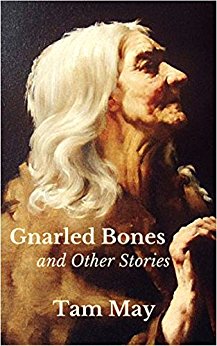
Short stories carry the burden of telling the tale in few words, so they often sacrifice many of the qualities one finds in a novel length work, including details that fill in our mental picture for us, making readers work harder to gain a clear vision for the story. Another common complaint that I often voice is the fact that they are a brief glimpse into the character’s lives and don’t always have a complete story arc, making them feel incomplete, like there should be more. Such is the nature of the beast we call the short story. I have had to learn to expect these things when I’m reviewing short fiction, and not mark against the story for these faults alone. So, while I may comment on some of these qualities when reviewing anthologies or short story collections, they will not be the basis for lower ratings. Those will be based on the quality of the writing and how well the stories are crafted, just as they are with a longer work.
That being said, I found Gnarled Bones and Other Stories by Tam May to be a collection of highly crafted stories, with brief descriptions that skillfully put readers in the scene and allow them a clear vision of each story being told. Each story in this collection has heavy literary qualities and each carries the theme of empowerment, or the lack of it, in some way. Although most of them felt unfinished to me, they were none-the-less captivating, capturing my full attention during the brief snapshots I was allowed.
Along with Gnarled Bones, the story which sticks out most in my mind is The First Saturday Outing, which I enjoyed at first, but was later disappointed in, when the woman’s inability to empower herself and embrace her freedom became apparent, making the character, whom I’d been routing for, appear weak and inept.
Also to be found in this collection is Mother of Mischief, where Marie is driven by her need to look after and care for someone, drawn to mischievous men who need to be kept in line. Bracelets, where Isabelle, a circus acrobat is drawn to her circus family through the tragedy of a lion attack on a child. And, Broken Bows where, for Anne, a train ride becomes an act of defiance and two very different souls find one another briefly.
Along with theme, the stories in Gnarled Bones and Other Stories have other things in common, as well. Each has a female protagonist, each has literary qualities and feel, and each is well crafted to tell the story with skill and ability. I give it four quills.

Kaye Lynne Booth does honest book reviews on Writing to be Read in exchange for ARCs at no charge. Have a book you’d like reviewed? Contact Kaye at kayebooth(at)yahoo(dot)com.
Share this:

Monthly Memo: The Flashback vs. The Flash Forward
Posted: July 13, 2017 Filed under: Fiction, Monthly Writing Memo, Movies, Mystery, Science Fiction, Screenwriting, Screenwriting, Stories, Uncategorized, Weekly Writing Memo, Writing, Writing Tips | Tags: Fiction, flash forward, flashback, flashbacks, Screenwriting, Stories, Writing, writing tip, Writing Tips 2 Comments
In last month’s memo I talked about ways you can use flashbacks in stories and it led to a discussion about flash forwards and a request from Kaye that I do a post about them, so I decided to focus on the difference between flashbacks and flash forwards. I’m going to primarily use films and TV shows for examples as the film/TV examples are easy to visually show what I mean.
(Disclaimer: I don’t own the rights to any of these video clips or shows. I apologize in advance for some of the quality of the clips but they were the only ones I could find at times. Many of these shows mentioned are on Netflix, so I recommend watching there if possible.)
Flashbacks:
A flashback is almost any moment when a story jumps from the present time of the story to show you something that happened in the past. It’s not just talking about the past, but actually showing the events that happened. The flashback can be just a quick glimpse, or it can be a very long section of the story.
Flashback Example 1 – The Usual Suspects:
This film opens with the explosion on the ship and then moves forward to Kevin Spacey in the police station being interviewed. When he starts telling the story of how all the “usual suspects” were rounded up the film flashes back to show this happening, and the story continues in the flashback time period until the end of the film when we return to Kevin Spacey in the police station again.
Flashback Example 2 – Forest Gump:
This one is pretty straightforward that it’s cutting to a flashback. Forest is in the present moment talking about things that happened in his past from his childhood to adulthood, and we constantly hear his voice over and see him in present day on the bench talking about his past.
Flashback Example 1 – Breaking Bad Season 1 Episode 1:
Again, we start in the present time where Walt is crashing the RV and already cooking meth, then we very clearly jump back after the opening credits several weeks in time to when he was a normal school teacher. The main story of this first episode is all flashback with the opening and ending being the present moments.
Flash Forwards:
Flash forwards are tiny glimpses of the possible future within a story. Basically you get a glimpse of the future and then return to the present afterward. This future glimpse doesn’t have to be true, and it doesn’t HAVE to happen, it’s just a glimpse of what COULD happen and the audience has to keep watching to see if it does.
This technique is often used in stories involving anything with psychics. The key is the events haven’t happened yet, and may never happen depending on how the present continues to unfold. It’s a glimpse of the potential future, but the story is still taking place in the present day and will return to present day once the future glimpse is over.
Flash Forward Example 1 – The Dead Zone (film)
When Christopher Walken shakes Martin Sheen’s hand he gets a vision of the potential future. We see clips of what Martin Sheen may do, but we don’t know if it will happen or not because it hasn’t happened yet, all we know is that it’s possible to happen. Once the flash forward is over we return to the present moment where Christopher Walken is.
Flash Forward Example 2 – Scrooged:
When Bill Murray leaves the elevator he gets several glimpses of the possible future he will encounter if he doesn’t change his ways. Again, these are all brief flash forwards showing potential future moments. It’s a little different because it seems like Bill Murray is in the flash forwards, but he has no ability to change them while he’s there so it’s still a flash forward to a potential future if he doesn’t change his ways in the present.
Flash Forward Example 3 – Terminator 2
When she lays her head down, Sarah Connor has a dream vision of the future if machines are allowed to get out of control. This vision is a potential future and is the motivation for her to try to stop this outcome with her actions in the present.
Flash Forward Example 4 – FlashForward TV Show Season 1 Episode 1:
This episode actually has a flash forward AND a flashback in it. I’ve started this clip right before the flash forward moment where the protagonist gets a glimpse of his future and then wakes up after the accident, but if you scroll back to the very opening of the episode you’ll see that the story starts with the accident, then there is a flashback to 4 hours earlier leading up to the accident again to show what caused it (which was actually the flash forward). Are you confused? I know, it’s a lot.
The flash forward is the glimpse of the potential future that the main character may experience at some point later on, and then you return to the present moment. The opening sequence at the start that shows the accident is NOT technically a flash forward because it’s not a glimpse of the future, it’s where the story is NOW. Then we flashback to 4 hour earlier to see how we got there and how the accident happened.
Flash Forward Example 5 – Sherlock Holmes (film)
This fight scene is a type of micro flash forward because it tells us what will happen moments before it does, even though it’s in verbal form. It’s more of an abbreviated flash forward because it’s verbal and it’s similar to how flash forwards are often used in fiction. The narrator gives the reader a glimpse of what will be to come, but we’re still in the present moment of the story where it hasn’t actually happened yet.
Distinguishing Between the Two:
Most of the time it’s pretty easy to tell whether something is a flashback or a flash forward because it’s in the middle of the story and the story either jumps forward or back for a short time before returning to the present. However, the one area that seems to cause the most confusion is when the flashback or flash forward is used immediately at the opening of a story. Is the story starting in a flash forward? Is the main story all in flashback? What is happening? To figure out whether you’re seeing a flashback or a flash forward, think about where the scene is currently taking place and where the protagonist is in the present.
If you look at the openings of Forest Gump and Breaking Bad, both are happening as we watch and we’re not seeing a future possible event, we’re seeing the events as they happen to the protagonist, then we (the audience) jump back to see how the protagonist got to that present moment, but all of it has already happened and the protagonist is still in the present at that opening scene waiting for us to catch up to him.
Flash forward scenes are events that have NOT happened yet, and may not happen, and when they end we are returned to the present moment where the story is taking place and the protagonist is currently. Everything between that present moment and the future event we saw has not happened yet, and may not happen, but that is why we’re watching to find out. The present moment may eventually lead to that flash forward moment, but there’s no guarantee.
One of the few times a show can open with a flash forward is if it opens with a psychic event such as a dream or prophecy where we get a glimpse of what may or may not happen before a character pops awake or something and reveals it all was a vision or dream. Then the rest of the show builds to reveal whether it is something that is going to happen or not.
Neither Flashbacks nor Flash forwards:
There are a few other story methods that some people confuse with flash forwards and flashbacks but one of the main ones I want to mention is time travel such as in the Back to the Future Series. This and other time travel stories are tricky areas because it is easy to say we’re flashing back because we’re going back in time, but that’s not true in most stories I can think of.
A flashback involves looking back at past events that have already happened exactly as the person remembers them happening, while most time travel stories involve a character physically going back to these past events such as Marty does, and having influence on those events. This makes it not a flashback because Marty has the ability to change things if he does something wrong. That means the events aren’t set and aren’t just a memory of what happened, they’re fluid and changing. Flashbacks are memories of what happened prior to the present so they can’t be changed unless someone is misremembering something or lying. Marty is physically there and it’s his present time even if he’s physically living in the past, and he can make mistakes (and does) that change the future, so it’s not a flashback.
The other thing I wanted to point out is that just because a story goes forward in time doesn’t mean it’s a flash forward. A flash forward is a glimpse into the future but it doesn’t move the story TO the future. When your story jumps forward in time to a future point, if the story continues from that point on and isn’t just a glimpse of that future time, then what you have is a forward time jump and not a flash forward.
Final notes
Every now and then you’ll see someone define those opening scene moments where we start the story at a major event as a flash forward because it shows a “future” event and then immediately goes back in time after to where a huge chunk of the story takes place. But these stories that start with a major event and then go back in time almost always say something like “x time earlier” which establishes that the first scene is the present time period and everything afterward is in the past, making everything after that opening scene a flashback.
Ultimately, if you’re asking “what happened to get us here?” then you’re probably about to see a flashback to find out. However, if you’re asking “what WILL happen to get us here?” then you’re watching a flash forward and you will return to the present to find out as events unfold.