Today we’re hanging around over at Carla Loves to Read for Day 3 of the WordCrafter Tales From the Hanging Tree Book Blog Tour with a guest post from C.R. Johansson about her story, “Therion’s Heart”. Won’t you join us?
There exists a tree that is timeless, spanning across all dimensions, which absorbs every life as those who are hanged as they die… and it remembers every one. The stories within are a select few of the Tales From the Hanging Tree.
Stories by Kaye Lynne Booth, Paul Kane, DL Mullan, C.R. Johannson, Joseph Carrabis, Sylva Fae, and Matt Usher.
This is the final stop on the WordCrafter My Backyard Friends Book Blog Tour. So today, we’re just going to recap a few things about this series and meet the three characters who haven’t been introduced yet: Ethan Eagle from Heather Hummingbird Makes a New Friend, and Nancy Nuthatch and Katy Cat from Timothy Turtle Discovers Jellybeans. At the other stops, you should have met all the main characters, plus Becky Beaver from Timothy Turtle and Nicholas Nuthatch from Charlie Chickadee Gets a New Home. If you missed a stop or two, don’t worry. I’m including a tour schedule with links at the end of this post, in the wrap-up section. Also, before we go, I’ll reveal the surprise which I promised at the first stop. So with that in mind, let’s get on with the introductions.
But first, a reminder that you can buy direct at the My Backyard Friends Store while the tour is running and through July 24th. Discounted eBooks, pre-orders for signed print copies, (if we can raise enough to have them done in color. Monies for this item will be refunded, if not.), and the My Backyard Friends poster with all of your favorite characters.
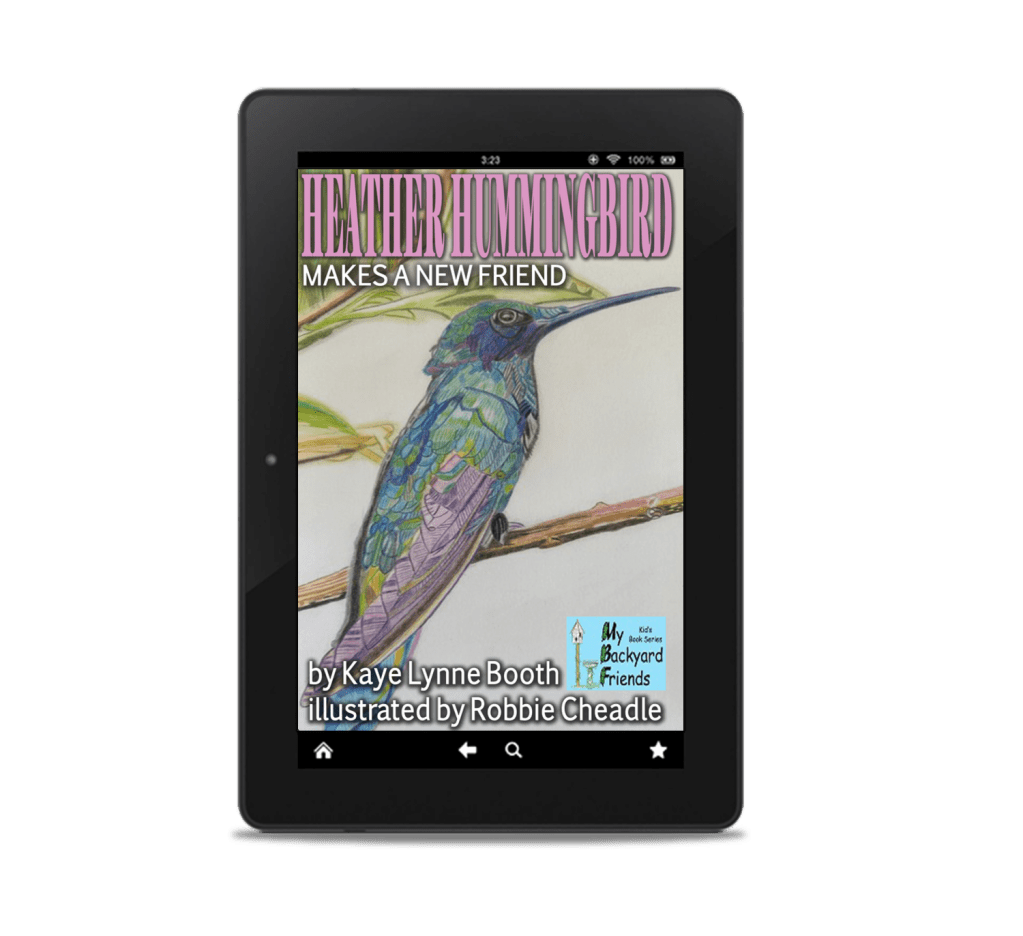
About Heather Hummingbird Makes a New Friend
The My Backyard Friends kid’s book series is inspired by the birds and animals that visit the author Kaye Lynne Booth’s mountain home. Beautiful illustrations by children’s author, poet, and illustrator, Robbie Cheadle, bring the unique voices of the animal characters to life.Heather Hummingbird Makes a New Friend is a picture book with a message of friendship and cooperation.
Heather Hummingbird and Ethan Eagle are two unlikely friends who discover that it is good to accept help from others and that is what friends are for.
If you miss the My Backyard Friends Store, which will disappear on Wednesday July 24th, you can get a digital copy of Heather Hummingbird Makes a New Friend through this retailer purchase link: https://books2read.com/MBF-HeatherHummingbird
Meet Ethan Eagle
Interview with Ethan Eagle
What type of eagle are you?
Isn’t it obvious? I am an American Bald Eagle; a national symbol, I am told.
You have lots of feathers covering your head. Why do they call you a bald eagle?
There are approximately two thousand feathers on my head, and they are all white. No other eagle has a white head. The label comes from the old English “balde” which means white.
Are American Bald Eagles and endangered species?
I am told that we are no longer endangered, although I still do not believe there are many of us. For a while there we were because humans were using some kinds of poisons that made their way up the food chain to us. It thinned the shells on our eggs so that they often were crushed under the weight of the mother sitting on them, causing our numbers to dwindle. My mother used to talk about how precious life was and how past generations struggled to keep their young alive and bring them to maturity, so us kids would not behave in a reckless manner once we learned to use our wings.
Eagles can fly very fast. Did your tiny hitchhiker slow you down much?
Not at all. Heather is only about three inches in size and I bet she only weighs about two and a half grams. I was woried at first that she might not be able to keep her hold at high wind speeds, since I have a six-foot plus wingspan and my cruizing speed is about thirty miles per hour, but she grasped some feathers with her tiny claws and tucked her body down into my underdown, leting the outer feathers block her from the wind. Heather is pretty smart for a hummingbird.
Why do you think yours and Heather’s is an unlikely friendship?
Normally, we larger birds of prey don’t bother ourselves much with birds as small as hummingbirds. When I first met Heather I found her kind of annoying. She never slowed down, and she spoke in quick, brief little snippits. She’d ask me a question and then zip away before I could answer. But the day she helped me, even when I did not believe there was anything she could do, changed the way I thought about hummingbirds, and Heather in particular.
Do you consider Heather to be your friend?
By all means. Eagles don’t have many friends. I believe we are intimidating to the smaller birds, even the hawks. We tend to be loners and we are territorial with our own kind, so we cannot ‘hang out’ together or the like. Heather is the only true friend I’ve ever had.
Fun Facts About Eagles
American Bald Eagles can live up to 20-25 years.
Bald Eagles have incredible eyesight, and can see in front of them and at a forty-five degree angle at the same time.
Bald Eagles eat mostly fish, but they are also carrion eaters.
“If a Bald Eagle catches a fish that is too heavy to lift, it may grasp the fish with its talons and use its wings like oars to swim to shore.” (“Fascinating Eagle FAQ”. National Eagle Center. https://www.nationaleaglecenter.org/learn/faq/)
Bald Eagles have special circulation in their legs and talons which allows them to withstand very cold temperatures and stand on the ice for short periods of time.
It’s interesting that a cat is friends with a turtle. How did that come about?
I’ve known Timothy Turtle since he was not much bigger than a tadpole. Even when he was small, I couldn’t very well eat him, because of his hard shell. I’d swat him around with my paws, but I never did him any damage. As he got bigger, he’d come by my yard on his way to the raspberry patch, or the strawberry patch, or even sometimes he would visit the melon patch. No doubt about it. That boy has a terrible sweet tooth.
Why would you suggest Timothy to turn around in his shell?
Oh for heaven’s sake, I was kidding. He had a tummy ache, and I just said that he might feel better if his tummy were in the round part of his shell. I didn’t think he could actually do it. My girl, Kimmy, called me and I had to run. Kimmy gets upset when I make her wait. When I came back, I found Timothy in a terrible bind, but I have to admit, it was kind of funny, too.
You know, I agreed to come answer your questions, but I don’t think I like what you’re implying. I might have been teasing him a little, like I always do, but I waasn’t being spiteful or mean. I don’t think I want to answer anymore of your questions.
And with a flip of her tail Katy Cat has left the building.
Fun Facts About Cats
Cats can run up to 30 mph for short distances.
Cats use their whiskers to sense changes in the air through vibrations.
Adult cats can leap up to 5 or 6 feet in the air, distances up to six times their body length, especially with a running start.
The bumps and ridges on a cat’s nosepad is unique, like a human’s fingerprints.
Cats sweat through their paw pads.
Cats have 32 different ear muscles and can rotate their ears 180 degrees.
One study claims that male cats are left-pawed, while females are right-pawed.
Cats sleep 12 – 16 hours per day, about 70% of their lives, and they dream. Science believes the dream about cat stuff like hunting a mouse or running for a food bowl, when their paws twtch in their sleep.
Cats make over 100 vocal sounds and each one has meaning.
The oldest known evidence of a pet cat was discovered by archeologists near Cyprus in 2004, and it predates Egyptian cat art by 4000 years.
Cats walk like camels and giraffes with a pacing gate, meaning they move both feet on one side, then the other.
Ancient Egyptians shaved off their eyebrows in mourning when their cats died.
About Timothy Turtle Discovers Jellybeans
The My Backyard Friends kid’s book series is inspired by the birds and animals that visit the author Kaye Lynne Booth’s mountain home. Beautiful illustrations by children’s author, poet, and illustrator, Robbie Cheadle, bring the unique voices of the animal characters to life.Timothy Turtle Discovers Jellybeans is a picture book with a moral message from a young turtle’s perspective.
Meet Timothy Turtle, who has a sweet tooth. He eats too many jelly beans and finds himself in a pickle. His friends Katy Cat and Betsy Beaver try to help, and Timothy learns that you can get too much of a good thing.
If you miss the My Backyard Friends Store, which will disappear on Wednesday July 24th, you can get a digital copy of Timothy Turtle Discovers Jellybeans through this retailer purchase link: https://books2read.com/MBF-TimothyTurtle
Meet Nancy Nuthatch
Interview with Nancy Nuthatch
Why did you agree to take time out of your busy day to help Timothy Turtle?
What else was I going to do? Let him starve? I had to forage and find insects for my hatchlings anyway. It didn’t take that much time to drop him an insect or two each day. They were enough to keep him alive, but not enough to let him gain weight until his tummy shrunk down to size.
Do you know Nicolas Nuthatch?
I should hope so. He’s my little brother. He’s more of a softie than I am. That’s how he met his friend Charlie Chickadee. The little guy needed a hand and Nick was there to offer one. They’ve been best friends ever since, even though they have a big age difference. I think Charlie looks up to Nick. I can’t complain. Charlie has always been a good kid.
As for me, I see Timothy around here and there. I’m sure he’s grateful for my help with his dilemma, but it’s not like he’s my best friend for life or anything. If I had to do it again, I would. It might not be such a bad thing to be a softie.
Fun Facts About Female Nuthatches
Nuthatches lay 5 – 9 eggs each breeding season. The female sits on the nest and incubates the eggs for 12-14 days, while the male brings food to the nest for her. They have one brood per year.
Both parents feed the youngsters until they are ready to leave the nest between 14-26 days. Young are fed a diet made up entirely of insects and spiders.
Pairs mate for life and remain together year round. Mating behaviors begin in late winter, as early as January in some areas. Male raises his head and spreads his tail feathers, droops his wings, sways back and forth, and bows deeply to his mate in courtship. He may also feed her when courting. (“The White-Breasted Nuthatch”. Audobon. https://www.audubon.org/field-guide/bird/white-breasted-nuthatch#)
Nuthatches nest in large natural cavities or vacated woodpecker holes. The females line the nest with bark fibers, grasses, twigs and hair. And they sweep the nest inside and out with insects crushed in their beaks. It is believed that the chemical secretions fend off predators.
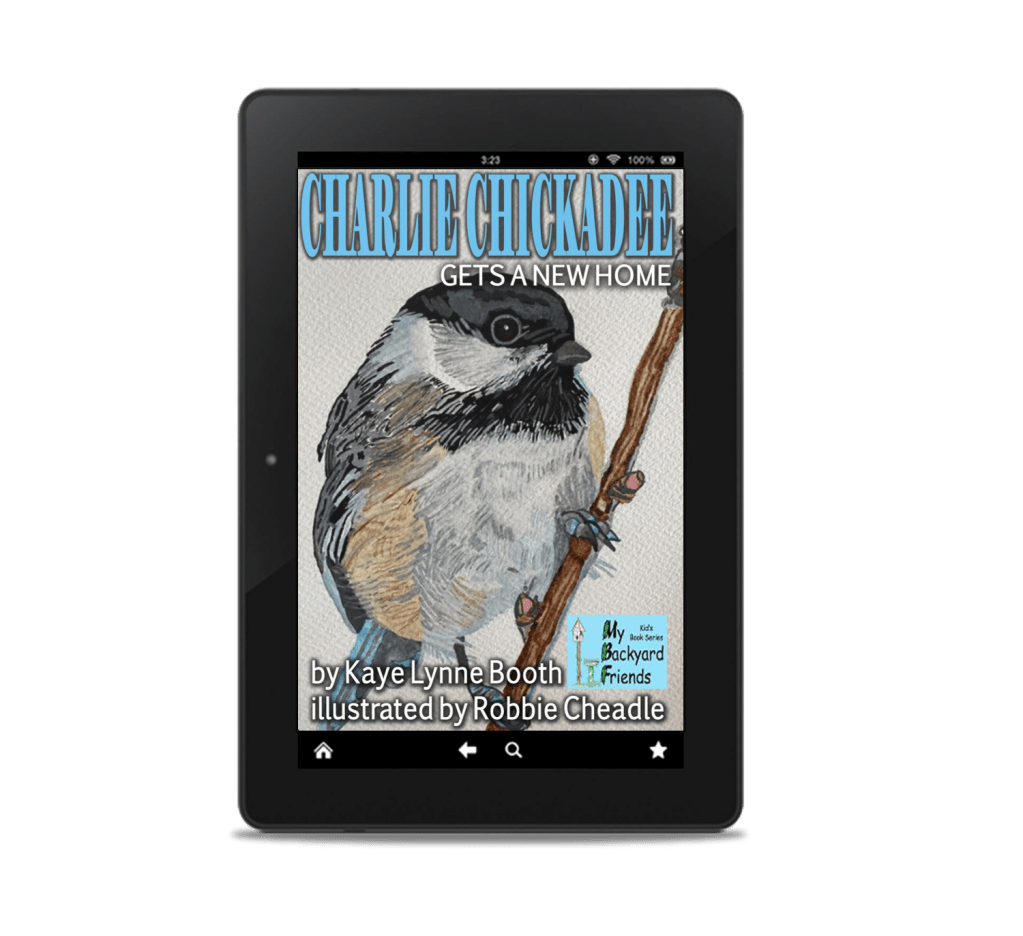
The My Backyard Friends kid’s book series is inspired by the birds and animals that visit the author Kaye Lynne Booth’s mountain home. Beautiful illustrations by children’s author, poet, and illustrator, Robbie Cheadle, bring the unique voices of the animal characters to life. Charlie Chickadee Gets a New Home is a story of survival from a young bird’s perspective.
Charlie Chickadee is happy with his family in their cozy nest. But whem the violet-green swallows thake the nest for their own, Charlie finds himself alone, seperated from his parents and on his own to face the dangers of the forest. His new friend Nicholas Nuthatch shows him the ropes and teaches him about the other birds and the woman who puts out food each day, and by a stroke of liuck, Charlie discovers the perfect spot and builds a new nest that he can be proud of.
If you miss the My Backyard Friends Store, which will disappear on Wednesday July 24th, you can get a digital copy of Charlie Chickadee Gets a New Home through this retailer purchase link: https://books2read.com/MBF-CharlieChickadee
That about wraps things up for the tour. If you’ve followed the tour, you’ve met all the characters introduced in the first three books in the My Backyard Friends Kid’s Book Series. While we had them all together for the tour, we also put together a cool poster, kind of like a group photo, in honor of the tour. Every kid would love to have this poster, featuring Robbie Cheadles wonderful illustrations, on their wall. But you can only get this fabulous poster at the My Backyard Friends Store until July 24th, so get one for each of the kids in your life now.
My Backyard Friends Poster Designed by Sonoran Dawn Studios
But wait! There’s one more surprise to reveal.
Surprise Giveaway!
Tell me in the comments which character is your favorite and the most interesting thing you learned about them during the tour for a chance to win one of two digital sets of all three books in a random drawing. After the tour ends, I’ll leave the comments open until Wednesday, so that everyone will have time to go back and visit stops they missed and get their comments in. The winners will be announced in my August segment of “WordCrafter News” on Monday July 29th, along with who the most popular character turns out to be.
My guest this month on “Chatting with the Pros” is New York Times bestselling author, Jonathan Maberry. Not only is he a five-time Bram Stoker Award winner, and comic book writer, his vampire apocalypse series, V-Wars, became a Netflix original series. Like last month’s guest, Jonathan Maberry is a prolific writer in multiple genres, including horror, science fiction, fantasy, suspense, thriller, and action. He is a board member for the Horror Writer’s Association, and president of the International Association of Media Tie-in Writers, as well as the editor of the rebirth of the iconic Weird Tales Magazine.
I had the pleasure of working with Jonathan briefly when he participated in the 2020 WordCrafter Stay in Place Virtual Writing Conference, where I learned that he is a prettty stand-up guy. Since he is the editor of Weird Tales Magazine, I also had the privelage of working with him on Weird Tales: Best of the Early Years 1926-27and editing his story for the Gilded Glass anthology as an intern at Wordfire Press through Western State Colorado University came with a big case of imposter syndrome on my part. Who was I to be editing the work of this award-winning, bestselling author? But he was great to work with in the capacity of both author and co-editor, and it is a pleasure to have him as my guest today.
Interview with Jonathan Maberry
KAYE BOOTH: You are an award-winning author, including the Bram Stoker Award for horror, the Scribe Award for media tie-ins, the Inkpot Award from the San Diego Comic Con, and numerous accolades for children’s and teen books. In fact, in 2016 you had an award named after you and were the first recipient at the Canyon Crest academy Writer’s Conference, which was the first teen writer’s conference in the U.S. Can you tell us about the Jonathan Maberry Aspiring Teens Award, the conference and why you were chosen for the honor?
JONATHAN MABERRY: That award came as a shock to me. I had been teaching for a few years at the wonderful Canyon Crest Academy Writers Conference and have been a strong supporter of the event. Before that I taught the Experimental Writing for Teens program back in Doylestown, Pennsylvania…and several students from that group went on to make professional sales in novels, short stories, and nonfiction. I’ve always liked working with our younger creatives –it’s my way of selfishly insuring I’ll always have great books to read. When the conference decided to name the award after me because of my work as an author of Young Adult and Middle Grade fiction, my work in comics for Marvel, and other things, I was so surprised. It’s a deep honor to help present the award each year, and there are many, many folks out there who deserve it. We must all work together to help guide and teach the next generation of creatives.
KAYE BOOTH: You also have several comics and graphic novels. How does your writing process differ for these types of books?
JONATHAN MABERRY: I’m primarily a novelist. I think in long, complex stories. However, a different skill set is needed for comics. Novels are solo ventures, however, and comic books are created by a team. The writer pitches the story and presents an outline to the editor. Editors in comics are a lot more hands-on than in other mediums –more like a movie director. Once the editor approves the comic going to script, he then picks the art team. This could be a penciler and inker –two types of artists; or it could be an artist who does both. Then the colorist and letterer are picked. The writer decides how many panels will be on each page and provides art direction. The artist sends back rough pencil sketches to show how the art direction would translate into visual storytelling. The editor, artist, and writer discuss this, make adjustments, and then the artist typically sends pages as they’re completed. There’s multiple pairs of eyes on this every step of the way. The colorist enters the picture around this point, often long before the entire thing is drawn. Colors matter, and I’ve learned from experience that the colorist is much like the lighting person in film –those colors suggest mood and tone. The last player is the letterer, and he has to make sure the dialogue and any narrative have room in each panel. This often requires that the writer do a pass to slim down the dialogue so as not to block the art, just as it’s important for the writer to consider which images best accompany dialogue–mor art can show with little or no dialogue; dialogue-heavy panels should not require complex art. Then there’s multiple passes where everyone tries to find any graphic or textual errors. It’s a fun process, but time-consuming. And it’s key for a writer to keep the ego in check. This is a team, not a solo thing, and every player brings experience, insight, and skill. A wise writer allows them to participate in the process of telling the story in what is predominately a visual medium. Comics are fun, though. And the collaborative process can really be fun and enriching.
KAYE BOOTH: Do you do the illustrations?
JONATHAN MABERRY: Although I am an artist, I don’t do my own comic book art. I’m not on that level of art skill, and besides, the artist choice is complex. The editor often suggests multiple possible artists, and discusses with the writer whether any given style suits the story. Once chosen, it’s useful for the writer to check out that artist’s previous work and then adjust his writing style to be harmonious with it. Being an artist myself helps with this process.
KAYE BOOTH: Some of your work has been turned into film, including V Wars, and Rot & Ruin. How does one break into this arena? Do you have to know somebody who knows somebody, or are the tricks that can help you in breaking into the trade?
JONATHAN MABERRY: When I stepped into the fiction world I knew no one in Hollywood. I’ve made a lot of friends through events like San Diego Comic-Con and other pop culture things where I’m on panels with other writers, comic book people, and folks from Hollywood. Many of my works have been optioned –and an option is when a producer “leases” a work for a specified period of time in the hopes he/she can put together a package (often a showrunner/head writer, maybe a director, maybe an actor, etc) that will be appealing to a studio. Mostly it’s freelance producers who option works.
My first optioned work was Patient Zero, my fourth novel. It was optioned by Michael De Luca for SONY, which took it to ABC, and it nearly made it to TV. At that time, the network exec decided to go instead with a remake of Charlie’s Angels. And that sort of thing happens to all writers. Later, when I wrote the V-Wars books and comics for IDW Publishing, they had created a media division, and it was IDW who shopped the project around and eventually found a home on Netflix. Alas, the show launched at the beginning of Covid, so even though it was a hit (#1 in 120 global markets), they canceled it. And, that’s Hollywood, too. I had nothing to do with that process.
However, because of my increased visibility due to V-Wars, I began getting invitations to send lists of my IPs to producers. IP = Intellectual Property (novel, short story, comic, etc). And sometimes a studio exec will invite me to L.A. for a face-to-face. During those meetings –which are openly fishing expeditions—I would chat about my works and which I feel would make for a good movie or TV show. One example was when Carl Rogers, the Vice-president of Alcon Entertainment invited me up for a sit-down. We chatted for a couple of hours, and afterward they optioned my teen post-apocalyptic zombie novels, Rot & Ruin for film development, and we are currently at the second draft of the script. More recently my Joe Ledger novels have been optioned for television. In both cases I’ll be an executive producer if we go from development into actual production. As an EP, I’ll have extensive creative input.
I also have a book-to-film agent, Dana Spector of CAA, and she is actively pitching my works to producers.
KAYE BOOTH: These days it seems like traditional publishing is faltering, or at least taking a back seat in many authors’ minds as they opt to take control of their own careers and publish independently. As someone who has been in the business for a while now, what do you see as the future for the publishing industry?
JONATHAN MABERRY: I disagree that traditional publishing is faltering. What’s changed is that indie publishing has matured thanks to the many advantages of digital sales (eBooks and downloadable audiobooks) and lower costs because of print-on-demand. Crowdfunding like Kickstarter, BackerKit and other utilities have allowed indie authors to finance well-edited and beautifully-designed books. Social media also gives indie writers a length of reach they never had before. Traditional publishing is actually learning from indie publishing, but the size of their companies makes it a bit harder to pivot in the direction of innovation. It is happening though.
I’ve been publishing for a long time. I began in the pre-Internet typewriter days when I was writing nonfiction magazine feature articles and nonfiction books (college textbooks and mass market). I saw the gradual changes as publishing evolved with the times. Since breaking into fiction in 2006, we had economic downturns that did a lot of damage to publishing corporations, as well as the rise of digital tech. I live quite comfortably off of my income as a traditionally-published author. Part of that is having a smart literary agent –Sara Crowe of Sara Crowe Literary—who has helped guide my career and with whom I’ve sold 60 novels, sixteen short story collections, 26 anthologies (as editor), ten nonfiction books, 28 runs of comics, and a board game in 18 years. So, no, I don’t think traditional publishing is in trouble. What’s key, though, is the writer also changing with the times. When new technology comes along that looks like it’s going to stick around long enough to matter, it’s part of my job to investigate, understand, and implement it in ways that support my career.
KAYE BOOTH: Many of the stories you write are really scary, weird, and creepy stuff. Where do the ideas for these stories come from?
JONATHAN MABERRY: Writing genre fiction does not involve giving a handful of characters a pleasant day. We write about crisis in its many forms. It doesn’t matter if it’s a zombie apocalypse or a fragile romance or Curious George misplacing his keeper’s yellow hat. There is a crisis at the heart of all drama.
For me, I like it darker because it allows me to write about people finding their way through –and hopefully out of—that darkness. I grew up dirt-poor and in a very violent household. My father was a terrible person, an abuser, and a racist. However my grandmother was amazing. She was basically Luna Lovegood as an old lady –she believed in everything that made up what she called ‘the larger world’, including ghosts, ESP, vampires, sprites, angels, faeries, werewolves, crisis apparitions, and all the rest. So, I was exposed to various kinds of ‘darkness’ as a kid. One very negative and one in which I found a great deal of comfort. My grandmother taught me not only about the folklore, myths and beliefs regarding the supernatural, but encouraged me to read anthropology, sociology, philosophy, and science in order to separate what is not part of the larger world and allow for what might be.
Funny, but a lot of folks ask why I write about monsters. I tell them that I don’t –I write about people who fight monsters, and that is a significant difference. In order to tell a story about rising above adversity, where one or more people confronting apparently impossible odds and an overwhelming threat, you have to make that threat real and the challenge steep. That way, the story is really about them finding courage, cultivating optimism, working together, becoming empowered, and taking agency over their own lives and destiny.
KAYE BOOTH: What are some tips you can offer to rising authors for making things scary or suspenseful?
JONATHAN MABERRY: There are a few ways to make a scary story really stand out. First, there’s the research. Folklore, mythology, and cultural beliefs offer thousands of scary elements, including older and much stranger versions of vampires, ghosts, demons, werewolves, etc. So, instead of doing a rinse-and-repeat thing with the standard Hollywood or publishing-world versions of these monsters (which, by the way, are largely extrapolations of story elements created by writers and not from any actual folklore), read deeply and build stories on less well-known and therefore less-predictable monsters. For example, nowhere in folklore is a vampire afraid of a cross or killed by sunlight. Nowhere in folklore is a vampire unable to enter a house unless invited. The sunlight and cross thing comes from Bram Stoker’s Dracula; and the sunlight was introduced as a convenient plot device in the 1922 silent horror film, Nosferatu.
Second, writers should start by taking a close look at what scares them. Them, specifically. When writing from one’s own fears, the connection to the emotions is right there, and if the writer is brave enough, then the confessional elements are truer and not watered down.
Then, write about what the characters in any given scene are feeling, maybe eavesdrop on their thoughts. Let the suspense of a threat not yet fully understood play a larger role than the reveal of the creature itself. Anticipation is so important to good horror storytelling. Once the monster is revealed, the story often morphs from suspenseful horror to terror-action. Not the same thing at all.
KAYE BOOTH: What do you think is the biggest misconception aspiring authors have about publishing that first book?
JONATHAN MABERRY: Oh, they think that first book is going to flip the switch and change their lives. Most people have no idea how small advances are for newbies, especially since the last couple of economic downturns. Also, they forget to put some of that money aside for taxes. They assume that their book will land in every single bookstore, and that doesn’t even happen for the top tier. They assume their published work will be on bookstores indefinitely. They expect the publisher to do the lion’s share of advertising. They believe they’ll be sent on a book tour. And they think that a published book is going to guarantee sell the next one pitched.
There are a lot of misconceptions. Dispelling these, and helping to set more realistic expectations and to learn how to be a more effective player in one’s own career path is one of the reasons I began the Writers Coffeehouse over 20 years ago. These are free 3-hour monthly networking events, typically hosted by indie bookstores, hosted and facilitated by actively published writers. The purpose is to help other writers to make good career decisions, learn the way publishing works, maybe find an agent, write better queries, learn social media strategies, and generally understand both the craft of writing and the business of publishing. I’ve been running the San Diego chapter at Mysterious Galaxy Bookstore in San Diego (https://www.mystgalaxy.com) for the last eleven years. We also have a Facebook page on which writers can ask questions, share information, brag about career milestones, and be part of a mutually-inclusive and supportive community. )www.facebook.com/groups/TheWritersCoffeehouse/). Ours is held from noon to 3pm on the first Sunday of every month. I host it, but when I’m not available it’s hosted by either Peter Clines, Scott Sigler, or Henry Herz –all successful writers.
KAYE BOOTH: Is there one book you have wanted to write, but haven’t written yet. If so, what is it and why not?
JONATHAN MABERRY: Oh, I have a bunch of dream projects, and I hope to get around to them at some point. One is a literary novel, Fruitwood Manor, about a retired soldier who buys an old hotel and turns it into a writers colony.
About Jonathan Maberry
JONATHAN MABERRY is a New York Times bestselling author, 5-time Bram Stoker Award-winner, 4-time Scribe Award winner, Inkpot Award winner, anthology editor, writing teacher, and comic book writer. His vampire apocalypse book series, V-WARS, was a Netflix original series starring Ian Somerhalder. He writes in multiple genres including suspense, thriller, horror, science fiction, epic fantasy, and action; and he writes for adults, teens and middle grade.
His works include the Joe Ledger thrillers, Kagen the Damned, Ink, Glimpse, the Rot & Ruin series, the Dead of Night series, The Wolfman, X-Files Origins: Devil’s Advocate, The Sleepers War (with Weston Ochse), NecroTek, Mars One, and many others. Several of his works are in development for film and TV. He is the editor of high-profile anthologies including Weird Tales: 100 Years of Weird, The X-Files, Aliens: Bug Hunt, Out of Tune, Don’t Turn out the Lights: A Tribute to Scary Stories to Tell in the Dark, Baker Street Irregulars, Nights of the Living Dead, and others. His comics include Black Panther: DoomWar, The Punisher: Naked Kills, Bad Blood and many others. His Rot & Ruin young adult novel was adapted into the #1 horror comic on Webtoon and is being developed for film by Alcon Entertainment. He the president of the International Association of Media Tie-in Writers, and the editor of Weird Tales Magazine. He lives in San Diego, California.
I received an ARC copy of Mystic: The Monk Addison Case Files, by Jonathan Mayberry from Wordfire Press in exchange for an honest review. All opinions are my own.
The unique character of Monk Addison is a literary Dexter, but with more valid motivation and a lot less planning. Monk lives in Pine Deep, a small town where weird occurrances are commonplace and villainous human monsters seem to be in abundance, so those few who know Monk’s story take it in stride. Monk is a bounty hunter who sees the dead murder victims, and avenges them, sealing a bond with each one to him with a blood-ink tattoo of their face on his skin. Once the tattoo and bond are complete, he lives their final moments through the victims eyes, be coming them and reliving their pain, their emotions, in the hope of gleening of glimpse of their killers face or other clues to the identity. Then, he seeks out the one or ones responsible and ends them before they can do the same to someone else.
Mystic is a collection of well-crafted short stories and poetry which relate his experiences with that other kind of case. Not the usual skip-trace, but the ones in which it’s too late for the client, and the goal is to save future would-be victims from suffering the same fate. I have to give kudos on the cover. It is unique, sums up the character and the story premise visually and is one that won’t soon be forgotten.
This short fiction collection is packed full of surprises. I never knew what to expect as I rooted for this antihero character and his friends. I give Mystic five quills.
About Mystic: The Monk Addison Case Files
Gerald “Monk” Addison used to be a soldier. Sometimes he’s a bounty hunter. Mostly, he’s a killer of killers.
His body is covered with the faces of victims of serial killers, human traffickers, and other monsters. Their blood is mixed with holy water and then inked onto his skin, allowing him to relive their deaths. To feel what they felt, and to see what they saw. The faces of the killers.
And then Monk goes hunting.
He is forever haunted by the ghosts who hire him. A madman mystic. A man driven to darkness and acts of shocking violence. Monk is a good man on a dark and dangerous road in search of personal redemption. In search of red justice.
Mystic collects the Monk Addison case files, pitting him against the most dangerous kinds of human monsters. These are stories of a complex and driven hunter of men. They are tales of a mystic hunting the nightmare streets and back alleys.
ic is set for release on December 3rd, 2024. You can purchase many books by Jonathan Maberry from his WordFire Press author page.
_________________
This segment of “Chatting with the Pros” is sponsored by The D.I.Y. Author and WordCrafter Press.
An author involves not only writing, but often, the publishing and marketing of the book.
In this writer’s reference guide, multi-genre author and independent publisher, Kaye Lynne Booth shares her knowledge and experiences and the tools, books, references and sites to help you learn the business of being an author.
Being an author today is more than just writing the book. Authors in this digital age have more opportunities than ever before. Whether you pursue independent or traditional publishing models, or a combination of the two but being an author involves not only writing, but often, the publishing and marketing of the book.
In this writer’s reference guide, multi-genre author and independent publisher, Kaye Lynne Booth shares her knowledge and experiences and the tools, books, references and sites to help you learn the business of being an author.
Topics Include:
Becoming Prolific
Writing Tools
Outlining
Making Quality a Priority
Publishing Models & Trends
Marketing Your Book
Book Covers & Blurbs
Book Events—In Person & Virtual
And more…
Meet the Author
Greetings! Thank you so much for dropping by to help us celebrate the release of The D.I.Y. Author. You all know me as author Kaye Lynne Booth, but with the release of this book, I hope to be known as the D.I.Y. author. This is the book that only I could write, where I share knowledge and experience as I build my author business. This is not a book on craft, but a reference for authors and aspiring authors who wish to expand and grow their author business on a limited budget. Learn the tips and tricks, sites and tools, which took me over a decade, and three masters degrees to amass.
I’ve always been a do it yourself kind of gal. I’ve built my author business up around this blog, finding ways around obstacles which stood in my way, learning new skill sets because outsourcing was more than I could afford. My first novel was published by a small independent publisher. But as the five-year contract ran out, I felt I could do better through my own small independent publishing house, WordCrafter Press, so I re-published it as the first book in my Women in the West adventure series last year, and I sold more copies than that other publisher had over a five year stretch. I just released the second book in the series this month. When Covid struck, I organized and hosted two virtual writing conferences, because writers are tribal bunch, and we need contact with like minded people. Networking is a huge part of building an author business. I use that networking to build not only my author business, but my own author tribe. I’ve published my own books, and collaborative anthologies, as well as publishing books for others. And I’ve built a winning blog team here on Writing to be Read with Robbie Cheadle, Jeff Bowles, Arthur Rorsch, and DL Mullan.
No one else has shared in these exact same experiences that I have, and that’s why only I could write The D.I.Y. Author, and why I can hold that title. But enough about me. The D.I.Y. Author is a great reference packed full of links to sites and tools and tips for increasing productivity, publishing choices, and marketing your books.
We have a great release party ahead to send this book off right. We’ve got exclusive offers running this week only. After Saturday, the whole D.I.Y. store will disappear, so take advantage of them now. By buying direct, you are supporting this author and her works more than when you purchase from retailers.
My D.I.Y. Video
Author Video Introduction – Author Kaye Lynne Booth
On with the party!
Thanks for dropping by for The D.I.Y. Author virtual release party. We’ve got some great things planned, including a giveaway for all attendees, so be sure to leave a comment, so I’ll know you were here. I’ll be monitoring the comments throughout the day and will answer any questions you might want to post there. While you’re here you can peruse the D.I. Y. store below, for exclusive and discounted offers that you won’t find anywhere else. The store will come down at the end of the week. After that you’ll have to pay full price through retailers, and signed copies will no longer be available.
And if you are already a bestselling author and you don’t need this book or the WordCrafter services offered here, you can still offer your support for the author and this project by using the ‘buy me a soda’ button below.
Buy me a soda
Show your support for author Kaye Lynne Booth and her many endeavors through WordCrafter Press & Writing to be Read.
Thanks for joining me today for The D.I.Y. Author Release Party. I hope you found a few useful tidbits here. For more tips and advice, you’ve got to buy the book. If you miss the window for the D.I.Y. Store, you can still purchase this useful writer’s reference here: https://books2read.com/The-DIY-Author
I’m so excited to tell you about the new things happening on Writing to be Read, starting this month. We’ve got a new way to build revenue for the blog and promotion opportrunities for you, as well as two new blog series on Saturdays. Read on to learn more.
Sponsor page is now live
I’m happy to be able to tell you that the new sponsor page on Writing to be Read is now live . Now you can be a WtbR sponsor and get your books or services promoted right here on this blog each month. Sponsors must be book, writing, or publishing releated. That’s the only rule. By becoming a WtbR sponsor, you not only help to support this blog and my author business, but you take advantage of affordable marketing opportunities that help you to reach a wider audience with your books and services.
Here’s how it works. You can choose from a single time promotion or a weekly ad for a sponsorship of three months or annualy. The new page has all the pricing and other details. All sponsors will also be listed on the sponsor page, as well. You can be a WtbR sponsor and sponsor your favorite WtbR blog series for as little as $5 a month. If you are interested in being a sponsor, I encourage you to contact me at KLBWordCrafter@gmail.com prior to submitting payment found there. Let’s chat to find the sponsorship plan that will work best for you.
If you’ve been following this blog for a few years, you may remember this blog series, although it has been a couple of years since I ran a segment. It’s not a new blog series as much as a revived blog series where I interview seasoned professionals to gain insights into the worlds of writing and publishing. We’re starting out right, with national and international bestselling author Kevin J. Anderson as my guest for the first segment. He’ll share insights into the publishing industry, talk about what works for him, and offer advice on increasing your writing productivity.
“Chatting with New Blood”
This series is a companion series to the “Chatting with the Pros” series, where I will be interviewing new authors and chatting about their author journey and their debut novels. For this series, my first guest with be author Julie Jones, and we’ll be chatting about her weird western novel, Blood Follows Blood.
Will I see you there?
I hope I have piqued your interest in the upcoming changes. Watch for the two new blog series on Saturdays and be sure to visit the sponsor page to become a member of the WtbR sponsors. Your support is always appreciated.
_______________________________________________
For Kaye Lynne Booth, writing is a passion. Kaye Lynne is an author with published short fiction and poetry, both online and in print, including her short story collection, Last Call and Other Short Fiction; and her paranormal mystery novella, Hidden Secrets; Books 1 & 2 of her Women in the West adventure series, Delilah and Sarah, and her Time-Travel Adventure novel, The Rock Star & The Outlaw. Kaye holds a dual M.F.A. degree in Creative Writing with emphasis in genre fiction and screenwriting, and an M.A. in publishing. Kaye Lynne is the founder of WordCrafter Quality Writing & Author Services and WordCrafter Press. She also maintains an authors’ blog and website, Writing to be Read, where she publishes content of interest in the literary world.
This post is sponsored by The D.I.Y. Author and WordCrafter Press
Being an author today is more than just writing the book. Authors in this digital age have more opportunities than ever before. Whether you pursue independent or traditional publishing models, or a combination of the two, being an author involves not only writing, but often, the publishing and marketing of the book.
In this writer’s reference guide, multi-genre author and independent publisher, Kaye Lynne Booth shares her knowledge and experiences and the tools, books, references and sites to help you learn the business of being an author.
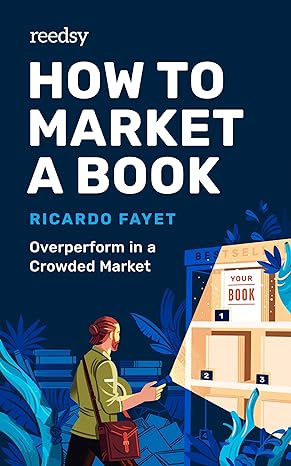
Writing a book is hard. Marketing it can be even harder.
Marketing a book in 2023 can seem like a full-time job, what with the crazy number of things authors seem to be expected to do: social media, blog tours, advertising, price promotions, mailing lists, giveaways, you name it.
But here’s a little secret: you don’t need to do all those things to successfully set your book on the path to success. What you need is a solid plan to find the one or two tactics that will work, and start to drive sales… in a minimum amount of time. And that’s exactly what you’ll find in this book.
Instead of drowning you in information or inundating you with hundreds of different tactics and strategies that eventually prove fruitless, this book will guide you through a step-by-step framework to find the ones that actually work for you and your book, so that you can start marketing more efficiently.
In particular, you’ll learn:
✔️ How to change your mindset and sell more books with less effort.; ✔️ How to write books that guarantee a lasting, profitable career; ✔️ How to get Amazon’s Kindle Store to market your book for you; ✔️ How to get thousands of readers into your mailing list before you even release the book; ✔️ How to propel your book to the top of the charts at launch; and ✔️ How to automate your marketing so that you can spend less time marketing and more time writing,
After helping over 150,000 authors crack the marketing code through a popular weekly newsletter, Reedsy’s Co-founder Ricardo Fayet is sharing everything he’s learned over the past few years in this beginner-friendly, jargon-free guide to book marketing.
Today’s author needs to be able to do all stages of the publishing process in order to run their author business, but one person cannot do it all. It can be overwhelming, even for the D.I.Y. author. (That’s me. 😉 ). I share my experience and knowledge about doing my marketing and promotions myself in my book, The D.I.Y. Author, which will be released on June 4th, 2024. But learning to run an author business doesn’t end when you publish a book, and although I just wrote a book about building and growing your author business, I still have much to learn on this never ending road to success. That’s why I took advantage of the free ebook by Reedsy‘s Ricardo Fayette, How to Market Your Book: Overperform in a Crowded Market. Fayette knows a lot more than I do on the subject of book marketing, so I refer my readers to his book in my book.
I don’t do paid advertising, and that is what a good portion of this book is about.
“But couldn’t I reach a larger audience with paid advertising?” Absolutely.
Someday, I hope to be able to expand into the paid advertising arena, so I read through those sections, and I must say, Ricardo Fayette explains things in such a way that even someone like me, who gets headaches when thinking analytics, can understand, and he is very thorough. He lays out the differences between Amazon Ads, Facebook Ads, and BookBub Ads, weighing the pros and cons of each. And man, did I learn a lot, particularly about BookBub Ads. He really gave me a lot to think about. Hopefully, I will be able to include what I’ve learned about paid advertising from this book in the revised edition of The D.I.Y. Author by putting it into practice at a future date.
Fayette also talks about the importance of a mailing list and how to set up a newsletter with a reader magnet, reminding me of another area where my efforts have been lacking. He compares several email servers and offers the basics of a good newsletter. I set out two years ago to find a new email server because I wasn’t happy with MailChimp. But things got busy and life happened, and my quest for an email server got laid to the side. I opted to stick with what I knew, not wanting to take the time to learn a new server system, let alone the time it takes to research them first. This book offers a list with some I wasn’t familiar with which are geared more toward authors. This peaked my curiosity, as it sounded like it might be just what I’m looking for. I haven’t sent out a newsletter in over six months, and my readers have probably forgotten me. This might be the motivation that I need to get a newsletter up and running, and keep it running.
He shares tips for working the Amazon system, as well as some of the other retailers, for those who publish wide. He even talks about selling direct from your website, and how to make each of these methods work for you. He covers keywords, backcover copy and book covers.
On the subject of book covers, I have to disagree with him as he insists you must outsource your book cover with an expensive professional cover designer. I do outsource many of my book covers because I’d rather put my time into my writing, but although I am a writer and not a book designer, I posess the design knowledge and most of the skills to create a good book cover. I designed the covers for my Women in the West Adventure Series and I’m quite happy with them. I wasn’t happy with the cover I did for The Rock Star & The Outlaw, so I outsourced it to someone who had more skill than I did, and changed the cover three months after publication. So, while I’m not saying you shouldn’t outsource your book covers, I don’t think that it is an absolute necessity. While Fayette is adament on this point, reminding us of it repeatedly throughout the book, I guess we’ll just have to agree to disagree on this one.
This is one of the most comprehensive books on book marketing that I’ve come across, and one I will be referring back to many times in the future as I grow and expand my author business. A great value from a free book.
_________________________________________________
About Author Kaye Lynne Booth
For Kaye Lynne Booth, writing is a passion. Kaye Lynne is an author with published short fiction and poetry, both online and in print, including her short story collection, Last Call and Other Short Fiction; and her paranormal mystery novella, Hidden Secrets; Books 1 & 2 of her Women in the West adventure series, Delilah and Sarah, and her Time-Travel Adventure novel, The Rock Star & The Outlaw. Kaye holds a dual M.F.A. degree in Creative Writing with emphasis in genre fiction and screenwriting, and an M.A. in publishing. Kaye Lynne is the founder of WordCrafter Quality Writing & Author Services and WordCrafter Press. She also maintains an authors’ blog and website, Writing to be Read, where she publishes content of interest in the literary world.
_______________________________________________
Want exclusive content? Join Kaye Lynne Booth & WordCrafter Press Readers’ Group for WordCrafter Press book & event news, including the awesome releases of author Kaye Lynne Booth. She won’t flood your inbox, she NEVER sells her list, and you might get a freebie occasionally. Get a free digital copy of her short story collection, Last Call and Other Short Fiction, just for joining.
You like to write, and maybe you’re good at it. You might even have written a book and published it. Now what?
What many people don’t realize, is that when you become an indie author, you are also an author business, and there’s more to it than just publishing a book. Hopefully, you have enough pride in your writing to want it to be , so you put your manuscript in front of an editor, or at least another set of eyes, then polished it to make it shine before you hit publish. But it’s after you hit that publish button that the real work starts.
Why? Because books don’t sell themselves. No one will buy your book if they never see it. You have to do something, or a lot of somethings, to get your book in front of readers’ eyes.
Isn’t that what Amazon is for? The answer is yes and no. Amazon’s marketing is based on several algorithms, and when although many things are still guesswork concerning those algorithms, one thing is for sure. The books they pick up on for promotion are books that are already doing well. Also, you have better chances of making some of the lists which get promotion if you are a KU author and your book is exclusive on Amazon.
So what does that mean for you? Well, it means that you have to do the heavy lifting of marketing and promotion to get your book selling before Amazon, (or other retailers), are going to see it as a book worth promoting. You need to draw in readers and stack up reviews, and we’re talking lots of them, so you can make those algorithms sit up and pay attention.
How do we do that? There are many avenues of promotion for your book, so that really depends on the route or routes that work best for you and your book. We’ll get back to the promotion in a bit.
Getting Reviews
But getting reviews requires research into book reviewers who are out there and what type of books they like to review, and making a list of those that read your genre. In my case, I’m a multi-genre author, so I have several lists. Then you write-up a press release to act as your official review request. Then you send that press release out to every reviewer on the list who might be interested in reviewing your list. There are a lot of reviewers out there, so your list may be a long one. I send out between 50 and 100 review requests for every book I publish, and from that, I may get four or five reviews, if I’m lucky.
You can also try making connections in the blogging community and asking blogger friends to review in exchange for an ARC or join a review group, like Sandra’s Book Club, where you list your book for a month in exchange for giving a review of someone else’s book. During your month you could potentially recieve two or three reviews.
You might also try building a street team of reviewers, who agree to review your book in exchange for an ARC copy of your book, and post it on or around release day. But this is more work, because it is your job to follow through and make sure they actually post their reviews.
Promoting Your Book
There are many avaneues of promotion. If you want paid promotions, which are always recommended, but not always affordable, there are Amazon Ads, Facebook Ads, BookBubs, The Fussy Libraian, King Sumo, Bargain Booksie, Free Booksie, and the list goes on. I don’t use paid ads, but I know they are available if I want them.
Social media promotion is the most easily accessible avenue for promoting your book. It is as easy as creating a post that tells us something about the book to make us want to buy it, has a call to action, and a purchase link, then promoting it to groups whose members are in your target audience and might be interested in your book.
My main tool for promotion is this blog. Most of my promotions start off here and then I promote the blog post on social media channels. A blog post is more permanant than a social media post, which easily gets lost in the scroll. I have people reacting or commenting on posts a week after I post it, but when it is a blog post, it is still there no matter when someone clicks on the link.
Conclusion
The point to all of this is that indie authors have to be able to do more than just write books. You are actually an author business and you are totally responsible for the success, (or failure), of your books. Getting reviews and promoting the book are only part of it. What are you doing about book covers? What about the back cover copy? Are you creating your own ads, or paying someone else to do it? These are things an indie author has to think about. You need an overall business plan and a marketing plan for each book. That’s why I wrote The D.I.Y. Author.
The D.I.Y. Author
Now you can learn from my experiences with a writing reference for building an author business.
About the Book
Being an author today is more than just writing the book. Authors in this digital age have more opportunities than ever before. Whether you pursue independent or traditional publishing models, or a combination of the two but being an author involves not only writing, but often, the publishing and marketing of the book.
In this writer’s reference guide, multi-genre author and independent publisher, Kaye Lynne Booth shares her knowledge and experiences and the tools, books, references and sites to help you learn the business of being an author.
For Kaye Lynne Booth, writing is a passion. Kaye Lynne is an author with published short fiction and poetry, both online and in print, including her short story collection, Last Call and Other Short Fiction; and her paranormal mystery novella, Hidden Secrets; Books 1 & 2 of her Women in the West adventure series, Delilah and Sarah, and her Time-Travel Adventure novel, The Rock Star & The Outlaw. Kaye holds a dual M.F.A. degree in Creative Writing with emphasis in genre fiction and screenwriting, and an M.A. in publishing. Kaye Lynne is the founder of WordCrafter Quality Writing & Author Services and WordCrafter Press. She also maintains an authors’ blog and website, Writing to be Read, where she publishes content of interest in the literary world.
_______________________________________
Want exclusive content? Join Kaye Lynne Booth & WordCrafter Press Readers’ Group for WordCrafter Press book & event news, including the awesome releases of author Kaye Lynne Booth. She won’t flood your inbox, she NEVER sells her list, and you might get a freebie occasionally. Get a free digital copy of her short story collection, Last Call and Other Short Fiction, just for joining.