Let me just start by saying that I’m a big fan of Andrea Pearson, the author of these books. I listened to her on the Six Figure Authors podcast, along with her two co-hosts, Lindsay Barker and Joe Lallo, all through the fall and spring semesters. So, when I found out we were going to be using Rock Solid Newsletter in our class, I jumped at the opportunity to buy the whole set, even though I only needed the one book for class. Which is just to say, that I knew these books would have lots of valuable information for me as an author before I ever cracked them open, and indeed they did.
In Book 1, Rock Solid Book, Andrea offers tips for making sure you have a book that readers will want to read. Book 2, Rock Solid Platform, gives advice on finding and acquiring fans who will read just about anything you write. Book 3, Rock Solid Promotion, discusses book marketing, protons and deals that sell. And finally, in Book 4, Rock Solid Newsletter, she tells how to set up your newsletter and automation sequence and clean your newsletter email list, so you know you have true fans who want to hear about you and your books, which increases your open and click rates and is more effective at selling books.
Self-Publish Strong Books 1-4 is filled with valuable information for independent authors, which I’m using to improve and grow my newsletter list, which is soon to become my readers’ group, and set up promotions for all of my 2022 releases. Andrea Pearson offers tips, advice and good strategies for producing a quality book which readers will buy, getting the word out about your books and finding readers who will buy them.
What she doesn’t do in Rock Solid Newsletter, is to instruct on the technical set-up of the newsletter, because each newsletter platform is different. I don’t hold that against the book though, as these books are not instruction manuals, but instead, they offer strategies to leverage your books into a better selling position. I managed to change my reader magnet and my welcome email so it will be delivered as intended. (I think,. I still need to test it.) And that’s where I’m stuck, because I don’t understand the technicalities of setting up an automation sequence, but I know I need to set one up. I may have to find someone to help me on that one. So, although I haven’t put all of the advice offered in Publish Strong Books 1-4 to use yet, I’m well on my way.
You can get your copy of Self-Publish Strong Books 1-4 here:
Kaye Lynne Booth lives, works, and plays in the mountains of Colorado. With a dual emphasis M.F.A. in Creative Writing and a M.A. in Publishing, writing is more than a passion. It’s a way of life. She’s a multi-genre author, who finds inspiration from the nature around her, and her love of the old west, and other odd and quirky things which might surprise you.
She has short stories featured in the following anthologies: The Collapsar Directive (“If You’re Happy and You Know It”); Relationship Add Vice (“The Devil Made Her Do It”); Nightmareland (“The Haunting in Carol’s Woods”); Whispers of the Past (“The Woman in the Water”); Spirits of the West (“Don’t Eat the Pickled Eggs”); and Where Spirits Linger (“The People Upstairs”). Her paranormal mystery novella, Hidden Secrets, and her short story collection, Last Call, are both available in both digital and print editions at most of your favorite book distributors.
When not writing, she keeps up her author’s blog, Writing to be Read, where she posts reflections on her own writing, author interviews and book reviews, along with writing tips and inspirational posts from fellow writers. In addition to creating her own imprint in WordCrafter Press, she offers quality author services, such as editing, social media & book promotion, and online writing courses through WordCrafter Quality Writing & Author Services. As well as serving as judge for the Western Writers of America and sitting on the editorial team for Western State Colorado University and WordFire Press for the Gilded Glass anthology and editing Weird Tales: The Best of the Early Years 1926-27, under Jonathan Maberry.
In her spare time, she is bird watching, or hiking, or just soaking up some of that Colorado sunshine.
Sign up for the Kaye Lynne Booth & WordCrafter Press Readers’ Group for and book event news for WordCrafter Press books, including the awesome releases of author Kaye Lynne Booth. Get a free digital copy of Kaye Lynne Booth’s paranormal mystery novella, Hidden Secrets, just for subscribing.
Welcome back to the “Ask the Authors 2022” Saturday blog series.
If you missed them, you can catch the first two segments here:
Segment 1 – Introductions for Kaye Lynne Booth & Kevin Killany/Writing Life Q & A
Segment 2: Introduction for Bobby Nash/Pre-Writing Rituals Q & A
This is the third segment for this series and today I’m going to introduce you to contributing author, Roberta Eaton Cheadle, who shares her essay about her own publishing journey in the book, and bring you a Q & A on plot, or storyline, from the WordCrafter writing reference anthology, Ask the Authors 2022.
Meet Roberta Eaton Cheadle
Roberta Eaton Cheadle is a writer of young adult and adult fiction in the supernatural fantasy, historical horror, and historical supernatural genres. Under the name Robbie Cheadle, she is a South African children’s author, publishing the Sir Chocolate series with her son, Michael, and a poet with 2 published poetry books.
To date, Roberta has published two novels, Through the Nethergate, and A Ghost and His Gold, along with several short stories in various anthologies including Whispers of the Past, Spirits of the West, and Where Spirits Linger, all edited and compiled by Kaye Lynne Booth, and Dark Visions, Nightmareland, Spellbound, Wings & Fire, and Shadowland, all compiled by Dan Alatorre.
Robbie is also a member of the Writing to be Read blogging team and co-editor of Poetry Treasures (2021) and Poetry Treasures 2: Relationships (2022), two poetry anthologies with contributing authors who were guests from her “Treasuring Poetry” blog series. When she is not writing, Robbie enjoys working in the garden and creating fondant and cake artworks to be featured in her children’s books.
And now for the Q & A.
Plot/Storyline
How do you feel about prologues? Love them or hate them? Why?
Mario Acevedo: I’m not a fan of prologues and as I see them as superfluous to the story. If you must include a prologue, then call it Chapter One to make sure readers like me won’t flip past it.
Paul Kane: I have no strong feelings about them either way. Sometimes I’ve used them, other times I’ve gone straight into Chapter One. I know some writers who say if you can avoid Prologues then do it and just start with the first chapter, but I think if it serves a purpose then there’s a place for one. I tend to include them in the thrillers, because it’s always an event that kicks things off – so for example in Her Last Secret, it’s the death of Jordan Radcliffe, in Her Husband’s Grave it’s the discovery of a body on Golden Sands beach, and in The Family Lie it’s a couple of campers who see a man on fire in the woods. I then split the narrative into parts, and in Chapter One I tend to introduce the main protagonist, so it might be the person who’ll be doing the investigating; someone whose eyes we’ll be seeing most of the events in the book through.
Chris Barili: I normally skip prologues in the books I read, especially if they’re more than two pages long, so naturally, I try to avoid them in my own writing. I tend to be of the mind that if it’s important enough to be in the story, I can be “Chapter One” or background info sprinkled throughout the story.
Bobby Nash: Prologues have their uses. I don’t think they need to be used in every story and I certainly don’t use them as an info dump. Sometimes, they work well.
Robbie Cheadle: I have no strong feelings about prologues. If the story requires one, then it should be there, if not, it can be omitted. I have not as yet included a prologue in one of my books.
Nancy Oswald: Not too fond of them. I think it’s better to jump right into the story.
Kevin Killiany: Prologues are essentially exposition—they explain the conditions or situation that make the story itself possible and necessary. Sometimes they contain information vital to the climax or outcome of the story that the writer could not figure out how to insert into the narrative itself. Like any tool they are not good or bad in and of themselves. I have, rarely, used prologues as placeholders in rough drafts; repositories to hold essential information until I work out how to work the really important bits into the narrative. Only one of my short stories ever went to press with both a prologue and epilog: “Simple Farmer”, Total Warfare, FanPro, 2006, a tie-in story for the Classic BattleTech RPG. They contained information long-time players knew, but new and less minutia-oriented readers would need to understand the story’s significance to the game.
What is the most difficult part of the story to write: beginning, middle or end?
Mario Acevedo: For me, the entire book is a challenge. I tell new writers not to sweat a perfect beginning because it’s often not till you write the ending do you figure what the beginning needs to say. The middle is called “the swamp” for good reason and the key here is to keep in mind the story question as you introduce plot twists.
Paul Kane: This changes, depending on at which point in the story or book you ask me. It’s hard to make a start on a project, because you’ve just got the blank page in front of you. But then it’s just as hard the next day to come to it and see another blank page… I tend to flag about halfway through and wonder what the hell I’m doing or wish I’d never even started it. The end is definitely the best part, if you’ve panned it well and can bring the book in for a good landing. There’s no more satisfying feeling in the world than having written the book. I always joke that I hate writing – which for a writer probably isn’t great – but I do love having written. Having a first draft that I can then tinker with. That’s my favourite part of the process if I’m honest, apart from getting the idea in the first place and developing that. But even at an early stage, you’ve got the whole mountain of a book to write ahead of you, which can be quite daunting.
Bobby Nash: I don’t know if I would call it more difficult to write, but the middle is usually where I start getting bogged down. Knowing when to transition from the middle to the end can be tricky.
Robbie Cheadle: It is all the same for me. I have the outline in my head, and I write in that direction. I do not find any parts more difficult, and I am for consistency and fluidity throughout my stories.
Jeff Bowles: For me, a short story or novel isn’t complete until I’ve managed to synthesize a decent tie-up ending. It can be tough to do, especially if you aren’t using a road map or outline of some sort, which I often do just to see where the story takes me. Sometimes I do a lot of preplanning, and that can certainly help, but even then, things in the plot can and do change, which means a good ending can still be hard to stick. Beginnings carry all the burden of proof, the reason someone will or won’t want to read your work, but even they depend on where a narrative ultimately ends up. As the saying goes, the seeds of an ending are always found in its beginning.
Nancy Oswald: Each book is different.
What are the elements of a good plot?
Paul Kane: That it hangs together well and is pacy. That there are no flabby bits which are unnecessary. Every bit of your story should be relevant and serve a purpose; if you could take certain bits out and still have the same plot, then they weren’t necessary in the first place. That it moves along well from beginning to the middle, to the end, and leaves a reader satisfied; and by that I mean content that they haven’t just wasted a chunk of their lives reading it. It’s why I always plan, so I can see the shape of the plot and work out what sections need to stay, which can be salvaged, and which need to be jettisoned.
Bobby Nash: I tell stories that I hope are coherent, make sense, and are entertaining. If that happens and the characters work, I’m happy.
What is the best hook you’ve ever written? Why?
Paul Kane: Ooh, that’s a hard one. Do you mean at the beginning of a story to make the reader go on? I’d say probably The Family Lie – and reviewers have mentioned this a lot! It’s the whole thing of showing those campers hearing something in the woods, looking out and seeing a guy on fire among the trees. I mean, what on earth’s going on there? If it doesn’t make you want to read on and find out then I’ve really not done my job properly. Up there with that is probably the start of Servants of Hell. That purposely mirrors the puzzle box scene with Frank from The Hellbound Heart, where he’s trying to solve the Lament Configuration and summon the Cenobites. I have a very similar scene, but right at the end you discover it’s Sherlock Holmes solving the puzzle just as the Cenobites show up. We then go back and find out how he ended up in that situation, but man what a hook! I was the one on fire the day I wrote that.
Chris Barili: Probably the opening to Guilty, the prequel to my Hell’s Butcher series. It opens with the main character face down in a saloon, dead from a gunshot wound. His first interaction is with a bartender who is half-rhinoceros.
Bobby Nash: I love this opening to Snow Falls.
“Abraham Snow knew he was about to die–
–and the thought of it pissed him off to no end.”
What kind of stakes do you set for your characters?
Paul Kane: Usually quite high stakes. Even if it’s something that’s high stakes for them alone, something that means a great deal to them, but might not to anyone else. You have to give characters motivation, nudge them to do things they might not otherwise do, and the only way to achieve that is by making it a high stakes gamble for them. They might lose their marriage, kids, or even their life. It makes a reader keep on turning the pages to find out how they’ll get on. In Lunar, the stakes really couldn’t be any higher for my protagonist Nick Skinner: he needs to find out why the world became stuck at a certain point in time; what the white-eyed Loons are roaming about, killing people; and he needs to find out where the love of his life Dawn is. Track her down and save her. Hopefully you go along with him for the ride to find out how he gets on.
Chris Barili: Again, that depends on the story and the genre. The stakes in a romance are a broken heart or happiness, while that in a horror story might actually be losing their heart.
Bobby Nash: Every story is different, but the stakes have to impact the character on some personal level. If the character doesn’t feel anything or there’s no stakes for them, the reader has no reason to get invested.
Robbie Cheadle:Through the Nethergate and A Ghost and His Gold were both about ghosts which have become trapped in between the physical world here on earth, and the afterlife. The reasons for this happening are different in both books, but the ghosts searching for redemption, so they can move on to the next level of existence is a common thread. The Soldier and the Radium Girl is different and is about a young couple’s quest for justice.
Do you write in subplots purposefully or do they develop organically for you?
Paul Kane: I work all those out beforehand, when I do my planning. That’s when subplots will occur to me and develop organically at the ideas level when I’m figuring it all out. As I mentioned, that doesn’t mean it’s all set in stone, there is always scope to change things if it makes the story better, but it allows you to figure out what main plots and subplots you’re going to need before you even start writing.
Chris Barili: Both. I plan some, and others pop up during the course of telling the story. If your characters are realistic enough, and you know them well enough you won’t be able to avoid the latter happening at least a little in your story.
Bobby Nash: A little of both. In writing series like Snow or Sheriff Myers, I know plot points for future books so I set up things that will pay off later. There are times, however, where I’ll decide something later and go back to set up the subplots and discover they are already there. Sometimes, my characters are smarter than I am.
Robbie Cheadle: Subplots do develop organically for me and are often a result of the interesting additional information I discover through my research as I go along.
Nancy Oswald: Develop organically.
Kevin Killiany: Subplots are always purposeful. In fact I always write complex or substantive subplots as individual stories in first/rough draft. Jigsawing the parts together—trimming, expanding, and polishing as needed—is part of the editorial process.
How do you assure that all subplots are resolved at the end of the story?
Mario Acevedo: I don’t because I like messy endings. The main story question is resolved, but usually involves a compromise by the protagonist. Unresolved subplots are good places to hitch up a sequel.
Paul Kane: Well, they might not be – but that would be something you leave dangling on purpose. For example, and this is a spoiler, at the end of The Gemini Factor we find out that one of the main characters Deborah is pregnant with twins. This was part of the subplot of her falling in love with Jack, a twin himself, who ends up getting killed. So we don’t really see the resolution of what she does about having his kids… unless I do a sequel, which actually I’m intending to do at some point. So leaving things open-ended sometimes can shoot off into yet another story. Pulling on a story thread that you’ve left dangling.
Chris Barili: Well, first off, some are not resolved because I want them to continue into the next book. For those that wrap up in the current book, I create a plot line, usually color-coded, in my beat sheet for that subplot so I don’t forget it.
Bobby Nash: Keep good notes. There was one time I realized that I had forgotten to resolve a plot point and so I started planning how to resolve it and the characters showed me which way to go. It turned out far better than my original idea. That’s why I trust my characters to get me where I need to go.
Robbie Cheadle: I engage the services of a developmental editor to read my stories carefully and help me tidy up lose threads, tighten the storyline, and produce the best story possible. I am also fortunate enough to have two Beta readers who read my work chapter-by-chapter and help me resolve issues and lose threads or contradictions as I go along.
Kevin Killiany: Sometimes they aren’t. Sometimes they’re hooks for the next story.
What methods do you use to add tension and conflict to your story?
Mario Acevedo: Make sure the characters, even those on the same side, have competing agendas.
Paul Kane: Well, I use suspense to ramp up the tension. And if you want to know how that works, just go away and watch a bunch of Hitchcock movies because he was the master. Show the bomb and the ticking clock under the table, but have the characters oblivious to it. That’s suspense, folks! As for conflict, you have to have characters with different points of view, just like in real life. Where do all the arguments come from in your own life? People who disagree with you on a certain course of action or about beliefs. Just look at something like The X-Files, which I watched from start to finish again recently. Mulder’s the believer, Scully’s the sceptic, and we watched the arguments – as well as sexual tension – between them for many years. Opposing viewpoints, yet when the chips were down they worked for the common good; the perfect combination. In my novel Arcana, which is set in an alternate universe, I had a young M-Forcer whose job it is to police magic users, unwittingly fall in love with a member of a group of magic users he’s chasing. Then you ask the question: what now? Will he turn his back on what he believes for love? Or bring her in? Or is there more to what’s going on in the first place than they know? It makes for tension, conflict and… if you’ll pardon the pun, given the novel in question, sparks.
Bobby Nash: Character moments are good for this. There are also tricks you can do on the writing side. Short, choppy sentences speed up the action. Long paragraphs slow it down. That sort of thing.
Robbie Cheadle: It depends on the book in question. With my current novel, there is a lot of irony because a lot of readers will be familiar with the story of the radium girls. War stories include their own tension due to the conflict situations that are innate in the history. I make use of flawed characters so that they do things that create conflict situations through their own poorly thought-out actions and their strong ideas and views about other characters and the situations they are in due to external circumstances.
Nancy Oswald: If I’m bored the reader will be too, so I try to pay attention to that and analyze where the story gets slow (or not).
Kevin Killiany: Mostly I just add tension and conflict. You should always keep in mind that every character is the hero of their own story—every character has a reason for what they’re doing. Begin with characters you care about (Not the reader, you; fake it ≠ make it.) and give them compelling reasons for their actions. When the actions and the underlying reasons for those actions of two people you care about run contrary to each other, the conflict generates the tension.
That wraps up the “Ask the Authors 2022” blog series for today. I thank you for joining us and hope you found some of this useful. Next Saturday will bring you an introduction to contributing author, Paul Kane and a Q & A on Character Development. See you then.
Ask the Authors 2022
And don’t forget to grab your copy of Ask the Authors 2022 from your favorite book distributor at the special price of 3.99 for the duration of this blog series, through the Books2Read UBL here: https://books2read.com/u/3LnK8e
Join Kaye Lynne Booth & WordCrafter Press Readers’ Group for WordCrafter Press book & event news, including the awesome releases of author Kaye Lynne Booth. Get a free digital copy of her short story collection, Last Call and Other Short Fiction, as a sampling of her works just for joining.
Welcome back for segment 2 of the “Ask the Authors 2022” blog series, with an introduction to Bobby Nash, who shares how to manage the many tasks which being an author entails, to the Ask the Authors 2022 Writing Reference Anthology, and a Q & A on Pre-Writing Rituals.
Last week, we learned a little about myself and author Kevin Killiany, in addition to the Q & A session on Writing Life. If you missed it, you can find it here.
And now on to this week’s post.
Meet Bobby Nash
Bobby Nash is not a man of action, a detective, or a hero, but he loves writing about characters who are all of those things and more. Bobby is an award-winning author of novels, comic books, short stories, screenplays, and more. He is a member of the International Association of Media Tie-in Writers and International Thriller Writers. On occasion, he acts, appearing in movies and TV shows, usually standing behind or beside your favorite actor. From time to time, he puts pen to paper and doodles. For more information on Bobby Nash and his work, please visit him at www.bobbynash.com, www.ben-books.com, and across social media.
Pre-Writing Rituals
Please tell us what genre(s) you write in and what type of research is required for your stories?
Mario Acevedo: I write commercial fiction—novels and short stories of supernatural fantasy, horror, and hard-boiled crime. My research is to make the story and setting sound as credible as possible.
Paul Kane: All kinds really. I’ve dabbled in a lot of genres and written in a lot of formats, from comics and audio scripting to TV and film. I started out doing journalism, so non-fiction, and had a couple of books out in that vein: The Hellraiser Films and Their Legacy is probably the most well-known. Then I returned to writing short stories, because I was always writing those growing up; especially for English classes where the teachers would get exasperated at the length of some of them. I started sending these off to small presses and was lucky enough to get some printed, which then led to a collection. At the same time I’d been trying to write a novel, The Gemini Factor. I’d had a stab at a few before, so technically this was about my third or fourth novel, but the first I wrote with any serious intention of getting it published – which it was eventually, and there was even an anniversary edition which came out in 2020 through Gestalt Media. That was a horror serial killer thriller, by the way – and indeed most of the stuff I was doing back then was horror, and I carried on in that vein for a little while. Then around 2007, I pitched a book to Abaddon/Rebellion for their post-apocalyptic Afterblight series, which was a reworking of Robin Hood. They accepted that and it was my first mass market novel, so I’d shifted into SF at that point and wrote three novels altogether – gathered together in the sellout Hooded Man – plus a novella for them. I also wrote my first YA novel, The Rainbow Man, as PB Kane. At the same time I was writing short films like The Opportunity and The Weeping Woman, and then some audios – I adapted The Hellbound Heart into a full cast audio drama for Bafflegab – as well as working on and running conventions. More recently I’ve moved into writing straight thrillers for HQ/HarperCollins under the name PL Kane and the first of those, Her Last Secret, Her Husband’s Grave and The Family Lie, have all done very well. In amongst all that, I’ve written a couple of short plays too, one of which – One for the Road – was performed at FantasyCon 2015. As for research, it very much depends on the kind of story you’re telling. Crime research is very different to SF, as you can probably imagine.
Chris Barili: I write in just about every genre, and I wouldn’t say one genre requires more research than the others. Rather, I’d say one series of stories requires it: Hell’s Marshal. Because it is set in the old west, I do extensive research to make sure it is accurate, or at least believable in light of the story itself.
Bobby Nash: I write in whatever genre the publisher wants. So far, I haven’t done a lot of fantasy, nor have I attempted romance or erotica. Most of my work has a thriller element to it. I also write a lot of action and crime fiction. Research varies from project to project.
Robbie Cheadle: My YA and adult books are all historical and most have a paranormal element. I do a lot of research for each book, plotting the historical events on a timeline and then overlying the events of my plot. A Ghost and His Gold had over thirty historical sources and my current work in progress, The Soldier and the Radium Girl, will end up have at least the same number of sources, possibly even more.
I also read a lot of books in the timeframe I am writing about, especially classic books that were written during the period. This helps me gain insight into the everyday lives of people living at the time and experiencing the historical events I’m writing about.
Nancy Oswald: I write mostly Colorado-set historical history for young readers. It’s not always in the same order, but I typically start by reading history of the area, but not always. I like to visit the sites and glean as much as I can about the area. For me, museums and history centers are a huge wealth of material.
Kevin Killiany: Young adult, because the stories are more direct and revelatory of character. “Hard” science fiction (which means the fictional science is compatible with and based on real world science) and historical. Both require serious research, because accuracy is essential to the authenticity of the story.
How do you prefer to conduct your research: Live? Online? First-hand accounts?
Mario Acevedo: While the Internet is the most used because it is right in my computer, I continue to surprise myself with what treasures you find in newspaper microfiche, libraries, and visiting a place.
Paul Kane: I mainly do my research through a mixture of online searches, books and documentaries. For example for Her Husband’s Grave I did a lot of digging into psychology and serial killers, because my main character Dr Robyn Adams helps the police with their serial cases. For The Family Lie, I watched documentaries about cults and stuff like Jonestown, which led to some sleepless nights I can tell you. The cult of personality and all that. You get first-hand accounts in documentaries about subjects like that, so I haven’t needed to go to the horse’s mouth yet. Apart from in one instance, where I had a weapons expert called Trev Preston who’d help me with some of the details in the Hooded Man series. I’d ask him bizarre things like, is possible to take down an Apache Helicopter with a bolas – and he’d say yes or no. The answer’s yes, by the way, and that scene is in Broken Arrow.
Chris Barili: I do almost all my research online. Just don’t have time or resources to go visit far away places. That said, I did do some of that during two recent road trips.
Bobby Nash: I enjoy meeting and talking to people who do the jobs. I’ve talked with FBI agents, police, doctors, etc. about their respective jobs to get a feel for what they do. That adds a personal touch to the characters I have in those roles. On-line research is an invaluable tool to have at your fingertips. I also like to travel and visit locations where I can set stories and scenes.
Robbie Cheadle: I do all my research on-line and I like to use diaries, letters, and journals from the time, if possible. Project Gutenberg is a wonderful resource for historical research.
Nancy Oswald: See above, but add first-hand accounts if they’re available. I usually save online for while I’m drafting, because inevitably I’ll need a piece of information that I couldn’t anticipate.
Kevin Killiany: I love a library—finding and searching through physical books—but these days the internet enables one to access more information quickly. Whenever possible, I visit locations used in my stories.
What are your best research sources?
Chris Barili: Town or county historians. As them the time and they will build you a clock.
Bobby Nash: Google is readily at my fingertips. Interviewing people is also a good source of information gathering and adds a personal touch.
Nancy Oswald: I like the online dictionary of etymology. Quick and accurate.
What do you look for in a source: Aim? Accuracy? Authority? Correlation?
Paul Kane: I think you’re always looking for accuracy, because it goes back to that thing of believability again. You need to be as accurate as you can with facts, just so the reader believes in what you’re doing. That said, it’s hard to research some of the things I write about, like monster cats coming back as ghosts and attacking people, but you just have to do your best. That’s where the imagination element comes into it. I recently wrote a story for a charity anthology that takes place in the universe of my novella The Rot, and I had to do tons of research into black mold to get that right – even just for short story. It’s that important.
Robbie Cheadle: I like my stories to be as historically accurate as possible, so I actively look for accuracy and correlate the information I find with as many other sources as possible.
Nancy Oswald: I usually check more than one source if I’m in doubt. For historical fiction I like to be accurate, but love, love, love historic photos for setting.
What pre-writing exercises do you employ: Outlining? Free writing? Brainstorming?
Paul Kane: I rarely need to brainstorm, because Ideas come to me all the time and I jot them down. This means I’ve got tons of notebooks to draw on if I ever go blank… And I do plans, outlines and chapter breakdowns for novels. I might not stick religiously to them, but I find it helps me focus and keep on the straight and narrow, to keep going whenever I lose where I might be in the story. Like a kind of roadmap. You wouldn’t set off for a destination without having one of those – or a Satnav, or your phone – so why set off on a journey of many hours of hard work and 80 or 90 thousand words without an idea of where you’re heading? Some people wing it, I know, but I suspect they’re just planning it all out in their heads or their subconscious.
Chris Barili: Yes. And more. Any tool I can get my hands on to make my writing better.
Bobby Nash: I rarely have time for pre-writing. Deadlines do not always allow for that. I spend my writing time writing. When I’m at the beginning of a project and creating characters, I will do free writing and just start jotting down notes as I get to know the characters. Sometimes, plot/story ideas will happen in this stage too.
Robbie Cheadle: I research each section before I start writing a new chapter. As mentioned previously, I have my ending plotted prior to commencing writing and that is the direction I write towards.
Nancy Oswald: Refer to answer about plotting or pantsing. Oh, it’s blank. None of the above. I think while I write most of the time, but I have used a time-line to plot on when I’m trying to track a fiction story-line and compare it to the actual historical events.
Do you try to write to market or write what you love?
Paul Kane: The quick answer is both. I’ve written stories just for the love it them, usually they’re new ones for collections – like ‘The Butterfly Man’, that was a story for a collection from PS of the same name. But I’ve also written for specific markets, like the Hooded Man stuff, or where an editor gives you a theme for an anthology. I wrote ‘The Shadow of Death’ for an anthology called Expiration Date, for instance, ‘Shells’ for an anthology called Terror Tales of the Seaside, and ‘Presence’ for Hauntings. So at that point you’re totally writing for a specific market or theme.
Chris Barili: Again, yes. I write to market within the boundaries of what I know and love. I won’t shoe-horn my writing into genres or labels, and while I write what I am passionate about, I don’t limit myself to things I know or share with the reader.
Bobby Nash: Write what you love. Writing to market can drive you crazy and often leave you unfulfilled. I speak from personal experience here.
Robbie Cheadle: I write what I enjoy and for my own pleasure. I would like others to enjoy my stories, but that is secondary to my primary aim of personal enjoyment. As a result, I have decided to continue to publish with smaller publishers rather than to try to get representation with a larger publishing house.
Jeff Bowles: I sort of try to do both at the same time, I suppose. I’ve always had this theory that solid, salable fiction can be fun and artistic, too. Crazy, I know, but that’s just how I feel! Anyway, I’ve sort of developed a unique style, and there’s certain subjects I seem to write about again and again, as it is with most authors, I think. When I try to write like other people, the results are mixed, so I learned a long time ago to try to hit the personal enjoyment metric and then sort out what I think is salable or not. It’s a fine line, one that’s almost always difficult to walk, but it’s almost always worth it in the end.
Nancy Oswald: I realized a long time ago I cannot write to a market. For one, living in rural Colorado, I can’t keep up with anything that resembles up-to-date or edgy. The last time I remember trying keep up with cool was when I was a teen (living in Denver) and I practiced doing “The Jerk” in front of a mirror.
Kevin Killiany: Obviously when writing tie-in fiction for a TV show or role-playing game, I have to write for the market. BUT I’m writing for that market because I love the game or show—you have to campaign constantly to get your foot in the door, and that requires a good deal of passion. With my own, original fiction, I write solely for me. If you guys like it, that’s fantastic.
________________________
That wraps up “Ask the Authors 2022” blog series for this week. Be sure to drop by next Saturday for an introduction to multi-genre author, Roberta Eaton Cheadle, and a Q & A on plot/storyline. (Okay, many of you already know Robbie, some of you quite well. Drop by anyway for the Q & A.)
Ask the Authors 2022
You can get your copy of Ask the Authors 2022 at your favorite book distributors at the special price of 3.99 for the duration of this blog series, through the Books2Read UBL: https://books2read.com/u/3LnK8e
We’ve had a great tour for Poetry Treasures 2: Relationships, but now it’s time to bring the fun to a close. To wrap things up today, we have a guest post from contributing author and poet Leon Stevens.
I like the conciseness of a poem and how it can capture a moment, thought, emotion, experience, or an observation, like a painting. With descriptive colors, thoughtful hues, rhyming shades, and new perspectives, when inspiration comes—usually when I least expect it—I just need to put it into words.
People will often say that they don’t understand poetry. I try not to hide the meaning in the words, rather I want to use the poem as a way to describe the feelings I have at that time. Life is a struggle. Poetry doesn’t have to be.
I wrote the four “ego” poems out of a need to understand why people act in ways that seemed detrimental to positive interactions. Watching people posturing, jockeying for status, and exerting pressure for personal gain, left me shaking my head and rolling my eyes.
Ego. The mention of ego can set people on the defensive. Ego drives greed, fame, and power, but it can also drive ambition, innovation, and progress.
“You have an ego.” Is it an insult, a compliment, or a fact? We associate having an ego with a negative trait because usually, it’s somebody’s ego that gets in the way of healthy relationships, sabotages the progress of others, or projects a not-so-amiable image. But, if you have a strong sense of self and abilities, an ego can help propel you forward in your personal endeavors.
I suspect that many readers can relate to at least one of the poems. We know the one who always needs to be the center of attention, the person who is always right, the one who thrives on social status, and the person who constantly seeks affirmation. Often, they are the fragile ones, and we see the positives and for those reasons, we keep them within our grasp.
Leon Stevens is an author, composer, guitarist, songwriter, and an artist, with a Bachelor of Music and Education. He published his first book of poetry, Lines by Leon: Poems, Prose, and Pictures in January 2020, followed by a book of original classical guitar compositions, Journeys, and a short story collection of science fiction/post-apocalyptic tales called The Knot at the End of the Rope and Other Short Stories. His newest publication is the novella, The View from Here, which is a continuation of one of his short stories. He is currently working on a new collection of poetry titled, A Wonder of Words.
That wraps things up for the WordCrafter Poetry Treasures 2: Relationships Book Blog Tour. Don’t forget to leave a comment, because you have to comment on each of the eight blog stops to be entered for a chance to win a free digital copy of this wonderful poetry anthology. It doesn’t have to be a long or even particularly smart; just enough to let me know you were there. If you missed any of the stops, I will post them here and I won’t do the drawing until tomorrow, so everyone will have plenty of time to visit this last stop and any that they have missed:
Day 1: Writing to be Read: Guest post by Lauren Scott
Day 2: ShiftNShake: Guest post and three readings by Robbie Cheadle
Day 8: Brings us right back here to Writing to be Read and the wonderful guest post by Leon Stevens. Thanks for following the tour and don’t forget to get your copy of Poetry Treasures 2: Relationships. 😉 Bye for now.
This is Day 1 of the WordCrafter Poetry Treasures 2: Relationships Book Blog Tour, and I want to tell you all, you are in for some real poetic treats this week. This wonderfully unique collection of poetry features works by Robbie Cheadle and her poetic guests from the 2021 “Treasuring Poetry” blog series right here on Writing to be Read, and it really is a treasure chest filled with poetic gems. We’ve got a fantastic eight day tour planned for you to learn more about this poetry anthology and I hope you will all join us through each tour stop.
Day 1: Opening Day here on Writing to be Readwith a guest post from contributing author Lauren Scott.
Day 2: Finds us at the ShiftNShakeblog with a guest post from blog series host, contributing author and editor Robbie Cheadle.
Day 3:The Showers of Blessingswill host a guest post from contributing author Lynda McKinney Lambert.
Day 4: Bay Dreamer Writes will host a guest post from contributing author Miriam Hurdle.
Day 5: Zigler’s Newswill bring us a guest post from contributing author M.J. Mallon and a review by Victoria Zigler.
Day 6: The publisher, (that’s me), will be in the interview spotlight over at This is My Truth Now.
Day 7: Robbie’s Inspirationhosts with a guest post from contributing author Colleen M. Chesebro.
Day 8: Writing to be Read will wrap things up with a guest post from contributing author Leon Stevens.
Follow the tour and leave a comment at each stop to be entered
in a random drawing for a free digital copy of
***Poetry Treasures 2: Relationships***
That all being said, I’m going to turn this post over to a wonderful author and poet, Lauren Scott. Enjoy the tour. Don’t forget to leave your comments for your chance at a free digital copy of this wonderful collection of poetry gems.
I am thrilled to announce the release of Poetry Treasures 2: Relationships, an anthology consisting of poetry from twelve authors. It is an honor to be among a group of amazing poets in this lovely collection that was compiled by Kaye Lynne Booth and Robbie Cheadle. Below is a little backstory of how Poetry Treasures 2: Relationships was born:
Kaye’s words:
In January of 2020, Robbie Cheadle introduced a new blog series on Writing to be Read called “Treasuring Poetry”, which quickly rose in popularity. Once a month, Robbie would feature one author/poet in a formatted Q&A and review their latest book on a blog platform where favorite poems could be shared and discussed. Robbie had some wonderful guests who are both talented poets and authors, and Robbie was attracting quite a bit of blog traffic.
By the end of 2020, we had a list of 12 talented poets who we felt were gems, so in 2021 we created a poetry anthology and invited Robbie’s “Treasuring Poetry” guests from the previous year to add their own contributions. The result was the first volume of Poetry Treasures, which was well received. 2021 had an equally talented line-up of guests, so we decided to do it again.
In Poetry Treasures 2: A Treasure Chest of Relationships, we’ve found some new gems. From the “Treasuring Poetry” guests of 2021, we have contributions from some very talented poets who are treasures in and of themselves: Arthur Rosch, Elizabeth Merry, D. Avery, Harmony Kent, Lauren Scott, Jules Paige, Leon Stevens, Miriam Hurdle, M.J. Mallon, Lynda McKinney Lambert, and of course, Robbie Cheadle. But unlike the pirates of olden days, we won’t bury our treasures. We want to share them with the world. I hope that you will enjoy reading these poems as much I’ve enjoyed helping to put them altogether.
I have contributed four poems, and the first, “The Fine Points” was inspired by my 33-year marriage to my husband. He is literally my best friend. The love we have shared over the years survived tough times when life threw us curveballs out of our control, but that same love thrived in more joyful moments than I can name. From the beginning when we shared our vows, when cell phones and computers were unheard of, we delivered unconditional love to each other that harbored no expectations of us to change in any way. I can’t ask for anything more.
After a couple years of marriage, our daughter was born, then our son completed our family three years later. Fast forward many years and our children are well into their adulting years.
“2020 in Digital” speaks of the chaos that raged in 2020, but how our year was brightened by our daughter and son-in-law’s unconventional yet beautiful wedding. They had been engaged for two years, together for nine, then Covid entered into the equation. A big wedding wasn’t going to happen due to restrictions, and they didn’t want to wait. So, they chose to do the next best thing.
“Something Right” was inspired when my husband and I were close to becoming empty nesters. Our daughter who is mentioned above had been out of the house for three years. Our son was about to venture into the world, paving his own path. Exciting, joyful, yet bittersweet. They both live across the country, pursuing their dreams, and we couldn’t be prouder knowing they’re making it on their own. But there are just too many states in between us, so hopefully, we can minimize that number in the near future.
Lastly, the poem entitled, “The Roses” is about my parents who have left our physical world. They used to love working in the garden, taking special pride in their roses. We miss them so much. It’s very surreal losing both parents, the family’s foundation.
If you’re a fan of poetry, I hope you’ll pick up a copy of this fabulous anthology that Kaye and Robbie worked hard in putting together. I’m sure there are poems within these pages that will resonate with you and touch your heart.
Lauren Scott resides in California with her husband of over three decades and their lovable lab, Copper. Their adult daughter and son live on the east coast. Lauren began writing poetry as a teen, but life intercepted her university plans, so as an adult she took writing classes at the local community college. Apart from these classes, her studies of poetry originated from reading the works of many great poets. Her strong connections to family and friends provide writing inspiration, as well as her love of nature and the marvelous wild world surrounding her. Backpacking trips with her husband along the California coast and Sierra Nevada mountains have stirred thoughts to pen about love, loss, family, and the many possibilities waiting to materialize.
Lauren was published in the anthology, Indra’s Net (2017). Additionally, she has been published in Woman’s World Magazine and The San Francisco Chronicle. She has authored three books: two collections of poetry – New Day, New Dreams (2013), and Finding a Balance (2015), and her recent memoir, Morethan Coffee: Memories in Verse and Prose (2021).
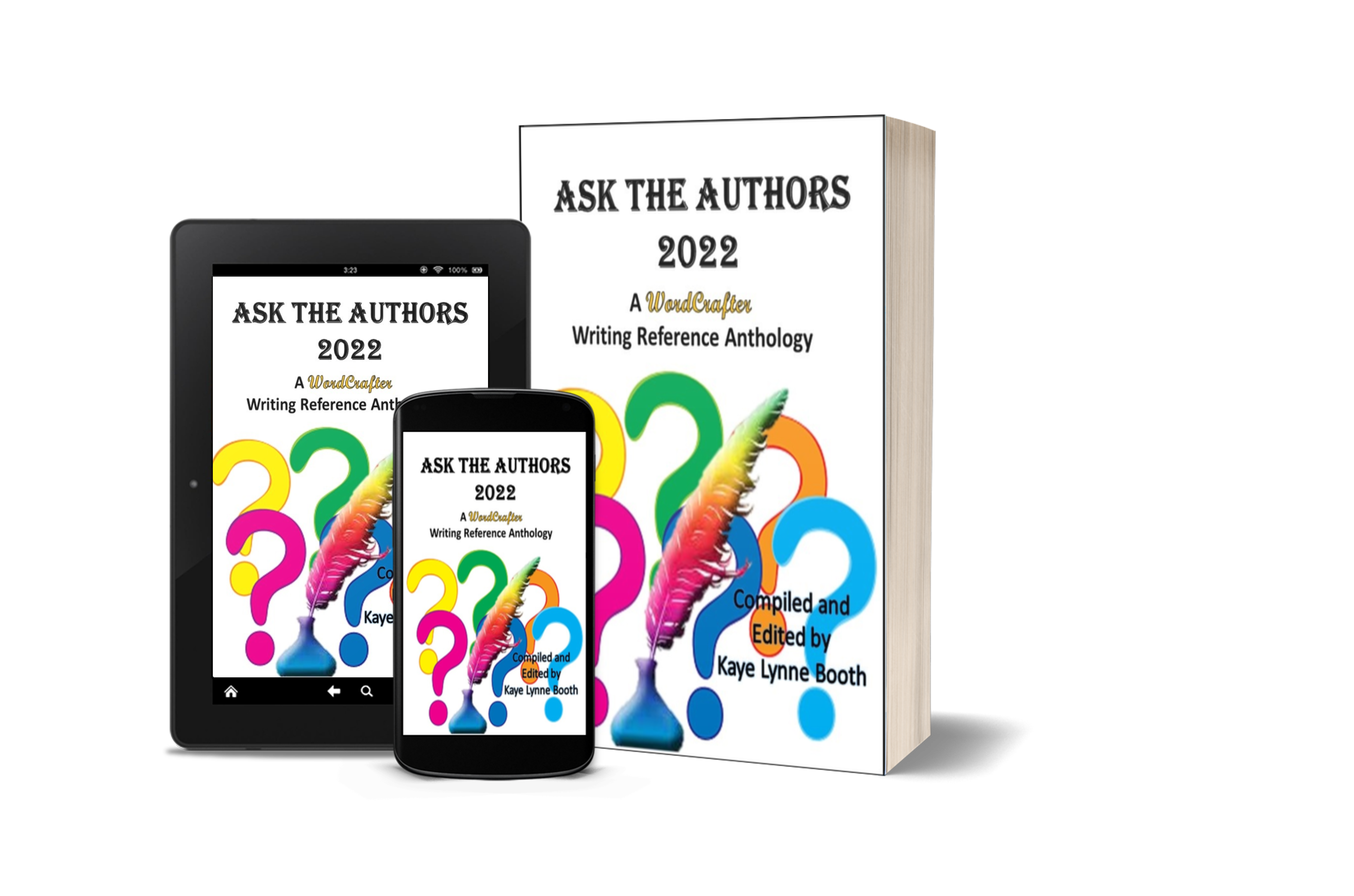
That’s right. The writing reference you’ve all been waiting for has arrived. Ten talented authors and industry experts have gathered together with me to share their writing tips and advice in essay and Q&A, creating a writing reference anthology like no other.
Where can you find publishing industry experts willing to share their secrets?
Ask the Authors 2022is the ultimate writer’s reference, with tips and advice on craft, publishing and marketing. Eleven experienced and successful authors share what works for them and offer their keys to success in traditional publishing, hybrid, and indie. You’ll learn industry wisdom from Mark Leslie Lefebvre, Kevin Killiany, L. Jagi Lamplighter, Bobby Nash, Paul Kane, Nancy Oswald, Chris Barili, Jeff Bowles, Roberta Eaton Cheadle, Mario Acevedo and Kaye Lynne Booth.
This book offers up-to-date and tried-and-true ways to improve your craft, explores current publishing and book marketing worlds. Take a peek inside and find out what works for you.
Praise for Ask the Authors 2022
“Ask the Authors is an up-to-date and broad-based compendium of advice from today’s working writers, to help you with understanding your own writing career. Great information!” —Kevin J. Anderson, New York Times bestselling author of Spine of the Dragon
Ask the Authors 2022
Ask the Authors 2022 is available in both digital and print. You can get your copy from your favorite book retailer through the Books2Read universal book link (UBL) here: https://books2read.com/u/3LnK8e
Sign up for the Kaye Lynne Booth & WordCrafter Press Newsletter for and book event news for WordCrafter Press books, including the awesome releases of author Kaye Lynne Booth. Get a free digital copy of Kaye Lynne Booth’s paranormal mystery novella, Hidden Secrets, just for subscribing.
Always have. I can’t seem to help it. I follow my heart instead of my head. But, once I chose a path, I am determined and stick to it. And when it comes to authoring, I bypass the easy path and stick to the rougher roads, learning as I go.
For my first novel, I chose the western genre, which isn’t exactly the fast lane to bestseller-dom. I publish poetry and anthologies. Most folks in the publishing industry will tell you these are much harder to sell than novels. And I’m a multi-genre author, who writes one-offs instead of series. Again, harder to sell, harder to build a fan base, because readers of my westerns probably won’t be interested in my paranormal stuff, or my short fiction collection, which has time travel, vampire, satire and origin stories all wrapped up between the covers.
If you have been following this blog and reading my posts, or if you subscribe to my newsletter, you may know that in the coming year my planned releases include the poetry anthology we just released, a nonfiction writing reference anthology, two science fiction/fantasy/horror/paranormal anthologies, and a fantasy fairytale anthology, and the re-release of my original western novel as a series starter. And yeah. That’s a lot. And no, not one of them will be an easy sell.
So why don’t I chose an easier path?
Well, for one thing, I enjoy working with other authors and compiling, editing and publishing poetry and short fiction anthologies allow me to do that. Also, I do it because I love a challenge. I find ways around or create solutions to help me through them, determined to make it all work even though it may be a rougher road. In fact, I’m trying to create a solution to the multi-genre author promotion thing right now.
But I think most of all, I have to write the stories that my heart wants me to tell. I’ve never tried writing to market. I like to write stories which excite me, and I’m not sure that a story written to fit into a certain genre or category would do that. And while some multi-genre authors stick to genres which are similar or sub-genres, I do things the hard way, so my genres span across the literary expanse, making my reader audience more difficult to find.
Let me tell you, it’s not easy for multi-genre authors to find and engage with all of their various audiences for the reason stated above. A reader may love your fantasy novel, but they may not care a bit about reading or learning more about your new steampunk novel. I hear there are super fans out there who fall in love with the author and will read anything they write, but as for me, I haven’t found any yet. And I’m betting that’s true for many multi-genre authors. It can be a real puzzler, figuring out ways to extend your reach in all of the genres that you write in, but I may have come up with one way to make that happen.
Cross-promotion.
More authors add up to extended reach, so I’m proposing that we create a newsletter swap group, comprised of multi-genre authors and all cross-promote each other’s books in our newsletters. We can all share new releases, and since we won’t all be releasing at once. Since all swap group members will be multi-genre authors, our audiences will already expect to hear about a variety of books and genres, so we’ll have a better chance of reaching readers who will buy our books. Every group members reach will be extended by the reach of all participating authors, and we will all have something else to say in our newsletters besides “Buy my book!” And best of all- it’s free promotion
Join us inuniting our promotion efforts for more followers and higher book sales.
I know a couple of authors who are already interested in taking advantage of this cross-promotion opportunity. If you are a multi-genre author who puts out an email newsletter at least monthly and wants to extend your reach for your books, I want to hear from you! Contact me at kayebooth@yahoo.com and put “Newsletter Swap” in the subject line. Tell me you’d like to participate, which genres you write in and tell me about any releases you have scheduled. I look forward to hearing from you.
Kaye Lynne Booth lives, works, and plays in the mountains of Colorado. With a dual emphasis M.F.A. in Creative Writing, writing is more than a passion. It’s a way of life. She’s a multi-genre author, who finds inspiration from the nature around her, and her love of the old west, and other odd and quirky things which might surprise you.
She has short stories featured in the following anthologies: The Collapsar Directive (“If You’re Happy and You Know It”); Relationship Add Vice (“The Devil Made Her Do It”); Nightmareland (“The Haunting in Carol’s Woods”); Whispers of the Past (“The Woman in the Water”); and Spirits of the West (“Don’t Eat the Pickled Eggs”). Her western, Delilah, her paranormal mystery novella and her short story collection, Last Call, are all available in both digital and print editions.
In her spare time, she keeps up her author’s blog, Writing to be Read, where she posts reflections on her own writing, author interviews and book reviews, along with writing tips and inspirational posts from fellow writers. She’s also the founder of WordCrafter. In addition to creating her own imprint in WordCrafter Press, she offers quality author services, such as editing, social media & book promotion, and online writing courses through WordCrafter Quality Writing & Author Services. When not writing or editing, she is bird watching, or hiking, or just soaking up some of that Colorado sunshine.
Sign up for the Kaye Lynne Booth & WordCrafter Press Newsletter for and book event news for WordCrafter Press books, including the awesome releases of author Kaye Lynne Booth. Get a free digital copy of Kaye Lynne Booth’s paranormal mystery novella, Hidden Secrets, just for subscribing.
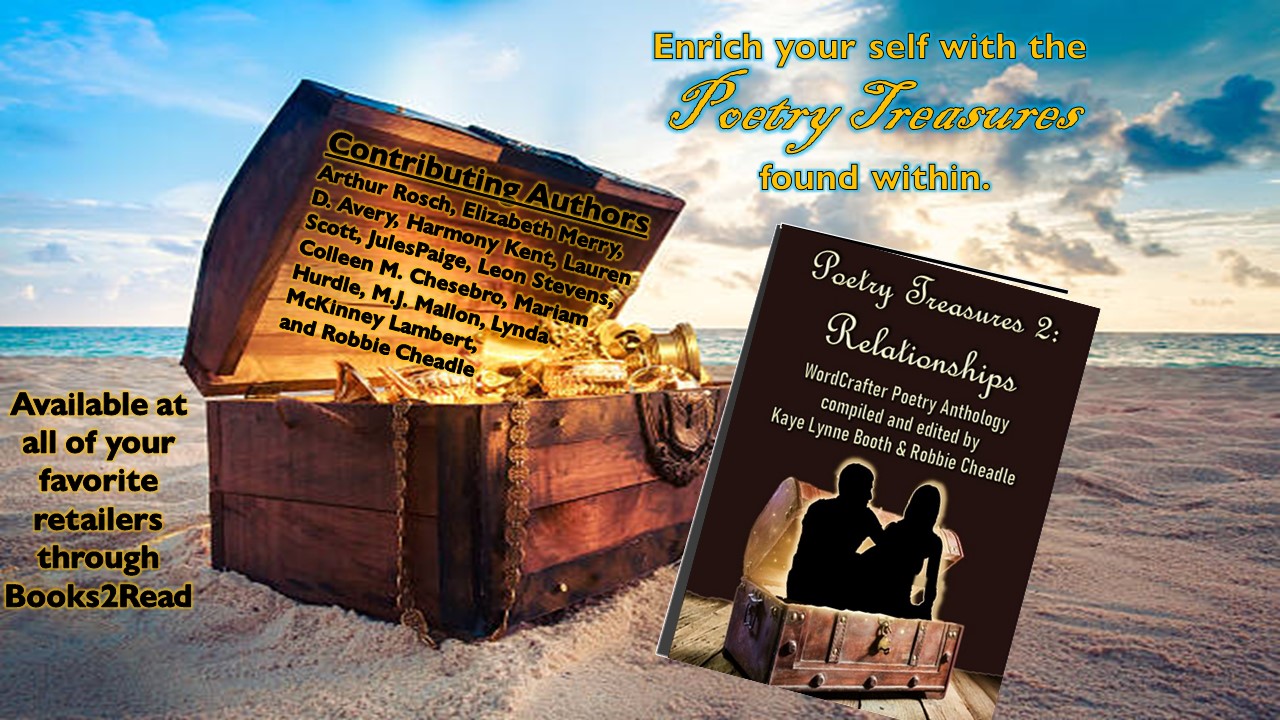
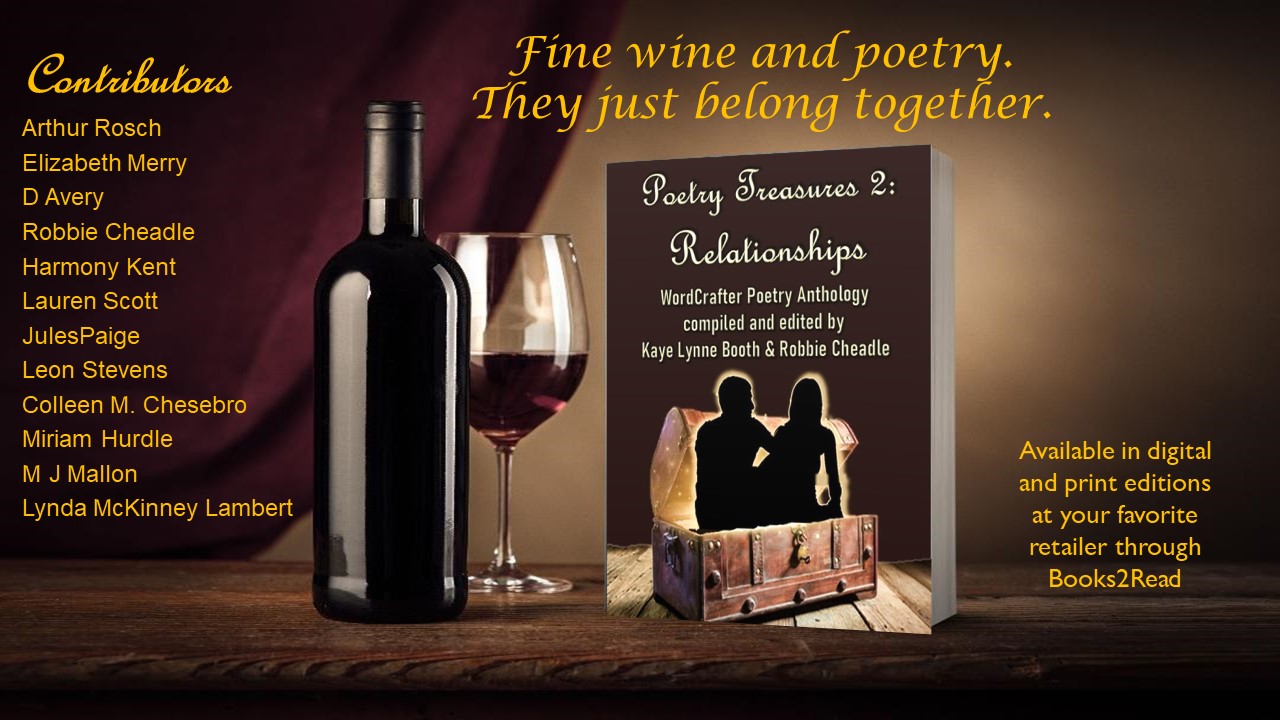
If, like me, you thoroughly enjoy Robbie Cheadle’s “Treasuring Poetry” blog series and can’t wait for her posts to come out each month, then you’ll be as excited as I am to learn that Poetry Treasures 2: Relationships is available at your favorite book distributors now!
Relationships are golden and each of
Arthur Rosch, Elizabeth Merry, D Avery, Robbie Cheadle, Harmony Kent, Lauren Scott, JulesPaige,
Leon Stevens, Colleen M. Chesebro, Miriam Hurdle,
M J Mallon, and Lynda McKinney Lambert
pay poetic tribute to their most intense
personal moments.
That’s right folks. Now you can get this wonderful collection of poetic gems by Robbie and her 2021 “Treasuring Poetry” guests all in one place. We’ll be doing a book blog tour April 25 – May 1 so you can learn more about the amazing treasures contained within, but you don’t have to wait.
Just click on the Books2Read Universal Book Link (ULB) to find your copy at your favorite book distributor now!: https://books2read.com/u/3kP8aK
The concept of 1,000 true fans was based on the theory of Wired editor, Kevin Kelly that a creator could make a descent living online with 1,000 truly invested fans, and it’s a concept that has been around for more than a decade. Today’s thinkers have revised that theory, and now it is believed that really, 100 true fans are all you need in this new “passion economy” which appears to be rising from within the new global internet communities, according to Aayushi Rachana, in her article “”100 True Fans” is All You Need in Passion Economy”, on Medium.com (March 11, 2021): https://medium.com/hapramp/all-you-need-to-know-about-100-true-fans-3fd72a35154f True fans are those who believe in you and want to support you in your creative endeavors; those fans who will buy everything that you write, just because you wrote it. And supposedly, we all have them – we just need to find them, or rather, we need to draw them to us.
That’s why I’ve decided to embark on a search for my own 100 true fans as I prepare to take my writing career to the full time level, but they aren’t going to just walk into my life and say, “Hi. I’m here to read everything you write, because I know how wonderful you are.” No, that’s not how it happens. True fans have to be earned; they have to be cultivated and grown from followers into fans, and a few will even mature into super fans, or true fans. But it doesn’t happen overnight, and it won’t happen on its own, and for me, it may be even more of a challenge as a multi-genre author who writes her heart instead of trying to write to market. So, I’ve developed a plan for drawing in followers, and hopefully, seducing them into fans, and then with luck it will turn into a long term relationship of super fans. Do I really have fans out there? We’ll just have to wait and see what happens.
The first step is to offer a way for my followers to become fans by learning more about me and my books through my newsletter. I haven’t been as good as I should have been about my newsletter, I admit. In fact, I let it go to the wayside for two years and only primed it with a revival issue this past month, which gave a brief overview of upcoming releases and current projects, including a reminder of the approaching deadline for the 2022 WordCrafter Short Fiction Contest (see submission guidelines here), and let my readers know that I’m still here. Newsletters also offer a way for followers to engage via email response, an opportunity for a connection to be made, which makes it more likely that they will become fans, or even superfans.
If you are reading this, then chances are good that you are at least a follower of mine. If you’d like to get to know me better or learn more about upcoming releases from myself or WordCrafter Press, you can join my newsletter and get a free digital copy of my paranormal mystery novella, Hidden Secrets, here: https://mailchi.mp/64aa2261e702/klb-wc-newsletter. Go on and subscribe. It’s free and you never know, you may even become a fan of you like what you discover in my newsletter.
Poetry Treasures 2: Relationships – Cover reveal
Above, you see the fantastic cover designed by Teagan Geneveine. I’m pleased to announce that to celebrate National Poetry Month, Poetry Treasures 2: Relationships will be scheduled for release in April. This wonderful poetry anthology features the works of guests from last year’s “Treasuring Poetry” blog series right here on Writing to be Read, hosted by Robbie Cheadle. Contributors include Arthur Rosch, Elizabeth Merry, D. Avery, M.J. Mallon, Miriam Hurdle, Colleen M. Chesebro, Lauren Scott, Harmony Kent, JulesPaige, Lynda McKinney Lambert, and Robbie Cheadle. Keep watching here, because it will be up for preorder soon.
Gilded Glass Up for Pre-order
You’ve all heard me talk about the great new anthology I am helping to put together through my publishing course at Western State Colorado University. In addition to the fabulous stories chosen from a plethora of exceptional submissions, it features stories by Sherrilyn Kenyon, Alan Dean Foster, Jonathan Maberry, Kristine Kathryn Rusch, and Michaelbrent Collings. I’m excited to tell you this amazing anthology is scheduled for release in July, but is now available for preorder and you can find it at your favorite retailer through books2read at the link below.
Sign up for the Kaye Lynne Booth & WordCrafter Press Newsletter for and book event news for WordCrafter Press books, including the awesome releases of author Kaye Lynne Booth. Get a free digital copy of Kaye Lynne Booth’s paranormal mystery novella, Hidden Secrets, just for subscribing.
In my publishing courses at Western State Colorado University, my instructors and mentors, Kevin J. Anderson and Allyson Longuiera have introduced us to several useful podcasts for independent authors and/or publishers and I’d like to share them with you here.
Hosts Dan Wells, Mary Robinette Kowal, Peng Shepard, and Howard Taylor offer up tips and writing advice, mainly on craft. This podcast provides short sessions, they claim 15 minutes, but the session for the link above is closer to 30. It’s an interview with Kevin J. Anderson about paying it forward, and it’s really good, so I tought you all might enjoy it. Kevin started out with traditional publishing way back when, but has now established his own independent press in WordFire Press, so he speaks to both sides of the industry, and this interview is proof that whether published traditionally or independently, authors are a good bunch. I’m proud to be counted amoung this tribe.
But the episodes really are brief, so take a little time and explore the site. They have many interesting topics of value to authors at all stages of their career. Here’s the main page link: https://writingexcuses.com/
With hosts Lindsay Baroker, Joe Lallo and Andrea Pearson, this podcast offers publishing and marketing tips, more than craft advice, but as six figure authors, they are crushing it and they are willing to share their advice with their listeners. I enjoy binging back episodes on my lengthy commute to and from my day job. They have a Facebook group which listeners can join, where they can pose questions to the hosts or their guests to be answered on the podcast. Lots of valuable information for authors here, whether just starting out or if you’ve been at it for a while.
I love this podcast! Host Joanna Penn (with a double N), is an author/enterprenuer and a futurist. Her podcast is filled with interviews and discussion about industry trends and where things might be headed. She’s got a killer accent which makes her fun to listen to, too.
Host Mark Dawson is a best selling independent author provides interviews and master classes on self-publishing. He and his co-host, James Blatch both have accents that are heavier and more difficult for me to understand, but they do offer up some valuable information on the independent publishing world.
This is every writers go-to podcast for all of your grammer questions, with Grammar Girl, Mignon Fogarty, who discusses proper grammar and common grammar mistakes. A quick reference for all grammar questions you are unsure of during writing and editing processes.
Like this post? Let me know in the comments. You can be sure not to miss any of Writing to be Read’s great content by subscribing to e-mail or following on WordPress. If you found this content helpful or entertaining, please share.