Day 5 of the WordCrafter Will Write for Wine & Stories I Stole From Lord Byron’s Bastard Book Blog Tour finds us over at Zigler’s News with another wonderful guest post from author Sara W. McBride and a review of her short story collection by Victoria Zigler. Join us to learn more about this author and her delightful books.
Stories I Stole from Lord Byron’s Bastard is a collection inspired by Venetian history. The fictional character, Alexis Lynn, wrote these stories in the novel Will Write for Wine by Sara W. McBride, but they are fun stand-alone adventures to be enjoyed with an excellent glass of Italian wine.
Today’s tour stop comes with a fun interview with author Sara W. McBride in addition to her guest post. So kick back a while and enjoy the tidbits offered here as you learn more about Sara and her wonderful books.
Introduction
Sara W. McBride, like many modern-day biological researchers, invents new swear words to sling at million-dollar machines while locked in a dark hole of a decaying academic hall. This has caused her to witness ghosts and create a romantic fantasy life within her head, which she now puts down on very non-technological paper with her favorite Jane Austen style quill pen.
Her first novel in the Alexis Lynn series, Will Write for Wine, and the companion short story collection, Stories I Stole from Lord Byron’s Bastard, both set in Venice, Italy, were recently released by Puck Publishing. She’s hard at work on the second Alexis Lynn novel, a Regency mystery series, and a haunted play. She strongly feels the world needs more haunted plays.
Don’t forget the awesome giveaway Sara is running on this tour, with a digital copy of each book up for grabs. You can enter the give-away for a chance to win at the link below:
Image of Lazzaretto Vecchio Credit: Wikipedia, Lazzaretto Vecchio Island, Plague Hospital
Interview with author Sara W. McBride
Why do you write?
Sara: To be immortal! Just kidding. It’s my fabulous mental escape into worlds and lives that I wish I could live.
Please tell us a bit about your publishing journey?
Sara: In 2014, I organized, edited, and published the first two NaNoWriMo Los Angeles anthologies. Then I helped with the next three. The group is still producing an annual anthology. It was a great way to learn the logistics of self-publishing and how to shape short stories. This year, my husband and I launched Puck Publishing, and we’re hoping to publish something every month.
Over the past twenty years, I’ve written fourteen bad novels that I’m glad I never published. LOL!
What made you decide to self-publish?
Sara: In the late 1990s, I was an assistant to a Hollywood book agent and I learned the ins and outs of traditional publishing and movie book deals. The agents and publishers were so parasitic on the author, it gave me the willies. In those days, traditional publishing paid high advances, but the treatment of the authors still put a bad taste in my mouth.
Today, they rarely pay above a $10,000 advance to a new author, they expect the author to do all the marketing, and then the publisher keeps the copyright and sells it off whenever they like, to whomever they like, and the book goes out of print.
I’ve seen too many friends get screwed by traditional publishing.
Will Write for Wine takes place in the artistic and romantic setting of Venice. Have you explored the physical locations for your books in the flesh, in order to get the details right when writing about these locations? Have you been there? Have you lived there? Why did you choose this setting?
Sara: I’ve had five research trips to Venice, totaling about five weeks. I’ve been in almost every church and museum of Venice, and a few places I probably wasn’t supposed to enter. I apparently don’t understand the meaning of yellow caution tape or closed doors.
Most of the Venice locations in the book are real places, but Manu’s osteria is fictional. However, I stole menu items from many of my favorite osterias in Venice.
I think Venice is one of the most magical and haunted cities in the world. Many people describe it as a floating museum; the entire city is trapped in the Renaissance. But if you simply sit still, sip a glass of wine in a campo or piazza, listen to the opera singers, and watch the people and pigeons, there’s a vibe that sinks into you. Every part of the city is simultaneously dead and alive. It is that barrier, that thin line between life and death that pervades every stone, stench, and serenade of Venice. Delicious!
Stories I Stole From Lord Byron’s Bastard involves Venetian history. What is the fasciation of this area for you?
Sara: I’m a history nerd! Venice is one of those cities that drips with history, but not just through architecture and museums, through the people, the food, the many generations that still live in the same house, the ghosts that are accepted as common place, and the street signs. Ponte del Diavolo, the Devil’s Bridge is bound to inspire a story in anyone. Gheto Novo, or the New Ghetto, caused me to question the history of the Jewish community within Venice.
It’s difficult for me to walk from one piazza to another in Venice without my mind percolating a story based purely on the sights, sounds, and smells. And I love the smells of Venice. Both the good and the bad. Only Venice can induce an entire story purely through its smells. I’ve learned to navigate the labyrinth of Venice by sniffing the air. How is that not a story!
Is there anything unique or unusual about your writing process?
Sara: I don’t know the end until I get there. I just write into a dark void and somehow it all works out. It keeps the process magical and fun. I used to outline, but I always got bored with the book before I finished it. Outlining turned writing into work. Ick! Writing needs to be fun for both the writer and the reader.
Is your writing process plot driven or character driven?
Sara: Character driven! Definitely.
Do you write with music, or do you prefer quiet?
Sara: Quiet! Or the hubbub of a coffee house crowd, hotel lobby, airplane terminal.
Atmosphere is important. What do you do to get into the writing zone?
Sara: There’s a zone? How do I find that? I want a writing zone. I just go about my day and jot down paragraphs, dialogue, and then type them in when I’m next at my computer.
How much of the story do you know before the actual writing begins?
Sara: NONE! Okay, maybe the opening scene. But usually not even that. Just a character in a place, who is feeling something.
Wine plays a big role in your character, Alexis Lynn’s life. What is the attraction?
Sara: I love wine! I also love beer, whisky (Scottish spelling), Compari cocktails, and most dishes cooked with truffles. However, to preserve my liver, I typically only drink once-a-week, so it’s a big event for me. I cherish my weekly glass of wine and how it complements my meal. Alexis drinks way more than I do. Fictional wine can’t damage a fictional liver.
Are you a wine connoisseur? What is your favorite wine?
Sara: I love wine! I once dreamed of becoming a wine sommelier. Isn’t my favorite wine obvious? Soave! Like Alexis Lynn, I also discovered Soave on my first trip to Venice. It’s been a favorite ever since, but difficult to find in America. Hence, more motivation to travel!
What’s something most readers would never guess about you?
Sara: My husband and I got engaged four days after we met. Unlike Alexis Lynn and her marital troubles, my husband and I have had a relatively easy, adventurous, crazy, happy and supportive marriage. This summer, we’re celebrating out twenty-five year anniversary. But I don’t know how we’re celebrating. Any suggestions?
You’ve got a scientific background, like your character. How much of Alexis Lynn is you?
Sara: Um … She’s totally me! Are authors allowed to confess that?
What time of day do you prefer to do your writing? Why?
Sara: Morning, if given a choice. But it happens all day.
What’s the hardest part of the story for you to write: beginning, middle or end?
Sara: I write chapters as if they are short stories, and then I arrange them into a book when I think I’ve developed something that has a beginning, middle or end. Is that weird? I don’t write chronologically. And I have chapters/stories that didn’t make it into this book that will be in the next one.
Alexis Lynn has a conversation and wine tasting with Casanova. Would you like to talk a bit about the inspiration for that scene?
Sara: I was enjoying my weekly glass of wine while reading the memoirs of Casanova and thought, “Man, this guy would give horrible marriage advice!” Then I grabbed my computer.
Besides Casanova, which author, poet or artist, dead or alive, would you love to have lunch with?
Sara: Lord Byron, or course! He’s bloomin’ brilliant, but people only remember him as a seducer. Sure, he seduced a few women, usually married ones, and has some famous bastards; the famous mathematician, Lady Lovelace, is one of his illegitimate children. But he also wrote the first English-Armenian dictionary, and was a very, charming, intelligent debater. His letters are filled with wisdom and humor. In an incredibly elegant manner, almost complimentary, he was able to inform someone of their idiocy. I would love to have lunch with Lord Byron, even if he spent an hour politely insulting me.
Besides writing, what are your favorite things to do?
Sara: Travel! I also love hiking, playing board games, reading every genre, watching cheesy Hallmark Christmas movies in the middle of summer, and learning Italian so I can one day move to Venice.
What is the biggest challenge of being a writer?
Sara: Pulling together a bunch of short stories into a cohesive novel and then figuring out what scenes are missing.
It was funny with Will Write for Wine, my husband included a little gondola and gondolier on the cover, and I suddenly realized that I didn’t have any gondola scenes in the book. Both the gondola scenes were the last scenes I wrote.
If writing suddenly made you rich and famous, what would you do?
Sara: Move to Venice and write more!
What’s the most fun part of writing a novel or short story/screenplay? What’s the least fun part?
Sara: Most fun? Dialogue! I’m originally a playwright, so I love dialogue.
Least fun? Killing a character I like. Killing a nasty character is delightful, but killing a kind character, or a character I’ve spent years with, is heart-wrenching.
How much non-writing work, (research, marketing & promotion, illustrations & book covers, etc…), do you do yourself for your books?
Sara: I do everything myself, but my husband does the cover art and most of the website maintenance. We have fun working together.
If your book was made into a film, who would you like to play Alexis Lynn?
Sara: Oh! Juicy question. Reese Witherspoon. Yep, definitely Reese Witherspoon. Mid-40s, cute, and like Alexis, she exudes positivity even when her world is falling apart.
What goals do you set for yourself in your writing?
Sara: Don’t plan ahead. If I don’t know what’s going to happen, neither does the reader. This is really funny because I’m writing a murder-mystery right now and halfway through the book, my murderer, who I didn’t know was the murderer, just totally confessed to the murder. So, um, geez, I guess that book is going to be a different style of murder mystery. LOL! So, I guess my goal in writing is to always be surprised.
As you can see, Sara is an author who loves what she does ad is pretty comfortable in her own skin. Now, let’s hear about her inspiration for the fourth story in Stories I Stole From Lord Byron’s Bastard, “Lazzaretto Vecchio: A Dowry for Saffron”.
Guest Postby Author Sara W. McBride
Inspiration for “A Dowry for Saffron”
What inspired the story, “Lazzaretto Veccchio: A Dowry for Saffron?”
“Sia laudato il signor Iddio non ci sono stati morti.”
Bless the Lord, there have been no deaths [today].
December 24, 1630, in Sant’Eufemia, Venice.
* * *
This quote is from the opening of a Nature paper, “A digital reconstruction of the 1630-1631 large plague outbreak in Venice,” by Gianrocco Lazzari, et al. Published Oct. 20, 2020.
* * *
I’ve always been fascinated by the European plagues, but when I read the above Nature paper, the effects of the 1630-31 plague on Venice consumed my mornings for several weeks. This especially seemed relevant while living through a new global pandemic, thankfully with much lower mortality rates.
In 1348-49, bubonic plague killed one-third of the European population, up to 25 million people, and Venice, as a crossroads for international trade, lost half its residents. Imagine living in a bustling city of 100,000 people, and half of them die within 18 months. It would be horrifying and haunting.
In response to the devastating plague of 1348-49, Lazzaretto Vecchio was established in 1423 as the first quarantine island in the Mediterranean region, and was used to separate the healthy from the sick during Venetian plagues. Lazzaretto Nuovo was established shortly afterward as a place where ships suspected to carry sickness among their passengers or crew were anchored for 40 days. English acquired the word “quarantine” from the Italian term for 40 days, quaranta giorni. The lagoon island of Poveglia also became a quarantine outpost sometime in the 15th century. It’s rumored that half the soil of Poveglia is human ash from burned plague corpses. Then it became a mental hospital from 1922-1968. No wonder the place is one of the most haunted locations in Europe.
Considering the 15th century world had no idea how disease was spread, the idea of quarantining the sick or foreigners arriving from plague stricken areas was very innovative.
The story, “Lazzeretto Vecchio: A Dowry for Saffron,” takes place during Venice’s plague of 1630-31, which killed a third of the city’s population. Both plague islands were used to isolate and treat the sick, however, caregivers were needed to work at the island hospitals, mostly because, I assume, workers kept dying of plague.
The Italian city of Ferrara had a long history of successfully avoiding plagues that ravaged other parts of Italy. They closed their city gates and screened all arrivals for any signs of disease. They insisted that Fedi, proofs, identification papers from a plague-free zone must be presented. Ferrara, starting as early as medieval times, engaged in public sanitation campaigns, sweeping away garbage and liberally spreading lime powder on any surface that had come into contact with an infected person.
When an Italian physician, Girolamo Fracastoro, published a text in 1546 describing the “seeds of disease” as something that could stick to clothes and objects, Ferrara increased their sanitation practices during plagues and burned the clothes of any infected people. Removing garbage, spreading lime powder and burning infected clothing probably reduced the flea pestilence that actually carried Yersinia pestis, the bacterium that causes plague.
Many natural remedies were prescribed for protection against the plague, but a medicinal oil designed by a Spanish physician, Pedro Castagno, was written into Ferrara’s, “Reggimento contra la peste,” regimen against the plague. The oil, called Composito, was recommended to be applied to the body.
“Before getting up in the morning, after lighting a fire of scented woods (juniper, laurel and vine shoots), warm the clothes and above all the shirt, rub first the heart region, near the fire to ease balm absorption, then the throat. [Afterwards], wash hands and face with acqua chiara (clean water) mixed with wine or vinegar of roses, with which sometimes all the body should be cleaned, using a sponge.”
Ferrara city’s regimen against the plague
The contents of Composito was never fully disclosed, but researchers examined the records of materials ordered by Castagno and determined that the oil contained venom from scorpions and vipers, and myrrh and Crocus sativus, which is a saffron flower from which the filaments produce the golden spice saffron. Both myrrh and saffron are known to have antibacterial properties, as does scorpion venom with the bonus that it’s also a pain reliever. So basically, Composito was an early antibiotic and pain reliever combo. Pretty nifty!
According to census records, Venice’s population was around 140,000 in 1624. By 1633, that number had fallen to 102,000. More than 43,000 deaths were recorded over just three years, with nearly half of them taking place between September and December 1630. The city of Venice began several public works projects, like the grand Baroque church, Santa Maria della Salute, greeting guests at the entrance to the Grand Canal. The church’s construction began in November 1630 with the goal of keeping citizens employed and maintaining art and labor skills.
The city of Venice also purchased food for the quarantined, both in the city and on the plague islands. It is logical to speculate that in the early months of 1631, Venice might have asked Ferrara, a city with success at conquering the plague, if their convents could be paid in order to encourage volunteers to work at the plague islands. My story is fictitious, but the stage was set for the events I describe in the story. I also talked about pirates in the story. Yes, there were pirates at this time: mercenary pirates and government deployed pirates (particularly from England).
My story focuses on a group of nuns who have been “volunteered” by their convents, and how they sacrifice one nun into a marriage in order to secure their much needed ingredient of saffron for Composito, their only hope for survival on the plague islands. The politics and finances of Venice in 1631 created a world where this story could have happened. There’s a lot of history not recorded in text books, and this is a story that no one would want recorded.
Something fun for readers:
In my research of the plague islands, I was surprised by the lack of ghost ship stories haunting the Venetian lagoon. If you know of any, please write me at sara@puckpublishing.com. If you’ve ever visited the eerie lagoon island, Poveglia, the plague island, turned insane asylum, turned old-folks home, which now stands empty—less the chilling screams on foggy nights—I want to hear about it.
Stories I Stole from Lord Byron’s Bastard is a collection inspired by Venetian history. The fictional character, Alexis Lynn, wrote these stories in the novel Will Write for Wine by Sara W. McBride, but they are fun stand-alone adventures to be enjoyed with an excellent glass of Italian wine.
Welcome to the WordCrafter Will Write for Wine & Stories I Stole From Lord Byron’s Bastard Book Blog Tour. This is going to be a fun tour because we have two fabulous books to celebrate by a wonderful new author Sara W. McBride. Will Write for Wine is her debut novel about a writer, Alexis Lynn, and her funny and romantic escapades when she moves to Venice to start a new life. Stories I Stole From Lord Byron’s Bastard is the recently released short story collection and companion to the novel. Her fiction is well researched and presented with a witty flare which I find refreshing and I think you will too. I hope you’ll follow the tour and join us at each blog stop. You’ll find the schedule and links below.
Blog Tour Schedule
Monday, June 27 – Opening Day Post – Writing to be Read – Guest Post: Inspiration for the Devil’s Bridge” & Review of Stories I Stole From Lord Byron’s Bastard
Tuesday, June 28 – Showers of Blessings – Guest Post: Inspiration for “Stealing Georgione’s Mistress”
Wednesday June 29 – Carla Loves to Read – Guest Post: Inspiration for “The Masked Kiss”
Thursday, June 30 – Writing to be Read – Guest Post: Inspiration for “A Dowry for Safron” & Interview with Sara W. McBride
Friday, July 1 – Zigler’s News – Guest Post: Inspiration for “The Pregnant Man” & Review of Stories I Stole From Lord Byron’s Bastard
Saturday, July 2 – Annette Rochelle Aben– – Guest Post: Inspiration for “The Haunted Palazzo”
Sunday, July 3 – Roberta Writes – Guest Post: Inspiration for “The Secret Vault”
Monday, July 4 – Wrap-Up Post – Writing to be Read – Guest Post: Inspiration for Will Write for Wine & Review of Will Write for Wine
Give-Away
In addidtion, to the awesome guests posts, interview, and reviews at each tour stop, Sara is offerin a chance to win a digital copy of each book, Will Write For Wine & Stories I Stole From Lord Byron’s Bastard. Leave a comment and click on the link below to enter for a chance to win:
I must begin by giving kudos to Sara W. McBride for the clever way that she has braided these seven short stories in this collection in with her debut novel, (and I’m told that she is currently working on a companion wine tasting journal). While both of these books stand alone easily, they really should be consumed together. In the novel, Will Write for Wine, we see the story of how Alexis Lynn comes to write these stories, but we don’t get to actually see the stories. For that, you must read Stories I Stole From Lord Byron’s Bastard, which offers not only the stories, but the true inspiration behind them. After reading her delightful novel, and seeing Alexis’ digging up the background for the stories and seeing Manu’s reaction to reading them, one can’t help but be curious about the actual stories and want to read the collection. It’s brilliant!
Now let me turn things over to the author, Sara W. McBride, so she can share her inspiration for the story.
The moment I saw the sign “Ponte del Diavolo,” I knew I had to write a story. At the edge of the bridge sits Palazzo Priuli, home to several Doge Priulis and is now an elegant hotel (www.hotelpriuli.com) in the Castello area of Venice. I had already been researching the tragic death of Antonio Foscarini, and then I discovered that the doge—Basically the president of Venice—who had him executed lived in the palazzo at the edge of Devil’s Bridge. It’s not often that history simply hands me a story, but there it was, burning bright in the Lancet windows of a 14th century palazzo. Here’s the real history behind the Devil-possessed Doge Priuli and his most famous victim:
Antonio Foscarini, executed on April 22, 1622, was a Venetian ambassador to London (1611-1615) and is rumored to have had an affair with King James’ Queen, Anne of Denmark. He returned to Venice during a “Spy War” with Spain and was suspected of betraying Venetian secrets to Spanish officials. Someone who knew about his affair with the Queen of England might have seeded this rumor. Upon his arrival in Venice in December 1615, he was arrested and held prisoner for three years under Doge Bembo, who uncovered the Bedmar plot which would have permitted Spanish mercenaries to march on Venice. In the midst of the crisis, Bembo died—or was possibly assassinated by the Spanish—and Doge Nicolo Donato reigned for a mere 35 days before he died. I believe he was assassinated by the Spanish, but have found no clear evidence for such a claim.
I’m considering writing a novel on the Venice/Spain Spy War of 1615-1622 because it’s super fascinating and an interesting statement on what fear does to a governing body.
Antonio Priuli (1548-1623) was elected doge in 1618 and released Foscarini in order to monitor him and his activities. Priuli was a brutal doge who arrested hundreds of innocent Venetians suspected of plotting against Venice. Was he possessed by the devil? Probably not, but how Devil’s Bridge earned its name is a mystery, so I took license and speculated that the devil enjoyed his residence at the bridge’s end.
On April 8, 1622, Foscarini, then a Senator of Venice, was arrested and accused by the Council of Ten—basically the governing body of Venice, particularly over state security matters—of meeting with ministers of foreign powers and communicating the most intimate secrets of the Venetian Republic. The evidence was weak and Foscarini denied all charges, yet he was still condemned to a public execution for high treason. Why? The answer will never be known, so I had fun speculating that perhaps a guest of his, under her own volition or persuaded by a demonically possessed doge, provided false evidence to seal his fate.
By the end of 1622, Doge Priuli showed signs of illness. In January, 1623, the same Council of Ten revoked Foscarini’s guilty verdict—Whoops, they were wrong—and reinstated the family’s honor with a posthumous exoneration. His bust and tomb can be found in the Church of San Stae in Venice. There’s more on Foscarini’s final resting place in “The Masked Kiss,” another story in this collection.
Doge Antonio Priuli died on August 12, 1623, but oddly, I am unable to locate his tomb. It’s usually pretty easy to find a doge’s tomb. I would have thought him to be buried in Santi Giovanni e Paolo (aka San Zanipolo), which houses tombs of 25 doges, but I haven’t found him there. The art and sculpture in this basilica-sized ediface is amazing! This behemoth church manages to hide on the North side of the Castello and is off the beaten tourist path, but you should definitely seek it out.
Two other Priuli doges, brothers Girolamo Priuli, 1486-1567, and Lorenzo Priuli, 1489-1559, are buried in San Salvador, but apparently there was no space remaining for their Priuli descendent, or perhaps the family just didn’t like Antonio.
Another source claims that the spy-hunting doge is buried alongside Marco Polo in the Church of San Lorenzo in the Castello district, but San Lorenzo has been closed for over a hundred years, only recently reopened, and I have not seen or read any evidence of the doge’s tomb being contained within. They couldn’t find Marco Polo either.
If you find the tomb of Venice’s 94th Doge, Antonio Priuli, please write to me at sara@puckpublishing.com. Otherwise, I’ll just have to assume he’s buried in the depths of the canal under Ponte del Diavolo.
Stories I Stole From Lord Byron’s Bastard is a short story collection by Sara W. McBride which will tickle your sense of adventure and discovery, and perhaps, your funny bone. A companion to her debut novel, Will Write for Wine, these stories bring Venetian history to life with a personal touch of humor, adding in the missing details which historical archives and family histories only elude to. Each story is accompanied with the history and inspiration behind it, and it’s fun to see how McBride crafted in characters to transform legend to story.
Included are tales of an unsuspecting hero who gets the girl, in “The Masked Kiss”; an apprentice who betrays his master in the name of love in “Stealing Giorgione’s Mistress”; a bridge occupied by a demon, in “The Devil’s Bridge”; a nun who chooses life on a plague island over marriage in “Lazzaretto Vecchio: A Dowry for Saffron”; a smuggling operation gone awry in “The Secret Vault”; and a delightful tale of a young artist forced to masquerade as a male in order to ply her trade in “A Gentleman’s Portrait by a Pregnant Man”. But, I’d have to say my favorite story in this collection is “The Haunted Palazzo”, because I’ve always been a sucker for a good ghost story, and the mysterious specter and wet windowsill are certainly prime food for ghostly fodder.
Stories I Stole From Lord Byron’s Bastard is a collection of short historically inspired stories which are light and entertaining reads. Fun and enjoyable. I give it five quills.
Hello and welcome back to Segment 8 of the “Ask the Authors 2022” blog series. This week brings an introduction to speculative fiction and horror author, Jeff Bowles, who shares a his thoughts on editing in the anthology, “Contrary to Popular Editing Beliefs”, & a Q & A session on editing and revision.
If you missed any of the previous segments, you can find them here:
Segment 1: Introductions to Kaye Lynne Booth & Kevin Killiany/Writing Life Q & A session.
Segment 2: Introduction to Bobby Nash/Pre-Writing Rituals Q & A session.
Segment 3: Introduction for Roberta Eaton Cheadle/Plot & Storyline Q & A session.
Segment 4: Introduction for Paul Kane/Character Development Q & A.
Segment 5: Introduction for Mario Acevedo/Action, Pacing and Dialog Q & A.
Segment 6: Introduction to Nancy Oswald/Tone: Voice, Person, Tense and POV Q & A.
Segment 7: Introduction for Chris Barili/Setting & World Building Q & A.
And now let’s move right into this week’s segment.
Meet Jeff Bowles
Jeff Bowles is a science fiction and horror writer from the mountains of Colorado. The best of his outrageous and imaginative short stories are collected in Godling and Other Paint Stories, Fear and Loathing in Las Cruces, and Brave New Multiverse. He has published work in magazines and anthologies like PodCastle, Tales from the Canyons of the Damned, the Threepenny Review, Dark Moon Digest, Whispers of the Past, and Spirits of the West. His story, “A Peaceful Life I’ve Never Known” was the winning story in the 2019 WordCrafter Short Fiction Contest.
Jeff earned his Master of Fine Arts degree in creative writing at Western State Colorado University. He currently lives in the high-altitude Pikes Peak region, where he dreams strange dreams and spends far too much time under the stars. Jeff also has two novels published, God’s Body: Book One – The Fall, and Love/Madness/Demon.
On to the Q & A.
Editing and Revision
How do you feel about the editing process? Love it or loathe it?
Mario Acevedo: The editing process is what turns the rough clay into art. The second draft is when your story begins to shine.
Paul Kane: I really enjoy the editing process. I don’t find it half as much work as getting the words down in the first place. I know for a lot of people it’s the other way around, but I like having written, when I’ve got the chunk of words down and I’m going through, refining it, making it better with each edit or pass. It’s like a sculptor with a lump of stone, each time you chisel some of that away the sculpture starts to take shape. The more you work on it, the better the shape becomes. I like having that lump of stone to work with, I’m just not that mad on getting the stone and carrying it to the studio or workshop in the first place, if you see what I mean.
Bobby Nash: Editing is part of the job. A novel gets multiple edit passes. I do a self-edit while writing it, usually going over yesterday’s work before starting on today’s writing. Then, I give it another edit after I’m finished. Once I’m satisfied, it goes to the editor then back to me for adjustments, changes, discussions. There may be two edit passes here. Finally, there’s the galley edit, which is my chance to look the story over in the form it will be printed to make sure it looks good.
Robbie Cheadle: I enjoy editing and I find it easier than the initial writing process. Re-writing and amending to create a better story is rewarding and satisfying for me. I edit as I go along and at the end of each chapter. If something changes in the story that effects what I have already written, I go back and update it. I cannot leave a change undone and just move on like some writers do. It bothers me too much.
Nancy Oswald: I look at it as an opportunity to make your book better, but there are times I’ve loved it and other times, not so much.
What roles do alpha and beta readers, critique partners, proofreaders and professional editors play in your editing and revision process?
Mario Acevedo: All are necessary and have helped improve my stories. My critique partners are my beta readers.
Paul Kane: I don’t really use alpha or beta readers. It works for some people, but not for me. I find if I get too much feedback, especially if it’s conflicting, it just confuses me more than it helps. I prefer to trust my own judgment initially, or – if she has time – my wife Marie has a read before it goes off somewhere. The editor you’re working with, especially if it’s a bigger publisher, will have things they want you to change or cut or whatever, which is absolutely fine. That’s the process for me, and part of the job. I just prefer to not let anyone see it before then. I think maybe it’s bad luck or something, as I am quite superstitious.
Bobby Nash: I have used beta readers, but not often. I do have a small group of patrons that get stories early. Some offer feedback. I work with editors, proofreaders, and others to get the books as close to perfect as I can make them.
Robbie Cheadle: I am part of an on-line writing group which meets for 2 hours every second week. We all read excerpts from our stories and give each other advice and feedback. One of the members of this group, beta reads each chapter of my novels as I go along and gives me constructive criticism and feedback.
Once the book is complete and I’ve edited it to my satisfaction, I send it to my developmental editor who provides feedback on structure, plot holes, loose threads, unnatural dialogue, and other important elements of my writing and story.
Once I’ve updated the novel for her comments, I send it back to her for a final read and make any last changes.
I then send it to a proofreader who helps pick up spelling and punctuation errors which I correct before sending the book to my publisher who does a final read and edit.
How do you handle your editing: hire professional editors? Trade-off with other authors? Critique partners? Beta-readers? Self-edit? Have a publisher that handles those things?
Paul Kane: I self-edit until it’s time to send it off to my actual editor at whatever publisher I might be working with at the time. If she has time, Marie has a look through and does a pass, but more often than not it’s me who goes through and does the drafts. Then it might go through several more once the editor has come back to me with notes, then finally the proofing and final editing stages.
Bobby Nash: I have editors I work with on my creator-owned projects. For books I do for other publishers, they provide the editor I will work with on the book. Before it gets to them though, I have done a self-edit pass or two.
Nancy Oswald: All of the above at different times, but bottom line, I like to be involved in all phases.
What do you look for in an editor?
Paul Kane: As I say, I don’t send it to an editor I pay or anything. It goes to the editor at the publishers, and you don’t get a choice in that, seeing as their company is paying you for the story or book. Having said that, I’m very lucky to have worked with some of the best editors in the business and there’s been nothing that’s really had me tearing my hair out. So, I guess what I’m looking for with an editor is someone who’s easy to work with, and we can go back and forth on changes or edits that will hopefully make the whole thing better in the long run.
Bobby Nash: Editing is more than catching typos and grammar errors. A good editor asks questions about story, points out inconsistencies, and offers advice and solutions. It’s a partnership. The writer and editor have the same goal. We both want to put out the best book we can.
Robbie Cheadle: In a developmental editor, I looked for someone who could help me resolve issues with my story without changing my voice and writing style. I found a ‘good fit’ editor a few years ago when I was writing Through the Nethergate and used the same lady to assist me with A Ghost and His Gold. While the Bombs Fell was developmentally edited by a different person. I was very happy with her feedback, but she was not available to help me with my most recent two books.
Nancy Oswald: Editors need to “get” the book. They need to be attentive to details, but not insert themselves into the MS to the extent of it sounding different.
Have you ever received an edit where it was obvious the editor didn’t get what you were trying to do? How did you handle that?
Paul Kane: I’ve had edits where I’ve felt the need to explain certain things, or argue my case about a specific point, but that’s only really been a small part of the overall edit. I’ve never had an editor do a complete hatchet job on one of my books, and for that I’m truly grateful.
Bobby Nash: It happens. Did I not explain it well? If so, then a rewrite needs to happen. The writer and editor talk. You discuss and work it out. As I mentioned above, the editor and writer are partners. The editor is not my enemy. We both want the book to be the best it can be.
Robbie Cheadle: This has not happened to me. Both developmental editors I have worked with have helped me tremendously and so does my beta reader. I am very open to suggestions and comments to help me improve my writing and stories.
_________________________
That wraps up this week’s “Ask the Authors 2022” blog series. Be sure and drop by next Saturday, when we introduce author and industry expert Mark Leslie Lefebvre and share a Q & A session on Publishing. You won’t want to miss all the useful information in that one. See you there.
Ask the Authors 2022
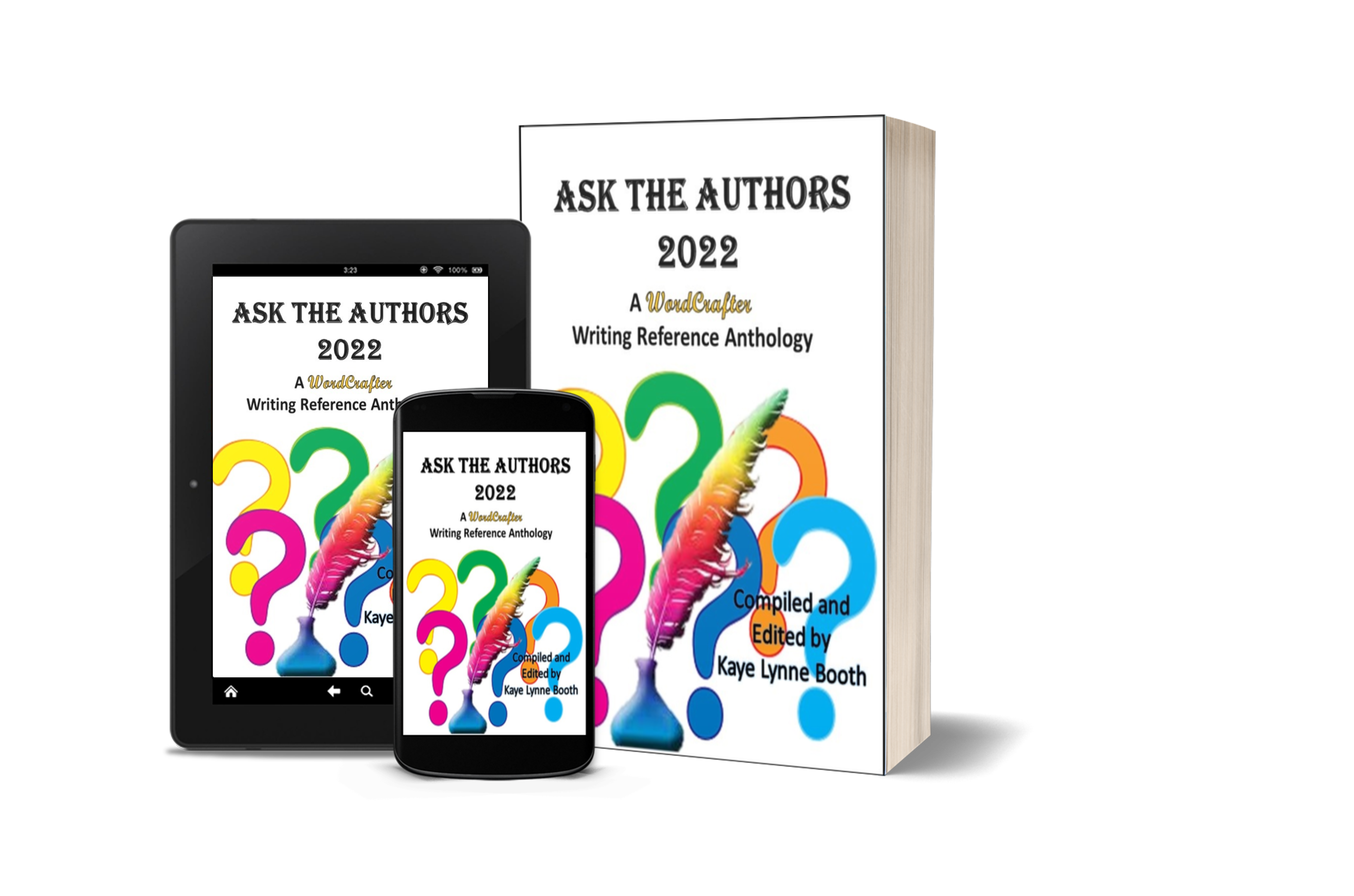
But first, just take a minute to grab your copy of this writing reference anthology which no author should be without from your favorite book distributor at the special send-off price of $3.99, using the Books2Read UBL: https://books2read.com/u/3LnK8e
_______________________
Join Kaye Lynne Booth & WordCrafter Press Readers’ Group for WordCrafter Press book & event news, including the awesome releases of author Kaye Lynne Booth. Get a free digital copy of her short story collection, Last Call and Other Short Fiction, as a sampling of her works just for joining.
Welcome back to the “Ask the Authors 2022” blog series. This is segment 7 of this Saturday series, which brings you a glimpse of the fantastic writing tips and advice featured in the Ask the Authors 2022 writing reference anthology, and today we introduce contributing author Chris Barili, who shares his thoughts and methods for character development in his own “Character Blueprint” in the anthology, and a Q & A session on setting & world building.
If you missed any of the previous segments, you can find them here:
Segment 1: Introductions for Kaye Lynne Booth & Kevin Killiany/Writing Life Q & A session
Segment 2: Introduction for Bobby Nash/Pre-writing Rituals Q & A session
Segment 3: Introduction for Roberta Eaton Cheadle/Plot & Storyline Q & A session
Segment 4: Introduction for Paul Kane/Character Development Q & A session
Segment 5: Introduction for Mario Acevedo/Action, Pacing & Dialog Q & A session
Segment 6: Introduction for Nancy Oswald & Tone: Voice, Tense, Person & POV Q & A session.
Let’s get started.
Meet Chris Barili
Chris Barili is a speculative fiction and romance author who was also my cohort in the M.F.A. in Creative Writing program at Western. He writes in a wide range of genres, including weird western (Hell’s Marshal series), and science fiction (Shadowblade) under his own name, and romance (Smothered) under the pen name B.T. Clearwater. Chris was a presenter and panel member for both the 2020 WordCrafter Stay in Place Virtual Writing Conference, and the 2021 WordCrafter New Beginnings Virtual Writing Conference.
Besides writing, Chris lifts weights, mountain bikes, practices martial arts and battles with Parkinson’s disease. Writing just may be his salvation. Chris also was a contributor to the original Ask the Authors writing reference project, back in 2018. When asked about a future where writing left him rich and famous, Chris said he would write more.
Now let’s see how our contributing authors responded in the Q & A.
Setting & World Building
What elements do you take into consideration when creating a new world?
Mario Acevedo: Time, place, setting, and the one many writers forget, mood.
Paul Kane: I’ve very rarely created entire worlds, but the ones I do write about – even in crime stories – I always view as just slightly to the left of ours. Alternate worlds that look very much like our own, but are just slightly different. I always make up locations, such as Norchester in The Gemini Factor, or Redmarket, Golden Sands and Green Acres in the PL Kane thrillers, simply because then you own those places and can do what you want with them. It’s much harder with real places like Nottingham or Sherwood, because someone might spot a mistake you made, even if you’ve done tons of research – for example we went on a private tour of Nottingham Castle just to make sure I could accurately describe things in Arrowhead. Nobody’s going to question something you do in a made-up place, that a street shouldn’t be in a certain spot or whatever. I like creating places anyway, though, because they very often feel like characters themselves. Norchester, for instance, is very much a character in The Gemini Factor. It even has two ‘faces’ as I say in the first chapter: the nice side that most people see, and a seedy underbelly that’s not very nice at all, full of drug-pushers and pimps. Or in this case, where a very unique serial killer operates.
Chris Barili: As many as the world requires. If I am sculpting an entirely new world, as I did in Shadow Blade, I consider everything from culture to economy, clothing to foods, and so on. Kevin J Anderson covers this really well in his book on world building, and I’ve been lucky enough to learn under him a bit.
Bobby Nash: Most of my stories take place in the real world so I start with the parts that are familiar. The basis for a town is the same in medieval time, modern day, and on another planet. Start with the familiar and build from there.
Nancy Oswald: Since I write historical fiction (mostly) the world has already been created, so the trick is to get to the heart of the historical period and let some of the actual history dictate parts of the story. For instance, the two fires in Cripple Creek in 1896.
Do places that you’ve traveled to ever end up in your books?
Mario Acevedo: Yes. Los Angeles, Hilton Head Island, Florida, St. Louis, Pacoima, New Mexico, Iraq. Haven’t been to outer space yet.
Paul Kane: It’s the same thing I talked about with characters, I put bits of places I know in stories. Unless they’re actual places like Nottingham, then I’ve made them up of various places I know. Redmarket is very much a mish-mash of Northern towns I know very well, Golden Sands is an amalgamation of various run-down seaside towns I’ve visited, mixed with dollops of other fictional towns like Broadchurch from the famous TV series. When I was writing about Glaive City in my comic book stories based around the gothic superhero Mortis-Man, I was very much thinking about cities from famous comic strips I read as a kid, and still read, which might resonate with readers. To give them a certain flavour of what the tales will be about, you see. So, I guess you could say I visited those places, only I did it through the medium of comic books and graphic novels.
Bobby Nash: Oh, yes. I often take photos while on a drive and have found locations that spark story ideas.
Robbie Cheadle: I do include places I have visited in my books. It is easier to describe a place and give a ring of authenticity if you have visited the setting from your story. I have also included places I have not visited and that required a lot of research of various crucial elements like climate, vegetation, and lifestyles.
Nancy Oswald: Yes. Visited the Sand Creek Massacre site, explored Cripple Creek, and the Jewish Colony is practically in my back yard.
What type of details do you add to help create a mental picture for your readers?
Paul Kane: I think the key is not to overdo it, just a splash here, a splash there. That builds up a picture in a reader’s mind, and very often they supply the rest from places they might know. If I say that Golden Sands has a Fish ‘n’ Chip shop, like I’ve just done in the novelette Corpsing, then I don’t need much of a description because chances are the reader will have been to a seaside chippy themselves at some point in their lives. All you need are broad strokes to paint that picture. Unless you’re doing something very specific with a place, making a certain point. If you’re going to have a character get thrown off a building, you need to describe how high it is in order for a reader to know they probably wouldn’t survive the fall. Things like that.
Chris Barili: Again, whatever the story needs. For example, in Hell’s Marshal, I opened in old wet Tombstone, right near the OK Corral, so a detailed description of the saloon in which the story opened was needed, but since many readers have at least seen a recreation of the corral itself, I was able to use fewer details.
Bobby Nash: I describe people and locations pretty well, I think. I try not to overdo it though. If I say a character walks into a bedroom, I don’t have to describe every item in it. The readers know what a bedroom looks like. They will fill in the details from their own experiences.
Robbie Cheadle: My writing style is descriptive, and I try to incorporate all of the senses into my stories.
Nancy Oswald: In my genre, this is a place where historical photos are invaluable, but I don’t see why historical photos or other photos couldn’t be helpful for fantasy and other types of world-building. They would just need to be tweaked appropriately.
Would you share a brief excerpt from one of your favorite setting descriptions? What is it about this setting description that you like?
I received several examples of setting description from contributing authors which made this section too lengthy, so if you want to see them, you’ll have to buy the book.
How do you choose the right sensory details for your story?
Paul Kane: It depends on what you’re trying to say, you have to pick and choose what’s important again – or what feels right. That’s something you only really develop over time, I think. Don’t feel like you have to throw everything in there: sight, sound, smell, touch, taste or whatever. It might be that less is more again, so you have to decide what it is you’re trying to say about a place or person. I don’t tend to put smell in there much, as I don’t have a sense of smell myself – so I’d only really be guessing. Obviously, if someone was near to a chemical plant, or a sewage works, I could probably hazard a guess that the smell is bad, but having never smelt that before, my description would be loose at best. Ask yourself what it is that’s important about a scene, because that should help you decide what to put in and leave out.
Bobby Nash: It’s all by feeling. Senses are important so I use them where I feel they work best.
Robbie Cheadle: I try to use all the sense in my writing. If the circumstances lend themselves to the incorporation of descriptions relating to smell, taste, or touch I try to bring them in. Descriptions involving sight and hearing work their way into my stories easier than the other sense.
Nancy Oswald: Try to stay character driven and historically accurate.
How do you communicate the rules of the world that you’ve created to your readers?
Paul Kane: The rules of most of my worlds tend to be the same as the one we’re living in, so it’s not that hard in most cases. If you’re writing something like a SF story, you’ll have to give the reader a sense of how that world works obviously, but it should be as the tale goes along – they’ll see through the telling of the story – rather than an info dump. So, in Arcana – which is a parallel universe – I had to show how the magic worked through the course of the story. I do have one bit near the beginning which is a flashback to a school classroom, but that was just to establish we’re not in this universe and that the history of it is different. The vast majority of what I set up in that novel comes through the telling of the story, that way it’s not too obtrusive. It’s not wise to have so many chunks of exposition or explanation too often or the reader will get bored.
Chris Barili: Through character actions words, and interaction with the world. Never by rote exposition.
Bobby Nash: I write the details, flesh things out with dialogue, stuff like that. I’m not a fan of the info dump, so I try to make that happen organically.
Robbie Cheadle: The Boers and the British soldiers in A Ghost and His Gold have their own codes of conduct, religious beliefs, and lifestyles. I bring these elements into my stories through descriptions and also through the use of thoughts and dialogue.
For real settings, do you explore the physical locations in which your stories are set?
Chris Barili: Usually just via the internet.
Bobby Nash: When I can, I do. That isn’t always possible though.
Robbie Cheadle: I explore the physical location when it has been possible for me to do so. Through the Nethergate is set in the English town of Bungay in Suffolk. I have visited Bungay twice as that is where my mother comes from. We have looked around the town and visited the churches, pubs, and the ruins of Bungay Castle.
A Ghost and His Gold is set in South Africa, and I have visited several of the places featured in the book including Irene, Pretoria, Mafeking, and Kimberley. It is easier for me to write about places I have visited, especially as I take lots of photographs.
Nancy Oswald: Yes, whenever possible.
Have you ever had a reader tell you that you missed the mark on a particular detail?
Bobby Nash: Sure. It happens. Sometimes they are right. Sometimes they aren’t. I’m happy that my story moved them enough to take time to let me know what they thought.
What techniques do you use to help readers visualize your world?
Paul Kane: I think it helps to see the world through a character’s eyes. A good device might be to take a ‘fish out of water’ character and throw them into this setting, so that you’re learning about the world as they do, as they go along. If you think about characters like Buck Rogers who gets flung into the future, or Stallone’s cop in Demolition Man, you get the picture. Hopefully then, if you’re giving the reader the right amount of information in the right way, they’re right there with the character seeing what they see.
Bobby Nash: Words and phrases. It’s my job to paint a picture with these words. The reader also helps by bringing his or her imagination into it as well.
Nancy Oswald: Always watch the verbs and passive voice.
Do you plan out your world or build as you go?
Paul Kane: It depends on the kind of world you’re building. If it’s a place that’s going to be a sprawling metropolis that you’re going to need to know inside out to tell your stories, it’s probably a good idea to know which bits are where. Is a new bit next to an old bit, are dangerous bits just a hop, skip and a jump from a nicer bit. I have a place called Graffitiland which is mentioned in my PL Kane books, and was the focus of the novelette of the same name. As you can imagine, this bit of wasteland is so-called because it’s covered in graffiti, so quite rough, but I also wanted it to be within spitting distance of some of the newer parts of the town I was writing about for plot purposes. I didn’t have any maps drawn out or anything, but just needed to jot down that this was the case – especially if I write about it again down the line. But if the whole story revolved around that sprawling city I was talking about, then you might want to start mapping bits out so you don’t contradict yourself.
Chris Barili: I start with an initial world-build, adding to it or changing things as the story progresses.
Bobby Nash: A little of both. When I created Sommersville, the county and town in several of my stories, I went in with a pretty well-established map, but I reveal important places, landmarks, etc. to the reader as needed in service of that particular story.
How do you keep track of the details of your world to avoid inconsistencies in the stories?
Mario Acevedo: Through rewrites and multiple drafts.
Paul Kane: By jotting down notes, essentially, or creating maps. Personally, I wouldn’t spend ages doing all this, because it’s enough to know roughly where things are for the purposes of my writing. But I do know other writers, especially if they’re writing Fantasy say, who spend a long time getting all these details right and recording them. It depends what kind of genre you’re working in.
Bobby Nash: I try to keep good notes.
Robbie Cheadle: I have a spreadsheet for my work-in-progress The Creeping Change as it involves a large number of characters. I write down the names and descriptions of certain supporting characters in my books, so I remember the details correctly.
___________________
That’s it for this week’s “Ask the Authors 2022” blog series. Drop by again next Saturday for an introduction to Jeff Bowles, whose essay contribution, , offers up a view on editing & revision, along with a Q & A segment on the same topic.
Ask the Authors 2022
“Ask the Authors is an up-to-date and broad-based compendium of advice from today’s working writers, to help you with understanding your own writing career. Great information!”
—Kevin J. Anderson, New York Times bestselling author of Spine of the Dragon
Don’t forget, you can purchase a copy of this must have writing reference from your favorite book distributor at the special send-off price of $3.99 through the Books2Read UBL: https://books2read.com/u/3LnK8e
______________________
Join Kaye Lynne Booth & WordCrafter Press Readers’ Group for WordCrafter Press book & event news, including the awesome releases of author Kaye Lynne Booth. Get a free digital copy of her short story collection, Last Call and Other Short Fiction, as a sampling of her works just for joining.
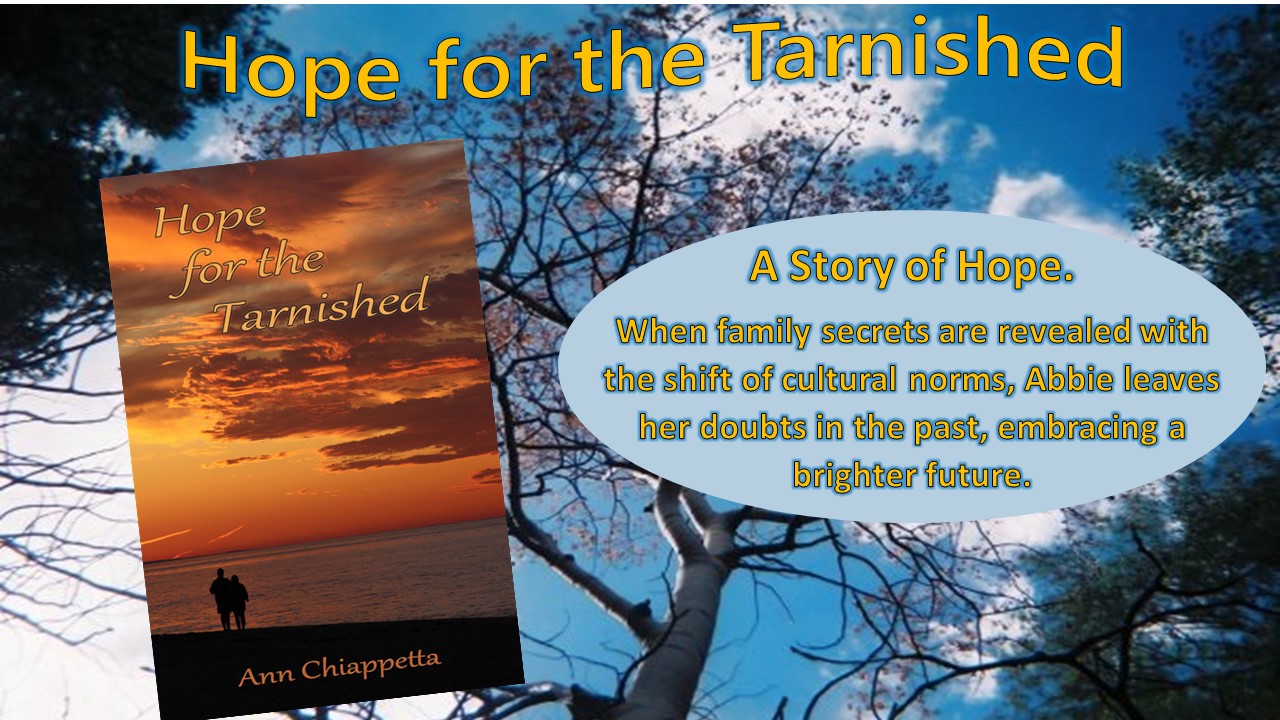
You don’t choose who you love, it just happens. Follow young Abbie Raymond as she traverses concentric rings of tragedy, hope and healing.
It’s Day 3 of the WordCrafter Hope for the Tarnished Book Blog Tour. Today, I’m pleased to bring you an interview with author Ann Chiappetta. Hope for the Tarnished is her debut novel and I get the feeling that she’s mighty proud of it, as she should be. This touching young adult novel sees a small girl grow into a young woman, in spite of the adversities life throws her way, and she is left with hope for a brighter future.
Let’s Meet Ann Chiappetta
Ann is an artist and often refers to her love of words as a natural compensation after losing her vision in 1993. Once a designer of acrylic displays and furniture, Ann trained her creative senses to flow over from the visual to the literary arts. Years later, she has become a poet and author, honing her talent in various mediums, including web content for nonprofits, regular bylines for online literary publications, poetry, anthologies and guest editing in online literary journals.
Ann possesses a master of science in Marriage and family therapy from Iona College and an undergraduate degree from the College of New Rochelle, both located in Westchester County, New York. A guide dog handler and advocate, Ann volunteers her time representing people with visual impairments and guide dog users on various National, State and local boards of directors. A consultant and guest presenter, Ann visits schools promoting awareness and equality for people with disabilities. She is the 2015 recipient of the WDOM Spirit of Independence award and the 2019 GDUI Lieberg-Metz award for excellence in writing.
Interview
Kaye: When did you know you wanted to be an author?
Ann: When I was a kid I would read a book and if it was a really good book, I would think about how they did it. My love of books grew with me and in seventh grade, after writing my first poem, the teacher said I could now call myself a poet. It was just a matter of time and education after that. I was always drawing, singing, dancing, imagining – it was a matter of creative discipline and eventually my talent emerged as I practiced.
Kaye: Is there anything unique or unusual about your writing process?
Annie: I do have one part of my creative process few authors utilize and that is text-to-speech technology on my computer because I am blind. I actually listen to the words as I type. I think it helps me craft stories and poems that also sound good when read aloud. I also tend to write down the bones, then return to the idea later after it has cooked a bit in the creative oven. I also use my dreams to write scenes and shorter pieces of fiction and poetry.
Kaye: What time of day do you prefer to do your writing? Why?
Annie: I like to write in the morning and sometimes catch an hour’s worth of editing work in the afternoons. I rarely write at night, that’s for reading, family and TV. I do record notes when I am out and need to recall something like overhearing a conversation or a feeling about something I’ve heard or explored. I will listen to the recording and then write a piece. The recording brings me back to the moment and strengthens the piece.
Kaye: Would you share the story of your own publishing journey?
Annie: I’ve been published for years in journals and even once in Reader’s Digest. Poetry was first, followed by nonfiction articles and a few bylines. I didn’t consider a book until 2015. My first book, Upwelling: Poems, was published in 2016. My Mom was my biggest fan and supporter of my talent and was a poet herself but did not let us read her work. After she died of cancer in 2015, I wanted to honor her memory and belief in me by finding a way to self-publish my poems. I had almost given up, losing faith that despite being blind and unable to use desktop publishing software because of my disability, I stumbled across DLD Books after reading another blind writer’s memoir. I emailed the address and Leonore Dvorkin wrote me back and the rest is self-publishing history. I dedicated my book to my Mom, Mary, and have since dedicated each book to her. Interestingly, as we went through her belongings, we found a poetry journal and I have some of her writing.
Kaye: What do you like to do when you’re not writing?
Annie: I read and listen to audio books with my husband. We like to cook and watch baseball and football together. I listen to music, from classical to pop tracks. Our adult daughter lives nearby and helps us out all the time. I record my poems and perform them for others. I volunteer my time in blindness organizations in my county as well as Nationally. I sit on local, State and National boards of directors representing artists who are blind, guide dogs as well as writers with disabilities. We have two dogs and three cats that keep us busy.
Kaye: Your new book is Hope for the Tarnished, a sweet Y.A. about a young girl who overcomes some very difficult life obstacles. What’s the most fun part of writing this novel? What’s the least fun part?
Annie: The most fun part about writing Hope for the Tarnished was developing the relationship between Abbie and Augie. I wanted their attraction to grow as they matured. The hardest part of the story was finding the right set of circumstances to separate them and then keep them apart. There was also times when writing the traumatic scenes were difficult and I needed breaks because I got all weepy or verklempt.
Kaye: Your book, Hope for the Tarnished, recently came out. Would you like to tell us a little about that?
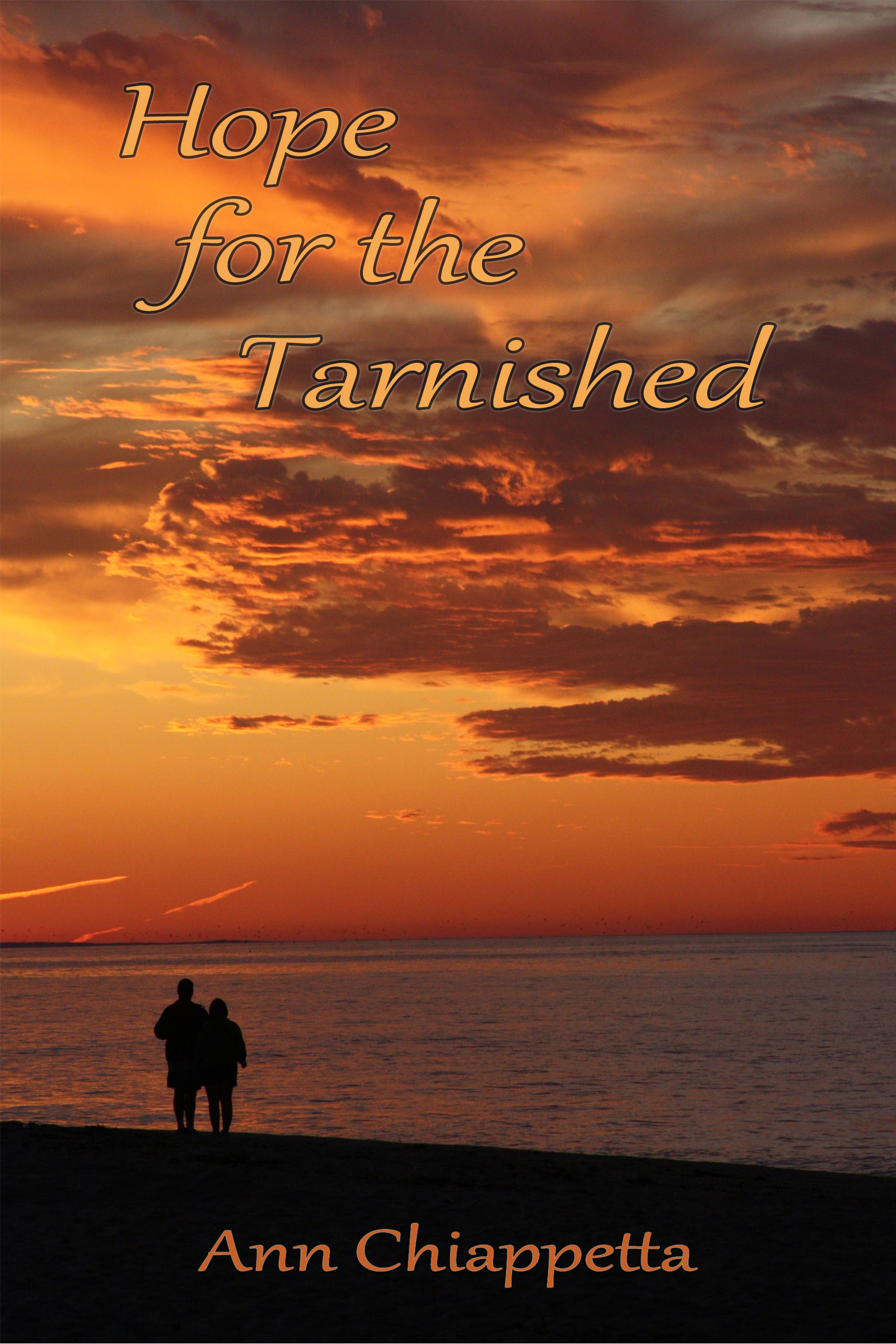
Annie: It is my first novel and I was apprehensive about sending out into the world. The novel was released in March 2022, a great month and not just because it is my birthday month, 😉 It is my first hard cover book and also the first book to also be offered through the Library of Congress catalog. My sister, Cheryll, provided the book cover photo, which is the third cover she helped design. Marketing a book is the tough part and doesn’t always feel successful, especially in terms of sales. I tell myself it is the readers who make it better, the ones who take the time to tell me what they thought of the book, how it effected them and even the criticism is important to me, it helps me want to become a better writer. It’s hard to hear the negative feedback but in the end, good and bad helps me push ahead and want to achieve more.
Kaye: How did you decide on this title?
Annie: My editor, Leonore Dvorkin helped me by researching variations of the title. I picked Hope for the Tarnished mostly because it encapsulated the overall arch of the book and it didn’t generate an over-used title.
Kaye: What kind of research do you find yourself doing for this story?
Annie: I researched the book title to make sure it wasn’t over-used. I brought in my knowledge of boating but did have to research the cars and other vehicles being used in the late 1970s and early 1980s. I also had to research the clothing styles. I was very happy when I was able to weave in the 1977 premiere of Star Wars, 😊 That movie was a key component of what generated my love of science fiction and fantasy.
Kaye: What’s the hardest part of the story for you to write: beginning, middle or end?
Annie: The middle, what I refer to as the doldrums. I often get stuck even after the outline is completed. Sometimes I stay awake at night thinking, “what comes next?”.
Kaye: How much of the story do you know before the actual writing begins?
Annie: I know the main idea, sketch the outline, make brief plot notes, maybe even a brief character sketch or two is done prior to the first chapter. I used to be a writer of discovery and now I am an outliner and planner. I’ve found outlining or developing a short synopsis crafts the story better and helps me avoid over-writing scenes. I’d much rather add to something than remove it, though a novel ends up shifting in both directions as it is written and edited.
Kaye: What do you think is the single most important element in a story?
Annie: Characters. If I don’t develop an emotional response for them, I don’t feel even the best theme or plot will help me through the story — both as a reader and author of a story.
Kaye: Have you created any of your characters based on people who you know in real life?
Annie: Who hasn’t? 😊 Seriously, though, my characters are most often composites of people I’ve known or characters I’ve admired from other books or stories. I do like to develop characters with realism and imagination.
Kaye: What is something your readers would never guess about you?
Annie: I love to go fast, used to race street cars in California. I’ve ridden horses in Lake Tahoe, Nevada and love riding motorcycles.
Kaye: What time of day do you prefer to do your writing? Why?
Annie: I am a morning writer. I like to awaken and listen to the sounds around me, find the flavor of the day and let my mind determine what to work on. Sometimes it is a poem or a deeper discussion over email about a project, at other times it is prepping a script to record. Though I like the quiet of night, I am often too tired to write. I am not the kind of person to write in a coffee shop, I’d be the person in the corner of the library with the laptop instead.
I like to write early in the day when my mind is most agile. Sometimes I edit and finish tasks like a blog post or something simple but keep the creative work for the mornings.
Kaye: How much do you read? What do you like to read?
Annie: I am eclectic when it comes to answering this question. Genres include science fiction and fantasy, some horror and suspense, memoir, nonfiction, literary fiction collections and short stories and crossovers. I also listen to poetry selections but I am picky about the poets I read. I get through about fifty books a year, give or take.
Some of my favorite authors are Rudyard Kipling, Cormac McCarthy, Stephen King, Nora Roberts, Brandon Sanderson, Larry Correa, Michael Connelly, John Irving, Kahlil Gibran, and I have read dozens of the books based on the Star Wars universe. I love to read poets Billy Collins, Joan Myles, Mary Oliver, Joy Harjo, Wallace Stevens, Langston Hughes, Wordsworth, William Blake, and many others.
Kaye: Which author, dead or alive, would you love to have lunch with?
Annie: Anne McCaffrey, author of the science fiction Dragon riders of Pern series.
Kaye: What is the one thing you hope to teach your children?
Annie: My kids are adults now. They both grew up while I progressed through my vision loss journey. I know this has helped them develop a high level of compassion for others and people with disabilities. I also know it was hard for my kids to cope with a Mom who is blind. We had tough moments and we got through it. Whenever I hear my daughter helped a neighbor or a Mom comment on how she helped someone, my heart is happy. I say to them that the world is a kind place if you believe it and be part of the kindness.
Kaye: What’s your favorite social media site for promotion? Why?
Annie: Face Book is my social media site of choice because it is robust and fairly easy to navigate.?
Kaye: What’s the best piece of advice you were ever given?
Annie: In order to be a good writer, you need to be a better reader and keep reading — as much as possible and in as many genres and styles as possible — and this and practice will hopefully help you become a great writer.
If you are only joining us now for the first time, and would like to learn more about Ann or her novel, you can follow the rest of the tour and check out the posts from the first two blog stops on the tour:
Welcome to the WordCrafter Hope for the Tarnished Book Blog Tour. On this tour you’ll learn about a touching new young adult novel, Hope for the Tarnished, with guest posts by the author, Ann Chiappetta, as well as reviews and an interview. I hope to see you all at each tour stop. Here’s the tour schedule so you don’t have to miss any of the stops:
Day 1:Writing to be Read – Introduction and Review
Day 2: Patty’s World – Guest Post by Ann Chiappetta
Day 3:Writing to be Read – Interview with Ann Chiappetta
Day 4:Roberta Writes – Guest Post by Ann Chiappetta
Day 5:Zigler’s News – Guest Post by Ann Chiappetta and Review
About Hope for the Tarnished
Young Abbie struggles to cope with the traumatic experiences in her life. Ripped from everything familiar after her parents’ divorce, she is dropped into a strange neighborhood and is emotionally abandoned by her unstable mother. Abbie is caught up in the cruel nature of one sister’s addictions and often rescued by her other sister’s sense of familial responsibility and love.
The story takes place in the 1970s, revealing family secrets and the shift of cultural norms as Abbie leaves her doubts in the past, embracing a bright future.
My Review
Hope for the Tarnished, by Ann Chiappetta is a young adult novel about a young girl who triumphs over the adversities of life to find a chance for happiness as a young woman. It’s a story of tragedy and triumph. It’s a story of hope that will tug at your heartstrings.
Growing up as a latch-key kid, before it was ‘thing’, with a mentally unstable mother, who is indifferent to her daughters’ needs, and sister who is an addict, Abbey faces loss and tragedy head on. But as she grows into a young woman, love complicates her life and makes her doubt her own decisions. With time, social norms and personal situations change, making Abbey dare to hope for happiness once more.
A touching story of love and hope, with the message that nothing ever stays the same, Hope for the Tarnished leaves you with an overall good feeling. I rooted for Abbey all the way through.
Announcing the winner of the 2022 WordCrafter Short Fiction Contest.
Every year, WordCrafter Press runs an annual short fiction contest and publishes the resulting anthology. The first contest was in 2019, with the Whispers of the Past paranormal anthology, followed by Spirits of the West paranormal western anthology in 2020, and Where Spirits Linger paranormal anthology in 2021.
Today it pleases me to announce that Roberta Eaton Cheadle is the winner of the 2022 WordCrafter Short Fiction Contest. Robbie has entered the WordCrafter Short Fiction Contest every year since 2019 and this year her story “The Bite” stood out and shined, although with so many good stories submitted, it was still quite difficult to choose. I am proud to include her story in Visions.
The Visions anthology will be different from years past in that I have included stories by invitation only, which were not a part of the contest, so it will be a bit larger than previous anthologies, with a total of nineteen terrific stories for your reading enjoyment. In addition to Robbie, contributing authors include previous contest winners, Jeff Bowles and Christa Planko; invited authors Sara McBride, W.T. Patterson, Julie Jones, Zack Ellafy, Leah Cutter, Joseph Carribis, D.L.Mullen and Stephanie Kraner; and contest entrants, Patty L. Fletcher, Billie Holladay Skelley, C.J. Serajeddini, C.R. Johansson, Keith J. Hoskins, and Janet Garber.
I look forward to putting this anthology together and sharing it with all of you.
Join Kaye Lynne Booth & WordCrafter Press Readers’ Group for WordCrafter Press book & event news, including the awesome releases of author Kaye Lynne Booth. Get a free digital copy of her short story collection, Last Call and Other Short Fiction, as a sampling of her works just for joining.
Hello again, and welcome to segment 5 of the “Ask the Authors” blog series. This Saturday series features introductions to each contributing author and excerpts from the Q & As featured in the newly released Ask the Authors 2022 writing reference anthology.
If you missed any of the earlier segments, you can find them here:
Segment 1: Introductions for Kaye Lynne Booth & Kevin Killiany/Writing Life Q & A session
Segment 2: Introduction for Bobby Nash/Pre-Writing Rituals Q & A session
Segment 3: Introduction for Roberta Eaton Cheadle/Plot & Storyline Q & A session
Segment 4: Introduction for Paul Kane/Character Development Q & A session
This week’s segment features an introduction to contributing author Mario Acevedo and a Q & A on action, pacing, and dialog.
Meet Mario Acevedo
Mario Acevedo is a national bestselling author of speculative fiction and has won an International Latino Book Award and a Colorado Book Award. His work has appeared in numerous anthologies to include A Fistful of Dinosaurs, Straight Outta Deadwood, and Blood Business. For 2020, he has short fiction in the forthcoming anthologies, Psi-Wars and It Came From The Multiplex, and a Western novel, Luther, Wyoming. Mario serves on the faculty of the Regis University Mile-High MFA program and Lighthouse Writers Workshops. Mario has also been a presenter and panel member for both the 2020 Stay in Place Virtual Writing Conference, and the 2021 New Beginnings Virtual Writing Conference.
And now, on to the Q & A.
Action, Pacing & Dialog
Do you have any tips for writing action scenes/fight scenes/car chases, where blow by blow descriptions could get tedious?
Mario Acevedo: Summarize. Only share the high points and include internalizations. Also add details that are often overlooked like nausea, panic, pain, exhaustion.
Paul Kane: I grew up watching a lot of action movies and TV shows, the ’70s and ’80s were a golden age for action as far as I’m concerned. So, a lot of that went in without me having to do much. I used to recreate certain action scenes with my toys, or I might race off up the garden with mates to pretend fight. When I wrote the Hooded Man books, I had to have a lot of action in there, so I got very good at not making things boring – there are only so many ways to describe a punch, for example. But the key I found was to visualize the scenes, even play them out – just like I did when I was a kid – so that they become, again, more believable. I was delighted when one of my battle scenes for Broken Arrow was compared favourably to those in The Lord of the Rings movies, especially Helm’s Deep; that’s one of my all-time favourite battles on film, so I did a little happy dance that day. The way to tackle any fight or action scene, whether it’s huge like the ones I’m talking about here, or just one-on-one, is to break it down into its component parts. Ask yourself what you need or want to show. Then do your research, watch a lot of fight sequences, or action scenes, mix and match the moves that are being made. If your character is a master of martial arts, study it. I had a character called Tanek, for example, who was skilled in the Israeli hand-to-hand combat of Krav Maga, so I went out and researched that. Jennifer Garner actually studied that for Alias, so I watched some fight sequences from the show. They used a very particular form of combat for the Batman fight scenes in the Nolan movies called the Keysi Fighting Method, which favours forearms and elbows, so it’s worth trying to find something that’s not been done before perhaps. Or not done very much. Finally, give your fight and action scenes a sense of character, make them like a dance or a ballet. They need to have rhythm, flow, so your reader can easily picture what’s happening. Too much going on at once is a big no-no, because you’ll lose them. Same goes for very dry descriptions of a fight: now this happens, now this, then this… Try and find a way to make your descriptions interesting, maybe comparing them to something, like two animals barging into each other or what have you.
Chris Barili: Know what you’re talking about. It seems obvious, but may writers take it for granted, and end up writing nonsense that loses the reader. For example, I have studied the martial arts most of my life, and I hold a second-degree blackbelt in Karate. Thus, I know that someone trained primarily in Judo or Jiujitsu will be a grappler by preference, while a Karate stylist will be a stand-up striker who looks to avoid going to the ground.
Bobby Nash: It can be difficult to keep fight scenes fresh. I learn the choreography, walk out the fights, play around with different ways to describe the action. How is the character feeling/responding to the action? I wrote a car chase once and showed it from the POV of a passenger in the car instead of the driver. As he’s holding on for his life, we get a sense of the danger that way as opposed to only descriptions of what the car is doing.
Robbie Cheadle: I am writing my second novel involving war which includes fighting scenes. I intersperse the fighting with dialogue, humorous comments, scenes of eating, drinking, and entertainment, and the receipt of letters from family and friends.
You cannot maintain tension at high levels for too long or it becomes monotonous and over-done. In real life, people relieve tension by singing, and making jokes, and talking and I follow this practice in my writing.
Nancy Oswald: Elmore Leonard: “I try to leave out the scenes readers skip.” Ralph Fletcher: “Write small and use slo mo. The more tension you want to create, the more important the details. In general focus on one detail well rather than all the details which can wash out a scene.”
How do you handle scenes where there is a lot going on, like battlefields or fights in busy settings?
Paul Kane: As I say, break it down into smaller chunks. Show the scale of what’s happening by all means, like an establishing shot in a movie, then focus in on certain specific fights and details. These will usually be with your main characters if it’s a big battle – so I would zoom in on a fight Robert, my Robin Hood, might be having with someone. Then cut to maybe Jack, who is my Little John, and see how he’s getting on. You have to give everyone who’s a main character a turn in the sun, plus give the reader memorable moments – like Robert taking down the Apache attack helicopter with a bolas.
Chris Barili: This is a tough one. I have found that choreographing the whole thing on a sketched-out map of the physical surroundings can help, and if that’s not enough, having some friends act out the scene can help you identify errors, misjudgments, and so on.
Bobby Nash: I try to make sure all of the necessary information is relayed. If you have a lot of characters, you have to try and balance who has dialogue or stuff to do so that they don’t disappear from the scene. POV helps here too.
Robbie Cheadle: I keep my sentences fairly short during battle scenes, and I use a lot of dialogue to break up the action.
How do you keep action flowing smoothly within a scene?
Mario Acevedo: Keep the scene and story question in mind so that the action strengthens the plot.
Paul Kane: Just keep it tight, moving from one bit of action to the next. Even in a small fight, if you have a character get punched or kicked, it’s enough to say it just winds them or takes them down – you don’t have to go into lots of detail about how it feels, whether they’re recovering, what’s going through their minds as they’re fighting. Keep it rattling along at a good pace. Sounds stupid, because it’s a fight, but make it punchy.
The use of weaponry is a good way of handing readers little details that help them visualize what’s going on. Everyone knows what a knife or rifle or handgun looks like. Of course, it depends very much on what kind of fiction you’re writing. A lot of my Hooded Man stuff was military based, because of the nature of armies fighting each other, so readers who enjoy that kind of thing like you to include the names of weapons, specifics relating to what they can do. Does a certain gun jam more often than others? Which are best for close combat as opposed to distance? I once wrote a story about an assassin called Mr D, who had to tear through lots of guards to get to his target. That started off with long-range sniper rifles, and ended up with hand-to-hand fighting as he got closer to the building his mark was in.
It’s also fun to write about weaponry that’s totally out of context, for example plates and pans in a kitchen that can be used to fight with. In my novel Lunar, Nick Skinner raids old castles and museums to get swords, shields and axes to fight the monstrous Loons. Similarly, The Storm was set in an old castle so weapons like that were no-brainers, but I do have my main character – who’s there as a workman – fight off a huge crustacean with a mini-digger. It was just what was around and big enough to tackle the oversized beast, but it worked a treat.
Chris Barili: Keep it short. A ten-page car chase will lose a reader like a prologue.
Bobby Nash: When writing action, I use shorter sentences, short, choppy dialogue, sometimes interrupted dialogue. That reads faster so the reader reads the action scenes faster, highlighting the fast-paced nature of the scene. During an action scene is no time for deep thoughts or anything extraneous. Keep it simple and keep it moving.
Do you consult experts to ensure your action is true to life? How do stories benefit from getting those little details right?
Paul Kane: If you know someone who’s been in the military, or police, or someone who teaches self-defense then definitely use them. Use any friends for anything which requires specialist knowledge. This might be something as everyday as fingerprinting or gathering DNA at a crime scene, say, or if you know a scientist it could be as big as how the universe works. But you don’t necessarily have to go to experts like that these days if you don’t know any, because information is freely available on the net and in books – especially writers’ handbooks. At the same time, talking to experts sometimes throws up interesting scenarios and might take a story in a direction it wouldn’t otherwise have gone.
Bobby Nash: Research can help, sure. Whatever you writer, whether it’s a real-world fight or two super-powered characters battling, you have to write it as though it’s real. If you believe it, the reader will believe it.
Robbie Cheadle: I read a lot of non-fiction to gain knowledge about the subjects of my historical novels. To get a good feel for the era, I read works of fiction set during that time. Fiction reading gives me insight into how people lived, socialized, travelled, and dressed during the period in which my novel is set.
Nancy Oswald: I’m a nut for accurate historical detail, even if it plays a minute part in the story.
Pacing
How can dialog help pace your story?
Mario Acevedo: Dialog is a great way to advance the plot by having the characters reveal crucial information or to help build a character. Dialog is more active and interesting then authorial narration.
Paul Kane: I think that’s where the planning comes into it, once more. If you have a chapter breakdown you can see where the novel needs tightening up. Is there too much exposition in a certain chapter, not enough? Too much action all in one go, or not enough for long periods? Are you hooking your reader at the end of your chapters, making them want to go on and read more in the next chapter? Even if you’re only writing a short story, if you jot down the structure of it in a few sentences you can usually work out where you’re going in terms of pace. Compare whatever you’re doing to other novels or short stories, see how they’re paced. If you want to write, then you have to read as well – like Stephen King says in On Writing. There really is no other way to learn how to do this. Similarly, if you’re scripting TV or film, then go away and watch how they’re paced. Or a comic or audio: read comics, listen to audio dramas and make notes. It really is the only way to learn your craft, whether it be characters, setting/description or pacing.
Robbie Cheadle: Dialogue speeds the pace of a story up, so I use more dialogue for tense, fast paced scenes.
What methods do you employ to control and maintain the pacing in your story?
Mario Acevedo: Know when to show and tell. Show is “reveal,” during which you draw out the narrative in a way that pulls the reader into the story. Tell is “exposition,” which you need to keep the reader oriented in between reveals.
Paul Kane: Try and stick to the plotting and planning you’ve done, even if it’s in broad strokes. That doesn’t mean your story can’t go off on a tangent if something occurs to you, but go back to the outlines that you’ve done at that point and rewrite those, see where the new development might take you. Predict and project, then go back to the writing of the tale. In my opinion that’s really the only way to keep a rein on the thing and make it go where you want it to go.
Robbie Cheadle: I break my story down into manageable pieces for each character. In my current work-in-progress, I am alternating chapters between Jake at the Western Front during WW1, and Kate in Orange, New Jersey.
In slower sections I use longer sentences and more detail and description to slow the pace down.
I also use introspection to develop my characters and control pace.
How do you find the right balance between action and dialog?
Paul Kane: For me personally, that’s something which just comes with practice. The more you write, the better at judging this you’ll be, until you’ll be doing it by instinct almost without thinking. If you drive, remember what it was like when you first started, trying to keep it all in your head? And once you’ve been on the road a while, a lot of that becomes like second nature to you, doesn’t it? Or it should do at any rate. It’s the same thing with writing really, you develop these skills over time – so that you can tell when something needs balancing out with a bit of dialogue, or a bit of action. It’s all just about putting in the work, honing your skills.
Nancy Oswald: Try to do them both at the same time by using appropriate action-filled tags.
Dialog
How do you write dialog that sounds natural and realistic?
Mario Acevedo: Listen to the way people speak, then write a tightened version. People tend to repeat themselves. Catalog unique ways in how people express themselves. Also, keep in mind the character’s agenda when using dialog.
Paul Kane: The trick is to get the balance right between it sounding naturalistic and conveying information. Most dialogue should be moving the story along or serving the story, otherwise what’s it doing in the piece at all? In real life we all have conversations that are just random or serve no purpose, or we get distracted and break off from a conversation to talk about something else. You can’t do that in your fiction, because people will get bored. Or they’ll think you’re not in control of your own writing, which would be true at that point. I get criticized a lot for not finishing sentences in dialogue, but what I’m trying to do is leave readers in a bit of suspense, whilst at the same time making it a bit more realistic. Human beings very often leave sentences unfinished, if they’re interrupted or just shocked. I don’t do it all the time, and like I say some people find it jarring, but it is one way of creating naturalistic dialogue if you have a reason for it. Another way is to just let the dialogue flow, batting it backwards and forwards, but don’t forget to keep reminding the reader who’s speaking with a ‘Mike said’ or whatever, every now and again. Or have a bit of action, like Mike scratching his head or getting up and walking across the room to break things up if you’ve had several lines of dialogue. I always find arguments quite easy to write, because the flow of them comes across as very believable, and you can include lots of relevant information. For me, it’s quite easy to imagine a couple of people having an argument, because it happens a lot in our everyday lives; lots of people have opposing viewpoints, so it’s fun to try and get both sides of that across.
Chris Barili: Listen to people talk and write dialogue that way as much as possible. Do NOT write dialogue in grammatically correct sentences…we don’t speak in MLA format, either.
Bobby Nash: A trick I learned is to read the dialogue out loud. That will tell you if it works or not.
Robbie Cheadle: I read all my stories aloud to myself, and to anyone else who’ll listen. Reading my writing aloud helps me to spot errors and clumsy unnatural dialogue.
Kevin Killiany: I read it aloud. (Yes, I do character voices.)
Do you use dialog tags? Basic or varied?
Mario Acevedo: I vary them and use action tags as often as possible. Remember that in interpersonal communication, half of what we communicate is non-verbal so include those clues: tone, pauses, eye movement, facial expressions, gestures, changes in posture to emphasize what is being said.
Paul Kane: I tend to stick with the basics, unless you’re trying to say something specific. For example, ‘he spat’ shows how shocked or mad that person is by something that’s been said. I tend to steer clear of things like ‘he pontificated’ or anything complicated like that, as it throws you right out of the story. But good old-fashioned ‘he said’ ‘she said’ works just fine. It’s amazing how your eye glosses over this when you read. Try it for yourself, read a page from a book, then go back and re-read it looking for those tags – and I guarantee you won’t have spotted half of them.
Bobby Nash: Yes. I used ‘said’ most of the time, but if I need to add a punch to a line, I may use a different tag.
Robbie Cheadle: When I use dialogue tags, I generally stick to ‘said’. I don’t always use a dialogue tag, sometimes I prefer to use an action by the speaker to indicate who is talking.
Nancy Oswald: Both or not at all. Let the actions act as your dialogue tags.
Kevin Killiany: I stick to basics, with some variations. Many times I leave them out. Example:
Pilar realized her watch had stopped.
“Jerry? What time is it?”
“Four. Uh, four oh eight.”
“Which?”
“Four oh eight. Nine, now.”
You know who’s saying what and you get an idea of Jerry’s personality with no tags.
Any pet peeves with dialog?
Mario Acevedo: Info dumps and a character not saying the obvious in response to what’s going on.
Paul Kane: Not really, just if the conversation isn’t going anywhere or serving any kind of purpose. Having two characters discuss what they’ve had for lunch, for example. Unless that lunch caused food poisoning that results in something significant happening in the plot, then what’s the reason for including it?
Chris Barili: No robot-speak unless the character is actually a robot, and usually not even then.
Bobby Nash: Noting specific. I try not to be cliché.
Kevin Killiany: People speaking grammatically correct written English with every pronoun unnecessarily identified. Normal conversation—even in formal situations—is usually made up of sentence fragments because spoken English assumes all members of the conversation understand what’s being discussed.
Would you share a brief excerpt from one of your best dialog scenes?
I asked this question and got some wonderful responses, but most of them are too lengthy to include here, so I guess if you want to view them, you’ll have to buy the book.
_____________________
That wraps up this week’s segment of the “Ask the Authors 2022” blog series. Be sure to drop by next Saturday, when we’ll introduce Nancy Oswald and bring you a Q & A on tone and all that entails.
Ask the Authors 2022
And don’t forget to grab your copy of the Ask the Authors writing reference anthology, at the special 3.99 price for the duration of this blog series, from your favorite book distributor through the Books2Read UBL: https://books2read.com/u/3LnK8e
________________________
Join Kaye Lynne Booth & WordCrafter Press Readers’ Group for WordCrafter Press book & event news, including the awesome releases of author Kaye Lynne Booth. Get a free digital copy of her short story collection, Last Call and Other Short Fiction, as a sampling of her works just for joining.
Welcome to Segment 4 of the “Ask the Authors 2022” blog series, where we’re offering up a little taste of what you’ll find in this hot new writing reference of the same name. Ask the Authors 2022 features writing tips and advice on craft, publishing, and book marketing from ten talented authors and industry experts.
In case you missed some of the previous segments:
Segment 1: Introductions for Kaye Lynne Booth & Kevin Killiany – Writing Life Q & A session
Segment 2: Introduction for Bobby Nash – Pre-writing Rituals Q & A session
Segment 3: Introduction for Roberta Eaton Cheadle – Plot/Storyline Q & A session
This week we meet bestselling horror author Paul Kane, who shares his love of the horror genre in his essay, “Writing Monsters”, and bring you a Q & A session on character development.
Meet Paul Kane
Paul Kane is the award-winning, bestselling author and editor of over a hundred books, both fiction and nonfiction. Some consider him to be a master of the macabe. He has been a guest at numerous writing events and conferences, and he was the keynote speaker at the 2021 WordCrafter New Beginnings Virtual Writing Conference.
A former British Fantasy Society Special Publications Editor, he is currently serving as co-chair for the UK chapter of The Horror Writers Association. His work has been optioned and adapted for the big and small screen. His audio work includes full cast drama adaptations, he has also contributed to the Warhammer 40k universe for Games Workshop and writes thrillers for HQ/HarperCollins as PL Kane. Paul lives in Derbyshire, UK, with his wife Marie O’Regan and his family.
Find out more at his site www.shadow-writer.co.uk which has featured Guest Writers such as Stephen King, Neil Gaiman, Charlaine Harris, Robert Kirkman, Dean Koontz and Guillermo del Toro.
And now, on to the Q & A.
Character Development
Nancy Oswald: This whole section was hard for me because I’ve never been good at planning a character. Lists aren’t helpful to me. What is helpful is to put your main character into the middle of their world and write from there. I usually have an ending or a direction in mind before I start writing, but there have been times when the character determines the story and not the other way around.
Do your characters ever surprise you?
Mario Acevedo: I never thought I’d be a writer who said that my characters have taken over the story, but it has happened. Big surprise, it was female characters. I’d have in mind a script for them, which they would rip to pieces and tear off on their own.
Paul Kane: Oh, all the time! If you’ve made them ‘real’ then they’ll suddenly do something that you don’t expect. That is to say, it’ll momentarily surprise you and then you’ll say: ah, of course that’s how they’d react because of… whatever it is you’ve seeded in their past. It’s really your subconscious putting things like that in, things you’ve set up and forgotten about, then when a character does something unexpected it’s only that you’ve forgotten how apt it was in the first place.
Chris Barili: Yes, all the time. If a character is predictable to me, it will be the same to a reader. So, I let them surprise me in whatever way they seem to need. Those surprises don’t always make the story, though.
Bobby Nash: All the time and I love it. In one story, a character let me know that I had the villain wrong. This character was the villain, not the one I had planned to be the villain. The kicker is that the story worked so much better once I realized that this character was indeed the villain.
Robbie Cheadle: No, my characters follow a pre-determined path decided by me upfront.
Kevin Killiany: Not exactly. I’m the only person living in my head—my characters only look like they have free will. That being said, the longer you work with a project, the more time your subconscious has to compost or ferment or percolate the ideas you’re building with—and that can lead to unexpected discoveries that give texture and dimension to the character. Sometimes my characters evolve over the course of writing and rewriting to the point that they person they’ve become wouldn’t do what the story required. Usually that’s an indication there’s something wrong with the story, not the character.
What makes a character interesting?
Paul Kane: I think it goes back to believability once again, which most things do. They have to be well-rounded, living and breathing people. If I get it right, the characters feel real to me. When I talk about them and what they go through, I talk about them as if they exist. You have to think that way in order for other people to believe them and believe in them. A lot of that means knowing your characters inside out, how they’d react to certain situations – in particular the ones you put them in. Would your character run away from a monster or just get stuck in, have a go, even if it meant dying to save others? That kind of thing. A lot of writers think giving characters quirks makes them interesting, but if there’s no reason for that to be there it just stands out. If you give your character gardening as a hobby, unless he’s fighting a giant plant then it’s not really something that should crop up in your story. The character of Alex Webber in Before was a lecturer, so that meant he was interested in making sure the next generation were educated and could make well-informed decisions. So when the future of the world is threatened, of course he’s going to fight against that; it’s just something rooted in his DNA. Those are the kinds of things that make characters interesting, not whether they sleep on the left or the right in bed.
Chris Barili: They have to be flawed. No one wants to read about perfect people with perfect lives and no conflict whatsoever. It is our characters’ flaws that make them realistic, and that set up most of the conflict in the story. After that, it is the act of exaggerating the characters, making them larger than life. Again, no one wants to read about normal people with normal lives. They want heroes and villains who are large and in charge. Would Dirty Harry have worked if he were a normal cop carrying a .38 special? No, because being a six-foot-four rogue cop with a .44 magnum in gleaming silver makes him stand out.
Bobby Nash: I don’t know. Interesting is like art or porn, I can’t describe it, but I know it when I see it. I need to have something to connect to with a character. Once I have that connection, I understand the character.
Robbie Cheadle: My characters all must overcome a lot of adversity in their circumstances. I believe that the growth in the characters as they play the cards which they are dealt by life makes them interesting.
Jeff Bowles: I think I have an answer to that question: idiosyncrasies, idiosyncrasies, idiosyncrasies. The thing about real people is that we all have our strange little quirks that make us who we are. And these are behaviors and beliefs it’s taken us a whole lifetime to accrue. It pays to think of your characters as being a little odd under the surface. The problem with a lot of storytelling out there is that too many authors figure their characters exist to serve the story. They don’t, it’s the other way around completely. Let your characters speak for themselves. Let the breath a little, see where they really want to go next. Don’t push them into situations that don’t serve their full expression. Let them tell you who they really are.
How do you make a character likeable?
Paul Kane: Sometimes you don’t. Sometimes you shouldn’t. I get reviews sometimes that say ‘the characters weren’t very nice’, but then look at some of the things they’ve been through. My psychologist Dr Robyn Adams went through a trauma at the hands of a serial killer, so is addicted to pain killers and drinks too much, leaps straight in with guys too often – because of something else revealed towards the end of Her Husband’s Grave. But you know what, she’s doing the best she can. Her flaws make her human, like all of us, and they make the moments of bravery stand out all the more. I think if you’re always trying to make your characters likable, you’re missing the point of making them believable. Not everyone’s nice all the time, there are grey areas – and that’s totally where your characters should be operating.
Chris Barili: You don’t have to make them likeable, just relatable. Thomas Covenant in White Gold Wielder (Stephan R. Donaldson) is not a likeable character at first, just a relatable one. He almost loses that with a deplorable act early in the book, bit manages to make it through, at least for most readers. I do know some who could not handle it and left the series behind.
Bobby Nash: I start with a likeable person as their base and build the character up from there.
Kevin Killiany: I never consider likeability. I try to make my characters as real as possible—which means complex, with parts some folk will like and parts some folk can’t stand.
How do you make your characters feel real?
Chris Barili: What are their fears and flaws? Read my article, “Character Blueprints” (Ask the Authors 2022) for the tools I use to do this.
Bobby Nash: As I mentioned above, I get to know the characters. Once that happens, they become real people to me. They have their own quirks, foibles, fears, flaws, strengths, and weaknesses. Just like real people.
How do you create a villain readers can love to hate?
Mario Acevedo: Readers must have empathy with all of your characters and understand why they do what they do. Their motivations must be consistent and compelling. One of my best villains was a female mad scientist who at first you cheered until you found out what she was up to.
Paul Kane: I don’t think there’s any magic formula, but the key thing with villains is again that they aren’t just cardboard cutouts. They can’t just be evil for evil’s sake, there needs to be reasons for what they’re doing. My bad guy for the Hooded Man books, De Falaise – essentially my version of the Sheriff of Nottingham – was motivated by the fact that he’d been kept down before the A-B Virus hit. He was a small bad guy in a big pond. The apocalypse gave him the freedom to create a kingdom of his own, so that was his motivation – and Robert, my Robin Hood, stood in his way. You got the impression with some Hood stories in the past that they just hated each other because one was bad, and one was good. In my books, just as Robert has his failings as a leader – for starters, he doesn’t want to be a leader and would much rather hide out in Sherwood waiting to die – so too does De Falaise have his good points, like his loyalty to companions like Tanek, his second in command. I mean, he is evil when you get right down to it, because some of the things he does are reprehensible, but there still needs to be some good in there. Having said all that, the most fun I’ve had writing a bad guy was The Infinity in Before. He’s a version of the Devil, essentially, and likes to meddle in human history. Writing lines for him, simply because he was a stereotypical big bad, was wonderful. It allowed me to put myself in the head of someone who has very few redeeming qualities, if any at all.
Chris Barili: I find that a couple of things can pull a reader into a love-hate relationship. First, a sense of humor. Even if it’s macabre or inappropriate, the ability to make us laugh endears even a harsh villain to us. You can also give that villain a good side by having him or her save a puppy or show some other admirable trait. Intellect combined with arrogance are a nice set of offsetting traits. But most of all, make them flawed like the hero. If they are invincible and pure evil, no one will want to read their stories. Take The Governor on the AMC series The Walking Dead. We find out early on that this otherwise despicable villain lost his whole family to the walkers and thus has them all locked up in his home as he hopes for a cure.
Bobby Nash: Same way as with a likeable character. I get to know them and understand why they do what they do. No villain thinks of themselves as the villain. Most villains believe what they are doing is right or justified. Very rarely is anyone evil just for the sake of being evil. Let the readers see the multiple facets of your heroes and villains.
Robbie Cheadle: Characters that do sadistic and unkind things are easy to make readers dislike. However, my characters all have redeeming features so the reader will end up conflicted, even when the character is behaving at his/her worst.
Do you ever create characters based on people who you’ve actually known?
Paul Kane: I think by necessity characters are mish-mashes of people you’ve known and other characters from books, film or TV shows, plus bits of yourself sometimes. I’ve never based a character wholesale on someone, as that way lies being sued, but I include certain traits from people I’ve known or still know. I was brought up with a lot of strong women around me, so I write a lot of tales with strong female protagonists. RED, my horror reworking of Little Red Riding Hood, is an obvious example of that. Rachael Daniels is someone who fights the wolf rather than running away from it, isn’t frightened to go up against a challenge. Her love-life might be a car crash, but she’s someone you want around when there’s trouble for sure.
Chris Barili: I will plead the fifth on this question, and all writers should, whether they have done this or not. Admitting that you have sets you up for legal action by others.
Bobby Nash: Oh, sure. I have many characters where the basis is a real person that I then built on top of to create a new character.
Robbie Cheadle: Yes, some of my characters are modelled off people I know. Grandfather Baker in Through the Nethergate has a lot of my father’s personality and characteristics. Michelle Cleveland in A Ghost and His Gold has some of my personality and characteristics, but she is more forgiving and generous towards her partner than I would be in the same circumstances.
Some of my characters are model on several people I have come across in a similar situation. For example, Tom Cleveland in A Ghost and His Gold is based on a combination of men in senior positions I have worked with in my own life.
Kevin Killiany: Every character is a composite of people I’ve known. Let’s face it, the only way to research people is to hang out with them a while. I never drop a whole person into a story—it’ll be A’s speech pattern, B’s fascination with baseball, C’s gestures, etc. Of course, those are just the starting points. As I know my character better everything will change, evolve.
Do any of your characters share traits with you?
Paul Kane: You can’t help but put bits of yourself in stories. I’ve talked about Alex Webber from Before being a lecturer, which I was for a while at college, so I could write about him with a degree of confidence and make sure it was authentic. I’ve always been scared of the dark and nighttime, which comes across in a lot of my stories. The little boy at the beginning in Of Darkness and Light – recently reprinted in the collection Darkness and Shadows – is very much based on me as a kid. Staring out into the darkness at bedtime and imagining all kinds of things lurking inside. But I think the writing also helps with tackling your fears, and in that particular story I could make the ‘creature’ in the darkness someone who was actually watching over the character of Lee Masterton, someone who would protect him from harm. He just didn’t know it at the time.
Chris Barili: All of them, of course. We cannot create characters without at least a little dash of ourselves in them.
Bobby Nash: Absolutely. There’s a little something of me in all of them. Some, more than others.
Robbie Cheadle: As mentioned above, Michelle is similar to me in some ways, but very different in others. She is a better me.
Kevin Killiany: Never the main character. But if there’s a plucky sidekick who alternates puns with sardonic commentary, that’ll be me.
What methods do you use to introduce readers to your characters?
Mario Acevedo: One of the techniques that F Scott Fitzgerald used to masterful effect was that he introduced his major characters in terms of their personality rather than merely describing their looks. I keep that in mind as I write my stories.
Paul Kane: I think it helps to show them doing something that defines them, so perhaps through their job. Most detectives are introduced through a crime scene for instance, and then we learn how good they are and what it means to them to be a cop. I introduced my main character Mitch Prescott – who at the start of The Family Lie is a PC – via a riot scene. He’s tried to tell the powers that be that there will be trouble at a demonstration, but they’ve totally ignored him, and of course – surprise, surprise – a riot breaks out in which one of his closest friends is injured. It forces Mitch to question what he’s doing on the Force, which leads to his dismissal when he confronts a senior officer about what happened, which in turn makes it easier for him to just go off and investigate what occurred with his father’s death in his hometown of Green Acres. But just from this one chapter, you realise he’s a man of integrity, a man who’s loyal to his friends, and a man who doesn’t like it when people don’t listen to his warnings – so you set up conflict for later when he reaches Green Acres and he’s being blocked at every turn.
How do you motivate your characters?
Paul Kane: I think that’s the same thing as what motivates us as people. We look after our friends and family, because we love them, and are sometimes motivated to do things we might not otherwise do because they’re in trouble. What motivates characters is the same as what motivates people in real life, because, remember, we’re trying to make those characters real. So, the father of murder Jordan Radcliffe – Jake – is motivated to find out who the killer is, not only because he loved his daughter, but also because he feels like he failed her. Failed her in life as a father, so he doesn’t want to fail her now in death. That’s a powerful motivating factor for any character. In my short novel The Storm, out through PS Publishing, the main protagonist Keegan is all about keeping the woman that he loves safe, even if it means battling giant monsters to do so. Love’s a big motivation for anything, I find, just like in real life. So are things like revenge or jealousy, the usual big ones.
Chris Barili: They are self-motivated by the situation into which I drop them. Usually, it is the will to survive that motivates them, but it can also be love, hate, rage, longing, and more.
Bobby Nash: How do I stop them? I usually have trouble keeping up with them.
Robbie Cheadle: My ghostly characters are motivated by the chance of redemption and moving on from their existence as spirits.
My physical characters are motivated by compassion and empathy for others and a desire to assist the spirits achieve the redemption they seek.
What kind of adversaries and obstacles do you create for your characters and what purpose do they serve?
Paul Kane: It depends very much on what the story is. Creating adversaries tends to go very much hand-in-hand with creating heroes. Myself and my wife Marie O’Regan – a terrific writer herself – do a workshop on this subject, and that’s one of the key elements. The hero or heroes dictate the villain or villains. Both are probably striving for something but pulling in opposite directions. In Arcana our protagonists are just trying to get freedom for magic-users, whereas the M-Forcers are trying to stop them, hunt them down and either kill them or put them in prison. Both have aims, but they’re the exact opposite of each other. The obstacles they face are very much dependent on the story you’re telling. It could be a man vs nature tale, in which your heroes are just trying to stay alive, so the setting would dictate what happens there. If it’s a shark, then you need to be at sea, if it’s snow then you need to be in the Arctic or Ant-Arctic, or you set it at a time of year when it’s snowing… My short story ‘White Shadows’, for example, is about a girl battling living snow in the middle of winter.
Chris Barili: Since most of the opposition to my characters comes from the antagonist, I always try to think, as I close a scene, “what could the villain do that would completely thrown the main character for a loop?”
Bobby Nash: Stories would be boring if there was nothing for the main character to overcome. Whatever the obstacle is, a villain, a test not studied for, a traffic jam, or whatever, gives the character(s) something to overcome or solve. Hopefully, your character comes out stronger on the other side of the obstacle.
What methods do you use to introduce readers to your characters?
Bobby Nash: We meet the characters in story. I let different characters be out POV in different chapters so we can understand them.
How do you give each character a distinctive voice?
Paul Kane: I think that just comes down to their personality really, who they are and what they do. How they respond to things, whether it’s trouble or something nice, will dictate their voice. So it’s all to do with character creation, and that believability factor again. If they respond in an authentic way, that will give them their voice. If you’ve created a strong female character, for example, they’re not likely to take a man bossing them around lightly. Indeed, they might even knock them out, depending on whether they’re a violent sort or not, or whether the provocation was bad. It’s things like that which give your characters a distinctive voice.
Chris Barili: This seems to come naturally for me. And I think that come from listening. I did twenty years in the military and traveled all over the world. So, I have had the chance to listen to many different conversations in many different cultures, and all of that goes into giving a character their own voice.
Bobby Nash: Once I get to know the character, they tell me what their voice is and that’s what I write. It all comes down to creating a fully formed character.
How do you feel about killing off your darlings?
Mario Acevedo: I am ruthless. There’s a vacant lot in my neighborhood where I’ve left my darlings rotting in shallow graves.
Paul Kane: Do you mean editing, like killing off your words? Or killing off characters? I love editing, chopping bits and refining, making scenes better. That’s the part of writing I like most, apart from being finished and having written. Killing off characters you love is hard, but all part and parcel of being a good writer. If it serves the story, no matter how you feel about the character, then you need to just get on with it. I always knew that I’d kill off Jack in The Gemini Factor, even before I started, which was difficult because I really liked him. He became like a friend. It gave the ended weight though, gave it an impact that would not have been there if I hadn’t just bit the bullet.
Chris Barili: When it becomes necessary to the story, I have no problem doing so. Sometimes, they get in the way. Other times their story line needs its own story because it is taking over. Other times, the main character has learned to depend on them too much.
Bobby Nash: I do it all the time, so I guess I’m okay with it. Ha! Ha!
Robbie Cheadle: I was advised to kill off a few of my darlings in Through the Nethergate by my developmental editor. It was a little hard to let those scenes go but it was the right thing to do. Listening to good advice is the best thing a writer can do.
What methods do you use to evoke emotion in your readers?
Mario Acevedo: Writing fiction gives you the wonderful opportunity to present what characters are thinking or feeling, either through internalizations or visceral reactions. I use these inner experiences to ground the reader in what the character is feeling and what is important in the story.
Paul Kane: There are all sorts of ways to do that, from killing off people readers have grown to love – as mentioned before – to putting them through the wringer, or even having them fall in love. If you’ve done your job properly, a reader will feel the emotions characters are going through. So when a character hates or loves something, or someone, a reader will feel that too. I once wrote a story about two ghosts falling in love called ‘Kindred Spirits’. The girl ghost has only just died, so she doesn’t know what she is, and the guy ghost is trying to help her because he’s been dead for some time. Hopefully a reader feels the sadness at the start that he feels, being alone where nobody can see or touch him, then the joy at finding someone else he can talk to and touch, even hug. To be able to cover the range of emotions like that in a short space of time isn’t easy, but it’s incredibly rewarding when it works.
Bobby Nash: It’s all in the characters and setting the mood. The emotion comes out of the performance of the character.
Kevin Killiany: Honesty
Which of your own characters was the most fun for you to write? Why?
Paul Kane: I enjoyed writing the character of Nick Skinner in Lunar, because he’s just your average guy in a bizarre situation, having to think on his feet and react to all these weird things that are happening to him. That was fun. And The Infinity, the bad guy in Before, as I’ve said. It was fun to write someone so evil that he’s verging on pantomime level, but that’s just how he is. There’s a scene where someone tells him to stop stirring, and he replies with: ‘I f**king enjoy stirring!’ Because he does. That’s what he’s all about. It was fun creating and writing him, especially writing his lines. The criticism I got the most about that book was The Infinity wasn’t in it enough, so you know you’ve done something right at that point. I’m toying with bringing him back in a short story or two, because you could go back in time and show him at any point – he’s been there at all the major turning points in history. It might be fun to do that…
Chris Barili: I really enjoy writing Frank Butcher, and most of his posse members. They’re some of the most complete characters I have built, and each has their own voice, their own flaws, and their own motivations. And each has a weird past that helps flesh out their personality, so writing the is easy.
Bobby Nash: That’s like asking me to pick a favorite child or parent. They all have their fun moments for different reasons. I love writing Archer Snow, the surly, but funny grandfather in the Snow series. Tom Myers is also fun to write.
Robbie Cheadle: I have enjoyed all my characters. During the writing process they all become very real and important. Once the book is published, they are quickly replaced by different characters, which is why I haven’t attempted a sequel.
Kevin Killiany: Cadet Fatima Kielani. [I jotted her last name down several years ago when I was watching a news report on Syrian Kurds fighting ISIS—it was on the screen briefly. I assumed it was Kurdish (and have a major supporting character in Life on Dirt identify it as such) but I was wrong. I’ve since learned it’s most common in the United Arab Emirates (with about half as many in Jordan) and is also found in both Austria and Benin, but no one knows its origin.] [It is not the Hawai’ian girls’ name Keilani.] Fatima is a seventeen-year-old Spacer, first generation, born and raised on Tombaugh Station, who volunteers for an experimental program on Earth, even though (or perhaps because) she’s terrified of the place. My background is special education and mental health services, and I gave Fatima a condition that has fascinated me since before it had a name: Social Communication Disorder (Pragmatic Communication Disorder in the UK). In many ways it resembles the Autism Disorder Spectrum, but is in no way related. People with SCD are blind to social norms and nonverbal cues, and must work their way through everyday interactions. I also, because I am cruel and unusual, gave her a rare dissociative disorder: she has trouble recognizing, or feeling, her own emotions. I have attached an entry from Fatima’s journal to illustrate both how she sees the world and how she interacts with others.
Which of your antagonists is your favorite? Why?
Chris Barili: So far, it’s a tie between Annie’s ghost of a mother in Smothered, and John Wesley Hardin in the Hell’s Bucher-based short story “Witch’s Kiss.” The first because I got to make her up and have her interrupt an intimate scene between her daughter and a man. The second because I researched him thoroughly and felt like I knew him well enough to write a story where this very real gunfighter did some very fictional things, and I feel like I did so without compromising his character.
Bobby Nash: The Controller in Suicide Bomb was a lot of fun to write.
Robbie Cheadle: I enjoyed Lucifer in Through the Nethergate. He was a young, good looking man with an interesting plan to manipulate modern trends and technology to invoke a third world war. I also enjoyed the hell he created.
____________________________
That’s all for this week on the “Ask the Authors 2022” blog series . Thanks for joining us. Drop by next Saturday, when the “Ask the Authors 2022” blog series introduces award winning multi-genre author, Mario Acevedo and offers a Q & A on Action, Pacing & Dialog.
Ask the Authors 2022
Don’t forget to get your copy of Ask the Authors 2022 from your favorite book distributor at the special price of 3.99 for the duration of this blog series, through the Books2Read UBL: https://books2read.com/u/3LnK8e
______________________
Join Kaye Lynne Booth & WordCrafter Press Readers’ Group for WordCrafter Press book & event news, including the awesome releases of author Kaye Lynne Booth. Get a free digital copy of her short story collection, Last Call and Other Short Fiction, as a sampling of her works just for joining.