Writer’s Corner: Researching down a rabbit hole
Posted: February 21, 2022 Filed under: Books, Western, Women's Fiction | Tags: Colorado History, Delilah, Doc Holliday, Glenwood Springs, LEadville, research, Writer's Corner, Writing to be Read 3 Comments
I just took a short trip to Glenwood Springs, Colorado; one of many that I have taken in search of the truth about Doc Holliday; a curiosity that began while doing research for Delilah back in 2016. At the time, I found evidence connecting Doc Holliday with the mining camp of Leadville, where that story ends up, and I used that in my story line to give it authenticity. I learned a lot about John Henry (Doc) Holliday, but I also found a lot of facts which are conflicting, and those conflicts have tickled at my brain ever since.
Many of the facts which are not to be disputed are John Henry Holliday’s birthplace and date: Griffin, Georgia on August 14, 1851. In addition it is known that he attended the Pennsylvania College of Dental Surgery, but before he could get his practice well established, he was diagnosed with consumption, what we know of today as tuberculosis, ruining a promising career when no one wanted to be treated by “a lunger”, so headed out west to be a gambler, which was considered a legitimate way to earn a living in those days, similar to that of a professional poker player today, as differentiated from a gambler.
But it wasn’t until the 1881 events in Tombstone Arizona and the “shoot-out at the O.K. Corral”, involving Doc Holliday and the infamous Earp brothers that his noteriaty grew into legendary proportions. months to seek relief from the reported health benefits of the natural mineral hot springs and vapor caves located there. In those days there were close to fifty hot springs running up and down the banks of the Grand River (now known as the Colorado River), as this was before Walter Devereaux purchased the townsite of Glenwood Springs and secured funding to build The Hotel Colorado and The Hot Springs Pool, as well as the city’s first power plant in 1892.
Glenwood Springs is where Doc died in 1887. It is there that he was supposedly buried, although there are claims that the hillside cemetary was flooded and several graves were washed out into the streets below and bodies scattered, so that no one really knew whose bodies were reburied where, leaving the exact location of Doc’s final resting place a bit of a mystery. A more recent addition to the cemetary is a sign suggesting that because he was destitute and could no longer hold a job as a dealer in one of the saloons, that he may have been buried further up the hillside in the pauper’s graveyard where many were buried with no headstone. I find this assertion to be highly unlikely, and assume this sign was made in an attempt to deter vandalism.

Sign at the bottom of the trailhead to the hillside Linwood Cemetary in Glenwood Springs, Colorado.
When talking to the locals, I learned that vandalism has been a problem for the cemetary and particularly for the grave of the infamous dentist, gambler and gunman, and the headstone which currently marks Holliday’s alleged gravesite in the Linwood Cemetary is the third headstone to mark the spot. The one prior to this one is displayed in Bullock’s Store, where the basement houses The Doc Holliday Museum with an interesting collection said to be connected to the man, as well as the only surviving pieces of the original building, which was destroyed in a fire in a 1945 fire. The building is in the loction where The Hotel Glenwood stood, Doc spent the last six months of his life, in a room on the third floor, destitute and dying of consumption. It is rumored that, broke and unable to work due to his failing health, and according to Bill Kight of the Glenwood Springs Historical Society, it is rumored that a friend, Walter Devereaux and his longtime companion, Mary Katherine Horony-Cummings, also known as Big Nose Kate, cared for him during his last days and were at his side when he died. (Glenwood Springs: The Official Insider’s Guide 2021-22, “Get to Know Doc Holliday”, by Bill Kight)


These are pictures of the older headstones that have since been removed from the Linwood Pioneer Cemetary. You can tell how old they are because of the grainy quality of the photos. The one on the right is now on display at Bullock’s Store. There was too much snow to make the trek up to the hillside cemetary on this trip, so I wasn’t able to get a picture of the current headstone.
A few doors down on the block from Bullock’s is Doc Holliday’s Saloon. I couldn’t find any evidence that there was any real connection to Doc here, but they serve good food and historical atmosphere make it a favorite of mine whenever I visit Glenwood Springs. It’s a great place to relax and enjoy a rib-eye sandwich and a game or two of billiards. Nobody said a research trip has to be all work and no play.

It seems a little bit ironic that Glenwood plays up the association with Doc and Leadville doesn’t, knowing that he spent much more time in Leadville than Glenwood Springs, where Doc visited in hopes of improving his health to make his last days a bit more comfortable. Another irony of this move was that the moisture of the waters and the steam, as well as the altitude, would have actually been detrimental to his failing health, which is why Doc did better in the desert atmosphere of Arizona, but he was forced to flee and seek sanctuary in Colorado, due to being wanted for murder after the Tombstone affair. (Gary L. Roberts, True West Magazine, “Doc Holliday’s Lost Colorado Years”, June 2013)

The story of Delilah takes place during the time when Doc would have been in Arizona, but Doc had visited Leadville prior to that and so he received a mention in my book, although he wasn’t present in the story. Delilah takes place in a very small time in Colorado’s vast history which I used bits and pieces of in my story, but there is much more history that the story didn’t cover, so don’t be surprised if Doc Holliday shows up in person in one of the books in the Women of the West Adventure Series, which Delilah may soon become a part of, now that I’ve spent all this time down a research rabbit hole.
Share this:

Review in Practice: “Mastering Amazon Descriptions” & “How to Write Fiction Sales Copy”
Posted: February 14, 2022 Filed under: Advertising, book marketing, Book Promotion, Copywriting, Fiction, Hooks, Writing | Tags: Book Review, Brian D. Meeks, Dean Wesley Smith, How to Write Fiction Sales Copy, Review in Practice, Writing to be Read 6 Comments
It’s not enough to just write the book.
Today’s author must be both writer and marketer. Authors in the the world of digital media and the rise of independent publishing are responsible for not only writing the book, but selling it, too. Even authors who are traditionally published are often responsible for a good portion of the promotional efforts.
These days, everyone knows that people can and do judge books by their covers. Most authors emphasize the importance of a a good book cover in selling books, but they’re talking about more than just the image and text on the front. Perhaps as important as that front cover, is the book’s description or blurb, found on the back cover for print books, or in your ebook’s meta-data.
A good book description’s job is to capture reader interest and make them want to know more,. Whether we’re talking about the hook of the first line, which must make you read on to the next sentence and then the next, or about the description as a whole, which must hook the reader, making them want to buy the book to learn the rest of the story, the book description is one of the most powerful tools we have at our disposal to sell books. According to Brian D. Meeks, a good book description has three elements: a powerful hook, engaging copy, and visually appealing formatting.
Mastering Amazon Descriptions
In Mastering Amazon Descriptions, Brian D. Meeks offers a formulaic plan for writing book descriptions that will sell books, including examples of description re-writes for books in varied genres. Although these descriptions are specified as Amazon descriptions, I’m sure this technique will work equally well with Kobo, or Barnes & Nobel, or even the Apple Store. By the time you’ve read through this book, you’ll be writing back cover copy like a pro, because Meeks’ method is simple enough that almost anyone can do it.
To prove it, I’ll share with you the re-write I did of the description for Delilah, which I am preparing for its re-release in the coming year.
Here is the original description:
“Brutally raped and left for dead, her fourteen-year-old ward abducted, Delilah’s homecoming from prison quickly turns into a quest for vengeance. Tough and gritty, sheer will and determination take her to the Colorado mining town of Leadville in her hunt for her attackers and the girl, Sarah. Somehow along the way, the colorful inhabitants of Leadville work their way into Delilah’s heart, giving her a chance for a future she thought she’d lost along with her innocence.”
Here is the description I wrote for the re-release before I read Mastering Amazon Descriptions:
Delilah is a woman haunted by her past. Her homecoming from prison quickly turns into a quest for vengeance when she is brutally raped and left for dead, and her fourteen-year-old ward is abducted. Sheer will and determination take this tough and gritty heroine up against wild beasts of the forest, Indians and outlaws to the Colorado mining town of Leadville, where the colorful inhabitants work their way into Delilah’s heart, offering a chance for a future she thought she’d lost along with her innocence.
Now, here is the description I wrote using Brian D. Meeks’ method:
Haunted by her past.
Raped and left for dead; her fourteen-year-old ward abducted.
Sheer will and determination take this tough and gritty heroine up against wild beasts of the forest, Indians and outlaws.
Can the colorful inhabitants of Leadville work their way into Delilah’s heart, offering a chance for a future she thought she’d lost along with her innocence?
I don’t think anyone would argue that this last description is an improvement. It has a better hook, shorter sentences, and leaves the potential reader with a question to make them want to learn more and read the book.
How to Write Fiction Sales Copy

How to Write Fictin Sales Copy, by Dean Wesley Smith offers three different formulas for writing back cover blurbs and sales copy, which are aimed toward a wide distribution, and several different approaches. Smith is an old pro in this writing game and he’s good at what he does, (which is write). While his methods are not as formulaic and are not specific to Amazon, they are never-the-less effective in posing unspoken questions about the book and making readers want to know more. Smith also offers 32 actual story blurbs as examples in multiple genres.
To experiment with one of Dean Wesley Smith’s techniques, I thought I’d try to rewrite the blurb for my paranormal mystery novella, which is riddled with what Smith calls “The Author Problem”, which results from too many passive verbs and too much focus on the plot. My description doesn’t have a lot of passive voice, but it does focus on the plot too much, revealing more than necessary, which is a common author error. The idea behind the blurb is to give potential readers just enough to pique their interest and make them want to purchase the book. If you reveal too much of the plot, there’s no reason to buy.
Cassie is nervous about her return to her ancestral lands with her boyfriend Tony for more reasons than one. She hasn’t been up in these mountains since the unexplained drowning of her parents. And her parents aren’t the only ones who have died or mysteriously disappeared in the area. Cassie doesn’t really believe the old legends passed down from her Native American ancestors, but she harbors no desire to become the keeper of her tribal legacy or the protector of the gold that goes with it. In fact, she plans to tell her Grandmother to pass the legacy to someone else, perhaps her cousin Miranda, who has been searching for the treasure for years. Cassie wants nothing to do with it now that she carries Tony’s baby in her womb. When Cassie forces herself to go out on the lake that took the lives of her parents and she discovers a cave which holds the treasure of her people, she must admit that the legacy is real, which means the curse that guards the treasure and threatens the males of her tribe must also be real. When Miranda’s boyfriend, Jake disappears on the lake, Cassie must find a way to stop the curse, before Tony becomes the next victim.
So here is my attempt at a rewrite, using Smith’s basic blurb pattern, beginning with a character summary that “nails the genre if possible”.
Cassie wants nothing to do with the legacy her grandmother wants to hand down to her. She doesn’t believe in all those Native American legends anyway.
She and Tony plan to be married and start a family. They’re only returning to her ancestral lands now to tell her grandmother to pass the tribal legacy on to someone else, along with the cursed gold that goes with it.
When she forces herself to go out on the lake where her parents drowned, she discovers the cave which holds the tribal treasure and the lake takes another life. Now Cassie must rethink all that she believes. If the treasure is real, could the curse be real, too?
Can Cassie find a way to stop it before Tony becomes the next victim?
If you love paranormal mysteries, pick up a copy of “Hidden Secrets”.
Which one of these descriptions would make you more likely to buy the book? You can see what a difference a few simple changes can make.
Authors must be able to write sales copy, as well as fiction or nonfiction, because stories don’t sell themselves. On The 6 Figure Authors podcast suggest that if a book isn’t selling well, the first things to look at are cover art and blurb. We see here with the examples I provided, what a difference changing up the blurb can make. I recommend both Mastering Amazon Descriptions, and How to Write Fiction Sales Copy to any author who wants to polish their blurb writing skills and improve their sales copy.
Share this:

Review in Practice: “An Author’s Guide to Working with Libraries & Bookstores”
Posted: January 31, 2022 Filed under: Uncategorized 6 Comments
An Author’s Guide to Working with Libraries & Bookstores, by Mark Leslie Lafabvre offers the inside scoop on how to develop relationships with bookstores and libraries, so local and global readers can find your books. It isn’t enough to get your book onto a distributor’s list. That doesn’t guarantee that your book will be purchased and stocked in brick and mortar bookstores or libraries, it just makes them aware of your book’s availability, but the competition is tough and there is still no guarantee that those in charge of acquisitions will actually see or notice your book.
Independent authors have come a long way since I’ve been writing in this game. As more authors go indie and do it well, independent authors are becoming hard to ignore, even though traditional publishing has tried very hard to do just that.
Although dependent authors have made strides in leaps and bounds to legitimize indie authorship, traditional publishers still have an in with brick-and -mortar bookstores and libraries; they have a system in place, even if it really doesn’t make a whole lot of sense. Indie authors are still finding their way in this area, and this book provides the map for how to get there.
Mark Leslie Lafabvre was publishing independently long before it was ‘a thing’, as well as working for first, Kobo and developing their self-publishing platform, Kobo Life, and now, for Draft-2-Digital as their director of business development, so he definitely has the experience and expertise to offer up this wonderful blueprint for getting our own books into bookstores and libraries.
Authors want to sell books, and to do that, we need to get our books in front of as many eyes as possible, because each new eye is a potential reader. Getting into bookstores and libraries offers the opportunity for a huge increase in the number of eyes on our books, and in the number of eyes that then may go on to purchase more of our work and become fans, and perhaps superfan’s that will buy everything we write. But we need to get our books into these outlets first and in An Author’s Guide to Working with Libraries & Bookstores, Mark Leslie Lafabvre has given us a secret for opening those doors. Relationships.
With all the valuable information packed into An Author’s Guide to Working with Libraries & Bookstores, every author who is serious about selling their books should have a copy. I give it five quills.

Share this:

Fun Poetry Challenge: Mothers Are Special People
Posted: January 24, 2022 Filed under: Poetry, Writing Challenge | Tags: Moms, Mother's Day, Mothers, Poetry, Poetry Challenge, Writing to be Read 7 Comments
This is a poem I wrote about my mom back in 2010:
Mom
I miss how your smile lights up your face and makes you shine.
I miss having someone there who trusts and believes in me.
I miss your kindness, and your generosity, your willingness to share.
I miss how you always see the glass as half- full.
I miss your energy and enthusiasm.
Most of all, I miss the way your arms envelope me in a hug.
I miss you, Mom.
Do you have a mom who is, or was, pretty special? Of course you do. We all feel our moms were, or are the best mom on the planet, right? I know my mom was. She was my best friend. She was special to me.
Moms are pretty special people. They put in countless hours to care for and comfort us. They love us unconditionally, no matter how bad we mess up. And they don’t stop caring and being our moms just because we grow up and move away. Our Moms are always there for us. Yep. Moms are pretty special.
So for this poetry challenge, I want you to write a poem, in your choice of form, telling me what makes your mom so special. You can send them to me at kayebooth@yahoo.com by March 15, to be shared in a special post in honor of Mother’s Day on May 9th, 2022.
Share this:

Writer’s Corner: Why you need to have your book edited
Posted: January 17, 2022 Filed under: Books, Editing, Fiction, Nonfiction, Short Fiction, WordCrafter, Write it Right Editing, Writing | Tags: Editing, Independent authors, independent publishing, WordCrafter Quality Writing & Author Services, Write it Right Quality Editing Services 1 Comment
Even traditionally published authors need to have their work edited. In the past, authors who were traditionally published could count on their publishers for certain benefits, including help with marketing, editing, cover art, etc… But with the rise of independently published authors, those benefits can no longer be taken for granted and today, some publishers don’t provide any more, is editing. In their article “Why your publisher won’t edit your manuscript – and what to do about it”, (https://withoutbullshit.com/blog/why-your-publisher-wont-edit-your-manuscript-and-what-to-do-about-it), Writing Without Bullshit claims that publishers in 2021 are looking for ‘publishable as is’ manuscripts. That means that they are expecting your manuscript to be ready to publish, requiring at the most, minimal copy editing before sending it through the publication process.
If traditionally published authors still need to have their work edited, then it goes to figure that it’s just as vital for an indie author. Independently published authors once carried a bad rep, because of a flux of new authors, or want-to-be authors, who flooded the market with poorly written and badly edited, if edited at all, books with the new lack of gatekeepers which came with the rise of independent publishing. While self-publishing became more affordable and accessible to aspiring authors, there were not the quality buffers of traditional publishing, leaving gaps wide enough to allow a plethora of poor-to-horrible quality books out into the market.
Independently published authors have managed to overcome that initial bad rep for the most part, but only by putting on the work and creating books of excellent quality, which are professionally edited, with covers that are professionally designed, at some expense to the author. But of course, we all want are books to be the best that they can be. Right? Right.
So why are some authors tempted to skip the editing step in the writing process? Maybe they think that as writers they know all the rules so they can edit it themselves just as well. But another set of eyes can pick up things that editing with author’s eyes may not. It’s true. And even if you use a critique group, beta readers, or even relatives or friends to look over your story or book draft, chances are, they will pick up mistakes that you have missed.
No matter the reason, what it all comes down to though, is that editing is expensive, and many aspiring authors, who haven’t hit the bestseller lists yet, can’t afford to pay a professional editor. I know I certainly can’t. I do have my fellow authors, who are kind enough to help me out, (authors really are a great group, aren’t they?), give my manuscripts and stories a going over, but authors are busy people and editing takes time; time that could probably be used better writing, so it is not an ideal arrangement.
That’s why when I founded WordCrafter Quality Writing & Author Services, and added Write it Right Editing Services to those available, my motto was “You should not have to mortgage your house to have your book edited.” So, I tried to make Write it Right Editing‘s rates affordable, especially for those who haven’t risen to the top, or made it into the six figure authors club yet.

If you don’t want to spend a fortune to have your book edited, or you just want a quick proofread to be sure your work is ready for publication, maybe it would be worth your time to drop over to the WordCrafter website and give Write it Right Editing a look. I’ve been editing since 2010 and I am currently part of the Mirror, Mirror editorial team for Kevin J. Anderson and the Western State Colorado University‘s publishing cohort, as well as my editing duties for WordCrafter, so I have plenty of experience editing novels, anthologies, poetry and non-fiction. I’ll be taking on new clients in 2022, as I move my writing business into the full-time realm. If you’d like to learn more about Write it Right Editing Services, visit the WordCrafter website here.
________________________________________________________________________________________________________
Kaye Lynne Booth lives, works, and plays in the mountains of Colorado. With a dual emphasis M.F.A. in Creative Writing, writing is more than a passion. It’s a way of life.

She’s a multi-genre author, who finds inspiration from the nature around her, and her love of the old west, and other odd and quirky things which might surprise you. She has short stories featured in the following anthologies: The Collapsar Directive (“If You’re Happy and You Know It”); Relationship Add Vice (“The Devil Made Her Do It”); Nightmareland (“The Haunting in Carol’s Woods”); Whispers of the Past (“The Woman in the Water”); and Spirits of the West (“Don’t Eat the Pickled Eggs”). Her western, Delilah, her paranormal mystery novella and her short story collection, Last Call, are all available in both digital and print editions.
In her spare time, she keeps up her author’s blog, Writing to be Read, where she posts reflections on her own writing, author interviews and book reviews, along with writing tips and inspirational posts from fellow writers. She’s also the founder of WordCrafter. In addition to creating her own imprint in WordCrafter Press, she offers quality author services, such as editing, social media & book promotion, and online writing courses through WordCrafter Quality Writing & Author Services. When not writing or editing, she is bird watching, or hiking, or just soaking up some of that Colorado sunshine.
___________________________________________________________________________________________________________
Like this post? Let me know in the comments. You can be sure not to miss any of Writing to be Read’s great content by subscribing to e-mail or following on WordPress. If you found this content helpful or entertaining, please share.
Share this:

Ahead in 2022 on Writing to be Read, WordCrafter and author Kaye Lynne Booth
Posted: January 10, 2022 Filed under: Anthology, Books, Dark Fantasy, Editing, Fairy Tales, Fantasy, Fiction, Nonfiction, Short Fiction, Stories, Treasuring Poetry, Western, WordCrafter, WordCrafter Press, Writing Contest, Writing Reference, Writing to be Read | Tags: 2022 Ask the Authors, 2022 Poetry Treasures, 2022 WordCrafter Short Fiction Contest, Books, Delilah, Fiction, Kaye Lynne Booth, Once Upon an Ever After, Playground for the Gods, Poetry, Slivered Reflections, Visions, WordCrafter Press, Writing to be Read 8 CommentsWell, we’ve all made it through another year and now have a whole new year ahead of us. I’m not into making resolutions that will just be broken, probably before the month of January has come to a close, but it seems like this time of year always brings about changes, so I thought I might share with you the changes planned for 2022, some of which are already in process.

Writing to be Read
On Writing to be Read, we have a few changes to the line-up. Jeff Bowles will only be doing one blog series, “Words to Live By”, on the first Wednesday of every month. Art Rosch will be doing “Mind Fields” and “The Many Faces of Poetry” bi-monthly, alternating every other Friday. Robbie Cheadle will still be offering all three of her monthly blog series. While “Growing Bookworms” and “Dark Origins” will keep their spots on the second and fourth Wednesday of each month, but “Treasuring Poetry” will be moving from it’s Saturday spot to the third Wednesday of each month.
My new series, “Writer’s Corner” will appear once a month on Mondays, as will my reviews, including any “Review in Practice” posts. I was considering making my monthly “Chatting with the Pros” series into a podcast, but I think that will have to wait, since I have so much on my plate already for 2022. So, what I’m wondering now, is does anyone miss this series and would like to see me bring it back on the blog? If you do, or you would, I’d love to hear about it in the comments. It will help me to decide whether or not this series is worth reviving.
Author Kaye Lynne Booth
Back in May, for the 2021 WordCrafter New Beginnings Virtual Writing Conference, Anthony Dobranski, author of Business Class Tarot, did a workshop on the use of the cards he created. We didn’t have a great turn-out in 2021 and there were numerous set-backs, including my loss of internet causing me to miss out on a full day of the conference I was hosting, so when no one showed up for this wonderful workshop, Anthony was kind enough to do a reading for me. It was a lot of fun and I was surprised at how accurate to my own life his reading was. One of the things that was revealed was that I was trying to do too much and I needed to enlist others to take a part of the load on me, because I have always tried to be a one woman show and do all the various tasks involved in being an independent author and publisher. (You can see the video of the full reading here.)
Acting on the revelations from that reading, as I ramp up to transition into a full time writing career, with several releases planned for 2022, I realized I needed beta-readers and reviewers, and others to just help spread the word on social media, and so the Kaye Lynne Booth & WordCrafter Press Street Team group was born. It’s a great group with members who support my writing endeavors and want to be a part of the process. Members have exclusive access to behind the scenes information, opportunities to weigh in on scene and cover creation, and early access to new releases and book events, in exchange for their support as beta-readers and reviewers, or their help in spreading the word through their social media channels.
I’m also reviving my newsletter after letting it fall by the wayside for over a year. Newsletter recipients will receive early notice of new releases and book events, and sometime news of works by other authors bi-monthly. You can sign up for my newsletter here.
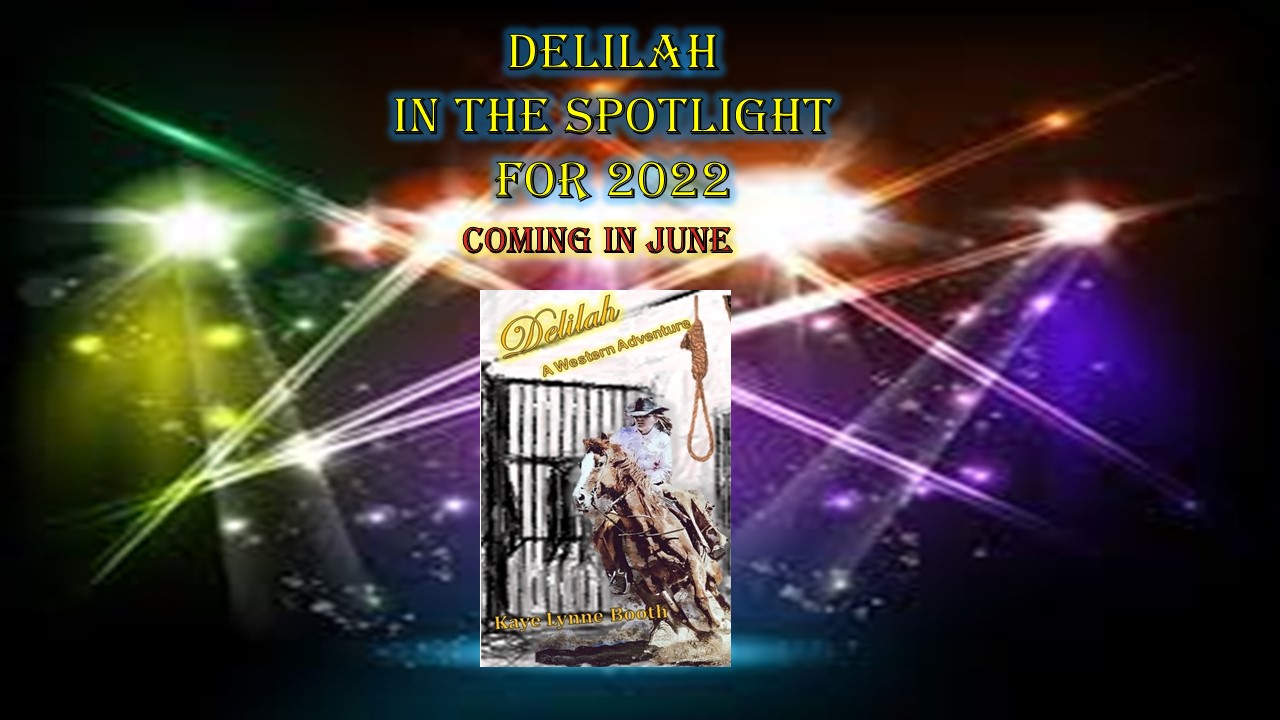
My first release for 2022 is scheduled for June, with the re-release of Delilah, in an edition that is the story I originally intended to tell. (You can find out more about the decision for this change here.) The current edition of Delilah will come down from the Amazon shelves sometime in April, and the new edition will be released wide, so it will be found not only on Amazon, but on Kobo, Barnes & Noble, Apple, Baker & Taylor, Bibliotheca, Borrow Box, Overdrive, Scribd, and other selected digital book outlets because WordCrafter Press publishes through D2D. (I’m a member of their affiliate program. Sign up for your own D2D account here.)
In the past, I told you about my science fantasy series, Playground for the Gods. The first book in that series was my thesis project when I was earning my M.F.A. at Western State Colorado University, back in 2016, so the it has been finished since then, yet you’ve never seen the implied promise of publication come to fruition. In 2022, I plan to release not just Book 1: The Great Primordial Battle, but also Book 2: In the Beginning, and Book 3: Inanna’s Song sometime toward the end of the year, but release dates for these haven’t been set yet.
WordCrafter Press & Author Services
WordCrafter Press has some great releases coming in 2022 as well. An updated version of the writing reference, 2022 Ask the Authors, is scheduled to be released in March. The original Ask the Authors, was taken from a Q&A blog series I ran in 2018. While the much of the advice offered from the 17 different authors who participated in that project is still valid today, this edition will address the changes in the publishing industry since the original edition was published and will feature an anthology of essays on craft and publishing in addition to the Q&A advice. This edition will feature advice from 13 authors, including Bobby Nash, Mark Leslie Lefebvre, Roberta Eaton Cheadle, Nancy Oswald, Christopher Barili, Mario Acevedo, L. Jagi Lamplighter Wright, Kevin Killany, Paul Kane, Jeff Bowles, Enid Holden, Christa Planko, and myself, Kaye Lynne Booth.

The call for submissions for the 2022 WordCrafter Short Fiction Contest posted on January 3rd. However, in 2022, WordCrafter Press will be putting out not just this one anthology, but a total of three short fiction anthologies. In addition to the Visions anthology, which contest submissions may be included in, that will be released in August, there will be two by invitation only anthologies: Slivered Reflections, which will be released in September, and Once Upon an Ever After, which will be released in November.
In 2021, we released the first edition of Poetry Treasures poetry anthology, featuring the works of Robbie Cheadle’s 2020 “Treasuring Poetry” poet guests on Writing to be Read, and we’ve decided to do it again. 2022 Poetry Treasures will feature the works of the 2021 “Treasuring Poetry” guests for a spectacularly unique poetry anthology, and will be released April to celebrate National Poetry Month.

Last, but not least, Write It Right Quality Editing Services is open to new editing clients in 2022. If you’re looking for affordable quality editing, Write It Right could be the editing service you’ve been looking for. A part of WordCrafter Quality Writing & Author Services.
I’m looking forward to 2022. I hope you’ll all join me in the coming year, as it promises to be a good one.
____________________________________________
Like this post? Let me know in the comments. You can be sure not to miss any of Writing to be Read’s great content by subscribing to e-mail or following on WordPress. If you found this content helpful or entertaining, please share.
Share this:

2022 WordCrafter Short Fiction Contest: Call for Submissions
Posted: January 3, 2022 Filed under: Anthology, Fantasy, Fiction, Ghost Stories, Horror, Science Fiction, Stories, WordCrafter, WordCrafter Press, Writing Contest | Tags: 2022 WordCrafter Short Fiction Contest, Call for submissions, Submission Guidelines, Visions, WordCrafter Press, Writing to be Read 2 Comments
The 2022 WordCrafter Short Fiction Contest is now open for submissions. The submission deadline of May 31, 2022. The winner will receive a $25.00 Amazon gift card and their story will be guaranteed to be featured in Visions. All finalists will also receive an invitation to be included in the anthology, which offers a small royalty share for your story contribution. Submission guidelines are pretty simple, but as they are different from last year, I suggest you read and follow them carefully.
Submit your story with a cover letter to KLBWordCrafter@gmail.com with “Submission: [Your Title]” in the subject line and pay the $5 entry fee below.
Contest Entry
Enter the 2022 WordCrafter Short Fiction Contest for a chance at an invitation to the Visions anthology and a grand prize $25 gift card.
$5.00
WordCrafter Press wants your visions.
For 2022, WordCrafter Press is looking for original short stories in the fantasy, science fiction, horror or paranormal genres. Past contests and anthologies have been limited to paranormal, and for Visions, your story can still have a ghost if you like, but it is not required. What I’ll be looking for for the 2022 WordCrafter anthology are your very best thought provoking stories, the kind of stories that will stay with readers long after they close the book.
WordCrafter Press is looking for original short stories to include a mix of fantasy, science fiction, horror, magical, and paranormal elements. Previously unpublished stories only.
Genres: Paranormal, Science Fiction, Fantasy, Horror or any combination there of.
Length: up to 5000 words
Submission Deadline: May 31, 2022
Pay: Royalty share
Rights: First Anthology Rights and audio rights as part of the anthology; rights revert to author one month after publication; publisher retains non-exclusive right to include in the anthology as a whole.
Open to submissions from January 1 through April 30, 2022.
Submit: A Microsoft Word or RTF file in standard manuscript format to KLBWordCrafter@gmail.com
If you don’t know what standard manuscript format is, review, for example, https://www.shunn.net/format/classic/
Multiple and simultaneous submissions accepted.
Find some helpful tips for submitting short fiction here, but mainly just follow the guidelines.
Share this:

Review in Practice – Word Craft: Prose & Poetry
Posted: December 31, 2021 Filed under: Book Review, Books, Poetry, Review in Practice, Teaching Writing | Tags: Book Review, Poetry, Review in Practice, Sally Cronin, Syllabic Poetry, Word Craft: Prose & Poetry, Writing to be Read 5 Comments
Word Craft: Prose & Poetry, by Colleen Chesebro is an insightful and helpful instructional book for those who wish to learn more about writing syllabic poetry and prose. The first section covers Japenese syllabic poetry forms and American syllabic poetry forms are covered in section two. The author outlines the rules and inspirations for each form, and provides plenty of examples to help you get the idea.
Hiaku has been one of my favorite forms of poetry to read since it was introduced to me in the fourth grade. However, my fourth grade teacher didn’t really explain this poetry form in a way that my fourth grade mind could really grasp, so I’ve never felt very accomplished in writing Haiku. In Word Craft, Colleen Chesebro was able to explain the art of this form of poetry in a manner which my aged mind was able to grasp, giving me a much better handle on what I’m trying to do with this form of poetry. Haiku is much more than just putting the right number of syllables in each line. Haiku is written to evoke images and emotion in a succinct way. I was surprised to learn that the syllabic rules for Haiku are not set in stone, and can be varied. Below is a Haiku which I wrote after reading the chapters on this poetry form.
Spring skies let rain pour
Wings stretch, ruffling wet feathers
small Hummingbird preens
While I know poets who write Tanka poetry, which combines poetry and prose,I’ve never understood what they were doing with these poems. Although I can’t say that I’ve mastered the Tanka, I think I do understand it better, but I will need a lot of practice before I write something in Tanka or Tanka prose poem that I feel worthy of sharing.
I also had some experience in writing Hiabun, which is a combination of poetry and prose similar to Tanka Prose Poetry, but I never really understood the purpose of this form of poetry. You would think this would be the easiest form of poetry in this book for me to write, as the inspiration can come from anything and it can be in any point-of-view and any tense that you wish to write in, but I still have a hard time grasping the how of this poetry form. Fortunately, Colleen Chesebro includes many examples of each poetry style and I have no doubt that, with patience and practice I will eventually get a handle on the Haibun.
Forms of Japanese poetry that I wasn’t familiar with in this book include Senryu, which is similar in form to a Hiaku but differs in subject matter; Haiga, which uses either Haiku or Senryu and combines three art forms, imagry, poetry and calligraphy; and Gogyohka, which is based on the Tanka, but you do not count syllables, with one phrase to a line and a line-break after each breath. I found the Renga, which is design to be written by two poets, interactively, , kind of like a poetic conversation, to be in intriguing poetry form.
This is my first attempt at a Senryu poem.
Hot tea steams
on chill summer morn
wake up call
For me, the forms of American syllabic poetry were more difficult, perhaps because they tend to be longer. In the second portion of the book, Sally Cronin includes explanation and instruction and examples for Cinquains of all types, Etherees, Nonets, and Shadormas. I made several unsuccessful attempts at the basic types of each of these poetry forms, but they are much harder than they look. My hat is off to Cronin and anyone else that can meld their syllables with seeming ease.
I took a challenge on Teagan Riordain Genevieve’s blog and for that I wrote a Shadorma poem, which I published here, on Writing to be Read. You can see my example of a Shadorma here, but I don’t know if it is any good. It really was harder than I thought it would be.
If you like syllabic poetry, either Japanese or American, and would like to try your hand at it, I highly recommend the instruction of Word Craft: Prose & Poetry, by Sally Cronin. This book introduced me to new forms, as well as delving deeper into forms I was familiar with. I give it five quills.
________________________________________________________________________________________________________
Like this post? Let me know in the comments. You can be sure not to miss any of Writing to be Read’s great content by subscribing to e-mail or following on WordPress. If you found this content helpful or entertaining, please share.
Share this:

Saying Good-bye to “Delilah” – But not for long
Posted: December 29, 2021 Filed under: Adventure, Books, Historical Inspiration, Western, WordCrafter, WordCrafter Press | Tags: Delilah, Kaye Lynne Booth, New release, western adventure, WordCrafter Press 5 Comments
After long deliberation I have come to a rather painful decision. After April 2022, Delilah will no longer be available through any book outlet. Delilah has been on the virtual shelves for five years now, and really hasn’t had many sales, even after adding forwards from authors Robert Hanlon and Paul L. Thompson, and a new cover and new back cover matter, so I’ve decided not to renew my contract with Dusty Saddle Publishing.
Originally, the story I wrote for Delilah was very different. I made major changes to the plot after the first draft was complete, based on feedback from a beta reader, which at the time I felt was valid, so I basically rewrote more than half of the story. The Delilah that I published, was not the same story that I originally conceived. Upon re-reading to see if I could determine why it might not be selling, I discovered several places where the story feels forced, where I was trying to make the events fit into the amended plot line and it was like trying to fit a round peg into a square whole. One of things authors must strive to accomplish is to write a good story that draws readers in and then provides a satisfying ending, so as not to disappoint readers, delivering on the promise. I think I’ve failed to do that with Delilah, leading to sales not being as good as I had hoped.

The good news is, although Delilah will be disappearing from the virtual shelves for now, I’m going to go back to that original story, at least as much as I can, as I resurrect her and revise this tale into the one I originally wanted to tell. Before the end of 2022 I plan to re-release Delilah in a revised edition complete with new cover (above) and ‘blurbage’. If you already read Delilah and liked it, the revised edition will be even better. It will be a story that is true to character and creator; the story that originally should have been and almost was, will be again. So watch for this new and improved western adventure to be released in June.
_________________________________________
Like this post? Let me know in the comments. You can be sure not to miss any of Writing to be Read’s great content by subscribing to e-mail or following on WordPress. If you found this content helpful or entertaining, please share.
Share this:

Writer’s Corner: Lessons for submitting to short fiction markets
Posted: December 27, 2021 Filed under: Anthology, book marketing, Short Fiction, Stories, Writer's Corner, Writing | Tags: Anthologies, Short Fiction, Submissions, WordCrafter Press 11 CommentsShort fiction doesn’t sell well. – That’s what I keep hearing. Anthologies are hard sells. So why would you even write short fiction, if it is so difficult to sell?
What many authors need to realize, is that while an anthology may be harder to sell than a novel, when you have work featured in an anthology, it is a project involving many authors, each with their own following which they bring to the table, creating a much bigger marketing network than you would have for a novel. Being a part of an anthology expands your marketing reach exponentially by the number of authors involved, which could actually make the marketing and promotion of the anthology easier and allow marketing to a much larger audience.
For the past few months I’ve been exploring short fiction and short fiction markets from the other side of things, as I worked to compile two separate anthologies. My solo project for my masters in publishing is The Best of Weird Tales 1926-27, which meant reading twenty-four issues of Weird Tales and selecting what I felt were the best stories to represent the publication, then compiling them into a single collection. It had to be a careful selection process, because much of what was socially acceptable in 1926 & 27, is far from acceptable in 2021.
The other project required for my degree involves being on the editorial team for the Mirror, Mirror anthology. You may have seen the call for submissions posted here on writing to be Read back in July. And there’s a chance that you even submitted to it, since we had over 600 submissions. That’s a lot of short stories to read. But I learned some valuable lessons from the experience:
- It pays to get your submission in early. The early submissions get fresh eyes and open mind. But those submitted closer to the deadline, are seen by eyes that are tired by minds that have read so-o-o many stories, many of which are similar in theme or concept, if you wrote to the submission guidelines.
- Follow the submission guidelines. This experience drove home to me how important this one really is. Going into this, my instructor and mentor, Kevin J. Anderson drilled in the importance of following the submission guidelines and took great care to make them clear in the call for submissions. It called for proper manuscript formatting, something every author should be familiar with, but just in case, he also included a link to a site that defined and explained what proper manuscript formatting is, and still we got manuscripts that were not formatted properly. Toward the end, I know improperly formatted manuscripts got set aside without a full read, because it hurt my tired old eyes too much, so this is really an important one, but many authors just didn’t get it. Publishers don’t want to work with authors who cannot follow simple instructions and format their manuscript properly or follow the guidelines, because this hints that they might be a pain to work with.
- Only submit a story that fits what the call is looking for. I was surprised how many stories we got that didn’t have a mirror in them at all; not even a compact for the character to check their make-up. Who sends a story without mirrors to an anthology titled Mirror, Mirror that requests a mirror be central to the story. I’m told that last year someone submitted Christmas cards for the call for submissions for Unmasked, last year’s anthology, which may evoke a chuckle when you hear it, but for editors overwhelmed with submissions, reading through a story that doesn’t even come close to meeting the guidelines or match the theme, it feels like a big waste of time. Editors have feelings, too. Be kind and only submit stories that meet the theme and guidelines, instead of trying to cram your story into a frame that doesn’t really match.
- In today’s market, busy editors are looking for something that is close to being publishable as is, so be sure your manuscript is polished. I feel like I shouldn’t have to state this one, but with as many seemingly unedited submissions, I guess it needs to be said. I was expecting it toward the end, when authors were rushing to meet the deadline, but even early on there were manuscripts that were riddled with misspellings and typos. Many of these may have been good stories, some even written to guidelines, but they were passed by because they would have required too much editing to ready them for publication. It would have required more time than my class of student editors would be able to give. So, I strongly urge having another set of eyes give a critical look over all stories prior to submission. Turning in a clean manuscript will strengthen the chances of your submission being accepted, or at least read clear through for a fair evaluation.
- Choosing favorites is much harder than I thought it would be. We were cautioned that last year’s anthology received over 500 submissions, with more than 100 received in the last week of submissions. Mirror, Mirror received over 600 and so many of them were truly excellent stories that choosing the few that we had the budget for was really difficult, especially since not everyone had the same favorites. In the end, we ended up with a heck of a selection of stories for this anthology. I think it will be great!
Although all of my personal favorites couldn’t be included, I did find a way to make 2022 a great year for anthologies at WordCrafter Press, with two by invitation only anthologies in addition to the annual short fiction contest and anthology. I gave you a sneak preview for the submission call for the annual anthology, which will be titled Visions, here. The official call for submissions will be posted in January, so stay tuned.
___________________________________________________________________________________________________
Like this post? Let me know in the comments. You can be sure not to miss any of Writing to be Read’s great content by subscribing to e-mail or following on WordPress. If you found this content helpful or entertaining, please share.



















