Treasuring Poetry – Meet writer and poet, Willow from Willowdot21

Today, I am delighted to feature writer and poet, Willow Willers, as my Treasuring Poetry guest. Willow blogs at willowdot21.

Which of your own stories is your favourite?

Well Robbie, my real first favourite is a trilogy I wrote about young boys who get caught up in drug running gangs and knife crime. My real ambition would be to have a chance to read this to young people at clubs and schools.

The death

The bench was hard but he could take that, it was the pain in his side and chest which filled his being, everything else was flat.

Fear gripped his mind, he was so cold inside yet a sweat was rippling down his back. His sight was blurred, was he going blind?

Slowly a long hidden memory came to the fore. His mother had taught him it long before he had changed. “Gentle Jesus meek and mild look upon me a little child.”

OH! Jesus if you are there help me now, I did not need you then but I do now. Jesus this pain is f###ing killing me, help me help me please. Slowly he slipped forward onto the floor and darkness washed over him and he knew no more.
***
“Where are you going son. No, out, will not do! Listen to me boy I am asking you. Why must you run with that pack it seems to me now there is no coming back. What has happened to you, you were such a good boy at school I had hopes that you’d go far but your just like your brother playing the fool.

No your not wicked but you are not a fool and I am telling you this, in my book you’re not cool.”

“What are you doing with that? Give it me back , don’t you threaten me son I’ll give you a smack. OH! Please will you listen to me don’t take that knife it will not set you free from the boredom in your life. It will not get you a job, it won’t make you a man what has happened to you and your world changing plan? You had vision and hunger for work as a decent and pleasant boy not as you are now , just a jerk.”
***
Clearing up quietly the priest approached the last row when something on the floor that caught the suns last glow. Red and sticky he knew what it was but he prayed to his God that it would not be true. The boy lying his arms out wide, blood flowing from his side. A thought crossed his mind but he dismissed immediately. He looked like Jesus did, you see. Arms out wide , blood from his side a cut round his forehead dripping, blood in his eyes.

He took out his mobile and took a deep breath as he dialled, ambulance, police he begged his mind running wild. The operator was telling him what to do, “Keep him warm and stem the blood is what I want you to do.” He ripped off his cassock and swaddled the lad he then noticed blood on his jeans ( the best ones he had) He cradled the boy and prayed in his ear “keep trying to stay ask now, Jesus will hear.”

It was half an hour until anyone arrived the paramedic crew gently moved the priest to one side. It was too late the boy was gone, then with their radios crackling loud, the police taped the area off, people from everywhere arriving, such a crowd.

Standing back and looking around the priest said a prayer without making a sound. “Dear God take the soul of this boy who died here today and give him some peace, and if you have time help me find words to soothe his family, at least ” Then he sat down exhausted, he was just a man even though he was called a priest.

A woman on her way home from work regretting an argument at the start of her day was wondering how to fix things and what she could say. She always said never give up, never leave a good word unsaid. Never leave things, sort them before you go to bed. Passing the church she saw her youngest boys friends , he wasn’t there perhaps they could make amends.

The Cause
He awoke with a jump. It was his brother rolling in drunk! Damn only 4am please don’t go over what’s to happen again. I know I must do this. I must prove myself.

It was all too easy a year ago when his best friend introduced him to the boys “you need to know” It had been simple things at first making old ladies jump, stealing traffic cones all laughing fit to burst.

When he was really trusted, got himself a name.Things became more serious it suddenly was a whole new game. They met the older boys, the ones with big fast cars. They all wore hoodies, bling and they all had facial scars.

It was money and messages that he had to run he was fit and had a bike.Now that is how easily it had begun. He often skipped school though not always willingly. There really was not any choice, what the big boys said, had to be.

His teachers all asked him why his work had slipped away he had a brilliant future and he had thrown it all away. He was a little worried but he shrugged his shoulders and wandered off, his teachers called him back but his friends told them to f### off.

Mum, she was desperate working on her own doing all she could to keep the house, the boys and to make  them a home. The oldest she had lost him he had gone to drugs. She had tried so hard but he just robbed her blind and made her look a mug.The young one she had dreams for she had prayed to the Lord each day but now he was on the wrong track, he was slipping the same way.

He knew he had become a waster, he knew that he was bad . It was the only way to be accepted and safe but the pain in Mum’s eyes made him feel sad. So he just avoided contact and hardened to her pleas. He was knocked back the other day when she begged him to stay home down on her knees.

He tried to ask his brother who ran with an older crew but he was useless as he was trapped there too. What chance was there, his brother asked, what was there for them to do there was no work or opportunities running with lads was at least something to do. It was all about status and how hard you are , what clothes you wore , what trainers and did you have a scar.

His brother had one, on his face, from a fight with a rival gang. Okay it hurt , six days in hospital 17 stitches but he was now a big man??

Today was his chance to join the glorious crew. To take part in the big ruck was all he had to do.

Two weeks he had known about the fight , where and exactly when. It was on his mind both day and night . His thoughts were full of dread , through his blood ran pure fear it was nearly six now, the day was finally here.

Later in the kitchen when he was taking the knife , his mother caught him and shouted at him. He raised his hand to her for the first and last time in his life. Luckily she was small so he pushed her to one side as he crashed through the door and out the gate . His mother sat on the floor and cried.
***
Later he met the guys when mum had gone to work, they knew a squat they could use to complete their plan. By 4pm they were jumpy they were ready to a man.They left the squat and through the railings ran. Jumping , punching the air and making feral calls they had it now they all knew the plan, they had all the balls.

He wished he’d picked a smaller knife this one was too large . As he was changing it’s position. Into him a couple of the lads all barged. At once he felt a sharp and stinging pain as he fell to the floor, it felt worse again. His side felt wet and his forehead was cut where he had scraped along the floor..

What’s wrong man, stop messing we haven’t got the time it’s 5 o’clock now hear those church bells chime. Oh! hey you’re hurt man what did you do. You stupid f### you stabbed yourself. We have to leave you here, no good to have a burden on the crew.

His best friend helped him into the church and sat him at the back , hold on, he said, laters. then ran off to join the pack.

So he alone now, life ebbing from his side thoughts of mum, school, his brother and he cried. He asked the lord for comfort but comfort did not come. He prayed a childhood prayer from deep inside his mind. The priest found him,and he was very kind. He wrapped his chest and held him and asked him not to go . He tried to but he couldn’t stay he felt too tired, too low.

He heard the priests’ desperate call as he slipped away forget the ambulance he though and just pray for me today. The priest felt him go, but he would not lose his grip he felt he needed to guide this lost boy, some mothers pride and joy.
The Effect
Getting off the bus and heading home, she was tired her feet aching but she was determined not to moan. This was important, it had to be done she needed to put her whole being into saving her youngest son!

Pushing the front door shut behind her putting the bags down on the kitchen floor she looked into the living room but there was no one there. No television no shoot’em’up games standing in the hallway she called out both boys names.

OH! well, she put the kettle on and maybe she’d ring around she had both their mobile numbers but they did not always want to be found. The doorbell rings , damn she had only just sat down, walking toward the door the phone begins to ring.

There it is the sight every mother dreads, a policeman and a policewoman , OH! god she thinks someone must be dead.

The hospital was noisy but she didn’t hear a sound her lungs were filling up as she were about to drown. She had been waiting for an age now, would no one take her in. She was feeling really sick now and felt like things were crawling on her skin.

It was so cold in there and he only had a sheet on . God he looked so pale but she supposed that was what you would look like when all your blood was gone.
***
She woke up with the headache she had, had since that day, the shock of the police visit and what they had to say.

She  knew she had to get up she knew she must today, it was the funeral and that would not go away.

Things had been different her elder boy had stayed home he seemed to want to help his mother and not leave her on her own. She dared not to hope he had changed but she was glad that he was there.

She slowly put her face on and then she brushed her hair.

His friends were at the church like they had been that day , he was not with them. Would this pain ever go away.

The priest seemed glad to see her and he offered his support, she felt close to this man who was with her boy when for his life he fought.
***
His favourite track finished and the last notes drifted away she stood up and looked at everyone and said she had something to say.

She knew that there was no work and that there was not much hope but joining gangs and using guns and knives was not the way to cope. Please listen, she pleaded you are slipping away too many lives are wasted too many die this way. Something must be done and it must be soon we are losing a generation it might be two if something is not done soon.

How many more mothers have to suffer like she.

We really need to sort this out……… her voice trailed off to silence as she repeated, how many more mothers like me?

What inspired you to write this particular poem?

I wrote this story in 2014 but with the news of yet so many gang related killings in London in fact all our towns and cities lately. There have been so many knife crimes these last years. In light of this I felt compelled to write about how easily you people regardless of their ethnic background get sucked into gang culture. I felt the need to show how far the ripples spread and how even the innocent are touched.

What are your plans for your poetry going forward?

I love my poetry and I hope to continue to write until I die. I would love to publish a book of poetry but something is holding me back. I don’t know what really.

What is your favourite poem?

My favourite poem is High Flight. by John Gillespie Magee JR.

Oh! I have slipped the surly bonds of Earth
And danced the skies on laughter-silvered wings;
Sunward I’ve climbed, and joined the tumbling mirth
of sun-split clouds, and done a hundred things
You have not dreamed of-wheeled and soared and swung
High in the sunlit silence. Hov’ring there,
I’ve chased the shouting wind along, and flung
My eager craft through footless halls of air….
Up, up the long, delirious, burning blue
I’ve topped the wind-swept heights with easy grace
Where never lark nor ever eagle flew-
And, while with silent lifting mind I’ve trod
The high untrespassed sanctity of space,
Put out my hand, and touched the face of God.

Why do you like this poem?

It always makes me cry. It’s the fact that this young man born in Shanghai, China, to an American father and a British mother, who both worked as Anglican missionaries who flew Spitfires for Great Britain during WW2. died not long after qualifying in 1941 in a routine training accident.

The beautiful words are so prophetic, I hope he got to touch the face of God.

A poem by Willow: Broken Angel

My wings are clipped my feet are tied.
I need to scream, but I can not cry.
I need to run I need to hide,
Afraid to stay , too tired to fly
Alone under a moon lit sky.
Can I run, can I hide,
Can I beat this pain inside
Will it end, will I be no more
Will I find the key to the locked door.
Broken angel that is me
No longer blessed no longer free.
Shackled, so harshly tied down
Lost to all, now bound to the ground.

Find out more about Willow here: https://willowdot21.wordpress.com/about/

About Robbie Cheadle

IMG_9902

Robbie Cheadle is a South African children’s author and poet with 9 children’s books and 2 poetry books.

The 7 Sir Chocolate children’s picture books, co-authored by Robbie and Michael Cheadle, are written in sweet, short rhymes which are easy for young children to follow and are illustrated with pictures of delicious cakes and cake decorations. Each book also includes simple recipes or biscuit art directions which children can make under adult supervision.

Robbie has also published 2 books for older children which incorporate recipes that are relevant to the storylines.

Robbie has 2 adult novels in the paranormal historical and supernatural fantasy genres published under the name Roberta Eaton Cheadle. She also has short stories in the horror and paranormal genre and poems included in several anthologies.

Robbie writes a monthly series for https://writingtoberead.com called Growing Bookworms. This series discusses different topics relating to the benefits of reading to children.

Robbie has a blog, https://robbiesinspiration.wordpress.com/ where she shares book reviews, recipes, author interviews, and poetry.

Find Robbie Cheadle

Blog: https://www.robbiecheadle.co.za/

Blog: robbiesinspiration.wordpress.com

Twitter: BakeandWrite

Instagram: Robbie Cheadle – Instagram

Facebook: Sir Chocolate Books

______________________________________________________________________________________________

Want to be sure not to miss any of Robbie’s “Treasuring Poetry” segments? Subscribe to Writing to be Read for e-mail notifications whenever new content is posted or follow WtbR on WordPress. If you found it interesting or entertaining, please share.


Growing Bookworms: Toys that help develop fine motor skills in children

It is important for children to develop good fine motor skills so they can perform important tasks such as feeding themselves, grasping objects, drawing, cutting, and writing. Successful achievement of these skills increases children’s confidence.

These are a few examples of toys that help children develop fine motor skills:

Threading beads

Threading beads on a string is an excellent activity for small children. Large beads with thick stings and large holes are best for younger children. Sets with smaller beads, strings and holes are available for older children. Children love making necklaces and bracelets for themselves, parents and other caregivers.

Lacing cards

Lacing involves threading a string or shoelace through a board. It is the same action that is used to thread shoelaces in a shoe. Parents and caregivers can create their own board using cardboard and scissors or a paper punch. Alternatively, you can purchase lacing kits.

Building blocks

Building blocks have many benefits other than improved fine motor skills. Among these are increased attention span, working with other children i.e. team work, gross motor skills, science concepts (such as gravity, weight, stability and balance), spatial development, early maths and number concepts, and language development. Lego is a more advanced form of building with blocks.

Drawing and painting tools

Drawing and painting is a wonderful and fun way of allowing children to develop their fine motor skills. There are a variety of different instruments for drawing and painting, including wax crayons, oil pastels, paints of all sorts, coloured pens and pencils, ect.

Drawing has the added benefit of teaching children how to hold a tool or instrument to make shapes and drawings on a surface.

Puzzles

Puzzle come in all sorts of shapes and sizes from shape sorters for very young children to large, complex puzzles for older children. There are also a variety of colourful peg boards that are available for children.

I had all of these toys for my children and I used to sit and do activities with them in the afternoons. I also used to get the boys to cut out shapes and stick them on paper to make interesting designs. Michael struggled with cutting and it was one of the first indicators I identified of his auditory processing barrier.

Did you do any of these activities with your children? If yes, do you think they helped your child with learning to write? Let me know if the comments.

About Robbie Cheadle

IMG_9902

Robbie Cheadle is a South African children’s author and poet with 9 children’s books and 2 poetry books.

The 7 Sir Chocolate children’s picture books, co-authored by Robbie and Michael Cheadle, are written in sweet, short rhymes which are easy for young children to follow and are illustrated with pictures of delicious cakes and cake decorations. Each book also includes simple recipes or biscuit art directions which children can make under adult supervision.

Robbie has also published 2 books for older children which incorporate recipes that are relevant to the storylines.

Robbie has 2 adult novels in the paranormal historical and supernatural fantasy genres published under the name Roberta Eaton Cheadle. She also has short stories in the horror and paranormal genre and poems included in several anthologies.

Robbie writes a monthly series for https://writingtoberead.com called Growing Bookworms. This series discusses different topics relating to the benefits of reading to children.

Robbie has a blog, https://robbiesinspiration.wordpress.com/ where she shares book reviews, recipes, author interviews, and poetry.

Find Robbie Cheadle

Blog: https://www.robbiecheadle.co.za/

Blog: robbiesinspiration.wordpress.com

Twitter: BakeandWrite

Instagram: Robbie Cheadle – Instagram

Facebook: Sir Chocolate Books

______________________________________________________________________________________________

Want to be sure not to miss any of Robbie’s “Growing Bookworms” segments? Subscribe to Writing to be Read for e-mail notifications whenever new content is posted or follow WtbR on WordPress. If you found it interesting or entertaining, please share.


Book Review: There Will Be Consequences

There Will Be Consequences, by Loretta Miles Tollefson is a biographical historical novel which tells the story of 1837 New Mexico territory history from a biographical perspective, using multiple P.O.V.s. 1837-38 is a complicated period of New Mexico’s history, when rebellion broke out, which Tollefson has undertaken to portray, and she chose an effective way to illustrate all of the different perspectives. There Will Be Consequences tells the story of an historical conflict in which there were no winners.

Although I am familiar with Colorado’s history for this period, this book shows that there was a lot more going on on the western frontier than just cowboys and Indians, wagon trains and mining. This is not a tale of high adventure, but one of the backbone of this country just trying to survive, and it is filled with events that most will find astounding.

There Will Be Consequences

Buy Link: https://www.amazon.com/There-Will-Be-Consequences-Biographical/dp/1952026059

There Will Be Consequences is skillfully crafted to offer an inside look into the events of the 1837 rebellion and the resulting events. If you are familiar with this historical period and area, you’ll enjoy the thoughtful insights Tollefson offers through the different perspectives offered. If you’re not, you’ll find it all quite interesting. I give it five quills.

__________________________________________________________

Kaye Lynne Booth lives, works, and plays in the mountains of Colorado. With a dual emphasis M.F.A. in Creative Writing and a M.A. in Publishing, writing is more than a passion. It’s a way of life. She’s a multi-genre author, who finds inspiration from the nature around her, and her love of the old west, and other odd and quirky things which might surprise you.

She has short stories featured in the following anthologies: The Collapsar Directive (“If You’re Happy and You Know It”); Relationship Add Vice (“The Devil Made Her Do It”); Nightmareland (“The Haunting in Carol’s Woods”); Whispers of the Past (“The Woman in the Water”); Spirits of the West (“Don’t Eat the Pickled Eggs”); and Where Spirits Linger (“The People Upstairs”). Her paranormal mystery novella, Hidden Secrets, and her short story collection, Last Call and Other Short Fiction, are both available in both digital and print editions at most of your favorite book distributors.

When not writing, she keeps up her author’s blog, Writing to be Read, where she posts reflections on her own writing, author interviews and book reviews, along with writing tips and inspirational posts from fellow writers. In addition to creating her own very small publishing house in WordCrafter Press, she offers quality author services, such as editing, social media & book promotion, and online writing courses through WordCrafter Quality Writing & Author Services. As well as serving as judge for the Western Writers of America and sitting on the editorial team for Western State Colorado University and WordFire Press for the Gilded Glass anthology and editing Weird Tales: The Best of the Early Years 1926-27, under Kevin J. Anderson & Jonathan Maberry.

In her spare time, she is bird watching, or gardening, or just soaking up some of that Colorado sunshine.

___________________________________________________________________________

Join Kaye Lynne Booth & WordCrafter Press Readers’ Group for WordCrafter Press book & event news, including the awesome releases of author Kaye Lynne Booth. Get a free digital copy of her short story collection, Last Call and Other Short Fiction, as a sampling of her works just for joining.


Mind Fields: Food Disorders And Other Fun Things to Do To F**k Yourself Up

Mind Fields

2022, The Year Of The Great Fungus

I have a conceit, i.e. that I should hold the title as “The World’s Most F**ked Up Person”. The only problem is that all of you would also like to hold this same title. Don’t try to con me. I know what you think. The only reason I know what you think is that it’s the same thing that I think.

Or. I used to think. When I recognized that each of us claims this title as the most neurotic person on Earth, I began to have more confidence in myself. Surely, I reasoned, if I am exactly the same amount of f**ked up as everyone else, then I must belong to this Family of Man. I’m human. And we all know that there is great dignity to being human. We are builders of pyramids, makers of satellites and space ships.

I have a very weird relationship with food. The first time I grasped that I was deeply crazy was when I began to eat huge amounts of food. I indulged especially in sweets. If I were to make a pie chart of my life (and refrain from eating it), I’m sure it would show huge chunks of time in the bulimia/anorexia’ zone. The worst of my food disorders followed me through adolescence; years seventeen through twenty two. I was out in the world, trying to maneuver by being on or near college campuses.

I had a sneaky way of being anorexic. I deluded myself into thinking that this was a spiritual discipline.  Macrobiotics. It would get me high, exalt me spiritually. By eating small portions of brown rice and onions, chickpeas in barley, I was the paragon of yogic discipline. This was who I wanted myself to be. I got skinny. I weighed 125. On top of this I was taking LSD and smoking DMT. I was deep into my purpose, my destiny of becoming a musician of salvation and a figure of reverence. I was grandiose as all hell.

Then I came to a breaking point. After a year of Macrobiotics, I had such a craving for a peanut butter and jelly sandwich that I bought the ingredients and took them back to my hidey hole. “What are you doing?” I asked myself. “This is a self betrayal, this is the opposite of Macrobiotic food. You asshole, what a failure you are!” So I ate it. Then I ate something else sweet and gooey. Then I couldn’t stop eating every kind of junk food on the planet. I had been like a spring ready to snap. Boing!

I was so ashamed of myself. This was 1967, before eating disorders had been invented. I was a pioneer. My bulimia wasn’t the pukey kind. It was the Exercise Freakishly type of bulimia, the one where on alternate days I would purge with sweat and effort, then follow with a day of relentless eating: an entire apple pie, backed up by a half gallon of ice cream. That kind of eating: epic, disgusting eating. After that came the cookies, and so forth. One day exercising. One day binge eating. Back and forth, one followed the other, for more than a year. I looked for help. I went to the college shrink. He said, “I don’t know what’s happening to you and I can’t help you. Besides, you’re not even enrolled as a student at this college.”

I lost weight during this time. It was paradoxical! How could I be losing weight? My metabolism must have been very confused. My waist was a twenty nine or thirty. I was living in a vacant student’s quarter, avoiding the security guys and bedding down with a pad and sleeping bag. I got money from my dad. I worked as a stable boy at a local horse ranch. A stable boy. I had my drums stashed at the university’s music building in a practice room. I practiced there for hours every day, getting high by all means and experimenting with the limits of my technique. That was the point of not going to college. I let my dad pay for semesters at Western Reserve or Wayne State, and then I would slip down to Yellow Springs from Cleveland and hang out with people who talked to trees. I would practice all the time, working through the famous “Stick Control” books and listening to Coltrane records.

This was a pleasant period that lasted about a year. I may be conflating two different periods of time. It doesn’t matter. That’s the way memory works when it sort of fails to work. I think there’s a memory bank in the brain and it gets filled up and needs to be purged once in a while. It’s all just story anyway. Life truly is fiction, it has to be. I just want a subject to write about and my life has been so bizarre that it qualifies as the stuff of novels. That poor guy (that is, myself) didn’t know what lay ahead. He thought that if he took enough acid, did yoga, ate rice and played the drums then he would launch himself into nirvana. It’s not a bad plan, really. The problem was that I was fractured psychologically, harboring behaviors that would shame me again and again. I was very (he says solemnly) very f**ked up.

These were adolescent ordeals, but they were precursors to my future. In the sixties my eighteen year old self dreamed of cosmic unity while the biggest thing that lay ahead of me was coke and heroin addiction. I interrogated my psyche by reading about psychology. After that came years of therapy. I was determined to save myself ,in spite of my terrible behavior.

It took a long time but none of it can be repudiated. It’s lucky I’m still alive and well.

After my food disorders came cocaine, and then, heroin.

I’m still slightly food disordered. I control, compensate, manage. Mostly I exercise.

The cocaine and heroin almost killed me. 

____________________________________________________________________

Arthur Rosch is a novelist, musician, photographer and poet. His works are funny, memorable and often compelling. One reviewer said “He’s wicked and feisty, but when he gets you by the guts, he never lets go.” Listeners to his music have compared him to Frank Zappa, Tom Waits, Randy Newman or Mose Allison. These comparisons are flattering but deceptive. Rosch is a stylist, a complete original. His material ranges from sly wit to gripping political commentary.

Arthur was born in the heart of Illinois and grew up in the western suburbs of St. Louis. In his teens he discovered his creative potential while hoping to please a girl. Though she left the scene, Arthur’s creativity stayed behind. In his early twenties he moved to San Francisco and took part in the thriving arts scene. His first literary sale was to Playboy Magazine. The piece went on to receive Playboy’s “Best Story of the Year” award. Arthur also has writing credits in Exquisite Corpse, Shutterbug, eDigital, and Cat Fancy Magazine. He has written five novels, a memoir and a large collection of poetry. His autobiographical novel, Confessions Of An Honest Man won the Honorable Mention award from Writer’s Digest in 2016.

More of his work can be found at www.artrosch.com

Photos at https://500px.com/p/artsdigiphoto?view=photos

__________________________________________________________________________________________________

Want to be sure not to miss any of Arthur’s “Mind Fields” segments? Subscribe to Writing to be Read for e-mail notifications whenever new content is posted or follow WtbR on WordPress. If you find it interesting or just entertaining, please share.


Bowlesian! – Godling: Part I

Godling: Part I

by Jeff Bowles

*This story and others like it can be found in my collection Godling and Other Paint Stories, available on Amazon now.


According to the oral tradition, the Gods created man, man created Godling, Godling ruled over man until man decided genocide was in fact the worst case ever made for machines ruling anything. Godling’s own subjects–the Ancient Spacefarers–overthrew and imprisoned him on the remote grasslands planet of Isolinius, there to dwell in perpetual confinement under the watchful eye of the monastic Divine Order of Battles Won.

Eons came and went. Human beings lost their drive for exploration and personal cosmic growth. They segregated themselves onto small worlds. After a sum of almost 5,000 years, the prison complex’s abbot warden, Renaldo Timekeeper, 126th in the Order’s line of such individuals, approached the god machine with a demand.

“I have two young friends, prisoner. They need help, and no one else on this planet will provide it. They will have an audience with you. In truth they’re already here, and their cause is as just as any.”

Godling studied Renaldo closely. Though he was intelligent and often keen in his worldly perceptions, the abbot warden was short, bald and foppish, preferring colorful robes and jeweled affectations, an annoying resplendent tone in his conversations and meandering arguments.

“I should very much like to kill you, abbot warden,” Godling said. “Have I told you this lately?”

“You have,” said Renaldo. “Repeatedly.”

“Then we understand each other. They bribed you, didn’t they? These friends of yours?”

Renaldo hesitated. He ran a gloved hand over his huge bald spot, saying, “If indeed it matters in any way, prisoner, the girl’s father–”

“Yes, the girl. Flush with love. That’s trouble to begin with. Their cause is romance, isn’t it? You clearly deserve to die, abbot warden. You don’t mind doing it yourself, do you? I seem to have lost the use of my hands, oh, 5,000 years ago.”

Godling’s enormous body had been constructed of an ultra-resilient Darkwork alloy. His brain contained a multitude of mechanisms and tissue chips, and his heart was made entirely of inky liquid circuit matter. The Ancient Spacefarers had neatly severed him into six parts in their rush to dethrone him: head, arms, torso, legs. They’d entombed and imprisoned these parts deep within Claustrum Mons, the highest mountain on Isolinius.

Godling’s head now rested in what was known as the Orange Room, there upon a pedestal, with his eyes pointed at the orange ceiling. From the base of his head–the severed end of his alloy neck–ran a thick, fibrous red line like rope. The line stretched, straight and taut, to the far wall of the room, disappearing there and linking with his other body parts in the other rooms of the prison.

“Prisoner,” Renaldo said, “you have neither the authority to command my death nor the time to see it through. As long as the rulers of this world regard you as an inexhaustible adviser–”

“Ah! Aha! Now we’ve struck it!” Godling bellowed. “Inexhaustible advisor. Your words, abbot warden, not mine. They come and go all day long. But this girl, and this boy. Hmm, trouble.”

Through a healthy slathering of a special and vibrant orange sensory-paint, the like of which Golding had invented himself, he observed the two young people as they made their way farther and farther down the long tunnel that burrowed deep into the side of the monstrous alpine slope of Claustrom Mons. They were barely more than teenagers, perhaps nineteen or twenty. Through the orange paint, Godling took the full measure of them. He lived in paint now. A special kind composed of a fine poly-organic blend of neural wireless transmitters and perception receptors/dispatchers. Orange for sensory, purple for locomotion, green for touch. He could inhabit anything and everything coated in the stuff, and so, he made the entire prison his body.

“They’re nearly at the blast doors, Renaldo,” Godling fumed. “Who opened the doors for them?”

“I did.”

“Just like that? Because you can? How I shall begin, abbot warden?”

Renaldo cleared his throat. “Perhaps, god machine, you should begin by introducing yourself.”

Yes, perhaps. Then again, perhaps Renaldo’s brain might be better employed as a protein-rich piston lubricant. Love and lovers. Hmph. Godling withdrew all perception from the Orange Room. In a flash, he nestled himself within a long patch of orange sensory-paint in the blast door safety chamber, the size and span of which fairly dwarfed the boy and girl. He spoke a dozen decibels louder than he intended, his voice harsh from the buzz of his concealed, quivering vibrathreads.

“Children, I can see you.”

The girl shrieked and the boy jumped back.

“I don’t mean to startle you.” Godling said, “Only to announce my presence. Hello. This is an announcement. Here I am.”

The girl’s eyes darted around the chamber.

“Here?” she said. “Where’s here?”

 “And who’s I?” said the boy. “I mean, who are you?”

Godling watched them closely. He studied the manner in which they held each other, clutched, clung, fresh excitement and fright brightening their cheeks and warming their skin. Godling sniffed them, tasted their scents. Pheromone levels high, anxiety toxicity enough to choke a rabid pneumatic horse. Taste of fear, smell of sex. Oh but they were so deep in it.

The boy looked the brazen, heroic sort. The kind Godling had long ago loved to crush beneath his massive clawed feet. Dark hair, dusky complexion, full, expressive lips. Crush, crush, crush, crush. And the girl …

The girl was a beastly thing. A creature any smart machine knew well enough to leave alone. Beautiful; gorgeous, even. Biologically … rather perfect. And did she look like…?

No, of course not. No woman alive looked like her. Nobody could ever come close.

“Who are you? Where are you?” the boy said.

“Ah, a man of action,” Godling said. “I do not like that. I should very much like to kill you. Universe takes all kinds, I suppose. I am Godling. Also known as the god machine. Also known as the god king. Also knows as the truest king of all. Also known as–”

“The monster king,” said the boy.

The girl’s face lit up. “The machine who ruled humanity for five centuries, ushered in an unprecedented era of peace and prosperity, permitted humans to travel the stars, and who took for himself the name Godling, because he truly was a god among men.”

“This is all true,” said Godling.

The boy cocked his head. “The same machine who debased himself for the love of a woman, lost his mind to rage, and who, without any warning at all, slaughtered millions of his own subjects.”

“This is true as well,” said Godling. “I also like to sing. Did you know that? Come along, now.”

He left the patch of orange in the safety chamber and flashed to the receiving room beyond.

“Well come on,” he called to the lovers when they moved not an inch. “Wouldn’t you like to see what your bribe has bought you?”

The boy and girl exchanged a nervous glance, and then as one, they stepped through. Godling made certain to close the doors behind them with two deafening clangs.

“Wouldn’t want any monster kings making a run for it,” he said pleasantly. “Off we go, then.”

*****

“Ressia,” said the girl. “My name’s Ressia.”

“Brennan,” said the boy.

Godling smiled inwardly. “There, isn’t that better? Good to be on a first-name basis, hmm? Now about your bribe …”

“Please, hallowed one,” said Ressia, “I don’t want you to get the wrong idea about us.”

The lovers followed Godling from one patch of sensory-paint to the next. The reception wing, the common, foot tunnel row, all the while, disturbing and unnerving monks wherever they went.

“Don’t mind them,” Godling said. “Not used to such lowly figures roaming their hallowed halls. Now child, about this wrong idea business. Surely you must know I am incapable of getting wrong ideas. Why, the rulers of this world–”

“Seek your counsel every week,” said Ressia. “Yes, we know.”

“That’s why we’re here,” said Brennan. “You see, her father–”

“Fathers,” Godling said. He moved further up the foot tunnel. “I am not concerned with fathers, nor am I interested in progenitors of any kind. The emperor of the entire Northern Continents seeks my counsel every third pseudo-day of each second cycle. And Delinius, the neo-liege, personally visits my Orange Room every time he has a crisis of faith. Do you have any idea how often a neo-liege has crises of faith?”

“No,” said Brennan, “but you see, her father–”

“And then there’s the trouble between King Marshal of Sevrum and Stevrik III of Quaratania.” Godling flashed into the security firezone antechamber, the room that stood directly outside the prison proper. “Don’t get me started on them. Some silly thing concerning Stevrik’s daughter. She desires, I’ve been told, to forsake her betrothed and marry her lover who … ah … ah, I see. You are Stevrik’s daughter, aren’t you?”

“I am,” Ressia admitted.

“But this is wonderful.”

“It is?”

“Yes. Don’t you see? You have come here for no good reason. You will leave my prison desperately disappointed, and I shall not be bothered with your nonsense a moment longer.”

Brennan scowled. “If you have no intention of hearing what we have to–”

“No intention? Never said that. Who said that? Never said it.”

Godling, in fact, had every intention of hearing what the lovers had to say. For if they hoped to gain a thing from him, he now hoped to gain something back. A plan began to form in the outer-regional processes of Godling’s mind. Oh, but he was a devious, calculating, beast of a machine. And if he had his way, young Ressia and Brennan would soon come to know it. 

“Please,” Godling said, “step into my prison.”

With the merest of thoughts, he deactivated and slid back the eighteen locking pins of the prison’s purple security door. It swung open slowly, groaning on its massive hinges.

“The first things you shall see, children,” Godling began, “are the razor-sharp claws of a genocidal mad-machine who feels no remorse at all.”

“My god,” Brennan gasped. “That … leg. It’s so large. And the room’s so….”

“Purple,” said Godling. “Yes, I know.”

The purple room, or more accurately, Purple Room One. Orange for sensory, purple for locomotion. Godling had the power to move anything coated in it. He had, at different points throughout the centuries, experimented with moving these very walls and this ceiling as a means of escape. In fact, of the 927 escape plans Godling had initiated in the past five millennia, Purple Rooms One and Two had been directly involved in 156.

Too bad those 156 plans had all proven failures. Along with the other 771.

“What is that there?” Brennan asked. “That red rope coming from the wall?”

“Ah, you’ve notice the bloodwire. Contains no blood at all, of course. Yet it does keep my body powered down at all times.”

“And just how tall are you, hallowed one?” said Ressia.

“Oh, I am a sight. The height of three men. Four if I care to feel insulted. Of course, if I were to feel insulted, I’d probably use those claws there to shred your skin and internal organs to long, sopping strips. Shall we?”

He quickly ushered them into Purple Room Two, and then, into Green Rooms One and Two. There, his arms rested upon their pedestals. Thick as ancient tree trunks, fingers spread wide like the wings of carrion gorgers. Green was for touch-paint, used throughout the prison precisely so Godling could feel, as if with his own Darkwork alloy fingers, a soft pillow or a damp cloth or the warm touch of a–

Godling’s memory banks refreshed. He saw her with the precision and exactitude of second sight. Auburn hair, like the sunset, wisest brown eyes. And the twisting, fiery agony they’d endured together….

“Hallowed one?”

Her image had a death grip on Godling’s primary visual tasking matrix. 5,000 years and he still couldn’t comprehend everything he’d lost.

“Hallowed one? Godling?”

Godling’s focus returned to his Green Room, to the boy, Brennan, and to the girl. No, she couldn’t compare at all. Blonde, not auburn. Beautiful, yes, but not nearly so exotic.

“The Orange Room,” Godling said, doing his utmost to quarantine the affected memory pathways. “To the room and to my counsel.”

Brennan shook his head. “But that’s only five rooms. The history vids say there’re–”

“Six. Yes. The black room is off limits, child. I will surely kill you for just the thought of it.”

*****

“You see, my father is King Stevrik III.”

“Yes….”

“And I do not wish to marry that horrible, despicable, lazy-”

“Please, child, before I corrode.”

A chance to escape. That’s what Godling hoped to gain from the boy and girl. To finally break free of this infernal prison once and for all. The fact the girl was Stevrik’s daughter simply added defensive sheen-varnish to the protractile warblade cake. Oh but Godling was a sly, cunning, fiend of a machine. 

Escape plan number 928 initiated. Proceed with escape plan 928.

He’d gathered the humans together, the young lovers and the oafish abbot warden, Renaldo Timekeeper. Renaldo sequestered himself in the corner of the room, content to fiddle with his white administrator gloves. No other personalities to contend with or further agendas to factor. No more perfect tools to employ than this young man and this young woman. Simple, effortless. Easy as ripping arms from sockets.

“Stevrik’s sworn enemy is King Marshal,” said Brennan. “The betrothal was meant to unite their thrones. But she loves me. We are meant to be together.”

“Yet it would seem Ressia’s betrothed swears otherwise,” Godling said, his large alloy head upon its pedestal glinting hazy green in the solvent battery lighting. “He is a prince, child, someday to be a king. What have you to offer this woman?”

“My mind, of course,” said Brennan. “My life, if necessary.”

“Money?”

“Some.”

“Job?”

“I’m a writer.”

“Oh dear, it’s worse than I thought.”

Keep them talking. That was the key. That was step one of escape plan 928. Yes, and what was step two? Renaldo most certainly had to be dealt with in step two.

“Well, Renaldo?” Godling said. “You’ve been rather quiet. Wasn’t it you who sold my time to these wretched romantics?”

“I didn’t sell them a thing. They simply required your help and I was willing to offer it. Use your influence to sway their fathers. Their cause is just. The war, you see …”

“The war?”

“The war,” said Ressia. “Because I have chosen not to marry the prince, Marshal has declared war on Quaratania, our city, our people.”

“Is that so?” Godling said.

Hmm. Quaratania to the East, at war with Sevrum to the West. And Claustrum Mons in the middle. Yes, perhaps the best time to escape. And Renaldo was in deeper than Godling had surmised. Deep enough he should champion their cause. He had to be dealt with, and of course, over the years Godling had considered many options for such an eventuality.

“Renaldo, if you wouldn’t mind terribly joining me in my black–”

A violent quake impacted the mountain and dropped Renaldo, Ressia, and Brennan to the floor. Claustrum Mons, and the prison within it, grumbled and groaned. Godling’s vibrathreads hummed in response.

Renaldo shouted, “Faith preserve us! What was that?”

Godling spread himself outward. He flashed to every patch of orange, everything green, every purple surface he could manipulate and move. He had the answer in less time than it took the rumbling aftershocks to wave and ripple their way through the complex.

“Detonation,” Godling said, returning full consciousness to the Orange Room. “A precise, constrained explosion equivalent to fifteen megatons.”

“Detonation?!” said Renaldo. “Where?”

“Outside the monastery. The blast doors have been blown apart. They’re coming for you, children.”

Another voice sounded from his vibrathreads. Quite unlike the voices of the three humans, and very much distinct from Godling’s. The god machine was in complete control of all his many faculties, and yet this voice, singular and crystal-clear, had the utter nerve to announce itself over his own synthetic vocal chords.

“I am General Praebus of his majesty King Marshal of Sevrum’s third mounted army. This is a raid designated lawful under the decrees of engagement set down by the Ancient Spacefarers. Give us what we want, monks, and no harm will come to you.”

The vibrathreads crackled a few times, and then went silent.

“Oh but this is terrible, Brennan!” said Ressia. “What are we going to do?” She pressed herself against her love and began sobbing.

“Now’s not the time to panic, my love,” said Brennan. “The god machine will help us.”

He would? Really? Godling hadn’t said he would. Perhaps he might have lied about helping them, but the boy and girl were sure to be killed. In needing to escape, they needed Godling, and in needing Godling, the monster king might finally leave this place. Of course, he told himself, that’s what he’d wanted all along. But now that it actually came to it …

“I can’t,” said Godling. “I’m sorry. I don’t feel like it.”

Brennan frowned. “You what?”

“I don’t feel like it. My body, it would take too long to free, you understand. We’d have to fight them off by ourselves and … Oh, hold on a moment, are you aware the monks have a private arsenal? De-atomizing submachine guns and other various nasty anti-doomsday deterrents, and if they see you trying to set me free–”

“They’ll do nothing, Godling,” Renaldo said. “They’ll stand down and impede neither General Praebus’ men nor the four of us.”

Ressia let out a moan. “Oh, he won’t help us, my love! He won’t help!”

“Ressia,” said Renaldo, “don’t you think it’s time we dispense with the pretenses? The wolves are nipping at our heels, my dear.”

Ressia silenced herself. She scowled at Renaldo, pulled away from Brennan, and then she straightened her dress and uttered, “It’s called commitment to an objective.”

“Objective?” said Godling. “Why are you talking about objectives? You don’t actually intend to release me, do you?”

“Most humbly, hallowed one, it was the only way to get inside,” Ressia said. “Rest assured, I am Stevrik’s daughter, and Brennan and I are in love, and Marshal’s men really are here–”

A second explosion shook the Orange Room. The overhead lighting flickered a few moments, then the low groan of the backup power sources steadily thrummed to life.

“They’ve hit the solvent batteries,” said Renaldo. “They must have engaged my brethren, despite assurances otherwise. Stay on guard, my young friends. We made plans for this.”

Godling shouted, “What are you talking about! What plans? Just what in the hells is going on here?!”

“A prison break,” said Renaldo. “One now rather short on time.”

He dug into his robe and removed a small metal canister with a thin, needling projection brush.

“Brennan, Ressia, your clothes, if you please,” he said.

The two lovers began dropping every last stitch of clothing. After squirming from their undergarments and shoes, they stood there naked. The abbot warden approached and used the projection brush to block them out into even sections. He projected three solid colors–green, purple, and orange–until overlapping layers covered every square inch of them. In less than half a minute, Brenan and Ressia looked like sad glistening mud people.

“Nicely done, abbot warden,” Godling said, bothering in no way to clear the condescension from his tone. “I fail to see the purpose, however. Am I now meant to inhabit this paint? I couldn’t possibly. Not without seeing what I touch and moving what I hear. The thought is rather mind-numbing.”

Renaldo shrugged. “Would it matter if I told you?”

“It would not. They shall all get shot to tiny, mud-colored pieces, and I shall have to spend weeks reconstituting my personality inside this big dumb head of mine.”

“You won’t leave?” Renaldo asked. “You’ve made up your mind?”

“I will leave. On my own terms. When the time is right.”

Renaldo smirked. “You’re a terrible liar, Godling. If you’d wanted to escape, you would’ve done so millennia ago.”

“That’s a complete misrepresentation of the facts,” Godling said. “I’ll have you know, I had a very, very, reasonably well-thought-out plan this time. Step one, keep them talking. Step two, deal with the oafish abbot warden. Step three–”

“Plan? What are you up to now? Nine hundred twenty-eight? Godling, people who escape prison only ever need the one plan. Has it ever occurred to you that you don’t actually want to leave?”

Godling had no response for this. None at all.

“Come with us, god king,” Renaldo pleaded. “Don’t waste away in here another five thousand years. Take back what once was yours, if not for yourself, then for all humanity. Resume your role as truest king of all.”

“It’s rude to nag, abbot warden,” Godling said, and then he sent the precise amount of noise through his vibrathreads to simulate a definitive conversation-ending crackle.

Renaldo frowned, as did Brennan and Ressia. Another explosion rocked the complex. The lights dimmed again, and this time, set themselves into a troublesome flicker.

“My friends, I give you the stubbornness of a machine,” the Timekeeper said. “The door is open. I have overridden his commands. I say again, the door is open.”

Brennan and Ressia shared a glance. The boy gave her a curt nod, and then both of them spun on their heels and rushed out the door.

“Where are you going?” Godling said.

“Wolves at our heels, god machine,” said the Timekeeper

“What door did you open, Renaldo?”

But the abbot warden wouldn’t say. Godling spread himself outward, finding them instantly. There, they headed for the Black Room. Oh no. Godling flashed across the prison to the large black door and tried to force it shut. He set all his processing power to the task. Another quake hit the complex. The lights cut out completely. He pushed, pulled, threw every iota and byte at it. Renaldo’s overrides were crude but effective.

In the darkness, Ressia and Brennan bashed into each other and fell into the room. It felt to Godling like a violation of the highest order. He hadn’t permitted anyone inside in over six hundred years.

“Is that it?” panted Ressia. “Is that all we have to do?”

Yes, that was all they had to do. And no, that wasn’t it, there was more. Unlike the other five rooms, the Black Room wasn’t named for the color of a paint. The black was something else, something deeper, so personal and interior to Godling it may as well have been his soul.

A loud crack split the silence. The giant chest piece of an ultra-resilient Darkwork alloy body broke in two. A deep, ruddy light shone from the chest and illuminated the room and Godling’s torso upon its pedestal. The black spilled over. It gurgled up through the alloy and blubbered and splashed onto the floor. Lunging for Ressia and Brennan, the black attached itself to them, covered all the muddied color of their bodies.

They screamed, writhing on the floor in abject agony. Godling felt the pull. It was inescapable, magnetic. He vanished from his sensory-paint at the door, flashed to the black, felt himself split in two. Green, purple, and orange, the three colors represented essential facets of a functional, conscious being. But every being needed a heart, or if one was a machine, a liquid circuit matter core. Godling felt the connection to the inky stuff, the attraction and resonance he had for the children and their paint. In engineering terms, his mental architecture had always been slaved to hardware. After the wars and terror and the annihilation of millions, it was said of Godling his heart was black as night. Here, in truth, was incontrovertible proof.

Continued Next Month!


Jeff Bowles is a science fiction and horror writer from the mountains of Colorado. The best of his outrageous and imaginative work can be found in God’s Body: Book One – The Fall, Godling and Other Paint Stories, Fear and Loathing in Las Cruces, and Brave New Multiverse. He has published work in magazines and anthologies like PodCastle, Tales from the Canyons of the Damned, the Threepenny Review, and Dark Moon Digest. Jeff earned his Master of Fine Arts degree in creative writing at Western State Colorado University. He currently lives in the high-altitude Pikes Peak region, where he dreams strange dreams and spends far too much time under the stars. Jeff’s new novel, Love/Madness/Demon, is available on Amazon now!

Love Madness Demon Cover Final

Check out Jeff Bowles Central on YouTube – Movies – Video Games – Music – So Much More!


Tales from the Bird Sanctuary: Spring Preening

Tales from the Bird Sanctuary

It’s hard work running a bird sanctuary. Make no mistake about it. But the rewards are awe inspiring and make it all worth it. I have a plethora of birds which visit the sanctuary of my property each year, and my visitors change with every season. (I wrote about the wide variety of bird visitors and shared images a while back. You can see that post here.) There’s always the regular day-to-day tasks of filling feeders, but this is the time of year when the hummingbirds start arriving and visiting birds expect baths to be available, that adds extra tasks to the sanctuary to-do list.

This week was my spring cleaning, when I spruce up the garden area, clearing away remnants of fall, cleaning out water features, and preparing the area for the coming bird season, because birds need a clean and healthy environment in which to thrive. Contrary to popular beliefs, they are not ‘dirty birds’. In fact, the bird baths and water features are my most popular attractions.

This year, I’m planning to renovate my main water feature, installing a new pump to create a waterfall, which the birds should absolutely love. This requires the old water to be pumped out and the whole thing cleaned out well before installing the new pump.

As I said before, the birds all love running water; any kind of spray or fountain will attract them, especially the hummingbirds. Today, since I was pumping out the water feature, I decided to see if I could attract some hummingbirds with the water, and hung the hose over a tree branch, suspending it above the ground, so that it made a good splash. This is a trick that usually works, and before I knew it I had two hummingbirds flirting with the idea of a spring shower, swooping back and forth near the stream of water coming from the hose.

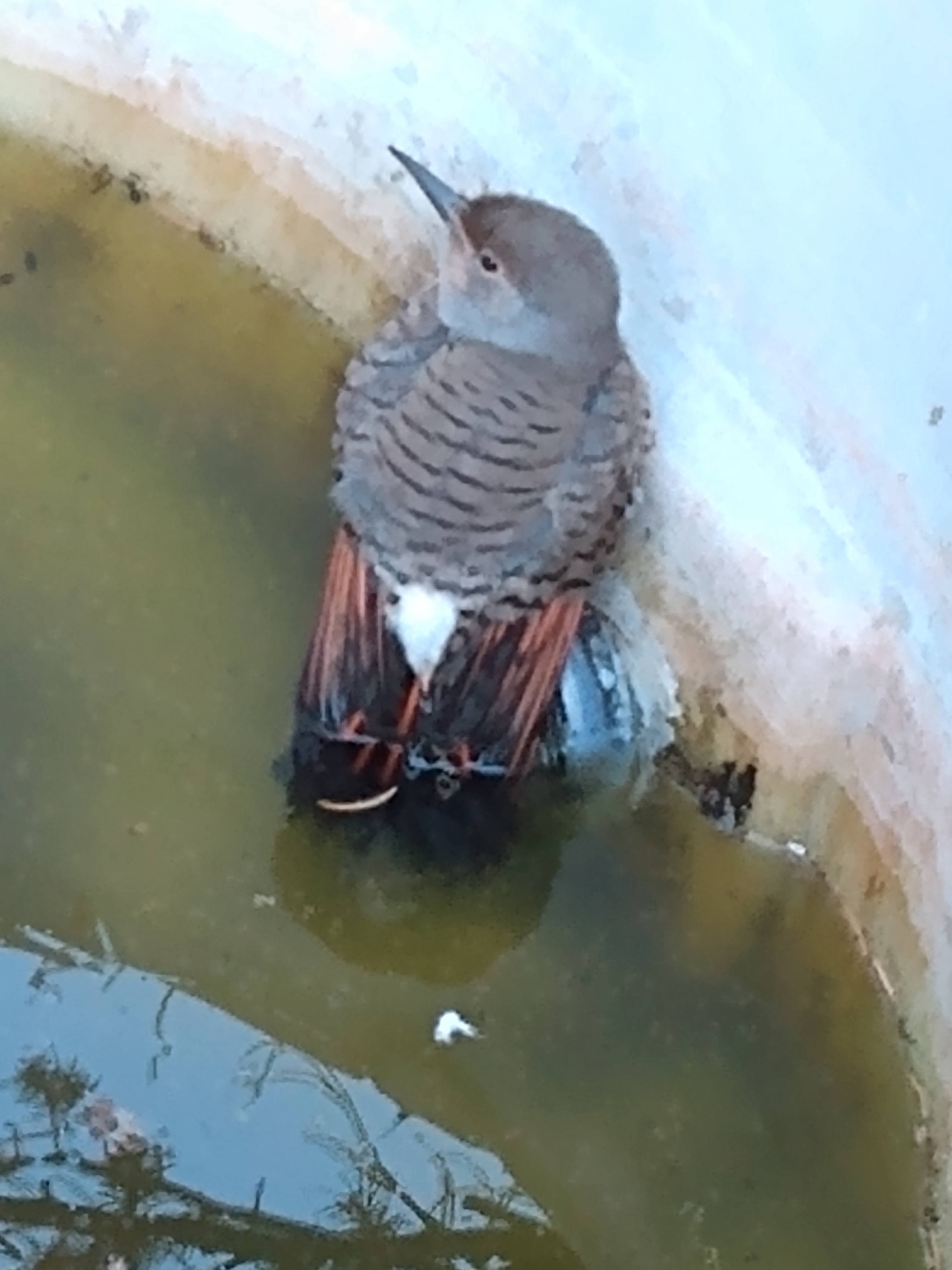
The force of the water was now making an indentation where it hit the ground, and a small, shallow pool had begun to form, so I put my thumb over the end of the hose, creating a lighter spray. One hummingbird found a shallow spot, and literally sat in the pool and bathed. I had seen them take showers in water streams before, but I didn’t know hummingbirds actually bathed. If I’d had my phone, I could have gotten some excellent photos, but at the time, I didn’t want to take my thumb away from the end of the hose and scare him away with the sudden noise from the hard hit of the water. By the time I did run get my phone, she was long gone. But I was rewarded later with another young hummer, who danced around the flow of the hose as if she were performing a mid- air ballet, which I was able to photograph. She blends in pretty well with the background, so she’s kind of hard to see, so I outlined her in each one.

And it wasn’t only the humming birds who felt the need for a spring preening. The bird baths had a plethora of visitors, including the Robin and the Scrub Jay pictured below at the pedestal bird bath.

This post is my first official installment in the “Tales from the Bird Sanctuary” blog series. I posted a post last month about the bird sanctuary which received favorable response, so I thought my readers might have interest in hearing more about my little bird visitors, so I hope you have enjoyed this. The photos aren’t great. Birds don’t often pose for their photos and the lighting is often off. So, what do you think? Would you like to see more installments in this series? Is it worth it?

_________________________

Kaye Lynne Booth lives, works, and plays in the mountains of Colorado. With a dual emphasis M.F.A. in Creative Writing and a M.A. in Publishing, writing is more than a passion. It’s a way of life. She’s a multi-genre author, who finds inspiration from the nature around her, and her love of the old west, and other odd and quirky things which might surprise you.

She has short stories featured in the following anthologies: The Collapsar Directive (“If You’re Happy and You Know It”); Relationship Add Vice (“The Devil Made Her Do It”); Nightmareland (“The Haunting in Carol’s Woods”); Whispers of the Past (“The Woman in the Water”); Spirits of the West (“Don’t Eat the Pickled Eggs”); and Where Spirits Linger (“The People Upstairs”). Her paranormal mystery novella, Hidden Secrets, and her short story collection, Last Call and Other Short Fiction, are both available in both digital and print editions at most of your favorite book distributors.

When not writing, she keeps up her author’s blog, Writing to be Read, where she posts reflections on her own writing, author interviews and book reviews, along with writing tips and inspirational posts from fellow writers. In addition to creating her own very small publishing house in WordCrafter Press, she offers quality author services, such as editing, social media & book promotion, and online writing courses through WordCrafter Quality Writing & Author Services. As well as serving as judge for the Western Writers of America and sitting on the editorial team for Western State Colorado University and WordFire Press for the Gilded Glass anthology and editing Weird Tales: The Best of the Early Years 1926-27, under Kevin J. Anderson & Jonathan Maberry.

In her spare time, she is bird watching, or gardening, or just soaking up some of that Colorado sunshine.

______________________________________________________________________

Join Kaye Lynne Booth & WordCrafter Press Readers’ Group for WordCrafter Press book & event news, including the awesome releases of author Kaye Lynne Booth. Get a free digital copy of her short story collection, Last Call and Other Short Fiction, as a sampling of her works just for joining.


Ask the Authors 2022 Book & Blog Series: Character Development

Ask the Authors 2022

Welcome to Segment 4 of the “Ask the Authors 2022” blog series, where we’re offering up a little taste of what you’ll find in this hot new writing reference of the same name. Ask the Authors 2022 features writing tips and advice on craft, publishing, and book marketing from ten talented authors and industry experts.

In case you missed some of the previous segments:

Segment 1: Introductions for Kaye Lynne Booth & Kevin Killiany – Writing Life Q & A session

Segment 2: Introduction for Bobby Nash – Pre-writing Rituals Q & A session

Segment 3: Introduction for Roberta Eaton Cheadle – Plot/Storyline Q & A session

This week we meet bestselling horror author Paul Kane, who shares his love of the horror genre in his essay, “Writing Monsters”, and bring you a Q & A session on character development.

Meet Paul Kane

Paul Kane is the award-winning, bestselling author and editor of over a hundred books, both fiction and nonfiction. Some consider him to be a master of the macabe. He has been a guest at numerous writing events and conferences, and he was the keynote speaker at the 2021 WordCrafter New Beginnings Virtual Writing Conference.

A former British Fantasy Society Special Publications Editor, he is currently serving as co-chair for the UK chapter of The Horror Writers Association. His work has been optioned and adapted for the big and small screen. His audio work includes full cast drama adaptations, he has also contributed to the Warhammer 40k universe for Games Workshop and writes thrillers for HQ/HarperCollins as PL Kane. Paul lives in Derbyshire, UK, with his wife Marie O’Regan and his family.

Find out more at his site www.shadow-writer.co.uk which has featured Guest Writers such as Stephen King, Neil Gaiman, Charlaine Harris, Robert Kirkman, Dean Koontz and Guillermo del Toro.

And now, on to the Q & A.

Character Development

Nancy Oswald: This whole section was hard for me because I’ve never been good at planning a character. Lists aren’t helpful to me. What is helpful is to put your main character into the middle of their world and write from there. I usually have an ending or a direction in mind before I start writing, but there have been times when the character determines the story and not the other way around.

Do your characters ever surprise you?

Mario Acevedo: I never thought I’d be a writer who said that my characters have taken over the story, but it has happened. Big surprise, it was female characters. I’d have in mind a script for them, which they would rip to pieces and tear off on their own.

Paul Kane: Oh, all the time! If you’ve made them ‘real’ then they’ll suddenly do something that you don’t expect. That is to say, it’ll momentarily surprise you and then you’ll say: ah, of course that’s how they’d react because of… whatever it is you’ve seeded in their past. It’s really your subconscious putting things like that in, things you’ve set up and forgotten about, then when a character does something unexpected it’s only that you’ve forgotten how apt it was in the first place.

Chris Barili: Yes, all the time. If a character is predictable to me, it will be the same to a reader. So, I let them surprise me in whatever way they seem to need. Those surprises don’t always make the story, though.

Bobby Nash: All the time and I love it. In one story, a character let me know that I had the villain wrong. This character was the villain, not the one I had planned to be the villain. The kicker is that the story worked so much better once I realized that this character was indeed the villain.

Robbie Cheadle: No, my characters follow a pre-determined path decided by me upfront.

Kevin Killiany: Not exactly. I’m the only person living in my head—my characters only look like they have free will. That being said, the longer you work with a project, the more time your subconscious has to compost or ferment or percolate the ideas you’re building with—and that can lead to unexpected discoveries that give texture and dimension to the character. Sometimes my characters evolve over the course of writing and rewriting to the point that they person they’ve become wouldn’t do what the story required. Usually that’s an indication there’s something wrong with the story, not the character.

What makes a character interesting?

Paul Kane: I think it goes back to believability once again, which most things do. They have to be well-rounded, living and breathing people. If I get it right, the characters feel real to me. When I talk about them and what they go through, I talk about them as if they exist. You have to think that way in order for other people to believe them and believe in them. A lot of that means knowing your characters inside out, how they’d react to certain situations – in particular the ones you put them in. Would your character run away from a monster or just get stuck in, have a go, even if it meant dying to save others? That kind of thing. A lot of writers think giving characters quirks makes them interesting, but if there’s no reason for that to be there it just stands out. If you give your character gardening as a hobby, unless he’s fighting a giant plant then it’s not really something that should crop up in your story. The character of Alex Webber in Before was a lecturer, so that meant he was interested in making sure the next generation were educated and could make well-informed decisions. So when the future of the world is threatened, of course he’s going to fight against that; it’s just something rooted in his DNA. Those are the kinds of things that make characters interesting, not whether they sleep on the left or the right in bed.

Chris Barili: They have to be flawed. No one wants to read about perfect people with perfect lives and no conflict whatsoever. It is our characters’ flaws that make them realistic, and that set up most of the conflict in the story. After that, it is the act of exaggerating the characters, making them larger than life. Again, no one wants to read about normal people with normal lives. They want heroes and villains who are large and in charge. Would Dirty Harry have worked if he were a normal cop carrying a .38 special? No, because being a six-foot-four rogue cop with a .44 magnum in gleaming silver makes him stand out.

Bobby Nash: I don’t know. Interesting is like art or porn, I can’t describe it, but I know it when I see it. I need to have something to connect to with a character. Once I have that connection, I understand the character.

Robbie Cheadle: My characters all must overcome a lot of adversity in their circumstances. I believe that the growth in the characters as they play the cards which they are dealt by life makes them interesting.

Jeff Bowles: I think I have an answer to that question: idiosyncrasies, idiosyncrasies, idiosyncrasies. The thing about real people is that we all have our strange little quirks that make us who we are. And these are behaviors and beliefs it’s taken us a whole lifetime to accrue. It pays to think of your characters as being a little odd under the surface. The problem with a lot of storytelling out there is that too many authors figure their characters exist to serve the story. They don’t, it’s the other way around completely. Let your characters speak for themselves. Let the breath a little, see where they really want to go next. Don’t push them into situations that don’t serve their full expression. Let them tell you who they really are.

How do you make a character likeable?

Paul Kane: Sometimes you don’t. Sometimes you shouldn’t. I get reviews sometimes that say ‘the characters weren’t very nice’, but then look at some of the things they’ve been through. My psychologist Dr Robyn Adams went through a trauma at the hands of a serial killer, so is addicted to pain killers and drinks too much, leaps straight in with guys too often – because of something else revealed towards the end of Her Husband’s Grave. But you know what, she’s doing the best she can. Her flaws make her human, like all of us, and they make the moments of bravery stand out all the more. I think if you’re always trying to make your characters likable, you’re missing the point of making them believable. Not everyone’s nice all the time, there are grey areas – and that’s totally where your characters should be operating.

Chris Barili: You don’t have to make them likeable, just relatable. Thomas Covenant in White Gold Wielder (Stephan R. Donaldson) is not a likeable character at first, just a relatable one. He almost loses that with a deplorable act early in the book, bit manages to make it through, at least for most readers. I do know some who could not handle it and left the series behind.

Bobby Nash: I start with a likeable person as their base and build the character up from there.

Kevin Killiany: I never consider likeability. I try to make my characters as real as possible—which means complex, with parts some folk will like and parts some folk can’t stand.

How do you make your characters feel real?

Chris Barili: What are their fears and flaws? Read my article, “Character Blueprints” (Ask the Authors 2022) for the tools I use to do this.

Bobby Nash: As I mentioned above, I get to know the characters. Once that happens, they become real people to me. They have their own quirks, foibles, fears, flaws, strengths, and weaknesses. Just like real people.

How do you create a villain readers can love to hate?

Mario Acevedo: Readers must have empathy with all of your characters and understand why they do what they do. Their motivations must be consistent and compelling. One of my best villains was a female mad scientist who at first you cheered until you found out what she was up to.

Paul Kane: I don’t think there’s any magic formula, but the key thing with villains is again that they aren’t just cardboard cutouts. They can’t just be evil for evil’s sake, there needs to be reasons for what they’re doing. My bad guy for the Hooded Man books, De Falaise – essentially my version of the Sheriff of Nottingham – was motivated by the fact that he’d been kept down before the A-B Virus hit. He was a small bad guy in a big pond. The apocalypse gave him the freedom to create a kingdom of his own, so that was his motivation – and Robert, my Robin Hood, stood in his way. You got the impression with some Hood stories in the past that they just hated each other because one was bad, and one was good. In my books, just as Robert has his failings as a leader – for starters, he doesn’t want to be a leader and would much rather hide out in Sherwood waiting to die – so too does De Falaise have his good points, like his loyalty to companions like Tanek, his second in command. I mean, he is evil when you get right down to it, because some of the things he does are reprehensible, but there still needs to be some good in there. Having said all that, the most fun I’ve had writing a bad guy was The Infinity in Before. He’s a version of the Devil, essentially, and likes to meddle in human history. Writing lines for him, simply because he was a stereotypical big bad, was wonderful. It allowed me to put myself in the head of someone who has very few redeeming qualities, if any at all.

Chris Barili: I find that a couple of things can pull a reader into a love-hate relationship. First, a sense of humor. Even if it’s macabre or inappropriate, the ability to make us laugh endears even a harsh villain to us. You can also give that villain a good side by having him or her save a puppy or show some other admirable trait. Intellect combined with arrogance are a nice set of offsetting traits. But most of all, make them flawed like the hero. If they are invincible and pure evil, no one will want to read their stories. Take The Governor on the AMC series The Walking Dead. We find out early on that this otherwise despicable villain lost his whole family to the walkers and thus has them all locked up in his home as he hopes for a cure.

Bobby Nash: Same way as with a likeable character. I get to know them and understand why they do what they do. No villain thinks of themselves as the villain. Most villains believe what they are doing is right or justified. Very rarely is anyone evil just for the sake of being evil. Let the readers see the multiple facets of your heroes and villains.

Robbie Cheadle: Characters that do sadistic and unkind things are easy to make readers dislike. However, my characters all have redeeming features so the reader will end up conflicted, even when the character is behaving at his/her worst.

Do you ever create characters based on people who you’ve actually known?

Paul Kane: I think by necessity characters are mish-mashes of people you’ve known and other characters from books, film or TV shows, plus bits of yourself sometimes. I’ve never based a character wholesale on someone, as that way lies being sued, but I include certain traits from people I’ve known or still know. I was brought up with a lot of strong women around me, so I write a lot of tales with strong female protagonists. RED, my horror reworking of Little Red Riding Hood, is an obvious example of that. Rachael Daniels is someone who fights the wolf rather than running away from it, isn’t frightened to go up against a challenge. Her love-life might be a car crash, but she’s someone you want around when there’s trouble for sure.

Chris Barili: I will plead the fifth on this question, and all writers should, whether they have done this or not. Admitting that you have sets you up for legal action by others.

Bobby Nash: Oh, sure. I have many characters where the basis is a real person that I then built on top of to create a new character.

Robbie Cheadle: Yes, some of my characters are modelled off people I know. Grandfather Baker in Through the Nethergate has a lot of my father’s personality and characteristics. Michelle Cleveland in A Ghost and His Gold has some of my personality and characteristics, but she is more forgiving and generous towards her partner than I would be in the same circumstances.

Some of my characters are model on several people I have come across in a similar situation. For example, Tom Cleveland in A Ghost and His Gold is based on a combination of men in senior positions I have worked with in my own life.

Kevin Killiany: Every character is a composite of people I’ve known. Let’s face it, the only way to research people is to hang out with them a while. I never drop a whole person into a story—it’ll be A’s speech pattern, B’s fascination with baseball, C’s gestures, etc. Of course, those are just the starting points. As I know my character better everything will change, evolve.

Do any of your characters share traits with you?

Paul Kane: You can’t help but put bits of yourself in stories. I’ve talked about Alex Webber from Before being a lecturer, which I was for a while at college, so I could write about him with a degree of confidence and make sure it was authentic. I’ve always been scared of the dark and nighttime, which comes across in a lot of my stories. The little boy at the beginning in Of Darkness and Light – recently reprinted in the collection Darkness and Shadows – is very much based on me as a kid. Staring out into the darkness at bedtime and imagining all kinds of things lurking inside. But I think the writing also helps with tackling your fears, and in that particular story I could make the ‘creature’ in the darkness someone who was actually watching over the character of Lee Masterton, someone who would protect him from harm. He just didn’t know it at the time.

Chris Barili: All of them, of course. We cannot create characters without at least a little dash of ourselves in them.

Bobby Nash: Absolutely. There’s a little something of me in all of them. Some, more than others.

Robbie Cheadle: As mentioned above, Michelle is similar to me in some ways, but very different in others. She is a better me.

Kevin Killiany: Never the main character. But if there’s a plucky sidekick who alternates puns with sardonic commentary, that’ll be me.

What methods do you use to introduce readers to your characters?

Mario Acevedo: One of the techniques that F Scott Fitzgerald used to masterful effect was that he introduced his major characters in terms of their personality rather than merely describing their looks. I keep that in mind as I write my stories.

Paul Kane: I think it helps to show them doing something that defines them, so perhaps through their job. Most detectives are introduced through a crime scene for instance, and then we learn how good they are and what it means to them to be a cop. I introduced my main character Mitch Prescott – who at the start of The Family Lie is a PC – via a riot scene. He’s tried to tell the powers that be that there will be trouble at a demonstration, but they’ve totally ignored him, and of course – surprise, surprise – a riot breaks out in which one of his closest friends is injured. It forces Mitch to question what he’s doing on the Force, which leads to his dismissal when he confronts a senior officer about what happened, which in turn makes it easier for him to just go off and investigate what occurred with his father’s death in his hometown of Green Acres. But just from this one chapter, you realise he’s a man of integrity, a man who’s loyal to his friends, and a man who doesn’t like it when people don’t listen to his warnings – so you set up conflict for later when he reaches Green Acres and he’s being blocked at every turn.

How do you motivate your characters?

Paul Kane: I think that’s the same thing as what motivates us as people. We look after our friends and family, because we love them, and are sometimes motivated to do things we might not otherwise do because they’re in trouble. What motivates characters is the same as what motivates people in real life, because, remember, we’re trying to make those characters real. So, the father of murder Jordan Radcliffe – Jake – is motivated to find out who the killer is, not only because he loved his daughter, but also because he feels like he failed her. Failed her in life as a father, so he doesn’t want to fail her now in death. That’s a powerful motivating factor for any character. In my short novel The Storm, out through PS Publishing, the main protagonist Keegan is all about keeping the woman that he loves safe, even if it means battling giant monsters to do so. Love’s a big motivation for anything, I find, just like in real life. So are things like revenge or jealousy, the usual big ones.

Chris Barili: They are self-motivated by the situation into which I drop them. Usually, it is the will to survive that motivates them, but it can also be love, hate, rage, longing, and more.

Bobby Nash: How do I stop them? I usually have trouble keeping up with them.

Robbie Cheadle: My ghostly characters are motivated by the chance of redemption and moving on from their existence as spirits.

My physical characters are motivated by compassion and empathy for others and a desire to assist the spirits achieve the redemption they seek.

What kind of adversaries and obstacles do you create for your characters and what purpose do they serve?

Paul Kane: It depends very much on what the story is. Creating adversaries tends to go very much hand-in-hand with creating heroes. Myself and my wife Marie O’Regan – a terrific writer herself – do a workshop on this subject, and that’s one of the key elements. The hero or heroes dictate the villain or villains. Both are probably striving for something but pulling in opposite directions. In Arcana our protagonists are just trying to get freedom for magic-users, whereas the M-Forcers are trying to stop them, hunt them down and either kill them or put them in prison. Both have aims, but they’re the exact opposite of each other. The obstacles they face are very much dependent on the story you’re telling. It could be a man vs nature tale, in which your heroes are just trying to stay alive, so the setting would dictate what happens there. If it’s a shark, then you need to be at sea, if it’s snow then you need to be in the Arctic or Ant-Arctic, or you set it at a time of year when it’s snowing… My short story ‘White Shadows’, for example, is about a girl battling living snow in the middle of winter.

Chris Barili: Since most of the opposition to my characters comes from the antagonist, I always try to think, as I close a scene, “what could the villain do that would completely thrown the main character for a loop?”

Bobby Nash: Stories would be boring if there was nothing for the main character to overcome. Whatever the obstacle is, a villain, a test not studied for, a traffic jam, or whatever, gives the character(s) something to overcome or solve. Hopefully, your character comes out stronger on the other side of the obstacle.

What methods do you use to introduce readers to your characters?

Bobby Nash: We meet the characters in story. I let different characters be out POV in different chapters so we can understand them.

How do you give each character a distinctive voice?

Paul Kane: I think that just comes down to their personality really, who they are and what they do. How they respond to things, whether it’s trouble or something nice, will dictate their voice. So it’s all to do with character creation, and that believability factor again. If they respond in an authentic way, that will give them their voice. If you’ve created a strong female character, for example, they’re not likely to take a man bossing them around lightly. Indeed, they might even knock them out, depending on whether they’re a violent sort or not, or whether the provocation was bad. It’s things like that which give your characters a distinctive voice. 

Chris Barili: This seems to come naturally for me. And I think that come from listening. I did twenty years in the military and traveled all over the world. So, I have had the chance to listen to many different conversations in many different cultures, and all of that goes into giving a character their own voice.

Bobby Nash: Once I get to know the character, they tell me what their voice is and that’s what I write. It all comes down to creating a fully formed character.

How do you feel about killing off your darlings?

Mario Acevedo: I am ruthless. There’s a vacant lot in my neighborhood where I’ve left my darlings rotting in shallow graves.

Paul Kane: Do you mean editing, like killing off your words? Or killing off characters? I love editing, chopping bits and refining, making scenes better. That’s the part of writing I like most, apart from being finished and having written. Killing off characters you love is hard, but all part and parcel of being a good writer. If it serves the story, no matter how you feel about the character, then you need to just get on with it. I always knew that I’d kill off Jack in The Gemini Factor, even before I started, which was difficult because I really liked him. He became like a friend. It gave the ended weight though, gave it an impact that would not have been there if I hadn’t just bit the bullet.

Chris Barili: When it becomes necessary to the story, I have no problem doing so. Sometimes, they get in the way. Other times their story line needs its own story because it is taking over. Other times, the main character has learned to depend on them too much.

Bobby Nash: I do it all the time, so I guess I’m okay with it. Ha! Ha!

Robbie Cheadle: I was advised to kill off a few of my darlings in Through the Nethergate by my developmental editor. It was a little hard to let those scenes go but it was the right thing to do. Listening to good advice is the best thing a writer can do.

What methods do you use to evoke emotion in your readers?

Mario Acevedo: Writing fiction gives you the wonderful opportunity to present what characters are thinking or feeling, either through internalizations or visceral reactions.  I use these inner experiences to ground the reader in what the character is feeling and what is important in the story.

Paul Kane: There are all sorts of ways to do that, from killing off people readers have grown to love – as mentioned before – to putting them through the wringer, or even having them fall in love. If you’ve done your job properly, a reader will feel the emotions characters are going through. So when a character hates or loves something, or someone, a reader will feel that too. I once wrote a story about two ghosts falling in love called ‘Kindred Spirits’. The girl ghost has only just died, so she doesn’t know what she is, and the guy ghost is trying to help her because he’s been dead for some time. Hopefully a reader feels the sadness at the start that he feels, being alone where nobody can see or touch him, then the joy at finding someone else he can talk to and touch, even hug. To be able to cover the range of emotions like that in a short space of time isn’t easy, but it’s incredibly rewarding when it works.

Bobby Nash: It’s all in the characters and setting the mood. The emotion comes out of the performance of the character.

Kevin Killiany: Honesty

Which of your own characters was the most fun for you to write? Why?

Paul Kane: I enjoyed writing the character of Nick Skinner in Lunar, because he’s just your average guy in a bizarre situation, having to think on his feet and react to all these weird things that are happening to him. That was fun. And The Infinity, the bad guy in Before, as I’ve said. It was fun to write someone so evil that he’s verging on pantomime level, but that’s just how he is. There’s a scene where someone tells him to stop stirring, and he replies with: ‘I f**king enjoy stirring!’ Because he does. That’s what he’s all about. It was fun creating and writing him, especially writing his lines. The criticism I got the most about that book was The Infinity wasn’t in it enough, so you know you’ve done something right at that point. I’m toying with bringing him back in a short story or two, because you could go back in time and show him at any point – he’s been there at all the major turning points in history. It might be fun to do that…

Chris Barili: I really enjoy writing Frank Butcher, and most of his posse members. They’re some of the most complete characters I have built, and each has their own voice, their own flaws, and their own motivations.  And each has a weird past that helps flesh out their personality, so writing the is easy.

Bobby Nash: That’s like asking me to pick a favorite child or parent. They all have their fun moments for different reasons. I love writing Archer Snow, the surly, but funny grandfather in the Snow series. Tom Myers is also fun to write.

Robbie Cheadle: I have enjoyed all my characters. During the writing process they all become very real and important. Once the book is published, they are quickly replaced by different characters, which is why I haven’t attempted a sequel.

Kevin Killiany: Cadet Fatima Kielani. [I jotted her last name down several years ago when I was watching a news report on Syrian Kurds fighting ISIS—it was on the screen briefly. I assumed it was Kurdish (and have a major supporting character in Life on Dirt identify it as such) but I was wrong. I’ve since learned it’s most common in the United Arab Emirates (with about half as many in Jordan) and is also found in both Austria and Benin, but no one knows its origin.] [It is not the Hawai’ian girls’ name Keilani.] Fatima is a seventeen-year-old Spacer, first generation, born and raised on Tombaugh Station, who volunteers for an experimental program on Earth, even though (or perhaps because) she’s terrified of the place. My background is special education and mental health services, and I gave Fatima a condition that has fascinated me since before it had a name: Social Communication Disorder (Pragmatic Communication Disorder in the UK). In many ways it resembles the Autism Disorder Spectrum, but is in no way related. People with SCD are blind to social norms and nonverbal cues, and must work their way through everyday interactions. I also, because I am cruel and unusual, gave her a rare dissociative disorder: she has trouble recognizing, or feeling, her own emotions.
I have attached an entry from Fatima’s journal to illustrate both how she sees the world and how she interacts with others.

Which of your antagonists is your favorite? Why?

Chris Barili: So far, it’s a tie between Annie’s ghost of a mother in Smothered, and John Wesley Hardin in the Hell’s Bucher-based short story “Witch’s Kiss.” The first because I got to make her up and have her interrupt an intimate scene between her daughter and a man. The second because I researched him thoroughly and felt like I knew him well enough to write a story where this very real gunfighter did some very fictional things, and I feel like I did so without compromising his character.

Bobby Nash: The Controller in Suicide Bomb was a lot of fun to write.

Robbie Cheadle: I enjoyed Lucifer in Through the Nethergate. He was a young, good looking man with an interesting plan to manipulate modern trends and technology to invoke a third world war. I also enjoyed the hell he created.

____________________________

That’s all for this week on the “Ask the Authors 2022” blog series . Thanks for joining us. Drop by next Saturday, when the “Ask the Authors 2022” blog series introduces award winning multi-genre author, Mario Acevedo and offers a Q & A on Action, Pacing & Dialog.

Ask the Authors 2022

Don’t forget to get your copy of Ask the Authors 2022 from your favorite book distributor at the special price of 3.99 for the duration of this blog series, through the Books2Read UBL: https://books2read.com/u/3LnK8e

______________________

Join Kaye Lynne Booth & WordCrafter Press Readers’ Group for WordCrafter Press book & event news, including the awesome releases of author Kaye Lynne Booth. Get a free digital copy of her short story collection, Last Call and Other Short Fiction, as a sampling of her works just for joining.


Dark Origins: African Myths and Legends – The Zulus Part 2 #Beadwork #Traditionalstory

Last month for Dark Origins, African Myths and Legends, I shared an introduction to the Zulu people of South Africa, the Great Zulu King Shaka and the legend of the Buffalo Thorn tree. If you missed it, you can read it here: https://writingtoberead.com/2022/04/27/dark-origins-african-myths-and-legends-the-zulus-part-1/

This month, I will be sharing information about Zulu beadwork and the messages contained therein as well as a traditional story.

Zulu beadwork

The Zulu people of South Africa have a rich tradition of beadwork. Originally, bone, small horns, shells and small pieces of polished wood and stone were pierced to make beads that were strung together as necklaces and belts.

When the Zulus started trading with the Europeans at the end of the 18th century, glass and ceramic beads were introduced into their beadwork.

Traditionally, both men and women wore beaded belts called umutsha to which a piece of cloth was attached to cover the pubic area. The belts have conical brass buttons that fasten the belt at both ends.

The colours and designs incorporated into Zulu beadwork hold specific meanings. Red beads, for example, signifies intense and jealous passion or eyes that are red from watching for a loved one to return. Yellow signifies contentment, pink or green for poverty or coolness, white for faithfulness and purity and black to indicate a desire to be married.

The main shape used in traditional Zulu beadwork is the triangle where the three corners represent Father, Mother, and Child. The triangle is also used to indicate gender and marital status, for example, if the tip points upwards it represents an unmarried girl. If the tip points downwards, it means an unmarried boy.

Zulu beadwork is used to make traditional dolls and jewelry as well as beaded ostrich eggs and bead coasters.

In summary, beads are an integral part of African history and culture. The serve as a form of money, indicate wealth, are spiritual talismans and form coded messages for the recipient.

Traditional Zulu music:

The South African pre-battle Haka:

Reading of a traditional Zulu story

My reading of The Chief’s Daughter and the Cannibal, a traditional Zulu story from Myths and Legends of Southern Africa by Penny Miller:

About Roberta Eaton Cheadle

Roberta Eaton Cheadle is a South African writer and poet specialising in historical, paranormal, and horror novels and short stories. She is an avid reader in these genres and her writing has been influenced by famous authors including Bram Stoker, Edgar Allan Poe, Amor Towles, Stephen Crane, Enrich Maria Remarque, George Orwell, Stephen King, and Colleen McCullough.

Roberta has short stories and poems in several anthologies and has 2 published novels, Through the Nethergate, a historical supernatural fantasy, and A Ghost and His Gold, a historical paranormal novel set in South Africa.

Roberta has 9 children’s books published under the name Robbie Cheadle.

Roberta was educated at the University of South Africa where she achieved a Bachelor of Accounting Science in 1996 and a Honours Bachelor of Accounting Science in 1997. She was admitted as a member of The South African Institute of Chartered Accountants in 2000.

Roberta has worked in corporate finance from 2001 until the present date and has written 7 publications relating to investing in Africa. She has won several awards over her 20-year career in the category of Transactional Support Services.

Find Roberta Eaton Cheadle

Blog: https://wordpress.com/view/robertawrites235681907.wordpress.com

Twitter: https://twitter.com/RobertaEaton17

Facebook: https://www.facebook.com/robertawrites

Amazon: https://www.amazon.com/Roberta-Eaton-Cheadle/e/B08RSNJQZ5

_____________________________________________________________________________________________

Want to be sure not to miss any of Robbie’s “Dark Origins” segments? Subscribe to Writing to be Read for e-mail notifications whenever new content is posted or follow WtbR on WordPress. If you found it interesting or entertaining, please share.


Review in Practice: Self-Publish Strong Books 1-4

Let me just start by saying that I’m a big fan of Andrea Pearson, the author of these books. I listened to her on the Six Figure Authors podcast, along with her two co-hosts, Lindsay Barker and Joe Lallo, all through the fall and spring semesters. So, when I found out we were going to be using Rock Solid Newsletter in our class, I jumped at the opportunity to buy the whole set, even though I only needed the one book for class. Which is just to say, that I knew these books would have lots of valuable information for me as an author before I ever cracked them open, and indeed they did.

In Book 1, Rock Solid Book, Andrea offers tips for making sure you have a book that readers will want to read. Book 2, Rock Solid Platform, gives advice on finding and acquiring fans who will read just about anything you write. Book 3, Rock Solid Promotion, discusses book marketing, protons and deals that sell. And finally, in Book 4, Rock Solid Newsletter, she tells how to set up your newsletter and automation sequence and clean your newsletter email list, so you know you have true fans who want to hear about you and your books, which increases your open and click rates and is more effective at selling books.

Self-Publish Strong Books 1-4 is filled with valuable information for independent authors, which I’m using to improve and grow my newsletter list, which is soon to become my readers’ group, and set up promotions for all of my 2022 releases. Andrea Pearson offers tips, advice and good strategies for producing a quality book which readers will buy, getting the word out about your books and finding readers who will buy them.

What she doesn’t do in Rock Solid Newsletter, is to instruct on the technical set-up of the newsletter, because each newsletter platform is different. I don’t hold that against the book though, as these books are not instruction manuals, but instead, they offer strategies to leverage your books into a better selling position. I managed to change my reader magnet and my welcome email so it will be delivered as intended. (I think,. I still need to test it.) And that’s where I’m stuck, because I don’t understand the technicalities of setting up an automation sequence, but I know I need to set one up. I may have to find someone to help me on that one. So, although I haven’t put all of the advice offered in Publish Strong Books 1-4 to use yet, I’m well on my way.

You can get your copy of Self-Publish Strong Books 1-4 here:

https://www.amazon.com/Self-Publish-Strong-Books-1-4-How-ebook/dp/B06X3W91BV

Or they can be purchased individually here: http://selfpublishstrong.com/books/

___________________________________________________________________________________

Kaye Lynne Booth lives, works, and plays in the mountains of Colorado. With a dual emphasis M.F.A. in Creative Writing and a M.A. in Publishing, writing is more than a passion. It’s a way of life. She’s a multi-genre author, who finds inspiration from the nature around her, and her love of the old west, and other odd and quirky things which might surprise you.

She has short stories featured in the following anthologies: The Collapsar Directive (“If You’re Happy and You Know It”); Relationship Add Vice (“The Devil Made Her Do It”); Nightmareland (“The Haunting in Carol’s Woods”); Whispers of the Past (“The Woman in the Water”); Spirits of the West (“Don’t Eat the Pickled Eggs”); and Where Spirits Linger (“The People Upstairs”). Her paranormal mystery novella, Hidden Secrets, and her short story collection, Last Call, are both available in both digital and print editions at most of your favorite book distributors.

When not writing, she keeps up her author’s blog, Writing to be Read, where she posts reflections on her own writing, author interviews and book reviews, along with writing tips and inspirational posts from fellow writers. In addition to creating her own imprint in WordCrafter Press, she offers quality author services, such as editing, social media & book promotion, and online writing courses through WordCrafter Quality Writing & Author Services. As well as serving as judge for the Western Writers of America and sitting on the editorial team for Western State Colorado University and WordFire Press for the Gilded Glass anthology and editing Weird Tales: The Best of the Early Years 1926-27, under Jonathan Maberry.

In her spare time, she is bird watching, or hiking, or just soaking up some of that Colorado sunshine.

_____________________________________________________________________________

Sign up for the Kaye Lynne Booth & WordCrafter Press Readers’ Group for and book event news for WordCrafter Press books, including the awesome releases of author Kaye Lynne Booth. Get a free digital copy of Kaye Lynne Booth’s paranormal mystery novella, Hidden Secrets, just for subscribing.


Ask the Authors 2022 Book & Blog Series: Plot/Storyline

Ask the Authors 2022

Welcome back to the “Ask the Authors 2022” Saturday blog series.

If you missed them, you can catch the first two segments here:

Segment 1Introductions for Kaye Lynne Booth & Kevin Killany/Writing Life Q & A

Segment 2: Introduction for Bobby Nash/Pre-Writing Rituals Q & A

This is the third segment for this series and today I’m going to introduce you to contributing author, Roberta Eaton Cheadle, who shares her essay about her own publishing journey in the book, and bring you a Q & A on plot, or storyline, from the WordCrafter writing reference anthology, Ask the Authors 2022.

Meet Roberta Eaton Cheadle

Roberta Eaton Cheadle is a writer of young adult and adult fiction in the supernatural fantasy, historical horror, and historical supernatural genres. Under the name Robbie Cheadle, she is a South African children’s author, publishing the Sir Chocolate series with her son, Michael, and a poet with 2 published poetry books.

To date, Roberta has published two novels, Through the Nethergate, and A Ghost and His Gold, along with several short stories in various anthologies including Whispers of the Past, Spirits of the West, and Where Spirits Linger, all edited and compiled by Kaye Lynne Booth, and Dark Visions, Nightmareland, Spellbound, Wings & Fire, and Shadowland, all compiled by Dan Alatorre.

Robbie is also a member of the Writing to be Read blogging team and co-editor of Poetry Treasures (2021) and Poetry Treasures 2: Relationships (2022), two poetry anthologies with contributing authors who were guests from her “Treasuring Poetry” blog series. When she is not writing, Robbie enjoys working in the garden and creating fondant and cake artworks to be featured in her children’s books.

And now for the Q & A.

Plot/Storyline

How do you feel about prologues? Love them or hate them? Why?

Mario Acevedo: I’m not a fan of prologues and as I see them as superfluous to the story. If you must include a prologue, then call it Chapter One to make sure readers like me won’t flip past it.

Paul Kane: I have no strong feelings about them either way. Sometimes I’ve used them, other times I’ve gone straight into Chapter One. I know some writers who say if you can avoid Prologues then do it and just start with the first chapter, but I think if it serves a purpose then there’s a place for one. I tend to include them in the thrillers, because it’s always an event that kicks things off – so for example in Her Last Secret, it’s the death of Jordan Radcliffe, in Her Husband’s Grave it’s the discovery of a body on Golden Sands beach, and in The Family Lie it’s a couple of campers who see a man on fire in the woods. I then split the narrative into parts, and in Chapter One I tend to introduce the main protagonist, so it might be the person who’ll be doing the investigating; someone whose eyes we’ll be seeing most of the events in the book through.

Chris Barili: I normally skip prologues in the books I read, especially if they’re more than two pages long, so naturally, I try to avoid them in my own writing. I tend to be of the mind that if it’s important enough to be in the story, I can be “Chapter One” or background info sprinkled throughout the story.

Bobby Nash: Prologues have their uses. I don’t think they need to be used in every story and I certainly don’t use them as an info dump. Sometimes, they work well.

Robbie Cheadle: I have no strong feelings about prologues. If the story requires one, then it should be there, if not, it can be omitted. I have not as yet included a prologue in one of my books.

Nancy Oswald: Not too fond of them. I think it’s better to jump right into the story.

Kevin Killiany: Prologues are essentially exposition—they explain the conditions or situation that make the story itself possible and necessary. Sometimes they contain information vital to the climax or outcome of the story that the writer could not figure out how to insert into the narrative itself. Like any tool they are not good or bad in and of themselves. I have, rarely, used prologues as placeholders in rough drafts; repositories to hold essential information until I work out how to work the really important bits into the narrative. Only one of my short stories ever went to press with both a prologue and epilog: “Simple Farmer”, Total Warfare, FanPro, 2006, a tie-in story for the Classic BattleTech RPG. They contained information long-time players knew, but new and less minutia-oriented readers would need to understand the story’s significance to the game.

What is the most difficult part of the story to write: beginning, middle or end?

Mario Acevedo: For me, the entire book is a challenge. I tell new writers not to sweat a perfect beginning because it’s often not till you write the ending do you figure what the beginning needs to say. The middle is called “the swamp” for good reason and the key here is to keep in mind the story question as you introduce plot twists.

Paul Kane: This changes, depending on at which point in the story or book you ask me. It’s hard to make a start on a project, because you’ve just got the blank page in front of you. But then it’s just as hard the next day to come to it and see another blank page… I tend to flag about halfway through and wonder what the hell I’m doing or wish I’d never even started it. The end is definitely the best part, if you’ve panned it well and can bring the book in for a good landing. There’s no more satisfying feeling in the world than having written the book. I always joke that I hate writing – which for a writer probably isn’t great – but I do love having written. Having a first draft that I can then tinker with. That’s my favourite part of the process if I’m honest, apart from getting the idea in the first place and developing that. But even at an early stage, you’ve got the whole mountain of a book to write ahead of you, which can be quite daunting. 

Bobby Nash: I don’t know if I would call it more difficult to write, but the middle is usually where I start getting bogged down. Knowing when to transition from the middle to the end can be tricky.

Robbie Cheadle: It is all the same for me. I have the outline in my head, and I write in that direction. I do not find any parts more difficult, and I am for consistency and fluidity throughout my stories.

Jeff Bowles: For me, a short story or novel isn’t complete until I’ve managed to synthesize a decent tie-up ending. It can be tough to do, especially if you aren’t using a road map or outline of some sort, which I often do just to see where the story takes me. Sometimes I do a lot of preplanning, and that can certainly help, but even then, things in the plot can and do change, which means a good ending can still be hard to stick. Beginnings carry all the burden of proof, the reason someone will or won’t want to read your work, but even they depend on where a narrative ultimately ends up. As the saying goes, the seeds of an ending are always found in its beginning.

Nancy Oswald: Each book is different.

What are the elements of a good plot?

Paul Kane: That it hangs together well and is pacy. That there are no flabby bits which are unnecessary. Every bit of your story should be relevant and serve a purpose; if you could take certain bits out and still have the same plot, then they weren’t necessary in the first place. That it moves along well from beginning to the middle, to the end, and leaves a reader satisfied; and by that I mean content that they haven’t just wasted a chunk of their lives reading it. It’s why I always plan, so I can see the shape of the plot and work out what sections need to stay, which can be salvaged, and which need to be jettisoned.

Bobby Nash: I tell stories that I hope are coherent, make sense, and are entertaining. If that happens and the characters work, I’m happy.

What is the best hook you’ve ever written? Why?

Paul Kane: Ooh, that’s a hard one. Do you mean at the beginning of a story to make the reader go on? I’d say probably The Family Lie – and reviewers have mentioned this a lot! It’s the whole thing of showing those campers hearing something in the woods, looking out and seeing a guy on fire among the trees. I mean, what on earth’s going on there? If it doesn’t make you want to read on and find out then I’ve really not done my job properly. Up there with that is probably the start of Servants of Hell. That purposely mirrors the puzzle box scene with Frank from The Hellbound Heart, where he’s trying to solve the Lament Configuration and summon the Cenobites. I have a very similar scene, but right at the end you discover it’s Sherlock Holmes solving the puzzle just as the Cenobites show up. We then go back and find out how he ended up in that situation, but man what a hook! I was the one on fire the day I wrote that.

Chris Barili: Probably the opening to Guilty, the prequel to my Hell’s Butcher series. It opens with the main character face down in a saloon, dead from a gunshot wound. His first interaction is with a bartender who is half-rhinoceros.

Bobby Nash: I love this opening to Snow Falls.

“Abraham Snow knew he was about to die–

–and the thought of it pissed him off to no end.”

What kind of stakes do you set for your characters?

Paul Kane: Usually quite high stakes. Even if it’s something that’s high stakes for them alone, something that means a great deal to them, but might not to anyone else. You have to give characters motivation, nudge them to do things they might not otherwise do, and the only way to achieve that is by making it a high stakes gamble for them. They might lose their marriage, kids, or even their life. It makes a reader keep on turning the pages to find out how they’ll get on. In Lunar, the stakes really couldn’t be any higher for my protagonist Nick Skinner: he needs to find out why the world became stuck at a certain point in time; what the white-eyed Loons are roaming about, killing people; and he needs to find out where the love of his life Dawn is. Track her down and save her. Hopefully you go along with him for the ride to find out how he gets on. 

Chris Barili: Again, that depends on the story and the genre. The stakes in a romance are a broken heart or happiness, while that in a horror story might actually be losing their heart.

Bobby Nash: Every story is different, but the stakes have to impact the character on some personal level. If the character doesn’t feel anything or there’s no stakes for them, the reader has no reason to get invested.

Robbie Cheadle: Through the Nethergate and A Ghost and His Gold were both about ghosts which have become trapped in between the physical world here on earth, and the afterlife. The reasons for this happening are different in both books, but the ghosts searching for redemption, so they can move on to the next level of existence is a common thread. The Soldier and the Radium Girl is different and is about a young couple’s quest for justice.

Do you write in subplots purposefully or do they develop organically for you?

Paul Kane: I work all those out beforehand, when I do my planning. That’s when subplots will occur to me and develop organically at the ideas level when I’m figuring it all out. As I mentioned, that doesn’t mean it’s all set in stone, there is always scope to change things if it makes the story better, but it allows you to figure out what main plots and subplots you’re going to need before you even start writing.

Chris Barili: Both. I plan some, and others pop up during the course of telling the story. If your characters are realistic enough, and you know them well enough you won’t be able to avoid the latter happening at least a little in your story.

Bobby Nash: A little of both. In writing series like Snow or Sheriff Myers, I know plot points for future books so I set up things that will pay off later. There are times, however, where I’ll decide something later and go back to set up the subplots and discover they are already there. Sometimes, my characters are smarter than I am.

Robbie Cheadle: Subplots do develop organically for me and are often a result of the interesting additional information I discover through my research as I go along.

Nancy Oswald: Develop organically.

Kevin Killiany: Subplots are always purposeful. In fact I always write complex or substantive subplots as individual stories in first/rough draft. Jigsawing the parts together—trimming, expanding, and polishing as needed—is part of the editorial process. 

How do you assure that all subplots are resolved at the end of the story?

Mario Acevedo: I don’t because I like messy endings. The main story question is resolved, but usually involves a compromise by the protagonist. Unresolved subplots are good places to hitch up a sequel.

Paul Kane: Well, they might not be – but that would be something you leave dangling on purpose. For example, and this is a spoiler, at the end of The Gemini Factor we find out that one of the main characters Deborah is pregnant with twins. This was part of the subplot of her falling in love with Jack, a twin himself, who ends up getting killed. So we don’t really see the resolution of what she does about having his kids… unless I do a sequel, which actually I’m intending to do at some point. So leaving things open-ended sometimes can shoot off into yet another story. Pulling on a story thread that you’ve left dangling.

Chris Barili: Well, first off, some are not resolved because I want them to continue into the next book. For those that wrap up in the current book, I create a plot line, usually color-coded, in my beat sheet for that subplot so I don’t forget it.

Bobby Nash: Keep good notes. There was one time I realized that I had forgotten to resolve a plot point and so I started planning how to resolve it and the characters showed me which way to go. It turned out far better than my original idea. That’s why I trust my characters to get me where I need to go.

Robbie Cheadle: I engage the services of a developmental editor to read my stories carefully and help me tidy up lose threads, tighten the storyline, and produce the best story possible. I am also fortunate enough to have two Beta readers who read my work chapter-by-chapter and help me resolve issues and lose threads or contradictions as I go along.

Kevin Killiany: Sometimes they aren’t. Sometimes they’re hooks for the next story.

What methods do you use to add tension and conflict to your story?

Mario Acevedo: Make sure the characters, even those on the same side, have competing agendas.

Paul Kane: Well, I use suspense to ramp up the tension. And if you want to know how that works, just go away and watch a bunch of Hitchcock movies because he was the master. Show the bomb and the ticking clock under the table, but have the characters oblivious to it. That’s suspense, folks! As for conflict, you have to have characters with different points of view, just like in real life. Where do all the arguments come from in your own life? People who disagree with you on a certain course of action or about beliefs. Just look at something like The X-Files, which I watched from start to finish again recently. Mulder’s the believer, Scully’s the sceptic, and we watched the arguments – as well as sexual tension – between them for many years. Opposing viewpoints, yet when the chips were down they worked for the common good; the perfect combination. In my novel Arcana, which is set in an alternate universe, I had a young M-Forcer whose job it is to police magic users, unwittingly fall in love with a member of a group of magic users he’s chasing. Then you ask the question: what now? Will he turn his back on what he believes for love? Or bring her in? Or is there more to what’s going on in the first place than they know? It makes for tension, conflict and… if you’ll pardon the pun, given the novel in question, sparks.

Bobby Nash: Character moments are good for this. There are also tricks you can do on the writing side. Short, choppy sentences speed up the action. Long paragraphs slow it down. That sort of thing.

Robbie Cheadle: It depends on the book in question. With my current novel, there is a lot of irony because a lot of readers will be familiar with the story of the radium girls. War stories include their own tension due to the conflict situations that are innate in the history. I make use of flawed characters so that they do things that create conflict situations through their own poorly thought-out actions and their strong ideas and views about other characters and the situations they are in due to external circumstances.

Nancy Oswald: If I’m bored the reader will be too, so I try to pay attention to that and analyze where the story gets slow (or not).

Kevin Killiany: Mostly I just add tension and conflict. You should always keep in mind that every character is the hero of their own story—every character has a reason for what they’re doing. Begin with characters you care about (Not the reader, you; fake it ≠ make it.) and give them compelling reasons for their actions. When the actions and the underlying reasons for those actions of two people you care about run contrary to each other, the conflict generates the tension.

_______________________________________________________________________

That wraps up the “Ask the Authors 2022” blog series for today. I thank you for joining us and hope you found some of this useful. Next Saturday will bring you an introduction to contributing author, Paul Kane and a Q & A on Character Development. See you then.

Ask the Authors 2022

And don’t forget to grab your copy of Ask the Authors 2022 from your favorite book distributor at the special price of 3.99 for the duration of this blog series, through the Books2Read UBL here: https://books2read.com/u/3LnK8e

____________________________________________________________________

Join Kaye Lynne Booth & WordCrafter Press Readers’ Group for WordCrafter Press book & event news, including the awesome releases of author Kaye Lynne Booth. Get a free digital copy of her short story collection, Last Call and Other Short Fiction, as a sampling of her works just for joining.