Mindfields: TV Addicts Anonymous
Posted: February 26, 2020 Filed under: Art's Visual Media Reviews, Commentary, Opinion, Television review, Writing | Tags: "You", Art Rosch, Arthur Rosch, Comedy, Fleabag, marketing, Mind Fields, Phoebe Waller-Bridge, remote control, TV, TV drama, Writing to be Read 3 Comments There was a time when watching television would make people feel guilty…as if they had nothing better to do. I have something better to do. I can watch better quality TV instead of the ubiquitous TV crapola. These days we have choices in TV-Land. Sometimes my wife and I watch TV all day and all night. I admit to some exaggeration here. I don’t watch TV all day; not any more. There was a time when I was pretty unmotivated and I watched TV around the clock…and I felt guilty about it. Fortunately that time is passed. I watch TV judiciously, choosing carefully what I expose myself to. There are as many TV universes as there are significant demographics. There are ravening people who feast on Jerry Springer and gentle wine-drinking people who watch PBS-only docs and dramas. I fall somewhere towards the latter. My spouse is more broadminded; she helps me expand my range of experiences. She’s addicted to The Home Shopping Network. We are both addicted to shows about animals and veterinarians.
I’m a keen observer of TV-as-cultural phenomenon. It’s the most powerful thing in the world outside of the Hydrogen Bomb. Television has dominated our experiential landscape since the early fifties and never more so than today. We have emerged into a golden age for television. There’s immense variety, convenience, amazing quality and the television sets have become so smart that they require control like a rowdy drunk at a party. It took me days to figure out how our new device functions. I still haven’t conquered the remote control. I can talk to it and it often responds. I’d be screwed if I couldn’t talk to that thing. It wouldn’t surprise me, if, some day soon, the remote responds with something like “Hey, I’m busy, asshole. Try again later.” I would expect rudeness from a television device. After all, this is the thing that brought us “Here Comes Honey Boo Boo.” Sometimes I hear my wife talking in the bedroom. Is she on the phone? No. She’s talking to the remote. Begging, pleading, bargaining with the remote.
We love to binge. That sets the tone of our lives. What will we binge tonight? It’s not easy to find binge-worthy stuff. Thank god for National Geographic, Netflix and Amazon Prime. Between Mrs. Maisel, Dr.Pol and Fleabag we have a good time. Fleabag is the work of actress/director/writer Phoebe Waller-Bridge. When we saw the last episode of Fleabag I shouted “Magnificent!” I don’t always offer such spontaneous accolades. Phoebe plays the character known only as Fleabag. She’s a fairly gorgeous creature in her gawky comical way. She’s maybe too tall, her nose is a little skewed, but these aspects are essential to her character. She would be boring if she had all the beauty conventions. The stories revolve around the Search For Love. Who isn’t searching? This quest is especially powerful in the young. It surges in women who are reaching a certain age, an age when their mothers are asking “When are you going to get married?” Fleabag is precisely that age and her obsessions are pulling her puppet strings. If she weren’t wryly self-aware she’d be suicidal. She is recovering from an awful trauma. Her best friend committed suicide over a breakup. She walked out into traffic and gave up her life. This grief haunts Fleabag and steels her determination to continue living. She too has ended a long relationship. Now she’s thrust into the world of men, those strange groping creatures who don’t understand women. Sound familiar? That’s US! The thing is, Phoebe/Fleabag is funny! Her wit is corrosive yet compassionate. When the two seasons were over we were gasping for more. Alas, Phoebe is moving into new productions. Watch her!
We binged on the two seasons of “You”. It’s gripping, but it’s also repugnant. In the beginning of the series the protagonist, Joe Goldberg, seems to be a likeable fellow. He develops into a monster as the tale unfolds. I’m holding back the spoilers here. The story hangs on Joe’s transformation into something sinister. His obsession is, again, Love. Or, more specifically, Women. The show gives us Joe’s thought processes. The narration is Joe’s self-talk and he has a one track mind.
I must remind my readers that I have a “writer’s rule” that I scrupulously observe. “Is this story worth telling?” I have three criteria that stories should encompass. They should be entertaining, insightful, and, if possible, inspiring. If they can’t reach the level of inspiration they should at least not leave us depressed. We get enough of that shit all around us. After watching every episode of “You” and being entertained, I still have mixed feelings as to whether or not we should have gone through the experience. There are plenty of shows about dark characters. Darkness is important to drama. It’s like death itself. Without death there would be no passion in life. All of life’s tensions and excitement are generated by the clash between light and dark. Is this oversimplified? Perhaps. I’m left with a slightly sour feeling about “You”. If I had eaten Joe Goldberg for dinner, I would have gas and diarrhea in the morning. Watch the series, by all means. It’s very good, well acted, well written…but I’ve warned you. Take some Pepto Bismol to bed, put it on your night table.
A Midwesterner by birth, Arthur Rosch migrated to the West Coast just in time to be a hippie but discovered that he was more connected to the Beatnik generation. He harkened back to an Old School world of jazz, poetry, painting and photography. In the Eighties he received Playboy Magazine’s Best Short Story Award for a comic view of a planet where there are six genders. The timing was not good. His life was falling apart as he struggled with addiction and depression. He experienced the reality of the streets for more than a decade. Putting himself back together was the defining experience of his life. It wasn’t easy. It did, however, nurture his literary soul. He has a passion for astronomy, photography, history, psychology and the weird puzzle of human experience. He is currently a certified Seniors Peer Counselor in Sonoma County, California. Come visit his blogs and photo sites. www.artrosch.com and http://bit.ly/2uyxZbv.
Want to be sure not to miss any of Art’s “Mind Fields” segments? Subscribe to Writing to be Read for e-mail notifications whenever new content is posted or follow WtbR on WordPress. If you find it interesting or just entertaining, please share.
Share this:

Words to Live By: The Creator in the Creative
Posted: January 1, 2020 Filed under: Commentary, Opinion, Uncategorized, Words to Live By, Writing | Tags: Commentary, Creativity, Editorial, Jeff Bowles, Opinion, Words to Live By, Writing to be Read 8 Comments
The first Wednesday of every month, writer Jeff Bowles muses on life, creativity, and our collective destinies as makers of cool stuff. You’re a writer, but have you ever thought about how or why? Here are some words to live by.
The Creator in the Creative
Creativity is a hard thing to nail down. I should know. I’ve tried many times. It’s universal, yet it can also be inconsistent. It’s one of the most primal urges we have, but many people stifle the creative impulse within themselves, which must suit them, but which is really a damn shame, if you ask me.
Sometimes, our creativity is like a good friend. At other times, it abandons us completely. In the face of tragedy, trauma, or just a really nasty string of bad luck, who the hell feels like writing anything? It’s hard to make cool stuff when you’re feeling low. But our creativity is never really gone for good.
In some spiritual traditions, the creative drive is an extension of the same lifeforce with which we make babies and raise families. I kind of like that sentiment, because in many ways, the projects we take on, the stories we tell, the art we make, it’s not unlike our very own precious yet finicky offspring. If there is a central intelligence in the universe, a oneness to all things, then certainly creativity is the most primary law residing therein. After all, most people’s concept of God is God, The Creator, not God, That Lazy Dude.
I’ve been creating things my whole life. I like to write songs, like to tell stories, I paint sometimes, and the fact of the matter is I never feel more at peace and connected than when I’m knee-deep in my work. It’s a buzz, really. It keeps me feeling good all day long. It’s also kind of frustrating sometimes, as I’m sure you’ll agree. To write a novel, for instance, requires intense focus and a terrible long-term memory, because if I actually thought about how often I’ve failed, I probably wouldn’t want to write at all.
If not for the unsettled nature of these things, I could live my life inside my art and never leave. Never even peek my head out to see what’s happening in the world. I also don’t have any children, which simplifies things, I suppose. My wife and I had no luck conceiving. As much as 15% of couples have fertility issues, and it makes you wonder about the connection between that essential lifeforce inside us and our ability to propagate on any level. I know that during the worst of our disappointment, I wrote more than I ever had before. Story after story after story. Mostly sad, sometimes nightmarish. It’s funny how your mental and emotional states can seep into your writing.
I had to learn to get good at creation, because for a very long time, it felt like there was nothing else for me. One can almost imagine the cosmos having one or two sloppy first drafts. There were many days I opted to spend time alone, probably because it was painful for me to see my wife in such misery. We were both hurting. We both needed to feel our pain, and then hopefully one day, to heal from it. She really wanted to be a mom, and as it slowly became clear she wouldn’t get that chance, I pursued her in ways I hoped would get through to her, despite her depression and angst. I wrote a lot about fertility. I wrote about miscarriages and frustration and having a life you’re not sure you want anymore. And I have to wonder if I had become a father, would I have worked even half as hard? I needed that energy out of me, needed to express it in some constructive way.
And I guess that’s the point, isn’t it? One little act of creation has the power to shape the world. Some people even believe we have the ability to create our own realities through sheer willpower. In New Age spirituality, they call it the Law of Attraction or the Law of Resonance. The spiritual self-help book The Secret cracked that whole thing open for mass consumption, though the basic metaphysical presumptions behind it are reportedly eons old. What is consciousness? Can you feel it? Manipulate it? Is consciousness conscious in the sense that it walks and talks and blinks and cracks a joke now and then? Or is it patient and observant within us, sleeping yet not asleep, wistful and dreaming while we strut around, the emperors of our little empires?
Many people perceive malleable seams in the fabric of reality. In practical application, sitting down to write a story is not unlike constructing a whole universe from thin air. Making gold from lead, that’s sort of the joy of being alive. At least it is for me. The fires that forge whatever I want, they burn brightly. It’s not such a stretch to imagine an unconscious connection between what I dream and how I live. And some forms of creativity are born in even hotter fires still.
Love, I’m certain, has spurred more creative endeavors than any other human experience. Unrequited love, for sure. I don’t know if you’ve ever felt the sting for someone unavailable or uninterested, but honestly, it makes for fantastic art. Hallelujah, at least it’s good for something, right? There is a kind of sacred triumvirate between the heart, the head, and the drive to create. I love my wife dearly. I love that I am afforded the joy of loving her. I write for her as much as for anything else. It’s a privilege and a wonder.

We can drive ourselves crazy stewing in our own unexpressed romantic juices. And it’s not like artists aren’t known for craziness, right? Take a van Gogh, lop off the tip of one ear for a woman, and they’ll never let you hear the end of it (pun not intended). It’s a matter of pride for some, carrying that torch. I prefer to carry nothing at all, or at least a slice of pizza or something, but that’s just me.
It begs the question, do we have to be in pain to make good art? Or perhaps in some kind of rapture? Religious art is made in the latter, pop songs and pop books the former. Peak experience is universal, though not in any form universally understood. The creative mind is often also the jealous and overly dramatic mind. Love makes you feel that way. I suppose pain does, too. All the tragedies of the world couldn’t fit into a million books, but don’t think people haven’t tried.
Essentially, creativity is a salve. It’s soothing. It boosts your brain chemistry, all those wonderful joy hormones, and it produces an effect like falling in love. Surely, if there is something of a higher nature in us, our creativity is its first mile marker. If you’re a particularly creative individual—and if you’re reading this article, I figure you must be—then wear it proudly, and don’t forget it’s one of the things that makes you who you are. I wouldn’t even know myself as Jeff Bowles if I couldn’t put the right words down on the page or strike just the right notes on a guitar.
High-mindedness is all well and good, but the truth is you’re human, you’re mortal, and at some point you will not exist in the form you enjoy now. Which makes it even more crucial for you to follow your star and use your talents and your natural spark and intelligence to turn lead into gold. Never underestimate the power of a good mystery. Perhaps it doesn’t matter where our creativity comes from, how it manifests. Maybe it’s enough that we perform the work of our kind, which is to say, the work of the universe itself.
Have you created something great recently? Something you’re really proud of? Share it in the comments section below. And meet me back here same time next month. We’ll have another chat. 😊

Check out Jeff Bowles Central on YouTube – Movies – Video Games – Music – So Much More!
Want to be sure not to miss any of Jeff’s “Words to Live By” segments? Subscribe to Writing to be Read for e-mail notifications whenever new content is posted or follow WtbR on WordPress. If you found this useful or just entertaining, please share.
Share this:

Friday Night Lights: Bingeworthy TV
Posted: May 31, 2019 Filed under: Art's Visual Media Reviews, Commentary, Drama, Television review | Tags: Art's Visual Media Reviews, community, Connie Britton, Drama, Football in Texas, Friday Night Lights, Kyle Chandler, small towns, Taylor Kitsch, Television review, Texas Football, TV, TV drama, TV reviews Leave a comment
FRIDAY NIGHT LIGHTS isn’t about Texas high school football.
It’s about Texas high school football.
I admit to writing this stupid/cutesy opening and I don’t even have a good reason for it. I suppose it expresses my surprise. I expected a sports drama. I anticipated a series about a scrappy low-ranked team overcoming its difficulties and moving on to the semi-finals and then the finals and then…..you know the story.It’s been done to death. Underdog Triumphs Despite Impossible Odds.
Peter Berg’s masterwork about Americans at their best and their worst is way beyond football scoreboards. The game dramas we’re given, the playoffs and championships, are almost footnotes. Do they win or lose the nationals? Yay! Boohoo! Oh well…the story moves on.
In case you haven’t heard, Texans have a local football culture like no other. Its passions fill in the great empty spaces of the land. It entertains, it distracts, it involves, it sucks people into its politics, it’s a tornado and it leaves nothing untouched.
It’s serious. The aristocracy of star players have perks beyond belief. They are scouted by major college teams and the NFL looms in the background for a few talented athletes. The perks have to be within the bounds, so to speak. There’s no buying and selling of games and players (or, at least, there’d better not be). This adherence to the strictures of amateurism doesn’t preclude assigning a virtual harem to the stars, the quarterback, the tight end, the wide receiver and so forth. These guys stride the halls of school like gods.
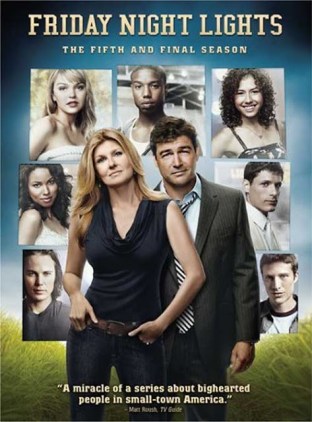
FRIDAY NIGHT LIGHTS isn’t about Texas high school football because it’s really about character, relationships and community.
The true star of this drama is a relationship. The marriage of Eric and Tami Taylor is the spine of this narrative’s skeleton. It’s the beating heart at the center of the town of Dillon, Texas. Without the marriage of Eric and Tami, there is no story. Actors Kyle Chandler and Connie Britton play their parts with such natural grace that their marriage should receive an Emmy. It is one of the great marriages in television history.
Eric is the new Head Coach of the Dillon Panthers. Tammy is the high school counselor. Their marriage is subject to pressures that would crush most commitments. If Eric and Tammy can survive this alchemist’s crucible, they will be peerless. They will be jewels.
If they can’t, they’ll be another sad divorce that leaves behind a shattered family. Their daughter Julie is at that age just before she starts to rebel and roll her eyes. We need to wait until Season Three for the foot-stomping, eye rolling and the whole alphabet of gestures of teenage contempt for adult restrictions. Meanwhile, she’s a nice cute kid with a training bra.
Eric and Tammy have tough jobs. If you think coaching high school football is small time stuff, think again. This is Texas. Eric needs all the qualities of a drill sergeant, a general, a shrink, a priest and a politician. He has to raise his voice and deliver a fifteen minute harangue to a team of wall-sized athletes until they are reduced to terrified little lumps of jelly, quivering on the locker room floor. Or he can put his arm around a confused, demoralized quarterback, pull the boy’s head onto his shoulder and choose the right words to unleash a deluge of tears. He must puncture the macho armor of these arrogant teen prima donnas and make them, FORCE them, to live in the real world where they are not God’s gift to women and football. Creating better athletes is secondary to creating better people.
All across the country, the name of Eric Taylor is being discussed. He’s a young, new coach, he’s just emerging and he’s the man to watch. He may be next year’s High School Coach Of The Year. He’s at the beginning of a career that may some day take him to the Super Bowl.
Eric is, by nature, a man of few words. At home, he’s a firm but gentle presence who doesn’t make a lot of noise. He’s busy. He’s working, watching playback of games, evaluating his own calls and his players’ moves. He works ALL the time. He lives football. His wife understands this, she has grasped it from the very beginning of their marriage and rather than pout and grow disillusioned, she creates her own life. She uses her own strengths and interests to engage the world. She’s a high school guidance counselor. This makes her the equivalent of a prison warden and The Great White Hunter on an African Safari. She is stimulated by challenge. She is one of those goddess mothers full of lush strength, red-maned, sexy and very tough.
What makes a marriage between two such powerful people function so well?
Honesty keeps the marriage strong. Tami and Eric are always honest with one another. Even when they lie, they’re honest about lying. Neither is afraid to admit being wrong about an issue. They support one another with unbreakable consistency. If they have a fight, they cut through the bullshit, find the central issue, and look for compromise. They don’t resort to yelling and name calling.
There are times when an irresistible opportunity appears before Eric or Tami. The problem is, accepting the opportunity would require changes in the marriage or the family lifestyle. One of them, Eric or Tami, is going to have to make a sacrifice. Who is willing to see a lifetime dream fade away? Who is wise enough to see that opportunity does NOT come only once in a lifetime?
The town of Dillon, Texas is neither large nor small. It’s like a town with a hundred thousand people that has been absorbed into the suburban sprawl of Houston or Dallas. It has an identity. Much of that identity is drawn from the supremacy of the Dillon Panthers.
The power brokers, the mayor, the oil moguls and the owner of the Cadillac dealership are Panther alumni and sit on the board of the Booster’s Association.They know which strings to pull, how to schedule games to the advantage of the team, how to acquire players from other teams who might be Panther-killers if they’re not brought into the fold. They’re the guys who play dirty, behind the curtain. A little pressure, maybe some mild blackmail; it gets the job done and the team is none the wiser.
It’s amazing how much of the human condition can be collected into a single file cabinet with the same labeled situations. There are aimless kids on drugs, there are abandoned old people, cheating husbands, bankrupt businessmen, pregnant cheerleaders, corrupt officials, natural disasters, infatuated teenagers going suicidal over a romantic setback….all these potholes in the road of life are much the same, no matter where you go.
The things that can’t be pigeonholed, that can’t be stuck in a file, are the lineaments of character. Which one of these people can overcome the temptation to shirk? Which one can step up and make an effort to change?
I ask, because I think Friday Night Lights is a narrative about that power in human beings, that ability to see their own trouble and solve the problem, and then move forward. There will be another problem, and another. No matter. By the time Season Three begins, even the people we learned to hate have become different, better. They are tougher, yet softer. They have something that we all wish we had: a supportive community.
I was amazed, over and over again, at the way the people of Dillon turn to one another. Coach Taylor’s door is always open. If the phone rings at three in the morning, he will answer it. “I’ll be right there,” he says, sliding out of bed and looking for his pants. If some sopping wet weeping teenager having a crisis knocks on someone’s door, there will be a soft place to fall. A motherly hand is extended: “Why come on in, sugar, you look awful, and you’re just SOPPING wet! What can I do for you?”
In my dreams I live in a place like that. Dillon is special because Southern Hospitality is not only real but it includes everyone and it understands that shame is the enemy of communication. As a community, Dillon expands its definition of humanity and grows like an amoeba to absorb shame so that being ashamed is not shameful. Lying about the cause of the shame, THAT’S shameful, so it’s better to unburden the heart, to come clean and let someone help you, someone with a wiser mind like Eric or Tami Taylor, or a hundred other people. What’s sad is that this town is a television fiction but it gives me hope. If someone can imagine such a place, someone can create it in the real world.
A Midwesterner by birth, Arthur Rosch migrated to the West Coast just in time to be a hippie but discovered that he was more connected to the Beatnik generation. He harkened back to an Old School world of jazz, poetry, painting and photography. In the Eighties he received Playboy Magazine’s Best Short Story Award for a comic view of a planet where there are six genders. The timing was not good. His life was falling apart as he struggled with addiction and depression. He experienced the reality of the streets for more than a decade. Putting himself back together was the defining experience of his life. It wasn’t easy. It did, however, nurture his literary soul. He has a passion for astronomy, photography, history, psychology and the weird puzzle of human experience. He is currently a certified Seniors Peer Counselor in Sonoma County, California. Come visit his blogs and photo sites. www.artrosch.com and http://bit.ly/2uyxZbv.
Want to be sure not to miss any of “Art’s Visual Media Reviews”? Subscribe to Writing to be Read for e-mail notifications whenever new content is posted or follow WtbR on WordPress.
Share this:

The Making of a Memoir: Obstacles and Roadblocks
Posted: April 8, 2019 Filed under: Commentary, Memoir, Nonfiction, The Making of a Memoir, Writing, Writing Process | Tags: Creative Nonfiction, Losing Michael: Teen Suicide and a Mother's Grief, Memoir, Nonfiction, The Making of a Memoir, Writing Process, Writing to be Read Leave a comment
Losing Michael: Teen Suicide and a Mother’s Grief
“The Making of a Memoir” is a bi-monthly blog series which explores the stages of writing a memoir as I write the story of losing my nineteen year old son, Michael, to suicide, through his story and the tale of a life without him and the grief I experience every day, even after he’s been gone for a decade. Some progress has been made toward the actual writing of the book since the last segment. I made a final decision on the title above for the book, and work on the cover is in progress with Art Rosch at Starrts Creative. Although there is still a lot of material still to sort through and compile what I want to include, I managed to work through a considerable amount. The going is slow, as I knew it would be, due to the emotional nature of the material and the memories some of it awakens.
In the last segment, “Stage 1: Prewriting Tasks“, I said I expected this book to be the most difficult story I have ever attempted to write, and that has proven to be true. In fact, it has proven to be difficult in more ways than I had imagined. This segment was supposed to be titled “Stage 2: Selling the Story”, but alas, unexpected “Obstacles and Roadblocks” has become a more appropriate title. Over the past two months, I run into several and I’m still trying to find a way around, over or through one huge one in particular – legalities.
Memoir can and should be a work of creative nonfiction. It is a true story told creatively, so as to capture and hold the readers’ attention. What memoir is not, is a work of fiction, with fictitional characters and places. You are telling a true story, something that actually happened, something in which other real people played different roles, and to tell the story, their parts must be told as well, even if the tale doesn’t portray all of them in a positive light. A good memoir must be told with honesty, from the heart.
As I sorted through the plethora of material I have gathered and saved since my son’s death: his poetry, writings and artwork; my poetry and writings; and oh so many photos, I couldn’t help but think about the other people involved, directly or indirectly with the story of the events leading up to Mike’s death and also the events that came after, and I realized that there were more than a few, people associated with Mike, and law enforcement officers, who might not want this story to come out because of the manner in which they might be viewed for their parts in his death.
It normally wouldn’t be a problem at all. I’m writing the story of events as they happened to the best of my knowledge. Many facts surrounding Mike’s death were suspicious, and for a time I believed that Mike might have been murdered. Things didn’t add up, but the proof to back up what I know to be true was withheld from me by local law enforcement. I no longer entertain the idea that Mike’s death was anything other than suicide, without the proof that the events happened the way I claim they did, I could be open to liable in telling this story.
The individuals involved wouldn’t really be a problem. The obvious solution is to change the names. Even in a true story, real people can have fictitious names, without damaging author credibility. Authors do this all the time; you just state that some names have been changed and readers won’t feel cheated.
The law enforcement agency and certain individual agents present a bigger problem. Do I change the names of the law enforcement agents? Do I change the name of the area they represent? How much can be changed before a true story becomes a work of fiction? The proof I lack wouldn’t portray the local law in a positive way and they know it, so they aren’t likely to have a change of heart about sharing it with me for the book. They play major roles in the events leading up to Mike’s death, and the story really can’t be told without their inclusion.
Although this issue has presented a roadblock that appears it might be unsurpassable, I have a couple of ideas on how I might be able to get around it. I need to let it play out and see. If not, I’ll look for a way to go over, or under if I have to. This is a story that must be told, and I’m determined to tell it. By the next segment, in June, I should be moving forward once more. I’ll let you know how it gets resolved. I do hope you’ll join me then.
Join me in my writing journey through “The Making of a Memoir” the second Monday every other month on Writing to be Read: February, April, June, August, October and December. To be sure not to miss one segment, subscribe to email or follow on WordPress for notification of new content.
Share this:

February: Taking a look at nonfiction
Posted: February 25, 2019 Filed under: Biographies, Biography, Books, Commentary, Creative Nonfiction, His Name Was Michael, Memoir, Nature writing, Nonfiction, Self-Help, Travel, Writing, Writing to be Read | Tags: Biography, Creative Nonfiction, Diaries, How-to books, Journalism, Memoir, Nature Guides, Nonfiction, Self-Help, Travel Books, Travel Memoir, Writing to be Read Leave a comment
Our monthly theme for February on Writing to be Read was, you guessed it – nonfiction. So, what tipped you off? Was it the great interview I did with nature author Susan J. Tweit? Or maybe the nonfiction revues of How to become a Published Author and Letters of May? Or perhaps it was the “Chatting with the Pros” interview of nonfiction author Mark Shaw? Whatever it was that gave it away, I’m here to tell you that these few posts on nonfiction don’t even scratch the surface of what the genre of nonfiction encompasses.
There are many subgenres of nonfiction, just as there are many subgenres under each of the genres of fiction. When someone asks what type of book your fiction novel is, we are quick to catetgorize it as a paranormal mystery, a historical romance, or a science fiction thriller. For some reason, we don’t seem to think about nonfiction the same way we do fiction and when someone asks what type of book your memoir is, or your travel diary, or your self-help book, we tend to lump it in with all the rest in nonfiction. Why this is, I don’t know, but I find that it is the case, time and time again.
The fact is, not all nonfiction books are alike and there are many categories or subgenres that fall within the nonfiction realm. Mark Shaw writes biographies and creative nonfiction tales that are very different from the memoirs, illustrated travel books and nature guides of Susan J. Tweit. Other types of nonfiction that are hard to define are books like Mark Todd and Kym O’Connell Todd’s Wild West Ghosts, which chronicles their ghost hunting experiences and offers advice on how you can be a ghost hunter too. Or Hollywood Game Plan by Carole Kirshner, which is a how-to guide for anyone wanting to break into the screenwriting world. These books are all nonfiction, but they are all very different types of books.
According to wikipedia the genres of nonfiction are biographies, autobiographies, memoirs, commentaries, creative nonfiction, critiques, essays, owners manuals, journalism, personal narratives, reference books, self-help books, speeches, and text books. I would add to that spiritual texts, encyclopedias, documentaries, how-to books, cookbooks, diaries and anthologies such as the one found in Letters of May, which is a collection of writings and artwork illustrating the world of those afflicted with mental illness. I’m sure there are others, but as you can see the list is quite extensive.
Nonfiction books may or may not be aimed to entertain, but the primary purpose, no matter the type of nonfiction book, is to inform. This may account for the fact that my reviews of nonfiction books receive more views in general, than most of my fiction reviews. A fact that I found to be surprising when I uncovered it while looking over the data for this blog. My theory is that readers turn more quickly to books they may find useful than they do to those with entertainment as their sole purpose.

My reasons for interest in nonfiction and all it’s many forms stems from preparation for my journey to write my own memoir, telling the story of my son’s death and my life without him, His Name Was Michael. My bi-monthly blog series which will chronicle that writing process, “The Making of a Memoir“, came out with the first segment in February, too. It was a good month for it to come out, as it also fits in with the nonfiction theme. I hope you’ll join us again next month, when the theme will be science fiction and fantasy.
Be sure to join me next month when we will explore science fiction and fantasy, with guest author Kevin J. Anderson on “Chatting with the Pros” on March 18th, as well as a review of his Selected Stories: Science Fiction Volume 2, and Jordan Elizabeth’s Rogue Crystal.
Update: In Friday’s post I talked about the changes coming for Writing to be Read. One more change that I just recieved confirmation of, and I’m pleased to announce: Art Rosch will also be posting one movie review a month, on the forth Friday of the month, in “Art’s Visual Media Review”.
Like this post? Subscribe to Writing to be Read for e-mail notifications whenever new content is posted or follow WtbR on WordPress.
Share this:

Christmas Isn’t What it Used to Be
Posted: December 22, 2017 Filed under: Commentary, Opinion | Tags: Christmas, Christmas Spirit, Merry Christmas 2 Comments
I can remember as I little girl going to the mall with my mother and my grandmother to do our Christmas shopping and sit on Santa’s lap. All the stores played Christmas music, the buildings were all lit up with beautifully colored Christmas lights and there were Salvation Army Santas on every other corner shaking their bells. It was a happy time, but not any more.
These days it seems like everybody is in a hurry, and Christmas spirit is often hard to find. People in the stores will run you over, or snatch an item right out of your hand. A minor bump in the aisle is likely to result in violence. Christmas shopping is no longer a pleasant experience, if you’re not too timid to venture out at all. Christmas is supposed to be a time of peace on Earth and good will toward men, but folks won’t hesitate to deck the aisles with anyone who gets in their way.
The other day I was in the store, and I saw an older man bending down to get a case of soda from the bottom shelf. A kid came barreling around the corner with a shopping cart and plowed right into the man, knocking him to his knees, pops splaying out of the case and scattering across the aisle. The man reacted, turning to say, “Hey, watch it!” Then, the boys mother came around the corner and told the man he was rude. Store employees appeared, offering to help the man up and cleaning up the mess in the aisle, and the lady and her son disappeared into the crowd.
The boy’s actions were disrespectful, not even offering an apology, but the mother’s response, to my view is incomprehensable. If I had done something like that as a child, or for that matter, if my children had done something like that, there would have been apologies, not only from the parent, but the parent would have made sure the child apologized as well and there would have been a couple of reddened butt cheeks when we got home. The woman didn’t see anything wrong with what her son had done, she felt no regret or guilt seeing the man on his knees in the aisle. She didn’t even take the time to see if he was alright. That’s not Christmas spirit. I’m not sure that’s even human.
Later, same store, same shopping trip. I watched a disabled woman with a pronounced limp move down the aisle leaning heavily on her basket. As she passed behind another lady, who was standing in the aisle examining the products on the shelf in front of her, the disabled woman jerked, causing her to bump the other woman lightly. She passed on by, apparently not realizing she had bumped the other woman, but the other woman jumped at the contact and glared after her. But it didn’t stop there. The woman turned and headed toward the disabled woman, coming up behind her. I don’t know what she planned to do, but it appeared that she might even mean the disabled woman harm. The disabled woman had no idea the irate woman was behind her or how close she had come to finding out the hard way. Fortunately, she looked up and saw me watching, and turned, heading back down the aisle the other way. Yep, Christmas spirit just oozing there.
These days everyone is angry and distrustful. We don’t trust our fellow man. How can we when road rage is common place, as are mass shootings and bombings of public events? You have to take care when opening emails or answering robocalls, because scammers are everywhere, trying to get your personal information to take your money or steal your identity. And mothers are afraid to let their kids sit on Santa’s lap for fear there might be a child molester hiding under that beard. This is the social climate that we live in today and it’s very different from the simple world that I grew up in. And it just doesn’t feel like Christmas anymore.

Through all the changes, it seems that many of us have lost sight of what the true message of Christmas is. Christmas is about giving; not about getting the best deal, or buying the most popular toy. Jesus was God’s gift to mankind because he loves us. That’s why the first word in Christmas is Christ. It’s sad to think the term isn’t deemed politically correct these days, because that term is meant to remind us of why we celebrate Christmas and what it’s all about. It’s about Love, plain and simple.
I have to smile when I see stories on the news of Secret Santa, the man who goes around giving money to complete strangers each year, or the man who drives around with a trunk full of basketballs, which he gives to needy kids, not just at Christmas time, but year round. Not all of us have forgotten what Christmas is about. There are those out there who still know about the spirit of giving and love for your fellow man. I think those folks were more abundant when I was growing up, but they can still be found if you look.
So this holiday season, I challenge all of you to renew your Christmas spirit: go out and do one nice thing for someone you don’t know, say ‘thank you’ when someone shows you a courtesy, or just give a smile to someone who looks like they’ve had a hard day. Call up a friend or releative you haven’t seen or heard from in a while and wish them a Merry Christmas. It doesn’t have to be much. Just enough to make you aware that you’re still a part of the human race and let you feel the love.

Share this:

Book Marketing – What Works?: Conclusions
Posted: October 23, 2017 Filed under: Book Review, Books, Branding, Commentary, Cover Art, Full Moon Bites, Interview, marketing, Promotion, Writing | Tags: Advertising, Book Blog Tours, book marketing, Books, Branding, PAs, promotion, Social Media Promotion, Street teams Leave a comment
Whether an independent author or traditionally published, it seems most of the marketing and promotion falls to the author in today’s literary arena. Even if we love marketing and don’t find it to be an absolutely harrowing task, we are writers, and time spent marketing is time not doing what we love: writing. We don’t want to waste our time and money on ineffective marketing methods. We want to make our marketing techniques pay off big in as little time and expense as possible, so we can spend more time putting words to page.
In this series, we’ve talked to seven authors to learn what methods of book promotion works for them. In Part 1, I talked with Cynthia Vespia, who chose to go independent after having minimal results with small publishers. She does her own cover art and all of her own marketing. She prefers face-to-face marketing events to social media marketing. While she does do social media release parties and book events, she finds them most effective to increase fanbase, rather than book sales. She says it is more difficult to gauge the effectiveness of social media marketing than it is to see the imediate results of conventions and book signings.
Something which I’ve tried which has been somewhat effective, at least in building my platform, if not in actual sales, are the book releases and book events on Facebook. Even though obtaining a spot in one of these events is free, they do require a lot of preparation for a short little spurt (1/2 hour to 1 hour) for your spot. And I think you’ll get better results if you hang out for at least a while, commenting and playing the games to support your fellow authors and creating visibility. If you’d like to check one out, I’m participating in a special Cyber-Monday event, hosted by Sonora Dawn Studios and DL Mullen, and they are still looking for author particiapnts.
In Part 2, Mark Todd and Kym O’Connell Todd , who are small press and independent authors. Kym does their covers and Mark copyedits their books, and they do all of their own marketing. They promote through blogging and have a YouTube channel, where visitors could watch recordings of their research and ghost investigations. They also have a website and author pages on Amazon and Goodreads. They have found blogging, and social media promotion effective ways to get the word out about their books, but they found in person book readings to be less effective and unpredictable. They advocate free promotions and KDP Select.
On the issue of KDP select, I have my doubts, and author Chris Barili is in agreement with me in Part 6. It doesn’t make sense to limit the venues on which you can sell your book. With KDP select, you must sell only on Amazon, exclusively, which excludes many other venues, such as Smashwords, Lulu, Book Baby, etc… And while I say it makes no sense, both of my books are with KDP select right now. I’ve left Last Call there for now, because I have an idea to do something else with that story, and it doesn’t make sense to pull it off KDP select until then. And with Delilah, it’s really up to my publisher, so for now, I don’t have a choice.
Part 3 featured an interview with Jordan Elizabeth, a small press author. Her publisher handles editing and book covers, but she handles the major portion of her marketing. She’s an advocate of social media promotion. She reports good results advertising with BookBub and Fussy Librarian, and also says book signings are effective.
In 2016, author Nicholas C. Rossis in his post, Call to Arms: Year-long survey reveals which book advertiser offers best value for money, says that at the end of 2016, the best buy for your buck as far as advertising discounted books goes, was Amazon Marketing Services, Book Barbarian, and ENT. But he also notes that these trends fluctuate and advertisers that were rated higher in 2015, may have rated lower or not made his list in 2016. And he notes that Amazon Marketing Service rising from the ranks with unfortold speed.
According to Writer’s News’ list of useful book promotion websites , Write Globe, which claims to be the perfect platform for creative individuals, ranked number one. Also mentioned are Writers.Support, BooksOnline.Best, Noble Authors, 79ads.in, Creative Designers and Writers, ShareNews.live, Earn.Promo, in that order. The last one on their list stuck out for me, because it’s free. As a starving writer, free always has a certain appeal. Another site for free advertising that I found was Authors Talk About It. They run your ad for your book in their newsletter for free and also free book cover contests, and featured author interviews. They ran my interview and made me sound good.
Independent author Tim Baker joined us in Part 4. He started out with small press publishers, but switched over to independent, creating his own brand. He does free promotions and giveaways and finds them to be effective in creating buzz, resulting in future sales. He contracts out editing, formating and cover art, but handles all his own marketing, believing there is no magic formula for selling books but hard work and persistance.
If you are fortunate enough to be able to hire out your non-writing tasks, so you can spend your time tending to the business of writing, there are plenty of sites out there where you can find free-lance service providers. My editing services are offered through The Author Market, and they also offer cover design and book trailers, proofreading, ghostwriting and PA services.
In Part 5, independent author Amy Cecil shared her thoughts on marketing and social media promotion. She hires out her marketing tasks so she has more time to spend on the business of writing. She hires for editing and cover design, has a marketing firm and two PAs. She’s a new found believer in book blog tours, has done a book signing at B&N, and has a street team for creating social media buzz aboout her books. She’s not in favor of free promotions, but loves the exposure that social media has given her.
While Jordan didn’t find review tours to be worth the money it costs of the promotional agencies as her results were minimal. I know a little about them, and I know authors who swear by them, like Amy Cecil. Many of my author interviews are part of the Full Moon Bites Promotions book blog tours. And I know there are plenty of other promotional services which set up book blog tours out there, but it appears the verdict is still up in the air on this book marketing method.
Part 6 features author Chris Barili, who has published both traditionally and independently. While his traditionally published book requires only minimal marketing from him, the independently published books require him to do it all. He has found social media marketing, free promotions and KDP select to be ineffective. What works for him is hard work and persistance.
In Part 7, I interviewed DeAnna Knippling, an independent author who has also developed her own brand and publishing label. She uses an Advance Reader Copy list and newsletters, free promotions, and tries to attract super-readers on Goodreads, testifying to the power of reviews. (Of free promos Knippling says that if it doesn’t generate new sales, it at least generates new readers and that’s worth the cost.)
There is no doubt that in today’s book market, in the world of digital marketing, book reviews are where it’s at. But, honest reviews aren’t always easy to come by. YA author Jordan Elizabeth used her street team for the task of finding reviewers, with mixed results, and DeAnna Knippling has done free promotions on sites like Instafreebie. Free ARCs don’t always garauntee the review. That’s one of the reasons I do honest book reviews here on Writing to be Read, to help promote other authors and their work.
Everybody talks about branding and how you have to have a brand, but it looks to me like branding is something that just sort of happens in many cases, such as my red quill and ink, which began as a social media avatar and has become my logo. In others cases, like DeAnna Knippling and Tim Baker, it’s a purposeful, but still comes almost naturally.
Overall, it seems that different methods are effective for different authors, and in different ways. While social media and free promotions may or may not produce new book sales, it does create buzz, which results in future sales, at least in theory. Although Mark and Kym don’t place a lot of value on social media promotion, Cynthia Vespia, Jordan Elizabeth, Amy Cecil and DeAnna Knippling find it an effective way to build a fan base and get reviews. It seems like face-to-face promotional encounters such as book signings and conferences are a pretty effective way to get your book out there, and free promos pay off if you look at other measures of effectiveness besides book sales. Tim Baker and Chris Barili both put their faith in hard work and persistance, regardless of the marketing methods you chose.
Like this blog post series? Subscribe to Writing to be Read for e-mail notifications whenever new content is posted or follow WtbR on WordPress.
Share this:

Jeff’s God Complex
Posted: May 10, 2017 Filed under: Books, Commentary, God Complex, Opinion, Publishing, Uncategorized Leave a commentThe God Complex vs. Non-Literary Sources of Entertainment
by Jeff Bowles

The written word is dying. You know it, I know it, and so does anyone else who’s taken a serious look at book sales in the last twenty-five years. Academics and the literary elite have been decrying this death for some time. Growing up in the 90s, I was told again and again my generation represented a kind of last ditch effort to save literacy before it was too late.
Does it have to be this way? Popular opinion would have you believe so. Then again, any form of creative expression that becomes less and less popular with each successive generation is doomed to fail at some point, right? Kids today. They’ve got myriad distractions. Movies, video games, the internet, comic books, television. The ones who grow up readers will probably stick with it. But young people without an inherent need to devour that latest giant book release tend to shy away from recreational reading their whole lives.
See, prose is a beautiful textual form, but it also requires the kind of attention span that went out of fashion with fax machines and cassette tapes. It requires imagination, particularly in regards to participation, and make no mistake, if you’re reading your favorite author, you’re a participant as much as a consumer.
I’ve often heard it said all great art forms thrive on limitations. Music, for instance, is built on sound, rhythm, aural evocation, but there is no visual component, and often when we listen to music, the absence of something interesting to look at often heightens the experience. Film, too. We have the visual, we have sound, but we cannot readily discern the thoughts, feeling, and motivations of the people onscreen; in other words, we can’t be inside their heads. Which is why world-class actors make all the difference. There’s an entire hidden world bubbling to the surface in great films, and our imaginations help complete the picture.
The written word is a lot like that, except that in a good piece of fiction, we may know the inner workings of our favorite characters. We just can’t see or hear them. A good book is a wonderful tool for sharpening the mind. As much as I like video games, movies, and comic books—and I do—they just aren’t as fulfilling on that level.
If you’re a fan of Science Fiction, Fantasy, and Horror, you should know your go-to genres have been coopted by video game developers and movie producers all over the world. They’ve taken the hallmarks and defining tropes you love and turned them into heightened visceral experiences that in the short term at least can blow even the best novels out of the water. I love reading about space pirates and interstellar imperial armadas. But somehow, when a PlayStation game puts a blaster rifle in my hand and lets me save the galaxy, it’s just too fulfilling a spectacle to ignore.
I’m 32 years old, which makes me a quote, unquote “older” Millennial. My generation takes a lot of guff out there, but no one can deny how skilled we are in the ways of media diversification. I have no problem switching between novels and games and comics and TV shows, because I know each unique format can render enjoyable stories. And that’s the thing, really. Stories are the key. We still love and crave them, spend a lot of time—too much time—in a kind of mad rush to consume them.
It’s just we’re less likely to turn to a good book to find them than Baby Boomers or even many Gen-Xers. The as-yet-unnamed generation coming up behind us is even less likely, and in fact, their concepts of good stories are even stranger, owing to the fact that many kids today worship YouTube and the limitless hysteria and disjointed infotainment it provides.
Oh sure, there may be a place for good books for years and years to come, but if you as a writer are in any way worried about their ultimate viability, might I recommend you study these other forms of entertainment and discover what makes them tick?
Are video games truly mindless? Or do they simply manage to capture the heat of battle like no other storytelling medium before? Are serialized “shared-universe” movie properties a waste of time, or are they the next step in branded and concise science-fictive intellectual properties?
I think we can make our prose more electric, our ideas bigger and harder to ignore. I think our fiction can be faster, more dangerous, put together like any good hybrid. Otherwise, I fear, we’re going to get out-shouted, the carnival barkers of a million different industries drowning out our unique voices one-by-one
I’ve dedicated by publishing history to this very principle, but I certainly understand the hesitancy I sense each time I tell fellow writers most of us aren’t ready for that kind of transition. Rather than allowing our favorite literary forms to die, we should encourage them to evolve. Ultimately, how many new fans a fresh-faced writer can hope to gain depends on the lengths he or she is willing to go to in an effort to stand out in the crowd.
By the way, the crowd in question? It’s full of billion-dollar storytelling giants, and the almighty dollar just ain’t what it once was. Hollywood still loves to adapt a book, though. Take my advice, folks. Write that which is entertaining enough to create and convert new book fans. The pool of international readers grows shallower every year. Let’s encourage more people to come take a swim, huh? Those who know more about Mario and Master Chief than Tolstoy or Shakespeare. It starts with you, dear writer. Just how damn entertaining can you be?
Interested in my writing? Check out my latest short story collection, Fear and Loathing in Las Cruces — https://www.amazon.com/Fear-Loathing-Las-Cruces-Stories-ebook/dp/B06XH2774F
Twitter: @JeffBowlesLives
Facebook: http://www.facebook.com/jeffryanbowles
YouTube’s Jeff Bowles Central: https://www.youtube.com/channel/UC6uMxedp3VxxUCS4zn3ulgQ
Amazon Author Page: https://www.amazon.com/Jeff-Bowles/e/B01L7GXCU0/ref=sr_ntt_srch_lnk_1?qid=14794534940
Share this:

The Pep Talk
Posted: April 5, 2017 Filed under: Commentary, Inspirational, Opinion, Pep Talk, Writing, Writing Tips 3 Comments
Every month in this space, author Jeff Bowles offers advice for young and struggling writers. No one ever said becoming a world-famous storyteller is easy. This is the Pep Talk.
Everyone needs a pep talk now and then. I could use one at least once a week. I know a lot of damn fine writers who’re having challenging times right now. Maybe it’s just the year 2017, a surge of new energy which has left us feeling stifled and worn down. I think drive comes in waves. Easy to manifest when you’re young and hungry, also easy when you’re working for paychecks. An unexamined life is not worth living. What makes you tick, my friends? Why do you feel the need to work hard for your dream?
For me, a famous song lyric says it all: “Time inspires me like a dog inspires a rabbit.”
There’s a certain creative disposition that fuels productivity by way of dread for the brevity of life. I am of that disposition. When I get into a writing slump, I wake up in the middle of the night feeling unfulfilled and guilty. I’ve got so much to say, so many stories to tell. Maybe it’s more important to create as if nothing can harm us, as if the whole universe is waiting for our next works of art. It can feel like that sometimes, can’t it? Thank God.
Do you have big dreams for your writing career? I certainly do. There’s kind of a junction between what we want and what reality is willing to give us. What keeps us writing even when no publishers are interested in our work and readers are few and far between?
I think the answer is more universal than people realize. If you’ve been doing this long enough, no doubt you know a few people who’ve climbed further faster than you. Now this can be a really painful experience, and I think it’s okay to admit it. Is it petty to resent those who’ve accumulated more success than us? It is, but to a large extent it’s also unavoidable.
It’d take a very balanced personality indeed to shrug off adversity 100% of the time. There’s something within us, perhaps culled from our hunter-gatherer days, that endows us with an astonishing capacity for jealousy.
“How’d he publish that book? Mine is so much better!”
“And she won an award for it? Meanwhile I’m sitting here in obscurity, twiddling my thumbs.”
Comments like these are a sure sign of a bad attitude, but tell me you’ve never thought something similar. It’s normal, right? Even if we don’t want it to be. But I’d also like to remind you it’s corrosive to the mind and spirit.
Publishing is a tricky business because we’re all vying for limited resources. Only so many pub spots, book deals, and readers worldwide. Add to it the fact readership across the globe is on the decline, and holy cow! The competition is on. Some people are fueled by competition. In a perfect world we’d all hold hands and celebrate each other’s work and tell ourselves we can be happy, healthy and sane no matter how many copies of our latest masterworks we sell (or fail to sell).
In the end, jealousy tends to destroy people who cling to it. I do believe jealousy also serves a higher function. You can watch everyone around you meet with success and learn a great deal from it. Watch the successful ones, pay attention to their habits and practices. Are they better writers than you? Doubtful. Perhaps they’re just more keyed in to what sells. I have to admit I’m not very good at this. I have to do everything the hard way. Don’t be like me. Many people will tell you success is a game of luck. I’m not so sure I believe in luck anymore.…
That which we define as luck, I think, can be greatly enhanced by focus and productivity. You can beat the odds by maintaining a steady workflow and making sure you’re constantly revising, submitting, rewriting, doing the dance. Belief is more important than luck. I think you’ve got to take charge of who you perceive yourself to be.
Quit telling yourself you’re a failure nobody wants to read. Stop it! Do your best to boost your ego. Nothing flawed or vain about it. Isn’t there enough in this world that tears us down? So build yourself up. Focus on the end goal, the dream day, a fresh contract, your pen set to the signature line. A few months later, another dream day, signing fresh copies of your latest best seller, a huge line piled up at your table, running out the bookstore (I always imagine a nice cozy Barns & Noble).
Everyone needs friends and allies, too. People who appreciate what you do. Now I’ve got to admit that if you’re just starting out or are not yet as successful as you’d like to be, finding individuals to believe in you might be a challenge. Who knows why people behave this way, but there’s something about a nascent writing dream that drives the skeptics crazy. I’ve met a million of them, and I know you have, too. Just keep working, focus on where you want to be rather than where you are in this present moment.
I’ll just go ahead and say it. I think it pays to be delusional. You’ve got to be the emperor with no clothes on. When people tell you, “Yeah but you aren’t this. I’ve known you for years. What you really are is this.” You’ve got to show them your fine purple robes, assure them they’re more than thin air, and then parade around like you aren’t naked.
Someone someday will clothe you in something more real. Better yet, you’ll manage to get hold of some nice clothes yourself. But you can’t be a victim of other people’s circumstances. You’ll feel what you’ll feel, but don’t let envy control your world. Because it will try, again and again. We’re not monks on high mountains practicing infinite patience and unbridled universal centeredness. We are at best creative people willing to bleed for our work. And what are you going to do as a result? Quit? Ha! You’re no quitter. You are everything literature and great minds have praised for eons. To write and succeed is a blessing. To endure even as we struggle, that is divine. See you next time, everyone!
Interested in Jeff’s writing? Check out his latest short story collection, Fear and Loathing in Las Cruces: https://www.amazon.com/Fear-Loathing-Las-Cruces-Stories-ebook/dp/B06XH2774F
Twitter: @JeffBowlesLives
Facebook: http://www.facebook.com/jeffryanbowles
Amazon Author Page: https://www.amazon.com/JeffBowles/e/B01L7GXCU0/ref=sr_ntt_srch_lnk_1?qid=1479453494
YouTube’s Jeff Bowles Central: https://www.youtube.com/channel/UC6uMxedp3VxxUCS4zn3ulgQ










Homeland: An Over(re)view
Posted: February 28, 2020 | Author: artrosch | Filed under: Art's Visual Media Reviews, Commentary, Television review, Thriller | Tags: Art's Visual Media Reviews, CIA, Claire Danes, Damian Lewis, Homeland, National Security, Showtime, spy thrillers, Television review, TV reviews, Writing to be Read | Leave a commentHomeland: An over-review
Showtime’s National-Security thriller, “Homeland”, is a Monster. It’s intense, cerebral, nerve-wracking, absorbing and addictive. It’s just the kind of stuff we like. Claire Danes is either a genius or the world’s most egregious over-actor since Adolph Hitler. Her eyes bug out of her head. She gives Bipolar Disorder a new public face. Her gaze darts everywhere in fits of paranoia. Claire is sensing the facts as they are: everyone is out to get her. Playing CIA analyst Carrie Mathison, she’s in disgrace. The agency to which she is devoted, the CIA, is also in disgrace, thanks to flubs, fumbles, the 9/11 disaster and political turf wars. Carrie’s the scapegoat. Everyone in the Intelligence community knows she’s a nut case. The thing is, she’s a nut case who is RIGHT. It takes a crazy person to identify the deeper reality. It takes a slobbering paranoid to fit all the pieces of the puzzle together in ways that no sane person would dare. This is a new era, a new paradigm. The Cold War is over. Hawkish right-wingers have spent the last decade enhancing the power of the Presidency, ditching congressional oversight and accountability. There is political and moral turmoil. A real President is never mentioned; there is just “The President” and he is kept out of the picture. How do we handle such issues as torture, assassination, domestic surveillance and murder-by-drone? The gloves are off. We do the expedient thing. If we have to kill people to save an intelligence operation, we do the killing. The operation is all-important.
There isn’t much ideology in “Homeland”. The characters are mostly driven by ambition, greed and ego. Carrie has given up trusting anyone. She’s fallen in love with Nick Brody (played by Damian Lewis). She doesn’t trust Brody, she’s “playing” him, but still she loves him. She suspects that he’s an agent of Iranian Intelligence, and she’s right. Nick Brody has endured eight years of torture by the Taliban. Now he’s a secret Jihadist. He’s been “turned” by his captors. He prays to Allah in his garage, out of sight of his family. He’s the Trojan Horse who’s going to wear a suicide vest. He’s going to blow up the political leaders of the U.S.A. in a single fiendish blast. He’s been elected as a Congressman on the basis of his heroic persona and is now being touted as the Vice Presidential nominee for the next general election.
“Allahu Akbar” he mutters reverently, bowing into his garage-floor prayer rug. His sixteen year old daughter, Dana, catches him in the act.
Oops.
She doesn’t say or do anything. She’s confused. She’s scared. She wants to love her father, the father who’s been gone since she was eight, who was declared dead before his dramatic recovery from the Taliban.
What do I know? Mandy Patinkin shrugs.
.
Shouldn’t everyone be suspicious of Nick Brody? But..but…he was a Marine, he survived eight years of captivity and didn’t break! He looks damn good in that uniform! Why shouldn’t he run for Congress? CIA sub-chief Saul Berenson is plenty suspicious. He’s played by a wooly faced Mandy Patinkin. He looks like the rabbi who presided over my Bar Mitzvah. I want him to embrace me in a bear hug, I want him to smell like cigars as his beard scratches my boyhood cheeks. He seems to be the only CIA officer who believes in Carrie’s crazed perceptions. He’s her mentor and protector. We, the audience, want to believe in his integrity. When he (apparently) succumbs to external pressure and betrays Carrie, it looks like he’s been lost as the story’s only honest character. Well, Carrie’s honest to a fault but she’s loop-dee-loo manic when she’s off her medications, which is most of the time. She’s a dedicated operative, her life and her family are the CIA. She’s on/again off/again with the CIA because she kept her Bipolar Disease a secret. Yet she’s so valuable, her results so palpable that she’s allowed to remain a kind of house pet with access to most of the deep secrets. In time she herself becomes one of the CIA’s secrets. She doesn’t know that she’s a secret, maybe the most important secret of them all. Well, I told you, she’s crazy!
Damian Lewis looks like Steve McQueen. His pursy little mouth is so McQueen. I know, it’s irrelevant, but it drives me crazy. I don’t know if he’s that good an actor. I just don’t know. The important thing is that he’s good enough. If he’s confused as Nick Brody, he damn well ought to be confused. He went to war as a gung-ho Marine and was taken prisoner and thrown into a hole. He spent five years in the hole and then was let out to be manipulated by arch-terrorist Abu Nazir. It was Stockholm Syndrome with full maple syrup. Devil-faced Abu Nazir played Good Cop on Nicholas Brody and converted him to Islam.
How confusing would it be if you came home to a wife, two kids and a nice suburban house, masquerading as a war hero while plotting to become a Martyr to the cause of global Jihad? Pretty damned confusing. Damian Lewis plays confused to the point of impenetrability. We don’t know who he is. His aberrations are written off to PTSD. As Congressman Brody he has access to all kinds of people and places. How lovely for terror chief Abu Nazir, who employs a full-time suicide vest maker: the little tailor who runs a small shop in Gettysburg with a sideline in explosives.
Nick Brody before cleaning up
“Homeland” is scary because we live in a scary world. An all-pervasive war is being fought everywhere, invisibly. It’s a war of computer hackers, Special Ops raids, spies, spooks, moles, rats, safe houses, cover identities, drone strikes, satellite imagery, surveillance at every traffic light and Seven Eleven. Nothing is too far fetched in today’s world. By creating a lead character who suffers from Bipolar Disorder, Showtime has pulled the band-aid off the wound. Ow! That hurts! It’s disturbing to contemplate Carrie Mathison running around, defying orders, blowing covers, making extremely risky decisions while her “handlers” in the communications van chew the ends of their fingers with anger and frustration. “Carrie, stop! Get back under cover!” Carrie doesn’t stop. She’s off her meds. Her judgment is impaired. This is the kind of spook in whom our trust resides, the spook who holds the safety of our nation in her agile but deeply warped mind.
I don’t recommend watching “Homeland” before bed time. We do it anyway. We dream freaky dreams.
Share this: