For years, authors have borrowed characters from previous authors’ works. For example, Jean Rhys’s novel, Wide Sargasso Sea, details the early life of Mrs. Rochester, wife to Mr. Rochester in Charlotte Bronte’s Jane Eyre.
Likewise, other authors have followed suit: George Macdonald Fraser uses Tom Brown and Flashman from Thomas Hughes’s novel, Tom Brown’s School Days, John Gardner wrote the novel, Grendel, about the beast in Beowulf, and Joseph Heller brought the biblical King David to life in GodKnows.
Now, it’s your turn.
The Exercise:
Select an antagonist or a minor character from a story or novel by someone else—select a character who intrigues you. Then, use that character as the protagonist in a scene or a story you write. For instance, what would Allie Fox’s wife say if she were to tell her version of Mosquito Coast or to write about the courtship between her and Allie? What might Rabbit’s illegitimate daughter (from John Updike’s Rabbit novels) say if she told her story?
The Objective:
To enter into the imaginative world of another writer, to understand that specific world and to build another one from it.
And, of course, to have fun with a character by taking him or her somewhere (either physically or mentally) that her original creator hadn’t imagined he or she would go.
About Lindsey Martin-Bowen
On Halloween 2023, redbat books released Lindsey Martin-Bowen’s 7th poetry collection, CASHING CHECKS with Jim Morrison. Her 4 th collection, Where Water Meets the Rock, was nominated for a Pulitzer; her 3rd, CROSSING KANSAS with Jim Morrison was a finalist in the QuillsEdge Press 2015-2016 Contest. In 2017, it won the Kansas Writers Assn award, “Looks Like a Million.” Writer’s Digest gave her “Vegetable Linguistics” an Honorable Mention in its 85th Annual (2017) Contest. Her Inside Virgil’s Garage (Chatter House Press 2013) was a runner-up in the 2015 Nelson Poetry Book Award. McClatchy Newspapers named her Standing on the Edge of the World (Woodley Press/Washburn University) was one of the Ten Top Poetry Books of 2008. It was nominated for a Pen Award.
______________________________________
Did you know you can sponsor your favorite blog series or even a single post with an advertisement for your book? Stop by the WtbR Sponsor Page and let me advertise your book, or you can make a donation to Writing to be Read for as little as a cup of coffee, If you’d like to show your support for this author and WordCrafter Press.
__________________________________
This segment of “Lindsey’s Writing Practice” is sponsored by WordCrafter Quality Writing & Author Services.
Whether it’s editing, publishing, or promotion that you need, WordCrafter Quality Writing & Author Services can help at a price you can afford.
Most fiction writers realize Character & Conflict remain essential elements in writing fiction. And those concepts can work to make a poem more engaging, too. Thus, this month’s practice offers hints for creating characters—and conflict, which remain essential in moving fiction along.
First,create a mind map for at least the main characters in your novel, short story, or poem. How?
Using the point-of-view for each character, fill in the “answers” to these questions:
1. I hate . . .
2. I love . . .
3. I need . . .
4. I fear . . .
5. I am drawn to . . .
6, I get shivers from . . .
Once you’ve set up this “map,” for you main character(s), think about each character’s flaws. For example, what might urge a character to make a choice opposite from what he or she would normally do? (Remember, each character is a hero or heroine in his or her own mind.)
Consider, too, how seasons and landscapes may serve as characters that motivate the human characters. Remember: TENSION (or CONFLICT) is ESSENTIAL to move fiction along. Thus, a character must WANT something at a story’s onset—and some person, place, or situation, must block him or her from getting it. Thus, the character must try a different ploy.
Dialogue, too, can create conflict as strong as action can. (In fact, many successful stories create as much—or even more—conflict with words as with action.
Again, much of this can work in poems, especially when the poet uses an archetype for either the persona—or a character the persona loves, hates, fears, is drawn to, or all of the preceding situations.
Have fun with this—and see if it helps move a story, chapter, or poem along. Remember: writing must HOOK the reader with a character in conflict with others, a situation, or him or herself.
About Lindsey Martin-Bowen
On Halloween 2023, redbat books released Lindsey Martin-Bowen’s 7th poetry collection, CASHING CHECKS with Jim Morrison. Her 4 th collection, Where Water Meets the Rock, was nominated for a Pulitzer; her 3rd, CROSSING KANSAS with Jim Morrison was a finalist in the QuillsEdge Press 2015-2016 Contest. In 2017, it won the Kansas Writers Assn award, “Looks Like a Million.” Writer’s Digest gave her “Vegetable Linguistics” an Honorable Mention in its 85th Annual (2017) Contest. Her Inside Virgil’s Garage (Chatter House Press 2013) was a runner-up in the 2015 Nelson Poetry Book Award. McClatchy Newspapers named her Standing on the Edge of the World (Woodley Press/Washburn University) was one of the Ten Top Poetry Books of 2008. It was nominated for a Pen Award.
___________________
Did you know you can sponsor your favorite blog series or even a single post with an advertisement for your book? Stop by the WtbR Sponsor Page and let me advertise your book, or you can make a donation to Writing to be Read for as little as a cup of coffee, If you’d like to show your support for this author and WordCrafter Press.
___________________
This segment of “Lindsey’s Writing Practice” is sponsored by WordCrafter Quality Writing & Author Services.
Whether it’s editing, publishing, or promotion that you need, WordCrafter Quality Writing & Author Services can help at a price you can afford.
Do your characters talk to you? I’ve met authors who say, “How could they? They aren’t real. They are fictional characters which I made up.” But if you are in touch with the characters which you created, I don’t see how they could not talk to you. I believe these authors who claim to not hear their characters maybe just aren’t listening.
My characters talk to me and help guide my stories. My characters refuse to stay silent. I don’t actually hear or see them, of course, but they do talk to me in my head. I hear the dialog as it goes on the page, and they are sure to tell me if I get it wrong.
I recall when this first happened while writing my first novel, Delilah. There was a scene in the story which I recognized wasn’t working, but I couldn’t figure out why. I sat in front of my computer re-reading the chapter, which was the dialog of a conversation between Delilah and another character. I said to myself, “Something isn’t right here, but what is it?” And a voice in my head replied, “I wouldn’t react that way.” Re-reading it once more, I realized that the voice of Delilah was right. I had my character reacting in a certain way because it was necessary in order for events in the future to occur, but it wasn’t a reaction that would come naturally from the character I had created. I rewrote the conversation, changing Delilah’s reaction to be true to her character, and it changed the direction of the story, completely. It required extensive revisions throughout the story, including total rewrites of the chapters which came after that scene, but it made it a much better tale than the one I had planned to write, so it was better for the story in the long run.
While writing Sarah, my character hijacked a conversation between her, Big Nose Kate, and a high-society woman, and her opinions on corsets set off an unexpected suffrage movement in Glenwood Springs, complete with a protest and corset burning. When I began writing the story, I had no idea that this would happen in the book, but when I placed the words upon the page, it all just clicked, and I said, “Oh, yeah”.
With both books in my Time Travel Adventure series every chapter is paired with a song. All of Amaryllis’ music was done by The Pretty Reckless, which first inspired her character. But for LeRoy and the other characters who were given P.O.V. in the second book, the music from various artists were used. As I perused the radio stations, searching for just the right song for each chapter. I can think of several times when a song I wasn’t familiar with would come on and LeRoy would give my mind a nudge that said, “Listen to this song.” Paying attention to what he had to say, I focused on the music, listening to the lyrics, and found that the song was perfect for a specific chapter, and the song ended up in the book and on LeRoy’s play list.
Of course, I’m aware that my character’s voices are really voices from my own subconscious, because every one of the characters I create are a part of me. But being in touch with them enough to them to hear their voices in my head makes them feel more like old friends and helps me bring the story to life.
We all have the ability to hear our characters if we’ll only listen to what they have to say. I’ve found that their observations are right on the money. My stories turn out better for listening to them. So, tell me. Do you listen to your characters?
About Kaye Lynne Booth
For Kaye Lynne Booth, writing is a passion. Kaye Lynne is an author with published short fiction and poetry, both online and in print, including her short story collection, Last Call and Other Short Fiction; and her paranormal mystery novella, Hidden Secrets; Books 1 & 2 of her Women in the West adventure series, Delilah and Sarah, and her Time-Travel Adventure novel, The Rock Star & The Outlaw,as well as her poetry collection, Small Wonders and The D.I.Y. Author writing resource. Kaye holds a dual M.F.A. degree in Creative Writing with emphasis in genre fiction and screenwriting, and an M.A. in publishing. Kaye Lynne is the founder of WordCrafter Quality Writing & Author Services and WordCrafter Press. She also maintains an authors’ blog and website, Writing to be Read, where she publishes content of interest in the literary world.
___________________________________________
Did you know you can sponsor your favorite blog series or even a single post with an advertisement for your book? Stop by the WtbR Sponsor Page and let me advertise your book, or you can make a donation to Writing to be Read for as little as a cup of coffee, If you’d like to show your support for this author and WordCrafter Press.
______________________________________
This segment of “Writer’s Corner” is sponsored by the My Backyard Friends Kid’s Book Series and WordCrafter Press.
The My Backyard Friends kid’s book series is inspired by the birds and animals that visit the author Kaye Lynne Booth’s mountain home. Beautiful illustrations by children’s author, poet, and illustrator, Robbie Cheadle, bring the unique voices of the animal characters to life.
In December, I finished writing the first draft of The Rock Star & The Outlaw 2: Seeing Doubles. This book will be the second book in my Time Travel Adventure Series, and I have to say I have been having so much fun writing it. Time travel is cool to write about, because it is pure fiction, so you have a lot of lee-way in your story, although there are still some scientific parameters that should be kept in mind.
In The Rock Star & The Outlaw, my protagonists created some time-loops, which crossed. In The Rock Star & The Outlaw 2: Seeing Double, they create a few more , intersecting with the time-loops created in the first book. What that means, is there is multiple versions of some characters, and the story is dealing with multiple time lines. While the first book dealt with two alternating P.O.V.s, those of the two protagonists, the second book also deals with multiple P.O.V.s from several different characters.
Multiple character P.O.V.s
This will be the first book I’ve written and published with so many different P.O.V.s. Because I have multiple versions of some characters, I had to differentiate which version’s eyes we were seeing things through. Thus, I ended up with ten different P.O.V.s and I must admit, it was challenging keeping track of which P.O.V. I was in, as well as which time line. My hope is that I did a good enough job with all this to not confuse my readers.
I chose to follow the method used by George R.R. Martin in his epic fantasy series, Game of Thrones. Each chapter has the name of the character whose P.O.V. readers will see the story unfold through. I don’t believe Mr. Martin used anything but the name of the character, but my chapters will also have chapter titles that are, in line with the first book, song titles. And, each chapter has to have a time designated so that readers won’t get confused about what time they are in, as well.
Multiple Time Lines
Writing about time travel, and thinking about time travel, and trying to reason out how things would work if time travel were real, can be enough to give an author a migraine. I admit there were times when I had to set the writing aside because it almost hurt to try and wrap my brain around the implications. But, mostly, it was just fun trying to figure out what would be possible and what wouldn’t.
When I first started writing this second book, I thought the first book was written and done. But by crossing time-lines and changing things in previous time lines, I realized my characters changed what happened in the first book. Each thing they change in the time line from the first book, changes things that happened in that story, and I found that it changed the way the first story comes out. So, I ended up rewriting the first story with an alternate ending.
Multiple Versions of Characters
This was where writing the second book got really confusing. With two Amaryllis and three LeRoys, all running around in different timelines, things get crazy. As mentioned above, each version of the character is designated with a different moniker. The characters from this second story are Amaryllis and LeRoy, while the characters from the first story timeline are “Rock Star” and “Cowboy”, and the very first LeRoy even makes an appearance as “Original LeRoy”. And there are two Moniques, (one designated “Shaman Woman”), although they never cross paths. I even have a duplicate horse, Blaze, who gets aggitated when her other self is in the vicinity.
Each of these characters were the same but different than their duplicates. In the first book, Amaryllis is a rock star, living in the fast lane, an adreneline junkie who gets off on facing danger. That Amaryllis is “Rock Star” in this story and the Amaryllis character is one who was changed by her time travel experiences and the lessons they taught her. But one thing is certain, they are both in love with their own version of LeRoy.
It did get confusing at times, but it was a lot of fun to write. The first chapters had to be rewritten halfway through because I realized that the time jumps I had initially planned wouldn’t work, but the new beginning works much better. I’m bad about editing as I write, but it is a part of my writing process. Writing about time travel, I found it to be necessary, especially when things were changed in the story, so earlier chapters had to be edited or revised to keep the storylines consistant.
Even though I edited as I wrote, I consider the completed manuscript a first draft. Now, it must go through a first and second edit by me and be passed through at least one very thorough beta-reader. The beta-reader for this story has done research and written in the time-travel genre, so I’m expecting her to be tough in her commentary. As you can see, I’ve still got a ways to go before doing the final revisions and publishing, but every step brings me closer.
______________________________________
About Kaye Lynne Booth
For Kaye Lynne Booth, writing is a passion. Kaye Lynne is an author with published short fiction and poetry, both online and in print, including her short story collection, Last Call and Other Short Fiction; and her paranormal mystery novella, Hidden Secrets; Books 1 & 2 of her Women in the West adventure series, Delilah and Sarah, and her Time-Travel Adventure novel, The Rock Star & The Outlaw,as well as her poetry collection, Small Wonders and The D.I.Y. Author writing resource. Kaye holds a dual M.F.A. degree in Creative Writing with emphasis in genre fiction and screenwriting, and an M.A. in publishing. Kaye Lynne is the founder of WordCrafter Quality Writing & Author Services and WordCrafter Press. She also maintains an authors’ blog and website, Writing to be Read, where she publishes content of interest in the literary world.
______________________________________
Did you know you can sponsor your favorite blog series or even a single post with an advertisement for your book? Stop by the WtbR Sponsor Page and let me advertise your book, or you can make a donation to Writing to be Read for as little as a cup of coffee, If you’d like to show your support for this author and WordCrafter Press.
______________________________________
This segment of “Writer’s Corner” is sponsored by The Rock Star & The Outlaw and WordCrafter Press.
A time-traveler oversteps his boundaries in 1887. Things get out of hand quickly, and he is hanged, setting in motion a series of events from which there’s no turning back.
In 1887, LeRoy McAllister is a reluctant outlaw running from a posse with nowhere to go except to the future.
In 2025, Amaryllis Sanchez is a thrill-seeking rock star on the fast track, who killed her dealing boyfriend to save herself. Now, she’s running from the law and his drug stealing flunkies, and nowhere is safe.
LeRoy falls hard for the rock star, thinking he can save her by taking her back with him. But when they arrive in 1887, things turn crazy fast, and soon they’re running from both the outlaws and the posse, in peril once more.
They can’t go back to the future, so it looks like they’re stuck in the past. But either when, they must face forces that would either lock them up or see them dead.
I don’t need MS Word to tell me that my language might be offensive. That’s me. I use offensive language, usually on purpose, for effect because I want to be offensive, or just because it is what my character would say. Of course, I’m not writing for a YA or younger audience. I would want curse words to be pointed out and questioned, if that were the case.
I cuss. Most of the people I know cuss. Even religious folk have been known to issue a curse or two. If I feel the reaction to a situation would be an issued expletive, then my character will issue it. That doesn’t mean that all my characters are potty mouths, but when a curse is in order, they throw it out there, and I believe it is appropriate in certain situations, and also more realistic.
Even if my protagonist isn’t a curser, like Delilah, who uses expletives such as dagnabbit, the people around her do, so my books do contain some cursing. I don’t feel like a story set on the western frontier, would be true to the period or the frontier culture.
Likewise, the modern day Las Vegas culture in the music circles involves drugs, sex, and rock-and-roll, so naturally my character, Amaryllis, in The Rock Star & The Outlaw is involved in all of that and more, and her language often isn’t ladylike. Even so, I try not to let her get carried away with the curse words. And Sarah deals with the issues of prejudice and sexism, and the language in the story reflects the prejudices of the times, whether the AI editor in MS Word likes it or not.
But my villains often have mouths so dirty even their own mothers wouldn’t kiss them. Respect for women or lack thereof is often indicated in the way a man refers to women. If a character lacks respect for women, which many male villians do, then their language when referring to them may be less than flattering. After all, the way a character speaks is one of the things readers use to clue them in to what a character is like, and then decide if they are a character they should like, or not.
Another speech trait which I use often is the improper use of the English language. In the old west, many people were not educated and used words such as ‘ain’t’ or they cut off the ‘g’ in ‘ing’ words. In Delilah, one of things she strived for was to speak more properly after meeting the Mormon woman, Marta, who was a natural born school teacher and corrected Delilah’s speech automatically out of habit. Many of the less savory characters in the Women in the West adventure series, clue readers into their ignorance by the way they speak. I reckon that’s what I do it fer. These are purposeful misspellin’s that drive my AI spell-check crazy.
Many of my western characters are representitive of the many immigrants who made the U.S. into the melting pot that it is known to be. They speak in different dialects to differentiate them from other characters, which gives them colorful speech that is recogizable without adding dialog tags. In Sarah, Lillian Alura Bennett is one such character, who happens to be an Irish madam at a bordello in Glenwood Springs. And in The Rock Star & The Outlaw, the Mexican dialect of Juan Montoya leaves no question when he is speaking.
In Delilah, I had the opposite problem as the character of Dancing Falcon was a young Indian boy, who had been taught to speak English at the Indian agency with a strict teacher, so his speech is almost too proper, which made his speech sound very formal in places. One of the comments from a beta reader was that no one talks like that, so I went back when revising and added in a place where he talks about his time on the reservation and his schooling experience, to explain why he spoke that way to readers. The point being that a characters speech should reveal something about them, as well as making them identifiable.
It was really fun to create the characters in the My Backyard Friends kid’s book series, which is based on the birds and animals which visit my yard in the Colorado mountains. Katy Cat is a bit of a diva, kind of stuck up, and thinks she’s better than everyone else. She’s willing to help out Timothy Turtle as long as it doesn’t inconvenience her too much. I relayed this information in the way she swishes her tail, (body language), and in the way she talks with a bit of attitude. Heather Hummingbird has a lot of energy, so she talks really fast and rarely perches for more than a few seconds at a time. Charlie Chickadee is a young bird on his own for the first time, so I made him a bit niave. The things he says reveals this more than the way that he says it.
Other reasons an author might make the character’s or even the narrator’s voice a bit quirky is because it is the author’s voice coming through. (You know the voice English teachers are telling you to find? Yep. That one.) To an extent, this is true for me. My own speech is usually rather blunt and to the point, and so are my characters’. I don’t use a lot of colorful purple prose, instead calling it like I see it. Many of my protagonists are the same way. Delilah says what’s on her mind and she doesn’t beat around the bush. Sarah, too, tends to speak before she considers the way her words will be taken.
AI editors don’t understand this, and so variants in speech are often marked as needing correction, when in fact, they are purposeful. This is why, just running through your story with an AI editor is never enough. But there are times when human editors don’t get it either. Kevin J. Anderson tells a story about submitting a book to a traditional publisher who turned it over to a novice editor who corrected all the little quirks that revealed his voice and marked his manuscript up until it looked like nothing but red scribbles. That’s when you know that an editor isn’t a good match for you. Kevin politely refused to work with that editor and they assigned him another one. That’s why it’s important to have an editor that gets you and your voice, and understands the nuances of your character’s dialog.
Finding the right editor isn’t always easy, especially if funds are tight. Many editors will offer a free edit of the first ten pages, or even the first chapter so you can fell them out and find out if they are right for you and your story. I wouldn’t go with any editor who doesn’t offer this, and of course, I offer it through Write it Right Quality Editing Services. Any editor worth their salt will understand that they must be able to differentiate between mistakes and purposful word choices.
___________________________________________
About Kaye Lynne Booth
For Kaye Lynne Booth, writing is a passion. Kaye Lynne is an author with published short fiction and poetry, both online and in print, including her short story collection, Last Call and Other Short Fiction; and her paranormal mystery novella, Hidden Secrets; Books 1 & 2 of her Women in the West adventure series, Delilah and Sarah, and her Time-Travel Adventure novel, The Rock Star & The Outlaw. Kaye holds a dual M.F.A. degree in Creative Writing with emphasis in genre fiction and screenwriting, and an M.A. in publishing. Kaye Lynne is the founder of WordCrafter Quality Writing & Author Services and WordCrafter Press. She also maintains an authors’ blog and website, Writing to be Read, where she publishes content of interest in the literary world.
____________________
This segment of “Writer’s Corner” is sponsored by The D.I.Y. Author and WordCrafter Press.
Being an author today is more than just writing the book. Authors in this digital age have more opportunities than ever before. Whether you pursue independent or traditional publishing models, or a combination of the two, being an author involves not only writing, but often, the publishing and marketing of the book.
In this writer’s reference guide, multi-genre author and independent publisher, Kaye Lynne Booth shares her knowledge and experiences and the tools, books, references and sites to help you learn the business of being an author.
This post has been a long time in coming. It was promised back when I posted “Writer’s Corner: Creating Characters with Depth” back in September. I finally got back around to tackling this subject, so let’s delve in.
While our characters need to be deep, they also need to be characters which readers can relate to and feel like they know, so that readers will care about what happens in our story enough to keep reading. A good part of this work is done at the beginning of the story, where we first introduce our characters. There are several methods we can use to make our characters feel more real to readers.
Save the Cat
All characters are flawed, just as all people are flawed, but they must also have redeeming qualities if readers are going to care about what happens to them. This method of redeeming our characters comes from Blake Snyder and his screenwriting book of the same name, Save the Cat. The idea is to reveal the good qualities of your protagonist through a good deed, like saving a cat in an opening scene.
Not all protagonists start out a story as the good guy or hero. In fact, in a story which follows the hero’s journey, the protagonist is usually reluctant to take on the role which he or she has been given. Bilbo Baggins comes to mind from J.R.R. Tolkien’s The Hobbit, where the character has no desire to leave his cozy hobbit hole and go on the adventure he’s been called on to take.
In Sarah, which will be released next month, I have a scene where we see Sarah, who goes by Hair of Fire in her Ute family, sits at the bedside of a sick child, administering healing medicines and showing concern for the child. Sarah is a nice character and this small act is enough to show reveal her caring qualities. Her hero’s journey begins when she is snatched away from her tribe and has no choice but to embark upon her journey.
Often our characters are not nice people to start out with, and developing redeeming qualities may be a part of their character arc, so the changes won’t be seen until fiurther along in the story. But they must have some redeeming qualities or the readers may not like them enough to route for them.
The worse a character is, the bigger the redeeming deed must be. So if you have a character like Dexter, a serial killer who kills serial killers you must try harder to show the softer, caring side, by showing how he supports his sister and can really be a nice guy. I would think it could be really rough getting readers, or viewers, to relate to someone who goes out and brutally kills people, even if they might deserve it. Dexter’s save the cat event comes when he saves the next victim of the serial killers who become his victims, a tricky ploy to pull off for the writers. Redeeming a character like Dexter could be quite a challenge.
Heart’s Desire
I was listening to Wulf Moon on the Stark Reflections podcast, episode 341. Wulf is a writer who found success at a young age and winner of the Writers of the Future contest, who turned his own success into a way to help his fellow writers to learn about the essentials of writing a good story. He claims readers must see & feel what is important to the character, what drives them to action and propels the story forward in order to care about the character and carry them through the story or series. Wulf calls this the “Heart’s Desire” and he claims that he’s found that one of the mistakes beginning writers make often is to not tap into the heart’s desire and let your readers see this aspect of your character.
I discussed this a bit in that previous blog blog post, (linked above), on giving your characters depth using the character triangle to identifying the character’s flaws, their need, and their “want”, but “Heart’s Desire” is stronger and more applicable term for the motivating factor for your character. No matter what you call it, by revealing what matters to your character, and what makes them take action, and their flaws, readers get a glimpse into what makes your character human.
Subtext and Inner Dialog
In The Rock Star & The Outlaw, Amaryllis is an adrenaline junkie who thrives on taking risks with her life through drugs, alcohol, and dangerous behaviors. Not a very savory character to start with at the beginning of the story, she winds up killing her boyfriend in self-defense and running from his cronnies and the law. In order to make readers care about her, I had to reveal things about her past, and show her vulnerablities through her relationship with Monique, her interactions with LeRoy, and her determination to stay by his side when she could have run and saved herself. To be sure my readers didn’t overlook the hints as to her motivations, I revealed them through inner dialog and subtext, putting her thoughts out there so there would be no misunderstandings about her motivations.
Subtext is found in body language and tone of voice. It is the feelings which lie just below the surface and may indicate things are quite different from what they appear. You can check out my archive post from 2017, “Dialog: Talking in Subtext” to get a deeper discussion on how to use subtext to make your characters feel more real.
Inner dialog can be used anywhere it is needed to clarify character motivations and help readers see where the character is coming from or understand the direction in which they are going, helping readers to relate to them. When Dexter’s inner thoughts are revealed, and they use this a lot in that series, viewers come away feeling that his actions are, if not justified, then at least understandable, making Dexter seem like maybe not such a bad guy, if misguided by his background. If readers, or viewers, can see the character’s point of view, they understand the character better, even if they don’t agree with it.
_______________________________________
For Kaye Lynne Booth, writing is a passion. Kaye Lynne is an author with published short fiction and poetry, both online and in print, including her short story collection, Last Call and Other Short Fiction; and her paranormal mystery novella, Hidden Secrets; Book 1 of her Women in the West adventure series, Delilah, and her Time-Travel Adventure novel, The Rock Star & The Outlaw. Kaye holds a dual M.F.A. degree in Creative Writing with emphasis in genre fiction and screenwriting, and an M.A. in publishing. Kaye Lynne is the founder of WordCrafter Quality Writing & Author Services and WordCrafter Press. She also maintains an authors’ blog and website, Writing to be Read, where she publishes content of interest in the literary world.
_____________________________________________
If you’d like to show your support for this author, you can make a donation to Writing to be Read for as little as a cup of coffee. All support is appreciated.
The WordCrafter The Rock Star & The Outlaw Book Blog Tour
Tour Schedule
The Rock Star & The Outlaw, by Kaye Lynne Booth – September 18 – 22
Monday – Sept. 18 – Opening Day – “Amaryllis & The Pretty Reckless” – Writing to be Read
Tuesday – Sept. 19 –“Writing with music and LeRoy McAllister & Review” – Carla Loves to Read
Wednesday – Sept. 20 – “The characters of Nick and Monique” – Writing to be Read
Thursday – Sept.21 – “Prostitution in the American West and the character of Maggie” – Roberta Writes
Friday – Sept. 22 – Closing Post – “Writing the Villian & Juan Montoya” – Writing to be Read
Day 3 of The Rock Star & The Outlaw Book Blog Tour
Welcome to Writing to be Read and the WordCrafter The Rock Star & The Outlaw Book Blog Tour. On this stop, I’ll introduce you to two of the supporting characters, the overzealous time-traveler, Nick Umbridge, and Amaryllis’ BFF, Monique. These are two supporting characters, but they play roles which are vital to the story.
Nick & the Time-Travel Device
Nick’s character developed from the main idea for the story – a time-travel device that fits in the palm of the hand, and a custom saddle pommel which it can slip into, to take horse and rider to the period of their choice. That’s how the story began in my head, and I wrote that first chapter, which ended up being the prolog, long before the rest of the story had developed fully. I needed a time-traveling cowboy and Nick was him.
Part of the idea for his character came from the movie Time Cop with Jean-Claude Van Damme. He works for a regulatory agency that develops time-travel gadgetry and Nick’s job is to test the prototypes. Another part of his character came from a character in a different time-travel movie, Time Stalkers, where William Devane plays a college professor who is obsessed with the old west. Nick has a similar obsession which drives him to pick 1887 as his time destination. Unfortunately, the call to blend and take in some of the local atmosphere is too much for him, and he sets a time-loop into motion that sends Leroy on the wildest ride of his life, before he is strung up by a lynch mob.
When LeRoy returns with Amaryllis, a paradox or two are created and Nick makes another appearance, trying to set things right. Although he means well, he wants to take Amaryllis back to her own time, in 2025; a move that would mean facing the forces she’s running from, so Nick becomes an antagonist for our time-traveling duo.
Monique & Werner Syndrome
Monique is Amaryllis’ best friend. She came about in a college assignment back in 2012 to write a shaman scene; a scene where the protagonist consults the wisdom of the medicine man, witch or shaman for guidance. Monique is my shaman, with the ability of looking into the future having been handed down from her grandmother. Although the character of Amaryllis was actually in this scene, too, but I think my focus was on developing the character of Monique.
I wanted her to be an interesting and unique character, so I gave her a bold, self-confident personality, and I gave her Werner Syndrome, a rare birth defect caused by the mutation of the WRN gene, which cause old age to set in prematurely. Those with Werner Syndrome take on the physical characteristics of an old person at an early age, including short stature from childhood, and other attributes such as wrinkled skin, baldness, muscular atrophy and cateracts (https://www.cancer.net/cancer-types/werner-syndrome). So even though Monique is 26, like Amaryllis, and they grew up together, Monique is small, and hunched and shriveled, looking more like a woman of 60, fitting the role of an old croon perfectly.
Monique is a rock in Amaryllis’ life. She’s who our heroine turns to for advice, the woman who thinks of everything, and Amaryllis knows she can count on her. That original scene, where Amaryllis asks her friend to throw the bones and gets a strange reading thaat neither woman understands, has undergone a lot of changes, but it ends up as the third chapter in the book, “Witches Burn”.
Excerpt from The Rock Star & The Outlaw
About the Book
A time-traveler oversteps his boundaries in 1887. Things get out of hand quickly, and he is hanged, setting in motion a series of events from which there’s no turning back.
LeRoy McAllister is a reluctant outlaw running from a posse with nowhere to go except to the future.
In 2025, Amaryllis Sanchez is a thrill-seeking rock star on the fast track, who killed her dealing boyfriend to save herself. Now, she’s running from the law and his drug stealing flunkies, and nowhere is safe.
LeRoy falls hard for the rock star, thinking he can save her by taking her back with him. But when they arrive in 1887, things turn crazy fast, and soon they’re running from both the outlaws and the posse, in peril once more.
They can’t go back to the future, so it looks like they’re stuck in the past. But either when, they must face forces that would either lock them up or see them dead.
That wraps up Day 3 of the WordCrafter The Rock Star & The Outlaw Book Blog Tour. Links are in the schedule above, if you missed days 1 & 2. I hope you have enjoyed meeting Nick and Monique. Be sure to visit those first two stops to meet the two protagonists and learn more about the creation of this wild time-travel adventure. Tomorrow will find us over at Robbie’s Inspiration/Roberta Writes, where I will introduce you to the character of Maggie and share some facts about prostitution in the American west. And don’t forget to leave a comment at each stop for a chance to win one of five digital copies of The Rock Star & The Outlaw, which I’ll be giving away in a random drawing at the end of the tour. I do hope you will join us.
About the Author
For Kaye Lynne Booth, writing is a passion. Kaye Lynne is an author with published short fiction and poetry, both online and in print, including her short story collection, Last Call and Other Short Fiction; and her paranormal mystery novella, Hidden Secrets; and book 1 of her Women in the West adventure series, Delilah. Kaye holds a dual M.F.A. degree in Creative Writing with emphasis in genre fiction and screenwriting, and an M.A. in publishing. Kaye Lynne is the founder of WordCrafter Quality Writing & Author Services and WordCrafter Press. She also maintains an authors’ blog and website, Writing to be Read, where she publishes content of interest in the literary world.
Masterclass Articles offers eight tips for character development: establish motivation and goals, choose a voice, do a slow reveal, create conflict, create backstory for important characters, give characters believeable traits, create a visual image of characters, and give supporting characters conflicting traits. While these are all useful tips in character development, and they all kind of mesh in together, although the reveal, the visual image, and the supporting characters have more to do with the presentation of your character to readers once you have a fully developed character. You can read the full article here: https://www.masterclass.com/articles/how-to-develop-fictional-characters#4Zt0GK2DaQjsNILtGsWJYO
There are many ways to grow and discover your characters. We will talk about two methods of character development here. One method I use are character triangles, which give characters motivation and goals. And Shadow Theory is useful in creating a history and backstory for your characters, and are useful in determining what the points on your character triangle are. Determining your characters fears or flaws attributes them with believable and relatable traits.
Character Triangles
It is important that a writer creates unique and interesting characters by giving them a history, and both internal and external conflicts that are similar and relate to the theme. No one wants characters which are flat and two-dimensional. In order to write characters with depth you must know what their motivations are, and for that, characters must have a good idea of their background or where they’ve come from, and where they are going, or what their dreams are, in order to understand who they are in your story.
Let’s take a look at one of my characters from a horror screenplay that I wrote. During the writing, I found that the characters in this piece lacked depth, and I will take you through the process I used to make them more complex and well rounded. The screenplay now sits in a virtual trunk somewhere and will likely never see the light of day, but for the purposes of demonstrating how more depth might be revealed in a character, it serves my purpose well. This is the format we use introduce a character in a screenplay, but I find it helpful to use in my fiction writing, enabling me to see how fleshed out my characters are. The words in parenthesis indicate the function a trait serves (want, need, or fear/flaw) on the character triangle, which I use to determine character motivation.
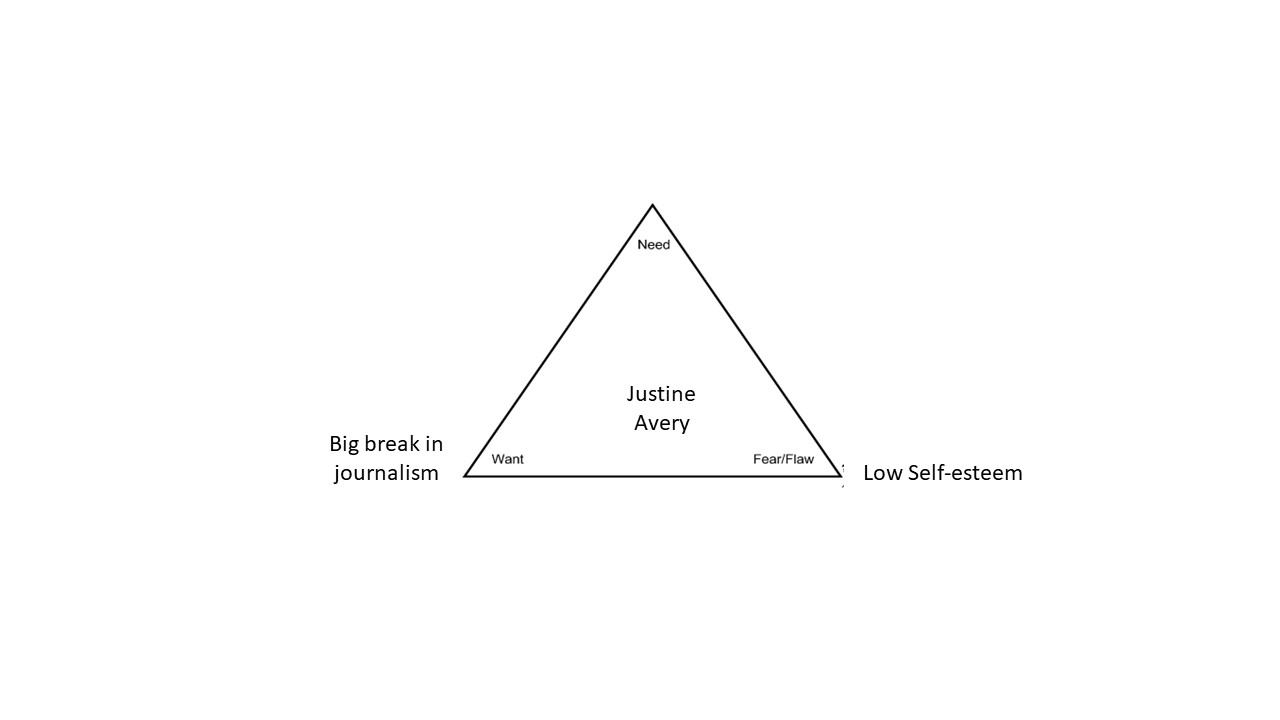
My protagonist, Justine Avery is a young journalism student who goes to stay at a purported haunted house on a dare.
This was my origianl introduction for the protagonist: JUSTINE AVERY – 24, naive, fresh out of college with a degree in video/cinematography, she thinks the chance to work on Kaylee’s documentary might be her big break (want), so she wants this gig more than anything, bad enough to take it even though she’s scared to death of what might happen (fear). She needs to keep her integrity, so she can look at herself in the mirror every morning.
Now here’s the rewrite I did to try and deepen Justine’s character: JUSTINE AVERY – 24, naive, fresh out of college with a degree in video/cinematography, she thinks the chance to work on Kaylee’s documentary could lead to her big break into the business (want), so she wants this gig more than anything, bad enough to take it even though she’s scared of blowing it (fear), because of her low self-esteem and an inability to believe in herself and her abilities (flaw). She needs to learn to believe in herself and have confidence in her talent and skill.
I think this version is a little better. I changed her fear and I gave her a fatal flaw which could be her downfall unless she can triumph over it. (And the fear is directly connected with her flaw, which ties in with my theme: Self-Reliance. This offers her the potential for the needed transformation in the scene where her boyfriend, Mitch, forbids her to go on the gig and she chooses to walk away.)
It shouldn’t take much to also work in the details of her added backstory, which isn’t in my original bio for her: Raised by controlling, overbearing parents, she learned early in life that it is easier to go with the flow than to risk tipping the boat over with resistance. Currently in a relationship with Mitch, an overbearing, controlling guy who managed to turn their first overnight date into his moving in party so smoothly, Justine still isn’t sure how it happened. Mitch is verbally and emotionally abusive to her, but he derides her so much, she has come to believe the things he says about her and she harbors huge doubts about her own self-worth.
Justine is beginning to seem more like a character with some depth and we can get some idea of what motivates her actions. Allowing her a flaw of low self-esteem not only turned her into an imperfect human, but it offers her the choice of staying in a stagnant relationship and continuing to employ behaviors which are no longer effective, or transforming into the self-reliant woman hinted at in that early scene with Mitch. It is much clearer now what her arc will be, and it’s all tied in with the theme.
The character triangle which I use represents this transformation loosely, depicting the character’s want and need, which are not the same, although the character may believe that they are, and their fear or flaw, which is an obstacle to be overcome in order to achieve the character’s want. The want is the concious desire that motivates the character, while the need may not be so obvious, because their need is subconcious and the character may not realize that their need exists. The need is what the character ends up with, and is often in opposition to what the character desires.
Shadow Theory
Another method that seems to work well in creating in-depth or complex characters is the shadow theory of character building, which is the idea which delves into the hidden or repressed aspects of a character, and these traits usually play a part in the character tranformation which must occur for the character to complete their arc. I’ve been experimenting with incorporating this method into my own character developemnet.
This theory claims that traits that are apparent on the outside, have an exact opposite trait residing on a subconcious level, and the two opposites may be in conflict-kind of like the two little guys sitting on the character’s shoulders, telling him what to do. This type of depth is often revealed through subtext, because the dialog is what the character says, but it may conflict with what they are actually thinking.
K.M. Weiland explains it this way – “I call this trick shadow theory, and it’s simply this: whatever is visible in a person’s external personality is an indication that the exact opposite resides in the shadow.” You can learn more about the shadow theory, which stems from the theories of human behaviors developed by Carl Jung and how to use shadow theory to create deeper and more complex characters here: “How to Create Insanely Complex Characters Using “Shadow Theory”“
Both of these methods can be used to delve into your characters and give them depth and complexity. I have used just the character triangle to shape my characters
In next month’s segment of “Writer’s Corner”, we’ll talk about the visceral portrayal of your characters , which will cover the Matips we didn’t hit on here, so be sure to drop by.
For Kaye Lynne Booth, writing is a passion. Kaye Lynne is an author with published short fiction and poetry, both online and in print, including her short story collection, Last Call and Other Short Fiction; and her paranormal mystery novella, Hidden Secrets; and book 1 of her Women in the West adventure series, Delilah. Kaye holds a dual M.F.A. degree in Creative Writing with emphasis in genre fiction and screenwriting, and an M.A. in publishing. Kaye Lynne is the founder of WordCrafter Quality Writing & Author Services and WordCrafter Press. She also maintains an authors’ blog and website, Writing to be Read, where she publishes content of interest in the literary world.
Want exclusive content? Join Kaye Lynne Booth & WordCrafter Press Readers’ Group for WordCrafter Press book & event news, including the awesome releases of author Kaye Lynne Booth. She won’t flood your inbox, she NEVER sells her list, and you might get a freebie occasionally. Get a free digital copy of her short story collection, Last Call and Other Short Fiction, just for joining.
We are well into the swing of the Kickstarter for Delilah and the Women in the West adventure series. One thing that stands out with the books in this series are its strong female protagonists and female historical characters which make appearances in each one. But it takes finesse to create a tough female character that is believeable.
So how do you write a strong character? According to the Six Figure Author Podcast’s (episode 108 “Are Your Craft Choices Hurting Your Booksales?”) Jo Lollo strong characters are well defined, but not necessarily one who can win a fight, but they must be an imposing and vital character to the story. Andrea Pearson adds that strong characters should have inner strangths, which can become weaknesses in certain situations. Lindsay Buroker says that they need to be believeable, especially with female characters.
I’m as big a supporter of women and women’s rights, etc… as the next guy or gal, but let’s be realistic. Readers are not going to believe that an average woman isn’t going to beat a man in hand to hand combat, because females are naturally smaller and have less physical strength than men do. That’s not realistic. Don’t make your female character go to walk into a biker bar and kick everybody’s butt unless you’ve given her superpowers, or magic, or some reason, like being a Karate expert or an Amazon warrior, that she can do such incredible things. And of course, your characters need to be flawed so they have room to change and grow by the end of the story.
I gave Delilah a background which explains why she is so tough and gritty, after growing up with abuse and surviving two years in the territorial prison, readers know she doesn’t take things lying down, so it comes as no surprise when she sets out after the two men who raped her and left her for dead, and abducted her 14 yeaar old ward, Sarah. In the first chapter, she is practicing with a handgun, because she knows this is a weakness which needs to be turned into a strenghth for her to survive. So when, later in the book, she makes an amazing shot, we know she earned that ability through hard work and practice.
The other women in the series, Sarah and Marta, are introduced in the first book, but they too are flawed in ways which allow them room to grow stronger. Sarah is fourteen when she is abducted, but by the time her story is through she will become a strong woman who readers will root for. Marta is a mild mannered Mormon woman, travelling across the Colorado frontier when her family is killed and she is taken in an Indian raid – all experiences which will change her life and make her stronger for when she is the protagonist of her own book.
The protagonist in the book I’m working on now, The Rockstar and the Outlaw is also a female with strong inner strength and many flaws. She is a singer, a rock star, with an addictive personality, which includes adrenaline as well as drugs, who finds herself in a situation which she knows she can’t win. Amaryllis escapes with the help of a time-traveling outlaw from the old west, but finds that trouble awaits her, no matter where or when she goes, and when the tables are turned the outalw can depend on the rock star to have his back. She also has a backstory, living a life od drugs, sex, and rock ‘n roll, which makes her strengths and weaknesses both realstic and believable. Her inner strengths allow her to save herself and do what is needed when called upon, in a fashion that readers can buy into.
So, you see, a character’s flaws can be used as building blocks to make the character’s actions believable, or you can give them a backstory which validates their strengths, in order to make their daring feats more believable. It is the inner strengths we are referring to when we talk about strong characters, although characters may need to be physically strong to back up their inner strengths. But you do have to take care that the strengths that you give them are realistic and believable. Of course, if you’re writing fantasy, giving her superpowers or magic might be believable. But if your protgonist is an ordinary woman, you shouldn’t give her extrordinary abilities. Readers are smart. They won’t buy it.
For Kaye Lynne Booth, writing is a passion. Kaye Lynne is an author with published short fiction and poetry, both online and in print, including her short story collection, Last Call and Other Short Fiction; and her paranormal mystery novella, Hidden Secrets. Kaye holds a dual M.F.A. degree in Creative Writing with emphasis in genre fiction and screenwriting, and an M.A. in publishing. Kaye Lynne is the founder of WordCrafter Quality Writing & Author Services and WordCrafter Press. She also maintains an authors’ blog and website, Writing to be Read, where she publishes content of interest in the literary world.
Join Kaye Lynne Booth & WordCrafter Press Readers’ Group for WordCrafter Press book & event news, including the awesome releases of author Kaye Lynne Booth. Get a free digital copy of her short story collection, Last Call and Other Short Fiction, as a sampling of her works just for joining.
Welcome to Segment 4 of the “Ask the Authors 2022” blog series, where we’re offering up a little taste of what you’ll find in this hot new writing reference of the same name. Ask the Authors 2022 features writing tips and advice on craft, publishing, and book marketing from ten talented authors and industry experts.
In case you missed some of the previous segments:
Segment 1: Introductions for Kaye Lynne Booth & Kevin Killiany – Writing Life Q & A session
Segment 2: Introduction for Bobby Nash – Pre-writing Rituals Q & A session
Segment 3: Introduction for Roberta Eaton Cheadle – Plot/Storyline Q & A session
This week we meet bestselling horror author Paul Kane, who shares his love of the horror genre in his essay, “Writing Monsters”, and bring you a Q & A session on character development.
Meet Paul Kane
Paul Kane is the award-winning, bestselling author and editor of over a hundred books, both fiction and nonfiction. Some consider him to be a master of the macabe. He has been a guest at numerous writing events and conferences, and he was the keynote speaker at the 2021 WordCrafter New Beginnings Virtual Writing Conference.
A former British Fantasy Society Special Publications Editor, he is currently serving as co-chair for the UK chapter of The Horror Writers Association. His work has been optioned and adapted for the big and small screen. His audio work includes full cast drama adaptations, he has also contributed to the Warhammer 40k universe for Games Workshop and writes thrillers for HQ/HarperCollins as PL Kane. Paul lives in Derbyshire, UK, with his wife Marie O’Regan and his family.
Find out more at his site www.shadow-writer.co.uk which has featured Guest Writers such as Stephen King, Neil Gaiman, Charlaine Harris, Robert Kirkman, Dean Koontz and Guillermo del Toro.
And now, on to the Q & A.
Character Development
Nancy Oswald: This whole section was hard for me because I’ve never been good at planning a character. Lists aren’t helpful to me. What is helpful is to put your main character into the middle of their world and write from there. I usually have an ending or a direction in mind before I start writing, but there have been times when the character determines the story and not the other way around.
Do your characters ever surprise you?
Mario Acevedo: I never thought I’d be a writer who said that my characters have taken over the story, but it has happened. Big surprise, it was female characters. I’d have in mind a script for them, which they would rip to pieces and tear off on their own.
Paul Kane: Oh, all the time! If you’ve made them ‘real’ then they’ll suddenly do something that you don’t expect. That is to say, it’ll momentarily surprise you and then you’ll say: ah, of course that’s how they’d react because of… whatever it is you’ve seeded in their past. It’s really your subconscious putting things like that in, things you’ve set up and forgotten about, then when a character does something unexpected it’s only that you’ve forgotten how apt it was in the first place.
Chris Barili: Yes, all the time. If a character is predictable to me, it will be the same to a reader. So, I let them surprise me in whatever way they seem to need. Those surprises don’t always make the story, though.
Bobby Nash: All the time and I love it. In one story, a character let me know that I had the villain wrong. This character was the villain, not the one I had planned to be the villain. The kicker is that the story worked so much better once I realized that this character was indeed the villain.
Robbie Cheadle: No, my characters follow a pre-determined path decided by me upfront.
Kevin Killiany: Not exactly. I’m the only person living in my head—my characters only look like they have free will. That being said, the longer you work with a project, the more time your subconscious has to compost or ferment or percolate the ideas you’re building with—and that can lead to unexpected discoveries that give texture and dimension to the character. Sometimes my characters evolve over the course of writing and rewriting to the point that they person they’ve become wouldn’t do what the story required. Usually that’s an indication there’s something wrong with the story, not the character.
What makes a character interesting?
Paul Kane: I think it goes back to believability once again, which most things do. They have to be well-rounded, living and breathing people. If I get it right, the characters feel real to me. When I talk about them and what they go through, I talk about them as if they exist. You have to think that way in order for other people to believe them and believe in them. A lot of that means knowing your characters inside out, how they’d react to certain situations – in particular the ones you put them in. Would your character run away from a monster or just get stuck in, have a go, even if it meant dying to save others? That kind of thing. A lot of writers think giving characters quirks makes them interesting, but if there’s no reason for that to be there it just stands out. If you give your character gardening as a hobby, unless he’s fighting a giant plant then it’s not really something that should crop up in your story. The character of Alex Webber in Before was a lecturer, so that meant he was interested in making sure the next generation were educated and could make well-informed decisions. So when the future of the world is threatened, of course he’s going to fight against that; it’s just something rooted in his DNA. Those are the kinds of things that make characters interesting, not whether they sleep on the left or the right in bed.
Chris Barili: They have to be flawed. No one wants to read about perfect people with perfect lives and no conflict whatsoever. It is our characters’ flaws that make them realistic, and that set up most of the conflict in the story. After that, it is the act of exaggerating the characters, making them larger than life. Again, no one wants to read about normal people with normal lives. They want heroes and villains who are large and in charge. Would Dirty Harry have worked if he were a normal cop carrying a .38 special? No, because being a six-foot-four rogue cop with a .44 magnum in gleaming silver makes him stand out.
Bobby Nash: I don’t know. Interesting is like art or porn, I can’t describe it, but I know it when I see it. I need to have something to connect to with a character. Once I have that connection, I understand the character.
Robbie Cheadle: My characters all must overcome a lot of adversity in their circumstances. I believe that the growth in the characters as they play the cards which they are dealt by life makes them interesting.
Jeff Bowles: I think I have an answer to that question: idiosyncrasies, idiosyncrasies, idiosyncrasies. The thing about real people is that we all have our strange little quirks that make us who we are. And these are behaviors and beliefs it’s taken us a whole lifetime to accrue. It pays to think of your characters as being a little odd under the surface. The problem with a lot of storytelling out there is that too many authors figure their characters exist to serve the story. They don’t, it’s the other way around completely. Let your characters speak for themselves. Let the breath a little, see where they really want to go next. Don’t push them into situations that don’t serve their full expression. Let them tell you who they really are.
How do you make a character likeable?
Paul Kane: Sometimes you don’t. Sometimes you shouldn’t. I get reviews sometimes that say ‘the characters weren’t very nice’, but then look at some of the things they’ve been through. My psychologist Dr Robyn Adams went through a trauma at the hands of a serial killer, so is addicted to pain killers and drinks too much, leaps straight in with guys too often – because of something else revealed towards the end of Her Husband’s Grave. But you know what, she’s doing the best she can. Her flaws make her human, like all of us, and they make the moments of bravery stand out all the more. I think if you’re always trying to make your characters likable, you’re missing the point of making them believable. Not everyone’s nice all the time, there are grey areas – and that’s totally where your characters should be operating.
Chris Barili: You don’t have to make them likeable, just relatable. Thomas Covenant in White Gold Wielder (Stephan R. Donaldson) is not a likeable character at first, just a relatable one. He almost loses that with a deplorable act early in the book, bit manages to make it through, at least for most readers. I do know some who could not handle it and left the series behind.
Bobby Nash: I start with a likeable person as their base and build the character up from there.
Kevin Killiany: I never consider likeability. I try to make my characters as real as possible—which means complex, with parts some folk will like and parts some folk can’t stand.
How do you make your characters feel real?
Chris Barili: What are their fears and flaws? Read my article, “Character Blueprints” (Ask the Authors 2022) for the tools I use to do this.
Bobby Nash: As I mentioned above, I get to know the characters. Once that happens, they become real people to me. They have their own quirks, foibles, fears, flaws, strengths, and weaknesses. Just like real people.
How do you create a villain readers can love to hate?
Mario Acevedo: Readers must have empathy with all of your characters and understand why they do what they do. Their motivations must be consistent and compelling. One of my best villains was a female mad scientist who at first you cheered until you found out what she was up to.
Paul Kane: I don’t think there’s any magic formula, but the key thing with villains is again that they aren’t just cardboard cutouts. They can’t just be evil for evil’s sake, there needs to be reasons for what they’re doing. My bad guy for the Hooded Man books, De Falaise – essentially my version of the Sheriff of Nottingham – was motivated by the fact that he’d been kept down before the A-B Virus hit. He was a small bad guy in a big pond. The apocalypse gave him the freedom to create a kingdom of his own, so that was his motivation – and Robert, my Robin Hood, stood in his way. You got the impression with some Hood stories in the past that they just hated each other because one was bad, and one was good. In my books, just as Robert has his failings as a leader – for starters, he doesn’t want to be a leader and would much rather hide out in Sherwood waiting to die – so too does De Falaise have his good points, like his loyalty to companions like Tanek, his second in command. I mean, he is evil when you get right down to it, because some of the things he does are reprehensible, but there still needs to be some good in there. Having said all that, the most fun I’ve had writing a bad guy was The Infinity in Before. He’s a version of the Devil, essentially, and likes to meddle in human history. Writing lines for him, simply because he was a stereotypical big bad, was wonderful. It allowed me to put myself in the head of someone who has very few redeeming qualities, if any at all.
Chris Barili: I find that a couple of things can pull a reader into a love-hate relationship. First, a sense of humor. Even if it’s macabre or inappropriate, the ability to make us laugh endears even a harsh villain to us. You can also give that villain a good side by having him or her save a puppy or show some other admirable trait. Intellect combined with arrogance are a nice set of offsetting traits. But most of all, make them flawed like the hero. If they are invincible and pure evil, no one will want to read their stories. Take The Governor on the AMC series The Walking Dead. We find out early on that this otherwise despicable villain lost his whole family to the walkers and thus has them all locked up in his home as he hopes for a cure.
Bobby Nash: Same way as with a likeable character. I get to know them and understand why they do what they do. No villain thinks of themselves as the villain. Most villains believe what they are doing is right or justified. Very rarely is anyone evil just for the sake of being evil. Let the readers see the multiple facets of your heroes and villains.
Robbie Cheadle: Characters that do sadistic and unkind things are easy to make readers dislike. However, my characters all have redeeming features so the reader will end up conflicted, even when the character is behaving at his/her worst.
Do you ever create characters based on people who you’ve actually known?
Paul Kane: I think by necessity characters are mish-mashes of people you’ve known and other characters from books, film or TV shows, plus bits of yourself sometimes. I’ve never based a character wholesale on someone, as that way lies being sued, but I include certain traits from people I’ve known or still know. I was brought up with a lot of strong women around me, so I write a lot of tales with strong female protagonists. RED, my horror reworking of Little Red Riding Hood, is an obvious example of that. Rachael Daniels is someone who fights the wolf rather than running away from it, isn’t frightened to go up against a challenge. Her love-life might be a car crash, but she’s someone you want around when there’s trouble for sure.
Chris Barili: I will plead the fifth on this question, and all writers should, whether they have done this or not. Admitting that you have sets you up for legal action by others.
Bobby Nash: Oh, sure. I have many characters where the basis is a real person that I then built on top of to create a new character.
Robbie Cheadle: Yes, some of my characters are modelled off people I know. Grandfather Baker in Through the Nethergate has a lot of my father’s personality and characteristics. Michelle Cleveland in A Ghost and His Gold has some of my personality and characteristics, but she is more forgiving and generous towards her partner than I would be in the same circumstances.
Some of my characters are model on several people I have come across in a similar situation. For example, Tom Cleveland in A Ghost and His Gold is based on a combination of men in senior positions I have worked with in my own life.
Kevin Killiany: Every character is a composite of people I’ve known. Let’s face it, the only way to research people is to hang out with them a while. I never drop a whole person into a story—it’ll be A’s speech pattern, B’s fascination with baseball, C’s gestures, etc. Of course, those are just the starting points. As I know my character better everything will change, evolve.
Do any of your characters share traits with you?
Paul Kane: You can’t help but put bits of yourself in stories. I’ve talked about Alex Webber from Before being a lecturer, which I was for a while at college, so I could write about him with a degree of confidence and make sure it was authentic. I’ve always been scared of the dark and nighttime, which comes across in a lot of my stories. The little boy at the beginning in Of Darkness and Light – recently reprinted in the collection Darkness and Shadows – is very much based on me as a kid. Staring out into the darkness at bedtime and imagining all kinds of things lurking inside. But I think the writing also helps with tackling your fears, and in that particular story I could make the ‘creature’ in the darkness someone who was actually watching over the character of Lee Masterton, someone who would protect him from harm. He just didn’t know it at the time.
Chris Barili: All of them, of course. We cannot create characters without at least a little dash of ourselves in them.
Bobby Nash: Absolutely. There’s a little something of me in all of them. Some, more than others.
Robbie Cheadle: As mentioned above, Michelle is similar to me in some ways, but very different in others. She is a better me.
Kevin Killiany: Never the main character. But if there’s a plucky sidekick who alternates puns with sardonic commentary, that’ll be me.
What methods do you use to introduce readers to your characters?
Mario Acevedo: One of the techniques that F Scott Fitzgerald used to masterful effect was that he introduced his major characters in terms of their personality rather than merely describing their looks. I keep that in mind as I write my stories.
Paul Kane: I think it helps to show them doing something that defines them, so perhaps through their job. Most detectives are introduced through a crime scene for instance, and then we learn how good they are and what it means to them to be a cop. I introduced my main character Mitch Prescott – who at the start of The Family Lie is a PC – via a riot scene. He’s tried to tell the powers that be that there will be trouble at a demonstration, but they’ve totally ignored him, and of course – surprise, surprise – a riot breaks out in which one of his closest friends is injured. It forces Mitch to question what he’s doing on the Force, which leads to his dismissal when he confronts a senior officer about what happened, which in turn makes it easier for him to just go off and investigate what occurred with his father’s death in his hometown of Green Acres. But just from this one chapter, you realise he’s a man of integrity, a man who’s loyal to his friends, and a man who doesn’t like it when people don’t listen to his warnings – so you set up conflict for later when he reaches Green Acres and he’s being blocked at every turn.
How do you motivate your characters?
Paul Kane: I think that’s the same thing as what motivates us as people. We look after our friends and family, because we love them, and are sometimes motivated to do things we might not otherwise do because they’re in trouble. What motivates characters is the same as what motivates people in real life, because, remember, we’re trying to make those characters real. So, the father of murder Jordan Radcliffe – Jake – is motivated to find out who the killer is, not only because he loved his daughter, but also because he feels like he failed her. Failed her in life as a father, so he doesn’t want to fail her now in death. That’s a powerful motivating factor for any character. In my short novel The Storm, out through PS Publishing, the main protagonist Keegan is all about keeping the woman that he loves safe, even if it means battling giant monsters to do so. Love’s a big motivation for anything, I find, just like in real life. So are things like revenge or jealousy, the usual big ones.
Chris Barili: They are self-motivated by the situation into which I drop them. Usually, it is the will to survive that motivates them, but it can also be love, hate, rage, longing, and more.
Bobby Nash: How do I stop them? I usually have trouble keeping up with them.
Robbie Cheadle: My ghostly characters are motivated by the chance of redemption and moving on from their existence as spirits.
My physical characters are motivated by compassion and empathy for others and a desire to assist the spirits achieve the redemption they seek.
What kind of adversaries and obstacles do you create for your characters and what purpose do they serve?
Paul Kane: It depends very much on what the story is. Creating adversaries tends to go very much hand-in-hand with creating heroes. Myself and my wife Marie O’Regan – a terrific writer herself – do a workshop on this subject, and that’s one of the key elements. The hero or heroes dictate the villain or villains. Both are probably striving for something but pulling in opposite directions. In Arcana our protagonists are just trying to get freedom for magic-users, whereas the M-Forcers are trying to stop them, hunt them down and either kill them or put them in prison. Both have aims, but they’re the exact opposite of each other. The obstacles they face are very much dependent on the story you’re telling. It could be a man vs nature tale, in which your heroes are just trying to stay alive, so the setting would dictate what happens there. If it’s a shark, then you need to be at sea, if it’s snow then you need to be in the Arctic or Ant-Arctic, or you set it at a time of year when it’s snowing… My short story ‘White Shadows’, for example, is about a girl battling living snow in the middle of winter.
Chris Barili: Since most of the opposition to my characters comes from the antagonist, I always try to think, as I close a scene, “what could the villain do that would completely thrown the main character for a loop?”
Bobby Nash: Stories would be boring if there was nothing for the main character to overcome. Whatever the obstacle is, a villain, a test not studied for, a traffic jam, or whatever, gives the character(s) something to overcome or solve. Hopefully, your character comes out stronger on the other side of the obstacle.
What methods do you use to introduce readers to your characters?
Bobby Nash: We meet the characters in story. I let different characters be out POV in different chapters so we can understand them.
How do you give each character a distinctive voice?
Paul Kane: I think that just comes down to their personality really, who they are and what they do. How they respond to things, whether it’s trouble or something nice, will dictate their voice. So it’s all to do with character creation, and that believability factor again. If they respond in an authentic way, that will give them their voice. If you’ve created a strong female character, for example, they’re not likely to take a man bossing them around lightly. Indeed, they might even knock them out, depending on whether they’re a violent sort or not, or whether the provocation was bad. It’s things like that which give your characters a distinctive voice.
Chris Barili: This seems to come naturally for me. And I think that come from listening. I did twenty years in the military and traveled all over the world. So, I have had the chance to listen to many different conversations in many different cultures, and all of that goes into giving a character their own voice.
Bobby Nash: Once I get to know the character, they tell me what their voice is and that’s what I write. It all comes down to creating a fully formed character.
How do you feel about killing off your darlings?
Mario Acevedo: I am ruthless. There’s a vacant lot in my neighborhood where I’ve left my darlings rotting in shallow graves.
Paul Kane: Do you mean editing, like killing off your words? Or killing off characters? I love editing, chopping bits and refining, making scenes better. That’s the part of writing I like most, apart from being finished and having written. Killing off characters you love is hard, but all part and parcel of being a good writer. If it serves the story, no matter how you feel about the character, then you need to just get on with it. I always knew that I’d kill off Jack in The Gemini Factor, even before I started, which was difficult because I really liked him. He became like a friend. It gave the ended weight though, gave it an impact that would not have been there if I hadn’t just bit the bullet.
Chris Barili: When it becomes necessary to the story, I have no problem doing so. Sometimes, they get in the way. Other times their story line needs its own story because it is taking over. Other times, the main character has learned to depend on them too much.
Bobby Nash: I do it all the time, so I guess I’m okay with it. Ha! Ha!
Robbie Cheadle: I was advised to kill off a few of my darlings in Through the Nethergate by my developmental editor. It was a little hard to let those scenes go but it was the right thing to do. Listening to good advice is the best thing a writer can do.
What methods do you use to evoke emotion in your readers?
Mario Acevedo: Writing fiction gives you the wonderful opportunity to present what characters are thinking or feeling, either through internalizations or visceral reactions. I use these inner experiences to ground the reader in what the character is feeling and what is important in the story.
Paul Kane: There are all sorts of ways to do that, from killing off people readers have grown to love – as mentioned before – to putting them through the wringer, or even having them fall in love. If you’ve done your job properly, a reader will feel the emotions characters are going through. So when a character hates or loves something, or someone, a reader will feel that too. I once wrote a story about two ghosts falling in love called ‘Kindred Spirits’. The girl ghost has only just died, so she doesn’t know what she is, and the guy ghost is trying to help her because he’s been dead for some time. Hopefully a reader feels the sadness at the start that he feels, being alone where nobody can see or touch him, then the joy at finding someone else he can talk to and touch, even hug. To be able to cover the range of emotions like that in a short space of time isn’t easy, but it’s incredibly rewarding when it works.
Bobby Nash: It’s all in the characters and setting the mood. The emotion comes out of the performance of the character.
Kevin Killiany: Honesty
Which of your own characters was the most fun for you to write? Why?
Paul Kane: I enjoyed writing the character of Nick Skinner in Lunar, because he’s just your average guy in a bizarre situation, having to think on his feet and react to all these weird things that are happening to him. That was fun. And The Infinity, the bad guy in Before, as I’ve said. It was fun to write someone so evil that he’s verging on pantomime level, but that’s just how he is. There’s a scene where someone tells him to stop stirring, and he replies with: ‘I f**king enjoy stirring!’ Because he does. That’s what he’s all about. It was fun creating and writing him, especially writing his lines. The criticism I got the most about that book was The Infinity wasn’t in it enough, so you know you’ve done something right at that point. I’m toying with bringing him back in a short story or two, because you could go back in time and show him at any point – he’s been there at all the major turning points in history. It might be fun to do that…
Chris Barili: I really enjoy writing Frank Butcher, and most of his posse members. They’re some of the most complete characters I have built, and each has their own voice, their own flaws, and their own motivations. And each has a weird past that helps flesh out their personality, so writing the is easy.
Bobby Nash: That’s like asking me to pick a favorite child or parent. They all have their fun moments for different reasons. I love writing Archer Snow, the surly, but funny grandfather in the Snow series. Tom Myers is also fun to write.
Robbie Cheadle: I have enjoyed all my characters. During the writing process they all become very real and important. Once the book is published, they are quickly replaced by different characters, which is why I haven’t attempted a sequel.
Kevin Killiany: Cadet Fatima Kielani. [I jotted her last name down several years ago when I was watching a news report on Syrian Kurds fighting ISIS—it was on the screen briefly. I assumed it was Kurdish (and have a major supporting character in Life on Dirt identify it as such) but I was wrong. I’ve since learned it’s most common in the United Arab Emirates (with about half as many in Jordan) and is also found in both Austria and Benin, but no one knows its origin.] [It is not the Hawai’ian girls’ name Keilani.] Fatima is a seventeen-year-old Spacer, first generation, born and raised on Tombaugh Station, who volunteers for an experimental program on Earth, even though (or perhaps because) she’s terrified of the place. My background is special education and mental health services, and I gave Fatima a condition that has fascinated me since before it had a name: Social Communication Disorder (Pragmatic Communication Disorder in the UK). In many ways it resembles the Autism Disorder Spectrum, but is in no way related. People with SCD are blind to social norms and nonverbal cues, and must work their way through everyday interactions. I also, because I am cruel and unusual, gave her a rare dissociative disorder: she has trouble recognizing, or feeling, her own emotions. I have attached an entry from Fatima’s journal to illustrate both how she sees the world and how she interacts with others.
Which of your antagonists is your favorite? Why?
Chris Barili: So far, it’s a tie between Annie’s ghost of a mother in Smothered, and John Wesley Hardin in the Hell’s Bucher-based short story “Witch’s Kiss.” The first because I got to make her up and have her interrupt an intimate scene between her daughter and a man. The second because I researched him thoroughly and felt like I knew him well enough to write a story where this very real gunfighter did some very fictional things, and I feel like I did so without compromising his character.
Bobby Nash: The Controller in Suicide Bomb was a lot of fun to write.
Robbie Cheadle: I enjoyed Lucifer in Through the Nethergate. He was a young, good looking man with an interesting plan to manipulate modern trends and technology to invoke a third world war. I also enjoyed the hell he created.
____________________________
That’s all for this week on the “Ask the Authors 2022” blog series . Thanks for joining us. Drop by next Saturday, when the “Ask the Authors 2022” blog series introduces award winning multi-genre author, Mario Acevedo and offers a Q & A on Action, Pacing & Dialog.
Ask the Authors 2022
Don’t forget to get your copy of Ask the Authors 2022 from your favorite book distributor at the special price of 3.99 for the duration of this blog series, through the Books2Read UBL: https://books2read.com/u/3LnK8e
______________________
Join Kaye Lynne Booth & WordCrafter Press Readers’ Group for WordCrafter Press book & event news, including the awesome releases of author Kaye Lynne Booth. Get a free digital copy of her short story collection, Last Call and Other Short Fiction, as a sampling of her works just for joining.