In Touch With Nature – Common Buzzard
Posted: February 24, 2026 Filed under: Animals, Bird Watching, Birds, In Touch With Nature, Nature, Photography, Poetry, Wildlife | Tags: African Wildlife, Animals, Common Buzzard, In Touch With Nature, Nature, Robbie Cheadle, Writing to be Read 54 Comments
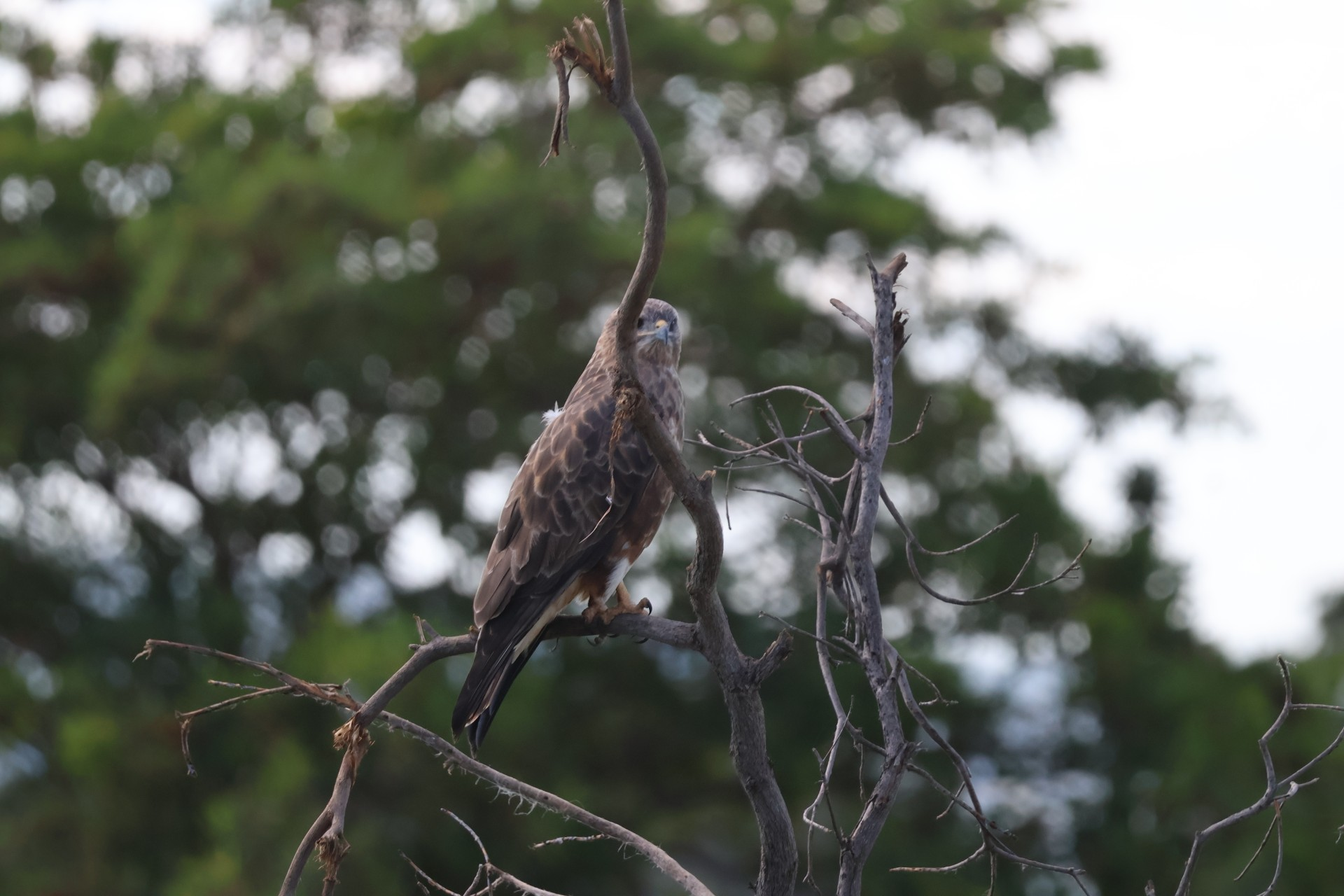
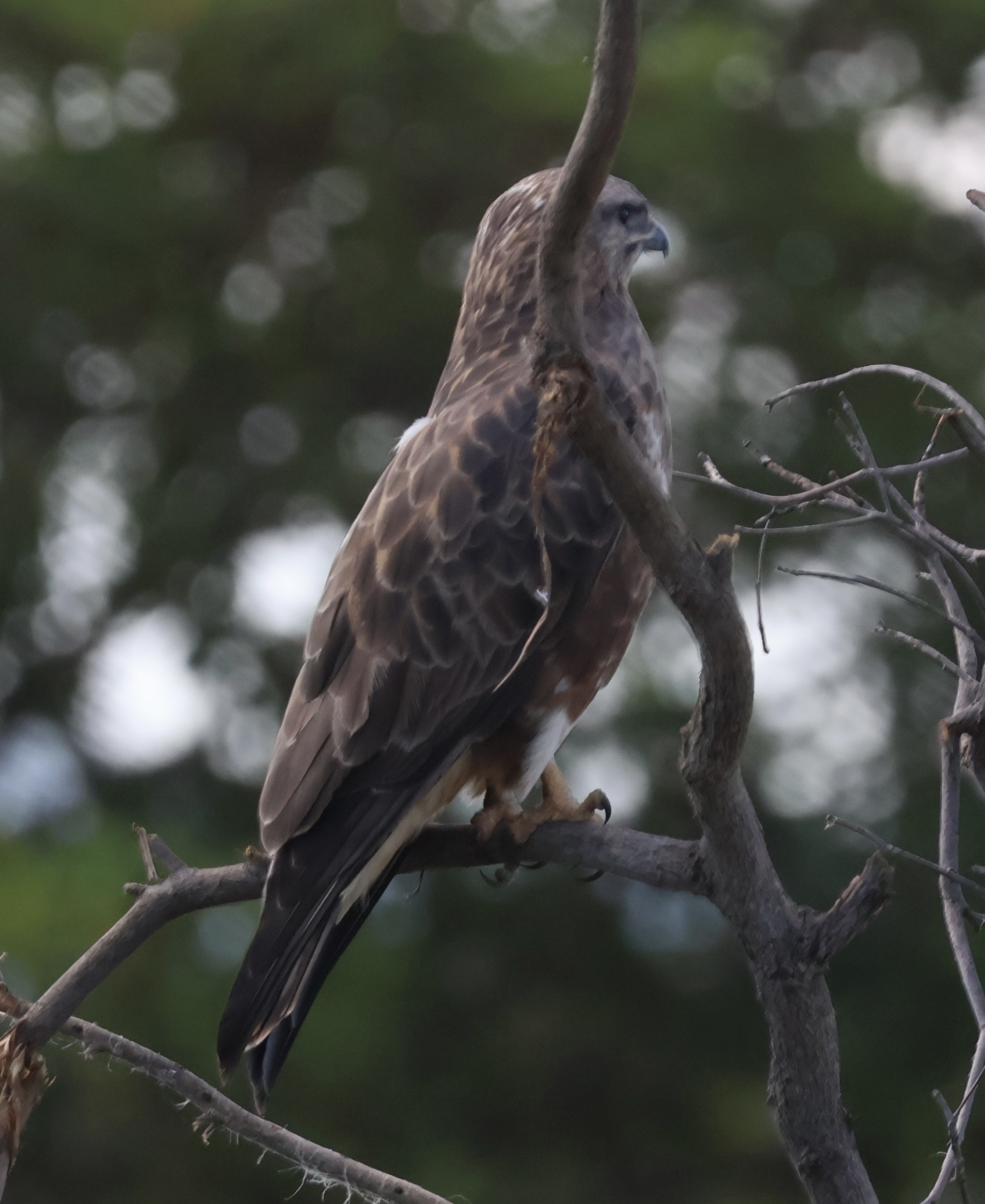
Nothing common about this buzzard
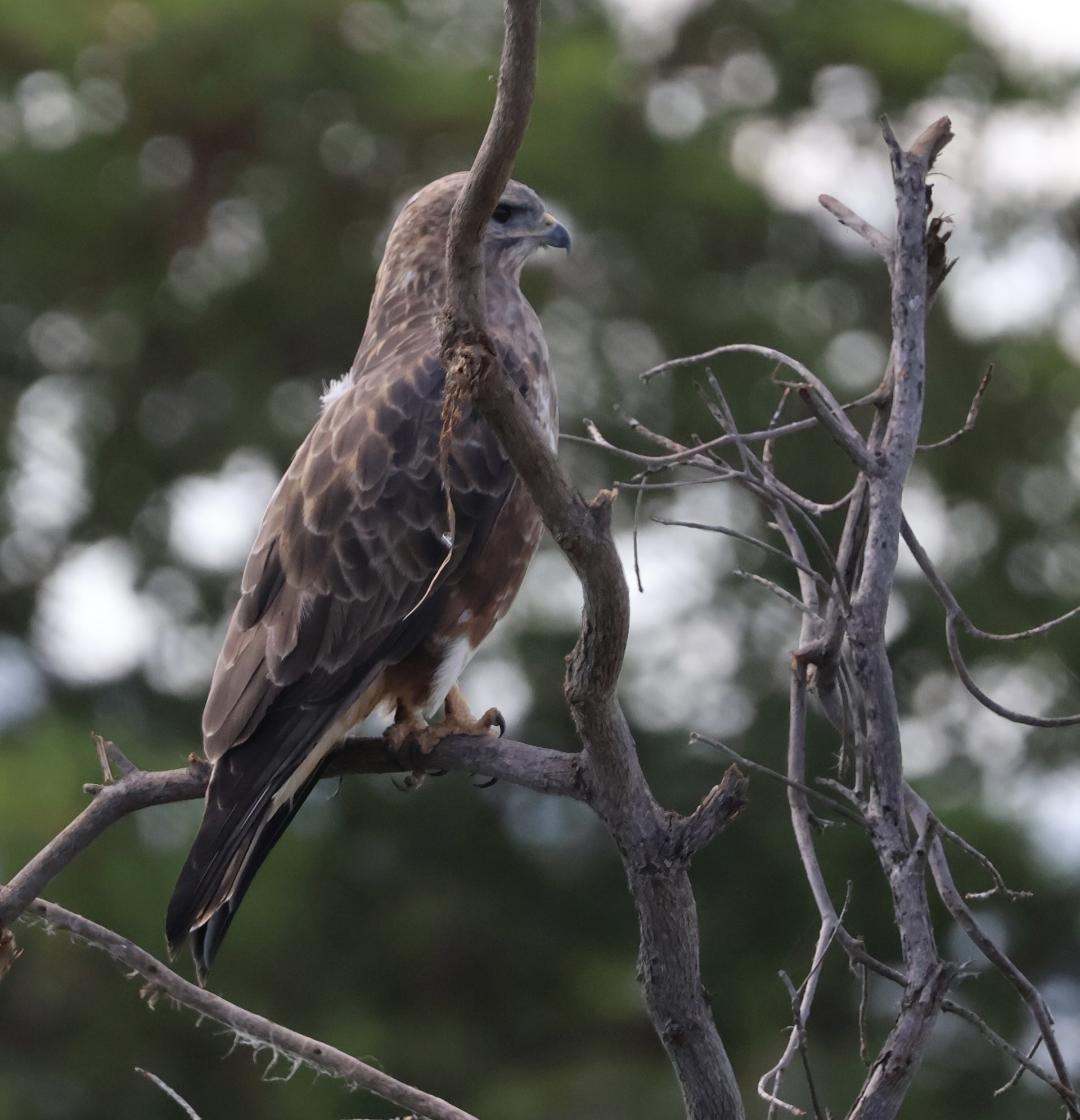
What a thrill to see you perched atop a tree
scanning the area; you have exceptional vision
head rotating, your eyes pass lightly over me
irrelevant in the context of your meal decision
I watch you staring at the mound filled earth
seeking signs of movement, either mouse or mole
your wings gracefully spreading once prey is found
the effort rewarded; of rodents there is no dearth
their silhouettes outlined as they emerge from a hole
in stealthy pursuit you soar gracefully to the ground
seizing your unsuspecting prey with grasping talons
tearing it apart with your sharp, hooked beak
one creature must die in order for another to live
one of nature’s most effective mammal assassins
your quarry succumbs without so much as a squeak
you, the victorious combatant, your prey unresistive
***
Tourist bird, I enjoy your annual visits to these shores
in migrating flocks of up to twenty of your comrades
gliding effortlessly over large expanses without pause
with a predetermined flightpath, you aren’t nomads
though your arrival may be met with strong resistance
from smaller birds who view you as a potential threat
mobbing you repeatedly until you relent and fly away
not much of a welcome after covering such distance
your feathery bulk the cause of much upset
an illusion to disguise how little you really weigh
a monogamous creature, you usually mate for life
your partner smaller, and suited to hunting prey
while for three weeks your chicks you brood
working as a team, you experience little strife
knowing he’ll deliver small morsels without delay
until they fledge and you join the search for food
About Roberta Eaton Cheadle

Roberta Eaton Cheadle, is a South African writer and poet specialising in historical, paranormal, and horror novels and short stories. She is an avid reader in these genres and her writing has been influenced by famous authors including Bram Stoker, Edgar Allan Poe, Amor Towles, Stephen Crane, Enrich Maria Remarque, George Orwell, Stephen King, and Colleen McCullough.
Roberta has two published novels and a collection of short stories and has horror, paranormal, and fantasy short stories included in several anthologies. She is also a contributor to the Ask the Authors 2022 (WordCrafter Writing Reference series).
Roberta is also the author and illustrator of seventeen children’s books, illustrator to a further three children’s books, and the author and illustrator of four poetry books published under the name of Robbie Cheadle, and has poems and short stories featured in several anthologies under this name.
Roberta’s blog features discussions about classic books, book reviews, poetry, and photography. https://roberta-writes.com/.
Find Roberta Eaton Cheadle
Blog: https://wordpress.com/view/robertawrites235681907.wordpress.com
Bluesky: https://bsky.app/profile/robbiecheadle.bsky.social
Facebook: https://www.facebook.com/robertawrites
Amazon: https://www.amazon.com/Roberta-Eaton-Cheadle/e/B08RSNJQZ5
___________________________________________
Like this post? Are you a fan of this blog series? Did you know you can sponsor your favorite blog series or even a single post with an advertisement for your book? Stop by the WtbR Sponsor Page and let me advertise your book, or you can make a donation to Writing to be Read for as little as a cup of coffee, If you’d like to show your support for this author and WordCrafter Press.
__________________________________________
This segment of “In Touch with Nature” is sponsored by the Midnight Anthology Series and WordCrafter Press.

Midnight Roost: Weird and Creepy Stories: 20 authors bring your nightmares to life in 23 stories of ghosts, paranormal phenomenon and the horror from the dark crevasses of their minds. Stories of stalkers, both human and supernatural, possession and occult rituals, alien visitations of the strange kind, and ghostly tales that will give you goosebumps. These are the tales that will make you fear the dark. Read them at the Midnight Roost… if you dare. https://www.amazon.com/Midnight-Roost-Kaye-Lynne-Booth-ebook/dp/B0CL6FPLVJ
Midnight Garden: Where Dark Tales Grow: 17 authors bring you 21 magnificent dark tales. Stories of magic, monsters and mayhem. Tales of murder and madness which will make your skin crawl. These are the tales that explore your darkest fears. Read them in the Midnight Garden… if you dare. https://www.amazon.com/Midnight-Garden-Where-Tales-Anthology-ebook/dp/B0DJNDQJD3
Midnight Oil: Stories to Fuel Your Nightmares: 14 authors bring you 16 dark tales that explore your deepest fears. These are the stories which nightmares are made of. Tales of monsters, mayhem, and madness which will make you shiver in the dark. Read them while you burn the Midnight Oil… if you dare. https://books2read.com/Midnight-Oil
Share this:

WordCrafter News: March Release – “The Rock Star & The Outlaw 2: Double Visions” and the 2026 Read an Ebook Week
Posted: February 23, 2026 Filed under: Blog Tour, Book Release, Book Sales, Books, Fiction, Kickstarter, romance, Science Fiction, Smashwords, Time travel, WordCrafter Book Blog Tours, WordCrafter News, WordCrafter Press | Tags: 2026 Read an Ebook Week, Book Blog Tours, Book Release, Kaye Lynne Booth, Kickstarter, Kickstarter campaign, Smashwords Sale, The Rock Star & The Outlaw 2 Double Visions, Time Travel Adventure Series, WordCrafter News, WordCrafter Press, Writing to be Read 1 Comment
March Release
After many delays, the long-awaited release of The Rock Star & The Outlaw 2: Double Visions will finally arrive on March 24, 2026. I’m going all out to launch this book with both a Kickstarter and a blog tour, run simultaneously. It’s such a wild and fun story, I’m really hoping to see it do well. The Kickstarter campaign will run March 1 through 28 and the tour will run March 23-27.
About The Rock Star & The Outlaw 2: Double Visions
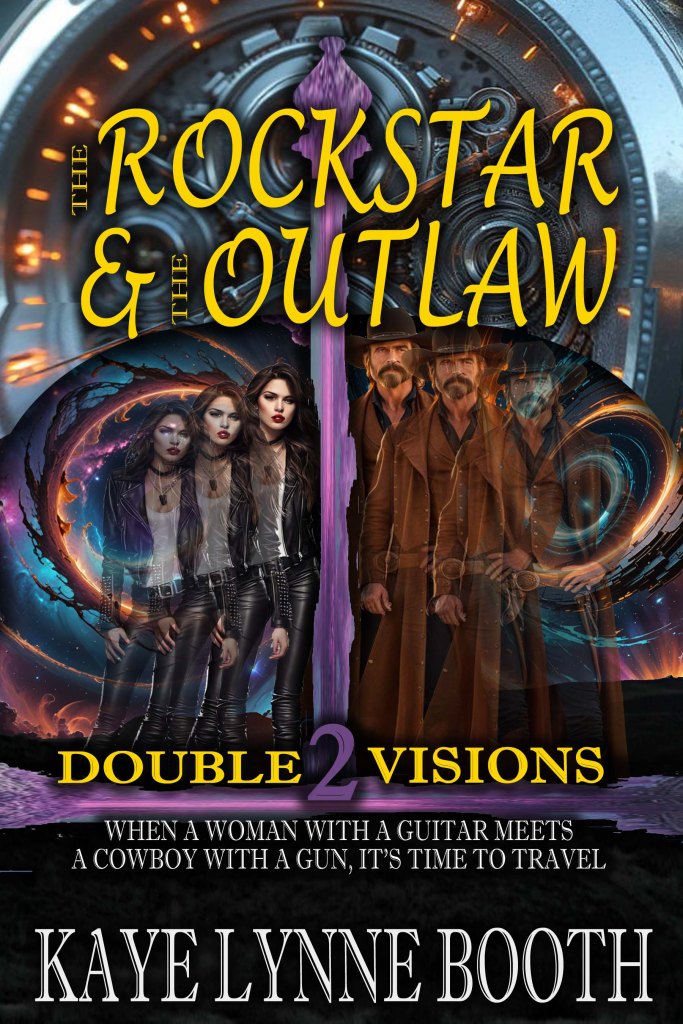
In 1887, LeRoy is stuck, bringing trouble down on those around him. Sissy is kidnapped and he’s the only one who can save her.
She wakes up in 2030, in a future very different to the one she knows, one in which she may not have been born. Amaryllis will stop at nothing to find LeRoy fix what she messed up in the past.
She and a version of Monique which is different from the one she grew up with travel back to 1887 to try and make things right.
Add two time travel regulators from the future who are after the time module, and things begin to get wild.
When the time loops are crossed, things change, but not the way Amaryllis intended and pretty soon, everybody is seeing doubles.
Purchase Link:
The Rock Star & The Outlaw 2: Double Visions Kickstarter Campaign
It’s almost here! The Kickstarter campaign for The Rock Star & The Outlaw 2: Double Visions starts Sunday, March 1. The campaign goal is $500 and we’ve got lots of rewards and several tier levels to choose from. Of course, you can get early digital copies and signed print copies of the second book in my Time Travel Adventure series at considerably less than offered through distributors when the book comes out on March 24th. Book 1 will also be available for less than retail as an add on, as well as several digital books from my catalog. But the really fun stuff is the Time Travel Adventure Series Poster and the Rock Star & The Outlaw Goodie Bag, offered at the highest tier level. But you don’t need to spend a lot to show your support, with the lowest tier level is only $5.00 and add ons are as low as $2 each.
Backing a Kickstarter campaign is a great way to show support for your favorite authors, because it’s similar to direct selling, cutting out retailers, and allowing the author to keep more of the profit from their book. You can back the Kickstarter by picking a reward tier and making a pledge. Only after the campaign funds, do you owe the money pledged, and if it doesn’t fund, you don’t owe a thing. And, if the campaign does fund, you’ll get all the cool items included in your reward tier, plus any add ons that you chose.
By clicking on the link below and indicating your interest, you will be notified as soon as the campaign goes live on March 1, so you can back the project at the reward level of your choice. Digital rewards will be fulfilled immediately after the Kickstarter campaign ends, and tangible rewards will be delivered by the end of May. Your support is appreciated. Together we can make The Rock Star & The Outlaw 2: Double Visions a huge success.
The WordCrafter Double Visions Book Blog Tour
The WordCrafter Double Visions Book Blog Tour will add the final send off for The Rock Star & The Outlaw 2: Double Visions at the end of the Kickstarter campaign, March 23-27. Meet my main p.o.v. characters and learn about the writing of the series in my guest posts, hear excerpt readings from the book, check out the reviews, and catch my review with DL Mullen on Undawnted. Of course, we’ll have a giveaway, three digital copies and one signed print copy.
Looking for Reviewers
I am looking for dependable reviewers to post reviews of The Rock Star & The Outlaw 2: Double Visions, (ideally, on the day of release to push the book up in the ratings). Reviews can be posted on Amazon, Goodreads, BookBub, and even on your own blog. If you send me a copy or a link before the blog tour starts, I can include them on the tour, as well. If you are interested, let me know in the comments and I’ll send you a digital copy for review.
2026 Read an Ebook Week on Smashwords

March 1 – 7 is the 2026 Read an Ebook Week on Smashwords. Select WordCrafter Press books will be discounted 25% – 75%, with many WP titles offered for free, only on the Smashwords Store. Below you’ll see a list of WP titles and their discounted prices. But, hurry! The sale lasts only one week. That’s one week to get these great WordCrafter Press titles at these great discounted rates.
- Behind Closed Doors: A Collection of Unusual Poems, by Robbie Cheadle – $2.99 (25%)
- Feral Tenderness: Poetry and Photography, by Arthur Rosch – $2.99 (25%)
- Shadow Blade, by Chris Barili – $5.54 (25%)
- Baiting the Hook, by Chris Barili – Free
- Hidden Secrets, by Kaye Lynne Booth – $1.99 (75%)
- Last Call and Other Short Fiction, by Kaye Lynne Booth – Free
- Small Wonders: Reflective Poems, by Kaye Lynne Booth – .99 (75%)
Women in the West Adventure Series, by Kaye Lynne Booth
- Delilah – $2.49 (50%)
- Sarah – $3.49 (50%)
Narrating the Paranormal Anthology Series
- Whispers of the Past – Free
- Spirits of the West – Free
- Where Spirits Linger – Free
- Lingering Spirit Whispers set – $3.49
Ask the Authors Writing Reference Series
- Ask the Authors – Free
- Ask the Authors 2022 – Free
Poetry Treasures Series
- Poetry Treasures – .99 (75%)
- Poetry Treasures 2: Relationships – .99 (75%)
- Poetry Treasures 3: Passions – $1.99 (50%)
- Poetry Treasures 4: In Touch with Nature – $1.99 (50%)
- Poetry Treasures 5: Small Pleasures – $2.99 (25%)
The Midnight Dark Fiction Anthology Series
- Midnight Roost: Weird and Creepy Tales – $1.74 (75%)
- Midnight Garden: Where Dark Tales Grow – $3.49 (50%)
- Midnight Oil: Stories to Fuel Your Nightmares – $5.24 (25%)
Themed Anthologies
- Curses: Chronicles of Darkness – $2.99 (25%)
- Tales From the Hanging Tree: Imprints of Tragedy – $2.99 (25%)
- Once Upon an Ever After – $2.99 (25% off)
- Visions – $3.74 (25% off)
- Refracted Reflections – $2.99 (25% off)
About Author Kaye Lynne Booth
For Kaye Lynne Booth, writing is a passion. Kaye Lynne is an author with published short fiction and poetry, both online and in print, including her short story collection, Last Call and Other Short Fiction; and her paranormal mystery novella, Hidden Secrets; Books 1 & 2 of her Women in the West adventure series, Delilah and Sarah, and book 1 in her Time-Travel Adventure series, The Rock Star & The Outlaw, as well as her poetry collection, Small Wonders and The D.I.Y. Author writing resource.
Kaye holds a dual M.F.A. degree in Creative Writing with emphasis in genre fiction and screenwriting, and an M.A. in publishing. Kaye Lynne is the founder of WordCrafter Quality Writing & Author Services and WordCrafter Press, where she edits and publishes two short fiction anthologies and one poetry anthology every year amidst her many writing projects. She also maintains an authors’ blog and website, Writing to be Read, where she publishes content of interest in the literary world.

______________________________
Did you know you can sponsor your favorite blog series or even a single post with an advertisement for your book? Stop by the WtbR Sponsor Page and let me advertise your book, or you can make a donation to Writing to be Read for as little as a cup of coffee, If you’d like to show your support for this author and WordCrafter Press.
________________________________
This post sponsored by WordCrafter Quality Writing & Author Services.
Whether it’s editing, publishing, or promotion that you need,WordCrafter Quality Writing & Author Services can help at a price you can afford.
Stop by and see what we have to offer today: https://writingtoberead.com/readings-for-writers/wordcrafter-quality-writing-author-services/
Share this:

A Birthday Wish in 2026
Posted: February 20, 2026 Filed under: Book Release, Books, Fiction, Kickstarter, Science Fiction, Time travel, WordCrafter Press | Tags: Kaye Lynne Booth, Kickstarter, My Birthday, The Rockstar & The Outlaw 2: Double Visions, Writing to be Read 6 CommentsMy birthday is March 3! And this year, I have a birthday wish that you can help to fulfill.
After two long years of waiting, the second book in my Time Travel Adventure series, The Rock Star & The Outlaw 2: Double Visions is finally ready to release. I’m doing the launch for this one a little different and run the book blog tour simultaneously with a Kickstarter campaign. Buying through the Kickstarter is better, because you can get digital copies much cheaper than you can through retailers, or exclusive items, like signed print copies and merchandise that isn’t available anywhere else. And, when you buy through the Kickstarter, I get to keep more money from the sale than I do when they sell through retailers. My funding goal is $500, but I wouldn’t cry if we exceeded that by far.
I haven’t run a Kickstarter in a couple of years, so it feels good to get back in the saddle. It is wonderful to watch those pledges rise, and there is nothing like the feeling of success once your campaign funds.
So, that’s my birthday wish; to successfully fund The Rock Star & The Outlaw 2: Double Visions Kickstarter campaign. And while I doubt that it will fund in only two days, (it would be nice, but doubtful), if it funds before the end of the campaign, on March 28th, I will still consider my birthday wish fulfilled. You can help give me my birthday wish by clicking on the link below and indicating your interest. Once I have at least ten followers, my following will be shown publicly. All you are doing now is expressing interest. Then, you will be notified when the campaign launches on March 1, and you can show your support at the reward level of your choice.
You can back the project for as little as $5, and every little bit counts when the pledges are building. You don’t need to pay your pledge until after the campaign ends, and if it doesn’t fund, you owe nothing. But my wish is that the campaign funds and maybe even exceeds the goal, which is why I’m asking for your support.
Won’t you please help give this old gal the best birthday ever?
About The Rock Star & The Outlaw 2: Double Visions
If you read the first book, you may not need any coaxing to buy Book 2. But in case you haven’t, let me tell you a little about The Rock Star & The Outlaw 2: Double Visions. This is a ‘gotta have it’ time travel story; a truly wild and crazy ride.
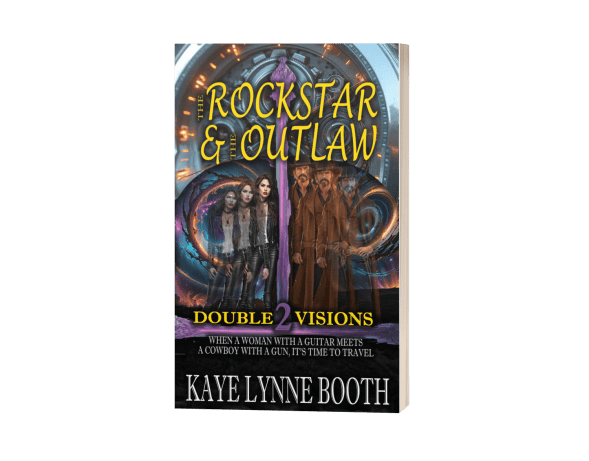
In 1887, LeRoy is stuck, bringing trouble down on those around him. Sissy is kidnapped and he’s the only one who can save her.
She wakes up in 2030, in a future very different to the one she knows, one in which she may not have been born. Amaryllis will stop at nothing to find LeRoy fix what she messed up in the past.
She and a version of Monique which is different from the one she grew up with travel back to 1887 to try and make things right.
Add two time travel regulators from the future who are after the time module, and things begin to get wild.
When the time loops are crossed, things change, but not the way Amaryllis intended and pretty soon, everybody is seeing doubles.
About Kaye Lynne Booth
For Kaye Lynne Booth, writing is a passion. Kaye Lynne is an author with published short fiction and poetry, both online and in print, including her short story collection, Last Call and Other Short Fiction; and her paranormal mystery novella, Hidden Secrets; Books 1 & 2 of her Women in the West adventure series, Delilah and Sarah, and Book 1 in her Time-Travel Adventure series, The Rock Star & The Outlaw, as well as her poetry collection, Small Wonders.
Kaye holds a dual M.F.A. degree in Creative Writing with emphasis in genre fiction and screenwriting, and an M.A. in publishing. Kaye Lynne is the founder of WordCrafter Quality Writing & Author Services and WordCrafter Press, where she edits and publishes two short fiction anthologies and one poetry anthology every year amidst her many writing projects. She also maintains an authors’ blog and website, Writing to be Read, where she publishes content of interest in the literary world.
___________________________________________
Did you know you can sponsor your favorite blog series or even a single post with an advertisement for your book? Stop by the WtbR Sponsor Page and let me advertise your book, or you can make a donation to Writing to be Read for as little as a cup of coffee, If you’d like to show your support for this author and WordCrafter Press.
_________________________________________
This post is sponsored by the Time Travel Adventure Series and WordCrafter Press.
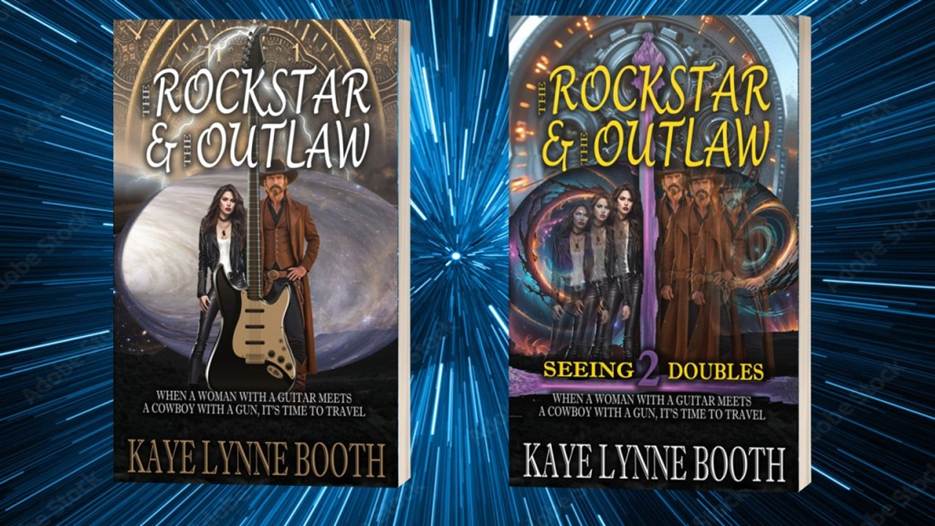
When a Woman with a Guitar Meets a Cowboy with a Gun, It’s Time to Travel
The Rock Star & The Outlaw: https://www.amazon.com/Rock-Star-Outlaw-Time-Travel-Adventure-ebook/dp/B0CJBRRCN1/
The Rock Star & The Outlaw 2: Seeing Doubles: Coming in March 2026
Share this:

Treasuring Poetry – Meet poet and author, Laura Lyndhurst, and a review
Posted: February 18, 2026 Filed under: Book Review, Books, Collection, Interview, Poetry, Review, Treasuring Poetry | Tags: #RobbieCheadle, #TreasuringPoetry, Book Review, Interview, Laura Lyndhurst, Poetry, Robbie Cheadle, Social Climbing and Other Poems, Treasuring Poetry, Writing to be Read 31 Comments
Hi everyone, today I’m thrilled to introduce you to Laura Lyndhurst. Laura is an accomplished author and poet and is also a new member of Story Empire blog which is a great resource for writers. You can read Laura’s first Story Empire post here: https://storyempire.com/2026/02/10/sowing-the-seeds-of-a-story/
Welcome Laura!
Tell us a bit about yourself and your poetry journey. How did you come to be a poet?
I never intended to write poetry. At school it was my least-favourite of the three prose-poetry-drama disciplines, and I didn’t like many of the poems that we studied. It was the same at university, when I finally got there in my forties. I was obliged to study Romanticism for my first-year core module, and I hated it. Wordsworth, Coleridge, Shelly; I wasn’t keen on them, although I was okay with some of Keats’s work. In the second year I couldn’t help but study more poetry, and I didn’t mind John Donne at all.
As to my own work, it was when I joined a Facebook writing group that it started. The group leader decided to post a picture every day for the month of October, inviting the group members to write a few paragraphs of prose around them. I sat with the first picture, thought, wrote—and what came out was poetry. The leader and members liked it, and thereafter I challenged myself to write poem every day from the picture prompt. At the end of the months I decided to publish them in a book, to claim copyright on them as much as anything. I called it October Poems, after the month in which I wrote them, and three more little collections followed in the next year or two.
What is your favourite poem by another poet and why?
That’s difficult. I like poetry more now than I used to, and there are several poets whose work appeals. I tend to listen to Leonard Cohen’s songs more than I read his poems, but he does have a way with lyrics; I mean, ‘the place is dead as Heaven on a Saturday night’ is so great. Hardy’s ‘The Darkling Thrush’ is up there, along with ‘This Be The Verse’ by Phillip Larkin. ‘Pity me not because the light of day’ by Edna St. Vincent Millay and ‘Rubbish at Adultery’ by Sophie Hannah attract, from the serious and the not-so as well. Choice for today, however, has to be ‘Refugee Blues’ by W.H. Auden. It never gets old, unfortunately, and although it’s written around one specific ethnic refugee group it can be applied to the myriad groups in existence before and since it was written; and now, in the 2020s, it feels massively relevant. You can find it here: https://allpoetry.com/refugee-blues
What is your favourite style of poetry and why?
Another difficult question. I don’t have a favourite style as such. I’ll read many different poems, some I’ll like and some I won’t, but the style of writing doesn’t have much bearing on why I like them or not. I do have an author friend, Thomas Leverett, who writes extensively in haiku form, and I loved his E Pluribus Haiku, which feels like travelling around the USA in haiku form. It’s on the link below, if you’re interested.https://www.amazon.com/Pluribus-Haiku-Anthology-3487-ebook/dp/B08X2YRQB2
Which is your favourite of your own poems?
I love them all, some more than others, it has to be admitted. I’ll choose the last one I wrote, however, because it is the last one and about ‘the end’. It’s from Social Climbing and Other Poems, and inspired by Clive Thompson’s photo of the altar of a Greek Orthodox Church.

Due Process
Your case has been a lengthy one; eighty-four years it’s taken, to
observe your less-than-perfect deeds and gather evidence to
aid the prosecution. But now you’ll have your day in court and
the jury gathered here, the Twelve, will finally decide, for or
against, whether you stay righteous here or whether you go down.
You wish to conduct your own defence? No, really, that won’t do, you’ll
be given representation. One of these saintly suits here gathered,
yes, that’s right, the ones with haloed wigs, will intercede for you.
Sorry for the delay; we understand that it’s a real nerve-wracking time for
you, but we can’t begin until His Honour gets here to take His place there,
in the big chair. The witnesses are here for you, plus jury, twelve good men
and true, not to forget the female sex, the immaculate, to try to push
your sins aside and hide you ‘neath their garments of compassion.
But nothing can occur until the God-Father is here; He’s judge
and jury all in one, Divine Justice in person. So please don’t fret,
or maybe do, for He knows you as well as you, and maybe better.
This whole set-up is just for show, to satisfy the need to see the
wheels of justice set in motion; your sentence fixed already,
your judgement day is here.
And here Our Father approaches now.
The court will rise …
Tell us a bit about your book, Social Climbing and other poems – what is the inspiration for the collection?
At the time I was friends with a photographer, Clive Thompson, and one of his pictures inspired a poem – ‘So This is Christmas’, which I recently published on my blog. Clive then allowed me to put together a book of my poems written to the prompts of some of his pictures.
What’s next for Laura Lyndhurst in the world of writing?
No more poetry, I’m afraid; nothing planned, at any rate, but if something occurs then I’ll be putting it together. At present I’m editing my latest novel, a whodunnit of sorts; a new departure for me, sort-of, because although I like adding a bit of a mystery to some of my stories this will be the first time I’ve brought the police in to investigate. It’s more focussed on before the murder, the personalities involved and their potential motivations. After that I’ll see what else occurs to me.
Many thanks for interviewing me. I’ve enjoyed it very much.
My review of SOCIAL CLIMBING: and Other Poems
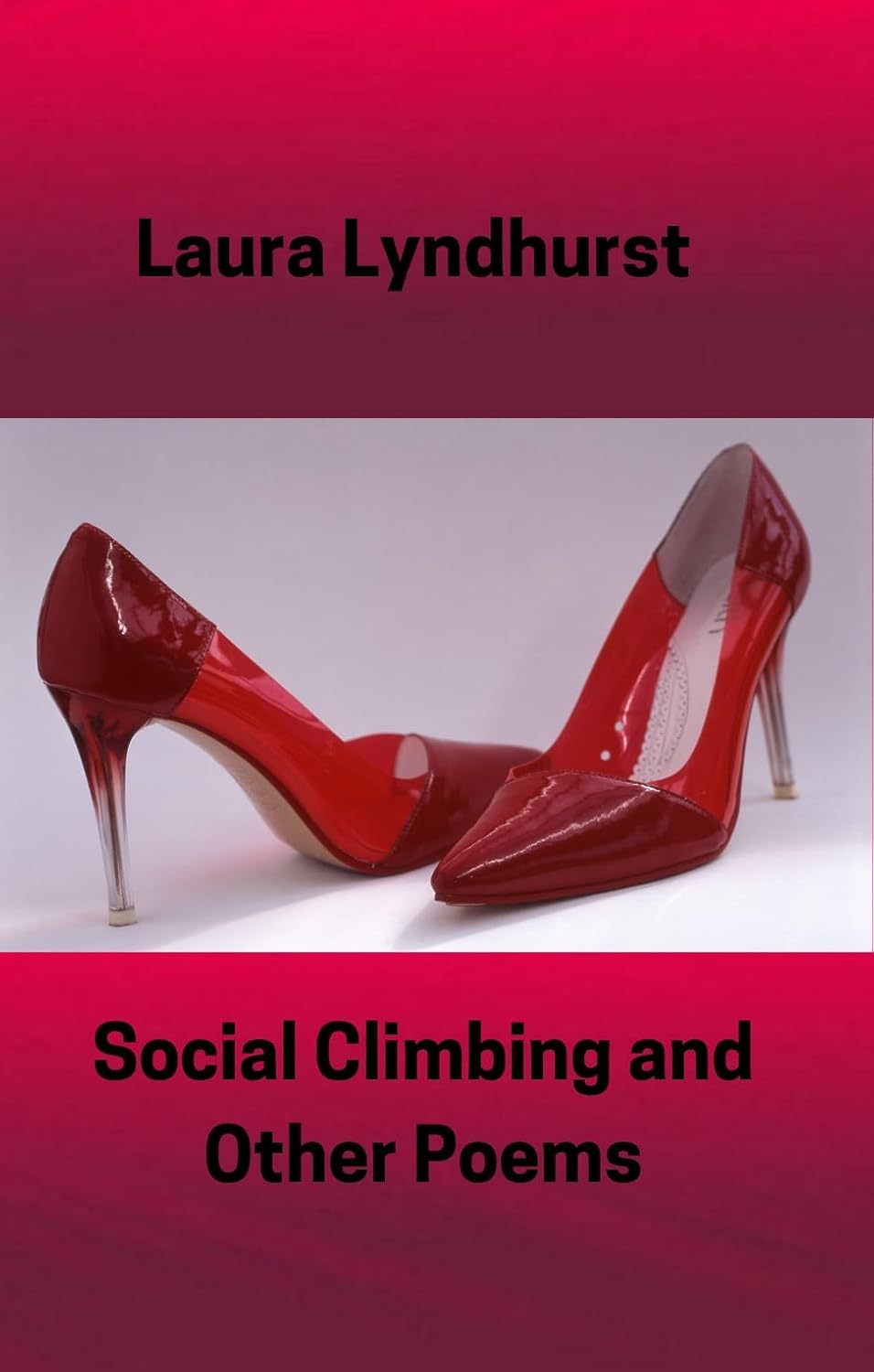
When I saw the cover of this collection, the shiny, red high heeled shoes against a white background, it reminded me of the movie, The Devil Wears Prada featuring Merril Streep and I was completely fascinated. I was not disappointed as this interesting collection of freestyle poems is a head on collision with an array of social situations, many of which are uncomfortable.
“The sit inside and watch the show, these Parisian fans of opera; but we,
lacking the means to buy the tickets for the red-plush, well-upholstered
seats and ornate murals, gilt-decked swirls and whirls of rococo decor,
prefer to take our entertainment in quite another way. Out here in the street”
from Street Theatre
Laura slices to the heart of human emotions and frustrations and these poetic expressions resonated with me. One poem I particularly delighted over is “I don’t know much about art but I know what I like”.
“So I’m breaking out of normalcy,
gone so very Modernisth,
this El Greco’s got his paintbox out
and given life a twist.”
Honestly, this poem made me laugh until I cried. Fantastic!
Each poem is introduced with a beautiful colour photograph by photographer, Clive Thompson.
Do yourself a favour, purchase this collection and allow Laura to put your life in perspective for you.
About Laura Lyndhurst
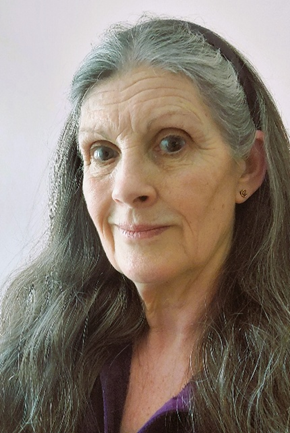
Laura Lyndhurst was born and grew up in North London, England, before marrying and travelling with her husband in the course of his career.
When settled back in the UK she became a mature student and gained Bachelor’s and Master’s degrees in English and Literature before training and working as a teacher.
She started writing in the last few years in the peace and quiet of rural Lincolnshire, and published her debut novel, Fairytales Don’t Come True, in May 2020. This book forms the first of a trilogy, Criminal Conversation, of which the second is Degenerate, Regenerate and All That We Are Heir To the third. Innocent, Guilty, the first of another trilogy, continues the story told in these three books and leads on to The Future of Our House, which is followed by Uphill, Downhill, Over, Out as the sixth and final book to end the series. An Honourable Institution was published as a stand-alone novel in January 2025, as was The Guilty Party in September 2025.
Laura also developed a taste for psychological suspense, which led to the writing and publication of You Know What You Did, to which What Else Did You Do? is the sequel.
Laura has also published four small books of poems, October Poems, Thanksgiving Poems and Prose Pieces, Poet-Pourri and Social Climbing and Other Poems.
Find Laura Lyndhurst
Website: https://booksthatmakeyouthink2.co.uk/
Facebook: https://www.facebook.com/laura.lyndhurst (personal profile)
Facebook: https://www.facebook.com/lauralyndhurstauthor/ (author profile)
Amazon: https://www.amazon.co.uk/stores/Laura-Lyndhurst/author/B088QFJJ3Q
Goodreads: https://www.goodreads.com/author/show/20336562.Laura_Lyndhurst
Instagram: https://www.instagram.com/lyndhurstlauraauthor/
Pinterest: https://uk.pinterest.com/lyndhurstlaura/
Tiktok: https://www.tiktok.com/@alectrona47
About Robbie Cheadle

South African author and illustrator, Robbie Cheadle, has written and illustrated sixteen children’s books, illustrated a further three children’s books, and written and illustrated three poetry books. Her work has also appeared in poetry and short story anthologies.
Robbie also has two novels and a collection of short stories published under the name of Roberta Eaton Cheadle and has horror, paranormal, and fantasy short stories featured in several anthologies under this name.
You can find Robbie Cheadle’s artwork, fondant and cake artwork, and all her books on her website here: https://www.robbiecheadle.co.za/
________________________
Did you know you can sponsor your favorite blog series or even a single post with an advertisement for your book? Stop by the WtbR Sponsor Page and let me advertise your book, or you can make a donation to Writing to be Read for as little as a cup of coffee, If you’d like to show your support for this author and WordCrafter Press.
__________________________
This segment of “Treasuring Poetry” is sponsored by WordCrafter Press and the Poetry Treasures series.
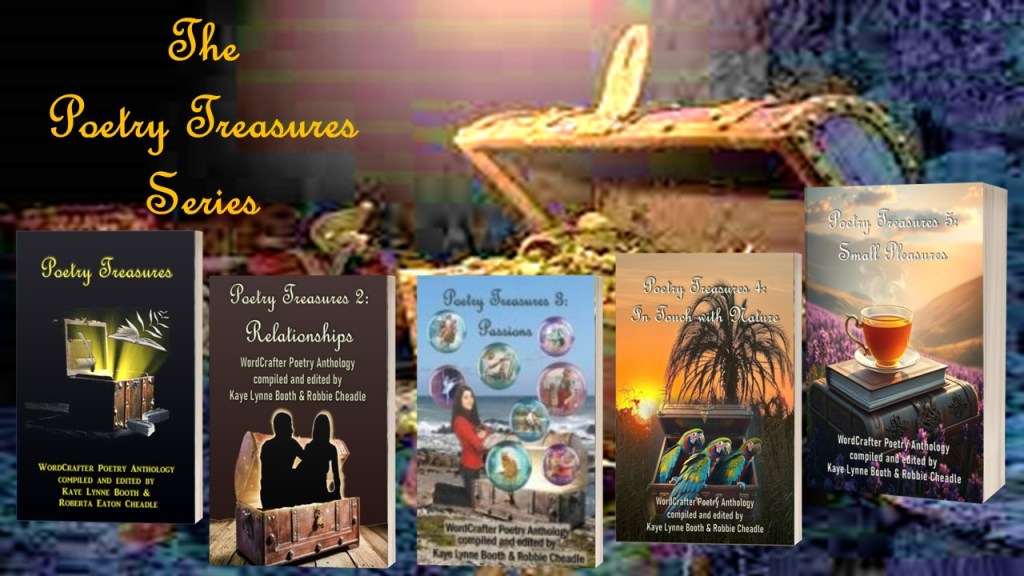
Get Your Copy Today!
Poetry Treasures: https://books2read.com/PoetryTreasures
Poetry Treasures 2: Relationships: https://books2read.com/PT2-Relationships
Poetry Treasures 3: Passions: https://books2read.com/u/b5qnBR
Poetry Treasures 4:In Touch With Nature: https://books2read.com/PT4-Nature
Poetry Treasures 5: Small Pleasures: https://books2read.com/PT5-SmallPleasures
Share this:

Birdwatching: My Best Bird Photos
Posted: February 16, 2026 Filed under: Bird Watching, Birds, Nature, Photography, Wildlife | Tags: Birds, Birdwatching, Kaye Lynne Booth, Nature Photography, Writing to be Read 5 Comments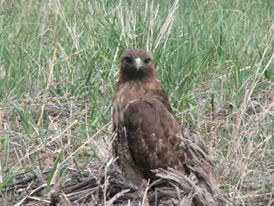
For many years I have been a birdwatcher, mostly due to the fact that there are so many different kinds of beautiful and fascinating birds that visit my yard and make the surrounding forest their home. But one thing about my flighty little friends is that many are skittish and don’t willingly do photo ops. But, every once in a while, the perfect opportunity arises and I get a really good picture. The rest of the time, the photos I get may be barely passable, if at all.
The good ones, like the one above of a red-tailed hawk, each have a story behind them, or at least the birds featured in them do. The story behind the photo above is a sad one. The only reason I was able to get close enough to get that photo was that the hawk had run into some power lines and electrocuted itself, disabling it from taking flight. I took several photos while waiting for the rescue workers from a local bird sanctuary to arrive. Unfortunately, they were unable to save him. He was a beautiful and majestic bird.
The young flicker in the photo below was another rescue that I made one spring day. The baby bird somehow ended up in my water garden pool, which is only has a small amount of water in the winter. In the photo, you can see its wet feathers, which were preventing him from flying back out, so it huddles by the drainpipe, cold, wet and afraid. I donned a pair of gloves and removed him gently, setting him on the ground to dry.

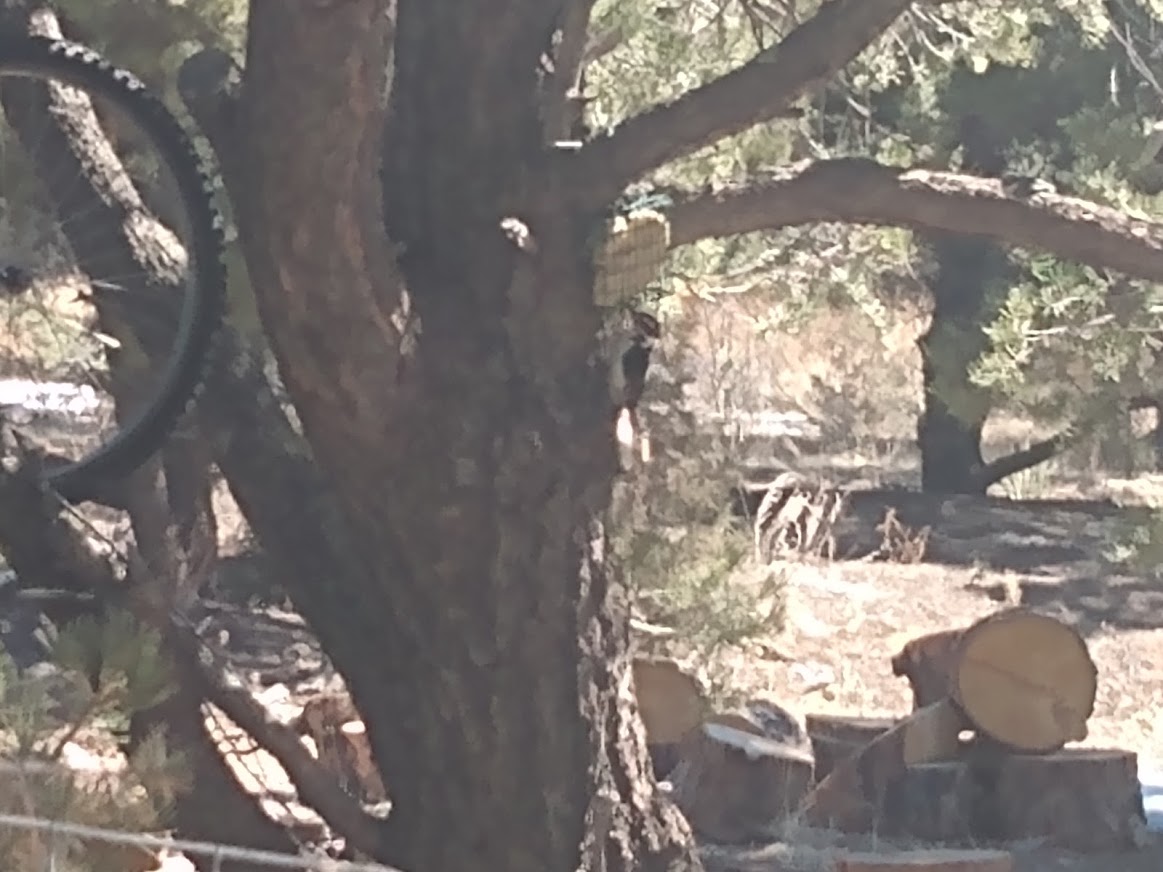
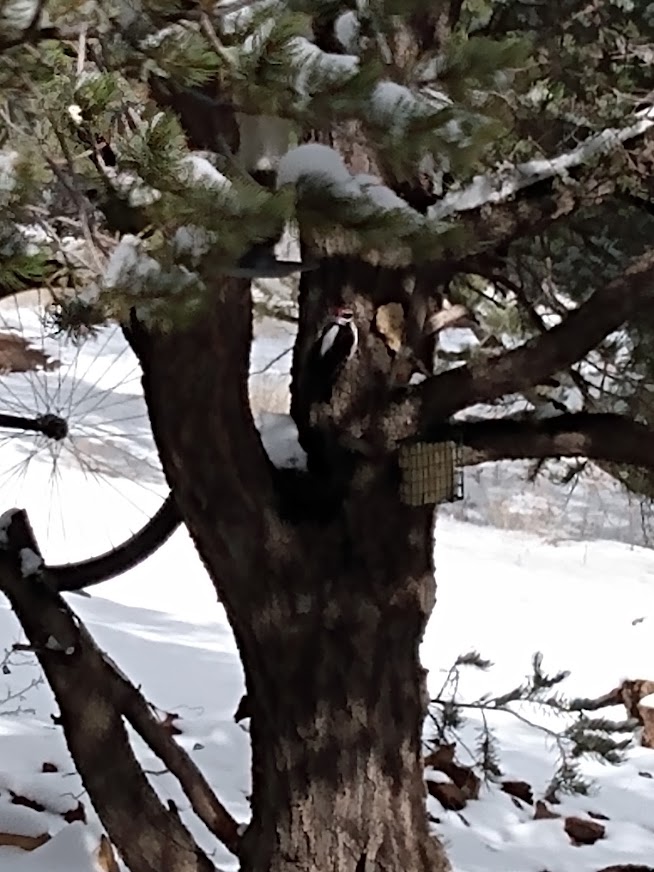
Not all my photo opportunities result from rescues and not all result in good photos. Flickers are in the woodpecker/sap sucker family of birds. Other birds in that family visit my mountain home, such as the downy woodpeckers, shown in the photos below. These guys just stop by from time to time for a bite to eat from my suet cakes. The one on my trellis must have been during mating season as he was flying from spot to spot on the trellis making strange clicking sounds to attract a mate.
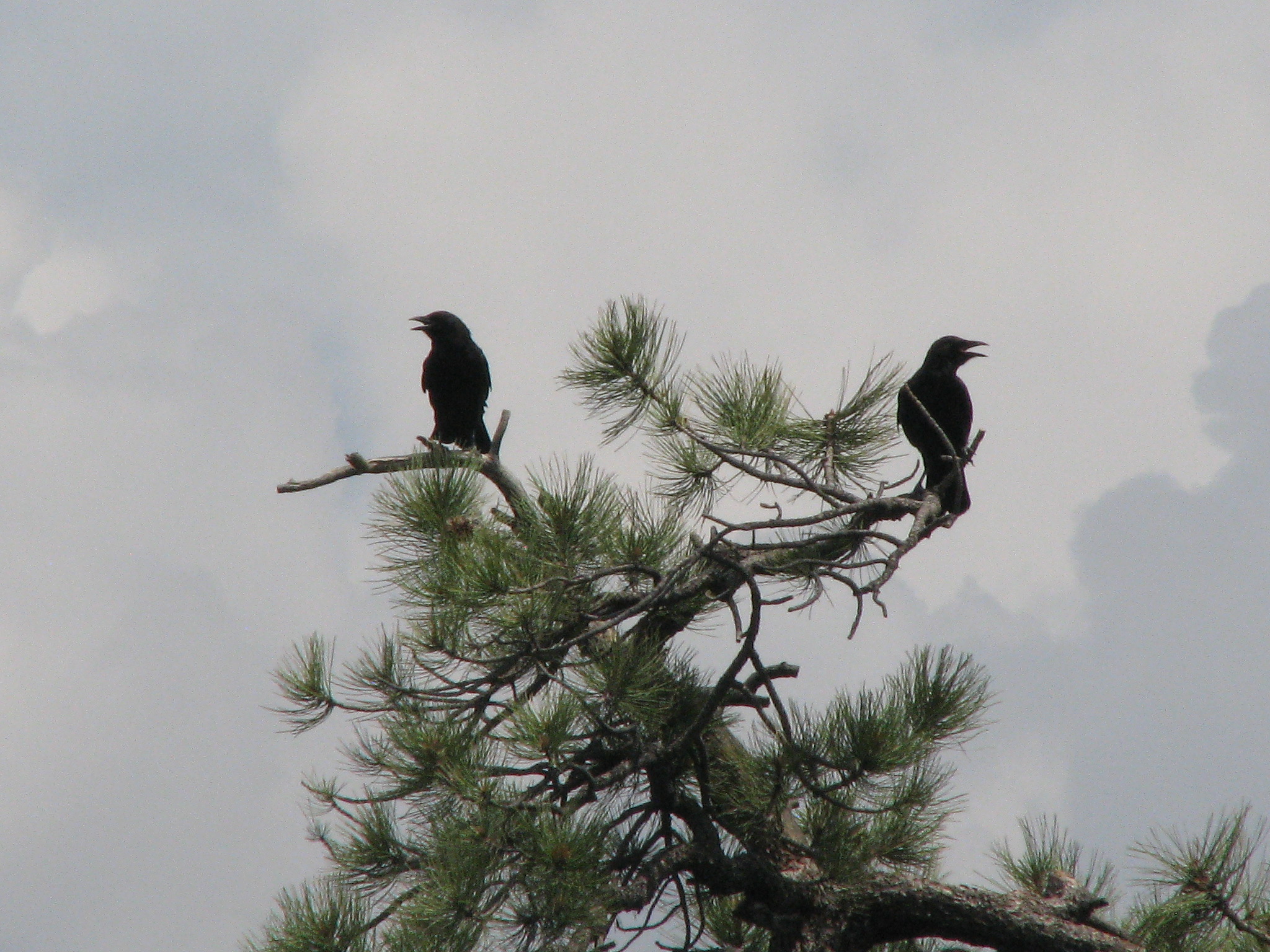
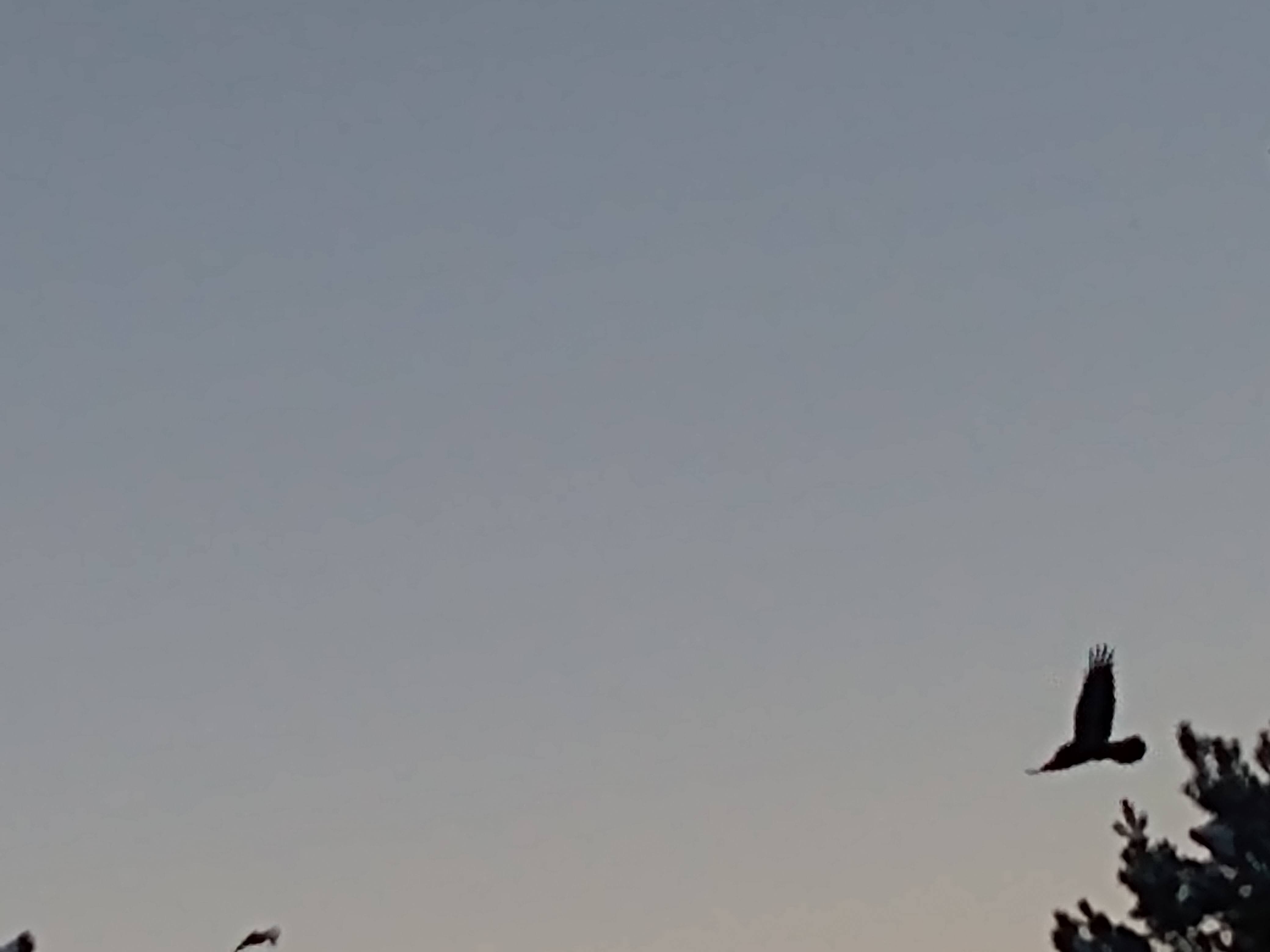
Then we have my resident ravens, who are very camera shy, but I manage to snap one every once in a while. The ravens are characters. They fly by and yell at you, “Caw! Caw!” and I’m just crazy enough to caw back at them. They watch the activity around my yard, often fly by real low to tease the dog, and steal things that you leave lying about, especially if it is shiny. One watches from the trees when I walk the dog, and wait until we are right below, then screams out a caw and flies away, thinking it a pretty good joke he played.
They are social birds. They frequently gather in large groups in neighboring horse fields, sometimes with their crow cousins, and jump up and down, cawing and acting silly. I call these little bird parties Raven Raves. Ravens mate for life, and at first, I had four resident birds, but a neighbor kid shot one down with a bb gun one summer. Those ravens flew madly, cawing and cawing for days afterward. They were in mourning. 😦
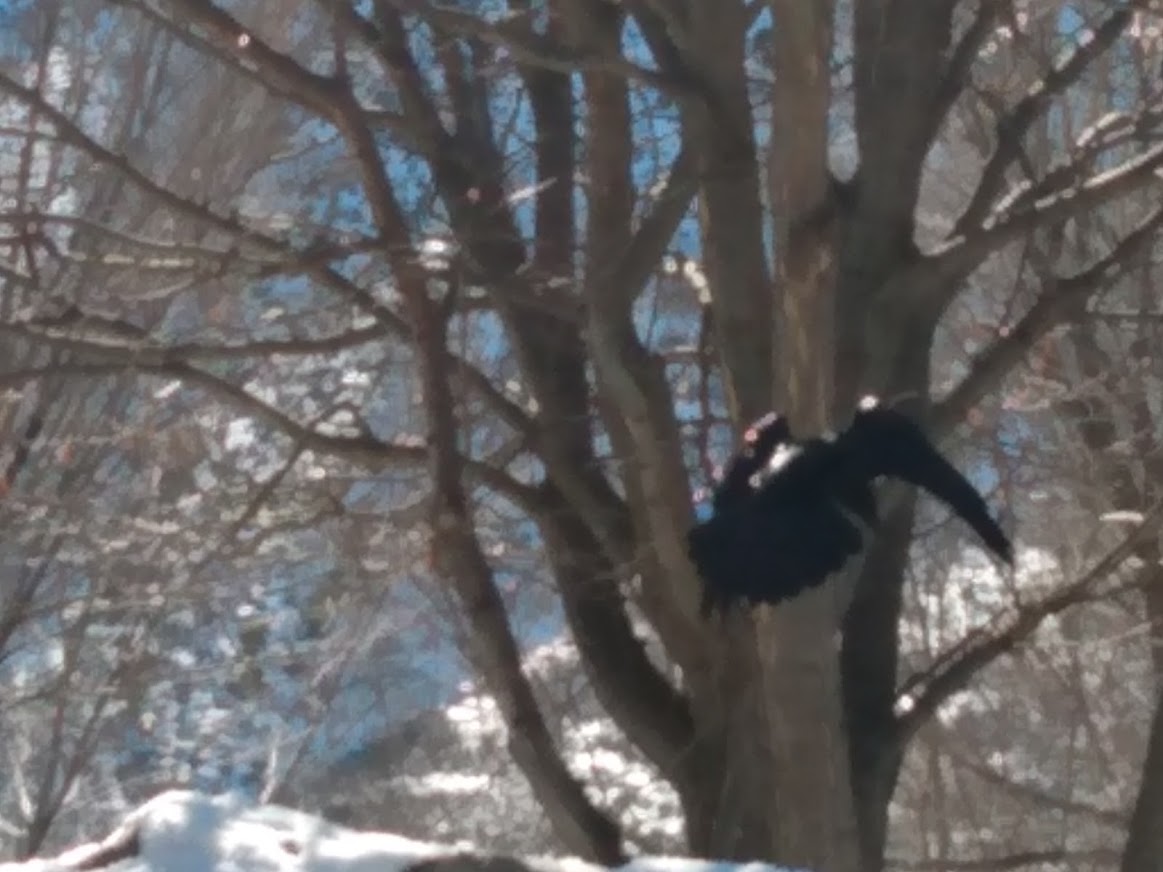
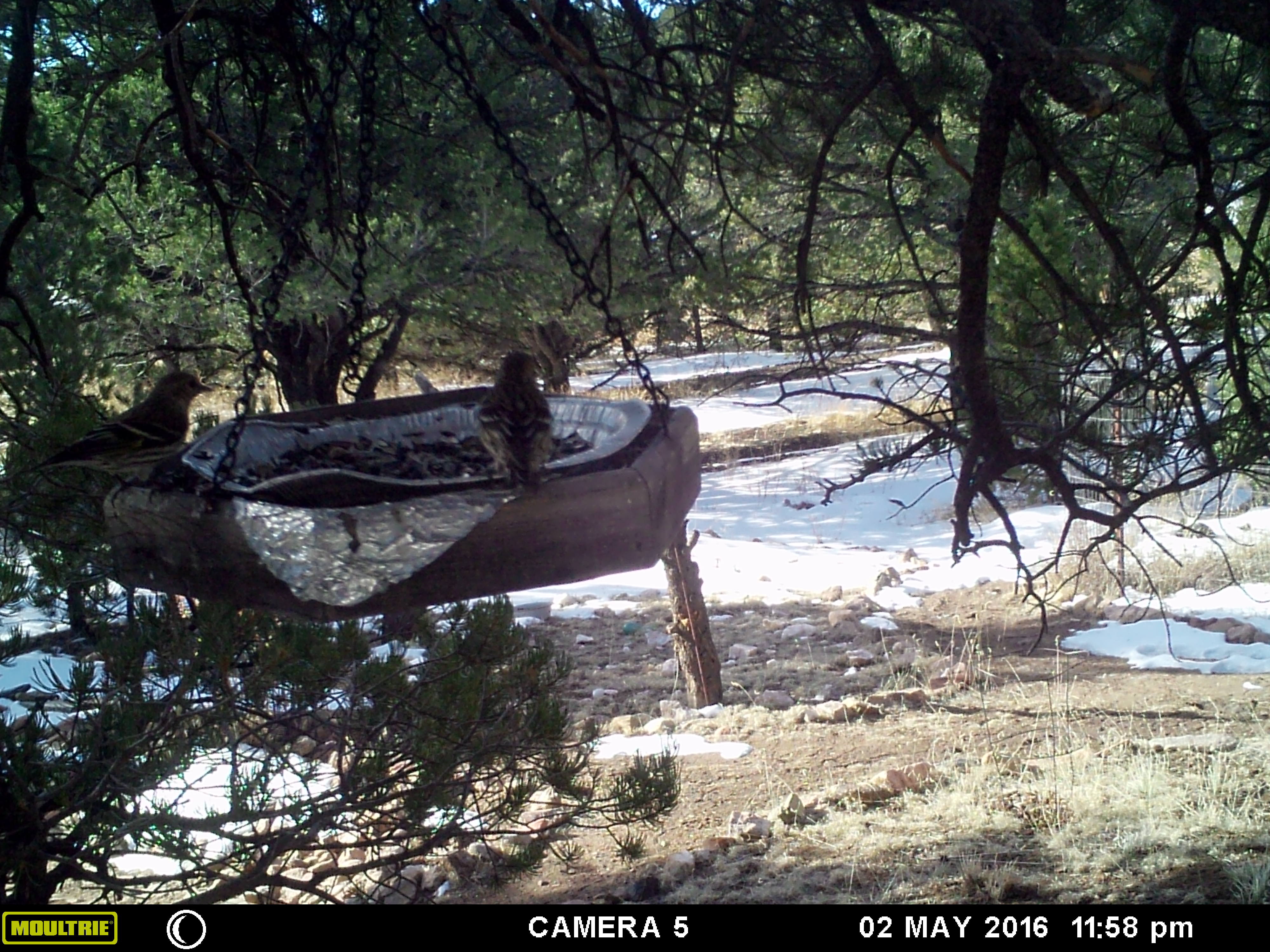
Most of the photos I get of the ravens are in flight, and they appear as small specks of black against a sky of blue and white. They don’t sit still often when they know you are watching. But I did get one nice photo of a pair perched in my tree, and a carefully placed game camera near my feeders caught a single raven swooping in to steal a bite.
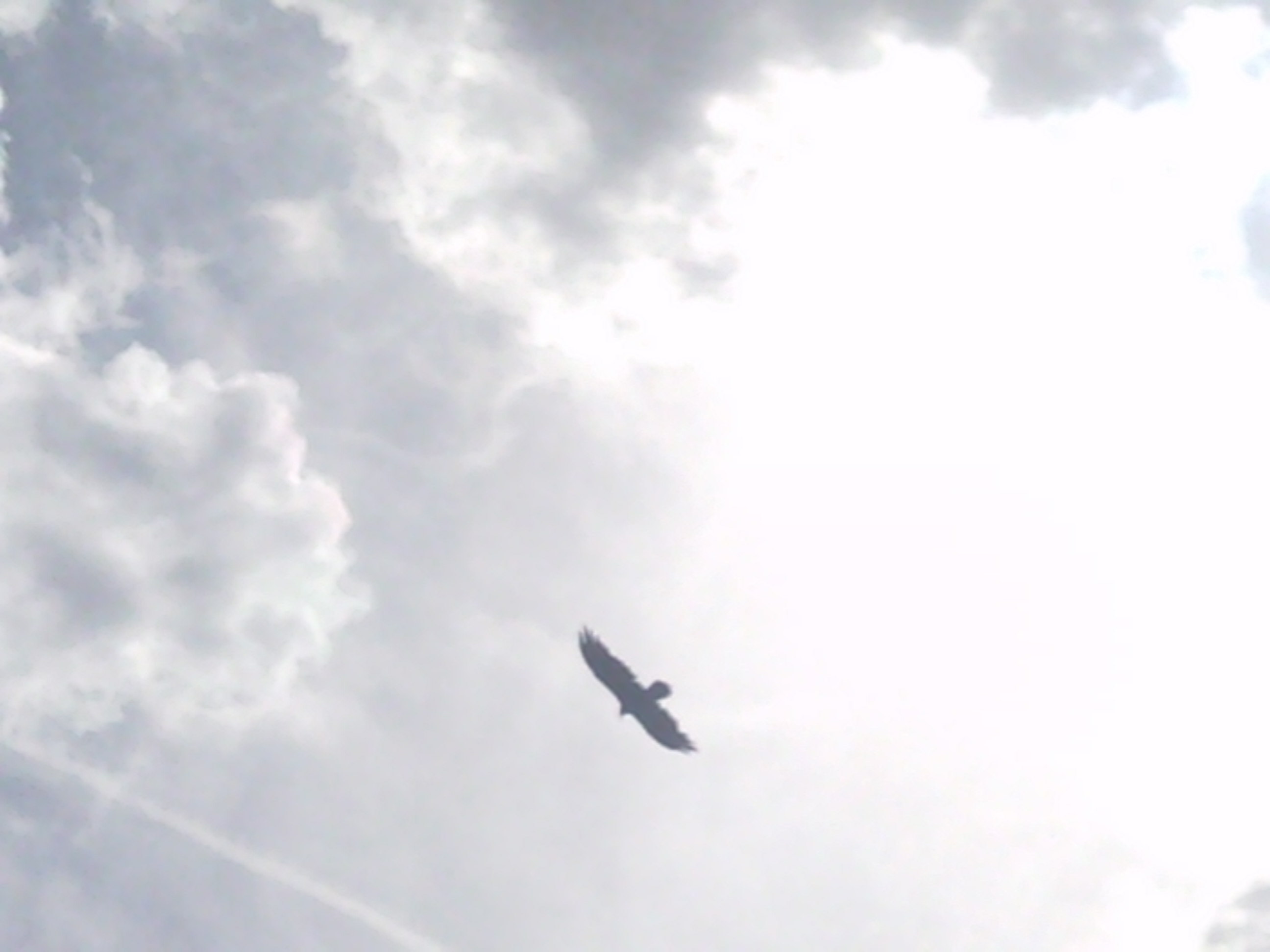
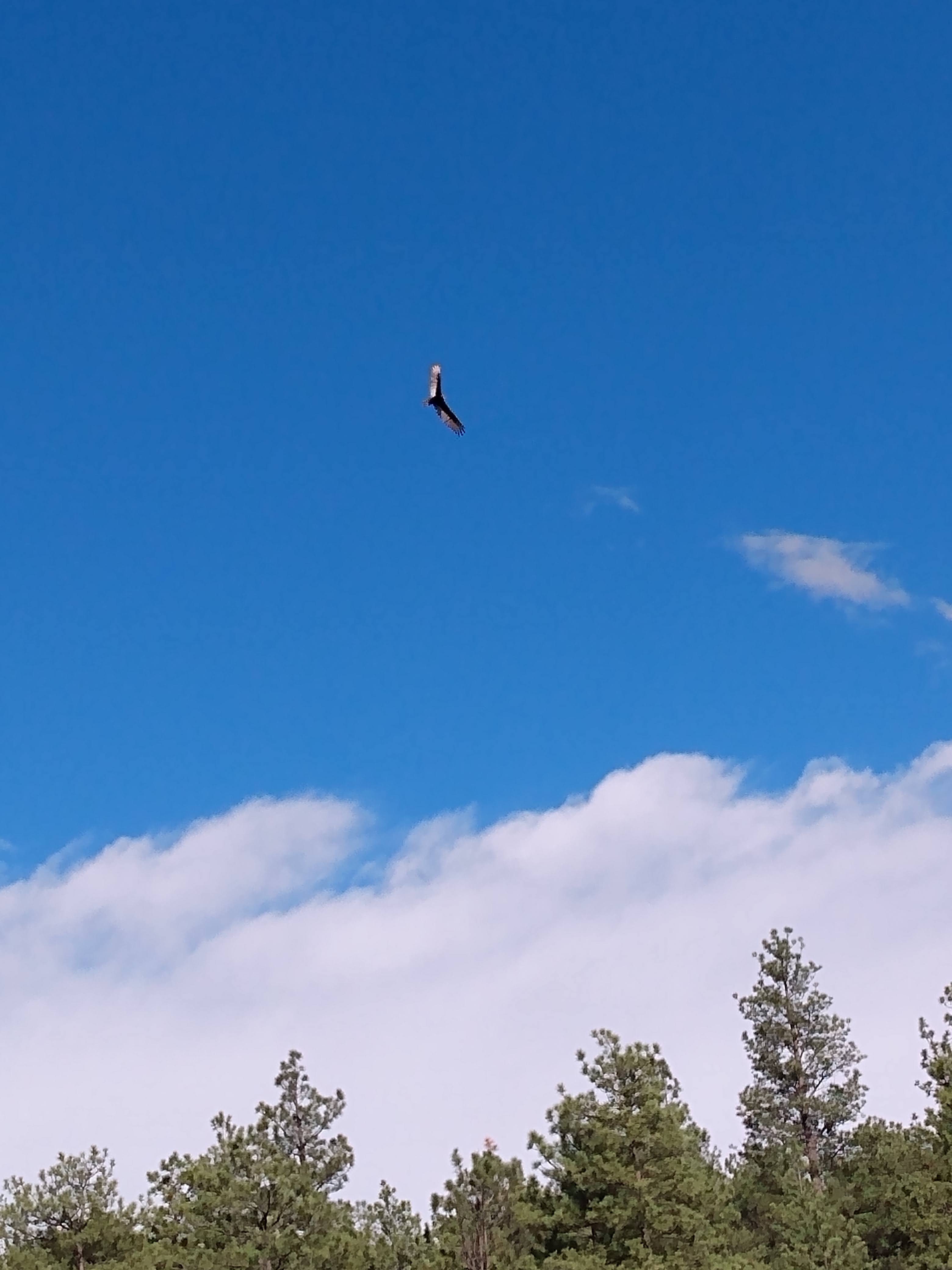
Another bird rarely caught on camera except in flight are turkey vultures. As carrion eaters, turkey vultures have gotten kind of a bad rep. Their role in nature isn’t pretty, and neither are they, with their bald red heads, which actually serves a purpose of cleanliness for the birds. Just think how bad they would be if their bloody meals stuck to the feathers on their heads. They are commonly seen riding the wind currents on blustery days. I am not a fan of wind, but they truly enjoy the weather that makes me want to stay inside.
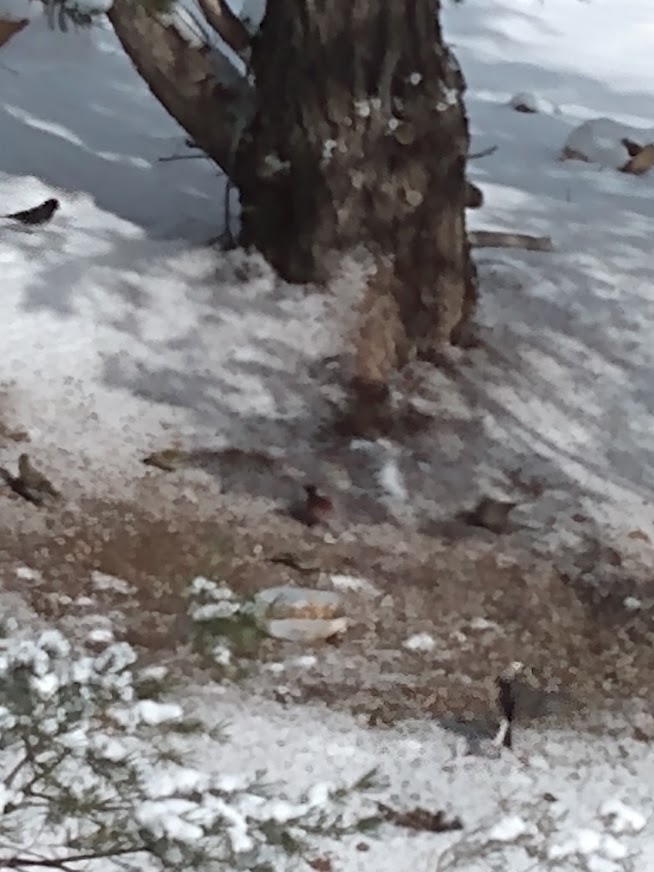
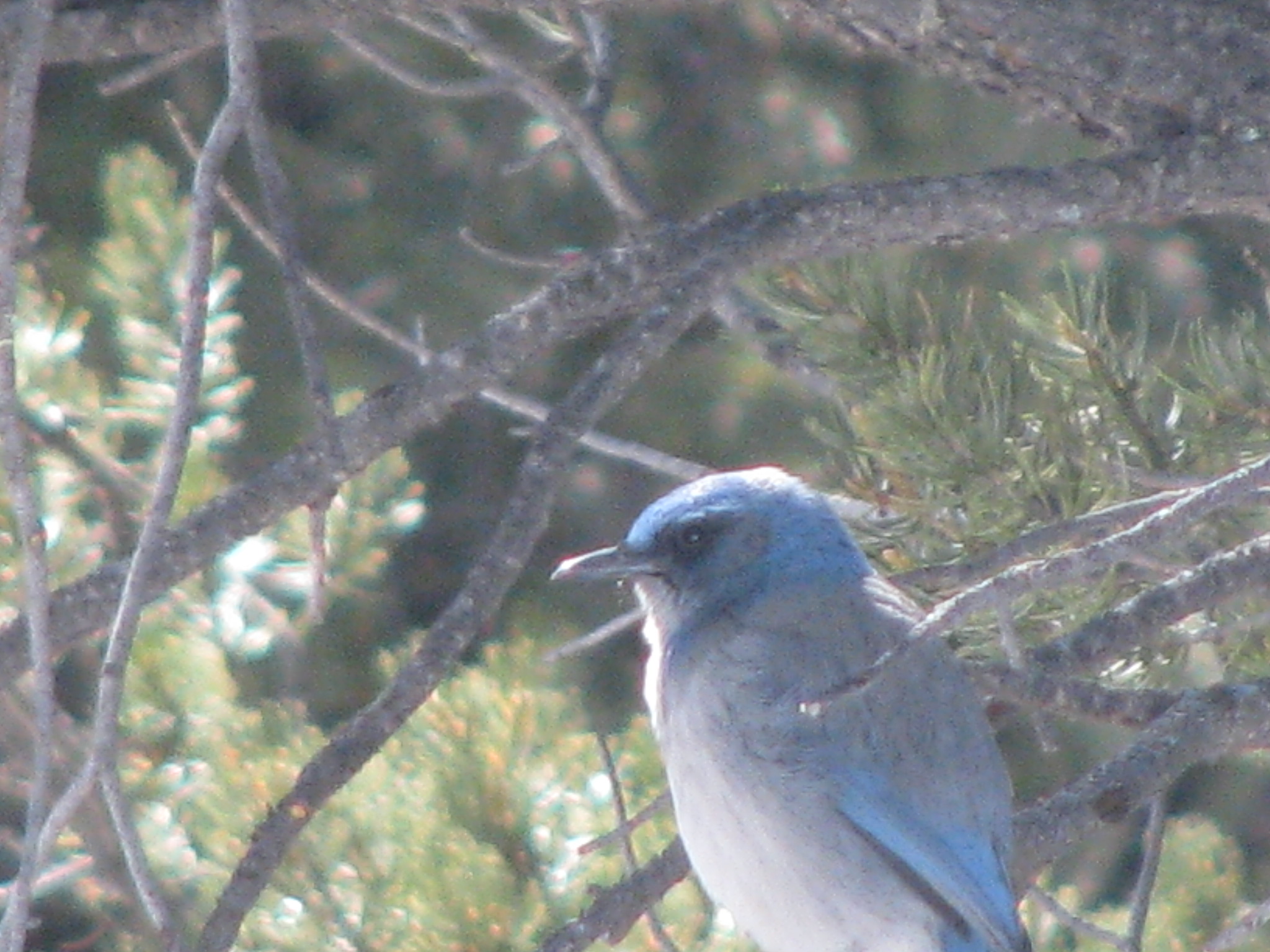
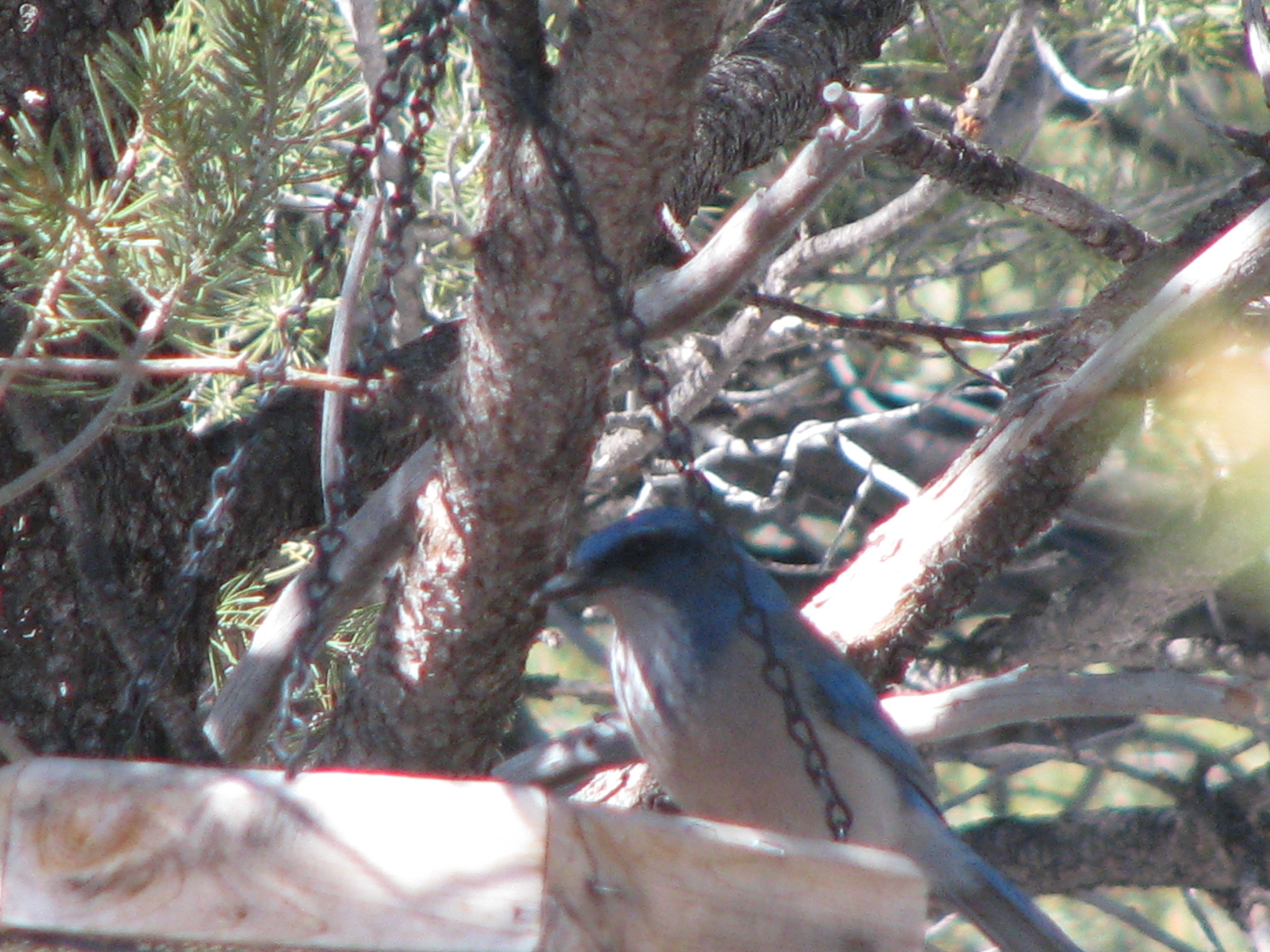
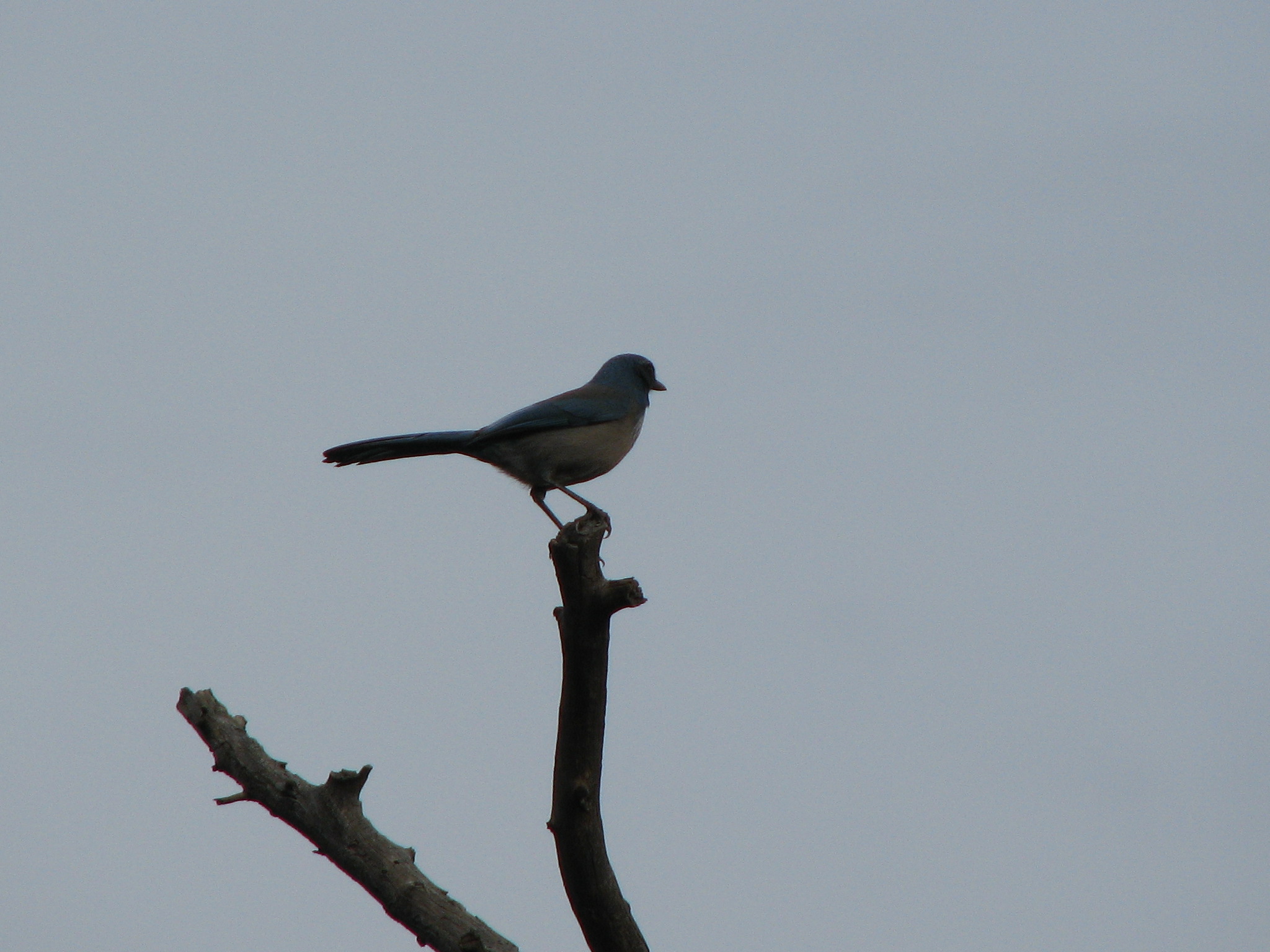
Other resident avians include juncos, chickadees, nuthatches and blue jays, which are her year round, and robins make their appearance each spring. Visiting birds include evening grossbeaks, colorful western tanagers, rock doves, and western bluebirds.
The blue jays are the neighborhood bullies. They fly in in flocks and take over the trees, chasing the littler birds such as juncos and chickadees away while they devour all the food I put out. They are a noisy bunch. That’s for sure.
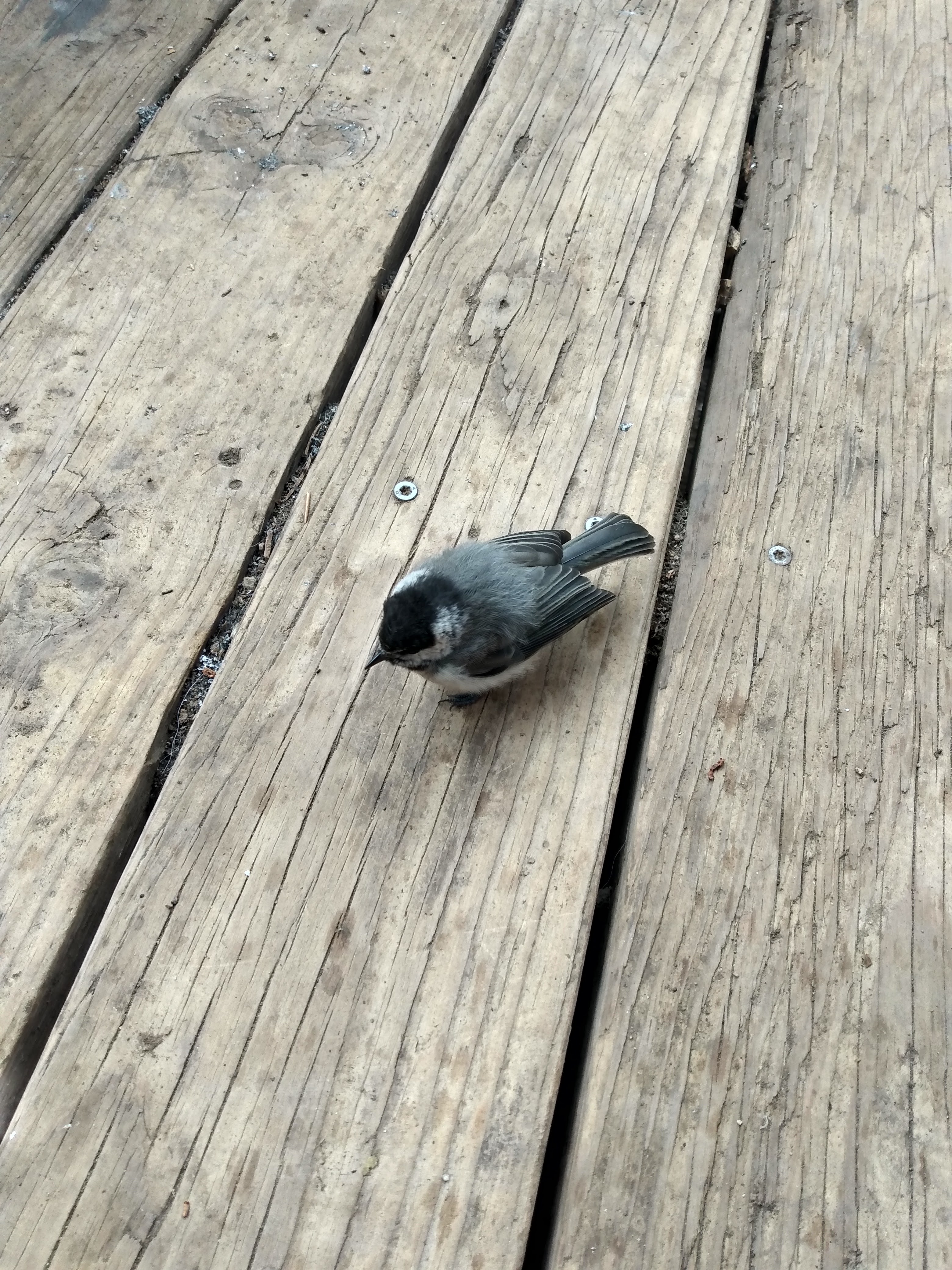
The chickadees are what I call my little forest bandits, with their little black masks around their eyes. They are bold little birds, as the picture of the chickadee on the deck shows. That little guy was about an inch away from my foot. I have had them land on my hand and one summer, I sat and read in a sombrero with birdseed in the brim and the chickadees came and landed on the hat. They are real characters, and the inspiration for my children’s book, Charlie Chickadee Gets a New Home.
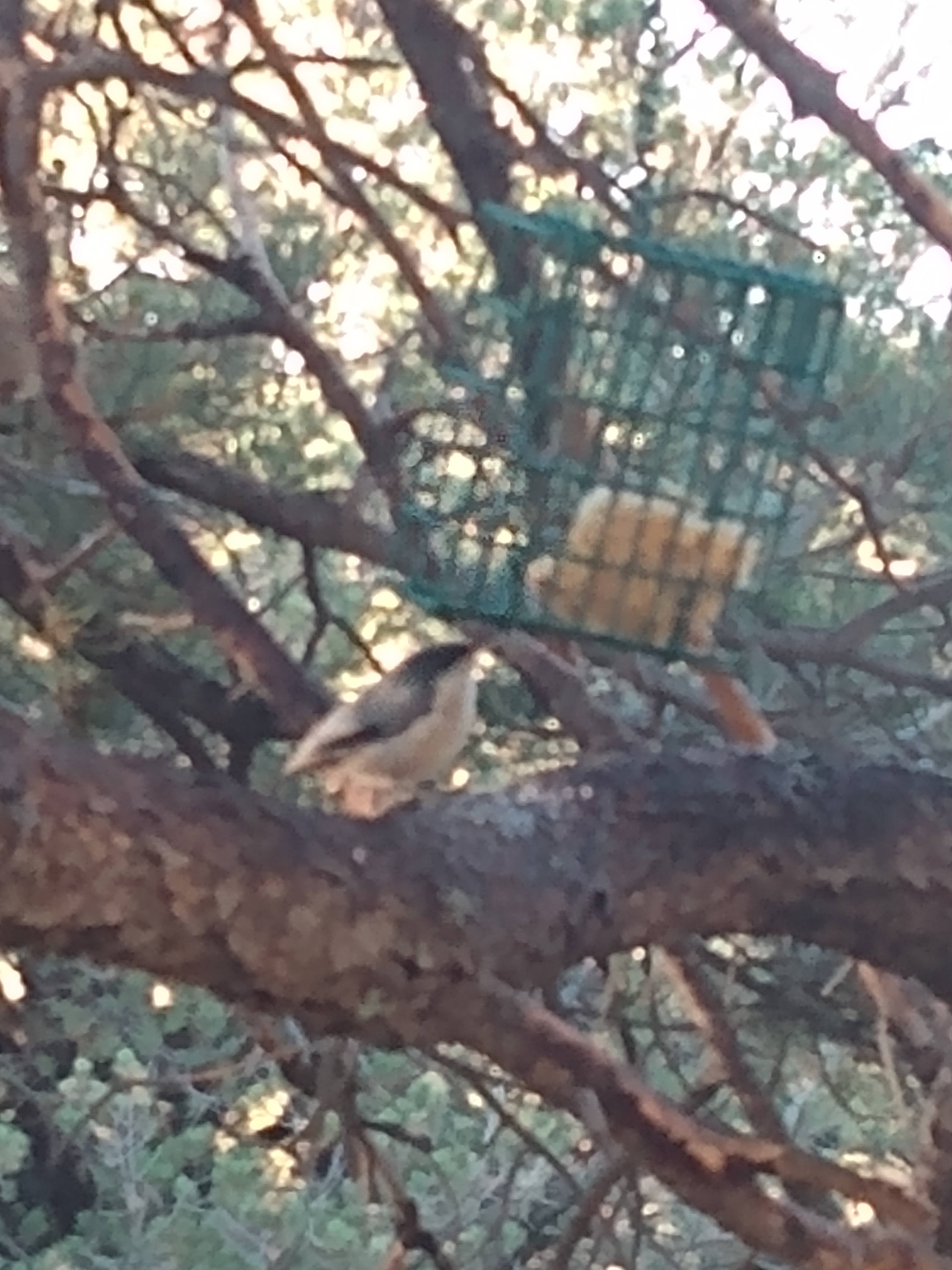
Nuthatches are my little acrobats, able to go down the tree trunk headfirst or even navigate branches completely upside down. Their black and white coloring reminds me of formal dinnerware. They are so cute. They are the inspiration for the character Nicholas Nuthatch in the above-mentioned book.
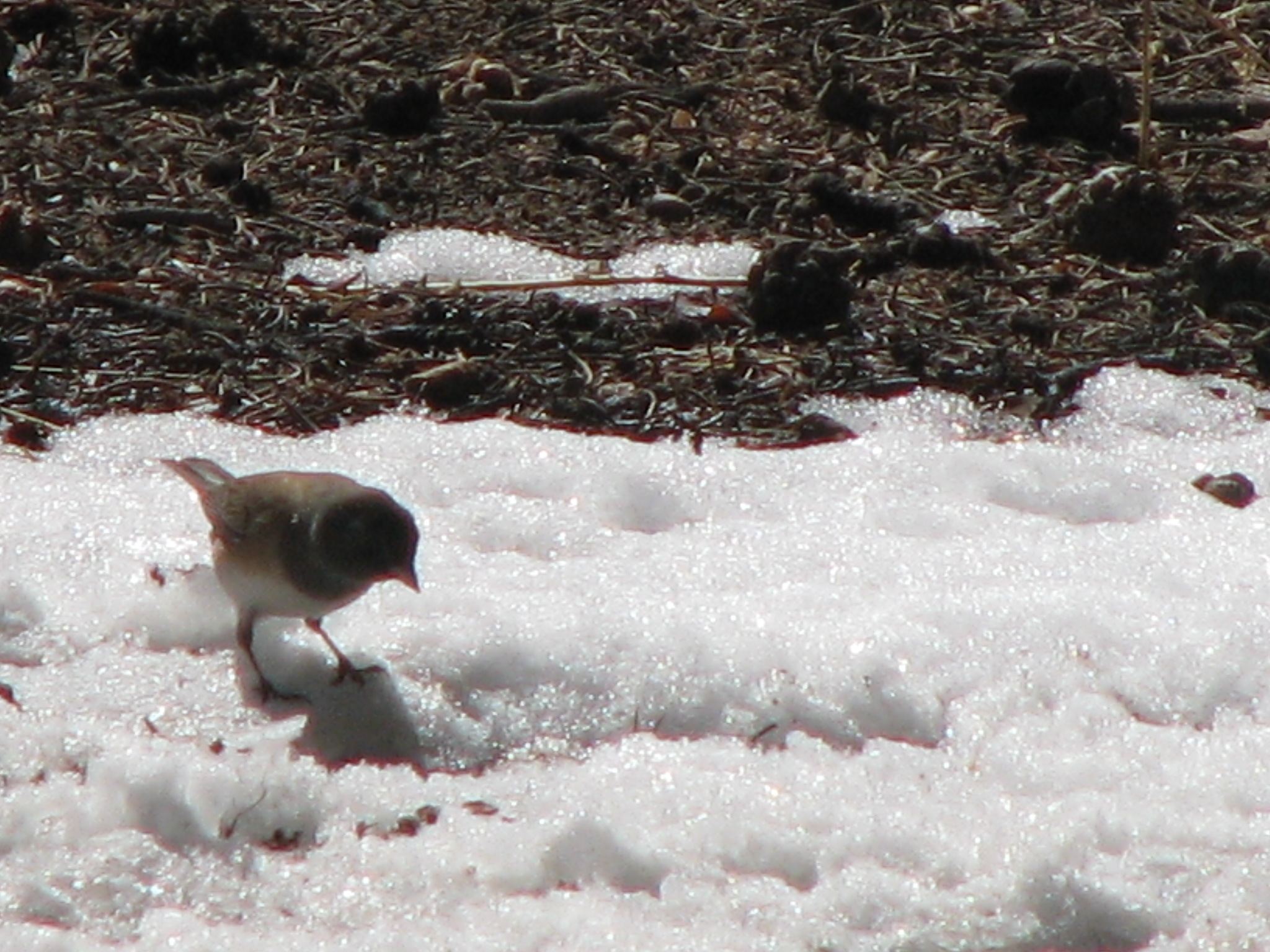
Juncos are mostly winter birds, although I see one or two occasionally in the summer. In the winter they flock in, feeding mostly on the ground rather than hitting the feeders in the trees, although they certainly are able.
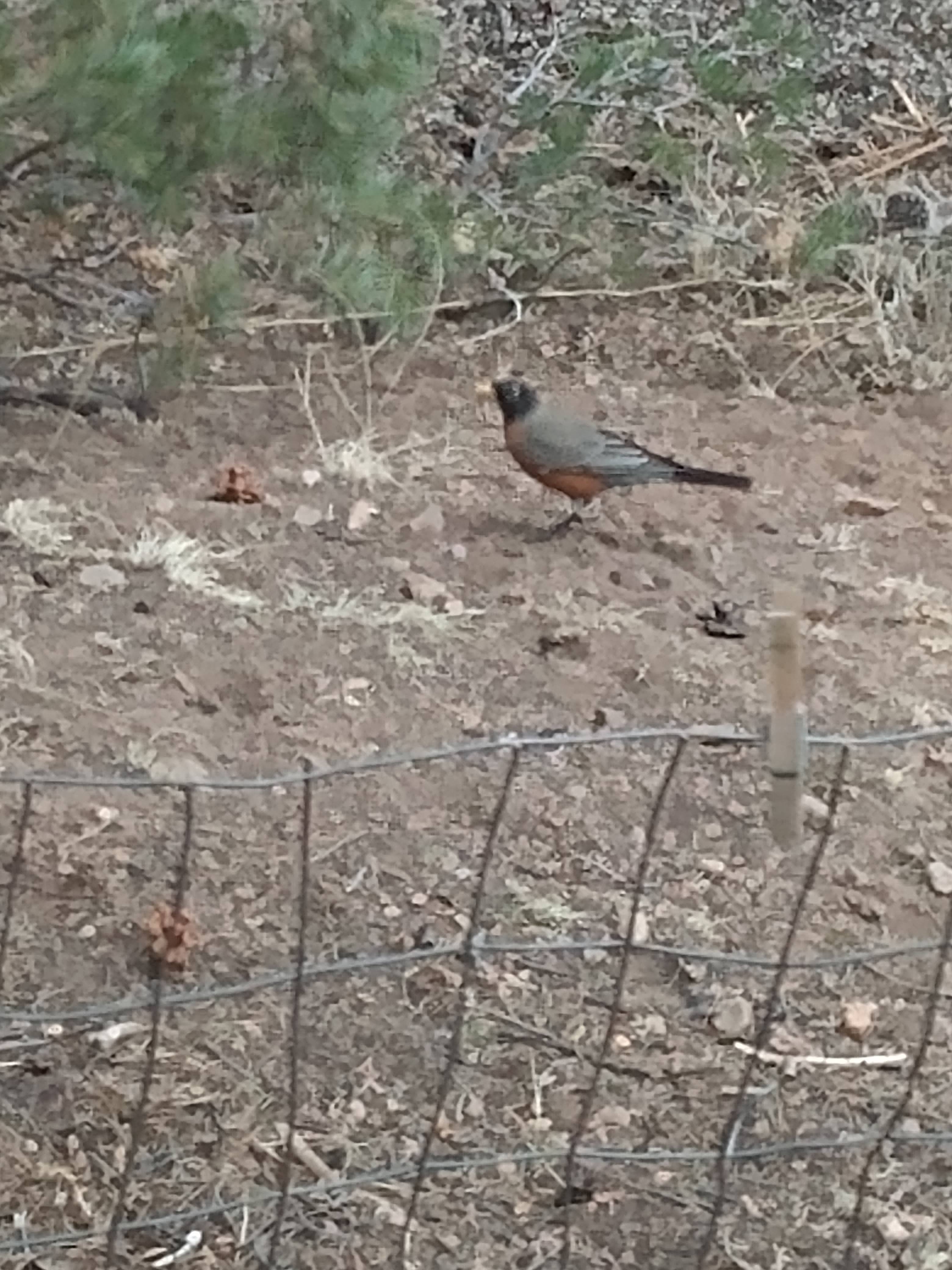
I feel like I have raised several generations of robins. I watch the babies grow up each spring, then I see them return and have their own brood the following spring. I know because I get to know their markings.
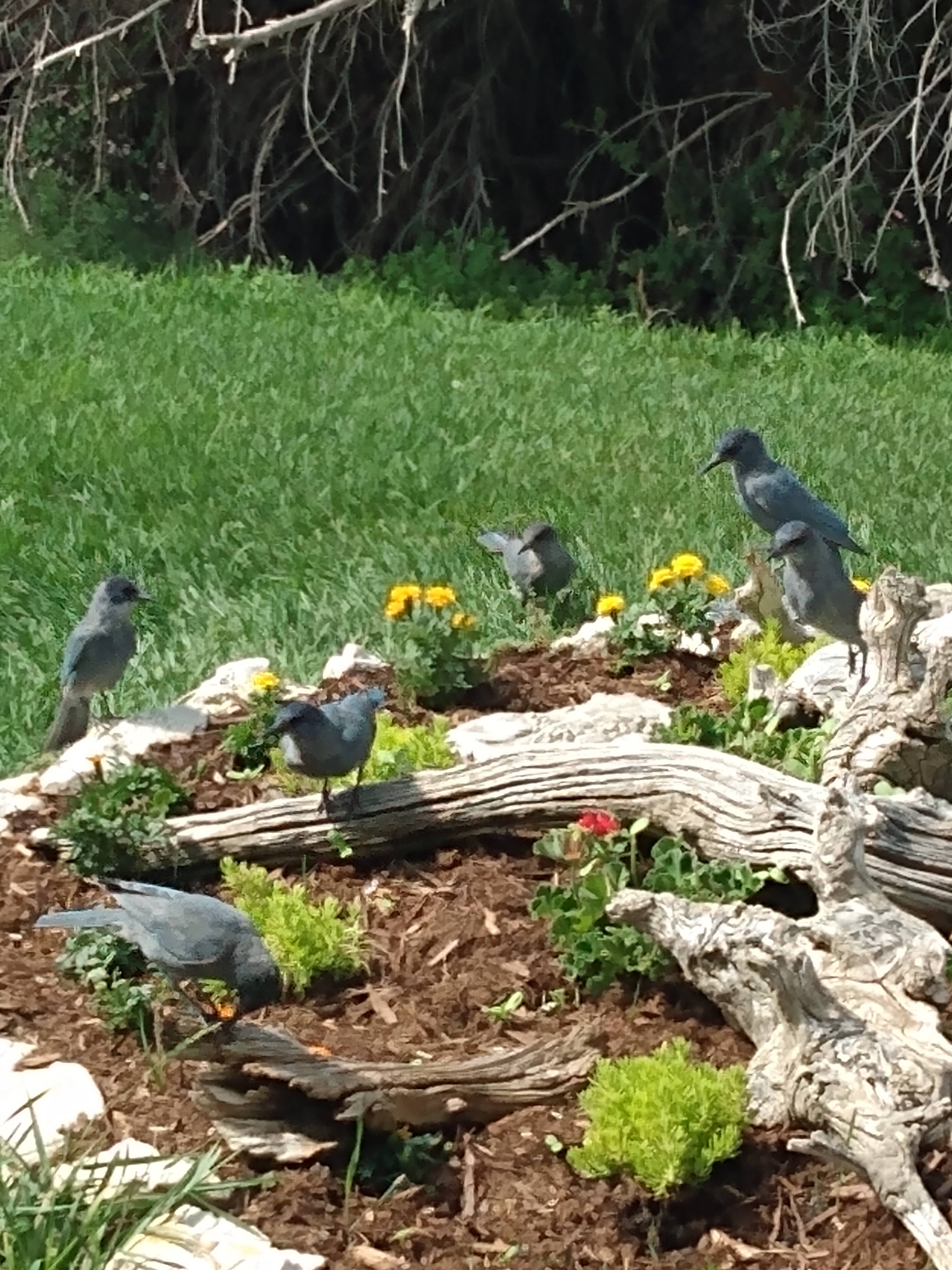
But my favorite seasonal residents are the hummingbirds that stop by on their tract up from South America. These tiny birds are really amazing when you think about the massive distances they travel. I have two different kinds of hummingbirds that visit my mountain home. First arrivals in the spring are the rufus hummingbirds. Then, mid-summer we see the Allen’s come in, which are louder and more aggressive than the rufus, and the skies around my home become an ariel warzone as the Allen’s guard all the feeders. Apparently, they don’t like to share, but their arial antics never cease to amaze me. And of course, they are the inspiration for my children’s book, Heather Hummingbird Makes a New Friend.
Hummingbirds mate twice a year, so I get to welcome in two sets of new generation youngsters, and twice a year I get to enjoy their amazing courting dance as the males dive and swoop in their arial courting dance. They build their nests of grass and bark, and they are very well camouflaged. In fact, even with hummingbirds by the dozens every year, I’ve only once been able to spot a nest.
One fall we had a really early snow which caught us all by surprise, including the hummingbirds, which were huddled on snow cover branches, stuck and unable to fly in the storm. I placed a feeder under my porch so they could get to nourishment in a sheltered area and boy was it a big hit, as you can see in the video below.
Then there are the birds which just drop by occasionally to say hi and partake in the seed and suet cuisine at my bird sanctuary. Frequent visitors include Rock Doves, Bluebirds (which are much smaller than Blue Jays), Western Tanagers, and Sparrows.
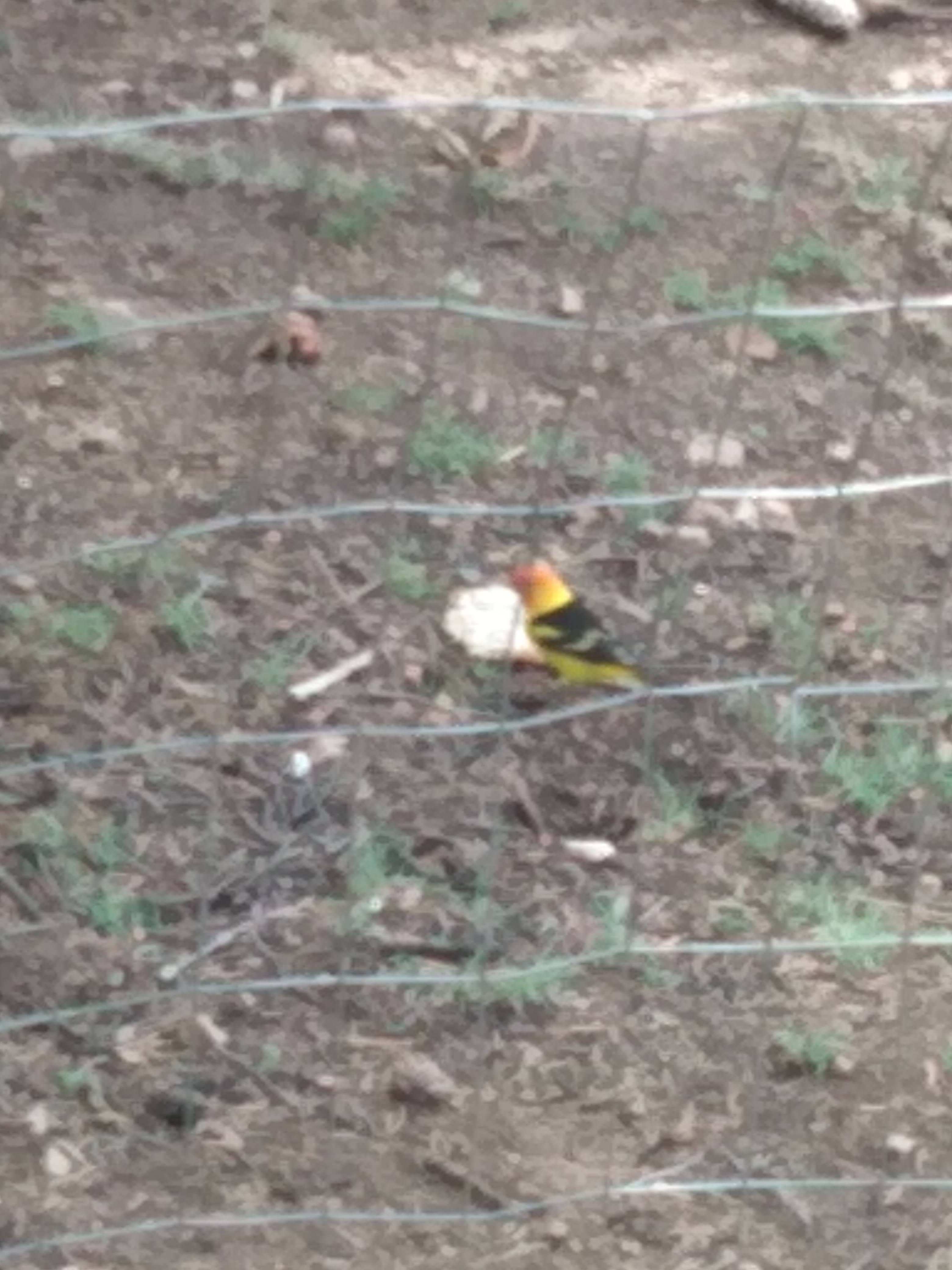
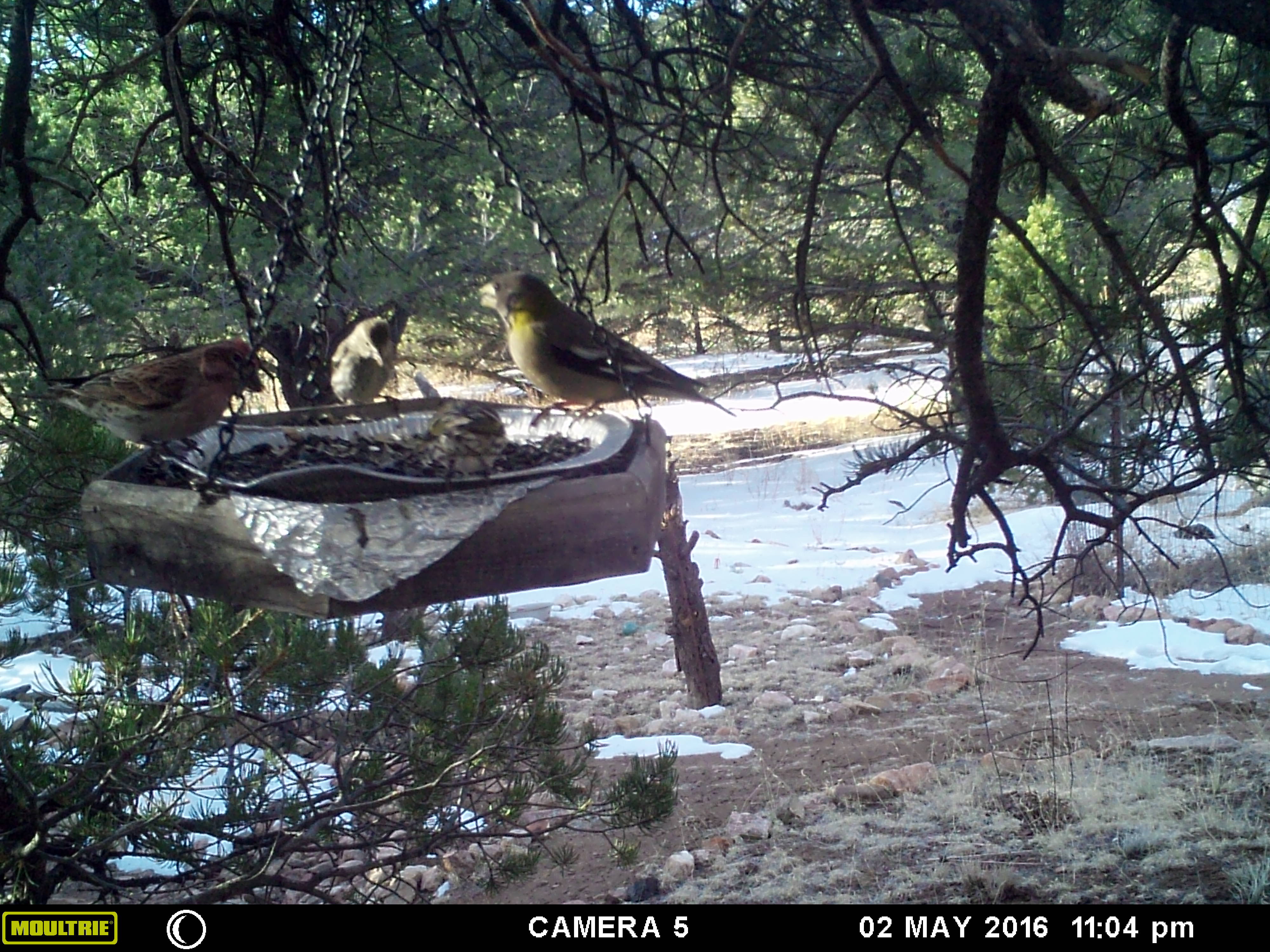
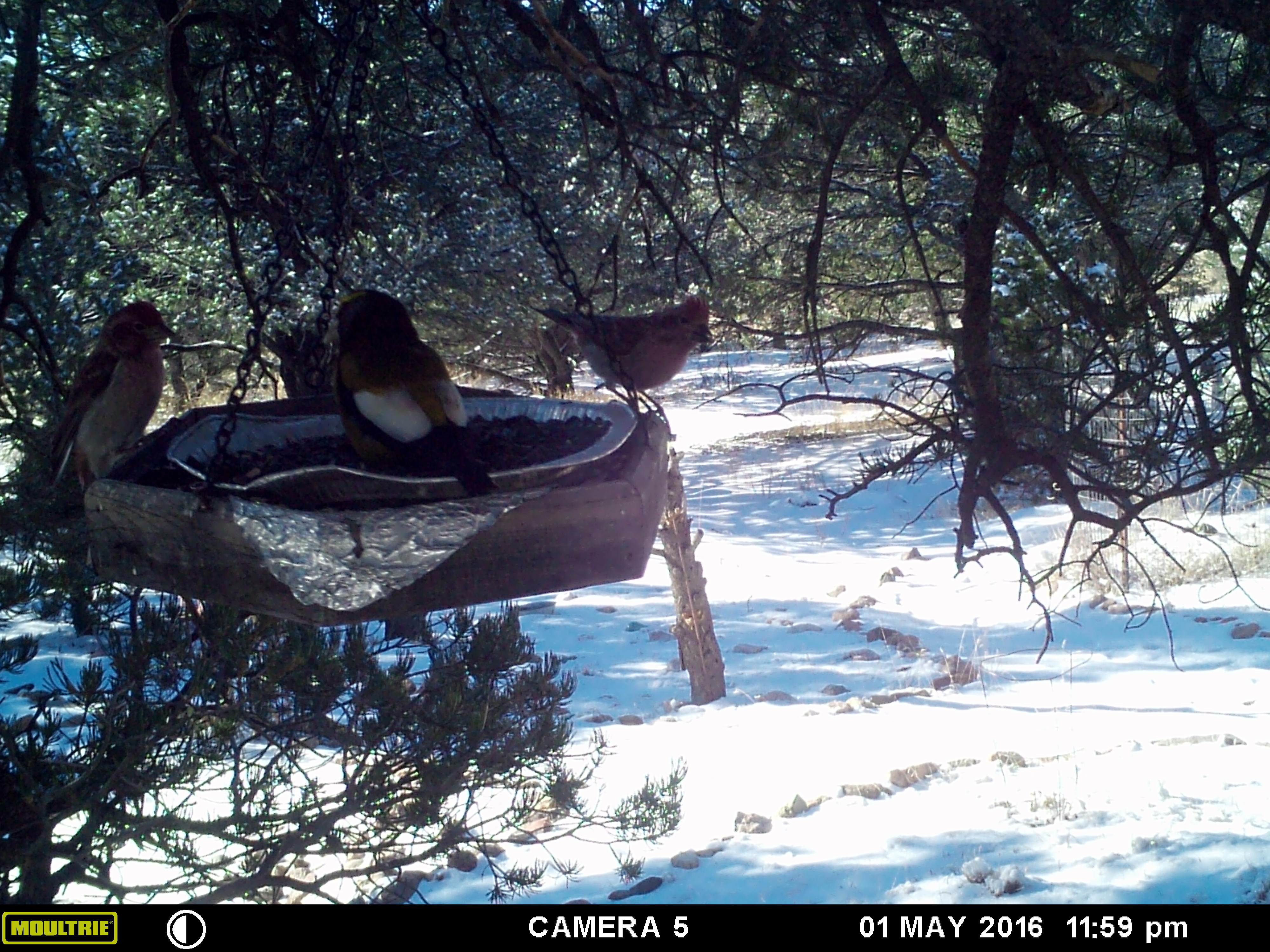
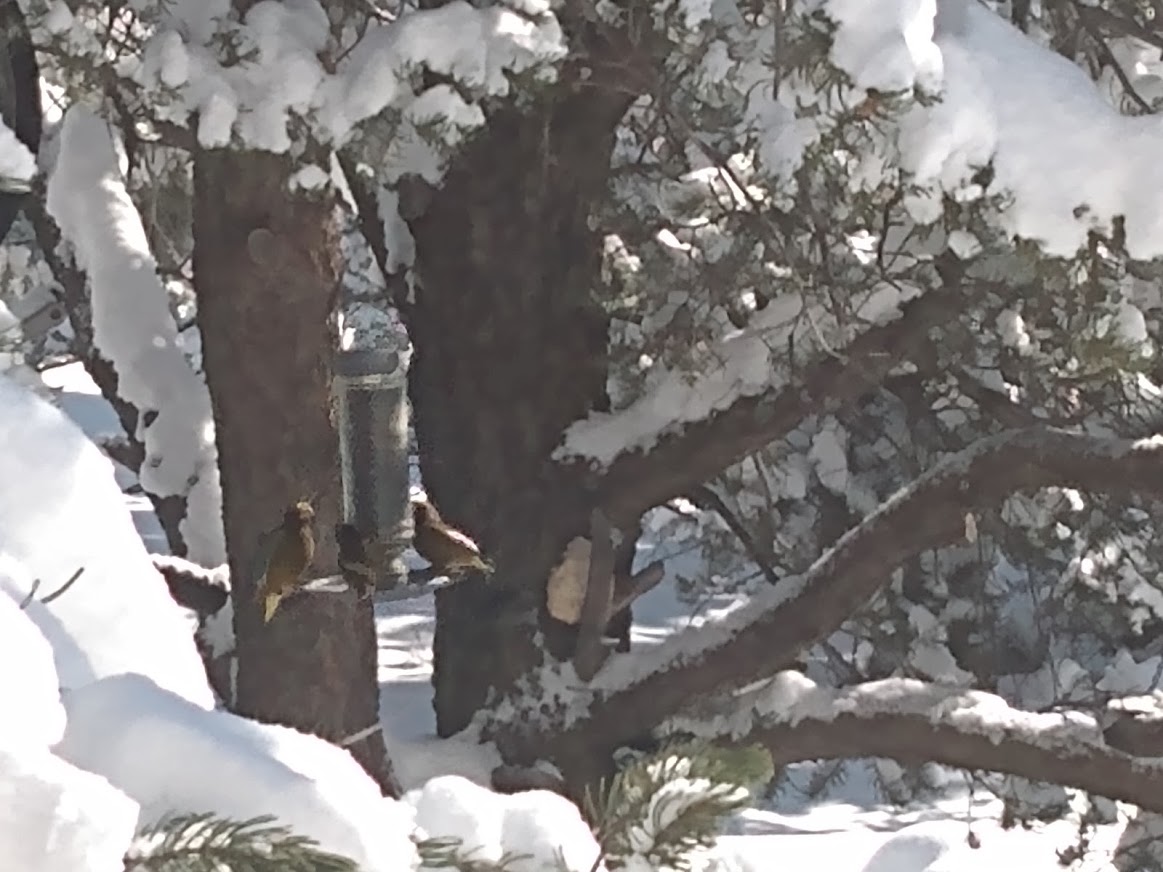
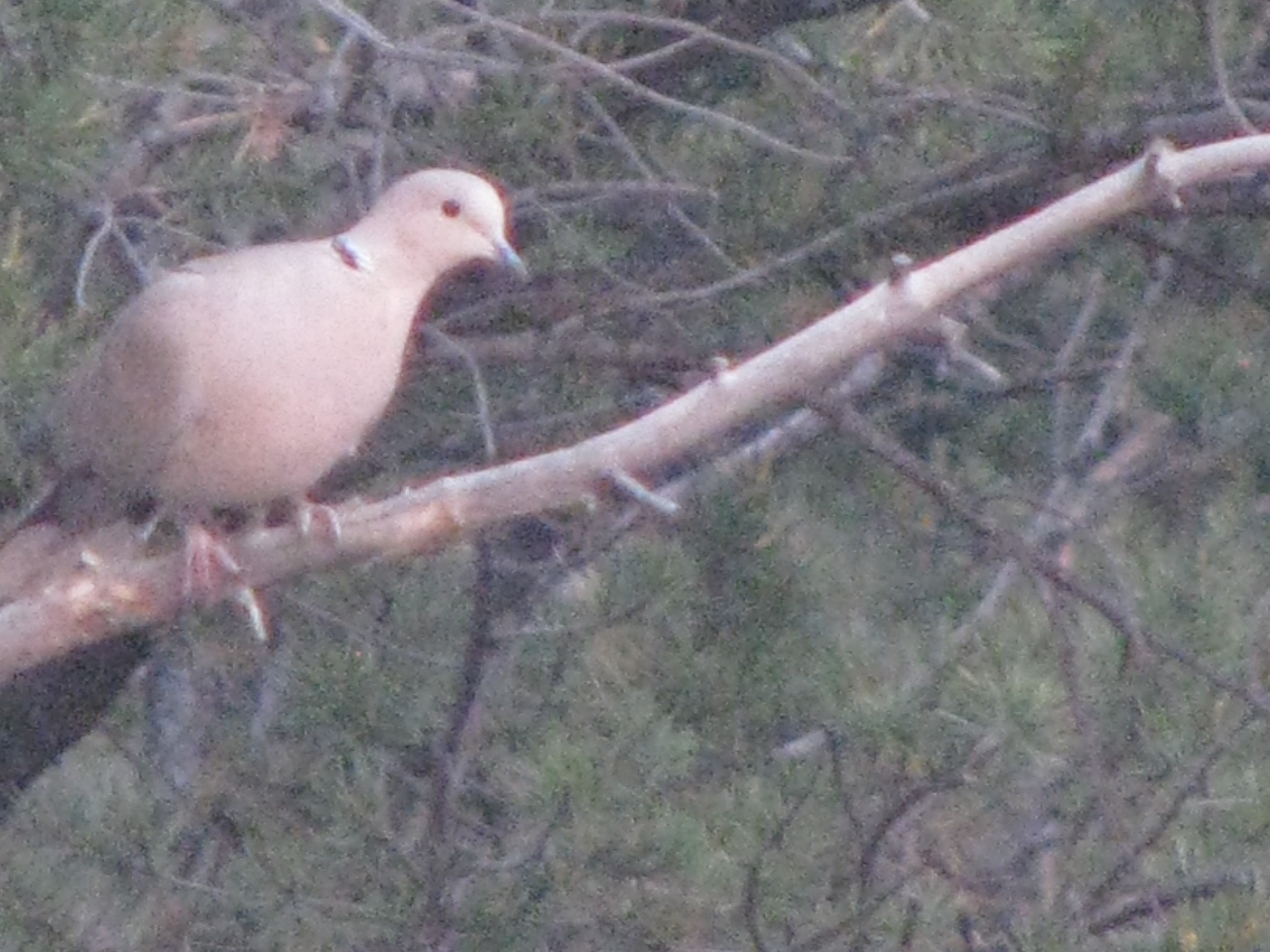
Although they do not appear in my yard, the waterfowl in the area is pretty amazing, too. Below, are photos from my many trips to nearby Lake DeWeese, Canon City’s Centennial Park, or Salida’s Sand Lake.
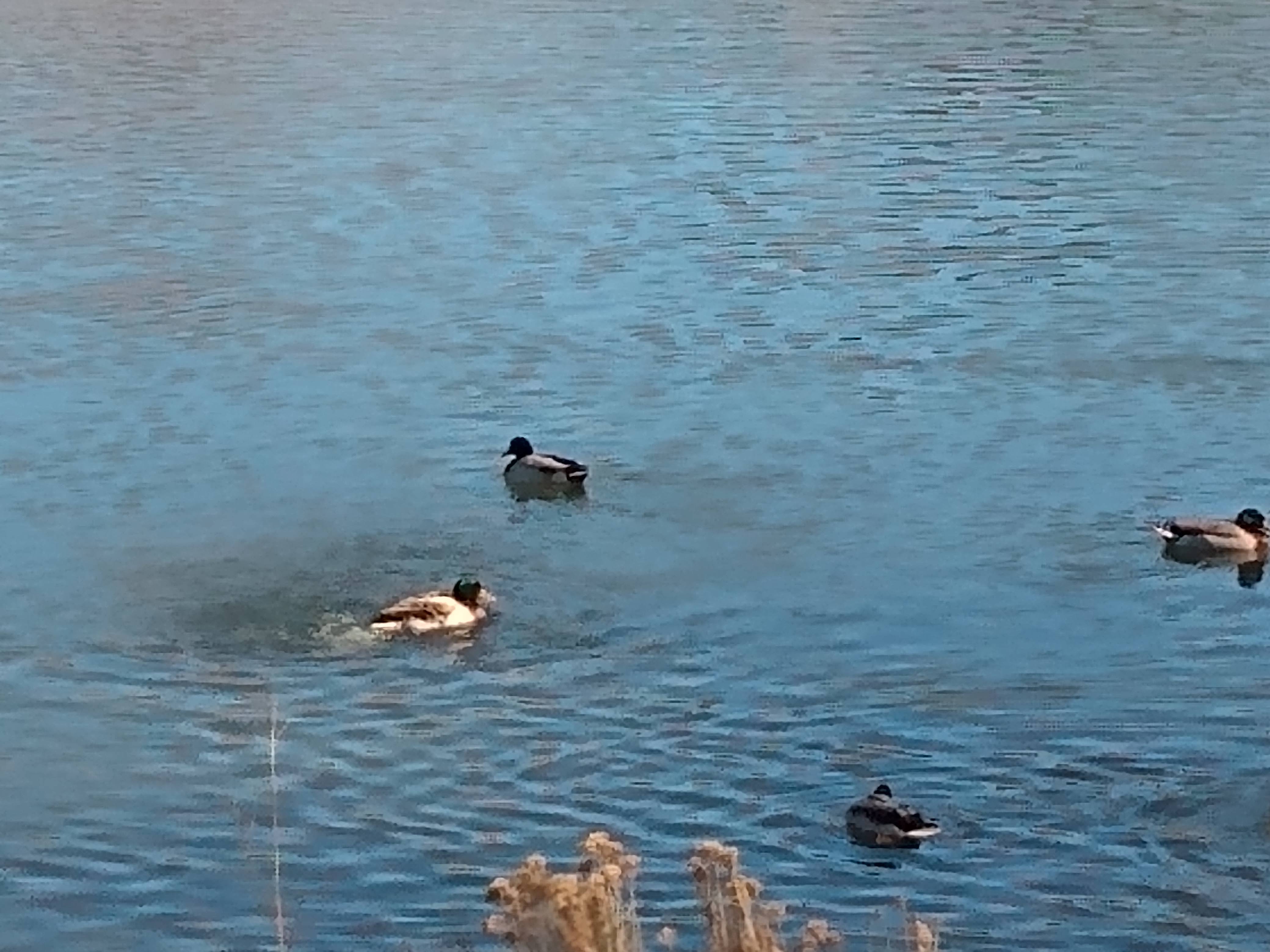
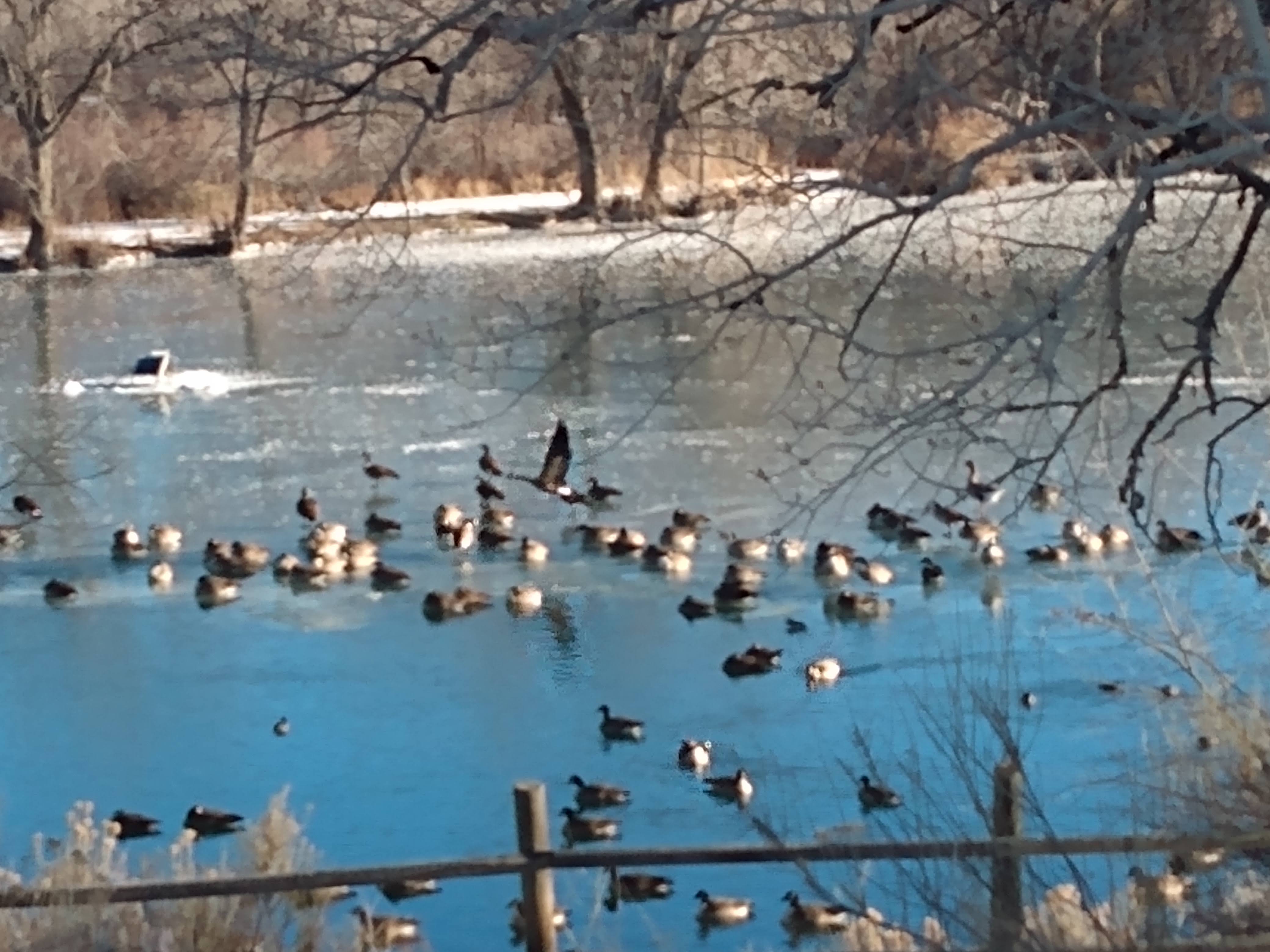
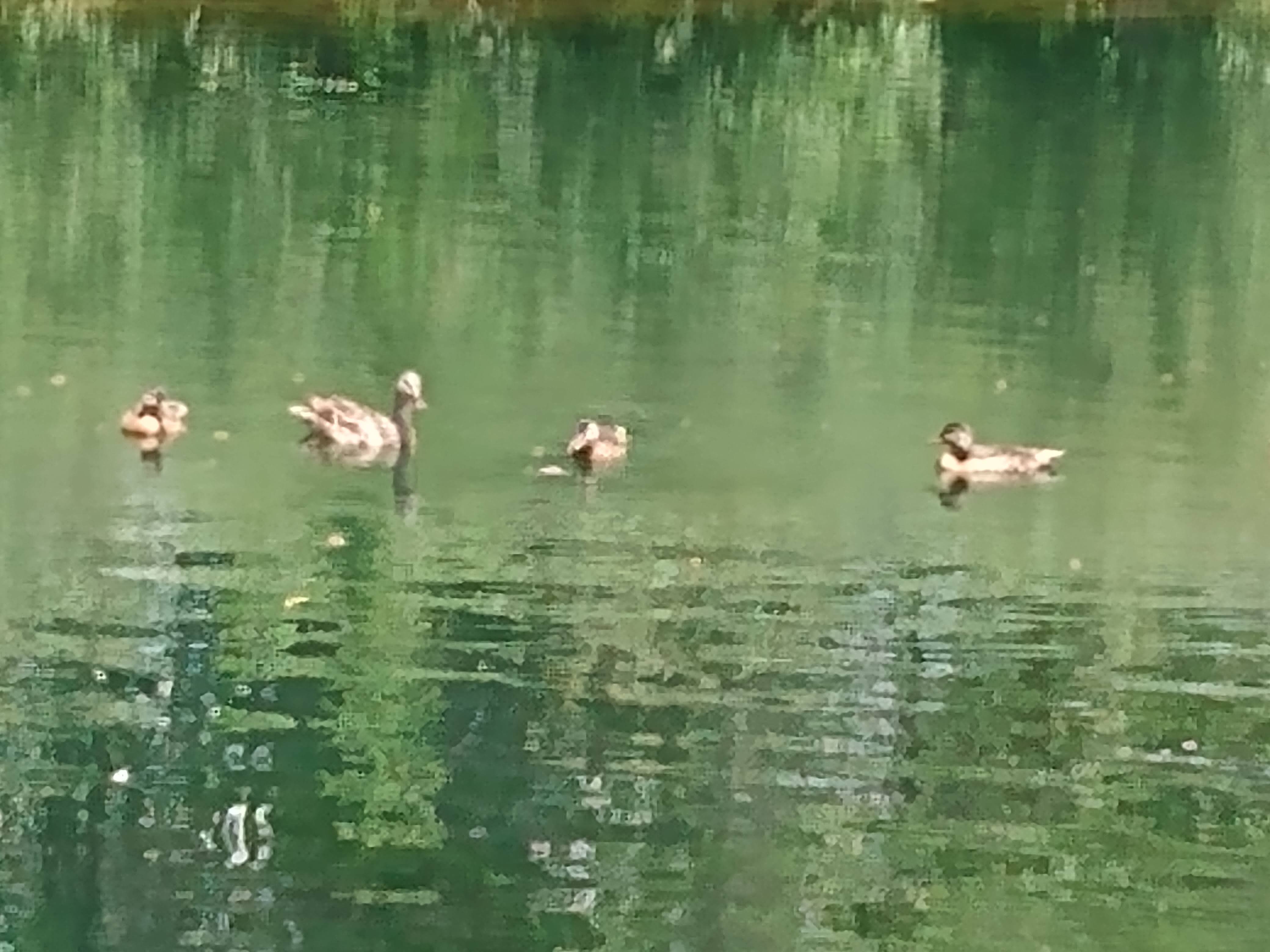
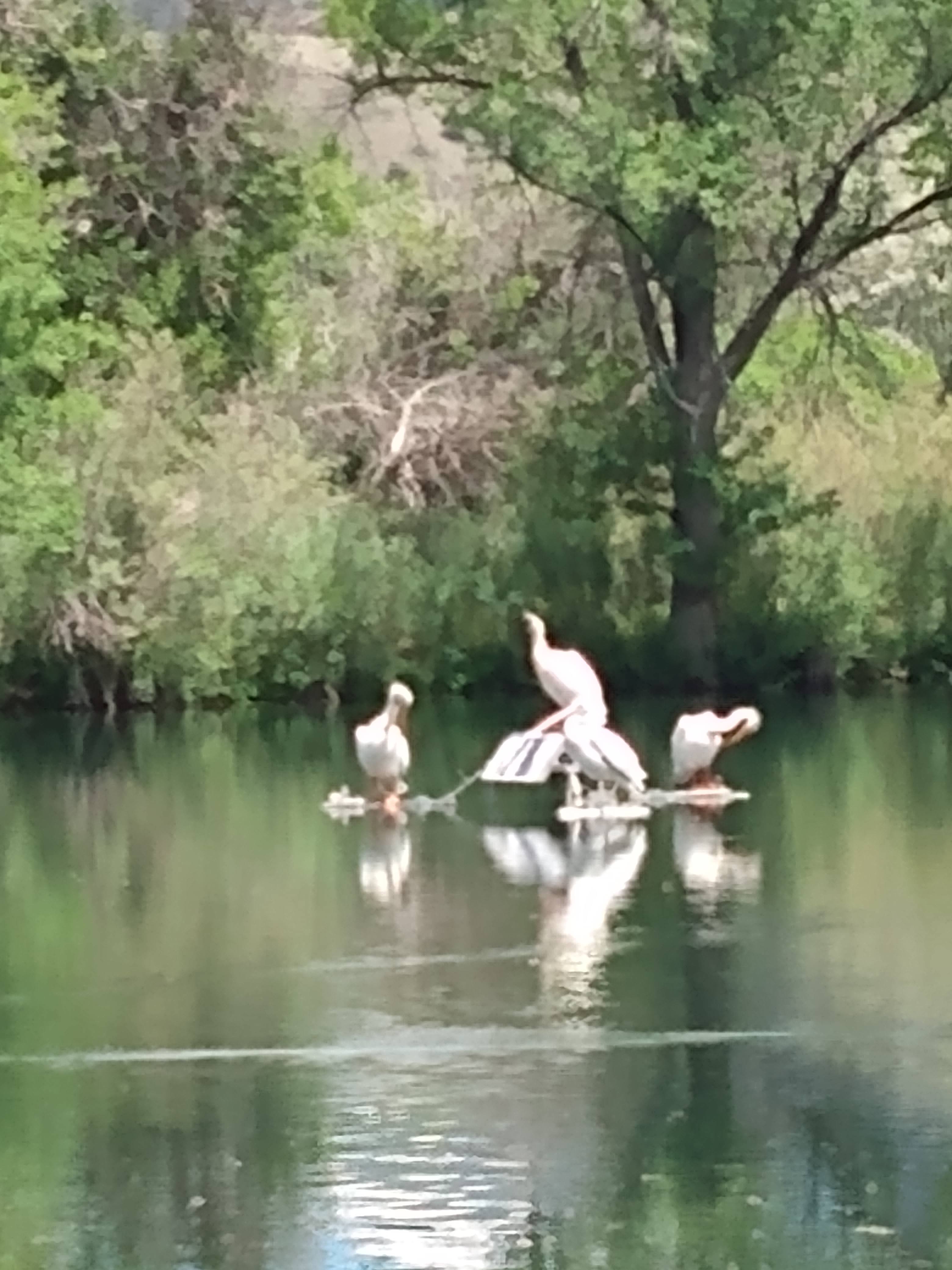
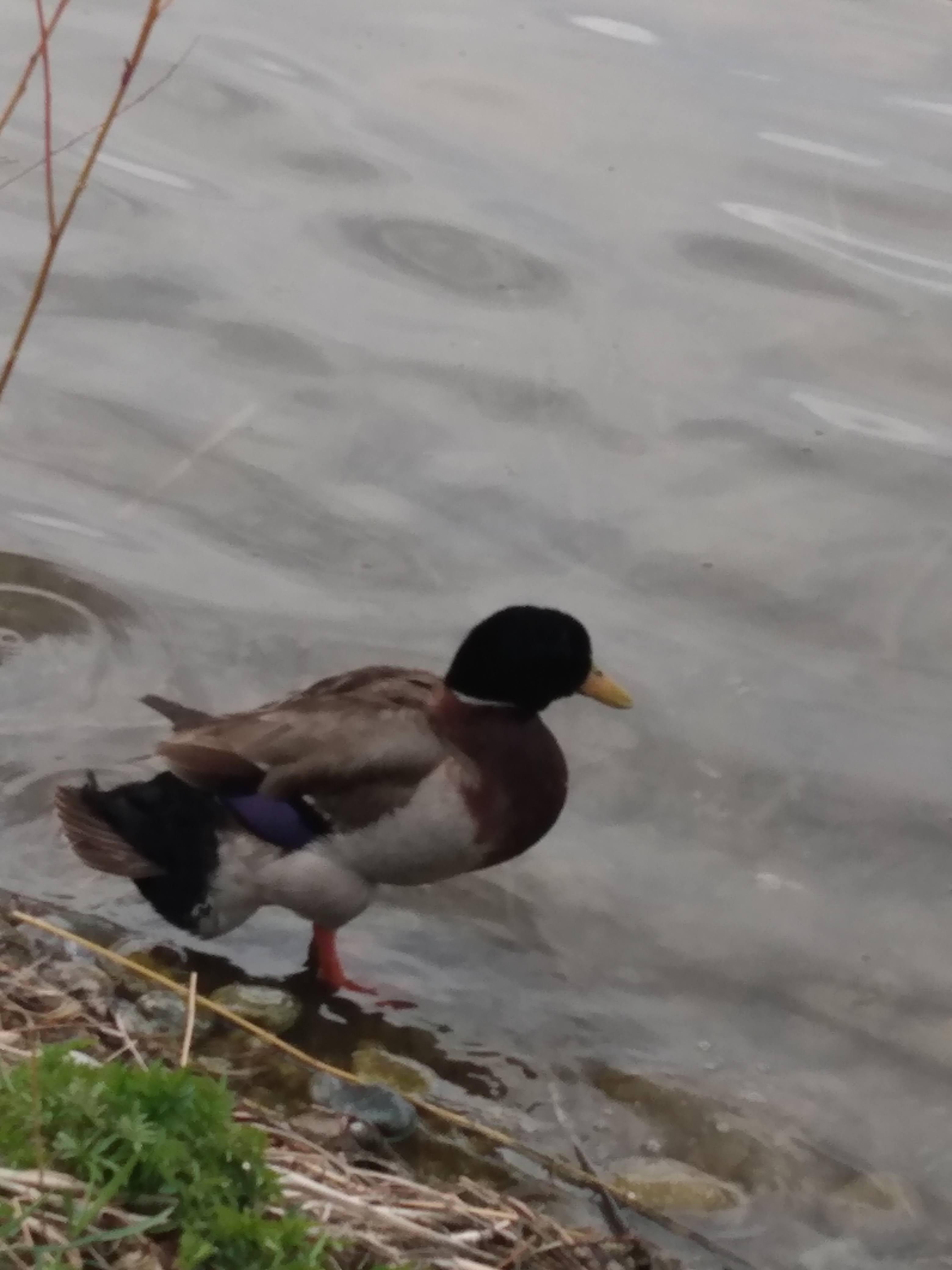
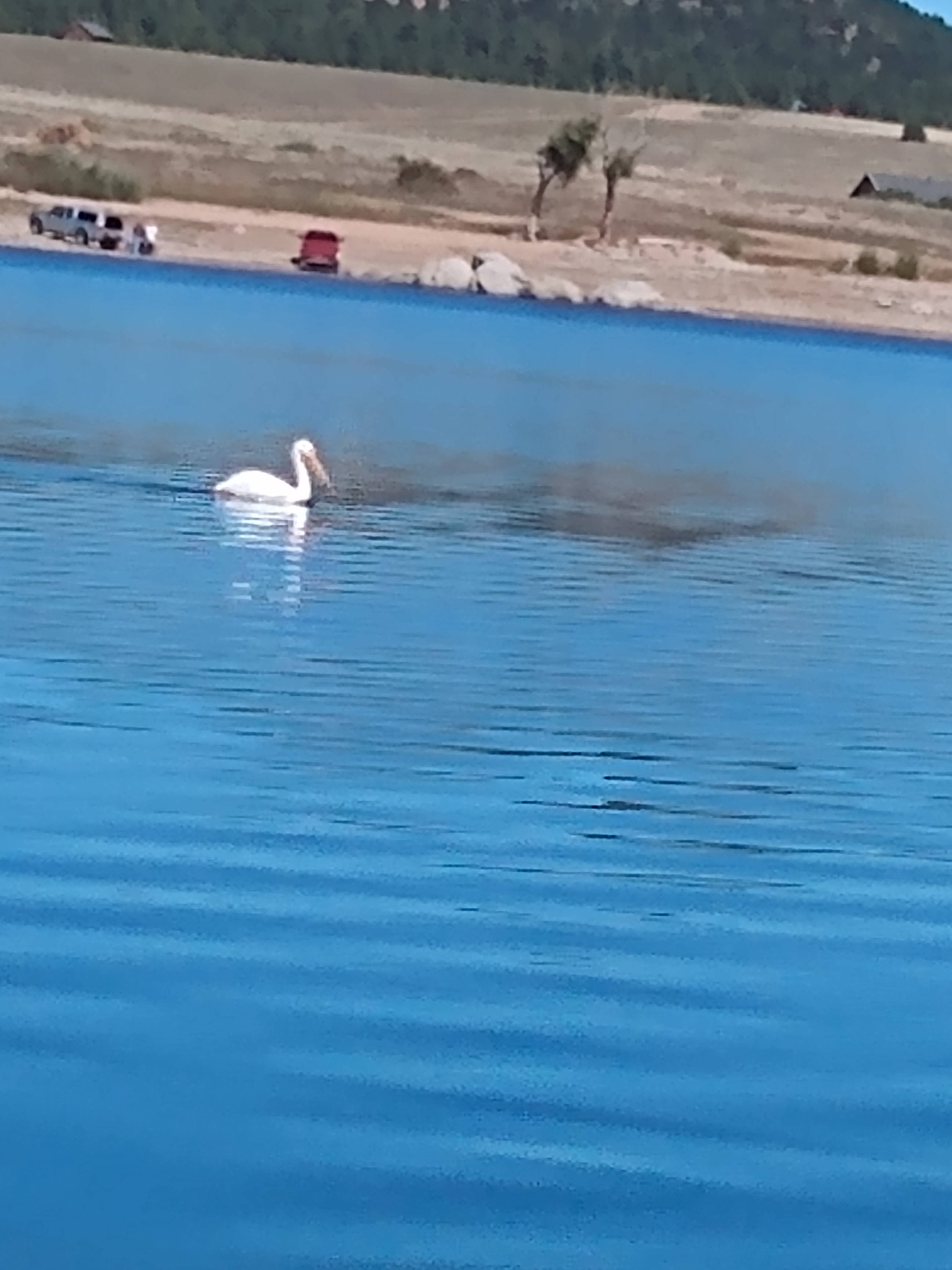
I also see wild turkeys in the area, and they have wondered onto my property on occasion. They travel in flocks and roost in the treetops.
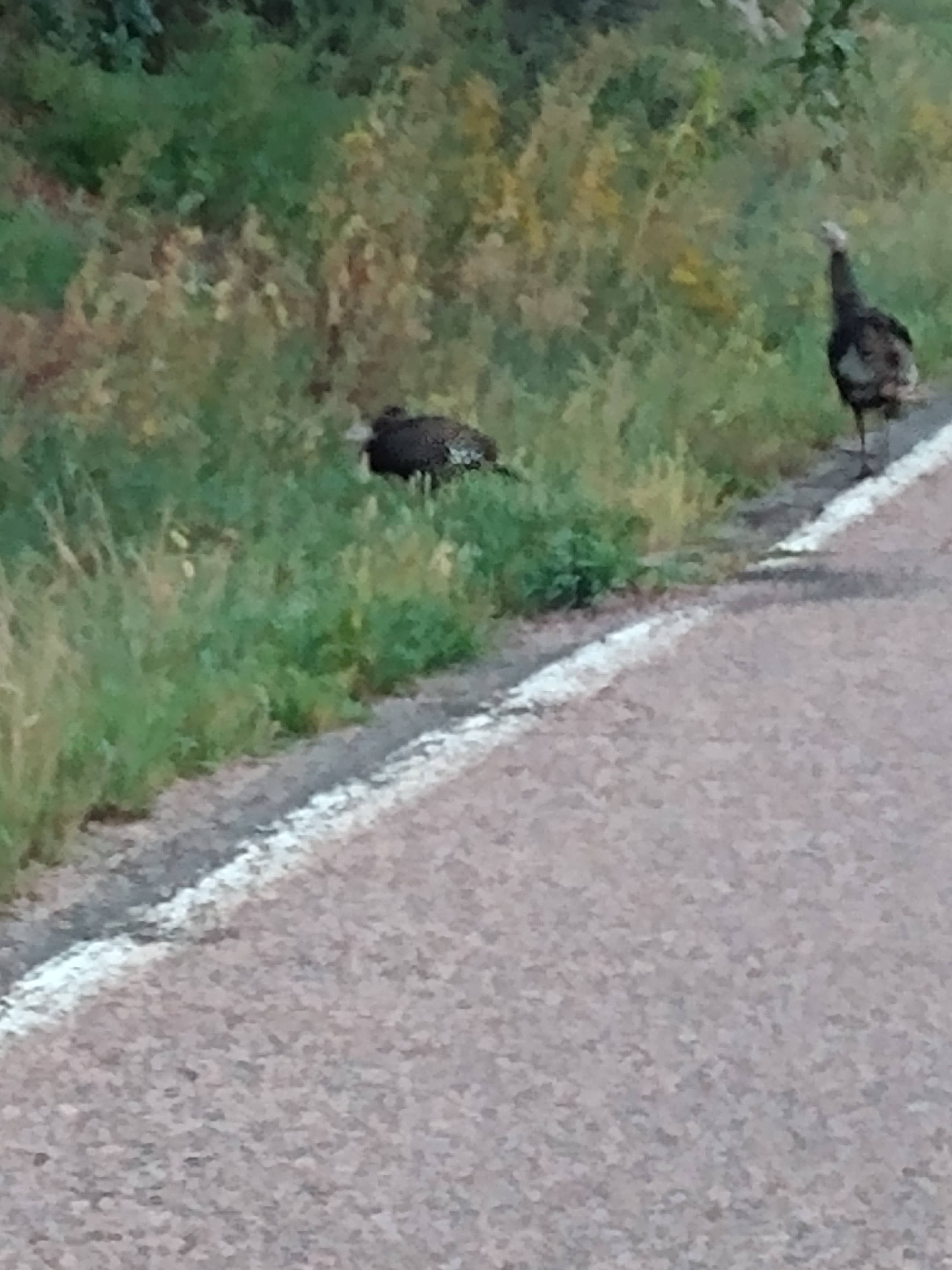
That’s what I have to share for this month. Are any of you at there birdwatchers? Tell me about the birds in your area.
Until next time…
About Kaye Lynne Booth
For Kaye Lynne Booth, writing is a passion. Kaye Lynne is an author with published short fiction and poetry, both online and in print, including her short story collection, Last Call and Other Short Fiction; and her paranormal mystery novella, Hidden Secrets; Books 1 & 2 of her Women in the West adventure series, Delilah and Sarah, and book 1 in her Time-Travel Adventure series, The Rock Star & The Outlaw, as well as her poetry collection, Small Wonders and The D.I.Y. Author writing resource.
Kaye holds a dual M.F.A. degree in Creative Writing with emphasis in genre fiction and screenwriting, and an M.A. in publishing. Kaye Lynne is the founder of WordCrafter Quality Writing & Author Services and WordCrafter Press, where she edits and publishes two short fiction anthologies and one poetry anthology every year amidst her many writing projects. She also maintains an authors’ blog and website, Writing to be Read, where she publishes content of interest in the literary world.
_______________________________
This post is sponsored by the My Backyard Friends Kid’s Book Series and WordCrafter Press.
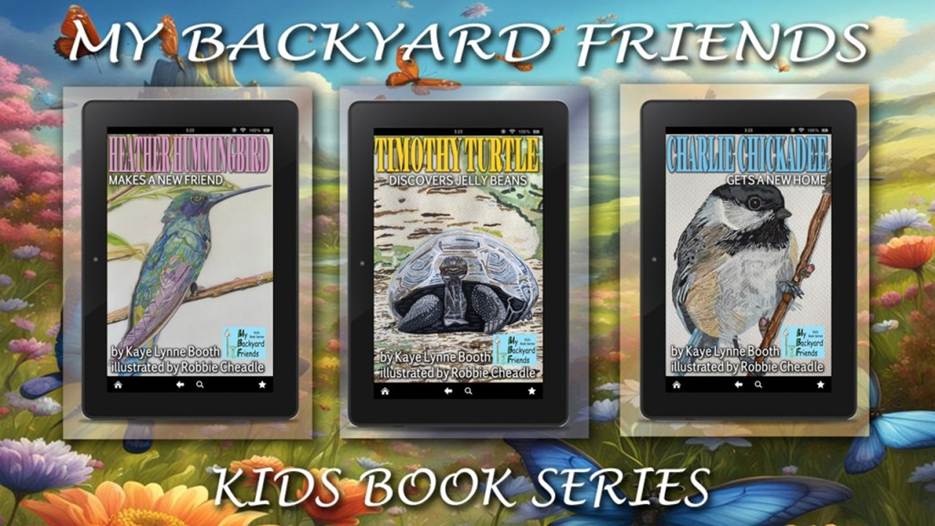
The My Backyard Friends kid’s book series is inspired by the birds and animals that visit the author Kaye Lynne Booth’s mountain home. Beautiful illustrations by children’s author, poet, and illustrator, Robbie Cheadle, bring the unique voices of the animal characters to life.
Get Your Copy Now.
Heather Hummingbird Makes a New Friend (Ages 3-5): https://books2read.com/MBF-HeatherHummingbird
Timothy Turtle Discovers Jellybeans (Ages 3-5): https://books2read.com/MBF-TimothyTurtle
Charlie Chickadee Gets a New Home (Ages 6-8): https://books2read.com/MBF-CharlieChickadee
Share this:

Book Review: “Wild Seduction”
Posted: February 13, 2026 Filed under: Book Review, Books, Fiction, Review, romance, Western, western romance | Tags: Amber Everly, Book Reveiw, Kaye Lynne Booth, western romance, Wild Seduction, Writing to be Read Leave a comment
About Wild Seduction
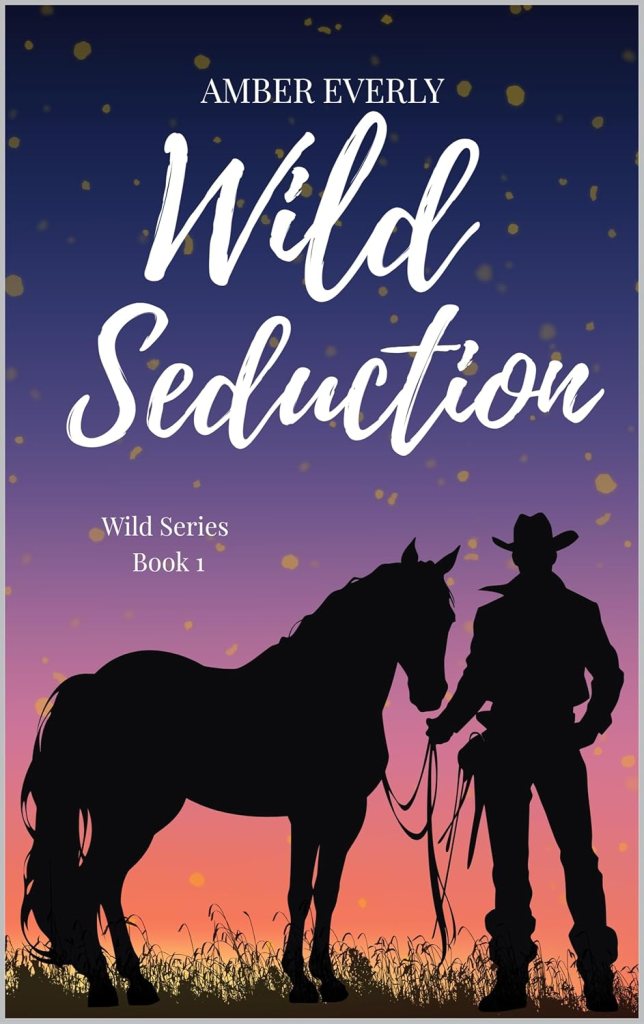
Dr. Rowan Ashford is an elite equine trauma surgeon—precise, ambitious, and on the run from a career-ending crisis. Her task is simple: travel to the snowy isolation of Montana, save a prize stud named Legacy, and earn enough to wipe out a crushing, $500,000 debt. The only thing standing between her and financial freedom is Jake Wild, a formidable, stone-cold rancher whose only priority is the bottom line—the crippling ledger of Wild Acres.
Haunted by his father’s legacy of failure, Jake views Rowan as a temporary, high-cost asset. He’s determined to keep the brilliant, fiery surgeon who saved his horse at arm’s length, fearing that any emotional attachment will lead to the ultimate loss. But when a brutal winter blizzard traps them alone in the isolated ranch house, the fight for survival quickly ignites a desperate, undeniable passion.
Under the pressure of a life-or-death rescue, Jake’s stoic shell shatters, revealing the vulnerable man beneath. Rowan forces him to choose: cling to the past and the fear of commitment, or embrace a future where their passion is matched by a powerful, multi-million dollar partnership. The seduction of Wild Acres is fierce, but the vow they make in the firelight is forever.
Purchase Link: https://www.amazon.com/Wild-Seduction-Amber-Everly-ebook/dp/B0FWV7DNMY
My Review of Wild Seduction
I received a free digital copy of Wild Seduction, by Amber Everly, from the review program on Sandra’s Book Club in exchange for an honest review. All opinions stated here are my own.
I chose this book because I liked the cover. The cover image and the title told me the story would be western romance, which is right up my alley. Although I’m not a big romance reader, in 2018, I was a judge for the Western Writers of America Spur awards and romance was my category, so I can honestly say I’ve read a lot of western romance.
Luke Wild is a traditional rancher, who values the old ways handed down by his father. He bears the weight of his father’s legacy, but feels inadequate to carry it on, especially when the ranch is failing and on the verge of going under. Rowan is the headstrong veterinarian who can save his prize horse and the ranch with all her modern medicine and equipment, if he’ll give her control to do so. Two strong willed characters, they go head-to-head in the struggle to save the horse and accept each other for their strengths.
In Wild Seduction, Everly follows classic romance story structure, for the most part, and romance tropes, making this book 1 in the series. She veers from the standard his view/her view with alternating chapters by adding more than main two P.O.V. characters, Luke and Rowan, including brief chapter viewpoints of brothers Nick and Mike , and that of foreman Pete. We don’t hear a lot from these other characters, and I found it kind of distracting, as I couldn’t see the author’s purpose in including them. If they were being introduced because their stories will be told in subsequent books in the series, they did not feel important enough here, I felt like they were just there to make the reader aware of the characters, but that could have been accomplished through the viewpoint of Luke, and not felt out of place. That being said, I felt the alternating chapters worked well to let the story unfold.
I had some difficulty relating to the characters for a couple of different reasons. One, I am not familiar with the ranching world or the veterinary world, but Everly did a great job of introducing me to these other areas and educating me in an unobtrusive way. But also, these character’s insight is way too clear to be believable. Luke knows he’s his own greatest obstacle because of his feelings of obligation to tradition and his father’s ways. Rowan knows the faults that are holding her back, giving both of them clear choices to make. But I find most people are not that honest with themselves and must struggle to identify and admit what’s blocking them before they can deal with it, and I don’t see that happening with either of these characters. Usually everyone around can see the trouble before the main character does. But these two know who they are and what they want quite clearly, leaving the path to creating a romance with their opposites on a straight path with few surprises.
A classic western romance with a good volley between character point of views. I give Wild Seduction four quills.

About Kaye Lynne Booth
For Kaye Lynne Booth, writing is a passion. Kaye Lynne is an author with published short fiction and poetry, both online and in print, including her short story collection, Last Call and Other Short Fiction; and her paranormal mystery novella, Hidden Secrets; Books 1 & 2 of her Women in the West adventure series, Delilah and Sarah, and Book 1 in her Time-Travel Adventure series, The Rock Star & The Outlaw, as well as her poetry collection, Small Wonders.
Kaye holds a dual M.F.A. degree in Creative Writing with emphasis in genre fiction and screenwriting, and an M.A. in publishing. Kaye Lynne is the founder of WordCrafter Quality Writing & Author Services and WordCrafter Press, where she edits and publishes two short fiction anthologies and one poetry anthology every year amidst her many writing projects. She also maintains an authors’ blog and website, Writing to be Read, where she publishes content of interest in the literary world.
________________________________________
Kaye Lynne Booth does honest book reviews on Writing to be Read in exchange for ARC digital copies, (she also accepts print copies). Have a book you’d like reviewed? You can request a review on the Book Review tab above.
Share this:

Read & Cook – Rhyming Dreams by Nicole Sara and Multicoloured Jelly Cupcakes
Posted: February 11, 2026 Filed under: Book Review, Collection, Poetry, Read and Cook, Recipes, Review | Tags: #ReadandCook, #RobbieCheadle, Book Reveiw, Nicole Sara, Poetry, Recipes, Rhyming Dreams, Writing to be Read 32 CommentsRhyming Dreams by Nicole Sara
What Amazon says
Rhyming Dreams is an enchanting and engaging collection of poems about the heart’s winding journey through deep wistful longing towards bliss and belonging along the meandering road of love and loss, hope and healing. This book is for anyone who dreams a lot, loves deeply, and has both good and bad days.. like steps on a pathway, be them confident or hesitating, nevertheless tirelessly searching for happiness in the enjoyment of small things around, yet so sweet, that life has to offer.
Each and every poem in this debut collection is deeply rooted in personal moments and experiences but still wonderfully universal, so that you feel taken by the hand and shown the beauty and brightness of it all, thus wholeheartedly invited to gently give yourself grace beyond the sadness of blue gloomy days, the tears or the brokenness.
This collection of beautifully flowing and uplifting verse is a soothing balm for the soul in search of serenity, helping the reader to reach peaceful shores deep within.
for here, on Earth, you and I
bearing within us the sky
we dance away beneath whispering stars
trying to reach beyond rails and bars
(fromKinship)
My review
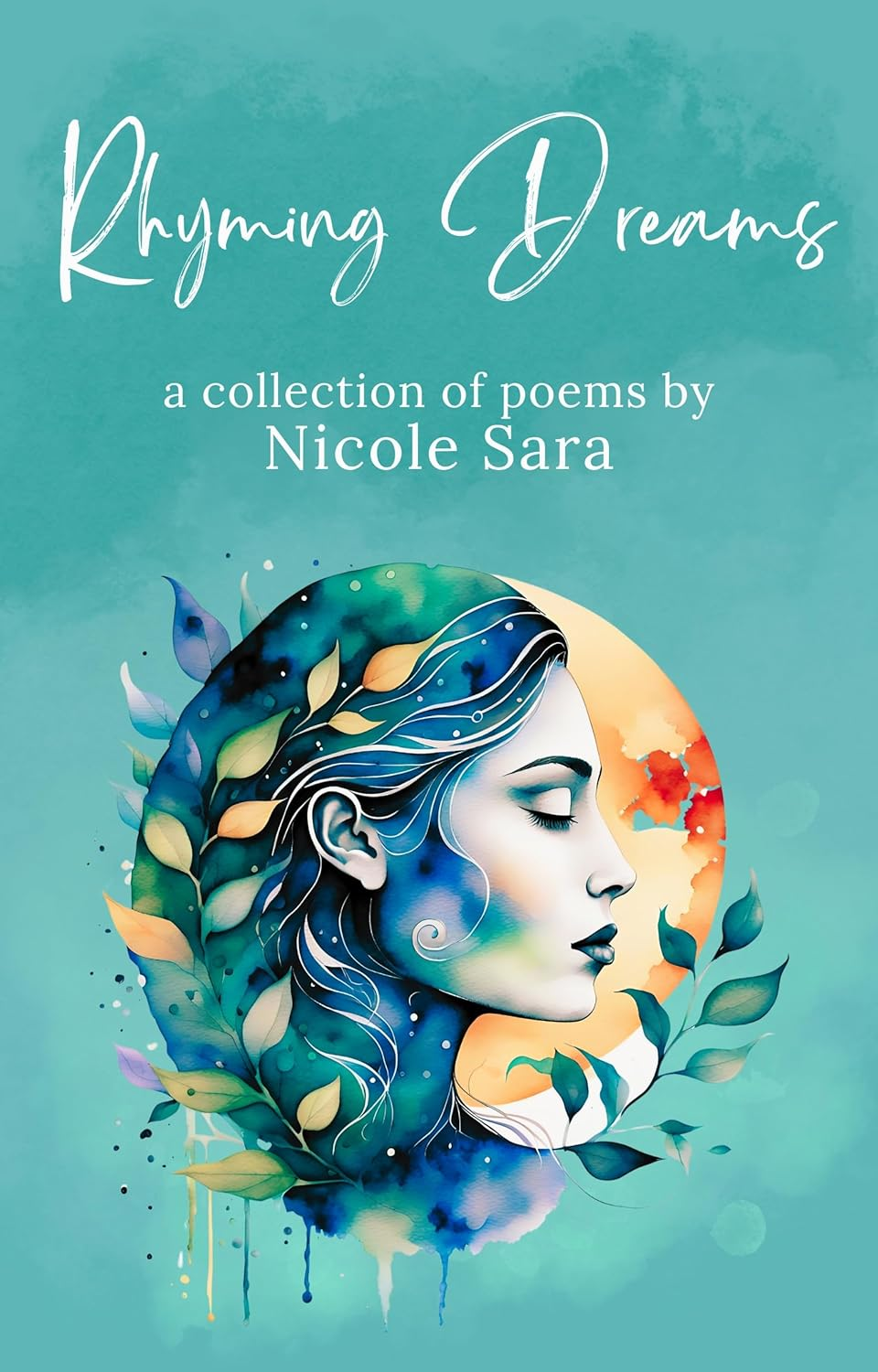
The poetry content of Rhyming Dreams is a delightfully ethereal as its striking cover of a female goddess in shades of blue against a turquoise background. The poet introduces this collection with an overview about the large variety of different steps she has taken during her life and how they have led her on different journeys. Some steps are hard to take and some are taken quickly, heedless of potential danger, but all lead to change. The overarching message in this introduction and in this book, is that no matter how tough life gets, our feet always eventually grow wings again and our steps led us upwards, in pursuit of our dreams and better opportunities.
Many of the poems are written in rhyming verse which is a favourite form of mine, and all are exquisitely beautiful. Each poem is matched with one of the poet’s wonderful colour photographs that compliment the words. One of the objectives of this collection is to create and share beauty by engaging all of the senses in a sensuous and vivid way. It creates a path of poems to joy and gratitude.
One of my favourite poems in the collection is called Starry Steps and it provides a small peek into the collection.
Starry Steps
“to step on stairs
of stars
to breathe in their light,
their dream
touching their statin star dust
beyond clouds
and the moon…
smiling
from within their shine
and hiding behind veils of rays
to fall asleep
sun in your heart…”
A poetry collection that uplifts and inspires.
Purchase Rhyming Dreams by Nicole Sara from Amazon US here: https://www.amazon.com/Rhyming-Dreams-Nicole-Sara-ebook/dp/B0DCZXWMBF
Multicoloured Jelly Cupcakes

Ingredients
1 each red, green, orange, blue and pink jelly; 1 lemon jelly; 125 ml evaporated milk; and 250 ml clear apple juice
Method
Make up the red, green, orange, blue and pink jellies according to the instructions on the packet. When set, chop the jellies roughly into squares. Heat the apple juice and dissolve the lemon jelly in the juice and allow to cool. Add the slightly beaten evaporated milk. Place cupcake holders on a baking tray and fill them to three quarters full with different coloured squares of jelly. Cover the jelly pieces with the lemon mixture. Place in the refrigerator to set overnight.
About Robbie Cheadle
Robbie also has two novels and a collection of short stories published under the name of Roberta Eaton Cheadle and has horror, paranormal, and fantasy short stories featured in several anthologies under this name.
You can find Robbie Cheadle’s artwork, fondant and cake artwork, and all her books on her website here: https://www.robbiecheadle.co.za/
Find Robbie Cheadle
Blog https://wordpress.com/home/robbiesinspiration.wordpress.com
Bluesky https://bsky.app/profile/robbiecheadle.bsky.social
YouTube https://www.youtube.com/channel/UCVyFo_OJLPqFa9ZhHnCfHUA
Goodreads https://www.goodreads.com/author/show/15584446.Robbie_Cheadle
_________________________________
Did you know you can sponsor your favorite blog series or even a single post with an advertisement for your book? Stop by the WtbR Sponsor Page and let me advertise your book, or you can make a donation to Writing to be Read for as little as a cup of coffee, If you’d like to show your support for this author and WordCrafter Press.
___________________________________
This segment of “Read and Cook with Robbie Cheadle” is sponsored by WordCrafter Press and their themed anthologies.

Tales From the Hanging Tree: Imprints of Tragedy: There exists a tree that is timeless, spanning across all dimensions, which absorbs every life as those who are hanged as they die… and it remembers every one. The stories within are a select few of the Tales From the Hanging Tree.
Curses: Chronicles of Darkness:
There are all types of curses.
Cursed places, cursed items, cursed people, cursed families.
Curses that last throughout time. Curses which can’t be broken. Curses which are brought upon ourselves. Curses that will kill you and those that will only make you wish you were dead.
Legends: Monsters That Go Bump in the Night: Coming in 2026
Share this:

Everyone is a Critic: My All-Time Favorites – Chick Flicks
Posted: February 9, 2026 Filed under: Everyone is a Critic, Movie Review, Movies, Review, romance | Tags: Chick Flicks, Everyone is a Critic, Movie Review, Movies, romance, Writing to be Read 4 CommentsFebruary is a month for lovers, what with St. Valentine’s Day and all, so I though it would be appropriate to begin this series in 2026 with the mushy romance stuff, so here are my all-time favorite chick flicks.
Chick Flicks – I may be an old chick, but I’m still a chick (Yep. I like Patrick Swayze)
There are some movies that I can watch over and over and never get tired of them because they are so fun to watch. I’m sure certain movies are the same for everyone, in this respect. For “Everyone is a Critic” in 2026, I’d like to talk about my all-time favorites, because if you haven’t seen them, they are worth watching, and if you have, maybe this will remind you how fun they are, and you’ll give one or two another go. I’ve categorized them by the values I find in them, or the reason that I watch them. Many of them, I have watched so many times, I can quote them word for word through many parts. (And, yes, I am old, but they really don’t make them like they used to.)
Now, here, I will share them with you in the hopes that you will get the same enjoyment I have from watching them. For those who have seen the movie, the quotes will bring certain scenes alive in their minds. And if you haven’t seen the movie and you watch it, when you see the scene, you’ll understand why I chose the quotes that I did.
Dirty Dancing (1987), with Patrick Swayze and Jennifer Grey
It was the summer of 1963, and Frances ‘Baby’ Houseman (Jennifer Grey) is spending it with her family at a Catskills resort. Bored and feeling out of place, she inadvertently discovers the underground world of dance through the resort’s entertainers. When one of the girls is unable to finish out their summer itinerary, Baby volunteers to train and take her place, putting her in direct contact and very close proximity of the lead male dance instructor, Johnny Castle (Parick Swayze).
This movie is total fantasy fulfillment for me. What I would have given when I was younger to be Jennifer Grey. This is a movie I never get tired of watching, even to this day.
Favorite Quote: “Nobody puts Baby in the corner.” – Johnny Castle (Swayze)
“Look, spaghetti arms. This is my dance space. This is your dance space. I don’t go into yours; you don’t go into mine. You gotta hold the frame.” – Johnny Castle (Swayze)
“I’m scared of what I saw, I’m scared of what I did, of who I am, and most of all I’m scared of walking out of this room and never feeling the rest of my whole life the way I feel when I’m with you.” – Baby (Grey)
“We’re supposed to do the show in two days, you won’t show me the lifts, I’m not sure of the turns, I’m doing all this to save your ass, what I really want to do is drop you on it!” -Baby (Grey)
Favorite Scene: The final dance & the lift on the log
Ghost (1990), with Demi Moore and Patrick Swayze
When banker Sam Wheat (Patrick Swayze) is murdered, leaving his girl Molly (Demi Moore) grieving in their new loft apartment. But Sam doesn’t cross over and learns that his best friend, Carl, is behind his murder. Now he must find a way to warn Molly from beyond the grave, as Carl tries to move in on Molly.
This is another movie which I love. Of course, it helps that the male star is Patrick Swayze. I would watch it just for that reason, but it also has a original paranormal story line of a true love cut short, and the character of Oda Mea (Whoopi Goldberg), is so entertaining that both merit kudos in their own rights.
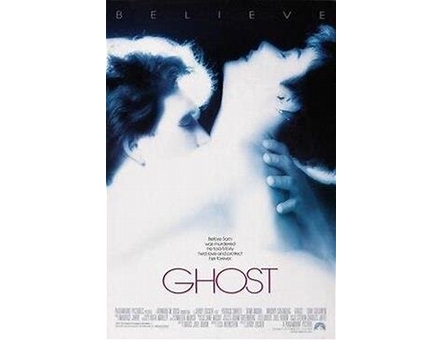
Favorite Scene: The pottery wheel scene, (of course) & the subway scene where he forces the other ghost to teach him to manipulate solid matter in his ephemeral form.
Road House (1989), with Patrick Swayze and Sam Elliot
I watch this movie strictly because of the stars. I like Sam Elliot, but I’ve always had a thing for Patrick Swayze. A young Swayze is just eye candy that I never get tired of seeing, even at my age. He really shows it off in this one, which only adds to the story line of big guy pushing the little guy and the little guy pushing back, with some pretty great fights, mixed with a romance story line and some very hot scenes with Swayze. Winner all around.
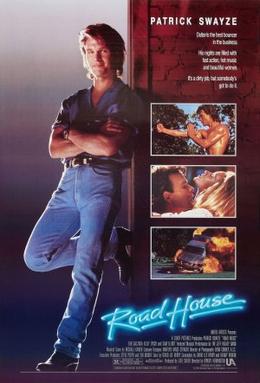
Favorite Scene: Any scene with Swayze in it.
Pretty Woman (1990), with Julia Roberts and Richard Gere
What starts as a week-long business arrangement between a billionaire Edward Lewis (Richard Gere) and a high-end hooker, Vivian Ward (Julia Roberts), turns into something more in this ultimate rags to riches romance, changing the way they both view life, and love. It’s funny and entertaining, and good for a laugh every time.
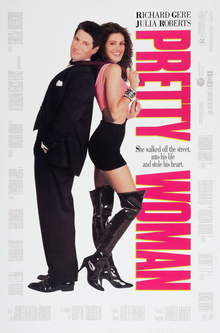
Favorite Scene: The bubble bath scene & the shopping spree
Favorite Quotes: “You and I are such similar creatures, Vivian. We both screw people for money.” – Edward Lewis (Gere)
“Do you have anything in this shop as beautiful as she is?” – Edward Lewis (Gere)
“I can do anything I want to, baby. I ain’t lost.” – Vivian Ward (Roberts)
“In case I forget to tell you later, I had a really good time tonight.” – Vivian Ward (Roberts)
” Did I mention my leg is forty-four inches from hip to toe; so, basically, we are talking about eighty-eight inches of therapy wrapped around you for the bargain price of three thousand dollars.” – Vivian Ward (Roberts)
“Big mistake. Big. Huge. I have to go shopping now.” – Vivian Ward (Roberts)
“Oh, it was so good, I almost peed my pants!” – Vivian Ward (Roberts)
Thelma and Louise (1991), with Susan Sarandon and Geena Davis
Thelma (Susan Sarandon) and Louise (Geena Davis) are friends to the end in this female bromance adventure. What starts out as a weekend road trip quickly turns into an adventure from which there is no turning back after a man tries to rape Thelma, and Louise comes to her aid and shoots him.
This is a story of female empowerment in spite of its tragic ending. An endearing tale of friendship that never gets old.
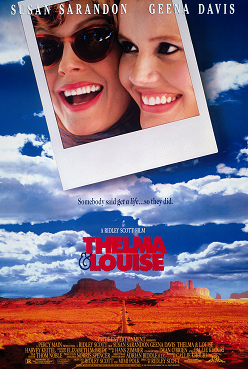
Favorite Scene: Outside the bar in the parking lot where Thelma is assaulted.
Favorite Quotes: “You shoot off a guy’s head with his pants down, believe me, Texas is not the place you wanna get caught.” – Louise (Sarandon)
“You’ve always been crazy, this is just the first chance you’ve had to express yourself.” – Louise (Sarandon)
“Well, we’re not in the middle of nowhere, but we can see it from here.” – Louise (Sarandon)
“Hey Louise, better slow down, I’ll just die if we get caught over a speeding ticket.” – Thelma (Davis)
“I’m not sorry that son-of-a-bitch is dead. I’m just sorry it was you that did it and not me.” – Thelma (Davis)
“Good mornin’ ladies and gentlemen. This is a robbery. Now, if nobody loses their head, nobody will lose their head. Simon says y’all lie down on the floor, please, right away. Thank you. Ma’am, would you get down? Not you, sir. Let’s see who’ll win a prize for keepin’ their cool. Sir, will you do the honors? Take all the cash out of the drawer, put it in a paper bag.” – Thelma (Davis)
About Author Kaye Lynne Booth
For Kaye Lynne Booth, writing is a passion. Kaye Lynne is an author with published short fiction and poetry, both online and in print, including her short story collection, Last Call and Other Short Fiction; and her paranormal mystery novella, Hidden Secrets; Books 1 & 2 of her Women in the West adventure series, Delilah and Sarah, and book 1 in her Time-Travel Adventure series, The Rock Star & The Outlaw, as well as her poetry collection, Small Wonders and The D.I.Y. Author writing resource.
Kaye holds a dual M.F.A. degree in Creative Writing with emphasis in genre fiction and screenwriting, and an M.A. in publishing. Kaye Lynne is the founder of WordCrafter Quality Writing & Author Services and WordCrafter Press, where she edits and publishes two short fiction anthologies and one poetry anthology every year amidst her many writing projects. She also maintains an authors’ blog and website, Writing to be Read, where she publishes content of interest in the literary world.
_________________________________
Did you know you can sponsor your favorite blog series or even a single post with an advertisement for your book? Stop by the WtbR Sponsor Page and let me advertise your book, or you can make a donation to Writing to be Read for as little as a cup of coffee, If you’d like to show your support for this author and WordCrafter Press.
___________________________________
This segment of “Everyone is a Critic” is sponsored by the Time Travel Adventure Series and WordCrafter Press.
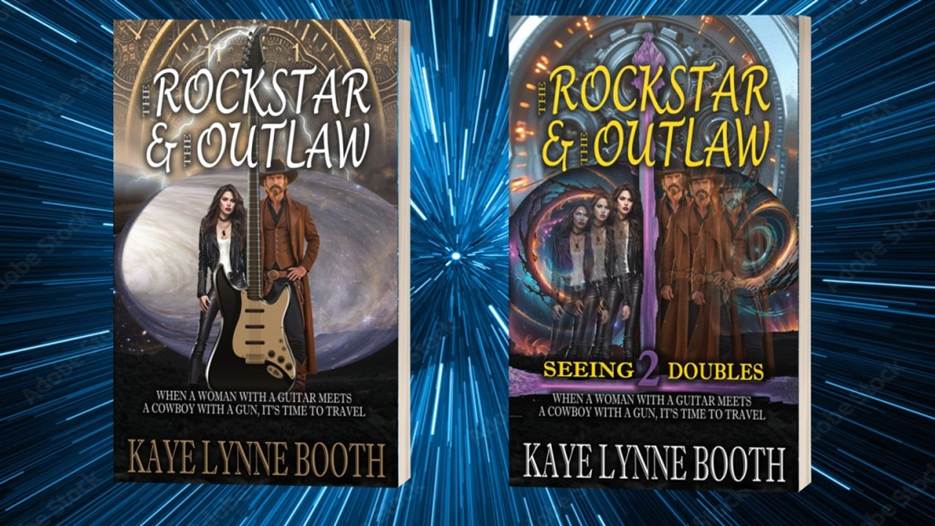
When a Girl with a Guitar Meets a Man with a Gun, It’s Time to Travel
The Rock Star & The Outlaw: https://www.amazon.com/Rock-Star-Outlaw-Time-Travel-Adventure-ebook/dp/B0CJBRRCN1/
The Rock Star & The Outlaw 2: Seeing Doubles: Coming in March 2025
Share this:

Undawntech: The Beginning of the Analog Mind
Posted: February 6, 2026 Filed under: AI Technology, Undawntech | Tags: AI Technology, Analog Mind, Baby boomers, Gen X, generations, Life, millennials, Undawntech, Writing to be Read Leave a comment
The last of the free-range children live in the X generation. We rode our bicycles to each other’s houses, sometimes miles away. We swam at the local watering hole, or city pool. We walked home from school. We worked out of the family home or business. We watched PG-13 and R rated movies without our parents. When our parents were at work, we unlocked the front door after school and waited for them to return home for dinner. We were given responsibility beyond our years. Our parents never verified where we were unless we didn’t call to check-in, or arrive home at sunset.
Gen X vs Other Generations
Generation X bridges the gaps in society and culture between the Baby Boomers, the children of the Depression Era parents of World War II, and the algorithmic digital minds of the Millennials and Generation Z. Some say that we are a forgotten generation. With all the talk of the younger and aging classes, Gen X could be viewed in this way.
However, we are so much more than what lies in the shadows of other people’s memories. Our generation of kids were born between 1965 and 1980, and it wasn’t an easy time. Our parents dealt with a two-income household as the economics of Globalism took root as the Berlin Wall fell. Many people of this era worked and went to college; there were no free passes. We wanted it all: family, career, and friends. Yet, we kept a sense of humor about it all.
Britannica: www.britannica.com/topic/Generation-X
The Psychology of Generation X Explained: www.newtraderu.com/2026/02/04/the-psychology-of-generation-x-explained
The Last Analog Mind: A Psychological Autopsy of Generation X: www.youtube.com/watch?v=tXeEElTfl8o
The Future Resides in the Past
Why are we discussing Generation X? Technology. Boomers are retiring from the rat race. Millennials and Generation Z are rising through the ranks of society. The pillars of stability and wisdom are being handed over to Generation X to navigate the coming breakthroughs in technology.
The Millennials and Gen Z have no analog frame of reference with which to question and ascertain, what is real or what is Memorex? Only Gen Xers will understand that old commercial. Will you know what is or isn’t Artificial Intelligence (AI), if you grew up with it? Gen X can recognize digitization.
This key factor of knowing when something is not what it appears may be the single greatest gift that humanity could receive. We didn’t grow up in an artificial world. We didn’t rely on the news to inform us. Generation X sought knowledge and wisdom.
Now, we have data and data sets. We have curated news and information. We have a prison world of technology. The internet has a kill switch. Your car monitors your driving. The thermostat in your home can be turned off by the electric company.
Generation X never had to deal with the outside looking in. That was our job. Here, we are having to be that sentry, again.
What the Next Generations Lack
Oh, the hate mail in the comments section…
Since Millennials and Gen Z never new a world without the fall out of 9/11, had to deal with two countries with nuclear weapons goading each other every week, or an economy with millions on unemployment, they rely on technology to cloister them in virtual reality and gaming. Those mental escapes don’t create culture or nurture society.
Reliance on all things fictional makes you weak.
Here are some disturbing statistics:
Gen Z may think they have it rough but millennials are the most burned-out generation: https://fortune.com/article/millennials-most-burnt-out-generation-more-than-gen-z
“A 2023 health survey from Cigna revealed 98 percent of Gen Z workers are actively dealing with symptoms of burnout.
Following efforts to rebuild after the pandemic, a 2022 survey by Deloitte found that 46 percent of Gen Z respondents and 45 percent of millennials felt burned out due to the pressures of their working environment. The same report found that 44 percent of Gen Z workers and 43 percent of millennials have rejected job opportunities because of worries about how it may affect their mental health.”
www.newsweek.com/gen-z-millennial-workers-lose-ambition-2023476
“Resume Genius asked 625 U.S. hiring managers which generation is the most challenging to work with, and 45% pointed to Gen Z, the generation born between 1997 and 2012. What’s more, 50% of Gen Z hiring managers admitted that their own generation is the most difficult to manage.”
How Generation X Can Bridge the Gaps in Humanity created by Technology?
Mentor your local burn-out. Mentor the generations coming up. Mentor someone before they fail.
Gen X is more than an age statistic that employers refuse to champion. Our generation of kids can become the greatest asset to our culture and society by fostering knowledge, commitment, expectations, and wisdom.
The analog mind has no constraints on creativity, memory, or forward-thinking. Technology has not slowed down our mental or emotional capacities in order to rise above us. We are free-range.
Let’s begin another era of the human analog and outsmart technology.
We became our own heroes.
Now, let’s be theirs.
_________________________________
Want more analog mind?
Read Kurst: A Salt Pines Mystery for an introduction to free-range thinker.
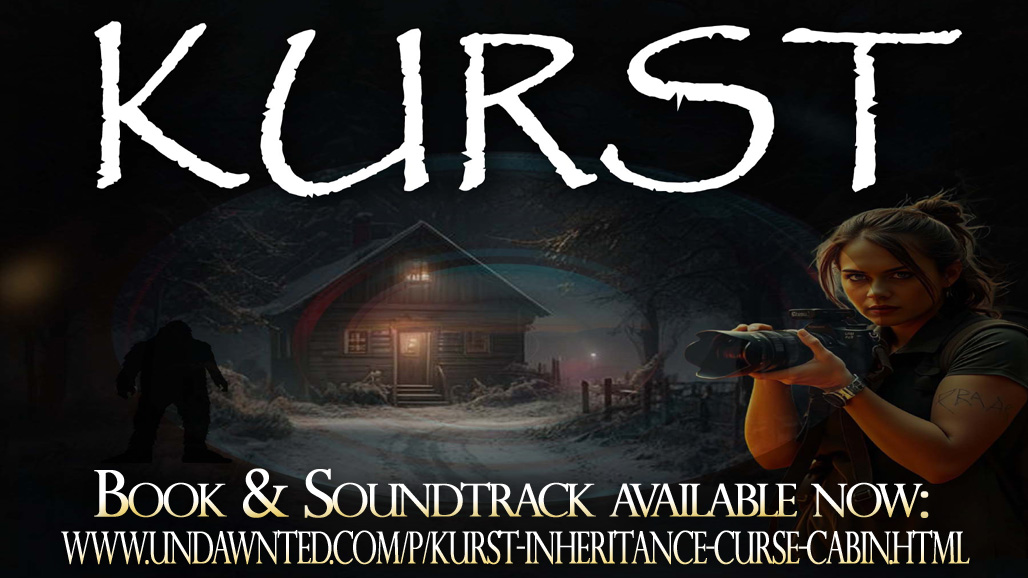
Karen Kurst comes into the legal possession of her deceased grandmother’s cabin in Salt Pines, Arizona. As she delves into the secrets of the quaint mountain village, she discovers that there is more than meets the eye. A mysterious creature roams the woods, a blended cryptid: Elemental, Sasquatch, and Skinwalker. The only way to contain this entity is through a magical spell passed down by her ancestor, Ralph Wallen II. Teaming up with the local indigenous sheriff, Karen is determined to break the family curse.
However, the question remains – will she have to sacrifice her own life to protect her newfound community?
Visit Kurst: www.undawnted.com/p/kurst-inheritance-curse-cabin.html
The short story is available in Midnight Garden anthology. books2read.com/MidnightGardenAnthology
The novelette is available now at these fine retailers: books2read.com/Kurst
—–~o0o~—oOo—~o0o~~—–
About DL Mullan
DL Mullan’s lecture, Spacescapes: Where Photography Ends; Imagination Begins, debuted at the Phoenix Astronomy Society, which then led to her Sally Ride Festival lectures. Her presentation, Bridging the Gap between Technology and Women, won her accolades at a community college’s Student Success Conference. She has been a panelist at speculative fiction, science fiction, and other regional conventions. Her digital exhibition pieces have won awards at convention art shows, as well as garnered her Second Premium at the Arizona State Fair. As an independent publisher, she uses her technical background to innovate in the creative arts.
As a creator, Ms. Mullan, began writing short stories and poetry before adolescence. Over the years, she has showcased her literary talents by self-publishing several collections of her poetry. She also writes novels, designs apparel, and creates digital art. DL Mullan‘s creative writing is available in digital and print collections, from academia to commercial anthologies. She is an award-winning digital artist and poet.
Currently, she has embarked on writing her multi-book Legacy Universe, Supernatural Superhero Series, as well as creating original soundtracks for her publications and independent electronic music albums, featured on SoundCloud and YouTube.
DL Mullan holds a Master of Arts in Teaching and Learning with Technology, and is a syndicated columnist, writing the creative nonfiction, Undawntech.
For news and updates, subscribe to the Undawntable Newsletter. Find DL on Amazon, Facebook, LinkedIn, and YouTube via her website.
Be sure to subscribe to her newsletters and follow her on social media. For further information, visit her at www.undawntech.com and www.undawnted.com.
______________________________________
Did you know you can sponsor your favorite blog series or even a single post with an advertisement for your book? Stop by the WtbR Sponsor Page and let me advertise your book, or you can make a donation to Writing to be Read for as little as a cup of coffee, If you’d like to show your support for this author and WordCrafter Press.
_____________________________________
This segment of “Undawntech” is sponsored by the Midnight Anthology Series and WordCrafter Press.
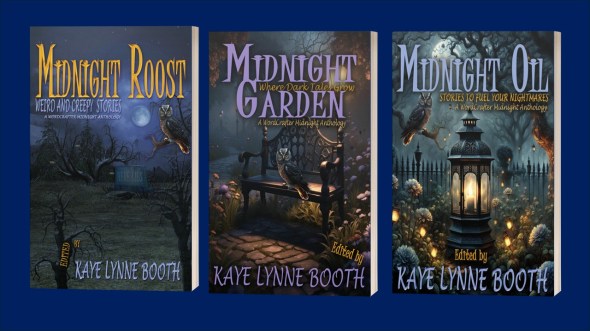
Midnight Roost: Weird and Creepy Stories: 20 authors bring your nightmares to life in 23 stories of ghosts, paranormal phenomenon and the horror from the dark crevasses of their minds. Stories of stalkers, both human and supernatural, possession and occult rituals, alien visitations of the strange kind, and ghostly tales that will give you goosebumps. These are the tales that will make you fear the dark. Read them at the Midnight Roost… if you dare. https://www.amazon.com/Midnight-Roost-Kaye-Lynne-Booth-ebook/dp/B0CL6FPLVJ
Midnight Garden: Where Dark Tales Grow: 17 authors bring you 21 magnificent dark tales. Stories of magic, monsters and mayhem. Tales of murder and madness which will make your skin crawl. These are the tales that explore your darkest fears. Read them in the Midnight Garden… if you dare. https://www.amazon.com/Midnight-Garden-Where-Tales-Anthology-ebook/dp/B0DJNDQJD3
Midnight Oil: Stories to Fuel Your Nightmares: 14 authors bring you 16 dark tales that explore your deepest fears. These are the stories which nightmares are made of. Tales of monsters, mayhem, and madness which will make you shiver in the dark. Read them while you burn the Midnight Oil… if you dare. https://books2read.com/Midnight-Oil
Share this:

LINDSEY’S WRITING PRACTICE: Book Review
Posted: February 4, 2026 Filed under: Anthology, Book Review, Books, Dark fiction, Fiction, Lindsey's Writing Practice, Review, Short Fiction, Stories | Tags: Book Reveiw, Lindsey Martin-Bowen, Lindsey's Writing Practice, Midnight Garden, Writing to be Read 3 Comments
Anthology Review: MIDNIGHT GARDEN: Where Dark Tales Grow

Purchase Link: https://books2read.com/MidnightGardenAnthology
Readers who relish dark tales will love this collection of numerous stories that often blend humorous word play to add levity to some very dark situations. For example, this second anthology in the Midnight Anthology Series, MIDNIGHT GARDEN, opens with award-winning author Paul Kane’s “Drip Feed.” The story incorporates light-hearted word-play into a grim setting–the polar opposite of the romantic backdrop in Kane’s “The White Lady,” from the 2023 MIDNIGHT ROOST collection.
In fact, this dark tale unsettled my psyche so much, I almost refused to comment upon it until after I read it a second time. Then, I focused upon its metaphoric interpretation,which is quite valid, especially considering our current world situation. And like many stories in this group, this one reveals some strong feminist themes. Thus, I now urge readers to “hang in there” while they peruse this midnight story.
Likewise, Ell Rodman’s “The Drummer,” set four hundred years ago in “Cull County.”
(yes—look up the noun definition for “cull” to glean this story’s underlying interpretation), projects both in-depth—but frightening images. (Note it ends in a fiery place where the Drummer ”wore fitted black robes, bearing a massive wooden hammer and a dark shield.”) Along with incorporating history into this piece, Rodman’s detailed descriptions of the environment keep readers traveling a mysterious path to the tale’s conclusion.
Also suspenseful but not as grim,, DL Mullan’s “Kurst,” is one of my favorites in this collection. Set in Salt Pines, a village in Arizona, “between dreamy pine peaks and unfathomable horrors,” the story opens when Karen Kurst leaves her editing job to checkout the “Kurst inheritance” on the Toronto National Forest’s eastern edge. After she encounters Sheriff “Bear” Barrett, who offers her background about her inheritance and eading materials, this story takes readers on a wild—frightening—but fulfilling “ride.”
Another favorite, Roberta Eaton Cheadle’s “Amahle’s Demon” reveals how little we often understand about our fellow creatures, which can result in heartbreaking ends. One of six elephants comprising a “sanctuary herd” recently moved to “another kraal near the visitors’ centre, ready for the afternoon tour.” Unfortunately, a much smaller creature—and a human’s ignorance led to an ending that evoked my tears.
Denise Aparo’s “Jack Moon and the Vanishing Book” (also a favorite tale) takes readers on a magical adventure of the mind—or perhaps into a different dimension via a “much sought-after Vanishing Book that steals souls.” While enjoying this other worldly piece, readers may decide whether it’s an earthly adventure or a magical one while enjoying the ride.
.
As I mentioned in my review of Midnight Roost, I’m mostly a rom-com fan, and Jon Shannon’s “Stitch” could fall into that category. But with a warning: Yes, it’s a romantic story about the characters Andy, a taxidermist and his wife, Julie, a superb seamstress, and the unusual creations they build together, which many of their colleagues consider bizarre. This tale comes with a warning, too: Its ironic humor is quite dark—and leads to a surprise “tongue-in-cheek” ending.
Julie Jones’s “Black Moon” serves as an allegory much like stories from ancient Greece. In fact, it brings to mind C.S. Lewis’s novel, Till We Have Faces, based upon Greek mythological characters.
In contrast, “Antepenultimate,” Molly Ertel ‘s first person narrative, initially evokes chuckles at the narrator’s obsession with the ticking of an antique “KIT-Cat Klock” that began “talking” to her until the narrator became obsessed with an internal urge that leads her down a terrible—and terrifying path.
Similarly, Kaye Lynne Booth’s first -person narrator in “The Puppet Men,” another of my favorites, awakens in a pitch-black room, where she encounters “A thin sliver of light coming in under the door” that clued [her] “memory” to recount she was sleeping in a dark room in her grandmothers house. There, she also hears “high-pitched , twittering, kind of chirpy” voices coming from her grandmother’s felt puppet collection. As an adult, she remains obsessed with those voices she found so threatening that she puts off back surgery to avoid the anesthetic, which she fears will bring the “evil puppets” back into her life.
In a similar vein, Alex Constance’s “The Peddler,” another “dark” tale, serves as an allegory about the downfalls of greed. And Constance’s description of the peddler, “Ichabod” reminded me of Disney’s Ichabod Crane in Washington Irving’s “The Legend of Sleepy Hollow,” especially in Disney’s cartoon version of that tale.
Although Danacka Scrimshaw’s “The Fae Game” at first appears to be a much “lighter: tale than most of those in this collection, the “flip” at its conclusion inspires in the reader feelings that are quite eerie.,
Prolific author Joseph Carrabis penned five stories in this collection, each with merit:
—“Striders,” with a “just desserts” ending, this sci-fi piece gives another nod to feminism
—“Grande Ture,” a short, intense tale that creates a strong statement about AI.
—“The Last Drop,” which illustrates ignorance and bigotry often leads to the opposite of bliss.
—And what I consider Carrabis’s literary masterpiece in this collection,“The Tomb,” a deep tale centering around a blind man who undergoes an operation to retain his sight. Although its plot varies significantly from the Val Kilmer 1999 film, At First Sight. (based upon a true case study by Dr. Oliver Sacks), it shares one of the movie’s sequence of events that creates the stories’ themes about the protagonist: being blind, undergoing an operation that gives him sight, then becoming disoriented when adapting to a visual world—and realizing he had more “sight” in his physical blindness. (Carrabis’s tale contains more “dark” physical drama in its conclusion.)
Aptly scribed with engaging (albeit sometimes weird) characters, all stories in this collection entice readers via their talented, skilled authors. And even if a story is terribly dark, most readers would likely concur it ends with characters reaping well-deserved fates—or “poetic justice,” such as those in Robbie White’s“Fire Sale at the Burdock Family Business” and Zack Ellafy’s “Self-Mutiny,”with its “poetic justice” ending. Indeed, even a narrator reaps his “just dessert in Paul Martz’s “The Blackest Ink.”
And for this well-written collection’s finale, the 2024 Wordcrafter Dark Fiction Contest winner, an engaging but eerie saga,‘The Seagull Man,” by M.J. Mallon unfolds with a detailed description of that bird-like man, who wears grey and white clothes and strolls regularly to the shore with a flock of seagulls circling him along the way. In contrast, “[t]he inhabitants of Cave Birdie knew of the Seagull Man’s reputation, his legend, and avoided contact with him.”
As the tale progresses, the reader learns why his neighbors avoid him—and most likely shares their reaction until the story unfolds in an unanticipated manner—a story that might be defined as a fantastical, especially for this reviewer who’s partial to Rom-Coms, including the eerie ones.
About Lindsey Martin-Bowen
On Halloween 2023, redbat books released Lindsey Martin-Bowen’s 7th poetry collection, CASHING CHECKS with Jim Morrison. Her 4 th collection, Where Water Meets the Rock, was nominated for a Pulitzer; her 3rd, CROSSING KANSAS with Jim Morrison was a finalist in the QuillsEdge Press 2015-2016 Contest. In 2017, it won the Kansas Writers Assn award, “Looks Like a Million.” Writer’s Digest gave her “Vegetable Linguistics” an Honorable Mention in its 85th Annual (2017) Contest. Her Inside Virgil’s Garage (Chatter House Press 2013) was a runner-up in the 2015 Nelson Poetry Book Award. McClatchy Newspapers named her Standing on the Edge of the World (Woodley Press/Washburn University) was one of the Ten Top Poetry Books of 2008. It was nominated for a Pen Award.

_________________________________________________
Did you know you can sponsor your favorite blog series or even a single post with an advertisement for your book? Stop by the WtbR Sponsor Page and let me advertise your book, or you can make a donation to Writing to be Read for as little as a cup of coffee, If you’d like to show your support for this author and WordCrafter Press.
__________________________________________________
This segment of “Lindsey’s Writing Practice” is sponsored by the Midnight Anthology Series and WordCrafter Press.
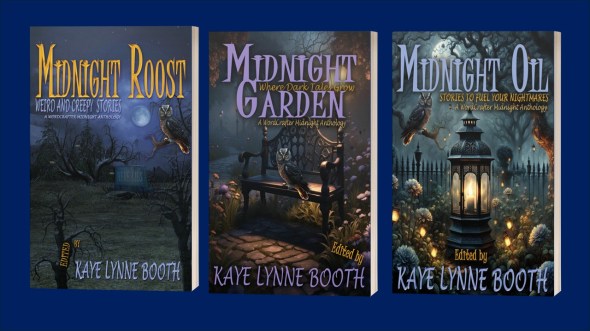
Midnight Roost: Weird and Creepy Stories: 20 authors bring your nightmares to life in 23 stories of ghosts, paranormal phenomenon and the horror from the dark crevasses of their minds. Stories of stalkers, both human and supernatural, possession and occult rituals, alien visitations of the strange kind, and ghostly tales that will give you goosebumps. These are the tales that will make you fear the dark. Read them at the Midnight Roost… if you dare. https://www.amazon.com/Midnight-Roost-Kaye-Lynne-Booth-ebook/dp/B0CL6FPLVJ
Midnight Garden: Where Dark Tales Grow: 17 authors bring you 21 magnificent dark tales. Stories of magic, monsters and mayhem. Tales of murder and madness which will make your skin crawl. These are the tales that explore your darkest fears. Read them in the Midnight Garden… if you dare. https://www.amazon.com/Midnight-Garden-Where-Tales-Anthology-ebook/dp/B0DJNDQJD3
Midnight Oil: Stories to Fuel Your Nightmares: 14 authors bring you 16 dark tales that explore your deepest fears. These are the stories which nightmares are made of. Tales of monsters, mayhem, and madness which will make you shiver in the dark. Read them while you burn the Midnight Oil… if you dare. https://books2read.com/Midnight-Oil



















