Poetry Treasures 2: Available now!
Posted: April 9, 2022 Filed under: Book Promotion, Book Release, Books, Poetry, Treasuring Poetry, WordCrafter Press | Tags: Arthur Rosch, Colleen M. Chesebro, D.Avery, Elizabeth Merry, Harmony Kent, JulesPaige, Lauren Scott, Leon Stevens, Lynda McKinney Lambert, M.J. Mallon, Miriam Hurdle, Poetry Collection, Poetry Treasures 2: Relationships, Robbie Cheadle, Treasuring Poetry, WordCrafter Press 44 Comments
Yes! It’s finally here.
If, like me, you thoroughly enjoy Robbie Cheadle’s “Treasuring Poetry” blog series and can’t wait for her posts to come out each month, then you’ll be as excited as I am to learn that Poetry Treasures 2: Relationships is available at your favorite book distributors now!
Relationships are golden and each of
Arthur Rosch, Elizabeth Merry, D Avery, Robbie Cheadle, Harmony Kent, Lauren Scott, JulesPaige,
Leon Stevens, Colleen M. Chesebro, Miriam Hurdle,
M J Mallon, and Lynda McKinney Lambert
pay poetic tribute to their most intense
personal moments.
That’s right folks. Now you can get this wonderful collection of poetic gems by Robbie and her 2021 “Treasuring Poetry” guests all in one place. We’ll be doing a book blog tour April 25 – May 1 so you can learn more about the amazing treasures contained within, but you don’t have to wait.
Just click on the Books2Read Universal Book Link (ULB) to find your copy at your favorite book distributor now!: https://books2read.com/u/3kP8aK
Share this:

The Many Faces of Poetry
Posted: April 8, 2022 Filed under: Poetry, The Many Faces of Poetry | Tags: Arthur Rosch, Poetry, The Many Faces of Poetry, Writing to be Read 13 Comments
Poetry Of The Gnu Age
After reaching enlightenment,
Milarepa’s first three steps
burned footprints
into the rocks of his shelter
so that today
pilgrims bow to these relics as holy icons.
The yogi’s steps were fired in the kiln
of his deep understanding. A thousand
years have passed and his footprints remain
sunk into the bare granite.

Piano Lessons
I have ten fingers.
The piano has…really…
twelve notes plus octaves therefrom.
I tell my fingers
each day
“land somewhere new. Somewhere
you’ve never been. If it sounds good
then lead me forward. IF it does not.
We go again.
Ten fingers. Twelve notes and octaves.
Fingers: spread yourselves newly. Knuckle middle finger
rise a bit. Good.
Now…listen. OK?
send five left fingers to the lowest octave
teach them where they belong
repeat the patterns repeat the patterns
bring the fingers back up
then throw them like dice
at the keyboard let them fly
repeat the patterns again
repeat the patterns: over time
my fingers know things, acquire sense and pitch
before my ears know
before my brain knows
my fingers know.
And, strange as it may sound, always listen to your fingers.
Let us say, hypothetically, that I go to sleep
in just a t shirt. I have two pillows under my head
and a pillow between my knees. As I get ready for bed
I sweep my blankets back and I sit on my pillows, not quite knowing
that I have just stuck my ass in my face. The knee
pillow, especially, is a real ass-face pillow but not
exclusively. No. My other pillows double duty as
butt blankies. I don’t know when or if
I put my ass in my face. No one does.
It is a concern, that’s all. A sanitary consideration.
Truth is you walk around with your ass every day,
it’s on your body
and it hasn’t given you Salmonella or ebola
yet. It’s not going to whether you sit half naked
or not. Everyone is full of shit. We know that.
When some men play around in government,
they shit like water buffalos. Who knew?
They’re all full of shit.
And they sit on their pillows a lot.
Another thing I can stop worrying about.
Ukraine
It is one thing to think
“aw fuck, not again.”
Then it’s another thing to do
nothing, from a sense of overwhelm
at the misery of the world. Many of these miseries
were created by human beings. They are capable of un-creating them but that would take a lot of work. Humans have
a streak of lazy when it comes to inquiry about themselves.
One can say “My bad”
as if that dismisses responsibility. I’ve been bad
but it’s over. That is not enough. You can’t say “My good”
but you’ve got to do “my good”,
you must keep making beautiful things in the face of ignorance.
Help other people with small daily tasks.
Use everything you’ve got
because in the face of this calamity,
it’s not going to be enough.
It’s just a motive to keep working so that,
some day,
it will be enough.
_________________________________________________________________________

Arthur Rosch is a novelist, musician, photographer and poet. His works are funny, memorable and often compelling. One reviewer said “He’s wicked and feisty, but when he gets you by the guts, he never lets go.” Listeners to his music have compared him to Frank Zappa, Tom Waits, Randy Newman or Mose Allison. These comparisons are flattering but deceptive. Rosch is a stylist, a complete original. His material ranges from sly wit to gripping political commentary.
Arthur was born in the heart of Illinois and grew up in the western suburbs of St. Louis. In his teens he discovered his creative potential while hoping to please a girl. Though she left the scene, Arthur’s creativity stayed behind. In his early twenties he moved to San Francisco and took part in the thriving arts scene. His first literary sale was to Playboy Magazine. The piece went on to receive Playboy’s “Best Story of the Year” award. Arthur also has writing credits in Exquisite Corpse, Shutterbug, eDigital, and Cat Fancy Magazine. He has written five novels, a memoir and a large collection of poetry. His autobiographical novel, Confessions Of An Honest Man won the Honorable Mention award from Writer’s Digest in 2016.
More of his work can be found at www.artrosch.com
Photos at https://500px.com/p/artsdigiphoto?view=photos
_________________________________________________________________________
Want to be sure not to miss any of Arthur’s “The Many Faces of Poetry” segments? Subscribe to Writing to be Read for e-mail notifications whenever new content is posted or follow WtbR on WordPress. If you find it interesting or just entertaining, please share.
Share this:

BOWLESIAN! – Dr. Julianus Techt’s Five Easy Steps to Building a Better You
Posted: April 6, 2022 Filed under: Bowlesian!, Dark Fantasy, Fiction, Horror, Short Fiction, Speculative Fiction, Stories | Tags: Bowlesian!, Jeff Bowles, Short Fiction, Short Stories, Writing to be Read Leave a comment
Dr. Julianus Techt’s Five Easy Steps to Building a Better You
by Jeff Bowles
You are an absolute horror show. You are a wreck and ruin of a human being. I can’t even stand the sight of you anymore. You’re weak. Feeble. Go on and do it. Go on and rid the universe of your wretchedness once and for all.
Sound familiar?
Hi, friends. Dr. Julianus Techt here. Life got you down? No friends? No significant love interests? No point in living one more excruciating, soul-crushing day? Believe me, I know the feeling.
Congratulations on your purchase of Dr. Julianus Techt’s 5 Easy Steps to Building a Better You. This book, and the accompanying materials and spells companion crate, are each designed with the lowlife in mind. Contained within these pages, friends, are the answers you are looking for. Not happy with the man/woman you have become? Why not simply build a better you? The methods, magics, and matriculations I am about to divulge are time-tested and fool-proofed.
I know exactly what it’s like. I was once in your shoes. My PhD is in world-class suffering. I earned my doctorate at the school of hard knocks. Now I am a new man entirely. Come along with me and discover the secrets to self-love, self-respect, and self-actualization. Your glorious, resplendent days in the sun are just 5 Easy Steps away….
Easy Step 1: Back to Basics
Why is it you hate yourself so much? Why is it you’re so despairingly, disconsolately desperate to become a better human being? Is it because, like me, you’ve let down every last friend, family member, and lover who’s ever cared about you? Or do you, like me, simply find life painful, disappointing, a series of valleys–each deeper and darker than the last–without even a passing glimpse of a single peak or shred of hope?
Ha ha. Well, you were sharp enough to buy this book. So at least you’ve got that going for you.
I want you to imagine what the better you will look like.
Now I want you to open your materials and spells companion crate and make it happen.
Inside the crate you will find,
One (1) man-sized sheet of multi-colored construction paper
Five (5) century-aged cherry wood logs, each weighing approximately twenty-five (25) lbs.
One hundred seventy-five (175) lbs. of premium oil-based plastilina modeling clay.
One (1) ancient scroll of Black Soul-Shard enchantments.
And last, but not least,
One (1) complimentary Pizza Barn coupon, buy 1 slice, get the second half-off.
Arrange your materials and spells in whatever manner that best allows for ease-of-access and attenuation with the life-force powers of the universe and the forsaken black domain of the damnation/animation god, Frülik.
Ready to begin?
Good. I was hoping you’d say that.
Note: Dr. Julianus Techt’s 5 Easy Steps to Building a Better You is, if nothing else, a trial-and-error process. Steps 2-4 will enable you to produce 3 different soul-shard versions of yourself. If at any time you become satisfied with a soul brother or sister, please feel free to skip to step 5, There, isn’t That Better? Similarly, if at any time you feel threatened or are attacked by your soul brothers or sisters, please discontinue use, flee your house or place of residence, and immediately cash in your complimentary Pizza Barn coupon as you await police/emergency medical technician intervention.
Easy Step 2: Frülik
From your kitchen, retrieve one (1) large knife, serrated; one (1) cereal bowl; one and one-half (1 1/2) teaspoons of iodized table salt; one (1) sticky bandage, extra-large; and one (1) lb. of leftover meat to offer as supplication to Frülik, the damnation/animation god.
Retrieve your ancient Black Soul-Shard scroll and refer to enchantment #12 as you perform the following:
Sit down on the floor with your legs crossed. Pour the salt into the bowl and set it in your lap so that it can catch the copious amounts of blood about to gush from the palm of your hand.
This next part may sting a little.
Slice open your hand and hold it over the bowl. As you howl in agony, notice that your blood runs red. This will change as you begin to recite the enchantment, the one which begins,
“Oh mighty Frülik! I offer you my blood and meat! Cleave my astral self in twain! Take from me now that which you desire most!”
Notice that three things occur. The first is that your blood turns black. Don’t be alarmed. This is simply an indication you have just sold your soul for something far purer than you can possibly imagine. Notice, too, that the air around you has suddenly grown approximately 50° cooler. Your breath puffs frost. You snort in the cold like a castrated bull. You should probably be aware that the damnation/animation god, who will be arriving shortly, cannot abide warmth. It reminds him the living still thrive in the world beyond his forsaken realm, and that for him, all hope for love, passion, and earthly pleasures are lost, lost, lost.
Anyway, the last thing you will notice is that a 10-foot tall, bone-armored, entrail-covered, cloven-footed demon god will scratch and claw his way from the cereal bowl filled with salt and your precious blood.
Once he’s standing over you, with the edge of his massive Broadsword of Deepest Lacerations resting precipitously against your neck, he will squeal like a cancerous boar. He will then say something to the effect of,
“Woe unto you! Woe! Your soul is damned to the bleakest pits of horror and suffering! Pestilence! Rotten, fetid, malodorous flesh! I shall feast on your severed scrotum each mealtime for a thousand lives of men!”*
*Please note that based on your gender, Frülik may or may not in fact use the word “scrotum.”
The damnation/animation god will now use his broadsword to cleave your head from your shoulders. Do not be alarmed, this is simply an astral projection of your head and nothing more. Unfortunately, the pain you feel is entirely real and will no doubt haunt you for years to come.
Frülik is consumed by his own lust for spiritual power. He will snort and stomp and pull exactly three (3) individual shards of your soul out through your neck. His desire, of course, is to eat them and thereby enslave you for all time as his personal Concubine of Nightly Anguish.
It is now appropriate to offer him the one (1) lb. of supplication meat.
“Meager vittles!” he will bellow, but he will nevertheless proceed to stuff the meat into his face and forget all about the severed pieces of your spiritual essence hanging from your throat.
Please refer to enchantment #16 on your ancient scroll. Recite and repeat until the damnation/animation god is banished, moaning and cursing your name, back to his profane realm.
“Mighty Frülik!,” you will say. “Return to blackness! Mighty Frülik! A caelo usque ad centrum!”
Once Frülik is gone, and his howls of abject agony and rage have finally subsided, you will feel the urge to pass out and slip into the Sleep of Ages. This is completely normal, a side-effect of doing business with a demon god, and I must tell you, feels rather nice after a nightcap of chamomile tea and vodka.
Before you sleep, pull the three soul shards from the astral wound in your neck and lay them out, as best you can, with the rest of the materials from your companion crate.
When you awaken in exactly twelve (12) days and nights, we will finally create your soul brothers/sisters. Won’t that be fun?
Easy Step 3: The Better You Emerges
Twelve (12) days and nights have now passed. Are we back in the land of the living? Excellent.
Quick, what is fragile, tenuous, rough around the edges, and excruciatingly, mind-numbingly easy to reduce to cinder? No, it’s not Dr. Julianus Techt’s four failed marriages. It’s paper, friends. Simple, well-crafted, infinitely pliable commercial paper.
Your next task is to create a soul brother/sister from the man-sized sheet of multi colored construction paper you’ve retrieved from the materials and spells companiontjngsopjojgs kijipsgmijijithinign ijisrjomoejoig Frülik fhsko
sohoihionofihisniohi Frülik shinjpspsom Frülik shions
Frülik loves Techt
Frülik loves Techt
Frülik luvs Techt
Frülik has Techt
Frülik has Techtmpr
Say goodbye, Techt
Say goodbye, Techgtnikjigjopop
Managing Editor’s Note: And this is the last thing he wrote for the project, people. The police entered his home last week to find the place torn to pieces but otherwise empty. They found on his workstation a single Tupperware dish containing a full pound of rotting meat.
Due to the highly volatile and disturbed nature of this manuscript–and of course, in light of Dr. Julianus Techt’s mysterious disappearance–One-Hill Prairie Publishing hereby suspends all production plans for Five Easy Steps to Building a Better You until further notice. We have also mandated the immediate destruction of all mockup materials and spells companion crates. Our number one priority is to keep the particulars of this project from reaching the public. Can you imagine what’d happen if some poor fool actually attempted any of this?
Post-Script: We realize that working with Dr. Techt these past weeks and months has been trying, and at times, freakishly horrifying. Free mental health screenings and complimentary Pizza Barn coupons to all who apply.
END
Jeff Bowles is a science fiction and horror writer from the mountains of Colorado. The best of his outrageous and imaginative work can be found in God’s Body: Book One – The Fall, Godling and Other Paint Stories, Fear and Loathing in Las Cruces, and Brave New Multiverse. He has published work in magazines and anthologies like PodCastle, Tales from the Canyons of the Damned, the Threepenny Review, and Dark Moon Digest. Jeff earned his Master of Fine Arts degree in creative writing at Western State Colorado University. He currently lives in the high-altitude Pikes Peak region, where he dreams strange dreams and spends far too much time under the stars. Jeff’s new novel, Love/Madness/Demon, is available on Amazon now!
Check out Jeff Bowles Central on YouTube – Movies – Video Games – Music – So Much More!
Share this:

Writer’s Corner: Five things you may not know about the publishing industry
Posted: April 4, 2022 Filed under: Books, Publishing, Writing | Tags: Hybrid Publishing, independent publishing, Publishing, Traditional Publishing, Writer's Corner, Writing to be Read 9 Comments
Since the beginning of this century, the publishing industry has undergone many changes at a very rapid pace due to the rise of digital technology and ebooks and the resulting swell of independent authors which has reshaped the way the industry operates. Traditional publishing houses have had a difficult time in adapting to these changes, which are transforming the playing field from being favorable to publishers into one more fair to authors. Trad. publishers are slow to adapt and their numbers are dwindling as they hang on to traditional practices that make little sense in this day and age. Just in the past five years we’ve seen the big 5 become the big 4, and in 2021 they merged into the big 3.
Many authors struggle with the decision of whether to self-publish or try for a traditional publishing deal, which could turn into an endeavor spanning years and your book may still not be published. Traditional publishing offers status and esteem when you can get it, but the road to a traditional publishing deal has many pitfalls and often ends in wrong turns and dead ends. It’s not easy to land a trad. publishing deal and there are no guarantees. This is nothing new. It has never been easy, but I think it’s harder than it used to be
When you take a good hard look at today’s publishing industry, you may find a few things which surprise you. I know I did.
Did you know…
- Advances offered by traditional publishing must be paid back before the author sees any of their royalties? That’s right. An advance is just that – payment of royalties in advance. And the royalty percentage offered by trad. publishers is considerably less than what indie authors receive, so it may take a very long time to pay out that advance, and if s book does not sell well, it may never pay out. Many self-published authors have opted for smaller royalty payments over the long haul, rather than one big chunk of money in the beginning that may never pay out any more than that initial advance payment.
- While a traditional publishing deal may still carry an advance with it, it seems the advance amounts have gotten smaller, as traditional publishers grow more unsure of your book’s ability to sell? While book publishers have always taken risks when signing a new author, with the rise of independent authors and publishers, there’s a lot more competition and publishers may be less confident of a book’s success, so they aren’t as willing as they once were to cough up the cash before the book has been proven. What’s more, they aren’t as willing to provide as much effort for promotion. In fact, trad. publishers today are looking at the reader platform, or fan base, that an author brings with them as well as their social media platforms, etc…, and they may expect authors to perform much of the marketing and promotion for their book. A small independent publisher which published my western novel, Delilah, but they did very little as far as marketing goes, and of course, there was no advance. I felt I could do better with it myself, which is why I chose not to renew my contract and will be re-publishing the book myself as part of the Women of the West adventure series.
- Traditional publishing created a return policy for bookstores and retailers that allows them to return print books at the publishers expense, which still applies today, effectively preventing independent publishers and authors from having their print books carried in brick and mortar bookstores? While print-on-demand has revolutionized the publishing industry, making it no longer be necessary for authors to create large or small print runs and stockpile books I’m their basement or garage, it is still a challenge for independent authors to get their books into bookstores due to the ridiculous return policy trad. publishers created for bookstores. Today, bookstores have played by these rules for so long that they have no desire to change the rules even though they should. You can read about the options when you publish through Ingram Spark here. There may be a work around if you can find an independent local bookstore willing to take your books on consignment, but for the most part, indie authors are limited to selling their print books online because of an outdated policy that never made sense in the first place. I mean, what other industry allows to retailers to return unsold products after a number of years for a full refund, potentially devastating the maker when the charge blindsides them unexpectedly?
- The time that you must wait for your book to go through the traditional publishing process could be two to three years or more from the time of signing, if you do manage to land a traditional publishing deal? Even after you have a contract, that doesn’t guarantee that your book will actually be published, and the publishing process is so long and tedious that your book could potentially be in limbo for years. Of course, that is not what happens most of the time, but it has happened. Children’s books take even longer to go through the publishing process. They can take up to five years or more. Imagine the disappointment of not being published after waiting years to get a trad. deal, and waiting even more years to go through the publishing process. This may be even more of a possibility with the instability of the traditional publishing industry today.
- Traditional publishers often ask for rights they never intend to use, and if you give them to them, you can no longer do anything with them? Traditional publishing contracts are not traditionally author friendly, often asking authors to throw in many rights that are unnecessary for the author to give up. For example, many publishing contracts ask for audio rights, even when they have no intention of publishing your book on audio. If these rights are maintained by the author, they can be licensed separately or used to produce their own audiobook through one of the many audiobook platforms available to authors today, but if they are included on your contract, the publisher can sit on them and the author will make nothing from them. That’s money left on the table that the author can’t touch. It is very important that authors know what they are signing and don’t sign away rights that they don’t need to.
Authors today have choices which authors of the past did not. We no longer have to go through the submission-rejection-resubmission grind for months or years to find someone else who likes your writing and might want to publish it. Today we can publish our works ourselves because we like it, and hopefully find others who like it too and will become fans and loyal readers. There are many authors today who choose to try the best of both worlds in some sort of hybrid combination that fits their needs.
I can’t see trying to beat a dead horse, and for me, I think that is what traditional publishing would be. Although making money from my books is always a goal, as I pointed out above, there are no guarantees that I would ever find someone who wanted to publish my book and, even then, there are no guarantees that it would actually happen, or that it would sell. I want people to read my books and that will never happen unless they are published. That’s why, for me, independent publishing will be the course that I choose. Which course is right for you?
________________________________________________________________________

Kaye Lynne Booth lives, works, and plays in the mountains of Colorado. With a dual emphasis M.F.A. in Creative Writing, writing is more than a passion. It’s a way of life. She’s a multi-genre author, who finds inspiration from the nature around her, and her love of the old west, and other odd and quirky things which might surprise you.
She has short stories featured in the following anthologies: The Collapsar Directive (“If You’re Happy and You Know It”); Relationship Add Vice (“The Devil Made Her Do It”); Nightmareland (“The Haunting in Carol’s Woods”); Whispers of the Past (“The Woman in the Water”); and Spirits of the West (“Don’t Eat the Pickled Eggs”). Her western, Delilah, her paranormal mystery novella and her short story collection, Last Call, are all available in both digital and print editions.
In her spare time, she keeps up her author’s blog, Writing to be Read, where she posts reflections on her own writing, author interviews and book reviews, along with writing tips and inspirational posts from fellow writers. She’s also the founder of WordCrafter. In addition to creating her own imprint in WordCrafter Press, she offers quality author services, such as editing, social media & book promotion, and online writing courses through WordCrafter Quality Writing & Author Services. When not writing or editing, she is bird watching, or hiking, or just soaking up some of that Colorado sunshine.
______________________________________________________________________
Sign up for the Kaye Lynne Booth & WordCrafter Press Newsletter for and book event news for WordCrafter Press books, including the awesome releases of author Kaye Lynne Booth. Get a free digital copy of Kaye Lynne Booth’s paranormal mystery novella, Hidden Secrets, just for subscribing.
Share this:

Book News and Such
Posted: March 28, 2022 Filed under: Book Promotion, Book Release, Books, Newsletter, WordCrafter Press | Tags: Anthologies, Books, Gilded Glass, Kaye Lynne Booth, Poetry, Poetry Treasures 2: Relationships, Short Fiction, WordCrafter Press, Writing to be Read 11 Comments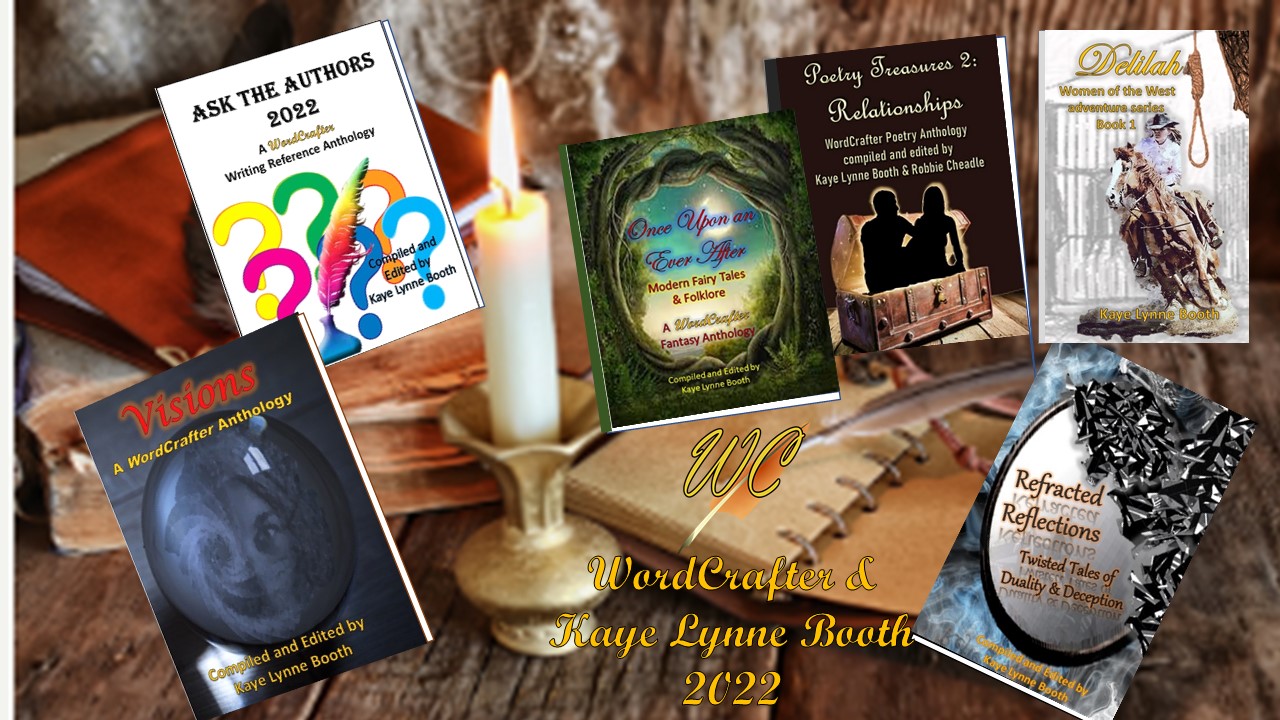
Looking for my 100 True Fans
The concept of 1,000 true fans was based on the theory of Wired editor, Kevin Kelly that a creator could make a descent living online with 1,000 truly invested fans, and it’s a concept that has been around for more than a decade. Today’s thinkers have revised that theory, and now it is believed that really, 100 true fans are all you need in this new “passion economy” which appears to be rising from within the new global internet communities, according to Aayushi Rachana, in her article “”100 True Fans” is All You Need in Passion Economy”, on Medium.com (March 11, 2021): https://medium.com/hapramp/all-you-need-to-know-about-100-true-fans-3fd72a35154f True fans are those who believe in you and want to support you in your creative endeavors; those fans who will buy everything that you write, just because you wrote it. And supposedly, we all have them – we just need to find them, or rather, we need to draw them to us.
That’s why I’ve decided to embark on a search for my own 100 true fans as I prepare to take my writing career to the full time level, but they aren’t going to just walk into my life and say, “Hi. I’m here to read everything you write, because I know how wonderful you are.” No, that’s not how it happens. True fans have to be earned; they have to be cultivated and grown from followers into fans, and a few will even mature into super fans, or true fans. But it doesn’t happen overnight, and it won’t happen on its own, and for me, it may be even more of a challenge as a multi-genre author who writes her heart instead of trying to write to market. So, I’ve developed a plan for drawing in followers, and hopefully, seducing them into fans, and then with luck it will turn into a long term relationship of super fans. Do I really have fans out there? We’ll just have to wait and see what happens.
The first step is to offer a way for my followers to become fans by learning more about me and my books through my newsletter. I haven’t been as good as I should have been about my newsletter, I admit. In fact, I let it go to the wayside for two years and only primed it with a revival issue this past month, which gave a brief overview of upcoming releases and current projects, including a reminder of the approaching deadline for the 2022 WordCrafter Short Fiction Contest (see submission guidelines here), and let my readers know that I’m still here. Newsletters also offer a way for followers to engage via email response, an opportunity for a connection to be made, which makes it more likely that they will become fans, or even superfans.
If you are reading this, then chances are good that you are at least a follower of mine. If you’d like to get to know me better or learn more about upcoming releases from myself or WordCrafter Press, you can join my newsletter and get a free digital copy of my paranormal mystery novella, Hidden Secrets, here: https://mailchi.mp/64aa2261e702/klb-wc-newsletter. Go on and subscribe. It’s free and you never know, you may even become a fan of you like what you discover in my newsletter.
Poetry Treasures 2: Relationships – Cover reveal

Above, you see the fantastic cover designed by Teagan Geneveine. I’m pleased to announce that to celebrate National Poetry Month, Poetry Treasures 2: Relationships will be scheduled for release in April. This wonderful poetry anthology features the works of guests from last year’s “Treasuring Poetry” blog series right here on Writing to be Read, hosted by Robbie Cheadle. Contributors include Arthur Rosch, Elizabeth Merry, D. Avery, M.J. Mallon, Miriam Hurdle, Colleen M. Chesebro, Lauren Scott, Harmony Kent, JulesPaige, Lynda McKinney Lambert, and Robbie Cheadle. Keep watching here, because it will be up for preorder soon.
Gilded Glass Up for Pre-order

You’ve all heard me talk about the great new anthology I am helping to put together through my publishing course at Western State Colorado University. In addition to the fabulous stories chosen from a plethora of exceptional submissions, it features stories by Sherrilyn Kenyon, Alan Dean Foster, Jonathan Maberry, Kristine Kathryn Rusch, and Michaelbrent Collings. I’m excited to tell you this amazing anthology is scheduled for release in July, but is now available for preorder and you can find it at your favorite retailer through books2read at the link below.
https://books2read.com/u/bwKZ8Y
______________________________________________________________________________
Sign up for the Kaye Lynne Booth & WordCrafter Press Newsletter for and book event news for WordCrafter Press books, including the awesome releases of author Kaye Lynne Booth. Get a free digital copy of Kaye Lynne Booth’s paranormal mystery novella, Hidden Secrets, just for subscribing.
Share this:

Dark Origins – African myths and legends: The San (previously Bushmen) Part 3
Posted: March 23, 2022 Filed under: Dark Origins, Mythology and Legend, Story Telling Methods | Tags: African Legend, Dark Origins, Legend and Mythology, South African History, Writing to be Read 44 Comments
In January and February, I introduced you to the San or Bushmen of Southern African and shared some of their cultural ways and traditional stories.
Part 1 provided an introduction to the San and some information about a specific rock art form of the human hand. You can read it here: https://writingtoberead.com/2022/01/26/dark-origins-african-myths-and-legends-the-san-previously-bushmen-part-1/
Part 2 provided an overview of the San hunting methods and I shared another traditional story. I also introduced you to the Bushman Heritage Museum in Nieu Bethesda. You can read it here: https://writingtoberead.com/2022/02/23/dark-origins-african-myths-and-legends-the-san-previously-bushmen-part-2/
Today, I am sharing a bit about the traditional religious beliefs of the San.
God and the afterlife
The bushmen traditionally believe in a greater and a lesser Supreme Being or God.
The greater God first created himself and then the land and the food it produces, the air and water. He is generally a positive power and protects, wards off disease and teaches skills to people. When angered, however, he can send bad fortune.
The lesser god is seen to be bad or evil, a destroyer rather than builder, and a bearer of bad luck and disease. The bushmen believed that bad luck and disease was caused by the spirits of the dead, because they want to bring the living to the same place they are.
Cagn is the name the bushmen gave their god. They attributed human characteristics to him as well as many charms and magical powers.
The bushmen believed in the afterlife and a dead man’s weapons were buried with him. They turned the face of the dead towards the rising sun, as they believed that if he was faced to the west the sun would take longer to rise the next day.
Witchcraft
The bushmen heritage includes a deep belief in witchcraft and charms. They have a dread of violating them and bringing bad luck upon themselves. The hunters believe that if their shadows fall on dying game it will bring disaster upon them. No matter how thirsty a bushman is, he will not dig a hole in the bed of a dried-up stream until he has made an offering to appease the spirit of the stream. The spirit is thought to take the form of an enormous man with either red or green skin and white hair. The spirit can make himself visible or invisible at will.
San rock art
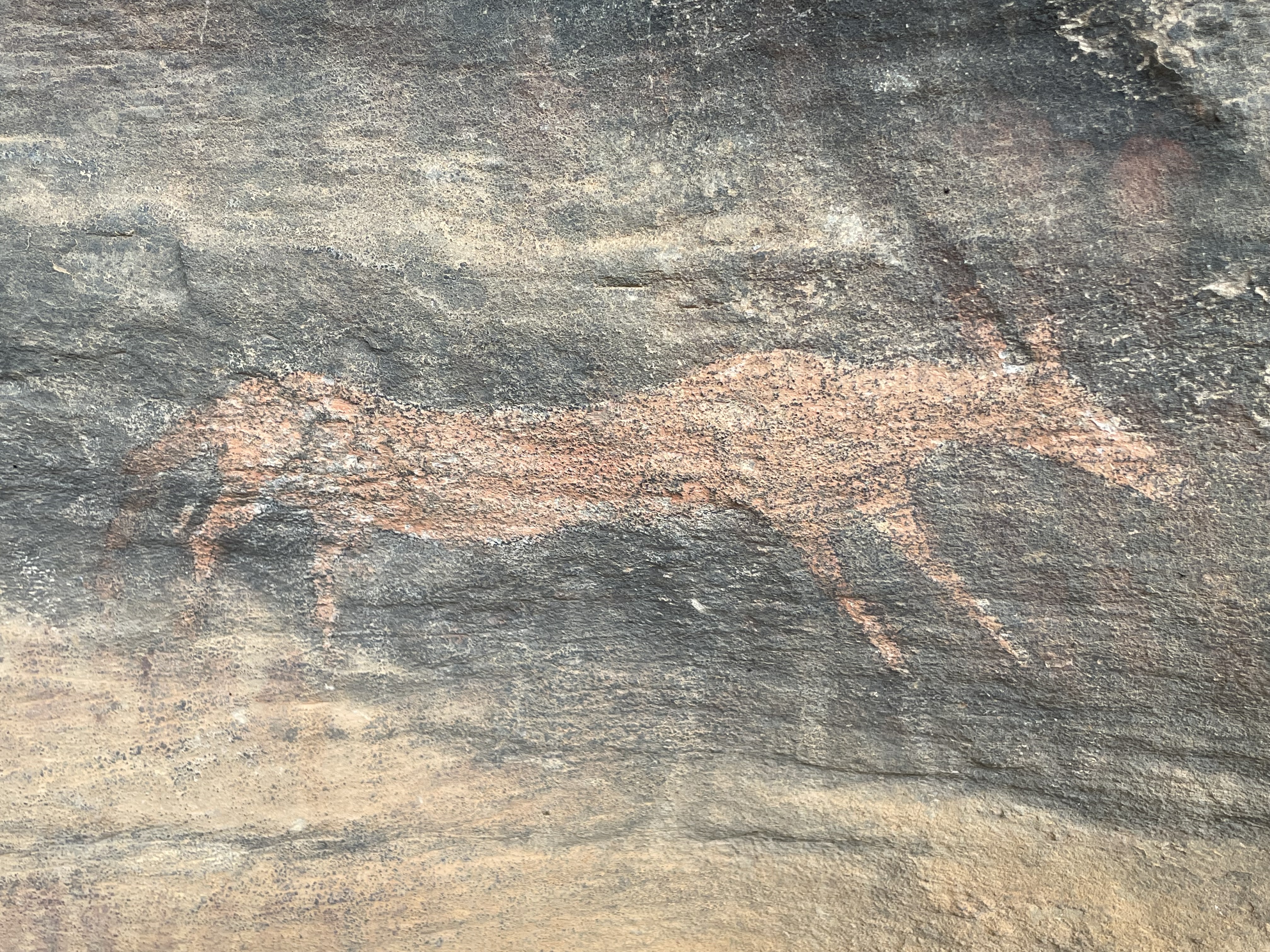
San rock art found in Namibia date back at least 25,000 years. The Bushmen continued with their rock art painting right up until the time of the European settlers. We know this because some of their more recent artworks depict wagons. Archaeologists believe that the San artworks were a way for the entire community to share mental images while in a group trance state.
The San artwork depicts non-human beings, hunters, and half-human half-animal hybrids. The half-human hybrids are believed to be medicine men or healers who performed healing dances.
Here are a few examples of San rock art we saw on our recent road trip to Nieu Bethesda:



San Bushman Moon Dance in the Kalahari Desert
About Roberta Eaton Cheadle

Roberta Eaton Cheadle is a South African writer and poet specialising in historical, paranormal, and horror novels and short stories. She is an avid reader in these genres and her writing has been influenced by famous authors including Bram Stoker, Edgar Allan Poe, Amor Towles, Stephen Crane, Enrich Maria Remarque, George Orwell, Stephen King, and Colleen McCullough.
Roberta has short stories and poems in several anthologies and has 2 published novels, Through the Nethergate, a historical supernatural fantasy, and A Ghost and His Gold, a historical paranormal novel set in South Africa.
Roberta has 9 children’s books published under the name Robbie Cheadle.
Roberta was educated at the University of South Africa where she achieved a Bachelor of Accounting Science in 1996 and a Honours Bachelor of Accounting Science in 1997. She was admitted as a member of The South African Institute of Chartered Accountants in 2000.
Roberta has worked in corporate finance from 2001 until the present date and has written 7 publications relating to investing in Africa. She has won several awards over her 20-year career in the category of Transactional Support Services.
Find Roberta Eaton Cheadle
Blog: https://wordpress.com/view/robertawrites235681907.wordpress.com
Twitter: https://twitter.com/RobertaEaton17
Facebook: https://www.facebook.com/robertawrites
Amazon: https://www.amazon.com/Roberta-Eaton-Cheadle/e/B08RSNJQZ5
_____________________________________________________________________________________________
Want to be sure not to miss any of Robbie’s “Dark Origins” segments? Subscribe to Writing to be Read for e-mail notifications whenever new content is posted or follow WtbR on WordPress. If you found it interesting or entertaining, please share.
Share this:

The Rewards of Running a Bird Sanctuary
Posted: March 21, 2022 Filed under: Bird Watching, Children's Books, Writing, Writing Inspiration | Tags: Bird Watching, Children's Stories, Heather Hummingbird, Kaye Lynne Booth, Writing to be Read 7 Comments
I started watching the birds which visited my yard about fifteen years ago. My property is densely forested and the early morning chatter in the trees was difficult to ignore, so my gaze would naturally go up to the trees around me, and I was amazed at the number of different types of birds that were dropping by. So, I began to sit out in the yard to write on summer days, and that first summer, I kept a journal of the different birds that I saw,
When winter came around, I bought a bird feeder and some seed. I wasn’t sure how many birds were stick around during the cold months of Colorado winter, but I was pleased to learn that, although many birds migrated south for the winter, birds such as Chickadees, Nuthatches, and Blue Jays were year round residents and the Juncos appeared. When summer roles around, the winter birds clear out and various other species of birds take up summer residence or stop by on their way through.
I even have a group of resident Ravens, originally two pairs until one was taken out by a BB gun by a neighboring child. Now there are only three, but they are always around, and we talk back and forth to each other. (I don’t really speak Raven, but I fake it well.) Watching birds has brought me inspiration, and I have a whole children’s book series, in which the characters are birds and there is a moral lesson to each one, but I haven’t yet been able to publish it for lack of an illustrator. If you’re interested, you can read the story of how I had and lost both illustrator and publisher for the first book in the series, “Heather Hummingbird Makes a New Friend” here.


Little by little, I’ve added feeders and water features, provided habitat conducive to birds and wildlife. I now put out several types of seed feeders as well as suet feeders in the winter, and in the summer I add Hummingbird Feeders, as well as planting a variety of flowers, water features and bird baths in order to create a bird sanctuary. Over the years, I have viewed bird species in the double digit numbers: American Robins, Red Crossbills, Western Bluebirds, Western Tanangers, at least three different types of Hummingbirds, Juncos, Evening Grosbeaks, Cowbirds, Owls, Mountain Doves, Hairy Woodpeckers, Red-Shafted Flickers, I don’t know how many types of Sparrows and Finches, Gray-breasted Blue Jays, Red-tailed Hawks, and even Turkey Vultures. No matter what time of year, the birds who dip into my feeders always appreciate the plentiful bird seed and suet feeders that I put out, and they line up on the tree branches for their turn at the morning baths in the summer.
By this winter, word had gotten out and the bird sanctuary has become a busy place. I put out my Moultrie Digital Game Camera, which is motion activated, for a day and got thousands of photos of birds at one of the feeders. The feeder they are using is a birdbath in warm weather, but I filled it with Sunflower seeds during the cold spell we had recently, and it is obviously quite popular. Among the birds in the photos below are Evening Grosbeaks, Casin’s Finch and several small Sparrows at the feeder.


I get a lot of joy from watching the birds that visit my bird sanctuary. They are so much fun to watch as they wait their turn to grab a bite. Of course, at times they don’t wait. They just jump right in squawking and pecking to get their share whether it’s their turn or not, and mid-air skirmishes are not uncommon. Just the other day I watched as a Gray-breasted Blue Jay swooped in a broke off a very large piece of suet, then he turned to take off with it, making a quick get-away. The piece that he had in beak was so large that it weighed him down and he took an unexpected dive, almost to the ground, before catching himself and swooping off into the trees with his bounty. Blue Jays are known around here to be big bullies, so it was really kind of comical to watch as he struggled due to his own gluttony.
It is true that birds of a feather flock together, as Evening Grosbeaks swarm in on the feeders as a yellow and black mob, temporarily chasing off any little guys and interrupting their meal. The Blue Jays flock in too, but the Grosbeaks are the only ones who won’t back down from them. Juncos gang up on the ground, catching the seed others knock down from above. Birds like Mountain Chickadees, Nuthatches and American Robins, usually visit in smaller family groups, and the bird sanctuary has seen a lot of families raised, but even the Hairy Woodpeckers usually visit in pairs.
It’s been a busy place this winter, but I’m looking forward to the coming of spring and the arrival of a new batch of birds, especially the Hummingbirds, which never fail to keep things buzzing around the bird sanctuary. I always look forward to their spring greetings, as they actually come and say hello, hovering right in front of my face upon arrival as the weather warms. But Hummingbirds are a whole other post. If you’d like to hear about them, comment to let me know, and maybe I’ll write about them later in the year.
________________________________________________________
Kaye Lynne Booth lives, works, and plays in the mountains of Colorado. With a dual emphasis M.F.A. in Creative Writing, writing is more than a passion. It’s a way of life. She’s a multi-genre author, who finds inspiration from the nature around her, and her love of the old west, and other odd and quirky things which might surprise you. She has short stories featured in the following anthologies: The Collapsar Directive (“If You’re Happy and You Know It”); Relationship Add Vice (“The Devil Made Her Do It”); Nightmareland (“The Haunting in Carol’s Woods”); Whispers of the Past (“The Woman in the Water”); and Spirits of the West (“Don’t Eat the Pickled Eggs”). Her western, Delilah, her paranormal mystery novella and her short story collection, Last Call, are all available in both digital and print editions.

In her spare time, she keeps up her author’s blog, Writing to be Read, where she posts reflections on her own writing, author interviews and book reviews, along with writing tips and inspirational posts from fellow writers. She’s also the founder of WordCrafter. In addition to creating her own imprint in WordCrafter Press, she offers quality author services, such as editing, social media & book promotion, and online writing courses through WordCrafter Quality Writing & Author Services. When not writing or editing, she is bird watching, or hiking, or just soaking up some of that Colorado sunshine.
___________________________________________________________________
Sign up for the Kaye Lynne Booth & WordCrafter Press Newsletter for and book event news for WordCrafter Press books, including the awesome releases of author Kaye Lynne Booth. Get a free digital copy of Kaye Lynne Booth’s paranormal mystery novella, Hidden Secrets, just for subscribing.
Share this:

Mind Fields – My award winning story
Posted: March 18, 2022 Filed under: Fiction, Mind Fields, satire, Science Fantasy, Stories | Tags: Arthur Rosch, Award Winning Story, Mind Fields, Sex and the Triple Znar-Foot, Short Fction, Short Story, Writing to be Read 14 Comments
Sex and the Triple Znar-Foot
Winner of Playboy Magazine’s Best Story of The Year
Sitting indolently in his gravity couch, Nerl Forfeech was lasciviously eyeing this month’s Plaything centerfold. Two of his tongues hung out from his upper crease as the shiny cellulose pages fell all the way to the floor. Such a lavish display was essential on the planet Znar-foot, a world where six genders struggle to reach alliances and make trysts. The photo that Nerl studied included all the erotic subtypes, built up into naked pyramids of hair, tumescences and orifices.
In this issue, as always, a gorgeous nude six sprawled in the typically suggestive pile, gravity being so low on Znar-foot that any other arrangement would have resulted in the lovers floating away. Their faces were lit with the ecstasy of romantic communion, their organs photographed to be all but fully visible. Nerl, idly fondling one of his protuberances, sighed as he viewed the tinted nipples, the arousing half-glimpses of fur-covered apertures.
Then, suddenly, the door-iris swooshed open and Cloong walked in. Nerl, hastily stuffing the segments back into the magazine, almost fell from the couch as he attempted to hide the issue under some cushions.
Cloong giggled at her embarassed partial lover. “Oh, go ahead,“ she piped, “You can unfold the layout again. I don’t care. They ARE rather lovely… but so impossible, don’t you think?”
Nerl threw down the magazine in disgust. “I wish you weren’t so right. I’ve had only two sixes in my entire life, and both of them got weird right away… right after….”
His voice trailed off at the memory of it. The ecstasy! And then, inevitably, confusion.
Cloong took Nerl by the trunk nooks, and they clung together in mutual frustration. Cloong was Nerl’s Two. And together they had a tentative Three with Albolon Farfing, who, unfortunately, was doing a loose sort of thing with a Two, Three and Four down in the Freesex District, the swinger’s playground in the city of Fichi Forfoot. Albolon had a tendency to be unreliable and he slipped in and out of identities like six-sided dice. He was a Her Two, but no… she is a her3Him… or sometimes a 4femmhe. Albolon was sketchy but still they loved him, if a bit reservedly, in return.
“What do you want to do tonight?” Cloong asked, licking Nerl’s eyeknobs playfully. To Nerl it only made the craving for someone to be inserting into his side slits more powerful. Cloong was only a quasi-femguy, good for sucking and the like… but he shouldn’t be too unfair to her. After all, he was only a quasi-himgalhim, and had limited abilities, as well. Like it or not, it was the way nature made them. With dozens of erogenous zones, the Znar-feet needed flesh on all sides, working in combination to produce the orgasmic culmination of multiple personalities. You could get off with Three; Four and Five were even better. But being a Six was the ultimate, and pitifully elusive, Total Turn-on.
“What can we do?” Nerl echoed distractedly. “Is there anything we can actually do to remedy this feeling?”
“Sure,” Cloong cheerfully volunteered. “We can go pick up Albolon and cruise a Triples Bar. You never know what might happen.”
“Not again,” Nerl groaned. “I can’t take it, the futile games, the flash and glitter. I’m a simple person. All I need is a good, simple five-to-one relationship. That’s not so much to ask.”
“Come on, “ urged Cloong, lifting her appendages in his trunk nooks. The effect was sufficiently erotic. “You’ll never meet anybody if you don’t show your faces. What can you lose? Would you rather stay home all night and masturbate in the washing machine?”
“Okay okay,” Nerl gave in. “Let me get my threads on. I’ll wear my jewel-studded trunk shapers and my simulated-tumescence trouser pads.”
“That’s the way!” Cried Cloong, getting up off Nerl’s abdominal folds. “Dress up sexy!”
Later the three of them strode snout in snout down the flamboyant promenades of Flesh-Bargain City, the accepted cruising ground for Znar-Foot’s frustrated sexuals.
Cloong was bouyed up between her partial lovers, dressed in a revealing mini-suit that left quite a few of her tubes exposed. The night was torpid, just right for the ongoing voyeurism of Gendervender Plaza. (Sometimes known as Six Sex Street.) Of course Albolon and Nerl were elegant beyond compare in their striped priapic enhancers. As they progressed down the brightly lit avenue, they caught the envious stares of lonely Ones or Twos, and occasionally the pitying glances of bustling Fours and Fives. But there were no Sixes. The Sixes would undoubtedly be at someone’s apartment, in bed. Or else arguing.
Cloong, Nerl and Albolon stopped to peer into various clubs and bars, to see which ones were running Threes that night. The formats always changed, rotating a nightclub’s patronage through the various combinations, Two-Fours, Five-Ones, Singles Night, and so forth. Of course, no one EVER went to a Single Night. Too humiliating.
As they walked, peering through the transparent view bubbles of the different clubs, they were accosted by street hustlers making suggestive offers: “Say honeys,”a gaudily dressed Non-specific eyed them speculatively. “I got just the Three for you, never been Sixed before, any of them. Got a taste for some fresh action?” Or another: “Need a massage, sports? Got a lovely pair, just juicin’ to get their trunks on you.”
Ignoring the lascivious stares and remarks, Cloong, Nerl and Albolon arrived at their favorite place, The Sexagram Club, and saw that it was running Triples that night. The house band, The Numbers Racket, could be heard raucously blaring, and their pulses raced with anticipation at the wild action within. The Numbers Racket, a successful Four offstage, never failed to turn on the audiences with their erotogymnastics and jerk’n’jell music. Cloong, Nerl and Albolon showed their IDs and entered the crowded room that smelled of trunk-pit persp and stimu-mist.
“Hey babies,” a Triple, rocking past in an orbiting dance, called out. “Hey hey, let’s get it on.”
Cloong pulled back. “How unsubtle. Come on, boys, this is no place to meet nice people. Let’s get out of here.”
But Nerl and Albolon had already spotted some promising looking action. “No, let’s stay, Cloong. It was your idea in the first place. If we don’t like it after a while, we can go someplace else.” They pulled her farther into the seething mass, where dancing bodies yanked and plopped spasmodically, simulating sex.
Onstage, The Numbers Racket had sprawled atop one another in an explicit orogenital configuration, while, up front, dancing Threes screamed their shock and delight.
Against the walls of the room, stimu-mist vendors lined up next to sensory-enhancement dealers, exchanging money balls for popular brands of dope. The rest of the room was all dance floor, with sufficient space in which to flirt, writhe and show off simul-sex aptitude.
Cloong and her hims moved onto the dance floor, their eyes constantly shifting across the room, taking in the more attractive groups, canceling out the ones who held no appeal. Since their tastes were relatively alike, they intuitively crossed through the various combinations until they were close to another sexy Three who seemed alone.
Perfect! A Three with two fems. Cloong lowered her tubes a trifle suggestively at the him of the group. Meanwhile, Nerl had shown a definite tumescence at the she-she-it in the flaming orange trunk gripper. They danced up closer, coyly initiatiing eyes contact. Albolon, however, didn’t move correspondingly. He was too busy eyeing a fem in a different Three altogether.
Cloong jerked at him and he staggered forward. “Idiot,” she hissed, but the cute Three had caught the little interchange and had indifferently moved away through the crowd.
Nerl reprimanded Albolon. “You blew it for us, man. Didn’t you see those gorgeous fems? Himwit! We would have been perfect. I just know it.”
Albolon cursed. “Ah, the one in the dotted tube-throttler was a pig. I almost scored another Three for us all by myself until you pulled at me so obviously.”
Cloong waved her eyeknobs impatiently. “Look over there. Do you think we can all agree on one Three to come on to? How about that short-tall-tall number in the corner?”
Al and Nerl furtively checked it out. “Okay. Let’s go.”
Again, they spasmed across the dance floor, dodging single and double Triples to get near the attractive Three that Cloong had pointed out. This one was a good dancer, doing all the most fashionable orifice-openers among several maneuvering Threes. They were dressed in one of the latest cozy-suits, a gauzy garment that joined the three bodies in a spacious but intimate arrangement. There was an obvious zipper where another Three suit could easily be hooked in.
“We don’t have one of those suits,” Nerl commented negatively. “This Three’s too uptown for us. And look at the competition. I hate standing in line.”
“Don’t be a onesyhead,” said Albolon, who lusted after high class liaisons. “We’re artists. Rich Threes need us.”
“Now that I think about it,” said Cloong abjectly, “rich people have no sensitivity. Maybe we should go check out that long-haired Three over there in the middle.”
By the time they were in close, Albolon was dragging the others. The music lulled for a moment. Agressively, he leered at the Three and said, “Hey, babies, didn’t we meet at a sensory-awareness clinic in Big Stir?”
The chic threesome laughed disdainfully and, without even answering, lost itself in the crowd.
Nerl and Cloong clung to each other in utter embarassment.
“Albolon,” she said sadly, “if we don’t get our relationship together, pretty soon we’ll be a Two.”
Albolon farted from his side vents in frustration.
“Would that be so bad? I’ve heard you two talking together, I know what you think. You think I care about that Trip up in Snort Beach, the one you guys can’t stand.”
He was beating his trunks up and down laboredly. Cloong stroked the pits with tender solicitation.
“No, no,” they said, “we’re not jealous of them, Albolon. It’s just that sometimes your crude come-on ruins our chances.”
Albolon backed away petulantly. “You’re just possessive, that’s what. Just because I have my style and like to check out things on my own.”
He turned, broke away from them, while they stood there, stunned. All around, Threes were watching them and giggling.
“And you know,” Albolon said stingingly, “I do get off on my other Trip. At least my Snort Beach floozy gives me plenty of space. Not only that, but they give better trunk, too.”
“Albolon, you’re crazy,” protested Cloong.
“You see,” he said, his eye nooks wide, “that’s what you really think of me when I’m being honest. Well, goodbye.”
He pivoted and was lost in the whirling bodies. Cloong and Nerl tried to catch him, but the door of the club hissed shut and Albolon was gone.
Shocked, under the mortifying gaze of twittering Threes, they left the club. Outside, the street was empty of Albolon. With tears rolling down their face-folds, they made their way across the livid avenue, but the lights and gaiety had lost their charm.
“Let’s go home, Nerl,” Cloong said mournfully. “This is no way to find your nice, simple five to one relationship.”
Nerl stood stubbornly in one spot. “Go home? You must be kidding! We just lost our Three. I don’t want to go home alone tonight. I’m just not ready for it.”
“You’re NOT alone,” said Cloong, a trifle peeved.
“You know what I mean,” said Nerl, regretting his spite.
“I guess I do,” she said, fatalistically.
Nerl gazed up into the dimly visible heavens, reddish in the glow of the street lights. All his anguish at the way they had been constructed poured out of his heart and flailed weakly against the indifference of the cosmos.
“There are are some worlds out there,” he said distantly, “where I’ll bet they have only three genders, or maybe even just two. Different arrangements entirely.”
Cloong laughed and took his center trunk with her snout. “Come on, Nerl. That’s absurd. Think how dull life would be. It would all be too simple.”
He shook his shaggy mane, as if to dispel the far-flung fantasy. Taking his girlfriend by one of her more exposed tubes, he led her down the hysterical walkways in search of a Four-Two club.
_________________________________________________________________________

Arthur Rosch is a novelist, musician, photographer and poet. His works are funny, memorable and often compelling. One reviewer said “He’s wicked and feisty, but when he gets you by the guts, he never lets go.” Listeners to his music have compared him to Frank Zappa, Tom Waits, Randy Newman or Mose Allison. These comparisons are flattering but deceptive. Rosch is a stylist, a complete original. His material ranges from sly wit to gripping political commentary.
Arthur was born in the heart of Illinois and grew up in the western suburbs of St. Louis. In his teens he discovered his creative potential while hoping to please a girl. Though she left the scene, Arthur’s creativity stayed behind. In his early twenties he moved to San Francisco and took part in the thriving arts scene. His first literary sale was to Playboy Magazine. The piece went on to receive Playboy’s “Best Story of the Year” award. Arthur also has writing credits in Exquisite Corpse, Shutterbug, eDigital, and Cat Fancy Magazine. He has written five novels, a memoir and a large collection of poetry. His autobiographical novel, Confessions Of An Honest Man won the Honorable Mention award from Writer’s Digest in 2016.
More of his work can be found at www.artrosch.com
Photos at https://500px.com/p/artsdigiphoto?view=photos
_____________________________________________________________________
Want to be sure not to miss any of Arthur’s “Mind Fields” segments? Subscribe to Writing to be Read for e-mail notifications whenever new content is posted or follow WtbR on WordPress. If you find it interesting or just entertaining, please share.
Share this:

Treasuring Poetry: Meet poet and author Abbie Taylor
Posted: March 16, 2022 Filed under: Book Review, Books, Interview, Poetry, Review, Treasuring Poetry | Tags: Abbie Taylor, Author Interview, Book Review, How to Make a Better Musetrap, Poetry, Robbie Cheadle, The Red Dress, Treasuring Poetry, Writing to be Read 47 Comments
Today, I am delighted to introduce poet and author, Abbie Taylor, to discuss her favourite poems and poetry in general.
Which of your own poems is your favourite?
“The Bedroom” is one of those red herring poems that makes you think it’s about one thing, then turns out to be about another. It illustrates how much my late husband Bill depended on me after suffering two strokes that paralyzed his left side. It’s my favorite because even today, almost ten years after his passing, I’m amazed that I was able to meet his needs for six years after his strokes, despite my limited vision. Here’s the poem:
The Bedroom
At three in the morning,
I’m mildly aroused
by the gentle touch of his hand.
He only has one good arm and leg
but still knows how to please me.
As he strokes me,
and I breathe the scent of his sweat,
I purr with anticipation.
The mood is shattered
when he whispers, “I need to pee.”
What inspired you to write this particular poem?
Every night, after I brought Bill home from the skilled nursing facility, where he recuperated after his strokes, he woke me at least once, sometimes more than once, during the night, because he needed assistance to sit on the side of the bed and use a urinal. He was never demanding during this time. He gently woke me by rubbing my back and shoulders. Once I was fully awake, he said, I need to pee.” After he heard me read the poem during a public event, when he woke me, he would say, “What does your poem say I have to do?” Eventually, he was able to use the urinal in bed without sitting up first. So, all I had to do was get up and empty the urinal periodically, which made life a lot easier.
What are your plans for your poetry going forward?
I don’t have any definite plans. I’ve put together several collections but haven’t had much time to do anything with them. I imagine I’ll eventually publish them.
What is your favourite poem?
I’m assuming you want to know about my favorite poem by another author. Well, that would be “The Lanyard” by Billy Collins. Here it is, along with a link to a video of him reading it.
The Lanyard
BY BILLY COLLINS
The other day I was ricocheting slowly
off the blue walls of this room,
moving as if underwater from typewriter to piano,
from bookshelf to an envelope lying on the floor,
when I found myself in the L section of the dictionary
where my eyes fell upon the word lanyard.
No cookie nibbled by a French novelist
could send one into the past more suddenly—
a past where I sat at a workbench at a camp
by a deep Adirondack lake
learning how to braid long thin plastic strips
into a lanyard, a gift for my mother.
I had never seen anyone use a lanyard
or wear one, if that’s what you did with them,
but that did not keep me from crossing
strand over strand again and again
until I had made a boxy
red and white lanyard for my mother.
She gave me life and milk from her breasts,
and I gave her a lanyard.
She nursed me in many a sick room,
lifted spoons of medicine to my lips,
laid cold face-cloths on my forehead,
and then led me out into the airy light
and taught me to walk and swim,
and I, in turn, presented her with a lanyard.
Here are thousands of meals, she said,
and here is clothing and a good education.
And here is your lanyard, I replied,
which I made with a little help from a counselor.
Here is a breathing body and a beating heart,
strong legs, bones and teeth,
and two clear eyes to read the world, she whispered,
and here, I said, is the lanyard I made at camp.
And here, I wish to say to her now,
is a smaller gift—not the worn truth
that you can never repay your mother,
but the rueful admission that when she took
the two-tone lanyard from my hand,
I was as sure as a boy could be
that this useless, worthless thing I wove
out of boredom would be enough to make us even.
Why do you like this poem?
In a humorous way, it emphasizes the idea that our mothers do so much for us but we feel we don’t do enough for them.
About Abbie Taylor

Abbie Johnson Taylor is the author of three novels, two poetry collections, and a memoir. Her work has appeared in The Avocet and Magnets and Ladders. She lives in Sheridan, Wyoming, where, for six years, she cared for her totally blind late husband who was partially paralyzed by two strokes soon after they were married. Before that, she worked for fifteen years as a music therapist in nursing homes and other senior facilities. During that time, she also facilitated a support group for blind and visually impaired adults, taught Braille, and served on the advisory board to a state trust fund providing adaptive equipment to blind and visually impaired children and adults.
Contact Abbie Taylor
Website: https://www.abbiejohnsontaylor.com
Blog: https://abbiescorner.wordpress.com
Facebook: https://www.facebook.com/Abbies-Corner-of-the-World-988391584616528/
Amazon: https://www.amazon.com/Abbie-Johnson-Taylor/e/B00GDM1BWK/#nav-tophttp://
My review of The Red Dress by Abbie Taylor

The Red Dress is a lovely novel about a woman, Eve Sawyer, who has become a best selling author and has a devoted husband and three children, but who has never been able to move on from an unfortunate incident in her younger years when, in a fit of embarrassed irritation, she gave away the red dress that her mother had made for her to wear to her prom. Although Eve was goaded by her selfish roommate, Charlene, into giving her the dress, her mother has never forgiven her for this transgression and it has impacted heavily on their relationship. Her mother is now suffering from dementia and is being cared for in a home for the elderly, but she still remembers that Eve gave away this dress and holds it against Eve.
Eve wore the dress to her prom and she associated the dress with bad memories as her date had disappeared with her best friend, Adele, and she had found them in a compromising position in the back of his father’s car. Eve cuts Adele out of her life and has not contacted her in many years, even though Adele had returned to their home town to raise her son, conceived on the night of the prom.
The story starts with Eve receiving a Facebook request to connect with her old roommate, Charlene. She accepts the request, although she had doubts because she didn’t like Charlene. Before long, her daughter, Ashley, is in touch with Charlene’s daughter, Brenda, and the situation is irreversible. Eve is having her own problems with overwork and issues with her older daughter, Julie, who feels neglected as a result. Her husband is also irritated with her because he feels she favours their younger daughter and son and is harsh with Julie.
This is a story that tackles the themes of working mothers, unresolved grudges and situations from the past, raising teenage children, forgiveness, terminal illness, and death. The author does a good job of sharing Eve’s frustration at her mother and older daughter, irritation at Charlene for the trouble she has caused her, and hurt at Adele’s betrayal of their friendship.
Eve has to confront her negative emotions to resolve these lingering troublesome relationship issues from her past and move on with her future.
I enjoyed the character of Eve and found her to be realistic and relatable. Her situation vividly establishes the difficulties that can result from unsettled emotional problems from the past and juggling work and motherhood.
I enjoyed this story and would recommend it to readers of family dramas.
What Amazon says
When Eve went to her high school senior prom, she wore a red dress that her mother had made for her. That night, after dancing with the boy of her dreams, she caught him in the act with her best friend. Months later, Eve, a freshman in college, is bullied into giving the dress to her roommate. After her mother finds out, their relationship is never the same again. Twenty-five years later, Eve, a bestselling author, is happily married with three children. Although her mother suffers from dementia, she still remembers, and Eve still harbors the guilt for giving the dress away. When she receives a Facebook friend request from her old college roommate and an invitation to her twenty-five-year high school class reunion, then meets her former best friend by chance, she must confront the past in order to face the future.
Purchase The Red Dress
My review of How to Build a Better Mousetrap: Recollections and Reflections of a Family Caregiver (Poetry)

How to Build a Better Mousetrap is a memorable book of poetry which covers two distinct time periods in the author’s life.
Part 1: On Being a Family Caregiver, revolves around the poet’s role as caregiver to her husband following his having two strokes, a year apart, and becoming partially paralysed.
The second section section of the book comprises of Part 2: Recollections, Part 3: Reflections and Part 4: In the End which describes through the medium of freestyle poetry, the various states of the poet’s life from her early childhood through to her old age. There is little mention throughout the book of the author’s visual impairment, but I am aware of it as I have previously read an anthology, Understanding edited by Stevie Turner, that disclosed this information.
The poetry in this book is compelling and quite fascinating in its honesty as the poet ventures to express feelings and emotions that many people might seek to hide. It is refreshing to read expressions of helplessness and even the occasional anger and resentment towards a set of circumstances that have so drastically and unexpectedly impacted on the poet’s life. These emotions are overwhelmed by the poet’s clear devotion and love for her partner.
These verses from three different poems in this collection illustrate this internal conflict:
“In the beginning, you knew all about me
which buttons to push,
how to hook me up,
install programs, fix problems.
Now, you hesitate,
push the wrong buttons.
When I don’t give you the desired response,
you beat my keyboard, proclaim I don’t work.”
From Before and After
“I open my eyes,
gaze upon his sweet sleeping face,
long to hold, kiss him,
caress his hair, his cheek.”
from Awakening
“I’ll never tell you you’re stupid
when you forget something or don’t understand.
I’ll never tell you you’re lazy
when you sit at the kitchen table in your wheelchair
while I fix dinner, clean up.
I’ll never tell you you’re a baby
when I must do most things for you.”
from Things I’ll Never Tell You
What Amazon says
In January of 2006, Abbie Johnson Taylors husband suffered a stroke that left him paralyzed on his left side. After months of therapy in a nursing facility, he returned home in September of that year. Although he still had little use of his left arm and leg, it was hoped that through outpatient therapy, he would eventually walk again. In January of 2007, he suffered a second stroke that wasnt as severe, but it was enough to impact his recovery. In August of that year, his therapy was discontinued because he showed no progress. He has never walked since.
The first five poems tell the story of how Taylor found her husband when he suffered his first stroke, detail events in the first few months afterward, and describe Taylor and her husbands reactions. The rest of the poems in the first part were inspired by Taylors experiences while caring for her husband. Covering such topics as dressing, feeding, toileting, their relationship, and his computer, they often provide a humorous outlook. Some poems are from the husbands point of view. Poems in the next two parts cover childhood memories and other topics. The last section of poems was inspired by Taylors fifteen years of experience as a registered music therapist in a nursing home before marrying her husband.
Purchase How to Build a Better Mousetrap: Recollections and Reflections of a Family Caregiver
About Robbie Cheadle

Robbie Cheadle is a South African children’s author and poet with 9 children’s books and 2 poetry books.
The 7 Sir Chocolate children’s picture books, co-authored by Robbie and Michael Cheadle, are written in sweet, short rhymes which are easy for young children to follow and are illustrated with pictures of delicious cakes and cake decorations. Each book also includes simple recipes or biscuit art directions which children can make under adult supervision.
Robbie has also published 2 books for older children which incorporate recipes that are relevant to the storylines.
Robbie has 2 adult novels in the paranormal historical and supernatural fantasy genres published under the name Roberta Eaton Cheadle. She also has short stories in the horror and paranormal genre and poems included in several anthologies.
Robbie writes a monthly series for https://writingtoberead.com called Growing Bookworms. This series discusses different topics relating to the benefits of reading to children.
Robbie has a blog, https://robbiesinspiration.wordpress.com/ where she shares book reviews, recipes, author interviews, and poetry.
Find Robbie Cheadle
Blog: https://www.robbiecheadle.co.za/
Blog: robbiesinspiration.wordpress.com
Twitter: BakeandWrite
Instagram: Robbie Cheadle – Instagram
Facebook: Sir Chocolate Books
______________________________________________________________________________________________
Want to be sure not to miss any of Robbie’s “Treasuring Poetry” segments? Subscribe to Writing to be Read for e-mail notifications whenever new content is posted or follow WtbR on WordPress. If you found it interesting or entertaining, please share.




















Mind Fields – Why Do We Pick On Ourselves?
Posted: April 1, 2022 | Author: artrosch | Filed under: Commentary, Mind Fields, Opinion | Tags: Arthur Rosch, marketing, Mind Fields, Social Commentary, The Human Condition, Writing to be Read | 3 CommentsWhy Do We Always Pick On Ourselves
from Mind Fields at writingtoberead.com
Americans pick on themselves. We do it constantly, relentlessly, awake, asleep, we pick on ourselves about everything. It’s as if a perfectionist mother–in-law sits inside our heads on a platform at the very center of our thoughts and points here and there, hectoring us with criticisms.
“You know you could lose a few pounds,” she will say. She points with a drooping finger. “You’re getting heavy.” Her eyes narrow and she leans forward. “What’s wrong with your face? Is that a zit? How could you have a zit at your age? Your pores are kind of large, too. Speaking of age, wow, It really shows you’re getting over the hill.! I see wrinkles at the sides of your mouth and eyes. And that big one in the middle of your forehead, wow.”
Her elbow rests in her left hand while she taps her cheek with the right index finger. “Who could love a mess like you? Who buys your clothes, a retarded pygmy? My god, where did you get those awful shoes?”
Her inspection continues with a glare all up and down the length of me. “Who does your hair”, she rasps, “a baboon? Get another stylist before it’s too late. The damage that’s being done, what a shame, a real shonda. Your hair is thinning out too, a little bit day by day. You’re getting a pot belly! Ever think of wearing something, a brace, maybe?” She sits in a rocker and lights a cigarette. “I have a skin cream that I can recommend. You’re at that age where it loses its elasticity.”
I’m quivering with shock now but determined to let her have her say. “Your teeth are a little funny. Has anyone ever suggested cosmetic dentistry?”
Pick pick pick, pick pick pick. Am I wrong? Have I overstated the case?
She never stops, this critical demon of the shadows. She is a product of decades of indoctrination. I only say “She” because I had a terrible mother. I’m still pissed off about that.
“I should remind you” she says inside my head, “to get your cholesterol checked. It can happen; any second it can happen, bam! and you keep over.You’re dead! Then what happens to your family? Do you have a good lawyer? My brother in law knows one. And his cousin’s a doctor! Have you checked your prostate lately? I hear there’s a new medication for that. There’s a pill for everything these days, just watch sixty minutes. I mean the commercials, not the show. There’s a pill that’ll help you stop smoking if you survive the side effects. I love the medications where one of the side effects is ‘diminished semen’. What does that mean? What kind of pill can have ‘diminished semen’ as a side effect? Isn’t that the scariest thing a man can hear, short of ‘penis may wither and fall off?’ Loss of semen really means having crappy sex, doesn’t it? So why don’t they say, ‘may have brief weak orgasms’?”
This yapping harridan, this carping abusive inner voice, how did it get inside our heads? Let’s make it simple. First there’s television. There are a lot of good things about television, it’s not the monolithic purveyor of propaganda it might be in some other countries. Still, it hauls a freight train of psychological toxins every second of every day, no matter if the sound is on, whether or not you’ve blocked the commercials. It doesn’t matter. The marketers behind television are so sophisticated that we don’t have to turn on the device to be contaminated. In our society, television has become a self-referential culture, the subject of billions of conversations. It has moved into our thoughts and taken residence, permanently.
After TV there’s movies, the internet, magazines, newspapers, radio, you can’t escape marketing anywhere, not even in an airport restroom.
We barely live real lives any more. We talk about fictional characters whose lives are infinitely more exciting than ours and whose dangers are far beyond anything we would ever permit ourselves to face.
It would be interesting to snatch someone from the past and have this person witness our marketing techniques. Show a Viagra or Cialis commercial. What if we brought someone from the Victorian era, from around 1895, and showed commercials for keeping your thing hard? Every ten minutes another commercial showing a man of about fifty with a woman of about thirty eight, snuggling together, holding hands, watching the sun set. We would have to explain the nature of this product to the viewer. Without the warning “see a doctor if erection lasts more then four hours” there is nothing to indicate what this product does, what’s it’s for. When we explain it to our time traveler, what will this person think about our culture? How embarrassed would he or she be, how shocked at the impropriety?
Well, sure, they were prudes. Their repression caused them vast inner conflicts, but I would speculate it added an extra thrilling dimension to sex. It seems that when we started discussing our president’s blow jobs on the public airwaves, some line was crossed, some basic decency and sense of proportion was jettisoned off the side of our big ocean liner of a culture. Sex also got a little bit more ordinary, a bit more like costume jewelry.
I digress, I was talking about how we pick on ourselves. It’s stupidly obvious. It’s about getting us to spend money. The entire purpose of marketing is to manipulate our desires. The basic technique is to infect us with feelings of inadequacy. Then we are bombarded with glittering images of things we’re led to believe will make us feel better. If we feel bad enough we’ll go out and buy some ridiculous cream, or pill, or car, or hair weave, or something that makes no sense at all, we’ll just go buy anything, walk into Walmart with our credit cards and shop, as an anesthetic. We’ll be perfect consumers, depressed, dazed automatons piling up debt. Glassy eyed, we walk the aisles of the stores, pace the infinite mallways without destination until we find ourselves back home with bags full of junk. How did all this crap appear in our houses? I don’t remember buying an eighty eight inch Super High Definition TV set with a quadruple-woofer ten speaker sound system with Dolby nine point two noise reduction software.
We’ve been had. We’re nuts. We pick on ourselves because all our role models are distortions that are dissonant with real life. We don’t see authentic people in the movies or on TV. We see heroes who can kill a dozen trained hyenas by throwing wooden chopsticks from fifty feet. We are not encouraged to admire people who aren’t particularly beautiful, rich or talented. We aren’t given strength of character as a yardstick of true heroism. It isn’t enough to be an ordinary person anymore, we have to be some carefully crafted mannequin, with no missing teeth, no bad habits. We’re going to live to a hundred and fifty in perfect health, glowing and radiant, with a beautiful partner by our side. There won’t be any old age, slow decay, debility, nothing like that because the inner witch-voice won’t allow us to relax and be human, be ordinary and obey the laws of nature even when they take our youth and beauty.
Isn’t that the primary mechanism of marketing? To raise dissatisfaction to a level where we’ll do anything to “better” ourselves in the form of consuming whatever’s consumable to get a buzz for a few minutes or hours?
Pick pick pick, we’ve learned to pick on ourselves without mercy. Go ahead, take a look at yourself in the mirror! Do you like what you see? Have you been taught to accept yourself with all your flawed genes and pathological behaviors?
Can you accept and love yourself as the unique creation that you are?
Of course not. There’s no money in love.
Not yet.
Arthur Rosch is a novelist, musician, photographer and poet. His works are funny, memorable and often compelling. One reviewer said “He’s wicked and feisty, but when he gets you by the guts, he never lets go.” Listeners to his music have compared him to Frank Zappa, Tom Waits, Randy Newman or Mose Allison. These comparisons are flattering but deceptive. Rosch is a stylist, a complete original. His material ranges from sly wit to gripping political commentary.
Arthur was born in the heart of Illinois and grew up in the western suburbs of St. Louis. In his teens he discovered his creative potential while hoping to please a girl. Though she left the scene, Arthur’s creativity stayed behind. In his early twenties he moved to San Francisco and took part in the thriving arts scene. His first literary sale was to Playboy Magazine. The piece went on to receive Playboy’s “Best Story of the Year” award. Arthur also has writing credits in Exquisite Corpse, Shutterbug, eDigital, and Cat Fancy Magazine. He has written five novels, a memoir and a large collection of poetry. His autobiographical novel, Confessions Of An Honest Man won the Honorable Mention award from Writer’s Digest in 2016.
More of his work can be found at www.artrosch.com
Photos at https://500px.com/p/artsdigiphoto?view=photos
______________________________________________________
Want to be sure not to miss any of Arthur’s “Mind Fields” segments? Subscribe to Writing to be Read for e-mail notifications whenever new content is posted or follow WtbR on WordPress. If you find it interesting or just entertaining, please share.
Share this: