“A Slip on Golden Stairs”: A western paranormal romance?
Posted: May 24, 2019 Filed under: Book Review, Books, Fiction, Paranormal, romance, Uncategorized, Western | Tags: A Slip on Golden Stairs, Book Review, Joanne Sundell, Paranormal, romance, Western, Writing to be Read Leave a comment
Some might cliam that the paranormal and western genres don’t go together, but A Slip on Golden Stairs, by Joanne Sundell does an excellent job of melding past with present, offering readers a romantic ghostly tale that you won’t want to put down. This well-crafted story conjures ghosts from the Alaska gold rush days, when many risked everything, including their lives, for a chance to strike it rich, telling their story through their connection to the present.
Abby Gray doesn’t believe in ghosts, but she can find no other explanation for the the mysterious figure of a woman in the second floor window of what was once a brothel, or the handsome stranger who appears when she least expects it, or the unexplained man’s voice calling her name, that no one else seems to hear. What starts out as a summer of chasing gold mining history, turns into a ghost hunting adventure into the past that ends in love. Through her search for answers, we learn the story of Abigail Grayson, a tough young girl, determined to find her freedom and independence in the Alaskan gold fields. The connection between the two women and their beaus is revealed slowly, with each turn of the page, as the love between Abigail and Elias navigates the obstacles along the way, and Abby searches for a man who can’t possibly exist. Abby believes she might be losing her mind. After all, can one fall in love with a ghost?
Whether readers are into westerns, ghosts or romance, A Slip on Golden Stairs is sure to satisfy. The two stories are woven together in a masterful blend of multiple genres. I give it five quills.

Kaye Lynne Booth does honest book reviews on Writing to be Read in exchange for ARCs. Have a book you’d like reviewed? Contact Kaye at kayebooth(at)yahoo(dot)com.
Share this:

We Can’t All Be Prolific Writers
Posted: May 22, 2019 Filed under: Books, Fiction, Western, Writing | Tags: Delilah, Delilah: The Homecoming, Writing, Writing Process, Writing to be Read 7 Comments
Not all authors can be prolific, turning out one, two, or even three books a year. To be sure, there are prolific authors out there. If you’d like examples, think Stephen King, Dean Koontz, J.K. Rowling, or take a look at my interview with the most prolific writer I personally know, Kevin J. Anderson. The words just seem to flow onto their manuscript pages with the right words, settling in just the right order, to say exactly what the author intended to say, requiring minimal editing and revision, churning out quality stories in mind boggling volume.
I am not a prolific writer. This is an epiphiny which came to me only recently. I know it can be done, but it’s just not me. Realizing this actually explains a lot about me. Now I know why I never could complete a NaNoWriMo. While it is true that I did once write a 35,000 word novel in nine days, it wasn’t the quality writing that I am capable of. It was a draft that was nowhere close to publication. I have to struggle through the plotting, and work things out in my head with my characters until I get it just right.
With Delilah, the first book in my western frontier saga, I completed the first draft and put it through a first read and revised, and ended up rewriting at least a third of the book because I changed one scene that impacted and changed everything that had come after, but the book came out better for it after two years.
The problem is that I’m a perfectionist, so anything that is less than as perfect as I can make it be isn’t good enough to go out there with my name on it. I don’t want to pump out a huge volume of sub-par writing just to bring in the green. My readers deserve more than that, and I won’t settle for less than the quality writing and well crafted stories that I long to create.
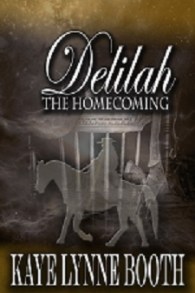
With the second book in the saga, Delilah: The Homecoming, I didn’t even get the first draft completed before the first rewrite. Around 40,000 words into the first draft, Delilah told me that the story was all wrong. Somewhere along the line, my plot had taken a wrong turn, and the story wasn’t going in the intended direction. (Yes, I talk with my characters with the stories in this saga.) When I reread what I had, I realized the truth of it. I had no idea where to take the story from the point it was at.
I tend to be a seat-of-the-pants writer. I get an idea and I have to get it down, so I just start writing. With short fiction, that’s not a bad thing, but when it comes to novels it can be. I could see a couple of places where I thought the story should go in a different direction, but the enormity of the task weighed on me and there were spots where I couldn’t see around what was already written. I set it aside for a month while I pondered the possibilities until I realized what needed to be done.
I may not be prolific, but I am obsessive/compulsive about writing, always having two or more WIPs in different stages of completion. While writing Delilah, I was also working on my thesis novel, which has now become book one of my Playground of the Gods science fantasy series, The Great Primordial Battle, along with completing several short stories during that time. Currently, along with crafting the first draft of The Homecoming, I’m working on two anthologies, preparing The Great Primordial Battle for publication, and working through the snags I’ve hit with my memoir, Losing Michael. It’s no wonder my books take years to write. Yet, I have the satisfaction of knowing that when I’m finished, they will be well crafted stories.
The soil of my mind is fertile and can produce an abundant harvest of stories. The children of my creativity just require longer gestation and growth periods. Stories don’t just spew out of my brain, ready made. They must be honed and crafted until they become the works of quality writing that my readers have already come to expect. But another thing that I’ve realized, with as many projects as I have going, when they all are finally published, and they are all lined up across my author pages and my website, it will appear that I am prolific to anyone who doesn’t know better.
The point is, as authors, we’re all heading toward the same goals, quality crafted stories. The path we chose to get there, they way that we approach the writing process, isn’t nearly as important as the fact that we complete the job. And we can all do that. What kind of writer are you?
Like this post? Let me know in the comments. You can be sure not to miss any of Writing to be Read’s great content by subscribe to e-mail or following on WordPress.
Share this:

Chatting with the Pros: Interview with western author Scott Harris
Posted: May 20, 2019 Filed under: Chatting with the Pros, Fiction, Historical Fiction, Interview, Western, Writing | Tags: Brock Clemons Series, CAZ series, Chatting with the Pros, Scott Harris, Shotgun Willy series, Six Gun Partners, Western, Writing to be Read 8 Comments
Today my author guest on “Chatting with the Pros” is a successful western author, who also happens to write his own blog, which ranked in the top 10 western blogs by Feedspot. He has written many western novels and numerous western short stories. His Brock Clemons Series was a finalist in the Western Fictioners Peacemakers Award and is ranked as a top selling series by his publisher, (and mine, as it happens), Dusty Saddle Publishing. According to his website, he grew up on Louis L’Amour. When it comes to the western genre, he really knows his stuff. Please help me welcome western novelist Scott Harris.

Kaye: What is most challenging about writing western for you?
Scott: Since I am still working full-time running my company, finding the time to write is the most challenging thing. I usually write in the morning and have to drag myself from the keyboard to go to work. I’m hoping retirement fixes that.
Kaye: You have three books out in the Brock Clemons series? What can you tell me about that series?
 Scott: There are actually eight books in the series. The six novels (in order) are: Coyote Courage, Coyote Creek, Coyote Canyon, Mojave Massacre, Battle on the Plateau and Ambush at Red Rock Canyon. Additionally, there are two collections of short stories based on the Brock Clemons characters: Tales From Dry Springs and Tales From the Grand Canyon.
Brock was my first series, so it holds a special place in my heart. The characters are more complex than those in my subsequent series, which makes writing the stories more difficult and more rewarding. I will come back to these characters, but probably not for a year or two.
 Kaye: What can you tell me about your CAZ: Vigilante Hunter series?
Scott: This series is pretty much the antithesis of the Brock series. It is six books (Slaughter at Buzzard’s Gulch, Never Shoot A Woman, The McKnight Massacre, Fire From Hell, Hell on Devil’s Mountain and A Whore’s Life) about a man named Caz (no last name) who travels the West searching for and killing evil men who have evaded justice. The series was an absolute blast to write.
Kaye: When writing for a series, do you outline the whole series from the start, or do you add books as you go? Are the books stand alone, or do the follow a chronological path which should be read in order?
Scott: I am on my 3rd series now (Stagecoach Willy) and I’m in the middle of the 2nd book. I have no idea where the next books are going to go and won’t think about the 3rd book until I finish this one. As a matter of fact, I do not outline my books at all. When I finish a chapter, I have no more of an idea of what the next chapter holds than the reader will. I know that’s different than most writers, but for me, it keeps the writing fresh.
For the most part, the Caz books can be read as stand alone, there is very little crossover from book to book. The Brock series is different and benefits by being read in order.
 Kaye: The most recent book in the Brock Clemons series is Coyote Canyon. Can you tell me a little about that book?
Scott: Coyote Canyon came out early last year and was the 3rd book in the Brock series. The series can be thought of as two different trilogies (Dry Springs and Grand Canyon), so in that sense Coyote Canyon was the last in a trilogy. It was a fun book to write because it wrapped up Brock and his families time in Dry Springs and set the stage for them to move to the Grand Canyon.
Kaye: In addition to your western novels, you have also contributed to several western anthologies. Do you prefer writing book length works or short fiction? Why?
Scott: I think that depends on my mood. My short stories range from 500 words to 5,000 words and sometimes I have an idea that I think is powerful, but requires no more than a short story. It can be freeing to write shorts without having to worry about the continuity that novels require.
On the other hand my novels (Brock averages about 50,000 words per book and Caz closer to 30,000 words) allow me to explore ideas and characters in depth. I would hate to be limited to one or the other.
 Kaye: You wrote a collection of short stories together with your son, Justin. How did that work? Did you write each story as a collaboration or did you each contribute stories of your own? Was it a good experience? Would you do it again?
Scott: We wrote our own stories, though we talk 2-3 times per week about what we’re working on. He is my best story editor and muse. It was a great experience and we’re working on some things together right now. He’s also about halfway done with his first novel.
Kaye: What is the most fun about writing western for you?
Scott: Coming up and with sharing my ideas. It is really exciting to be able to create stories and characters and then do with them what you will. I have learned that it doesn’t take long before the character takes over and I find myself saying “He/She would never do/say that”
Hearing from readers that they like my work is tremendously rewarding. And I’m just old fashioned enough to still love seeing my books in actual print, with paper, ink and a cover.
Kaye: Your blog recently received the Feedspot award, ranking it up there with the top 20 western blogs out there. I believe your blog was actually ranked in the top 10. Would you like to talk a little about that?
Scott: It was flattering, of course. I try to write posts that are honest and candid. I share my troubles and mistakes (at least with regards to writing) and I believe that resonates with people. I love getting feedback from readers. I am absolutely certain that I learn as much, if not more, from my readers than they do from me.

Kaye: Since you write one of the top western blogs, and have been a fan of westerns since an early age, what do you see when you look at the genre today? Do you find more male or female western authors? Do you find the genre dominated by independently published authors? Do you find it trending more toward western romance these days?
Scott: The genre certainly leans toward being male dominated, but it’s changing and more and more women are getting involved, which is great. Certainly the 3-4 huge names dominate the book stores and it’s tough for most of us to get any shelf space. But, Amazon opens the world for independent writers and gives many of us a chance to find an audience. Can’t ask for more than that.
I have noticed the western romance genre getting more notice and attention. It’ll be interesting to see if that continues.
Kaye: Where do you see the western genre going in the future?
Scott: Wherever we want to take it, or maybe more realistically, wherever the readers want us to take it. There are plenty of different genres sitting under the Western umbrella, so it’s up to us to write some great books and pull in readers – new and old – and at the same time, we need to listen to what the readers are telling us.
 Kaye: What is in store for the future for Scott Harris? Does Brock or Caz have more stories in store for them? You are working on the second book in the Shotgun Willy series? Tell me about that series, if you would.
Scott: I’m done with Brock and Caz for now. I am working on the 2nd book in the Stagecoach Willy series. Willy is a stagecoach driver and keeps stumbling into trouble and then I need to write him out of it. He has a sense of humor, which is fun to write and has a partner, Ten, that he’s been staging with for years. When I finish the 6th book, I plan to do a “capstone” book that brings Brock, Caz and Willy together in one grand book.
Kaye: What do you like to do when you’re not writing?
Scott: Spend as much time as possible with my wife, Randi, my son, Justin and my daughter Samantha and her husband Devin. Randi and I travel quite a bit, try to take one RV trip per month. Next month is a 3 week trip to South Bend to watch our daughter graduate from Notre Dame Law School.
Next year, we’re retiring and moving to Tennessee. Very much looking forward to it.
I want to thank Scott for chatting with me here and sharing some of his expertise in the western genre. I very much enjoyed this and hope all of my readers have, too. You can learn more about Scott Harris on his blog and website, or on his Amazon author page. Join me next month on “Chatting with the Pros”, when my guest author will be hardboiled crime fiction novelist Jim Nesbit. I hope to see all of you then.
Like this post? Let me know in the comments. You can be sure not to miss any of Writing to be Read’s great content by subscribe to e-mail or following on WordPress.
Share this:

Jeff’s Movie Reviews – Avengers: Endgame
Posted: May 17, 2019 Filed under: Uncategorized Leave a comment
Earth’s Mightiest
by Jeff Bowles
For more on Avengers: Engame, make sure to check out my full video review.
A wonderful thing happened to me as I watched Avengers: Endgame in the theater. At some point I realized that the worries and concerns that have been plaguing me in recent months are really just a steppingstone to something better, an invitation to move onward and upward in life. It happened around about the same time the core Avengers we met way back in 2012 tried to convince Robert Downey Jr.’s Iron Man to repair the past. “Well crap,” I said to myself, “if their mistakes are universe-ending, maybe mine aren’t as bad as I thought.”
And that’s the thing about this fourth Avengers movie, the capstone to the first eleven years of the mighty Marvel Cinematic Universe. Both understated and bold, the film urges us to reexamine our past choices. Some people stay stagnant and bemoan what they can’t change, while others look ahead and try to envision a better future.
Or maybe I just really love comic books, and a big, wonderful superhero flick like this awakens something serious and startling in me. Individual mileage may vary, of course, but truth be told, I’ve never seen a motion picture quite like this, and neither have you.
Avengers: Endgame is the second part of a two-part epic, which itself is the penultimate chapter of a series that’s twenty-two stories deep. That’s right, in order to gain a full appreciation for the trials and triumphs of Earth’s mightiest heroes, we need to go back to the very beginning, to the moment Tony Stark first slipped into his Iron Man suit. Readers of Marvel comic books were never astonished at how well this little project pulled together in the end, but audiences unfamiliar with a working shared universe might find themselves surprised by the complex tapestry eleven years of movies can weave.
Thanos the Mad Titan wiped out half of all sentient life in the universe with the snap of his fingers in last year’s Avengers: Infinity War, and now our heroes feel the need to, well, do some avenging. When it becomes clear it’s too late to fix Thano’s bold solution to universal overpopulation, the Avengers scatter and make individually vein efforts to move on with their lives. Captain America runs a support group for survivors of the infamous snap, Black Widow runs clandestine operations to protect what’s left of the world, Iron Man has settled into an existence of perfect domesticity, and Thor … well, don’t let me ruin for you how he’s ended up.
When Scott Lang, Ant-Man (Paul Rudd), unexpectedly pops his little shrinky-growy head out of the aptly named Quantum Realm, it slowly dawns on everyone it may be possible to return the universe to its former state after all, the lives of all those who turned to ash included. The movie focuses on the original six heroes we’ve come to love, which is a wise choice. Avengers: Infinity War sure was a beast of a movie, but it was also bloated with characters. The result here is a tighter, more focused narrative, one that dispenses with unnecessary story arcs in lieu of a clear and present runway to adventure, mind-bending time trickery, and a whole hell of a lot of interpersonal drama.

That’s the thing that’s so surprising about Endgame. Whereas most superhero movies overwhelm audiences with big fights and tons of CGI, this film invests in characters and the changes that have worked their way into every aspect of their personalities. Which isn’t to say big fights aren’t present, but the truth is this is a much more personal film than you might expect. As usual, it’s a long shot to save the world, but really, the adventure is secondary to the people.
Storytelling like this is often brooding and overly serious, but really, a good sense of humor turns out to be the name of the game. It’s not all beat-downs and overwhelming anxiety. These characters care about each other, and it shows. Past comic book movies like The Dark Knight have grappled with similar apocalyptic themes, but the first time The Hulk opens his mouth in Endgame, you’ll quickly realize superheroes rarely work best in their darkest, most imposing manifestations. Filmakers Joe and Anthony Russo and their very capable screenwriting team take some magnanimous risks with the humor, off-the-cuff and casual as much of it seems. It’s all worth it. The sense of good-cheer offsets nicely with moments of world-ending weight.
Additionally, a large section of Avengers: Endgame is devoted to reexploring some of the greatest moments from MCU history. It’s funny to think about nostalgia in a series that’s only a decade old, but for audiences who’re fully invested in the story thus far, it really is a beautiful opportunity to look back. So many great moments in Endgame were earned years ago, and while some movie reviewers and quasi-fans have gotten it into their heads this is the last big hurrah, by the time the credits roll, it’s clear we haven’t seen anything yet.
In movie biz terms, it was always a question how long some of these actors would stick around, but Marvel Studios is playing with eighty years of published continuity. Marvel, the little comics company that could, has been finding new ways to explore and reinvent itself on a weekly basis for longer than most people today have been alive, which means no, Virginia, the MCU will not be running out of ideas any time soon. If you keep showing up to the theater, they’ll keep pumping these movies out, and as I write this review, Avengers: Endgame has already become one of the highest grossing films of all time.
Speaking of writing reviews, it’s tough to describe Endgame without spoiling it completely. Suffice it to say, this three-hour epic will leave audiences breathless and hungry for more. It’s a huge, big-hearted film saturated by personal stakes. Or is that a personal movie containing universal stakes? I can’t imagine a more fitting entertainment milestone. Surely, the quality won’t always live up to the hype, but until such a time Marvel jumps the shark like Fonzie, box-office supremacy shouldn’t be an issue.
The next movie in the MCU arrives in early July. Spider-Man: Far From Home has already promised to explore the fallout from Endgame, and that’s really what Marvel is best at. Each time we come out for one of these flicks, we get more context and more invention. Say what you will about silly superhero movies, but don’t be surprised if in twenty years the film industry is still dominated by capes, masks, and tights. Until then, I’ve only got three words for you: make mine Marvel.
Avengers: Endgame gets a perfect 10 out of 10.
Ka-pow!
Check out Jeff Bowles Central on YouTube – Movies – Video Games – Music – Short Stories – So Much More!
You can keep up on what Jeff’s been watching and catch all of his great movie reviews the third Friday of each month. Subscribe to email or follow on WordPress toda
Share this:

Writing for a YA Audience: Books in the Library
Posted: May 15, 2019 Filed under: Books, Fiction, Libraries, Self-Publishing, Writing, Writing for a YA Audience, Young Adult | Tags: Books, Jordan Elizabeth, Libraries, Writing for a YA Audience, YA, Young Adult, Young Adult Fiction 1 Comment
“This is available at the library, right?’ I get that question a lot.
You should know that I talk about my books. A lot. I get excited and that passion spills over whether I’m at a book signing or conversing with a coworker. Some people don’t want to buy books. They might not like the book, so they don’t want to invest in the purchase, or they don’t want to have books cluttering their homes. Whatever the reason, libraries are perfect.

Photo by Janko Ferlic on Pexels.com
If I’m asked locally, then I get to say yes, my books are available. Other places…well…not so much. That surprises people.
Here’s the thing about indie books. Libraries don’t normally stock them. They need a reason to purchase a copy. This could be because you’re a local author, because you did an event there, or because someone requested it.
The best way to help out an author is to ask your local library to purchase a copy. This is a sale for the author and exposure. People are going to borrow the book, read it, and talk about. There is no marketing tool as powerful as word of mouth.
Jordan Elizabeth is a young adult fantasy author. She’s often wandering libraries looking for something to spark her interest…or she’s squealing over a treasure discovered in a used book room. You can connect with her via her website.
Want to be sure not to miss any of Jordan’s Writing for a YA Audience segments? Subscribe to Writing to be Read for e-mail notifications whenever new content is posted or follow WtbR on WordPress.
Share this:

Interview with western romance author Juliette Douglas
Posted: May 13, 2019 Filed under: Fiction, Historical Fiction, Interview, Western, Writing | Tags: Author Interview, Author Profile, Freckled Venom, Juliette Douglas, Western, Writing to be Read 2 Comments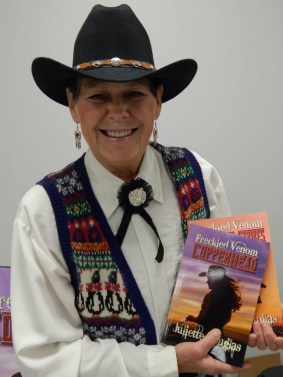
I’m pleased to be chatting today with a prolific author who has burst onto the western scene in a relatively short amount of time. Her debut novel, Freckled Venom, was a Laramie award winner, and she recently signed on with Delilah‘s publisher, Dusty Saddle Publishing. The amazing part is she manages churn out all of her many books, while still holding down a traditional job outside the home, as well. Let’s see if she has any secrets to share. Please welcome western author Juliette Douglas.
Kaye: Your website says you are a new voice in the western genre, but it seems like you have written a lot of books. How long have you been writing western?
Juliette: I was a new voice 5 years ago, as I tend to have more grit in my novels then most women western writers.
I was 1st published in 2013, but the publisher was awful so ditched them and became indie and re-issued my books with new covers and re-edited interiors in 2014. So that’s when I like to say I’ve been published.
Kaye: What did you write before westerns?
Juliette: I have never written a thing before in my life. So I guess you could say I’m a late bloomer.
Kaye: Do you think it is more difficult for a woman to author a western novel and make a success of it?
Juliette: No I don’t. When I began to promote my novels at local events, I sold more to men then women. Since then I have all ages who read my books.
I personally feel it’s easy for me to write strong female characters in an old western setting then to write a contemporary western.
I love history, so it’s a good match for me. I’ve been blessed with my success. I know I am up against many good male western writers who have been around much longer then I have, but I’m making strides.
Kaye: What’s the biggest challenge in writing westerns for you?
Juliette: Making sure the things I want to happen are in the right time frame, I use the weapons for that era etc. For example: smokeless gunpowder did not appear until the 1890s.
Kaye: Your female characters are bold and brassy in a genre where women are typically portrayed as damsels in distress needing rescued by a big strong man. How do you write your heroines in a way that makes them believable, yet allows them to remain independent?
Juliette: I try to put myself into the situation. How would I feel, behave, emotions I might hide or display. Would I be angry or decide these are the cards I was dealt and how would I go about living my life with these secrets or circumstances thrown at me. Women who carved out a future for themselves in the old west had to be some of the strongest I have ever read about and I try to portray that with my characters.
Kaye: What can you share about your Freckled Venom Series?
Juliette: It was a great experience for me as a writer. I loved how my characters took over and I was just the messenger typing out their words and feelings.
 The Freckled Venom Series is very different then most western novels out there because it has a gun toting rugged female who bounty hunts instead of the usual male filled westerns. I’ve reversed the roles you might say.
In Freckled Venom Skeletons I tried something different. I had two points of view going on. One from the children’s POV and then the adults and it worked very well.
There will be many more stories in the FV Series. This summer I will have Freckled Venom Vixen The Early Years and for Christmas, Plum Dickens of a Christmas. A reunion of sorts with all the characters brought together in this book.
Kaye: What do you consider to be the single most important element in a western?
Juliette: Good storylines & plots. Plenty of action and hair-raising adventures.
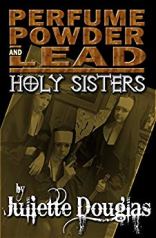 Kaye: Would you talk a little about Perfume, Powder and Lead: Holy Sisters?
Juliette: Hahaha…This was one of the most fun books I have written. The idea is so absurd that this would have happened, but a possibility in those days.
Three soiled doves are tired of that life and set out to the gold fields, but they need money to get there. They stumble across nuns killed by raiders, and the girls change their habits, so to speak and make plans to rob a bank dressed as nuns.
But there are deeper elements also allowing the reader to form a bond with these girls.
It’s raw, it’s gritty and it’s not for everyone to read.
Kaye: Are there any of your books which you’d classify as western romances?
Juliette: I have the teasing potential of romance in most of my novels and my readers seem to like that.
Kaye: One of your most recent releases, Bed of Conspiracy, sounds to me like an
historic thriller involving political conspiracy, assassination plots and cloak
and dagger action, all set during the Grant administration? Was it difficult for
you to stray outside of the western genre?
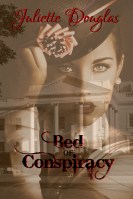 Juliette: Oh man, I had wanted to do this story for 3 years before I finally found time to write it.
Loved writing this one! Set in 1876 it wasn’t hard for me at all. I loved weaving actual events into the story. Looking at maps of Washington DC from 1876 to learn the layout of the city to include actual street names and places scattered about in the fictional story. It has ended up being one of my most popular novels and due to the high interest has spawned a series. Next one titled: Death Deals the Hand, A Ross & Sam Adventure.
Kaye: Where do you find inspiration for your stories?
Juliette: Every where. Everyday stories and situations that can be transported back in time to the old west!
Kaye: What’s the most fun about writing westerns?
Juliette: Everything!
Kaye: The first book in your Freckled Venom series was also your debut novel, Copperhead, which you won a Laramie Award. What is the Laramie Award and how does one receive it?
Juliette: The Laramie Award is the western division of the Chanticleer awards. I submitted Copperhead on a whim and won over very stiff competition.
For 2019 I will be entering Bed of Conspiracy in the Laramie Awards Adventure & Caper category. Will see what happens!
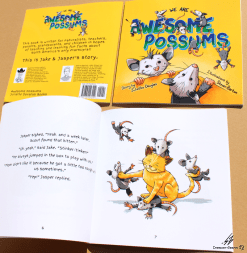
They also have a category for children’s books and I will be entering my 1st Children’s book: We Are Awesome Possums.
Kaye: Would you recommend aspiring authors attempt the western genre? Why or why not?
Juliette: You need to know the history of the old west for sure. There are still many untold stories out there to share, but it takes hard work to come up with a fresh idea with the old tales that would be marketable.
The American Old West is our history, no one else can claim it. It speaks to the hearts of men, women and children across the world. It is America’s claim.
Kaye: If you could have lunch with any author, alive or dead, who would it be? Why?
Juliette: Louie L’Amore. A fascinating man. His stories are based on a lot of his own actual experiences. It would be neat to visit and talk with him.
I want to thank Juliette for sharing with us today. It has been an absolute pleasure. You can learn more about Juliette Douglas and her work on her Facebook Author page or her Amazon Author page. I’m proud to share a publisher with Juliette. I hope you will join me next week on “Chatting with the Pros”, when my author guest will be another Dusty Saddle author, Scott Harris. I hope to see you then.
Like this post? Let me know in the comments. You can be sure not to miss any of Writing to be Read’s great content by subscribe to e-mail or following on WordPress.
Share this:

“Not Just Any Man”: A Journey into New Mexico’s Past
Posted: May 10, 2019 Filed under: Book Review, Books, Fiction, Historical Fiction, Western | Tags: Book Review, Historical Fiction, Loretta Miles Tollefson, Not Just Any Man, Western, Writing to be Read 1 Comment
A true western makes you feel the landscape, and Not Just Any Man, by Loretta Miles Tollefson does just that. Tollefson’s use of present tense narration and vivid visual imagry don’t just help readers see the scene in their mind, but actually puts you there. Woven into true events in New Mexico’s history, Tollefson portray’s the landscape as it was, with a storyline and fictional characters which could have been, and for as long as it takes to read the book, maybe they were.
Gerald Locke is not just any man. He’s a man of mixed race, trying to find a place for himself and acceptance from his fellow man, which he believes might be found in the frontiers of what is today, New Mexico. In Gerald’s time, it is a vast land filled with open spaces and wildlife, plentiful with opportunity, and Gerald has hopes of finding a spot where he can settle down and live comfortably, but first, he must raise the funds to embark on such an endeavor. He hasn’t planned on sharing his dream, but when he makes the acquaintance of Suzanna Peabody, new dreams in which she is by his side begin to foster as he makes his way following the rugged life of a trapper. Upon his return to Taos, he finds his dreams haven’t changed but his doubts have grown. He’s not the same man he was when he set out. Will Suzanna have him when she learns just who he really is?
Tollefson’s masterful use of third person present tense and her vivid descriptions make this book seem like a journey into the past. I give Not Just Any Man five quills.
Kaye Lynne Booth does honest book reviews on Writing to be Read in exchange for ARCs. Have a book you’d like reviewed? Contact Kaye at kayebooth(at)yahoo(dot)com.
Share this:

Finding the right books to interest your child in reading
Posted: May 8, 2019 Filed under: Uncategorized 34 Comments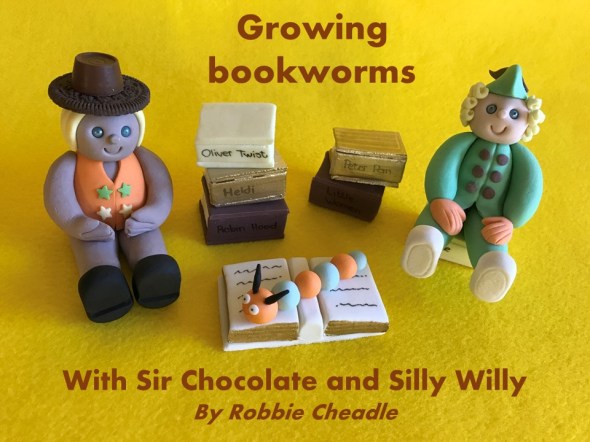
In the few weeks since my last post, two of the bloggers I follow have written a post about children’s books that influenced their lives and the choices they made during their early adulthoods.
These posts set me to thinking about which books, of the enormous number I read as a young girl, had the most impact on me and my life. This thought then led me to thinking about why I love books and reading so much and why it was so important to me that my own boys discover the joys of the written word. From these various thought patterns emerged the realisation that I understood fairly early on in motherhood that, if I wanted my boys to love reading as much as I did, I had to identify what sorts of books would appeal to them enough to draw them away from all the competing attractions in our modern world.
When I was a girl, we only had television for one hour a day and the children’s programs were only in English on alternate nights. There were no ipods, ipads or iphones with all their graphic presentations of battles, adventures, space and fantasy worlds to distract me from reading. Books were the main source of entertainment for me other than socialising in the street with other neighbourhood children. My dad was strict and we could only go out to play with other children between 9 A.M and 12 P.M. and then again between 2 P.M. and 5 P.M. That left plenty of time for me to read. This is not the case for my children. In order to get them to read, the book has to appeal to them enough for them to set their electronic devices aside for a period to read.
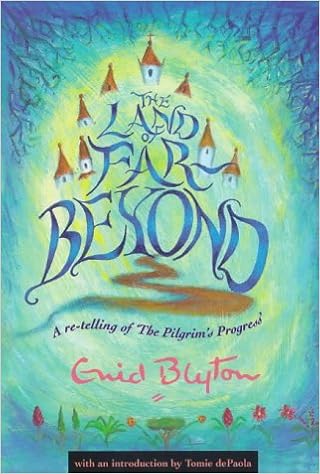
Looking back, I realise that I loved fantasy books. I was a huge fan of Enid Blyton. Not her adventure books or girly school books but her books about fairies, brownies, pixies and all the other fantasy folk who existed in her Folk of the Faraway Tree, Mr Pink-Whistle, The Wishing Chair and other similar book series. My favourite of Enid Blyton‘s stand alone books was, and still is, The Land of Far Beyond.
When my oldest son, Greg, was born, I started to read to him straight away. When he was 15-months old he would sit and listen to me read two or three pages of one or other of the Folk of the Faraway Tree books. As he grew older, I read our way through all my old favourites including Noddy and friends, Paddington Bear, Rupert Bear and, one of my all time favourites, Mary Poppins by P.L. Travers. Mary Poppins is fantasy at its best with the children visiting a world inside a painting, watching a circus comprising of acts by the planets, stars, sun and moon, visiting people and lands at each point of the compass and entering a garden they built in the park, inhabited by people made of clay and mud. It soon became evident that young Greg’s taste in books was similar to mine. While I was pregnant with Michael, I used to read to Greg (aged 2 1/2 at the time) for up to three hours a day. Greg turned into a fantasy reader and has, on his own, read his way through all the Chronicles of Narnia books by C.S. Lewis, The Hobbit by J.R.R. Tolkien, The Indian in the Cupboard books by Lynne Reid Banks, The Borrows collection by Mary Norton (Did you know that Mary Norton also wrote The Magic Bed Knob and Bonfires and Broomsticks which were turned into the Disney movie Bedknobs and Broomsticks?) and then on to the Harry Potter series by J.K. Rowling and now Lord of the Rings and all of Tolkien‘s other books. Recently, Game of Thrones by George R. R. Martin and Wheel of Time by Robert Jordan have swelled the ranks of Greg’s book collection which comprises of approximately five hundred books.
It was so easy to interest Greg in reading that I thought it would be the same with Michael. Little did I know that Michael would follow a different reading path to Greg and it would be much harder to interest him in reading due to his nature and learning barriers. Michael did like having Enid Blyton read to him but he would not read it aloud. I could not get him interested in reading fantasy books, or any of my other favourite books either, to me or alone. This was a problem. There had to be books out there that would tickle his reading fancy. We tried modern books, Horrid Henry by Francesca Simon and Diary of a Wimpy Kid by Jeff Kinney, as well as many others. Michael would listen and enjoy me reading them to him but he would not read them himself.
One day, an interesting thought occurred to me. Maybe Michael, a small boy who loved building with lego and doing science experiments with me, would like non-fiction books. I bought him the entire Mickey wonders why collection. What a hit. Michael loved them. After I had read a few of the articles, he would happily have a go at reading a few pages of one just to keep on learning and reading more. We read our way through all of these books and then moved on to all sorts of other non-fiction children’s books including all the horrible history and horrible science books. I enjoyed reading Michael’s choices too as I also learned from them. When we visited the UK when Michael was 9 we acquired books about Jack the Ripper, the black plague and the great fire of London. I have used each of these books to gain an understanding of these murders and events for use in stories I have written.

Michael’s audio comprehension has always been much higher than his reading level. I discovered that his enjoyment of non-fiction extended to audio books too. Over the past few years we have listed to audio books about the vikings, the greatest scientists of all time, great inventors and many others.
I have two nephews and two older nieces. I have applied my theory that you just need to find the right books to interest a child in reading to them too. Ben and Ryan also enjoy non-fiction books. Books about science fiction and boys on adventures like the Astrosaurs collection by Steve Cole, Humphrey the hamster books by Betty G. Birney and the Will Solvit books by Zed Storm also proved very popular with the boys.
The girls tastes are different. They enjoy Winne the Witch by Valarie Thomas and they loved the illustrations by Korky Paul. The Little Miss and the Little Men collections by Roger Hargreaves were popular with them. I also discovered that all of the young children loved Dr Seuss and rhyming text was interesting and captivating for their young minds.
If you have a reluctant reader, it may be that you have not found their golden reading lever. Most people have one if you can only find it. If fantasy isn’t popular, try something else.
The more that you read, the more things you will know. The more that you learn, the more places you’ll go. Dr. Seuss
About Robbie Cheadle

Hello, my name is Robbie, short for Roberta. I am an author with five published children’s picture books in the Sir Chocolate books series for children aged 2 to 9 years old (co-authored with my son, Michael Cheadle), one published middle grade book in the Silly Willy series and one published preteen/young adult fictionalised biography about my mother’s life as a young girl growing up in an English town in Suffolk during World War II called While the Bombs Fell (co-authored with my mother, Elsie Hancy Eaton). All of my children’s book are written under Robbie Cheadle and are published by TSL Publications.
I have recently branched into adult horror and supernatural writing and, in order to clearly differential my children’s books from my adult writing, I plan to publish these books under Roberta Eaton Cheadle. I have two short stories in the horror/supernatural genre included in Dark Visions, a collection of 34 short stories by 27 different authors and edited by award winning author, Dan Alatorre. These short stories are published under Robbie Cheadle.
I have recently published a book of poetry called Open a new door, with fellow South African poet, Kim Blades.
Find Robbie Cheadle
Blog: https://bakeandwrite.co.za/
Blog: robbiesinspiration.wordpress.com
Goodreads: Robbie Cheadle – Goodreads
Twitter: BakeandWrite
Instagram: Robbie Cheadle – Instagram
Facebook: Sir Chocolate Books
Want to be sure not to miss any of Robbie’s Growing Bookworms segments? Subscribe to Writing to be Read for e-mail notifications whenever new content is posted or follow WtbR on WordPress.
Share this:

Interview with Christian western romance author Patricia PacJac Carroll
Posted: May 6, 2019 Filed under: Author Profile, Books, Christian fiction, Fiction, Historical Fiction, Historical Romance, Interview, Uncategorized, Western, Writing, Writing to be Read | Tags: Author Interview, Author Profile, Christian western romance, Christion fiction, Historical Romance, Lockets and Lace, Patricia PacJac Carroll, romance, Sandra's Journey, Sweet Romance, Western, Writing to be Read 2 Comments
My author guest today is a prolific writer, who must publish an average of at least six books per year, in numerous romance series. Patricia PacJac Carroll writes historical and western Christian romance at a rate that I find amazing. The books on her Amazon Author page scroll in what seems like a never ending flow. In addition to her own series, which are many, on occasion, she’s invited to participate in series with a collection of other authors, as is the case with her most recent release. Let’s see what she has to share with us today.
Kaye: In what ways is writing a Christian western romance different from writing a western romance?
Patricia: For me, saying it is Christian means at least some of the characters have a Christian world view. Faith and hope in the Lord are evident in their lives. No preaching or sermons or a lot of verses, only faith as it relates to the story and the characters.
Kaye: Your latest book was recently released, Sandra’s Journey. Would you like to tell me a little about the story?
Patricia: Sandra is struggling, she’s walled herself in away from others. Her little brother’s death and the fact that a fiance left for Calfornia the year before and she only received one letter from him, have stolen her courage. She meets a corporal who is escorting the wagon train, and he challenges her to dream. Romance blossoms along the California trail where by trails end she will have to choose between the two men. A story of courage rediscovered and dreams coming alive.

Kaye: Sandra’s Journey recently came out as a part of a historical western series with a wagon train theme, which includes your book and those of several other Christian western authors. Would you like to tell me about the Lockets and Lace series?
Patricia: The Locket and Lace series is made up of several different authors. I was asked to join in 2018 and wrote Oregon Dreams for the Locket and Lace series for 2018. And then this year again for the Locket and Lace series for this year with Sandra’s Journey.
Every book has a connection to the Bavarian Jeweler in St. Joseph, Missouri. They have a locket that was made in the shop and a piece of lace. We had 9 books last year and 10 this year. They are all wonderful books
Kaye: The Lockets and Lace series books are not the only books you’ve written, by far. You have written several other series, including the Mail Order Brides and The Law Keepers series. How many books have you written? How long have you been writing?
Patricia: I have been writing seriously for thirteen years and began publishing in 2012. I have 40 books out right now and plans for many more. I have several series ~ Mail Order Brides of Hickory Stick, Montant Brides of Solomon’s Valley, and several others.
Kaye: Tell me a little about your author’s journey, if you would?
Patricia: I began writing and attending critique groups in 2006. I loved it, but my friends would call me the book of the week person because story ideas would attack me. I love the thrill of a new story and still do. Finally, I decided I better finish a book and my first book was Liberty Belle that I published in 2012.
Kaye: Your husband is instrumental in your writing, so much so that you’ve incorporated both of your initials into your author’s name – PacJac. Would you talk about how he enables you to write?
Patricia: My husband is a wonderful prince of a man who gives me the time to do what I love. He let me retire in 2006 so I could write. And now, my writing has enabled him to retire. We are a wonderful team and are enjoying our lives. I added the PacJac to my writing name because I found there were other Patricia Carroll’s out there in the writing world. It works well though because you put PacJac in Amazon and it will pop up my books.
Kaye: Your female characters of the contemporary strong and independent variety, or do they follow the traditional damsel in distress variety of heroine?
Patricia: I’d say they are a combination. While I want to be historically correct, readers live in the 21st century. I do like spunky women, but I also enjoy writing about a character who grows in courage and strength, too.
Kaye: What part of writing do you find to be the biggest challenge?
Patricia: The self-discipline. I am a seat-of-the-pants writer, and I tend to live my life the same way. I enjoy fun, family, and friends as well as writing so at times the need to balance comes into play.
Kaye: Where does your inspiration come from?
Patricia: The Lord. He gives me the stories. I am amazed at how He has made sure I understand that. One time I had the opportunity to put a Christmas story in an anthology and had a weekend to write it as it was due Monday at noon. Now, I had bragged that if you just give me a name and a place, I will come up with a story. Well, after my haughty attitude, my friends gave me a name and place and my imagination heard crickets. Nothing. Nada. No story. Now, that was a bit scary to me. A writer isn’t much without a story. So I figured I missed the anthology. But then at 5:30 Monday morning I woke up with a picture in my mind of a cowboy on a horse pulling a Christmas tree and knew I had a story. And I wrote it and turned it in before noon. You can find that story in my book Christmas in Texas. The Richest Christmas. So I will give the Lord all the credit for anything good that I do. Any mistakes are mine.
Kaye: Your books obviously are portrayed in a western landscape, based on historical times and events. What kinds of research do you find yourself doing for your books?
Patricia: Documentaries, books on the old west. I have always loved the west and westerns.
Kaye: Do you feel you draw pieces from your own life into your stories? How so?
Patricia: Yes, and I tell my friends anything may be used in a story. I know I often have my characters state “How hard can it be?” That is all me.
Kaye: What is the most fun part of writing western romance for you?
Patricia: I enjoy the characters and the things they get themselves into. Plus horses, I love horses and they have always been part of the draw to westerns for me. I also love the idea of the wide open wild country.
Kaye: What is something many of your readers wouldn’t guess about you?
Patricia: For twenty years, I owned and ran a pet store. Sea Horse Pets in Arlington, Texas. As you can guess I love animals. And people. I love to write, and my heart is that readers will enjoy my stories and be strengthened and encouraged by reading them. I enjoy making readers happy.
I want to thank Patricia for joining me today to share her thoughts with us. I don’t know about all my readers, but I am astounded by the sheer volume of her works. You can learn more about Patricia at the links below. Stop in and see if you too are not awed by the books she’s produced within the span of the past seven years.
Links
Author page on Amazon: https://www.amazon.com/Patricia-PacJac-Carroll/e/B008R9JCN2/
Facebook Author page: https://www.facebook.com/PatriciaPacJacCarrollAuthor/
Website: http://www.pacjaccarroll.com/
Newsletter sign up http://eepurl.com/bpPmbP
Like this post? Subscribe to Writing to be Read for e-mail notifications whenever new content is posted or follow WtbR on WordPress.
Share this:

“Chance Damnation”: A strange paranormal western fantasy
Posted: May 3, 2019 Filed under: Book Review, Books, Dark Fantasy, Fiction, Paranormal, Speculative Fiction, Western | Tags: Book Review, Chance Damnation, DeAnna Knippling, Paranormal, Paranormal western, Western, western fantasy, Writing to be Read 2 Comments
Chance Damnation, by DeAnna Knippling is a western turned inside out. It draws you in with a strange opening scene, jumping right into the thick of the action, where multi-horned demons attack a small ranching community in Buffalo County, South Dakota, and then carries you away into the depths of the story as things get even stranger.
There is definitely something out of the ordinary going on, and young Celeste Marie seems to be at the center of it. Jerome is determined not to let the demons have her, but the adults won’t listen to him because he’s just a kid. When Celeste Marie is kidnapped by the demons and Jerome goes after her into the demon realm below, community members who died in the demon rampage return as demons and Jeromes older brothers and other family members fight against the demons, but it seems as if they might be fighting a losing battle. This paranormal western fantasy is filled with surprises.
Stranger and stranger. But, it is strange in a good way. It captured my interest and kept the pages turning. It is strange in a good way. The story is well written and well paced, as is with most of the books I’ve read by DeAnna Knippling. It is a weird western, but a good story. I give Chance Damnation four quills.

Kaye Lynne Booth does honest book reviews on Writing to be Read in exchange for ARCs. Have a book you’d like reviewed? Contact Kaye at kayebooth(at)yahoo(dot)com.




















