Posted: August 9, 2019 | Author: kayelynnebooth | Filed under: Book Review, Books, Fiction, Mystery, Paranormal | Tags: Book Review, Broomsticks and Burials, Lilly Webb, Paranormal Mystery, Writing to be Read |

Broomsticks and Burials, by Lily Webb, is a paranormal mystery cozy and a really fun read. Once you buy in to a magic place that only those with paranormal talents can see, the rest comes easy.
Zoe Clarke is an out of work journalist, and when she gets an offer to work on the newspaper in Moon Grove, she can hardly refuse, even though it requires her to pull up stakes and move to a town she’s never even seen on a map. Right away she notices something different about Moon Grove. Maybe it’s the anchorman who transforms from a wolf to show her around that tips her off, but she worries she may not be right for the job. After all, she has no paranormal talents, so she shouldn’t even be able to see Moon Grove. Or does she?
When she finds that her predecessor was murdered, creating the opening for her, she starts looking into the mysterious circumstances even though several people warn her off, a broken broomstick at the scene her only clue. But, once she gets started, the plot thickens and she just can’t stop until the mystery is solved and she’s discovered that she belongs in Moon Grove more than she ever could have imagined.
Broomsticks and Burials is a light-hearted cozy mystery that’s fun to read. I give it four quills.

Kaye Lynne Booth does honest book reviews on Writing to be Read in exchange for ARCs. Have a book you’d like reviewed? Contact Kaye at kayebooth(at)yahoo(dot)com.
Posted: August 7, 2019 | Author: Jeff Bowles | Filed under: Uncategorized |
All Hail the Late Bloomers!
By Jeff Bowles
The first Wednesday of every month, science fiction and horror writer Jeff Bowles offers advice to new and aspiring authors. Nobody ever said this writing thing would be easy. This is your pep talk.
It’s a forgone conclusion water never boils when you watch it. As aphorisms go, it’s kind of true, I guess. I know that in my own life, there have been times I’ve wanted something so bad, have focused on it so intensely, that it was almost no surprise I ended up with nada in the end. Do you feel that way about your writing career? Stuck? Unappreciated? Have you felt that way now for years or even decades?
It’s pretty rare for an aspiring author to strike gold on her or his first time out. Most writers accept this as fact, but I often wonder how many of us have internalized it. Stories of the ubiquitous wunderkind abound. It stirs our imaginations, the young upstart genius who, in earnest, works diligently to produce that one perfect novel and who, after a little effort, lands themselves a literary agent, then a book deal, then a movie deal, then…
But what about folks who don’t achieve much until they get a bit older? What about the late bloomer, who works just as hard as that young upstart, but for whom success has been slow in coming?
For a lot of people on the outside looking in, a writer’s inability to move the proverbial ball forward is often a sign of poor motivation, or worse, a lack of true talent. Unfortunately, the megastars have tainted the pool in this regard. For one, writers who achieve success while young tend to be tragically nonchalant about publishing and what it really takes for the vast majority of their peers to reach the same level. Selling yet another novel or short story is no big deal for them, and in my experience, more than a few of them fail to see the struggle the rest of us face. I don’t mean to call anyone out, of course. It’s just that perspectives shift wildly depending on who you talk to.
I don’t know about you, but I like to believe in a little thing called fate. Sometimes the things we want most just aren’t right for us, and it’s only after the fact, after we’ve struggled to attain them, that we realize we were perhaps meant for greener pastures. Whatever comes my way in life, I can’t actually argue with the cards I’ve been dealt, and neither can you. You can try, I suppose. Let me know in the comments section below how that’s worked out for you. Yeah, maybe it’s taking you longer to reach your goals than it took others. We can try to control things, buy self-help books, attend seminars about producing more commercially viable writing, but the reality of the situation is that thousands upon thousands of really talented folks struggle on a daily basis to be heard. It doesn’t mean we have to hate what we do. In fact, in can empower us to enjoy it even more.
There’s some solace to take if you’re perhaps getting on in life and are wondering if you should pack your silly writing dream up and focus on more worthwhile goals. Feeling dejected, rejected, and abused is not an age or experience thing. We all know what it’s like. The good news is that many of the most talented and successful authors you’ve ever heard of didn’t get their careers rolling until later in life. Bram Stoker, for example, didn’t publish his first story until the age of forty-three. And William S. Burroughs, the author of Naked Lunch, didn’t find the strength to take his writing seriously until the tragic death of his wife.
Luckily, you don’t need tragedy to learn the same lesson he did. It’s never too late. Not ever. You can’t predict when or where lighting will strike, and if you choose to quit, you won’t see all your effort pay off. It can’t be denied, there is something special about that wunderkind model. I wanted to be that guy. I’m sure more than a few of you did, too. But there’s also something to be said for experience, wisdom, patience, and dare I say it, deliberate and well-measured progress (also perhaps known as SLOOOOOOW progress).
So maybe you didn’t write a book until your kids were grown, your spouse had asked for a divorce, you lost your job, or whatever else you’ve been through in life. Isn’t it safe to say you’ve experienced things you and only you can write about? A treasure trove of experience, actually. And maybe you’ve read a few good books along the way, too.
We never know how much something means to us until we no longer have it. Never assume anything when it comes to this fate business. And don’t beat up that dead horse in your own mind. No, success is not a window that closes after a set time. Enjoy the work, love the craft, keep producing, and never stop dreaming. And I mean, it could be worse, right? You may have never started writing at all. Trust me on this one, folks, the world would be a far less magical place if you had.
Until next month!
Jeff Bowles is a science fiction and horror writer from the mountains of Colorado. The best of his outrageous and imaginative short stories are collected in Godling and Other Paint Stories, Fear and Loathing in Las Cruces, and Brave New Multiverse. He has published work in magazines and anthologies like PodCastle, Tales from the Canyons of the Damned, the Threepenny Review, and Dark Moon Digest. Jeff earned his Master of Fine Arts degree in creative writing at Western State Colorado University. He currently lives in the high-altitude Pikes Peak region, where he dreams strange dreams and spends far too much time under the stars. Jeff’s new novel, God’s Body: Book One – The Fall, is available on Amazon now!

Check out Jeff Bowles Central on YouTube – Movies – Video Games – Music – So Much More!
Want to be sure not to miss any of Jeff’s Pep Talk segments? Subscribe to Writing to be Read for e-mail notifications whenever new content is posted or follow WtbR on WordPress.
Posted: August 5, 2019 | Author: kayelynnebooth | Filed under: Art's Visual Media Reviews, Ask the Authors, Blog Content, Chatting with the Pros, Editing, God Complex, Growing Bookworms, Jeff's Movie Reviews, Monthly Writing Memo, The Many Faces of Poetry, Weekly Writing Memo, WordCrafter, WordCrafter Press, Writing, Writing for a YA Audience, Writing to be Read | Tags: Art's Visual Media Reviews, Ask the Authors, Ask the Authors Anthology, Chatting with the Pros, Growing Bookworms, Jeff's Movie Reviews, Jeff's Pep Talk, The Many Faces of Poetry, Whispers of the Past, WordCrafter, Writing for a YA Audience, Writing to be Read |

Looking back, I can remember when I first started this blog, back in 2010. I really had no idea what I was doing, or even what blogging was all about, but I knew I wanted to write and Writing to be Read offered a platform where someone might actually read what I wrote. Back then, I really struggled with what to write. I couldn’t imagine why anyone would care to read what I had to say.
Since then, I’ve learned a lot. Acquiring an M.F.A. in Creative Writing, along with my experience as The Southern Colorado Literature Examiner, gave me the knowledge, skills and confidence to imagine that I could create content that people would want to read. I write about what I know. My passion has always been writing, thus that is what I write about.
In 2016, I decided that there was no way that I could produce enough quality content to keep fresh content and keep readers visiting the blog, so I began recruiting other talent. My knowledge was limited to my own writing experience and I wanted to expand the scope of the content. With the help of others who knew more about areas which I wasn’t versed in, I was able to do this.
My first team member was Robin Conley, and her “Writing Memos” are still bringing viewers to the blog, although she is no longer an active team member. Next, Jeff Bowles was added to the team, with two segments. Although he no longer does his “God Complex” segment, you can find “Jeff’s Pep Talk” on the first Wednesday of every month, and “Jeff’s Movie Reviews” posts on the third Friday. Jeff is great at writing motivational posts and he writes killer movie reviews, so if you haven’t checked out his segments, I recommend that you do.
This year, Art Rosch joined the team with his “The Many Faces of Poetry” segments the last Wednesday of each month, and he recently began posting for “Art’s Visual Media Reviews” on the last Friday. Both segments cover subject matter Art was versed in and his reviews are both interesting and entertaining. Also, joining the team in 2019 are Jordan Elizabeth, with her “Writing for a Y.A. Audience” segment on the third Wednesday of each month, which explores Jordan’s inspirations and writing experiences, and Robbie Cheadle with her “Growing Bookworms”, which emphasize the importance of reading for children and explores children’s literature.
In 2018, I ran two twelve week segments of “Ask the Authors”, which was quite popular, where I interviewed an author panel on the various aspects of writing. Although it was fairly successful, it was also a lot of work, and it required a lot of time from each of the authors on the panel in order to respond to my questions with depth and knowledge. The compilation of those segments is currently in process for the Ask the Authors anthology, to be published by WordCrafter Press.
In 2019, we’ve seen a little more structure as I added monthly genre themes to focus on specific genres, and added my “Chatting with the Pros” segment in coincidence with those. We also saw the first “WordCrafter Paranormal Story Contest”, which will result in the publication of the Whispers of the Past paranormal anthology, also by WordCrafter Press. (Jeff Bowles was the winner of the contest for his short story, “A Peaceful Life I’ve Never Known”. He received a $25 Amazon gift card and his story will be featured in the anthology.)
Writing to be Read is growing, and recently had its 500th post. View numbers are up, as well as followers, and I attribute it to the quality content posted by both myself and my team members. Of those 500 posts, 100 of them were made by Writing to be Read team members and I want to take time now to acknowledge and thank them for the quality contributions that they each make to the blog. Writing to be Read is a labor of love and team members don’t receive compensation for the time and dedication they put into their segments, so they really do deserve kudos for the content they provide. To show my appreciation and bring them and the blog segments each one contributes, I’ve created a “Meet the Writing to be Read Team Members” page, and I hope all of you will check it out and learn more about those who provide such great content.
This new page comes along with other new changes as I prepare to launch WordCrafter Quality Writing & Author Services. I’m happy to say that although some parts are still under construction, the website is now live. Write it Right Quality Editing Services, which used to be found here on this site, is now housed on the WordCrafter site, so if you are looking for it, you can now find it there. Other changes you may notice in the near future include the migration of my “Copywriting and P.A. Services” to the WordCrafter site, where it will become WordCrafter Social Media Copywriting and Book Promotions.
These are the most immediate changes which have taken place or are expected to before the end of the year on Writing to be Read. Closer to that time, I’ll be posting another update that will tell you what you can expect in 2020. Can you believe it? It’s just around the corner. So until then…
Happy Writing!
Kaye Lynne Booth, M.F.A.
Posted: August 2, 2019 | Author: kayelynnebooth | Filed under: Book Review, Books, Fiction, Mystery, Stories, Suspense | Tags: Anthology, Book Review, Death Among Us, Murder Mystery, Short Fiction, Short Stories, Writing to be Read |
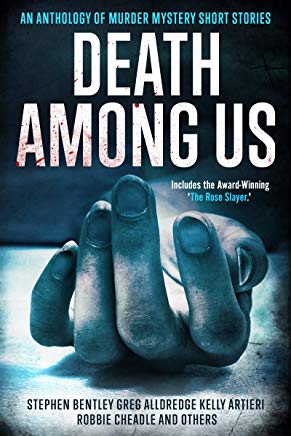
Death Among Us – An Anthology of Murder Mystery Short Stories, compiled and edited by Stephen Bentley is a curious collection of stories, indeed. As I’ve mentioned before, the problem with short fiction lies in telling a complete story in a condensed form, with beginning, middle and end, and it’s one of my peeves when I walk away from a short story and it doesn’t feel complete, or it feels as if it ended too abruptly, as if the author was in a hurry to wrap things up. Some of the stories in this collection are like that, and some were more telling than showing. A few I didn’t feel really fell into the category of murder mystery at all, but for the most part each one kept me engaged despite all that. (That’s another thing about short fiction; you don’t have to keep your reader engaged for a long period of time, but that also means that you have less time to hook them and reel them in.) And there were some stories in this collection, which I’ll talk about in a minute, that were really well written and I was able to immerse myself in from start to finish.
Of particular note, Michael Spinelli’s No Man’s Land is the tale of a desert manhunt for a gruesome serial killer. It’s well-crafted, and built tension and suspense all the way up to the surprise ending. The two stories by L. Lee Kane, A Deadly Lady and Stop Me If You Can, are really two parts of one tale of abuse and revenge, crafted so that the first part offers the motive for what happens in the second. And Justin Bauer kept me fully engaged clear through Sales Meeting, although I felt the ending was tied up a little too neatly. This is not to say that the other shorts in this collection weren’t good, but these three are the ones that stick out in my mind the most.
I will also mention that there are three stories included by Writing to be Read team member, Robbie Cheadle, in this murder mystery collection: Justice is Never Served, An Eye for an Eye, and The Murder of the Monk. Robbie’s stories are each inspired by factual historic events that have to make one wonder and tell the tales the way she imagines them to have happened.
Overall, this anthology was entertaining, (and, after all, isn’t that the point?). I give Death Among Us four quills.

Kaye Lynne Booth does honest book reviews on Writing to be Read in exchange for ARCs. Have a book you’d like reviewed? Contact Kaye at kayebooth(at)yahoo(dot)com.
Posted: July 29, 2019 | Author: kayelynnebooth | Filed under: Author Profile, Books, Crime, Fiction, Hard-Boiled Crime Fiction, Interview, Noir, Writing | Tags: Crime Fiction, Michael Pool, Noir, Noir crime fiction, Rose City, Texas Two Step, Writing to be Read |
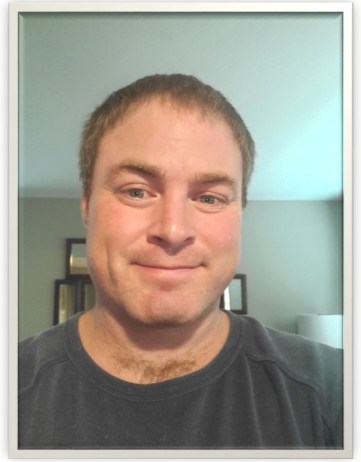
My guest today is a talented author, whom I happen to know personally. He was a part of my M.F.A. cohort at Western State Colorado University, and I had the privilege of , being present for his reading from his thesis novel, which was released this past year and fit in with this month’s Crime Fiction genre theme for review, Rose City. A P.I. by day, it’s no surprise that he writes crime fiction. What was a surprise to me was his talent for writing noir with true craftsmanship, which is why I invited him to join me here. Please help me welcome noir author, Michael Pool.
Kaye: Would you share briefly your writer’s journey? How did you get to where you are today?
Michael: A lot of writing, haha. I’ve been writing fiction since my very early twenties, however, I did take about 5 years in my late twenties where I barely wrote at all. In my 30’s I finally decided to take it more serious and began focusing on building a career through longer works. Prior to that, I’d mostly written short fiction. Though I still enjoy short stories, these days I mostly write novels, with a recent focus on detective fiction.
Kaye: Noir fiction takes a look at the darker side of human behaviors and generally features corruption and loose, (or lack of), morals. Why is it your chosen genre?
Michael: Well, I guess first I would say that it’s not my chosen genre. These days I definitely gravitate toward detective novels.
It’s a sub-genre that I have written in quite a lot, however. I would put Texas Two-Step as more of a pure crime novel, although it fits the Elmore Leonard vision of noir to a large degree. Rose City is a Southern Gothic Mystery.
However, I am attracted to noir stories because I like seeing the world through the eyes of an anti-hero. No matter the criminal, they are always the star of their own movie, and always see themselves as the justified “good guy.” What noir does really well is show that there is enough dirt to go around, and thus it turns notions of good and evil on their heads, leaving the reader with the distinct understanding that there are no good and bad people, only good and bad choices.
All of us are always teetering on the edge of destroying ourselves through our shortcomings and noir is all about that process, making it entertaining, if horrifying, to read.
Kaye: What is the biggest challenge in writing noir for you?
Michael: I’m not sure I see it as challenging. I’ve always been a fan of the underdog, and I consider the down and out to be my people in so many ways. I love capturing the world from the view of men and women with their backs against the wall, many of whom have just enough ruthlessness in them to cause catastrophic damage in the pursuit of (often) vein goals which are not necessarily good for them.
Kaye: What is the most fun about writing noir?
Michael: I always joke that I’m a bit of a dark and stormy person, so I like that noir’s tone allows lots of room for that darkness and allows for a lot of intense, violent, complicated conflicts to arise in the narrative.
Kaye: Rose City was your thesis project in your M.F.A. program, but it is also the companion novel to Texas Two-Step. Can you tell me a little about both books and explain how they are related?
Michael: Both books are set in the fictional East Texas locale, Teller County. They are related only by their setting and a shared villain in common. Without giving too much away, there is a villain who skates on consequences in Texas Two-Step that may finally get his in Rose City.
Interestingly, Rose City was written first, as a graduate school thesis. For whatever reason, Texas Two-Step was published first. They can be read in any order.
 Texas Two-Step is a “One last crime” story involving a couple of jam-band obsessed Denver pot growers who, after getting pushed out of the market by legal marijuana, have one last big crop to sell, and turn to an old but reckless associate down in Texas to move the harvest. They soon find themselves tangled up with real, violent criminals in a cat-and-mouse game where everyone involved has an agenda, and a rogue Texas Ranger is on their trail, desperate to nail their associate. It’s a multiple point-of-view book with lots of humor and a satisfying climax.
 Rose City is a “prodical son returns” story where the protagonist, Cole Quick, has left Teller County 14 years earlier after being robbed of a stash of fronted cocaine, taking with him his local debutante girlfriend, whose family all but disowned her as a result. The book picks up 6 months after her untimely death from breast cancer. Cole returns to Teller County for his estranged, abusive father’s funeral, and soon finds himself caught up in his old debt, as well as tasked with proving an old friends death was murder, rather than a vicious murder-suicide. To get back out of town alive, he has to take on the entire crooked town’s structure and bring it down to rubble.
Rose City was the first full novel I had ever written. And, honestly, it was a mess for a long time. Five years of good edits have turned it into a really great novel. It’s emotional, suspenseful, and moves forward at a non-stop pace. It deals with themes of racism, classism, corruption, abuse, and self-destruction in a way that is compassionate but takes a hard eye to the reality these kinds of problems crop up in.
Kaye: In Rose City, Cole Quick has a dark past that he thought he left behind. But a trip back to his home town finds him down and out, and vulnerable. There’s a lot more going on than he is aware of in his old stomping grounds, and almost without realizing what’s happening, he’s swept up into it, and it becomes a matter of survival for him to discover what really happened to his best friend, Jimmy. Are noir protagonists all average guys who get swept up by circumstance and have to fight their way out?
Michael: I don’t think noir protagonists are all average guys. In fact a whole bunch of them are anything but, they’re self-destructive fringe characters living by their own moral codes, and bound for trouble of their own making.
But all of my characters tend to be average men and women caught in extraordinary scenarios. I’m not much for thrillers with superhuman protagonists, and my writing tends to put a lot of focus on everyday people and their relationships, with the understanding that crime and total destruction are always in the peripheral of our lives, whether we believe it or not. I use crime as a lens to explore the human condition, because it’s an integral part of the human experience. We live in societies with rules, both good and arbitrary, and we all find ourselves running up against those in some ways. But some men and women won’t just accept things the way they are, and that to me is the kind of person who will make a good protagonist.
Kaye: You are the founder and editor-in-chief of Crime Syndicate Magazine. Can you tell me about that? What was your motivation to start it? What can readers find there? What are your goals for it in the future?
Michael: I put Crime Syndicate down about a year ago, just didn’t have time for it anymore. Crime Syndicate did focus a lot on short noir fiction, and there are some incredibly good stories in the three issues I put out. I’m happy to have had the experience, but I’m a writer at heart, not an editor.
Kaye: Noir characters are always flawed in some way. How flawed should a noir character be?
Michael: The important thing is not how flawed, it’s more that their flaw be something that will drive them to make decisions that are not necessarily good for them, and in fact the best noir characters have a flaw that is in direct opposition to their needs, causing a sense of inner conflict that will drive the story to a dark ending.
Kaye: If you could have lunch with any noir author, alive or dead, who would it be? Why?
Michael: I suppose a Dashiel Hammett or Ross MacDonald. Neither are really “noir” authors. I’d put them both more as hardboiled detective writers. But both have been major influences on my writing. I work as a private investigator, and in Hammett I get a very clear sense that he knows the work (which makes sense, because he was a Pinkerton at one time). With McDonald, I love the way he uses the detective as a lens to look at family dynamics and the effects changing social issues and dynamics have on families. It’s something I naturally do in my own writing, and I’d love to pick his brain about process.
Kaye: You are a Jiu-jitsu instructor. Are any of your characters skilled in martial arts?
Michael: Not really, for some reason! I am working on a modern pulp P.I. series (I’m calling it Gonzo P.I. as a style), and that character, Rick Malone, does have some jiu-jitsu experience, which he puts to good use from time to time. But in a lot of ways Rick is also a broken man and an outcast, so he’s still very far from the superhuman or hyper-capable protagonists I was talking about earlier. I love jiu-jitsu, and of course it does show up from time to time in my action scenes!
Kaye: In addition to book length works, you also write short fiction. Your works have been included in several anthologies. Which do you prefer? Why?
Michael: As I mentioned, I mostly write novels now. I prefer them because there is a market for them, haha. No, honestly, I agree with readers on why they prefer novels, and particularly series. When you fall in love with a protagonist you want to spend more time with that protagonist as a reader, and as a writer, I feel the same way. It can be hard to spend a year at a time on the same project, but the end result is more satisfying and makes it much further out into the universe.
Kaye: What parts of you, do your readers get to see in your characters?
Michael: Compassionate but conflicted and flawed characters in my books all have a big piece of me in them. I’m highly emotional, and have had plenty of dark experiences in my personal life. Those experiences crop up in less-than-direct ways in my writing, but anytime you reach an emotional moment in one of my books, you’re definitely interacting with the deepest parts of me as a writer and human being. To me that is a vital part of why I write in the first place.
Kaye: Your books feature intricate storylines that are well thought out. What’s your writing process like? How do you create your plots?
Michael: I’m an outliner these days. I stray from the outline often, but I mark out plot beats in advance as much as possible, and adjust them as I go. I literally keep a beat sheet for each book to make sure I’m staying on pace and on task. I find structure to be freeing rather than limiting. To understand why story structure is so vital you have to understand why humans began to tell stories in the first place, then you can see why structure evolved the way it did, and use that information to create the ever-elusive “uniquely familiar” plot lines that resonate with readers.
Kaye: What is your greatest writing accomplishment to date?
Michael: That’s a tough one! I feel like my greatest accomplishment is just getting to where I am. I feel poised to break through to a larger audience with this next project, finally, but more than that, I feel like I’ve finally become a skilled, adept long-form fiction writer.
Kaye: What are you working on now? What’s next for Michael Pool?
Michael: Right now I’ve just finished the first book in a new P.I. series, Throwing Off Sparks, and am at work on book two, tilted Daughters of the Republic. Both feature my obsessive female East Texas P.I., “Rowdy” Riley Reeves. Riley’s origin story, “Weathering the Storm,” is slated for release as part of The Eyes of Texas anthology on 10/21/2019. Within a paragraph of starting that story I knew she would become a series character, and I’m REALLY excited to share this new series with the world, I think it brings something totally new to detective fiction.
I’m also working on a pulp P.I. novel I mentioned earlier, also the first in a series, called Catfish Quarum. It is set in Colorado and features down-and-out drug-addled P.I. Rick Malone. A second book in that series is currently in the outline stage, titled One Way Out. I have big hopes for this series, it allows me to be goofy and serious all in the same breath, and to really capture a lot of uniquely Colorado social issues and characteristics. Look for it over the next couple years. I wish that were faster, but publishing is its own complicated process, unfortunately.
I want to thank Michael for sharing with us today. I think he has helped to define noir and differentiate it from the other sub-genres of crime fiction. If you’d like to learn more about Michael or his books, you can visit his author site, or his Amazon author page.
Like this post? Let me know in the comments. You can be sure not to miss any of Writing to be Read’s great content by subscribe to e-mail or following on WordPress.
Posted: July 28, 2019 | Author: artrosch | Filed under: Art's Visual Media Reviews, Opinion, Television review | Tags: Art's Visual Media Reviews, New Orleans, Post-Katrina, Television review, Treme, Writing to be Read |

In early October, 2005 my partner and I were driving our new 38 foot motorhome from Ft. Lauderdale to Petaluma,CA. It was going to be a four thousand mile drive on I-10, the southernmost of our nation’s interstate highway system. As we drew into the outskirts of Pensacola we noted the ravaged condition of the trees, fences, billboard signs and the Interstate itself. The campgrounds were jam packed. We only found a site because someone had suffered a heart attack and was rushed to the hospital twenty minutes before we pulled into the Pensacola KOA.
We were in the zone of Hurricane Katrina’s wrath and the next four hundred miles would be like driving through a poorly kept secret. Along the highway were big plywood signs done in red magic marker: FEMA, they said, and sometimes an arrow pointed the way down a dirt road. These signs were emblematic of the slipshod management of a terrible disaster. Imagine, plywood planks with red magic marker: this way to the internment camp of white trailers.
Ahead of us lay New Orleans. We saw the city only a few weeks after it was submerged and torn all to hell. When we began watching the TV series Treme (trem-may), we had a visceral sense of connection to the experiences of the characters.

TREME is producer/director David Simon’s series about post-Katrina New Orleans. Simon is the creator of crime masterworks like HOMICIDE and THE WIRE. TREME is something different. It is a filmic mural that depicts conditions in a ravaged community. Suspense is not what draws the viewer into the show. It’s the characters that keep us watching.
One of the major characters of the series is New Orleans itself. There is a depth of culture in this city that is unmatched by any other American city. Treme is one of the neighborhoods in this town, an area where musicians live and form their community. They play at one another’s gigs. They do funerals, following wheeled black carriages in stately slow-march. They play at nightclubs where the patrons and musicians alike are having so much fun that it seems almost unreal, as if there can’t possibly be so much joy in this troubled world. But there it is: real music, dancing, carrying-on and everyone is having a freaking great time.
There’s nothing strident about Simon’s portrait of New Orleans. It’s a town trying to bounce back, but the bounce is a little flat. People want to rebuild their homes but the promised insurance checks and subsidies keep getting lost in bureaucracy. A man has spent three years rebuilding his home with his own money and his own skills. Suddenly a city inspector appears and cuts off his water and power. “The City” wants to see the original deed on the property. It’s a document whose origins go back two hundred years. It’s lost in history, lost in the flood. Can he PROVE that his family has occupied this parcel of land since 1824?

Photo by Art Rosch
He forgot a payoff to someone. He’s lost track of the fifties and hundreds he’s hemorrhaged to fees and penalties.
New Orleans has become a scene where politicians and developers gather like ghouls to create a theme park where there was once a city. If they have things their way, it will be resurrected as NewOrleansLand or Cajun-O-Rama. The citizens of New Orleans are fighting back. They know their city will never be the same. But the disaster has made them aware of themselves as an extended family. There is something special about being a New Orleans native. There’s a terminology, a language, a history and a lot of blood that goes into the making of a citizen of New Orleans.
TREME is strangely relaxing to watch. Real-life characters like musicians Carla Thomas, Kermit Ruffins and Allen Toussaint thread through the plot playing themselves, providing a sound track of amazing skill and vivacity. TREME is loaded with top of the line music.
“Let the good times roll”, or “Laissez le bon temps roulez” is the unofficial motto of Mardi Gras. The good times may roll but a new motto is emerging from the frustrated natives of New Orleans.
I will paraphrase the words of Sofia, the sixteen year old daughter of civil rights lawyer Toni Bernette, played by the fantastic Melissa Leo. Every day Sofia retreats to her bedroom, closes the door, aims the laptop camera at her face and uploads to YouTube a monologue of rage and bitterness.
“Fuck you, man, fuck you!” she says. “If you’re not going to help us, at least don’t hinder us. Just get the fuck out of our way!” THAT is the new motto of New Orleans.
A Midwesterner by birth, Arthur Rosch migrated to the West Coast just in time to be a hippie but discovered that he was more connected to the Beatnik generation. He harkened back to an Old School world of jazz, poetry, painting and photography. In the Eighties he received Playboy Magazine’s Best Short Story Award for a comic view of a planet where there are six genders. The timing was not good. His life was falling apart as he struggled with addiction and depression. He experienced the reality of the streets for more than a decade. Putting himself back together was the defining experience of his life. It wasn’t easy. It did, however, nurture his literary soul. He has a passion for astronomy, photography, history, psychology and the weird puzzle of human experience. He is currently a certified Seniors Peer Counselor in Sonoma County, California. Come visit his blogs and photo sites. www.artrosch.com and http://bit.ly/2uyxZbv.
Want to be sure not to miss any of Art’s Visual Media Reviews segments? Subscribe to Writing to be Read for e-mail notifications whenever new content is posted or follow WtbR on WordPress.
Posted: July 25, 2019 | Author: kayelynnebooth | Filed under: Book Review, Classics, Crime, Fiction, Pulp Fiction, Stories | Tags: Awesome Tales #10, Crime Fiction, Pulp Fiction, Quintin Peterson, Review, Short Fiction, Short Stories, Writing to be Read |

You just don’t see a lot of pulp magazines anymore in the classic tradition from days of old, but Awesome Tales is a modern pulp magazine pulp fans will take delight in. If your a fan of the dazzling heroes and diabolical villians of the classic pulp traditions, Awesome Tales #10 takes you on a refreshing trip down memory lane with four masterfully written contemporary tales, by four different authors, told in classic pulp form and style.
“No Virtue in Patience”, by John L. French is a futuristic pulp story with tech gangs and computer generated card tournaments. A heist of the biggest solitaire game in town, with a proize of a solid gold deck of cards.
“No Patience for Fools” by Aaron Rosenberg offers a different perspective on the solitaire tournament of the previous story. Cleverly crafted to tell the same story from the opposite side of the law, it has a surprise ending, as well.
In “Broken Doll” by Quintin Peterson, tough guy bionic P.I. Luther Kane sets out to save a one-legged streetwalker named Gypsy, and maybe his own guilt ridden self, but he learns the classic lesson all P.I.s should know the hard way: never trust anyone.
“Give Them a Corpse Part 2” by Rich Harvey is the second part of a three part story featuring the Domino Lady, a classic masked superheroine, complete with crime fighting skills and secret identity, fights against the classic villians of The Black Legion. Like all good cloak and dagger crime fighting serials, this story easily stands alone.
Every one of the stories in Awesome Tales #10 are well-crafted and entertaining. They will satisfy hardcore pulp fans and maybe even earn the genre a few new fans. I give it five quills.

Kaye Lynne Booth does honest book reviews on Writing to be Read in exchange for ARCs. Have a book you’d like reviewed? Contact Kaye at kayebooth(at)yahoo(dot)com.
Posted: July 23, 2019 | Author: kayelynnebooth | Filed under: Books, Crime, Fiction, Hard-Boiled Crime Fiction, Noir, Pulp Fiction, Suspense, Tension, Writing | Tags: Awesome Tales #10, Crime Fiction, Crime Novels, Hard-boiled fiction, Jenifer Ruff, Jim Nesbitt, Michael Pool, Noir, Noir crime fiction, Pulp Fiction, Quintin Peterson, Rose City, The Numbers Killer, Writing to be Read |

The crime fiction genre covers a lot of ground. By definition, crime fiction involves mystery to be solved, usually who the killer is, or a quest to figure out some type of diabolical plot. Crime fiction stories involve pretty high stakes, and therefore a lot of suspense. Often there is a ticking clock to ratchet the tension even higher. And of course, there is always a crime of some sort to be solved, or prevented; some sort of wrong to be righted.
Crime fiction is a broad term which includes many sub-genres, which focus on the investigation of a crime and the apprehension of a suspect, either by law enforcement agents, as in The Numbers Killer, by my “Chatting with the Pros” author guest, Jenifer Ruff or by a tough guy P.I., as in hardboiled crime fiction such as Jim Nesbitt writes, with his tough guy P.I., Ed Earl Burch in The Best Lousy Choice and the two previous books in that series.
Hardboiled heroes are memorable. Who doesn’t know of Sam Spade or Mike Hammer and their cynical tough-guy images? They are usually down on their luck, or at least between clients. They are often heavily flawed, often self-destructive, but a ladies man none-the-less, with a love them and leave them attitude and the snappy dialog of the 1920’s. Hardboiled fiction was birthed by Carrolle John Daly and Dashielle Hammett in the 20’s, and carried on by authors such as Raymond Chandler and Mickey Spillane.
In noir crime fiction, the protagonist is usually an extremely flawed, average guy. He’s usually down and out, or perhaps on a downward spiral in a situation that seems bleak and hopeless. He’s a self-destructive hero, who ends up going against all odds to fight corruption and injustice, not because it is his job, but for strictly personal motivations, which are usually not in his own best interests. An excellent example of this is found in Rose City, by Michael Pool (See my interview with Michael next Monday, the 29th).
And of course, the classic crime fiction is pulp, such as Quintin Peterson writes in Awesome Tales #10 . From pulp, we get our classic heroes and fiendish evil villains. It’s from pulp that comic book super heroes and super villains arose, which is yet, another sub-genre of crime fiction, which has expanded with a life of its own to super colossal proportions.
We went on a hunt for crime fiction, and we found quite a bit. I learned a lot and I hope you did to. Now, I’m looking forward to August in a quest for mysteries and mystery authors. My “Chatting with the Pros” guest will be New York Times bestselling author, Gilly Macmillan. I’ll also be interviewing mystery author Gerald Darnell. And I’ll be reviewing a mystery anthology, Death Among Us, as well as a search and rescue mystery, Murder on the Horizon, by M.L. Rowland, and a paranormal cozy, Broomsticks and Burials, by Lilly Webb. I hope you’ll join me.
Like this post? Let me know in the comments. You can be sure not to miss any of Writing to be Read’s great content by subscribe to e-mail or following on WordPress.
Posted: July 20, 2019 | Author: kayelynnebooth | Filed under: Book Review, Books, Fantasy, Fiction, Illustrations, Post-Apocalyptic, Pulp Fiction, Super Hero | Tags: Book Review, Fantasy, God's Body, Illustrations, Jeff Bowels, Pat R. Steiner, Post-Apocalyptic, Pulp Fiction, Superheroes, Writing to be Read |

God’s Body, by Jeff Bowles has one of the most masterfully crafted openings that I have read in a long time. By the beginning of the second paragraph, he had placed me in the setting, I knew this was like no other story I had ever read, and I was hooked, which is what a great opening should do. It impressed me so, that I asked the author’s permission to reprint it here.
“The toe was an ungodly mountain of flesh. As massive as it was inexplicable. It clung to the Earth like a bulbous pink tumor. Enormous, all-encompassing, the height of a skyscraper, the breadth of Niagara Falls. Rain water washed through its thick patchwork of crevasses and cracks. Long vertical rivers lapped at skin-cell canyon walls. There were flesh creeks and tidal waves. The toenail itself was the hanging shelf of the world.
Then Harold looked higher and saw the rest. Lord God Almighty…”
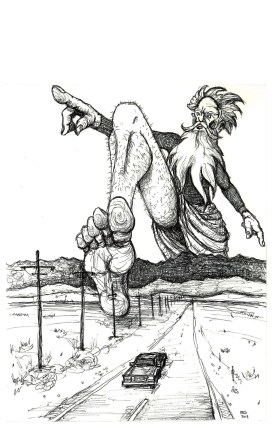 You just can’t read this and not want to know more. It’s obvious this isn’t going to be your average, everyday story, and you must read on in anticipation of what will come next. It’s clear this will be a story of epic proportions, and Bowels does not disappoint. God’s Body is an Armageddon story like no other; a post apocalyptic tale of good vs. evil in the best of pulp fantasy traditions, if such traditions existed. Bowles pulls out all the stops, using humor, irony and contemplation of the human condition to tell his tale with skill and craftsmanship. Everything about this story is of epic scale.
I’m not going to give you a rundown of this story line because the whole thing was such an entertaining read that I wouldn’t want to give out any spoilers, but what I will tell you is that in addition to the wonderful writing talent of Bowles, the artistic craftsmanship of Writer’s of the Future illustrator Pat R. Steiner accompanies this story with some truly awesome illustrations like the one seen here.
A truly original story that puts a new twist to an age-old theme. Written with skill and talent in a literary work of true craftsmanship, God’s Body is like nothing else you’ve ever read. I give it five epic quills.

Kaye Lynne Booth does honest book reviews on Writing to be Read in exchange for ARCs. Have a book you’d like reviewed? Contact Kaye at kayebooth(at)yahoo(dot)com.


 via
via 





















