Today is the start of a new poetry appreciation series here on Writing to be Read where I will be introducing you to a number of wonderful poets in our blogging community, discussing well known poets and their poetry and reviewing poetry books. I hope you will participate in the discussions and enjoy meeting and greeting the poets, both new and known to you, and discovering new books of poetry.
My first guest is accomplished poet and writer, Sally Cronin, of Smorgasbord Blog Magazine blog. Sally has recently published a new book of poetry, 99-word flash fiction and short stories called, Life’s Rich Tapestry: Woven in words which I have reviewed below. Before we get there, however, Sally is going to share her thoughts about her favourite poem, The Law of the Jungle by Rudyard Kipling.
Over to Sally
What is your favourite poem?
That is an extremely tough question and had me stumped for a couple of days as I wanted to revisit the poems that I have loved since childhood to make sure that this really would qualify as my favourite poem.
The Law of the Jungle by Rudyard Kipling
(From The Jungle Book)
Now this is the Law of the Jungle — as old and as true as the sky; And the Wolf that shall keep it may prosper, but the Wolf that shall break it must die. As the creeper that girdles the tree-trunk the Law runneth forward and back — For the strength of the Pack is the Wolf, and the strength of the Wolf is the Pack.
Wash daily from nose-tip to tail-tip; drink deeply, but never too deep;
And remember the night is for hunting, and forget not the day is for sleep.
The Jackal may follow the Tiger, but, Cub, when thy whiskers are grown,
Remember the Wolf is a Hunter — go forth and get food of thine own.
Keep peace with Lords of the Jungle — the Tiger, the Panther, and Bear.
And trouble not Hathi the Silent, and mock not the Boar in his lair.
When Pack meets with Pack in the Jungle, and neither will go from the trail,
Lie down till the leaders have spoken — it may be fair words shall prevail.
When ye fight with a Wolf of the Pack, ye must fight him alone and afar,
Lest others take part in the quarrel, and the Pack be diminished by war.
The Lair of the Wolf is his refuge, and where he has made him his home,
Not even the Head Wolf may enter, not even the Council may come.
The Lair of the Wolf is his refuge, but where he has digged it too plain,
The Council shall send him a message, and so he shall change it again.
If ye kill before midnight, be silent, and wake not the woods with your bay,
Lest ye frighten the deer from the crop, and your brothers go empty away.
Ye may kill for yourselves, and your mates, and your cubs as they need, and ye can;
But kill not for pleasure of killing, and seven times never kill Man!
If ye plunder his Kill from a weaker, devour not all in thy pride;
Pack-Right is the right of the meanest; so leave him the head and the hide.
The Kill of the Pack is the meat of the Pack. Ye must eat where it lies;
And no one may carry away of that meat to his lair, or he dies.
The Kill of the Wolf is the meat of the Wolf. He may do what he will;
But, till he has given permission, the Pack may not eat of that Kill.
Cub-Right is the right of the Yearling. From all of his Pack he may claim
Full-gorge when the killer has eaten; and none may refuse him the same.
Lair-Right is the right of the Mother. From all of her year she may claim
One haunch of each kill for her litter, and none may deny her the same.
Cave-Right is the right of the Father — to hunt by himself for his own:
He is freed of all calls to the Pack; he is judged by the Council alone.
Because of his age and his cunning, because of his gripe and his paw,
In all that the Law leaveth open, the word of your Head Wolf is Law.
Now these are the Laws of the Jungle, and many and mighty are they; But the head and the hoof of the Law and the haunch and the hump is — Obey!
Robbie: This is a wonderful choice of poem, Sally. I also love it. Interestingly enough my favourite poem is also by Rudyard Kipling and I will share it later in this series.
What is your interpretation of this poem?
This is about living in harmony within a society whether it is a wolf pack or amongst a human pack. Having social etiquette and respect for others is essential if all are to avoid conflicts, get enough to eat, be accepted and to thrive. There is a natural order to things and if you learn that when you are young, when you leave your pack you are well equipped to survive on your own with the skills to begin your own pack. And whilst is sounds draconian, those rules are there to protect the young as well as teach them manners. It applies to both wolf cubs and man cubs….
Robbie: A wonderful interpretation of this poem and of life in general. I have similar thoughts on how societies can best achieve success and one of my favourite key words in this regard is the need for discipline.
What emotions does the poem invoke in you?
When I first read the Jungle Book I was too young to really appreciate the undertones in the story about life, survival and the human and animal parallels. But I loved the book and this poem was rich in both words and intent, and when I was ten or eleven and read for the second time, I could see how this philosophy of life in the pack, related to life in a family. It made me feel secure to think of my father as the Head Wolf, and it also made me very protective of my other family members including my younger brother, who probably did not appreciate all the attention I lavished on him as I would like to believe! It also brings back memories of our time with Sam [Robbie: Sam is a lovely dog who was part of Sally and David’s family for many years before he passed. He has his own book called Sam, A Shaggy Dog Story] as our own small pack and how interestingly he adopted his own social rules of etiquette that run parallel to those in the poem. For example he considered us his alpha male and female and he would not start his own dinner until we were eating our own. He was very protective of any young family members who visited and also the elderly, sticking close to them. If he spotted something that he considered might be dangerous to us, he would always put himself between us and the threat. Whenever I saw him exhibiting these kinds of behaviour it always bought this poem back to me and made me so proud.
Robbie: Isn’t it wonderful the powerful emotions and associations a poem can invoke in a reader. Sam was a wonderful dog. You can read my review of Sam, A Shaggy Dog Story here: Goodreads review
If you could choose to write like any well-known poet, who would it be?
That is another tough question Robbie as there are many poets who have stirred my emotions and also my imagination. And whilst I would love to be able to write like Rudyard Kipling both in prose and verse, I am always drawn to the young and sometimes short lived war poets. They conveyed the reality of war, stripping it bare of glory but telling a story in a few short lines. Their legacy is that we never forget those who died, even if we might not always learn the lessons we need to from their passing.
Rupert Brooke for me is one of the finest examples of these poets, and if I could convey the depth of emotion, intent and storytelling in my poetry, I would be very happy indeed. Whilst The Soldier is the most often quoted poem, certainly at military funerals, it is one of his peacetime poems that always resonates with me especially as I get older and celebrate married life.
Kindliness by Rupert Brooke
When love has changed to kindliness —
Oh, love, our hungry lips, that press
So tight that Time’s an old god’s dream
Nodding in heaven, and whisper stuff
Seven million years were not enough
To think on after, make it seem
Less than the breath of children playing,
A blasphemy scarce worth the saying,
A sorry jest, “When love has grown
To kindliness — to kindliness!” . . .
And yet — the best that either’s known
Will change, and wither, and be less,
At last, than comfort, or its own
Remembrance. And when some caress
Tendered in habit (once a flame
All heaven sang out to) wakes the shame
Unworded, in the steady eyes
We’ll have, — THAT day, what shall we do?
Being so noble, kill the two
Who’ve reached their second-best? Being wise,
Break cleanly off, and get away.
Follow down other windier skies
New lures, alone? Or shall we stay,
Since this is all we’ve known, content
In the lean twilight of such day,
And not remember, not lament?
That time when all is over, and
Hand never flinches, brushing hand;
And blood lies quiet, for all you’re near;
And it’s but spoken words we hear,
Where trumpets sang; when the mere skies
Are stranger and nobler than your eyes;
And flesh is flesh, was flame before;
And infinite hungers leap no more
In the chance swaying of your dress;
And love has changed to kindliness.
Robbie: An amazing poem, Sally, thank you for sharing it with us. The war poets certainly know how to highlight the best and worst life has to offer.
Thank you so much for inviting me over today to share my love of poetry and thank you for your wonderful reviews for my work which keep me motivated.
Robbie: Thank you for your contribution to Treasuring Poetry, Sally. Your thoughts and input are greatly appreciated.
Life’s Rich Tapestry: Woven in words by Sally Cronin
What Amazon says
Life’s Rich Tapestry is a collection of verse, microfiction and short stories that explore many aspects of our human nature and the wonders of the natural world. Reflections on our earliest beginnings and what is yet to come, with characters as diverse as a French speaking elephant and a cyborg warrior.
Finding the right number of syllables for a Haiku, Tanka, Etheree or Cinquain focuses the mind; as does 99 word microfiction, bringing a different level of intensity to storytelling. You will find stories about the past, the present and the future told in 17 syllables to 2,000 words, all celebrating life.
This book is also recognition of the value to a writer, of being part of a generous and inspiring blogging community, where writing challenges encourage us to explore new styles and genres.
My review
This new book sees author, Sally Cronin, delving into new genres in the form of a variety of styles of poetry and 99-word flash fiction pieces. It also includes a number of her delightful short stories, although those differ from others that I have read by this author as many of them feature an animal as the main character.
The poetry is beautiful and is split into sections, namely, Seasons of the year; All things human; Fairies and other folk; The natural world; Remembrance, Celebrating pets and Random thoughts. The poems included in the sections entitled Season of the year and The natural world largely feature the natural environment, including the various seasons and the different creatures that inhabit it, and makes use of all the senses to wrap the reader in the specific joys and pleasures of the flowers, the light, celebrations, birds and and other natural phenomena including drought, snow and frost.
The poetry sections entitled All things human, Remembrance and Random thoughts as well as some of the flash fiction and short stories utilize the writer’s amazing ability to invoke great emotion from her readers towards her characters and their circumstances and situations, while being easy to relate to and highly believable.
The poems and stories that feature pets and animals showcase the authors love of the animal world and convey the special relationships that frequently develop between people and their pets.
I appreciate the undertone of happiness that is generally present in this authors books and stories. It is a wonderful thing to be able to read a book that makes you feel great emotion and still come out on the other end with the impression that life is a wonderful and great journey. This is definitely a skill that Ms Cronin has and uses to its best advantage in all her books, poems and stories.
I have been a storyteller most of my life (my mother called them fibs!). Poetry, song lyrics and short stories were left behind when work and life intruded, but that all changed in 1996. My first book Size Matters was a health and weight loss book based on my own experiences of losing 70kilo. I have written another twelve books since then on health and also fiction, including four collections of short stories. My latest book is a collection of verse, micro fiction and speculative short stories titled Life’s Rich Tapestry: Woven in Words
I am an indie author and proud to be one. My greatest pleasure comes from those readers who enjoy my take on health, characters and twisted endings… and of course come back for more.
As a writer I know how important it is to have help in marketing books.. as important as my own promotion is, I believe it is important to support others. I offer a number of FREE promotional opportunities on my blog and linked to my social media. If you are an author who would like to be promoted to a new audience of dedicated readers, please contact me via my blog. All it will cost you is a few minutes of your time. Look forward to hearing from you.
Want to be sure not to miss any of Robbie’s “Treasuring Poetry” segments? Subscribe to Writing to be Read for e-mail notifications whenever new content is posted or follow WtbR on WordPress. If you found it interesting or entertaining, please share.
Most writers are busy people. I know I am. Most of my 2019 writing goals are still sitting on a back burner, simmering, because I was way to busy with work, school and this blog, as well as launching WordCrafter Quality Writing & Author Services and WordCrafter Press, to stir up my own stories and bring them to a boil. So, I’ve been looking into different ways to manage my time better. As I get older, skipping sleep in order to write seems to be getting less and less feasible.
On Being a Dictator, by Kevin J. Anderson and Martin L. Shoemaker is a author’s resource about how writers can use idle times in your day to spark creativity and increase productivity through dictation. It is a part of the Million Dollar Writing series, designed to help aspiring authors along the way.
I was blessed, back in 2012, to hear Kevin J. Anderson speak during the Writing the Rockies Conference at Western State Colorado University, (then, just plain old Western State College), where he talked about using dictation in his writing. While the rest of us had all been indulging in Western’s wonderful cuisine, Kevin had written roughly two chapters of his latest novel while hiking a pristine trail in the beautiful Gunnison Valley, in beautiful Colorado.
I was impressed with the idea at the time, and soon went out and bought myself a digital recorder, much like the one featured on the book cover. Although, it did help me to preserve my writing ideas on the spot, it required me to be embarked in activities where I could stop frequently to turn on and off the recorder. Then when I went back to access these ideas and get them down in print, I had to skip around to find the ideas or perfect sentences I was looking for and then type them out myself, which took up just as much time, if not more, so it didn’t take me long to give up this idea and go back to pecking out my story, one word at a time, as I had always done.
Upon reading On Being a Dictator, my thoughts on the matter have changed a bit. Anderson and Shoemaker begin by emphasizing the point that, like everything else in life, dictation takes time and practice, making me realize how foolish it was for me to expect to go buy a digital recorder and immediately start cranking out novels.
This resource is also valuable because the two co-authors each have different approaches to dictation which fit best into their individual lifestyles, proving that there is no one ‘right way’ to use this method and technology. This made me realize that I really didn’t give dictation a chance. I didn’t play with it enough to discover the different ways it might be useful to me with practice.
The book also includes descriptive lists of the different types of equipment and transcription software available and the advantages and disadvantages of each, as well as transcription services. Since technology is changing very rapidly, there are devices and software available now, which were not even thought of back in 2012, and likely next year, there will be even better technology available that wasn’t mentioned here. But their efforts gave me a good idea of what is available now, and got me thinking about how it might be of use to me.
Once again, I am impressed with this idea of turning otherwise idle activities, creativity-wise into productive writing time. On Being a Dictator has convinced me I should give writing by dictation another go. Maybe you should, too. I give it four quills.
Kaye Lynne Booth does honest book reviews on Writing to be Read in exchange for ARCs. Have a book you’d like reviewed? Contact Kaye at kayebooth(at)yahoo(dot)com.
I started Write it Right Editing Services back in 2010 because I didn’t think an author should have to take out a mortgage just to pay for having their book edited. Book editing can be expensive! We all want our writing to shine and be flawless, but like they say, a patient who diagnoses oneself, or a defendant who represents oneself in a court of law, an author who edits their own work has a fool for a client. Okay, maybe it’s not quite the same. Good writers usually know how to edit, and may be able to do a fine job editing the work of others, because they know the basics of good writing. But, when you edit your own work, many times you see what you know the words are supposed to say, even if that isn’t what you put down on the page, and errors can be easily overlooked. Not only that, but authors don’t always have an unbiased eye when it comes to their own work, or perhaps they just are unable to see how their wonderful words could possibly be made any better.
This is why an author needs to have someone else go over their work. Some authors use critique partners, or writing groups to vette their work and get feedback to make their writing better, and that can work if your critique partner or the members of your writing group are talented writers themselves. But if they are not, or you don’t have any of those people readily available to you, you probably need to hire an editor to polish up your manuscript before publication.
Aspiring authors who have not yet been down the path to publication may need more than just a basic line edit. They may need guidance as to story structure and proper formatting, too. These are the services Write it Right Editing Servicesstill offers under the WordCrafter umbrella, at rates that won’t break the bank or be too terribly hard on your pocketbook. Most of us are starving artists, after all.
I got my M.F.A. in Creative Writing during a transition period, when the education sector hadn’t caught up with the changes that the rapid growth new technologies, specifically the development and rising popularity of the Internet. Hence, the one thing about being an author that they didn’t teach me was how to market and promote my own books once they were published. Gone are the days when a publisher buys your book and not only publishes, but promotes it.
Traditional publishers are still out there, but with the rise of self-publishing, they realized that authors were capable of handling promotion, so the amount they are willing to offer has gone down considerably, and many small independent presses don’t have the resources to throw promotion of your book in with the deal. Besides, the majority of authors out there these days are self-published, so they have to manage their own promotions anyway.
An author today has a few choices to make. Self-promote or outsource by hiring a marketing company, which doesn’t come cheap. If you know a little about marketing, you might be okay handling these things yourself. But, that was the one area of the business of writing that my M.F.A. program didn’t cover, and that’s why I am currently back in school earning a B.A. in Marketing. I’ve got books out there, but it’s up to me to sell them.
Marketing and promotion can be a time consuming activity, especially if you design your own graphics, as well as creating content for your promos. And let’s face it, time spent creating promotional materials is time spent not writing. That’s the trade-off that we authors are faced with.
The solution is to outsource your promotions, but again, this can be expensive. So, I decided to offer WordCrafter Social Media Copywriting & Book Promotionsas a way to assist my fellow authors in freeing up their time so they can spend more of it doing what they do best – writing. This service offers inexpensive promotion packages, or you can opt to purchase individual posts to be used on social media.
So, if you are a busy author who would love to have more time to write or you need a little help in making your work shine, pop on over and see what WordCrafter Quality Writing & Author Services has to offer you. You’ll be glad that you did.
Like this post? Let me know in the comments. You can be sure not to miss any of Writing to be Read’s great content by subscribe to e-mail or following on WordPress. If you found this content helpful or entertaining, please share.
My author guest today on “Chatting with the Pros” is someone who focuses on helping fellow authors to find and harness their positive inner energies and let them shine through, both in their writing and in their lives. She has written memoirs, poetry, written and/or compiled writing resource books, and she offers workshops focused on healing and transformation through memoir writing. Her works have won numerous awards, including Best Book Award, Feathered Quill Book Award, Mom’s Choice Award, Eric Hoffer Award, and Allbooks Review Editor’s Choice Award. Please help me welcome creative nonfiction author, Diana Raab, PhD.
Kaye: You have a PhD in Psychology with a research focus on the healing and transformative powers of memoir writing. Can you explain briefly what those powers are?
Diana: My research examined how pivotal experiences encouraged individuals to write memoirs as a way to transform, grow, and become empowered. I interviewed esteemed writers about the role writing their memoirs had in their lives. Poet Kim Stafford said that writing his memoir transformed him, in that it helped him come to a new understanding about his brother’s suicide. Another writer said that the writing experience relieved him from the pain of his past. And another writer who lost a son said that writing helped her look at life in a much larger context and also helped to keep her son “alive.” Writer Maxine Kingston said that she was transformed by penning her memoir because she was finally able to tell the stories from her past, which for a long time had been a secret. Thus, in most cases, the writers were liberated from the demons of their pasts.
Kaye: How can writing facilitate transformation and empowerment?
Diana: Transformation is a dramatic change in one’s physical or psychological well-being. It’s about becoming more aware of and facing our thoughts, feelings, and experiences. Writing down our feelings can lead to self-realization and a sense of empowerment, because we’re moving our feelings from inside of us and onto the page; and like therapy, it can help us work through our challenges. Writing can also be transformative because it helps us gain a better understanding of ourselves. With that understanding comes deeper reflection, and consequently a more profound sense of harmony.
Kaye: What is your biggest challenge of being a writer?
Diana: That’s a great question. In my earlier years, while raising children, my biggest challenge was carving out the time to write. These days, I would say that my biggest challenge as a writer is finding inspiration.
Kaye: What time of day do you prefer to do your writing? Why?
Diana: When I was younger, I used to love writing in the wee hours of the night, but now that I’m older, my preference is to write early in the morning. That’s when my mind and thought processes are most clear. I like writing just after my morning meditation, as sometimes thoughts emerge during this time that can move me into a highly creative and inspirational zone.
Kaye: Besides writing, what are your favorite things to do?
Diana: I love being with my adult children (ages 36, 34, and 30) and playing with my grandchildren; and I love hiking and going for beach walks. I meditate every day, and like most writers, I love to read. I also love cooking, especially soups and desserts. I love doing needlepoint, a craft I learned from my maternal grandmother, Regina, who committed suicide when I was ten. She was my caretaker, and this was a huge loss for me. Her story is the basis of my first memoir, Regina’s Closet: Finding My Grandmother’s Secret Journal.
Kaye: How does memoir writing differ from other writing forms? Don’t most forms of writing “unleash the true voice of the inner self”?
Diana: I don’t believe that most forms of writing “unleash the true voice of the inner self.” It might start out that way when writing fiction, but soon the imagination comes into play. Memoir writing is a first-person account chronicling a slice of life, not an entire life. It is a subjective recollection from one’s own perspective. Typically, there is a theme or thread running through a memoir. What sets a memoir apart from other forms of nonfiction is that it weaves the story as it happened, but also includes reflection. It’s much more than a journalistic telling. Compelling memoirs definitely unleash the true inner self.
Kaye: Tell me about your writing workshops. What can I expect to come away with if I take a workshop with you?
Diana: What you will come away with will depend on the nature of the particular workshop. Each one is different, depending on its focus. I usually revise my workshop format accordingly. For example, I’ve taught high-risk youth, bereaved adults, hospice workers, and those battling with drug addiction. My regular workshops are related to memoir writing, where participants of different writing levels come together to work on their personal stories.
I limit these groups to ten individuals so that I can offer individualized coaching. Participants learn by hearing my comments about their memoirs, and we also discuss published memoirs. They’re grateful to hear about all the tidbits of information I’ve gathered during my 40-year writing career. I stress the idea that writing is a process, and like any other process, patience is necessary. Those who take my workshops say that they leave them feeling very inspired to continue their memoir-writing journeys.
Kaye: What lessons do you want readers to walk away with from reading Writing for Bliss: A Seven-Step Plan for Telling Your Story and Transforming Your Life?
Diana: There are many lessons within those pages, as I weave my story into a how-to book on personal writing. I want readers to understand the transformative powers of memoir writing and be aware that writing is a journey. I stress the idea of truly enjoying that journey and not becoming focused on the destination. People have called Writing for Bliss “instructive, inspiring, healing, and a blueprint for writing for healing and transforming your life.”
Kaye: You put together a book project that was quite innovative with Writers and Their Notebooks. I thought it was a really cool idea, and apparently others did too, since it became a Best Books award finalist with USA Book News. In fact, I’d bet there is an abundance of valuable information for aspiring authors. What inspired you to compile an anthology of author essays about the value of an author’s notebook?
Diana: As I mention in the Preface, “As artists have sketchbooks, writers have notebooks.” My inspiration for creating this anthology originated from my own experience and the joy that journaling has brought into my own life. For more than five decades, journaling had helped ground and center me. My passion began with my mother giving me a Kahlil Gibran journal when I was ten to help me cope with my grandmother’s suicide.
This book is a celebration of well-published writers who use their notebooks to inspire, record, and document anything and everything that nurtures or sparks their creative energy. Many of the essays in the collection are confessional in nature. This year celebrates the book’s tenth anniversary. The project is even more meaningful for me now, as many of the writers in the anthology have passed away, such as Sue Grafton and Michael Steinberg.
Kaye: Another valuable anthology which you put together is Writers on the Edge, a collection of 22 authors being brutally honest about their own battles with addiction. Was it difficult to get so many authors to open up?
Diana: Great question. Addiction is defined as the obsession and compulsion to self-destruct. Author James Brown and I co-compiled this anthology because of our passion for the subject. We contacted writers who we thought would be interested in writing about their journaling practices. We were honored when Jerry Stahl agreed to write the foreword. A number of authors said that they didn’t know if they could write so intimately and honestly, but they did. Some had never written nonfiction before, so it was a huge challenge for them, but in the end, they felt a huge sense of satisfaction. As we said in the preface, “These battles are not fought alone, and perhaps these stories will also provide insight and hope to all those and their loved ones struggling with some form of addiction and its inevitable consequences.”
Kaye: You’ve written two memoirs yourself. Why did you choose to share with others your inner thoughts and feelings during a difficult time in your own life, with Healing with Words: A Writer’s Cancer Journey?
Diana: After my first cancer diagnosis in 2001, I decided, as a gift to myself, to enroll in graduate school for my MFA in writing. My two memoirs were a part of my creative thesis. In actuality, I had no intention of writing a memoir about my cancer journey. I was the type of person who believed that I got breast cancer, had a mastectomy and reconstruction, was healed, and that it was over and I’d be okay. I didn’t want my cancer diagnoses to define me.
During my recovery, I did a lot of journaling, but with no intention to publish a book on the subject. Five years later, to my surprise, I was diagnosed with multiple myeloma, an incurable form of bone marrow cancer. Supposedly, it’s not connected to breast cancer. I was devastated, but the silver lining was being told that I had smoldering myeloma and wouldn’t yet need treatment, just regular blood work.
My friends and colleagues encouraged me to write about my cancer journey because they thought it would help others. To make the book a little different and more universal, I decided to create a self-help memoir where I provided journaling opportunities for readers to share their own cancer journeys.
Kaye: You won the Mom’s choice award for your first memoir was Regina’s Closet: Finding My Grandmother’s Secret Journal. What kind of revelations does it contain?
Diana: During the writing process, I learned a lot about my grandmother. I began writing the book about the time of my first cancer diagnosis. I wanted to study my grandmother’s life to see if she’d committed suicide in 1964 because of cancer, but that wasn’t the case. I learned that at the time of her death, she was very depressed, and her doctor had given her a prescription for Valium, which she eventually overdosed on. By studying my grandmother’s life, I learned that she held on to the demons of her past, such as being orphaned during World War I and marrying an abusive man. All this inner turmoil eventually got to her, so she took her own life.
Kaye: Imagine a future where you no longer write. What would you do?
Diana: I don’t want to think about it. I love writing, whether it’s journaling; or writing poems, articles, letters, or blogs. It’s where I find my peace.
Kaye: What is next for Diana Raab? What can your readers and authors look forward to in the future?
Diana: Last year I turned 65 and felt that there was a huge shift in my vision. While I’ve always practiced mindfulness, I find that I’ve been living more in the moment. Also, in recent years, I’ve lost a number of loved ones, which is another reminder to enjoy the present. Thinking a little farther ahead, I hope to give more workshops and maybe create some short inspirational books. I’m currently working on my fifth book of poetry. I also have an unfinished novel that has been sitting in my drawer. Maybe one day I’ll be inspired to get back into it, or perhaps I’ll become inspired to write a children’s book for my grandchildren. Time will tell!
I want to extend my thanks to Diana Raab for joining us today and sharing with us. I have to agree with her philosophies, as I’ve experienced the healing powers of writing in my own life. I believe many of us have. If you’d like more information about Diana, her books, projects and events at her website: dianaraab.com.
You can catch the monthly segment “Chatting with the Pros” on the third Monday of every month in 2020, or you can be sure not to any of the great content on Writing to be Read by signing up by email or following on WordPress. Please share content you find interesting or useful.
When the first world war broke out in 1914, few could’ve imagined the devastation it would bring. In the span of only four years, an estimated nine million military personnel and seven million civilians were killed, not to mention the resulting genocides and influenza outbreaks that claimed another fifty to one hundred million lives. It was called the war to end all wars, but sitting here in the year 2020, we know better. War never ends, it seems. It only gets deadlier.
Director Sam Mendes has crafted a masterwork in his new film 1917. No single motion picture in the history of cinema has so completely captured the awe-inspiring brutality, horror, and futility of World War I. To be perfectly frank, filmmakers of the 21st century tend to leave it alone, opting instead to tell stories set in that other great conflict of the 20th century, or perhaps Vietnam or the more recent wars in the Middle East. Which is a shame, really, because it’s entirely possible here and now we can learn more from this point in history than from anything else that’s occurred in the last hundred years.
One hundred years. In the grand scheme of things, it’s not so very long a time. People haven’t changed, and clearly, neither has our lack of vision. From the soldier’s perspective, the whims and machinations of those in charge couldn’t be further from the front lines, from no man’s land, from that thin, inky terminator between life and death.
Day to day, hour to hour, moment to moment, the soldier has mental space for only three things: duty, survival, and the lives of fellow comrades. And this is the absolute genius of 1917. In one hour and fifty-nine minutes, Mendes leads us on an odyssey, through a crucible, in which two young English lance corporals, Blake and Schofield, are entrusted with a message that could potentially save the lives of 1,700 men, including Blake’s brother. The German army have withdrawn from the front in what is clearly a strategic feint, a trap waiting to be sprung. Which—no surprise here—isn’t itself enough to stop the English advance. By no means does the enemy cede ground for nothing. This is the first world war, after all. Millions of men fought and died for inches of turf, just a little advance here, a retreat there, bloody as all hell, unforgivable in essence, yet historically, far too readily forgotten.
George MacKay as Lance Cpl. Shofield in 1917
A true cinematic wonder, 1917 is shot with a single steady cam, broken up only a handful of times by strategic cuts that make it seem as though the film occurs in perfect realtime. The camera follows Blake and Schofield from one awe-inspiring set piece to another. From the back of the line, to the men at the front, just a few minutes’ walk through muddy, overcrowded trenches, but a world of difference, an emotional gamut of attitude, drudgery, and despair. And we’re there with them the whole time. No man’s land, eerily silent and still after the German withdrawal. A ruined French city, a beautiful few minutes of stillness and peace with a young woman and an orphan baby. The choreography of the moment-to-moment action is so perfectly laid out one can’t help but wonder how it was achieved. Nothing is left on the table. Basic character beats are no less profound than exploding shells and ricocheting bullets.
The story couldn’t be simpler either, which is of benefit. Our two heroes have crystal clear intentions. Mendes and co-screenwriter Krysty Wilson-Cairns refuse to bat an eye, which means dialogue is for the most part brief, the writing duo instead opting for visualness over verbosity. I mean, all things considered, the enemy soldiers sometimes can’t seem to hit the broad side of a barn, and Schofield in particular escapes certain death at reasonable rifle range a few too many times, but isn’t that kind of an inadvertent signifier of war? The randomness? How can we explain the loss of one soldier over another when they’re standing in the same spot?
Such questions are inherent to 1917, with a multiplicity of personalities that range from burnt-out grunts to naïve young men who’ve yet to see the brutality the war has in store for them. A star-studded secondary cast—all officers, mind you—anchor the film as the big-budget epic it is, but newcomers Dean-Charles Chapman (Blake) and George MacKay (Shofield) are exceptional and provide a beating heart many war movies neglect to include. Sam Mendes, it seems, has personal stakes. He dedicates the film to his grandfather, who served in the war. Mendes is known as a masterful if not legendary filmmaker, most notably helming American Beauty and the better entries of the Daniel Craig James Bond movies. And yet, something tells me this epic will cement his reputation as a filmmaker of finer stuff, much like his contemporary, writer/director Christopher Nolan.
Nolan made Dunkirk, which has much in common with 1917. The films take place in other times, other wars, but they are both wonderfully cinematic and personal. 1917 may in fact be superior to Dunkirk, simply because its linear, single-camera, single-shot narrative grants no opportunity for detachment or the lessening of tension. Quieter moments are still rife with fear. The danger is perhaps rarely as immanent as the filmmakers propose, owing in large part to that broad-side-of-a-barn effect, but viewers should still be on the edge of their seats for the entire running length. Truly, there’s no escape for these two men. It’s either reach their destination or die. In war, as in all things, the experience of an individual is no less significant than the experience of an entire nation. Joseph Stalin once famously declared one death is a tragedy, one million is a statistic. Sam Mendes and 1917 beg to differ.
Writing to be Read gives the new World War I action epic 1917 a 9 out of 10.
Modern people of the world, pay heed. This was their world then. Our world now is no less fragile.
Jeff Bowles is a science fiction and horror writer from the mountains of Colorado. The best of his outrageous and imaginative short stories are collected in Godling and Other Paint Stories, Fear and Loathing in Las Cruces, and Brave New Multiverse. He has published work in magazines and anthologies like PodCastle, Tales from the Canyons of the Damned, the Threepenny Review, Nashville Review, and Dark Moon Digest. Jeff earned his Master of Fine Arts degree in creative writing at Western State Colorado University. He currently lives in the high-altitude Pikes Peak region, where he dreams strange dreams and spends far too much time under the stars. Jeff’s new novel, God’s Body: Book One – The Fall, is available on Amazon now!
Check out Jeff Bowles Central on YouTube – Movies – Video Games – Music – So Much More!
You can keep up on what Jeff’s been watching and catch all of his great movie reviews the third Friday of each month on Writing to be Read. Subscribe to email or follow on WordPress today.
We’re starting a new monthly writing challenge series here on Writing to Be Read. Have you ever read a book or a short story and thought to yourself, I can do way better than this? Well, here’s your chance. Write Me Better will highlight a new prose passage by a different author each month, ranging from masterful to, well, just plain amateurish. Anyone and everyone will be open for a little revision, Shakespeare, Steven King, Ernest Hemingway, even the folks who write for this blog, and maybe someday down the line if you’re up for it, even you. Your mission, should you choose to accept it, is to rewrite what’s already been written. Give it a new style, a new focus. Make it a comedy routine or just plain tear it to shreds. It’s up to you! The following month, I’ll show off my version, and then we’ll look at some of yours. Sound Fun?
Our first piece comes from a little known master named Jeff Bowles. Before you go getting excited, this is one of the first short stories I ever wrote, and yes, I was being cheeky with the whole “master” thing. See for yourself. Let me forewarn all you armchair authors, this passage is not for the faint of heart. It’s bad. I mean real bad. So bad I had to write dozens of other stories just to wash the taste from my mouth. Okay, here we go. This is a little thing I like to call Tsar Alexei. Now Write me Better!
They hunt me even now. Aristocrat boyars, holy men, those who profess loyalty and who have received my kindness. All of them, cursing me in their thoughts even as they toast to my divine rule. A tsar must anticipate dissent. Even on the day of his wedding, he must be on guard and govern with an iron will. These things are expected of me, of Ivan’s son, Alexei. Russia needs Alexei. Even the malcontents gathered here need Alexei.
Regrettably, I am not Alexei. I’m not even human. But these are small matters; always, confidence is key.
I have allowed only two others to sit with me at the main banquet table, a fact which surely displeases the boyars and Metropolitan Boris, the head of the church. Boris rubs his bald head as his eyes trace the empty length of my table. I simply tip my glass to him and smile.
My bride, my lovely Tsarina Sofia sits beside me. Her dark hair flows along her neck, shimmering with highlights of brown and deep red in the candlelight. Her royal wedding necklace glints and sparkles. Her supple lips upturn in a smile as she examines a knife that belonged to Vasily III. She is happy. Her thoughts are of her troubled beginnings, of famine, of my grace and judgment in choosing her, above all others in Muskovy, to be mine.
“Are you well, my love?” I say.
Sofia smiles. “Yes. I could not have dreamed of all this, Alexei.”
“No?”
“I always hoped to marry, but…”
“Now you are tsarina. You were granted fortune when you least expected it. I understand completely.”
I touch Sofia’s hand. Her cheeks darken; her eyes widen. She smiles again.
Fëdor, my loyal servant, nudges me. I chose him first as honorific thousandman for the ceremony. Were he any other man, I would kill him for the distraction.
“Alexei,” he says, “please, we must speak in private.”
I try my best to swallow my anger. “I know, Fëdor. I knew when the celebration began, and I knew in the procession. I’ve known these past three days. It’s difficult to forget when your lapdog constantly nibbles at your heel.”
“I’m sorry, Alexei.” Fëdor averts his eyes. His large brow tightens and his thick lips purse. “But you must hear the message from our…from the Lord.”
“Speak openly. None here would dream of harming me.”
“Yes, but…”
“Fëdor, I am tsar, yes? Wasn’t it I, through sheer power and intelligence, that supplanted that feeble-minded Vladimir?”
“It was,” says Fëdor.
“Then respect me. Respect my bride and my guests, and only distract me from the festivities as long as you must. Speak openly.”
Okay, everybody, that does it for this month. Don’t forget to rewrite the above passage and share it in the comment section. Adios!
Jeff Bowles is a science fiction and horror writer from the mountains of Colorado. The best of his outrageous and imaginative short stories are collected in Godling and Other Paint Stories, Fear and Loathing in Las Cruces, and Brave New Multiverse. He has published work in magazines and anthologies like PodCastle, Tales from the Canyons of the Damned, the Threepenny Review, Nashville Review, and Dark Moon Digest. Jeff earned his Master of Fine Arts degree in creative writing at Western State Colorado University. He currently lives in the high-altitude Pikes Peak region, where he dreams strange dreams and spends far too much time under the stars. Jeff’s new novel, God’s Body: Book One – The Fall, is available on Amazon now!
Check out Jeff Bowles Central on YouTube – Movies – Video Games – Music – So Much More!
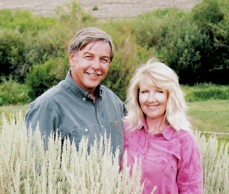
I am so excited to have these two authors, Mark Todd and Kym O’Connell Todd, as my guests today. They are both really great people and our conversations are always interesting, to say the least. Although I’ve never met Kym in person, Mark was my professor and mentor, and later my co-worker at Western State Colorado University. They also were a part of one of my 2018 “Ask the Authors” blog series and will be featured authors in the anthology of the same name, which is taken from that series and is planned for release in 2020.
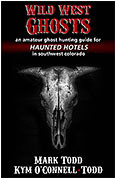
You’ve heard of those couples who have been married so long and know each other so well that they can finish each other’s sentences? Well, these two really do that, both in speech and in writing, and they have co-authored several books together. We’re going to talk today about their nonfiction collaboration, Wild West Ghosts, which documents their paranormal research, (which was of course, carried out as a team). Let’s welcome them now and see what they have to share with us today.
Kaye: You’ve written both fiction and nonfiction. What are some of the major differences that you see between the two types of writing?
Kym-n-Mark: We both began as journalists, so we cut our eyeteeth writing nonfiction. Lots and lots of straight news stories.
Kym: For years my job as a newspaper features editor gave me plenty of practice at bringing out the lives of interviewees to readers by applying creative writing techniques such as scene dramatization, dialogue, setting, and “character” description.
Mark: This may sound flippant, but my favorite description of the difference is this: nonfiction is writing that pretends it’s true while fiction is writing that pretends it isn’t! Okay, that even sounds flippant to me. But I think there’s a kernel of truth in there.
Kaye: In Wild West Ghosts, although the material is nonfiction, describing ghost hunts that you have been on, the historical characters which inhabited the locations in the past were very real and they had lives. How did you help those characters come to life for your readers?
Kym-n-Mark: We did a lot of research for each hotel and often found first-hand historical accounts either by the people we wrote about or about those folks by others from the time. During and after our paranormal investigations, we tried to be mindful the entitles we seemed to contact were once real people and respectful when we told the stories they had to share – or at least our encounters with them.
Kaye: What is the most unusual ghost hunt you’ve ever been on? Why?
Kym-n-Mark: We’d have to say the Norwood Hotel really stands out for all the things that happened. A cup flew off a table in front of us, we encountered a cold spot, and multiple pieces of equipment reported the same readings. In one room, there seemed to be a pathetic presence who identified herself as “Leah” who asked us to help her, and when we reviewed out digital recorder later asked us to remember her. In another room at the hotel, all our equipment red-lined and then shut down at the same time. We decided it was time to go.
Kaye: What time of day do you prefer to do your writing? Why?
Kym-n-Mark: Ha! As journalists we learned to write to deadline, so any time is good. But we also pick whatever time we’re both free to write together.
Kaye: You’ve been a college professor and Kym is a graphic designer, in addition to being authors. If writing suddenly made you rich and famous, what would you do?
Kym-n-Mark: Probably what we’re doing right now. We write because we enjoy it. Besides, we’ve turned a number of hobbies into businesses through the years, and it somehow kills the joy. We’d never want that to happen to our writing if that’s all we had to do.
Kaye: What is the biggest challenge when writing with a co-author?
Kym-n-Mark: For us it’s never been a challenge. But we’ve talked to other authors who found it hard. Most use “over the transom” writing, where each writes drafts and passes it to the other to revise back and forth. But all a matter of compatibility – in writing style, in work ethic, and in commitment.
Kym: Writing style and values are important. If either one of us had large egos, we’d either stop writing together or else we’d be divorced.
Mark: Yes, dear.
Kaye: What is the best part of writing with a co-author?
Kym-n-Mark: We’re sure there are others out there who do it like we do, but we can’t name anyone.
Kym: I start a sentence…
Mark: …and I finish it.
Kym: Or vice versa. Then before we finish a session, we reread and rewrite until –
Mark: — until we can’t tell who wrote what.
Kym: You’d think were married or something. Oh wait, we are!
Kaye: What is your favorite channel for book promotion?
Kym-n-Mark: That’s a toughie. We’ve tried most of them, and we ended up taking the sage advice to focus on just a handful that seemed to fit us best. Like you, Kaye, we like blogging, and have had a fair amount of success with that channel when cross-promoting with FB and Twitter.
Kaye: What’s the best piece of writing advice you were ever given?
Mark: I’ve always liked Natalie Goldberg’s advice from her book, “Writing Down the Bones: “Always give yourself permission to fail.”
Kym: I’ve always liked this: “Just start writing. If you don’t like it, that’s what the delete button is for.”
Kaye: What advice do you have for aspiring authors?
Kym: Don’t quit your day job. Until you make it, the electricity still needs to be paid.
Mark: I agree. I usually takes time to break in to publishing. Don’t put the pressure on yourself or your family. You’ll either find yourself blocked or you’ll crank out something that’s a waste of your time and your readers.
Kaye: Are there more books in the future for Mark and Kym Todd? What are you currently working on?
Mark: We’ve both really gotten into genealogy – we even have a blog dedicated to the more interesting skeletons we’ve each discovered in our closets. I’ve also always wanted to finish a memoir (one of those drafts-in-a drawer kinds of thing) about growing up in in a family mortuary business. A comedy, of course.
Kym: Our last book about ghosts happened because we were celebrating with our publisher the publication of our the third book in the Silverville trilogy. I never drink but had two Cape Cods that night. When our publisher asked us what was next, I blurted out a book about haunted hotels. Two days later, he called us and said he’d publish the ghost book. Maybe we’ll plan the next one when I get drunk again.
I want to thank Kym & Mark for joining us here and sharing today. As always when talking with them, the conversation was unique and entertaining, as well as being informative. I, for one, can’t wait to learn what that next book will be about, so I think Mark should take Kym out more often. You can learn more about Mark & Kym and their books on Mark’s Amazon Author page or on his Goodreads author page. To learn more about their paranormal investigations, visit their blog, Write in the Thick of Things.
Like this post? Let me know in the comments. You can be sure not to miss any of Writing to be Read’s great content by subscribe to e-mail or following on WordPress. If you found this content helpful or entertaining, please share.
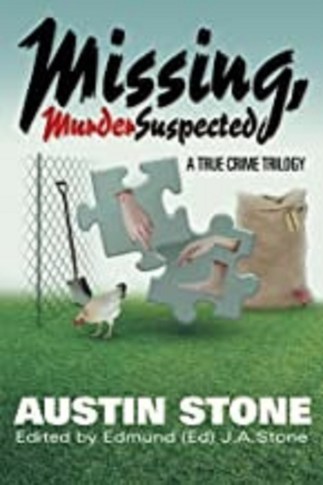
Missing: Murder Suspected is a true crime trilogy written by Austin Stone, compiled and edited by his son, Edmund J.A. Stone after his father’s death. In his investigative style of writing, similar to that of Truman Capote, Austin Stone has managed to bring the characters of each story to life in the reader’s mind in grisly detail.
A chicken farmer who buries a love struck woman beneath one of his chicken coops. A surgeon prone to fits of rage kills his wife and nanny, dismembering their bodies and concocting elaborate stories to account for their absence from his home. A firefighter kills his abusive wife in the heat of a moment, disposing of her body in a shroud of burlap sacks. These are murders which took place in the early 1900’s, and Stone offers a glimpse into the lives and motivations of the people involved through his telling.
If you like cold case type of stories, you will find these stories intriguing. There was too much telling and not enough showing for my own tastes, but giving the journalistic style, I don’t see how this could have been avoided. I give Missing: Murder Suspected three quills.
Kaye Lynne Booth does honest book reviews on Writing to be Read in exchange for ARCs. Have a book you’d like reviewed? Contact Kaye at kayebooth(at)yahoo(dot)com.
In the Southern hemisphere, January is the time of year when our children start a new school year. This year, my youngest son is starting secondary (high) school which means, new environment, new friends, new teachers – just about new everything. He is anxious about it and I keep reminding him that the groundwork for this transition to high school has been laid over many years of nursery, pre-prep and prep school and he is well equipped to deal with the changes.
Sitting with him over the past few weeks of his holiday (and mine) and ensuring he reads [and understands] his first high school English set work book and his first Afrikaans (second language) reader, I was reminded of when I taught both my boys to read when they were six years old. In South Africa, children only start reading when they are seven, but my boys were keen to read and I saw no reason why I, with two degrees and the equivalent of a masters, couldn’t teach them something so common place. Ha! It proved to be significantly harder than I expected and I take my hat off to pre-prep teachers who teach children to read so effortlessly. For me it was a slog. Of course, it didn’t help that I forgot to start by teaching Gregory the alphabet. I am not sure how I thought he would read words before he could recognise his letters, but somehow, it slipped with me. Despite my only teaching Greg the alphabet after I taught him his first two hundred sight words, he still learned to read quickly and is now an accomplished reader. I can no longer say he is a prolific reader as, at seventeen years old, he is not that keen on reading at the moment. Hopefully it will change down the line when the allure of being the same as everyone else wears off.
Anyhow, these memories led me to thinking how important knowing the alphabet and learning the sounds is for children as they travel the path towards literacy.
My boys and I had a lot of fun learning the alphabet. Michael, aged three, got to sit in on Greg’s (aged six) lessons, and Greg (aged nine) got to help Michael (aged six), when he started his reading journey. One of our favourite past times, when Greg was learning, was singing the alphabet song:
Greg, Michael and I also used our time in the car to learn the alphabet. We played a game called “I spy” and we would each chose an item that started with a certain letter and the others would have to guess what it was. This game was a lot of fun and we played it for a number of years. The boys used to ask for it when we traveled. Now they ask for audio books and we listened to an awful lot of Eva Ibbotson books when we toured Scotland in August 2019.
The third fun activity we played to learn the alphabet was to bake an item that started with a certain letter. It had to be an exact sound match so, we couldn’t for example, make gingerbread for the letter “g”. This game and tasting session was very popular and sometimes we invited friends over to join in the fun. I specifically remember making jelly cakes [have you ever heard of those – if not you will find the recipe in Sir Chocolate and the Condensed Milk River story and cookbook.
Multicoloured jelly cupcakes
The nice thing about baking with children is that it is also a wonderful opportunity to teach them maths concepts like grams and kilograms and millilitres and litres. They also learn to weigh and measure and realise the importance of being exact. I even taught mine about ounces and pints as some of my cook books use English measures.
Do you know any fun games to teach children the alphabet? Let me know in the comments.
About Robbie Cheadle
Hello, my name is Robbie, short for Roberta. I am an author with six published children’s picture books in the Sir Chocolate books series for children aged 2 to 9 years old (co-authored with my son, Michael Cheadle), one published middle grade book in the Silly Willy series and one published preteen/young adult fictionalised biography about my mother’s life as a young girl growing up in an English town in Suffolk during World War II called While the Bombs Fell (co-authored with my mother, Elsie Hancy Eaton). All of my children’s book are written under Robbie Cheadle and are published by TSL Publications.
I have recently branched into adult and young adult horror and supernatural writing and, in order to clearly differential my children’s books from my adult writing, I plan to publish these books under Roberta Eaton Cheadle. My first supernatural book published in that name, Through the Nethergate, is now available.
I have participated in a number of anthologies:
Two short stories in #1 Amazon bestselling anthology, Dark Visions, a collection of horror stories edited by Dan Alatorre;
Three short stories in Death Among Us, an anthology of murder mystery stories, edited by Stephen Bentley;
Three short stories in #1 Amazon bestselling anthology, Nightmareland, a collection of horror stories edited by Dan Alatorre; and
Two short stories in Whispers of the Past, an anthology of paranormal stories, edited by Kaye Lynne Booth.
I also have a book of poetry called Open a new door, with fellow South African poet, Kim Blades.
Want to be sure not to miss any of Robbie’s “Growing Bookworms” segments? Subscribe to Writing to be Read for e-mail notifications whenever new content is posted or follow WtbR on WordPress. If you found it interesting or entertaining, please share.
Nonfiction is the stuff texts books are made of, the straight-out boring stuff that puts you to sleep, right? Not necessarily. Texts books don’t have to be boring. Nonfiction that is written creatively can capture the reader’s interest or immerse them into true life stories. From memoir, to self-help and how-to books, and yes, even text books can be highly entertaining.
True life circumstances and facts determine the story in nonfiction, yet nonfiction authors are faced with the same challenges as fiction authors to bring the characters and setting to life in the readers mind, or portray the information they wish to relate in a manner which readers can relate to. Both fiction and nonfiction authors strive to grab readers attention, now, in this digital age more so than ever before. But there are differences, as well.
To start off 2020, we’re going to delve into creative nonfiction in January. We have a pretty good sampling on the different forms that creative nonfiction might take. My author guest on “Chatting with the Pros” is bestselling author and memoirist, Diana Raab, who believes in the healing powers of writing. I will also be interviewing an author team, Mark Todd and Kym O’Connell Todd, who wrote Wild West Ghosts, one of the most informative and entertaining how-to books I’ve read. I will also be reviewing a true crime book, Missing: Murder Suspected, by Austin Stone, edited by his son Ed after his father’s passing, and a book on writing, On Being a Dictator, by Kevin J. Anderson and Martin Shoemaker. I do hope you will join us and help get Writing to be Read off to a good start for the year ahead.
For additional samplings of creative nonfiction see the following interviews and reviews:
Like this post? Let me know in the comments. You can be sure not to miss any of Writing to be Read’s great content by subscribe to e-mail or following on WordPress. If you found this content helpful or entertaining, please share.





 Diana: I love being with my adult children (ages 36, 34, and 30) and playing with my grandchildren; and I love hiking and going for beach walks. I meditate every day, and like most writers, I love to read. I also love cooking, especially soups and desserts. I love doing needlepoint, a craft I learned from my maternal grandmother, Regina, who committed suicide when I was ten. She was my caretaker, and this was a huge loss for me. Her story is the basis of my first memoir, Regina’s Closet: Finding My Grandmother’s Secret Journal.

 Kaye: You put together a book project that was quite innovative with Writers and Their Notebooks. I thought it was a really cool idea, and apparently others did too, since it became a Best Books award finalist with USA Book News. In fact, I’d bet there is an abundance of valuable information for aspiring authors. What inspired you to compile an anthology of author essays about the value of an author’s notebook?
 Kaye: Another valuable anthology which you put together is Writers on the Edge, a collection of 22 authors being brutally honest about their own battles with addiction. Was it difficult to get so many authors to open up?
 Kaye: You’ve written two memoirs yourself. Why did you choose to share with others your inner thoughts and feelings during a difficult time in your own life, with Healing with Words: A Writer’s Cancer Journey?



 Kaye: In Wild West Ghosts, although the material is nonfiction, describing ghost hunts that you have been on, the historical characters which inhabited the locations in the past were very real and they had lives. How did you help those characters come to life for your readers?