It’s the final stop on the WordCrafter “The Ones Who Stayed With Me” Book Blog Tour.
Giveaway
Leave a comment for a chance to win a free digital copy of
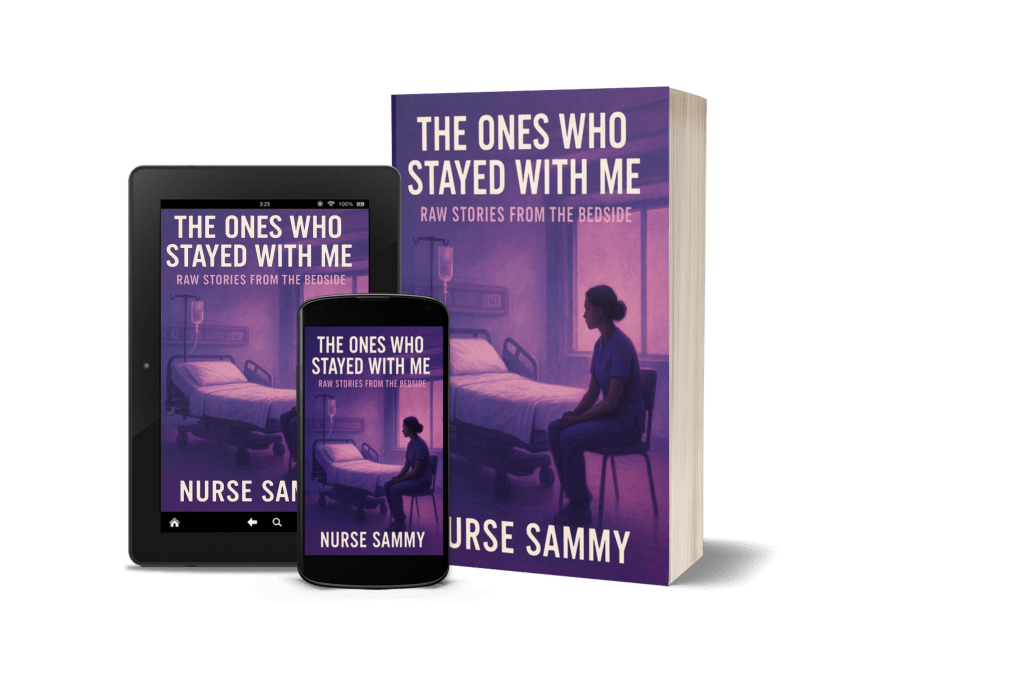
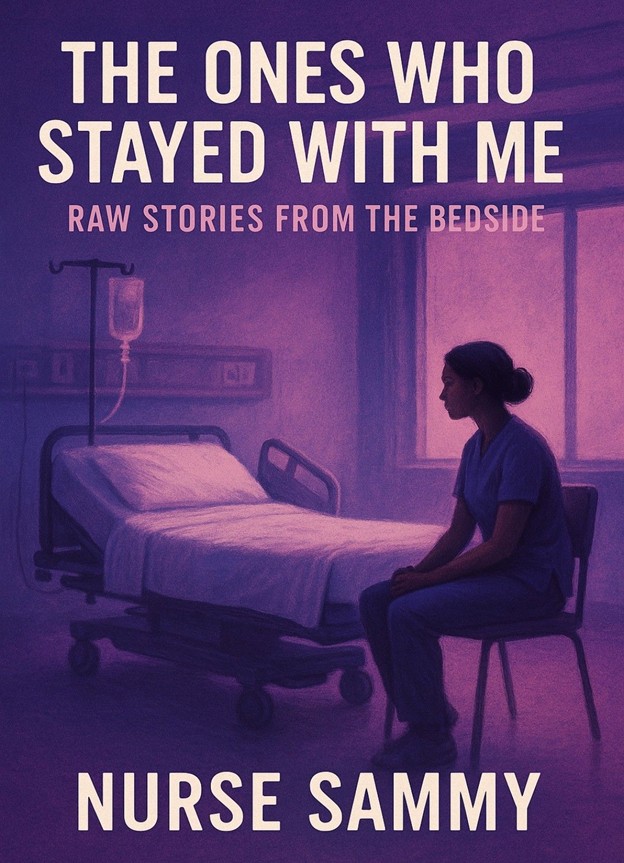
The Ones Who Stayed With Me
By Nurse Sammy
One entry per stop.
Winners are chosen in a random drawing.
Sponsored by WordCrafter Press.
About The Ones Who Stayed With Me
Chronicles of the journey into the medical field as a young nurse and beyond, told with raw sensitivity and compassion. The Ones Who Stayed with Me offers small glimpses into the world of an L.P.N. put in difficult, often touching or humorous, situations—and Nurse Sammy’s courage, vulnerability, and insight are a gift to us all. In these pages, Nurse Sammy tells her story and that of those she met along the way.
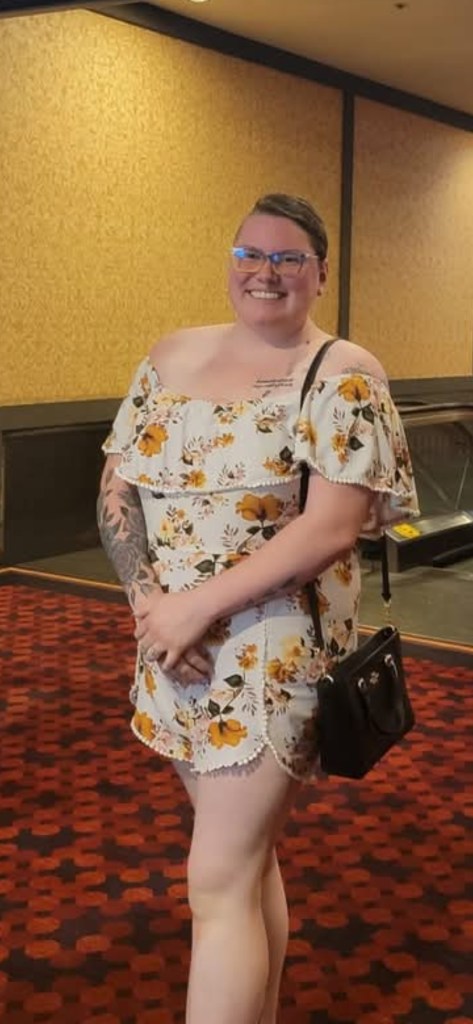
Nurse Sammy has spent her life walking the quiet edges of human suffering and human grace. Long before she ever wore scrubs, she learned how to read a room by the way someone breathed and how to steady a shaking hand. How to listen to the stories people only tell when they think it might be their last night to say them. Nursing wasn’t a career she chose; it was the language her heart was already speaking.
She has worked in places where life is beginning, and in places where life is ending; in rooms lit by hope, and in rooms where grief hangs heavy in the doorway. Rehab centers, memory care halls, pediatric units, assisted living, private homes, wherever someone needed gentleness, she went. She became the one who held vigil, the one who noticed the quiet details, the one who stayed.
Her personal life has carried its own ache, abuse survived, love lost, a marriage that bruised the soul, another built from healing, and a grief that still hums beneath her ribs. She writes from the tender, broken places, from the nights she rebuilt herself alone, from the mornings she rose anyway. Her words are shaped by both the wounds and the resilience that followed.
The Ones Who Stayed With Me is her first published work, a collection of truths disguised as stories, honoring the people who left fingerprints on her life in ways they never saw. Her writing is soft but unflinching, honest but merciful, threaded with the belief that even in darkness, someone is always holding a light.
Nurse Sammy lives in the Pacific Northwest, where she continues to care, to witness, to learn, and to turn the hardest parts of her journey into something that might help someone else breathe a little easier.
My Interview with Nurse Sammy
Kaye: The book tells a lot about your journey as a nurse. Would you tell us a little about your author journey? What inspired you to write The Ones Who Stayed With Me?
Sammy: My first year of nursing was very adventurous. I knew these stories would be written in a book one day. There was just something in me. I kept record of these stories. It took me a few years to work up the courage to write, but in the summer of 2025, I took the time to finally start. I started a new sticky note on my phone and wrote down the stories I wanted to write. I started a rough draft in word and would work on it before or after work. I spent lunch on my phone writing titles and brainstorming ideas. I was enjoying the process of writing so much that it was consuming my life, I could not stop. The emotions of writing helped me process what I had experienced and what others did too. I wanted to teach people what really happens behind the curtain.
Kaye: What are some of the challenges in writing this book for you?
Sammy: Writing was never my strong suit in school. I am a horrible speller, and grammar is not my forte. I was nervous that my stories would be unreadable and hard to digest. As I wrote, things got easier. I was stressed that this wouldn’t work out. I had to take a step back and remember that I was writing this for me first. No one had to see it if I chose that. I got more confident and showed some friends. It became easier.
Kaye: What is the most gratifying part of this book for you?
Sammy: Being able to share the stories with others. I wanted to educate and teach people what healthcare professionals go through. These are common stories in healthcare. A lot of us have had similar shifts. I wanted patients to understand that they are not alone either.
Kaye: What has been the biggest obstacle for you, as an author?
Sammy: Believing in myself. Having faith in myself to follow through on something. To start something and finish it. This was a big project for me. I was proud of what I was doing, that it kept me on track. I had to persuade myself once to keep going, I was determined.
Kaye: What author (dead or alive) would you most like to have lunch with?
Sammy: Judy Blume. She wrote childhood classics. Some of my favorite days in school were 4th and 5th grade. Judy Blume’s books were the books chosen for those two years. We read them out loud together. Did book reports on them. And had quizzes over them. I fell in love with them. They are simple cute books. But they were my childhood. Even as an adult, I read her books.
Kaye: What is the best piece of writing advice that you have ever received?
Sammy: Start. Just start writing. Everything will flow out as long as you start. Let the emotions out and write for yourself first and others second.
Kaye: Are there more books in the works, or is this just a one-and-done thing?
Sammy: I have started brainstorming and have a sticky note in my phone for my second book. There are many stories that still haven’t been written. The more years I work, the crazier things have gotten. Especially after Covid. I am excited to keep writing and hope I can educate more and more people.
Kaye: Where do you hope to see yourself as a writer, and as a nurse, in ten years?
Sammy: I hope to have a few more books written. I really enjoyed this process and hope to continue it. As a nurse, I dream of having my doctorate in nursing. I hope to go back to school soon to work towards a higher degree in nursing. I plan to one day be a Nurse Practitioner for pediatrics or geriatrics, only time will tell.
Kaye: What advice do you have for aspiring authors?
Sammy: Believe in yourself, even if no one else does. That spark in you wants to grow, let it. Even if you just write a sentence a day. Understand you are allowed to learn and grow as you write. You don’t have to be perfect.
Kaye: Where can readers learn more about you and your books?
Sammy: I am currently working on social media accounts as an author. I will have profiles on Facebook, Instagram, and TikTok. Stay tuned.
Denise Aparo’s Review of The Ones Who Stayed With Me
The Ones Who Stayed With Me by Nurse Sammy Book Review by Denise Aparo
The Ones Who Stayed With Me by Nurse Sammy is a powerful debut collection of true stories that leaves a lasting impression on both the heart and mind. These narratives are raw, honest, and emotionally intense—sometimes humorous, always compassionate—and reveal how grace can be found in the merciful field of nursing through care, service, and human connection.
Written in a memoir-style, journalistic format, Nurse Sammy chronicles eight years of her life working as a Certified Nursing Assistant (CNA). She guides readers through her journey from the very beginning, presenting her experiences through a series of chronological snapshots. The book may be read cover to cover or opened at random, as each chapter stands on its own while contributing to a larger, meaningful whole. The stories explore life’s beginnings, endings, and everything in between, taking place in rehab centers, memory care halls, pediatric units, assisted living facilities, private homes, and wherever compassionate care is needed most.
Interwoven throughout the book are deeply personal reflections on heartache, surviving abuse, profound grief, a lost marriage, and ultimately, healing and rediscovered love. The opening chapter, This Job Will Break Your Heart, immediately grounds the reader in the emotional reality of nursing, while also emphasizing resilience, strength, and the wisdom gained through hardship.
Each chapter offers a gripping short story filled with Nurse Sammy’s experiences, emotions, and adventures in the field. Not every story has a happy ending—some have no ending at all—but each carries a moral and a life lesson, delivered with sincerity, empathy, and at times, gentle humor. For readers considering a career in caregiving or nursing, this book provides invaluable insight into both the emotional demands and the profound rewards of the profession.
Ultimately, The Ones Who Stayed With Me serves as a moving reminder that angels often appear in our darkest hours—sometimes wearing scrubs.
Lindsey Martin-Bowen’s Review of The Ones Who Stayed With Me
The Ones Who Stayed with Me—Raw Stories from the Bedside (WordCrafter Press 2026)
Whew! Even though I am not a member of this collection’s target audience, indeed its true stories hooked me. (I admit, with a mother who was an RN from the late 1940s and returned to the profession after raising seven children, and a sister who works as a Nurse Anesthetist with a daughter whose first year of being a nurse was during the COVID epidemic, a story collection penned by an author named Nurse Sammy aroused my curiosity.)
Yes, once reading these episodes, I was snared. Nurse Sammy penned these true stories about her experiences serving in an array of positions in the nursing profession, (which she entered when she was 18), as a guide for those entering that field. By age 20, she served as a night shift Charge Nurse for a huge retirement community enclosed in a “sprawling” building linked to “elegant corridors easy to get lost in.” There, she “oversaw 190 residents, six Med Aides, and fourteen CNAs until 10 pm.” After that hour, she reminisced, she and six CNAs served that retirement home.
Afterwards, in a section entitled Finding My Groove: Rehab #3, Vancouver, WA, she describes where she believes she “finally received real training, two weeks across all shifts.” There, in that place which “felt like family,” she worked as a Floor Nurse from Monday through Friday, 2 p-10 pm.
“Nurses handled all meds and treatments,” she recalled. “It was intense, but I thrived. My usual shift included seventeen patients.”
And she remained there when “COVID-19 hit,” and she “volunteered for he new Covid wing. Sixteen rooms, one nurse, two CNAs, twelve-hour shifts, five days a week. I did it for five months. No one died on my watch.”
About halfway through this collection, she included another episode about the Covid experience, “2020 The Year the World Shut Down,” occurring when she was “twenty-two years old and two years into my nursing career.” There the residents were “people who already could not breathe on their own, long before COVID was a headline.”
When the facility received its “first positive [COVID] case” . . .[w]e all knew it was over,”
she wrote, then described how ill-prepared that institution was for the pandemic: “We stored our masks in paper bags, labeled with our names, praying they would still be ‘clean’ the next day. Some of us used the same face shield for weeks, wiping it down between patients, cracked forming in the corners. We all knew it was not enough.”
And here, she included the heart-breaking story of a 55-year-old patient she dubbed “Jane,” who’d been a resident for years.
“She had a trach and was on a vent, but she was vibrant, She had a laugh that filled the whole house, even with the voice that comes through a speaking valve. Every morning, she wanted her hair brushed, red lipstick on and her gospel music playing. She was not supposed to die, not yet.”
Nevertheless, Jane tested positive, and “she knew. She looked at me with wide, terrified eyes I wanted to believe. ‘No Jane. You are strong. You will beat that.” I could not. We both knew what this virus did to the lungs. Especially lungs relying on machines.”
Her body’s oxygen needs “skyrocketed” a day later, and by the third day, she could no longer laugh. Nurse Sammy sat by her bed in sweat-soaked gown, held Jane’s hand in
“double-gloved fingers, and whispered “Your are safe. You are not alone.”
Jane died the next day. Nurse Sammy added, We did no even have time to mourn her,” and added, “I did not sleep. I barely ate. I cried on the bathroom between med passes. Still, I came back the next day, and the one after that. Who else would sit with them? Who else would make sure they did not die afraid?”
Later, in the sections, Better Than Textbooks and Jane the Bitch, set in the second and fourth assisted living centers where she served as a memory care nurse, Nurse Sammy shares the experience with “John.” a senior citizen raised during the Great Depression, who shared stories about his family using “flour sacks for curtains” and “talked about sneaking sis of bootleg gin during Prohibition. “John lit up when I sat beside him. His eyes usually dull and half-lidded would brighten.”
Similarly, her short about “Jane the Bitch” revealed how that resident, a retired nurse, who “had worked nights for decades,” was sharp, sarcastic, condescending and downright mean,” was tamed when Nurse Nanny watched how she liked to take her meds “with ice cold milk” and “liked the lights dimmed,” and stared serving her milk “in a chilled glass,” turned down the lights and “picked up on her other quirks.”
“ . . .surviving Jane meant learning her code. Once I cracked it, something unexpected happened. She started talking. Not in her usual bark, but in something softer. Once night, she told me about her first years as a nurse. How she worked in the E.R., sometimes twelve days in a row. How she buried her stress in sarcasm and bourbon, How she lost her husband, and how pain had followed her for years before it ever settled in her bones.”
Especially in those two pieces, Nurse Nancy revealed how a nurse may connect with elderly persons who must live the rest of their lives in assisted living centers.
She added that after she and Jane connected that night, she caught Jane “watching me from her recliner while I quietly filled the med cup.”
“She said, ‘You are good. You pay attention.’ That was the closest U ever got to a compliment fro Jane. Weirdly, it meant more than the thank yous I had gotten that week. . . I learned that even the most difficult people need connection. Even bitches deserve consistency. Sometimes the person who fights you the hardest is the one who needs you the most. . . Jane was the bitch I never saw coming, and one who never left me.”
(Note—Nurse Nancy refers to all the male patients as “John” and all the female patients as “Jane,” to preserve their identities.”
A Pacific Northwest writer, Nurse Sammy continues to serve the medical community as an LPN. This collection of stories is her first published book, which she wrote to “honor the
people who left fingerprints on her life in ways they never saw.” And by doing so, she created a collection well-worth reading—even for us non-nurses.
—Lindsey Martin-Bowen
Cashing Checks with Jim Morrison (redbat books 2024)
Wrap Up
That wraps things up for today’s stop and for the tour. Thank you all for joining us, and don’t forget to leave a comment to show your support, and for an entry in the giveaway for a free digital copy. If you missed a stop, you can still visit each one through the links in the schedule below.
Tour Schedule
Mon. 12 – Poetry by Mich, Hotel by Masticadores & Masticadores Phillipines – “The Backbone of Healthcare: The C.N.A.” Reading by Nurse Sammy –
I’m pleased to announce the release of a collection of true-life stories from the career of an L.P.N., written by a debut author known only as Nurse Sammy on January 13, 2026. I am so excited to be partnering with Nurse Sammy on this book and publish it through WordCrafter, because my own experiences in the health care field makes Nurse Sammy’s accounts ring true. Some stories will make you laugh. Others may make you cry. But there’s never any doubt that these stories come straight from the heart.
Chronicles of the journey into the medical field as a young nurse and beyond, told with raw sensitivity and compassion. The Ones Who Stayed with Me offers small glimpses into the world of an L.P.N. put in difficult, often touching or humorous, situations—and Nurse Sammy’s courage, vulnerability, and insight are a gift to us all. In these pages, Nurse Sammy tells her story and that of those she met along the way.
What’s Ahead in 2026
WordCrafter Press has a busy year planned for 2026, with a book release almost every single month, and two months designated to the writing of my own works, I may find little time to breathe. But, I’m excited about the new works by rising authors that are scheduled, including the one above, by Nurse Sammy, a paranormal romance by B.T. Clearwater, and two novels by rising author Lindsey Martin-Bowen, as well as a nonfiction work on a new approach to treating diabetes, by Daniel Cox, Ph.D., A.B.P.P.
We’ll also be publishing two themed anthologies which are by invitation only, as well as our annual short fiction contest and the resulting anthology, which will be book 4 in the Midnight Anthology Series.
February: Writing Month
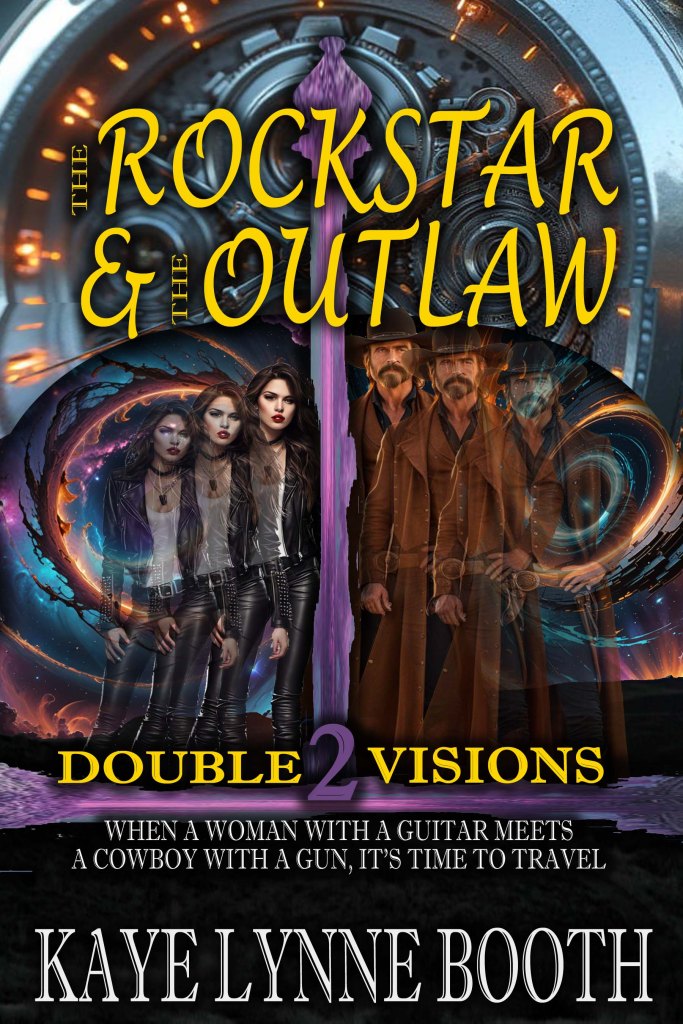
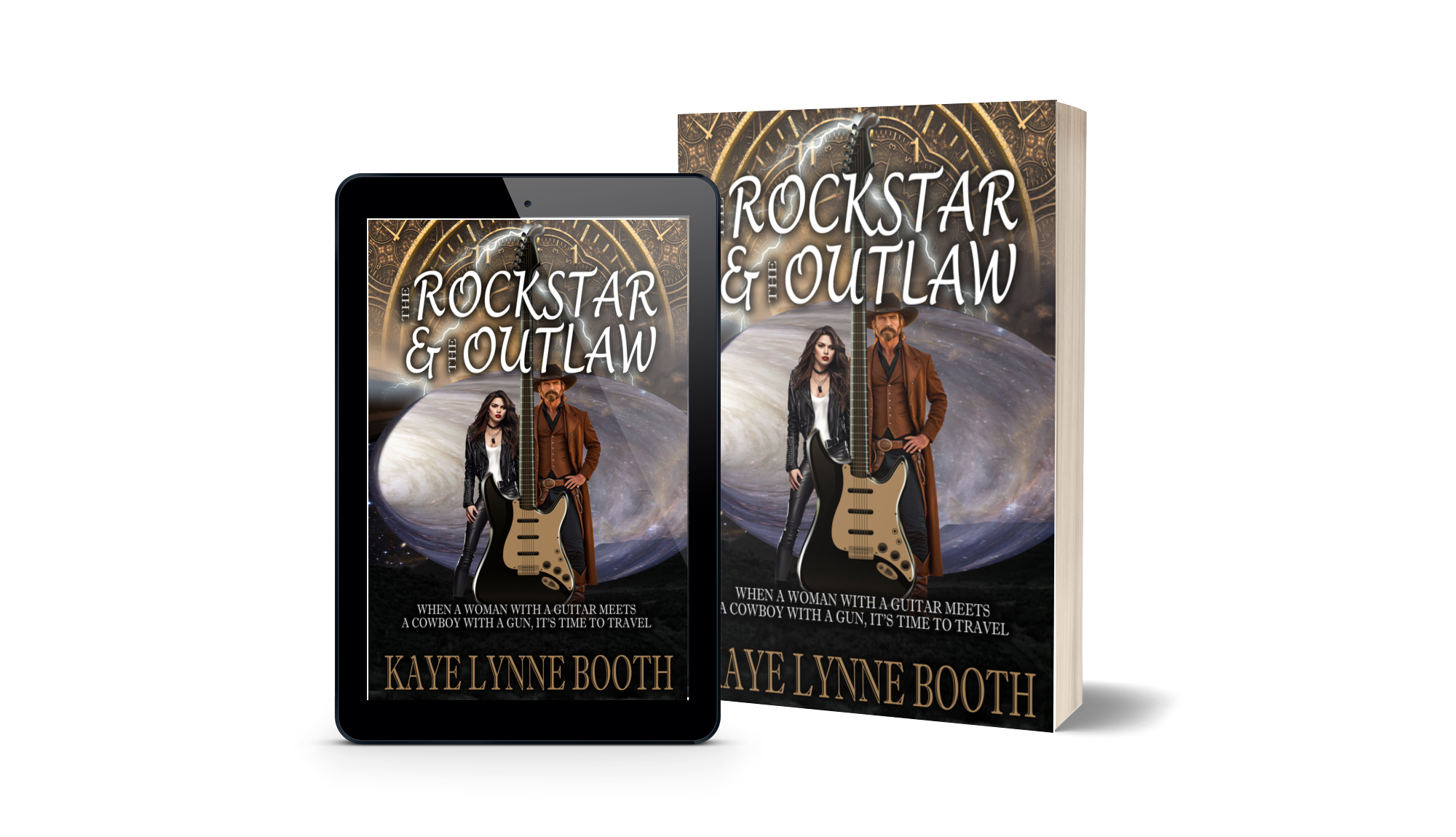
I’ll be using this month to finalize the second book in my Time Travel Series, The Rock Star & The Outlaw 2: Double Visions, which will be scheduled for release in March. This book was originally scheduled to release in 2025, but due to unforeseen technical difficulties, (my laptop died), I was unable to make those deadlines, so I’m excited to be releasing it at last.
March: The Rock Star & The Outlaw 2: Double Visions – Book 2 in the Time Travel Adventure Series, by Kaye Lynne Booth
In 1887, LeRoy is stuck, bringing trouble down on those around him. When Sissy is kidnapped and he’s the only one who can save her.
In 2030, Amaryllis will stop at nothing to find LeRoy fix what she messed up in the past, when she wakes up in a future very different to the one she knows, one in which she may not be born.
She and a version of Monique which is different from the one she grew up with travel back to 1887 to try and make things right.
When they cross the other time loops, already created, things change, but not the way Amaryllis intended.
Add two time travel regulators from the future who are after the time module, and things start to get wild.
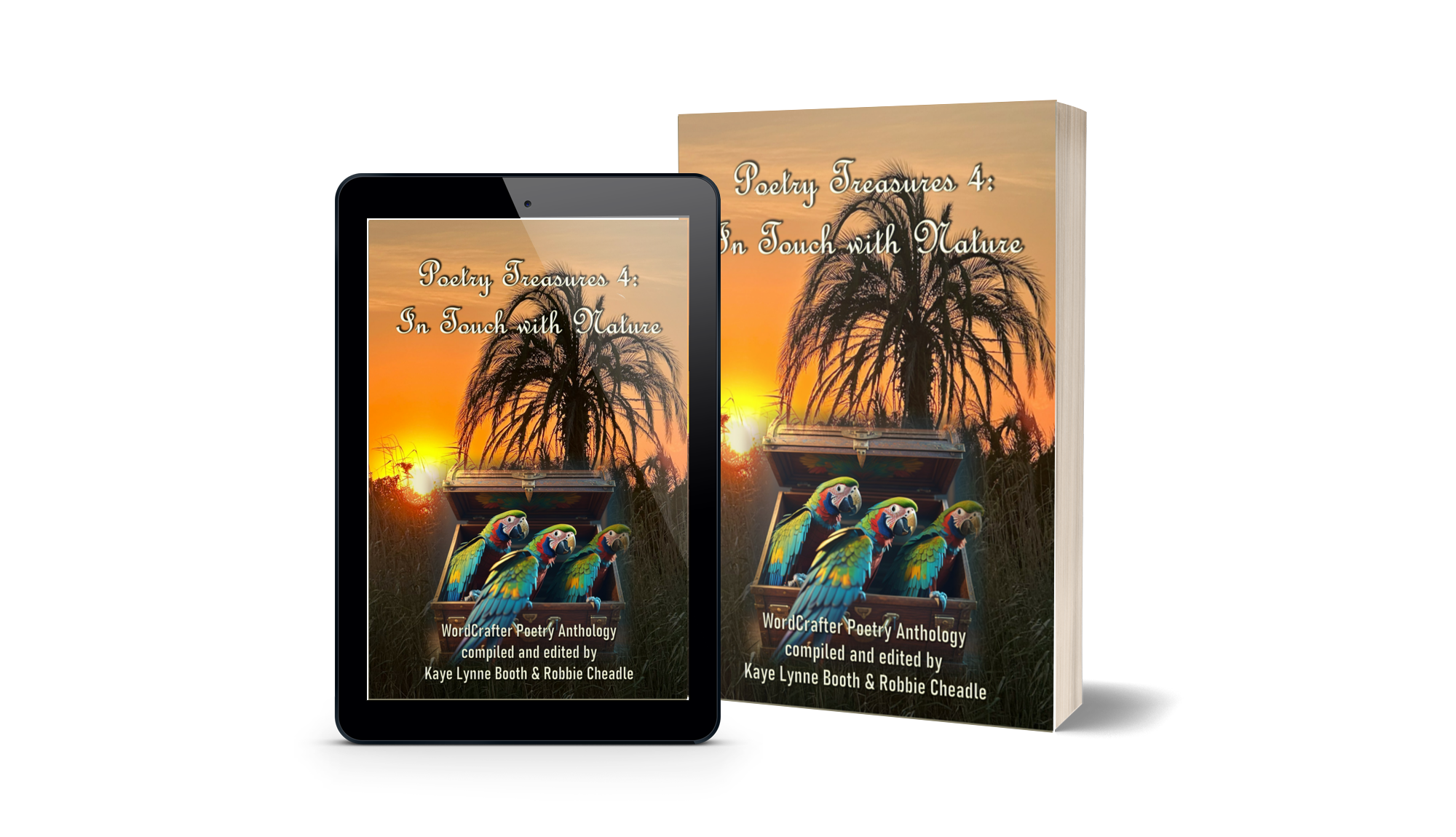
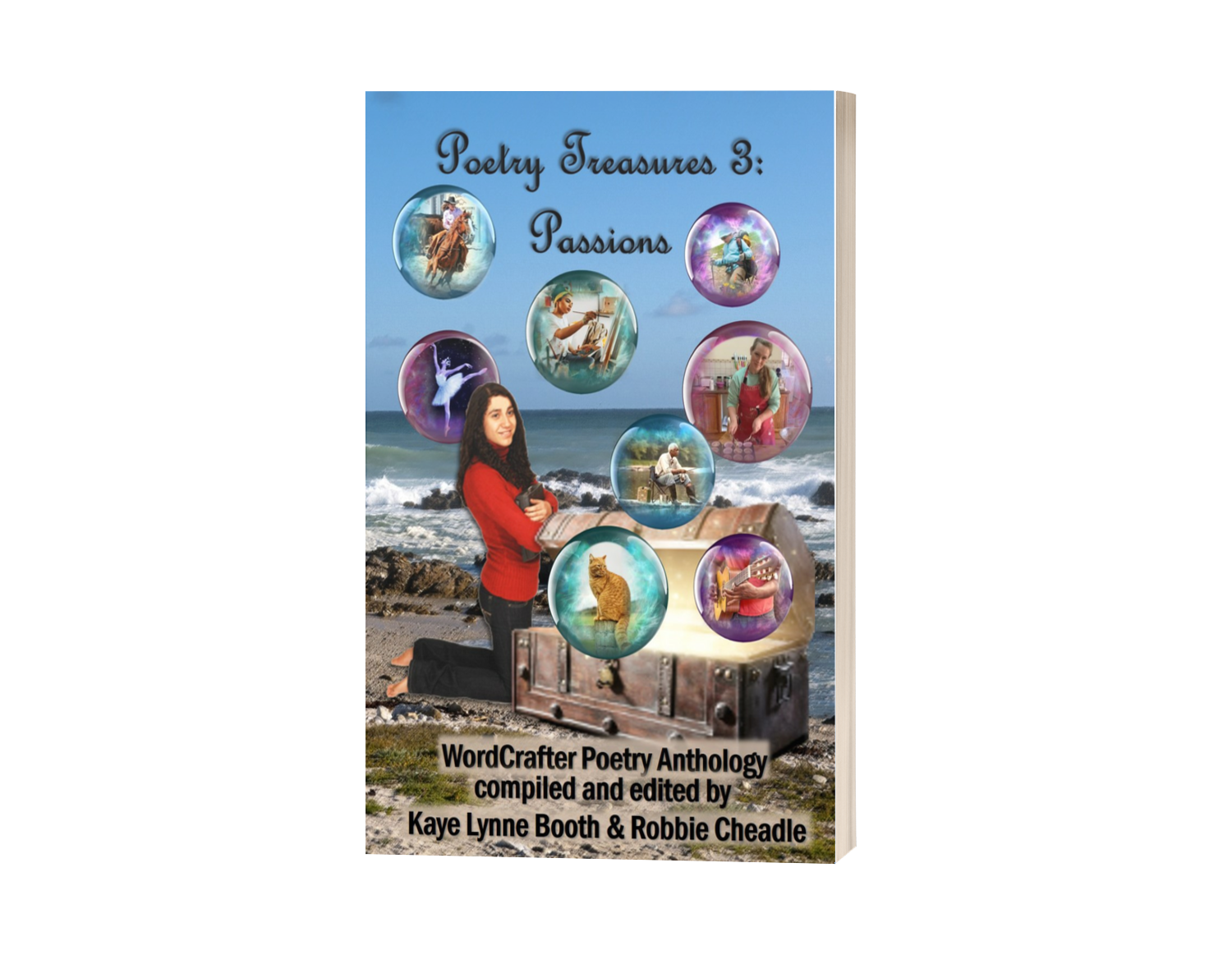
The annual WordCrafter poetry anthology, Poetry Treasures will be released in April in celebration of National Poetry Month. 2026 brings us volume 6 in the Poetry Treasures anthology series with a theme of ‘Seasons’. The contributors for this anthology are selected from the guests on Robbie Cheadle’s “Treasuring Poetry” blog series in 2025.
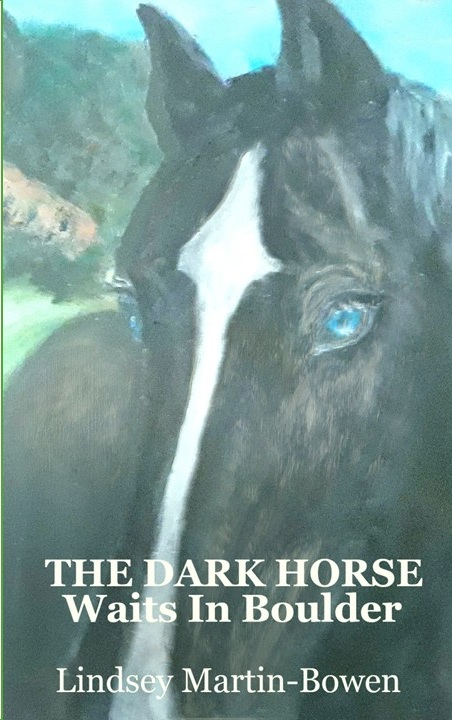
May: The Dark Horse Waits in Boulder, by Lindsey Martin-Bowen
A Romantic Comedy set in Boulder, Colorado, in the late 1970’s. Charli Erickson is a “rock poet” who’s a bit “flippant.” Each chapter will be music to your ears.
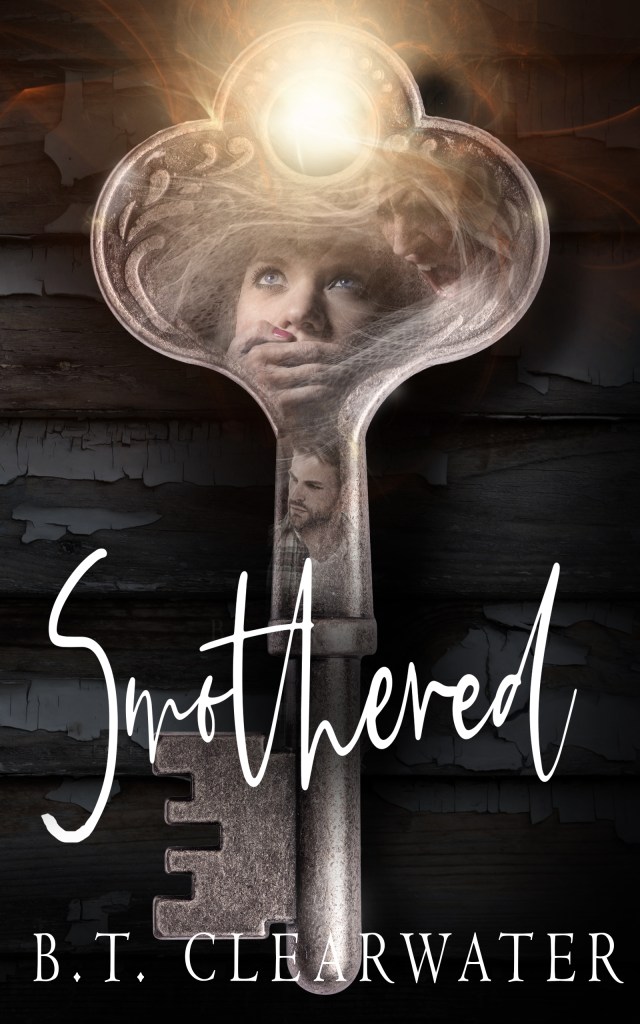
June: Smothered, by B.T. Clearwater
A paranormal romance by B.T. Clearwater.
June: Diabetes: How to prevent or treat it with a new and effective approach that does not involve supplements, weight loss or medication, by Daniel Cox Ph.D., A.B.P.P.
Personalized, research based, practical, empowering, effective workbook. For individuals who want to take control of their diabetes.
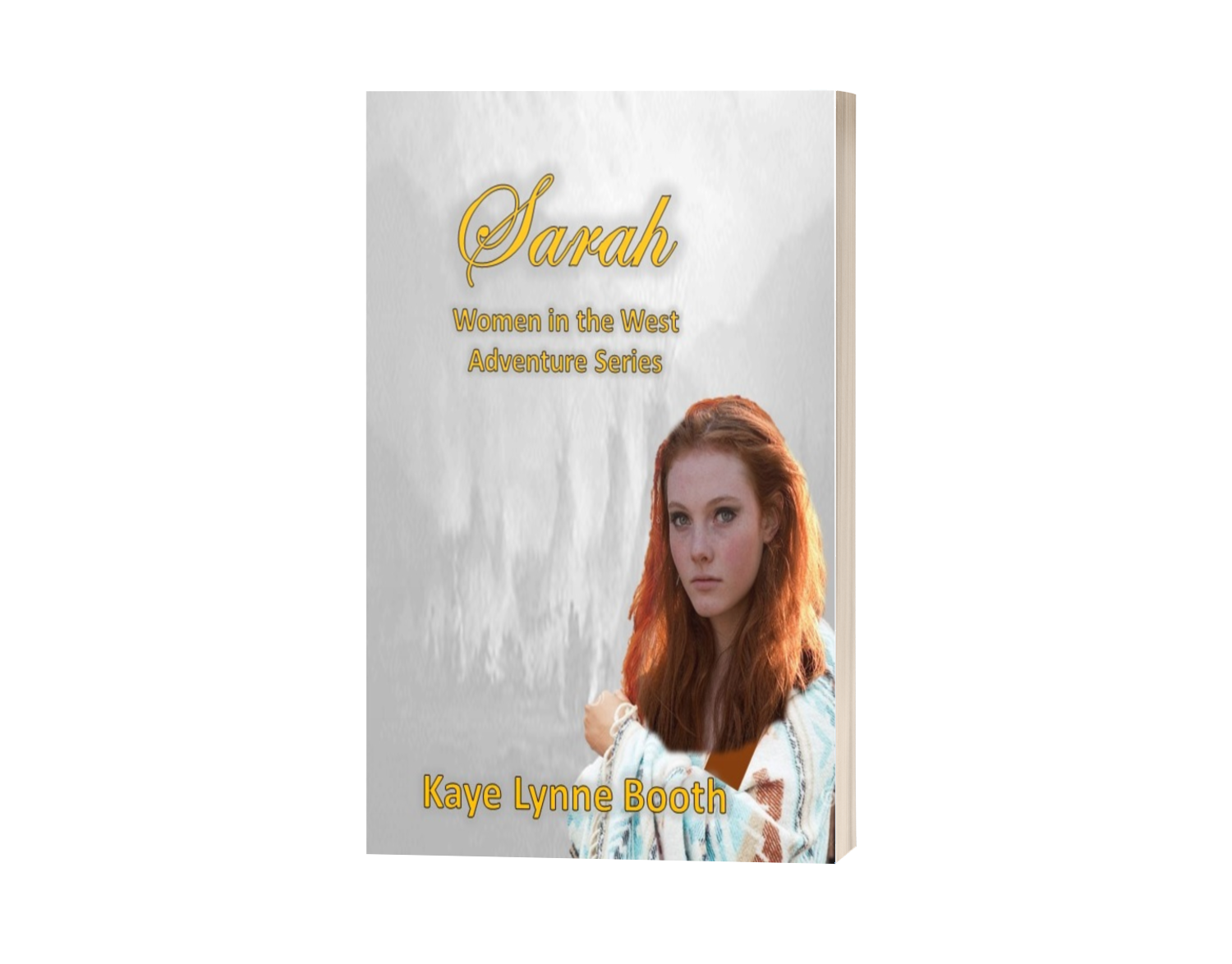
July: Marta – Book 3 in the Women in the West Adventure Series, by Kaye Lynne Booth
Marta is a woman trying to make a new start in hostile territory.
Marta is not the timid Mormon woman, who was abducted by Utes as her husband and children were killed in the raid. Now she is determined to make her way as an independent woman, after her partner tried to cheat her out of her share of a gold mine.
Determination and inner grit bring this strong and spunky heroine into the company of a cast of colorful and unique female characters and together, they face down banditos, Comancheros, and angry husbands and fathers, as well as Marta’s disgruntled partner as they travel the rugged desert landscape to unruly border town of El Paso, Texas.
If you like strong and capable female protagonists, you’ll love Marta.
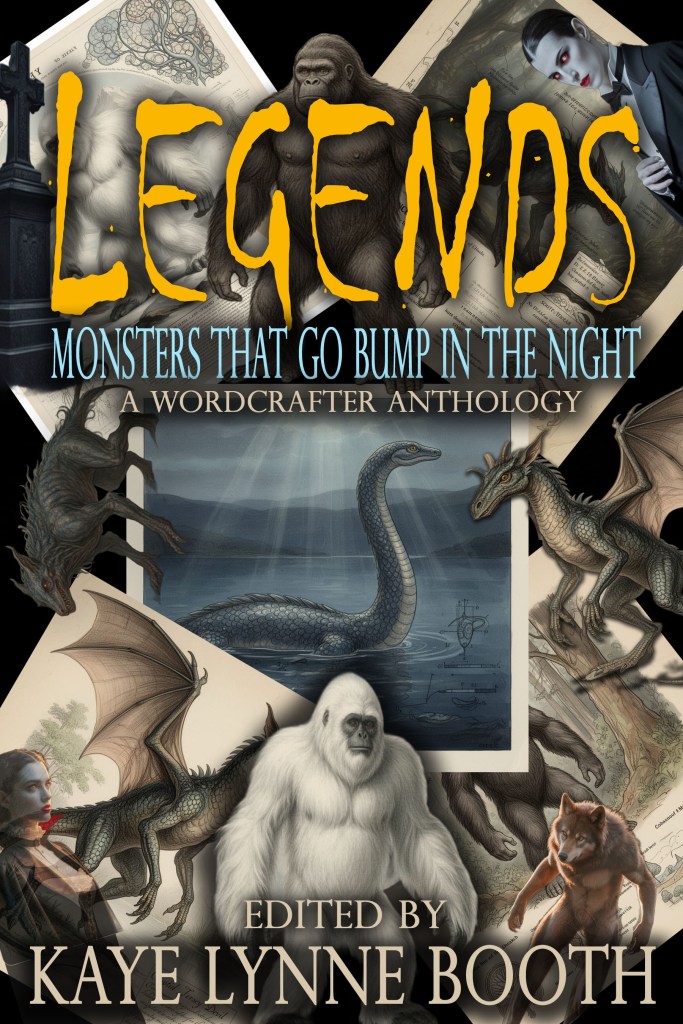
August: Legends anthology
A WordCrafter themed anthology
September: Deep City in Times Roman, by Lindsey Martin-Bowen
A “Roman Clef” based upon the Moony movement, popular in the 1970s and ’80. Set in the 1980s, Lynette and Shirley are quite angry at the Reverand Yun Sung Ghunne, who has separated their husbands from them as he is forming his Ghunies movement. This story spoofs the Mooney movement, or any movement that is mainly designed to dupe persons into supporting the leader and building his wealth.
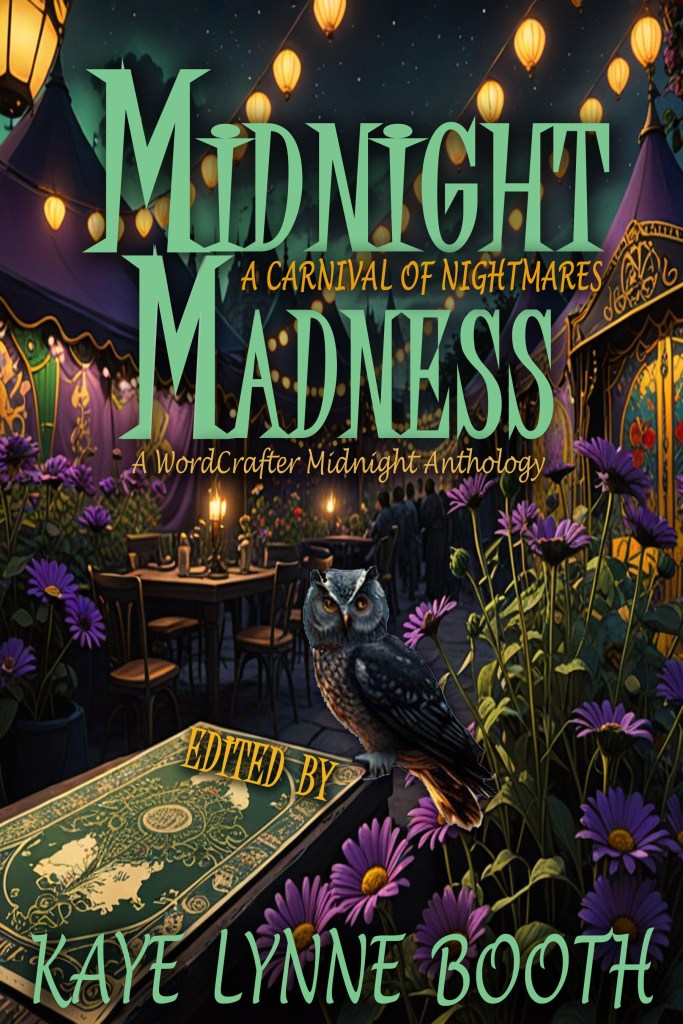
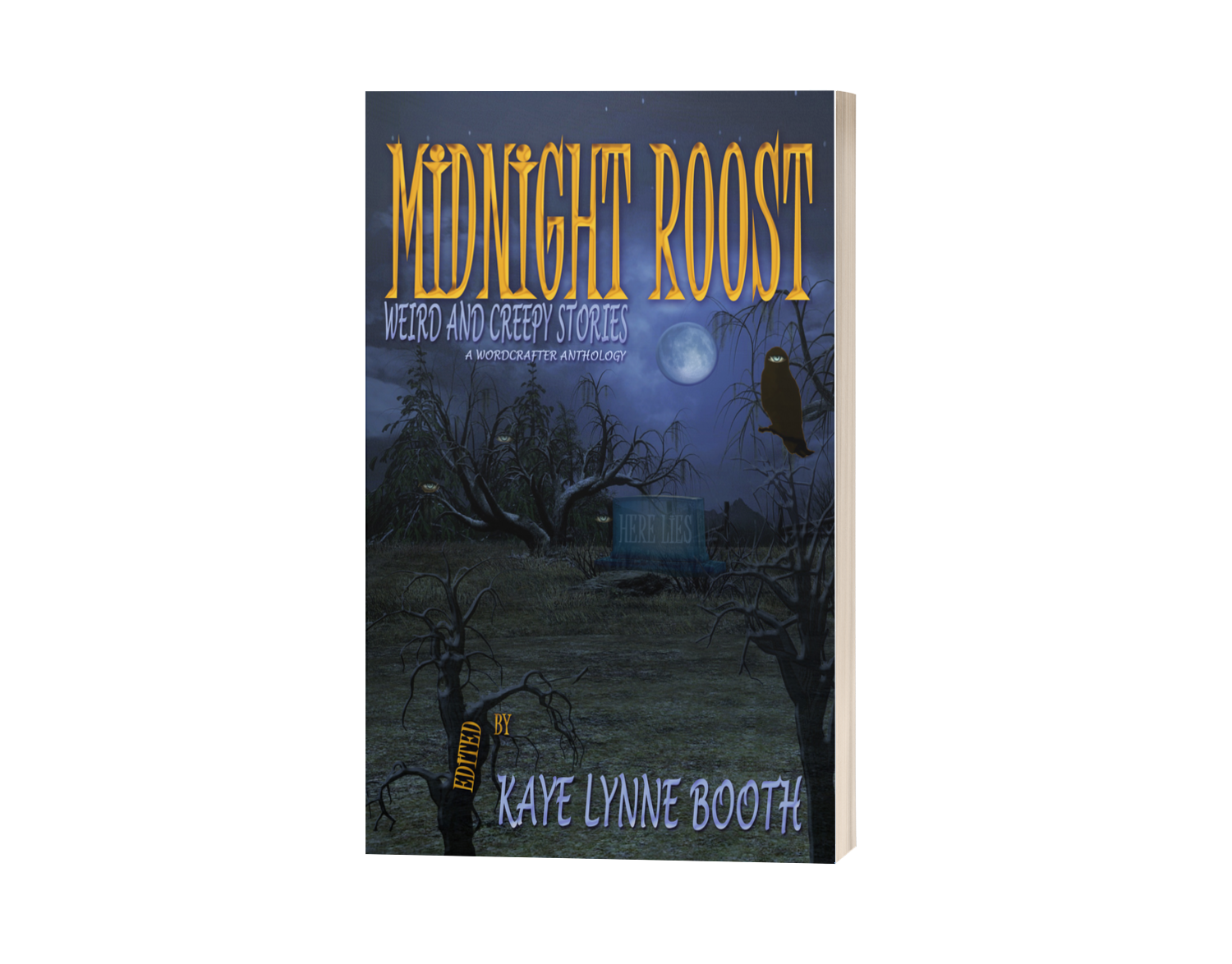
October: Midnight Madness: A Carnival of Nightmares dark fiction anthology
Volume 4 of the WordCrafter
Midnight Dark Fiction Anthology Series
November: Writing Month
This month I’ll be working on revising what I have of my Playground for the Gods science fantasy series. (It’s been a while since you heard about this one. I bet you forgot all about it, but I didn’t.) Originally planned as a massive four-book series, I now plan to release this entire series in serial installments on Ream.
This series started out as my thesis project for my first M.F.A. degree. I left off with the first book completed, and part of the second, as well as a few chapters for the third. Once these have been revised, which is planned for the month of July, I should be ready to take off with new chapters and continue the saga. Look forward to seeing this series released on Ream as a serial in 2027!
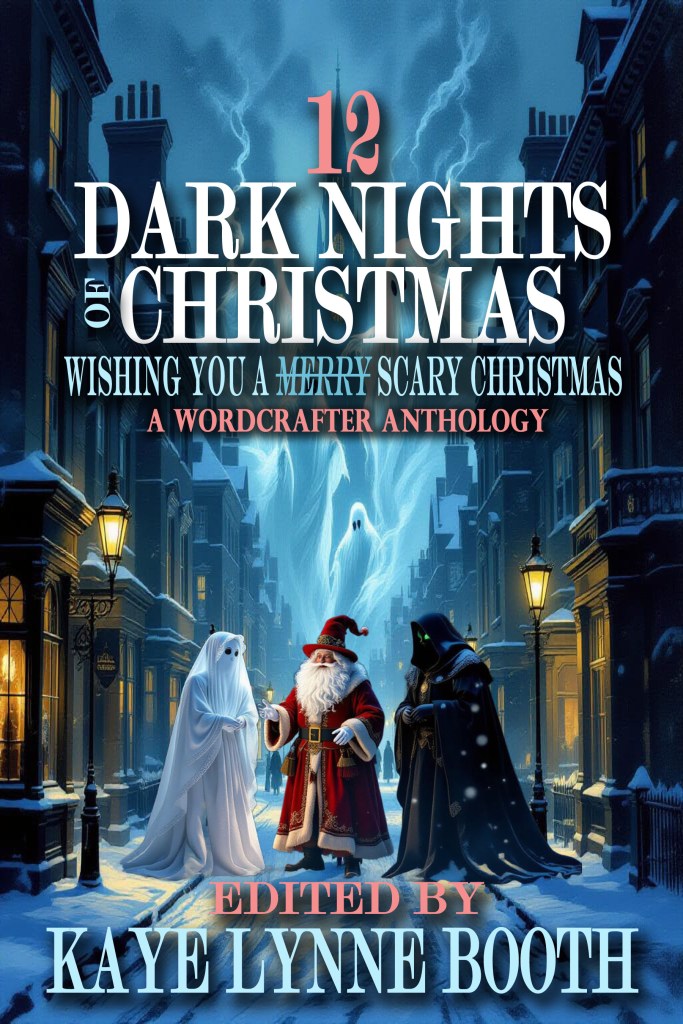
December: The 12 Dark Nights of Christmas anthology
‘Twas the night before Christmas
And all through the crypt
Not a body was stirring
Not a single bone twitched.
The corpses were nestled in eternal beds
While visions of the macabre lurched through their heads.
The Spirits were restless and flitting about
In anticipation of mayhem when the demons came out.
Twelve dark stories that prove Santa isn’t the only thing stirring on Christmas.
Nobody expects to lose a child but when it happens what can we do? In the sea of grief that seizes the soul how can we swim against the tide? But when that loss is compounded in each minute of every day, what do we do then?
Slings and Arrows is a story about the consequences of a moment, a moment, which separates a mother and daughter in ways impossible to imagine.
It charts their parallel lives, each suffering, one knowing, one not.
It is brutally honest; an account filled with bewilderment, guilt, anger and pain yet it also holds the key to hope. That whatever happens, the bonds of love can never be broken.
My Review: Slings & Arrows
Having lost a child of my own, it is not surprising that Slings & Arrows, by Julie Elizabeth Powell drew my interest. I have to say that I was not disappointed. The details of the loss of my son are very different from Ms. Powell’s loss of her daughter, but she offers up her story in a straight forward manner, with a brutal honesty which couldn’t help but touch my heart. Tears filled my eyes as I read Powell’s words time and again, as she is torn by conflicting emotions as she awaited her daughter’s body following a spirit which it appeared had departed.
Slings & Arrows is a brutally honest depiction of the stress, confusion, loss and grief which comes with watching a loved one slowly waste away long after their ‘life’ has ended. Kudos to Powell for baring her soul so openly in this tale of a loss that lingered on for years, consuming everything she has to give, and taking all that she has left. A tragic tale which hits close to home for me. I give Slings & Arrows five quills.
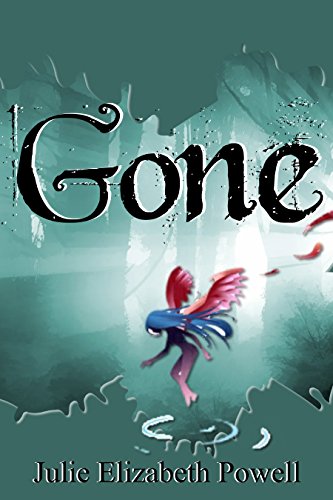
About Gone
Is Charley crazy, delusional or dead?
Follow her amazing, emotional journey and emerge into the battle with her nemesis – herself.
This inspirational fantasy will take you into realms otherwise unknown, turning your world upside down while you’ll be wondering what is real and what is not. It’s an adventure, a mystery and an imaginative fairytale for adults.
Gone, by Julie Elizabeth Powell, is a journey searching for answers to the unanswerable question of where we go when we are gone from here. Powell offers one possible scenario in a crazy world where her character, Charley, meets Jenny, the daughter that she lost and hopes she has the answers Charley has been looking for. To learn whether or not Jenny has those answers, you’ll have to tag along and visit this sometimes confusing, often surprising place and find out for yourself.
Having read Powell’s first book, Slings & Arrows, which is a heart-wrenching memoir where she bares her sole over the loss of her daughter and the time leading up to her death, when she was alive and suffering, it is difficult not to relate to the experiences in this fictional tale, as a way to find answers for Powell herself. Where we go when we’re gone from here is an age-old question, one we will all have to face, but Powell goes beyind that, in trying to answer “Why?” I hope Powell found at least some of the answers she was looking for in the writing. I think the answers are different for everyone, but it was fun to take the journey. I give Gone four quills.
My author guest today on “Chatting with the Pros” is someone who focuses on helping fellow authors to find and harness their positive inner energies and let them shine through, both in their writing and in their lives. She has written memoirs, poetry, written and/or compiled writing resource books, and she offers workshops focused on healing and transformation through memoir writing. Her works have won numerous awards, including Best Book Award, Feathered Quill Book Award, Mom’s Choice Award, Eric Hoffer Award, and Allbooks Review Editor’s Choice Award. Please help me welcome creative nonfiction author, Diana Raab, PhD.
Kaye: You have a PhD in Psychology with a research focus on the healing and transformative powers of memoir writing. Can you explain briefly what those powers are?
Diana: My research examined how pivotal experiences encouraged individuals to write memoirs as a way to transform, grow, and become empowered. I interviewed esteemed writers about the role writing their memoirs had in their lives. Poet Kim Stafford said that writing his memoir transformed him, in that it helped him come to a new understanding about his brother’s suicide. Another writer said that the writing experience relieved him from the pain of his past. And another writer who lost a son said that writing helped her look at life in a much larger context and also helped to keep her son “alive.” Writer Maxine Kingston said that she was transformed by penning her memoir because she was finally able to tell the stories from her past, which for a long time had been a secret. Thus, in most cases, the writers were liberated from the demons of their pasts.
Kaye: How can writing facilitate transformation and empowerment?
Diana: Transformation is a dramatic change in one’s physical or psychological well-being. It’s about becoming more aware of and facing our thoughts, feelings, and experiences. Writing down our feelings can lead to self-realization and a sense of empowerment, because we’re moving our feelings from inside of us and onto the page; and like therapy, it can help us work through our challenges. Writing can also be transformative because it helps us gain a better understanding of ourselves. With that understanding comes deeper reflection, and consequently a more profound sense of harmony.
Kaye: What is your biggest challenge of being a writer?
Diana: That’s a great question. In my earlier years, while raising children, my biggest challenge was carving out the time to write. These days, I would say that my biggest challenge as a writer is finding inspiration.
Kaye: What time of day do you prefer to do your writing? Why?
Diana: When I was younger, I used to love writing in the wee hours of the night, but now that I’m older, my preference is to write early in the morning. That’s when my mind and thought processes are most clear. I like writing just after my morning meditation, as sometimes thoughts emerge during this time that can move me into a highly creative and inspirational zone.
Kaye: Besides writing, what are your favorite things to do?
Diana: I love being with my adult children (ages 36, 34, and 30) and playing with my grandchildren; and I love hiking and going for beach walks. I meditate every day, and like most writers, I love to read. I also love cooking, especially soups and desserts. I love doing needlepoint, a craft I learned from my maternal grandmother, Regina, who committed suicide when I was ten. She was my caretaker, and this was a huge loss for me. Her story is the basis of my first memoir, Regina’s Closet: Finding My Grandmother’s Secret Journal.
Kaye: How does memoir writing differ from other writing forms? Don’t most forms of writing “unleash the true voice of the inner self”?
Diana: I don’t believe that most forms of writing “unleash the true voice of the inner self.” It might start out that way when writing fiction, but soon the imagination comes into play. Memoir writing is a first-person account chronicling a slice of life, not an entire life. It is a subjective recollection from one’s own perspective. Typically, there is a theme or thread running through a memoir. What sets a memoir apart from other forms of nonfiction is that it weaves the story as it happened, but also includes reflection. It’s much more than a journalistic telling. Compelling memoirs definitely unleash the true inner self.
Kaye: Tell me about your writing workshops. What can I expect to come away with if I take a workshop with you?
Diana: What you will come away with will depend on the nature of the particular workshop. Each one is different, depending on its focus. I usually revise my workshop format accordingly. For example, I’ve taught high-risk youth, bereaved adults, hospice workers, and those battling with drug addiction. My regular workshops are related to memoir writing, where participants of different writing levels come together to work on their personal stories.
I limit these groups to ten individuals so that I can offer individualized coaching. Participants learn by hearing my comments about their memoirs, and we also discuss published memoirs. They’re grateful to hear about all the tidbits of information I’ve gathered during my 40-year writing career. I stress the idea that writing is a process, and like any other process, patience is necessary. Those who take my workshops say that they leave them feeling very inspired to continue their memoir-writing journeys.
Kaye: What lessons do you want readers to walk away with from reading Writing for Bliss: A Seven-Step Plan for Telling Your Story and Transforming Your Life?
Diana: There are many lessons within those pages, as I weave my story into a how-to book on personal writing. I want readers to understand the transformative powers of memoir writing and be aware that writing is a journey. I stress the idea of truly enjoying that journey and not becoming focused on the destination. People have called Writing for Bliss “instructive, inspiring, healing, and a blueprint for writing for healing and transforming your life.”
Kaye: You put together a book project that was quite innovative with Writers and Their Notebooks. I thought it was a really cool idea, and apparently others did too, since it became a Best Books award finalist with USA Book News. In fact, I’d bet there is an abundance of valuable information for aspiring authors. What inspired you to compile an anthology of author essays about the value of an author’s notebook?
Diana: As I mention in the Preface, “As artists have sketchbooks, writers have notebooks.” My inspiration for creating this anthology originated from my own experience and the joy that journaling has brought into my own life. For more than five decades, journaling had helped ground and center me. My passion began with my mother giving me a Kahlil Gibran journal when I was ten to help me cope with my grandmother’s suicide.
This book is a celebration of well-published writers who use their notebooks to inspire, record, and document anything and everything that nurtures or sparks their creative energy. Many of the essays in the collection are confessional in nature. This year celebrates the book’s tenth anniversary. The project is even more meaningful for me now, as many of the writers in the anthology have passed away, such as Sue Grafton and Michael Steinberg.
Kaye: Another valuable anthology which you put together is Writers on the Edge, a collection of 22 authors being brutally honest about their own battles with addiction. Was it difficult to get so many authors to open up?
Diana: Great question. Addiction is defined as the obsession and compulsion to self-destruct. Author James Brown and I co-compiled this anthology because of our passion for the subject. We contacted writers who we thought would be interested in writing about their journaling practices. We were honored when Jerry Stahl agreed to write the foreword. A number of authors said that they didn’t know if they could write so intimately and honestly, but they did. Some had never written nonfiction before, so it was a huge challenge for them, but in the end, they felt a huge sense of satisfaction. As we said in the preface, “These battles are not fought alone, and perhaps these stories will also provide insight and hope to all those and their loved ones struggling with some form of addiction and its inevitable consequences.”
Kaye: You’ve written two memoirs yourself. Why did you choose to share with others your inner thoughts and feelings during a difficult time in your own life, with Healing with Words: A Writer’s Cancer Journey?
Diana: After my first cancer diagnosis in 2001, I decided, as a gift to myself, to enroll in graduate school for my MFA in writing. My two memoirs were a part of my creative thesis. In actuality, I had no intention of writing a memoir about my cancer journey. I was the type of person who believed that I got breast cancer, had a mastectomy and reconstruction, was healed, and that it was over and I’d be okay. I didn’t want my cancer diagnoses to define me.
During my recovery, I did a lot of journaling, but with no intention to publish a book on the subject. Five years later, to my surprise, I was diagnosed with multiple myeloma, an incurable form of bone marrow cancer. Supposedly, it’s not connected to breast cancer. I was devastated, but the silver lining was being told that I had smoldering myeloma and wouldn’t yet need treatment, just regular blood work.
My friends and colleagues encouraged me to write about my cancer journey because they thought it would help others. To make the book a little different and more universal, I decided to create a self-help memoir where I provided journaling opportunities for readers to share their own cancer journeys.
Kaye: You won the Mom’s choice award for your first memoir was Regina’s Closet: Finding My Grandmother’s Secret Journal. What kind of revelations does it contain?
Diana: During the writing process, I learned a lot about my grandmother. I began writing the book about the time of my first cancer diagnosis. I wanted to study my grandmother’s life to see if she’d committed suicide in 1964 because of cancer, but that wasn’t the case. I learned that at the time of her death, she was very depressed, and her doctor had given her a prescription for Valium, which she eventually overdosed on. By studying my grandmother’s life, I learned that she held on to the demons of her past, such as being orphaned during World War I and marrying an abusive man. All this inner turmoil eventually got to her, so she took her own life.
Kaye: Imagine a future where you no longer write. What would you do?
Diana: I don’t want to think about it. I love writing, whether it’s journaling; or writing poems, articles, letters, or blogs. It’s where I find my peace.
Kaye: What is next for Diana Raab? What can your readers and authors look forward to in the future?
Diana: Last year I turned 65 and felt that there was a huge shift in my vision. While I’ve always practiced mindfulness, I find that I’ve been living more in the moment. Also, in recent years, I’ve lost a number of loved ones, which is another reminder to enjoy the present. Thinking a little farther ahead, I hope to give more workshops and maybe create some short inspirational books. I’m currently working on my fifth book of poetry. I also have an unfinished novel that has been sitting in my drawer. Maybe one day I’ll be inspired to get back into it, or perhaps I’ll become inspired to write a children’s book for my grandchildren. Time will tell!
I want to extend my thanks to Diana Raab for joining us today and sharing with us. I have to agree with her philosophies, as I’ve experienced the healing powers of writing in my own life. I believe many of us have. If you’d like more information about Diana, her books, projects and events at her website: dianaraab.com.
You can catch the monthly segment “Chatting with the Pros” on the third Monday of every month in 2020, or you can be sure not to any of the great content on Writing to be Read by signing up by email or following on WordPress. Please share content you find interesting or useful.
Nonfiction is the stuff texts books are made of, the straight-out boring stuff that puts you to sleep, right? Not necessarily. Texts books don’t have to be boring. Nonfiction that is written creatively can capture the reader’s interest or immerse them into true life stories. From memoir, to self-help and how-to books, and yes, even text books can be highly entertaining.
True life circumstances and facts determine the story in nonfiction, yet nonfiction authors are faced with the same challenges as fiction authors to bring the characters and setting to life in the readers mind, or portray the information they wish to relate in a manner which readers can relate to. Both fiction and nonfiction authors strive to grab readers attention, now, in this digital age more so than ever before. But there are differences, as well.
To start off 2020, we’re going to delve into creative nonfiction in January. We have a pretty good sampling on the different forms that creative nonfiction might take. My author guest on “Chatting with the Pros” is bestselling author and memoirist, Diana Raab, who believes in the healing powers of writing. I will also be interviewing an author team, Mark Todd and Kym O’Connell Todd, who wrote Wild West Ghosts, one of the most informative and entertaining how-to books I’ve read. I will also be reviewing a true crime book, Missing: Murder Suspected, by Austin Stone, edited by his son Ed after his father’s passing, and a book on writing, On Being a Dictator, by Kevin J. Anderson and Martin Shoemaker. I do hope you will join us and help get Writing to be Read off to a good start for the year ahead.
For additional samplings of creative nonfiction see the following interviews and reviews:
Like this post? Let me know in the comments. You can be sure not to miss any of Writing to be Read’s great content by subscribe to e-mail or following on WordPress. If you found this content helpful or entertaining, please share.
I’m sorry to say that the obstacles and road blocks I mentioned in my April post have brought my memoir writing process to a screeching halt before it had truly begun, and thus, this bi-monthly blog series must come to a halt, as well, until I can find answers to the problems related to writing about real people and organizations which is necessary to telling my son Michael’s story, as well as my own. Losing Michael: Teen Suicide and a Mother’s Grief has been shelved, at least for a while due to legalities. This book project is based from my personal experience and is dear to my heart, and it great saddness that I make this decision, but I’m not ready to face the trials that forging ahead with it would require.
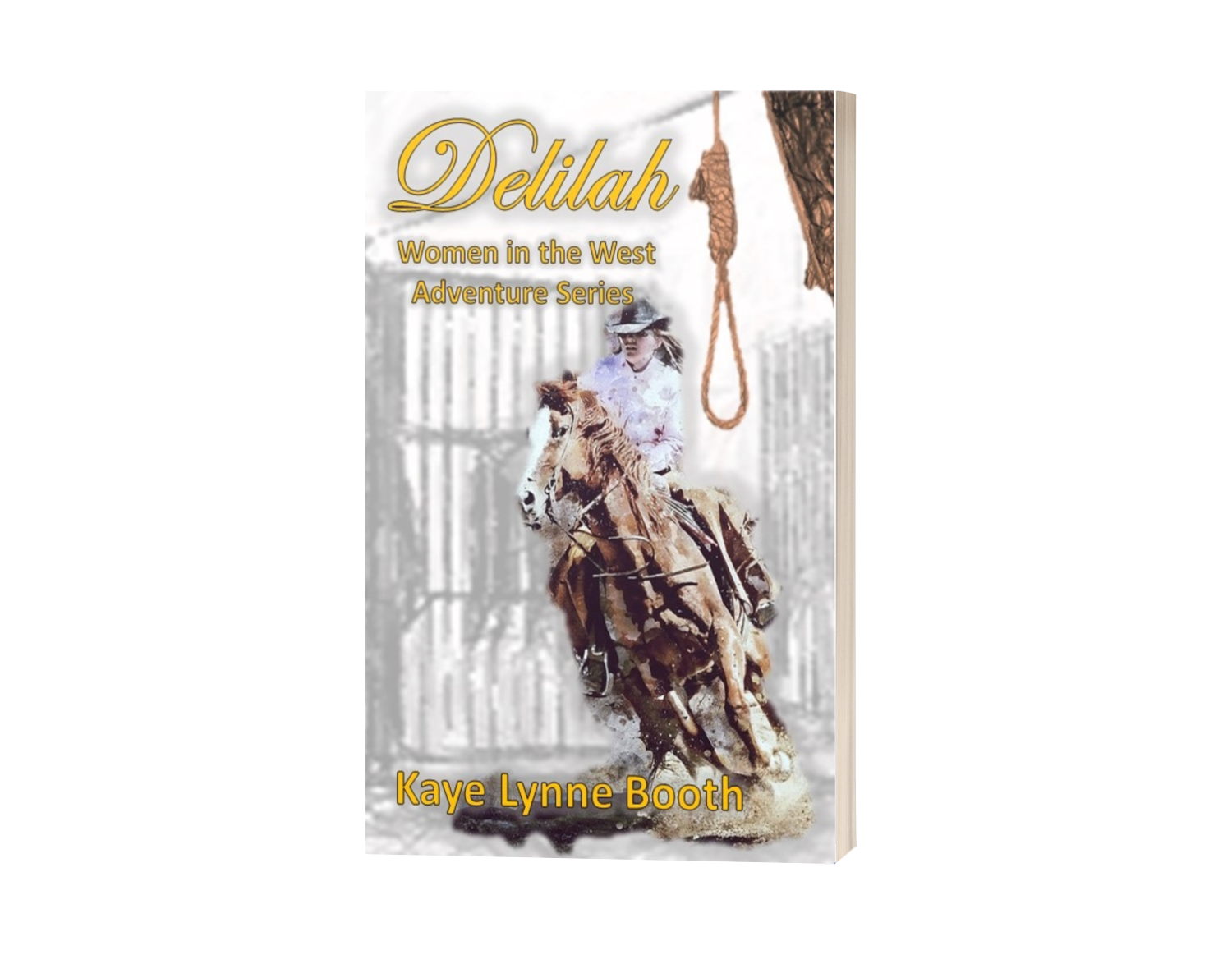
On the other hand, there are exciting things on the horizon. My efforts for the near future will turn to working on the issue of re-issuing Delilah, which Dusty Saddle Publishing has so graciously offered to do. Once this is completed, I plan to pick up where I left off on the drafting of the second book, Delilah: The Homecoming. I just got Delilah back on track in this story with considerable revisions and I’m a little sad to have to delay the completion of this book, but also confident that the story will be better for it.
I will be getting the WordCrafter website up and running and ready for launch. Get ready folks, because WordCrafter Writer & Author Services is coming soon. Services will include Editing and Copywriting services, online courses, and WordCrafter Press.
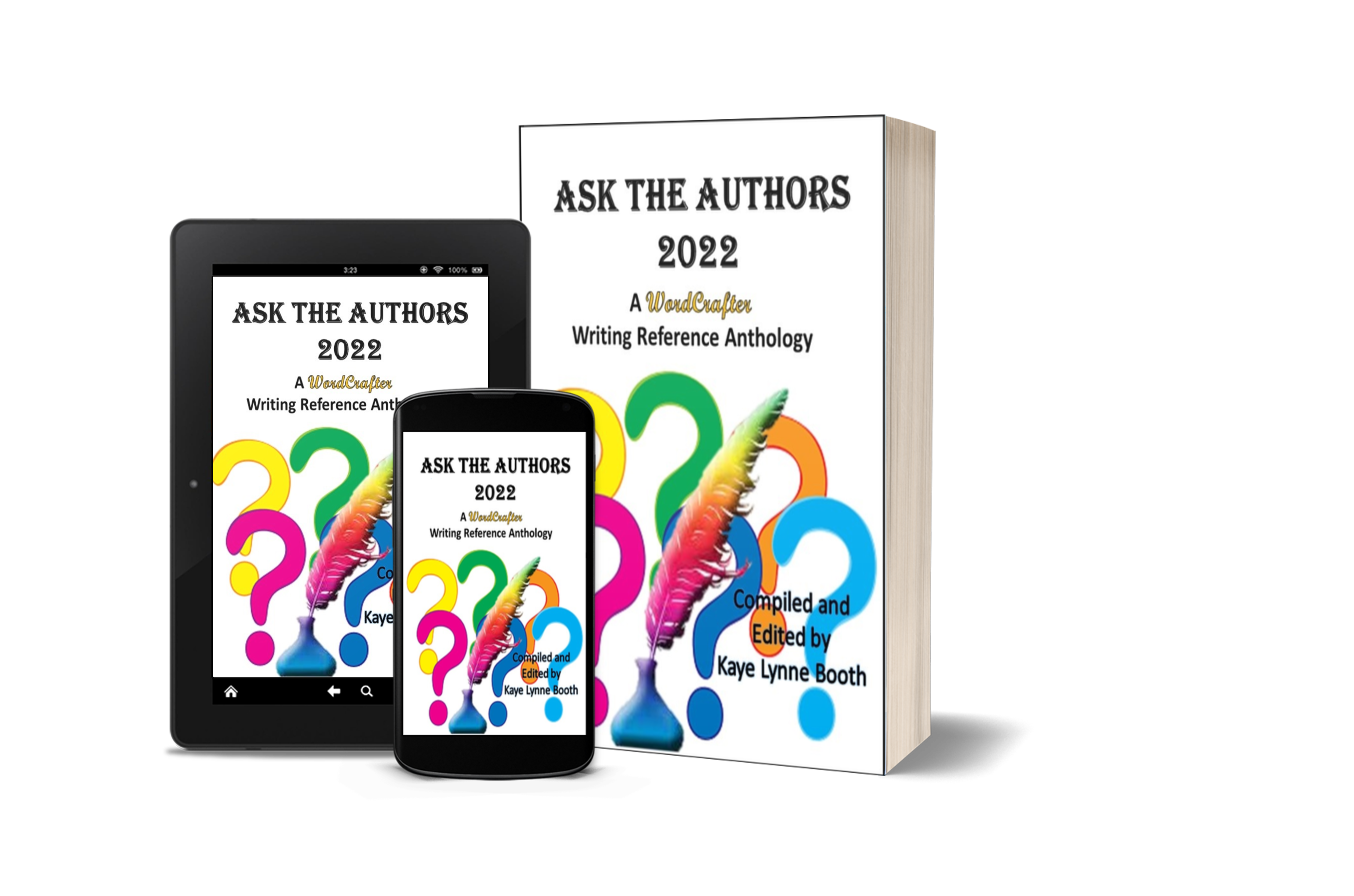
I’ll also be compiling and publishing the two great anthologies to be released by WordCrafter Press. The Ask the Authors anthology will feature the collaborative interviews from the 2018 “Ask the Authors” blog series right here on Writing to be Read. This book will be filled with writing tips and advice from authors who are out there doing it, a valuable writing reference for authors in all stages of the publishing journey.
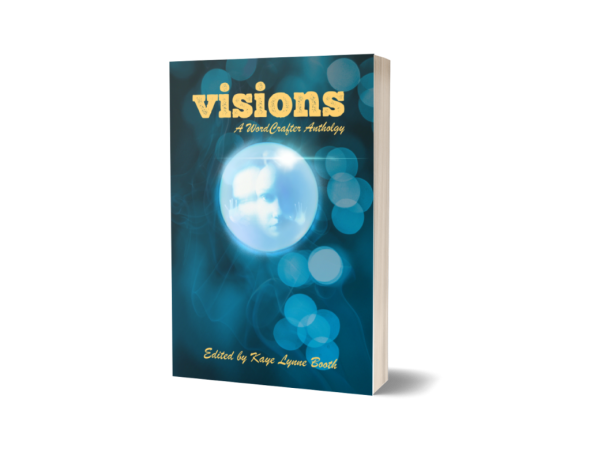
The other anthology, Whispers in the Dark, will be a short story collection harvested from the WordCrafter Paranormal Short Story Contest held at the beginning of 2019. It will feature several of the submissions from the contest, including the winning entry, “A Peaceful Life I’ve Never Had”, by Jeff Bowles. These anthologies are still in the preliminary stages, but I plan to have them both out by the end of the year. I have cover ideas for each one, but only Whispers has a final version at this time. I plan to release it in October.
To keep up on the latest with my writing endeavors and with Wordcrafter, sign up for my monthly newsletter in the pop-up. When you do, you’ll recieve a free e-copy of my paranormal mystery novella, Hidden Secrets.
“The Making of a Memoir” is a bi-monthly blog series which explores the stages of writing a memoir as I write the story of losing my nineteen year old son, Michael, to suicide, through his story and the tale of a life without him and the grief I experience every day, even after he’s been gone for a decade. Some progress has been made toward the actual writing of the book since the last segment. I made a final decision on the title above for the book, and work on the cover is in progress with Art Rosch at Starrts Creative. Although there is still a lot of material still to sort through and compile what I want to include, I managed to work through a considerable amount. The going is slow, as I knew it would be, due to the emotional nature of the material and the memories some of it awakens.
In the last segment, “Stage 1: Prewriting Tasks“, I said I expected this book to be the most difficult story I have ever attempted to write, and that has proven to be true. In fact, it has proven to be difficult in more ways than I had imagined. This segment was supposed to be titled “Stage 2: Selling the Story”, but alas, unexpected “Obstacles and Roadblocks” has become a more appropriate title. Over the past two months, I run into several and I’m still trying to find a way around, over or through one huge one in particular – legalities.
Memoir can and should be a work of creative nonfiction. It is a true story told creatively, so as to capture and hold the readers’ attention. What memoir is not, is a work of fiction, with fictitional characters and places. You are telling a true story, something that actually happened, something in which other real people played different roles, and to tell the story, their parts must be told as well, even if the tale doesn’t portray all of them in a positive light. A good memoir must be told with honesty, from the heart.
As I sorted through the plethora of material I have gathered and saved since my son’s death: his poetry, writings and artwork; my poetry and writings; and oh so many photos, I couldn’t help but think about the other people involved, directly or indirectly with the story of the events leading up to Mike’s death and also the events that came after, and I realized that there were more than a few, people associated with Mike, and law enforcement officers, who might not want this story to come out because of the manner in which they might be viewed for their parts in his death.
It normally wouldn’t be a problem at all. I’m writing the story of events as they happened to the best of my knowledge. Many facts surrounding Mike’s death were suspicious, and for a time I believed that Mike might have been murdered. Things didn’t add up, but the proof to back up what I know to be true was withheld from me by local law enforcement. I no longer entertain the idea that Mike’s death was anything other than suicide, without the proof that the events happened the way I claim they did, I could be open to liable in telling this story.
The individuals involved wouldn’t really be a problem. The obvious solution is to change the names. Even in a true story, real people can have fictitious names, without damaging author credibility. Authors do this all the time; you just state that some names have been changed and readers won’t feel cheated.
The law enforcement agency and certain individual agents present a bigger problem. Do I change the names of the law enforcement agents? Do I change the name of the area they represent? How much can be changed before a true story becomes a work of fiction? The proof I lack wouldn’t portray the local law in a positive way and they know it, so they aren’t likely to have a change of heart about sharing it with me for the book. They play major roles in the events leading up to Mike’s death, and the story really can’t be told without their inclusion.
Although this issue has presented a roadblock that appears it might be unsurpassable, I have a couple of ideas on how I might be able to get around it. I need to let it play out and see. If not, I’ll look for a way to go over, or under if I have to. This is a story that must be told, and I’m determined to tell it. By the next segment, in June, I should be moving forward once more. I’ll let you know how it gets resolved. I do hope you’ll join me then.
Join me in my writing journey through “The Making of a Memoir” the second Monday every other month on Writing to be Read: February, April, June, August, October and December. To be sure not to miss one segment, subscribe to email or follow on WordPress for notification of new content.
Our monthly theme for February on Writing to be Read was, you guessed it – nonfiction. So, what tipped you off? Was it the great interview I did with nature author Susan J. Tweit? Or maybe the nonfiction revues of How to become a Published AuthorandLetters of May? Or perhaps it was the “Chatting with the Pros” interview of nonfiction author Mark Shaw? Whatever it was that gave it away, I’m here to tell you that these few posts on nonfiction don’t even scratch the surface of what the genre of nonfiction encompasses.
There are many subgenres of nonfiction, just as there are many subgenres under each of the genres of fiction. When someone asks what type of book your fiction novel is, we are quick to catetgorize it as a paranormal mystery, a historical romance, or a science fiction thriller. For some reason, we don’t seem to think about nonfiction the same way we do fiction and when someone asks what type of book your memoir is, or your travel diary, or your self-help book, we tend to lump it in with all the rest in nonfiction. Why this is, I don’t know, but I find that it is the case, time and time again.
The fact is, not all nonfiction books are alike and there are many categories or subgenres that fall within the nonfiction realm. Mark Shaw writes biographies and creative nonfiction tales that are very different from the memoirs, illustrated travel books and nature guides of Susan J. Tweit. Other types of nonfiction that are hard to define are books like Mark Todd and Kym O’Connell Todd’s Wild West Ghosts, which chronicles their ghost hunting experiences and offers advice on how you can be a ghost hunter too. Or Hollywood Game Plan by Carole Kirshner, which is a how-to guide for anyone wanting to break into the screenwriting world. These books are all nonfiction, but they are all very different types of books.
According to wikipedia the genres of nonfiction are biographies, autobiographies, memoirs, commentaries, creative nonfiction, critiques, essays, owners manuals, journalism, personal narratives, reference books, self-help books, speeches, and text books. I would add to that spiritual texts, encyclopedias, documentaries, how-to books, cookbooks, diaries and anthologies such as the one found in Letters of May, which is a collection of writings and artwork illustrating the world of those afflicted with mental illness. I’m sure there are others, but as you can see the list is quite extensive.
Nonfiction books may or may not be aimed to entertain, but the primary purpose, no matter the type of nonfiction book, is to inform. This may account for the fact that my reviews of nonfiction books receive more views in general, than most of my fiction reviews. A fact that I found to be surprising when I uncovered it while looking over the data for this blog. My theory is that readers turn more quickly to books they may find useful than they do to those with entertainment as their sole purpose.
My reasons for interest in nonfiction and all it’s many forms stems from preparation for my journey to write my own memoir, telling the story of my son’s death and my life without him, His Name Was Michael. My bi-monthly blog series which will chronicle that writing process, “The Making of a Memoir“, came out with the first segment in February, too. It was a good month for it to come out, as it also fits in with the nonfiction theme. I hope you’ll join us again next month, when the theme will be science fiction and fantasy.
Be sure to join me next month when we will explore science fiction and fantasy, with guest author Kevin J. Anderson on “Chatting with the Pros” on March 18th, as well as a review of his Selected Stories: Science Fiction Volume 2, and Jordan Elizabeth’s Rogue Crystal.
Update: In Friday’s post I talked about the changes coming for Writing to be Read. One more change that I just recieved confirmation of, and I’m pleased to announce: Art Rosch will also be posting one movie review a month, on the forth Friday of the month, in “Art’s Visual Media Review”.
Like this post? Subscribe to Writing to be Read for e-mail notifications whenever new content is posted or follow WtbR on WordPress.
I’m starting this bi-monthly blog series, The Making of a Memoir, which will chronicle my journey as I write my memoir of my teenage son’s suicide and my life without him, breaking down the memoir process into stages. I am sharing thios process for several reasons. One, Michael’s story deserves to be told. It needs to be told. Two, telling my own story may act as a catharthis and help me to resolve my own unresolved issues surrounding Mike’s death. Three, commiting to bi-monthly accountability to you, my readers and fellow authors, forces me to create and meet deadlines, assuring that I make adequate progress on the book. It is too easy to make excuses and avoid the emotionally difficult tasks if I’m accountable only to myself. And four, I believe there are those of you out there who are interested in the methodology behind creating memoir.
Before I can begin writing the my memoir telling the story of my son’s death and the story of my own journey to find closure and my need to be sure that he will always be remembered, I must know what it is that I want to say, and have some idea of how I want to present it. After Michael’s death, I went through his writings and artwork, I went through every picture of him over and over and over. I listened to his music. And I cried and cried, and I thought I would never stop. It never has. At least not completely, but I did gain control over it by putting all his things away, to be dealt with at a later time. I knew I needed to tell his story then, but I wasn’t ready. Not then.
I actually made several false starts at writing his story at different times, I wrote poetry, some of it semi-epic, but the emotional wounds were still fresh. I was angry and overcome by grief, and I wanted by son back. I wasn’t able to portray what I was feeling with the depth of emotions I was experiencing. I had to set it all aside and heal some before I could undertake this immense task.
In addition, I wasn’t a skilled enough writer to undertake it at that point. I’ve since earned my M.F.A. in Creative Writing, published three books, and have short fiction and poetry featured in several publications and anthologies. Does that make me an expert now? No. But it has taken me down that path, and certainly I know more about writing books and my writing skills are much improved. I believe that I’m ready now to undertake the writing of my son’s story and my own.
There is no doubt in my mind that this book will be the most difficult book I could ever attempt to write. It is difficult because there is so much emotional investment in this book for me. I’ve collected and saved a mass of materials which may or may not end up in this memoir, but it first must be sorted and compiled. This is a difficult task because of the emotions attached to every piece of material I’ve collected and with the memories associated with each one. Michael has been gone from my life for a decade, but the compilation of these materials still must be taken slowly, a little at a time.
On the other hand, emotional investment in the author lends authenticity to the story and that, according to some, leads to best seller material that people want to read. If you go by that thinking, the more difficult the book is to write, the better it will be. You can let me know if I’m right after you’ve read it.
I thought I had the title. His Name Was Michael: How I lost my son to teen suicide. The title, “His Name Was Michael”, is perfect, for it reflects the feelings I had as time passed and others went on with their lives. Sometimes, I felt that everyone had forgotten about him except my husband and I. A title that would make people remember is a must, and I think it does that. But the subtitle, “How I lost my son to teen suicide”, although clearly and concisely telling the reader what the story is about, it doesn’t roll off my tongue smoothly when I say it aloud. I came up with the idea of replacing it with “No Happy Endings”, and although it states a truth about this story, the potential reader picking it up off the shelf or spotting it online, might pass it over because it sounds depressing and doesn’t really tell them what the book is about. At this point, I have to wonder if a subtitle is even necessary. Comments on Facebook reflect the idea that the title is strongest without any subtitle. So, I am rethinking the title and I’m open to suggestions or thoughts in the comments.
There is still much to do in addition to compiling material and deciding on a title, before I can begin the actual writing of the story, pre-writing tasks, if you will. There are still more materials to gather and research to be done. I know you may be wondering what there is to research. Don’t I know my own story? After all I lived it. But the fact is there is research to be done on every book. On this one, I need to know things like statistics on teen suicide, and I need resources for warning signs of suicide and other information on the subject. I may not use everything I dig up, but I will have it available if I decide that it has a place in this book. I believe it does but I haven’t worked out how I want to present it. There is so much that I want to say, but not all of it belongs. Finding my voice for this book will mean finding my true voice.
There are several people I need to interview, people who I haven’t seen since Michael died, people who have something valuable to contribute to his story. I must learn to control the emotional whirpool that surfaces when I anticipate these contacts, the memories connected, cause turmoil within me. But, I know his story must be told, and to tell it in the manner it deserves, and so, I must contain my emotions and silence the memories in order to what must be done. The very act of doing this very difficult task for the sake of his story will become a part of my own, for it is my story, as well.
There must be at least a vague outline, which is now begining to take shape in my head. I believe I know how I want to begin the story and the structure I need to use. The next step will be to get it down in print, so I have a clear direction in which I want the story to go which I can refer back to to ensure that I stay on track. Outlines are a valuable tool in giving any story direction and making sure it doesn’t veer off into left field and lose the storyline and the way I’ve chosen to structure this particular story demands that guidance.
I’m starting this blog series, The Making of a Memoir, which will break down the memoir process into stages, for two reasons. One, Michael’s story deserves to be told. It needs to be told. Two, telling my own story may act as a catharthis and help me to resolve my own unresolved issues surrounding Mike’s death. And three, commiting to bi-monthly accountability to you, my readers and fellow authors, forces me to create and meet deadlines, assuring that I make adequate progress on the book. It is too easy to make excuses and avoid the emotionally difficult tasks if I’m accountable only to myself.
Since I hope to get this memoir published traditionally, I will also need a book proposal, a query letter and somewhere around the first three to five chapters for that. We’ll cover that in the April segment The Making of a Memoir: Stage 2: Selling the story. I do hope you will join me on my journey.
Like this post? Subscribe to Writing to be Read for e-mail notifications whenever new content is posted or follow WtbR on WordPress.
My guest today is an author, nature lover and plant ecologist. Her books include memoirs, beautifully illustrated travel books, nature guides, and even children’s books, but they all have strong ties with nature. Her books reveal connections with nature and life that have not been pondered or may have been overlooked in our everyday lives. Her books have won the ForeWord Book of the Year, the Colorado Book Award, and she is a five time recipient of Colorado Author’s League Award. With a background in science and plant ecology, she expertly weaves her natural environment into her writings, illustrating how all things interact and connect. Let me introduce creative nonfiction author, Susan J. Tweit.
Kaye: You are a female author who champions the natural environment. Do you identify most as a feminist, a naturalist or an environmentalist?
Susan: All of the above. I grew up in a family of naturalists and scientists; restoring everyday nature is my way of leaving the world a better place. And I work in two fields where women are still second-class citizens in so many ways: science and writing. So am a feminist just be participating in those fields as a woman.
Kaye: On your website you claim that you taught yourself to write after you realized that you enjoyed the stories told by the data more than you did doing the research. How does one teach oneself to write?
Susan: I don’t know how other people teach themselves to write creatively, but for me, as a scientist trained to eschew personal opinions and emotions, and to be extremely parsimonious with descriptive adverbs and adjectives, I found my writing voice in reading the works of writers whose works I admire. I read Ann Zwinger and Terry Tempest Williams, Barry Lopez and Kim Stafford, Brenda Peterson and Linda Hogan, Leslie Marmon Silko and Denise Chávez, Robert Pyle and Gary Paul Nabhan, Sharman Apt Russell and Barbara Kingsolver, and so many others.
As I read, I thought about the mechanics of how each writer told their stories (whether fiction or essays), how they introduced subjects and characters, where they got personal and where they stepped back, how they described landscape and culture, how they used words and language… I tried out techniques and styles until I found my own voice, which has continued to evolve through twelve books and hundreds of essays, articles, and columns for newspapers and magazines.
Kaye: Connections are a common theme in many of your works. Can you talk a little about those?
Susan: As a plant ecologist, I am fascinated by the relationships and interrelationships that form community, whether the human community, or what I call “the community of the land,” the interwoven communities of species—from tiny microbes to gigantic redwood trees—that make life on Earth possible. Who loves who, who eats who, who sleeps with or pollinates who, who can’t stand who… All of those relationships weave the fabric of Life with a capital L. Without them we would not exist, and we have so much to learn about the connections that are vital to this planet. I just collaborated with science illustrator Samantha Peters on “Natural Partners,” a feature for WILDFLOWER Magazine on plants and the animals they rely on. It’s up on the internet here: https://www.wildflower.org/magazine/fauna/natural-partners (The print version took the cover of the magazine, and it’s really gorgeous!)
Kaye: Writing seems to be a way of life for you, and your love for nature is woven into almost everything you do. You have a background as a plant biologist and most of your books offer a perspective on nature and the environment, and you call your books love letters “to the earth and its living web of lives”. If you could convey one message to your readers, what would it be?
Susan: Get outside and get to know nature nearby. Learn even a handful of your neighbors in the world of plants and animals and you’ll never be bored. Nature is vital to our health and wellbeing—it’s the best antidote to stress I know of, the closest source of inspiration and renewal, and it doesn’t require a prescription or training. And it’s free!
Kaye: Besides writing and ecological restoration projects, what are your favorite things to do?
Susan: I’m an outdoors person, so I love taking long walks in the arroyo near my home, hiking with friends, and setting out on long road trips to see this amazing continent. At home, I tend a small garden of native wildflowers and other plants chosen to provide habitat for songbirds and pollinators, cook elaborate dinners for family and friends, and read. I’m an omnivorous reader, which leads into your next questions…
Kaye: You’ve written three memoirs about your life experiences. What makes an experience worthy to become a memoir?
Susan: Memoir is a way of distilling what our own lives and experiences have to offer others. What makes an experience worthy of memoir is partly whether we can find a way of telling the story that is compelling to others (that is, to a wider audience than our close friends and family!). It might be that we lived through a critical part of history, or our personal journey is exceptional in some way, or simply that we figure out how to relate our very ordinary story in a way that offers some universal wisdom about being human. Both of my published memoirs—Walking Nature Home; and Barren, Wild, and Worthless: Living in the Chihuahuan Desert—taught me about how to tell a story, how show the way we grow and change over time, and how to pick and choose telling detail. Each one presented different challenges, and the memoir I am working on now is challenging me in new ways. Telling my personal story may be my greatest learning experience as a writer!
Kaye: Would you tell us about your Write & Retreat Workshops?
Susan: They are an immersion in writing, in learning place and story, and in the inner work that is the source of our creativity. Each one includes hands-on writing and workshop time, as well as time to retreat and nurture our inner selves. Each one is set in some extraordinary place chosen to inspire us, with time spend exploring that place. I don’t have any W&R workshops planned this year, but next year I may offer one set near Yellowstone National Park, that place of wildness and wonders.
Kaye: You are a member of Story Circle Network, Women Writing the Westand Colorado Author’s League. How are these organizations beneficial to you as a writer?
Susan: I am also a member of Wyoming Writers. Belonging to at least one professional writing organization is critical to writing: they offer education, resources, and, most importantly. community. Writing is an inherently solitary activity: pulling words from deep within, honing them into stories, and then offering the work of our hearts to the world is perilous. Finding a community of fellow sufferers… uh, writers, is essential to maintaining our sanity, growing in the craft, and getting published.
Kaye: What is the one thing in your writing career that is the most unusual or unique thing you’ve done so far?
Susan: Besides leaving behind a paycheck, benefits, and job security to chase words and stories? Hmm… It’s hard to choose just one. Kayaking with sea turtles in the Sea of Cortez off Baja California? Learning about how to blow up dams to restore a river and its salmon run? Dancing with a Native American community to celebrate the return of those salmon? Watching a grizzly bear mom teach her twin cubs how to dig and eat spring-beauty bulbs in a meadow in Yellowstone National Park? Walking alone through some of the wildest country in the Lower 48 states, carrying all I needed on my back to listen to myself? Tending my husband and the love of my life through his death from brain cancer and then figuring out how to write how to survive loss? Seeing monarch butterflies return to a restored patch of urban nature? I’ve been fortunate to experience miracles and wonders all along the way.
Kaye: What are you working on now? What can readers expect in the future from Susan J. Tweit?
Susan: I’m working on The Climate Victory Garden, a book about how gardens can help grow The Green New Deal and slow climate change. It’s another chapter in my life-long quest to leave this world in better shape than I found it by restoring nature nearby and our connection to the green and living world.
Many thanks to Susan for sharing with us today. You can learn more about Susan J.Tweit and her work by visiting the following links:
Join us next Monday, when I’ll begin a new bi-monthly blog series, “His Name Was Michael”, which will chronicle the stages of writing a memoir as I work through them for my own memoir of the same name, telling the story of my son’s death and my own grief process. This first post will talk about the prewriting stage for memoir.
Like this post? Subscribe to Writing to be Read for e-mail notifications whenever new content is posted or follow WtbR on WordPress.









 Diana: I love being with my adult children (ages 36, 34, and 30) and playing with my grandchildren; and I love hiking and going for beach walks. I meditate every day, and like most writers, I love to read. I also love cooking, especially soups and desserts. I love doing needlepoint, a craft I learned from my maternal grandmother, Regina, who committed suicide when I was ten. She was my caretaker, and this was a huge loss for me. Her story is the basis of my first memoir, Regina’s Closet: Finding My Grandmother’s Secret Journal.

 Kaye: You put together a book project that was quite innovative with Writers and Their Notebooks. I thought it was a really cool idea, and apparently others did too, since it became a Best Books award finalist with USA Book News. In fact, I’d bet there is an abundance of valuable information for aspiring authors. What inspired you to compile an anthology of author essays about the value of an author’s notebook?
 Kaye: Another valuable anthology which you put together is Writers on the Edge, a collection of 22 authors being brutally honest about their own battles with addiction. Was it difficult to get so many authors to open up?
 Kaye: You’ve written two memoirs yourself. Why did you choose to share with others your inner thoughts and feelings during a difficult time in your own life, with Healing with Words: A Writer’s Cancer Journey?


 The other anthology, Whispers in the Dark, will be a short story collection harvested from the WordCrafter Paranormal Short Story Contest held at the beginning of 2019. It will feature several of the submissions from the contest, including the winning entry, “A Peaceful Life I’ve Never Had”, by Jeff Bowles. These anthologies are still in the preliminary stages, but I plan to have them both out by the end of the year. I have cover ideas for each one, but only Whispers has a final version at this time. I plan to release it in October.











The Making of a Memoir: Obstacles and Roadblocks
Posted: April 8, 2019 | Author: kayelynnebooth | Filed under: Commentary, Memoir, Nonfiction, The Making of a Memoir, Writing, Writing Process | Tags: Creative Nonfiction, Losing Michael: Teen Suicide and a Mother's Grief, Memoir, Nonfiction, The Making of a Memoir, Writing Process, Writing to be Read | Leave a commentLosing Michael: Teen Suicide and a Mother’s Grief
“The Making of a Memoir” is a bi-monthly blog series which explores the stages of writing a memoir as I write the story of losing my nineteen year old son, Michael, to suicide, through his story and the tale of a life without him and the grief I experience every day, even after he’s been gone for a decade. Some progress has been made toward the actual writing of the book since the last segment. I made a final decision on the title above for the book, and work on the cover is in progress with Art Rosch at Starrts Creative. Although there is still a lot of material still to sort through and compile what I want to include, I managed to work through a considerable amount. The going is slow, as I knew it would be, due to the emotional nature of the material and the memories some of it awakens.
In the last segment, “Stage 1: Prewriting Tasks“, I said I expected this book to be the most difficult story I have ever attempted to write, and that has proven to be true. In fact, it has proven to be difficult in more ways than I had imagined. This segment was supposed to be titled “Stage 2: Selling the Story”, but alas, unexpected “Obstacles and Roadblocks” has become a more appropriate title. Over the past two months, I run into several and I’m still trying to find a way around, over or through one huge one in particular – legalities.
Memoir can and should be a work of creative nonfiction. It is a true story told creatively, so as to capture and hold the readers’ attention. What memoir is not, is a work of fiction, with fictitional characters and places. You are telling a true story, something that actually happened, something in which other real people played different roles, and to tell the story, their parts must be told as well, even if the tale doesn’t portray all of them in a positive light. A good memoir must be told with honesty, from the heart.
As I sorted through the plethora of material I have gathered and saved since my son’s death: his poetry, writings and artwork; my poetry and writings; and oh so many photos, I couldn’t help but think about the other people involved, directly or indirectly with the story of the events leading up to Mike’s death and also the events that came after, and I realized that there were more than a few, people associated with Mike, and law enforcement officers, who might not want this story to come out because of the manner in which they might be viewed for their parts in his death.
It normally wouldn’t be a problem at all. I’m writing the story of events as they happened to the best of my knowledge. Many facts surrounding Mike’s death were suspicious, and for a time I believed that Mike might have been murdered. Things didn’t add up, but the proof to back up what I know to be true was withheld from me by local law enforcement. I no longer entertain the idea that Mike’s death was anything other than suicide, without the proof that the events happened the way I claim they did, I could be open to liable in telling this story.
The individuals involved wouldn’t really be a problem. The obvious solution is to change the names. Even in a true story, real people can have fictitious names, without damaging author credibility. Authors do this all the time; you just state that some names have been changed and readers won’t feel cheated.
The law enforcement agency and certain individual agents present a bigger problem. Do I change the names of the law enforcement agents? Do I change the name of the area they represent? How much can be changed before a true story becomes a work of fiction? The proof I lack wouldn’t portray the local law in a positive way and they know it, so they aren’t likely to have a change of heart about sharing it with me for the book. They play major roles in the events leading up to Mike’s death, and the story really can’t be told without their inclusion.
Although this issue has presented a roadblock that appears it might be unsurpassable, I have a couple of ideas on how I might be able to get around it. I need to let it play out and see. If not, I’ll look for a way to go over, or under if I have to. This is a story that must be told, and I’m determined to tell it. By the next segment, in June, I should be moving forward once more. I’ll let you know how it gets resolved. I do hope you’ll join me then.
Join me in my writing journey through “The Making of a Memoir” the second Monday every other month on Writing to be Read: February, April, June, August, October and December. To be sure not to miss one segment, subscribe to email or follow on WordPress for notification of new content.
Share this: