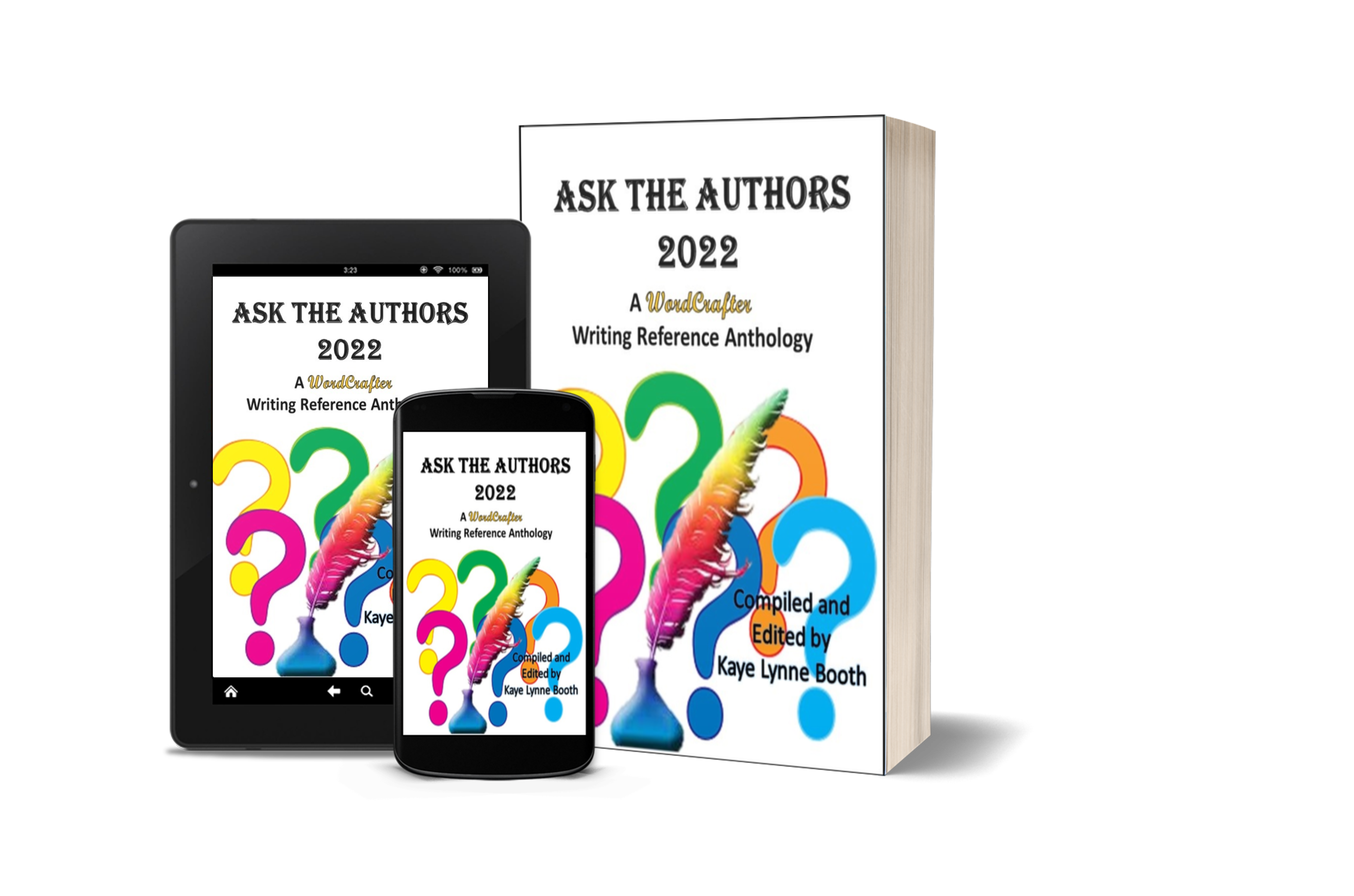
Interview with fantasy author Laurel McHargue
Posted: March 4, 2019 Filed under: Books, Dark Fantasy, Fairy Tales, Fantasy, Fiction, Interview, Writing | Tags: Adult Fairytales, Author Interview, Author Profile, Fantasy, Laurel McHargue, Writing to be Read 3 Comments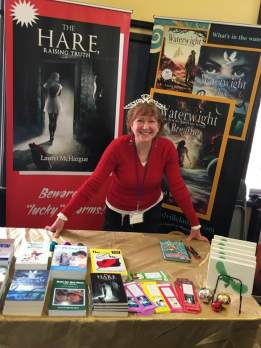
I’m talking today with fantasy author Laurel McHargue, a woman with a lot of energy. She’s written eight books including her Waterwight fantasy series and an adult fairytale, The Hare, Raising Truth, she hosts her own podcast, Alligator Preserves, is a former teacher and active community member, networks and promotes her works online, and finds time attend writing events for face to face interactions with her fans and potential new readers, as well as other authors. Even through email the positive energy radiates from this author. I could give you a lengthy fanfare on how impressed I am with this lady, but I think it’s better to let you see for yourselves. So, without further ado, please welcome Laurel Mchargue.
Kaye: Would you talk about your author’s journey? How did you come to come to be a writer?
Laurel: When I was quite young, I learned I could get attention by telling stories. As the fourth of five girls, I was low on the proverbial totem pole when it came to feeling important, so I had to be creative. I think my wild dreams helped, though eventually, my parents would roll their eyes when I’d come down in the morning with an “unbelievable” dream I’d just have to share. Who knew a dream would launch my first fantasy series? I didn’t then, but hey, I was just a kid!
Fast forward through a lifetime of unique experiences that people were curious about—I was frequently told, “You should really write about that!”—and I finally made the decision to make writing my career. I always did well in classes that required writing, and there were teachers along the way who encouraged me greatly.
I think I always knew I’d write stories someday, but until I made the commitment, it was always a “someday” kind of dream.
Kaye: What can you tell me about your YA fantasy series, Waterwight, and specifically about your Waterwight Breathe which will be released on March 15th?
Laurel: Waterwight started with a dream in which I was running away from bad guys through a dilapidated town, and I came up against a large body of water. The only way across it was to fly, and so I flew. Halfway across, however, I doubted my ability to make it to the other side and started to fall. A flying frog appeared and said, “Grab hold!” and I grasped his leg. He got me to the other side and then died in my arms. The dream had other elements I was able to use in my story as well. Anyway, I shared the dream with my author friend Carol Bellhouse (because I wasn’t living at home anymore!) and she told me I needed to write a story around it.
At the time, I’d never written fantasy, and the thought of turning a dream into a story thrilled and terrified me! Over the course of a year my story unfolded chapter by chapter, and by the time I got to the end, I wasn’t ready to leave my characters. I knew there was more for them to do, and there were questions I needed to answer. So, Waterwight Flux answers questions, develops characters, and sets up more challenges for Celeste, the orphaned protagonist.
I chose to write Waterwight Breathe, the final book, in first person present tense perspective after reading The Hunger Games. I love the immediacy of the thoughts and actions, and having the last book narrated by the protagonist seemed like the perfect way to end the series. I know it’s unconventional to have different points of view in the same series, but my life decisions have frequently been unconventional, and I have no regrets!
 Waterwight Breathe is available on March 15th, and it might be my favorite work yet. I couldn’t wait to get to the ending, the only part of the book I actually planned!
Kaye: You received three CIPA EVVY awards for the first book in the series. That’s quite an accomplishment. What is it about this book that makes it EVVY Award worthy?
Laurel: The CIPA EVVY awards are highly competitive, and each book is evaluated with a rubric—not against other submissions. The judges look at everything from cover design to editing to plot and character development. Waterwight is a fantasy adventure with mythical and mystical elements and a female protagonist; it received praise from Kirkus Reviews and many readers. I’d like to think those readers and the EVVY Awards judges felt compelled to keep reading at the end of each chapter. I had fun ending most of my chapters with cliffhangers!
The first book is also divided into three parts, so readers get to see what’s happening from different perspectives in each part. As a bonus, and because I’m a former English teacher, I added a synonym glossary and questions for discussion in the back of each book in the series. I don’t dumb down my prose for YA readers.
I used 99designs.com for my cover design and couldn’t be happier! The same artist created my covers for all three books in the series. Also, I paid a professional proofreader to ensure there weren’t any annoying typos or misspellings.
Kaye: Your novel Miss? is based on your own experience as a first-year teacher and earned the IndieReader Approved Award. Tell me about this book.
Laurel: I’m incredibly fortunate to have friends who are authors too. In 2012, one of those friends, Stephanie Spong, challenged me to do NaNoWriMo with her. I had never heard of such a beast! Well, being the competitive individual I’ve been told I am, I looked into it, and after thinking the 30-day personal challenge was ludicrous, I signed up on October 31st!
This was about six years after my first year of teaching 7th grade English in a doomed middle school. As a resigned Army Major, I honestly thought teaching 7th grade Language Arts would be a breeze. Oh…Em…Gee! I was very wrong.
Because I couldn’t believe what I was experiencing each day, at the end of the day I’d create a bullet-point list of everything that happened. I walked into NaNoWriMo with a year’s worth of those bullet points and had all the material I needed to write my first novel.
I remember telling my students, “Someday, I’m going to write a book about you all!” I said it as a humorous threat, and every class would be filled with hands going up and exclamations of, “Oh, Miss! Can I be in it?”
Although I couldn’t put all 130 students in “Miss?”, I meshed together many of them and included actual events from that year. I say it’s “loosely fictionalized” because of that, and because I added some romance and a scary situation that didn’t actually happen, but could have.
Kaye: Could you talk about your adult fairytale, The Hare, Raising Truth?
Laurel: The same friend who challenged me to NaNoWriMo challenged me to a 3-Day Novel Writing Contest! Stephanie Spong discovered the contest and really wanted to do it, so what choice did I have? (smiley face).
I sent my husband away for Labor Day Weekend (official contest dates), stocked my house with food and beverages, and set up little workout stations around the house. Stephanie came to my house ready to write for 72 hours and we agreed on rules: She could have the dining room, I had the “Red room” (that may have influenced my writing!), and no talking unless we happened to bump into one another in the kitchen.
We were very good girls!
As I enjoy challenging myself with different genres (and contests with crazy time limits), I decided to try something completely different for this contest. “I’m going to write it in 2nd person perspective,” I told Stephanie, and she warned me about the difficulty. Bonus, I thought. I also thought I’d write something light and funny.
Something happened, however, when I heard Rod Serling’s voice from The Twilight Zone in my head (in the Red room). My story turned darkly comedic quite fast, and there was nothing I could do about it . . . I had to see where it would take me.
I completed The Hare, Raising Truth—a Grimm’s Fairy Tale/Twilight Zone mashup—in about 38 hours. It’s novella length, and it was an absolute blast to write. My husband read it when he returned from his banishment and said it’s the best thing I’ve written so far, and I’ve had many people ask, “How did you get into the head of a horny teenage boy so well?”
Well…it wasn’t that difficult!
Kaye: You have a podcast called Alligator Preserves. What is that about?
Laurel: I started my podcast Alligator Preserves—which is about storytelling and the human condition—for several reasons. I wanted to be able to narrate my own books, so my husband set me up with the equipment I’d need to do that (even after I banished him that Labor Day weekend!). Also, friends had suggested that many of my blog posts should be recorded, since blog posts tend to get buried and lost once they’re posted. I wanted to be able to “tell” stories as well as write them.
When I started recording, I realized I had a great set-up for interviewing other people who’ve “done things” too, so I started asking racers and Reiki practitioners and authors and challenge seekers if they’d like to share their stories. The response was overwhelming, and now I have a hard time figuring out how to fit them all into my own schedule while still having time to do my writing.
Recently, I’ve gone to a pay-for-service model for anyone with a book or product they’d like to promote. Creating a podcast with another person is a lot of work. I value the time I spend reading and researching (prior to the interview) and editing and posting to social media (post recording). I provide all the links to the audio and video I create to my interviewee for use on their social media as well. For authors, it’s another plank to add to their author platform!
Kaye: What is the biggest challenge of writing fantasy?
Laurel: I can visualize scenes in my head so clearly, and most of them are fast-paced. The challenge is in slowing down my writing to help readers see what I’m seeing. Also, sometimes my writing is dream-like, and I have to find ways to convey that not-quite-real feeling.
That’s how multiple drafts help. I may blast through several chapters, totally believing that I’m conveying what my mind is seeing, and then I’ll have someone read them and they’ll say, “Huh? What just happened here? I don’t get it”!
My challenge is usually in adding more to a scene rather than deleting. There’s always more an author can do to make their writing sing more clearly!
Kaye: What’s the most fun part of writing for you?
Laurel: I think many authors might say that writing “The End” upon completing a project is the most fun, and I won’t lie—a happy dance always follows—but really, the fun is in the little surprises that happen along the way. It’s the unexpected character that pops into my head while I’m walking the dog or the funny thing a character will say. I’m more of a “pantser” than a “planner,” so I’m surprised all the time!
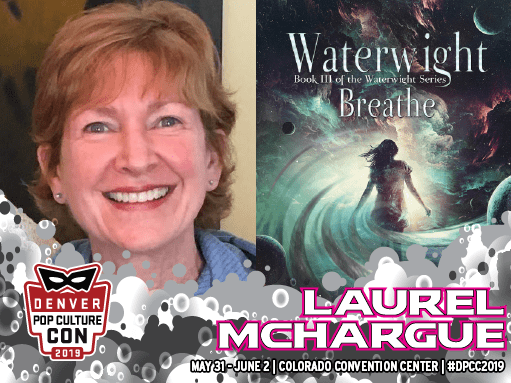
Sharing my work and having a fan say, “Wow! I loved that!” is another obvious fun part, but that’s after the writing is published. I brought my work to the 2018 Denver Comic Con and was blown away by the interaction I experienced with readers. I’ll attend the 2019 Denver Pop Culture Con (new name) this year with my completed trilogy and a new graphic novel! Now, that will be fun!
Kaye: Fantasy isn’t the only genre that you write in, and you hope to explore as many genres as possible throughout your writing career. What is your favorite genre to date?
Laurel: I’m horrible when it comes to “what’s your favorite” questions, but I’d have to say that I’m really enjoying short stories right now. I’ve entered several “flash fiction” contests with very short time limits, and being able to complete a project in a week or less exhilarates me!
I’m putting together a short story collection now. I’ve promised my Patreon patrons a new short story every month (which I narrate on my podcast Alligator Preserves) and when I’ve created enough, I’ll publish them and acknowledge my partons.
That said, many of my fans tell me they love my nonfiction blog posts. Once Waterwight Breathe is launched, my next big project will be a nonfiction piece based on my dad’s WWII letters. I hope to have a draft completed by the end of 2019!
Kaye: Where does your inspiration come from?
As Neil Gaiman said when asked where he got his ideas, “I make them up . . . out of my head.” (http://www.neilgaiman.com/Cool_Stuff/Essays/Essays_By_Neil/Where_do_you_get_your_ideas%253F). But how does inspiration get into my head? It gets there from every sensory experience throughout my days and from the Technicolor dreams I’ve had since I was a child. Someone said dreams are your brain’s way of dealing with all the things bombarding your senses during the day, and when I remember my dreams, I can often link them to something that has happened, or something that’s been “on my mind.”
Real people and creatures inspire my characters as much as imaginary ones (and who says the bizarre creatures in my dreams aren’t “real”?). Old Man Massive, the mountain spirit in my Waterwight trilogy, was inspired by an outcropping of stone on Mt. Massive that looks like an old, bearded man. Names and superpowers were inspired by real people I’ve known or met while writing the series. Zoya, my tragic octopus, was inspired by a paddleboarding experience on Twin Lakes, as was Noor, my fire-breathing dragonfly. The whole series started with a crazy dream I shared with a friend. I see and find inspiration all around me.
People have asked me where I get my imagination from, and all I can say is that it must be a gift from the universe! It’s certainly not a “thing” you can buy, and I’m not even sure it’s a “thing” you can learn. I consider myself quite fortunate that I was born with an imaginative brain.
 Kaye: What do you do when you’re not writing?
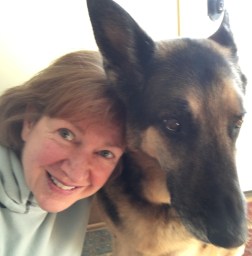
Laurel: When I’m not writing, I’m thinking about writing or I’m marketing my writing (sure wish I could clone myself for that task) or I’m reading or I’m recording a podcast episode or I’m cooking a yummy dinner or I’m brushing a pillow’s worth of hair from my German Shepherd or I’m cleaning out my sock drawer (because, where do all those socks come from?) or I’m swimming (several mornings per week, and not very fast) or I’m chatting with my friends or with one of my four sisters or I’m worrying about my sons (because I’m a mother) or I’m wondering how the day has passed so quickly. And other things, too.
Kaye: Hunting for Red Meat is a collection of memoir-style essays based on your own adventures hunting elk. When did you get the idea to make them a published collection?
Laurel: Several friends have told me how much they enjoy my blog posts, and one of them, Erin Sue Grantham (who also hunts), suggested I put them into a book. When I looked at putting them all in a book, I was overwhelmed by how many stories I had, and realized a book containing them all would be too big. So I thought about segregating them into topic areas.
After three years of hunting (and never filling a tag), I had plenty of hunting blog posts, so I decided to start there. Our oldest son, Nick, suggested it would be a “blook” a blog book, and I had fun coming up with the title.
I really thought I’d have a lot more sales by now with a title starting with “Hunt for Red…,” but alas, no. I honestly think many readers would enjoy it as it’s far more of an appreciation of the majesty of the wild outdoors than it is about hunting. I share my awe and my suffering, my adrenaline and my poetic moments.
My next “Blook” will probably be about our camping adventures.
Kaye: You have also published two books on Haiku. Do you have a special love for that poetry form? What is it that draws you to it?
Laurel: I love Haiku because—like a short story—they finish quickly. You have only seventeen syllables to play with, and it’s like completing a puzzle. Five-seven-five. That’s it.
Teaching grades 7-12 also gave me an appreciation for Haiku. When the word “poetry” comes from a teacher’s mouth, it’s generally followed by groans. Once a student learns how to count out syllables, though, and fit them into a “puzzle,” or a “math challenge,” for those more inclined toward that side of the brain, poetry suddenly becomes fun.
I was always amazed by the final products my students would create, boys as well as girls, and what fun it was to watch them tap on desktops or count on fingers while figuring out the syllabic pattern.
Haikus Can Amuse: 366 Haiku Starters “happened” after I dropped my cell phone into the ocean. Cell phones don’t like salt water. Anyway, I had a few weeks to kill before getting a new phone (I was away on vacation when it happened), and it was Leap Year, so I figured, why not come up with 366 first lines! I put that together as a gift journal for people who like filling in blanks and journaling just a little bit.
Hai CLASS ku is a spinoff of my cell-phone-debacle book, and it’s designed as a classroom workbook with a semester’s worth of haiku first lines (90) and space to draw a sketch and write a bit about inspiration. It’s also a great tool for substitute teachers.
Kaye: Which author or poet, dead or alive, would you love to have lunch with? Why?
Laurel: Dead? Steinbeck. Why? Because I love his writing. Alive? Margaret Atwood. Why? Because I love her writing. So many tremendous authors, so, so, so little life to experience them all.
I want to thank Laurel for joining me and sharing a little about experiences and her work. You can learn more about both at the links below.
SoundCloud (Alligator Preserves podcast): https://soundcloud.com/user-564361489
iTunes link: https://itunes.apple.com/us/podcast/alligator-preserves/id1337322865?mt=2
Stitcher permanent show link: http://www.stitcher.com/s?fid=165314&refid=stpr
(this link is optimized for mobile and Twitter posts)
Amazon Author page: https://www.amazon.com/Laurel-McHargue/e/B00INB9OO6
Blog link: http://leadvillelaurel.com/
Facebook: https://www.facebook.com/LeadvilleLaurel
Twitter: https://twitter.com/LeadvilleLaurel
Instagram: https://www.instagram.com/leadvillelaurel/
LinkedIn: Laurel (Bernier) McHargue
Like this post? Subscribe to Writing to be Read for e-mail notifications whenever new content is posted or follow WtbR on WordPress.
Share this:

“Fanya in the Underworld”: A unique Y.A. fantasy adventure
Posted: January 11, 2019 Filed under: Book Review, Books, Fantasy, Fiction, Young Adult | Tags: Aaron Siddall, Book Review, Fantasy, Fanya in the Underworld, Jordan Elizabeth, Writing to be Read, Young Adult Fiction 3 Comments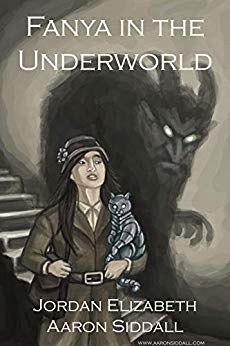
Fanya in the Underworld, by Jordan Elizabeth, is a delightful futuristic steampunkish adventure with spirits instead of steam. Filled with unusual creatures and mechanical devices from beyond the depths of imagination, this story is filled with surprises. Illustrations by Aaron Siddall help bring Elizabeth’s fascinating mechanisms to life, creating a unique journey into the imagination.
Fanya lives in an Alaska with spirits and unusual mechanical companions and servants all around her. She never gives either much thought until her father dies and the Council allows her inheritance to go to her step-mother, leaving she and her sister, Luetkea, to live in poverty. Fanya fights to get back what is rightfully hers and finds that there are things going on in the world around her of which she is unaware, which go beyond the Council to a mytsterious man named Finley. The deeper she digs into the situation, the more she learns about who she really is, and the harder Finley pushes to stop her from learning the truth. When Finley abducts her sister, Fanya will stop at nothing to get her back and take her rightful place in the scheme of things.
Gripping from the first pages, Fanya in the Underworld is a hero’s journey about growing up and discovery. Aimed at Y.A. readers, it’s entertaining for all ages. I give it five quills.

Kaye Lynne Booth does honest book reviews on Writing to be Read in exchange for ARCs. Have a book you’d like reviewed? Contact Kaye at kayebooth(at)yahoo(dot)com.
Share this:

“Time to Live”: A YA Mystical Fantasy
Posted: September 28, 2018 Filed under: Book Review, Books, Fantasy, Fiction, Speculative Fiction, Young Adult | Tags: Fantasy, Jordan Elizabeth, Magic, Time to Live, YA, Young Adult, Young Adult Fiction Leave a comment
Time to Live by Jordan Elizabeth was released yesterday. I had the privelage of a review copy and found it to be a delightful story of magic and mayhem. I was able to fall into this young adult novel and kept the pages turning.
Endowed with powers she’s not supposed to have yet, Banon seems to find trouble and someone to rescue wherever she goes. Then, she disses the wrong guy and re-ignites the kindling for an all out clan war that’s gone on for so long, no one remembers how it really started, throwing her in the path of her true soul mate, awakening memories within them both, and bringing understanding as to why they’d never felt as if they belonged.
I question why this book is titled as such, but I think the cover is killer. I enjoyed this tale to the utmost and give Time to Live five quills.

Kaye Lynne Booth does honest book reviews on Writing to be Read in exchange for ARCs. Have a book you’d like reviewed? Contact Kaye at kayebooth(at)yahoo(dot)com.
Share this:

Interview with Multi-Genre Author R.A. Winter
Posted: September 17, 2018 Filed under: Author Profile, Book Covers, Books, Contemporary Romance, Fantasy, Fiction, Interview, Paranormal, romance, Speculative Fiction, Western, Writing | Tags: Author Interview, Contemporary Romance, Mystic, Native American, Paranormal, Paranormal Romance, R.A. Winter, Spirit Keys series, Twisted, Western 2 Comments
I recently made the acquaintance of the energetic, sassy author, R.A. Winter. She writes in several genres, including fantasy, magical realism, dark fantasy, , time travel romance, contemporary Native American romance, and paranormal Native American western. And it seems she never rests when it comes to writing. Please help me to welcome R.A. Winter to Writing to be Read.
Kaye: Hello and welcome. Would you start by sharing the story of your own publishing journey?
R.A.: I started out writing genealogy nonfiction books under my married name. I love research and old libraries! I also love reading romances. With so many ideas flirting around my head, I thought I’d give creative writing a go.
Kaye: Is there anything unique or unusual about your writing process?
R.A.: I write the raunchiest first draft, the humor is way over the top. Then I cut it down, and my crit circle cuts it down further. My editor slices more. They say that a bit of humor goes a long way.
Kaye: You have sites on both WordPress and Wix. Can you give us the advantages and disadvantages of each? Which site do you prefer? Why?
R.A.: Wix is easier to deal with, super simple to navigate and change. WordPress is a bit of a pickle to deal with, and every time I change something, I mess up the page. I do prefer WordPress because I can easily share review and pages on a whim. Wix doesn’t give you that option.
Kaye: You’re on the review team at The Naked Reviewers, where authors can submit a book and request an honest review. Would you like to tell us a little about that site and what the review process is?
R.A.: We have a group of published author on Scribophile.com who formed the group. Right now, I think there is twelve of us. When someone submits a book, we all read the first chapter, the ‘look inside’ feature on Amazon. Then we rate the writing, the blurb, and the cover. If two of us agree, we review the book. Each Wednesday, two of us leave our review as a feature, if anyone else read it, they leave their thoughts in the ‘comment’ section. It does mean that most books that we review get a 4.0 or higher rating, usually. We wanted to show off the best books.
Kaye: You had bad experience with Amazon regarding reviews. This is something we’re hearing from many authors, although complaints vary. Many reviewers, including myself, have had book reviews pulled by Amazon, with the claim that their terms of use were violated because of an existing relationship which would bias our opinions. I even heard of an reviewer whose reviews were pulled because Amazon saw that they were Facebook friends, which they claimed indicated a prior relationship. (This doesn’t make sense to me. Many authors who I have done reviews for have become virtual online friends because of the review, not the other way around.) Your experience was a bit different because it wasn’t books that you were reviewing. Would you like to tell us a little about your experience?
R.A.: I ordered products from Amazon.com. A coffee grinder, a milk frother, and a small coffee taper, they just happened to be from the same company in China. Now, I review every product I receive, but when I went to upload my reviews, Amazon wouldn’t allow it. After contacting them, they said that I had a ‘relationship’ with the company in China and that I’d violated their terms. Apparently, I ordered too many things from them. I just don’t understand. They ask you to review, you review… then they’re like… you review too much! They banned me for LIFE for writing any reviews.
My point to them was- IF I was screwing reviews, wouldn’t my books have like 300 hundred reviews instead of each of them having less then 10? I mean seriously. THAT’S what would have benefited me!
Kaye: What is one thing that your readers would never guess about you?
R.A.: I have five children… all boys. I’ve lived in 5 different countries too. I don’t know which one was harder to live through. And all my boys look like my husband.
Kaye: What are your secrets for juggling writing with family?
R.A.: My kids are older, so they don’t need me. I like to write at night, when the house is quiet and no one interrupts. My earbuds are essential, and a song list that corresponds to my writing mood.
Kaye: You have some really great covers, some of which you’ve shared here. What do you do for cover art? DIY, or hired out, or cookie cutter prefab? Do you have a great cover designer you’d like to recommend?
R.A.: Some are creations of Kayci Morgan, from KreativeCovers.com. A few I did myself, which you can probably tell. Kayci is wonderful to work with and very reasonable. I am learning Photoshop and I’m doing my own teasers. I’m getting better but I just don’t have the finesse to do covers well.
Kaye: You have a paranormal romance fantasy novella, Twisted, which I’m excited to be reviewing here on Writing to be Read. (So watch for that review on Friday.) What can you tell us about that story?
 R.A.: Twisted is a novella, and one of the hardest things I’ve
written.
It’s a Freaky-Friday, body switching piece… full of adult humor. A witch’s land is cursed. Males are no longer born to the vampires, nor are females born to the wolves. To end the curse, the witch must solve a riddle, and she has to have the cooperation of the vampires and the werewolves.
Kaye: What is the strangest inspiration for a story you’ve ever had?
R.A.: My Spirit Key series was a way to keep my cat alive in my memories. He’d just past away, and Dingle had the oddest personality for a cat. He always reminded me of an old man, you know the one. The spunky old guy in the nursing home who’s constantly bugging the pretty nurses and running behind them with his walker, never able to catch them. Occasionally, he’d pinch their behinds, but act like he didn’t do it. I taught Dingle how to wink, but usually he had this grumpy look on his face. He used to love to jump out and scare me, then give me that ugh, you’re-stupid-to-fall-for-that-again look. He’s now a ten-thousand year old spirit who has a bit of trickster in him.
Kaye: Your Spirit Key series are westerns with a bit of a different twist to them. Would you like to tell us about them?
R.A.: Contemporary Native American’s in a western setting with magical realism is the gist of the Spirit Key Series. In book 1, we follow young Sara, as the ghosts of ancestors haunt her days and try to keep her away from young RedHorse. There’s a new spirit in town, a nefarious one who has his own agenda. The Old One wants the land for the dead and he’ll do anything to have it, including taking away what Sara loves most.


Kaye: There are two books in The Spirit Key series: Painted Girl and Redhorse. What type of research did you do for these books?
R.A.: The first two book are contemporary, set in modern day Kansas on a farm. Books 3 and 4 (which are almost finished) go back to 1950, and we delve into Grandfather’s life, and that of the ten-thousand year old spirit who watches over them. My research centered on the old Indian Schools, and the horrors that the children underwent. It’s all to stop the spirits from invading this world, and to give grandfather his happy ending. The Native American research is from my family.
Kaye: You also write contemporary romance with a Native American twist. What about Little Sparrow, A Kiowa in Love or Red Dress, Two Wives?
R.A.: Those were my early books. I’ve taken the ebooks down, and now I’m writing those into the Spirit Key Series. Everyone is related, so it made sense to do that. I kept the hard copies up because a few people really liked them the way they were. My writing evolved, and I thought those two would be great as part of the Spirit Key Series with some rework.
Kaye: What is the attraction for adding a Native American element to your writing?
R.A.: Two fold. My grandmother was ‘found’. It was assumed that she was Native American. This was in the 1880’s, a time when the tribes had to travel west and were forced onto reservations. Our family farm was near one of the routes and my grandfather brought home a baby girl one day, saying that he’d found her. My cousins are Sioux. I barely remember the eldest two girls but I do remember their beauty. One day, when I was only six years old, they disappeared. Just up and gone. Our family went nuts, as you can imagine. It wasn’t until twelve years later that we learned that they had been taken west to different orphanages and divided up. (This was the early ’70’s when the government still took NA children on a whim.) Anyway, my stories revolve around finding your identity when you don’t know who you are, when you have no memories of your family. My Native American family is rooted by my life stories. You know that you’re different, but you feel the same as everyone else. You just have to find your own special, because it’s there, you don’t have to go looking for it. It just may be hiding in plain sight.
Kaye: I’m also very interested in your time travel romances, As Long As I Have You and Always With You. What can you share with us about them?
 R.A.: These were part of an anthology, and part of a series inside the anthology. The rules are simple, Cupid owns a bar, and his mate has a special tattoo that glows when soul mates are touched. In book 1, Ann Paolo comes to the bar with her dog. Unbeknownst to her, the dog, Han, is the spirit of a long dead Native American, who has been cursed to follow Ann through time, always to love her, and be loved, but never to be with her. Cupid sends them back in time, so Han can erase his curse. In book 2, Ann’s back, because so many lifetimes couldn’t be rewritten. This time, Cupid calls on the fates to bring Han to life in this day and time. The fates have a bit of trouble writing him into time-line, so they turn to Netflix for ideas. Han is now, Dan Winchesty, from the TV show Super-Unnatural Killers and Revealers Suckers for short. You know, Dan Winchesty- the one with the perky nipples? It’s a spoof on Supernatural, and I think it’s hilarious, but that’s just my opinion.
Kaye: What is your favorite genre to write in so far? Why?
R.A.: I love magical realism and fantasy. Creating my own world, and rules, takes a lot of thought and design. You just can’t pop something on paper, it has to make sense, have rules, have life, and you have to bring a reader into your world and make them happy.
Kaye: How much non-writing work, (marketing & promotion, illustrations & book covers, etc…), do you do yourself for your books?
R.A.: I do all my own marketing, which isn’t much. Word of mouth is my best friend, because lets face it, my works are different. I just had a review from a guy, who said that someone at work bullied him into reading it and he loved it, even with the romance in the book. I think that was a compliment.
Kaye: If one of your books was made into a film, which book would you want it to be? And who would you like to play the lead?
R.A.: Hmm, I’d love the Spirit Key to be a series on Netflix, but for a movie, I’d chose Twisted. Sam Witwer and Meaghan Rath. They had great chemistry in Being Human. Now, however, Meaghan would be a vampire, and Sam would be a wolf.
Kaye: What’s next? What does the future look like for R.A, Winter?
R.A.: Oh, I have at least six books in various stages of completion. Twisted will be turned
into a series, readers have asked for that. I’m also writing a series about Death Takers
coming alive and finding love. It’s a dark romance series that takes the reader on a
journey to Tartarus and the bowels of hell. Book 1 is finished, book 2 is halfway. Once
book 2 is ready I’ll publish.
Kaye: If writing suddenly made you rich and famous, what would you do?
R.A.: I’ve done a lot of things on my bucket list. I’ve traveled the world, lived in five different countries and enjoyed most of my life. If I had a lot of money, I’d pay off my family’s student loans. Right now, it’s around 200k, and I’m serious. It would be life changing for them to pay off their debts. BTW, I have one family member, with 100k debt who graduated from Pitt with a bachelor’s in psychology. Anyone have any job prospects for him? E-mail me.
I want to thank R.A. Winter for joining us today and putting up with my interrogation. Seriously though, she was really a good sport about answering all of my questions with open, honest answers. You can find out more about her and her writing on her website, her Spirit Keys site, or her Amazon Author Page.
Like this post? Subscribe to Writing to be Read for e-mail notifications whenever new content is posted or follow WtbR on WordPress.
Share this:

“The Gods of the Gift”: A Psychedelic Space Fantasy
Posted: June 8, 2018 Filed under: Book Review, Books, Fantasy, Fiction, Speculative Fiction | Tags: Arthur Rosch, Book Review, Fantasy, Humor, Space Fantasy, The Gods of the Gift Leave a comment
The Gods of the Gift is a space adventure reminiscent of Gilamesh, the legend of Atlantis, and Bilbo’s journey combined into a universal oddyses of epic porportions. From the planet/person of Calakadon who inadvertantly barks like a seal, to the Viztar the futufu drug lord, to the flatulent language of the inhabitants of the planet Shoms, to Kringmar the fallen Dzujhdu who hangs out in his skull, it’s a wild ride which you’ll be tempted to binge and gorge yourself on, but it may be better digested in small, but frequent doses with time to process and savor, providing you can wait to see what happens next. No matter how you read it, you’ll be wearing a smile that will grow larger as you spend more time with Rosch’s crazy characters and their wacky antics.
Arthur Rosch is a masterful storyteller crafting his tale, which rivals the epic legends of old, along the lines of great storytelling traditions. The omniscient POV can be difficult to pull off, but Rosch does it with skill and eloquence, with only the occasional head hop. Garavel, the story’s protagonist, takes us on a hero’s journey to the farthest reaches of the universe and our imaginations in search of the planet Wayuzo. Rosch’s world building lies in the tradition of Tolkien, creating unique languages, rituals and customs for the inhabitants. He uses his uses his own descriptive powers with language to paint visual images which are clear and defined. His memorable and unique characters are bold and unusual, with odd habits and mannerisms, and deftly described appearances emblazened upon readers’ minds.
The Gods of the Gift keeps readers entertained for days on end. A masterfuly crafted story, which brings us into strange and unexplored worlds where anything can happen. I give it five quills.

Kaye Lynne Booth does honest book reviews on Writing to be Read in exchange for ARCs at no charge. Have a book you’d like reviewed? Contact Kaye at kayebooth(at)yahoo(dot)com.
Share this:

“Gyre”: A Science Fantasy Romance novel worth reading
Posted: April 20, 2018 Filed under: Book Review, Books, Fantasy, Fiction, romance, Science Fiction | Tags: Atlantis, Fantasy, Fiction, Gyre, Jessica Gunn, Lemuria, romance, Science Fiction Leave a comment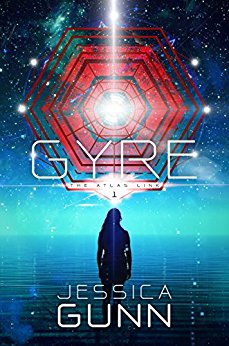
Gyre, by Jessica Gunn is the first book in her Atlas Link series. It is the story of Chelsea, a descendent of Atlantis, who is just discovering her amazing powers and Trevor, a Lemurian descendent, who should be her mortal enemy, but instead falls for her in a big way. See? Boy meets girl, but there is no way they can be together, yet they will fight against all the odds, and even against family to prove them all wrong. Now if that isn’t the recipe for a perfect romance, I don’t know what is. As they are traveling aboard a top secret naval submarine complete with cloak, I think Gunn has the science fiction elements and Lemurians and Atlanteans with super powers pretty much covers the fantasy realm. If it sounds confusing, read the book. It’s actually a pretty good genre combination.
Chelsea is discovering her powers. First super strength, which she was able to ignore, or deny, but now she keeps teleporting to a location near Trevor any time she gets stressed. The problem is, Trevor is on a top secret U.S. Naval Sub cruising the ocean depths, but on that vessel also may lie the answers to Chelsea’s unasked questions about who she is really and she might learn to control her newfound powers. Unlike Chelsea, Trevor is aware of his heritage as a Lemurian, but he refuses to get involved in the war his people are wageing with the Atlanteans. He just can’t believe the girl he’s falling for is his innate enemy, and he’s able to keep it all under control until they find an Atlantean outpost filled with valuable artifacts on the ocean floor. It seems everybody wants those artifacts for their own reasons, and we can only guess who will get them, and where Chelsea will end up.
This story is well-written, with minimal telling of the tale. The characters are likeable, except for Trevor’s friend and fellow Lemurian, Valerie, who is a bit difficult to figure out, but I think that’s done on purpose to throw readers off the trail. I give Gyre four quills.

Kaye Lynne Booth does honest book reviews on Writing to be Read in exchange for ARCs at no charge. Have a book you’d like reviewed? Contact Kaye at kayebooth(at)yahoo(dot)com.
Share this:

Our New World: An enigma filled with paradox
Posted: February 23, 2018 Filed under: Book Review, Books, Dark Fantasy, Fantasy, Fiction, Speculative Fiction | Tags: Book Review, Dark Fantasy, Desiree King, Our New World, Speculative Fiction Leave a comment
Our New World, by Desiree King is the story of a diverse world united at last. Human, Vampire, Magi, Shapeshifters and Fae are all able to dwell in harmony at last, and Sidney and Darien the Dark Prince are both anticipating comeing into their own. But the laws of this new world require they must be wed to assume their rightful places, and they forbid them to marry one another. This is a problem because these two childhood sweethearts are all grown up and hopelessly in love. All the odds are against their ever being together, but Darien has a plan and Sidney is determined, and love conquers all.
The title causes a problem in logic because the characters are calling this “our new world”, but Sidney and Darien share a birthdate, and are both just coming of age, and it seems this new world structure has been in place for much longer than their brief lifespans to date. For me, it seems as if the characters would not be looking at this as their new world, but as the only world they have ever known.
Also my suspension of disbelief could have used more sensory details, to make me smell, hear and feel this world that the author has plunged me into. In spite of the fact that the characters felt stereotyped and lacked depth, I liked them and found myself anticipating when I would be able to learn what happened next.
Also, I didn’t realize until late in the story who the antagonist was. We don’t see how really bad he is until well into the story, so appears as more of an obstacle to be overcome, rather than an adversary, right up until the scene where Henry punishes Sidney because his previous punishments have had no effect and it ticks him off. Only then, are we allowed a glimpse of his cold cruelty, and I have to say, the realization was a shock.
My biggest problem with this story was the fact that although the protagonist is reputed to be a deadly combat fighter and carries the blood lines of not only magi, but a powerful fire fae, it seems someone else is always coming to her rescue, either Darien the Dark Prince, or her bff and P.A., or her Fae grandfather, Eldon. I had difficulty buying into the idea that this spoiled little rich girl with status, was ready to step up and take a council seat or run her city, when she continuously put her own selfish desires ahead of what was best for her city or their new world. Oh, they talked about the possible consequences, but then she presses forward and does as she pleases without a second thought.
Despite this story’s many problems, I found the storyline to be one which held my interest and I found myself wanting to know what happens next. And after all, that’s what is important, isn’t it? I give Our New World three quills.

Share this:

Exposition: Telling vs. Showing
Posted: January 22, 2018 Filed under: Books, Dialogue, Exposition, Fantasy, Fiction, Science Fiction, Writing | Tags: Exposition, Fiction, Show vs. Tell, Writing, Writing to be Read Leave a comment
A writer should show the reader, rather than tell the reader. Help them form a mental picture in their minds. Put them into the story. How many times have we all been told this? Finding a balance between showing and telling is a hard thing to do, but to be a good writer we must strive to achieve that balance.
I’m a person who likes to think big, and in my writing it’s no different. As many of you know, in graduate school, my genre fiction thesis project was the first book in my Playground for the Gods science fantasy series, In the Beginning. But, what you may not know is that my original thesis proposal was for what turned out to be the third book, only in my mind it was the only book and it spans back beyond prehistoric time. While preparing my thesis proposal the feedback that I recieved from instructors and cohorts time and again, was that my proposal would require too much exposition unless I created an epic tomb of unfathomable porportions, way beyond the scope of my thesis requirements, and impossible to complete in the time allowed.
The main problem was that there was a lot of background that I felt the reader needed to understand where the character was coming from in the now of the story. Most of that information was being communicated to my readers through exposition. The story wasn’t taking them back to relive the scene, it was simply filling them in on what they needed to know, because the story I wanted to tell spanned over billions of years. That’s a lot of backstory. That’s exposition.
Robin Conley saw a similar problem in her review of the movie Batman vs. Superman: Dawn of Justice, “Almost all of these really big elements deserved a proper set up because they are major story parts that will potentially carry over… The long exposition and set up in the film makes the story drag and hard to stay involved, no matter how many interesting elements there are.”  Robin explains what exposition does and why we don’t want too much of it. Too much exposition is like coming in in the middle of a film you’ve already seen, and filling in other viewers on what is happening, instead of letting them watch the film and figure it out for themselves.
That was the problem with my PfG story – way too much exposition. It happens all the time. And it’s easy to overlook it when you’re the author. Which is exactly what I had done with my thesis. I had that story outlined and plotted, but I kept having to stop and fill in the background details with exposition. And exposition tells your readers something, but it doesn’t provide a mental image for them. It doesn’t pulace them in the scene. Action and dialog accomplish those tasks quite well. And my cohorts and instructors were right, although at the time, I didn’t want to believe them.
My solution was to turn my story into a four part series. Hence the Playground for the Gods series was born. All that backstory, which had come out mostly in exposition, became a story of its own, one that I could show my readers, rather than telling them about it. My original story idea will eventually be book three, and although I did have to write the whole first book instead of the story I set out to tell for my thesis, that story outline is still waiting for me to put it in story form.
Of course, that isn’t the only way to solve problems of exposition, but this can be applied without creating entire novels. You simply expand on some scenes to eliminate exposition and create a longer story, chosing those scenes that are most vital to the story. You can also chose to leave certain information out, thus eliminating exposition without lengthening, and perhaps even shortening your story. It is a delicate balance, but as the writer, you must do what the story needs to achieve it. What works for one story may not necessarily be the answer for another.
So, how much exposition is too much? That’s a very subjective question, but generally speaking, if you’re telling your reader what happened, with a few lines of glib dialog thrown in here or there, then you have too much exposition. Your reader wants to get lost in the book, and for that, they need a story that is told in such a way that they feel like they are there.
We’ve all read stories like that. For me, it’s Anne Rice. I may have never been to New Orleans, but after reading some of her books, I feel like the Garden District and the French Quarter are old frieinds. I can smell the magnolia blossoms, and see the old plantation houses as if I’d been there. That’s the kind of story we, as authors, strive to write, regardless of the genre we write in. It’s the kind of story that has the perfect balance, using exposition only when absolutely necessary to fill in details, providing plenty of action and dialog to fill in the rest. It’s a delicate balance, but one we must all strive for.
Until next time, Happy Writing!
Like this post? Subscribe to Writing to be Read for e-mail notifications whenever new content is posted or follow WtbR on WordPress.
Share this:

Book Marketing – What Works? (Part 1): Interview with fantasy author Cynthia Vespia
Posted: September 4, 2017 Filed under: Books, Cover Art, Dark Fantasy, Fantasy, Interview, marketing, Promotion, Speculative Fiction, Super Hero | Tags: book marketing, Cover Art, Cover Design, Cynthia Vespia, marketing, promotion, Social Media Marketing 4 Comments
Frequently I rant about the time I have to spend marketing and promoting my writing instead of actually writing. It’s no secret that marketing is not my favorite author hat to wear, and I know a lot of other authors who feel exactly the same way. But the fact is, in today’s writing industry, the author must carry most, if not all, of the load when it comes to promoting their work and marketing their masterpieces.
Now, I’m a struggling author, just as many of you are, so I don’t have a big marketing budget and I can’t afford to hire someone to do my marketing for me. My promotions are limited mainly to social media marketing, usually the kind that’s free. Even when I have a little money to put into marketing, I don’t really know what avenues would be effective enough to be worth it.
A lot of the information about book marketing that is out there on the Internet today is geared toward marketing your non-fiction book, whether it be self-help, or how-to, or even a cookbook. These articles tell you how to show potential readers why they need your book, how your book can help them, which is great, except most of their strategies do not apply to marketing fiction.
As a result of this discovery, I’ve been doing some research of my own into the matter, but I’ve found that the effectiveness of any marketing strategy depends on many factors, and results vary from author to author. In this eight part series, we’ll take a look at my findings and interview seven different authors to learn what they’ve found to be effective in marketing their own work. All work and no play makes us all very dull writers, so we’ll get to know a little about each one of them and their books just for fun.
It’s my pleasure today to interview speculative fiction author, Cynthia Vespia. I have review several of her books, including her Demon Hunter saga: The Chosen One & Seek and Destroy and Hero’s Call, Lucky Sevens, and Life, Death and Back. In addition to her great storytelling, Cynthia is also a talented cover artist, designing most of her own covers, as well as working freelance.
Kaye: Would you share the story of your own publishing journey?
Cynthia: Once upon a time I was a young mind hungry for books. I’d read Piers Anthony; C.S. Lewis; and comic books (my favorite being The Punisher). Then one day I stumbled upon a book by Dean Koontz called Intensity. To make a long story short it got me hooked and I knew then I wanted to write. My first novel, The Crescent, was written after seeing a documentary about female gladiators narrated by Lucy Lawless. I self-published it back when self-publishing wasn’t cool. It was fun to see my book in print. Flash forward to today and that same story is in pre-production as a feature film.
Along the road I’ve written several more books and short stories, each of which I’m very proud of. I received a Best Series nomination in 2009 for Demon Hunter.
Kaye: What made you decide to go with self-publishing?
Cynthia: I was published by small publishing houses but I never really saw any benefit when I could do the same things they were doing and they weren’t even really promoting me much. So much like a lot of other authors I’ve gone the indie route.
Kaye: As a fantasy writer, what kind of research do you find yourself doing for your stories?
Cynthia: Honestly, the majority of my work is completely created in my head. Recently the type of research I’ve been doing is for superpowers, modeling, and locations for the Silke Butters Superhero Series. And for my upcoming apocalypse trilogy there was a lot of research regarding weapons and safe-houses.
Kaye: What’s the most fun part of writing a novel or short story/screenplay? What’s the least fun part?
Cynthia: The most fun part of writing for me is in the initial creation of the characters and their backstory. It’s like a sculptor molding clay. You breathe life into your subjects.
The least fun part is in the aftermath which is marketing and promotion. It’s so difficult to posture yourself out in front of a very large crowd of other writers all clamoring for attention.
Kaye: What is the strangest inspiration for a story you’ve ever had?
Cynthia: Probably Sins and Virtues. I was at Alcatraz in SF and I went inside one of the prison cells for a photo. Afterwards, I felt a heavy cloak of energy from what I could only feel was a former prisoner’s spirit.
While writing Sins and Virtues I started to see visions of prison escapes that I had no business knowing about. If you read the first chapter you’ll get a taste of what I mean. That feeling stayed with me throughout the entire novel. It only left when I was done writing.
Kaye: What’s the best piece of advice you were ever given?
Cynthia: I’ve heard quite a bit of good advice over the years. I seek it out, and write it down in my journal. Lately, I’ve been falling back on one from Arnold Schwarzenegger where he said “earn it so nobody can say they gave you shit.”
Kaye: What do you see as the pros and cons of independent/traditional publishing?
Cynthia: Sadly, the pros and cons are one in the same in that everyone can publish a book. There’s a lot of good work being published that would probably never see the light of day due to the politics of traditional publishing, but at the same time I’ve seen a lot of awful books out there too.
The other things I’ve been noticing is that it’s no longer about the writing. It’s become a numbers game. How many FB followers or Twitter followers do you have? How many likes did you get? How many reviews did the novel receive? How large is your fan base?
I struggle with that because I don’t have the time to spend all day on social media when I have other things that take up my time like earning a living. There’s people now who are even cheating the system with paid “likes” etc. to bump themselves up into the top spot. To me, that’s not what writing should be about. It’s about the story, not how much attention you can get for yourself. Sorry if I’m coming off very negative but I’ve been doing this for a very long time and the business model has changed so much now that I hardly recognize why I started writing in the first place.
Kaye: What do you do for cover art? DIY, or hired out, or cookie cutter prefab?
Cynthia: I always do my own cover art. That is one of the beauties of going indie, you can have complete control over your cover. Although, I do have to point out that the comic book look of the Karma character in my Silke Butters series was done by an artist named Ka Rolding, whom you can find on Deviantart.
I also create covers for other authors too, so if you’re in need of a custom cover please look me up at http://www.cyncreativeservices.com/authorstudio
Kaye: What’s your favorite social media site for promotion? Why?
Cynthia: None…lol. I’d rather do a face-to-face event than spend time on social media promoting. But if I have to choose I like Twitter because it makes you think and be clever with your 140 characters. BTW, you’re all using hashtags wrong!
Kaye: How much non-writing work, (marketing & promotion, illustrations & book covers, etc…), do you do yourself for your books?
Cynthia: All of it! I’m a one woman show. It’s honestly extremely exhausting. Like I said, I just don’t have the time needed to put in to make a dent. I even bit the bullet and hired a couple people this year and it still didn’t make a difference. But I’m trying every day. That’s all you can do is try, right?
Kaye: You participate in book events on social media often. How effective do you see Facebook release parties and cover reveals, etc… being?
Cynthia: It depends on the crowd and your time slot. I’ve had some that were very active (including my launch party for Karma) and then others where nobody interacted at all, or not until later on. I find them effective for exposure. I’ve actually gained quite a few new FB friends from events so I’ll continue to do them. But I will suggest going in with a game plan and do some interactive posts, don’t just ramble on about how your book is for sale.
Kaye: What works best to sell books for you, as far as marketing goes?
Cynthia: For me, I like face-to-face conventions. Because of the genre I write in I can easily blend into comic cons. I liken it to an actor doing a stage play over doing a movie. In that regard, they get immediate audience reaction when they are doing a play, rather than waiting for box office receipts from a movie. The same can be said about conventions. I get an immediate reaction from readers (some have even come back the next day to compliment my work) where as stuff online I don’t really see what is working and what isn’t. Also, during conventions I keep a tally on how many books are selling and my 2009 Best Series nominee Demon Hunter is still the biggest seller.
Kaye: Why do you think some authors sell well and others don’t?
Cynthia: Again, it’s all who you know. And a lot of that comes from great networking. There’s something to be said for word-of-mouth. I also believe some genres sell better than others, that’s just the way it goes.
Kaye: Which author, dead or alive, would you love to have lunch with?
Cynthia: J.K. Rowling or George RR Martin. I’m fascinated by the amount of detail they’ve both put into their respective worlds of Harry Potter and Game of Thrones.
Kaye: What kind of Chinese food do you order all the time?
Cynthia: I don’t always eat Chinese food but when I do I prefer orange chicken and lo mein.
I want to thank Cynthia Vespia for joining us and for sharing her marketing strategies with us. If you’d like to learn more about Cynthia, check out her author profile, here on Writing to be Read, or check out her website.
Be sure to catch Writing to be Read next Monday, for Part 2 of Book Marketing – What Works?, where I will interview the co-authors of the Silverville Saga books and Wild West Ghosts, Mark Todd and Kym O’Connell Todd, who will share their experiences in marketing and clue us in to which ones have been most effective.
Like this post? Subscribe to Writing to be Read for e-mail notifications whenever new content is posted or follow WtbR on WordPress.
Share this:

“Kistishi Island”: An Unbelievable YA Journey
Posted: August 18, 2017 Filed under: Book Review, Books, Fantasy, Fiction, Young Adult | Tags: Book Review, Fantasy, Fiction, Jordan Elizabeth, Kistishi Island, Young Adult 3 Comments
I recently had the pleasure of reading Kistishi Island, by Jordan Elizabeth. This YA novel was a well-written story, with a plot that comes full circle. Although the names are a bit difficult to pronounce, the characters are interesting and likable, especially Corvo (goddess of crows, and Krieg, goddess of war). The main character, Serena, is portrayed to be a teenager with depth, but still a teen, and you won’t be able to help but like her.
When Serena talks to her imaginary friends, they just don’t feel imaginary. The kids at school taunt her and she winds up in trouble all the time. Her aunt thinks she’s crazy and wants to send her to an asylum, her mom is off on archaeological digs all the time and is never around, and her imaginary friends are the only friends she has.
What will happen if she learns her imaginary friends are really goddesses watching over her? We’re about to find out, when she runs away to the Island of Kistishi to find her mom, where the walls of the ruins suck you into underground dwellings and other people see her friends, too. Besides learning that her friends aren’t imaginary, Serena also learns that she is capable of depending on herself, and that she’s capable of having real friends.
This story is well-crafted and perfect for YA readers, (or older readers who secretly love YA stories but don’t want to admit it). It is a fun and exciting read. I give Kistishi Island four quills.