Wake Me Up When September Ends
Posted: September 10, 2018 Filed under: Books, Memoir, Nonfiction, Poetry, Writing, Writing Inspiration | Tags: Memoir, Michael Daniel Lee Booth, Mother's Grief, Nonfiction, Teen Suicide 9 Comments
September is a month that I’d prefer to skip over if I could. It is not an easy month for me and hasn’t been for the last ten years. My son Michael was born on September ninth, he died on September 21 at the age of nineteen, and he was buried on September twenty-eighth. Had he lived, he would have been 30 years old yesterday. Since his death the Green Day song, Wake Me Up When September Ends, has held a special personal meaning for me, because it would be preferrable to go to sleep and not wake up until September was over each year. But of course, that isn’t possible and so, I plod through the month, struggling with my emotions, and life goes on. I haven’t forgotten, and I don’t miss him any less as time goes on, but I am now able to prevent my loss from consuming my life, as it did at first.
After he died, I felt his story needed to be told, but I couldn’t bring myself to do it, even though most of what I wrote during the first two years concerned him in one way or another. The wounds were still too fresh and I couldn’t distance myself from the situation enough to write it. I always knew that it was a tale that needed to be told, and I knew I was the only person who could write it, so I saved all the files and the photos, as well as physical momentos and hand written stories and poems written by my son.
As I mentioned in a recent post, It’s All a Matter of Time, I’ve begun compiling the plethora of journals, stories, poetry and visual images I have accumulated in releation to my son, so tuning out the world and hoping September will go away is not going to work this year. I’ve gathered these materials over the past ten years since his death and they are my works, as well as his, and eventually, it will all be included in my memoir about his life and death, His Name Was Michael: How I Lost My Son to Teen Suicide. After a decade, it is time for his story to be told. The pre-writing preparations have begun and I hope to have it ready for publication by this time next year.
This September will be filled with many tears, as I read through all the materials I’ve gathered and/or written for this book. To put it all together I must read through every piece of writing and go through all the photos of him. I’m not saying that it will be easy for me, because it won’t. In fact, it will probably be one of the most difficult things I’ve ever written, but there is no one else who can do it. It’s all up to me and I feel it’s got to be written.
Michael’s story is many stories wrapped up into his tale. His story will tell the tale of an amazingly unique young man in love, who made some poor choices. It will tell who Michael Daniel Lee was and who he might have been one day, had he lived. It will tell of a mother’s grief and attempts at denial. It will tell of the coping mechanisms employed just to make it through each day after the loss of a child. It will tell of a son, who was also my best friend, and a sense of loss that is undescribable, unknowable, unfathomable. It will tell of an epidemic that sweeps through our world taking young people who have their whole lives ahead of them.
Below is the eulogy that I wrote, which I read standing before a mortuary filled with mourners for my son one week after his death. It’s one piece in the tapestry of writing that will be used to illustrate Michael’s brief time on this Earth. I hope it will pique your interest and encourage you to read the book when it comes out, hopefully by this time next year. If you’d be interested in pre-ordering the book, leave a comment letting me know and I’ll put you on the list, making sure you get your copy when the time comes. It would be great to know that someone is interested, and that I will be writing this for someone other than myself.

Michael Daniel Lee Booth
When Mike said, “I love you”, it was forever, and when he called you his friend, you knew you could depend on him to stand by you, no matter what. He loved to try new things, to explore and to learn. He had a love for life and for all that he held sacred. Mike strove for excellence in all that he did, and lived by a code of honor that was extremely tough to uphold. His Christian upbringing was intermixed with Hindu and Buddhist beliefs to make up the tapestry of his own personal belief system that was disciplined and unyielding. When he made mistakes, Mike was harder on himself than anyone else ever could have been.
When he got mixed up with the wrong people and things, he made some poor choices. He did not deny what he had done, but instead stood up and accepted the punishment that was given to him. He tried to make amends for his wrongs and was on his way to accomplishing that goal. He expressed great sorrow for his errors, and inflicted emotional punishment on himself over and above what the law could ever require of him.
He had a strong will and could accomplish anything that he set his mind to, including learning to speak Japanese and perform martial arts skillfully, all on his own. Mike had a love for Japanese culture and he could have lived off of green tea and sushi. His knowledge and skills were gladly shared with those who wished to learn. Mike had a love for nature and enjoyed all kinds of outdoor activities, including skiing, hunting, fishing and hiking. His imagination was endless and he created stories and drawings that reveal a talent far beyond his tender youth.
Mike was so much to so many people; a loving son, a dependable big brother, a doting little brother, a respectful grandson, a loyal friend and a devoted husband. He loved his dog, Zaar, who was a companion and loyal friend to him. Mike was sensitive, and hurt so easily and so deeply, yet he was too strong willed to ever let it show outwardly. Only through his writing, can we glimpse the love that he embraced or the pain that he felt. When he loved, he loved with all of his being. Mike was fun loving and enjoyed spending time with those that were important in his life. He had beautiful curls and the most wonderful smile, which could light up my heart whenever I saw it. Mike turned 19 three weeks ago. He had a whole life ahead of him. He was much too young to be called home to God.
Like this post? Subscribe to Writing to be Read for e-mail notifications whenever new content is posted or follow WtbR on WordPress.
Share this:

“Destiny’s Detour”: Not Really Romance
Posted: September 7, 2018 Filed under: Books, Memoir, romance | Tags: Book Review, Destiny's Detour, Mari Brown, romance Leave a comment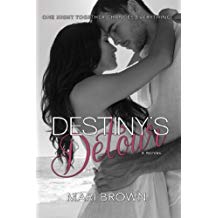
Although Destiny’s Detour, by Mari Brown, may contain a happily ever after, I can’t really classify it as romance, because their HEA is more of a happy all the way through. For me, part of the fun of romance, or any story really is finding out how the characters will resolve conflict and overcome obstacles which are preventing them from achieving their goal.
For romance, that goal is usually for the couple in question to build and maintain a romantic relationship. In Destiny’s Detour, the worst conflict I found was that the captain of the dance team doesn’t like Destiny, which really doesn’t cause a problem because it seems no one really cares what Buffy thinks anyway. Although her brother David doesn’t like the ‘mushy stuff’ when it involves his sister, he is supportive of her relationship with Troy, so there’s not a lot of tension there either.
Brown writes this story in first person, present tense, which can be difficult to do, but Brown pulls is off fairly well. Destiny tells us what happens and what she is feeling, but I’d like to see more of the action. Instead of telling me she’s excited, I’d like to feel her heart beating as if it were trying to come through her chest wall.
Destiny’s Detour is a cute feel good story. It just doesn’t have a lot of tension to make me want to keep reading. I give it three quills.

Kaye Lynne Booth does honest book reviews on Writing to be Read in exchange for ARCs. Have a book you’d like reviewed? Contact Kaye at kayebooth(at)yahoo(dot)com.
Share this:

Social Media: What’s it good for?
Posted: September 3, 2018 Filed under: Books, marketing, Promotion | Tags: author platform, book marketing, Book Promotion, promotion, Reader Platform, Social media Leave a comment
I posted a link in my Writing to be Read Facebook group a couple of weeks ago. The article discussed the new changes made by Facebook which do not allow us to post promotional materials on personal Timelines. Under the new guidelines promotional posts are only allowed to be made on our Facebook Pages, which are designed to be set up for businesses. If you break the rules and make promotional posts on your Timeline, Facebook can ban you. This information caused quite a stir in my group, and I admit it caused me quite a bit of concern, as well. I came to the conclusion that, as with everything in life, we must learn to be flexible and accoodate change. I changed the title of my Kaye Lynne Booth Screenwriter page to Kaye Lynne Booth Author and Screenwriter and set my automatic posts from WordPress to post there instead of on my Timeline and hoped for the best.
One of the comments I received was a question toward one of the group members who was upset, viewing this as a ploy to force us to purchase paid advertising. The second member asked how using Facebook’s free advertising was going and asked if she had sold many books from it. While I don’t think this change prohibits making promotional posts as long as you make them through allowable channels, the conversation made me stop and think about what we authors are expecting to achieve through such posts.
Free promotion through social media is great. It offers us, as authors, an avenue to get the word out about our writing, without putting a dent on our wallets. For aspiring authors, who haven’t made it to fame and fortune yet, like myself, that’s great. But what results are we expecting?
If you’re thinking your book will rise to the top of the best seller lists, you’re dreaming. That’s not the way it works. The best seller lists, at least those on Amazon, work on algorithms, and if you’re only one of a smattering of books in a category, it may not take many book sales to place your book at the top of the list. Authors who write romance have it a lot tougher, because there are a whole slew of romances out there, a lot of competition, so even if your book is making sales, it may not be enough to launch you to the top because it’s based on the books which sell the most in that particular category.
Likewise, most of the folks who those promotional posts reach are other authors, not the people in your target audience. Authors may buy books, but basically they want the the same thing you do. They are out there to promote their own work. Social media isn’t designed to sell books, although their paid promotions may be quite effective, and anyone who is using free promotions to try and sell books, or anything else, may be sorely disappointed. Social media, my friends, is designed to promote connections, some of which may be quite valuable, but it’s not designed to sell merchandise, hence the word ‘social’. And that is what I get from my promotional efforts on Facebook and any other social media site I use. I grow my blog following and my email list. I find a few people who are willing to review my book. I meet people who can include me in their author services as an editor. I connect with artists who can create the book covers I need. While many are fellow authors, I tap into that as well, offering them interviews or reviews here on Writing to be Read. They get some free exposure and I great content for my blog. It works out great.
That being said, I’ve come to the sobering realization that nothing is free, and I’m going to have to invest some of my hard earned money if I want to boost my book sales. While I can’t afford paid promotion on Facebook or Amazon right now, there are affordable promotions out there.
- There are some affordable avenues of promotion out there. Most recently, I found a promotional site called I Like E Books, which has promotional packeages which range from free up to twenty dollars, which seems promising. They provide promotion on social media channels and other cool stuff, depending on which level od promotion you pay for.
- Although not a promotional site, per se, Book Bub is great for featuring your books under your favorites, so folks can see that they are available. You can follow your favorite authors and hopefully gain some followers of your own. It doesn’t cost anything to join.
- On All Author, you can have your book featured on their site for six months, with twitter promos, weekly mock-up banners, and review posting for a flat fee of $24.
- It’s also free to sign up for PromoCave, which is a site for ongoing promotion via social media sites. It helps on this site to post content fairly regularly, since it will bring readers to your profile.
- BMI Books is a global book marketing site where you can place and manage a book ad for free, although I’m unsure how this one works as yet.
- You may also sign up for free on Write Globe, which has a nice book promotion platform as well as supporting other types of creativity. This site was listed as number one in a list of “Top 7 Websites for Book and Author Promotion” by Alwin Gnanaraj on LinkedIn.
- Creative Designers & Writers is a free international classified site, where you can create and post an ad. It is supportive of other creatives as well and can serve as a platform for collaborative works with graphic designers and artists.
- Books Online Best also allows you to post a free ad in addition to other author services, such as book trailers and author interviews. You can also create a freelance site here.
One day, I’ll be able to afford to play with the big boys. For now, I will be grateful for the benefits I can get from social media, but I will approach it with reasonable expectations, being grateful for every follower I gain and counting any book sales that comes from it as an extra added bonus.
Like this post? Subscribe to Writing to be Read for e-mail notifications whenever new content is posted or follow WtbR on WordPress.
Share this:

“Kissed by Literature”: A YA collection of short fiction
Posted: August 31, 2018 Filed under: Book Review, Books, Fiction, Paranormal, Speculative Fiction, Stories, Young Adult Leave a comment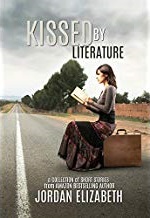
Like many authors, Jordan Elizabeth started out writing short fiction, and in Kissed by Literature, she offers us a generous sample of paranormal and speculative shorts. The trouble in writing short fiction comes in making the story feel complete, with a beginning, middle and end, using a minimal number of words. It’s not an easy thing to do, and while there are stories included that feel a little rushed in the pacing or end abruptly, as can only be expected in a collection of shorts of this size, those that do feel complete hit the mark and give readers goosebumps. Among them, my favorites include House of Sixty Bells, a ghostly mystery solved; Satin, a tale of paranormal friendship with ulterior motives; and Lock the Door, the story of a husband’s guilt following his wife’s murder.
A delightfully eerie collection of paranormal and speculative stories, I give Kissed by Literature four quills.

Kaye Lynne Booth does honest book reviews on Writing to be Read in exchange for ARCs. Have a book you’d like reviewed? Contact Kaye at kayebooth(at)yahoo(dot)com.
Share this:

It’s All a Matter of Time
Posted: August 27, 2018 Filed under: Books, Memoir, Nonfiction, Revision, Writing | Tags: Future, Last Call, Memoir, Michael: How my son became a teen suicide statistic, Non-fiction, Past, Time, Time travel, Writing 1 Comment
Time. It fascinates us, captures our imaginations with the possibilities of time and time travel, so much so that our literature and the entertainment industry are filled with stories and songs which follow that theme. There have been countless movies on the subject: the Back to the Future series; Time Cop; The Terminator; Groundhog Day; Planet of the Apes; Bill and Ted’s Bogus Journey; The Butterfly Effect; Land Before Time; and Timestalkers, to name a few. And of course, television series: Dr. Who; Quantum Leap; Sliders; Time After Time; Outlanders – not to mention series with one or more episodes that involve time travel. Books and stories about time travel include: A Connecticut Yankee in King Arthur’s Court, by Mark Twain; The Time Machine, by H.G. Wells; Rip Van Winkle, by Washington Irving; A Christmas Carol, by Charles Dickens; “The Langoliers”, by Stephen King (Four Past Midnight); Timeline, by Michael Crichton; Harry Potter and the Prisoner of Azkaban, by J.K. Rowlings; The Time Traveler’s Wife, by Audrey Niffenegger; and more recently, All Our Wrong Todays, by Elan Mastai. Even the music industry has gotten in on the theme: Fleetwood Mac can’t stop thinking about tomorrow; Tim McGraw deals with it in segments, so he only worries about the next thirty years; Bad Company is ready for love and figures better things are bound to happen looking forward; Jim Croche wants to save it in a bottle; Cindy Lauper comments on the repetitiveness of it, as things tend to happen time after time; and Stevie Nicks would do it all again, even though it’s not always a breeze. These lists don’t even scratch the surface. So, why is it that time so fascinates us?
I had a little Australian Shepherd named Dorchester. I got her when she was a pup. When she was young, she was agile and fast. Man, was she fast. She could smoke both the male Blue Heelers she grew up with to get a Frisbee. Then, she’d run off with it and wouldn’t give it back. She never was much for playing by the rules. But, as she got older, of course, she slowed. Age affects dogs in many of the same ways that it affects people: it gets harder to get up and down; movement is slower, more careful; the senses are not as accute as they once were, etc… Dorchester began to lose her eyesight first, even before her she lost her speed and her agility, so I had to become her seeing eye person. I began carrying a walking stick on our walks, thunking it down firmly on the ground with each step I took, so that she could hear where I was and follow. We walked this way for several years until eventually she was no longer able to go on walks with me anymore due to poor eyesight and other effects of aging.
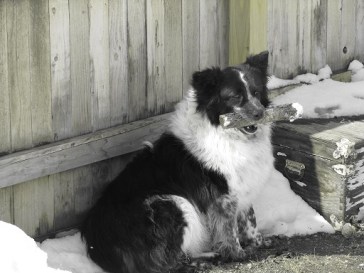
Dorchester isn’t with me anymore, but I still go on walks with both of the Heelers. We all walk a little slower these days. Our walks are shorter and there’s not a lot of rabbit chasing anymore, but they are are enjoyed, never the less. My son’s dog, Zaar, was Dorchester’s mate. They were the same age, each joining our family at about the same time. As Zaar ages, he is not only losing his sight, but his hearing, as well. He is very frightened of thunder and storms always gave him major anxiety attacks, so his not being able to hear so good hasn’t been a totally bad thing, but it does pose new problems on our walks. Zaar grew up walking on our property, so he thinks he knows where he’s going and doesn’t always pay attention to where his walking companions are headed. He gets into ‘the zone’, nose up, sniffing th air, and no matter how loud I yell, he doesn’t hear me, causing me to have to chase after him, touching him to get his attention and get him back on track. Zaar was also raised around a Heeler who was deaf, so he learned hand signs and once I have his attention, he will follow, but it’s getting his attention that’s the trick.

The exercise he gets from his walks is what keeps him healthy and mobile. As I watch him getting older, I feel a sense of urgency, knowing that time may be running short for our walks and I want to enjoy my time with him while I can. I guess I just don’t know how to be a seeing eye person for a dog that can’t hear. He doesn’t hear my stick. I must figure out how to adapt and rise to the challenge, because left to his own devices, Zaar would soon be lost, especially after dusk, when his eyesight is at its poorest. It seems none of us are as young as we used to be.
It’s easy to look back and see what we’ve lost. ‘Hindsight is better than foresight’, and all that. Looking to the past, all our regrets become vividly obvious, but we tend to embellish the good times, as well. I think happy moments may be remembered as euphoric, more so than what they actually were, because those are the times we wish to hold onto. When I look back, there’s a dividing line to my timeline, seperating my life before my teenaged son died, and post-death, signifying the time when he was no longer in my life. That’s my loss. The time when Mike was alive seems brighter, more vivid in my memories. He was my biggest fan, with aspirations and the ability to be a writer himself. He was a unique soul and a source of inspiration for me.
These days, I feel a sense of urgency to make this writing for a living thing work while I still have time to do so. I have certainly taken enough time making it happen. I was 52 when I finally earned my M.F.A. and 53 before I became a published author. I’m sure I have some good years left, but I have to wonder if there will be enough for me to realize my dream. I wish I could go back in time and do things differently, but of course that’s only possible in my fiction.
 Now, with time travel, there’s the possiblity of doing things over, making things turn out different. Granted, it doesn’t usually turn out well when you go messing around with time, but things can, on occasion turn out better. If you don’t believe me, just take a look at MY time travel short, Last Call. Things aren’t going good for Derek, but he finds a way to make his life better. Maybe I could go back and get started on this career path a lot earlier in life. That’s not Derek’s solution, but it could work.
I don’t live in Derek’s world and there is no Last Call bar for me. I know I can’t just sit back and wait for things to happen, so if I want to reach my dreams while I’m still alive to see it, I have to take action. I must market what I already have published, but even more importantly, I must keep writing. So, my plan is to just keep at it. Eventually, my efforts will pay off. I have to believe that.
So what if I didn’t earn my M.F.A. until I was 52 and wasn’t published until I was 53? I’m not the only one to get a late start on their dream. After all, according to an inspirational Facebook post by Karen Caron, Stan Lee’s first big comic came out at age 40, Morgan Freeman had his first major movie role at age 52, and Julia Child didn’t make her cooking show debut until age 51. That puts me in some pretty good company.
Young or old, all we can do is look to the future. (There’s that time thing again.)

With that in mind, I’ve begun the writing and compilation of my memoir about my son’s life and death, finally, after nine years. I’ve decided that it’s time to reunite the two time periods that divide my life and my thinking. After his death, I wrote poems and stories about him, pouring my grief out onto the page. I compiled all the photos of him into a slideshow for his memorial dinner. In addition to that, I plan to contact some of Mike’s friends and request them to contribute writings of their own about who Mike was for them. It’s going to be a massive amount of work, but his story deserves to be told and there is no one else who can tell it. It will be my first non-fiction work of book length.
I’ve always said that I never have less than three works in progress. Michael: How my son became a teen suicide statistic, will make the third one, as I’m also writing the first draft of the sequel to my western novel, Delilah: The Homecoming and I’m revising the first book in my science fantasy Playground for the Gods series, The Great Primordial Battle. Writing is an integral part of my life, past, present and future. I may be an old woman, but there is no other direction in which my life can go. Mike would be proud of my accomplishments so far and I think he would be glad that his story will finally be out. After nine years, it’s about time.
Like this post? Subscribe to Writing to be Read for e-mail notifications whenever new content is posted or follow WtbR on WordPress.
Share this:

DARE: The sex is the story line
Posted: August 24, 2018 Filed under: Adult, Book Review, Books, Erotica, Fiction | Tags: Adult Fiction, Book Review, DARE, Erotica, James Crow 1 Comment
Most erotic stories get categorized as romance, for obvious reasons, and many erotic stories read like a romance with erotic scenes tossed in here and there to spice things up. Or the opposite, so much erotica it’s hard to find the story line, it seems everyone in the tale is having random sex for the sake of having sex, and there doesn’t seem to be much point to the tale.
Neither can be said for DARE, by James Crow. A tale where I found that the sex scenes carried the story. At times the flashbacks out weighed the present scenes and multiple sexual encounters play out for us simultaneously, but they are all relevant to the main story line. But reader beware, DARE goes beyond the erotic and into the realm of very twisted kink, and is definitely aimed at very mature audiences. To be honest, I found the subject matter a little shocking, but the matter-of-fact British tone that discusses atrocities as if they were run of the mill, everyday occurances may have something to do with the shock factor.
I’m not sure how I feel about this story, but it is an interesting approach to story telling, with a surprise twist at the end, so I give DARE four quills.

Kaye Lynne Booth does honest book reviews on Writing to be Read in exchange for ARCs. Have a book you’d like reviewed? Contact Kaye at kayebooth(at)yahoo(dot)com.
Share this:

So, How Do You Build a Reader Platform?
Posted: August 20, 2018 Filed under: Advertising, Books, Fiction, marketing, Nonfiction, Paranormal, Promotion, Reader Platform, Science Fiction, Western, Writing, Writing to be Read | Tags: book marketing, marketing, Reader Platform, Social Media Marketing Leave a comment
I’ve heard it asked if a reader platform is even necessary. So, let me ask you, as writers and authors, without readers what are we? Of course, we need to have a reader platform. All it is is a fan base equivilent, but it can make the difference between the success and the failure of our books. Without my readers, there would be no one to buy my books, read my books, recommend my books or review my books. So, how does one build a reader platform?
It’s a good question. And I’ve heard of many different methods of doing just that, and none of them require construction tools. Not even a screwdriver. All it takes is what we writers and authors do best: words, communication, contact.
 I started out with this blog, Writing to be Read, and the number of subscribers is climbing as I work to improve the content. The thing is, there was no way for me to capture those subscriber emails or reach out to them. So, I created a monthly newsletter, and added a sign-up pop-up, offering a free e-book as a thank you for subscribing. If you sign up for the newsletter, you get a free e-copy of my paranormal mystery novelette, Hidden Secrets, which isn’t available anywhere else.
The trick is to get people to read your work in the first place. You can’t have a fan or a reader unless they have read something you’ve written and liked it. Nobody will follow you, or write a review, or join your reader group, if they haven’t first, read your book. One way to do that is to identify your target audience and promote to them, offering them all the reasons why they will like your work.

Another, and probably the most important, is to be sure your writing is fun and entertaining, if you’re writing fiction. With non-fiction, you need to make the subject matter interesting and present it well. And humor never hurts, no matter what you write. Even dark works can have dark humor. In short, whatever you are writing, make sure that it is quality writing. This should go without saying, but they won’t become your loyal readers if they can’t make it through the book due to the poor quality writing.
After all, a reader platform is really just a fan base of those who are interested in your work, and by finding them and adding them to your mailing list, you are effectively building a reader platform. With this method, I had a big initial burst of subscribers following the launch of a marketing campaign, then it tapered off to a slower rate of growth. My list is growing slowly, but I’m gaining a few new subscribers every month.
Other authors I know start Facebook reader groups or ask fans to join their street teams. I don’t know how well they work, but it seems there’s always activity happening in these groups and they seem to have lots of members. I would think you would have to have a solid fan base to pull ‘groupies’ from, so perhaps this is just an additional step, rather than an alternative method. Most of the authors I know who have street teams or Facebook reader groups, swear they don’t know what they’d do without them, relying on them to spread the word on new releases, post reviews on release day, find reviewers for their books, and/or show up for support at book events. These authors are harnessing the power of their readers and directing it to where it is needed most. And I’m thinking they might be on to something.
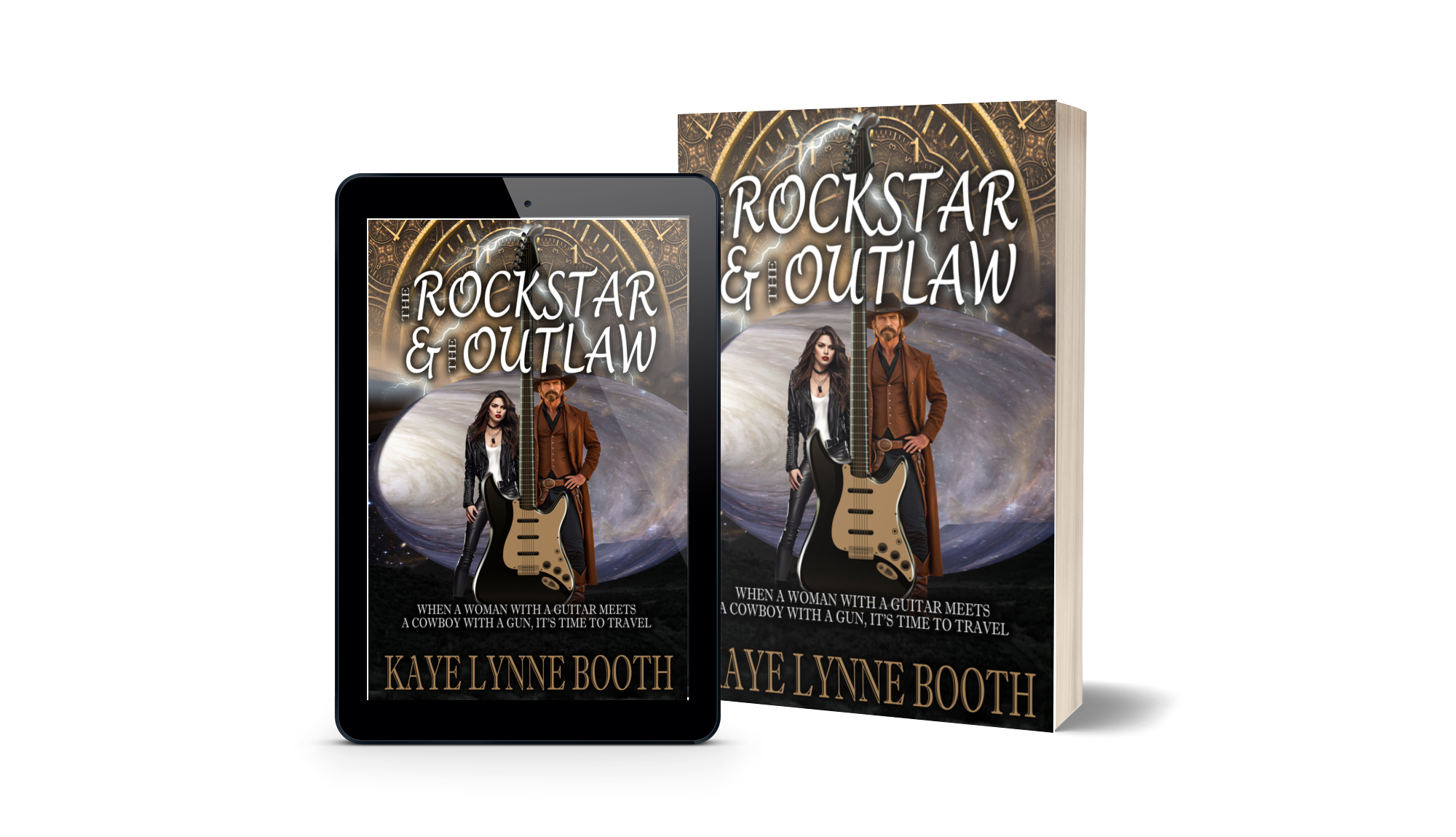
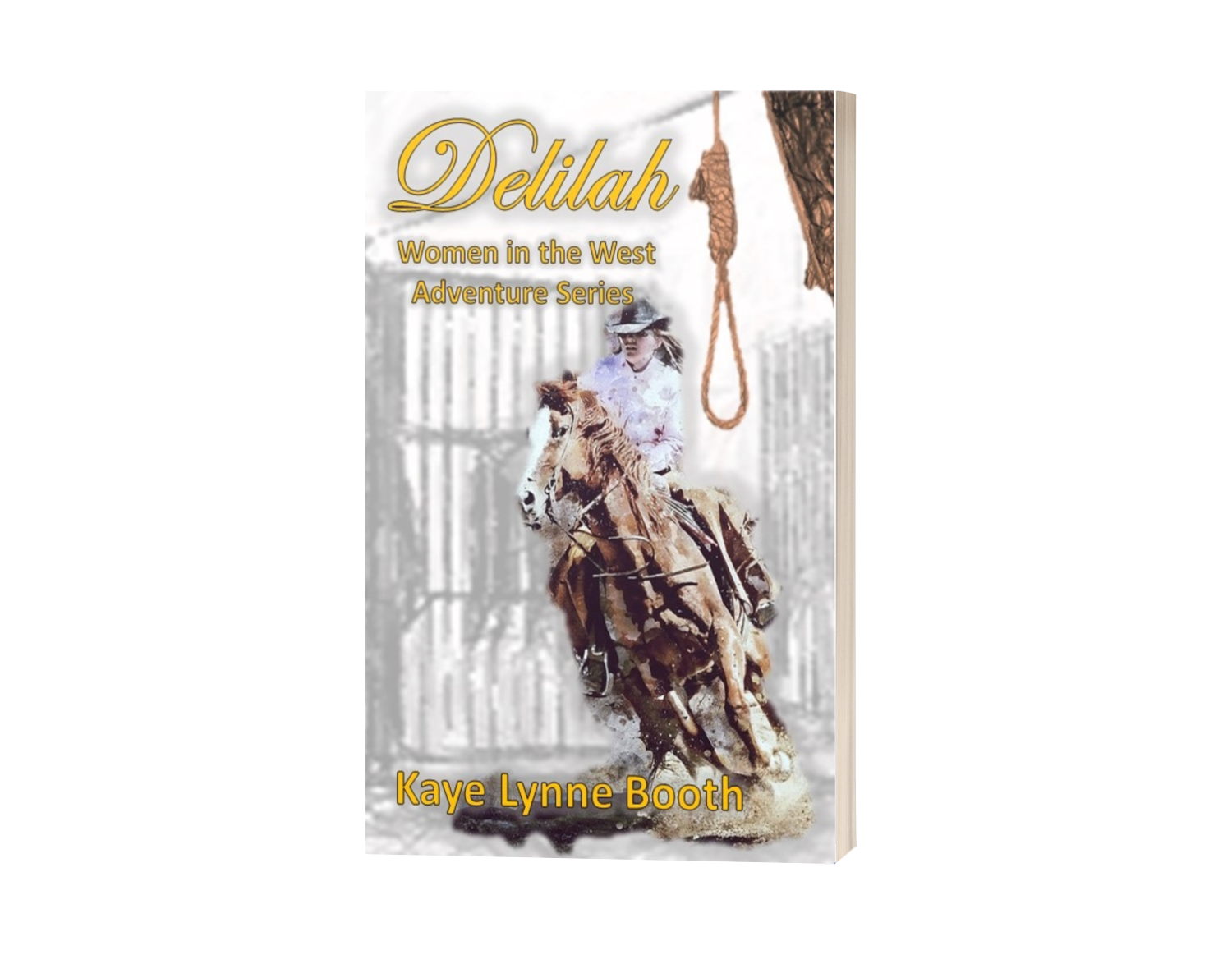
Part of the problem may be that I’m a multi-genre author. To date, I’ve published a western novel, Delilah; a paranormal mystery novelette, Hidden Secrets; and a science fiction time travel short story, Last Call. I’ve also had a dystopian short story and a crime romance short story published in anthologies, as well as shorts and poetry online. Western readers, science fiction readers and paranormal readers are not all included in the same crowd. I’m also eclectic in my reading habits, but most folks want to read only their preferred genres. Now how do I find readers that are so hard core they want to read everything I’ve published?
My answer is, I don’t. I’m finding that I must seek out readers for each one seperately and build a seperate reader platform for each one. The western readers who liked Delilah will be interested in the sequel, The Homecoming, when it’s finished, but they may not be interested in the books for my science fantasy Playground for the Gods series, when the first book is released. And many of my readers are authors themselves and they may be interested in the content on Writing to be Read, rather than any of my fiction works. When I look at it in this way, the task at hand seems to be enormous, the goal so far away. I’m not sure where to start, but I’m determined to find out.
I think a good start would be to find out which of my works the readers I already have are interested in, so I’ve added a genre question to the pop-up for the newsletter sign-up, so that I can place readers on different lists and then new subscribers can receive notifications concerning those works that they are interested in.
All of this marketing stuff is new to me and I’m learning as I go, so if you do sign-up for my monthly newsletter, I’d love it if you’d drop me an email and let me know how the whole sign-up process went, and what worked for you and what didn’t. After all, I’m smart enough to know that without you, my readers, I wouldn’t sell any books. I appreciate the fact that you stand by me. Let me hear form you at: kayebooth(at)yahoo(dot)com.
Like this post? Subscribe to Writing to be Read for e-mail notifications whenever new content is posted or follow WtbR on WordPress.
Share this:

“The Affected”: A Tale of Horror
Posted: August 17, 2018 Filed under: Book Review, Books, Dark Fantasy, Fiction, Horror, Speculative Fiction, Suspense | Tags: Book Review, Demons, horror, James McNally, The Affected Leave a comment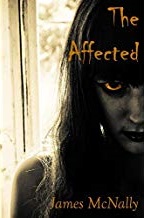
There’s nothing like a good horror story. The Affected, by James McNally is a tale of horror straight from the pits of hell. This story is not for the feint of heart due to the heineous acts contained within.
Random town’s people are vanishing, or being murdered, but whatever is going on, there won’t be any town left if someone doesn’t figure it out and put a stop to it, and soon. And then there is the strange man in white who has been appearing to some residents and seems to be stalking them, there one moment and gone the next. The mystery unravel, but can this demonical surge be stopped before there is no one left?
Although I found a few logic flaws throughout, the story is so well plotted, overlooking them came easy. A plot worthy of the classic horror tales. I give The Affected four quills.

Kaye Lynne Booth does honest book reviews on Writing to be Read in exchange for ARCs. Have a book you’d like reviewed? Contact Kaye at kayebooth(at)yahoo(dot)com.
Share this:

Writing for a YA Audience: CLICK YOUR CONVERSE HEELS TOGETHER
Posted: August 15, 2018 Filed under: Books, Stories, Writing, Writing for a YA Audience, Young Adult | Tags: Converse Sneakers, Details, Writing, Writing for a YA Audience, Young Adult Fiction Leave a comment
When I write contemporary young adult stories, I draw on my own experiences growing up. A huge part of my childhood involved wearing Converse sneakers. Okay, you’re probably thinking that’s a sad childhood, but bear with me. I was always obsessed with shoes. I liked the old-fashioned ankle-boot style. I liked the shiny Mary Janes. I hated regular sneakers. They weren’t cute enough. I endured sneakers only for gym class.
In Junior High, I started seeing the other children wearing Converse sneakers. They came in all sorts of patterns and colors, and they went over your ankle. They were unique, and even though almost everyone had a pair, everyone had a DIFFERENT pair. Some kids even wore mismatched sneakers or used fancy laces. I went home to tell my grandmother I just had to have my own Converse sneakers. (If you aren’t familiar with Converse sneakers, you have got to check out their incredible selection.)
She took me to the coolest sneaker store in the mall (I don’t remember the name of this wicked awesome store) and got me…a pair of knock-offs. They were black and came below my ankle. I fell in love with them because they had a side-pocket. I wore those sneakers until they fell apart.
In the meantime, my grandmother and I went to the nearby outlet mall. We would go once or twice a year. At their shoe store, I saw a beautiful array of colorful Converse sneakers. She bought be an official, high-top pair. They were black with white pinstripes. I wore them so much they started to fall apart…so now I don’t wear them much to preserve their life.
After that, I got a pair each time we went to the outlet mall. I even got a pair that reached up to my thighs! I now have twelve pairs altogether in my collection. Converse is still my favorite brand of sneaker.
Why am I talking to you about my Converse obsession? Well, Converse sneakers were a huge part of my childhood, from shopping for them to wearing them almost every day. I loved wearing them to gym class with fishnet stockings. I always write about my young adults wearing Converse because that’s what I wore. I didn’t realize how prevalent the brand featured in my writing until an editor called it to my attention. I went back through my writing and almost every girl character has a pair at one point in their individual stories!
If you were writing about shoes, what shoes would you mention? What shoes are most important in your life?

Photo by Pixabay on Pexels.com
Jordan Elizabeth is a young adult fantasy author. Her latest book, a post-apocalyptic novella entitled ROTHAM RACE, released July 14th fron CHBB. If you’re wondering if it features Converse sneakers, you will have to read it to find out.
You can connect with Jordan via her website, JordanElizabethBooks.com.
Share this:

Interview with poet Rosemerry Wahtola Trommer
Posted: August 13, 2018 Filed under: Books, Interview, Poetry, Writing, Writing to be Read | Tags: Naked for Tea, Poetry, Rosemerry Wahtola Trommer, Writing 7 Comments
Today I have the privelege of interviewing a fabulous poet, Rosemerry Wahtola Trommer. As well as writing poetry, she also does performance poetry and is fondly called Word Woman. Once you see her perform, there is no question as to why. Rosemerry is vibrant and energetic and enthusiastic about her poetry, and about life, and this shines through in her work. She was Western Slope Poet Laureate here in Colorado from 2015-2017, she leads poetry and in 2016, she gave a fabulous TED Talk in Paonia, Colorado, The Art of Changing Metaphores, which is definitely worth watching if you wish to see how we can use metaphores to help shape our thinking, our lives and even the world around us. Please help me welcome this wonderful Word Woman to Writing to be Read.
Kaye: When did you know you wanted to be an poet?
Rosemerry: I have a very strong memory of sitting on the floor in my fifth grade classroom in a reading corner, and finding a poem by Walter de la Mare in a magazine. It was about a snowflake, and it began, “Before I melt, come look at me, this lovely icy filigree.” I memorized it, only 12 lines, and fell totally in love with the sounds of the poem. I had no idea what it meant, I just knew it thrilled me, the way the sounds chimed with each other. I felt it in my whole body. I don’t know that’s so much when I knew I wanted to be a poet, but it is when the love affair began.
Kaye: What is the biggest challenge of being a poet?
Rosemerry: Hmmm. Perhaps it is knowing that I have so much farther to go in my craft—that I am not yet writing the poems I feel I am here to write. Still so many layers of me to peel away, still so much to explore. And no way to get there except to write and write and practice and practice and read and read …
Kaye: Would you talk a bit about your personal poetic process?
Rosemerry: Since 2006 I have written a poem a day, and that daily practice is a huge part of my process. It makes it so that writing a poem isn’t just something that happens when I am sitting in front of a page, it’s something that is happening all day long. It completely changes the way I am in the world—how I pay attention, how I meet the moment. I’ll add that I am an avid reader of poems and read many every day—I am always trying to expand my poem horizons, see what a poem can do in other’s hands, and teach myself based on what other poets have done successfully.
Kaye: As a poet, you sculpt your words to form an image in the minds of those who are listening or reading your work. So, in a way, you are an artist and words are your medium. Are you creative in other ways, as well?
Rosemerry: It wouldn’t be painting (though I enjoy collaborating with artists!) But I do sing with a women’s acapella group, Heartbeat. We’ve been together since 1994, and I love pushing myself musically with them. And in the kitchen, I like to be creative with cooking and baking. And perhaps I am a creative parent? In fact, my son tells me he wishes I were more normal. And perhaps this is a good place to mention that I am currently finishing the first season of a podcast on creative process called “Emerging Form,” which I am doing with science writer Christie Aschwanden.
Kaye: How did you become attached to the handle of Word Woman? Is there a story behind that?
Rosemerry: About twenty years ago I was trying to come up with a business name that would accommodate all my language interests. At the time, I was an editor for a newspaper, freelancing for magazines, writing and teaching poems and performing a lot. Plus, my Master’s Degree is in English Language and Linguistics. I am obsessed with words, always have been. It just seemed to fit! It kind of cracks me up that it sounds like a super hero. The words themselves are the heroes. Poems have literally saved my life.
Kaye: Your book, Naked for Tea recently came out and was a finalist for the Able Muse Book Awards. Would you like to tell us a little about that?
Rosemerry: Such a thrill! I was sooooooo hoping to be published by Able Muse. I love their poetry books. The day that I found out that they were going to publish it, even so it wasn’t the winner, I was in the Telluride Library. When the text came through, I started jumping up and down, and was soon surrounded by a host of cheering and exuberant librarians! The library is a great place to find out about a book contract!
Kaye: Naked for Tea is an interesting title. How do you decide the titles for your books?
Rosemerry: Usually the titles come from lines in poems, and that’s the case here, too. The title poem is actually named, That’s Right. The first line is, “I showed up naked for tea.” And it’s the perfect poem to represent the book in that I feel that the whole collection is about the art of showing up as vulnerably, as authentically as possible. I joke that the poems are all about failure, and they are—about finding the beauty in our brokenness, our mistakes.
 Kaye : Naked for Tea also has a very interesting cover. How did you come up with it? If you don’t mind me asking, did you serve as the model?
Rosemerry: It’s not me! The publisher, Alex Pepple, had no idea the stir it would cause, because it certainly does look as if it’s my naked spine and long brown hair. The name of the photo he used is Back Story, which tickles me—perfect for a book of poems. I am happy with the metaphorical suggestion of showing up naked.
Kaye: Would you talk a little about performance poetry and how you got into that?
Rosemerry: When I moved to Telluride in 1994, I was lucky to fall in almost immediately with Art Goodtimes, one of the finest performers of poetry in Colorado. He awed me. So physical. So playful. So powerful. Before that I had NO performance poetry skills. What luck to find myself in close proximity to a master—and one who was willing to give me honest, gentle feedback, too.
Kaye: Performance Poetry is really a physical medium, yet when you perform, your movements appear as if they were a natural part of your speech. Your movements flow smooth and graceful. Does it ever feel as if you are doing a dance with your poetry? Have you ever tried adding music to your poetry performances?
Rosemerry: I naturally talk with my hands and body, which, I think, is lucky for poetry performance, though I don’t doubt that the performance enhances it. There are small pieces in a few poems which I have intentionally choreographed, but for the most part, I just let my body do what it does. I have found, though, that it often will move the same way for the same poem, and that these repeated gestures are very helpful for memorization—it’s as if the poem gets in the body which helps it to lodge in the mind.
As for music, yes! I love adding music! Of course I sing myself sometimes—to enter a poem or within a poem—but to have someone else accompany me is one of my greatest pleasures! I perform frequently with my good friend Kyra Kopestonski, a cellist. She and I have so much fun playing around and finding ways for the music and the poem to speak to each other. It’s especially great for very short poems because those are very hard to perform successfully without musical interludes. But it’s especially great for all poems! And I’ve been lucky enough to collaborate with many different musicians—guitar, flute, bass, drums, even a whole band. I would love to be like Laurie Anderson and have my own band!
Kaye: What is the strangest inspiration for a poem you’ve ever had?
Rosemerry: Ha! I’ve written some mighty weird poems. Picking up a grave digger hitchhiker, perhaps? Black widow egg sacs? Wearing a tail?
Kaye: What is the single most important quality in a poem for you?
Rosemerry: Authenticity.
Kaye: What’s the best piece of advice you were ever given?
Rosemerry: From David Lee, past poet laureate of Utah and a very fine poet and performer: Surround yourself by poets better than you are.
Kaye: What is the one thing in your writing career that is the most unusual or unique thing you’ve done so far?
 Rosemerry: Tough to say … but here’s the first thing that comes to mind. Once I participated as a guest artist for the Art & Architecture Weekend in Telluride. The Ah Haa School assembled a team to support me. We used three-line poems (I have thousands) and they painted them on the walls, they made garlands with poems, I had a cream dress covered in poems, white gogo boots covered in poems … and then I stood in the middle of the decorated room at a table with a bowl full of words and the participants came in and either picked a word or gave me one of their own, and then, after a brief conversation with them about why they chose the word, I wrote them a personal three-line poem on the spot—87 in six hours. I felt so in the zone, the day whizzed by. It was absolutely magical. People wept, hugged me, kissed me, laughed. It was an incredible interaction. And then I was given the juried artist award for the whole event, icing on the cake!
Kaye: Imagine a future where you no longer write poetry. What would you do?
Rosemerry: I can’t imagine it. Really. I think if I were deserted and alone on a desert island, I might still write poems in the sand. But if I try really really hard to not be me and think of what else I would do, um, drive race cars. But I would never do that.
Kaye: It seems like poetry really is ‘in your blood’. Can you give me an example of how poetry flows out into the other areas of your life?

Rosemerry: Well, it does feel like an integral part of me. And I guess it does leak out! I have a little game with myself to see how poems might make their ways into the hands of people who think they don’t like poems. Part of that is doing readings. Part of that is leading collaborative workshops with other teachers, pairing poetry with meditation or painting or healing from grief. Part of that is writing short poems on river rocks and leaving them all over town (in stairwells, public bathrooms, on street corners, etc). Like a poetry easter bunny, any given day of the year. I’ve left many hundreds of rocks out there, and they are always picked up! But I would say that more than poetry flows out, it flows in. I feel as if I am always finding poems, other people’s poems and poems waiting to be written. That’s such a thrill!
Kaye: What’s the most fun part of writing a poem for you? What’s the least fun part?
Rosemerry: Most fun: The blank before the poem arrives. All that potential! And then the thrill of the seed of the idea showing up. That AND when the ending shows up and you know, “Yes, yes, that’s it.”
Least fun: realizing that I have already used the words blossom, sometimes, moon, shine and invitation a million times and I need to come up with another word.
Kaye: Which poet, dead or alive, would you love to have lunch with?
Rosemerry: Only one?? And I think you mean besides the poets I presently hang out with. Hmm. Gerard Manley Hopkins. I think it would be awkward, but to be that close to greatness?? I would be happy to sit there in awkward silence as we ate our boiled potatoes.
Kaye: What advice do you have for aspiring poets?
Rosemerry: Surround yourself with other poets. Though the act of writing is solitary, as Ammons would say, you “sit alone picking away at your own liver,” the art of it and the communion of it is in community. Most of my best friends are poets—they inspire me, chide me, keep me in line, offer me a life line.
And of course, read. Read. Read smart—with a pen in your hand, taking notes on what you love and why. Read for pleasure.
And last, memorize, or, better yet, learn poems, as we say, by heart.


I want to thank Rosemerry for sharing with us today on Writing to be Read. Her energy and enthusiasm seems to be contagious for me. I hope it is for all of you aspiring poets out there, too. You can learn more about Rosemerry Wahtola Trommer and the amazing things that she’s done on her Word Woman website, where you’ll find calendar, book sales, writing prompts and more. Her poetry books are avaiable on Amazon and you can visit her Author Page , too. You can also find her daily poems here. Please take the time to like the post or leave a comment to show your support for Rosemerry and/or Writing to be Read.
Like this post? Subscribe to Writing to be Read for e-mail notifications whenever new content is posted or follow WtbR on WordPress.
If you are an author, poet or screenwriter and you’d like to be interviewed on Writing to be Read, drop Kaye an email at kayebooth(at)yahoo(dot)com with “Interview Request” in the subject line.