Day 3 of the WordCrafter “Refracted Reflections” Book Blog Tour
Posted: September 21, 2022 Filed under: Anthology, Blog Tour, Book Promotion, Book Release, Books, Fairy Tales, Fantasy, Fiction, Giveaways, Guest Post, Science Fiction, Short Fiction, Stories, WordCrafter Book Blog Tours, WordCrafter Press | Tags: Anthology, Book Blog Tours, Elisabeth Caldwell, Fantasy, Refracted Reflections, Science Fiction, WordCrafter Book Blog Tours 9 Comments
Digital Giveaway
For a chance to win a free digital copy of Refracted Reflections, just leave a comment to show you were here. Follow the tour and comment at each stop for more chances to win. Three copies will be given away in a random drawing.
On today’s tour stop, we have a guest post by contributing author Elisabeth Caldwell, who talks about the inspiration for her story. Her’s is a unique tale about that starts off the anthology with a bang. So, without further ado, I’ll let her tell you about the inspiration behind “The Mirror Guardian”.
“Mirror Guardian” Inspirations
Several years ago, I was in the shower washing my hair and noticed multiple dark strands of hair wrapped around my hands and fingers. Everyone loses hair when they wash it. But this was too much hair. And it kept happening. After multiple visits to various doctors, a dermatologist declared I had female pattern baldness. I would never recover the hair I had lost, but minoxidil would, hopefully, help slow the balding process.
Terror struck me, and my mind raced. What if the medicine didn’t work? How much hair would I lose? How fast would it fall out? If I lost too much hair, what would I do? Would I shave my head?
Night after night these thoughts kept me awake, and I started to try to envision what it might be like to be bald. How would people see me? Would they look at me or avert their eyes? How would I see myself? Would I be afraid to look in the mirror? Would I bravely go out in the world? Or would I hide myself away like a princess in a tower? Would a prince come to save me? Or would I be strong enough to save the prince?
I was organizing my bookshelves right around the time a friend forwarded me the call for submissions for mirror-themed short stories, and I came upon my favorite fairytale book that I had saved from my childhood. These were the same fairytales I had read to my daughters – daughters who are now teenagers barraged by social media full of air-brushed beauty. My girls scroll through image after image of seemingly perfect people leading seemingly perfect lives and are saddened by their own imperfections.
I am old enough to know that no person and no life are perfect.
Sitting with that worn and weathered book in my hand thinking of Maid Maleen who sat for seven years in a tower waiting to be rescued, I realized my girls deserved a fairytale of female strength. I wanted to give them a heroine who didn’t fit the traditional mold of beauty. Who didn’t let everyday conceptions of what she should be and how she should act define her. A heroine whose beauty shone like moonlight on her bare head. A heroine who didn’t sacrifice her happiness because it was expected of her.
And from this came Kella. I hope you enjoy her story!
About the Author

Elizabeth Caldwell grew up a Philly (and suburban Philly) girl with thick glasses and her nose buried in a book. When she was 12, she fell into the yellowed pages of one of her grandmother’s Mary Stewart novels and has been obsessed with reading and writing ever since. She sees fairies in the trees, mermaids in the ocean, ghosts peeking out the windows of sprawling Victorians in Cape May, and a story behind every couple that walks by holding hands. She writes poetry, short stories and novels.
Elizabeth lives in Bucks County, PA with her three vibrant children, a husband who is her soulmate and best friend, and one very sweet, albino corn snake. She practices law by day, writes by night and daydreams every chance she can get.
About the Book

Refracted Reflections: Twisted Tales of Duality & Deception
Refractions and Reflections…
A reflection can be revealing or deceptive. What stares back at you when you glance into the mirror?
A prison, designed to trap you and take away all that is dear to you?
A portal to another dimension? Another time?
An evil twin, luring you to the other side?
Your loved ones with a fond farewell?
A distorted version of yourself? A person you no longer even recognize?
A protective savior?
Do you dare to gaze into the looking glass?
Will what you see save you…, or haunt you forever?
If you liked Gilded Glass and Once Upon an Ever After, you’ll like Refracted Reflections: Tales of Duality & Deception.
Purchase Refracted Reflections at your favorite book distributor here: https://books2read.com/u/3kPyxn
Thanks for joining us today for Day 3 of the WordCrafter Refracted Reflections Book Blog Tour. I hope you enjoyed meeting Elizabeth and learning more about her outstanding story. Follow the tour for a chance for a free digital copy of this exceptional anthology, Refracted Reflections: Twisted Tales of Duality & Deception, or pick up your copy at the link above. Below are the links to the previous stops, in case you missed them:
Monday – September 19 – Introductory post on Writing to be Read
Tuesday – September 20 – Guest Post by author Ligia de Wit & a review on Carla Loves to Read
I hope you’ll join us again tomorrow on Roberta Writes, with a guest post from Valerie B. Williams about the inspiration behind her story, “The Tinker’s Gift”. Until then, Happy Reading!
______________________________________________________________________________
Book your WordCrafter Book Blog Tour today!
Share this:

Welcome to the WordCrafter “Once Upon an Ever After” Book Blog Tour
Posted: August 22, 2022 Filed under: Anthology, Blog Tour, Book Release, Books, Collaboration, Fairy Tales, Fantasy, Guest Post, Magical Realism, Mythology and Legend, Short Fiction, Stories, WordCrafter Book Blog Tours, WordCrafter Press | Tags: Anthology, Fairy Tales, Fantasy, Guest Post, Old Roots New Soil, Once Upon an Ever After, Sarah Lyn Eaton, WordCrafter Book Blog Tours 14 Comments
Welcome to the WordCrafter Once Upon an Ever After Book Blog Tour, where we’re launching Once Upon an Ever After: Modern Myths & Folklore with guest posts from contributing authors about their story inspirations, reviews and an interview the anthology and WordCrafter Press with me, Kaye Lynne Booth. So, stick with us by following the schedule below, to learn more about this mystical new anthology and its authors. Check back daily, as I’ll be adding the links as they go live.
Tour Schedule
Monday – August 22 – Opening Day Post – Writing to be Read – Intro. & Guest Post – Sarah Lyn Eaton
Tuesday – August 23 – Patty’s World – Review & Guest Post – Robbie Cheadle
Wednesday – August 24 – The Showers of Blessings – Guest Post – Olivia Merchiston
Thursday – August 25 –Roberta Writes – Interview w/ Kaye Lynne Booth
Friday – August 26 – Zigler’s News – Review & Guest Post – Lyndsay Elizabeth Gilbert
Saturday – August 27 – Closing Post – Writing to be Read – Guest Post – A.E. Lanier
Digital Giveaway
For a chance to win a free digital copy of Once Upon an Ever After, just leave a comment to show you were here. Follow the tour and comment at each stop for more chances to win. Three copies will be given away in a random drawing. (Yep. I literally draw the names out of a hat.)
This anthology was by invitation only, which means I invited the authors because of specific stories, which caught my imagination. The result is a unique collaboration with a wonderful group of authors who have been an absolute pleasure to work with.
Today’s guest post is from contributing author Sarah Lyn Eaton, who wrote the story “Old Roots, New Soil”. Her story grabbed ahold of me and stuck in my head because of the imagery of the spooky old apple orchard her words created for me and because it involves a mysterious curse which is pretty cool. What more could you ask for in a modern day fairy tale?

Finding Roots
I originally wrote the story that appears in this anthology for another submission call, looking for folk tales and modern fairy tales based on some kind of mirror imagery. My brain tends to jump outside of, but stay near to, the box and I began to consider what kind of folk magics my ancestors might have practiced, may have believed. The inspiration for this story was rather close to home.
I grew up in between Lake Ontario and Lake Erie. Generations of my family lived in the area and that’s where my roots are. Our family genealogy is a project my dad worked on when I was a kid, and now we do it together. Over the years I have sought out information on the history of the places our ancestors lived, how they developed and evolved. What were their industries? Their environmental impact?
This is similar to the way I layer a character and where they came from and what circumstances they find themselves in when the story opens, and where they need to get to.
On my father’s side of the family, we have mostly been on this soil since the Mayflower, if not those first 50 years of migration to the new world. And my mother’s side of the family has lines that go back that far. But she also has more recent migrations from Germany and Ireland. And one of the German names caught my eye, that of my great-great-great-great maternal grandmother Wilheminia Wernersbach.
In 1836, George Arth, 35, and Wilheminia Wernersbach, 37, emigrated from Germany with sons Adam, 7, Jacob, 3, and George, 3 months. The emigration card did not list a destination. I believe they were in Antwerp for some time before coming to America. When Wilhemenia brought her sons to America, George Arth was not with them. In 1850, when they are first on record in Pendleton, NY her son Adam, my great-great-great grandfather had his own family plot, right next to her own. In fact, she saved up money to buy a third plot on the other side, so that each son would have his own land, but they would still be together.
I thought about their story and let my brain wander. I wondered what it was like for this woman to bring her children to a new world, and then all the way to the other side of New York that was still being developed. What of this land did she find strange? What of her land might she have brought with her? What customs would have been a comfort to her? What guardians might she have called on to protect her family? How might they have made their living in a new place?
When you do a lot of genealogy and you can get beyond the lists of names and dates and you start to retain details, you start to notice family patterns emerging. Generational patterns that the people toiling every day, trying to get to the next one can’t see. And sometimes you can see how trauma gets passed down, and sometimes even transposed, like in the telephone game of passing messages down a line of people, to see what it becomes at the end.
How can you undo something you can’t understand? How do you combat a family legacy that was kept hidden from you? And what if you found yourself crossing an apple orchard, about to open the door to a dark part of your family’s past?
And that was the seed that formed the first breath of my story.
Sarah Lyn Eaton

Sarah Lyn Eaton is a queer pagan writer and burn survivor. She is a life-long Star Wars geek who spends her free time rock hunting, or venturing into the woods with her camera. Her stories have been published in the anthologies Brave New Worlds, Upon a Twice Time, Unburied: A Collection of Queer Dark Fiction, Of Fae and Fate: Lesser Known Fairy Tales Retold, On Fire, and Dystopia Utopia. In 2021, Sarah Lyn was awarded The Speculative Literature Foundation’s Working Class Writer Grant.
About Once Upon an Ever After
This unique and imaginative collection of eleven thought provoking fantasy stories will delight readers who enjoy stories of wishes gone awry.
What happens when…
A woman desires to carry on her family’s legacy, uncovering a long-buried curse?
A not so perfect witch casts a spell to defy age and preserve her relationship with her handsome shapeshifting familiar?
A time traveler longs to be the savior of knowledge lost?
An incompetent delivery boy becomes an unlikely savior of forgotten artifacts?
A magic mirror yearns for a different question?
A tiny story witch desires to share her stories with the world?
Spells are cast, unlikely alliances made, and wishes granted, sometimes with surprising outcomes. You’ll love this anthology of modern myths, lore, and fairy tales. Once you read these twisted tales, you’ll be sure to be careful what you wish for….
If you liked Gilded Glass, you’ll enjoy Once Upon an Ever After: Modern Myths & Fairy Tales, short stories with thought provoking themes, captivating characters and diverse cultures, from humorous to horrifying, from the legendary past to possible futures and back to the here and now.

Today is the last day of pre-order for this wonderful new anthology. Once Upon an Ever After goes live tomorrow. You can get your copy through your favorite book distributor with the Books2Read UBL here: https://books2read.com/u/mKdWGV
_______________________________________________________________________
Book your WordCrafter Book Blog Tour today!
Share this:

Wrapping up the WordCrafter “Will Write For Wine” & “Stories I Stole From Lord Byron’s Bastard” Book Blog Tour
Posted: July 4, 2022 Filed under: Beach Reads, Blog Tour, Book Promotion, Book Review, Giveaways, Guest Post, Romantic Comedy, WordCrafter Book Blog Tours | Tags: Beach Reads, Romantic Comedy, Sara W. McBride, Will Write for Wine, WordCrafter Book Blog Tours 9 Comments
This is the last stop on the WordCrafter Will Write For Wine & Stories I Stole From Lord Byron’s Bastard Book Blog Tour with a guest post by author Sara W. McBride about the inspiration behind the Will Write For Wine, and my review of her debut novel. I want to thank you all for joining us, and if you missed any of the stops along the way, you can catch them at the links below.
Writing to be Read – Opening day post: Guest post by Sara W. McBride – The Inspiration for “The Devil’s Bridge”, and review of Stories I Stole From Lord Byron’s Bastard
The Showers of Blessings – Guest post by Sara W. McBride – The inspiration for “Stealing Georgione’s Mistress”
Carla Loves to Read – Guest post by Sara W. McBride – The inspiration for “The Masked Kiss”, and review of Stories I Stole From Lord Byron’s Bastard
Writing to be Read – Interview with author Sara W. McBride and guest post – The Inspiration for “Lazzaretto Vecchio: A Dowry for Saffron”
Zigler’s News – Guest post by Sara W. McBride – The Inspiration for “A Gentleman’s Portrait by a Pregnant Man”, and a review of Stories I Stole From Lord Byron’s Bastard
Annette Rochelle Aben – Guest post by Sara W. McBride – The Inspiration for “The Haunted Palazzo”
Roberta Writes – Guest post by Sara W. McBride – The Inspiration for “The Secret Vault”
Give-Away
Don’t forget to leave a comment and click on the link below to enter for a chance to win a free digital copy of Will Write For Wine or Stories I Stole From Lord Byron’s Bastard.
http://www.rafflecopter.com/rafl/display/d9280cae1/?

Credit: Laocoön statue, Vatican, Photo by Frank Eiffert on Unsplash
Inspiration for Will Write for Wine
Guest post by author Sara McBride
What inspired the novel Will Write for Wine?
My love affair with Venice began in 2005 on my very first trip to Italy. I had planned a two-week research trip, by myself, that started in Venice and ended in Rome. My husband had shown me an article about an art historian who believed a sketch by Michelangelo, dated 1504, was of the torso of Laocoön, the statue that Pope Julius II paraded through the streets of Rome and subsequently launched the Vatican Museum. But Laocoön wasn’t discovered until 1506, and it’s discovery changed the world of Renaissance art.
How did Michelangelo sketch a statue that was still buried in the earth? The hypothesis was simple: Michelangelo forged the statue and buried it.
I spent 6 months researching Michelangelo’s life, his art commissions, and his war with Pope Julius II—Which is epic!—and came to the conclusion that the hypothesis might be true. I built a 76-page itinerary—fully color-coded, because I’m that anal—and set out across Italy to walk the steps of Michelangelo and those I believed assisted with his subterfuge.
I hunted for evidence in the art world itself. Since I wanted to write a novel, I also sought ambiance from historical locations and wrote down the smells of restoration sites with turpentine and plaster dust hanging in the air, the sounds of echoing footfalls in an empty cavernous church or of a single woman weeping in a side chapel, the taste of rustic breads, the sight of sunset over St. Peter’s Basilica in Rome, and the smoothness of Istrian stone supporting Venetian palazzos.
After that first trip, I could walk into any museum room and at a glance, tell you which paintings were completed before or after 1506, the year of Laocoön’s discovery. That’s how influential the discovery of Laocoon was on the Italian Renaissance art scene. But on the flip side, I couldn’t tell you how the artist felt when he painted or sculpted an art piece.
I wrote a novel. It read like an 800-page art history dissertation. Snore-ville! Even though the entire novel is centered around Michelangelo, Bramante, Rafael, Sansovino, and Pope Julius II, the reader never becomes invested in the characters. I understood the history, the places, the art, but not the men or what motivated them.
Anyone can sing a song, but for it to resonate and draw in a listener, it must be sung with emotion. It is the emotion of the song that tells a story. My novel was missing the emotion.
But seventeen years later, I’m still drawn to the story of Laocoön, which I believe to be Michelangelo’s greatest forgery—Some forgeries were documented—and with every art museum exhibit, every church, every trip to Europe, I see more evidence for the pieces of the story. But now I seek to understand why Michelangelo and Pope Julius II were at such odds with each other. For that, I needed to understand people.
Venice is an amazing city to study not just history, ambiance, food, beauty, and smells, oh so many smells, but to study people. And out of that study, came the novel, Will Write for Wine.

Buy Link: https://www.amazon.com/Will-Write-Wine-Alexis-Novel-ebook/dp/B09XVM6Y38
What they are saying on Amazon:
The mind of Alexis Lynn is as delightful and convoluted as the labyrinth of canals and streets of Venice. Tagging along on the ride with this endearingly flawed character is sometimes rooting for her, sometimes laughing with her, sometimes crying with her, sometimes wanting to smack her, and sometimes wanting to smack the men she entangles herself with. Will Write for Wine is a quick and light beach read – no, scratch that – it’s a quick and light European vacation read. Alexis Lynn puts the “fun” in “dysfunctional” and the “Veni” in “Venice”!
My Review
Alexis Lynn is at a crossroads, starting a new life in Venice and leaving the old one in the America behind, making the choices which will affect her future. At times like this, lots of wine may be required, and there’s no end to what Alexis Lynn will do for good wine- the writing of stories, the breaking of hearts, the solving of age-old mysteries. In Will Write for Wine, by Sara McBride, it’s a fun ride with Alexis, her new found friends and the ghosts of Venice as she writes stories, falls in and out of love, and delves into Venetian history to create a new life for herself with the best from the old, as well as the new.
Pour yourself a glass of wine and settle in for a good read with Will Write for Wine. You don’t need a good wine to enjoy this novel, but I’d highly recommend it. I give it five quills.

________________________________________________________________________________
Book your WordCrafter Book Blog Tour today!
Share this:

Day 5 of the WordCrafter “Will Write for Wine” & “Stories I Stole From Lord Byron’s Bastard” Book Blog Tour
Posted: July 1, 2022 Filed under: Beach Reads, Blog Tour, Book Promotion, Book Review, Giveaways, Guest Post, Romantic Comedy, Short Fiction, Stories, WordCrafter Book Blog Tours | Tags: Book Review, Sara W. McBride, Stories I Stole From Lord Byron's Bastard, Will Write for Wine, WordCrafter Book Blog Tours Leave a comment
Day 5 of the WordCrafter Will Write for Wine & Stories I Stole From Lord Byron’s Bastard Book Blog Tour finds us over at Zigler’s News with another wonderful guest post from author Sara W. McBride and a review of her short story collection by Victoria Zigler. Join us to learn more about this author and her delightful books.
https://ziglernews.blogspot.com/2022/07/wordcrafters-book-blog-tour-for-will.html
Share this:

WordCrafter “Will Write For Wine” & “Stories I Stole From Lord Byron’s Bastard” Book Blog Tour Day 4
Posted: June 30, 2022 Filed under: Author Interview, Author Profile, Beach Reads, Blog Tour, Book Promotion, Books, Fiction, Giveaways, Guest Post, Humor, Interview, Romantic Comedy, Short Fiction, Stories, Women's Fiction and Poetry, WordCrafter Book Blog Tours | Tags: Author Interview, Author Profile, Beach Reads, Romantic Comedy, Sara W. McBride, Short Fiction, Short Story Collection, Stories I Stole From Lord Byron's Bastard, Will Write for Wine, WordCrafter Book Blog Tours 23 CommentsStories I Stole from Lord Byron’s Bastard is a collection inspired by Venetian history. The fictional character, Alexis Lynn, wrote these stories in the novel Will Write for Wine by Sara W. McBride, but they are fun stand-alone adventures to be enjoyed with an excellent glass of Italian wine.
https://www.puckpublishing.com
Today’s tour stop comes with a fun interview with author Sara W. McBride in addition to her guest post. So kick back a while and enjoy the tidbits offered here as you learn more about Sara and her wonderful books.
Introduction

Sara W. McBride, like many modern-day biological researchers, invents new swear words to sling at million-dollar machines while locked in a dark hole of a decaying academic hall. This has caused her to witness ghosts and create a romantic fantasy life within her head, which she now puts down on very non-technological paper with her favorite Jane Austen style quill pen.
Her first novel in the Alexis Lynn series, Will Write for Wine, and the companion short story collection, Stories I Stole from Lord Byron’s Bastard, both set in Venice, Italy, were recently released by Puck Publishing. She’s hard at work on the second Alexis Lynn novel, a Regency mystery series, and a haunted play. She strongly feels the world needs more haunted plays.
Give-Away!
Don’t forget the awesome giveaway Sara is running on this tour, with a digital copy of each book up for grabs. You can enter the give-away for a chance to win at the link below:
http://www.rafflecopter.com/rafl/display/d9280cae1/?

Credit: Wikipedia, Lazzaretto Vecchio Island, Plague Hospital
Interview with author Sara W. McBride
Why do you write?
Sara: To be immortal! Just kidding. It’s my fabulous mental escape into worlds and lives that I wish I could live.
Please tell us a bit about your publishing journey?
Sara: In 2014, I organized, edited, and published the first two NaNoWriMo Los Angeles anthologies. Then I helped with the next three. The group is still producing an annual anthology. It was a great way to learn the logistics of self-publishing and how to shape short stories. This year, my husband and I launched Puck Publishing, and we’re hoping to publish something every month.
Over the past twenty years, I’ve written fourteen bad novels that I’m glad I never published. LOL!
What made you decide to self-publish?
Sara: In the late 1990s, I was an assistant to a Hollywood book agent and I learned the ins and outs of traditional publishing and movie book deals. The agents and publishers were so parasitic on the author, it gave me the willies. In those days, traditional publishing paid high advances, but the treatment of the authors still put a bad taste in my mouth.
Today, they rarely pay above a $10,000 advance to a new author, they expect the author to do all the marketing, and then the publisher keeps the copyright and sells it off whenever they like, to whomever they like, and the book goes out of print.
I’ve seen too many friends get screwed by traditional publishing.
Will Write for Wine takes place in the artistic and romantic setting of Venice. Have you explored the physical locations for your books in the flesh, in order to get the details right when writing about these locations? Have you been there? Have you lived there? Why did you choose this setting?
Sara: I’ve had five research trips to Venice, totaling about five weeks. I’ve been in almost every church and museum of Venice, and a few places I probably wasn’t supposed to enter. I apparently don’t understand the meaning of yellow caution tape or closed doors.
Most of the Venice locations in the book are real places, but Manu’s osteria is fictional. However, I stole menu items from many of my favorite osterias in Venice.
I think Venice is one of the most magical and haunted cities in the world. Many people describe it as a floating museum; the entire city is trapped in the Renaissance. But if you simply sit still, sip a glass of wine in a campo or piazza, listen to the opera singers, and watch the people and pigeons, there’s a vibe that sinks into you. Every part of the city is simultaneously dead and alive. It is that barrier, that thin line between life and death that pervades every stone, stench, and serenade of Venice. Delicious!
Stories I Stole From Lord Byron’s Bastard involves Venetian history. What is the fasciation of this area for you?
Sara: I’m a history nerd! Venice is one of those cities that drips with history, but not just through architecture and museums, through the people, the food, the many generations that still live in the same house, the ghosts that are accepted as common place, and the street signs. Ponte del Diavolo, the Devil’s Bridge is bound to inspire a story in anyone. Gheto Novo, or the New Ghetto, caused me to question the history of the Jewish community within Venice.
It’s difficult for me to walk from one piazza to another in Venice without my mind percolating a story based purely on the sights, sounds, and smells. And I love the smells of Venice. Both the good and the bad. Only Venice can induce an entire story purely through its smells. I’ve learned to navigate the labyrinth of Venice by sniffing the air. How is that not a story!
Is there anything unique or unusual about your writing process?
Sara: I don’t know the end until I get there. I just write into a dark void and somehow it all works out. It keeps the process magical and fun. I used to outline, but I always got bored with the book before I finished it. Outlining turned writing into work. Ick! Writing needs to be fun for both the writer and the reader.
Is your writing process plot driven or character driven?
Sara: Character driven! Definitely.
Do you write with music, or do you prefer quiet?
Sara: Quiet! Or the hubbub of a coffee house crowd, hotel lobby, airplane terminal.
Atmosphere is important. What do you do to get into the writing zone?
Sara: There’s a zone? How do I find that? I want a writing zone. I just go about my day and jot down paragraphs, dialogue, and then type them in when I’m next at my computer.
How much of the story do you know before the actual writing begins?
Sara: NONE! Okay, maybe the opening scene. But usually not even that. Just a character in a place, who is feeling something.
Wine plays a big role in your character, Alexis Lynn’s life. What is the attraction?
Sara: I love wine! I also love beer, whisky (Scottish spelling), Compari cocktails, and most dishes cooked with truffles. However, to preserve my liver, I typically only drink once-a-week, so it’s a big event for me. I cherish my weekly glass of wine and how it complements my meal. Alexis drinks way more than I do. Fictional wine can’t damage a fictional liver.
Are you a wine connoisseur? What is your favorite wine?
Sara: I love wine! I once dreamed of becoming a wine sommelier. Isn’t my favorite wine obvious? Soave! Like Alexis Lynn, I also discovered Soave on my first trip to Venice. It’s been a favorite ever since, but difficult to find in America. Hence, more motivation to travel!
What’s something most readers would never guess about you?
Sara: My husband and I got engaged four days after we met. Unlike Alexis Lynn and her marital troubles, my husband and I have had a relatively easy, adventurous, crazy, happy and supportive marriage. This summer, we’re celebrating out twenty-five year anniversary. But I don’t know how we’re celebrating. Any suggestions?
You’ve got a scientific background, like your character. How much of Alexis Lynn is you?
Sara: Um … She’s totally me! Are authors allowed to confess that?
What time of day do you prefer to do your writing? Why?
Sara: Morning, if given a choice. But it happens all day.
What’s the hardest part of the story for you to write: beginning, middle or end?
Sara: I write chapters as if they are short stories, and then I arrange them into a book when I think I’ve developed something that has a beginning, middle or end. Is that weird? I don’t write chronologically. And I have chapters/stories that didn’t make it into this book that will be in the next one.
Alexis Lynn has a conversation and wine tasting with Casanova. Would you like to talk a bit about the inspiration for that scene?
Sara: I was enjoying my weekly glass of wine while reading the memoirs of Casanova and thought, “Man, this guy would give horrible marriage advice!” Then I grabbed my computer.
Besides Casanova, which author, poet or artist, dead or alive, would you love to have lunch with?
Sara: Lord Byron, or course! He’s bloomin’ brilliant, but people only remember him as a seducer. Sure, he seduced a few women, usually married ones, and has some famous bastards; the famous mathematician, Lady Lovelace, is one of his illegitimate children. But he also wrote the first English-Armenian dictionary, and was a very, charming, intelligent debater. His letters are filled with wisdom and humor. In an incredibly elegant manner, almost complimentary, he was able to inform someone of their idiocy. I would love to have lunch with Lord Byron, even if he spent an hour politely insulting me.
Besides writing, what are your favorite things to do?
Sara: Travel! I also love hiking, playing board games, reading every genre, watching cheesy Hallmark Christmas movies in the middle of summer, and learning Italian so I can one day move to Venice.
What is the biggest challenge of being a writer?
Sara: Pulling together a bunch of short stories into a cohesive novel and then figuring out what scenes are missing.
It was funny with Will Write for Wine, my husband included a little gondola and gondolier on the cover, and I suddenly realized that I didn’t have any gondola scenes in the book. Both the gondola scenes were the last scenes I wrote.
If writing suddenly made you rich and famous, what would you do?
Sara: Move to Venice and write more!
What’s the most fun part of writing a novel or short story/screenplay? What’s the least fun part?
Sara: Most fun? Dialogue! I’m originally a playwright, so I love dialogue.
Least fun? Killing a character I like. Killing a nasty character is delightful, but killing a kind character, or a character I’ve spent years with, is heart-wrenching.
How much non-writing work, (research, marketing & promotion, illustrations & book covers, etc…), do you do yourself for your books?
Sara: I do everything myself, but my husband does the cover art and most of the website maintenance. We have fun working together.
If your book was made into a film, who would you like to play Alexis Lynn?
Sara: Oh! Juicy question. Reese Witherspoon. Yep, definitely Reese Witherspoon. Mid-40s, cute, and like Alexis, she exudes positivity even when her world is falling apart.
What goals do you set for yourself in your writing?
Sara: Don’t plan ahead. If I don’t know what’s going to happen, neither does the reader. This is really funny because I’m writing a murder-mystery right now and halfway through the book, my murderer, who I didn’t know was the murderer, just totally confessed to the murder. So, um, geez, I guess that book is going to be a different style of murder mystery. LOL! So, I guess my goal in writing is to always be surprised.

Buy Link: https://www.amazon.com/Stories-Stole-Lord-Byrons-Bastard-ebook/dp/B0B27TS5GL
As you can see, Sara is an author who loves what she does ad is pretty comfortable in her own skin. Now, let’s hear about her inspiration for the fourth story in Stories I Stole From Lord Byron’s Bastard, “Lazzaretto Vecchio: A Dowry for Saffron”.
Guest Post by Author Sara W. McBride
Inspiration for “A Dowry for Saffron”
What inspired the story, “Lazzaretto Veccchio: A Dowry for Saffron?”
“Sia laudato il signor Iddio non ci sono stati morti.”
Bless the Lord, there have been no deaths [today].
December 24, 1630, in Sant’Eufemia, Venice.
* * *
This quote is from the opening of a Nature paper, “A digital reconstruction of the 1630-1631 large plague outbreak in Venice,” by Gianrocco Lazzari, et al. Published Oct. 20, 2020.
* * *
I’ve always been fascinated by the European plagues, but when I read the above Nature paper, the effects of the 1630-31 plague on Venice consumed my mornings for several weeks. This especially seemed relevant while living through a new global pandemic, thankfully with much lower mortality rates.
In 1348-49, bubonic plague killed one-third of the European population, up to 25 million people, and Venice, as a crossroads for international trade, lost half its residents. Imagine living in a bustling city of 100,000 people, and half of them die within 18 months. It would be horrifying and haunting.
In response to the devastating plague of 1348-49, Lazzaretto Vecchio was established in 1423 as the first quarantine island in the Mediterranean region, and was used to separate the healthy from the sick during Venetian plagues. Lazzaretto Nuovo was established shortly afterward as a place where ships suspected to carry sickness among their passengers or crew were anchored for 40 days. English acquired the word “quarantine” from the Italian term for 40 days, quaranta giorni. The lagoon island of Poveglia also became a quarantine outpost sometime in the 15th century. It’s rumored that half the soil of Poveglia is human ash from burned plague corpses. Then it became a mental hospital from 1922-1968. No wonder the place is one of the most haunted locations in Europe.
Considering the 15th century world had no idea how disease was spread, the idea of quarantining the sick or foreigners arriving from plague stricken areas was very innovative.
The story, “Lazzeretto Vecchio: A Dowry for Saffron,” takes place during Venice’s plague of 1630-31, which killed a third of the city’s population. Both plague islands were used to isolate and treat the sick, however, caregivers were needed to work at the island hospitals, mostly because, I assume, workers kept dying of plague.
The Italian city of Ferrara had a long history of successfully avoiding plagues that ravaged other parts of Italy. They closed their city gates and screened all arrivals for any signs of disease. They insisted that Fedi, proofs, identification papers from a plague-free zone must be presented. Ferrara, starting as early as medieval times, engaged in public sanitation campaigns, sweeping away garbage and liberally spreading lime powder on any surface that had come into contact with an infected person.
When an Italian physician, Girolamo Fracastoro, published a text in 1546 describing the “seeds of disease” as something that could stick to clothes and objects, Ferrara increased their sanitation practices during plagues and burned the clothes of any infected people. Removing garbage, spreading lime powder and burning infected clothing probably reduced the flea pestilence that actually carried Yersinia pestis, the bacterium that causes plague.
Many natural remedies were prescribed for protection against the plague, but a medicinal oil designed by a Spanish physician, Pedro Castagno, was written into Ferrara’s, “Reggimento contra la peste,” regimen against the plague. The oil, called Composito, was recommended to be applied to the body.
“Before getting up in the morning, after lighting a fire of scented woods (juniper, laurel and vine shoots), warm the clothes and above all the shirt, rub first the heart region, near the fire to ease balm absorption, then the throat. [Afterwards], wash hands and face with acqua chiara (clean water) mixed with wine or vinegar of roses, with which sometimes all the body should be cleaned, using a sponge.”
Ferrara city’s regimen against the plague
The contents of Composito was never fully disclosed, but researchers examined the records of materials ordered by Castagno and determined that the oil contained venom from scorpions and vipers, and myrrh and Crocus sativus, which is a saffron flower from which the filaments produce the golden spice saffron. Both myrrh and saffron are known to have antibacterial properties, as does scorpion venom with the bonus that it’s also a pain reliever. So basically, Composito was an early antibiotic and pain reliever combo. Pretty nifty!
According to census records, Venice’s population was around 140,000 in 1624. By 1633, that number had fallen to 102,000. More than 43,000 deaths were recorded over just three years, with nearly half of them taking place between September and December 1630. The city of Venice began several public works projects, like the grand Baroque church, Santa Maria della Salute, greeting guests at the entrance to the Grand Canal. The church’s construction began in November 1630 with the goal of keeping citizens employed and maintaining art and labor skills.
The city of Venice also purchased food for the quarantined, both in the city and on the plague islands. It is logical to speculate that in the early months of 1631, Venice might have asked Ferrara, a city with success at conquering the plague, if their convents could be paid in order to encourage volunteers to work at the plague islands. My story is fictitious, but the stage was set for the events I describe in the story. I also talked about pirates in the story. Yes, there were pirates at this time: mercenary pirates and government deployed pirates (particularly from England).
My story focuses on a group of nuns who have been “volunteered” by their convents, and how they sacrifice one nun into a marriage in order to secure their much needed ingredient of saffron for Composito, their only hope for survival on the plague islands. The politics and finances of Venice in 1631 created a world where this story could have happened. There’s a lot of history not recorded in text books, and this is a story that no one would want recorded.
Something fun for readers:
In my research of the plague islands, I was surprised by the lack of ghost ship stories haunting the Venetian lagoon. If you know of any, please write me at sara@puckpublishing.com. If you’ve ever visited the eerie lagoon island, Poveglia, the plague island, turned insane asylum, turned old-folks home, which now stands empty—less the chilling screams on foggy nights—I want to hear about it.
Buy Link: https://www.amazon.com/Will-Write-Wine-Alexis-Novel-ebook/dp/B09XVM6Y38
____________________________________________________________________________________
_________________________________________________________________
Book your WordCrafter Book Blog Tour today!
Share this:

Welcome to the WordCrafter “Will Write for Wine” & “Stories I Stole From Lord Byron’s Bastard” Book Blog Tour
Posted: June 27, 2022 Filed under: Beach Reads, Blog Tour, Book Promotion, Book Review, Books, Fiction, Giveaways, Guest Post, Historical Fiction, Historical Inspiration, Humor, Review, Romantic Comedy, Stories, WordCrafter Book Blog Tours, Writing Inspiration | Tags: Historical Fiction, Historical Romance, Humor, Novel, Sara W. McBride, Short Fiction, Stores I Stole From Lord Byron's Bastard, Will Write for Wine, WordCrafter Book Blog Tours 15 CommentsStories I Stole from Lord Byron’s Bastard is a collection inspired by Venetian history. The fictional character, Alexis Lynn, wrote these stories in the novel Will Write for Wine by Sara W. McBride, but they are fun stand-alone adventures to be enjoyed with an excellent glass of Italian wine.
______________________________________________________________________
Welcome to the WordCrafter Will Write for Wine & Stories I Stole From Lord Byron’s Bastard Book Blog Tour. This is going to be a fun tour because we have two fabulous books to celebrate by a wonderful new author Sara W. McBride. Will Write for Wine is her debut novel about a writer, Alexis Lynn, and her funny and romantic escapades when she moves to Venice to start a new life. Stories I Stole From Lord Byron’s Bastard is the recently released short story collection and companion to the novel. Her fiction is well researched and presented with a witty flare which I find refreshing and I think you will too. I hope you’ll follow the tour and join us at each blog stop. You’ll find the schedule and links below.
Blog Tour Schedule
Monday, June 27 – Opening Day Post – Writing to be Read – Guest Post: Inspiration for the Devil’s Bridge” & Review of Stories I Stole From Lord Byron’s Bastard
Tuesday, June 28 – Showers of Blessings – Guest Post: Inspiration for “Stealing Georgione’s Mistress”
Wednesday June 29 – Carla Loves to Read – Guest Post: Inspiration for “The Masked Kiss”
Thursday, June 30 – Writing to be Read – Guest Post: Inspiration for “A Dowry for Safron” & Interview with Sara W. McBride
Friday, July 1 – Zigler’s News – Guest Post: Inspiration for “The Pregnant Man” & Review of Stories I Stole From Lord Byron’s Bastard
Saturday, July 2 – Annette Rochelle Aben– – Guest Post: Inspiration for “The Haunted Palazzo”
Sunday, July 3 – Roberta Writes – Guest Post: Inspiration for “The Secret Vault”
Monday, July 4 – Wrap-Up Post – Writing to be Read – Guest Post: Inspiration for Will Write for Wine & Review of Will Write for Wine
Give-Away
In addidtion, to the awesome guests posts, interview, and reviews at each tour stop, Sara is offerin a chance to win a digital copy of each book, Will Write For Wine & Stories I Stole From Lord Byron’s Bastard. Leave a comment and click on the link below to enter for a chance to win:
http://www.rafflecopter.com/rafl/display/d9280cae1/?
Introduction
I must begin by giving kudos to Sara W. McBride for the clever way that she has braided these seven short stories in this collection in with her debut novel, (and I’m told that she is currently working on a companion wine tasting journal). While both of these books stand alone easily, they really should be consumed together. In the novel, Will Write for Wine, we see the story of how Alexis Lynn comes to write these stories, but we don’t get to actually see the stories. For that, you must read Stories I Stole From Lord Byron’s Bastard, which offers not only the stories, but the true inspiration behind them. After reading her delightful novel, and seeing Alexis’ digging up the background for the stories and seeing Manu’s reaction to reading them, one can’t help but be curious about the actual stories and want to read the collection. It’s brilliant!
Now let me turn things over to the author, Sara W. McBride, so she can share her inspiration for the story.

https://www.puckpublishing.com
Inspiration for “Devil’s Bridge”
Guest Post by author Sara W. McBride
What inspired the story, “The Devil’s Bridge?”
The moment I saw the sign “Ponte del Diavolo,” I knew I had to write a story. At the edge of the bridge sits Palazzo Priuli, home to several Doge Priulis and is now an elegant hotel (www.hotelpriuli.com) in the Castello area of Venice. I had already been researching the tragic death of Antonio Foscarini, and then I discovered that the doge—Basically the president of Venice—who had him executed lived in the palazzo at the edge of Devil’s Bridge. It’s not often that history simply hands me a story, but there it was, burning bright in the Lancet windows of a 14th century palazzo. Here’s the real history behind the Devil-possessed Doge Priuli and his most famous victim:
Antonio Foscarini, executed on April 22, 1622, was a Venetian ambassador to London (1611-1615) and is rumored to have had an affair with King James’ Queen, Anne of Denmark. He returned to Venice during a “Spy War” with Spain and was suspected of betraying Venetian secrets to Spanish officials. Someone who knew about his affair with the Queen of England might have seeded this rumor. Upon his arrival in Venice in December 1615, he was arrested and held prisoner for three years under Doge Bembo, who uncovered the Bedmar plot which would have permitted Spanish mercenaries to march on Venice. In the midst of the crisis, Bembo died—or was possibly assassinated by the Spanish—and Doge Nicolo Donato reigned for a mere 35 days before he died. I believe he was assassinated by the Spanish, but have found no clear evidence for such a claim.
I’m considering writing a novel on the Venice/Spain Spy War of 1615-1622 because it’s super fascinating and an interesting statement on what fear does to a governing body.
Antonio Priuli (1548-1623) was elected doge in 1618 and released Foscarini in order to monitor him and his activities. Priuli was a brutal doge who arrested hundreds of innocent Venetians suspected of plotting against Venice. Was he possessed by the devil? Probably not, but how Devil’s Bridge earned its name is a mystery, so I took license and speculated that the devil enjoyed his residence at the bridge’s end.
On April 8, 1622, Foscarini, then a Senator of Venice, was arrested and accused by the Council of Ten—basically the governing body of Venice, particularly over state security matters—of meeting with ministers of foreign powers and communicating the most intimate secrets of the Venetian Republic. The evidence was weak and Foscarini denied all charges, yet he was still condemned to a public execution for high treason. Why? The answer will never be known, so I had fun speculating that perhaps a guest of his, under her own volition or persuaded by a demonically possessed doge, provided false evidence to seal his fate.
By the end of 1622, Doge Priuli showed signs of illness. In January, 1623, the same Council of Ten revoked Foscarini’s guilty verdict—Whoops, they were wrong—and reinstated the family’s honor with a posthumous exoneration. His bust and tomb can be found in the Church of San Stae in Venice. There’s more on Foscarini’s final resting place in “The Masked Kiss,” another story in this collection.
Doge Antonio Priuli died on August 12, 1623, but oddly, I am unable to locate his tomb. It’s usually pretty easy to find a doge’s tomb. I would have thought him to be buried in Santi Giovanni e Paolo (aka San Zanipolo), which houses tombs of 25 doges, but I haven’t found him there. The art and sculpture in this basilica-sized ediface is amazing! This behemoth church manages to hide on the North side of the Castello and is off the beaten tourist path, but you should definitely seek it out.
Two other Priuli doges, brothers Girolamo Priuli, 1486-1567, and Lorenzo Priuli, 1489-1559, are buried in San Salvador, but apparently there was no space remaining for their Priuli descendent, or perhaps the family just didn’t like Antonio.
Another source claims that the spy-hunting doge is buried alongside Marco Polo in the Church of San Lorenzo in the Castello district, but San Lorenzo has been closed for over a hundred years, only recently reopened, and I have not seen or read any evidence of the doge’s tomb being contained within. They couldn’t find Marco Polo either.
If you find the tomb of Venice’s 94th Doge, Antonio Priuli, please write to me at sara@puckpublishing.com. Otherwise, I’ll just have to assume he’s buried in the depths of the canal under Ponte del Diavolo.
Buy Link: https://www.amazon.com/Stories-Stole-Lord-Byrons-Bastard-ebook/dp/B0B27TS5GL
My Review
Stories I Stole From Lord Byron’s Bastard
Stories I Stole From Lord Byron’s Bastard is a short story collection by Sara W. McBride which will tickle your sense of adventure and discovery, and perhaps, your funny bone. A companion to her debut novel, Will Write for Wine, these stories bring Venetian history to life with a personal touch of humor, adding in the missing details which historical archives and family histories only elude to. Each story is accompanied with the history and inspiration behind it, and it’s fun to see how McBride crafted in characters to transform legend to story.
Included are tales of an unsuspecting hero who gets the girl, in “The Masked Kiss”; an apprentice who betrays his master in the name of love in “Stealing Giorgione’s Mistress”; a bridge occupied by a demon, in “The Devil’s Bridge”; a nun who chooses life on a plague island over marriage in “Lazzaretto Vecchio: A Dowry for Saffron”; a smuggling operation gone awry in “The Secret Vault”; and a delightful tale of a young artist forced to masquerade as a male in order to ply her trade in “A Gentleman’s Portrait by a Pregnant Man”. But, I’d have to say my favorite story in this collection is “The Haunted Palazzo”, because I’ve always been a sucker for a good ghost story, and the mysterious specter and wet windowsill are certainly prime food for ghostly fodder.
Stories I Stole From Lord Byron’s Bastard is a collection of short historically inspired stories which are light and entertaining reads. Fun and enjoyable. I give it five quills.
_____________________________________________________________________________________
Book your WordCrafter Book Blog Tour today!
Share this:

Day 5 of the WordCrafter “Lingering Spirit Whispers” Book Blog Tour: Guest Post by Christa Planko
Posted: December 3, 2021 Filed under: Anthology, Blog Tour, Book Promotion, Book Release, Books, Fiction, Ghost Stories, Guest Post, Paranormal, Short Fiction, Stories, WordCrafter Book Blog Tours, WordCrafter Press | Tags: Christa Planko, Lingering Spirit Whispers, Paranormal, Paranormal Anthology Set, Spirits of the West, Where Spirits Linger, Whispers of the Past, WordCrafter Book Blog Tours, WordCrafter Press 1 Comment
Thank you for joining us for Day #5 of the WordCrafter Lingering Spirits Whisper Book Blog Tour. In case you missed any of the posts from earlier in the week, you can find them all right here on Writing to be Read, and you can visit the author interviews on Un dawnted , but you can only leave comments on Writing to be Read.
Monday November 29th – Writing to be Read/Un dawnted interview with Stevie Turner
Tuesday November 30th – Writing to be Read/Un dawnted interview with Kaye Lynne Booth
Wednesday December 1st -Writing to be Read/Un dawnted interview with Jeff Bowles
Thursday December 2nd – Writing to be Read/Un dawnted interview with Roberta Eaton Cheadle
Today we have a guest post by author Christa Planko about the inspiration behind her winning story, “Olde-Tyme Village”, which is featured in Where Spirits Linger.

“Where Spirits Inspire: The Inspiration Behind ‘Olde-Tyme Village’”
By Christa Planko
A stroll through a Victorian shore town during off-season leaves enough to the imagination to raise goosebumps and stir the creative mind. The brightly painted homes with their steeply pitched roofs and ornate gables give the sensation of having stepped into a time machine. With summer’s tourists packed and gone, the streets lie practically barren. The exception is the few living beings taking in the autumn air and architecture—and the spirits who may be joining them unseen.
That was the inspiration behind my story, “The Olde-Tyme Village.” It was an October trip to historic Cape May, NJ that fed my imagination. Wandering through the quiet town, I marveled at the elaborate homes, many of them vacant. I couldn’t help but fancy I saw a curtain move in a window or a grey face peering through a dusty pane. A shift of wind carried a moan that could have been the spirit of a woman watching from a widow’s peak for her husband to return from sea. Mind trick or imagination?
Certainly, many of the homes have a long-standing history. The peninsula was originally inhabited by the Lenni-Lenape tribe before Cornelius Mey purchased the land in 1621. It soon developed into a prosperous fishing and whaling industry for English colonists. Later in the 18th century, Cape May began its development as a resort town for enjoying the ocean and fresh seafood. The town saw its share of pleasure, prosperity, and promiscuity over the years. It saw an equal share of tragedy. Surviving wars and devastating fires, residents’ emotions must have run deep. The wealth of books and oral accounts of Cape May’s ghostly occupants suggest that many tormented souls were left to linger.
Was “Olde-Tyme Village” based on any researched history? The answer is yes and no. Like my October stroll through Cape May, the story was fueled by pure imagination. It takes place at a fictional resort remote from modern society. The “historic residents” and guests of the village are made up as well. The research I did do was to learn about Victorian architecture and industries that prospered during this era in order to ground the descriptions and backgrounds in historic fact. The story’s mood and time-warp occurrences were exaggerations of my own experiences in Cape May.
A final question may be: Do I believe in ghosts? While I enjoy a spooky story around a campfire or during Halloween season, I can’t say that I ever truly believed in ghosts. I did have an unexplained experience at a historic site near my hometown a few years ago. That experience—or possible encounter—has since opened my mind to the possibility. I’ll spare the details until I have the chance to do some further research on the area and possible tragedies. I sense a future story on the horizon!
To see my bio and a list of published works, please visit:
https://christascorner.godaddysites.com/about-us
____________________________________________________________________________________________________

Christa is a professional writer with a passion for creative expression. She has had her poetry and short stories featured in several publications, including River Poets Journal, Wingless Dreamer, Tanka and Haiku Journals, Rune Bear, Jitter Press, and Every Day Fiction. When she’s not writing, she is likely bicycling, kayaking, or dancing. She currently resides in South Jersey with her 4 feline muses.
______________________________________________________________________________________________________
You can get your copy of Lingering Spirit Whispers here.

Thanks for joining us on the WordCrafter Lingering Spirit Whispers Book Blog Tour! I hope that you’ve enjoyed Christa’s guest post here on Writing to be Read, and the Un dawnted author interviews earlier in the week. If you missed any, the links can be found at the top of this post to go back and catch them all.
As a reminder, tomorrow will be Sonoran Dawn’s Autumn Wonders Book Event on Facebook, so be sure to drop in. Contact the host, D.L. Mullen and Sonoran Dawn Studios, if you’d like to reserve an author slot for promotion of your work. WordCrafter has a slot in the event, so you can find more about this anthology set, as well as other WordCrafter Press books there. Come and join in the fun.
__________________________________________________________________________________________________________
Book your WordCrafter Book Blog Tour today!
Share this:

Day 5 of the WordCrafter “Where Spirits Linger” Book Blog Tour
Posted: September 24, 2021 Filed under: book marketing, Book Promotion, Book Review, Books, Giveaways, Guest Post, Paranormal, WordCrafter Book Blog Tours | Tags: Book Review, Christa Planko, Enid Holden, Kaye Lynne Booth, Paranormal, Roberta Eaton Cheadle, S.L. Kretschmer, Short Fiction, Short Stories, Stevie Turner, Where Spirits Linger, WordCrafter Book Blog Tours Leave a comment
For Day 5 of the WordCrafter Where Spirits Linger Book Blog Tour brings us a guest post by contributing author, Stevie Turner about her story, “David’s Revenge”, on Zigler’s News and a review by Victoria Zigler. Please join us to learn more about this author and her story. Leave a comment and earn a chance to win a free digital copy of Where Spirits Linger.
https://ziglernews.blogspot.com/2021/09/where-spirits-linger-wordcrafter-book.html
_____________________________________________________________________________________________
Book your WordCrafter Book Blog Tour today!
Share this:

Day 3 of the WordCrafter “Where Spirits Linger” Book Blog Tour
Posted: September 22, 2021 Filed under: Blog Tour, Books, Fiction, Giveaways, Guest Post, Paranormal, Stories, WordCrafter Book Blog Tours | Tags: Kaye Lynne Booth, Where Spirits Linger 1 Comment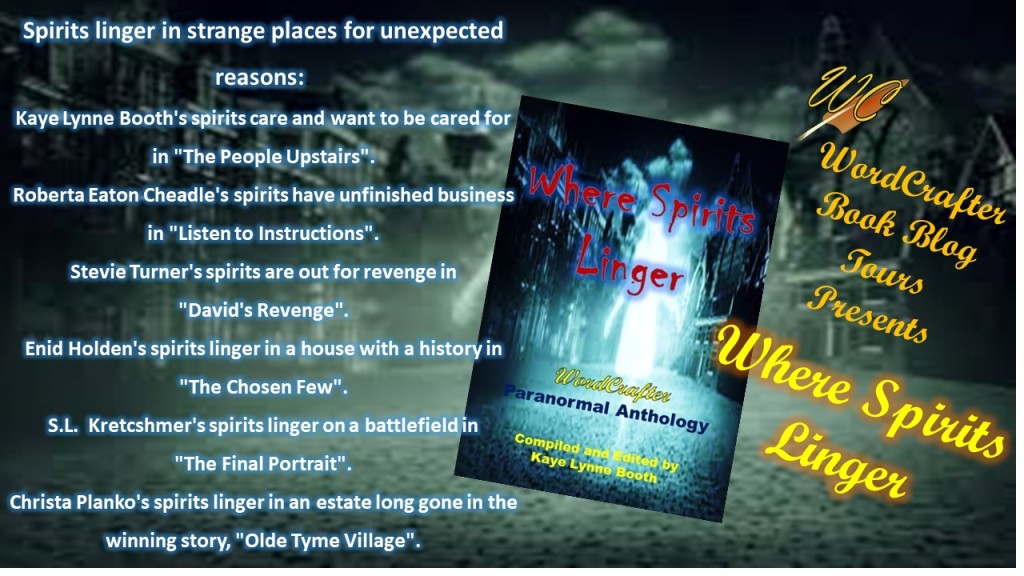
Day 3 of the WordCrafter Where Spirits Linger Book Blog Tour finds us over at Patty’s World with a guest post from me! Join us to learn about the inspiriation behind my story, “The People Upstairs”, which is included in the newly released paranormal anthology.
Book your WordCrafter Book Blog Tour today!
Share this:

Day 5 of the WordCrafter “Behind Closed Doors” Book Blog Tour
Posted: August 27, 2021 Filed under: Blog Tour, book marketing, Book Promotion, Book Review, Books, Guest Post, Poetry, Review, WordCrafter Book Blog Tours | Tags: Behind Closed Doors, Poetry, Poetry Collection, Robbie Cheadle, WordCrafter Book Blog Tours Leave a comment
We’re wrapping up the WordCrafter Behind Closed Doors Book Blog Tour over at Zigler’s News with a guest post by poet and author Robbie Cheadle and a review by Victoria Zigler. Please join us to learn a bit more about the author and her book.
http://ziglernews.blogspot.com/2021/08/behind-closed-doors-collection-of.html
______________________________________________________________________________________
Book your WordCrafter Book Blog Tour today!




















