Posted: June 3, 2019 | Author: kayelynnebooth | Filed under: Books, Fiction, Interview, Medical Thriller, Suspense, Thriller, Writing | Tags: Author Interview, Dan Alatorre, Medical Thriller, Suspense, The Gamma Sequence, Thriller, Writing to be Read |
I”m chatting with International bestselling author, Dan Alatorre. He has written in several genres, including humor, science fiction time travel, and even children’s books. With his most recent book, The Gamma Sequence, Dan delves into the world of medical thrillers. This isn’t the first time Dan has dabbled in the thriller realm though. You can see my review of Dan’s suspense thriller, Double Blind, here: https://wp.me/pVw40-3Li. Today, he’s going to share his perspective on the thriller genre, and medical thrillers in particular.
Kaye: You are a multi-genre author, but your most recent release is a medical thriller, The Gamma Sequence, which is featured in a collection of medical thrillers, Do No Harm, that will release in July. Why have you chosen to delve into medical thrillers?
Dan: I got invited to participate in a box set with a bunch of New York Times best-selling authors and USA today bestselling selling authors, and I thought it was too good of an opportunity to pass up. It’s like being invited by a bunch of major-league baseball players to come play on the All-Star team. So I jumped at the chance. That experience was a lot of fun, but when they asked me again to participate in a medical thriller, I initially said I didn’t think I should because I wasn’t really known for that and I wasn’t an expert in that. My friend Jenifer Ruff disagreed and said that a lot of my stuff had the basic elements; I just needed to kind of paint with a different color. I looked into what readers of that genre expect from their stories, and she was right. Writing a medical thriller was a lot of fun and people really are going to enjoy The Gamma Sequence, because there are just surprises you’re just never going to anticipate. It has a great villain. It has conflicted good guys. There’s a lot to like on a lot of layers.
Kaye: How do medical thrillers differ from other types of thriller?
Dan: A typical murder mystery is: a murder happens and the detective goes about solving it. With a medical thriller, you take those basic elements and you set them in a medical scenario but often the person doing the detecting is not a cop or a detective but somebody from the sciences, or the victims are from the medical sciences, or it has a general medical background setting that is going to be part of the solution. If murder mysteries are typically painted in blue, then this is painted in purple because it’s those things with some shades of other things.
Kaye: What was the biggest challenge in writing thrillers for you?
Dan: I needed to learn what readers of the genre expect in their stories so they wouldn’t be disappointed. I needed to lay out a decent outline so I could hit the points I needed to hit, and I had an extremely short deadline. Most books like this take the author a year to write. I had this completed in about 1/4 of that time – by necessity. And it literally went almost right up to – the day I had to submit it, I was still getting some feedback from beta readers and making a few tweaks. But it’s really, really good. People are really going to enjoy it. The early reviews are tremendous.
Kaye: Can you briefly tell readers about The Gamma Sequence?
Dan: Geneticist Lanaya Kim must do what authorities haven’t—tie together the “accidental” deaths of several prominent scientists around the country to show they were actually murdered. Over the past two years, geneticists have died in what appear to be accidents, but Lanaya knows otherwise. If she tells her secrets to the authorities, she risks becoming a suspect or revealing herself to the killer and becoming an open target. Hiring private investigator Hamilton DeShear may help her expose the truth, but time is running out. The murders are happening faster, and Lanaya’s name may be next on the killer’s list. But when Lanaya and DeShear start probing, what they discover is far more horrifying than anyone could ever have imagined.
The more they look, the more they find – and the bigger the problems get. In the meantime, they’re getting shot at and having to run for their lives because people are trying to kill them!
Kaye: What elements of storytelling do you feel are specific to the thriller genre?
Dan: For me, it is a fast pace that goes from one interesting thing to the next without slowing down. Now, that sounds like any good movie or book, and that’s the challenge. You really don’t have time to slow down and get distracted but you still need red herrings and false leads and multiple suspects. So at the same time you’re hitting the accelerator, you have to be looking down the side roads, too. Here’s the key: what’s interesting? How fast can you get to it? What’s the next interesting thing? How fast can you get to that? Each chapter has to ask another question and add to the mystery while it’s answering something early from earlier. The reader can’t put it down. I’ve had people tell me they missed their stop on the train because they were so engrossed in The Gamma Sequence!
Kaye: Do you feel thrillers require a faster pace to keep the adrenaline flowing?
Dan: I think most stories should have a fast pace. Some should not but most should. Thrillers definitely should. Murder mysteries definitely should. Comedies definitely should. But you can see how romances might really benefit from taking a slow pace, and there are certain dramatic stories that definitely want to dive deep. But thrillers need to be a roller coaster ride, and The Gamma Sequence definitely is that. It has beautiful settings and a terrific villain, and a pace that keeps it moving, nonstop.
Kaye: Thrillers are action packed and filled with conflict and tension. What techniques do you use to keep the story moving, the readers on the edges of their seats, and the pages turning?
Dan: Conflict and tension. Internal dilemmas. Stuff a reader would relate to – in a good guy and a bad guy. You have to have likable characters and multi-dimensional characters. You have to have an interesting villain with a compelling reason for doing what he’s doing. I prefer if the villain does not see himself as a bad guy but sees himself as having different goals than the good guy, and their goals happen to be in conflict with each other. And a fast pace is definitely helpful.
Kaye: Are there any particular thriller authors that you fashioned your writing style after as you approached writing in the medical thriller genre?
Dan: I can’t say I styled myself after any particular author in the genre, but I have been compared very favorably to Robin Cook and Michael Crichton. A few others. That’s good company.
Kaye: You have also written, horror, murder mystery, sci-fi time travel, and humor. What are the differences in writing a thriller from the other genres you’ve written in?
Dan: The broad strokes are still the same: What’s interesting and how quickly can you get to it? So, if it’s a horror story, I get to the scary as fast as possible, but I horror you build lots of tension and suspense. In a murder mystery, you have to make it be exciting and move along quickly while really baiting the hook each and every chapter, building to the big reveal at the end. A medical thriller is very similar to that because it all keeps building until it reaches a critical mass and then you finish with a bang. So far, nobody has seen the surprise ending coming in The Gamma Sequence. I love that. I get emails: I did NOT see that coming! That’s fun.
Kaye: As you prepare to write in a genre that is new to you, what kind of pre-writing preparations do you make?
Dan: I talk to fans of the genre to find out what types of books or movies are their favorites, and what they liked about them. I try to make interesting characters including the villain. I want to have a fast pace because a good story feels like it has a fast pace, regardless. The fact is, it’s a lot of work to make a story appear effortless. And I definitely sit down with some trusted advisors to hammer out an outline that is going to fulfill the expectations of what readers of the genre have. Then I have my boundaries drawn and I go crazy and have a lot of fun inside those lines, occasionally straying a little here and there outside the lines, because you have to push the envelope, but always delivering intensity on every page. The Gamma Sequence does that.
Kaye: What is your favorite genre to write in? Why?
Dan: Comedy. It’s so much fun! Making people laugh is a lot of fun. Scaring them in a horror story is a lot of fun, too. And taking them on a roller coaster ride in a thriller is a lot of fun, too!
Kaye: What is the one thing in your writing career that is the most unusual or unique thing you’ve done so far?
Dan: Probably what’s most unusual is that I’m not afraid to try something new, and then I kick ass to make it amazing. A lot of authors develop something and stay with it, and that’s great. I do that, too – but I’m not afraid to jump over into something new.
I want to thank Dan for joining us today. You can read my review of The Gamma Sequence this Friday. You can pre-order the box set Do No Harm here: https://www.amazon.com/Do-No-Harm-Seventeen-Thrillers-ebook/dp/B07RFSSQZ4/ref=sr_1_2?keywords=Do+No+Harm&qid=1559140737&s=books&sr=1-2
Learn more about Dan Alatorre and his books at the following links:
Blog and Website: https://danalatorre.com/
Amazon Author page: https://www.amazon.com/Dan-Alatorre/e/B00EUX7HEU/ref=dp_byline_cont_ebooks_6?author-follow=B00EUX7HEU&
Posted: May 20, 2019 | Author: kayelynnebooth | Filed under: Chatting with the Pros, Fiction, Historical Fiction, Interview, Western, Writing | Tags: Brock Clemons Series, CAZ series, Chatting with the Pros, Scott Harris, Shotgun Willy series, Six Gun Partners, Western, Writing to be Read |

Today my author guest on “Chatting with the Pros” is a successful western author, who also happens to write his own blog, which ranked in the top 10 western blogs by Feedspot. He has written many western novels and numerous western short stories. His Brock Clemons Series was a finalist in the Western Fictioners Peacemakers Award and is ranked as a top selling series by his publisher, (and mine, as it happens), Dusty Saddle Publishing. According to his website, he grew up on Louis L’Amour. When it comes to the western genre, he really knows his stuff. Please help me welcome western novelist Scott Harris.

Kaye: What is most challenging about writing western for you?
Scott: Since I am still working full-time running my company, finding the time to write is the most challenging thing. I usually write in the morning and have to drag myself from the keyboard to go to work. I’m hoping retirement fixes that.
Kaye: You have three books out in the Brock Clemons series? What can you tell me about that series?
 Scott: There are actually eight books in the series. The six novels (in order) are: Coyote Courage, Coyote Creek, Coyote Canyon, Mojave Massacre, Battle on the Plateau and Ambush at Red Rock Canyon. Additionally, there are two collections of short stories based on the Brock Clemons characters: Tales From Dry Springs and Tales From the Grand Canyon.
Brock was my first series, so it holds a special place in my heart. The characters are more complex than those in my subsequent series, which makes writing the stories more difficult and more rewarding. I will come back to these characters, but probably not for a year or two.
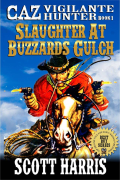 Kaye: What can you tell me about your CAZ: Vigilante Hunter series?
Scott: This series is pretty much the antithesis of the Brock series. It is six books (Slaughter at Buzzard’s Gulch, Never Shoot A Woman, The McKnight Massacre, Fire From Hell, Hell on Devil’s Mountain and A Whore’s Life) about a man named Caz (no last name) who travels the West searching for and killing evil men who have evaded justice. The series was an absolute blast to write.
Kaye: When writing for a series, do you outline the whole series from the start, or do you add books as you go? Are the books stand alone, or do the follow a chronological path which should be read in order?
Scott: I am on my 3rd series now (Stagecoach Willy) and I’m in the middle of the 2nd book. I have no idea where the next books are going to go and won’t think about the 3rd book until I finish this one. As a matter of fact, I do not outline my books at all. When I finish a chapter, I have no more of an idea of what the next chapter holds than the reader will. I know that’s different than most writers, but for me, it keeps the writing fresh.
For the most part, the Caz books can be read as stand alone, there is very little crossover from book to book. The Brock series is different and benefits by being read in order.
 Kaye: The most recent book in the Brock Clemons series is Coyote Canyon. Can you tell me a little about that book?
Scott: Coyote Canyon came out early last year and was the 3rd book in the Brock series. The series can be thought of as two different trilogies (Dry Springs and Grand Canyon), so in that sense Coyote Canyon was the last in a trilogy. It was a fun book to write because it wrapped up Brock and his families time in Dry Springs and set the stage for them to move to the Grand Canyon.
Kaye: In addition to your western novels, you have also contributed to several western anthologies. Do you prefer writing book length works or short fiction? Why?
Scott: I think that depends on my mood. My short stories range from 500 words to 5,000 words and sometimes I have an idea that I think is powerful, but requires no more than a short story. It can be freeing to write shorts without having to worry about the continuity that novels require.
On the other hand my novels (Brock averages about 50,000 words per book and Caz closer to 30,000 words) allow me to explore ideas and characters in depth. I would hate to be limited to one or the other.
 Kaye: You wrote a collection of short stories together with your son, Justin. How did that work? Did you write each story as a collaboration or did you each contribute stories of your own? Was it a good experience? Would you do it again?
Scott: We wrote our own stories, though we talk 2-3 times per week about what we’re working on. He is my best story editor and muse. It was a great experience and we’re working on some things together right now. He’s also about halfway done with his first novel.
Kaye: What is the most fun about writing western for you?
Scott: Coming up and with sharing my ideas. It is really exciting to be able to create stories and characters and then do with them what you will. I have learned that it doesn’t take long before the character takes over and I find myself saying “He/She would never do/say that”
Hearing from readers that they like my work is tremendously rewarding. And I’m just old fashioned enough to still love seeing my books in actual print, with paper, ink and a cover.
Kaye: Your blog recently received the Feedspot award, ranking it up there with the top 20 western blogs out there. I believe your blog was actually ranked in the top 10. Would you like to talk a little about that?
Scott: It was flattering, of course. I try to write posts that are honest and candid. I share my troubles and mistakes (at least with regards to writing) and I believe that resonates with people. I love getting feedback from readers. I am absolutely certain that I learn as much, if not more, from my readers than they do from me.

Kaye: Since you write one of the top western blogs, and have been a fan of westerns since an early age, what do you see when you look at the genre today? Do you find more male or female western authors? Do you find the genre dominated by independently published authors? Do you find it trending more toward western romance these days?
Scott: The genre certainly leans toward being male dominated, but it’s changing and more and more women are getting involved, which is great. Certainly the 3-4 huge names dominate the book stores and it’s tough for most of us to get any shelf space. But, Amazon opens the world for independent writers and gives many of us a chance to find an audience. Can’t ask for more than that.
I have noticed the western romance genre getting more notice and attention. It’ll be interesting to see if that continues.
Kaye: Where do you see the western genre going in the future?
Scott: Wherever we want to take it, or maybe more realistically, wherever the readers want us to take it. There are plenty of different genres sitting under the Western umbrella, so it’s up to us to write some great books and pull in readers – new and old – and at the same time, we need to listen to what the readers are telling us.
 Kaye: What is in store for the future for Scott Harris? Does Brock or Caz have more stories in store for them? You are working on the second book in the Shotgun Willy series? Tell me about that series, if you would.
Scott: I’m done with Brock and Caz for now. I am working on the 2nd book in the Stagecoach Willy series. Willy is a stagecoach driver and keeps stumbling into trouble and then I need to write him out of it. He has a sense of humor, which is fun to write and has a partner, Ten, that he’s been staging with for years. When I finish the 6th book, I plan to do a “capstone” book that brings Brock, Caz and Willy together in one grand book.
Kaye: What do you like to do when you’re not writing?
Scott: Spend as much time as possible with my wife, Randi, my son, Justin and my daughter Samantha and her husband Devin. Randi and I travel quite a bit, try to take one RV trip per month. Next month is a 3 week trip to South Bend to watch our daughter graduate from Notre Dame Law School.
Next year, we’re retiring and moving to Tennessee. Very much looking forward to it.
I want to thank Scott for chatting with me here and sharing some of his expertise in the western genre. I very much enjoyed this and hope all of my readers have, too. You can learn more about Scott Harris on his blog and website, or on his Amazon author page. Join me next month on “Chatting with the Pros”, when my guest author will be hardboiled crime fiction novelist Jim Nesbit. I hope to see all of you then.
Like this post? Let me know in the comments. You can be sure not to miss any of Writing to be Read’s great content by subscribe to e-mail or following on WordPress.
Posted: May 13, 2019 | Author: kayelynnebooth | Filed under: Fiction, Historical Fiction, Interview, Western, Writing | Tags: Author Interview, Author Profile, Freckled Venom, Juliette Douglas, Western, Writing to be Read |
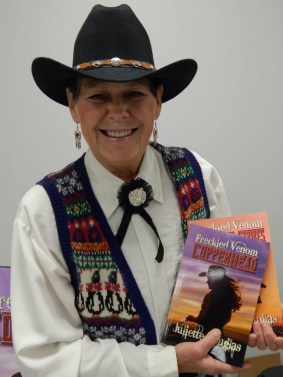
I’m pleased to be chatting today with a prolific author who has burst onto the western scene in a relatively short amount of time. Her debut novel, Freckled Venom, was a Laramie award winner, and she recently signed on with Delilah‘s publisher, Dusty Saddle Publishing. The amazing part is she manages churn out all of her many books, while still holding down a traditional job outside the home, as well. Let’s see if she has any secrets to share. Please welcome western author Juliette Douglas.
Kaye: Your website says you are a new voice in the western genre, but it seems like you have written a lot of books. How long have you been writing western?
Juliette: I was a new voice 5 years ago, as I tend to have more grit in my novels then most women western writers.
I was 1st published in 2013, but the publisher was awful so ditched them and became indie and re-issued my books with new covers and re-edited interiors in 2014. So that’s when I like to say I’ve been published.
Kaye: What did you write before westerns?
Juliette: I have never written a thing before in my life. So I guess you could say I’m a late bloomer.
Kaye: Do you think it is more difficult for a woman to author a western novel and make a success of it?
Juliette: No I don’t. When I began to promote my novels at local events, I sold more to men then women. Since then I have all ages who read my books.
I personally feel it’s easy for me to write strong female characters in an old western setting then to write a contemporary western.
I love history, so it’s a good match for me. I’ve been blessed with my success. I know I am up against many good male western writers who have been around much longer then I have, but I’m making strides.
Kaye: What’s the biggest challenge in writing westerns for you?
Juliette: Making sure the things I want to happen are in the right time frame, I use the weapons for that era etc. For example: smokeless gunpowder did not appear until the 1890s.
Kaye: Your female characters are bold and brassy in a genre where women are typically portrayed as damsels in distress needing rescued by a big strong man. How do you write your heroines in a way that makes them believable, yet allows them to remain independent?
Juliette: I try to put myself into the situation. How would I feel, behave, emotions I might hide or display. Would I be angry or decide these are the cards I was dealt and how would I go about living my life with these secrets or circumstances thrown at me. Women who carved out a future for themselves in the old west had to be some of the strongest I have ever read about and I try to portray that with my characters.
Kaye: What can you share about your Freckled Venom Series?
Juliette: It was a great experience for me as a writer. I loved how my characters took over and I was just the messenger typing out their words and feelings.
 The Freckled Venom Series is very different then most western novels out there because it has a gun toting rugged female who bounty hunts instead of the usual male filled westerns. I’ve reversed the roles you might say.
In Freckled Venom Skeletons I tried something different. I had two points of view going on. One from the children’s POV and then the adults and it worked very well.
There will be many more stories in the FV Series. This summer I will have Freckled Venom Vixen The Early Years and for Christmas, Plum Dickens of a Christmas. A reunion of sorts with all the characters brought together in this book.
Kaye: What do you consider to be the single most important element in a western?
Juliette: Good storylines & plots. Plenty of action and hair-raising adventures.
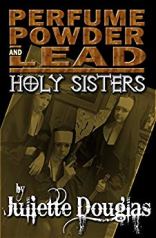 Kaye: Would you talk a little about Perfume, Powder and Lead: Holy Sisters?
Juliette: Hahaha…This was one of the most fun books I have written. The idea is so absurd that this would have happened, but a possibility in those days.
Three soiled doves are tired of that life and set out to the gold fields, but they need money to get there. They stumble across nuns killed by raiders, and the girls change their habits, so to speak and make plans to rob a bank dressed as nuns.
But there are deeper elements also allowing the reader to form a bond with these girls.
It’s raw, it’s gritty and it’s not for everyone to read.
Kaye: Are there any of your books which you’d classify as western romances?
Juliette: I have the teasing potential of romance in most of my novels and my readers seem to like that.
Kaye: One of your most recent releases, Bed of Conspiracy, sounds to me like an
historic thriller involving political conspiracy, assassination plots and cloak
and dagger action, all set during the Grant administration? Was it difficult for
you to stray outside of the western genre?
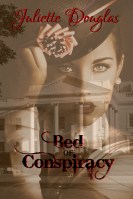 Juliette: Oh man, I had wanted to do this story for 3 years before I finally found time to write it.
Loved writing this one! Set in 1876 it wasn’t hard for me at all. I loved weaving actual events into the story. Looking at maps of Washington DC from 1876 to learn the layout of the city to include actual street names and places scattered about in the fictional story. It has ended up being one of my most popular novels and due to the high interest has spawned a series. Next one titled: Death Deals the Hand, A Ross & Sam Adventure.
Kaye: Where do you find inspiration for your stories?
Juliette: Every where. Everyday stories and situations that can be transported back in time to the old west!
Kaye: What’s the most fun about writing westerns?
Juliette: Everything!
Kaye: The first book in your Freckled Venom series was also your debut novel, Copperhead, which you won a Laramie Award. What is the Laramie Award and how does one receive it?
Juliette: The Laramie Award is the western division of the Chanticleer awards. I submitted Copperhead on a whim and won over very stiff competition.
For 2019 I will be entering Bed of Conspiracy in the Laramie Awards Adventure & Caper category. Will see what happens!
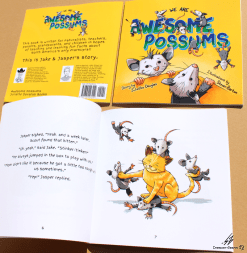
They also have a category for children’s books and I will be entering my 1st Children’s book: We Are Awesome Possums.
Kaye: Would you recommend aspiring authors attempt the western genre? Why or why not?
Juliette: You need to know the history of the old west for sure. There are still many untold stories out there to share, but it takes hard work to come up with a fresh idea with the old tales that would be marketable.
The American Old West is our history, no one else can claim it. It speaks to the hearts of men, women and children across the world. It is America’s claim.
Kaye: If you could have lunch with any author, alive or dead, who would it be? Why?
Juliette: Louie L’Amore. A fascinating man. His stories are based on a lot of his own actual experiences. It would be neat to visit and talk with him.
I want to thank Juliette for sharing with us today. It has been an absolute pleasure. You can learn more about Juliette Douglas and her work on her Facebook Author page or her Amazon Author page. I’m proud to share a publisher with Juliette. I hope you will join me next week on “Chatting with the Pros”, when my author guest will be another Dusty Saddle author, Scott Harris. I hope to see you then.
Like this post? Let me know in the comments. You can be sure not to miss any of Writing to be Read’s great content by subscribe to e-mail or following on WordPress.
Posted: May 6, 2019 | Author: kayelynnebooth | Filed under: Author Profile, Books, Christian fiction, Fiction, Historical Fiction, Historical Romance, Interview, Uncategorized, Western, Writing, Writing to be Read | Tags: Author Interview, Author Profile, Christian western romance, Christion fiction, Historical Romance, Lockets and Lace, Patricia PacJac Carroll, romance, Sandra's Journey, Sweet Romance, Western, Writing to be Read |
My author guest today is a prolific writer, who must publish an average of at least six books per year, in numerous romance series. Patricia PacJac Carroll writes historical and western Christian romance at a rate that I find amazing. The books on her Amazon Author page scroll in what seems like a never ending flow. In addition to her own series, which are many, on occasion, she’s invited to participate in series with a collection of other authors, as is the case with her most recent release. Let’s see what she has to share with us today.
Kaye: In what ways is writing a Christian western romance different from writing a western romance?
Patricia: For me, saying it is Christian means at least some of the characters have a Christian world view. Faith and hope in the Lord are evident in their lives. No preaching or sermons or a lot of verses, only faith as it relates to the story and the characters.
Kaye: Your latest book was recently released, Sandra’s Journey. Would you like to tell me a little about the story?
Patricia: Sandra is struggling, she’s walled herself in away from others. Her little brother’s death and the fact that a fiance left for Calfornia the year before and she only received one letter from him, have stolen her courage. She meets a corporal who is escorting the wagon train, and he challenges her to dream. Romance blossoms along the California trail where by trails end she will have to choose between the two men. A story of courage rediscovered and dreams coming alive.

Kaye: Sandra’s Journey recently came out as a part of a historical western series with a wagon train theme, which includes your book and those of several other Christian western authors. Would you like to tell me about the Lockets and Lace series?
Patricia: The Locket and Lace series is made up of several different authors. I was asked to join in 2018 and wrote Oregon Dreams for the Locket and Lace series for 2018. And then this year again for the Locket and Lace series for this year with Sandra’s Journey.
Every book has a connection to the Bavarian Jeweler in St. Joseph, Missouri. They have a locket that was made in the shop and a piece of lace. We had 9 books last year and 10 this year. They are all wonderful books
Kaye: The Lockets and Lace series books are not the only books you’ve written, by far. You have written several other series, including the Mail Order Brides and The Law Keepers series. How many books have you written? How long have you been writing?
Patricia: I have been writing seriously for thirteen years and began publishing in 2012. I have 40 books out right now and plans for many more. I have several series ~ Mail Order Brides of Hickory Stick, Montant Brides of Solomon’s Valley, and several others.
Kaye: Tell me a little about your author’s journey, if you would?
Patricia: I began writing and attending critique groups in 2006. I loved it, but my friends would call me the book of the week person because story ideas would attack me. I love the thrill of a new story and still do. Finally, I decided I better finish a book and my first book was Liberty Belle that I published in 2012.
Kaye: Your husband is instrumental in your writing, so much so that you’ve incorporated both of your initials into your author’s name – PacJac. Would you talk about how he enables you to write?
Patricia: My husband is a wonderful prince of a man who gives me the time to do what I love. He let me retire in 2006 so I could write. And now, my writing has enabled him to retire. We are a wonderful team and are enjoying our lives. I added the PacJac to my writing name because I found there were other Patricia Carroll’s out there in the writing world. It works well though because you put PacJac in Amazon and it will pop up my books.
Kaye: Your female characters of the contemporary strong and independent variety, or do they follow the traditional damsel in distress variety of heroine?
Patricia: I’d say they are a combination. While I want to be historically correct, readers live in the 21st century. I do like spunky women, but I also enjoy writing about a character who grows in courage and strength, too.
Kaye: What part of writing do you find to be the biggest challenge?
Patricia: The self-discipline. I am a seat-of-the-pants writer, and I tend to live my life the same way. I enjoy fun, family, and friends as well as writing so at times the need to balance comes into play.
Kaye: Where does your inspiration come from?
Patricia: The Lord. He gives me the stories. I am amazed at how He has made sure I understand that. One time I had the opportunity to put a Christmas story in an anthology and had a weekend to write it as it was due Monday at noon. Now, I had bragged that if you just give me a name and a place, I will come up with a story. Well, after my haughty attitude, my friends gave me a name and place and my imagination heard crickets. Nothing. Nada. No story. Now, that was a bit scary to me. A writer isn’t much without a story. So I figured I missed the anthology. But then at 5:30 Monday morning I woke up with a picture in my mind of a cowboy on a horse pulling a Christmas tree and knew I had a story. And I wrote it and turned it in before noon. You can find that story in my book Christmas in Texas. The Richest Christmas. So I will give the Lord all the credit for anything good that I do. Any mistakes are mine.
Kaye: Your books obviously are portrayed in a western landscape, based on historical times and events. What kinds of research do you find yourself doing for your books?
Patricia: Documentaries, books on the old west. I have always loved the west and westerns.
Kaye: Do you feel you draw pieces from your own life into your stories? How so?
Patricia: Yes, and I tell my friends anything may be used in a story. I know I often have my characters state “How hard can it be?” That is all me.
Kaye: What is the most fun part of writing western romance for you?
Patricia: I enjoy the characters and the things they get themselves into. Plus horses, I love horses and they have always been part of the draw to westerns for me. I also love the idea of the wide open wild country.
Kaye: What is something many of your readers wouldn’t guess about you?
Patricia: For twenty years, I owned and ran a pet store. Sea Horse Pets in Arlington, Texas. As you can guess I love animals. And people. I love to write, and my heart is that readers will enjoy my stories and be strengthened and encouraged by reading them. I enjoy making readers happy.
I want to thank Patricia for joining me today to share her thoughts with us. I don’t know about all my readers, but I am astounded by the sheer volume of her works. You can learn more about Patricia at the links below. Stop in and see if you too are not awed by the books she’s produced within the span of the past seven years.
Links
Author page on Amazon: https://www.amazon.com/Patricia-PacJac-Carroll/e/B008R9JCN2/
Facebook Author page: https://www.facebook.com/PatriciaPacJacCarrollAuthor/
Website: http://www.pacjaccarroll.com/
Newsletter sign up http://eepurl.com/bpPmbP
Like this post? Subscribe to Writing to be Read for e-mail notifications whenever new content is posted or follow WtbR on WordPress.
Posted: April 22, 2019 | Author: kayelynnebooth | Filed under: Books, Contemporary Romance, Fiction, Interview, Paranormal, romance | Tags: Author Interview, B.T. Clearwater, Chris Barili, Paranormal, Paranormal Romance, romance, Smothered, Writing to be Read |
Today I have the pleasure of interviewing author Chris Barili, and although he’s written in other genres, and his latest release is the fantasy novel Shadow Blade, which I reviewed last month, he also writes romance under the name B.T. Clearwater. You can read my review of his paranormal romance, Smothered, here.
In January, we talked to women’s fiction author Barbara Chepaitis and western author Loretta Miles Tollefson about the fact that women authors still are encouraged to use sex neutral pen names when writing certain genres, but here we have a male author who uses one when writing romance. We’re going with talk to Chris about writing romance and why there aren’t more male romance authors today. Or are there? Let’s find out what Chris Barili has to say about it.
Kaye: You have fiction published under your own name, but when it came to Smothered, your publisher suggested you publish as B.T. Clearwater. This is the reverse of what many female authors experience when publishing in certain genres, such as western. Did you feel like there is discrimination toward male romance authors?
Chris: My publisher didn’t encourage the pseudonym, actually. That was advice from a mentor and college professor, who recommended different pen names for different genres due to perceptions in the industry that if you write one genre well, you’re limited to that genre. I also publish westerns under a different pen name, T.C. Barlow.
And while I didn’t experience discrimination toward me as a male romance writer, I did get some raised eyebrows and comments like, “You write THAT?” So I had my youngest daughter think up a pen name that used my initials, and that sounded gender neutral. She came up with B.T. Clearwater.
Kaye: Do you think it is harder for male authors to make it in the romance genre than it is for female authors? Why?
Chris: I think it’s harder because not enough men have tried, so there’s no benchmark for it, no evidence to the doubters that men can do it. Men tend to avoid it because of the stigma associated with writing “that” kind of fiction.
Kaye: What is the biggest challenge of writing romance for you?
Chris: Probably making it “juicy” enough for a modern audience. I’m an old-fashioned guy, so I like love stories, and I tend to focus on the emotional relationship rather than the sexual one. Many (not all, but many) romance readers are looking for the steamy stuff, and that just isn’t me.
Kaye: You have a family, and are involved in cycling and martial arts, yet you find time to write and attend conferences and seminars. What are your secrets for juggling writing with your home life?
Chris: Mostly, I neglect my dog. 😊 No, that’s only a little true. As with anything, finding time for writing is a matter of discipline and sacrificing things that are less important. I had to remove a video game from my computer because it was distracting me from writing. Similarly, my DVR is 90% full of programs I fully intended to watch, but can’t get to because of writing. You have to make writing THAT important. My priorities are: my family, my health, the day job, writing. Everything else comes later.
Kaye: What is your favorite genre to write in? Why?
Chris: I’m actually published in every fiction genre: fantasy, science fiction, romance, horror, western, and crime. I don’t know that I have a favorite, but I do most of my writing in the fantasy and romance genres. They’re all fun to write, and one of the things I learned during my MFA studies under Russell Davis at Western is to let the story find its genre. Don’t try to force it into one you’re comfortable writing.
Kaye: If Smothered was made into a film, who would you like to see play male and female leads?
Chris: Interestingly, when I develop a character, I often choose a model, actor, public figure, etc to roughly model their looks. In this case, I used actor James Denton as a rough look-a-like for Mike, and Annie was loosely modeled on Jeanine Garofalo. So yeah, them.
Kaye: What’s is the single most important element in a romance story?
Chris: Damage. The lead female character has to be broken somehow, and the only way she can heal herself is to be with the male lead. It’s corner, and not a great way to base a real relationship, but that’s kind of the trope of romance. She has to realize she cannot live without him.
Kaye: Where did you find the inspiration for Smothered?
Chris: Again, my MFA studies, only this time in a class with Michaela Roessner. She had us write a sex scene that gets interrupted somehow, and I had mine interrupted by the ghost of the woman’s late mother, who appears at the foot of the bed. That interested me so much that it grew into a novel, which was my MFA thesis.
Kaye: What was the most fun part of writing a romance for you?
Chris: Romance is a very formulaic genre, and the fun part, for me anyway, is finding a way to make that formula sound new. They say there are no new stories, only new ways of telling old ones, and I think that’s what I like about romance. Proving to doubters that it CAN be original and unique.
Kaye: Is there a future for B.T. Clearwater? Can readers expect to see more from this author?
Chris: Oh yeah, B.T. has a novella published in Gwyn McNamee’s Last Resort Motel series, called “Room Fifty-Eight.” That came out a few months ago, and will appear in a box set soon. And B.T.’s latest novel, Rise and Fall, needs to go off to the freelance editor soon for a work-over. I decided to take B.T. full indie, to self-publish those stories, because self-pubbed romances can do very well. Gwyn has given me some tips on how to get it right. So when Rise and Fall and the next two in that series are ready, I’ll upload them and see how they do.
Kaye: Chris Barili has a fantasy novel coming out in June, Shadow Blade, which I recently reviewed. Would you like to tell us a little bit about that one?
Chris: Shadow Blade was actually my backup thesis. Yeah, I had a backup. Outlined both, but wrote Smothered and saved Shadow Blade for after graduation due to the world-building it needed. It tells the story of Ashai Larish, an assassin for the feared Denari Lai order. The Denari Lai are a religious order that keeps their killers loyal by addicting them to the very magic that makes them so effective at killing. In Ashai’s case, he is sent to kill a king and his daughter, but falls in love with the princess, and finds himself fighting to keep her alive rather than to kill her.
Shadow Blade is being published by WordFire Press, as a “Kevin J. Anderson Presents” title, where the best-selling author highlights a new author “to watch.” It’s on a review tour now, and should come out in e-book and hard cover in May, and by the time this article airs, it will be out as part of WordFire’s “Epic Fantasy” bundle at StoryBundle.com.
I want to thank Chris for joining us and sharing today. It is interesting to learn about writing romance from a male perspective. You can learn more about Chris and all of his works on his author blog and website, his Amazon Author page, his Goodreads Author page, as well as on Facebook and Twitter. You can learn more about the works of B.T. Clearwater on Amazon, Goodreads, Simon & Schuster, and Smashwords.
Like this post? Subscribe to Writing to be Read for e-mail notifications whenever new content is posted or follow WtbR on WordPress.
Posted: April 15, 2019 | Author: kayelynnebooth | Filed under: Author Profile, Books, Chatting with the Pros, Fiction, Historical Romance, Interview, romance, Writing | Tags: Author Interview, Chatting with the Pros, Historical Romance, Maya Rodale, romance, Writing to be Read |
Today on “Chatting with the Pros” my guest author is a historical romance novelist, Maya Rodale. She writes strong female characters who stand up for themselves and still manage to maintain their feminity. Her books have appeared on the USA Today bestselling list and have been published in several languages. Her novel, The Wicked Wallflower won the RT Reviewer’s Choice Award for best historical hero, and What a Wallflower Wants was labeled as a romance novel for the #MeToo movement. I’m pleased to have the opportunity to chat with her today and learn her thoughts on romance, female authors and women’s place in the world.
Kaye: Your stories favor strong heroines for your main characters. Do you think romance is usually a female domain?
Maya: Romance has been traditionally a female domain, though 18% of readers today are men! I would love to see more men openly reading romance, but I also hope it never loses it’s focus on the female experience and the empowerment it brings to so many women in publishing.
Kaye: Perusing your website and checking out your book covers, one gets the impression that your romances are a bit risqué. How steamy can you get before you cross over into the land of erotica? Do your books cross that line?
Maya: Romance Writers of America provides the best succinct definition of erotica: “Romance novels in which strong, often explicit, sexual interaction is an inherent part of the love story, character growth and relationship development and could not be removed without damaging the storyline.”
So it’s not a matter of how much sex is portrayed but how the sex engages with the plot. My historicals definitely have some steamy sexy times on the page, but I wouldn’t classify them as true erotica.
Kaye: How do you decide the titles for your books? Where does the title come in the process for you?
Maya: A title needs agreement from both the publishing team and myself; sometimes the title I pitch is the one we go with. Sometimes the story is nearly done and we’re frantically brainstorming at the last minute to find something that works.
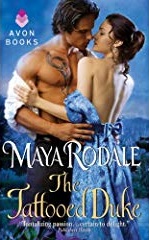
Fun behind the scenes story: I wrote The Tattooed Duke thinking the title would be Brave New Lord which I LOVE but my pub team thought The Tattooed Duke had better sales potential, so that’s the one we went with.
Kaye: Your books feature strong female heroines, who stand up for themselves and what they believe against the men around them and societal beliefs. Why do you think your readers relate to them?
Maya: I think this is the experience for most women: we are constantly having to stand up and assert our humanity. I like to think that my heroines help real women have the courage and confidence to do this. And for those readers who don’t feel it’s necessary, I hope they see that it is.
Kaye: What are some tips for writing strong female characters in a time period when there weren’t many to be found, and making them believable?
Maya: The more I dig deeper in my research of history the more I believe that this is a myth. Women have always gotten out of the house and done great, wonderful, terrible things; but it hasn’t been recorded, or their stories haven’t been told, or (male) historians deemed it unimportant. Women have never been boring, silent bystanders to the world.
I think we’ve been (maybe deliberately) shut out of history books and as a result we don’t know the long and full history of women being active participants in the world. Start with a look at the New York Times Overlooked Obituaries, for example.
The problem isn’t that strong historical female characters aren’t accurate, the problem is that we have been made to believe they are. And in the name of “historical accuracy” we unwittingly perpetuate that in our novels.
My tip for writers: find those stories, write those stories! And then explain your research in the author’s note. And my advice for readers: check your biases and preconceived notions and let yourself get swept up in the story. You may just learn something new about history too.
Kaye: What’s the biggest challenge in writing romance for you?
Maya: Protecting my time! It’s my day job and still there are so many demands on my time and energy that make it hard to focus on my books.
 Kaye: You wrote a nonfiction book titled Dangerous Books for Girls: The Bad Reputation of Romance Novels Explained. Can you explain briefly why romance has a bad rep and it is justified?
Maya: Romance novels have a bad reputation because they’re so powerful—they are the only art that consistently portray women triumphing in a world that doesn’t want women to triumph. Mocking them as “trashy books” or just “mommy porn” or “unrealistic” is a way to diminish their power. If we valued women and women’s work more, we’d value romance novels more!
Kaye: How many different countries and languages are your books sold in?
Kaye: What’s the most fun about writing romance?
Maya: I do love being the all powerful Goddess of fictional worlds. And not having to get dressed up for work 😉
Kaye: What do you think is the single most important element in a romance story?
Maya: The development of the romantic relationship! And the happy ever after, of course.
Kaye: Where does inspiration for your stories come from?
Maya: Story inspiration is everywhere if you open your heart and mind to it! Right now I’m finding the New York Times “overlooked obituaries” of historical women to be a gold mine of story ideas for historical romance. I just need more time to write them…
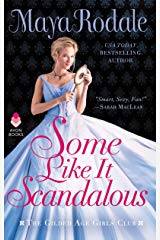 Kaye: You have a new book in your Gilded Age series coming out in June, Some Like it Scandalous. Would you like to tell us about it?
Maya: Longtime enemies embark on a sham engagement and end up falling in love! The only way for society darling Theo Prescott to survive his most recent, unspeakably outrageous scandal is marry someone respectable. Someone sensible. Someone like Daisy Swan. But she has plans that do not include a loveless marriage to anyone. Instead, she aspires to sell cosmetics that she has created. But this brainy scientist needs a smooth talking charmer’s flair for words and eye for beauty to make it a success. Before long, Daisy and Theo are trading kisses. And secrets. And discovering that despite appearances, they might be the perfect couple after all.
Kaye: As a romance writer, what kind of research do you find yourself doing for your stories?
Maya: I do A LOT of research. Everything from reading biographies, non-fiction, histories, other novels to trips to the library or visits to museums. Or just googling. There’s general research to do about the time period—for example, I had to learn all about the Gilded Age (1860-1900) in Manhattan for my new seriesThe Gilded Age Girl’s Club.And then there’s research necessary for each particular book. For the next book in the series, Some Like It Scandalous I had to do a deep dive into the invention and popularization of cosmetics, since the heroine launches a cosmetics company with the hero.
Kaye: What advice do you have for aspiring romance authors?
Maya: My best advice I think comes from Nora Roberts: “Ass in the chair. Words on the page.” Also, my friend once told me “If you’re not getting a rejection once a week you’re not trying hard enough.” Brutal, but effective.
Like this post? Subscribe to Writing to be Read for e-mail notifications whenever new content is posted or follow WtbR on WordPress.
Posted: March 18, 2019 | Author: kayelynnebooth | Filed under: Books, Chatting with the Pros, Collaboration, Dark Fantasy, Fantasy, Fiction, Interview, Science Fiction, Speculative Fiction, Teaching Writing, World Building, Writing, Writing to be Read | Tags: Chatting with the Pros, Fantasy, Kevin J. Anderson, Writing to be Read |
My guest today on “Chatting with the Pros” is an award winning and best selling author who has written countless novels and over 56 national and international best sellers. A majority of his works fall into the science fiction or fantasy genres, but he writes across many genres. In a recent introduction for “The Big Idea: Kevin J. Anderson“, an article about the latest release in his short fiction collection, Selected Stories, John Scalzi calls him, “one of the most prolific authors working today”, and one look at his immense book list on Amazon would leave no doubt that this is an accurate assessment. (You can find my review of selected stories here). He’s written a lot of books, 56 of which have hit the national and international best seller lists, and he’s been writing for many years, and I’m sure we will find his knowledge and experiences enlightening. Please help me welcome Kevin J. Anderson.
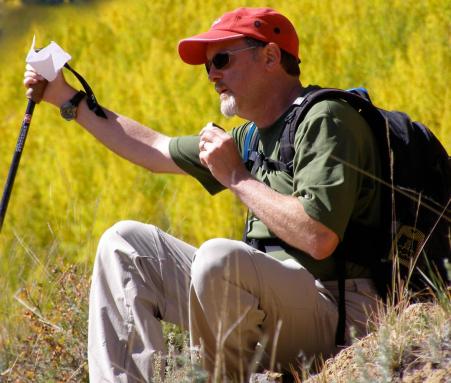
Kaye: You have written at least 56 national or international best sellers. What makes a good story in your mind?
Kevin: People want to read a good story with an exciting/interesting plot, a well-developed setting, and engaging characters. Make it a story you WANT to read, with clear prose and action. I don’t like muddled, glacial-paced stories where the prose is just too precious.
Kaye: Why science fiction and fantasy? Why not western or romance or mystery? What’s the attraction?
Kevin: Well, I’ve also written plenty of mysteries, and some of my work has been set in the old west, and most good stories have a strong romance component (though I don’t write category Romance or Westerns). I like to tell an interesting story, and I move around a lot among genres, even though I am primarily known for science fiction or fantasy. I grew up in a very mundane small town in rural Wisconsin, and I was captivated by SF/F from an early age, because it showed my imagination what was possible. I wanted to go to exotic places, whether they were filled with aliens or dragons. Science fiction took me to a much wider universe. (And as a skinny, nerdy kid with glasses and a bad haircut, “romance” wasn’t much of a possibility, so I stuck with spaceships and swords.)
Kaye: You wrote several Star Wars and X-Files novels. Is it difficult to immerse yourself in someone else’s settings and characters enough to pick up a thread and run with it in the same tone and writing style? How do you go about getting yourself into that mindset?
Kevin: It’s no more difficult than trying to immerse yourself in the old west or ancient Japan for a historical. A writer’s job is to absorb the story, characters, voice, and setting. I was already a big fan of Star Wars, Star Trek, X-Files, and Dune, and I enjoyed going to work in those universes. In each instance, I would completely surround myself with the property — whether that meant watching the Star Wars films over and over again, or the episodes of the X-Files, or repeatedly rereading DUNE and its sequels. You pick up the manner of speaking, the “look and feel” of the world, and you make it into your own story.
Kaye: You’ve done several collaborations, including books of the Dune series, with Brian Herbert and the Clockwork books which you collaborated with Neil Peart, drummer for the band Rush. What is the biggest challenge when collaborating on a book?
Kevin: You both need to have the same vision for the book—which means a LOT of talking and brainstorming ahead of time—and you both need the same work ethic (so each partner puts in the same amount of time and effort…a tortoise and hare collaboration will just cause a lot of friction), and you need to be flexible. There’s never only ONE way to write a sentence or describe a scene. I would never want to collaborate with a diva!
Kaye: Do you belong to any writing organizations? If so, which ones? Do you feel your membership in these writing organizations have been helpful in your writing successes? How so?
Kevin: I belong to the Horror Writers Association (and edited three anthologies for them, the BLOOD LITE series), IAMTW (International Association of Media Tie-In Writers), and SFWA, the Science Fiction and Fantasy Writers of America, although some of their recent decisions have made me so upset that I would not renew my membership if I wasn’t already a lifetime member. The problem with such organizations is that you can become to engrossed in the politics and bickering that you forget your real purpose, which is to WRITE.
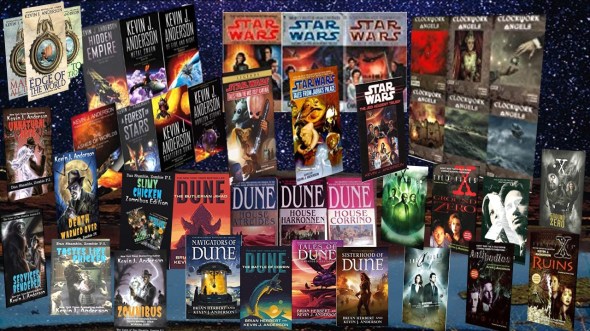
Kaye: You’ve written several series, including Saga of the Seven Suns, Dan Shamble P.I. and the Clockwork books? Are any of your books stand alone? Why do you lean toward series?
Kevin: I’ve written many standalone books. The one I just finished last week, a vampire/serial-killer thriller STAKE, that’s not part of a series. But I like to tell big stories, and once you’ve done all the effort of world building and character building an entire universe, you want to spend some time. To me, a trilogy is perfect — a beginning, middle, and end, with enough room to tell the story and describe the world in all its glory. Pragmatically speaking, it’s a much better decision commercially to build a series, because readers will want more and more, and each new book will help sell copies of previous volumes. Can you imagine if A.C. Doyle had stopped after writing only one Sherlock Holmes story?

Kaye: Science fiction authors create whole worlds from their imaginations, often with new languages created in their own minds, and you have created many. How do you go about creating a new language?
Kevin: Hmm, creating languages? I’m not really a linguist and I don’t know that I’ve developed full languages (though I do use weird words). I just make up the words by making what seem to be the appropriate sounds, linguistic flavors, scary sounds for monsters or villains, softer or ethereal sounds for pleasant things. I can’t really explain it more rigorously than that.
Kaye: Your work has won many prestigious awards. Which award are you most proud of? Why?
Kevin: Awards are awards, and it’s nice to have them, but I really prefer READERS. That’s what makes your writing worthwhile. It’s not terribly prestigious, but the award I value most is one I received very early in my career, when I received a trophy with an engraved brass plate and everything, naming me “The Writer with No Future” because I could produce more rejection slips than any other writer at an entire conference. To me, that didn’t mean I was a failure as a writer or that my work was awful—it proved that I was more persistent, that I kept trying, kept getting better, and never gave up. I still have that trophy.
Kaye: In addition to being an author, you and your wife, Rebecca Moesta, are publishers at Wordfire Press, but originally you were traditionally published. Why the switch to being your own publisher after being traditionally published for so many years?
Kevin: Survival. No choice. The publishing industry has undergone a tremendous upheaval equivalent to the Industrial Revolution, and I could either be a mammal and evolve or stay a dinosaur and go extinct. I am still traditionally published (four books released in 2018, in fact, and a new 3-book contract from Tor Books for an epic fantasy series), but I also have a lot of backlist titles that were out of print and my fans wanted to read them. So I started releasing them myself with all the innovations of new technology. It’s just another alternative.
Kaye: What does Wordfire press offer as a publisher for other authors?
Kevin: We are nimble and flexible, and we can produce books and get them to market far quicker than a traditional publisher can manage. But when you work with an indie publisher, or if you do it yourself, then you have to do all the work, all aspects of it. It’s another income stream and another way to get your book in front of your audience.
Kaye: Is Wordfire taking submissions? What type of fiction is Wordfire looking for?
Kevin: Not really, I’m afraid. When we are open, we’re looking for established writers who don’t need their hands held, writers who already have their own platforms, fanbases, and marketing efforts because we have to rely on them to do the work that a whole department at a traditional publisher would do.
Kaye: You recently signed on as an adjunct professor at Western State Colorado University and you are a finalist candidate for the director of their Certificate in Publishing program. What prompted you to venture into the world of academia?
Kevin: Actually, I’m now a full professor and I run their Masters program in Publishing. I will start the first group of MA students this coming summer. There’s a LOT of paperwork and bureaucracy in academia! I have taught writing and publishing quite often at countless writers’ conferences and conventions, most notably our own Superstars Writing Seminars, which is just hitting its tenth year. Becoming a professor and teaching at a beautiful university in the Colorado mountains is great, offers a little more stability than freelance writing, and (the bane of all freelancers) it gives me health insurance and benefits I wouldn’t otherwise get.
Kaye: Any writing pet peeves?
Kevin: I don’t like artsy-fartsy stuff, dense prose and opaque plots. Tell me a great story with a cool setting and interesting characters!
Kaye: Creating characters, developing plot, world building – what is the most challenging part of writing for you?
Kevin: Those are all fun, but if I had to choose I would say I have most difficulty with building rich, fleshed-out characters. Plotting and worldbuilding—that’s what I excel in.
Thanks to Kevin for sharing with us today. He’s given us food for thought with some really great answers. You can find more about Wordfire Press here: https://wordfirepress.com/. Kevin and his wife, Rebecca Moesta, head up the Superstars Writing Seminars each year in February, in Colorado Springs, Colorado, for those interested in learning the business of writing. If you’d like to become a member of the Superstars Tribe, or would just like more information about Superstars, visit the folowing link: superstarswriting.com. Visit the links below to learn more about Kevin J. Anderson and his works.
Amazon Author page: https://www.amazon.com/Kevin-J-Anderson/e/B000AQ0072/ref=sr_ntt_srch_lnk_1?qid=1545798018&sr=1-1-fkmr1
Wordfire Press: http://www.wordfire.com/
Blog: http://kjablog.com/
Join us next month on “Chatting with the Pros”, when I’ll be chatting with romance author Maya Rodale. You can catch the monthly segment “Chatting with the Pros” on the third Monday of every month in 2019, or you can be sure not to any of the great content on Writing to be Read by signing up by email or following on WordPress.
Posted: March 4, 2019 | Author: kayelynnebooth | Filed under: Books, Dark Fantasy, Fairy Tales, Fantasy, Fiction, Interview, Writing | Tags: Adult Fairytales, Author Interview, Author Profile, Fantasy, Laurel McHargue, Writing to be Read |
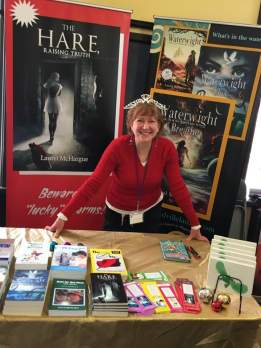
I’m talking today with fantasy author Laurel McHargue, a woman with a lot of energy. She’s written eight books including her Waterwight fantasy series and an adult fairytale, The Hare, Raising Truth, she hosts her own podcast, Alligator Preserves, is a former teacher and active community member, networks and promotes her works online, and finds time attend writing events for face to face interactions with her fans and potential new readers, as well as other authors. Even through email the positive energy radiates from this author. I could give you a lengthy fanfare on how impressed I am with this lady, but I think it’s better to let you see for yourselves. So, without further ado, please welcome Laurel Mchargue.
Kaye: Would you talk about your author’s journey? How did you come to come to be a writer?
Laurel: When I was quite young, I learned I could get attention by telling stories. As the fourth of five girls, I was low on the proverbial totem pole when it came to feeling important, so I had to be creative. I think my wild dreams helped, though eventually, my parents would roll their eyes when I’d come down in the morning with an “unbelievable” dream I’d just have to share. Who knew a dream would launch my first fantasy series? I didn’t then, but hey, I was just a kid!
Fast forward through a lifetime of unique experiences that people were curious about—I was frequently told, “You should really write about that!”—and I finally made the decision to make writing my career. I always did well in classes that required writing, and there were teachers along the way who encouraged me greatly.
I think I always knew I’d write stories someday, but until I made the commitment, it was always a “someday” kind of dream.
Kaye: What can you tell me about your YA fantasy series, Waterwight, and specifically about your Waterwight Breathe which will be released on March 15th?
Laurel: Waterwight started with a dream in which I was running away from bad guys through a dilapidated town, and I came up against a large body of water. The only way across it was to fly, and so I flew. Halfway across, however, I doubted my ability to make it to the other side and started to fall. A flying frog appeared and said, “Grab hold!” and I grasped his leg. He got me to the other side and then died in my arms. The dream had other elements I was able to use in my story as well. Anyway, I shared the dream with my author friend Carol Bellhouse (because I wasn’t living at home anymore!) and she told me I needed to write a story around it.
At the time, I’d never written fantasy, and the thought of turning a dream into a story thrilled and terrified me! Over the course of a year my story unfolded chapter by chapter, and by the time I got to the end, I wasn’t ready to leave my characters. I knew there was more for them to do, and there were questions I needed to answer. So, Waterwight Flux answers questions, develops characters, and sets up more challenges for Celeste, the orphaned protagonist.
I chose to write Waterwight Breathe, the final book, in first person present tense perspective after reading The Hunger Games. I love the immediacy of the thoughts and actions, and having the last book narrated by the protagonist seemed like the perfect way to end the series. I know it’s unconventional to have different points of view in the same series, but my life decisions have frequently been unconventional, and I have no regrets!
 Waterwight Breathe is available on March 15th, and it might be my favorite work yet. I couldn’t wait to get to the ending, the only part of the book I actually planned!
Kaye: You received three CIPA EVVY awards for the first book in the series. That’s quite an accomplishment. What is it about this book that makes it EVVY Award worthy?
Laurel: The CIPA EVVY awards are highly competitive, and each book is evaluated with a rubric—not against other submissions. The judges look at everything from cover design to editing to plot and character development. Waterwight is a fantasy adventure with mythical and mystical elements and a female protagonist; it received praise from Kirkus Reviews and many readers. I’d like to think those readers and the EVVY Awards judges felt compelled to keep reading at the end of each chapter. I had fun ending most of my chapters with cliffhangers!
The first book is also divided into three parts, so readers get to see what’s happening from different perspectives in each part. As a bonus, and because I’m a former English teacher, I added a synonym glossary and questions for discussion in the back of each book in the series. I don’t dumb down my prose for YA readers.
I used 99designs.com for my cover design and couldn’t be happier! The same artist created my covers for all three books in the series. Also, I paid a professional proofreader to ensure there weren’t any annoying typos or misspellings.
Kaye: Your novel Miss? is based on your own experience as a first-year teacher and earned the IndieReader Approved Award. Tell me about this book.
Laurel: I’m incredibly fortunate to have friends who are authors too. In 2012, one of those friends, Stephanie Spong, challenged me to do NaNoWriMo with her. I had never heard of such a beast! Well, being the competitive individual I’ve been told I am, I looked into it, and after thinking the 30-day personal challenge was ludicrous, I signed up on October 31st!
This was about six years after my first year of teaching 7th grade English in a doomed middle school. As a resigned Army Major, I honestly thought teaching 7th grade Language Arts would be a breeze. Oh…Em…Gee! I was very wrong.
Because I couldn’t believe what I was experiencing each day, at the end of the day I’d create a bullet-point list of everything that happened. I walked into NaNoWriMo with a year’s worth of those bullet points and had all the material I needed to write my first novel.
I remember telling my students, “Someday, I’m going to write a book about you all!” I said it as a humorous threat, and every class would be filled with hands going up and exclamations of, “Oh, Miss! Can I be in it?”
Although I couldn’t put all 130 students in “Miss?”, I meshed together many of them and included actual events from that year. I say it’s “loosely fictionalized” because of that, and because I added some romance and a scary situation that didn’t actually happen, but could have.
Kaye: Could you talk about your adult fairytale, The Hare, Raising Truth?
Laurel: The same friend who challenged me to NaNoWriMo challenged me to a 3-Day Novel Writing Contest! Stephanie Spong discovered the contest and really wanted to do it, so what choice did I have? (smiley face).
I sent my husband away for Labor Day Weekend (official contest dates), stocked my house with food and beverages, and set up little workout stations around the house. Stephanie came to my house ready to write for 72 hours and we agreed on rules: She could have the dining room, I had the “Red room” (that may have influenced my writing!), and no talking unless we happened to bump into one another in the kitchen.
We were very good girls!
As I enjoy challenging myself with different genres (and contests with crazy time limits), I decided to try something completely different for this contest. “I’m going to write it in 2nd person perspective,” I told Stephanie, and she warned me about the difficulty. Bonus, I thought. I also thought I’d write something light and funny.
Something happened, however, when I heard Rod Serling’s voice from The Twilight Zone in my head (in the Red room). My story turned darkly comedic quite fast, and there was nothing I could do about it . . . I had to see where it would take me.
I completed The Hare, Raising Truth—a Grimm’s Fairy Tale/Twilight Zone mashup—in about 38 hours. It’s novella length, and it was an absolute blast to write. My husband read it when he returned from his banishment and said it’s the best thing I’ve written so far, and I’ve had many people ask, “How did you get into the head of a horny teenage boy so well?”
Well…it wasn’t that difficult!
Kaye: You have a podcast called Alligator Preserves. What is that about?
Laurel: I started my podcast Alligator Preserves—which is about storytelling and the human condition—for several reasons. I wanted to be able to narrate my own books, so my husband set me up with the equipment I’d need to do that (even after I banished him that Labor Day weekend!). Also, friends had suggested that many of my blog posts should be recorded, since blog posts tend to get buried and lost once they’re posted. I wanted to be able to “tell” stories as well as write them.
When I started recording, I realized I had a great set-up for interviewing other people who’ve “done things” too, so I started asking racers and Reiki practitioners and authors and challenge seekers if they’d like to share their stories. The response was overwhelming, and now I have a hard time figuring out how to fit them all into my own schedule while still having time to do my writing.
Recently, I’ve gone to a pay-for-service model for anyone with a book or product they’d like to promote. Creating a podcast with another person is a lot of work. I value the time I spend reading and researching (prior to the interview) and editing and posting to social media (post recording). I provide all the links to the audio and video I create to my interviewee for use on their social media as well. For authors, it’s another plank to add to their author platform!
Kaye: What is the biggest challenge of writing fantasy?
Laurel: I can visualize scenes in my head so clearly, and most of them are fast-paced. The challenge is in slowing down my writing to help readers see what I’m seeing. Also, sometimes my writing is dream-like, and I have to find ways to convey that not-quite-real feeling.
That’s how multiple drafts help. I may blast through several chapters, totally believing that I’m conveying what my mind is seeing, and then I’ll have someone read them and they’ll say, “Huh? What just happened here? I don’t get it”!
My challenge is usually in adding more to a scene rather than deleting. There’s always more an author can do to make their writing sing more clearly!
Kaye: What’s the most fun part of writing for you?
Laurel: I think many authors might say that writing “The End” upon completing a project is the most fun, and I won’t lie—a happy dance always follows—but really, the fun is in the little surprises that happen along the way. It’s the unexpected character that pops into my head while I’m walking the dog or the funny thing a character will say. I’m more of a “pantser” than a “planner,” so I’m surprised all the time!
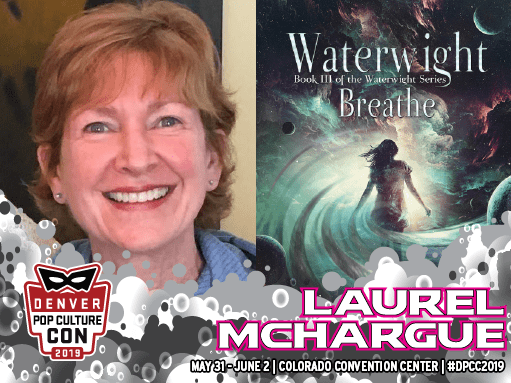
Sharing my work and having a fan say, “Wow! I loved that!” is another obvious fun part, but that’s after the writing is published. I brought my work to the 2018 Denver Comic Con and was blown away by the interaction I experienced with readers. I’ll attend the 2019 Denver Pop Culture Con (new name) this year with my completed trilogy and a new graphic novel! Now, that will be fun!
Kaye: Fantasy isn’t the only genre that you write in, and you hope to explore as many genres as possible throughout your writing career. What is your favorite genre to date?
Laurel: I’m horrible when it comes to “what’s your favorite” questions, but I’d have to say that I’m really enjoying short stories right now. I’ve entered several “flash fiction” contests with very short time limits, and being able to complete a project in a week or less exhilarates me!
I’m putting together a short story collection now. I’ve promised my Patreon patrons a new short story every month (which I narrate on my podcast Alligator Preserves) and when I’ve created enough, I’ll publish them and acknowledge my partons.
That said, many of my fans tell me they love my nonfiction blog posts. Once Waterwight Breathe is launched, my next big project will be a nonfiction piece based on my dad’s WWII letters. I hope to have a draft completed by the end of 2019!
Kaye: Where does your inspiration come from?
As Neil Gaiman said when asked where he got his ideas, “I make them up . . . out of my head.” (http://www.neilgaiman.com/Cool_Stuff/Essays/Essays_By_Neil/Where_do_you_get_your_ideas%253F). But how does inspiration get into my head? It gets there from every sensory experience throughout my days and from the Technicolor dreams I’ve had since I was a child. Someone said dreams are your brain’s way of dealing with all the things bombarding your senses during the day, and when I remember my dreams, I can often link them to something that has happened, or something that’s been “on my mind.”
Real people and creatures inspire my characters as much as imaginary ones (and who says the bizarre creatures in my dreams aren’t “real”?). Old Man Massive, the mountain spirit in my Waterwight trilogy, was inspired by an outcropping of stone on Mt. Massive that looks like an old, bearded man. Names and superpowers were inspired by real people I’ve known or met while writing the series. Zoya, my tragic octopus, was inspired by a paddleboarding experience on Twin Lakes, as was Noor, my fire-breathing dragonfly. The whole series started with a crazy dream I shared with a friend. I see and find inspiration all around me.
People have asked me where I get my imagination from, and all I can say is that it must be a gift from the universe! It’s certainly not a “thing” you can buy, and I’m not even sure it’s a “thing” you can learn. I consider myself quite fortunate that I was born with an imaginative brain.
 Kaye: What do you do when you’re not writing?
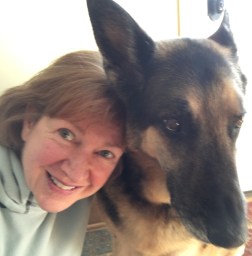
Laurel: When I’m not writing, I’m thinking about writing or I’m marketing my writing (sure wish I could clone myself for that task) or I’m reading or I’m recording a podcast episode or I’m cooking a yummy dinner or I’m brushing a pillow’s worth of hair from my German Shepherd or I’m cleaning out my sock drawer (because, where do all those socks come from?) or I’m swimming (several mornings per week, and not very fast) or I’m chatting with my friends or with one of my four sisters or I’m worrying about my sons (because I’m a mother) or I’m wondering how the day has passed so quickly. And other things, too.
Kaye: Hunting for Red Meat is a collection of memoir-style essays based on your own adventures hunting elk. When did you get the idea to make them a published collection?
Laurel: Several friends have told me how much they enjoy my blog posts, and one of them, Erin Sue Grantham (who also hunts), suggested I put them into a book. When I looked at putting them all in a book, I was overwhelmed by how many stories I had, and realized a book containing them all would be too big. So I thought about segregating them into topic areas.
After three years of hunting (and never filling a tag), I had plenty of hunting blog posts, so I decided to start there. Our oldest son, Nick, suggested it would be a “blook” a blog book, and I had fun coming up with the title.
I really thought I’d have a lot more sales by now with a title starting with “Hunt for Red…,” but alas, no. I honestly think many readers would enjoy it as it’s far more of an appreciation of the majesty of the wild outdoors than it is about hunting. I share my awe and my suffering, my adrenaline and my poetic moments.
My next “Blook” will probably be about our camping adventures.
Kaye: You have also published two books on Haiku. Do you have a special love for that poetry form? What is it that draws you to it?
Laurel: I love Haiku because—like a short story—they finish quickly. You have only seventeen syllables to play with, and it’s like completing a puzzle. Five-seven-five. That’s it.
Teaching grades 7-12 also gave me an appreciation for Haiku. When the word “poetry” comes from a teacher’s mouth, it’s generally followed by groans. Once a student learns how to count out syllables, though, and fit them into a “puzzle,” or a “math challenge,” for those more inclined toward that side of the brain, poetry suddenly becomes fun.
I was always amazed by the final products my students would create, boys as well as girls, and what fun it was to watch them tap on desktops or count on fingers while figuring out the syllabic pattern.
Haikus Can Amuse: 366 Haiku Starters “happened” after I dropped my cell phone into the ocean. Cell phones don’t like salt water. Anyway, I had a few weeks to kill before getting a new phone (I was away on vacation when it happened), and it was Leap Year, so I figured, why not come up with 366 first lines! I put that together as a gift journal for people who like filling in blanks and journaling just a little bit.
Hai CLASS ku is a spinoff of my cell-phone-debacle book, and it’s designed as a classroom workbook with a semester’s worth of haiku first lines (90) and space to draw a sketch and write a bit about inspiration. It’s also a great tool for substitute teachers.
Kaye: Which author or poet, dead or alive, would you love to have lunch with? Why?
Laurel: Dead? Steinbeck. Why? Because I love his writing. Alive? Margaret Atwood. Why? Because I love her writing. So many tremendous authors, so, so, so little life to experience them all.
I want to thank Laurel for joining me and sharing a little about experiences and her work. You can learn more about both at the links below.
SoundCloud (Alligator Preserves podcast): https://soundcloud.com/user-564361489
iTunes link: https://itunes.apple.com/us/podcast/alligator-preserves/id1337322865?mt=2
Stitcher permanent show link: http://www.stitcher.com/s?fid=165314&refid=stpr
(this link is optimized for mobile and Twitter posts)
Amazon Author page: https://www.amazon.com/Laurel-McHargue/e/B00INB9OO6
Blog link: http://leadvillelaurel.com/
Facebook: https://www.facebook.com/LeadvilleLaurel
Twitter: https://twitter.com/LeadvilleLaurel
Instagram: https://www.instagram.com/leadvillelaurel/
LinkedIn: Laurel (Bernier) McHargue
Like this post? Subscribe to Writing to be Read for e-mail notifications whenever new content is posted or follow WtbR on WordPress.
Posted: February 22, 2019 | Author: kayelynnebooth | Filed under: Blog Content, Book Review, Chatting with the Pros, Fiction, Film Review, Interview, Nonfiction, Paranormal, WordCrafter Press, Writing, Writing Contest | Tags: Book Reviews, Chatting with the Pros, Film Review, Jeff Bowles, WordCrafter, WordCrafter Press, Writing to be Read |

The entries are rolling in for the paranormal fiction contest and each one must be read. Stories good enough to recieve invitations to the anthology will also need to be edited. In order to accomodate a time budget for all this contest judging and anthology compilation activities in addition to my other life responsibilities, you can expect to see a few changes in the Friday Reviews.
One good change is we’ll be seeing more of Jeff Bowles. Last week he stepped in with a movie review of Glass that was brutally honest, but captivating. That review was so well recieved that he’s agreed to share a movie review with us on the third Monday of every month. His review of Glass was knowledgeable of the genre and written well enough to be mistakeing for one of the top critiques. If book reviews are hugs for authors, then Writing to be Read wants to hug the film industry, too. If you want to keep up on many of the latest movies, be sure to catch Jeff’s Movie Review (working title) each month.
I also plan to make two reviews each month instead of four, for books in the genre to go along with the monthly theme set by the genre the “Chatting with the Pros” guest author for the month. In February my guest author was nonfiction author Mark Shaw, so the February theme was nonfiction. My supporting author interview was with nature writer Susan J. Tweit and my supporting post was about my own nonfiction endeavor with the first post in my new bi-monthly series, “The Making of a Memoir“. My reviews were both of nonfiction books of different sub-genres: Mark Shaw’s How to Become a Published Author and a compilation of poetry artwork and writings about mental illness, the Letters of May anthology.

March’s theme will be science fiction and fantasy, and the “Chatting with the Pros” guest author will be national and international best selling author Kevin J. Anderson. He’s written more best sellers than there is room to list here and I’m thrilled to have him on Writing to be Read. My supporting post will be about my science fantasy series, Playground for the Gods. I’m still searching for a author for my supporting interview, but my reviews will be for Kevin J. Anderson’s Selected Stories and Jordan Elizabeth’s Rogue Crystal. If you want to be sure not to miss any of these great science fiction and fantasy segments, be sure to sign up to email or follow on WordPress to get notification of new content.

Before I wrap this up, let me just remind you all that there is still time to submit your short story to the WordCrafter paranormal fiction contest. The deadline is April 1, so don’t drag your feet on this one. The entry fee is $5 and the winner will recive a $25 Amazon gift card and a guaranteed place in the WordCrafter Press paranormal short fiction. Email your submissions to kayebooth (at) yahoo (dot) com and I’ll send you confirmation instructions for submitting your entry fee.
Your submission can be any genre, but your story does have to include a paranormal element, so get those stories in. Other entries may be included in the anthology by special invitation, and all anthology authors will recieve a small royalty share if the book makes any money. You can get the full submission guidelines here: https://kayelynnebooth.wordpress.com/2019/01/28/short-fiction-contest-paranormal-stories-sought/
I do hope you’ll all join me in the exciting changes ahead. I’m always interested in reader feedback, so leave a comment and let me know what you’d like to see on Writing to be Read.
Want to keep up to new content so you never miss a post? Subscribe to Writing to be Read for e-mail notifications whenever new content is posted or follow WtbR on WordPress.
Posted: February 20, 2019 | Author: jordanelizabethbooks | Filed under: Books, Collaboration, Dark Fantasy, Illustrations, Interview, Steampunk, Writing, Writing for a YA Audience, Young Adult | Tags: Aaron Siddall, Dark Fantasy, Fanya in the Underworld, Jordan Elizabeth, Steampunk, Writing for a YA Audience, YA, Young Adult, Young Adult Fiction |

Every book is a collaboration. I work with editors, cover artists, and the publishers in so many ways behind the scenes. A few years ago, I got to collaborate in a different way. This time it was with a local illustrator, Aaron Siddall. He had an idea for a YA steampunk story. He would illustrate it and I would write it. We created a world of magic and mysterious creatures, and the book was released on November 14, 2018 from CHBB Publishing. *Hold for applause, wink wink.*

I would like to introduce Aaron Siddall to all of you. We met years ago when I joined the Utica Writers Club.
JE: When did you join the Utica Writers Club? What do you like most about it?
AS: The Utica Writers Club and I came together in 2010. I do write and occasionally read from things that I am working on, but I mostly attend for the creative energy. That and I find that writers make for excellent friends.
JE: How long have you been an illustrator?
AS: I’ve had a passion for art all of my life, but I had my first professional experience as an illustrator in 2001 working for Kenzer & Company and White Wolf Studios, both as a freelancer.
JE: What are some of the projects you’ve illustrated?
AS: Its hard to narrow down to favorites. But several stand out, such as; High Towers and Strong Places: A Political History of Middle Earth by Tim Furnish and published by Oloris Publishing. How Robin Hood Became an Outlaw by Learning A-Z. Ravenloft Denizens of Darkness by White Wolf Studios.
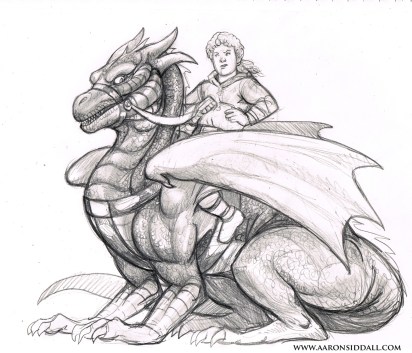
JE: How did you come up with the idea for FANYA?
AS: In a discussion concerning Steampunk and Fairy tales that I was involved with, I compared elements from both in relation to our world in the late 1800s (the Victorian era). In doing so, Russia and Alaska at the time were in the midst of tumultuous times, as there are many marvelous Russian Fairy Tales and the legends of the First Nations have many similar legends, these elements came together naturally in my mind.

JE: How did you come up with the title?
AS: Fanya is a name that shows up in both Russian and Inuit and Aleut peoples.
JE: What do you hope people take away from FANYA IN THE UNDERWORLD?
AS: Overall, I hope that people enjoy the action and magic of the setting. There is a great deal to think on and enjoy.
JE: What is your favorite illustration from the book?
AS: The one of Mr. Beisy on the doorstep in chapter two.
We hope you enjoy reading FANYA IN THE UNDERWORLD. Reviews and emails are always appreciated. If you love the artwork as much as I do, merchandise is available here.
Want to be sure not to miss any of Jordan’s Writing for a YA Audience segments? Subscribe to Writing to be Read for e-mail notifications whenever new content is posted or follow WtbR on WordPress.