A Writer’s Eye View of Social Media Promotion
Posted: May 29, 2017 Filed under: Books, marketing, Opinion, Promotion, Publishing, Self-Publishing, Writing | Tags: marketing, promotion, Time, Writing 2 Comments
Social media is great. Or is it? From a writer’s perspective, maybe a little of both. On the one hand, promotion on social media can and often does bring readers to your blog, or book, or article, or whatever you are promoting. Some sites are more helpful than others in this regard. There is no doubt that social media promotion draws attention, but then you have to figure out the other side of the equation.
Promotion on social media takes a lot of time. And I mean a lot of time. Think about it. First you have to share a link on your timeline, or page, or wall, or whatever. That doesn’t take long. But then you have to share it in groups, and for me, there are a lot of groups to share in. Okay, so after you’ve spent between thirty to forty-five minutes or even up to two hours, (depending on how fast your internet connection is operating, how fast the site you’re sharing on is operating, and how many groups you are sharing the post with), and the post is shared everywhere you wish to share it, you’re still not done.
No. Because you see, social media is set up for social networking. You don’t want to drop into each group and post your promotion, then go about your business. No. When you join a group, you are expected to participate, rather than just promote. If you want people to like, comment, or share your posts, you’ve got to do the same for them. That’s how social networking works. And let me tell you, it is easy to get caught up thanking folks for liking or sharing your posts, responding to comments on your posts and liking, commenting on and sharing the posts of others, and before you know it, several hours have elapsed. This part of networking needs to be done each day, even when you don’t have any promotional posts to make.
So, now consider that I spend up to two hours promotion, two or three times a week, which is what I do for Writing to be Read. You need to socialize daily. I try limiting myself to one hour of socializing online on days I’m not promoting, so I can promote my work, but not appear to be a self-absorbed spammer. Just doing that adds up to ten hours a week.
Most recently, I participated in a Book Release Event on Facebook for the promotion of my recently released western, Delilah. I was one of many authors who did either half-hour or hour long takeover slots in a two night event. In a takeover slot, the author makes posts aimed at both promotion of their own book and entertainment in the form of silly, but fun, party games and giveaways. My investment was several hours in planning and preparation, plus one evening and a partial, and another afternoon responding to comments and contest wrap-up, and it’s yet to be seen if there will be a significant rise in sales which might be attributed to the event.
Of course, it isn’t just Delilah I must promote. I also promote my short story that I have on Amazon, Last Call, and writing that I have in online publications such as Across the Margin and Zetetic: A Record of Unusual Inquiry. And of course, I spend a good deal of time promoting this blog, Writing to be Read. It’s not that I don’t like social media promotion. It allows me to interact with my readers others in the business, and I truly do enjoy that, but it takes a lot of time. That’s time that is not spent writing.
Promotion is a necessary evil to me, and it must be done on top of writing queries and cover letters and submitting completed novels to publishers or agents, and articles, stories and poetry to the publications they might appear in, checking and responding to emails, searching the web and applying for freelance jobs, in addition to holding’s down a full-time day job. And then, I have to find time to live some resemblance of a life. Oh yeah, and somewhere in there, I have to actually sit down and write, both for my freelance jobs and my own stuff, for blog and for sale. And I must find time to read the books I review. So, you see than ten hours a week can be tough.
This isn’t the first time I’ve brought this subject up. In Today’s Authors Wear Many Hats, which I posted back in October, I wrote about the different roles an author must play and how they’ve expanded because of the digital age and the rising trends in self-publishing. Promotion and marketing are just two of those hats, but they’re important ones. Most of us are among the starving artists, and can’t afford to hire someone to do it for us, or spend a lot of money boosting posts to reach more people, and social media is an avenue of promotion which is free, or at least fairly inexpensive.
Bottom line – Promotion and marketing do require that we spend at least a minimal amount of time on them, but as writers, it’s a necessary part of the job. Like the artist, who must sell her own paintings, or convince a gallery owner to display her wares, we must peddle our creations, whether we publish them ourselves, or are picked up by a small press or traditional publisher. And social media is a big part of that in today’s market. Social media drives traffic, and we need traffic, because traffic leads to sales, at least theoretically.
Share this:

“Wicked Treasure” is a Wicked Story
Posted: May 26, 2017 Filed under: Book Review, Books, Steampunk, Young Adult | Tags: Book Review, Jordan Elizabeth, Steampunk, Treasure Chronicles, Wicked Treasure, Young Adult Leave a comment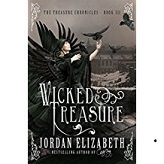
Wicked Treasure, by Jordan Elizabeth is a read you won’t want to put down. Elizabeth captures the reader’s attention from the first page. It’s a truly enjoyable read. Wicked Treasure is the third novel in her Treasure Chronicle series. Preceding it are Treasure Darkly and Born of Treasure. As with all of Elizabeth’s YA steampunk romance novels, (including Runners and Riders, from her Return to Amston series). Wicked Treasure is an enticing adventure that leaves you wanting more.
Garth and Amethyst are thrown into sleuthing out a new mystery, when the kidnapping of their daughter throws them onto the trail of a diabolical conspiracy of government cover up that threatens to rock the entire country. Exposing the cover up threatens to rock the very structure of the government, making all Treasures and Grishams dispensable liabilities and they find themselves in a race to save their own lives. Full of twists, turns and outright surprises, Wicked Treasure keeps readers guessing and pages turning.
Wicked Treasure is a well crafted YA steampunk novel, filled with suspense and intrigue, that holds readers’ interest from the very first page. I give it five quills.

Share this:

There’s No Escaping Hell For “Hell’s Butcher”
Posted: May 19, 2017 Filed under: Books, Dark Fantasy, Fiction, Speculative Fiction, Western | Tags: Book Reviews, Books, Chris Barili, Dark Fantasy, Hell's Butcher, Hell's Marshal, horror, Reviews, Speculative Fiction, Western Leave a comment
I had the pleasure of reading the Hell’s Butcher series by Chris Barili, Hell’s Marshal and Hell’s Butcher. This series is refreshingly different, a combination of western, speculative fiction and super hero, and somehow, it all works.
Frank Butcher has been appointed Hell’s Marshal, sent back to the land of the living on the trail of killers escaped from hell, bent on wrecking havoc and changing history to aide in the rise of the south. In Hell’s Marshal, Frank and his posse of walking dad and their coyote guide are after the renegade soul of Jesse James before he can revive the confederacy and rise up once more against the union.
They travel on a stage pulled by hell’s steeds, which never tire and move at incredible speeds, and they carry weapons with the power to send souls back to hell, where they belong. But, it isn’t easy to pursue their prey in bodies that have been dead a long time, causing extra difficulties to the chase. The coach is driven by a mortal man with special gifts and they’re joined by an orphan boy with the power to see souls raised from the fiery pit.
In Hell’s Butcher, John Wilkes Booth is the renegade soul, back to build an army to finish the government takeover, the conspiracy around the assassination failed to complete, and Frank and his posse must send them back. In a chase filled with misdirection, and battles with demonic souls inhabiting living bodies, there is no way to triumph without further damning the posse members’ souls.
************************************Spoiler Below*********************************
I absolutely love these story lines and must say these books are well crafted. Barili does a smash up job of drawing the reader into his world, where condemned souls can walk among the living. My only problem with these books is the fact that Frank doesn’t seem to change much. Guilt and self-loathing are Frank’s fatal flaws as the protagonist, and although it doesn’t necessarily be resolved, there should at least be some evident change by the end of each story arc. Even by the end of the second book, although he reasons that people should not have to suffer for things they’ve done due to circumstances beyond their control, yet he still resigns himself to whatever punishment the judges dole out, feeling he deserves it, unable to apply the lesson to his own situation, and he is unable to forgive himself.
*******************************************************************************
Both books in this series, Hell’s Marshal and Hell’s Butcher are entertaining tales with refreshingly original story lines. Each book could be stand alone stories. Regardless of the one glitch found in the protagonist’s character arc, they are fun reads that keep the pages turning. I give them both four quills.

 If you like the Hell’s Butcher series as much as I did, you’ll want to be sure and grab the prequel, Guilty, which is now also available. Guilty tells the story the events in Frank’s life that brought him before the judges and put him in the position to serve as Hell’s Marshal. This book offers insight into Frank’s character, so we can see where all that self-loathing comes from, drawing the series together and giving it cohesion. It is a different, but wonderfully entertaining story line. I give Guilty five quills.

Kaye Lynne Booth does honest book reviews on Writing to be Read in exchange for ARCs at no charge. Have a book you’d like reviewed? Contact Kaye at kayebooth(at)yahoo(dot)com.
Share this:

Most People Won’t Put Their Money Where Their Mouth Is
Posted: May 15, 2017 Filed under: Books, Opinion, Promotion, Uncategorized, Writing | Tags: Book Reviews, Books, Delilah, Kaye Lynne Booth, marketing, promotion, Reviews 11 Comments
Warning: Rant Ahead
I’ve been seriously writing for seven years, and I can’t tell you how many friends and family members have been there offering support and encouragement. For the last year, since I graduated for my M.F.A. with two novels completed they have all continued to urge me on with enthusiasm, promising to purchase a book if I get published and inquiring about getting on pre-order lists. I felt myself fortunate to have so many staunch supporters.
I’m not talking about all those folks out there that ‘like’ your posts without actually following the link and reading the blog posts, or buying the book. That kind of thing happens all the time and is to be expected, because these folks don’t really know you. No, who I’m talking about are those who actually know me, people I felt I could depend on to be there and back me up in all circumstances.
So, maybe you can see why I might experience confusion when, after my western novel, Delilah, was finally published, I expected to have a few sales, not hundreds or anything, but at least a few. When checking on it’s progress, I found Delilah had two reviews so far, with a four star rating, which pleased me to no end. In fact, one of the reviews compared me to a feminist Louis L’Amour, which is pretty high praise for a western.
However, when I inquired as two my sales, my publisher informs me that I have only two. At least both buyers wrote reviews. So where are all my avid followers who love me and couldn’t wait to buy my book? It seems all of my supporters have disappeared into the woodwork, so to speak. Not one has honored their vow to buy my book, not even my own family members.
I think the thing that makes me the angriest is the fact that they all know how hard I’ve worked to get this far, but as soon as they are asked to fork out some cash, and we’re only talking ninety-nine cents here, they vanish. I don’t see or hear from them anymore, or if I do, the subject of the book isn’t mentioned, but rather, it is skillfully danced around. And now it is apparent, they are not willing to spend a buck on my book, the work they claimed to have so much faith in. Am I wrong to be hurt and disappointed?
Since the publication of Delilah, I have worked hard to promote the book and stir up some sales. I have made blog posts talking about it, shared them all over social media like crazy, sent out ARCs to be reviewed. I did an interview with author Dan Alatorre on his authors blog, which can be viewed here. My publisher even set up two days, where readers to get the book for free, and still only two sales.
I wasn’t expecting to be an overnight best seller, and I suppose I need to keep in mind that those two sales produced very good reviews. I want to take time out here to thank those two readers who actually bought Delilah and took the time to write a review. Because, as I’ve mentioned before, these days, reviews are everything. Not that good reviews will bring increased sales, but they do make a difference.
According to Amazon you have to have the magic number of fifty reviews before they will deem your book worthy of their promotion, and I’m learning fast that fifty reviews will not be easy to get. I’d venture that most books available on Amazon don’t make the grade, and that marketing and promotion can make or break a book, because to gain readers, people have to be able to find your book and want to read it. Because they can’t write a review, if they haven’t read the book.
I imagine many authors go through these same feelings. It’s all a part of the writing game. Now that I have that out of my system, I’ll get back to the business of writing, and promoting my writing. So, wish me luck, and if you like gritty westerns, spend a buck on Delilah.
Share this:

“The Lying Planet”: Only The Truth Will Set Them Free
Posted: May 12, 2017 Filed under: Book Review, Books, Fiction, Science Fiction, Young Adult | Tags: Book Review, Carol Riggs, Science Fiction, The Lying Planet, Young Adult Fiction Leave a comment
The Lying Planet, by Carol Riggs is a grabbing YA science fiction novel. Riggs puts a new twist on the story where all is not as it appears. On the planet Liberty, the future seems bright, but when the truth is finally unveiled, it may be very dark indeed.
On the planet Liberty, kids look forward to turning eighteen and venturing out of the colony they grew up in, away from their families, to live lives of their own. Jay can’t wait to gain his freedom. But what’s a kid to do when he discovers that everything he was ever lead to believe is a lie, the very fabric that he’s built his life on is false? Jay uncovers a secret that will change life on Liberty forever, and once he knows the truth, there’s no turning back.
Riggs brings us action and suspense in a well crafted YA science fiction novel which is filled with surprises. Just when you think you have it all figured out, another twist is added. I give The Lying Planet five quills.

Share this:

Interview with independent author Dan Alatorre
Posted: May 8, 2017 Filed under: Author Profile, Books, Fiction, Interview, Publishing, Self-Publishing, Super Hero, Writing | Tags: Books, Dan Alatorre, Humor, Inspiration, Interview, marketing, Poggibonsi, promotion, The Navigators, Writing 8 Comments
Today, I have have a real treat for you on Writing to be Read. My interview today is with a very funny guy, who is a successful independent author. He’s a family man, with a background in business, so book marketing and promotion is just another part of the job for him. He’s got two books which have both been recently released, Poggibonsi: An Italian Misadventure? and The Navigators, which we will learn more about right here.
Dan has so much to share with us that I’m going to structure this interview a bit differently than I have on interviews in the past. The first part will allow us to get to know Dan a little as a person. The second part will delve into his marketing knowledge, followed up with the last section which will probe into his writing techniques, what writing means to him and questions on craft. So, without further ado, let me introduce to you, independent author Dan Alatorre.
Kaye: You are a family man, Dan. What are your secrets for juggling writing with family?
Dan: I think if you are a writer you need to prepare yourself for the inevitable “you spend too much time on the computer” conversation/argument.
That’s just how it works.
So, my recommendation is, give work its proper due and give family its proper due and give writing its proper due. How you balance that is, you have to decide whether or not spending time with your young children is important or not. (Answer: IT IS.)
When my daughter goes to her dance class or a Girl Scout Daisies Troop meeting, that’s writing time for me. When she’s going to one of her little girlfriends’ birthday parties, that’s writing time for me. However, I make pizza from scratch every Friday afternoon for my family and that’s family time. I don’t write then. When she was younger, I would write after she went to bed at 8 PM, but often that is time that should be spent with the spouse. Adult time.
Me, I get up at 4:30 in the morning to write for a few hours. That’s how I manage it. I also watch very few TV shows, and the ones I watch are all recorded so I can skip all the commercials. In other words, I utilize a lot of time saving devices but I am also thinking about my stories pretty much all the time, so when I sit down to write I’m ready to let loose. If we are at Busch Gardens and I get a good idea, I will excuse myself for a moment and tell the idea into my phone – and then get right back to the family. So they lose me for a minute or two but I got my idea captured.
And I’m not talking about being there half-hearted – you need to be there 100% for your kids especially when they’re young. But there’s always two minutes here and there if you have a great story idea. Nobody’s going to complain about that. What they complain about is when you take all that family time for your writing and then keep doing things like excusing yourself at Busch Gardens. That’s not gonna fly.
Now, with all that said, every spouse of a writer is going to understand occasionally you are in the zone and you just have to keep going. Whether that is getting up early or working late or whatever for a few days or a week, they get it. They can see it on your face and every time you talk to them you are excited about it. I’m just saying, if you are willing to give them what they need, they will give you what you need. Be generous with them and then be very selfish when you need to be. That also works.
Kaye: A lot of your stories come from your own experience as a parent, things you learned from your daughter, Savvy, and they make us laugh. Do you have a knack for finding the humorous side of things to use in your stories, or is it something you have to work at?
Dan: Both. (I hate when you offer somebody a choice and they choose both things, but in this case it’s really true.) I’m a funny guy. I have a knack for finding the funny things in life, and that’s rampant in certain characters in my stories. Sam in Poggibonsi is a scream – she steals the show. In Savvy stories, my daughter does.
I’ve always had a good sense of humor and I have always been able to make people laugh. When I was a child – I have six brothers and sisters – so around the dinner table it was tough to compete for mom and dad’s attention. Cracking a joke or being able to slip in a funny comment was a way to bring the house down and get a little recognition. I was not a class clown in school, though! Okay, maybe a little. But I was the guy who would do a stand-up routine at the variety show or write stuff for the newspaper.
Before I started writing a blog, I was putting stories on Facebook for my wife’s friends and my friends. I would put a post up at five in the morning and by dinner time there would be 100 comments saying how I made everybody cry before they went to work! Other times they would be a bunch of comments saying how hilarious that story was and that I should write a book. Eventually I listened to them.
But the subject matter of those early stories was my daughter – and anybody who spends five minutes around little kids either decides they’re a pain in the ass or they are amazing and brilliant and hilarious. I fit into that second category. My daughter cracks me up and now that she knows she can, she has her routines that she does that bust me up every single time. So she inherited a funny bone from me and from her mother. My wife is very funny, too.
Kaye: What is the one thing you hope to teach your children?
Dan: It’s a little early to try to teach them this particular lesson, but I have been fortunate enough to come from a large family so my nieces and nephews have gone through college and are making their way in the world. The advice I give to them as young adults is: pursue your passion. Whatever gives you joy in life, do that for a living. Don’t worry about the money, because if you hate your job you will be spending your money on being happy. If you do what you love, you can get by and a lot less money.
Nobody listens, but that’s the advice I give.
At her young age, my daughter enjoys ideas of being a fashion designer and a singer and a writer. Right now she can keep all those thoughts in her head. When it gets closer to the time when she actually has to decide, I hope I am able to be behind her 100% in whatever she chooses. And I hope she chooses with her heart as much as with her head. I work with too many new authors who are 35 and 45 and 55 finally started writing, when they wanted to do it their whole lives. I think we need to follow our passions much earlier in life. I’m not sure Americans foster that in our children.
Kaye: How would you describe yourself in three words?
Dan: Hmmm… only three?
Intense. Hilarious. Smart.
But I think not in that order. I think if you asked three or four people who have read my stories, like three or four of my critique partners that I use all the time, they would say smart and then funny and then prolific or something. I don’t know if they would go with intense.
Kaye: What did your road to publication look like?
Dan: Bumpy.
I found an agent through a friend and the agent kind of started doing things along the traditional path of publication, which is known to move at a glacially slow pace. I came from the business world of Fortune 500 companies, and business moves fast. If you say you’re going to read something in six weeks, I need to be able to call you at six weeks plus one day and get your thoughts on it.
Traditional publishing doesn’t work that way. They they say six weeks, and then you call after six weeks and they say they need another six weeks. That’s why books take two years to come out. I’m not saying my way is better, I’m just saying after being exposed to that type of a slow process, I realized it was not for me. I have no problem working on a project for two years and polishing it, I just have zero patience for giving someone your finished product, a book that is ready to go – and letting them sit on it for two years.
So the agent and I parted ways and I have not really considered going traditional since then, but I am not adverse to it. It is good for certain stories and it is not good for really unique or groundbreaking stories. That may change, but right now that’s the case and that’s been the case for a few years. I don’t really see it changing, but I do see the role of traditional publisher changing. In my mind, they have to get quicker. To Kill A Mockingbird doesn’t come across their desk every day, but then again maybe it does. There sludge piles are so big they’d never know. They’re never getting to a lot of the good stuff, and since the majority of trad books don’t earn back their advance, I’d say their selection process sucks and their competency level is questionable at best.
Kaye: With your background in business, it seems like promotion and marketing are pretty second nature for you. In fact, we found each other because you were looking for authors to swap interviews with, because you know that interviews are good marketing tools. What was the most fun interview you’ve ever done? Why?
Dan: I did an interview with Kathleen Townsend that was just hilarious. That was probably my best written interview prior to this one, but it was done for a different reason. I was just trying to make her laugh and her readers laugh. In this interview, I’m trying to cull a little more in depth because your readership skews different from hers. I hope authors understand interviews are certainly done to sell books, but sometimes they’re done to educate and sometimes they’re done to entertain. The best ones are a combination of all those things.
Anyway, one of the best interviews I ever did was when Jenny and Allison interviewed me for the release of The Navigators. We set up a three-way video call that we recorded. That was really a lot of fun.
The interview that hands-down was the funniest interview I ever did was interviewing the author of the bestseller The Fourth Descendant for a trilogy she was releasing called Project Renovatio. We probably spent two hours doing the interview and we probably laughed hysterically for one hour and 50 minutes of it. The 10 minutes when we weren’t laughing is most of what we used for the interview. The other 90% was just a hilarious good time. We became great friends – we were good friends before that interview but we were great friends after that interview. It was just nonstop laughter. Completely unusable, and it wasn’t outtakes, it was just making jokes and laughing.
One of my great joys in life is I can go to that interview if I’m having a crappy day and I can look at the outtakes and within 10 minutes I’m laughing my butt off. There’s a snippet of it on YouTube. Most of the time she (the interviewee) is laughing and wiping her mascara out of her eyes because she’s laughing her so hard she’s crying. Great interview.
Kaye: What’s your favorite social media site for promotion?
Dan: Specifically for promotion? Probably Facebook, and in that, Facebook ads. It depends on what you’re trying to do. New authors need to build an author platform, and Facebook is really good for helping do that, but there are a million ways to waste your money when you are trying to pay for advertising.
Probably for every good add source I paid for, I have paid for 10 bad ones. My advice to people is this: track everything. Look at your reports every day and when you run an ad try to the best of your ability to only run one ad with one promoter at a time. If you run five ads on Mother’s Day and do well, how do you know which one sold all the books? You don’t. If you run your ads one at a time and track your results, you will. Then you can replicate your success, if it’s replicate-able.
That’s not always possible, but to the extent that it’s possible please try to track your results. Quit giving to the people who don’t give you results.
Kaye: What do you do for cover art? DIY, or hired out, or cookie cutter prefab?
Dan: I had the great pleasure of working with Perry Elizabeth for many of my early book covers. Perry designed a number one bestseller for me, as well as designing a number one bestseller for a friend’s debut novel. She designed maybe six of my first seven book covers. She’s brilliant. She has a gift.
Like many things (I came from a business background having gone to the president circle with two different Fortune 500 companies) and in that world the saying “If it’s not broken, don’t fix it,” doesn’t apply. They would say, “If it’s not broke, fix it so it’s even better.” Something like that. Maybe I should’ve paid more attention in all those meetings.
Anyway, when you have good success you have to look if you can make bigger success. Sometimes the answer is yes and sometimes the answer is no. In the case with Perry, she is very devout in her religion, and I knew some of the risqué subject matters in my stories would not be something she would appreciate her name being associated with. So I had to take it upon myself to find other people to work with for those. I can’t put one of my partners in that position, you know? So I had to put other titles with other artists – and I am very fortunate they’ve done a terrific job, too! Look at how eye catching The Navigators cover is. That’s all part of it, making your book stand out. I’ve been very fortunate to work with so many skilled people.
Now, I have on occasion tried to design my own book cover or to buy an image and work with that, and I have had some decent success with it. But here’s a tip for new authors: even if I know exactly what I want the cover to look like, I still roll it out on my fans.
How did I find cover designers? I joined author groups and asked everybody for referrals. I looked at books I liked and saw who did the covers. I shopped. You can spend hundreds of dollars (and occasionally under a hundred) on covers that look as good as ones that cost thousands, and usually for new authors money is in short supply.
For example, The Navigators I bid it out. I didn’t really know what the cover should look like, so I gave a brief synopsis to three or four cover artists, and then I posted their mock-up results on my Facebook page so my friends could vote. One cover jumped to the front, hands down – and that’s the one I went with. And it was very successful.
With Poggibonsi, I pretty much knew what I wanted from the get go. I wanted to portray sex and humor in a single image that could potentially be iconic. If you ever saw the poster for the movie M*A*S*H, or Jaws, or The Godfather, we know that when something is a hit it tends to own that image. And with Poggibonsi, I knew that the cover would convey very simply and easily a large portion of what the story was about. Additionally, like the name Arnold Schwarzenegger, Poggibonsi is not easy to say or read or pronounce. My thinking was what Arnold said: it’s hard to say but once people hear it they can’t forget it. And I think that’s the case with this title, too.
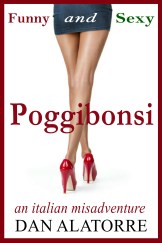
Kaye: Poggibonsi: An Italian Misadventure just came out last month. What can you tell us about it?
Dan: Poggi jumped into the cold cruel world on April 20, and it’s burning up the charts! I’m so happy. Poggibonsi is without a doubt my funniest book I have ever written. It’s going to do amazing because it’s just knock-down drag-out funny as hell.
In the story, I take on so many things that are just absolutely not funny! Infidelity, death, getting fired, you name it. And in the process I make you laugh at every single step. Some of the characters are the funniest people you’re ever going to meet, and one in particular absolutely steals the show. On the other side, it is in insanely romantic romance story! And it’s hard to make a romance that’s really romantic while also being funny, but I think I threaded the needle pretty well on this one.
Kaye: What is the strangest inspiration for a story you’ve ever had?
Dan: Hmm. Strangest.
Hmmm…
I was talking to an author friend of mine the other day and I was explaining to her that she was very creative in setting up a new world or a situation that is different from our current existence. I, on the other hand, have taken things that we are all very familiar with and looked at them from a very, very different view point. I’ve never tried to create a fantasy world like she has. So my complement to her was how creative she is at that, and she’s great storyteller in addition. My complement to myself was that I can take things that everybody knows and all of a sudden they are questioning everything about it and laughing their butts off or crying their eyes out or being scared to death of these things that they already knew.
Now, as far as the strangest places I’ve drawn inspiration, if you start with the premise that I have pretty much dealt with the world as we know it, then the inspiration has been unique insights on things that are common place.
So, my inspiration has come from everywhere, which doesn’t help anybody who’s reading this to figure out what inspires me, but I am inspired by the same things that I find humor in. The common situation or as Alfred Hitchcock used to do to Cary Grant, taking an ordinary man and putting him in extraordinary circumstances. Having an ordinary situation with ordinary people become somehow extraordinary. Taking your life as you know it and turning it on its head and giving you a roller coaster ride but doing it in such a way that you like the characters and you’re rooting for people to succeed – and at the same time, with my stories nothing is what it seems. All of a sudden you have skated out over the thin ice and there are there you are being blindsided by things you didn’t know were coming.
In Poggibonsi, you think a certain situation can’t get any worse, and it gets so, so, so much worse, and people are sending me emails saying, “I did not see that coming!” They love the roller coaster ride. I try to give them a good one every time.
Kaye: Did you always want to be a writer?
Dan: I think so, yes. My direction in life was to create a career and then do the writing in your spare time. That’s probably how most people do it and that’s what I would recommend, too. As long as you make time for everything, you’ll be okay. If you don’t make time for everything, you’ll be very frustrated that you’re not doing your writing – so make time for everything!
But like I said, I went to work in business before I started writing in earnest, and once I started writing in earnest I didn’t want to do anything else.
Kaye: Are you a plotter or a pantser?
Dan: I am absolutely a plotter, but let me explain.
Before I really start writing a story, I will percolate on it for a while to get some ideas going. Before I start writing in earnest, I am throwing ideas into a folder. Once I sit down I have a beginning, a middle, and an end. The that’s my outline – sometimes nothing more than that.
But just because I have AN ending does not mean that is the way the story ends. It simply means that that’s the direction I’m heading in; that’s the way I intend to go. If I get a better ending, I am absolutely taking the story there, but if I don’t come up with something better, this is the destination I’m going to end up at.
That gives you the best of both worlds. You can be as free and crazy as you want and you still have a path to get you back on track. Or, if you really find some new destination, you go there.
But it’s been my experience that probably 75% of the books that never gets finished by the writers don’t get finished because they got excited, they started writing, they had a couple of good ideas – and then they ran out of steam. Jim Patterson – yes I call James Patterson “Jim” – said it’s better to spend an extra month on the outline then it is to start the story not know where you’re going with it.
Having a goal and having a destination, that will help you finish your story. I think 90% of writers block and unfinished stories happens because of the lack of an outline.
But again, it is not locking you in a cage, it is simply directing your creativity. Having an outline does not stifle your creativity, it directs it.
Kaye: What’s the best piece of advice you were ever given?
Dan: I wrote a blog post once where I put like 20 memes in it and then I explained what each of them had meant to me at different periods. One of them was Hemingway saying write every day. Every day, get up and bite the nail. That’s so important because the more you work at something the better you get at it, so don’t stop.
The other was something along lines of, “Every great story is this: nothing is as it seems.”
I thought the simplicity of that second one was overstated. Like almost like it’s too simple so it’s stupid. And then all the sudden I read it like a second or third time and I was like oh my God it’s brilliant.
So those two are good. The best one is: the reader is your willing accomplice. On that one, if you set a realistic world and you work hard to make a good story, the reader will go along with you. As long as you do a good job, you can do whatever you want. And once you do it well, you can play the reader like a piano. You have the power and they want to go on the ride. Willing accomplice.

Kaye: The Navigators also came out recently. Would you like to tell us a little about that one?
Dan: Gosh, I’m so proud of Navs. The Navigators is a great story involving time travel. Five graduate students in paleontology accidentally discover a strange machine, and right off the bat they have to figure out what it is they discovered. As they conclude it’s a time machine, each of them has a different idea of how they should use it – so there’s immediate conflict. There is a lot going on with the characters in the story. Pretty much nothing is what it seems, so there is intrigue at multiple levels, plus it’s a real page turner. People who start reading this book have reported back that they are just unable to put it down. I’m very proud of that. It’s a real home run.
Kaye: How do you decide the titles for your books? Where does the title come in the process for you?
Dan: Man, titles are hard! They shouldn’t be, but they are.
Originally, Poggi was going to be called something like “My Italian Assistant”, but that all had too much of a schlocky 80s sex romp feel. This is not that. This is a story that goes deep in everything it pursues. The humor is outrageously funny. The romance is deeply passionate. You will laugh and you will cry and your heart will break. As a result, it deserves its own unique word.
Now, I’m not a fool. I gave it a pretty simple subtitle to explain what was going on. But most of my critique partners said I couldn’t call it that. Well, after they got used to reading a few chapters and calling it by its name, they were cool with it – and they wanted me to keep the tile as Poggibonsi.
So you have a unique title and a unique cover for a unique story. That’s either going to be a home run or a complete strike out. Right now if I can convince people to start reading it at all, they end up loving it. There are so many toys twists in surprises and absolutely hysterical moments, really some unforgettable stuff and some unforgettable characters, it’s a rare treat that readers around the world are loving.
With Savvy stories, I kicked around a lot of ideas and I was told many times not to use that title. To me, it was a double entendre. Savvy stories are stories about Savvy, which is the nickname of my daughter Savannah. I also gush about how smart and amazing children are, so savvy stories also means stories about people who are street smart. Which is probably the wrong way to describe infants and toddlers, but you get the idea.
The Navigators really required a different formula. I was writing the story and I was calling it The Fantastic Five as its working title – which is just awful – and everybody who saw it kept saying, “You can’t call it that! Find something else.”
The reason it was the “fantastic five” was because they were five characters and each did something kinda fantastic. I knew that would never be the final title but I just couldn’t think of anything good. I was just stumped. It happens.
Anyway, I was in the middle of a scene and the characters were debating about flying the time machine somewhere, and one of the characters said they were thinking about it all wrong. He said, “We’re not really driving it, we just are setting the destinations and the times.”
So the first character said, “Oh, so we are the navigators?”
Again, there is a double meaning to that.
The time machine is something they really haven’t figured out when they start testing it so they are putting in longitude and latitude and a time, and letting the device take them on an adventure. It also refers to the young lady in the story who is kind of drifting along doing the things that people probably wanted her to be doing as opposed to choosing her own life. So she too is also not a pilot yet. She’s not making the decisions yet. In the story, she ends up becoming the main character and really growing into a leadership role.
That was important because I have a young daughter, and it’s kind of a projection of her where she might be 15 years in the future.
Many of my stories are written on multiple levels. I had one beta reader asked me if a certain scene was a metaphor for the guy’s marriage. It was. Other scenes were reflections of other things, too. There’s only a little bit of that (and a little goes a long way) but when somebody discovers it, it’s like a brilliant flash of joyful light to me.
The Water Castle and An Angel On Her Shoulder came about in similar fashion. The water castle is the way a young child refers to a landmark that the story kind of takes place around. And “an angel on her shoulder” is a remark that a doctor says about the child who got diagnosed with a rare but potentially fatal heart condition in my paranormal thriller.
So, I guess when I need to come up with a title, I have my characters express it in dialogue! There you go. That’s my secret. Have a character open your mouth and hope a title pops out.
Kaye: What is the single most important quality in a novel for you?
Dan: I have to care about the characters. There are a lot of different ways to achieve that, but readers are kind of generous. They will give you a little while to make them care about a character, but you have to make them care. If you don’t, nothing else matters.
In The Navigators, I thought about starting the book at the landslide where one of the characters almost gets killed. Aside from it being some obvious action, I knew in my heart that we just wouldn’t care if somebody got killed because the readers hadn’t gotten to know anybody yet.
By contrast, in An Angel On Her Shoulder, it starts with an action scene where the wife is beginning to wonder if her husband and child have been accidentally killed, and the chapter ends with her being frantic – asking that question – but we don’t know.
Because I have the wife being concerned about her young daughter, and because I have her emotions jumping from she doesn’t know what’s going on to “Oh my god what’s going on?” – and all the people around her are saying “Oh my god look at all the blood, there’s no way somebody could survive that,” she is getting more and more frantic…
The reader cares because the character cares. She is really getting frantic and she is really nervous and we can’t help but be empathetic and then therefore we care also.
Then I’m really mean. I jump into a flashback that took place several decades before, and you have to float through that for a few chapters – so that you kind of forget about the frantic scene – and then we end up right back in that opening scene a few minutes before it happens. I know flashbacks are persona non grata, but I got to tell you, this is an amazing roller coaster ride that readers love! The way I played it, it was a stroke of genius if I do say so myself. I love that story.
Kaye: Which author, dead or alive, would you love to have lunch with?
Dan: Mark Twain, because he was very, very funny and very, very smart and apparently liked to drink. I just think sitting down and having lunch with him would involve lots of drinks and lots of laughs, and I’m not sure there’s a better lunch than that.
Hopefully one day some kid will say they want to have lunch with me, and I will fly to where they live and we will go get hammered and have the most awesome lunch ever.
Kaye: Have you ever had places that you travel to end up in your books?
Dan: Kind of. When I was going to Italy for a vacation I kept telling myself I knew I’d find a story there. And I loved Venice and I loved Rome – I loved everywhere we went in Italy. Gelato is amazing, the pizza is amazing, the women are amazing, the art and the architecture is amazing. Italy is amazing.
And I was really trying to force it. I was really saying okay, is this story? Is that a story?
It doesn’t work that way. On the plane ride home I got the idea of a man going on a business trip to Italy so I could explain a lot of the things I saw through his eyes, and then I wanted it to be a romance but I wanted it to be a comedy, too. There’s lots of things to find funny about traveling, but the romance was going to be an unconventional one, and from that little spark, I said there’s the story.
Many of the people who read it have told me I made the country of Italy into a great character in the story, and that is very high praise. I have an Italian translator who I have worked with translating my other books and she read it and she love the way I depicted her country, so I am absolutely satisfied with how that story came out. It’s an absolute home run on every level.
Kaye: What is the hardest part of being a writer?
Dan: Many people, most in fact, struggle with being able to finish their first story. They want to fine-tune it forever and they are afraid of publishing it. Whatever it is, they struggle to get the first one done. Once they get the first one born, they realize what a huge weight has been lifted off of them and they become much more at ease with writing and everything else. Unfortunately, just as many people suffer from the opposite affliction, which is thinking something is a masterpiece. What it really needs a lot of work, and they publish it too soon.
That’s not a very helpful answer, is it? But it explains this: the hardest part is knowing when the story is ready. The people who release it too soon don’t know when it’s ready, and the people who polish it forever don’t know when it’s ready.
How do you figure it out? You write what needs to be said, you give it to trusted critique partners who will tell you the things you said that did not need to be said, and then you trim out the stuff that doesn’t need to be there – and release it.
Then start writing your next one. After you do this a few times you will not be afraid to release a story and you won’t be afraid to take input from people who have your best interest at heart. You’ll have a thicker skin and a bunch of other things. That’s when you – most of you – will become really good writers. A few people do it on the first shot; most don’t.
If I could give you one thing, it would be not just confidence but enough confidence. Tell your story and don’t be afraid to be passionate and to be emotional and to really put your soul on the page. Expose yourself. Writing is the equivalent of standing naked on a stage, prepared to be laughed at and humiliated – and doing it anyway.
Write from your heart and don’t hold anything back. Not the pain, not the love, not the fear, not anything. When you put it on the page from your heart, the reader get it. They connect. The more personal you make it to yourself, the more universally understood it is. That’s where too many authors make their mistake. They don’t open up and let it pour. They write the words but they don’t write the heart. They tell a good story when they have a great one within them. They hold back because they’re afraid of what people might say or might think, or that their mom right read it or that their friend might hate it or whatever. When you can let go of that and stand naked on the stage, that is where the great stuff comes from. You may fail miserably, but you will have given it your all. That’s confidence. I wish I could give you enough of that to make you put your soul on the page. When you do, you will be greatly rewarded for it.
I want to thank Dan for joining us today and sharing his knowledge and experience with us. I couldn’t help but chuckle as I went over your answers. It’s been a lot of fun. To learn more about Dan and his books, drop by his blog.
Like this post? Subscribe to Writing to be Read for e-mail notifications whenever new content is posted.
Share this:

“The Path to Old Talbot”: A YA Novel That Deals With Tough Real Life Issues With Sensitivity
Posted: May 5, 2017 Filed under: Book Review, Books, Fiction, Young Adult | Tags: Book Review, Jordan Elizabeth, Novel, Reviews, The Path to Old Talbot, Young Adult Leave a comment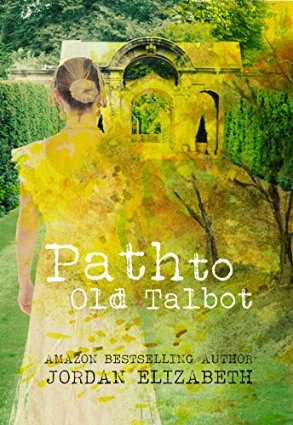
The Path to Old Talbot, by Jordan Elizabeth appears on the surface to be a novel about a doorway leading to another time, and it is that. But it is also a story about how a young girl and her mother cope with her father’s mental illness. It’s a tough issue. What does a teen do when their parent has mental problems. It may be something that isn’t talked about, so the child or young adult must deal with it internally, not expressing their feelings outwardly. Our heroine, Charity, expresses her inner thoughts and feelings to the reader, even when they are thoughts and feelings she can’t express to friends or family, giving readers a unique insider’s view of a tough love scenario. It is a difficult issue and I give Jordan Elizabeth kudos for tackling it in a realistic, but sensitive manner.
When Charity and her mother discover a door to the past in their new home, they can hardly believe it, but they quickly take advantage of to make brief escapes from their own reality. But with each visit, it gets harder for Charity to leave her new found friends from the past to their fates, as she digs up the past in the present. But can the past really be changed or is it preordained?
The Path to Old Talbot is a well written and engaging story, perfect for today’s YA readers, who may be dealing with similar issues in their own lives, (mental illness, not time travel). I give it four quills.

Kaye Lynne Booth does honest book reviews on Writing to be Read in exchange for ARCs at no charge. Have a book you’d like reviewed? Contact Kaye at kayebooth(at)yahoo(dot)com.
Share this:

Spreading the News
Posted: May 1, 2017 Filed under: Author Profile, Books, Interview, Promotion | Tags: Author Profile, Dan Alatore, Interview, Kaye Lynne Booth 3 Comments
Being a newly published author is a big deal. At least it is to me. Now that I have a book to promote, that’s where I’ve been spending a lot of my time. After all, I want to send my book off right. So, for the past few weeks, that’s all you’ve heard from me, talk about Delilah.
I’ve learned that promoting my book is even more work than I had anticipated, which is not to say that I’m not relishing every bit of it, even though I moan and groan about most marketing activities. I’ve promoted my heart out, appealed to readers for reviews, applied for a Goodreads author page, (next, I have to figure out how to do the same on Amazon), contacted people about release parties, and I’m doing an author interview with Dan Alatorre.
You can read my author profile, which includes that interview on Dan’s blog today, so I hope you all will check it out. You can read my author profile here. And don’t forget stop in here and read my interview with Dan, which will be posted here on Writing to be Read next Monday.
Share this:

“Perils for Portents”: A Steampunkish Novel with a Heroine to be Admired
Posted: April 28, 2017 Filed under: Action/Adventure, Book Review, Books, Fiction, Steampunk, Young Adult | Tags: Action, Book Review, Books, Diana Benedict, Historical Fiction, Novel, Perils for Portents, Reviews, Young Adult Leave a comment
Perils for Portents, by Diana Benedict is a well crafted story and a truly enjoyable read. Taking place in an era when women had to struggle to be taken seriously, young Francie Wolcott proves a heroine who young women today can look up to in a story of mystery and adventure.
When their parents die, Francie and her brother, Rooney, are left to make their own way in the world. Francie uses her resources, combined with Rooney’s ingenuity to travel across the country by unconventional means, to their uncle and grandmother in San Francisco. On the journey, the automaton Rooney designed is possessed by a ghost, whose fortunes are right on the mark. When she reveals a murder the circus owner was involved with, it puts Francie on his radar as a liability. Once they’ve reached their family, Rooney settles in well, while Francie entertains plans to travel the world with the fortune telling automaton. But her grandmother has other plans for her, as she puts Francie on display for all eligible suitors, regardless of how repulsive Francie finds them. Besides thwarting her grandmother, Francie must also evade the circus owner, who is set on her demise, and she proves herself up to the task.
Perils for Portents is a delightful historic YA novel, with elements of adventure and romance. It is well written and entertaining. I give it four quills.

Kaye Lynne Booth does honest book reviews on Writing to be Read in exchange for ARCs at no charge. Have a book you’d like reviewed? Contact Kaye at kayebooth(at)yahoo(dot)com.



















Jeff’s God Complex
Posted: May 10, 2017 | Author: Jeff Bowles | Filed under: Books, Commentary, God Complex, Opinion, Publishing, Uncategorized | Leave a commentThe God Complex vs. Non-Literary Sources of Entertainment
by Jeff Bowles
The written word is dying. You know it, I know it, and so does anyone else who’s taken a serious look at book sales in the last twenty-five years. Academics and the literary elite have been decrying this death for some time. Growing up in the 90s, I was told again and again my generation represented a kind of last ditch effort to save literacy before it was too late.
Does it have to be this way? Popular opinion would have you believe so. Then again, any form of creative expression that becomes less and less popular with each successive generation is doomed to fail at some point, right? Kids today. They’ve got myriad distractions. Movies, video games, the internet, comic books, television. The ones who grow up readers will probably stick with it. But young people without an inherent need to devour that latest giant book release tend to shy away from recreational reading their whole lives.
See, prose is a beautiful textual form, but it also requires the kind of attention span that went out of fashion with fax machines and cassette tapes. It requires imagination, particularly in regards to participation, and make no mistake, if you’re reading your favorite author, you’re a participant as much as a consumer.
I’ve often heard it said all great art forms thrive on limitations. Music, for instance, is built on sound, rhythm, aural evocation, but there is no visual component, and often when we listen to music, the absence of something interesting to look at often heightens the experience. Film, too. We have the visual, we have sound, but we cannot readily discern the thoughts, feeling, and motivations of the people onscreen; in other words, we can’t be inside their heads. Which is why world-class actors make all the difference. There’s an entire hidden world bubbling to the surface in great films, and our imaginations help complete the picture.
The written word is a lot like that, except that in a good piece of fiction, we may know the inner workings of our favorite characters. We just can’t see or hear them. A good book is a wonderful tool for sharpening the mind. As much as I like video games, movies, and comic books—and I do—they just aren’t as fulfilling on that level.
If you’re a fan of Science Fiction, Fantasy, and Horror, you should know your go-to genres have been coopted by video game developers and movie producers all over the world. They’ve taken the hallmarks and defining tropes you love and turned them into heightened visceral experiences that in the short term at least can blow even the best novels out of the water. I love reading about space pirates and interstellar imperial armadas. But somehow, when a PlayStation game puts a blaster rifle in my hand and lets me save the galaxy, it’s just too fulfilling a spectacle to ignore.
I’m 32 years old, which makes me a quote, unquote “older” Millennial. My generation takes a lot of guff out there, but no one can deny how skilled we are in the ways of media diversification. I have no problem switching between novels and games and comics and TV shows, because I know each unique format can render enjoyable stories. And that’s the thing, really. Stories are the key. We still love and crave them, spend a lot of time—too much time—in a kind of mad rush to consume them.
It’s just we’re less likely to turn to a good book to find them than Baby Boomers or even many Gen-Xers. The as-yet-unnamed generation coming up behind us is even less likely, and in fact, their concepts of good stories are even stranger, owing to the fact that many kids today worship YouTube and the limitless hysteria and disjointed infotainment it provides.
Oh sure, there may be a place for good books for years and years to come, but if you as a writer are in any way worried about their ultimate viability, might I recommend you study these other forms of entertainment and discover what makes them tick?
Are video games truly mindless? Or do they simply manage to capture the heat of battle like no other storytelling medium before? Are serialized “shared-universe” movie properties a waste of time, or are they the next step in branded and concise science-fictive intellectual properties?
I think we can make our prose more electric, our ideas bigger and harder to ignore. I think our fiction can be faster, more dangerous, put together like any good hybrid. Otherwise, I fear, we’re going to get out-shouted, the carnival barkers of a million different industries drowning out our unique voices one-by-one
I’ve dedicated by publishing history to this very principle, but I certainly understand the hesitancy I sense each time I tell fellow writers most of us aren’t ready for that kind of transition. Rather than allowing our favorite literary forms to die, we should encourage them to evolve. Ultimately, how many new fans a fresh-faced writer can hope to gain depends on the lengths he or she is willing to go to in an effort to stand out in the crowd.
By the way, the crowd in question? It’s full of billion-dollar storytelling giants, and the almighty dollar just ain’t what it once was. Hollywood still loves to adapt a book, though. Take my advice, folks. Write that which is entertaining enough to create and convert new book fans. The pool of international readers grows shallower every year. Let’s encourage more people to come take a swim, huh? Those who know more about Mario and Master Chief than Tolstoy or Shakespeare. It starts with you, dear writer. Just how damn entertaining can you be?
Interested in my writing? Check out my latest short story collection, Fear and Loathing in Las Cruces — https://www.amazon.com/Fear-Loathing-Las-Cruces-Stories-ebook/dp/B06XH2774F
Twitter: @JeffBowlesLives
Facebook: http://www.facebook.com/jeffryanbowles
YouTube’s Jeff Bowles Central: https://www.youtube.com/channel/UC6uMxedp3VxxUCS4zn3ulgQ
Amazon Author Page: https://www.amazon.com/Jeff-Bowles/e/B01L7GXCU0/ref=sr_ntt_srch_lnk_1?qid=14794534940
Share this: