Jeff’s Pep Talk: Roleplaying Games – Alternative Means of Expression Part III
Posted: September 4, 2019 Filed under: Inspirational, Opinion, Pep Talk, Writing, Writing Tips | Tags: Dungeons & Dragons, Jeff's Pep Talk, Pep Talk, Role Playing Games, Writing, Writing to be Read 3 Comments
Roleplaying Games – Alternative Means of Expression Part III
By Jeff Bowles
The first Wednesday of every month, science fiction and horror writer Jeff Bowles offers advice to new and aspiring authors. Nobody ever said this writing thing would be easy. This is your pep talk.
Earlier this year, I wrote two articles about finding new writing inspiration in what I called alternate means of creative expression. In the first article, I talked about creating new non-writing projects to jumpstart your inspiration, and in article two, I shared the perspective that sometimes the best thing you can do for yourself in the face of writing burnout is to—get this—quit for a while. If you’ve read the Pep Talk before, you know I’m a huge advocate for treating yourself well as a precursor to good creative output. I’ve seen too many very talented, very capable writers hit a wall in their work and tear themselves to pieces because they can no longer commit to a regular writing schedule. Being an author can be a pretty tough gig, and it does most people no good to pretend burnout doesn’t exist. Be kind to yourself. Recognize human creativity is not an inexhaustible resource, but rather, is more like a battery that occasionally needs a recharge.
This month I’ve got some new ideas how to go about said recharge, all centered on a little thing many adults have a hard time engaging in: play.
I like to play. In fact, you could say I’m an enthusiast. When I was a kid, sometimes the only refuge from school, bullies, and the pressures of modern family life was in fun and games. The thing about kids is nobody has told them yet it’s not okay to use their imaginations. You may not believe me on this, but a lot of people learn to ignore their creative impulses because they’re not “practical,” “serious,” or “valuable” enough for the adult world.
But you and I are storytellers, which means we know better. I say the day you stop playing is the day you lose contact with your own heart and soul. When I was getting too old for make-believe on the playground, I got into playing video games. Later, I got into playing music with my friends. In either case, I refused to sever contact with that part of myself that required the emotional release of a rollicking good time. And since we’re all storytellers here, odds are you may be a lot like me, in the sense that some part of you still feels the need to bring to life concepts, characters, and worlds that previously only existed in your head.
In my very personal experience, video games are a good way of nursing a bruised and battered creative drive, and if you’re so inclined, or if you simply haven’t played a good game in years, you might be surprised to learn modern gaming offers so much more quality and variety than players had access to in decades past. Only problem with video games is that although they’re interactive by nature, they’re often no different than watching a movie or a TV show, at least as far as these things go. In gaming, I don’t get to create the story, not really. Some other storyteller is graciously offering his or her talents, which in itself offers a fine respite, but it doesn’t always help me find my own inspiration.
So may I offer an alternative, one that might shock you in its sheer unabashed nerdiness. Back in the 1970s, people used to have to—wait for it—use their imaginations if they wanted to play. On a whim inspired by fantasy literature like The Lord of the Rings, a small group of very talented and enterprising nerds created something brand new from some very old storytelling traditions. (Nerds is not a pejorative, by the way. Not in the year 2019. These days, I’m a nerd, you’re a nerd, the old lady down the street is a nerd, and so is her pet poodle.) In 1974, a man called Gary Gygax published the very first version of Dungeons and Dragons, and the world of tabletop roleplaying was born. Now I know what you’re thinking.
“Dungeons and Dragons? Isn’t that only for people with bad acne, social issues, and a penchant for dwelling in their mothers’ basements well into their mid-40s?”
I’ll admit, the stereotypes tend to cling to D&D like a shirt of fine mithril clings to the back of a frightened halfling. But here’s the thing, tabletop roleplaying games engage an individual’s storytelling capacity in some pretty surprising and dynamic ways. For those not in the know, roleplaying games (RPGs) involve a shared storytelling experience between players and a game runner—in D&D parlance, a Dungeon Master. The game is all pretend and dice rolls, slowly and joyfully co-creating and co-experiencing an unfolding adventure completely unique to you and your group of friends. And let me tell you something else, here in 2019, there are so many variations, spin-offs, and reinventions of the basic RPG schema it’d make your head spin. There’s fantasy roleplaying, sci-fi roleplaying, horror roleplaying, romantic roleplaying, and even roleplaying based on Saturday morning cartoons. And I’ll tell you another thing, these kinds of games have experienced a huge resurgence in recent years.
I’ll make a confession at this point: my wife convinced me to write this article. I didn’t grow up playing D&D. Like many of you, when I was a kid and teenager I scoffed at it. Sure, I collected comic books, wrote speculative fiction stories, played video games, and enjoyed the heck out of entertainment properties like Star Wars and Star Trek, but for some reason, tabletop roleplaying was simply a bridge too far. My prejudices continued well into adulthood, but very recently my wonderful wife turned me on to a new way of experiencing RPGs.
Round about the time internet culture discovered people like to watch others game electronically, it also discovered the joys of watching a group of strangers play D&D. The most successful example of this is Critical Role, which you can watch on internet apps Twitch and YouTube. Critical Role is a weekly show populated by a group of eight Hollywood voice actors who just so happen to be best friends and hopelessly devoted D&D enthusiasts. These guys aren’t your prototypical basement trolls, either. They’re charming, attractive, talented, incredibly funny professionals who are as dedicated in their own ways to the craft of storytelling as you and me. They play D&D like no one else, personifying their characters with impressive skill and gusto to generate an incredibly engaging and entertaining storytelling experience that shouldn’t be tons of fun to watch but is. And they show you what’s possible when you engage your imagination in a completely improvised way.
Admit it, sometimes the act of writing is lonely. It’s just you, your word processor, and your dedication to the craft. Fun is not at all required, as much as we’d like it to be. So here’s my advice if you’re dead tired of laying down one paragraph after another, one concept after another, one character, theme, or narrative arc after another, and your mind is aching for a bit of a vacation: go out and play a little bit. Not everyone has access to a group of people who like roleplaying. This much is true. It’s also true a huge chunk of the adult population considers such things frivolous at best. But look, roleplaying can be a hell of a good time, and as modern pop psychology often reminds us, sometimes you’ve got to nurture your inner child before you can fully embrace what it means to be a grown up.
RPGs force players to think on the fly, to produce results from nothing but their own creativity and random dice throws. It’s extreme storytelling, if you think about it, and if you’ve tried everything else to combat that nasty spell of writer’s block, it may be just what the doctor ordered. There are plenty of online resources that can help you find local games in your area, but if you’re still not sure, maybe just start with a little passive viewing. Do yourself a favor and check out some internet shows like Critical Role. There are a lot of options out there. See if it doesn’t spark something within you, and if it does, maybe consider giving it a try yourself.
We live in such a take-no-prisoners world. Is it really too much to ask of yourself to slow down every once in a while and just have some good, clean, creative fun for the sake of, well, good, clean, creative fun?
Until next time, folks, keep those storytelling skills limber and toss a couple d20s. That’s roleplaying parlance, by the way. It’s your adventure. Tell it how you want it.

Check out Jeff Bowles Central on YouTube – Movies – Video Games – Music – So Much More!
Want to be sure not to miss any of Jeff’s Pep Talk segments? Subscribe to Writing to be Read for e-mail notifications whenever new content is posted or follow WtbR on WordPress.
Share this:

We Can’t All Be Prolific Writers
Posted: May 22, 2019 Filed under: Books, Fiction, Western, Writing | Tags: Delilah, Delilah: The Homecoming, Writing, Writing Process, Writing to be Read 7 Comments
Not all authors can be prolific, turning out one, two, or even three books a year. To be sure, there are prolific authors out there. If you’d like examples, think Stephen King, Dean Koontz, J.K. Rowling, or take a look at my interview with the most prolific writer I personally know, Kevin J. Anderson. The words just seem to flow onto their manuscript pages with the right words, settling in just the right order, to say exactly what the author intended to say, requiring minimal editing and revision, churning out quality stories in mind boggling volume.
I am not a prolific writer. This is an epiphiny which came to me only recently. I know it can be done, but it’s just not me. Realizing this actually explains a lot about me. Now I know why I never could complete a NaNoWriMo. While it is true that I did once write a 35,000 word novel in nine days, it wasn’t the quality writing that I am capable of. It was a draft that was nowhere close to publication. I have to struggle through the plotting, and work things out in my head with my characters until I get it just right.
With Delilah, the first book in my western frontier saga, I completed the first draft and put it through a first read and revised, and ended up rewriting at least a third of the book because I changed one scene that impacted and changed everything that had come after, but the book came out better for it after two years.
The problem is that I’m a perfectionist, so anything that is less than as perfect as I can make it be isn’t good enough to go out there with my name on it. I don’t want to pump out a huge volume of sub-par writing just to bring in the green. My readers deserve more than that, and I won’t settle for less than the quality writing and well crafted stories that I long to create.
With the second book in the saga, Delilah: The Homecoming, I didn’t even get the first draft completed before the first rewrite. Around 40,000 words into the first draft, Delilah told me that the story was all wrong. Somewhere along the line, my plot had taken a wrong turn, and the story wasn’t going in the intended direction. (Yes, I talk with my characters with the stories in this saga.) When I reread what I had, I realized the truth of it. I had no idea where to take the story from the point it was at.
I tend to be a seat-of-the-pants writer. I get an idea and I have to get it down, so I just start writing. With short fiction, that’s not a bad thing, but when it comes to novels it can be. I could see a couple of places where I thought the story should go in a different direction, but the enormity of the task weighed on me and there were spots where I couldn’t see around what was already written. I set it aside for a month while I pondered the possibilities until I realized what needed to be done.
I may not be prolific, but I am obsessive/compulsive about writing, always having two or more WIPs in different stages of completion. While writing Delilah, I was also working on my thesis novel, which has now become book one of my Playground of the Gods science fantasy series, The Great Primordial Battle, along with completing several short stories during that time. Currently, along with crafting the first draft of The Homecoming, I’m working on two anthologies, preparing The Great Primordial Battle for publication, and working through the snags I’ve hit with my memoir, Losing Michael. It’s no wonder my books take years to write. Yet, I have the satisfaction of knowing that when I’m finished, they will be well crafted stories.
The soil of my mind is fertile and can produce an abundant harvest of stories. The children of my creativity just require longer gestation and growth periods. Stories don’t just spew out of my brain, ready made. They must be honed and crafted until they become the works of quality writing that my readers have already come to expect. But another thing that I’ve realized, with as many projects as I have going, when they all are finally published, and they are all lined up across my author pages and my website, it will appear that I am prolific to anyone who doesn’t know better.
The point is, as authors, we’re all heading toward the same goals, quality crafted stories. The path we chose to get there, they way that we approach the writing process, isn’t nearly as important as the fact that we complete the job. And we can all do that. What kind of writer are you?
Like this post? Let me know in the comments. You can be sure not to miss any of Writing to be Read’s great content by subscribe to e-mail or following on WordPress.
Share this:

Jeff’s Pep Talk: Who Influences the Influencers?
Posted: May 1, 2019 Filed under: Fiction, Inspirational, Pep Talk, Writing | Tags: Inspiration, Jeff's Pep Talk, Motivation, Writing, Writing to be Read 2 Comments
Who Influences the Influencers?
By Jeff Bowles
The first Wednesday of every month, science fiction and horror writer Jeff Bowles offers advice to new and aspiring authors. Nobody ever said this writing thing would be easy. This is your pep talk.
Are you an influencer? You might want to think about it a moment before you answer. In our culture, to influence is to make a big splash, to inform what individuals and groups value, how they think and interact. I’m an influencer because I’ve got a Mom and Dad, a wife, a brother, friends. I’ve had a huge impact on them, and it goes without saying, they’ve impacted me. We all influence each other, right? We can’t help it. If I know you and you know me long enough, we’ll start to get under each other’s skin. Science even suggests we’ll start to look alike, as terrifying as that sounds.
Human beings are the influential type. We’re social creatures, and usually, when one of us has trouble, there’s a whole baying wolf pack of supporters and naysayers coming up behind. One of the things I dislike most about our modern storytelling ecosystem is the fact writers today tend to favor death, tragedy, betrayal, all the nasty things in life. Whereas love, respect, loyalty, they seem to get left in the dust. So you’re a writer. You like to tell stories and communicate complex ideas that might otherwise mystify people. You’re an agent of truth, an avatar of righteous disclosure, and you need a clear mind and a firmly rooted foundation.
Enter the influencers. They come in all shapes and sizes. They can be that grade school teacher who first read you your favorite book. Or the acclaimed author who, after forty years of alcoholism, workoholism, and abject failure, produced that one brilliant novel that sets your soul singing every time you read it. You can be your own influencer, too. Who is it that forces you to sit down at the computer and write? Is it your work ethic? Where’d you pick that up? I’m an all-or-nothing guy, much more comfortable working in bursts and spurts. Also more likely to face periods of intermittent burnout because of it. But even I get uncomfortable when I’ve allowed myself to rest on my laurels too long. Knock me down, I get back up (eventually). Who influenced me to perform this way?
It may sound sappy, but I don’t believe people come into our lives by accident. I learned to work hard from my family. They taught me to laugh as well, which means my stories are par-boiled and strange as hell. I didn’t know I had talent until people close to me told me in no uncertain terms. Even as an adult, there have been those moments a special person has come out of nowhere and made me feel suddenly and delightfully valuable. A little encouragement goes a long way, right? And thank god for that.
But let’s not forget the negative influencers in our lives. The people who tell us we can’t, shouldn’t, mustn’t, that we’d never. Sometimes, especially when we’re just starting out, our naysayers seem more numerous than our supporters. I was an indie singer/songwriter until I turned twenty-three and decided I was a writer. Just about everyone in my life, my family, friends, even my fiancé, were puzzled by the sudden turnaround.
“Don’t you still want to do music on the side?” they asked, oblivious to the fact I might interpret their concern as doubt in my abilities.
I wasn’t born to write, not really, and neither were you. We worked at it, honed our abilities to finely pointed instruments of literary destruction. Sure, people like us have a natural aptitude for this sort of thing. But for crying out loud, my first completed short story was such a godawful mess I haven’t had the strength to look at it in all the years since. No, my family wasn’t super supportive of my choice. I think they wanted to be, but perhaps they didn’t know how. To say they were unequivocally negative about my chances wouldn’t be fair, but I was their golden boy when I had a guitar in my hands, something substantially less than that when I started cranking out sub-par stories. Like you do. Because we all have to crawl before we can crawl just a tiny bit faster.
Here’s the thing. I’m grateful for their doubt. I recognize now that if not for a little healthy adversity, there’s no way I’d be the writer I am today. Do you feel the same? Who influenced you? Who told you you could or couldn’t? You may be surprised to realize you needed both groups in equal measure. We never really know how bad we want something until it’s denied us. Ask any hard-case of unrequited love out there, it’s always so much more romantic when the answer is a resounding “no.”
I’ve got a brief writing exercise for you, a small motivational tool to unearth where you’ve been and help you ponder where you’d like to go. Write down the top ten people who have influenced you on your writing journey. Could be anybody, teachers, authors, loved ones. Now for each one, assign a numerical value from one to ten. Your high school language arts teacher, what was her name? She gets a seven because she’s the first person to compliment your out-of-the-box ideas. Tally up the final score for all ten influencers and answer one very simple question: did you do this alone?
No! Of course you didn’t. There were people ushering your progress the whole time, laughing at you, cheering you, doubting you, praising you. There were ghosts of old writers in all the books you collected, urging you to follow in their footsteps, to find truth in their work, such that it could be found. The sheer joy of the struggle, the artistic and cerebral strains, buoyed by hearts buoying hearts, the ability to sit down and craft a narrative that takes everything you are, were, believe, love, hate, condense it into chalky baby formula, slap it in the food processor, and then ka-blam! Gourmet word smoothies (literally speaking, of course).
It’s no small thing to think about these people from time to time. For so many of us, real support doesn’t manifest until we’ve been working for years and years. Imagine you were raised to go into business. Mom, Dad, I want to be a writer instead. Professors, Dean, sorry I’m leaving your wonderful but boring academic program. I’ve got the bug, you see, and there really is only one cure.
The older I get, the clearer it seems to me our desires don’t come to us by chance. Plenty of people try their hands at penning their first novel and never make it further than a chapter or two. So take for granted the fact that if the urge to create is so strong in you you’ve never been able to lay it down, obviously, much gratitude and respect, you are MEANT (that’s all caps, MEANT) to keep working. Saying nothing about MEANT to be super rich or super successful, MEANT to win awards, MEANT to change the world. No, simply MEANT to write, which is no small MEANT at all, thank you very much.
Do yourself a favor today and give some gratitude to all your many influencers. Without their love, support, disinterest, and bad advice, you wouldn’t be able to influence others in kind. Oh no, you didn’t think you were getting out of it that easy, did you? Of course you’re the biggest influencer of all. We don’t live in bubbled slip-space isolation, present state of geopolitical affairs notwithstanding. You never know who’ll come knocking on your door. That special individual may become the most important author of the millennium. Then again, they might just be a friendly guy or gal who needs a friendly pep talk and a kind word or two.
Don’t make your job harder, and don’t make them feel they should abandon theirs. Writers who make a point of discouraging others give me indigestion. Probably for the best, in the long and short of things. I never really listened to their sort anyway. Until next time, folks. Dream large. After all, if you don’t, who will?
Check out Jeff Bowles Central on YouTube – Movies – Video Games – Music – So Much More!
Want to be sure not to miss any of Jeff’s Pep Talk segments? Subscribe to Writing to be Read for e-mail notifications whenever new content is posted or follow WtbR on WordPress.
Share this:

Jeff’s Pep Talk: The Big C(riticism)
Posted: March 6, 2019 Filed under: Fiction, Humor, Inspirational, Nonfiction, Pep Talk, Writing | Tags: Criticism, Jeff Bowles, Jeff's Pep Talk, Writing, Writing to be Read 3 Comments
The Big C(riticism)
By Jeff Bowles
The first Wednesday of every month, science fiction and horror writer Jeff Bowles offers advice to new and aspiring authors. Nobody ever said this writing thing would be easy. This is your pep talk.
I don’t think there’s a soul on earth who likes criticism. There’s just something about it that can cut to the bone. Human beings have such fragile egos anyway, those pesky little conscious seats of individuality that get bruised and battered when others make us feel small, less talented, less competent, perhaps even less valid as people. Some more than others, right? I’ve had writers tell me they never feel offended, angry, upset, or in any way discouraged after a round criticism. I don’t think I believe them. I mean, not at all? Even just a little? Really?
And of course, if you’re checking out this blog, odds are you’ve seen your share of creative criticism. It’s essential to the process, right? Every writer can benefit from it, from the newest of newbs to the most seasoned authors. And a change in attitude often occurs once a writer actually gets neck deep in a viable career. At that point, criticism has become just another part of the job, kind of less of a hassle than, say, making deadlines you have no hope of making or enduring long, drawn-out revision cycles.
But there’s another dimension to writers that’s so common it’s a cliché. Many of us suffer from mental illness. I know I do, and lots of my associates and acquaintances are in the same boat. Most of the time their personal stories boil down to a bit of depression here and there, but look, there’s something about a creative profession that requires long periods of solitude that seems to attract folks who are maybe a bit less emotionally equipped than the rest of humanity. Plus, you know, the ubiquitous link between genius and madness. Some of the greatest writers in history should have been in the nut house. Some of them were.
Now there’s a big difference between getting your feelings hurt over some bad comments from a crit group and losing your mind completely. We subject ourselves to the honest (and often brutal) opinions of our colleagues because we understand in the end criticism will make us better. Especially when we’re just starting out. If we can find a few people who really get what we’re all about and who consistently offer good feedback, we’re wise to consider them valuable resources. The fact remains, writers pour ourselves into our work. In many ways, stories and novels, articles and memoirs, they’re like our children. Sometimes it’s hard not to take criticism personally. And I don’t think there’s anything wrong in admitting it.
So as a writer who’s had one or two creative outbursts himself (sorry about that black eye, prof), here’s a few tips to soothe the wounded beast. Number one, and going back to the crit group thing, it really does help to know a few people who are on the same page as you creatively. It’s old advice, but it is enormously beneficial. Also, try not to work with writers who aren’t quite as skilled as you are. Likewise, learn to recognize when you’ve gotten in with folks who have a lot more ability and experience. Writers who punch in above your pay grade aren’t going to be able to help as much as you might expect, and you may even struggle trying to understand and disseminate their feedback.
Next tip: always keep a few pots on the fire. Okay, this new story didn’t work out for me, but at least I have that other one that shows way more potential. Dive into this process head first, if you can. Conceive, draft, and revise in cycles. Nothing blunts criticism like a sense of forward momentum. Keep an idea notebook handy. Never miss an opportunity to dream up something new and play with it a little. We’re still growing here. Got lots and lots of stories to tell in the future. Stagnation sucks. It crushes the life out of creativity. Avoid it if at all possible.
Tip number three: make sure to honor your private life. I mean that. Some people throw themselves into their work at such high velocity their relationships and daily routines suffer. You’ve got friends, right? Hang out with them, have some fun. While we’re at it, don’t neglect your romantic life, either. Seems like kind of a toss-off to some people, but look, you’re human. Biology is a factor, and it’s just a basic fact that people tend to be happier when they consistently engage this part of their personality. Family, hobbies, even other, more practical career goals, these can all serve as a refuge when your creative mind is battered and tired. Conversely, writing itself can act as a pretty powerful refuge from things like, oh, family, hobbies, career goals, romantic life, friends…
Fourth tip: don’t worry about developing a thick skin. Focus more on developing a keen critical mind. Say someone tears your latest to shreds. You can either A) get emotional about it, B) decide this loser doesn’t know what the hell he or she is talking about, or C) penetrate the matter a little more deeply, choose which criticisms are valid, discard everything else, move on to the next thing. Your lizard brain is your lizard brain. It’s a given. But your analytical mind, that you’ve got to hone. So get clinical if you can. Easier said than done? For some it really is. You’re not a robot. At least I don’t think you are. I mean, you haven’t blinked in several minutes. I’m watching you…
Do the best you can to stay neutral during and after a round of feedback. Or if not neutral, at least receptive and pragmatic. This is a process. Repeat it to yourself if it helps. This is a process. This is a process. And don’t forget to ask plenty of questions. Stay engaged. Again, criticism affects people differently. I imagine some will read this blog post and think, “I don’t see what the big deal is. This Jeff Bowles guy must be a total train wreck.”
To which I might reply, “Stop staring at my mangled caboose!”
…Ahem, yes. Anyhoo, there’s no accounting for temperament. Look, it’s always seemed to me writers just aren’t honest when it comes to these things. And why should we be? Nobody likes a hot head. No one’s particularly desperate to work with a soppy, spongy mess. But there’s always the case to be made for blowing off steam when necessary. Never let it jeopardize your work, your reputation, or your sense of professionalism, but don’t bottle it up, either. If you find the situation becomes chronic, do a little soul searching. What’s really bothering you here? Why does criticism seem to affect you so much? Self-analysis, some say, is the path to divinity. Not that divinity has anything to do with the life of a writer.
Speaking of which, and if all else fails, there’s still good old-fashioned counseling and therapy. It might sound dopey and overwrought to even remind you of it, but sometimes in life, it helps to get serious about ourselves and consider our own triggers and shortcomings. No shame in it, and never let people tell you there is. Mental health is extremely important, much more important than the modern world ever seems to recognize. And even simple depression can become dangerous if left unchecked.
And now to spoil the mood completely, some depressed writer jokes!
“Well doc, I guess it all started when they said my steampunk riff on The Notebook was even lousier than my 50 Shades of Grey fan fic written from the whip’s perspective.”
“Really? And how did that make you feel?”
“Like we should have used a safe word.”
Why did the anxiety-riddled writer cross the road? Are you crazy? I’m not going outside. That road is clearly a death trap.
[end of joke digression]
Ready to tackle another round of critiques? Well, in a perfect world, I guess you would be. Do what you need to do to combat discouragement and self-defeatism. One of the healthiest attitudes we can adopt as professional writers is the macro, career-long perspective and an abysmal memory. If the fates allow, you’re in this for the long haul, so just remember this or that little hiccup will mean nothing in the end. It’s a basic fact that we learn more from failure than success. So what are you waiting for? Get out there and fail as hard as you can!
Pep talk concluded. Feel better now, don’t you?
Check out Jeff Bowles Central on YouTube – Video Games – Music – Entertainment – So Much More!
Want to be sure not to miss any of Jeff’s Pep Talk segments? Subscribe to Writing to be Read for e-mail notifications whenever new content is posted or follow WtbR on WordPress.
Share this:

The Making of a Memoir: Stage 1: Prewriting Tasks
Posted: February 11, 2019 Filed under: Books, His Name Was Michael, Memoir, Writing, Writing to be Read | Tags: His Name Was Michael, Memoir, Pre-writing, research, The Making of a Memoir, Writing, Writing to be Read 4 Comments
His Name Was Michael
I’m starting this bi-monthly blog series, The Making of a Memoir, which will chronicle my journey as I write my memoir of my teenage son’s suicide and my life without him, breaking down the memoir process into stages. I am sharing thios process for several reasons. One, Michael’s story deserves to be told. It needs to be told. Two, telling my own story may act as a catharthis and help me to resolve my own unresolved issues surrounding Mike’s death. Three, commiting to bi-monthly accountability to you, my readers and fellow authors, forces me to create and meet deadlines, assuring that I make adequate progress on the book. It is too easy to make excuses and avoid the emotionally difficult tasks if I’m accountable only to myself. And four, I believe there are those of you out there who are interested in the methodology behind creating memoir.
Before I can begin writing the my memoir telling the story of my son’s death and the story of my own journey to find closure and my need to be sure that he will always be remembered, I must know what it is that I want to say, and have some idea of how I want to present it. After Michael’s death, I went through his writings and artwork, I went through every picture of him over and over and over. I listened to his music. And I cried and cried, and I thought I would never stop. It never has. At least not completely, but I did gain control over it by putting all his things away, to be dealt with at a later time. I knew I needed to tell his story then, but I wasn’t ready. Not then.
I actually made several false starts at writing his story at different times, I wrote poetry, some of it semi-epic, but the emotional wounds were still fresh. I was angry and overcome by grief, and I wanted by son back. I wasn’t able to portray what I was feeling with the depth of emotions I was experiencing. I had to set it all aside and heal some before I could undertake this immense task.
In addition, I wasn’t a skilled enough writer to undertake it at that point. I’ve since earned my M.F.A. in Creative Writing, published three books, and have short fiction and poetry featured in several publications and anthologies. Does that make me an expert now? No. But it has taken me down that path, and certainly I know more about writing books and my writing skills are much improved. I believe that I’m ready now to undertake the writing of my son’s story and my own.
There is no doubt in my mind that this book will be the most difficult book I could ever attempt to write. It is difficult because there is so much emotional investment in this book for me. I’ve collected and saved a mass of materials which may or may not end up in this memoir, but it first must be sorted and compiled. This is a difficult task because of the emotions attached to every piece of material I’ve collected and with the memories associated with each one. Michael has been gone from my life for a decade, but the compilation of these materials still must be taken slowly, a little at a time.
On the other hand, emotional investment in the author lends authenticity to the story and that, according to some, leads to best seller material that people want to read. If you go by that thinking, the more difficult the book is to write, the better it will be. You can let me know if I’m right after you’ve read it.
I thought I had the title. His Name Was Michael: How I lost my son to teen suicide. The title, “His Name Was Michael”, is perfect, for it reflects the feelings I had as time passed and others went on with their lives. Sometimes, I felt that everyone had forgotten about him except my husband and I. A title that would make people remember is a must, and I think it does that. But the subtitle, “How I lost my son to teen suicide”, although clearly and concisely telling the reader what the story is about, it doesn’t roll off my tongue smoothly when I say it aloud. I came up with the idea of replacing it with “No Happy Endings”, and although it states a truth about this story, the potential reader picking it up off the shelf or spotting it online, might pass it over because it sounds depressing and doesn’t really tell them what the book is about. At this point, I have to wonder if a subtitle is even necessary. Comments on Facebook reflect the idea that the title is strongest without any subtitle. So, I am rethinking the title and I’m open to suggestions or thoughts in the comments.
There is still much to do in addition to compiling material and deciding on a title, before I can begin the actual writing of the story, pre-writing tasks, if you will. There are still more materials to gather and research to be done. I know you may be wondering what there is to research. Don’t I know my own story? After all I lived it. But the fact is there is research to be done on every book. On this one, I need to know things like statistics on teen suicide, and I need resources for warning signs of suicide and other information on the subject. I may not use everything I dig up, but I will have it available if I decide that it has a place in this book. I believe it does but I haven’t worked out how I want to present it. There is so much that I want to say, but not all of it belongs. Finding my voice for this book will mean finding my true voice.
There are several people I need to interview, people who I haven’t seen since Michael died, people who have something valuable to contribute to his story. I must learn to control the emotional whirpool that surfaces when I anticipate these contacts, the memories connected, cause turmoil within me. But, I know his story must be told, and to tell it in the manner it deserves, and so, I must contain my emotions and silence the memories in order to what must be done. The very act of doing this very difficult task for the sake of his story will become a part of my own, for it is my story, as well.
There must be at least a vague outline, which is now begining to take shape in my head. I believe I know how I want to begin the story and the structure I need to use. The next step will be to get it down in print, so I have a clear direction in which I want the story to go which I can refer back to to ensure that I stay on track. Outlines are a valuable tool in giving any story direction and making sure it doesn’t veer off into left field and lose the storyline and the way I’ve chosen to structure this particular story demands that guidance.
I’m starting this blog series, The Making of a Memoir, which will break down the memoir process into stages, for two reasons. One, Michael’s story deserves to be told. It needs to be told. Two, telling my own story may act as a catharthis and help me to resolve my own unresolved issues surrounding Mike’s death. And three, commiting to bi-monthly accountability to you, my readers and fellow authors, forces me to create and meet deadlines, assuring that I make adequate progress on the book. It is too easy to make excuses and avoid the emotionally difficult tasks if I’m accountable only to myself.
Since I hope to get this memoir published traditionally, I will also need a book proposal, a query letter and somewhere around the first three to five chapters for that. We’ll cover that in the April segment The Making of a Memoir: Stage 2: Selling the story. I do hope you will join me on my journey.
Like this post? Subscribe to Writing to be Read for e-mail notifications whenever new content is posted or follow WtbR on WordPress.
Share this:

Jeff’s Pep Talk: “Doing the MFA Thing”
Posted: December 12, 2018 Filed under: Pep Talk, Teaching Writing | Tags: Colorado, School, Short Stories, Writing Leave a comment
“Doing the MFA Thing”
By Jeff Bowles
The first Wednesday of every month, science fiction and horror writer Jeff Bowles offers advice to new and aspiring authors. Nobody ever said this writing thing would be easy. This is your pep talk.
When I was deciding to go back to school for an MFA, I noticed that a lot of writers—particularly those working in Science Fiction and Fantasy—looked down on the need to earn a secondary degree in what is essentially a field dominated by outsiders and formerly independent upstarts. Most successful writers have no MFA, after all. They learned to write successfully on their own. Teachers and professors need MFAs, but not writers. That’s the general feeling out there.
And I had no intention of becoming a teacher. I did, however, have a strong desire to tell stories at a higher level than I was capable of at that time. The thought of going back to school was both exciting and nausea inducing. Like many writers, I’ve got a touch of anxiety and isolationism. Meeting new people, lots of new people, it can be tricky for me. I also knew if I chose the wrong program, it’d set me back in my career rather than push me forward.
If you are considering a creative writing MFA, know there are basically two categories these kinds of programs can fall into: literary and traditional vs. everyone else. I write genre fiction. I’m a hopeless pop culture nerd and it never occurred to me to write anything else. Luckily, that made my decision much easier. Sensing correctly that most traditional master’s programs can get snobby about what and how you write, I knew I needed to place myself among like-minded people. At the time I decided to apply, the early part of 2013, there were only a few programs in the United States that specialized in genre fiction (that is to say, Sci-Fi, Fantasy, Horror, Crime; you know, the good stuff). Two of these were clear across the country, and all had a ‘low residency’ requirement, which is just another way of saying students have to live on campus a few weeks of the year.
The third program I found was a fairly new entry into what has since become a growing category of alternative MFA programs and certificates. It was also in my home state, Colorado, about 150 miles west of the little prairie town where I live with my wife. Western State Colorado University is a small but growing mountain college nestled in the Gunnison Valley, absolutely beautiful place, especially in the summer. The setting is rustic, but I’m a rural Colorado guy anyway, so it suited me just fine. Like I said, I was pretty nervous about meeting a whole new group of people, but I was hopeful in the very least that I’d come out of the program a much better writer, ready to take on the literary world in all its many serpentine manifestations.
During the two years I attended Western, I wrote an enormous amount of material, the majority of which I published. Actually, I started publishing it in the middle of my coursework, which impressed my classmates. I’d already been writing seriously for seven or eight years, and that’s kind of a stereotypical calibration mile marker at which point writers ‘stop being just okay’ and ‘start getting good’. Anyway, maybe the timing was on my side. Make no mistake, writers can be a jealous and fickle lot, and many who doubt their own abilities fall victim to popular whims and the nasty habit of clinging to others who, ehem, smell like success. That’s actually a constant in entertainment industries far and wide, so it really shouldn’t come as a surprise that nastiness and in-fighting can and do occur in MFA programs.
So while I can honestly say I produced a large amount of quality (and more importantly, saleable) work, the sum total of the experience was perhaps not exactly what I expected. For one, if you find that you’re a bit of a loner—as many authors are—you may consider other avenues. The notion of community is indeed important, but in programs such as these, group dynamics are a factor. You may experience interpersonal drama as the natural course. Heck, you may even participate in it. Some people think competition is good, that it breeds character, dedication, and an overall positive, can-do attitude. I don’t agree. I think it usually brings out the worst in people. The problem is that folks get into the mindset there is only so much success to go around, a grand lie if there ever was one. And really, a high-stress creative environment can only exacerbate insecurities, anxiety, and small-minded thinking. It’s entirely possible you’ll experience nothing of the sort during your time at an MFA, but then again, you may find yourself crawling through a big stinking pile of it.
The other thing worth mentioning is that if you as a writer are prone to overwork or burnout, you may consider getting a certificate or simply attending a really good writing workshop or two. There are plenty of those to go around, and they don’t require tens of thousands of dollar to attend, either. I wouldn’t trade my time at Western for anything. Really, I wouldn’t. The experiences I had, the people I met (even the ones I ended up disagreeing with), shaped me in unexpected ways. Pressure cooker situations can make you better at what you do, but they can also cause a slowdown or even complete stoppage of your natural creative drive. Ultimately, this is what happened to me, though luckily, writer’s block is perfectly surmountable given enough time and patience.
As I’m sure you well know, creative writing can be pretty difficult, especially when we as writers are put into situations or contracts under which we’re required to maintain constant output. But writing isn’t like most other creative professions, in that it doesn’t just require your creativity and imagination, but also your intellect and higher reasoning skills. To string one word after another, continuously, until a fully realized narrative emerges, that’s pretty hardcore, right? So again, if you are prone to periods of overwork or burnout, if you make a habit of pushing yourself too hard or of not being forgiving or gentle enough to allow yourself time to recoup your creative energy, an MFA may not be for you.
Yes, you can teach with one, and that may be the most useful outcome. Not every writer wants to teach. In fact, I think most don’t. But if you’ve been doing this a while, I’m sure you’ve also recognized the very real truth that superstar authors are few and far between, and even fewer simply got lucky on their paths, as opposed to agonizing over their craft for years and years before anyone showed even the slightest interest. So to teach or not to teach? Well, a paycheck is better than an empty bank account under any circumstance, and since reality is (unfortunately) rather persistent, you may find you need to pay some bills before your incredible new urban fantasy novel sees the light of day.
At the time I attended Western State, the school’s Genre Fiction program was still pretty new, and as such, the faculty still had a few things to iron out. This led to an uneven learning experience at times, but as far as a basic academic progress went, I always felt satisfied. Some of my classmates had a bad habit of complaining about certain aspects of our coursework, but I was always of the opinion that you get out what you put in. In other words, I never even bothered second-guessing individual assignments or their value. I simply treated them as writing challenges, opportunities for me to have fun and excel. And I loved to write, so I committed myself to telling the best stories I could, and at least in the short term, it paid off for me.
One thing is certain, if you go into an intense learning environment with a bad attitude, you’re already behind the eight ball. I had a great attitude, though my somewhat imbalanced mental health picture (at the time I suffered from some pretty bad depression) set me apart from my classmates, in that I occasionally needed extra help and time in order to get my work done. My teachers were more than willing to accommodate me, and thanks to them, I graduated on time and with (mostly) straight A’s. I used that lovely piece of frameable paper to bounce myself into some editing and freelance work, but if I’m being honest, sustained productivity become an issue after that. Perhaps I was just dog tired. Can you really blame me?
When all is said and done, the choice to pursue an MFA comes down to what you value and what you think you can accomplish on your own. An intense, focused experience like this can make you a better writer. I know it made me better. But it’s also true that you can get better on your own, through dedication, persistence, and a healthy work ethic. I think I was open and ready for something that allowed me to hone my abilities in a safe, nurturing, and output-driven environment. I’d like to thank all the faculty and staff at Western State Colorado University for their generosity of spirit and willingness to pass on their considerable knowledge and expertise. Don’t forget, folks, this is your story. Tell it how you want to sell it!
Until next time!
Check out Jeff Bowles Central on YouTube – Video Games – Music – Entertainment – So Much More!
Want to be sure not to miss any of Jeff’s Pep Talk segments? Subscribe to Writing to be Read for e-mail notifications whenever new content is posted or follow WtbR on WordPress.
Share this:

Writing for a YA Audience: School is in Session
Posted: November 21, 2018 Filed under: Teaching Writing, Writing, Writing for a YA Audience | Tags: Jordan Elizabeth, Teaching Writing, Writing, Writing for a YA Audience, Young Adult 1 Comment
I might be a writer, but I’m also a teacher. Ever since I took my first class – ballet, age 3 – I wanted to teach. I taught my dolls whatever I learned. I taught my maternal grandmother. Beneath the expert tutelage of a child age 5, she learned yoga, tap, jazz, and Spanish. I contribute a lot of my success in Spanish (as in, I passed) to the hours spent teaching it to her. Teaching was what I wanted to do.
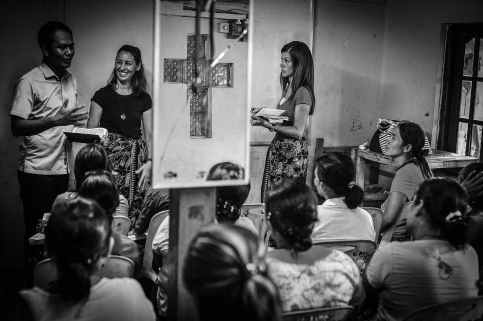
Photo by Abel Tan Jun Yang on Pexels.com
I went to college for elementary education. I imagined a classroom of eager faces mirroring my grandmother’s. We would do the best projects and everyone would love learning. I walked in with my arms filled with my favorite books, materials for astronomy models, and a skip in my step.
Instead, I was faced with mandatory testing and parents angry that their child had homework on the night when they watch reality TV. After college, I switched to teaching young adults in a collegial setting. I fell in love with teaching all over again. They were eager to learn. (Well, most of them.) I didn’t have to deal with parents who used foul language while screaming at their kid for using the same foul language. There weren’t days spent learning how to pass a mandatory test instead of mastering the material. Anyway, I digress…
I went from teaching adults at a local community college to teaching adults for a financial institute. On the side, I started teaching classes in one of my passions: writing. Libraries in the area were willing to give me time on weekends or weeknights to teach writing to anyone who wanted to come, free of charge. The classes ranged from general writing tips to fantasy-specific discussions to how to get published.
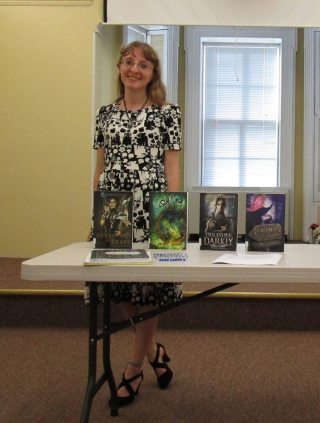
Still today, even though I’m no longer teaching as a day job, I lead classes at local libraries. The classes are always small and intimate – five people to ten. This gives us the opportunity to have one-on-one discussions and to have the attendees share selections of writing for feedback. Most recently, in August, I got to teach a two-part fantasy workshop to youth for a library summer program. The ideas they came up with were complex and original. They weren’t afraid to write out of the box.
The best part about teaching a writing class is observing the passion in everyone’s face. Whereas my grandmother’s passion came from helping me better myself, these students have a passion for the written word, and I’ll do anything I can to help them expand that passion.
Jordan Elizabeth is a young adult fantasy author. If you’re a teacher or librarian, she would love to talk to you about leading a workshop or giving a presentation. You can connect with Jordan via her website, JordanElizabethBooks.com.
Share this:

Interview with author Alexandra Forry
Posted: November 14, 2018 Filed under: Author Profile, Books, Fiction, Interview, romance, Writing | Tags: Alexandra Forry, Author Interview, Deepest Elements, romance, Writing 3 Comments
I have the pleasure today of interviewing romance author Alexandra Forry, whose latest novelette, Deepest Elements is scheduled for release on November 17. Alexandra is a lovely young author who writes her stories in spite of being afflicted with cerebral palsy. She’s agreed to share with us today a glimpse into her life and a little about her books. Please help me welcome Alexandra Forry.
Kaye: You have written in multiple genres and formats, but you are primarily a romance author. Why romance?
Alexandra: I’m hopelessly romantic, from way back. I loved a good romance that ends not happy with the man rides off in the sunset with his soul mate. I love forbidden romance the most. I write real-to-life romance because I think people can relate to it more than a fairytale romance. There is sometime about witting romance that fulfills my soul like I meant to be a romance author. If you get what I mean. Thank for asking this question, it really makes me think. No one has asked me this before you, Kaye.
Kaye: On October 12, 2014, you promoted your work at a ladies tea at Louisa Voisine’s Showroom in Las Vegas NV. How did you manage to get an invite for this opportunity? Do you feel it was successful? In what ways?
Alexandra: That was the best promoting event I’ve been to and it was very successful in every way. I met Ms. Senior United States of 2018, while I was there. I was purely a fairytale afternoon!!!
Louisa Voisine Millinery is a award winning famous Hat and Fashion Designer. Her designs are like a work of art. Louisa’s hat’s are Kentucky Derby Winning Design, Emmy Awards featured designer Pre-Emmy Event. I encourage you to check her website out!!! I had the honor to meet Louisa at Mob-Con back in 2014 and became good friends.
Mob-Con was a 3-day event Meet Real Mobsters and the Lawmen who put ’em away, with speakers and the authors like myself selling their books. Not to add, it’s not every day you get to see Mobsters, FBI, CIA news reporters and true crime authors in one ballroom talking about the good old days, acting like old friends.
Sorry to get off track. Louisa was there selling her hat’s at Mob-con and we got to talking a bit. After Mob-Con I got a Facebook message from her inviting me to sell all of my books at her high tea. Also, she’d give me two invites so I could bring whomever I wanted. I chose to take my dear and beloved Grandma. We always wanted to get all dressed up and go to a high tea. I shall never forget that tea because it really was truly made one of my grandma’s dreams come true.
Kaye: What writing groups are do you hold membership in? Would you recommend that other authors join similar writing organizations? Why or why not? What are the benefits for you?
Alexandra: I’ve got to tell you the truth. I need to re-join RWA. A few years I got out of the whole writing scène because of personal reasons but now I am back. A fellow author and friend told me this when I was first starting out he told me to join real writing groups to be taken seriously and make contact and friends. He was right. Now I’m apart of a top Authors Dinner Group in Washington, D. C. They help me out hugely. In the writer’s business, it’s whom you know. I got damn lucky at age 23!
Kaye: What can you tell us about your children’s books?
Alexandra: The Troop 740 books were based on my own Girl Scouts experience. In fact, I had a tycoon Girl Scout leader, let’s call him LL, when I lived in Portland Oregon. LL rented out a major radio station for us be on the radio, and once rented out a delta airlines aircraft for us to view what first class and the airplane cockpit look like. LL even flew in fresh flowers from Hawaii for us to learn about. I want to make my book’s leader a man, but in today’s age I didn’t want to take a gamble on it, so the leader is a woman. I hope to go on more adventure’s with Troop 470, someday! 😉
Kaye: In spite of many obstacles which life has placed in your path, you have overcome them and reached for your dream of being an author. The Omerta Affair was your debut novel. How did it feel when that book was published and you could finally say, “I made it! I’m a published author?
Alexandra: Oh hell YES!!!, I was jumping with over joy, tears of joy. It was a super amazing, wonderful feeling “I really did, I’m a published author.” It’s all began on my 22 birthday, I went to the newly open Mob Museum and to my shock, Frank Cuttolla was there signing his book. I meet him and told him that I want to be a Mafia-Romance and he told me that if I need help just let him know. I said okay thinking he has better things to do than helping me a young CP girl at the time. I found him on Facebook weeks later and we began to talk, he always inviting me to this and that. I base my fist book “Omerta Affair” off on Tony Spilotro’s reign as The Las Vegas Mafia Boss, in the 1970s. He had it all, running the Crime underworld. He could have any woman he wanted in Las Vegas, instead, he became romantically Geri Rosenthal. At first, it was a Casino’s FanFic to the 1995 move, that I was witting and putting online for free, but my family and friend told me it was way too good to be a FanFic. After I was done with my book Frank hooked me up with some people and that how my book came to be. Now he’s Uncle Frank to me. ❤
Kaye: One of the obstacles you’ve had to overcome is Cerebral Palsy, and you haven’t let it stop you from doing what you love. Have you given any of your characters disabilities to overcome?
Alexandra: YES! I really hope to write a romance that the leading woman has CP and falls in love. It makes me mad that there no disabilities romance books. Like we are still people with romantic feelings. People beg me to write my life story, I tried and give all my might, but I stopped writing it because I was up to a painful point in my life that I don’t care to remember. Sorry it’s the way I feel. Who knows maybe someday I will finish it.
Kaye: What challenges does cerebral palsy pose for you as a writer specifically?
Alexandra: I use up 3 to 5 times the amount of energy that people use without
Cerebral Palsy. My muscle spasms sometimes act up and slow down my typing.
Other than that, it doesn’t present any challenges to my thinking process
about my storytelling. I have CP but CP dose NOT have me! 🙂
Kaye: Timeless Omerta: With Beauty Comes Danger is the follow-up for that first book. It’s kind of a sequel, but not, and it launched you into the world of romance authors. Can you talk a little about the differences in the two books?
Alexandra: TIMELESS OMERTA Is a lighter version of Omerta Affair. After Omerta Affair came out for sale, a few months went by, I began to wonder what if I took out the harsh, colorful language making the story’s main love scene more romantic. With that idea, why not rename it something that a woman would really want to pick up to read when they saw it. I’ve re-titled it TIMELESS OMERTA. Making it more for women.
Kaye: Why did you choose to write Pit Boss: A Screenplay as a screenplay, rather than a novel? Why did you feel it was a better fit for the screenplay format? Do you have other screenwriting experience?
Alexandra: Pit Boss: A Screenplay was the very first writing piece that I’ve completed. Back in July 2011, my birth father passes away from stage 4 cancer. He didn’t catch it before it was way too late. I was very devastated by his fast death.
I bought a book and a screenwriting program on how to write a screenplay because I needed something that I never done before to take my mind off of my father’s death. I’ve locked myself in my room (in a way) for a month to learn and wrote “Pit Boss”
In 2016, I felt that I wanted to publish it, even if I didn’t make a penny for it. Just to showcase my work. Then with help with a ghostwriter, I turned the Pit book into a novel.
Kaye: Besides writing, what are your favorite things to do?
Alexandra: Every night, I love to sit down and relax in my chair (my comfort zone) watching a movie with my dad. That’s is my favorite part of the day> I love coloring, I have a lot of adult coloring books. 😉 I enjoy listing to audiobooks. walking outside, having a blast with my group of friends here in Williamsburg.
Kaye: What time of day do you prefer to do your writing? Why?
Alexandra: I don’t have a time that I prefer to write. When I start writing, I can go until I am wiped out. LOL 😉
Kaye: What is the biggest challenge of being a writer for you?
Alexandra: My spelling and grammar for sure. Being slow at typing, I can’t type 1,000 words a day, I wish. The biggest thing is that I get writers’ block or I lose interest in my writing and stop. I need to find a way to fix that.
Kaye: What is the one thing in your writing career that is the most unusual or unique thing you’ve done so far?
Alexandra: Okay, so one of my friends once dared me to write a very XXX romantic, erotic, sex scene! Let’s just say that I blew him out the water when he read it. Ha, ha, ha!
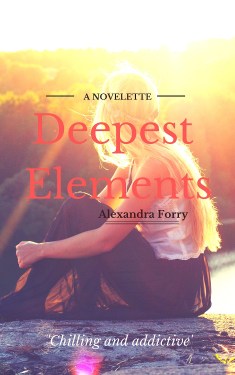
Kaye: Your book, Deepest Elements is scheduled for release on November 17. Can you tell us a little about it?
Alexandra: To my astonishment, all of the Beta and Test reads really love it! Saying that Deepest Elements is worth your time. Truth be told, I haven’t felt this way about one of my books coming out since Omerta Affair. I had this book idea tucked away in my mind since I was a teenager in high school!!! Have to tell you, that this book will be a kick off for a big series set, to be called Deepest Elements Series!
Here’s a brief synopsis:
My worst fear was those woods; my greatest fear had once been him.
She was an innocent, heading for her illustrious private boarding school in the best tradition of the grandmother who raised her, and with the blessing of the father who adored her. Forsaken by her mother soon after birth, she had made lifelong friends in a protective, privileged,Portland society.
Arriving in Radcliffe Heights, Rhode Island, freshman Peony “Poppy” Calloway admired the picturesque small town. But deep in the shadows of the woods near Blue Bell Boarding School, and along its hallowed halls, lurked illicit sex, murder, and harrowing danger.
Seduced by Jordon Dashwood, the handsome, blue-eyed, white blonde Headmaster, Poppy enters a world of love, ecstasy, heartbreak, betrayal, and death.
“Deepest Elements” is by the well-known author of “Wildflower,” Alexandra Forry.
Thank you so much for reading my in-depth interview. Also, thank you so very much, Kaye, for having me on your wonderful blog Today! Best wishes, Alexandra!
I want to thank you Alexandra, for sharing with us today. It’s been a pleasure learning abouot your books and the challenges you face in creating them.
Readers can learn more about Alexandra and her books here:
Facebook Author page: https://www.facebook.com/cpgalauthor/?hc_location=group
Amazon Author page: https://www.amazon.com/Alexandra-Forry/e/B00JBGRIKO/ref=sr_ntt_srch_lnk_1?qid=1540486609&sr=8-1&fbclid=IwAR3pSojbhA9lhk_0UHBQtIKidymGevYFAA_7orO8hBlEPWgJZktqtsBJxRA
Don’t forget, Deepest Elements is scheduled for release on November 17, so be sure and grab your copy.
Like this post? Subscribe to Writing to be Read for e-mail notifications whenever new content is posted or follow WtbR on WordPress.
Share this:

It’s All a Matter of Time
Posted: August 27, 2018 Filed under: Books, Memoir, Nonfiction, Revision, Writing | Tags: Future, Last Call, Memoir, Michael: How my son became a teen suicide statistic, Non-fiction, Past, Time, Time travel, Writing 1 Comment
Time. It fascinates us, captures our imaginations with the possibilities of time and time travel, so much so that our literature and the entertainment industry are filled with stories and songs which follow that theme. There have been countless movies on the subject: the Back to the Future series; Time Cop; The Terminator; Groundhog Day; Planet of the Apes; Bill and Ted’s Bogus Journey; The Butterfly Effect; Land Before Time; and Timestalkers, to name a few. And of course, television series: Dr. Who; Quantum Leap; Sliders; Time After Time; Outlanders – not to mention series with one or more episodes that involve time travel. Books and stories about time travel include: A Connecticut Yankee in King Arthur’s Court, by Mark Twain; The Time Machine, by H.G. Wells; Rip Van Winkle, by Washington Irving; A Christmas Carol, by Charles Dickens; “The Langoliers”, by Stephen King (Four Past Midnight); Timeline, by Michael Crichton; Harry Potter and the Prisoner of Azkaban, by J.K. Rowlings; The Time Traveler’s Wife, by Audrey Niffenegger; and more recently, All Our Wrong Todays, by Elan Mastai. Even the music industry has gotten in on the theme: Fleetwood Mac can’t stop thinking about tomorrow; Tim McGraw deals with it in segments, so he only worries about the next thirty years; Bad Company is ready for love and figures better things are bound to happen looking forward; Jim Croche wants to save it in a bottle; Cindy Lauper comments on the repetitiveness of it, as things tend to happen time after time; and Stevie Nicks would do it all again, even though it’s not always a breeze. These lists don’t even scratch the surface. So, why is it that time so fascinates us?
I had a little Australian Shepherd named Dorchester. I got her when she was a pup. When she was young, she was agile and fast. Man, was she fast. She could smoke both the male Blue Heelers she grew up with to get a Frisbee. Then, she’d run off with it and wouldn’t give it back. She never was much for playing by the rules. But, as she got older, of course, she slowed. Age affects dogs in many of the same ways that it affects people: it gets harder to get up and down; movement is slower, more careful; the senses are not as accute as they once were, etc… Dorchester began to lose her eyesight first, even before her she lost her speed and her agility, so I had to become her seeing eye person. I began carrying a walking stick on our walks, thunking it down firmly on the ground with each step I took, so that she could hear where I was and follow. We walked this way for several years until eventually she was no longer able to go on walks with me anymore due to poor eyesight and other effects of aging.
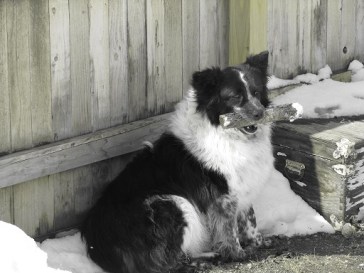
Dorchester isn’t with me anymore, but I still go on walks with both of the Heelers. We all walk a little slower these days. Our walks are shorter and there’s not a lot of rabbit chasing anymore, but they are are enjoyed, never the less. My son’s dog, Zaar, was Dorchester’s mate. They were the same age, each joining our family at about the same time. As Zaar ages, he is not only losing his sight, but his hearing, as well. He is very frightened of thunder and storms always gave him major anxiety attacks, so his not being able to hear so good hasn’t been a totally bad thing, but it does pose new problems on our walks. Zaar grew up walking on our property, so he thinks he knows where he’s going and doesn’t always pay attention to where his walking companions are headed. He gets into ‘the zone’, nose up, sniffing th air, and no matter how loud I yell, he doesn’t hear me, causing me to have to chase after him, touching him to get his attention and get him back on track. Zaar was also raised around a Heeler who was deaf, so he learned hand signs and once I have his attention, he will follow, but it’s getting his attention that’s the trick.

The exercise he gets from his walks is what keeps him healthy and mobile. As I watch him getting older, I feel a sense of urgency, knowing that time may be running short for our walks and I want to enjoy my time with him while I can. I guess I just don’t know how to be a seeing eye person for a dog that can’t hear. He doesn’t hear my stick. I must figure out how to adapt and rise to the challenge, because left to his own devices, Zaar would soon be lost, especially after dusk, when his eyesight is at its poorest. It seems none of us are as young as we used to be.
It’s easy to look back and see what we’ve lost. ‘Hindsight is better than foresight’, and all that. Looking to the past, all our regrets become vividly obvious, but we tend to embellish the good times, as well. I think happy moments may be remembered as euphoric, more so than what they actually were, because those are the times we wish to hold onto. When I look back, there’s a dividing line to my timeline, seperating my life before my teenaged son died, and post-death, signifying the time when he was no longer in my life. That’s my loss. The time when Mike was alive seems brighter, more vivid in my memories. He was my biggest fan, with aspirations and the ability to be a writer himself. He was a unique soul and a source of inspiration for me.
These days, I feel a sense of urgency to make this writing for a living thing work while I still have time to do so. I have certainly taken enough time making it happen. I was 52 when I finally earned my M.F.A. and 53 before I became a published author. I’m sure I have some good years left, but I have to wonder if there will be enough for me to realize my dream. I wish I could go back in time and do things differently, but of course that’s only possible in my fiction.
 Now, with time travel, there’s the possiblity of doing things over, making things turn out different. Granted, it doesn’t usually turn out well when you go messing around with time, but things can, on occasion turn out better. If you don’t believe me, just take a look at MY time travel short, Last Call. Things aren’t going good for Derek, but he finds a way to make his life better. Maybe I could go back and get started on this career path a lot earlier in life. That’s not Derek’s solution, but it could work.
I don’t live in Derek’s world and there is no Last Call bar for me. I know I can’t just sit back and wait for things to happen, so if I want to reach my dreams while I’m still alive to see it, I have to take action. I must market what I already have published, but even more importantly, I must keep writing. So, my plan is to just keep at it. Eventually, my efforts will pay off. I have to believe that.
So what if I didn’t earn my M.F.A. until I was 52 and wasn’t published until I was 53? I’m not the only one to get a late start on their dream. After all, according to an inspirational Facebook post by Karen Caron, Stan Lee’s first big comic came out at age 40, Morgan Freeman had his first major movie role at age 52, and Julia Child didn’t make her cooking show debut until age 51. That puts me in some pretty good company.
Young or old, all we can do is look to the future. (There’s that time thing again.)

With that in mind, I’ve begun the writing and compilation of my memoir about my son’s life and death, finally, after nine years. I’ve decided that it’s time to reunite the two time periods that divide my life and my thinking. After his death, I wrote poems and stories about him, pouring my grief out onto the page. I compiled all the photos of him into a slideshow for his memorial dinner. In addition to that, I plan to contact some of Mike’s friends and request them to contribute writings of their own about who Mike was for them. It’s going to be a massive amount of work, but his story deserves to be told and there is no one else who can tell it. It will be my first non-fiction work of book length.
I’ve always said that I never have less than three works in progress. Michael: How my son became a teen suicide statistic, will make the third one, as I’m also writing the first draft of the sequel to my western novel, Delilah: The Homecoming and I’m revising the first book in my science fantasy Playground for the Gods series, The Great Primordial Battle. Writing is an integral part of my life, past, present and future. I may be an old woman, but there is no other direction in which my life can go. Mike would be proud of my accomplishments so far and I think he would be glad that his story will finally be out. After nine years, it’s about time.
Like this post? Subscribe to Writing to be Read for e-mail notifications whenever new content is posted or follow WtbR on WordPress.
Share this:

Writing for a YA Audience: CLICK YOUR CONVERSE HEELS TOGETHER
Posted: August 15, 2018 Filed under: Books, Stories, Writing, Writing for a YA Audience, Young Adult | Tags: Converse Sneakers, Details, Writing, Writing for a YA Audience, Young Adult Fiction Leave a comment
When I write contemporary young adult stories, I draw on my own experiences growing up. A huge part of my childhood involved wearing Converse sneakers. Okay, you’re probably thinking that’s a sad childhood, but bear with me. I was always obsessed with shoes. I liked the old-fashioned ankle-boot style. I liked the shiny Mary Janes. I hated regular sneakers. They weren’t cute enough. I endured sneakers only for gym class.
In Junior High, I started seeing the other children wearing Converse sneakers. They came in all sorts of patterns and colors, and they went over your ankle. They were unique, and even though almost everyone had a pair, everyone had a DIFFERENT pair. Some kids even wore mismatched sneakers or used fancy laces. I went home to tell my grandmother I just had to have my own Converse sneakers. (If you aren’t familiar with Converse sneakers, you have got to check out their incredible selection.)
She took me to the coolest sneaker store in the mall (I don’t remember the name of this wicked awesome store) and got me…a pair of knock-offs. They were black and came below my ankle. I fell in love with them because they had a side-pocket. I wore those sneakers until they fell apart.
In the meantime, my grandmother and I went to the nearby outlet mall. We would go once or twice a year. At their shoe store, I saw a beautiful array of colorful Converse sneakers. She bought be an official, high-top pair. They were black with white pinstripes. I wore them so much they started to fall apart…so now I don’t wear them much to preserve their life.
After that, I got a pair each time we went to the outlet mall. I even got a pair that reached up to my thighs! I now have twelve pairs altogether in my collection. Converse is still my favorite brand of sneaker.
Why am I talking to you about my Converse obsession? Well, Converse sneakers were a huge part of my childhood, from shopping for them to wearing them almost every day. I loved wearing them to gym class with fishnet stockings. I always write about my young adults wearing Converse because that’s what I wore. I didn’t realize how prevalent the brand featured in my writing until an editor called it to my attention. I went back through my writing and almost every girl character has a pair at one point in their individual stories!
If you were writing about shoes, what shoes would you mention? What shoes are most important in your life?

Photo by Pixabay on Pexels.com
Jordan Elizabeth is a young adult fantasy author. Her latest book, a post-apocalyptic novella entitled ROTHAM RACE, released July 14th fron CHBB. If you’re wondering if it features Converse sneakers, you will have to read it to find out.
You can connect with Jordan via her website, JordanElizabethBooks.com.