Interview with nature author Susan J. Tweit
Posted: February 4, 2019 Filed under: Author Profile, Books, Interview, Memoir, Nature writing, Nonfiction, Teaching Writing, Uncategorized, Writing | Tags: Author Interview, Connections, Memoir, Nature Guides, Nature writing, Susan J. Tweit, Travel Books, Writing to be Read 6 Comments
My guest today is an author, nature lover and plant ecologist. Her books include memoirs, beautifully illustrated travel books, nature guides, and even children’s books, but they all have strong ties with nature. Her books reveal connections with nature and life that have not been pondered or may have been overlooked in our everyday lives. Her books have won the ForeWord Book of the Year, the Colorado Book Award, and she is a five time recipient of Colorado Author’s League Award. With a background in science and plant ecology, she expertly weaves her natural environment into her writings, illustrating how all things interact and connect. Let me introduce creative nonfiction author, Susan J. Tweit.
Kaye: You are a female author who champions the natural environment. Do you identify most as a feminist, a naturalist or an environmentalist?
Susan: All of the above. I grew up in a family of naturalists and scientists; restoring everyday nature is my way of leaving the world a better place. And I work in two fields where women are still second-class citizens in so many ways: science and writing. So am a feminist just be participating in those fields as a woman.
Kaye: On your website you claim that you taught yourself to write after you realized that you enjoyed the stories told by the data more than you did doing the research. How does one teach oneself to write?
Susan: I don’t know how other people teach themselves to write creatively, but for me, as a scientist trained to eschew personal opinions and emotions, and to be extremely parsimonious with descriptive adverbs and adjectives, I found my writing voice in reading the works of writers whose works I admire. I read Ann Zwinger and Terry Tempest Williams, Barry Lopez and Kim Stafford, Brenda Peterson and Linda Hogan, Leslie Marmon Silko and Denise Chávez, Robert Pyle and Gary Paul Nabhan, Sharman Apt Russell and Barbara Kingsolver, and so many others.
As I read, I thought about the mechanics of how each writer told their stories (whether fiction or essays), how they introduced subjects and characters, where they got personal and where they stepped back, how they described landscape and culture, how they used words and language… I tried out techniques and styles until I found my own voice, which has continued to evolve through twelve books and hundreds of essays, articles, and columns for newspapers and magazines.
Kaye: Connections are a common theme in many of your works. Can you talk a little about those?
Susan: As a plant ecologist, I am fascinated by the relationships and interrelationships that form community, whether the human community, or what I call “the community of the land,” the interwoven communities of species—from tiny microbes to gigantic redwood trees—that make life on Earth possible. Who loves who, who eats who, who sleeps with or pollinates who, who can’t stand who… All of those relationships weave the fabric of Life with a capital L. Without them we would not exist, and we have so much to learn about the connections that are vital to this planet. I just collaborated with science illustrator Samantha Peters on “Natural Partners,” a feature for WILDFLOWER Magazine on plants and the animals they rely on. It’s up on the internet here: https://www.wildflower.org/magazine/fauna/natural-partners (The print version took the cover of the magazine, and it’s really gorgeous!)
Kaye: Writing seems to be a way of life for you, and your love for nature is woven into almost everything you do. You have a background as a plant biologist and most of your books offer a perspective on nature and the environment, and you call your books love letters “to the earth and its living web of lives”. If you could convey one message to your readers, what would it be?
Susan: Get outside and get to know nature nearby. Learn even a handful of your neighbors in the world of plants and animals and you’ll never be bored. Nature is vital to our health and wellbeing—it’s the best antidote to stress I know of, the closest source of inspiration and renewal, and it doesn’t require a prescription or training. And it’s free!
Kaye: Besides writing and ecological restoration projects, what are your favorite things to do?
Susan: I’m an outdoors person, so I love taking long walks in the arroyo near my home, hiking with friends, and setting out on long road trips to see this amazing continent. At home, I tend a small garden of native wildflowers and other plants chosen to provide habitat for songbirds and pollinators, cook elaborate dinners for family and friends, and read. I’m an omnivorous reader, which leads into your next questions…
Kaye: You’ve written three memoirs about your life experiences. What makes an experience worthy to become a memoir?
Susan: Memoir is a way of distilling what our own lives and experiences have to offer others. What makes an experience worthy of memoir is partly whether we can find a way of telling the story that is compelling to others (that is, to a wider audience than our close friends and family!). It might be that we lived through a critical part of history, or our personal journey is exceptional in some way, or simply that we figure out how to relate our very ordinary story in a way that offers some universal wisdom about being human. Both of my published memoirs—Walking Nature Home; and Barren, Wild, and Worthless: Living in the Chihuahuan Desert—taught me about how to tell a story, how show the way we grow and change over time, and how to pick and choose telling detail. Each one presented different challenges, and the memoir I am working on now is challenging me in new ways. Telling my personal story may be my greatest learning experience as a writer!


Kaye: Would you tell us about your Write & Retreat Workshops?
Susan: They are an immersion in writing, in learning place and story, and in the inner work that is the source of our creativity. Each one includes hands-on writing and workshop time, as well as time to retreat and nurture our inner selves. Each one is set in some extraordinary place chosen to inspire us, with time spend exploring that place. I don’t have any W&R workshops planned this year, but next year I may offer one set near Yellowstone National Park, that place of wildness and wonders.
Kaye: You are a member of Story Circle Network, Women Writing the Westand Colorado Author’s League. How are these organizations beneficial to you as a writer?
Susan: I am also a member of Wyoming Writers. Belonging to at least one professional writing organization is critical to writing: they offer education, resources, and, most importantly. community. Writing is an inherently solitary activity: pulling words from deep within, honing them into stories, and then offering the work of our hearts to the world is perilous. Finding a community of fellow sufferers… uh, writers, is essential to maintaining our sanity, growing in the craft, and getting published.
Kaye: What is the one thing in your writing career that is the most unusual or unique thing you’ve done so far?
Susan: Besides leaving behind a paycheck, benefits, and job security to chase words and stories? Hmm… It’s hard to choose just one. Kayaking with sea turtles in the Sea of Cortez off Baja California? Learning about how to blow up dams to restore a river and its salmon run? Dancing with a Native American community to celebrate the return of those salmon? Watching a grizzly bear mom teach her twin cubs how to dig and eat spring-beauty bulbs in a meadow in Yellowstone National Park? Walking alone through some of the wildest country in the Lower 48 states, carrying all I needed on my back to listen to myself? Tending my husband and the love of my life through his death from brain cancer and then figuring out how to write how to survive loss? Seeing monarch butterflies return to a restored patch of urban nature? I’ve been fortunate to experience miracles and wonders all along the way.
Kaye: What are you working on now? What can readers expect in the future from Susan J. Tweit?
Susan: I’m working on The Climate Victory Garden, a book about how gardens can help grow The Green New Deal and slow climate change. It’s another chapter in my life-long quest to leave this world in better shape than I found it by restoring nature nearby and our connection to the green and living world.
Many thanks to Susan for sharing with us today. You can learn more about Susan J.Tweit and her work by visiting the following links:
Amazon Author page: https://www.amazon.com/Susan-J.-Tweit/e/B000AQ53RY/ref=sr_ntt_srch_lnk_1?qid=1547778739&sr=1-1
Website: http://susanjtweit.com/
Join us next Monday, when I’ll begin a new bi-monthly blog series, “His Name Was Michael”, which will chronicle the stages of writing a memoir as I work through them for my own memoir of the same name, telling the story of my son’s death and my own grief process. This first post will talk about the prewriting stage for memoir.
Like this post? Subscribe to Writing to be Read for e-mail notifications whenever new content is posted or follow WtbR on WordPress.
Share this:

Chatting with the Pros: Interview with Women’s Fiction Author Barbara Chepaitis
Posted: January 21, 2019 Filed under: Chatting with the Pros, Interview, Science Fiction, Women's Fiction, Writing | Tags: Author Interview, Barbara Chepaitis, Chatting with the Pros, Science Fiction, Women's Fiction, Writing to be Read 1 Comment
In January, Writing to be Read is celebrating women’s fiction and female authors. You may have caught my Interview with Loretta Miles Tollefson two weeks ago, or my post about the history of female authorship last week. In continuation of this monthly theme, I’m pleased to welcome a woman who authors science fiction and women’s fiction as my first guest for this new monthly series, Chatting with the Pros. Barabara Chepaitis is a traditionally published author of both science fiction and women’s fiction, and she’s very familiar with the issues that surround being a woman author in today’s publishing industry. Let’s see what she has to say.
Kaye: What defines women’s fiction? Is it the subject matter, female protagonists, or the manner in which women are portrayed?
Barbara: In my experience, women’s fiction is defined by the publisher, who wants to have a specific place to put a book in a bookstore. For me, the difference between my science fiction and my ‘women’s fiction’ was what name they used. When I write science fiction, they want me to use my initials to hide that I’m a girl. When I write women’s fiction, they want to use my name, to prove I’m a girl.
Since I’ve never written a novel that doesn’t have a female protagonist, it’s clear to me that this isn’t the defining aspect. Other than that, I think the definition is kind of the way Dr. Who describes time – wibbly wobbly.
Kaye: What draws you to women’s fiction?
Barbara: I don’t know that I am drawn to women’s fiction. I’m a feminist, for sure, but I never set out to write any particular genre. I just get an idea for a character and story, then tell it. If they happen to be female, that’s because I’ve known some fascinating women, with very complex lives.
Kaye: Do you think it is tougher female authors today, or has digital and self-publishing evened the playing field for women in the publishing industry?
Barbara: It’s always been more difficult for women, in every field of endeavor we have in our culture. There’s so many many ways to block women. First, you can just not hire (or publish, or pay) them. Second, you can let them do the work, but not acknowledge the work they’ve done, attributing it to others. Only time will tell if digital and independent publishing will change that kind of move. Being cynical, I guess that women will have to continue to fight for their place. But that’s just me, being cynical.
Kaye: Romance usually has female protags. Why is it not considered as women’s fiction?
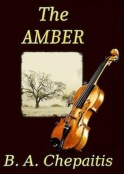 Barbara: The quick answer – because the narrative arc primarily follows a trajectory of romance. I know that when I’ve written material that has a strong romance (as in The Amber) but has something else as it’s narrative arc (coming of age, self-discovery, overcoming demons, etc.) then it isn’t seen as romance. For instance, there’s some pretty strong romantic properties to the whole Jaguar series, but she’s primarily dealing with criminals and crime.
Kaye: What makes a good story?
Barbara: The answer to that varies pretty wildly, depending on who you ask. For my husband, a good story is often one of a hero who makes the ultimate sacrifice for a cause. He loves Spartacus, Saving Private Ryan, and so on. For me, a story of a hero who overcomes incredible obstacles to reach a goal that serves others, or creates a new understanding of life, is always entrancing. I’m guessing that for romance readers, the tale of finding true love is what winds their clocks. So the question to ask, really, is what makes a good story for you?
Kaye: Your Fear series has a futuristic setting, an action adventure storyline and a strong female protagonist, Jaguar Addams. It’s really women’s genre fiction. What genre or genres do you put it in?
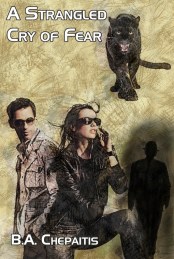 Barbara: I wrote the Fear series as a detective/mystery series. It just happened to be set in the future. When I was seeking a publisher, there was no such thing as ‘cross-genre’, and the mystery/detective market wanted nothing to do with it. Thus it landed in science fiction, which was more open, and they called it cyberpunk suspense – which made me wonder if I had to do something different with my hair, you know?
You can say Jaguar is ‘women’s fiction’ in that it has a powerful female protagonist and is written by a woman, but there’s plenty of men hanging around as well, and they all have their own obstacles to overcome, sacrifices to make, stuff to learn. Most of my work crosses literary lines in some way. I’m bitextual, and trangenre, I guess. And proud of it.
Kaye: Would you like to tell us a little about the series?
Barbara: Jaguar Addams and Alex Dzarny work on Prison Planetoid 3, which was established after a time of massive domestic violence known as The Killing Times. Now the worst criminals are sent to the Planetoid Prisons, where they’re run through programs that make them face the fears which drove their horrid crimes, based on the theory that all crime grows out of fear. Jaguar and Alex are both practitioners of the Empathic arts, and have some maxxed out psi capacities, which they use in their work.
Jaguar and Alex are alike in their dedication to the job, but they approach it differently. Jaguar runs with scissors, and colors way outside the lines. If Alex runs with scissors, he points them down. Both characters have close and complicated friendships with others who work on the Planetoids, and Jaguar has a ‘family’ in a Native American community in the Southwest. She’s an offshoot of a Mayan nation by heritage.
Each book is its own case, as in a detective series, but there is a larger arc along the way, which deals with Jaguar’s need to develop trust in intimacy, and Alex’s need to get a little more wild.
Kaye: Would you talk a little about the books that are published under Barbara Chepaitis, the ones that annnounce that you’re a girl and would probably most be classified as ‘women’s fiction’?
Barbara: I’ve got 3 under the ‘Barbara’ name:
Feeding Christine: “It was the season of Miracles in Teresa’s kitchen, and while none of the women particularly believed in miracles, neither did they think they’d be needing one. They were wrong.”
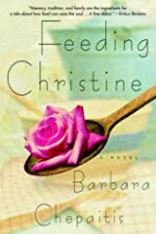 TERESA DI ROSA, owner of the thriving catering business Bread and Roses, makes the feeding of bodies and souls her life work. Now, with her niece CHRISTINE and her friends DELIA and AMBERLIN, she’s gearing up for the big event of the year – the annual Christmas open house. But as the party gets organized, her life is spinning out of control.
Her divorce is barely final, her son is spending Christmas with his father, and Christine seems to be losing her grip on sanity as she grieves the death of her mother, Teresa’s sister. The radical steps Teresa takes to rescue Christine shock everyone, but with her friends, Teresa feeds Christine a healthy dose of courage, wisdom and love.
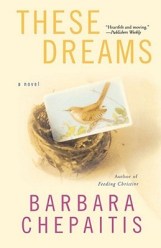
These Dreams: Cricket Thompson’s routine life of husband, home, and family becomes a land of nightmare when an act of random violence leaves her daughter critically wounded. The crisis destroys her family, exposes her illusions and defies her belief in dreams. She seeks solace at the bird sanctuary where she volunteers, and learns that healing is a miracle of choice rather than chance.
Something Unpredictable: Just FYI – SOMETHING UNPREDICTABLE is based on a house that me and my husband actually tried to buy. There really is a circus house.
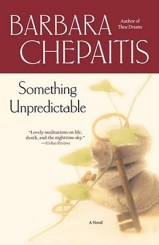 Delilah is 31, has no career to speak of, and is living at home with her hippie parents, and hanging on to a boyfriend who likes to photograph her naked in tubs of blue jello. Clearly, Delilah needs a plan.
Her sister is living the perfect life with the perfect husband, her father continues to make money off the stock market, and her mother continues to spend it on the latest social cause. Delilah would love to save the world as well if only it weren’t such an overwhelming task. She longs for inspiration. But she’s about to encounter some things she never predicted – a long-lost grandmother, Carla, who used to tame tigers with the circus; a 260 year old house with septic problems; an ex-fiancee; and a man named Jack – all of which will change her life forever.
Kaye: Food plays a central role in much of your women’s fiction. In fact, you might consider it a core theme for your books. Can you explain why this is, and why it’s important?
Barbara: Mmm. Foood. I’m a real foodie, and love to cook and play with my food. Perhaps because my mother’s family is Italian, I also understood from an early age that food is a language all its own, something we consume to learn about the land and its people and our relationship to all that. To me, cooking is similar to writing, and eating and reading are the way we enrich ourselves, body and soul.
Kaye: Why does symbolism play such a big role in your work?
Barbara: Symbolism? Actually, none of it is symbolism. It’s all experience and reflection on experience. If I write about a family violin that’s been lost and must be found, it’s because I know that music connects us across time with our ancestry. If I write about food, it’s because food speaks to us all the time.
Kaye: Children of the Land (Songs of the Mothers Book 1): This title screams women’s fantasy. I imagine a fantasy world laden with legends of yore. Would you like to tell me a little about this book?
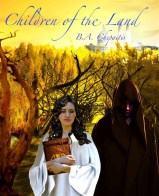 Barbara: Children of the Land is actually the last novel in a series that I wrote which attempted to move across genres through each novel. It started with Children of the Gods, historical fiction with a contemporary twist, retelling the ancient history of the Haudonosaunee. Next was a near future novel titled Children of the World, which featured the descendants of the first novel as they approached the historical moment when biological immortality became possible. After that was Children of the Land, where the next round of descendants dealt with the political and world ramifications of that possibility in a fantasy novel.
When I talked to publishers about the series, they looked at me with something akin to terror. I swear their hair stood on end. It’s really the ultimate in transgenre, and couldn’t be handled by this market. Ultimately, I decided to go ahead with Children of the Land, which is indeed a fantasy novel, and worry about the others later. I have to say it was one of my favorite writing experiences ever. It really appealed to my love of language, and my love of the Heroine’s journey. It also allowed me to play with a lot of gods and goddesses from a variety of cultures, because part of the idea is that it’s time for them to return, and establish a closer relationship with humans, who are indeed the children of the land.
Here’s the synopsis:
Lord Aroc rules all, giving the gift of immortality only to his citizens. The balance between City and village has been preserved for a long age, but a change is at hand, signaled by the dancing of the Northern Lights. Now, a young woman’s choice to plant a small seed will determine world dominion, and the return of the gods.
That woman is Vareka, a Citizen working for Lord Aroc as Watcher for the villagers of Eryahsa. Such villagers live apart from the City, and are ultimately absorbed to feed the City’s energy. As heavy solar flares disrupt the City’s technology, the northern lights cause villagers to recall ancient stories of the Dreamers – spirit beings who would someday return. Then, an old man in Eryahsa tells Vareka she is inheritor of a task only she, daughter of a Dreamer and a Human, can complete.
She bears a locket handed down from mother to daughter for ages uncounted, and the seed it holds must be planted if the Dream is to continue.
She must choose her path, with no guarantee of success. Either she will take her friends on a perilous journey to find the place and time of planting, or she will accept Aroc’s rule, allowing him to remake the world, in his own image.
Kaye: Your fiction features strong female characters, and their strengths give them power. Where do you draw your characters from?
Barbara: For me, characters make themselves known in a very visceral way, speaking up inside me to tell me it’s time to tell their stories. Jaguar popped up when I was on the highway, and I had to pull over and make notes. I can still see her, sitting on the arm of her couch, in her apartment with its skulls and hanging herbs. She was smoking a cigarette, swinging her leg back and forth, and she said, “What you’ll do next is write me.”
Characters and their world, how they arise, where they come from, is a bit of a mystery to me, but I have noted that the best thing I can do is maintain an attitude of openness to their arrival. In fact, an attitude of openness in general. A kind of “Okay. I’m ready. Whaddya got?”
I’m sure that this attitude is assisted by the fact that I grew up with a horde of powerful and complicated women, but I can’t say that any one of them has become a particular character. Perhaps it’s just the flavor of their lives that gets put in the mix.
Kaye: So, would you say your stories are character driven?
Barbara: Yes, my stories are character driven. Characters, with all their complexities and eccentricities, create plot. They have something to say, and are blocked from saying it. Or they have something to hide and it’s revealed. Or they have something to BE, and are meeting obstacles in being that. Characters – human and animal – are at the heart of all plots, the heart of all interest, the heart of our hearts.
Kaye: They say the pen is mightier than the sword. What causes have you used your status as a writer to champion?
Barbara: I once helped a Navy SEAL and Army Ranger rescue a war-wounded eagle from Afghanistan, and that came about only because I’m a writer. I’ve also used my writing in any way I can to promote environmental causes. In fact, I’d love to do more of that.
You can get the full story on the war-wounded eagle in her book, Saving Eagle Mitch: One Good Deed in a Wicked World. Thank you for sharing with us today Barbara. You can learn more about Barbara Chepaitis and her works at the following links:
Goodreads Author Page (Barbara Chepaitis): https://www.goodreads.com/author/show/202062.Barbara_Chepaitis
Goodreads Author Page (B.A. Chepaitis): https://www.goodreads.com/author/show/841157.B_A_Chepaitis?from_search=true
Feeding Christine https://www.amazon.com/s/ref=nb_sb_noss?url=search-alias%3Daps&field-keywords=Feeding+Christine+chepaitis
SOMETHING UNPREDICTABLE https://www.amazon.com/s/ref=nb_sb_noss?url=search-alias%3Daps&field-keywords=Something+Unpredictable+chepaitis
Like this post? Subscribe to Writing to be Read for e-mail notifications whenever new content is posted or follow WtbR on WordPress.
Share this:

Interview with western author Loretta Miles Tollefson
Posted: January 7, 2019 Filed under: Author Profile, Book Covers, Books, Cover Art, Fiction, Historical Fiction, Interview, Western, Writing Process | Tags: Author Interview, Author Profile, Delilah, Loretta Miles Tollefson, Not Just Any Man, The Pain and the Sorrow, western fiction, Western genre, Writing to be Read 12 Comments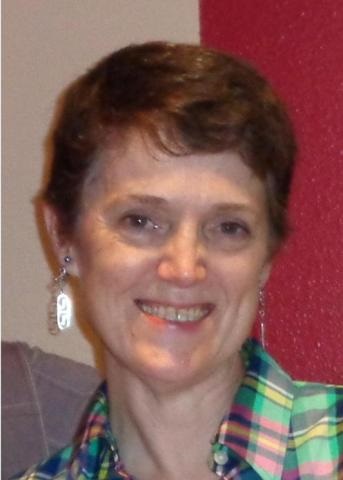
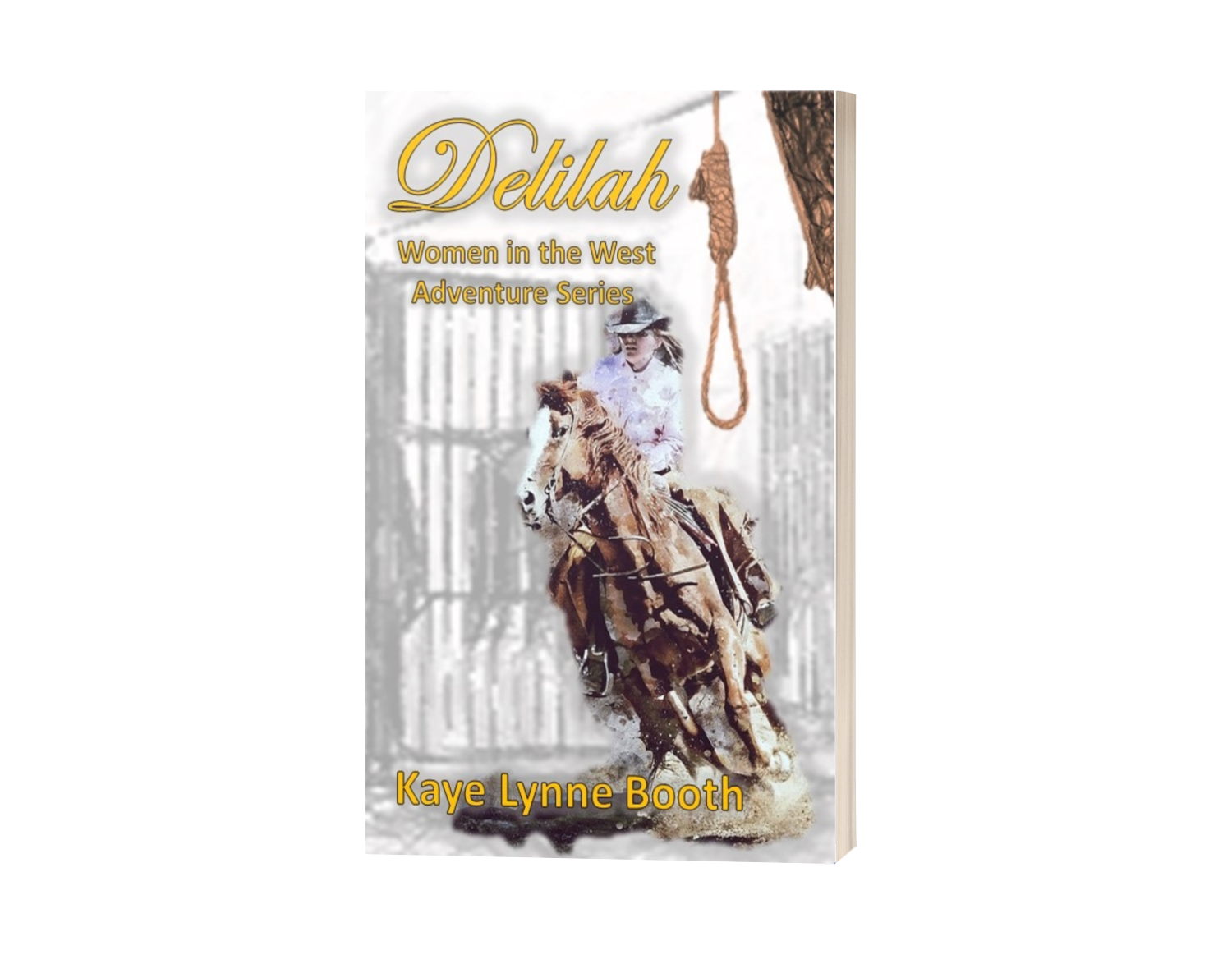
After writing an excerpt of Delilah for an assignment in grad school, I remember thinking, ‘this could be a book’. But I also remember thinking that a western by a female author probably wouldn’t sell. Women weren’t supposed to write westerns. After all, the western frontier was for rugged men. I knew there were women in the west, but I guessed that they weren’t protagonist material. Then, I wrote and published Delilah anyway. It was a story that wanted to be told. My character, Delilah spoke to me and the writing of the tale was too important for me to let the idea that it might not be a best seller stand in the way.
In the meantime, I was happy to learn that there are other female western authors out there. I’m pleased to have one as my guest today. Her books are set in the historical New Mexico landscape based on factual historical people and places. Western fiction author Loretta Miles Tollefson will share her thoughts on the matter of gender in the western genre and other aspects of writing and her books.
Please welcome Loretta Miles Tollefson.
Kaye: Would you share the story of your own publishing journey?
Loretta: When I was fifteen I won a writing contest in a Sunday School paper and that triggered a deep desire to continue to see my words in print. I published a couple more pieces in that same paper, then branched into short stories and poetry in my 20s and 30s. I had a few things published and received a co-publication offer for a novel. Unfortunately, I didn’t have the financial resources to follow up on that. I continued to write and had some poetry published in my 40s and early 50s. I self-published a couple novels in my mid-50s and then The Pain and the Sorrow was published by Sunstone Press in 2017. I was frustrated by the lack of opportunities to advertise a novel that had been traditionally published and went back to the self-pub route with Not Just Any Man.
Kaye: When did you know you wanted to be an author?
Loretta: I was 15 but, because I come from a very practical family, I chose to take the pragmatic approach of going into newspaper and magazine work instead of stepping into the uncertain waters of fiction. Eventually, I became a Special Projects Manager for a regional planning organization here in New Mexico, a job which utilized both my writing and research skills. I didn’t realize my dream of writing full time until I retired about five years ago.
Kaye: What is the most enjoyable part of writing westerns for you?
Loretta: For me, the most enjoyable part of writing is finding ways to bring the historical details, my characters’ personalities, and the storyline itself together. It’s like weaving a tapestry. And then there’s always the sudden inspiration that seems to come out of nowhere, when my characters seem to be telling me what they want to say. Although I, as the author, always have control, I’m sometimes surprised at where the story takes me.
Kaye: What is the biggest challenge of writing western fiction for you?
Loretta: I think my biggest challenge in writing historical fiction set in the West is feeling like I need to double check all the details. Even though I grew up on a small farm and we had horses and cows and chickens and hung the clothes on a line and pretty much all the rest of it, there’s a great deal I don’t remember or took for granted at the time. And, of course, I didn’t actually live in the early 1800s. I have to be careful not to assume certain ways of doing things or specific pieces of equipment were common back then. I’m always concerned that I’ll slip into an anachronism.
Kaye: You follow the old adage “write what you know”, setting your books in areas where you have lived and are familiar with, yet you must envision those settings in another time period. It seems perhaps your own setting acts as inspiration for your stories?
Loretta: It does. Very much so. I’ve lived in New Mexico almost thirty years and was fortunate enough to travel all over the state in connection with my job. Then, after I retired, we moved to Eagle Nest, New Mexico, on the northern end of the Moreno Valley. We lived there five years and that experience really brought together my love of history and my desire to write full time. There’s so much history here in New Mexico that I don’t think I will ever run out of ideas. We recently moved to Santa Fe, New Mexico, and that will continue to inspire me and to provide me with great resources for my research.
Kaye: Your novel, Not Just Any Man, was recently released. Would you like to tell us a little about that book?
 Loretta: Not Just Any Man is about a black mountain man in 1820s New Mexico named Gerald Locke, Jr. It’s an adventure story, as Gerald traps in Northern New Mexico and then joins a fur trapping expedition across the Arizona desert and up the Colorado River. The group includes Enoch Jones, the only mountain man in the West who seems to have an issue with Gerald’s skin color. Jones has a few other issues as well, and the conflict between the two men is a crucial plot element.
But this isn’t just an adventure story. Gerald has met a young woman in Taos who seems far above his station in life and he can’t stop thinking about her. Even if he can survive the Sangre de Cristo mountains, the Mohave Indians, and the arid rim of the Grand Canyon, as well as Enoch Jones, can Gerald prove to himself and the girl he loves that he is, after all, not just any man?
Kaye: Do you think western readers are more receptive to male protagonists?
Loretta: There certainly are a lot of male protagonists in the western genre. I think this is because the traditional Western initially reflected the cultural assumption that only men played an active role in events in the West. As we broaden our understanding of the historical West, both before and after the United States was the primary actor there, we’re realizing just how often women played critical roles on the frontier. Life was harsh. Any family that was going to survive needed everyone in it to be fully engaged. Women had to take on roles they hadn’t necessarily played before. If anything, I believe their experiences on the frontier helped to begin breaking down the barriers that we’re still disassembling today. As we do that, I suspect Western readers will become more and more receptive to all kinds of protagonists.
Kaye: You have wonderful covers with beautiful landscapes that cry out ‘western’! Where do you get your covers?
Loretta: Well, thank you! I’m glad you like them. I worry about my covers. Other than The Pain in the Sorrow, I’ve designed them all myself and created most of them using a combination of Publisher and Gimp. The pundits’ advice is to have someone else do them, but I tend to have very specific ideas about what I want, and I haven’t yet discovered anyone who can quite catch my vision.
Loretta: The Pain and the Sorrow was strongly inspired by New Mexico history. Its characters actually existed and the primary incidents in the story are based on historical artifacts.
The plot of Not Just Any Man is also strongly situated in actual events. While the protagonist and villain are both fictional, most of the mountain men in the novel, are based on actual people—Old Bill Williams, Milton Sublette, Ewing Young, etc.—and much of the story line is based on their first-hand accounts.
Kaye: The Pain and the Sorrow has historical basis, as do all your books as I understand it. And it’s obvious that you strive to make your details as accurate as possible. Do you weave the history into your stories or is it the New Mexico history that inspires the stories?
 Kaye: The Pain and the Sorrow is based in New Mexico history and a historical figure of legend, but the story about your female protagonist. Not all of your novels have female protagonists though. Was the female protagonist easier to write since you have a natural female perspective?
Loretta: The Pain and the Sorrow was a very difficult story to tell because of the abuse my teenage protagonist suffers at the hands (and other body parts) of her husband. I think that writing Gregoria’s story may have been more difficult for me precisely because I am female. My emotions were very raw during the entire process. I might have found it easier to tell Gregoria’s story if I didn’t have a “natural female perspective” and felt less connection with her.
Kaye: Do you think it’s more difficult for a female to make it in the western genre than it is for male authors?
Loretta: I think it’s difficult for any author to break into any genre today, regardless of their gender. However, it seems to me that more women are writing Western-style stories and getting them published than has been true in the past. For example, of the fourteen authors showcased in Five Star Publishing’s recent The Trading Post and other stories, four or five are women. In early December 2018, the twenty top-sellers in Amazon’s Western category included at least two women. There may have been more, publishing under a male pseudonym. We’ll really know that women have made it in western fiction when no one finds it necessary to use a male, or male-sounding, pen name when they do so.
Kaye: My publisher slapped Delilah into the romance category, listing it as a frontier romance. While there is a romantic element to the story, I didn’t make it the major focus of the story. I guess they thought it was more marketable as a romance, and I do think that because my protagonist is female, the book might have a stronger appeal to a female audience. Do you think western readers are more receptive to stories with a male protagonist?
Loretta: That’s hilarious. I really liked Delilah and I enjoyed the romance element in it, but classifying it as a frontier romance seems to me to diminish its marketing potential. I never search for frontier romance. As a result, I would have missed Delilah entirely if that’s the only place it could be found. I feel strongly that the current way the market is being sliced into finer and finer categories does us all — readers and writers alike — a disservice because it makes it more difficult to find the well-written, well-conceived books like Delilah that transcend easy categorization.
Kaye: Do you feel that it is harder for women authors to be taken seriously in the western genre?
Loretta: To a certain extent, this may be true. After all, as I mentioned above, some women authors of Westerns apparently feel that it’s necessary to use pseudonyms to obscure their gender. But I think that as we persist, this will become less and less of an issue.
Kaye: You are also a poet and you have out several poetry books. Would you talk a little about what inspires your poetry?
Loretta: My poetry is very personal, especially But Still My Child, which contains the poems I wrote after a miscarriage over thirty years ago. The poems I wrote during that time and afterwards helped me process that grief and I hope publishing them will support others in that same process.
My other volumes of poetry were the result of an attempt to blend my interest in poetry with my love of story. For historical stories, now that I think of it. The poems in But Then Moses Was There and Mary At The Cross try to get inside the heads of Biblical characters to express what living their experiences might have felt like.
Kaye: You’ve also written other non-western novels. What other genres do you write in?
Loretta: I’ve written an urban fiction about coming of age/homelessness in 1980s Seattle and a chick lit novel about a New Mexico couple who wins the lottery. I’m not working in either of those genres now. I’m focusing my energies exclusively on historical fiction set in Old New Mexico.
That focus on historical fiction has also resulted in two short story collections set in New Mexico: Valley of the Eagles and Old One Eye Pete. Valley is a collection of micro-fiction. The stories are all 500 words or less. Old One Eye Pete contains longer pieces, with stories featuring the mountain man Old One Eye Pete acting as the narrative thread.
Kaye: What is the working title of your next book?
Loretta: It’s called Not My Father’s House. It’s a sequel to Not Just Any Man and (spoiler alert!) focuses on Suzanna’s struggle to adapt to living high in New Mexico’s Sangre de Cristo mountains. I’ve just finished the second draft, so it should be out by the middle of 2019.
Kaye: Besides writing, what are your favorite things to do?
Loretta: I research material for my upcoming books — or at least I tell myself it’s for my upcoming books. Hah! And I read fiction: historical, mystery, suspense, Westerns, and pretty much anything else that looks interesting to me at the moment. I review most of everything that I read, unless it has 100 reviews or more. I would love to review more historical fiction set in 1800s New Mexico and Southern Colorado, since Southern Colorado was part of New Mexico at one time.
Kaye: Would you tell us a little about your blog? What will readers find there if they visit?
Loretta: My blog is at http://www.LorettaMilesTollefson.com. About once a week, I post a short piece about a historical event or a flash fiction story set in Old New Mexico, which I define as anything prior to statehood in 1912. The site also includes news about, and links to, my books.
Kaye: Which author or poet, dead or alive, would you love to have lunch with?
Loretta: I have so many favorites. This is a hard question to answer. I think right now, given the work I’m doing, the person I would most like to have lunch with would be Paulette Jiles. I really enjoyed her News Of The World and the way she brought actual events to life in that book.
Kaye: What do you like to do when you’re not writing?
Loretta: I read and explore the region with my husband. Ultimately, it’s all research.
Kaye: Is there anything unique or unusual about your writing process?
Loretta: My writing process consists of writing the first draft, letting it sit a month, revising, letting it sit a month or so, then revising again until I feel it’s really ready. This process seems to be becoming more unusual in today’s fast-paced writing environment.
Kaye: How much non-writing work, (research, marketing & promotion, illustrations & book covers, etc…), do you do yourself for your books?
Loretta: At the moment, I’m doing all my own research, marketing, promotion, book covers, and so forth. I’m stretching myself pretty thin with all these different activities, but doing it all gives me a lot of control. I may have to start farming some of the non-writing work out as I move along in my journey.
Kaye: If your book was made into a film, who would you like to play the lead?
Loretta: To tell you the truth, I watch so little television and so few movies these days, that I’m not sure who would be the best actor to play Gerald or Susanna in a movie based on Not Just Any Man or Gregoria or Charles Kennedy in The Pain And The Sorrow. I’d love some input from your readers on this question.
Kaye: I can and will reach out to readers for input on who should play your leads were your story made film, but now you have to answer another question: Since many of my readers may not have read your books, can you tell us what characteristics these characters would have so they can better imagine who would be a good fit?
Loretta: Hmmm,
Characteristics:
Gerald: square forehead, gray eyes. Half black/half Irish. Late 20s.
Suzanna: slim, tall for a woman (about Gerald’s height). long black hair, dark brown eyes. Half anglo (WASP), a quarter french, a quarter Navajo. About 16.
Alright readers. Here’s your chance be heard. Who do you think would be good for the roles of Gerald and Suzanna? Please comment with your suggestions. Loretta and I would both love to hear the possibilities.
Kaye: What advice do you have for aspiring authors?
Loretta: In a nutshell: read, revise, revise again.
If you plan to write fiction, read fiction. Especially classic fiction: Hemingway, Steinbeck, Austen, Dickens, and so forth. Also, read contemporary fiction, and not just books in your genre. Some of my favorite authors right now are Louise Penny and Donna Leon. They teach me pacing and character development. I’m especially fascinated by the way their protagonists develop over the course of the series. Everything’s research, even the books you don’t like. And don’t be afraid to express your opinions and trust your instincts. It’s okay to not like a book even if everyone else is saying how wonderful it is.
Most of all, revise! As Anton Chekhov said, “rewrite everything five times.” Well, maybe not that many, but you see what I mean. I would add “but not immediately” to that advice. Take the time to let your work rest, and then go back and look at it again. When you start changing sentences back to the way you had them in a previous version, that’s when you should stop. But not until then.
Revise it, let it rest, then revise it again. There’s a popular saying that “Perfection is the enemy of done.” I am uncomfortable with that statement. While no work is going to be absolutely perfect, rushing to publication is the enemy of quality work. Try to get your story as well-written as possible. Producing quality work is what will keep your readers coming back for more.
I want to thank Loretta for joining us today and sharing a glimpse into the world of western writing from a female author’s perspective. I have admired her work since I reviewed The Pain and the Sorrow last May, and it’s a thrill to have the privelage of interviewing her. It’s a real treat to hear from another female author in the world of western fiction.
Like this post? Subscribe to Writing to be Read for e-mail notifications whenever new content is posted or follow WtbR on WordPress.
Share this:

Interview with author Alexandra Forry
Posted: November 14, 2018 Filed under: Author Profile, Books, Fiction, Interview, romance, Writing | Tags: Alexandra Forry, Author Interview, Deepest Elements, romance, Writing 3 Comments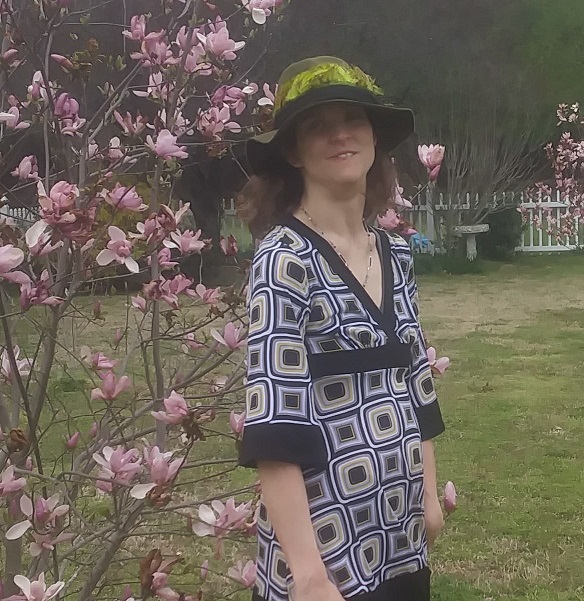
I have the pleasure today of interviewing romance author Alexandra Forry, whose latest novelette, Deepest Elements is scheduled for release on November 17. Alexandra is a lovely young author who writes her stories in spite of being afflicted with cerebral palsy. She’s agreed to share with us today a glimpse into her life and a little about her books. Please help me welcome Alexandra Forry.
Kaye: You have written in multiple genres and formats, but you are primarily a romance author. Why romance?
Alexandra: I’m hopelessly romantic, from way back. I loved a good romance that ends not happy with the man rides off in the sunset with his soul mate. I love forbidden romance the most. I write real-to-life romance because I think people can relate to it more than a fairytale romance. There is sometime about witting romance that fulfills my soul like I meant to be a romance author. If you get what I mean. Thank for asking this question, it really makes me think. No one has asked me this before you, Kaye.
Kaye: On October 12, 2014, you promoted your work at a ladies tea at Louisa Voisine’s Showroom in Las Vegas NV. How did you manage to get an invite for this opportunity? Do you feel it was successful? In what ways?
Alexandra: That was the best promoting event I’ve been to and it was very successful in every way. I met Ms. Senior United States of 2018, while I was there. I was purely a fairytale afternoon!!!
Louisa Voisine Millinery is a award winning famous Hat and Fashion Designer. Her designs are like a work of art. Louisa’s hat’s are Kentucky Derby Winning Design, Emmy Awards featured designer Pre-Emmy Event. I encourage you to check her website out!!! I had the honor to meet Louisa at Mob-Con back in 2014 and became good friends.
Mob-Con was a 3-day event Meet Real Mobsters and the Lawmen who put ’em away, with speakers and the authors like myself selling their books. Not to add, it’s not every day you get to see Mobsters, FBI, CIA news reporters and true crime authors in one ballroom talking about the good old days, acting like old friends.
Sorry to get off track. Louisa was there selling her hat’s at Mob-con and we got to talking a bit. After Mob-Con I got a Facebook message from her inviting me to sell all of my books at her high tea. Also, she’d give me two invites so I could bring whomever I wanted. I chose to take my dear and beloved Grandma. We always wanted to get all dressed up and go to a high tea. I shall never forget that tea because it really was truly made one of my grandma’s dreams come true.
Kaye: What writing groups are do you hold membership in? Would you recommend that other authors join similar writing organizations? Why or why not? What are the benefits for you?
Alexandra: I’ve got to tell you the truth. I need to re-join RWA. A few years I got out of the whole writing scène because of personal reasons but now I am back. A fellow author and friend told me this when I was first starting out he told me to join real writing groups to be taken seriously and make contact and friends. He was right. Now I’m apart of a top Authors Dinner Group in Washington, D. C. They help me out hugely. In the writer’s business, it’s whom you know. I got damn lucky at age 23!
Kaye: What can you tell us about your children’s books?
Alexandra: The Troop 740 books were based on my own Girl Scouts experience. In fact, I had a tycoon Girl Scout leader, let’s call him LL, when I lived in Portland Oregon. LL rented out a major radio station for us be on the radio, and once rented out a delta airlines aircraft for us to view what first class and the airplane cockpit look like. LL even flew in fresh flowers from Hawaii for us to learn about. I want to make my book’s leader a man, but in today’s age I didn’t want to take a gamble on it, so the leader is a woman. I hope to go on more adventure’s with Troop 470, someday! 😉
Kaye: In spite of many obstacles which life has placed in your path, you have overcome them and reached for your dream of being an author. The Omerta Affair was your debut novel. How did it feel when that book was published and you could finally say, “I made it! I’m a published author?
Alexandra: Oh hell YES!!!, I was jumping with over joy, tears of joy. It was a super amazing, wonderful feeling “I really did, I’m a published author.” It’s all began on my 22 birthday, I went to the newly open Mob Museum and to my shock, Frank Cuttolla was there signing his book. I meet him and told him that I want to be a Mafia-Romance and he told me that if I need help just let him know. I said okay thinking he has better things to do than helping me a young CP girl at the time. I found him on Facebook weeks later and we began to talk, he always inviting me to this and that. I base my fist book “Omerta Affair” off on Tony Spilotro’s reign as The Las Vegas Mafia Boss, in the 1970s. He had it all, running the Crime underworld. He could have any woman he wanted in Las Vegas, instead, he became romantically Geri Rosenthal. At first, it was a Casino’s FanFic to the 1995 move, that I was witting and putting online for free, but my family and friend told me it was way too good to be a FanFic. After I was done with my book Frank hooked me up with some people and that how my book came to be. Now he’s Uncle Frank to me. ❤
Kaye: One of the obstacles you’ve had to overcome is Cerebral Palsy, and you haven’t let it stop you from doing what you love. Have you given any of your characters disabilities to overcome?
Alexandra: YES! I really hope to write a romance that the leading woman has CP and falls in love. It makes me mad that there no disabilities romance books. Like we are still people with romantic feelings. People beg me to write my life story, I tried and give all my might, but I stopped writing it because I was up to a painful point in my life that I don’t care to remember. Sorry it’s the way I feel. Who knows maybe someday I will finish it.
Kaye: What challenges does cerebral palsy pose for you as a writer specifically?
Alexandra: I use up 3 to 5 times the amount of energy that people use without
Cerebral Palsy. My muscle spasms sometimes act up and slow down my typing.
Other than that, it doesn’t present any challenges to my thinking process
about my storytelling. I have CP but CP dose NOT have me! 🙂
Kaye: Timeless Omerta: With Beauty Comes Danger is the follow-up for that first book. It’s kind of a sequel, but not, and it launched you into the world of romance authors. Can you talk a little about the differences in the two books?
Alexandra: TIMELESS OMERTA Is a lighter version of Omerta Affair. After Omerta Affair came out for sale, a few months went by, I began to wonder what if I took out the harsh, colorful language making the story’s main love scene more romantic. With that idea, why not rename it something that a woman would really want to pick up to read when they saw it. I’ve re-titled it TIMELESS OMERTA. Making it more for women.
Kaye: Why did you choose to write Pit Boss: A Screenplay as a screenplay, rather than a novel? Why did you feel it was a better fit for the screenplay format? Do you have other screenwriting experience?
Alexandra: Pit Boss: A Screenplay was the very first writing piece that I’ve completed. Back in July 2011, my birth father passes away from stage 4 cancer. He didn’t catch it before it was way too late. I was very devastated by his fast death.
I bought a book and a screenwriting program on how to write a screenplay because I needed something that I never done before to take my mind off of my father’s death. I’ve locked myself in my room (in a way) for a month to learn and wrote “Pit Boss”
In 2016, I felt that I wanted to publish it, even if I didn’t make a penny for it. Just to showcase my work. Then with help with a ghostwriter, I turned the Pit book into a novel.
Kaye: Besides writing, what are your favorite things to do?
Alexandra: Every night, I love to sit down and relax in my chair (my comfort zone) watching a movie with my dad. That’s is my favorite part of the day> I love coloring, I have a lot of adult coloring books. 😉 I enjoy listing to audiobooks. walking outside, having a blast with my group of friends here in Williamsburg.
Kaye: What time of day do you prefer to do your writing? Why?
Alexandra: I don’t have a time that I prefer to write. When I start writing, I can go until I am wiped out. LOL 😉
Kaye: What is the biggest challenge of being a writer for you?
Alexandra: My spelling and grammar for sure. Being slow at typing, I can’t type 1,000 words a day, I wish. The biggest thing is that I get writers’ block or I lose interest in my writing and stop. I need to find a way to fix that.
Kaye: What is the one thing in your writing career that is the most unusual or unique thing you’ve done so far?
Alexandra: Okay, so one of my friends once dared me to write a very XXX romantic, erotic, sex scene! Let’s just say that I blew him out the water when he read it. Ha, ha, ha!
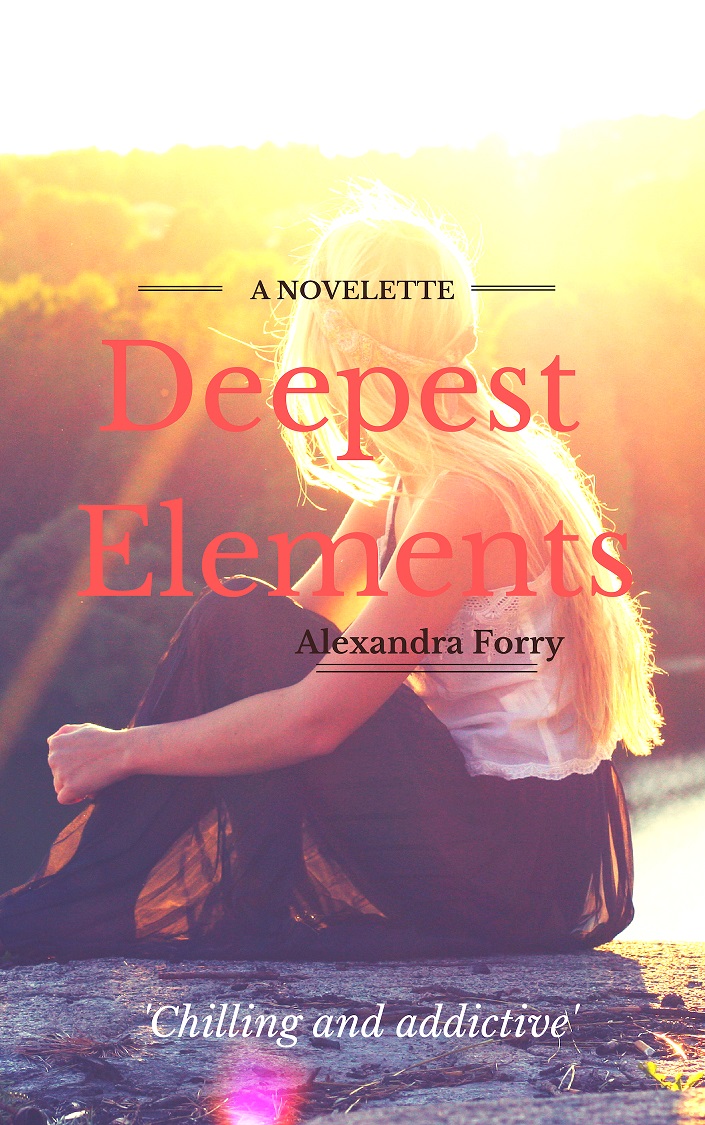
Kaye: Your book, Deepest Elements is scheduled for release on November 17. Can you tell us a little about it?
Alexandra: To my astonishment, all of the Beta and Test reads really love it! Saying that Deepest Elements is worth your time. Truth be told, I haven’t felt this way about one of my books coming out since Omerta Affair. I had this book idea tucked away in my mind since I was a teenager in high school!!! Have to tell you, that this book will be a kick off for a big series set, to be called Deepest Elements Series!
Here’s a brief synopsis:
My worst fear was those woods; my greatest fear had once been him.
She was an innocent, heading for her illustrious private boarding school in the best tradition of the grandmother who raised her, and with the blessing of the father who adored her. Forsaken by her mother soon after birth, she had made lifelong friends in a protective, privileged,Portland society.
Arriving in Radcliffe Heights, Rhode Island, freshman Peony “Poppy” Calloway admired the picturesque small town. But deep in the shadows of the woods near Blue Bell Boarding School, and along its hallowed halls, lurked illicit sex, murder, and harrowing danger.
Seduced by Jordon Dashwood, the handsome, blue-eyed, white blonde Headmaster, Poppy enters a world of love, ecstasy, heartbreak, betrayal, and death.
“Deepest Elements” is by the well-known author of “Wildflower,” Alexandra Forry.
Thank you so much for reading my in-depth interview. Also, thank you so very much, Kaye, for having me on your wonderful blog Today! Best wishes, Alexandra!
I want to thank you Alexandra, for sharing with us today. It’s been a pleasure learning abouot your books and the challenges you face in creating them.
Readers can learn more about Alexandra and her books here:
Facebook Author page: https://www.facebook.com/cpgalauthor/?hc_location=group
Amazon Author page: https://www.amazon.com/Alexandra-Forry/e/B00JBGRIKO/ref=sr_ntt_srch_lnk_1?qid=1540486609&sr=8-1&fbclid=IwAR3pSojbhA9lhk_0UHBQtIKidymGevYFAA_7orO8hBlEPWgJZktqtsBJxRA
Don’t forget, Deepest Elements is scheduled for release on November 17, so be sure and grab your copy.
Like this post? Subscribe to Writing to be Read for e-mail notifications whenever new content is posted or follow WtbR on WordPress.
Share this:

Interview with multi-genre author Brenda Mohammed
Posted: October 10, 2018 Filed under: Author Profile, Books, Fiction, Interview, Memoir, Nonfiction, Science Fiction, Travel, Writing | Tags: Author Interview, Brenda Mohammed, Memoir, Science Fiction, Travel Memoir 2 Comments
I have the pleasure of interviewing independent author Brenda Mohammed today. She is not only a multi-genre author, but a multi-award winning author, who seems to dabble in a bit of everything. She comes from a background in finance, but became an author when she wrote a memoir about her battle with ovarian cancer. Since then, she’s written several other memoirs, as well as a science fiction series, a horror novel and a crime novel, as well as a wonderful self-help book for aspiring authors. She has done so much, and made so many travels, and I’m thrilled to have her share all that with us here, on Writing to be Read. Please give a warm welcome to Brenda Mohammed.
Kaye: When did you know you wanted to be an author?
Brenda: I never planned to be an author. I was a successful Bank Manager for many years. After I retired from the Bank at an early age, I became an Insurance Professional. I loved working in Finance and helping many people achieve their financial goals. In 2005 I was stricken with ovarian cancer. My doctor in Trinidad told me that she could not help me, and no other doctor in Trinidad at that time was qualified to do so. I sought treatment in Miami and gained a new lease on life. In 2013 I wrote a book about my cancer ordeal and recovery, I am Cancer Free. That was my first book and I have never stopped writing after that. To date I have written nineteen books.
Kaye: You’ve written 6 memoirs, 2 children’s books, a science fiction series, a crime novel, and a nonfiction book on writing. What’s the secret to tackling so many different genres?
Brenda: There really is no secret to writing in multiple genres. I have always loved a challenge and constantly seek out new opportunities. I write whatever I feel passionate about.
Kaye: You have written books in multiple genres: science fiction, memoir, self-help, etc… What are some of the differences you run into in writing different genres?
Brenda: When I am writing science fiction I maintain my focus on science fiction, and similarly with the other genres. The secret is to stay focused on the plot or the subject to achieve the end result. However, the problem I faced was in promoting my books.
I discovered a way around that and made Facebook Author pages for each genre. I have seven Facebook author pages. I also joined several Facebook groups that specialise in genres in which I write, to promote my books.
Kaye: Which genre is your favorite to write in? Why?
Brenda: I really enjoyed writing my science fiction series because it took me to another world for a while. When I wrote it I found myself becoming the hero or heroine and doing impossible things.
Kaye: You won a Readers’ Favorite Award in the 2018 International Book Awards for both your YA science fiction series Zeeka Chronicles,and your memoir I Am Cancer Free. What, if anything do these two books have in common besides both being Reader’s Favorite Book Award recipients? What makes them award winning books?


Brenda: Strange. I think I just answered that question above. The books have nothing in common yet there is a common thread. One is a futuristic thriller and the other is a survival story. As I said above when writing science fiction. i.e. Zeeka Chronicles, I found myself becoming the hero or heroine. In I am Cancer Free I am the heroine.
Seriously though, I quote from Readers Favorite: “Contest entries are judged all year long and are given a rating score based on key literary elements. The judges simply read the book and score it based on its merits.”
Kaye: Those are not the only award winning books you’ve written. Two other memoirs, My Life as a Banker received a second place award in memoirs in the Metamorph Publishing’s Summer Indie Book Awards in 2016 and Your Time is Now received IHIBRP 5 Star Recommended Read Award Badge. What can you tell us about those two books?


Brenda: My Life as a Banker is a memoir about my life in Banking. Banking was my first love. I always wanted to work in a bank. I love serving and helping people and seeing them prosper. Banking gave me the opportunity to do so and especially when I climbed the ranks to Commercial Area Credit Manager and was able to help business people with startups and expansion. Banking allowed me to play my part in building the economy of my native country, Trinidad.
Your Time is Now is intended to help people understand their own lives and to realize that we are all here on earth for a purpose.
The reviews for both these books speak a lot for them.
Kaye: What is it like to receive notification that your book is the recipient of a prestigious award?
Brenda: I have won many awards before in both Banking and Insurance.in my home country
However, as this was an International Award it was a most joyous feeling to tell my friends and family that I won two prestigious awards with Readers Favorite International and will be attending the Awards Ceremony in Miami. In November.
Kaye: What’s something most readers would never guess about you?
Brenda: I dabble in art, poetry, and graphics in my spare time. Some of my art work hang on the walls of my home.
Kaye: What time of day do you prefer to do your writing? Why?
Brenda: I prefer to write in the still of the night. When everyone is asleep I find peace to think and write.
Kaye: What is the biggest challenge of being a writer?
Brenda: Only a few days ago I penned this poem about writing:
Writing takes me into a fantasy world.
Sometimes I find myself in a black hole.
I edit and fight to come out of it
But not before I get into a fit.
My books have gathered great reviews
Won awards and made the news.
Is it worth it, I sometimes ask?
Writing a book is a great task.
A writer’s life is a rather lonely one.
All day behind a computer is no fun.
An author must make the time
Read others’ books and go out and lime.
Do not sit at your computer all day.
Join the family in travel and play
Love of a family is life’s greatest gift
When you need to relax they give you a lift.
Kaye: Is there anything unique or unusual about your writing process?
Brenda: Before writing a story I write an outline of the entire plot in a couple of pages. I then use that to build my story. It sounds simple, but it is not.

Kaye: Your book on writing is titled How to Write for Success: Best Writing Advice I Received. Can you briefly share what the best writing advice you ever received really was? What is the main message of this book?
Brenda: The Best Writing Advice I Received was “Keep the Reader in mind when writing. In other words write for the reader and your books will sell.”
To answer the second part of the question I will quote one of the five-star reviews. The one from Readers Favorite is too long so I will share this one from an Amazon Reviewer:
“Having read a couple of Mohammed’s books, I knew I wouldn’t be disappointed in this self-help book, and I was not. The book covers not only the gamut on the art of writing, but the formulation of an idea for a book, to proofreading, and eventual marketing of his/her book. This is an excellent book for anyone who finds him/herself contemplating becoming a writer. With Mohammed’s book in hand, there should be little, if any, room for error. I highly recommend.”
Kaye: You like to travel. Do the places you travel end up in your books?
Brenda: Yes they do and they did. I wrote Travel Memoirs with Pictures: Exploring the world. It is an illustrated picture book filled with reflections of my travels around the world.

In this pictorial travel book of my priceless memories, I describe places visited and the wonderful times I and my family had in our tourist trips. The book is great to read while on a vacation or for some travel inspiration.
I want to thank Brenda Mohammed for joining us here today and sharing a little about her lovely books. You can learn more about Brenda and her books on Amazon at: http://Author.to/BCM786. I love how she turned her own life experiences into books to be shared by all.
Like this post? Subscribe to Writing to be Read for e-mail notifications whenever new content is posted or follow WtbR on WordPress.
Share this:

Interview with Multi-Genre Author R.A. Winter
Posted: September 17, 2018 Filed under: Author Profile, Book Covers, Books, Contemporary Romance, Fantasy, Fiction, Interview, Paranormal, romance, Speculative Fiction, Western, Writing | Tags: Author Interview, Contemporary Romance, Mystic, Native American, Paranormal, Paranormal Romance, R.A. Winter, Spirit Keys series, Twisted, Western 2 Comments
I recently made the acquaintance of the energetic, sassy author, R.A. Winter. She writes in several genres, including fantasy, magical realism, dark fantasy, , time travel romance, contemporary Native American romance, and paranormal Native American western. And it seems she never rests when it comes to writing. Please help me to welcome R.A. Winter to Writing to be Read.
Kaye: Hello and welcome. Would you start by sharing the story of your own publishing journey?
R.A.: I started out writing genealogy nonfiction books under my married name. I love research and old libraries! I also love reading romances. With so many ideas flirting around my head, I thought I’d give creative writing a go.
Kaye: Is there anything unique or unusual about your writing process?
R.A.: I write the raunchiest first draft, the humor is way over the top. Then I cut it down, and my crit circle cuts it down further. My editor slices more. They say that a bit of humor goes a long way.
Kaye: You have sites on both WordPress and Wix. Can you give us the advantages and disadvantages of each? Which site do you prefer? Why?
R.A.: Wix is easier to deal with, super simple to navigate and change. WordPress is a bit of a pickle to deal with, and every time I change something, I mess up the page. I do prefer WordPress because I can easily share review and pages on a whim. Wix doesn’t give you that option.
Kaye: You’re on the review team at The Naked Reviewers, where authors can submit a book and request an honest review. Would you like to tell us a little about that site and what the review process is?
R.A.: We have a group of published author on Scribophile.com who formed the group. Right now, I think there is twelve of us. When someone submits a book, we all read the first chapter, the ‘look inside’ feature on Amazon. Then we rate the writing, the blurb, and the cover. If two of us agree, we review the book. Each Wednesday, two of us leave our review as a feature, if anyone else read it, they leave their thoughts in the ‘comment’ section. It does mean that most books that we review get a 4.0 or higher rating, usually. We wanted to show off the best books.
Kaye: You had bad experience with Amazon regarding reviews. This is something we’re hearing from many authors, although complaints vary. Many reviewers, including myself, have had book reviews pulled by Amazon, with the claim that their terms of use were violated because of an existing relationship which would bias our opinions. I even heard of an reviewer whose reviews were pulled because Amazon saw that they were Facebook friends, which they claimed indicated a prior relationship. (This doesn’t make sense to me. Many authors who I have done reviews for have become virtual online friends because of the review, not the other way around.) Your experience was a bit different because it wasn’t books that you were reviewing. Would you like to tell us a little about your experience?
R.A.: I ordered products from Amazon.com. A coffee grinder, a milk frother, and a small coffee taper, they just happened to be from the same company in China. Now, I review every product I receive, but when I went to upload my reviews, Amazon wouldn’t allow it. After contacting them, they said that I had a ‘relationship’ with the company in China and that I’d violated their terms. Apparently, I ordered too many things from them. I just don’t understand. They ask you to review, you review… then they’re like… you review too much! They banned me for LIFE for writing any reviews.
My point to them was- IF I was screwing reviews, wouldn’t my books have like 300 hundred reviews instead of each of them having less then 10? I mean seriously. THAT’S what would have benefited me!
Kaye: What is one thing that your readers would never guess about you?
R.A.: I have five children… all boys. I’ve lived in 5 different countries too. I don’t know which one was harder to live through. And all my boys look like my husband.
Kaye: What are your secrets for juggling writing with family?
R.A.: My kids are older, so they don’t need me. I like to write at night, when the house is quiet and no one interrupts. My earbuds are essential, and a song list that corresponds to my writing mood.
Kaye: You have some really great covers, some of which you’ve shared here. What do you do for cover art? DIY, or hired out, or cookie cutter prefab? Do you have a great cover designer you’d like to recommend?
R.A.: Some are creations of Kayci Morgan, from KreativeCovers.com. A few I did myself, which you can probably tell. Kayci is wonderful to work with and very reasonable. I am learning Photoshop and I’m doing my own teasers. I’m getting better but I just don’t have the finesse to do covers well.
Kaye: You have a paranormal romance fantasy novella, Twisted, which I’m excited to be reviewing here on Writing to be Read. (So watch for that review on Friday.) What can you tell us about that story?
 R.A.: Twisted is a novella, and one of the hardest things I’ve
written.
It’s a Freaky-Friday, body switching piece… full of adult humor. A witch’s land is cursed. Males are no longer born to the vampires, nor are females born to the wolves. To end the curse, the witch must solve a riddle, and she has to have the cooperation of the vampires and the werewolves.
Kaye: What is the strangest inspiration for a story you’ve ever had?
R.A.: My Spirit Key series was a way to keep my cat alive in my memories. He’d just past away, and Dingle had the oddest personality for a cat. He always reminded me of an old man, you know the one. The spunky old guy in the nursing home who’s constantly bugging the pretty nurses and running behind them with his walker, never able to catch them. Occasionally, he’d pinch their behinds, but act like he didn’t do it. I taught Dingle how to wink, but usually he had this grumpy look on his face. He used to love to jump out and scare me, then give me that ugh, you’re-stupid-to-fall-for-that-again look. He’s now a ten-thousand year old spirit who has a bit of trickster in him.
Kaye: Your Spirit Key series are westerns with a bit of a different twist to them. Would you like to tell us about them?
R.A.: Contemporary Native American’s in a western setting with magical realism is the gist of the Spirit Key Series. In book 1, we follow young Sara, as the ghosts of ancestors haunt her days and try to keep her away from young RedHorse. There’s a new spirit in town, a nefarious one who has his own agenda. The Old One wants the land for the dead and he’ll do anything to have it, including taking away what Sara loves most.


Kaye: There are two books in The Spirit Key series: Painted Girl and Redhorse. What type of research did you do for these books?
R.A.: The first two book are contemporary, set in modern day Kansas on a farm. Books 3 and 4 (which are almost finished) go back to 1950, and we delve into Grandfather’s life, and that of the ten-thousand year old spirit who watches over them. My research centered on the old Indian Schools, and the horrors that the children underwent. It’s all to stop the spirits from invading this world, and to give grandfather his happy ending. The Native American research is from my family.
Kaye: You also write contemporary romance with a Native American twist. What about Little Sparrow, A Kiowa in Love or Red Dress, Two Wives?
R.A.: Those were my early books. I’ve taken the ebooks down, and now I’m writing those into the Spirit Key Series. Everyone is related, so it made sense to do that. I kept the hard copies up because a few people really liked them the way they were. My writing evolved, and I thought those two would be great as part of the Spirit Key Series with some rework.
Kaye: What is the attraction for adding a Native American element to your writing?
R.A.: Two fold. My grandmother was ‘found’. It was assumed that she was Native American. This was in the 1880’s, a time when the tribes had to travel west and were forced onto reservations. Our family farm was near one of the routes and my grandfather brought home a baby girl one day, saying that he’d found her. My cousins are Sioux. I barely remember the eldest two girls but I do remember their beauty. One day, when I was only six years old, they disappeared. Just up and gone. Our family went nuts, as you can imagine. It wasn’t until twelve years later that we learned that they had been taken west to different orphanages and divided up. (This was the early ’70’s when the government still took NA children on a whim.) Anyway, my stories revolve around finding your identity when you don’t know who you are, when you have no memories of your family. My Native American family is rooted by my life stories. You know that you’re different, but you feel the same as everyone else. You just have to find your own special, because it’s there, you don’t have to go looking for it. It just may be hiding in plain sight.
Kaye: I’m also very interested in your time travel romances, As Long As I Have You and Always With You. What can you share with us about them?
 R.A.: These were part of an anthology, and part of a series inside the anthology. The rules are simple, Cupid owns a bar, and his mate has a special tattoo that glows when soul mates are touched. In book 1, Ann Paolo comes to the bar with her dog. Unbeknownst to her, the dog, Han, is the spirit of a long dead Native American, who has been cursed to follow Ann through time, always to love her, and be loved, but never to be with her. Cupid sends them back in time, so Han can erase his curse. In book 2, Ann’s back, because so many lifetimes couldn’t be rewritten. This time, Cupid calls on the fates to bring Han to life in this day and time. The fates have a bit of trouble writing him into time-line, so they turn to Netflix for ideas. Han is now, Dan Winchesty, from the TV show Super-Unnatural Killers and Revealers Suckers for short. You know, Dan Winchesty- the one with the perky nipples? It’s a spoof on Supernatural, and I think it’s hilarious, but that’s just my opinion.
Kaye: What is your favorite genre to write in so far? Why?
R.A.: I love magical realism and fantasy. Creating my own world, and rules, takes a lot of thought and design. You just can’t pop something on paper, it has to make sense, have rules, have life, and you have to bring a reader into your world and make them happy.
Kaye: How much non-writing work, (marketing & promotion, illustrations & book covers, etc…), do you do yourself for your books?
R.A.: I do all my own marketing, which isn’t much. Word of mouth is my best friend, because lets face it, my works are different. I just had a review from a guy, who said that someone at work bullied him into reading it and he loved it, even with the romance in the book. I think that was a compliment.
Kaye: If one of your books was made into a film, which book would you want it to be? And who would you like to play the lead?
R.A.: Hmm, I’d love the Spirit Key to be a series on Netflix, but for a movie, I’d chose Twisted. Sam Witwer and Meaghan Rath. They had great chemistry in Being Human. Now, however, Meaghan would be a vampire, and Sam would be a wolf.
Kaye: What’s next? What does the future look like for R.A, Winter?
R.A.: Oh, I have at least six books in various stages of completion. Twisted will be turned
into a series, readers have asked for that. I’m also writing a series about Death Takers
coming alive and finding love. It’s a dark romance series that takes the reader on a
journey to Tartarus and the bowels of hell. Book 1 is finished, book 2 is halfway. Once
book 2 is ready I’ll publish.
Kaye: If writing suddenly made you rich and famous, what would you do?
R.A.: I’ve done a lot of things on my bucket list. I’ve traveled the world, lived in five different countries and enjoyed most of my life. If I had a lot of money, I’d pay off my family’s student loans. Right now, it’s around 200k, and I’m serious. It would be life changing for them to pay off their debts. BTW, I have one family member, with 100k debt who graduated from Pitt with a bachelor’s in psychology. Anyone have any job prospects for him? E-mail me.
I want to thank R.A. Winter for joining us today and putting up with my interrogation. Seriously though, she was really a good sport about answering all of my questions with open, honest answers. You can find out more about her and her writing on her website, her Spirit Keys site, or her Amazon Author Page.
Like this post? Subscribe to Writing to be Read for e-mail notifications whenever new content is posted or follow WtbR on WordPress.
Share this:

Interview with author Ashley Scott
Posted: July 23, 2018 Filed under: Action/Adventure, Author Profile, Books, Dark Fantasy, Fiction, Interview, Speculative Fiction, Thriller | Tags: Action, Ashley Scott, Author Interview, Dark Fantasy, Demon Anarchy, Speculative Fiction, Thriller Leave a comment
I always love to do interviews with new authors, because they get so excited. The first interview I ever did, with Dan Alatore, I was riding on the top of the world. For me, it signified that this was it and I was really a published author. Today we have an up and coming author with us, Ashley Scott, whose debute novel is a dark fantasy action thriller, Demon Anarchy. She’s here today to tell us about her book and a little about herself, as well.
Kaye: Would you share the story of your own publishing journey?
Ashley: My publishing story began with a manuscript of course. Once completed, my beta readers tore it apart piece by piece. I had to make changes before daring to pass it along to my editor, who also helped strengthen my story, Demon Anarchy, before deciding where to publish. Should I publish through a house or self publish through a website? After doing some research I decided to self publish through Amazon with assistance of a few friends who have done this process before. I love how simple it was however my next goal is to publish a book through a publishing house.
Kaye: Are you a plotter or a pantser? Why?
Ashley: I guess you could say a little bit of both. If I plot out my story chapter by chapter (I’ve tried this method before and it took me weeks, I finally accomplished beginning to end and threw all my notes out because I grew bored of the story). This proved to me I required some mystery involved in plotting my stories. So now I write very minimal notes and type what comes to mind. I believe some plotting is good to keep the flow of your story and to keep your readers interested.
Kaye: What is the one thing in your writing career that is the most unusual or unique thing you’ve done so far?
Ashley: Um….how about try ‘too hard’? If that’s a thing? I used to get up in the early hours of dawn to type a page or two before going to college or going to work. I also used to trial so many different methods of plotting and note taking it drove me insane! So I settled for what currently works and blocked out a reasonable amount of time during the day to type.
Kaye: Would you like to talk a little about your blog or website?
Ashley: Currently, I don’t have a blog. I only have a website where you can find a buy link to my book Demon Anarchy along with my contact information and monthly author interviews I post to help authors succeed at reaching out to their audiences.
Kaye: What was the most fun interview you’ve ever done? Why?
Ashley: I’ve only completed a few author interviews so far, I think all of them are fun to do in a way.
Kaye: Would you like to tell us a little about Demon Anarchy?
Ashley: Would I ever! It’s not only a page flipper flooded with action including explosive weaponry, but also combined with entrancing romantic encounters and a twisted plot line. It opens to New York City, the big apple, where the reader discovers demons lurching in the shadows of the city living off the blood of humans. Only agents know of their existence, the rest are left blind to the war about to appear within the allies and streets.
Time isn’t on their side when the agents discover the leader of the demons appear and wreak havoc among the city by rallying the numbers, creating Demon Anarchy.

Kaye: If Demon Anarchy was made into a film, who would you like to play the lead?
Ashley: I keep jumping between two main characters. Alice, an agent trained to kill demons, and Damien a half demon who feels trapped between the human the demon world. Damien would be my first choice, Mr. Bad Apple and won’t take a no for an answer, however Alice whose stubborn and strong willed personality takes a close second. I would cast Milla Jovovich as Alice, and Christian Bale as Damien.
Kaye: It seems that you travel quite a bit. Have any of the places you’ve traveled ended up in your books? Which ones?
Ashley: I love to travel, which is why I’ve traveled different parts of the world with my husband. Yes, I’ve traveled to New York City which is the setting for my story Demon Anarchy as portrayed with descriptions of alleyways during rainy nights and the busy crowded streets filled with people during the day. I always thought the big apple would be the perfect location for demons lurking in the shadows.
Kaye: What is the strangest inspiration for a story you’ve ever had?
Ashley: Not sure….there has been so many random moments where all I have to do is listen to the right music or see something that sparks my imagination and my thoughts go wild.
Kaye: What can you tell us about what’s in store for your readers? Any WIPs you’d like talk about?
Ashley: I’m currently 22 weeks pregnant and am due in November, so my writing has slowed down a bit. But I’m still hammering away at the first book of a trilogy consisting of young women who revolutionize their kingdom in the early 1800’s. The book I’m currently typing is about a young woman who fights against the world of men to become the first female professor in her kingdom by entering the king’s challenge, a challenge of the mind proven to pluck out the smartest individual in Cirus whose worthy enough to tutor the future heir to the throne. However within time the plot could change a little depending on my mood/interest, but this is the strongest plot I’m currently focusing a lot of my time and effort on.
Kaye: Describe yourself in three words.
Ashley: Friendly. Gregarious. Social.
Kaye: Your introduction on your Facebook page says, “Multi-tasking is my talent”. Besides writing, what are your other talents?
Ashley: Playing tennis, editing manuscripts, and developing exercise programs for the elderly.

Like this post? Subscribe to Writing to be Read for e-mail notifications whenever new content is posted or follow WtbR on WordPress.
If you’re an author and you’d like to be interviewed on Writing to be Read, email Kaye at kayebooth(at)yahoo(dot)com and put Interview Request in the subject line.
Share this:

Interview with author Tom Johnson
Posted: July 2, 2018 Filed under: Author Profile, Books, Children's Books, Fiction, Interview, Mystery, Nonfiction, Publishing, Self-Publishing, Super Hero, Writing | Tags: Author Interview, Children's Stories, Nofiction, Publishing, Pulp Fiction, Writing 5 Comments
Today I have the pleasure of interviewing an old hand in the writing and publishing business, author Tom Johnson. Tom has written stories from a young age. He has been publishing his writing for more than twenty-two years and has over eighty books in publication. He grew up reading comic books and pulp fiction, becoming a collector in adulthood and his stories reflect the fascination that those books held for him. He has also written numerous nonfiction books and is currently involved in writing children’s stories. Please help me welcome Tom Johnson.
Kaye: Hi Tom. Although in the past, you’ve written and published many different genres, you are currently writing only children’s stories. So, let’s talk about that. Tell me a little about your stories.
Tom: My children stories are about 1k and meant as bedtime tales, and to be read in classroom or library settings. They are short stories with little morals to teach children something about life.
Kaye: Are they a series or stand alone?
Tom: They are a series, and published in anthologies about once a year. There have been four anthologies so far. I was invited to participate beginning in volume #3. The anthology is called Wire Dog Storybook. Here is the background. True story. A young girl, Ellen Walters, asked her father, David Walters, if she could have a dog, and he said, “No.” So she found an old wire hanger and shaped it to resemble a dog, and called it wire dog. David Walters was fascinated by her ingenuity and created the Wire Dog Storybooks. So the stories usually feature Ellen and Wire Dog, but always Wire Dog. Five of my stories have been published so far, and I’ve written three more for the 2018 yearbook when it comes out at the end of the year.
Kaye: What age group are they aimed at?
Tom: I feel that we should begin reading to our children by age one. With that in mind, my stories are aimed at the age group of 1 to 5. However, older children will enjoy the stories, as do adults.
To get a better idea of what Tom’s children’s stories are like, you can get a free copy of one here. They are short and can be read in only a few minutes.: Wire Dog Has An Ugly Mood Day – Or The House of 1000 Mirrors https://wiredogstories.com/2016/01/19/story-40-wire-dog-has-an-ugly-mood-day/
Kaye: What differences do you see between writing for children and writing adult fiction?
Tom: Adult fiction usually means, “no holds barred”, while writing children stories you want to stay away from violence, horror, and adult themes. Keep in mind, young children absorb what they hear quickly, and some themes could have an adverse effect on young minds. When writing for children we must keep this in mind.
Kaye: What appeals to you about writing for children?
Tom: Do you remember the old radio show for kids, Let’s Pretend ? It produced shows for children that acted out fairy tales and light adventures – nothing as harsh as today’s cartoons that are aimed at our youth. Well, I have the chance to import my love for adventure in tales easily understood by young people; children who some day may also experience that same love to pass on to their children. Stories that give our children a moral to live by, not “It’s clobbering time!” Or Pow! Bang! Boom! It’s something my mother did for me when I was little, and now I have the same opportunity, and I’m not going to pass it up.


You can get the Wire Dog books here:
Wire Dog Storybook #3 http://www.lulu.com/shop/david-clyde-walters/wire-dog-storybook-3-in-full-color/paperback/product-22554849.html
Wire Dog Storybook #4 http://www.lulu.com/shop/david-clyde-walters/wire-dog-storybook-4-in-color/paperback/product-23424745.html
Kaye: You have wanted to write for children since you were little and your mother used to read to you.
Tom: Oh, yes. I hope that mothers are still reading to their children. They learn at such a young age, and we’re missing an opportunity if we fail them when they’re young. They will never forget what they learn as children, it’s when their minds are growing and grasping at everything. I think one of the first words they learn is, “Why?”
Kaye: What were your favorite children’s stories?
Tom: Really, I would have to look them up in the book of fairy tales on my shelf. There were so many she read to me. Knights saving young damsels come to mind. I remember one particular fairy tale where the princess was on a glass mountain, and the young knight had to save her. She watched each day as a knight riding brown horse attempts to scale the glass mountain, then a knight on a white horse, and so on, until the final day when a knight riding a great steed scales the mountain, and we find out that he was the knight on the brown horse, the white horse, etc. It wasn’t the color of the horse, but the persistence of the knight that finally achieved the goal.
Kaye: In what ways do the stories you write emulate those favorites from your childhood?
Tom: Like the fairy tale I mentioned above, my stories will also have a similar moral – it’s not the color of the horse, or the knight’s armor, but his persistence that wins the hand of the princess. Do the right thing, for the right reason. Persevere. If you don’t succeed today, try and try again.
Kaye: You have written since you were a young man, for fifty some years, and you had your own small press for many years. Always, your life seems to have writing at the center of it. Looking back on your life, what does writing mean to you?
Tom: I think writing was always an escape to other worlds, other realms, and other dimensions. We could be anyone we wanted, go anywhere we wished, and experience great adventures. We create those worlds and people we want in them, and our heroes and heroines are who we want to be, or the friends we want beside us. We choose those things that mean the most to us. Whether we’re a cowboy or cowgirl, Conan or Xena, we bring the characters to life. That’s what writing means to me, to give life to my characters.
Kaye: How do you see the rise of digital publishing affecting authors of today?
Tom: Publishing has never been easier. When we were publishing the small press magazines, it was hands on. We did every aspect of the business, from reading, approving or rejecting, editing, set up and printing, then mailing to subscribers and bookstores that carried our magazines. Today we have Lulu and Amazon for all that. We just write, they publish. Anyone can be a writer or publisher now.
 Kaye: What is the strangest inspiration for a story you’ve ever had?
Tom: I had a dream one night. A young boy was in the woods dying when a strange being found him and comforted him as he passed. The strange being was an alien and I saw the saucer-shaped craft behind him. When I woke the dream stayed with me. Did the alien kill the boy? Why was the alien there? What was the boy doing in the woods? It wouldn’t let go of me. I wrote What Goes There from that dream. The boy was dying from snakebite and the alien took his pain from him so he could pass more easily. Then I made a mystery with the plot. The story is part of my book, These Alien Skies.
Kaye: Is there anything unique or unusual about your writing process?
Tom: When I write, I don’t want to be disturbed. No music, no background noise at all. My work computer is in my bedroom. I close my door from all outside communication, telephone, wife, neighbors, etc. I have to be alone when I write.
Kaye: You’ve written over eighty books in many different genres over the course of your career. Which of your books would you say are your favorites? Why?
 Tom: If we’re speaking of my fiction stories I would probably say my favorite is Guns of The Black Ghost, as it is my homage to Walter Gibson and his character The Shadow (remember him). The Shadow was one of my favorite radio dramas as a kid, and I met the creator of the character, Walter Gibson, in the mid-1970s and we were friends until his passing. I always wanted to write a Shadow novel, but copyright protection kept me from it, thus my own character, The Black Ghost came into being.
However, my non-fiction research books are probably my best sellers. I’ve written over half a dozen of them. A lot of work went into them. A lot of reading and studying, and I think it paid off, as fans have all bought the huge books for the data. These are books that don’t get thrown away, but have a special place on their bookshelves.
Kaye: So, tell us a little about your nofiction books. What is the subject matter and how did you come to write them?
Tom: As a pulp collector it was natural for me to become a historian. I had completed runs in many of the lead characters, thus had the opportunity to study the novels for research, identifying authors, plots, etc. At the time I was writing fiction and Introductions for ALTUS PRESS books, and the publisher wanted my research put into books. Some of those series were Secret Agent X Companion, Operator #5 Companion (History of The Purple Wars), The Phantom Detective Companion, The Black Bat Companion, Dan Fowler’s G-Men Companion, and Echoes 30. Several ran for twenty years, and 171 issues. Some not so long, but just as popular to the fan and collectors today. There may be others, my mind is slipping, but these were the big volumes. They covered the complete pulp series of each title. Echoes 30 covered conventions, pulp books, authors, artists, and publishers. All are in demand and have been good sellers.


Kaye: Are you a plotter or a pantser? Why?
Tom: I’m a pantser. I never could understand why you needed to write a fifty-page plot outline, just write the darn book. Once the words start flowing you don’t want them to stop. And they will, if you’re outlining.
Kaye: What do you think is the single most important element in a story?
Tom: Characterization. Make your characters come alive. You want readers to connect to them, feel for them, and be drawn to them. The plot will work itself out, but if your characters aren’t real I don’t care how much of a plot you have, it will bomb.
Kaye: If writing suddenly made you rich and famous, what would you do?
Tom: I don’t know that I would want to be rich and famous. What would be next? I want to always be reaching, always trying to entertain. If I set my goal for rich and famous I might forget about the entertainment and pleasure we get from writing. If I entertain one person, then I am already rich. Besides, we already have money, and fame is fleeting at best.
Kaye: What’s the best piece of advice you were ever given?
Tom: Write what you know. I’ve read a lot of books where the author is writing about something s/he knows nothing about, and it shows. I know information is at the tip of one’s fingers today, but if you haven’t truly experienced something you will come off as unbelievable if you try to write about the subject.
I want to thank Tom for joining us today on Writing to be Read and offering up some really great answers to my questions. I have really enjoyed having him. If you’d like to learn more about Tom Johnson or his books you can check out his website or his Amazon Author Page.
Like this post? Subscribe to Writing to be Read for e-mail notifications whenever new content is posted or follow WtbR on WordPress.
Share this:

Interview with Paranormal Romance Novelist Lilly Rayman
Posted: June 25, 2018 Filed under: Author Profile, Books, Dark Fantasy, Fiction, Historical Romance, Interview, Paranormal, romance, Speculative Fiction | Tags: An Unexpected Bonding, An Unexpected Hellhound, An Unexpected Mating, An Unexpected Revelation, Author Interview, Lilly Rayman, Lilly's Lycans, Mated Hearts, Red Wolf, The Unexpected Series Leave a comment
I’m pleased to welcome romance author Lilly Rayman as my guest here on Writing to be Read. Lilly is an Australian author who writes both paranormal romance and historic romance, and has short stories featured in several anthologies. I recently met Lilly during a Facebook book event and I’m looking forward to reading her work. (Watch for my review of An Unexpected Mating in future reviews.) Today she’s here to share the details of her writing and give us a glimpse into her upcoming release, An Unexpected Revelation, the second book in her Unexpected Trilogy, which is scheduled for release the end of this month.
Kaye: Hi Lilly. Would you share the story of your author’s journey?
Lilly: I would write when I was a teenager, stories that were a collage of my favourite books that I had read at the time. But then after I left school, I stopped writing, although I did keep reading. After my first daughter was born, I was reading a lot, and I found Wattpad, allowing me to read freely. But after reading a lot of amateur stories that all had the same cliché storylines, I found myself with a whole new story in my mind that avoided those cliché’s. I used Wattpad to write it, and it got great feedback. I was encouraged to add my story to an online writing competition, and it won best work and most popular work. The prize money allowed me to get it edited, and then I published An Unexpected Bonding, book one of the Unexpected Trilogy. I was hooked, and storylines came flowing out of me. I’ve since published a pair of short stories that challenge the concept of HEA, called Mated Hearts, and my first Historical Romance, Red Wolf, which is a story that has been with me for 13 years or so, and I was so pleased to finally be able to write it. I also have an anthology story connected to my trilogy published, and a permafree short story companion novel to the trilogy.
Kaye: When did you know you wanted to be an author?
Lilly: I think I’ve always wanted to be an author, it just took me a while to actually get to this point in my life. I used to write a lot as a child, and then as a teenager I wrote to escape from bullies that tormented my school life. Then life after school got in the way, although I would still read. When I had my first daughter, I found myself once more wanting to sit down and write again.
Kaye: Is Red Wolf the only historical romance you’ve written?
Lilly: Red Wolf is currently the only historical fiction at present that is published, but I have another historical in progress at the moment.
Kaye: What is it that appeals to you about historic fiction?
Lilly: Red Wolf, the prologue was a scene that has been in my mind since I was 19, and beside the strengthening of my use of words, tense ect, it hasn’t changed. The following story that centres around that scene has, and honestly it is a far better story than it ever would have been had I followed the original immature story idea I originally had.
Kaye: You describe your two story combo, Mated Hearts, as a paranormal romance with a western flair. How did you end up with such an unusual genre combo?
Lilly: Paranormal with western flair, means my shifters are cowboys or country folk. My Unexpected Series is set in Texas, and The Last Centaur is set in Montana. As for how I ended up with the unusual genre combo? I guess because I’m married to an Aussie stockman, which is basically a cowboy, and the life we’ve lived, in the stock camps, mustering cattle, catching bulls, attending rodeos, it gave me some experience to draw on. I just couldn’t rationalise a wolf pack running around Australia, so settled for Texas as my setting instead.
Kaye: Besides writing, what are your favorite things to do?
Lilly: Reading, spending time with my family, and working on the farm, which includes feeding cattle and horses, as well as branding time.
Kaye: If you have a blog, how did that start and what is it about?
Lilly: I only have a basic blog on my website, which is to try and keep an online presence when I decided to publish as an independent author.
Kaye: Tell us about your Facebook readers group, Lilly’s Lycans.
Lilly: Lilly’s Lycans is a reader group with style. I’ve been working at building up my group since March, and slowly its building in numbers. I try to have an active schedule of fun posts and encourage other authors to participate twice a week to introduce my Lycan’s to a variety of authors. I also run a reader rewards program, which is a special surprise treat, something different, at the end of every month for the most active member of the group.
Kaye: Which author, dead or alive, would you love to have lunch with?
Lilly: Anne Maccaffery. She was the most talented wordsmith who created the world of Pern, and I couldn’t help but fall in love with every one of her Dragon’s their riders, and all the holders or journeymen.
Kaye: What’s the most fun part of writing a novel or short story? What’s the least fun part?
Lilly: The most fun is creating a story that people can fall into and float through it rather than simply read it. The least fun is when you’ve got two books scheduled to come out in the near future.
Kaye: How do you decide the titles for your books? Where does the title come in the process for you?
Lilly: Some titles come to me with the initial concept of the story. Other titles come to me as I work through the story.
Kaye: What is the working title of your next book?
Lilly: Which one? Lol. I have two dragon stories in progress, Dragon Scorned and Heartstone of Dragons. I also have an historical romance called Roping Her Duke on the Go. I’m also working on An Unexpected Hellhound, which is the final book in my trilogy, and I will be a part of a collaboration and a couple of anthologies in 2019.
Kaye: Can you tell us a little about An Unexpected Revelation and An Unexpected Hellhound? When are they scheduled for release?
Lilly: An Unexpected Revelation is the second book of my Unexpected Trilogy and is due for release on the 30th June. An Unexpected Hellhound is the last book of the trilogy, and I am hoping to have it ready for a 2019 release.
Kaye: What is the one thing in your writing career that is the most unusual or unique thing you’ve done so far?
Lilly: Probably “Love Hurts”. It was a very short story that was published in the Love Sucks: An Anti-Valentines Day Anthology that was released in February 2018. It was a challenge to me as a romance author to actually write something so anti-romance. I am rather pleased with how well it turned out.
Kaye: What do you think is the single most important element in a story?
Lilly: Avoiding the cliché of other books in the genre.
Kaye: With that in mind, can you tell me what makes your books different?
Lilly: The main complaint I had with werewolf stories was the weak knee heroines needing to be rescued by an aggressive alpha who was fated to the complete opposite (who in reality would never work with that sort of personality, they would be beaten and downtrodden). Or the whole element of mate rejection, and the mess that ensues that is the whole basis of the story that just has a reader growling.
Kaye: What do you do for cover art? DIY, or hired out, or cookie cutter prefab?
Lilly: I have the most amazing cover artist who does the most awesome cover art for me.
Kaye: What’s the best piece of advice you were ever given?
Lilly: It wasn’t advice per say that was given personally to me, but rather a book I downloaded by Rayne Hall, The Word Loss Diet. The contents of that book have held with me from the moment I read it and applied it to my first book, An Unexpected Bonding. I try and keep those rules and the advice in the book, at the forefront of my mind whilst I write, and again while I edit. It allows me to present, what I believe is a more professional polished book, since the advice gives authors the chance to lift their work up from the amateur level of writing to a more professional feel.
Kaye: Would you like to share links to your books and website, etc… so that readers who are interested will know where to find you?
Lilly:
Website: http://lillyrayman0007.wixsite.com/lillyrayman
Goodreads Author page: https://www.goodreads.com/author/show/9866872.Lilly_Rayman
Amazon Author page: https://www.amazon.com/Lilly-Rayman/e/B00X5CR5QC
Facebook Author page: https://www.facebook.com/LillyRayman0007/
Twitter: https://twitter.com/lillyrayman0007
Books – Buy links and blurbs:
Red Wolf (FREE in KU / $2.99)
BUY LINK: Books2read.com/RedWolf
By royal dictate, Lady Jacqueline, tempestuous Duchess of Wolvarden and tall, dark and dashingly handsome Prince Leopold of Mercia, are to be married, whether they want to or not.
Although their first meeting is less than promising, they eventually reach an understanding, but what began as a discharge of duty for Leopold, quickly becomes his most fervent wish.
The only obstacle to Leopold’s desire seems to be Red Wolf, resident champion knight of Wolvarden. Will the only knight able to defeat Prince Leopold stand in the way of his quest to win his duchesses heart?
Meanwhile, danger stalks Wolvarden, and Leopold may find Red Wolf is not the enemy after all.
An Unexpected Bonding: Book 1 in The Unexpected Trilogy (FREE in KU / $2.99)
BUY LINK: Books2read.com/AnUnexpectedBonding
For centuries there has been hatred, bloodshed and killing between the vampire and wolf nations.
Livvie
After the death of her mother, she was now the only wolf-less member of the Romulus pack, and found it almost impossible to live with them. With the Alpha’s permission she left to travel the country. When she fell in love, she found her place in the world and settled with the man of her dreams on his cattle ranch in Texas. But after nearly a decade away from the pack, Livvie’s life is about to change. Will she embrace this change or fight it?
Darius
The vampire, son of the Egyptian Sun God Ra, is wandering. His heart is aching, and his soul is restless. Eventually he finds himself in Texas, working for a beautiful woman with a magnetic pull he does not understand. It’s only when she is taken from him, that he recognises a bond that is stronger than all others. The truth of that bond will shake him to his core.
Will the unexpected bonding between wolf and vampire be enough to overcome the centuries of hatred and bring peace and unity to all?
Will the wolf and the vampire overcome their own heartaches to accept their bonding and let romance evolve?
Best Work and Most Popular Work in the iParchment writing rally 2014.
Mated Hearts (FREE in KU / 99c)
BUY LINK: Books2read.com/MatedHearts
Mated Hearts brings together two short stories from Paranormal Romance author Lilly Rayman. The Last Centaur has Lilly’s “Western Flair”, and StarCrossed is set in Lilly’s home country of Australia and brings a paranormal twist to everyone’s favourite Shakespearian tragedy.
The Last Centaur
Tasunke likes to keep to himself on his modest property on Blackfeet Indian Reservation. Breeding horses are his life and livelihood, after all, he understands horses better than people. One day, Tas finds his quiet existence on the remote plains at the foot of the Rocky Mountains being disturbed when he stumbles across a beautiful young woman in need of help.
Paisley is on the run. An abusive boyfriend threatened to kill her. When she overhears him planning to kill someone, she knows he will make good on his threat. In an attempt to make it back to Canada before he can kill her, she finds her car tumbling off the roadside.
Just when she thinks she is about to die, she is rescued by a rugged cowboy. Can Tas keep them both safe from a murderous boyfriend?
StarCrossed
Julie Capaldi; senator’s daughter and Roman Montana; bikie bad-boy find their eyes meeting across the crowded dance floor of the Verona bar. Their love is instant, their mating forbidden.
StarCrossed is the tragic story of two young wolves destined for each other, yet having to fight their warring families for the chance to be together forever. Both stories contain mature content, which includes but is not limited to sexual scenes, swearing and violence.
An Unexpected Mating: Companion Novel to The Unexpected Trilogy (FREE EVERYWHERE)
BUY LINK: books2read.com/AnUnexpectedMating
Will the love of his children be enough to give meaning to his life?
I want to thank Lilly for joining us today and sharing her writings and her thoughts with us.
Like this post? Subscribe to Writing to be Read for e-mail notifications whenever new content is posted or follow WtbR on WordPress.
Share this:

Interview with Independent Author Chele Pedersen Smith
Posted: June 4, 2018 Filed under: Action/Adventure, Author Profile, Books, Fiction, Inspirational, Interview, romance, Writing | Tags: Author Interview, Behind Frenemy Lines, Chele Pedersen Smith, Inspirational, Spy Romance, The Pearly Gates Phone Company 1 Comment
Our guest today on Writing to be Read is a newly blossoming independent author of two very different books; the first a spy romance and the second a collection of inspirational stories, Chele Pedersen Smith. I recently met Chele through a Facebook book event in which I was lucky enough to win a free copy of her spy romance, Behind Frenemy Lines. After chatting with her, I see many ways in which she and I are kindred spirits, including that she also put off pursuing her passion until our later years, and also in her enthusiasm for the craft and the many creative ideas she has for getting her works into readers’ hands. I’ve enjoyed interviewing her and I hope my readers will enjoy it to as I share it with you.
Kaye: In On Writing, Stephen King talks about how he started his writing career with his brother, printing news on an old printing press, using grape jelly for ink. You have a similar start. Would you share the story of your author’s journey?
Chele: Sure! I’ve been writing since the bicentennial, which sounds really ancient and colonial. Ha-ha. In sixth grade when my best friend Debby and I won the school’s first annual hobby contest with our collaborated mystery booklets. We were totally shocked because a classmate entered her motorcycle and we thought for sure Annette would win. It just goes to show that sometimes the best things are simple and come in small packages!
In junior high, I wrote a teen mystery series my friends loved to read, sometimes before the ink dried on a chapter. I’d fold bunch of unlined white paper and staple it. The plots revolved around protagonist Sherri Whitman and her friend Anna Daine. Anna was more like me, the ordinary girl with ironic luck and Sherri was my alter ego— pretty, more daring and often accomplished what she set out to do. There are 17 books in this series, mostly short booklets until high school when I switched to writing on notebook paper fastened in folders. A bridging symbol between the booklets and the note books is book nine written in a blank journal. Now, that felt like a real book and I think it was the beginning of a serious dream.
With more room to write in the folders and a little maturity, the stories morphed into multiple, more complicated plots. In high school, I took all the writing electives and was on the school paper senior year as well as my first semester of college where I started to major in communications.
One day watching Romancing the Stone, Kathleen Turner’s character was a writer and I noticed she typed her books on a typewriter off the top of her head. I thought, “That is what real writers do!” so I started writing that way too. It was hard to think that way at first, and typewriters did not have the ease computers have today when it came to errors. Now it is second nature to write this way. I still use journals to jot down ideas and I have a separate document on each book called, “Notes for Behind Frenemy Lines,” etc. That way I can cut and paste dialogue if I want to save it for another place, or remind myself what I want to include in the story.
At 21, I tried my first stab at getting published. It was a Sherri manuscript about an amazing mystery that happened to me during my first semester of college. I sent it to a publishing house for young adults and got my first rejection! I was bummed but proceeded to send it to several young adult publishers who said it was too short. So I added other mysteries and back stories from previous Sherri books, but it still got rejected. Only Scholastic gave me detailed criticism and sent me two paperbacks to use as examples. By then I was a newlywed and put it aside to figure out later. I was focused on writing short stories and sending them to Redbook because they use to have contests. I never won but I still have those and other short stories from the 80s, as well as most of the Sherri series.

After years of hiatus, I got back into fiction writing the summer of 2013. An idea for a story kept circling my head like a vulture. It would not go away. Characters formed, names were tried on for size. The perfect first hook crafted itself. Finally one morning, I made coffee, opened a Word doc and then typed out that sentence. And just like that I was writing again! The story is called Confessions of a Goody-Goody and is a bit of a struggle at times because it is based on real life juicy events. I thought Goody-Goody would be my first book, but I got stuck halfway through. It got too personal and I didn’t know how to proceed.
In the meantime, I enrolled in college so I set aside. I took creative writing courses and the writing prompts helped me take Goody-Goody to a higher level. Plus I am adding in a lot of fiction, so I do plan to finish it! In fact, a chapter excerpt appears in our latest literary magazine to set my goal in ink!
Kaye: You gave up a promising career in the health care field to become an author. How do you justify that? Any regrets?
Chele: I had quitter’s remorse at first. I rarely give up on something, but after bailing after just one week in the dental hygiene program, I cried hysterically. What had I done? I felt lost. Did I just make the biggest mistake of my life wasting all that hard work, all those sciences, maintaining A’s to get in?( It wasn’t really a waste because exercised brain power and I made a great group of friends my age and we rocked!)
After waffling on other majors, I ended up in communication because it was the closest thing to a writing degree available. (It’s funny, coming full circle from my youth.) The electives included two creative writing classes, which I loved, and two journalism levels. I lucked out because the spring J2 involved a trip to NYC media writing conference and that was a blast. The good news is, just this the fall, the school branched communications into concentrations and voila–professional writing materialized! It was like the movie Field of Dreams: take writing classes and the degree will come! So now, I’m there with just four classes left.
At this point, I’m mainly getting the degree to complement my novel writing. I’ve recently received fantastic validation through the English department via several professors and have just won two awards for my writing! So I definitely feel I made the right choice. But as for making moolah, if a job in the field isn’t feasible, I will probably fall back on my pharmacy technician training and write novels in my free time. I’ve kept up with my pharmacy certification just in case.
Kaye: What is the biggest challenge of being a writer for you?
Chele: The writing is the fun part, compared to formatting paperbacks and self-promoting. But I’d have to say it is a toss-up between finding time to write and my husband giving me a hard time about it. Since he went to the awards night with me, he seems more impressed and realizes it is more than just a hobby.
I mostly write during semester breaks which isn’t very long, unless it is summer. (Although most summers I’ve taken classes, too.) I have all these book ideas and half-finished projects. I’m afraid I’ll lose steam or the muse will leave me before I get them done. And I’m a revision queen so even after I do finish a book, it takes time to patch plot holes, paint in more details, and weed out never-ending typos.
Kaye: What’s something most readers would never guess about you?
Chele: I’m corny and get excited over little things. I never lost my childhood wonder. I love word play so much, maybe I should’ve gone into advertising. The corniness may not come as a surprise to anyonewho reads Behind Frenemy Lines. Lee has some punny lines.
Maybe a more of a shock is that in the 80s, I wanted to be a radio DJ. 1984 was so “outrageous” as Lionel Richie exclaimed at the music awards that year and I remember thinking music would never be as good it was then! We had Michael Jackson at his peak, Kool and the Gang and Madonna, and the British bands! (Little did I know a guy named Adam Levine would arrive on the scene and swoon me in the 21st century.)
In my late teens, I’d play DJ in my room with my little brother, practice queuing up and spinning records and timing announcements with my stereo. Well, it paid off, because the first year at the college, they had an opening for DJ at the school radio station and I had a stint for about a month. It was fun to live out a brief dream, even though I’m not sure anyone actually listened.
Kaye: You have plans for a sequel to Behind Frenemy Lines, and several other writing projects for 2018. Would you like to tell us a little about what’s in store?
Chele: I’m working on a romantic comedy novella. I don’t want to give the premise away or the title just yet because it is a unique way to meet a date. When I needed character names, I turned to classic Hollywood starlets so that was fun. I hope to finish it this summer. I already have the cover made to inspire me! By the way, my covers are made by graphic designer Steven Novak. He has the knack of turning my visions into fabulous covers! I also have two other romance novellas started. Maybe I’ll offer them as a tri-pack.
As for the BFL sequel, Galaxy’s heritage has Russian connections and it falls nicely into current events. But I have some comedic moments and surprises up my sleeve too. And of course it will follow the trysts and trusts issue like the first book.
I write off the cuff, so I don’t know what will happen exactly in each work. In that novella, will Viv’s stalking of her crush win him over? Or will it make him mad? I have no idea yet. Maybe the characters will take over and surprise me. I also plan to revamp and publish the Sherri Whitman series, maybe as a whole unless I lengthen each mystery, and the one that got rejections—Will the Real Green Phantom Please Stand Up— is on my list too! Currently I am compiling the 80s short-stories into a speculative fiction book. So the muse needs to stick around.
Kaye: How did your blog start and what’s it about?
Chele: I have a blog on Goodreads. I’m still experimenting with to get it just right. I try to keep it about topics related to my books and writing, mainly romance, but have also ventured off into pop culture ponderings. It may just become the life of a writer.
Kaye: What time of day do you prefer to do your writing? Why?
Chele: I like the solitude of morning home alone with a cup of coffee and my favorite songs blasting. No one interrupting me except Penny, the golden. I love the night too; it is mysterious and brings out the muse, but it is not usually practical to write then. Except for an odd summer night last year I was not sleepy at all, so I got up to write in the living room. I sat in the dark by the glow of the laptop with a happy golden retriever curled by my side until 4 am! That was when I wrote the last scene of Behind Frenemy Lines—the prologue!
Kaye: If writing suddenly made you rich and famous, what would you do?
Chele: I’d jump for joy and thank God. He gave me this talent and being able to make a living on it would be a pinch- me moment! Then I’d hire a housekeeper because I hate cleaning and clutter. It would be amazing to go a book tour and be a guest on Ellen. Being in the spotlight would feel awkward though. Being a writer, it would be nice to have my name known. But I don’t want to be famous exactly; I’d love for my characters to be. When I got my first review from a Goodreads giveaway and the reader fell in love with Lee, I was ecstatic! It was what I hoped would happen. When reviewers mention Galaxy, I’m thrilled. I made these guys up and now people are getting to know them.
Kaye: In a story we are often asked to create images for the reader that we may not have experienced ourselves. When have you had to do that?
Chele: I write what I know, but I also Google a lot! There is a scene in Behind Frenemy Lines where Lee and Galaxy go to the White House to interview Anita, the communications director, about the threats made. I’ve seen the outside of the White House from a park gate, but have never been inside. So, I scoured virtual tours online and described it from there. After the meeting, the spies go rogue exploring the place, so I had to look up different rooms and recreate the experience the best I could.
I’ve also researched Russian Heirloom furniture, so I could describe some antique pieces in Galaxy’s apartment. Soon after, I received a brochure in the mail about Russian art and heirlooms. I couldn’t believe it!
Kaye: You’re a mom as well as being an author. What are your secrets for juggling writing with family?
Chele: My kids are grown now—my son is 27 and daughter is 19 — but they were still young when I was writing the spiritual stories. I only wrote sporadically then, mostly holiday newsletters, and I would craft those when they were in bed. When I got back into writing four years ago, my daughter was about to graduate from 8th grade. So it was easier then. I write while she sleeps in. As for writing around a husband, I like my free time during the week when he’s at work.
Kaye: What is the one thing you hope to have taught your children?
Chele: I hope they see I’m accomplishing my life’s dream, and dreams don’t happen by themselves. You have to put the effort in and seek out the opportunities and avenues to get you there. My daughter is an amazing artist and she is going to school for an art degree. I don’t tell her she has to be a doctor or lawyer. Art is good therapy for her. My son is great at math and has a business degree with a math minor. He’s still trying to find his degree job, but in the meantime is advancing in a job he’s had for 10 years. He likes to do creative writing as a tension reliever after work and my daughter just got public praise from her English professor for a creative angle in her final essay. As a writer and mother, that makes me both proud and relieved. I love that they have writing skills but mostly they are doing what they love.
Kaye: What is the strangest inspiration for a story you’ve ever had?
Chele: At a Disney resort three years ago, the maintenance crew knocked on the door and were swapping out tree plants. I hadn’t noticed ours and it looked fine when they carted it away, leaving a fresher one in its place. I thought, “how strange.” It seemed suspicious to me, but we were busy and I didn’t think much more about it until we got home. I knew I wanted to work it into a story someday. It happened to fit a scene in BFL, so in it went. What happens in the book is much more exciting than in real life. Also that summer, we received an automated call from our electric company about a 3 am power outage planned to replace transformers. I thought, wouldn’t that be a perfect cover-up to commit a crime? So it found its way there, too.
Every day events make me suspicious now.
Kaye: Your two published works are very different genres. How do you get from inspirational nonfiction to a romantic thriller? What other genres might be in store for your readers?
Chele: Behind Frenemy Lines, is a tasteful spy romance, and was my first published book in January 2017. Almost a year after I started writing fiction again, my husband was going to Germany for business and I thought it would be fun to test my writing out on him I decided to write a spy scene, since that was what he liked to read— Jack Reacher, Jack Ryan, and all that. I hid it in his suitcase, so well in fact, after two days I had to inquire about it and give hints. He really liked it. I added back stories and a serious case to solve. The challenge was adding politics. I joke that I have political amnesia because I don’t understand it very well and I find it boring. I also wanted something unique since that is the genre he reads, he probably has heard every plot out there. So I came up with a unique premise, but it does veer off in other directions too.
Since he traveled often that year in 2014, I kept writing other suitcase chapters, just for kicks with no intention of publishing. About two-thirds done I knew I wanted it to be my first book. And the more I developed secret agent Lee Clancy, the more I fell in love with him. He’s a gallant gentleman, has confidence but is not arrogant, knows how to romance, but he isn’t perfect. He’s a real guy, flaws and all. He woos his spy partner, Galaxy O’Jordan, but isn’t sure if he wants to kiss her or wring her neck. The feeling is mutual.
Gal is complicated, beautiful, has body image issues and is klutzy like me, which adds light comedy. She is ruthless but vulnerable and has questionable connections with a shady past. I originally made her up in 11th grade journalism class in 1981 for the conclusion to a T.V script, but I added her multi-faceted personality in 2014. I’m not sure where her name came from. I wanted something exotic for her honey-trapping role, but maybe I was influenced by Star Wars or the space shuttle hoopla back then. I still love her name today!
When White House threats dredge up an old presidential cover up, the case careens a crazy corner into la-la land and it’s up to NSA’s Link agency to figure it out. Enter Galaxy O’Jordan, feminist crusader with a shady past. An agent harboring secrets, she’s sworn off love while mending a broken heart. It’s just her luck when she’s paired with chivalrous hunk Lee Clancy, surveillance specialist! It’s not long before they’re smitten, despite their best efforts to play it cool.
The Pearly Gates Phone Company was published in October 2017 and is an uplifting collection of mini-miracles that happened in my life as well as my family and friends. Remember those spiritual shorts I kept submitting to a Christian magazine? I realized I had quite a few stacking up. From there I wrote a bunch more. There are 33 anecdotal snippets to inspire hope, comfort and give a few chuckles. The title is from the main story in the book, about my dad calling a month after he died. This was 2002 but if it happened today, I think we would have a better explanation about technology. Still, it was a goosebumps moment that was so remarkable, I had to write about it soon after it happened. The original was too long and complicated, but it’s had a few revisions since then, 2014 being the most recent. That is when just the right title popped into my head. I knew it would make the perfect title for the book too.
Have you ever been wowed by the wonders of God? Or enchanted by an extraordinary event? This is a book of coincidental moments, those instances that stop you in your tracks, and you know deep inside it could only be explained by heavenly evidence.
Kaye: You have two very unique titles for your books. How do you decide the titles for your books? Where does the title come in the writing process for you?
Chele: Thank you! I love whimsy titles. Sometimes the perfect one just comes to me, even before I start the story, like the novella and Confessions of a Goody-Goody. But for the two books out now, the names did not immediately click until halfway through. Behind Frenemy Lines had the working title Spy Story as I chiseled away on each traveling chapter. Especially since I threw it together a day or two before my husband’s trip. It was just a place holder, really. Then my daughter was having trouble with a friend and we were not sure if this girl was a friend or enemy so I referred to her as a frenemy. With that word in my head, I suddenly had a title—a play on the movie, “Behind Enemy Lines.” And it was perfect since we don’t know which side Galaxy is on.
As for The Pearly Gates Phone Company, during the original writing, I had the title, “A Call from Heaven” and then with a rewrite, other titles like, “Hello from Hippie Heaven” or “A Heavenly Hello” materialized, but did not feel right. I knew I wanted something more fun. Finally, during the last revision, it popped in!
Kaye: What’s your favorite social media site for promotion? Why?
Chele: Facebook seems to be the easiest and I like Instagram. Twitter seems mysterious to me. I’ve tweeted and try to use hashtags, but not sure how effective it is. The self-promoting concept is one of the most challenging parts of being an author.
Kaye: How would you describe yourself in three words?
Chele: Goofy, Creative, Lifetime learner
Kaye: What makes you laugh or cry?
Chele: I’d rather laugh than cry, so I enjoy comedies. There is no shame in crying, but for me personally, it is easier to laugh. Maybe because I “ugly-cry.” There isn’t anything lady-like about it. Everyday moments crack me up. I always say, “Life’s a sitcom.” And that usually refers to mishaps happening to me.
At orientation a few years ago, they played a little cartoon emphasizing students asking for help to do all they can to pass, rather than use excuses and blame the professor. The cartoon was drawn simply and used computerized, monotone voices, which sounded so funny. I was trying so hard not to burst into a fit and almost left the auditorium, but luckily I was able to keep it under wraps. Good thing, because no one else was laughing. I am easily amused and find if we don’t take life too seriously, we can have a good time.
Sometimes my laughter rolls into crying, especially if I am tired or needed a good cry and brushed it off. An episode of The Goldbergs had me laughing so hard, I was in tears. My daughter came home and I couldn’t even talk to explain what was going on. I could only point to the TV. In the ep, Barry was trying to make sculptures of his girlfriend, copying a cue from Lionel Richie in his video “Hello.” His attempts were hideous, and each one was funnier than the last. I just lost it.
As for crying, I am soft-hearted when it comes to children and animals, so I avoid movies with disturbing themes, but sometimes they sneak in a “feel good movie of the year.” I hate that!
I had big crying jags moving here and experiencing my first partially empty nest when my son stayed behind to move in with his dad to finish college. It felt so unnatural. Another big tears moment was a month later. Losing our old golden retriever, Buster was one of the saddest days I can remember, aside from losing my parents.
I’ve also cried out of sheer happiness, like when my daughter said she wrote about my mom as her favorite relative. I knew she would love to know that! Or when I was trying to track down a friend and finally got a letter from his mother. That was in the 80s, before internet and Facebook, so it felt like a true miracle.
Thank you for asking me all these wonderful questions.
Thank you Chele, for joining us and sharing today on Writing to be Read. It obvious that you really opened yourself up and spoke from the heart. It has been great to interview you. I hope all my readers will thank you as well, and remember to watch for my review in the near future of Behind Frenemy Lines. You can find ouot more about Chele and her books here:
Facebook Author Page: https://www.facebook.com/chele.pedersensmith.5?lst=1570686027%3A100021726966363%3A1528131001
Facebook group: Chele’s Galaxy
Twitter: https://twitter.com/cpsmithbooks
Amazon Author Page: amazon.com/author/chelepedersensmith
Goodreads Author Page: https://www.goodreads.com/author/show/16337551.Chele_Pedersen_Smith
Like this post? Subscribe to Writing to be Read for e-mail notifications whenever new content is posted or follow WtbR on WordPress.