Thanks to contributing author Joseph Carrabis giving us a taste of the stories in the new Visions anthology from WordCrafter Press. Follow the link to learn more.
Thanks to contributing author Joseph Carrabis giving us a taste of the stories in the new Visions anthology from WordCrafter Press. Follow the link to learn more.
Thanks to contributing author Joseph Carrabis giving us a taste of the stories in the new Visions anthology from WordCrafter Press. Follow the link to learn more.
Thanks to contributing author Joseph Carrabis giving us a taste of the stories in the new Visions anthology from WordCrafter Press. Follow the link to learn more.
Thanks to contributing author Joseph Carrabis giving us a taste of the stories in the new Visions anthology from WordCrafter Press. Follow the link to learn more.
For a chance to win a free digital copy of Refracted Reflections, just leave a comment to show you were here. Follow the tour and comment at each stop for more chances to win. Three copies will be given away in a random drawing.
On today’s tour stop, we have a guest post by contributing author Elisabeth Caldwell, who talks about the inspiration for her story. Her’s is a unique tale about that starts off the anthology with a bang. So, without further ado, I’ll let her tell you about the inspiration behind “The Mirror Guardian”.
“Mirror Guardian” Inspirations
Several years ago, I was in the shower washing my hair and noticed multiple dark strands of hair wrapped around my hands and fingers. Everyone loses hair when they wash it. But this was too much hair. And it kept happening. After multiple visits to various doctors, a dermatologist declared I had female pattern baldness. I would never recover the hair I had lost, but minoxidil would, hopefully, help slow the balding process.
Terror struck me, and my mind raced. What if the medicine didn’t work? How much hair would I lose? How fast would it fall out? If I lost too much hair, what would I do? Would I shave my head?
Night after night these thoughts kept me awake, and I started to try to envision what it might be like to be bald. How would people see me? Would they look at me or avert their eyes? How would I see myself? Would I be afraid to look in the mirror? Would I bravely go out in the world? Or would I hide myself away like a princess in a tower? Would a prince come to save me? Or would I be strong enough to save the prince?
I was organizing my bookshelves right around the time a friend forwarded me the call for submissions for mirror-themed short stories, and I came upon my favorite fairytale book that I had saved from my childhood. These were the same fairytales I had read to my daughters – daughters who are now teenagers barraged by social media full of air-brushed beauty. My girls scroll through image after image of seemingly perfect people leading seemingly perfect lives and are saddened by their own imperfections.
I am old enough to know that no person and no life are perfect.
Sitting with that worn and weathered book in my hand thinking of Maid Maleen who sat for seven years in a tower waiting to be rescued, I realized my girls deserved a fairytale of female strength. I wanted to give them a heroine who didn’t fit the traditional mold of beauty. Who didn’t let everyday conceptions of what she should be and how she should act define her. A heroine whose beauty shone like moonlight on her bare head. A heroine who didn’t sacrifice her happiness because it was expected of her.
And from this came Kella. I hope you enjoy her story!
About the Author
Elizabeth Caldwell grew up a Philly (and suburban Philly) girl with thick glasses and her nose buried in a book. When she was 12, she fell into the yellowed pages of one of her grandmother’s Mary Stewart novels and has been obsessed with reading and writing ever since. She sees fairies in the trees, mermaids in the ocean, ghosts peeking out the windows of sprawling Victorians in Cape May, and a story behind every couple that walks by holding hands. She writes poetry, short stories and novels.
Elizabeth lives in Bucks County, PA with her three vibrant children, a husband who is her soulmate and best friend, and one very sweet, albino corn snake. She practices law by day, writes by night and daydreams every chance she can get.
About the Book
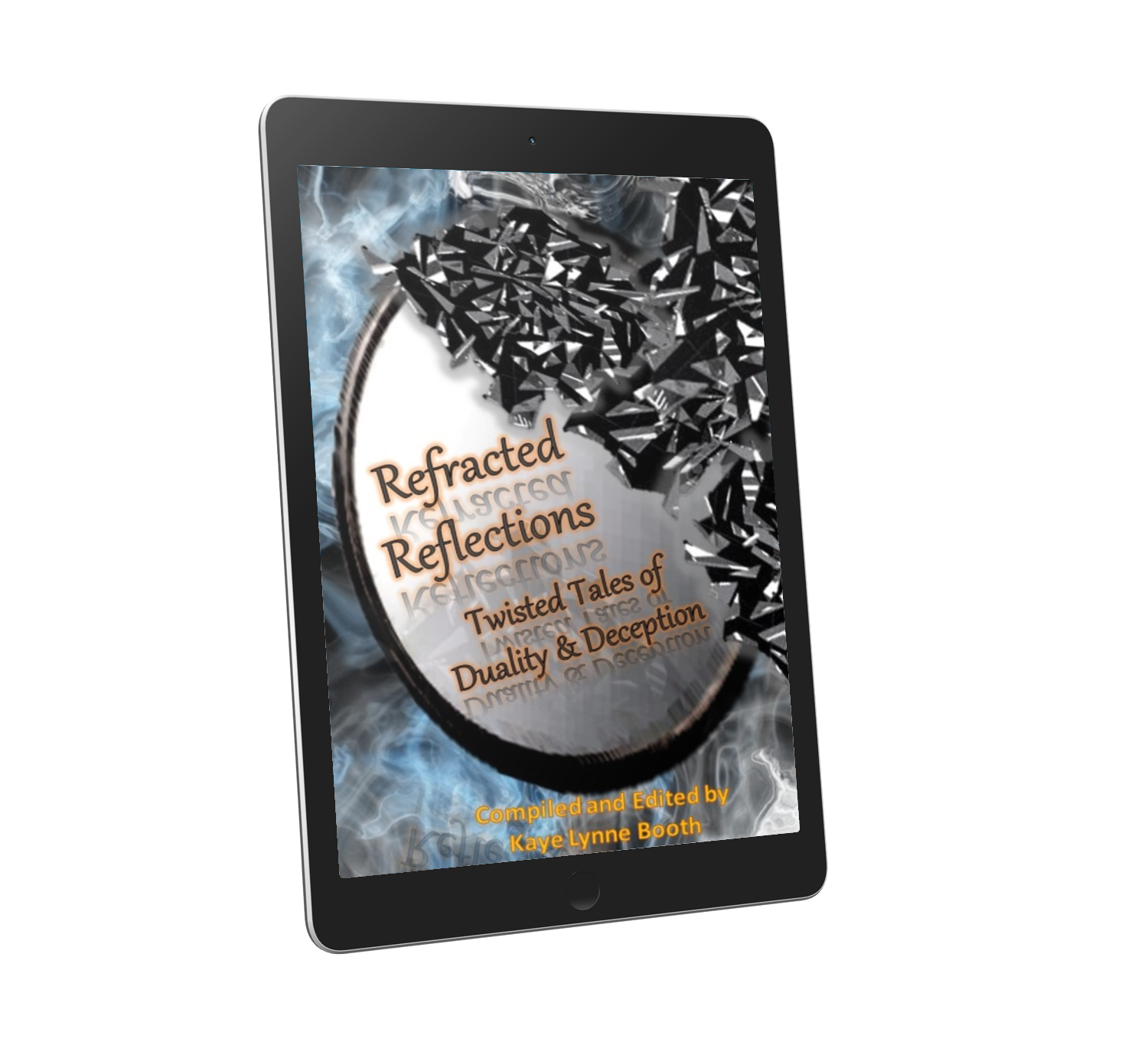
Refracted Reflections: Twisted Tales of Duality & Deception
Refracted Reflections: Twisted Tales of Duality & Deception
Refractions and Reflections…
A reflection can be revealing or deceptive. What stares back at you when you glance into the mirror?
A prison, designed to trap you and take away all that is dear to you?
A portal to another dimension? Another time?
An evil twin, luring you to the other side?
Your loved ones with a fond farewell?
A distorted version of yourself? A person you no longer even recognize?
A protective savior?
Do you dare to gaze into the looking glass?
Will what you see save you…, or haunt you forever?
If you liked Gilded Glass and Once Upon an Ever After, you’ll like Refracted Reflections: Tales of Duality & Deception.
Thanks for joining us today for Day 3 of the WordCrafter Refracted Reflections Book Blog Tour. I hope you enjoyed meeting Elizabeth and learning more about her outstanding story. Follow the tour for a chance for a free digital copy of this exceptional anthology, Refracted Reflections: Twisted Tales of Duality & Deception, or pick up your copy at the link above. Below are the links to the previous stops, in case you missed them:
Tuesday – September 20 – Guest Post by author Ligia de Wit & a review on Carla Loves to Read
I hope you’ll join us again tomorrow on Roberta Writes, with a guest post from Valerie B. Williams about the inspiration behind her story, “The Tinker’s Gift”. Until then, Happy Reading!
Welcome to the WordCrafter Refracted Reflections Book Blog Tour, where we will have reviews and guest posts from a few of the awesome authors who contributed to this unique and unsual fantasy & science fiction anthology. This is the second of three WordCrafter anthologies to include stories handpicked by me, mostly from the submissions which caught my eye when on the editorial team for Guilded Glass. This anthology was by invitation only and the stories contained within are exceptional. Today is the last day it will be available for pre-order, because the release is tomorrow!
Refracted Reflections: Twisted Tales of Duality & Deception
Reflections and Refractions…
One reveals truths, while the other bends light into varying shapes of deception.
Does a small camp mirror reveal hope… or death?
Is the warrior in the mirror a monster… or a protector?
Does a glimpse in the mirror reveal a young woman’s true self… or what someone else has shaped her into?
Does the mysterious portal to the future reflect what could be… or what must be left behind?
Are the dancers reflected in the water’s depth things of beauty… or evil?
This unique and imaginative collection of nine mind tantalizing fantasy and science fiction stories will appeal to readers who enjoy thought provoking tales with hidden meanings resting deep below the surface. These stories will keep you pondering long into the night.
If you liked Gilded Glass or Once Upon an Ever After, you’ll love Refracted Reflections.
We have a great tour planned for this week and I hope you will stick with us and follow the tour. We have a great giveaway, where you could get a free digital copy of the anthology, just by leaving comments. Today is a double tour stop day, with this post and a review by DL Mullan on Undawnted, so be sure to click the link below and check out her review. You may leave comments for her review here, as well.
(Note: Links in the schedule below will not work until the post goes live.)
Tour Schedule
Refracted Reflections – September 19 – 23
Monday – September 19 – Introductory post on Writing to be Read & Review on Undawnted
Tuesday – September 20 – Guest Post & Review – Ligia de Wit on Carla Loves to Read
Wednesday – September 21 – Guest Post – Elisabeth Caldwell on Writing to be Read
Thursday – September 22 – Guest Post – Valerie B. Williams on Roberta Writes
Friday – September 23 – Review & Guest Post – Roberta Eaton Cheadle on Zigler’s News
For a chance to win a free digital copy of Refracted Reflections, just leave a comment to show you were here. Follow the tour and comment at each stop for more chances to win. Three copies will be given away in a random drawing.
Each of the stories included in Refracted Reflections feature a mirror or reflection in some significant way. The reflections given are sometimes surprising, often fooling those who gaze upon them, because things aren’t often as they seem.
I have included two of my own stories, “The Devil Made Her Do It”, which is a reprinted story about a woman blinded by love and deceived by a man who just might be the devil, which first appeared in Relationship Add Vice, from Zombie Pirates Publishing; and an original fairy tale, The Not So Perfect Prince, about a prince who is so full of himself that he can’t see who he truly is.
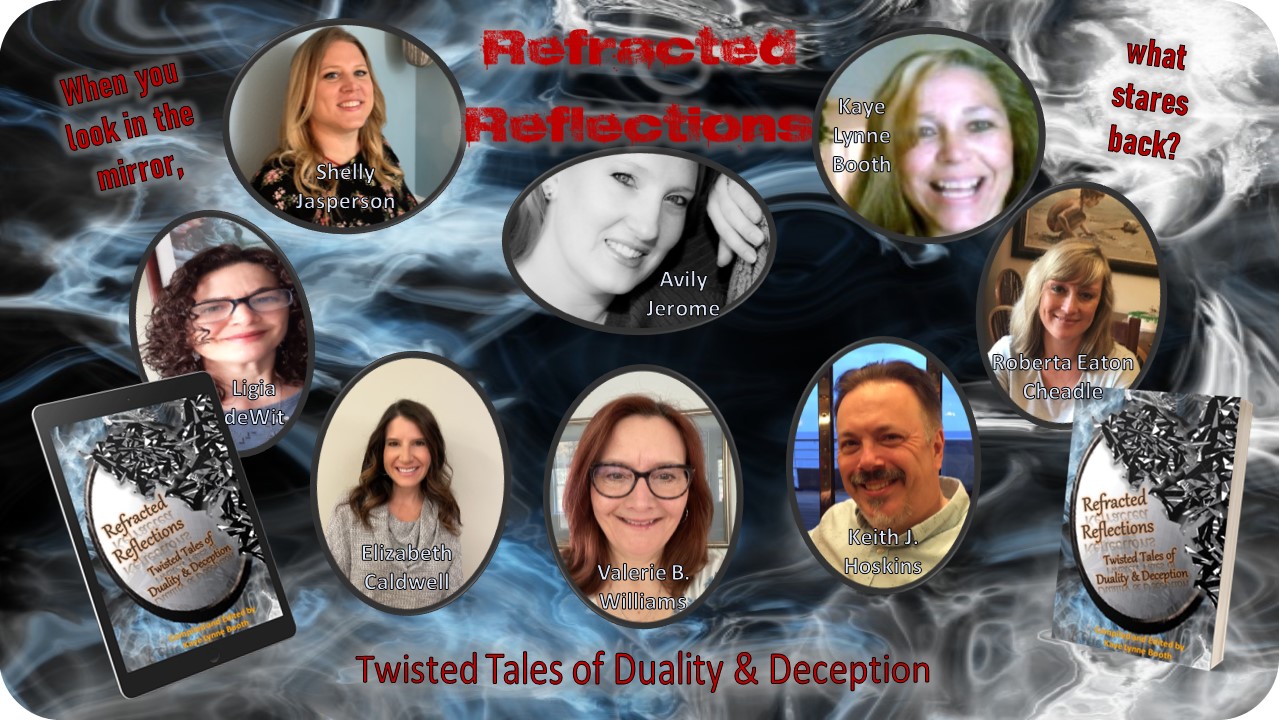
But mine are only two among nine outstanding stories by eight talented authors, and we’ll be introducing five of the contributing authors on this tour: Valerie B. Williams, Roberta Eaton Cheadle, Ligia de Wit, Elisabeth Caldwell, and of course me, Kaye Lynne Booth.
Follow the tour to learn more about Refracted Reflections: Twisted Tales of Duality & Deceptions, and for more chances to win a digital copy of your very own. Don’t forget to stop by Undawnted for DL Mullan’s review today, and you’ll find us over at Carla Loves to Read with a guest post from contributing author, Ligia de Wit and a review by Carla Johnson-Hicks.
About Kaye Lynne Booth
For Kaye Lynne Booth, writing is a passion. Kaye Lynne is an author with published short fiction and poetry, both online and in print, including her short story collection, Last Call and Other Short Fiction; and her paranormal mystery novella, Hidden Secrets. Kaye holds a dual M.F.A. degree in Creative Writing with emphasis in genre fiction and screenwriting, and an M.A. in publishing. Kaye Lynne is the founder of WordCrafter Quality Writing & Author Services and WordCrafter Press. She also maintains an authors’ blog and website, Writing to be Read, where she publishes content of interest in the literary world.
Thank you all for following the WordCrafter Once Upon an Ever After Book Blog Tour. We’ve had a great tour, with two reviews, my interview with Robbie Cheadle, and guest posts from five of the contributing authors. We had a great group of authors contributing to this anthology and I want to thank authors Sarah Lyn Eaton, Roberta Eaton Cheadle, Olivia Merchiston, Linsay Elizabeth Gilbert, and A. E. Lanier for sharing their story inspirations. If you missed a stop, you may still visit it through the links below.
Tour Schedule
Monday – August 22 – Opening Day Post – Writing to be Read – Intro. & Guest Post – Sarah Lyn Eaton
Tuesday – August 23 –Patty’s World – Review & Guest Post – Robbie Cheadle
Friday – August 26 – Zigler’s News – Review & Guest Post – Lyndsay Elizabeth Gilbert
Saturday – August 27 – Closing Post – Writing to be Read – Guest Post – A.E. Lanier
Digital Giveaway
For a chance to win a free digital copy of Once Upon an Ever After, just leave a comment to show you were here.
Follow the tour and comment at each stop for more chances to win.
Three copies will be given away in a random drawing
Today, we’re wrapping up the WordCrafter Once Upon an Ever After Book Blog Tour with a guest post from contributing author A.E. Lanier, who wrote “The Fourth Spire”, a haunting tale of knowledge lost. It’s a thought provoking tale of a burning library within a castle spire with a genuine fairy tale feel.
Excerpt from “The Fourth Spire” by A.E. Lanier
The Fourth Spire
Like most bookish people, I love a good library. Whether real or fictional, I like the idea of many books gathered in one place, the physical monument to the pursuit of knowledge, the fantasy of actually getting work done.
There have been many wonderful libraries–both real and fictional–in my life. I adored my local library as a child and ,like many people, was fundamentally changed by the library in the 1991 Beauty and the Beast. But my favorite library growing up was the one from Avatar the Last Airbender. A single tower reaching up out of the desert, hiding floor upon floor of mystically curated information, briefly discovered before vanishing below the sand once more–buried forever.
There is a romance to the destruction of a library. It feeds into the idea that there were things we once knew and never will again. The hope that perhaps we can relearn, tinged with understanding that the struggle between loss and rediscovery will cost us. It is nostalgia and a love of books and lost places all tied up in one.
“The Fourth Spire” came from my fascination with the aesthetic of the burning library. I wanted to explore what was valuable in mourning the destruction of a library and to consider whether there was something dangerous in romanticizing it. It was, in many ways, a question I was asking of myself.
I am the kind of person that watches an action film and winces harder when a scroll is burned than when an unnamed character is killed. At the end of the day, neither the character nor the scroll is real. But the scroll feels real in a way the character does not. And I sometimes find that impulse within myself disturbing. Books and artifacts are valuable and important, but I will mourn an unknown book in a way that I will not mourn an unknown person; its possibility is somehow more tangible to me.
“The Fourth Spire” is about that tendency to appreciate books more than people. And about the ways in which the knowledge we have lost is often more captivating than the knowledge we still have. I am not certain the story provided answers for me, but then I’m not entirely convinced I was looking for them. Certainly, it provided a feeling. A set of questions. And what more can we ask, really, of a burning library?
A.E. Lanier
A. E. Lanier is a writer, educator, and chronic overthinker living in Central Texas.She enjoys caves, silent reading, and other people’s cats. Her work has appeared in The Arcanist and Daily Science Fiction.
This unique and imaginative collection of eleven thought provoking fantasy stories will delight readers who enjoy stories of wishes gone awry. What happens when… A woman desires to carry on her family’s legacy, uncovering a long-buried curse? A not so perfect witch casts a spell to defy age and preserve her relationship with her handsome shapeshifting familiar? A time traveler longs to be the savior of knowledge lost? An incompetent delivery boy becomes an unlikely savior of forgotten artifacts? A magic mirror yearns for a different question? A tiny story witch desires to share her stories with the world?
Spells are cast, unlikely alliances made, and wishes granted, sometimes with surprising outcomes. You’ll love this anthology of modern myths, lore, and fairy tales. Once you read these twisted tales, you’ll be sure to be careful what you wish for….
If you liked Gilded Glass, you’ll enjoy OnceUpon an EverAfter: Modern Myths & Fairy Tales, short stories with thought provoking themes, captivating characters and diverse cultures, from humorous to horrifying, from the legendary past to possible futures and back to the here and now.
Once Upon an Ever After: Modern Fairy Tales & Folklore
You can get your copy of Once Upon an Ever After at your favorite book distributor through the Books2Read UBL here: https://books2read.com/u/mKdWGV
Welcome to the WordCrafter Once Upon an Ever After Book Blog Tour, where we’re launching Once Upon an Ever After: Modern Myths & Folklore with guest posts from contributing authors about their story inspirations, reviews and an interview the anthology and WordCrafter Press with me, Kaye Lynne Booth. So, stick with us by following the schedule below, to learn more about this mystical new anthology and its authors. Check back daily, as I’ll be adding the links as they go live.
Tour Schedule
Monday – August 22 – Opening Day Post – Writing to be Read – Intro. & Guest Post – Sarah Lyn Eaton
Tuesday – August 23 – Patty’s World – Review & Guest Post – Robbie Cheadle
Friday – August 26 – Zigler’s News – Review & Guest Post – Lyndsay Elizabeth Gilbert
Saturday – August 27 – Closing Post – Writing to be Read – Guest Post – A.E. Lanier
Digital Giveaway
For a chance to win a free digital copy of Once Upon an Ever After, just leave a comment to show you were here. Follow the tour and comment at each stop for more chances to win. Three copies will be given away in a random drawing. (Yep. I literally draw the names out of a hat.)
This anthology was by invitation only, which means I invited the authors because of specific stories, which caught my imagination. The result is a unique collaboration with a wonderful group of authors who have been an absolute pleasure to work with.
Today’s guest post is from contributing author Sarah Lyn Eaton, who wrote the story “Old Roots, New Soil”. Her story grabbed ahold of me and stuck in my head because of the imagery of the spooky old apple orchard her words created for me and because it involves a mysterious curse which is pretty cool. What more could you ask for in a modern day fairy tale?
Finding Roots
I originally wrote the story that appears in this anthology for another submission call, looking for folk tales and modern fairy tales based on some kind of mirror imagery. My brain tends to jump outside of, but stay near to, the box and I began to consider what kind of folk magics my ancestors might have practiced, may have believed. The inspiration for this story was rather close to home.
I grew up in between Lake Ontario and Lake Erie. Generations of my family lived in the area and that’s where my roots are. Our family genealogy is a project my dad worked on when I was a kid, and now we do it together. Over the years I have sought out information on the history of the places our ancestors lived, how they developed and evolved. What were their industries? Their environmental impact?
This is similar to the way I layer a character and where they came from and what circumstances they find themselves in when the story opens, and where they need to get to.
On my father’s side of the family, we have mostly been on this soil since the Mayflower, if not those first 50 years of migration to the new world. And my mother’s side of the family has lines that go back that far. But she also has more recent migrations from Germany and Ireland. And one of the German names caught my eye, that of my great-great-great-great maternal grandmother Wilheminia Wernersbach.
In 1836, George Arth, 35, and Wilheminia Wernersbach, 37, emigrated from Germany with sons Adam, 7, Jacob, 3, and George, 3 months. The emigration card did not list a destination. I believe they were in Antwerp for some time before coming to America. When Wilhemenia brought her sons to America, George Arth was not with them. In 1850, when they are first on record in Pendleton, NY her son Adam, my great-great-great grandfather had his own family plot, right next to her own. In fact, she saved up money to buy a third plot on the other side, so that each son would have his own land, but they would still be together.
I thought about their story and let my brain wander. I wondered what it was like for this woman to bring her children to a new world, and then all the way to the other side of New York that was still being developed. What of this land did she find strange? What of her land might she have brought with her? What customs would have been a comfort to her? What guardians might she have called on to protect her family? How might they have made their living in a new place?
When you do a lot of genealogy and you can get beyond the lists of names and dates and you start to retain details, you start to notice family patterns emerging. Generational patterns that the people toiling every day, trying to get to the next one can’t see. And sometimes you can see how trauma gets passed down, and sometimes even transposed, like in the telephone game of passing messages down a line of people, to see what it becomes at the end.
How can you undo something you can’t understand? How do you combat a family legacy that was kept hidden from you? And what if you found yourself crossing an apple orchard, about to open the door to a dark part of your family’s past?
And that was the seed that formed the first breath of my story.
Sarah Lyn Eaton
Sarah Lyn Eaton is a queer pagan writer and burn survivor. She is a life-long Star Wars geek who spends her free time rock hunting, or venturing into the woods with her camera. Her stories have been published in the anthologies Brave New Worlds, Upon a Twice Time, Unburied: A Collection of Queer Dark Fiction, Of Fae and Fate: Lesser Known Fairy Tales Retold,On Fire, and Dystopia Utopia. In 2021, Sarah Lyn was awarded The Speculative Literature Foundation’s Working Class Writer Grant.
About Once Upon an Ever After
This unique and imaginative collection of eleven thought provoking fantasy stories will delight readers who enjoy stories of wishes gone awry.
What happens when…
A woman desires to carry on her family’s legacy, uncovering a long-buried curse?
A not so perfect witch casts a spell to defy age and preserve her relationship with her handsome shapeshifting familiar?
A time traveler longs to be the savior of knowledge lost?
An incompetent delivery boy becomes an unlikely savior of forgotten artifacts?
A magic mirror yearns for a different question?
A tiny story witch desires to share her stories with the world?
Spells are cast, unlikely alliances made, and wishes granted, sometimes with surprising outcomes. You’ll love this anthology of modern myths, lore, and fairy tales. Once you read these twisted tales, you’ll be sure to be careful what you wish for….
If you liked Gilded Glass, you’ll enjoy Once Upon an Ever After: Modern Myths & Fairy Tales, short stories with thought provoking themes, captivating characters and diverse cultures, from humorous to horrifying, from the legendary past to possible futures and back to the here and now.
Once Upon an Ever After: Modern Fairy Tales & Folklore
Today is the last day of pre-order for this wonderful new anthology. Once Upon an Ever After goes live tomorrow. You can get your copy through your favorite book distributor with the Books2Read UBL here: https://books2read.com/u/mKdWGV
Welcome back once again to the “Ask the Authors 2022” blog series, where we’re offering glimpses into the content of Ask the Authors 2022 writing reference anthology; a unique reference packed full with the writing tips and advice from ten different authors and myself. The Q & A sessions can run a bit long, with all of the contributors weighing in, but they are only a small taste of the wisdom contained in this book. I want to thank all of you who have joined us for each session and keep coming back for more. If you haven’t purchased a copy of your own yet, there’s a link for the UBL at the end of this post, where you can grab one from your favorite book distributor at the special send-off price of 3.99 for the duration of this blog series.
If you missed any of the previous segments, you can find them here:
Segment 1: Introductions for Kaye Lynne Booth & Kevin Killiany/Writing Life Q & A session
Segment 2: Introduction for Bobby Nash/Pre-writing Rituals Q & A session
Segment 3: Introduction for Roberta Eaton Cheadle/Plot & Storyline Q & A session
Segment 4: Introduction for Paul Kane/Character Development Q & A session
Segment 5: Introduction for Mario Acevedo/Action, Pacing & Dialog Q & A session
Segment 6: Introduction for Nancy Oswald/Tone: Voice, Person, Tense & POV Q & A session
Segment 7: Introduction for Chris Barili/Setting & World Building Q & A session.
Segment 8: Introduction for Jeff Bowles/Editing & Revision Q & A session
Today’s segment brings you an introduction to award winning author and publishing industry expert Mark Leslie Lefebvre, whose contribution to the anthology is “Publishing Trends to Watch” and a Q & A session on Publishing. So let’s get started.
Meet Mark Leslie Lefebvre
A self-confessed book nerd, Mark Leslie Lefebvre, who is a former President of the Canadian Booksellers Association and the former Director of Self-Publishing and Author Relations for Rakuten Kobo (and founder of Kobo Writing Life), thrives on innovation and excellence within all aspects of the publishing and bookselling industry.
With more than a quarter century of experience, Mark has been involved in bookselling as it evolved from strictly bricks and mortar operations and into online and digital venues, and has continually been at the forefront of applying digital solutions to publishing and book selling.
An author who has embraced both traditional and self-publishing opportunities for himself as well as the thousands of authors he has coached, advised and consulted with over the past two decades, Mark not only believes that each author’s journey is individualized and personal, but that each specific project a writer embarks upon can have its own unique goals, elements and desired outcomes. He can be found online at www.markleslie.ca
And now on to the Q & A.
Publishing
Are you independently published, traditionally published, or a combination of both?
Mario Acevedo: I’m traditionally published by a large and regional/small presses.
Paul Kane: Combination of both. I started out in the small, indie presses, before working with some of the bigger places, so I like to go back there and write fiction for them when I can. Plus, it gives me a bit more freedom to experiment or write something that might not be that commercial; because the indies don’t have the same kind of print runs as bigger publishers there’s a bit less pressure to appeal to huge audiences. The flip side of that is you get read by a lot more people when you’ve done something for a bigger publisher, simply because they have the money to put behind advertising, production, distribution and marketing. Having said that, I still try to do as much of that as I can myself – I never assume it’s all being done for me. I’ve been known to set up blog tours myself, even when working with bigger publishers because sometimes the personal touch is what bloggers and book reviewers respond to.
Bobby Nash: Both. I’m what they call a hybrid author. I work for traditional publishers of all sizes. I also have my own indie small press, BEN Books.
Robbie Cheadle: Most of my books are published by TSL Publishers in the United Kingdom. I love working with Anne Samson and find her fair and helpful. I self-published Open a new door, a collection of poems which I co-wrote with another South African poet, Kim Blades. I did not enjoy the self-publishing experience and prefer to work through a publisher.
I have short stories and poems published in a number of anthologies which have been published by the editor and compiler through their own publishing enterprises.
Nancy Oswald: A combination.
Mark Leslie Lefebvre: I am a combination of both traditionally published books, independently published books, as well as a hybrid mix of selling work to or collaborating with indie publishers in a slightly traditional way.
What factors influenced you to take your chosen publishing route?
Paul Kane: Things just seemed to slot into place for me, rather than choosing a particular route. I went to art college thinking I’d go into some kind of career in the arts, but it turned out I was better at theory than the practical stuff, so I went to university initially to study History of Art, Design and Film. While I was there, I chose an optional module called ‘Professional Writing’ and loved it, which led me into the journalism – and I figured I could at least make a living writing non-fiction that way, with articles and reviews.
Because I was writing for the day job, I thought I’d do some stories for pleasure – and they ended up being published too, in small press magazines. Then the fiction started to overtake the non-fiction, and the rest is history.
I don’t think I consciously chose any of that, it just sort of happened. I definitely didn’t think to myself when I was younger ‘I’m going to be a writer when I grow up.’ That, honestly, never even crossed my mind because I came from a very working class background where you did manual jobs like being a builder or joiner or whatever. My dad was a miner, so his was a hard job – especially compared to mine – but at the same time he never discouraged me going down the creative route. He did, however, instill in me a solid work ethic which I still have today.
Bobby Nash: When I started, doing it yourself was not as accepted as it is today. Working for a publisher was the only way to get a book published at the time. Fast forward and there are more options. This allows me to do some projects the way I want through my own press and still do work for other publishers as well. For me, it truly is the best of both worlds.
Robbie Cheadle: Initially, I submitted my Sir Chocolate story ideas to four or five small publishing houses and TSL Publications responded to say they were interested in publishing them for me. I was fortunate as I didn’t experience a lot of rejection and I benefited from the experience and expertise of a publisher right from the beginning of my journey.
Nancy Oswald: For me it’s been like water finding its way through a channel. My course had often determined by which barriers are encountered, force and velocity, and other influencing factors like an unexpected change in the weather, excessive rain, drought, and human factors.
Please briefly share the story of your own publishing journey.
Paul Kane: A lot of that’s covered in the above, but if I’ll take you through from when I started to get stories accepted in the small presses to today… When I got back into writing fiction again in the ’90s, which had been something I enjoyed tinkering with back in my teens, I wrote a lot of short stories. Some of them worked, some didn’t, but it was all practice. I’d been doing a correspondence course to help with my non-fiction and my fiction, and I sent the tutor a story I’d written that had come to me, fully formed, in a dream: ‘The Cave of Lost Souls.’ She loved it and told me I had to send it off somewhere. I’d been toying with the idea of entering it into a writing competition, but then I saw an advert in a trade magazine for a publication called Terror Tales. I sent the story off to the editor, John B. Ford, and he wanted to use it in an upcoming issue. He also lived locally, so invited me to a gathering of writers. I sat around listening to all these stories about what they were doing and thought to myself, ‘wow!’ But also, if they’ve done it, maybe there’s a chance for me too. They gave me pointers as to which publications to try my work with, where I could find listings and so on. That led to more acceptances, attending more events and eventually getting a couple of collections out. I also found out about something called The British Fantasy Society who were looking for volunteers for positions, one of which was for Special Publications Editor. That enabled me to work with such names as Ramsey Campbell, Neil Gaiman, Muriel Gray and Clive Barker. I was helping out running their convention FantasyCon as well, and indeed years later ended up co-chairing a few. In the meantime, someone I’d met at an event – Jonathan Oliver – was looking for ideas for post-apocalyptic novels set in a universe called ‘The Afterblight Chronicles’, mass market books brought out by the publisher he worked for, Abaddon/Rebellion. I pitched a few and Jon loved the Robin Hood idea. I worked up a chapter breakdown, which got me the first book – there ended up being a trilogy of novels a couple of shorts and novelettes and one novella – and suddenly my longer fiction was getting some attention. I’d also gone into editing professionally, putting books together with Marie for places like Simon & Schuster, PS Publishing and Constable & Robinson. Anthologies like Hellbound Hearts, A Carnivale of Horror and The Mammoth Book of Body Horror… All of this enabled me to try my hand at things like film and TV scripting, comics, audio and theatre scripting, which broadened the scope of what I was doing. And it led me into writing crime thrillers for HQ/HarperCollins, which I’m doing today as PL Kane. In a nutshell, that’s my journey.
Bobby Nash: I started writing comic books. I then wrote a novel, then a second, which was published, Evil Ways. Then, I did a mix of comics, novels, and shorter stories for several years. These days, I’ve added screenplays and audio scripts to the mix. I like to try new things.
Nancy Oswald: Published, two large publishers, one it Canada and one in New York, published small Colorado owned publisher, self-published twice, each time for a different reason.
Mark Leslie Lefebvre: I started off in the mid 1980s when there really was no other choice but to submit short stories to magazines in order to slowly build yourself a name within writing and publishing and hopefully attract the attention of an agent or editor who might take your book proposal seriously because of your proven track record.
After years of rejection my first short story was published in 1992. I earned $5 USD and a contributor’s copy of the digest-sized quarterly magazine with a circulation of perhaps 500 people. And as time went on, I started selling to bigger markets with larger distribution and higher pay. (At the time 5 cents a word was considered a “professional rate” for a short fiction sale).
Over the years I sold dozens of stories to various small press magazines and anthologies, but my work never remained in print for more than maybe six months maximum. So, in 2004, I collected a number of my previously published short stories along with a couple of ones that hadn’t appeared anywhere, and I self-published them in print (using Ingram Lightning Source for making a Print on Demand (POD) book entitled One Hand Screaming.
Back then self-publishing was a dirty word, and most self-respecting authors serious about a writing career would ever consider that path. All of my friends who had publishing deals with big publishers told me that self-publishing was the best way to kill my writing career.
But I did it anyway.
I did so because after all those years of writing, I still didn’t have a book out. In addition, the majority of the stories had not only already graduated from the slush piles of the various magazines they’d first appeared in (thus having an editorial “seal of approval” but they had also been edited.
I secured an ISBN, established a publishing company (Stark Publishing – which I use to this day), had a logo for the company created, and had a book cover designed. (The cost for the logo and book cover was about $24, the price of a case of beer paid to my best friend who was a graphic designer.
In 2009, I used the Stark Publishing imprint to publish an anthology called Campus Chills. I solicited sponsorship for this anthology from three university bookstores (University of Waterloo, University of Alberta, and McMaster University Bookstore) so I could pay contributors pro rates for their original stories. The book was a historic publishing first. It was the first professional anthology to be produced exclusively for the Espresso Book Machines that the three bookstores owned.
My first full length book traditional deal was Haunted Hamilton, which was published in 2012 by Dundurn, Canada’s largest independent publishing house.
Since then, I have continued to work with traditional publishers and also use my Stark Publishing imprint to publish my own books as well as a few selected titles from author friends.
What do you see as the pros and cons of traditional/independent publishing?
Paul Kane: The pros of traditional publishing are, as mentioned, more money behind things like advertising and marketing, distribution and so on. You’ll also likely get paid more as an author. The cons are the restrictions of the marketplace, in that you’ll have to deliver something that’s more of a crowd-pleaser than you would if it was only intended to be a limited book of say 500 copies. That’s where the indies shine, because they’re more likely to take a chance on something experimental. But don’t look for fortunes that way, if that’s your goal. I straddle both traditional and indie and adore both. I’m lucky enough to enjoy writing mass market thrillers, and at the same time put out horror books with huge monsters in. The best of both worlds, frankly. If, by indie, you mean self-published, I’ve never done that, but I know a lot of people who do – some make a very good living at it – so there’s nothing wrong with that either. Do whatever makes you happy as a writer, I say, because that will come across in your writing.
Bobby Nash: Traditional publishing handles the production work, which is nice. They handle the cover, printing, and distribution. If the publisher has good distribution, that’s a big plus. The more places your book is shelved, the better your odds in terms of sales.
Indie publishing offers more freedom to do what you want with a shorter lead time. You handle production, cover, and there’s usually only Amazon and a few on-line retailers carrying your book.
No matter which you choose, you, the writer, are expected to handle almost all of the marketing and promotion.
Robbie Cheadle: Working with a publisher taught me a lot about the publishing process and spared me having to do all the research and experimentation myself. I find it beneficial to have a second set of experienced eyes read and edit my books. My publisher gives me advice about formatting my books and also deals with Lulu.com and Amazon on my behalf. This lifts a lot of the administration from my shoulders. As a full-time working person with a demanding corporate job, I don’t think I would manage the proofing, type-setting, and other administration on my own as well as have time to write and market my books. My publisher also does some marketing of my books which is helpful.
Nancy Oswald: It depends on personal goals, opportunities, and life’s circumstances. Money and control and time are issues that have played into my decision. Marketing is not. You still have to get out and promote yourself.
Mark Leslie Lefebvre: First of all, I embrace both, and I recognize that there are unique pros and cons for each of them. I’ll try to boil them down to a few things.
With self-publishing (or indie publishing), you’re in full control. You are the publisher, which means you control everything. Whether or not it’s published, when it is published, how it’s edited, the cover design, the price, what markets it is released to. That is both a blessing and a curse because there are a lot of moving parts; and many authors don’t like the idea of having to do all that work – or, more specifically, having to hire out the right people for those tasks and project manage the process.
On the plus side, because you’re in control, you don’t need to wait for a gatekeeper to anoint your book from out of a slush pile of millions of manuscripts. If you want to change something you don’t need anyone else’s permission, you can do it.
And, of course, you can earn much higher royalties (up to 70% in many cases) and get paid monthly rather than perhaps once a year or maybe twice a year.
The biggest downside to self-publishing is that while you have easy access to digital sales (eBooks, Audiobooks, and POD print book online sales), you have extremely limited access to “in store” and “on shelf” placement in bookstores. That’s one area where traditional publishing outshines self-publishing significantly.
Traditional Publishers are part of an “old boys” network of a complex and often confusing supply chain requiring warehousing and returns (a business practice instituted during the Great Depression and which remains to this day). But they are the best way to get your books into bookstores.
Dundurn, the largest traditional publisher I work with, not only gets my books onto the shelves of chain and indie bookstores, but has also gotten my books onto the shelves at Costco and Walmart. That’s something I’d never be able to afford to do as an indie author publisher. But with this type of distribution comes setbacks, that I’ll get to shortly.
Another great benefit of working with a traditional publisher is they take care of the majority of the business aspects. They have in house or hire out all of the professionals needed to bring a book to market. From developmental, copy, and line editors to proofreaders, to professional book formatters and cover designers, to in house marketing and sales (to pitch your book to bookstore buyers), they not only project manage all of that, but, more importantly, they pay for all of those services.
The advance an author receives from a traditional publisher is, typically, significantly smaller than it used to be. There was a time when a midlist author could make a full-time living off of their book advances alone. That has not been the case for many years.
Authors also have no idea how their book is selling. They may receive an annual, or perhaps twice-annual statement of their book sales, and are perhaps paid once or twice a year for the previous year’s sales. There is also a 30% withholding on those payments against the aforementioned returns. This means, for every $100 owned to you in royalties, they hold back $30 as protection against the cost of returns.
If I can use two examples of my own books, here’s a bit of a breakdown on earnings.
For one of my traditionally published books that sells for $24.99 in print, I earn 8% on each sale, which is about $2.00. I get paid for that once a year with 30% withheld for a full year. I’m not even going to talk about the eBook sales as that’s a joke and barely adds up to enough sales to even talk about (because most traditional publishers don’t sell a lot of eBooks because they price they high enough to drive people to buy the print version, which is often cheaper, or just a dollar or two more than the eBook price).
For one of my self-published books, which sells for $14.99 in print, I earn $3.20 per sale. But I don’t sell a lot of print on my self-published books. The majority of my sales come from eBook sales. When I sell an eBook for $4.99, I earn $3.49. And I get paid on those sales every month, as opposed to once per year.
One thing most authors misunderstand is that they think working with a traditional publisher means you won’t have to do marketing. That couldn’t be further from the truth.
Authors have to do their own marketing regardless of how a book is published.
One last thing I always consider when thinking about the pros and cons of traditional publishing versus self-publishing: If it’s important for me to earn money and sell a lot of units in a digital manner where I’m in control, then I self-publish. If it’s important for the book to be in print and on bookstore shelves, then I look at traditional publishing. Because each book I write, or plan on writing has its own unique path often depending on my goals and how they relate to those factors.
Which formats are your books available in: ebook? Print? Audio? Hardback? Large print? NFTs?
Mario Acevedo: My books are available in print, ebook, and audio. My few hardbacks are out of print.
Paul Kane: All kinds, it just depends which book it is. Most are ebook and print. Some have had audios made of them, like The Rot from Horrific Tales. Encyclopocalypse have turned a lot of my back catalogue into audios, but also published a recent collection called The Naked Eye as an ebook and print, paperback and hardback. So it really does depend on what book it is and who brought it out. Doing searches for Paul Kane, PB Kane – my YA pseudonym – and PL Kane will come up with a bunch of stuff from me.
Bobby Nash: I have books available in hardcover, paperback, ebook, and audio. For BEN Books, I make an effort to get the books in as many formats as I can so readers can find it. On projects I do for other publishers, I don’t always have a say in format.
Robbie Cheadle: My YA and adult books are available as ebooks from Amazon and Lulu.com and as paperbacks from TSL Publications in the UK, Lulu.com, and Amazon. My children’s books are available as ebooks from Lulu.com and as paperbacks from TSL Publications in the UK, Lulu.com, and Amazon. My two poetry books are available from Amazon as paperbacks and ebooks and Behind Closed Doors is available through a variety of other distributors too.
Nancy Oswald: Ebook, print, both hard back and soft cover. It has varied from book to book. I’d love to have audio versions of my books, but I don’t think there would be a market for the ages I write for.
Mark Leslie Lefebvre: My books are available in eBook, Print (trade paperback, hardcover, large print) and Audiobooks. Not all titles are available in all formats. And, ironically, my self-published titles are available in more formats than my traditionally published books.
I also have a small selection of self-published titles available in an NFT-type model and will likely expand that over time.
If your books are available in audio format, which distribution platforms do you use? Can you tell us about your audio book experiences?
Paul Kane: Usually Audible, though a few have come out as CDs as well. Her Last Secret was a CD release, as well as a download. I tend to just let the publishers get on with that, as they know more about it all than me. Sometimes I get sent audition clips from people who want to do the narration, and indeed I was put in touch with the guy who did the narration for Arcana from Wordfire Press, Robert Power, because he wanted to ask some questions and I spent a very pleasant evening on the phone chatting to him. But generally, I don’t really have anything to do with it, other than I might listen to some actors reading bits of the book and say which one I prefer or who I think suits the story best.
Bobby Nash: Audible is the biggie. We have also experimented with other audio publishers. I love audio books and have been blessed to work with some fantastic narrators. I love audio and will keep putting them out in that format as long as I can.
Mark Leslie Lefebvre: I primarily use Findaway Voices for audiobook distribution to more than 40 retail and library markets.
When it comes to audiobooks, the expense to produce them is quite high and I’m currently in a position where I’m thousands of dollars in the hole on earning that money back. But for me it’s a long-term thing, that I know will earn out over time. For me, it’s a long-term investment.
Are your books available wide or exclusive to Amazon? Or a combination of both? Why?
Paul Kane: Most, if not all, of my books are on Amazon, but also available from the publishers themselves too – as well as from all good bookstores. Again, I don’t really have much to do with all that as bookselling isn’t my field. I leave it to people much more qualified than me to sell my wares, I just write them in the first place!
Bobby Nash: A little of both. For BEN Books titles, the ebooks are exclusive to KDP so they can be enrolled in Kindle Unlimited. This is a way for me to promote the books to those who subscribe to KU to try my books for free and still make a few pennies. Paperbacks are at Amazon, B&N, Books-A-Million, etc. I also have an on-line store where you can buy autographed books from me directly.
Nancy Oswald: Back to marketing—Amazon on all of them, but I have them in as many local venues as possible; Book stores, gift shops, local stores.
Mark Leslie Lefebvre: I am wide beyond the limited perspective of “wide or exclusive to Amazon.” I could go on for hours, days, and weeks explaining it. You’re better off reading my budgie-basher of a book released in 2021 called Wide for the Win: Strategies to Sell Globally via Multiple Platforms and Forge Your Own Path to Success.
What factors help to determining the pricing of your book?
Paul Kane: I have absolutely no idea honestly. My second thriller, Her Husband’s Grave, has been available for about a year now at just £2 in paperback – and I have no idea why. I’m just delighted it is, because it’s been my biggest seller to date. It’s something to do with price matching, but I have no idea how it all works.
Bobby Nash: The base cost is your starting point. From there, you see the cost the bookstore or Amazon will take. Then, I round up a bit. I make about $1.50 profit per book. That’s why sales quantity is important.
Robbie Cheadle: My publisher prices my books and I am not able to run promotions for free or discounted downloads of my ebooks.
Nancy Oswald: I look at similar books and make my best guess about the market. On my two most recent books, I considered inflation.
Mark Leslie Lefebvre: When it’s a self-published title (ie, when I get to determine the price), it’s a combination of understanding the markets (the global markets, and not just the US markets) and the genres. So country, genre, size and format of the book all play a factor in determining the right price.
One thing I like to remind authors is that they should think of price as a verb rather than a noun. It’s fluid, and can and should change over time to match market conditions and other factors.
Which self- publishing platforms have you used? Please tell us about your experiences with them?
Bobby Nash: I mostly use Amazon/KDP. I have used Smashwords for ebooks in the past and Lulu for hardcovers. The experiences are generally good.
Robbie Cheadle: I have only self-published through Amazon, but I had assistance with the typesetting, cover, and administration.
Nancy Oswald: Only KDP (Create Space first, then KDP) Great experience both times. Books look good, hold up, and I like the POD aspect of ordering.
Mark Leslie Lefebvre: Again, for a blow-by-blow of the majority of them, read Wide for the Win. It’ll take dozens of pages to try to go through them in detail.
But in a nutshell, by default, here’s how I self-publish.
I publish direct to Amazon via KDP (Kindle Direct Publishing) for eBook and Print
I publish direct to Kobo via KWL (Kobo Writing Life) for eBook (and for selected audio titles)
I publish direct to Google Play for eBook (and for selected audio titles)
I use Draft2Digital for distributing to numerous other eBook retail platforms (Apple Books, B&N Nook, a handful of others), and most of the major library platforms (OverDrive, Baker & Taylor, hoopla, Bibliotheca, BorrowBox, etc) as well as for print via D2D Print (which is partnered with Ingram Lighting Source)
I also do print distribution via a combination of Ingram Spark and Ingram Lighting Source direct. (This is a side effect of being doing it for so long that I have different titles in different systems based on what was and wasn’t available at the time)
When seeking out a traditional publisher, what should an author look for? What should they beware of?
Paul Kane: I think you need to look at the publishers who are releasing books like the one you want to write and sell. You probably wouldn’t approach a religious publisher with a book about demons or zombies, say, but one that’s had some success in this area would definitely be more open to it. As for things to be aware of, run a mile if any agent or publisher asks you for money to look at or publish your book. They should be paying you, not the other way around.
Bobby Nash: What does the traditional publisher offer? If you like what they can do for your book, then go for it. Do they help with promotion? Do they offer an advance? What is their distribution platform like? Where are their books sold? Ask questions and research before signing. Reach out to other authors they publish and ask questions. Never pay to be published though. That’s not traditional publishing.
Robbie Cheadle: I am very careful of the publishing contract. I do not want my characters and ideas becoming the property of the publishing house and my stories continuing to be written by another writer if I die. I retain the rights to my characters in my publishing contracts.
Nancy Oswald: For me, I was lucky to find a small publisher who liked what I wrote. So, I’d say look for a good match. Do your homework in terms of other books the publisher puts out. When I started out, I targeted only big companies with a name, but have since learned that there are lots of small and mid-press companies that can be rewarding to publish with. With that said, trust is a huge issue. I entered into one joint publishing enterprise with my small press publisher, but that is only because we had similar goals and years of trust built up before we agreed to do this. There’s never a crystal ball, and I was lucky. Besides researching the publishers and their lists, you might consider locating and reaching out to some of the authors a certain publisher has worked with and ask them about the publishing experience they’ve had with company X. I have a friend who publishes with X Libris which some experts say you should NEVER do. But she has had a great experience, now has 6-8 books out and is completely happy. Find the publishing match that fits your goals and project.
Mark Leslie Lefebvre: First and foremost, if it’s a proper traditional publisher, the money should always flow TO the author from the publisher, and NEVER, EVER, from the author to the publisher. No exceptions. If there’s any money paid to a publisher, they’re not a real publisher, no matter how much they protest or wave their arms around and explain some asinine and convoluted reasons for it. End of story.
Anyone can hang up a shingle and call themselves a publisher, but if they do not have “old school” traditional publishing supply chain distribution through bookstores where there’s a very likely chance and easy availability for the book to be stocked in a bookstore, they’re typically not offering you any better chance of having a book in stock in a bookstore than you can do on your own. (Yes, they might pay for editing, design, etc, but the “in store” distribution is a MAJOR hurdle).
Also be aware of signing over the rights to formats that the publisher is not actually using. IE, if they want audio rights but don’t publish audiobooks, don’t sign away your audio rights. You can earn more selling them to someone who does.
Any publishing advice for new authors?
Paul Kane: Just to hang in there, and never give up. It can be a hard business with ups and downs, so you need a thick skin and you need staying power. It’ll happen for you eventually if you’re good enough and just keep going. Also, don’t take rejections personally; it’s all subjective and what one editor hates another might love. Just look at some of the big releases that have been rejected so many times before being given a chance.
Bobby Nash: Have fun and enjoy the experience. Yes, writing is my job and there are days it’s a tough job, but t’s still a job I love. That’s what keeps me going.
Nancy Oswald: Just start, and don’t be afraid to make mistakes along the way. Do your homework if traditional publishing is what you want to do. Go to conferences and take advantage of one-on-one interviews with publishers and agents. When a book is returned, even if it’s a form letter without comments, sit down and re-write your book all the way through. You’ll be surprised at how those re-writes will improve your writing.
Mark Leslie Lefebvre: Patience, Practice, and Persistence are three of the main traits needed for a long-term publishing career. Also, you’ll never stop learning and there is no magic bullet for any of the hard work that is required to be successful. So, stop wasting your time looking for one.
Publishing, regardless of whether or not you choose traditional publishing or self-publishing/indie publishing (or, ideally, some combination of both), takes a lot of work, a lot of constant learning and re-learning, and dedication to continuing to work at it even when nothing seems to be working or all the cards are stacked against you.
To get through those times, which will happen to every single writer as the markets continue to shift and change and bend and flow, you need to believe in yourself and never give up on the dream and desire. And, ideally, if you get intrinsic pleasure in the act of actual writing itself, that could be enough to sustain you through the process during those “dry” periods.
What are the advantages of creating your own publishing imprint? Do you recommend it? Why or why not?
Bobby Nash: I started BEN Books to get some of my older, out of print works back into print. Eventually, I realized that I could launch projects there that I might not be able to pitch to a traditional publisher. When I started writing crime novels, I was known for doing comics, sci-fi, horror. It was a hard sell to convince publishers I could write a crime thriller. BEN Books became a way to get those stories told. Now, I’m more known for the crime thrillers. Go figure.
Nancy Oswald: The jury’s out for me on this. I just recently created an imprint and registered it with the state of Colorado. I have no idea what I’m doing, and it’s weird for me to associate with and imprint and not myself as an author which I’ve done most of my years publishing with a small press.
Do you use crowd sourcing or subscription services to fund your publishing endeavors?
Paul Kane: A couple of things I wrote have had Kickstarters, but they’ve been a short film and a comic and the people behind bringing them to life have handled the campaigns. All seemed to go well, though, so I can’t complain.
Bobby Nash: I haven’t crowdsourced any novels yet, but I’m considering it for a box set next year. I’m still working out the logistics. I do have a Patreon page ( www.patreon.com/bobbynash ) that works like a subscription service.
___________________
That’s all for this week’s “Ask the Authors” blog segment. Thank you all for hanging with us. Next Saturday we’ll be wrapping up this Saturday series with an introduction to YA and middle grade author, L. Jagi Lamplighter, whose anthology contribution discusses “The Trouble with Troupes”, and a Q & A session on the most formidable of subjects, book marketing.
This must have writing reference is available through Barnes & Nobel, Rahkatan Kobo, the Apple Store, Amazon, Scribd and many more. As the “Ask the Authors 2022” blog series is drawing to a close, be sure to get your copy of Ask the Authors 2022 at the special send-off price of $3.99 for the digital edition, from your favorite book distributor through the Books2Read UBL: https://books2read.com/u/3LnK8e
____________________
Join Kaye Lynne Booth & WordCrafter Press Readers’ Group for WordCrafter Press book & event news, including the awesome releases of author Kaye Lynne Booth. Get a free digital copy of her short story collection, Last Call and Other Short Fiction, as a sampling of her works just for joining.