3 editing types.
Posted: April 27, 2014 Filed under: Uncategorized Leave a commentSome great editing advice from an author I call a friend.

I’m in the middle of an editing project, and editing is popcorning all over my brain cells.
So if you’re serious about editing your written work well, then this one’s for you.
(Writer, taken seriously, this post can make your writing brilliant.)
Here we go.
Editing takes form in three ways:
Details.
Content.
And rhythm & sound.
If you want to be a fabulous self editor, then you’ll need to know all three.
1. Details…
Just about anyone who knows punctuation and grammar well can edit for details. A period here, a comma there. No, a semicolon does not work there. Yes, in this case, the question mark goes outside the quotation marks. No, you can’t put the words not only in your sentence without but also. The style guide says so, and we follow the rules.
So many people believe that they know the rules. They…
View original post 596 more words
Share this:

Time Flies
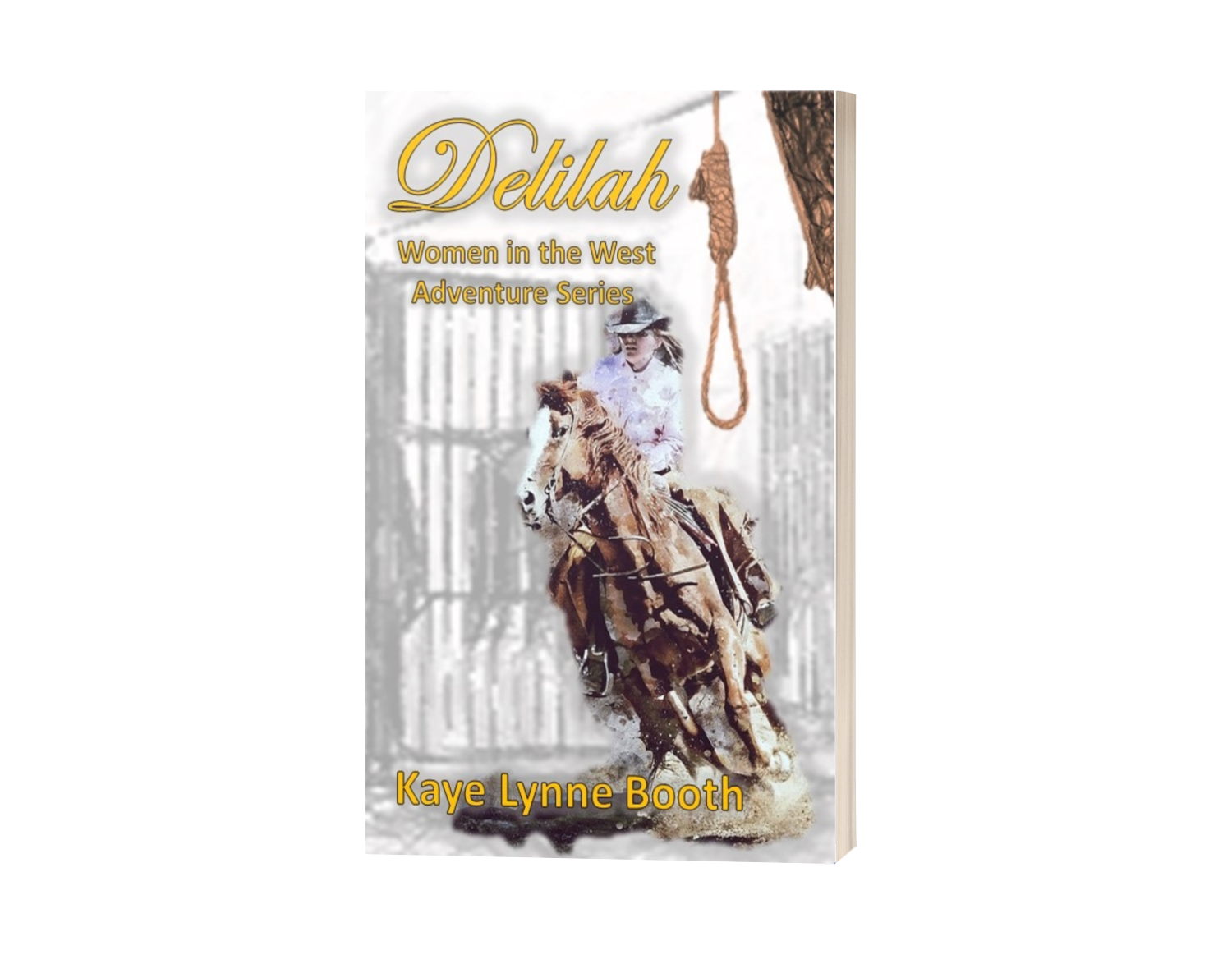
Posted: January 12, 2014 Filed under: Fantasy, Fiction, Mystery, Western, Writing | Tags: Books, Fantasy, Fiction, mystery, New Year, Western, Writing Leave a comment Wow! It’s 2014 and I just realized how long it’s been since I published here, I’ve been busy earning my degree, along with the many other demands that life places on all of us. But hard work and dedication pays off. In fact, since I began the MFA program at Western State Colorado University, I’ve produced rough drafts for two novels, which I’m now working on revising. The first is a western, Delilah, and the second is a middle grade mystery, The Adventures of Ann and Kinzi. I’m currently working on a mythological fiction/fantasy/science fiction novel, with the working title, A Playground for the Gods, which I’m considering using as my thesis.
Delilah is a tough young woman who grew up on the Colorado frontier. On her way home to the San Luis Valley, she’s brutally raped and left for dead, sending her on a quest for vengeance. Her hunt for her tormentors leads her to the Colorado mining town of Leadville, where the colorful inhabitants work their way into Delilah’s heart and give her hope for a future she’d thought lost along with her innocence. Now she must stay alive and protect her new-found friends as she faces the many dangers of the western wilderness and the outlaw elements of the growing new Colorado territory.
The Adventures of Ann and Kinzi is the story of two young girls growing up during the depression. Their shared love of animals and the fact that they’ve both lost their mothers are the common ground on which cements their friendship. When strange things start happening at the McViddie farm, where they care for the horses, and one of their classmates disappears, Ann and Kinzi set out to solve the mystery and save their friend, but they must do it without being caught by the kidnapper themselves.
In A Playground for the Gods, Inanna is the goddess of love and war on a quest to save humanity. The foolish judgement of men and their misuse of the technology the gods have provided have brought them to the brink of self-destruction and convinced the gods that humanity is not ready to receive the secrets of long life and powers that would make them godlike. They’re preparing to find a new planet on which they hope to find a new species to bestow their gifts upon. Inanna must prove that humans are worthy of their godly gifts, and convince them not to leave humanity in such a mess.
That’s it. That’s my excuse for neglecting this Writing to be Read blog. Now all I can do is ask forgiveness from my readers and offer the promise that if they stick with me, I promise to blog on a regular basis in the coming year. I don’t foresee that I will abandon novel-writing, but I do plan to try to organize my time better, so I’ll be able to commit to at least two or three posts a month. I hope you will all join me for the journey.
I’d also welcome any feedback on which of the above stories capture your interest and why. Comments are always appreciated.
Share this:

“Unfinished Business” by Tim Baker an entertaining read
Posted: September 25, 2013 Filed under: Book Review, Fiction, Uncategorized | Tags: Books, Fiction, Tim Baker, Unfinished Business 2 Comments
“Unfinished Business” by Tim Baker
No one is ever ready to die because we never know when our time is up. Some, who die of a terminal illness, may know that death is approaching and have time to put their affairs in order, but death strikes most unprepared and they leave this life with unfinished business hanging… well, unfinished. Unfinished Business by Tim Baker is a creative and original story that explores the possibilities how the universe may balance the scales and take care of those things that have been left unfinished by departed souls. This delightfully entertaining story will tickle your funny bone and keep you guessing.
When Meg Seabury loses her friend and mentor, Lita, she inherits an unexpected gift, although at times she wonders if it isn’t a curse. Suddenly, Meg is able to see the final thoughts of those who cross the threshold of the funeral home where she works, and she soon learns that it is up to her to finish what they didn’t have the chance to take care of. Her new abilities lead her on a strange roller-coaster ride to places she would never go and compels her to do things she would never do in her old “normal” life. Not all that’s left undone are positive events. Meg finds she doesn’t have a choice but to carry through, restoring the balance of the universe, even if it leads her into dangerous situations or could land her in jail.
Unfinished Business is now added to the list of novels by Tim Baker recommended by this reviewer, which also includes Water Hazard, No Good Deed, Pump It Up, Backseat to Justice and Living the Dream. All Tim’s books are available at www.blindoggbooks.com.
Share this:

Catching Up
Posted: May 10, 2013 Filed under: Writing Leave a comment This is what I call a catch up post. I have been busily writing my heart out, but unfortunately none of it has appeared here on Writing to be Read. I want to apologize for neglecting all my faithful readers and perhaps make up for it, in part, by sharing what I have been up to.
I’ve been working on a middle grade mystery novel, The Adventures of Ann and Kinzi, that has turned into quite the project. With 26,000 words down, the first draft is now well on its way to being finished. I also wrote a political op/ed piece that has a good shot at being published after making revisions, and I wrote a query letter for my western novel, Delilah, the first draft of which is waiting for revision at this time.
I covered the 2013 Pikes Peak Writers Conference as the Southern Colorado Literature Examiner, and I’ve also been working on a blog post for the Pikes Peak Writers blog. While attending the conference, I had my first pitch session, where I pitched one of my children’s books and got a “send it”, so I have also been working on revisions of the book, as well as writing a cover letter and synopsis for it.
In addition, I’ve worked up a chapter outline and a start on a non-fiction book, The Unseen Victim, that’s been brewing in my mind for several years, and developed a good idea of the research that I’ll need to do for it. I’ve written the first draft for an article on creative and critical thinking skills in writing and how to teach them in the classroom setting, which may eventually end up here. In class, I learned to write out a syllabus and lesson plan, knowledge that has the potential to be very useful in my future writing career.
With the end of the semester just around the corner and most of these projects finished, or at least close to being wrapped up, I find myself in an unusual dilemma. While many writers complain of not knowing what to write, my question is what to work on first. I have Delilah awaiting rewrite, with query letter ready to go. I have the remainder of the first draft of The Adventures of Ann and Kinzi to finish. I have research to do for The Unseen Victim. And I’m compelled to work on my memoir about the death of my son, which continues to cry out to me from somewhere inside, needing to be written. With the whole summer looming ahead of me, I don’t know what direction to work in next.
All of that just to say I’ve been really busy. To make up for my negligence here dear readers, I bring s peace offering of a short excerpt from my western novel, Delilah. I hope you enjoy reading it, as much as I enjoyed writing it.
Delilah watched as the prison gates opened, the gunnysack of rations they had given her thrown over her shoulder. She was dressed in the same clothes she’d arrived in–worn brown trousers and a chambray shirt, with the leather fringed coat that Manuelo gave her for her sixteenth birthday. She loved the fringe that adorned the sleeves and breast, making her feel fancy. It held a special place in her heart because it came from Manuelo.
She reckoned she’d head back to the little town in the San Luis Valley where she grew up. She didn’t know what awaited her back in San Luis, but Manuelo would be there. His letters had promised her as much. He was the one person who had always been there for her and who believed in her. He was the only person who understood why she killed her step-father when she was seventeen.
Delilah strolled through the gates, not looking back at the line of prisoners waiting to go the brick yards in their black and white striped duds. Being female spared her from the brickyards, but she’d slaved in the laundry, scrubbing the red dirt from those stripes for two long years. She wouldn’t miss the sight of those dirty striped uniforms or most of the prisoners in them.
Outside the gates, she examined the contents of the sack Shamus had handed her. The prison had given her rations of flour, sugar, coffee, beans and a hunk of lard. She pulled out the chunk of jerky she’d seen Shamus slip into the sack when the other guards weren’t looking. The young, rusty-haired guard had always been kind to her. Delilah thought he might even be a little sweet on her. She was certain the jerky wasn’t part of the standard rations for a prisoner being released.
She wandered through the dusty streets of Canon City chewing jerky, not sure where she was headed. A rather plain blue dress with hand stitching was displayed in the window of the Mercantile Store. It was the kind of dress her mama would have wanted her to wear. Mama was constantly harping on her to wear dresses like her little sister, Katie, but Delilah refused. She hadn’t worn a dress since she was old enough to ride.
As a girl, her mother and the school teacher, Consuela harped about her un-ladylike appearance, but Papa never minded her wearing britches instead of dresses. They were better for riding and for hunting, which they both enjoyed doing. Even after he died and Mama had sold Delilah’s horse to pay the outstanding mortgage payments, she still wouldn’t dress in lace and frills like the other girls. She spent her time hunting to put food on the table, selling the skins of the animals she’d killed to do her part in supporting the family. These were activities for which a dress would be most cumbersome.
She stopped in front of the livery to look over the horses in the corral, the smell of hay and manure filling her nostrils. She leaned her arms over the top rails of the corral fence, watching the horses stomp and snort to one another. A tall, bearded man in overalls approached her, smoking a pipe. “Can I do something for you, Miss?” he asked.
Share this:

How writing is like building a storage shed
Posted: March 24, 2013 Filed under: Fiction, Memoir, Mystery, Writing | Tags: building a shed, Fears, Memoir, Writing 3 Comments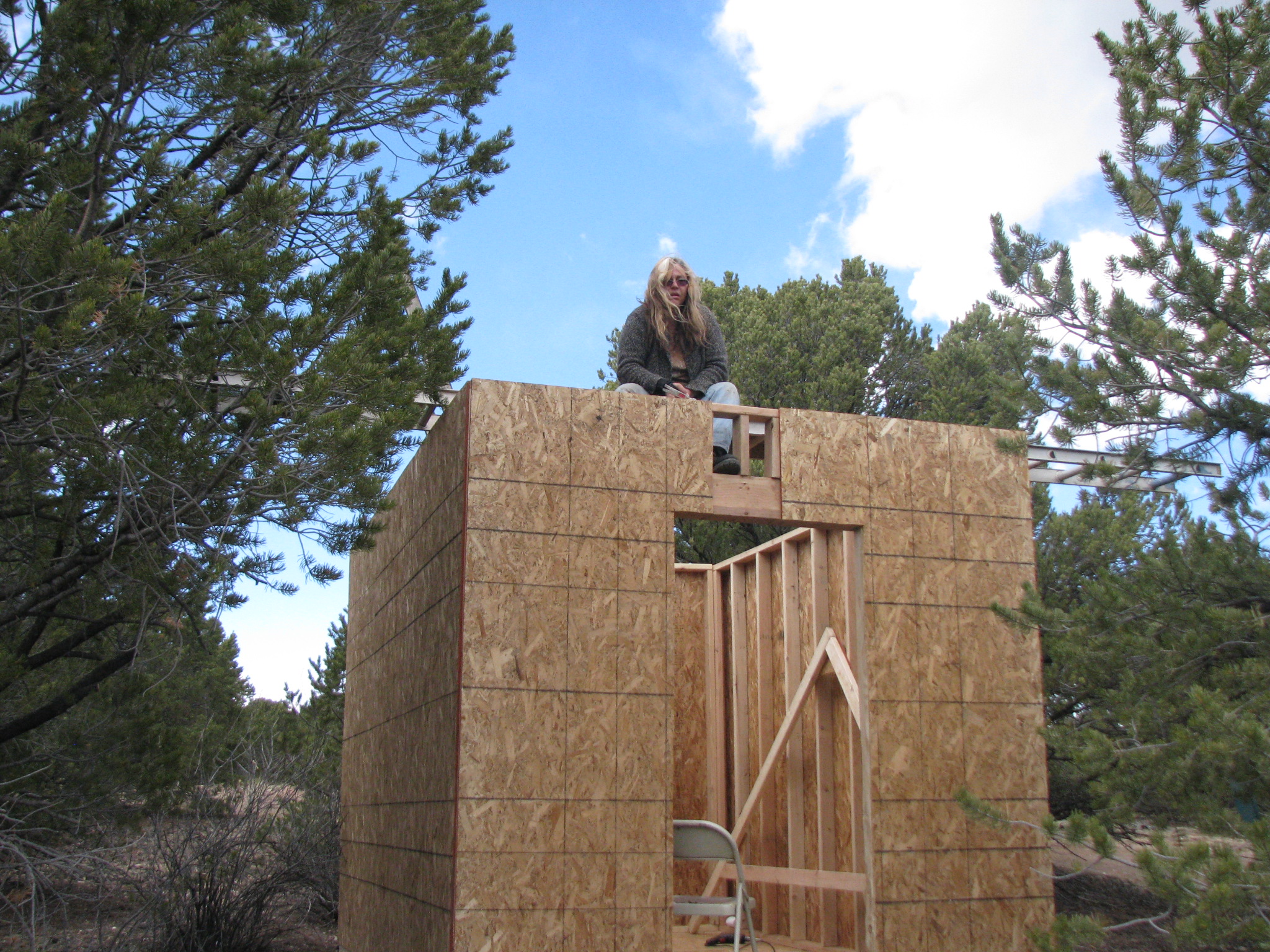 My husband asked me to help him build a storage shed and I agreed to the task. How hard could it be, right? Except that I am not a carpenter, and I was committing time away from my writing. Well, that’s not true either. I’m never very far from my writing. I’m always thinking about my writing in my head, even when I’m physically occupied with other tasks. So, although I was out hammering nails, my thoughts kept straying to how building this shed related to the YA mystery I am working on for my Genres II class.
The good solid twang you hear when you hit the nail head on reminds me of the feeling I get when I find an element the story is missing and added it in, knowing I’ve nailed it, (pun intended). But more often, I don’t get that direct hit, the story elements shooting off pell-mell into the forest, like the nails that I miss, or curling up like the nails that hit knots and won’t be driven forward, and I have to keep going at it from different angles until I am able to drive it home.
The story is sort of along the tradition of the Nancy Drew mysteries, with two young girls, growing up in the 1940’s as the protagonists. The story is three-quarters of the way finished, but I keep second guessing myself on what it is lacking. As I begin to pound nails into a new wall, I notice that I am starting on one side, with the intent to work my way to the other, yet I begin halfway up from the bottom corner. I wonder why I chose to start where I did, and it occurs to me just how many different places there are to begin on this wall, just as there is in my story. There is no hard and fast rule that a story has to start at the beginning, just as there’s no law that says you must start nailing a wall from the top right hand corner. With the wall, where I begin won’t really make a lot of difference in the end, but with my story it might. I toy with the idea of changing the point where I begin the story until I’m abruptly brought back to the here and now by the throbbing in my thumb after I missed the nail and hit it with the hammer. All these thought about writing are very distracting, which isn’t necessarily a good thing.
I’m afraid of heights. It’s a fear I’ve been dealing with for the past thirty years. I believe the official term is acrophobia, from the Greek words that combine “summit”, “edge” or “peak” and the word meaning “fear”. Merriam Webster’s Dictionary defines it as an “abnormal dread of being in a high place”, although I’m not sure I would define it as abnormal. I like to think of it as a healthy fear of potentially dangerous situations. That being said, I am a firm believer in meeting my fears head on and overcoming them. I have forced myself to face this one on many occasions, yet it still keeps rearing its ugly head to challenge me.
When I agreed to help with this project, I knew that at some point I would be required to climb a ladder to help with the roof, but we weren’t to that point yet, so his request that I climb up and slid across the ladder he had positioned across the top, extending from one side of the building to the other to nail in a small board caught me by surprise. I had gone for four solid hours and was tired when I started out this morning, and I couldn’t muster the energy to fight off my fear. Instead something inside my brain just mentally snapped.
“Oh, no. Oh, no,no,no,” I said even as I picked up my hammer and nails and began to climb the ladder with tears streaming down my face.
“What? Just climb up there and pound in a couple of nails. What’s so hard about that?” my husband asked, absorbed in whatever he was working on and not really paying attention to my reaction.
“I’m going,” I said.
There must have been something in my voice that made him look up and take notice. “Are you crying?” he asked. “Really?” He was puzzled by my reaction because I usually just buckle down and do what needs doing in situations like this, without making a big deal of it.
I swung my legs over the vertical ladder and slid my butt across it. “No, I’m fine,” I said, hammering in two nails as quickly as I could. When I turned to slide back the way I had come, my body didn’t move. I was temporarily frozen. I’d had this happen before when I climbed out under a large cement bridge that spanned the Colorado River to get pictures of my party of rafters, so I knew eventually my body would respond to my minds commands to move, once I got control of my fear, but knowing that made the experience no less terrifying for the moment.
“Wait, I’ll get a picture of you up there,” my husband offered.
“No!” I said.
“It’s okay,” he replied. “You look good up there. Just stop crying a minute and look up at the camera.”
Having my picture taken was the last thing I wanted at that moment, but as I was stuck for the moment, there was nothing to do about it. So, I wiped the tears from my face and resolved myself to the fact that I would have a photo to capture the moment. My eyes remained glued to the top of the front wall however, because every time I tried to look down at him with the camera, I felt my fear rise once more.
“Oh, you decided to come down,” he said, as I finally emerged from the opening that would be the door. He had gone about his business, allowing me time to gather my courage and get myself down from above. “I thought maybe you were going to make a nest up there.”
Now, with my feet firmly planted on the ground, his statement made me realize what a great opportunity I had missed because of my dumb fear and it made me angry. There I was, sitting with a bird’s eye view of the forest around me and I hadn’t taken advantage of it. I’d been too scared to even notice.
That’s when I realized that I’ve been doing the same thing with my memoir. Writing the story of my son’s death and my own grief is a difficult task. There are many issues that the memories stir that I’m not sure I’m ready to deal with. I’ve been putting off doing the research for several sections for this very reason, because I didn’t want to rehash the pain that interviewing the people who knew my son would inevitably produce. My instructor at Western State, Barb Chepaitis, has emphasized that eventually I must face these memories in order to portray the story honestly, and I suddenly realized how right she is. By putting off the necessary interviews because I fear the pain they will bring, I’m depriving myself of the full picture, just as I deprived myself of that high altitude view that would have allowed me to see the world a little differently. Eventually, I’m going to have to do them to present an honest portrayal of the story I need to tell, and by putting it off, I risk losing track of the key players. It’s already been four years since my son died. His friends have all gone on with their lives. They aren’t just hanging around waiting to be interviewed by me.
That night, I got on the computer and sent messages to several of the people who knew Mike, asking for their assistance. Already, I’m going to have to track down some that I no longer know how to contact. Once I have this part of the research done, I still won’t have a finished book, any more than pounding in those two nails produced a finished shed, but it will bring me one step closer to having all the material I will need to do the job.
Share this:

It’s Not About Speed
Posted: March 2, 2013 Filed under: Writing | Tags: Writing, writing advice, Writing Process 7 CommentsI’ve heard a good average for writers is one book a year. For some of us aspiring writers, that seems like a break-neck pace. Then there are those that whip out a novel in a month’s time for NaNoWriMo each year, and there’s a girl in my class who participated in a 365 stories project where she wrote a story a day for a year. Many of us may not write that fast though. I’ve done NaNoWriMo twice unsuccessfully. Those who do finish may have something that resembles a novel, but it’s far from a polished manuscript. It’s good to be able to write fast if you’re writing to deadline or if you want to make a living as a novelist, producing one or more books per year. But the fact of the matter is, it’s not how fast you write that is important, as much as it is that what you write is good, quality writing.
What is important, my instructors at Western State will tell you, is that you find a writing speed that is comfortable for you, that allows you to produce quality writing and set your own pace. I’ve heard it suggested that if you write three hundred words a day, which probably adds up to a couple of hours on slow days, you can complete a novel in a year, and supposedly, that’s a reasonable pace. That’s probably true, and it at least shows dedication, but some writers may find that even meeting that three hundred word per day mark is difficult at times. I know for me, if I have what I want to write, firmly planted in my head before I start, I can write a lot faster than that. But, if I start out with only a vague idea that I’m not sure how I want to express it, those three hundred words may come agonizingly slow, like pulling cactus needles from my derriere after not choosing my seat carefully on a long mountain hike.
I wrote the first draft of my first novel, Delilah, in six months, which I’m told is pretty good. I wrote between 600 and 1,000 words a day on the days I actively wrote. But honestly, I didn’t write on Delilah every single day of that six months. Many days I just worked out stuff in my head, figuring out what I wanted to write and how I would write it. It was a pace that worked for me. I didn’t feel I was pushing it too hard I sand I still produced some quality writing. I still have a lot of work to do on the rewrites, but it feels good to know I have a good solid base that can withstand some minor alterations or even major reconstruction if necessary.
Writers are human beings, and just as each and every one of us are unique individuals with different strengths and weaknesses, every writer has their own speed at which they write. Can someone else write a first draft faster than I did? Yes, my instructor, Barb Chepaitis, wrote a novel in a weekend. It probably took her longer to regain her sanity afterwards, than it did to write the story, but it is possible. She did it to see if she could. It’s not her normal writing speed, but she does write much faster than I do. Other writers struggle to get a first draft done in a year.
On the first day of class last summer, Barb asked us if we knew how many words we could write in an hour. Being beginning MFA students, most of us did not. She said it was important that we know how fast we write, but she didn’t say it was important that we write fast. Finding that comfortable rhythm where the story flows out without being forced is what produces good quality writing. It doesn’t matter if you only put down two hundred words a day, as long as they are good words. It’s not about speed. The story will always get told in its own time. It’s our job to our job as writers to make sure it’s told well.
Share this:

Posted: January 26, 2013 Filed under: Uncategorized Leave a comment
Kaye Lynne Booth on Scholars and Rogues. Nice. 🙂 Hope you’ll all check it out.
Share this:

A Closer Look at My Own Writing Process
Posted: January 6, 2013 Filed under: Fiction, Writing | Tags: Delilah, Fiction, Writing, Writing Process Leave a comment Since I’ve been seeking my MFA through Western State University, my posts here have been dwindling. On top of my school work, I’ve been writing a western novel and I’m close to having it completed, but this also has put a strain the limits of my writing time, not to mention several curveballs that life has thrown at me recently. However, I’m learning some really neat things about my own writing process that can be shared here, so perhaps my readers will forgive me for slacking off a bit.
In my Craft & Practice I class, my instructor, Barbara Chepaitis, guided us in analyzing our own writing process and taught us about the different types of writing processes. This is a subject I’d never thought much about before. While some writing processes are very structured, with outlines and plot lines and story arcs, others are more organic, just letting the words flow to the page, and still others are somewhere in between. While I’ve done outlines for my nonfiction writing process, I’ve tended to be more organic in my fiction writing process. I just sit down and start writing and see what comes about.
That’s what I did with the western novel I’ve been diligently working on. Delilah started as a character driven story, when I was assigned to do a western excerpt for my class this summer. I created the character of Delilah for the excerpt and it built itself one scene at a time as the character showed me what happened next. It’s been a fun journey since trouble seems to have a way of finding Delilah, but as I neared the finish line, I needed to make sure that my plot and all of my sub-plots wrapped up neatly. I didn’t want to inadvertently leave any loose ends. So, I found it necessary to plot it out and take a look at my story arcs, one for the plot and one for each sub-plot, to make sure they all had a beginning, a middle and an end, and see how they interrelated with each other.
In doing this, I was surprised to see how many different story arcs my story actually has. After drawing out the main plotline, I drew a story arc in a different color for each of my different sub-plots and ended up with eight different story arcs, including the main arc. Every motivation or relationship that Delilah has, creates a different sub-plot with a story arc of its own. Like a good stew, where each separate ingredient mixes its own flavor into the pot to create that delicious stew taste, each separate story arc adds to the flavor of my story. Below is a picture of what I came out with.
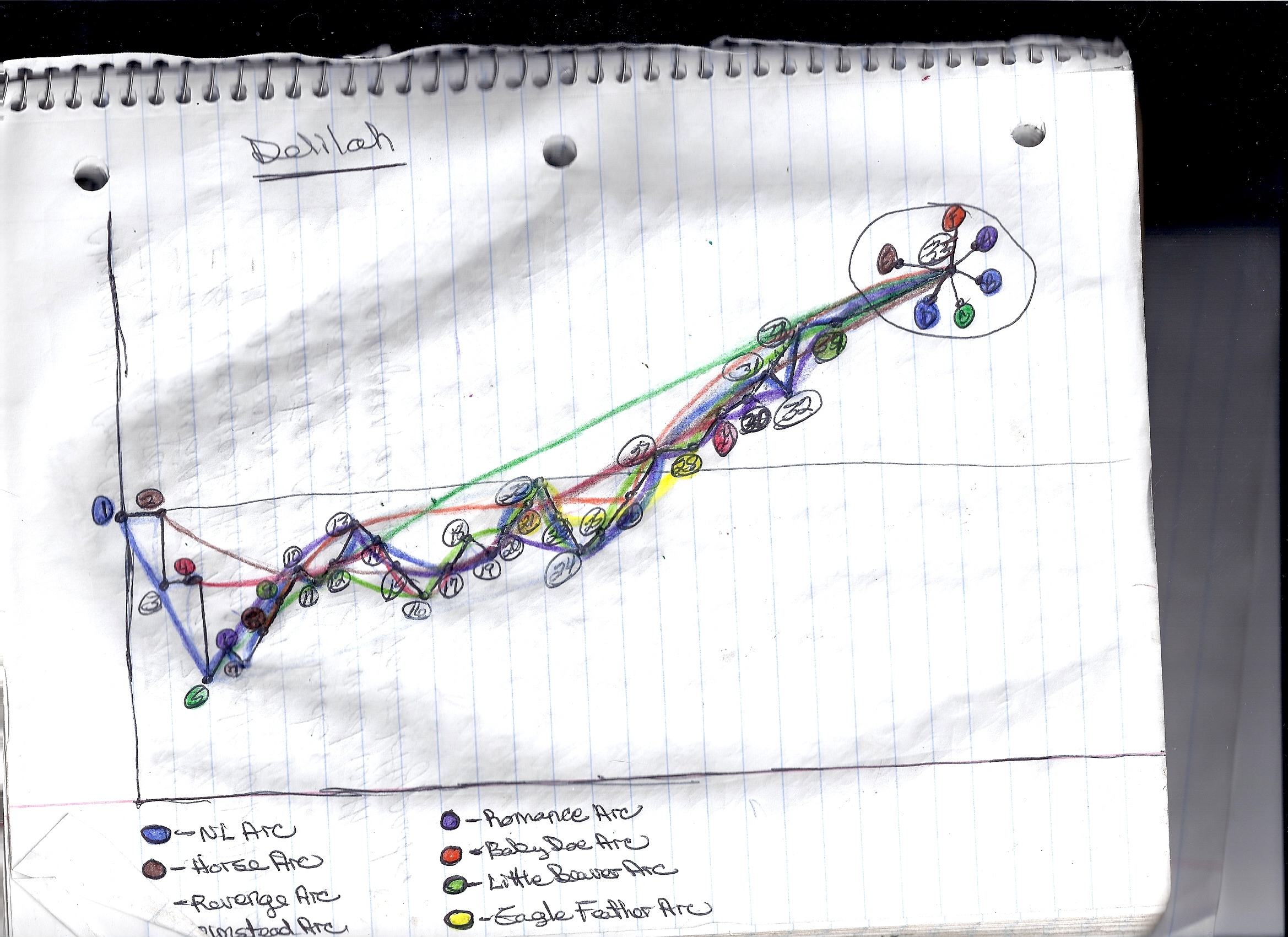
This enabled me to see where things were missing and envision how it will all come together in the end. It has required me to revise some parts of my story, but I can see the value in doing this. The different colors represent the individual story arcs and the colored circles represent the plot points where each one begins and ends. The main story arc includes every plot point, while the sub-plots start at different plot points, further into the story and some end before the main story ends, while at least five of them are tied in together and conclude at the end, along with the main plot. This is what I think a good story should do, so I am pleased with the results. Now that I have discovered how it all ends, all that’s left to do is to write it.
My instructor, Barb did not try to tell us that one process was better than another and she encouraged us to explore different processes to see what worked for us and what didn’t. I’ve discovered that my process needs to be both structured and organic. I’ve never tried the structured approach to fiction before, so with my next novel, which is an action/adventure story, I’ve started with the plotting. In fact, I already have the main plot line of the major events drawn out. Although this story is based on a character, Betty Lou Dutton, that I created and used for two scenes in Barb’s class, this approach will be a basic reversal of my usual process. As I write, I may find that more story arcs need to be added, although I already know there will be at least four sub-plots, it will be interesting to see how well this turns out. Wish me luck.
Share this:

Keeping My New Year’s Resolutions
Posted: January 2, 2013 Filed under: Writing 2 Comments It’s time to bring in 2013. It’s that time of year when we all avow to make improvements in our lives, so we make a lot of resolutions that will probably be forgotten by the end of February. One reason that this happens is because we make resolutions that we really don’t want to keep. We resolve to stick to a diet and lose a certain number of pounds. How much fun is that? Or we resolve to work harder and earn that promotion at work. I know I always look forward to putting in more hours, don’t you? Many times resolutions involve giving up the things that we love, but we know are bad for us, like smoking or drinking. These are all good changes to make in our lives, but how many of us really want to let go of our vices. It’s no wonder they are given up and forgotten about so soon.
I usually don’t make resolutions just for that reason, but this year, I’ve decided to make resolutions to do things that I really want to do. They all involve doing what I love to do, so seeing them through will be a pleasure. So, here are New Year’s resolutions for 2013 that I think I can keep:
• Find a writing or copy editing job that pays enough steady money to allow me to support my family, pay off our debts and finish our mountain home
• Sell at least one novel by the end of the year
• See Heather Hummingbird published, even though the publication was delayed from the original release date of last October
• Sell at least two children’s books by the end of the year
(You can help me reach my goals by contacting me if you know of a paying writing/editing job that might be a good fit for me.)
Share this:

“Chasing the Trickster” can be rather tricky
Posted: November 20, 2012 Filed under: Book Review, Full Moon Bites | Tags: April Grey, Book Review, Chasing the Trickster, Full Moon Bites 1 Comment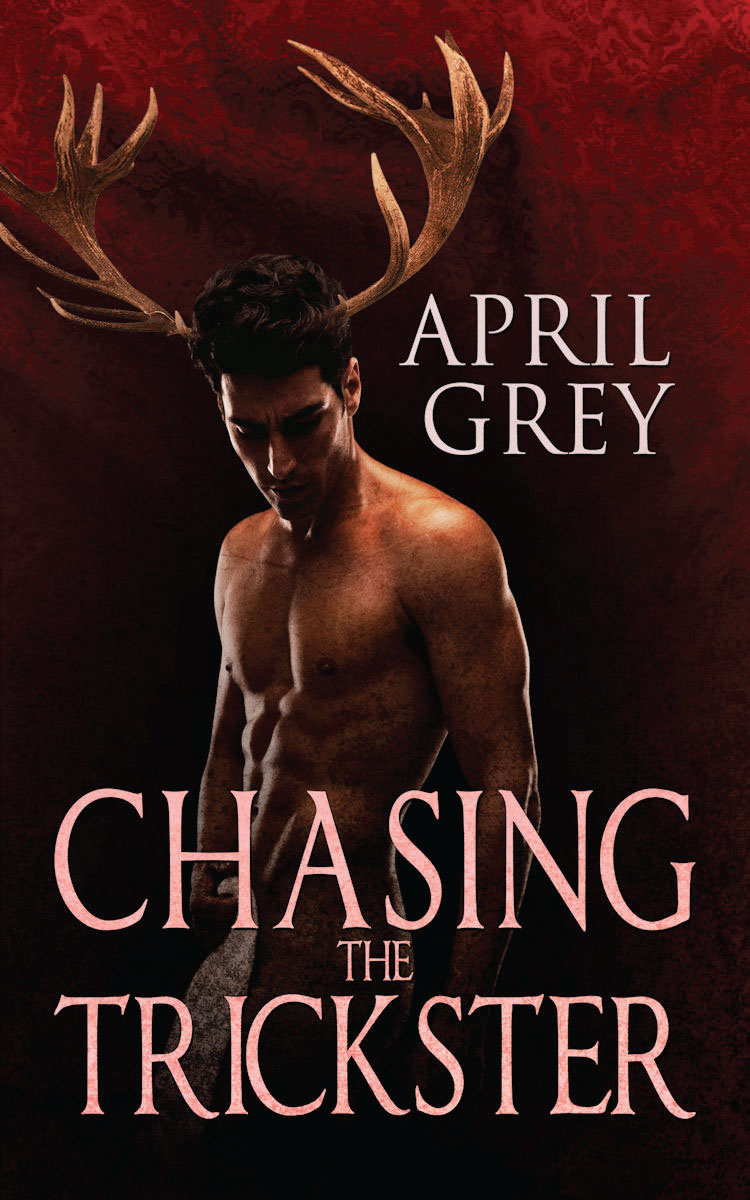 In April Grey’s Chasing the Trickster, nothing is as it seems. This book brings old world Celtic archetypes into a modern day world with surprising and sometimes confusing results. Two women are one, and one man is actually two, or at least one man and a fertility god. The more that is explained the less that makes sense as the story switches back and forth from past to present until the two finally intertwine to knit together all the pieces of two stories into the one that they were all along. But, that doesn’t end it, because the end is a new beginning and we have to go back to the beginning to understand the end.
Although alternating perspective from first to third person is a bit disconcerting, Grey’s main characters are larger than life and her supporting characters are interesting and colorful. Nina, a gifted photographer whose spirit visions show up in her photographs; Pascal, who shares his physical body with an ancient fertility god; Linda, who has lost everything that is dear to her – they are all chasing the Trickster without knowing it, and the chase won’t end until he catches them. Through Grey’s clearly drawn settings the chase takes readers on a journey from the city streets of New York, New York to the arid deserts of Santa Fe, New Mexico. The Trickster is mischievous and doesn’t care who gets hurt carrying out his will. Is it possible for each of them to find a happy ending at the end of the chase? Only when past and present meet will the answers be discovered.