“Simplified Writing 101” Makes Academic Writing Seem… Simple
Posted: July 8, 2016 Filed under: Book Review, Books, Nonfiction, Writing | Tags: Book Review, Erin Brown Conroy, Simplified Writing, Writing 2 Comments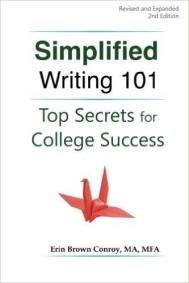
The guidelines set forth in Simplified Writing 101: Top Secrets for College Success, by Erin Brown Conroy, pave the way to good academic writing that will improve grades on college assignments. This book is not your usual writing tutorial. Most academic writing tutorials are dry and boring, just laying out the “rules” as law, and making readers struggle to get through the material. Brown Conroy’s relaxed writing style sets readers at ease, perhaps allowing for better retention of the information. It’s like an old friend or respected cohort sharing bits of wisdom, imparting knowledge in easy to understand language that won’t put readers off.
Simplified Writing 101 contains writing advice that can be expanded beyond Academia. Section 1 covers word choice. The list of words to avoid to make your writing clear and concise in the first three chapters aren’t just for academic writing, where one wants to sound professional, or at least knowledgeable. This list contains words that are vague or unnecessary, or that turn the readers off, pushing them away, causing them to reject the message without giving it a fair chance. It is based on sound writing principles, which can be equally applied to copywriting, where the aim is to persuade, or literary writing, where the goal is to enchant and entertain. They could even be applied to screenwriting, where, as in poetry, every word counts. Also in this section is a chapter on properly citing sources, making word choices and mastering a higher vocabulary found in well-written academic papers.
Section 2 covers structure and form, offering a closer look at well-crafted sentences. The chapters in this section cover fragments, run-on sentences, how to create rhythm by varying sentence length, and active vs. passive writing.
It also discusses the rhythm of your words and suggests that they should sing on the page. She uses an analogy with sports for those who are not musically inclined to ensure her point is understood, (using clear and concise writing, of course). Although I am not musical, nor am I a boxer, I easily understood the concept of varying sentence length and why it should be practiced. When Brown Conroy writes about active vs. passive writing, her suggestions are not limited to Academia. Active writing can be used in all types of writing to grab and hold readers’ attention.
Section 3 covers paragraphs. After learning how to create the building blocks, sentences, we’re ready to move on to the core foundation of your paper. The chapters in this section cover how to make your sentences work for you, how to keep your paragraphs focused, linear writing, how to lead your reader with well-structured sentences, how to achieve closure for each paragraph, and finishes up with connectives, transitions and connectors.
No tutorial on writing would be complete without instruction in punctuation, so that is what we find in Sections 4 and 5. Simplified Writing 101 gives the subject thorough coverage, including when and when not to use a comma, punctuating compound sentences and lists, misuse of exclamation points, how many spaces following end punctuation, use of quotations, how to use punctuation to control pacing in your writing, hyphens, en-dashes and em-dashes, semi-colons, and colons. A whole chapter is devoted to an inside look at how professors go about grading papers and the little mistakes, such as grammar and punctuation, which add up to a loss of points and bring down grades.
Grammar is found in Section 6, noting words that must go together, writing in the proper tense and correct person, and contractions. It also talks about commonly misused or mistaken words, and sticky pairs, or pairs of words that must be found together and using words that indicate tense. And Section 7 covers how to narrow your topic, creating your research question, create an outline, using your thesis statement into a blueprint for your paper. This section also includes a four step process to creating a first draft, found in Chapter 36 with multiple methods for planning, how to draft efficiently, revise for the best word arrangement, and edit for basic errors and mechanics.
Logically, Simplified Writing 101 provides sections on revision and completing the final product, to help students know what to do once that first draft is complete. In Section 8, Brown Conroy explores writing with style, the basics of good writing, and how to answer readers’ questions before they can ask them. Section 9 covers the creation of the final draft, including ways to avoid procrastination, doing as many rewrites as it takes, what to check and rewrite in academic papers, finding an editor or getting feedback, assignment submissions and email communications in Academia, and making professional connections.
A valuable reference, Simplified Writing 101 provides lists of different types of words, such as common connectives or conjunctive adverbs, and separates them into groups, depending on which type of writing they are appropriate for: academic use, mid-range academic use, or non-academic use. Each list is also separated into what job each group of words does, or what purpose they serve. There is also a list of common mistakes, the little things that drop down points and lower grades: use of brackets; dates; times; quotations and double quotations; use of slashes; proper capitalization; and rules of abbreviation, and a list of rules for writing numbers. These lists are nice because they provide an easy-to-use reference, in case memory fails us, which it is certain to do sometime during all of our writing careers, so they may come in very handy.
Simplified Writing 101 is the writing tutorial I wish I’d had as an undergraduate. As it was, I struggled through English classes, not really understanding, but Brown Conroy makes writing guidelines and rules crystal clear, and it all seems so simple. Use it as an introductory writing guide or keep it as a reference, but this tutorial is a must have for your personal library. It will see you through your academic career and beyond.
I give Simplified Writing 101 an A+, er, I mean, five quills. 
Simplified Writing 101: Secrets for College Success can be purchased in both hard copy and ebook.
Kaye Lynne Booth does honest book reviews on Writing to be Read, and she never charges for them. Have a book you’d like reviewed? Contact Kaye at kayebooth(at)yahoo(dot)com.
Share this:

Weekly Writing Memo: Inciting your Story
Posted: July 6, 2016 Filed under: Uncategorized Leave a comment The inciting incident is the event in the story that causes the main conflict of your story to happen. Choosing the incident that starts your story is important because it is the foundation for all events that happen from that moment on. If you don’t write the inciting incident correctly, your story may not work or make sense. To know if your incident is working, ask yourself these questions:
Is it big enough?
The inciting incident has to be something big enough that it changes things for your character. It may seem small when it happens, but the event has to create a cascade of events for the rest of the story. Basically, the inciting incident is starting an avalanche, so it has to be powerful enough to get things moving.
An example of this which most people will know is in Lord of the Rings. The inciting incident for the trilogy can go all the way back to Bilbo Baggins finding the ring, or it could be considered to be when Bilbo leaves the ring to Frodo. It seems inconsequential, but it’s a major thing because of what the ring really is. Basically, because the ring is not just any ring, it’s THE ring, it’s a huge event that leads to the endless conflicts throughout the rest of the series.
Is it small enough?
While it’s important that the inciting incident is big enough that it can cause a huge series of events that will fill a story, it doesn’t need to be so big that it feels like the climax of the story. There are some stories that have huge inciting incidents, but the inciting incident should never be so big that it overshadows the rest of the story. There has to be somewhere for the story to build to. In most cases, the inciting incident is something small, that could almost seem inconsequential to the reader and the protagonist, but it has much bigger implications.
Returning to the Lord of the Rings example, when Bilbo leaves Frodo the ring it seems like such a small unimportant thing. It’s just a ring! But there is foreshadowing with the way characters interact with it that shows there could be something more about it.
Is it realistic?
Whatever your inciting incident is, it has to be something that is believable for your story. Being realistic and believable is, of course, subjective, but what matters is that it fits YOUR story. If the inciting incident doesn’t fit your world and your characters, it will feel like the author is forcing the story to go in the direction they want it to go; it’ll make the story feel unnatural.
If you worry about making something realistic, just remember that anything can be believable in a story if set up right. Sticking with the Lord of the Rings example, Bilbo finding the ring could be considered unbelievable, except that the ring is set up to have a sort of will of its own that makes people do things. This sets it up for every character who possesses the ring, or who is even in the same vicinity of it, to act in certain ways that can help move the plot forward. It works because it was set up that way from the beginning.
Does it matter?
The final thing to consider for your inciting incident, is whether it matters. If the inciting incident is something that changes nothing for your character, or the plot, then it is not really an inciting incident at all. As mentioned in the previous sections, it has to be something that is big enough to lead to future events. Beyond that, though, it has to be something that impacts the protagonist in a way that is significant enough to force them to act in some way. This is the incident that propels your protagonist to make some decision or change that leads them on the journey of the story. If the inciting incident isn’t something that does that, then it doesn’t matter to the story or the character and isn’t an inciting incident.
In Lord of the Rings, when Bilbo gives the ring to Frodo it matters immensely to Bilbo. He doesn’t want to give it up, and almost doesn’t. Frodo knows how much this ring means to Bilbo, so it matters greatly to Frodo when he is given it. He knows it’s something special, even if he doesn’t know what.
Final notes:
Whatever your inciting incident is for your story, as long as it fulfills the requirements above it should be a successful event to get your story started. The thing that matters most is that your event fits your story, and that it can be the first domino in a chain that causes future conflicts. Your entire story hinges on that first incident, so make sure it is solid before you get started writing or your entire story could falter.
Robin Conley offers great writing advice most Wednesdays on Writing to be Read. If you just can’t wait until next week to find out more, you can pop into her blog, Author the World, for more tips, or a weekly writing prompt.
Share this:

Weekly Writing Memo: Building a Story
Posted: June 29, 2016 Filed under: Fiction, Screenwriting, Stories, Uncategorized, Weekly Writing Memo, Writing, Writing Tips | Tags: Creative Fiction, Fiction, Writing, writing advice, Writing Process Leave a comment Stories are essentially a million little pieces intertwined in such a way that they relay a picture from the writer’s head into the mind of the reader. Specifically, every scene, and every story, is made up of a series of arcs (character arcs, plot arcs, genre arcs, etc) that combine to tell the story on various levels. In order for the arcs to work, they have to be carefully constructed and woven together so that they support each other and so the story forms a cohesive whole.
One of the most important parts of building a story is the construction. Each of the various arcs within the story have to start and end at the correct place, and have to be balanced with the other elements. If any arc or element is out of place, the entire story can falter or fail completely. There are dozens or more elements and arcs within a story to consider, but the main arcs I’m going to focus on are character, plot, and genre. These three are generally the core of every story, and if they’re right, the other elements are more likely to be right.
Character
The general rule in any story is that every character has to have an arc of their own, not just in the story as a whole, but in every single scene of the story. At the start of every scene, each character present should have two or more goals. The first goal is their overarching goal, and the second is their immediate goal. For example, in a scene where a man wants to get his daughter an ice cream, his first goal could be a larger goal that carries on throughout the story of trying to make his daughter happy, while his second goal is one that is the focus of the scene such as simply trying to buy an ice cream cone.
These goals are what drive each scene forward, and are what drive the character’s every action. A goal can change in the middle of the scene, but no matter what a character has to have a goal. The character arcs in every scene are generally caused by how they succeed or fail at achieving their goal. In the ice cream example, the character’s arc could be something like:
On the scene level: the character starts out hopeful that he will be able to buy the ice cream, he hits a peak in line when he is about to achieve his goal, but then when he gets to the front and finds out that they are out of the ice cream his daughter wants his hope disappears and he is in a much worse position than he started.
On the story level, this would be a minor arc in his larger development. This would be the arc where the father goes from trying to find his daughter’s happiness in material things to maybe looking deeper to find something more that can truly make her happy. The scene won’t resolve the problem, but it would be the first step of the father solving the problem and help him head toward the path where he will find the solution.
As shown above, by looking at and understanding the goals you can find the character’s arc of emotional and mental development in every scene, and in the story as a whole.
Plot
Each goal itself should be a part of the plot, and should have some form of arc as well. Some goals, like the larger story goals, will be made up of a bunch of mini-arcs, while the minor goals will just have a minor arc of their own. The goals make up the plot because they are what drive the action and create conflict within the story. They’re what the character wants and is constantly stopped from getting one way or another.
For each goal, there should be an arc of how it develops and changes throughout each scene and the story. Goals in general will be made up of some mix of the basic format of: conception of goal, plan to achieve the goal, enacting the plan, and failure or success. The outcome either leads to a new goal, or a new plan to achieve the new goal. Each arc of the plot can lead to new plots and goals depending on whether the character is successful or not, and whether the success/failure of the goal leads to new problems or new goals.
For example, in the ice cream story, the dad doesn’t get the ice cream so it leads to a new goal and new problem for the plot. He either has to find somewhere else to get the ice cream his daughter desperately wants, or he has to find a new way to make her happy.
Genre
Many people don’t consider that there are genre arcs within stories, but in there are almost always some form of genre arcs that happen in genre stories. For example, most romance stories involve some form of meeting of the potential couple, a period of interactions between the couple culminating in some form of acknowledgement of feelings, the breaking point where they are thrown apart, and then the reunion. This varies, of course, depending on the different types of romance stories, but being aware of the genre arc and knowing how to use them can help you create a certain flow within your story that readers find natural. It can also help you make sure your plots are working well for the genre you are using.
Even if you don’t go with a typical genre arc for your story, you should consider how the genre evolves throughout your story. For example, in horror there should be a general increase in the horror as the story develops, culminating in the final climactic moment toward the end of your story. If you don’t have an arc of the horror elements as well as the character and plot elements, then the horror part of your story could fall flat. So always consider the genre you are writing in, and think of how that influences your plot and character.
Whatever you are writing, there are many levels of story you are telling and each element should really have an arc of its own, even if it’s a minor one. Some arcs may not be super important or even that interesting, but it’s how they fit in with the other larger and more important elements that matter. Each element should be supporting the larger story as a whole. If you find a part of your story that isn’t doing its part to support the story, remove it. You’re building something where every part needs to do its job, so make every element count.
Robin Conley offers great writing advice most Wednesdays on Writing to be Read. If you just can’t wait until next week to find out more, you can pop into her blog, Author the World, for more tips, or a weekly writing prompt.
Share this:

Acceptance or Rejection – Which do You Prefer?
Posted: June 27, 2016 Filed under: Commentary, Fiction, Opinion, Promotion, Publishing, Western, Writing | Tags: Acceptance, Creative Fiction, Fiction, Flash Fiction, I Had to Do It, Kaye Lynne Booth, Rejection, Western, Writing 1 Comment
 Back in May, I wrote a post about dealing with the rejection by a publisher of Delilah. My response to the rejection was to submit my novel elsewhere and keep hoping it will get picked up. More recently, I did a post on hybrid publishers, as I explored the concept after I had a hybrid publisher request my full manuscript. Unfortunately, they passed on Delilah, too. It is out to yet another publisher now.
I could go into another post about rejections. Lord knows, I’ve gotten plenty. But I’ve always been one to see the glass half-full side, rather than half-empty, focusing on the positive side to everything, so I think I’d rather talk today about acceptances. I don’t think anyone will disagree when I say acceptances are much better than rejections. You don’t have to be a writer to figure that one out.
You don’t get them as often as rejections, but they’re a lot more satisfying. But there’s a reason I want to write a post on acceptances. If you follow me on Facebook, or Twitter, or Google+, you may have seen my very recent post announcing that my flash fiction western story, I Had to Do It, has been picked up by Zetetic: A Record of Unusual Inquiry.
It’s true this isn’t a big paying publication. I’m certainly not going to get rich from this one little 850 word story. Flash fiction never pays a lot. There’s simply not enough words to make the pennies add up to much, even with higher paying publications. But, I was still elated when I received the acceptance, because my story found a home and people will now read it, and because it is still one more publishing credit for me. I can’t explain the rushing feeling of excitement and pride that small note from the editors brought me. I think most of all, it was thrilling to know that someone else really liked my writing. It was a affirmation of my own belief that my writing really is pretty good.
That probably sounds silly to those who have not yet received an acceptance. (Never fear. It will come.) But we writers are an odd lot, and we are filled with fears and self-doubt. Filled with it. Most of the time we can keep these elements of our inner beings at bay by simply pecking away at the keyboard or filling up sheets of notebook paper, but every once in a while we let our guards down and that’s when they strike. The fear and self-doubt simmer in us, just down below the surface, until they see an opportunity, a weakness, and then they reach up and grab a handful of us and don’t let go.
I think just about every writer worries that the only person in the whole world that really thinks their writing is good is themselves. Friends and family don’t count because they may be saying they like it so as not to hurt your feelings. When you receive an acceptance, any acceptance, it tells you other people do like your writing, and motivates you to get busy writing more.
It’s a good feeling. One I think every writer needs to experience. It can’t happen unless you submit relentlessly and write, write, write. That’s my advice. Write your heart out and then submit like crazy, and never, ever give up. The notes that say, “yes”, make it worth surviving all the ones that said, “no”. So what are you waiting for? Get writing!
Like this post? Subscribe to Writing to be Read for e-mail notifications whenever new content is posted.
Share this:

Chronology is full of surprises
Posted: June 24, 2016 Filed under: Book Review, Books, Fantasy, Fiction, Horror, Science Fiction, Speculative Fiction, Steampunk, Stories | Tags: Anthology, Book Review, Books, Creative Fiction, Fantasy, Fiction, horror, Review, Speculative Fiction, Steampunk, Writing 3 Comments
I’ve just had the pleasure of reviewing a new anthology of short fiction put out by Curiosity Quills Press. When asked if I’d like to review Chronology, I had the impression that it was a steampunk anthology, which is a genre I’m newly discovering. Some of the stories in this collection do have steampunk elements, such as Wind Up Hearts, the steampunk-ish romance that is sure to break readers’ hearts, by Bram Stoker Award finalist, Stan Swanson, or Flight of the Pegasus by Dr. Darin Kennedy. There’s also That Which is Hidden, a haunted steampunk-ish werewolf romance, by Julie Frost. But, I was pleasantly surprised to find the stories in Chronology to be a diverse mixture of speculative fiction.
Some are futuristic, leaning more toward science fiction, such as the apocalyptic Afterparty by Mark Woodring, Limited Liability, a futuristic outer space story by Matthew Graybosch or Gookie Visits Her Moma by G. Miki Hayden, an alternate universe science fiction story about a space bounty hunter whose current bounty takes her back to her home planet. Many others are more in the fantasy realm, such as Draconic King, by award winning author, James Wymore, or Yours Until the Ink Dries, a true faerie tale, as a young outcast girl discovers her true identity in her drawings, by Y.A. author Jordan Elizabeth. And then there are those stories that fall into the mythical realm, such as Strange Flesh, a well-crafted story of mythical creatures by Katie Young, or Wampus Cat, a tale of Appalachian legends come true by international bestselling author Scott Nicholson.
Still, others have a horror element or two, such as The Lair, a story of a cursed treasure hunt in jungle swamps, by best-selling independent author, Tony Healey, or Lava, a spectral love story by New York Times bestselling author, Piers Anthony, or In the Clutches of the Mummy Prince, by B.C. Johnson, which was not very scary. Also I had trouble relating with the main character in Johnson’s story, who wasn’t very likeable. There is also The Comeback, the weirdest zombie romance I’ve ever heard of, told from the zombie’s POV, by techno-thriller and MG fantasy author, Tara Tyler, and Inmate #85298, a chilling death row tale, by author and screenwriter, Andy Rausch.
Of course, there are also those stories that weren’t so easy to classify, including White Chapel, which sheds new light on the story of Jack the Ripper, by author, editor and podcast co-host, Andrew Buckley, or Signs Unseen, the story of a small town race war, by J.P. Moyahan, or Bait and Witch, a troublesome witch story by speculative fiction author, J.P. Sloan. There is also The Bull, by novelist and short story writer, J.R. Rain, which turns a Minotaur into a superhero, and The Unattended Life, a reminder to stop and smell the roses by J.E. Anckorn, and an intriguing airship romance, Above the Clouds, by Richard Roberts.
Yes, it is a big book, about 530 pages, but it is definitely a good read. In addition to the stories mentioned above there are the three I enjoyed the most, which I saved to tell you about in more detail. The following stories stuck out in my mind the most, but not in any particular order.
The Room Below, by novelist Wilbert Stanton is a horror story worthy of Lovecraft, or King. This story about a stay in a mental institution that puts One Flew Over the Cuckoo’s Nest to shame. It held my attention and kept me on the edge of my seat, and had a surprising, yet satisfying ending.
The Colorado King, by Nathan Yocum is a story in which survival is the name of the game as a father and daughter travel over post-apocalyptic badlands in search of kin and refuge, bringing with it some very hard lessons. This well-crafted tale grabs readers’ attention and doesn’t let go, yet it leaves readers feeling like there should be more, probably due to the fact that it is an excerpt. I’m guessing that it is from Yocum’s novel, The Zona.
And finally, Innocent Deception, by Matthew Cox is a well-crafted story which has a surprising reveal in its final pages. The daughter of a pharmaceutical company’s CEO is kidnapped and held for ransom, but the plan falls apart when the mother doesn’t want the kid back.
Overall, I give Chronology 3 Quills. 
Kaye Lynne Booth does honest book reviews on Writing to be Read, and she never charges for them. Have a book you’d like reviewed? Contact Kaye at kayebooth(at)yahoo(dot)com.
Share this:

Weekly Writing Memo: Where’s the Story?
Posted: June 22, 2016 Filed under: Uncategorized Leave a comment As I’ve touched on in previous posts both here and on Author the World, the setting you choose for your story can be pivotal to your story’s success. The setting of a story can have just as much impact on character and plot as an antagonist could, so it’s incredibly important to think carefully about where you set your story. The three biggest ways the setting can influence the story is through tone, character, and plot.
Tone
The tone of your story can help tell your audience how to interpret everything that happens. If your narrator has a flippant tone to how they tell the story, it can tell audiences not to take things too seriously. If the narrator has a serious, dark voice, it can tell audiences that the story will be dark. The setting is a major part of declaring the tone. Think of any story, movie or book, whichever comes to mind. Where is it set? What if you set it somewhere completely opposite? How would the story change?
A great example of this is the TV show Burn Notice. I heard somewhere that the original script had the show set in a city like Chicago (I can’t remember if this is the right city, but at the very least, it was similar to Chicago in tone). Imagine how that setting would change the story compared to where it actually was set, Miami. First off, visually it would be very different. Instead of the bright sunshine and beautiful beaches, you’d get the cold concrete and grayer tones that Chicago has to offer. Instead of brightly dressed citizens in sundresses and bikinis and laid-back suits, you’d get city folk bundled up against strong winds and even snow now and then.
The story taking place in such a bright sunshiny place creates a contrast between the serious spy drama with the laid-back atmosphere. It makes things more humorous, and allows the story to have some brightness in what is really a dark story if you think about it. If the story was set in Chicago as originally planned, then not only would the drama be more serious because the setting would be more serious, but the overall appearance of the show would be more serious.
Character
Setting is not only important for tone, but for character as well. If your character is a hardened detective in a small town, he’s going to be out of place and his tactics might not work. Of course, if that’s the point then that is a perfect set-up. If you want your detective to fit in, though, then you might reconsider where you place him. The setting has to highlight something about your character. Does it show how perfectly your character can navigate their world, or does it show how out of place they are? Whatever it is, make sure you’ve thought it through.
The other thing to consider is how the setting helps create your character into who they are. If this is a setting that your character has lived in for a while, then it will have an impact on their personality and past. If this is a setting they are new to, then remember to show how the setting your character has come from contrasts to the setting they are in now.
Plot
One of the final things to consider when choosing a setting is the plot. How does the setting you choose affect the plot? If you are writing a big spy thriller but you set it in a small town, it’s going to be hard to have the kind of espionage needed to really make a spy thriller succeed unless that small town has some sort of national secret to it. Similarly, if you’re looking for a big chase scenes with lots of chaos and people, you’re going to be hard pressed to find the right setting for it in a small town setting.
When choosing where to set your story ask yourself a few questions. What kind of people does this setting allow my protagonist to interact with? What kind of conflicts are inherent to this setting? What kinds of locations does this setting provide for me to work with? These three questions are all vital things to consider when choosing a location, so make sure to consider them carefully.
Final Notes
Ultimately, wherever you set your story will influence every other part of your story. If you’re ever doubting a choice, or if you want to check if your choice is a good one, try asking yourself what your story will look like if you set it in the complete opposite location. If your story doesn’t work at all in this location, then your original location is probably best. If the opposite location does work, then compare the two and see which one works better overall. Sometimes there will be more than one optimal setting for a story, but the important thing is that you’ve considered your options, and that you’ve chosen your setting carefully and with deliberate purpose.
Robin Conley offers great writing advice most Wednesdays on Writing to be Read. If you just can’t wait until next week to find out more, you can pop into her blog, Author the World, for more tips, or a weekly writing prompt.
Share this:

Writing Horror is Scary Business
Posted: June 20, 2016 Filed under: Uncategorized 1 Comment
For my summer semester, which will complete my additional screenwriting emphasis for my M.F.A. in Creative Writing, it was left up to me to decide what project I would like to work on, either feature film or television series. Since it is my final semester and I’ve already written both, it’s kind of a “whatever you want to do next” scenario. I’ve written a spec television script, for The Odd Couple, created an original television series, Unhappily Ever After, and written the pilot episode for it, as well as written two full features, one action, Across the Border, and one bio-pic, Bonnie. I’ve tried my hand at writing comedy with the television scripts, and I’ve delved into a couple of different genres in film. Now, I want to try my hand at horror. I’ve loved horror films since I was a kid. This summer, I want to write a monster in the house that will keep viewers awake until the wee hours of the morning.
If you’re writing a comedy, you write jokes and hope somebody laughs at them. But, how does one write scary? I think it is as much of a challenge as trying to make people laugh. The movie was pretty lame, but if you’ve read the book, The Blair Witch Project, you know that the story is actually pretty scary. When I read it, it left me with an eerie feeling that brought it back to the forefront of my thoughts for several days after. They had a good story, but they didn’t do it justice on the screen. That’s when I started thinking about how I might write a screenplay that would leave viewers with that same eerie feeling.

Robin Conley, who shares writing tips here, in her “Weekly Writing Memo”, did a three post series on writing horror on her own blog, Author the World. In her first post, The 3 Acts of Horror Stories, she talks about introducing the monster, increasing the threat, and the final face-off. No matter what kind of horror story you are writing, there must be some kind of monster, even if it’s the human kind, or the spectral kind. The bigger and meaner and scarier the monster is, the greater the threat for the characters. I definitely want a monster that will keep the tension ratcheted up and keep viewers on the edge of their seats.
In his book, Save the Cat Goes to the Movies, Blake Snyder points out that our monsters must be “evil” and the more that is at stake for our characters the scarier the monster must be. He suggests, “This is also why the tiny spiders in Arachnophobia, or the ones that can be dispatched with a baseball bat in Signs or die of the sniffles in War of the Worlds, are so unsatisfying.”1 And, I must admit, he’ got a point. Although I have always had a fear of spiders, in Arachnophobia it’s hard to be too worried about the characters, because this is a monster which can be easily escaped. The characters could get up and leave, or just step on the damn spiders, or buy a can of Raid™, for heaven’s sake.

I will definitely make my monster bigger than a spider. My monster will be of the supernatural, other worldly type, because they leave more to the imagination. Supernatural monsters can appear in many different forms, so you have open possibilities for making them really scary.
In her second post on writing horror, 4 Elements of Horror, Robin talks about how setting, senses, contrast, and imagination are important elements in horror, making your scarier by increasing tension and creating anticipation. It’s easy to see how the setting affects tone and sets expectations. A graveyard is definitely a scarier setting than a botanical garden. Although you could make a botanical garden scary by placing scary stuff within, a graveyard comes scary and you don’t have to anything to create a scary atmosphere and tone.
Blake Synder says, “the more cramped the space – the more isolated our heroes – the better.”2 That’s what the term he coined for this type of movie, Monster in the House, is all about. The characters must be trapped with the monster in some defined space, be it a house, or an island, or an isolated cabin in the woods. In The Shining, it’s a secluded hotel. In Cabin in the Woods, it’s, you guessed it, a cabin in the woods. In The Texas Chainsaw Massacre, it’s an area surrounding the house and extends to include the whole town. Going back to the example of Arachnophobia, if the characters can just get up and walk away from the monster, there isn’t much of a challenge.

One of the scariest movies to me, when I was young, was Legend of Hill House, and later there was Amityville Horror and Rose Red. To me these were even scarier than the slasher movies, like Halloween or Scream. Since my monster is of the supernatural kind, it seems only natural that my setting would be a haunted house. In haunted house movies, the setting becomes a character, in fact it becomes your antagonist. It’s not easy to battle against a house, or a ghost in a house for that matter.
Robin also mentions using the senses to create tension. Screenwriting is a visual medium, and certainly characters can see things which are scary, but you can also use other senses to your advantage. It’s not hard to see how scary sounds could be worked in to your story, but there are also ways to work in the other senses, and is a good trick if you can pull it off. Obviously, you cannot make the audience smell the scent of freshly dug earth, but you can have a character comment on the odor and, thus clue the viewers into the fact that such a smell is present. Ditto with the sense of touch. If you are clever, there are ways to do this.
This will come in handy for me, because spectral monsters may not always be visible, but their presence can often be detected by a smell or odor that accompanies them. If you’ve ever walked through a room and detected the faint odor of perfume or pipe tobacco for just a moment, and then it was gone, you’ll know what I’m talking about. It’s as if someone just walked through the room, but when no one did, it’s kind of creepy. Feelings, such as chills or cold spots in a room are also known to often accompany specters.
Robin talks about balancing the horror elements, presentation and the stakes, in her third post, 3 More Elements of Horror. Not only do you need to have all the elements Robin mentions in her posts in a horror story, but you need to present them in a way that will give the audience the urge to hide their eyes, yet be unable to resist peeking through their fingers because even though it’s scary, they need to see what happens.
This is accomplished, I think, by having the right combination of horror elements and lulls in the storm, and by starting out small and building the tension and increasing the stakes in increments. At first, your characters may not take the threat seriously, but as more and more things happen and the severity of each event increases methodically, it forces them to eventually admit that something is amiss. You can even throw in some false alarms in the beginning to make it feel like there’s danger before there really is, but be cautious with this one. You want to build tension, but too many disappointments may cause viewers to lose interest before the real fun begins.

In her first post, Robin talks about having a death in the first act, perhaps as a catalyst to send your hero on his journey into the second act, where his normal life will be turned upside-down. She mentions that you want to do this in screenplays where the monster is of the serial killer kind and the threat needs to be established right up front, but I feel this puts the writer at a disadvantage, because there’s no bigger threat to build up to. Maybe this is an advantage of the supernatural monsters. There are so many little things you can do to build up tension and increase the threat little by little.
Blake Snyder also says that there must be some kind of sin, committed by at least one of the characters, which brings the monster down upon them. In a lot of horror movies, it is greed, a lust for money, which prompts them to go where they don’t belong or awakens the monster. In Friday the 13th, it is sex. The councilors were off doing the wild thing when Jason drowned, and the new councilors’ presence arouse his mother’s anger just by being at the camp. In Witchboard, the characters play around with the Ouija board and summon the monster, and in Nightmare on Elm Street, the kids get to pay for the sins of their parents. I plan to fall back on the good old dependable sins, greed and ambition, for my screenplay.
I don’t think you need a lot of blood and violence for a movie to be scary. I believe that if I play on the primal fears of my viewers, I can make a movie so scary, they’ll be wetting their pants. But I guess I won’t know until I write the darn thing, so I’d better get to work, and we’ll see if I can succeed in my goal to make a good old fashioned scary movie for modern times.
- Save the Cat Goes to the Movies. Synder, Blake. McNaughton & Gunn, Inc. 2007. p. 3
2. Save the Cat Goes to the Movies. Synder, Blake. McNaughton & Gunn, Inc. 2007. p. 3
Like this post? Subscribe to Writing to be Read for e-mail notifications whenever new content is posted.
Share this:

Batman V. Superman: Dawn of Exposition
Posted: June 17, 2016 Filed under: Uncategorized Leave a commentI know at this point a lot has been said about the movie Batman vs. Superman: Dawn of Justice, but as a writer I thought it might be interesting to look at some of the story issues I felt were a problem within the film. The three largest issues in the film, in my opinion, was the exposition, the protagonist/antagonist confusion, and the some of the transitions.
I shouldn’t really have to say this, but SPOILERS BELOW…
Exposition
This movie had an uphill battle as far as trimming exposition from the very start because there was a lot that needed to be set-up. They had to set up Batman’s new past, his vendetta against Superman, Superman’s hero worship in the public, Lex Luthor’s role in the world, Wonder Woman’s presence, and a ton of other minor elements as well. Almost all of these really big elements deserved a proper set up because they are major story parts that will potentially carry over into future stories, however, setting them up in one movie led to a very long build up in the film before the action started. The long exposition and set up in the film makes the story drag and hard to stay involved, no matter how many interesting elements there are.
Protagonist/Antagonist Confusion
Many stories have multiple protagonists without there being any sort of problem, but in this story the protagonists, and antagonists for that matter, are warring for the focus. Batman is originally set up as the protagonist of the film, with Superman as his antagonist. Then it switches to Superman as the protagonist with Batman as his antagonist. That wouldn’t be such a problem, except there is a bigger antagonist in the film – Lex Luthor.
So much focus is on Batman and Superman being at odds, that Lex Luthor’s plot line is shafted somewhat and pushed until later in the film. There are elements early on, of course, but the Lex Luthor plot feels week because he gets so little attention. He is also painted as the minor threat in a lot of ways, because both of the protagonists don’t even see him as a threat until very late in the film. If Lex’s plotline had been worked into the story a bit earlier, so his plan was clearer earlier (at least to the audience) then I think it would have helped balance out the conflicting antagonists. Audiences know who Lex is, most likely, so they know he’s the villain, but if he had been more involved in the feud between Batman and Superman, instead of just an opportunist about it, then it would have helped strengthened his plotline.
Transitions
The jumps back and forth between Batman and Superman’s plotlines were some of the main rough transitions in the film, however the ones where Bruce is getting a vision of some sort are the ones that really don’t work for me. Things transition into these visions and then it throws the viewer off balance as they try to figure out what is going on. It’s only clear once we come out that we’re in a vision or dream of some sort, but even then it’s not really explained. If you know some of the comic lore then you might understand what is happening, but without it there isn’t enough to set up the visions to explain why they’re happening, or what they mean. Which is really a shame.
Overall, the film is not a terrible one. There are a lot of great moments, and acting, and I’m excited to see what future films come from this. If the exposition had been more balanced and condensed in the beginning, and if Lex Luthor’s role had been better intertwined, I really think I would have loved this one. As it stands, though, I think it’s one I won’t watch again until I’m feeling like a Superhero marathon.
Share this:

Weekly Writing Memo: Going Through the Motions
Posted: June 15, 2016 Filed under: Fiction, Screenwriting, Uncategorized, Weekly Writing Memo, Writing, Writing Tips | Tags: Creative Fiction, creative process, Writing, writing advice, Writing Process 1 Comment Lately I’ve been coming across a lot of writing where the emotional connection has been lacking. If your audience isn’t invested or connecting with your story somehow, they will not want to stick around to finish it. There are a lot of ways your writing could lack an emotional connection, but the main one I find is when your characters or your plot aren’t ringing true to the audience. When it feels like the characters are just going through the motions of the story, rather than really living and breathing the story, then it starts to feel false. So how do you keep it feeling realistic so your audience is emotionally invested?
Actions and Words
One of the most important elements in a story to help it feel realistic is that your characters dialogue and their actions match up. To do this, make sure your character is behaving in a way that goes with their attitude and dialogue. If your character is angry, and is yelling, don’t have their body language be weak and cowering. If your character is shy and afraid, don’t have them adopting a dominant posture. These things are minor touches in your writing, but if your characters’ words aren’t backed up by their actions and body language, then their words won’t ring true and will make the audience feel as if something is off, even if they can’t put into words what exactly it is.
The exception, of course, is if the character is someone who says one thing and does another, or if your character is purposely behaving in a contradictory way because of anxiety, fear, or ulterior motives. In those cases, you still have to be consistent with that character and continue that behavior throughout the story. If they act irrationally when they’re afraid, then show the audience that and make them behave that way every time. If they are a perpetual liar, or manipulator, then again show that and make sure the audience understands the contradictions.
Sincerity
The second element that helps make your audience emotionally connect is to feel like your characters are behaving sincerely. I don’t mean they have to be telling the truth all the time or behaving kindly, they just have to be behaving true to who they (the characters) are. If a character isn’t behaving the way they would in reality, then the audience will pick up on that and feel like they’re being lied to and not connect with the story.
This comes down to one thing – you want your characters to be people, not actors. If it feels like they’re actors pretending to be someone, then it will create an unnecessary barrier between the story and your audience. You want your characters to always be themselves, and to behave in accordance to how they would naturally behave unless there is a significant reason for them not to.
Others
A lot of people think that the only characters the above stuff matters for is for the main characters, and maybe the secondary or even tertiary characters, but it’s more than that. Every single character in your story matters, and every single character should have a motive for their behavior that they drives their behavior. Without this, minor characters in stories will feel like placeholders and even disrupt the story.
If you have a ton of minor characters who just pass through the story without distinguishing them by giving them their motivations, it’ll be like placing a color photo on all gray background. While that can be pretty and help make the main photo pop, it’ll make the background uninteresting.
In a story, this kind of thing makes the story as a whole suffer because your character is living in this world, and if the world is boring and uninteresting, or unrealistic, then it’ll start to affect the main character. If you give your minor characters one thing, give them a motivation for being in the scene and every action they take. As long as they are clearly motivated, and stick true to these motivations, they’ll help give the scene more purpose and make the story more dynamic, which means it’ll be easier for your audience to get invested.











The new “Point Break” fails to raise adrenaline levels
Posted: July 2, 2016 | Author: kayelynnebooth | Filed under: Commentary, Film Review, Writing | Tags: Film Review, Point Break, Review, Writing | Leave a commentI just watched the new Point Break, the one that came out last year, and I am sad to say, I was very disappointed. Maybe on the big screen, the special effects were impressive, but on video, they are obvious computer imaging. In the original, 1991 movie, when they jumped out of the plane and were free falling through the sky, viewers could feel the adrenaline rush, and when they were riding the waves, we almost felt wet. The graphics on the 2015 movie aren’t even convincing, and viewers don’t feel that same excitement when they swooped through a mountain canyon in wing-suits. A lot of it just didn’t look real, so there was no reason for the adrenaline to flow.
Perhaps if the title were changed, and the characters in the 2015 movie didn’t have the same names as the characters in the original 1991 Point Break, it could be judged upon its own merit. But as it stands, they’ve set the new movie up to be compared to the original, which I feel is a big mistake. The original movie was an action movie, in which an FBI agent infiltrates a group of surfers who are bank robbers, and it was fun to watch. The 2015 version has a completely different tone than the original movie, being more of an international crime suspense thriller with a lot of extreme sports thrown in.
The transition to the international plot did not work well. The Johnny Utah character, played by Luke Bracey, I conveniently involved in extreme sports, before becoming an FBI agent, so he doesn’t waste time learning to walk the walk in order to infiltrate the culture. He’s already a member of the club. They all know him. Then, just as conveniently, maybe even more so, he figures out where to look for the bad guys, goes straight there and the first group he encounters are the guys he’s looking for, and the Brohdi character, played by Edgar Ramirez, more convenient still, saves him from drowning after a surfing incident. Too many coincidences for me to buy in. Sorry.
And let me add here, though I’m reviewing this film based on the merit of the screenplay and story, that Bracey is no Keanu Reeves and Ramirez is no Patrick Swayze. In the original movie, it was clear early on that our bad guys were thrill seekers, adrenaline junkies, and viewers understood where they were coming from, what their motivation to take so many risks and live so dangerously was. I did not get that sense about these guys. And I didn’t really get a sense of how bad they were. The creators failed to create a villain I could love to hate.
(SPOILER ALERT – There may be spoilers from this point on.)
Patrick Swayze’s Bohdi character was such a villain. You knew he was a bad guy and he had to go down, but you could understand why Utah agrees to let him go out his own way, at the end, after winning their struggle in the water. Ramirez’s Bohdi is not. I didn’t get what made him tick, or what his motivations were. At the end of the 2015 movie, when Utah lets Bohdi go, I didn’t get it. There’s no struggle, no fight. Utah doesn’t even try and talk Bohdi out of it. Bohdi says, “You’ve got to let me go”, and Utah says, “Okay.” Maybe I don’t get it, because empathy with these characters is something I never felt through the whole movie. There was just no connection.
Also, the villains in the original Point Break were bank robbers, financing their surfing tour with their spoils. The villains it the 2015 movie appeared as modern day Robin Hoods, robbing from the rich and giving away all the spoils. It’s difficult to see them as bad guys because they have a cause.
The one interesting twist I felt the 2015 movie had was the girl, Samsara, who we at first believe is a love interest, but later we are surprised to learn she’s a part of the crew, after Utah shoots and kills her in the kiss of death moment. Of course, in the original, the girl is a love interest and the bad guys use her as leverage to get Johnny Utah’s cooperation, so I was expecting something similar here. I liked that twist, where there was not much else to be liked about this movie. As I mentioned above, I think this movie might have done alright as a standalone, but it doesn’t measure up to the original movie. I was not impressed with the recent Point Break movie, and I can only give it two quills.
Kaye Lynne Booth does honest book reviews on Writing to be Read, and she never charges for them. Have a book you’d like reviewed? Contact Kaye at kayebooth(at)yahoo(dot)com.
Share this: