“Old One Eye Pete”: A western short fiction collection
Posted: March 6, 2020 Filed under: Book Review, Books, Fiction, Historical Fiction, Western | Tags: Book Review, Loretta Miles Tollefson, Old One Eye Pete, Western, Writing to be Read 3 Comments
Old One Eye Pete, by Loretta Miles Tollefson is a western short story collection, with individual stories that fit together loosely to form a part of a bigger story that takes place within the Old New Mexico territory. As always, Tollefson’s tales are based on historical events, people and places and are historically accurate, featuring interesting and memorable characters.
Most of these stories feature Old One Eye Pete, an old trapper who wanders the New Mexico mountains with his horse and pack mule, and knows more about the people, the area and the goings on there than near anyone in the territory. These stories are brief, and great reads when you just have a short wait or a few minutes to kill.
A light, easy read that made me chuckle from time to time. True western short fiction. I give Old One Eye Pete four quills.

Amazon Buy Link: https://www.amazon.com/Old-One-Eye-Pete-Stories-ebook/dp/B07H1R1L5B/ref=sr_1_1?keywords=Old+one+eye+Pete&qid=1583605164&s=books&sr=1-1
Kaye Lynne Booth does honest book reviews on Writing to be Read in exchange for ARCs. Have a book you’d like reviewed? Contact Kaye at kayebooth(at)yahoo(dot)com.
Share this:

Riding the Landscape of Westerns in March
Posted: March 2, 2020 Filed under: Books, Fiction, Historical Fiction, weird western, Western, western romance, Writing to be Read | Tags: classic western, weird western, Western, western romance, Writing to be Read Leave a comment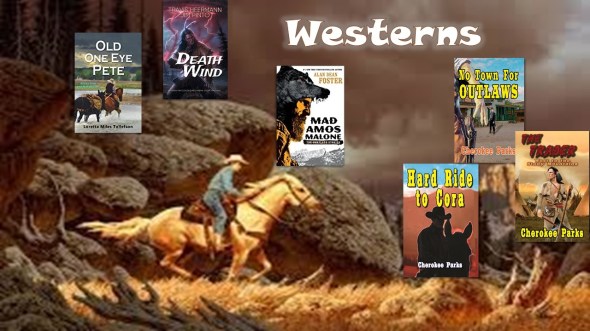
The western genre has always been about man against the elements, man against man, and man against nature. Western heroes are tough and rugged, and ready to face outlaws, Indians, wild animals, and any inclement of bad weather to uphold right and see justice done. In the western genre that I grew up with the good guys wore white hats and the bad guys wore black, and there was no question as to who was who. Cowboys were rough and rowdy, but they were gentleman when a lady was present, tipping their hats and addressing her as Ma’am. There was a clear sense of right and wrong in westerns written by Louis L’Amore and Zane Grey, and right always won out in the end.
Today’s westerns are different. Although you can still find the classic western with authors such as my “Chatting with the Pros” author guest, Cherokee Parks, or the guest for my supporting interview, Alan Dean Foster. But, the western of today isn’t as clear cut. Today’s westerns look past lawmen and outlaws to the less known factions of western society, with protagonists such as soiled doves, Indians, Negroes, and immigrants from many different countries, who may be looked down upon by some as less desirable, so they must work harder to convince the reader that they are the good guy. They portray segments of the western populations which have been previously overlooked or devalued. Although members of near invisible populations, they were a part of the western culture and western fiction is now giving them voice. The tales may be fiction, but the portrayal of life in the western landscape is not romanticized as much as it once may have been. It may be more stark and brutal in many ways, but they are true to the places and times of their settings.
In the western genre market, there are more female authors than ever before, and that means more female protagonists. A woman as main character can’t be a delicate flower who cowers behind her man as in westerns of old. The women of the west were tough, because they had to be. It was often a matter of survival. Even in western romance, the women are strong willed and determined, and they play many different roles on the western frontier. We all know that many women made a living in the parlor houses, bordellos, and saloons, but women played many other roles on the western frontier, and today’s western authors are capitalizing on that.
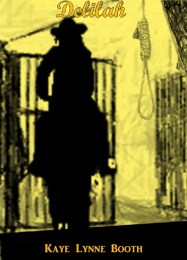 My own western, Delilah, features a tough and gritty female protagonist who, at the age of nineteen, is already hardened against life’s trials. Although not actually a romance, it does have that romance element, but she must learn to love again before that story line can come to completion. Delilah is being re-released this month with a great new cover, (designed by WordCrafter), and new front materials, including forewords by western authors Robert Hanlon and C. Emerson Law. I’m looking for feedback, so please let me know what you think of the new cover in the comments.
The historical westerns of Loretta Miles Tollefson, such as her short fiction collection, Old One Eye Pete, which I’ll be reviewing, are embedded in New Mexico territory in the 1800s. Many of Tollefson’s books feature tough female protagonists who do what they must to survive the harsh landscape and harsher men of the times, who rise above the traditional female role through strength and courage. I think an author must work harder to sell to women characters in non-traditional roles to the reader, but if written well, they make interesting and, often colorful characters that enhance their stories. readers don’t want to put down. Western romance is in abundance. At the end of March, Writing to be Read will feature a special post about my experience as a judge of the western romance category, including reviews of some of my favorite entries.
But in contemporary times, space westerns venture into the science fiction genre, and there are even western fantasy stories, such as the steampunk western romance series of Jordan Elizabeth. Westerns have branched out to combine with the paranormal, creating the weird western sub-genre, such as Death Wind, by Travis Heerman and Jim Pinto, which I will be reviewing this month. This sub-genre is growing in popularity as authors realize the potential for supernatural tales from the old west. The western frontier leaves behind many ghosts and contemporary authors are realizing their story potential.
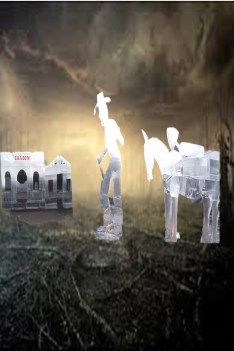 Paranormal western is the genre for the 2020 WordCrafter Short Fiction Contest, but there have only been a few entries. I think maybe authors shy away from the western genre, especially those outside the U.S. that are not so familiar with the history of the American frontier. But the American frontier is not the only possible setting for a western story. Think Quiggly Down Under, for a western story set in the Australian Outback. Every country has western style stories in their history. As long as there is a western element and a paranormal element of some type in your story, it qualifies as an entry. It can be about zombies rambling over the western prairie, on vampires nesting in the Rockies. It can be a haunted hotel or saloon in a frontier town, or a restless spirit that refuses to pass on until the hombre that pulled the trigger on them pays for what he done. If you are a creative writer, then step up and take the challenge to write a paranormal western and send it to me. The deadline is April 30th, so there’s still plenty of time. Don’t forget, the author of the winning story will receive a $25 Amazon gift card. You can find the complete submission guidelines here.
Join us on Writing to be Read as we ride the landscape of the western genre and explore the possibilities. The western genre is alive and well today, although it may look different than expected. I love to hear from readers, so be sure to leave a comment to let me know you’ve visited. Also feel free to like and share.
Reviews of westerns by Loretta Miles Tollefson:
Reviews of steampunk western romances by Jordan Elizabeth:
Reviews of weird westerns:
Hell’s Butcher series, by Chris Barili
Chance Damnation, by DeAnna Knippling
2019 interviews with western authors:
Scott Harris – classic western
Juliette Douglas – western romance
Patricia PacJac Carroll – Christian western romance
Loretta Miles Tollefson – historical western
Like this post? Let me know in the comments. You can be sure not to miss any of Writing to be Read’s great content by subscribe to e-mail or following on WordPress. If you found this content helpful or entertaining, please share.
Share this:

Interview with erotic romance author Jade C. Jamison
Posted: February 24, 2020 Filed under: Adult, Author Profile, Books, Erotic Romance, Erotica, Fiction, Interview, romance, Writing, Writing Tips | Tags: Author Interview, Bullet, Erotic Romance, Erotica, Heat, Jade C. Jamison, Tangled Web, Writing to be Read 4 Comments
My author guest today makes her living writing erotic romance under a pen name, and prefers to display the cover of her bestselling novel, Bullet, the first book in her Rock Star Romance series, (see my review of Bullet), rather than an author photo in order to conceal her real identity. (When you like at it that way, authors can be kind of like superheroes, taking assumed identities. You’ve gotta admit that’s pretty cool.) We may not know who she is behind the book cover, but we do know that she’s written over fifty books to date, and when perusing them, one is sure to find one that’s just the preferred temperature, because she writes in them all, from sweet romance to sizzling hot erotica. Please welcome erotic romance author Jade C. Jamison.
Kaye: Why do you write erotic contemporary romance? Would you ever consider writing any other genre? If so, which one?
Jade: It took me forever to puzzle out exactly what genre I wrote.Back in 2013, the term “erotic romance” seemed to most capture what I wrote, but the “E” word is now becoming taboo.(I’m smiling as I write this.)Nowadays, the genre is being called “steamy contemporary romance,” although that may change yet again. But, anyway, I digress. Not only would I consider writing in other genres, I have. Within romance, I’ve written everything from romantic comedy to romantic suspense. Outside romance, I’ve written horror and nonfiction, but under another name, I’ve penned mystery, news writing, instructional pieces, academic literature, and even poetry.
Kaye: Does erotic romance come naturally to you? Why does it appeal to you to write in this genre?
Jade: I don’t know that writing romance comes naturally to me. Ten-plus years ago, I found that, no matter what I wrote, some aspect of romance became part of the story. So even though I have a tale to tell and even though the relationship is the key element in the story, making sure I have all the facets that make a romance satisfying to avid readers of the genre is not always easy, and it’s definitely not organic.
Why it appeals to me? I haven’t a clue. I’m sure a psychologist would have a heyday with me.
Kaye: What is the most difficult part of writing erotic romance for you? What part is the most fun?
Jade: Sex scenes are, by far, the hardest. They easily become the most tedious part as a reader as well. From some of my conversations with other authors, I don’t believe I’m alone. You want to keep things fresh, so to speak, and non-repetitive while at the same time you want to keep readers emotionally engaged. It’s easy to mess that up in those sorts of scenes—so I put a lot of pressure on myself to write scenes that are emotional and engaging.
The most fun part is when a character surprises me. I think I know where the story is going and then BAM! She does something completely unexpected, but I know it’s working and there’s no way I’ll change it.
Kaye: Which of your stories is your favorite? Why?
Jade: Sorry if you’ve heard this from me before, but asking me to choose a favorite story is like asking me to choose a favorite child.That said, I do have some stories that I don’t like as well as others, but my lips are sealed. Some of the stories I like the least are reader favorites.
Kaye: Your sex scenes range in temperature from steamy, to sizzling, to blazing hot. What determines how hot the scenes get in each story?


Jade: Part of it depends on the story itself. In my bestselling book Bullet the sex scenes got hotter as the story moved on. That was one of the ways I let the reader know the main character was maturing. It mostly depends on what I think readers will expect. Am I billing the book as super steamy (like Finger Bang), or am I emphasizing the story itself (like Savage)? But, honestly, I always thought they were all pretty close in steaminess. I guess I’m too close to the forest!
Kaye: Do you prefer to write during the day, or are your stories so hot they can only be written at night?
Jade: I actually do almost all of my writing in the early morning, from about 5:30-6:30 am. It’s the only quiet time I have and I find I’m far more creative when my brain is fresh.
Kaye: You’ve written over fifty books. What is the writing achievement are you most proud of?
Jade: I don’t know that I’ve “achieved” anything as an author, other than sharing my stories with the world.I guess, though, that I’m currently proud of my growth as an author. I’ve really taken a step back in an effort to realize that being prolific isn’t nearly as important as transporting a reader to a different world—so I’m proud of not letting my pride stop me from learning!
Kaye: What is one thing your readers would never guess about you?
Jade: I enjoy playing Pokemon Go.I used to play Pokemon games with my kids when they were little, and now they have me playing this silly game on my phone!!!
Kaye: In 2019, you released books 3 and 4 from your Matchmaker collection. They are described as Reverse Harem Romances on their covers. I can see lots of potential for steamy action there. Would you like to talk a little about this story collection?

Jade: I’d taken a couple of marketing courses the year before, compelling me to “write to market”. So, I looked through Amazon’s top 100 contemporary romance books and found that Reverse Harem Romances were dominating at the time. At first, I thought that meant a literal harem, but with a woman surrounded by men. I discovered through my research that that’s not quite what Reverse Harem is all about. I like a challenge, so I decided to go for it. One of the courses I took is by one of the bestselling indie romance authors in the history of Amazon, and she advised writing a series with cliffhanger endings at the end of each book. That was another challenge. So, that’s the nuts and bolts of the series.
The story itself is about Claire, an actress struggling to make it in Hollywood. She tries out for a reality TV show called Matchmaker, hoping that if the right people see her, they might give her a chance as an actress. If nothing else, she’s bound to meet the love of her life. Her suitors are five gorgeous men who’ve been “guaranteed” to be a perfect match, but the audience gets to determine who stays and who goes. And, yes, there’s quite a bit of steam between the covers.
Kaye: I reviewed Heat: Book 1, which was really a short prelude to a larger story that will change the way you think about getting a message forever. But there is more to the story. Would you talk about Heat: The Complete Series?

Jade: Heat was another challenge I couldn’t say no to. Several years ago, I was approached by a publishing company in Australia about republishing one of my older series, and I did that with them. While it never neared the level of success they’d promised, a year later they approached me about something new they were doing, inspired by stories James Patterson had been writing. The basic premise for the romance stories was that you write a short but intense “intro,” followed by three more books, all following a particular formula—but very hot with cliffhangers at the end of each short book. I really liked the idea, so I pitched what became Heat. Unfortunately, it didn’t perform as well as I had hoped, so I took back my rights to it after a year and republished it.
So what you read in the free first part, Heat: Book One, is the beginnings of a steamy romance between Sergio and Rachel. Rachel is actually a character from Finger Bang, and I’d been inspired to write a story about her for a long time. When I was approached by this publishing company, I thought her story might be perfect for the format they’d talked about. Because it’s shorter and steamier, there’s not as much depth to the characters, but that wasn’t the idea behind the series. It’s meant to be intense, somewhat shocking, and super steamy. Fun. No ugly crying, no heart-wrenching moments. Just pure, unadulterated fun. What you read in Heat: Book One is a prelude to the rest of the story. If you enjoyed the first part, you’ll love the complete story.
Kaye: What is next for Jade C. Jamison? What can your readers look forward to?
Jade: The biggest problem for me is I have so many things I want and need to write, and so little time. I literally have over fifty book ideas outlined, but I’m currently working on a project. It’s a series called Small Town Secrets. I’ve taken about thirteen of my books off the shelves, and I’m re-purposing them. In an effort to be an even better writer, I’m rewriting eight of those books, but they are now all interconnected in this series. My review team has read the first one (Love and Lies) and loved it. I’m hoping to release six of those books in 2020.
I also have one book left in the Nicki Sosebee series. Book 12, Wake Up, ended on a cliffhanger, and so I can’t keep my readers waiting for too long. That book is fully plotted and I promise it will be satisfying! I just need to write it. But, I also have several other series I need to finish (Feverish, Codie Snow, Tangled Web), so we’ll see what I can tackle. I would love to write a lot more this year (like I said, fifty ideas and counting!) but I have a lot on my personal plate, so it all depends on how much I can get done in the time I have. I’d cross my fingers, but I can’t type while I do that!
Kaye: (See my review of Tangled Web)
I want to thank Jade for joining me here and sharing today. It has been a real pleasure. I learned a few things about writing erotic romance and hopefully my readers did, too. This interview is the perfect way to finish up February’s erotic romance. And thank all of my readers for reading and commenting on Writing to be Read. I hope you will all saddle up and join me again next month, when we plan to wrangle up the western genre. See you here.
Like this post? Let me know in the comments. You can be sure not to miss any of Writing to be Read’s great content by subscribe to e-mail or following on WordPress. If you found this content helpful or entertaining, please share.
Share this:

“Heat: book one”: You’ll never think of message the same way again
Posted: February 21, 2020 Filed under: Adult, Book Review, Books, Erotic Romance, Erotica, Fiction, romance | Tags: Book Review, Erotic Romance, Erotica, Heat: book one, Jade C. Jamison, romance, Writing to be Read Leave a comment
Heat: book one, by Jade C. Jamison is a prequel to her Heat: The Complete Series, which can be read in a single sitting. Jamison has a talent for drawing readers in and immersing them in the character, making them almost active participants in the story, and Heat is no exception. This brief tale is an introduction, featuring one of the most sensual messages ever imagined for the reader to relax and enjoy.
In Heat, we meet Rachel Donahue, a busy investment broker who needs to unwind at least once a week. And we meet Spike, a sexy and talented male masseuse who really knows how to make a girl feel really, really good. Maybe too good. What happens when Rachel meets her new client and realizes that Sergio and Spike are one and the same, and she is going t be working very closely with him, leaves the reader wanting more. You won’t be able to resist buying Heat: The Complete Series to find out the rest of the story.
Sizzling hot erotic romance that leaves readers longing for more, I give Heat: book one five quills.

Amazon Buy Link: https://www.amazon.com/Heat-Book-Jade-C-Jamison-ebook/dp/B07JRC8TP6/ref=sr_1_1?keywords=Heat+Jamison&qid=1583605811&s=books&sr=1-1
Kaye Lynne Booth does honest book reviews on Writing to be Read in exchange for ARCs. Have a book you’d like reviewed? Contact Kaye at kayebooth(at)yahoo(dot)com.
Share this:

Chatting with the Pros: Interview with contemporary romance author Amy Cecil
Posted: February 17, 2020 Filed under: Adult, Books, Erotic Romance, Fiction, Interview, romance, Writing | Tags: Amy Cecil, Author Interview, Erotic Romance, Knights of Silence MC, Sainte, Writing to be Read 1 Comment
My author guest this month on “Chatting with the Pros” is a talented romance author of both historical and contemporary romance novels. Her Knights of Silence MC series tells the story of the sometimes violent and brutal world of motorcycle club life with characters who feel very human and vulnerable at times. The series is a tale of love and loyalty, and yes, there’s some tastefully written, but quite erotic sex scenes. (You can see my review of Sainte, the last book in the MC series.) I also had the pleasure of reviewing Ripper, which was one of the most cleverly crafted romances I’ve ever read. To turn a Jack the Ripper tale into an erotic romance takes some talent. Erotic romance author Amy Cecil did with a well crafted hand. I’m so pleased to be able to chat with her today. Please join me in welcoming her.

Kaye: Why do you write in the romance genre? Why not science fiction, or fantasy or mystery?
Amy: I initially chose romance because that is what I have always read. I do not read science fiction and doubt that I could even write in that genre. As I wrote more books, I have intertwined other genres into them such as fantasy, romantic suspense and ever mystery. So even though I started with romance, I’ve always been open to other genres that interest me.
Kaye: What is the most difficult part of writing romance for you? What is the most fun?
Amy: I would have to say the most difficult thing with romance for me is finding a relationship scenario that isn’t over saturated in the market. For all of us romance readers, we are always looking for something fresh. We want that happily ever after, but finding the angst to get to that point can be difficult.
And, the most fun part of romance for me is the banter between the couples. I love to bring snarky attitudes together and have a battle of the wits, so to speak.
Kaye: Your Knights of Silence MC series chronicles a motorcycle club over the course of several years. As you read the series you get better acquainted with each of the members, which have well developed backstories that make the whole of the story seem very real and believable. What drew you to these stories with these characters?
Amy: That’s a great question. And actually pretty funny how the series got to where it is now. When I started, my focus was on Ice and Emma, childhood sweethearts that great apart who found each other again. It was gonna be one book. When I got to about half way through the book, my PA at the time suggested that I release it, even though it has this huge cliffy. So I did, which then created book 2. That was supposed to be the end. But as I was writing these characters and their story lines grew, I realized I had more to say. Never in a million years at the beginning did I think that Honey would be such a pivotal character in the series to warrant he own book. So the draw was Ice and Emma and the continuing development came with each book released from my mind.
Kaye: You recently released the last book in the Knights of Silence MC series, Sainte. Can you talk a little about Sainte’s part of the Story? Why was he chosen for the central focus character in the final book?
Amy: When the series started to lean toward Honey, I realized that male character that I had intended for her was completely wrong for her. She needed a saint, literally to save her from herself. And while Hawk was the most beloved character in the series, he did not have the mental strength to get Honey through. And I just couldn’t let him sit around and watch her with another man. So, Hawk had to die and make room for Sainte. Sainte is a former mafia hit man who knew Ice when he was a kid. He is Emma’s cousin, which she didn’t know about. So he had a reason to stay with the MC from the beginning. When he met Honey, he realizes quickly, she is the woman for him and he decides to stay and leave the mafia world. (Not that it is all that different. LOL). Sainte brings the story full circle, bringing the club the peace it has been wanting for a long time.
Kaye: As I mention in my review of Sainte, your characters are well developed with rich, believable backstories. Where do you draw your characters? How do you create with their stories?
Amy: As noted in questions 3 and 4 above, their stories come to me as I write them. I keep referring back to Honey, but she is a perfect example. When the series started, she was nothing, but the jealous ex-girlfriend. By the time we get to the third book, her story line develops and the reader sees she is the most complex character in the whole series. She’s a recovering coke addict, struggling with her addiction every day. She wants love so bad she can taste it, but is terrified to grab the bull by the horns and take it when it’s offered to her. As the story grows, my characters grow and develop stories of their own.
Kaye: Although the series focuses on the male members, their “old ladies” play important roles as well, offering an abundance of strong, if flawed, female characters. Why do the ladies play such an important role within the framework of your stories?
Amy: Well, you know the old saying, “there is a strong woman behind every man.” I wanted my female characters to be as strong as their male counterparts. Because these women are connected to the MC, they are surrounded by violence. They have to be strong to survive. Emma comes to the MC in ICE a very naïve young woman. By the end, she gives new meaning to the term “old lady” and could definitely have a patch of her own.
Kaye: Who is your favorite MC Character and why?
Amy: At first, I would have to say Caden/ICE all the way. And don’t get me wrong, I love him because he is the heart of the MC. He’s strong and protective and the kind of guy that when he holds you in his arms you feel safe. But then, Sainte came along. Sainte is everything that Ice is, but Sainte has that snarky personality that I love. He’s not afraid to tell it like it is and if he’s hated for it, he will just smile and walk away. Yes, definitely Sainte.
Kaye: The MC world is often dangerous and violent. As a result, throughout the series several characters have had to die. Is it difficult for you to kill off your darlings? Who was the hardest for you?
Amy: Several minor or past characters have died and frankly, I didn’t even bat an eye. When the realization hit me that I had to kill Hawk, that one was difficult. He was a major player in the story line and very much loved character by my readers. And believe me, I thought of several ways to keep him, but I just couldn’t get it to work with how I wanted the story to go. So he died. It was hard, but it would have been so much harder to kill Ice or Sainte, or even one of the girls.
Kaye: You also write historical romance. Are those stories a bit tamer than you contemporary romances?
Amy: Yes, definitely. My historical romances are Jane Austen FanFic and I think the hard core Jane Austen fans would have heart attacks if I made them as steamy as my contemporary romances.
Kaye: Your erotic scenes are done tastefully and in context for the story, yet you turn up the heat just enough to make them sizzle. How do you know how far to take your sex scenes? How hot is too hot?
Amy: That’s an easy question. I think about what I like to read and go from there. I have read several books where every other page is a sex scene and that is just ridiculous. Many authors think sex is what sells your book, but I disagree. Readers want a story that they can sink their teeth into. They want to relate to their characters and that is really hard to do if they are screwing like bunnies the entire time.
I also believe that you want to leave the reader wanting for more in a particular scene. We all have an imagination and I believe that sometimes it is best to let the readers mind take over and make the sex in the book what they want.
Kaye: You are finished with the Knights of Silence. What is next for Amy Cecil? Is there a new series in the works?
Amy: Currently, I am working on a sequel to On Stranger Prides, which is a Pride and Prejudice variation titled On Familiar Prides. After that, I have a short story I wrote last year in an anthology about a WWI spy that I would like to develop into a full-length novel. As far as the Knights series goes, I definitely plan to expand on it. I currently have one spin-off series published, the Enemy Duet, but I also see others as well as a next generation series. I know for a fact, I can not stay away from my biker boys for very long, so definitely expect more in the future. I’m also working on making all my books available on audio, so that has kept me pretty busy as well.
Kaye: You are an award winning romance author. What do you feel is your biggest writing accomplishment to date?
Amy: Wow, you really save the toughest for last. I always thought that my writing was measured by the number of reviews, or the awards won, or even that pretty “bestseller” orange banner you get from Amazon. And yes, I have lots of reviews, awards and have had a couple orange banners and I am thankful for every one of them. But when I really think about accomplishments in my writing, none of these apply. Sure, they are great and all, but what I am most proud of is my readers. And it’s not just because they read my books, but because of the people and the friendships I have developed with them. I have met some amazing people through this journey and I can say, it’s not the awards, or the reviews or the “bestseller” banners that keep me writing, it’s the readers.
I want to thank Amy for taking the time to share today on Writing to be Read. Romance comes in many different shapes and sizes. In her Knights of Silence MC series, it comes in the form of big, tough bikers and their girls. Her characters are well developed and feel very realistic and relate-able so readers come to care about them, and her sex scenes have just the right amount of heat to make them erotic, but not feel over the top. It has been a pleasure chatting with her here and getting a glimpse into the workings of contemporary erotic romance series. Join us next month, when the theme will be the western genre and my “Chatting with the Pros” author guest will be Cherokee Parks.
Like this post? Let me know in the comments. You can be sure not to miss any of Writing to be Read’s great content by subscribe to e-mail or following on WordPress. If you found this content helpful or entertaining, please share.
Share this:

Jeff’s Movie Reviews Presents: Rise of the Comic Book Film
Posted: February 14, 2020 Filed under: Comic Hero, Fiction, Jeff's Movie Reviews, Movies, Super Hero | Tags: Comic Book Heroes, Comic book movies, D.C. Comics, DC Comics, Jeff Bowles, Jeff's Movie Reviews, Marvel, Movies, Superheroes, Writing to be Read 4 Comments
Dollars, Cents, and Superpowers
by Jeff Bowles
There was a time comic book adaptations were a non-starter for the majority of moviegoers. For every generally well-liked superhero movie, like 1978’s Superman: The Movie or 1989’s Batman, there were at least a dozen examples of comic films gone wrong. For one, the Marvel Universe was bargain-basement, low-rent stuff. Old timers will tell you of an era in which Stan Lee’s greatest creations were relegated to B-movie direct-to-video time wasters, most of which were shot and funded outside the Hollywood system. Like, waaaaay outside the Hollywood system.
And DC, the former granddaddy of the genre? They tanked at least two very lucrative franchises because they forgot about pleasing fans and got cynical about their own intellectual property. Nobody, for instance, then or now, was willing to take 1997’s Batman and Robin seriously. For God’s sake, the batsuit had nipples. Holy unnecessary anatomy, Batman! You’ll poke someone’s eye out!
The 21st century, however, has seen quite the reversal in fortune for comic book adaptations. Boy, has it ever. In the year 2020, the biggest, most financially successful films in motion picture history feature superheroes, most of which are Marvel characters, because the notion of a working cinematic universe turned out to be an absolutely genius stroke. So how did this happen? What turned the silliest of nerd pastimes into a multi-billion dollar entertainment powerhouse?
In a few months, Writing to Be Read will be running some special articles in honor of national comic book month. May, by the way, is usually the time Marvel unleashes its biggest contender for the year. 2019’s Avengers: Endgame was a blockbuster of epic proportions, and over at DC, they’re cooking up a Wonder Woman sequel, a possible sequel to the Oscar nominated Joker, yet another Batman reboot, and Birds of Prey just hit theaters last week (and immediately flopped; sorry, DC).

Two things account for the dynamic transformation comic movies have undergone in the past twenty years: the aging-up of the comic-loving, video-game-playing, anime-watching nerd population, and the success of a movie called Blade.
For those who’ve never seen it (and at this point, it’s a little bit obscure), Blade is a 1998 Marvel action-horror flick starring everyone’s favorite vampire-slaying daywalker. Wesley Snipes took the lead role and made him exceptionally cool. And since he was still a bankable star, the film overperformed. The success of Blade emboldened Marvel to take the plunge and adapt one of their most popular properties, The Uncanny X-Men. Featuring all the fan-faves like Wolverine, Cyclops, Storm, Gene Grey, and Professor X, 2000’s X-Men was not exactly faithful to the source material, but it was thrilling to finally watch a Marvel movie that didn’t suck. Again, the idea of an entire working cinematic universe was just a glint in the eye of current Marvel Studios chief, Kevin Feige. The success of X-Men paved the way for the Spider-Man series, halfway decent adaptations of Hulk, Daredevil, Punisher, and The Fantastic Four, and at last, the granddaddy of all franchise starters, Iron Man.
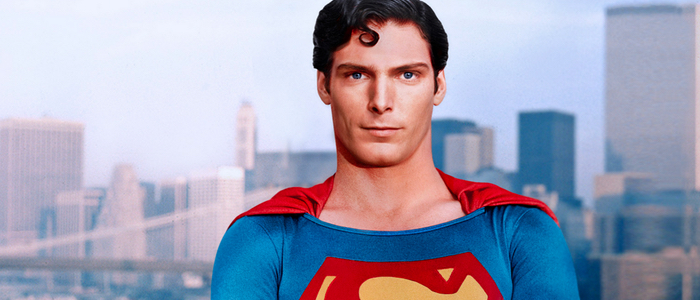
In truth, however, the modern comic movie owes everything to Superman and its star, Christopher Reeve. His first turn in the famous blue tights hasn’t aged exceptionally well, but it still stands out as one of finest examples of a big-screen superhero adaptation done right. Gone are the childish theatrics and abysmally small budget, the mindless plot, and for the most part, the wink-wink, nudge-nudge counter culture irreverence of something like the 1960s Batman television series. Superman: The Movie took its source material seriously. Richard Donner, the film’s director, insisted on a high level of verisimilitude, which isn’t something most Hollywood filmmakers would’ve gone for. Word has it the original screenwriter—none other than Mario Puzzo of Godfather fame—loaded his script with so many tongue-in-cheek gags the film may as well have been a super-farce. For an entire generation of fans, Christopher Reeve embodied the Man of Steel, fighting for truth and justice, making everyone believe a man could fly.
And of course, historically the franchise bombed out after four entries because, you know, DC. Same thing happened to the Batman franchise in the nineties. The folks at Warner Brothers were so shocked and sickened by Tim Burton’s Batman Returns, they snatched the option to make a third bat-sequel from his grubby, weird, Edward-scissor-like hands and passed it off to the marketing machine. Again, four movies was all that first Batman series got, but by then, the genie was out of the bottle, and it wouldn’t be long until Marvel ruled the roost. Marvel, by the way, had been in bankruptcy right until the time X-Men released in theaters. Quite a Cinderella story for the House of Ideas, one nobody could have predicted two decades ago.
In 2008, Marvel and Paramount Pictures released Iron Man, and it was off to the races. Starring the always impeccable Robert Downey Jr., Iron Man injected new life into the genre, and in so doing, completely rewrote the rules of Hollywood. Over ten years later, the Marvel Cinematic Universe is twenty-three movies strong and still growing. Two MCU movies are scheduled to hit theaters in 2020, Black Widow and The Eternals. The thing about Marvel is they’re willing to take risks, knowing that if they do their characters justice, fans will show up. And we do. In droves.
The MCU is truly a mighty thing, containing team-ups like The Avengers and Guardians of the Galaxy, more experimental and hipper entries like Thor: Ragnarok (and doubtless) the upcoming Thor: Love and Thunder, politically relevant films like Black Panther, and everything in between. Yeah, they’re still just silly comic book movies, but the entire world is in love with them, and their impact on our culture cannot be overstated. Just imagine all those kids growing up with Captain America posters on their walls. That’s a lot of money in the making, and Marvel’s parent company, Disney, knows it.

The future of this genre is wide-open, and its not hard to imagine a time Marvel and DC have become two of the most powerful and ubiquitous entertainment companies in the world. Their most popular characters are already known everywhere, and they have been for decades. Really, this is just the cherry on top for a literary form invented for children in the first half of the 20th century. Superman wasn’t just the first superhero, he was the first super media product. The chiseled face that launched a thousand ships. And that doesn’t even begin to account for all the successful and wonderful comic book movie adaptations that don’t include a single cape or superpower. Greats of the sub-sub genre include Ghost World, American Splendor, 300, Road to Perdition, and Sin City. Check any of those out for a palate cleanser. You won’t be disappointed.
It’s funny, but the comic book industry itself has only shrunk in recent years. The good news for comic readers is the movies aren’t likely to completely replace good old paper and ink any time soon. After all, where would all those mega powerful, newly wealthy studio execs get their ideas? What, Hollywood come up with something fresh? Yeah. And Captain America is a communist.
Next month we’ll get back to the movie reviews, folks. For now though, go and have yourself a Marvel movie marathon, especially if you’ve never done one before. Yeah, it’s a lot of confusing action and universe-ending doom, but hey, saving the world has never been so fun. Or so lucrative. Am I right, Disney?

Check out Jeff Bowles Central on YouTube – Movies – Video Games – Music – So Much More!
You can keep up on what Jeff’s been watching and catch all of his great movie reviews the second Friday of each month on Writing to be Read. Subscribe to email or follow on WordPress today.
Share this:

Interview with erotic romance author Nicky F. Grant
Posted: February 10, 2020 Filed under: Adult, Erotic Romance, Erotica, Fiction, Interview, Writing | Tags: Author Interview, BDSM, Beyond Surrender series, Erotic Romance, Erotica, Nicky F. Grant, Writing to be Read 2 Comments
My author guest today is a woman who knows who she is and what she wants out of life, and she goes after it with gusto. She writes sizzling hot erotic romance about love, sex, power and control. In 2019, she received a Stiletto Award in the erotic/BDSM category, from the Contemporary Romance Writers of America for her first novel, Beyond the Masks. She loves life and she loves what she does. It is my pleasure to have her with us today. Please join me in giving a warm welcome to Nicky F. Grant.
Kaye: Can you tell us briefly about your own author’s journey?
Nicky: It happened by accident, actually. I was (and still am) a huge reader of romance. I’d devour an erotic romance book every two days and it got to a point where they became the same. Different character names, but the similar formula. My husband and I were kicking back with a few drinks and came up with a plot idea for Beyond the Masks. One where it focused on a strong CEO heroine and her professional and personal challenges with two alpha men. An angsty, love triangle. It was supposed to be something to tinker with, but I soon found myself swept up in the story. Now, I can’t get enough.
Kaye: Why do you write in the romance genre? What draws you to the power world of your Beyond Surrender Romance series?
Nicky: Erotic romance seems to have a bad rap in the “real world”, unfortunately. And some books with BDSM can come off a little over the top, in my opinion. Fun to read, but unrealistic.
My passion for this genre comes from a deep understanding of the emotional connections to love, sex, and BDSM. My goal is show each reader that there’s a profound connection between these things well beyond floggers and obedience that’s usually present in these books. BDSM exists in my world of Beyond Surrender, but as a “third character” between the heroes and heroines. It’s catalyst to spark their inner desires and understand why it’s okay to feel what they do.
Also, I want my readers to relate to my powerful female characters. I try to lift up women in all capacities and having fun in the bedroom while owning one’s sexual prowess is one of them.
Kaye: What is the biggest challenge to writing romance for you? What is your favorite part?
Nicky: A huge challenge is starting a new book. It takes me time to let go of past characters after I’ve written their Happily Ever After. Also, my confidence wavers with the thought of a new story. What if I don’t do it justice? What if readers don’t understand my twisted brain? It’s nerve-wracking!
On the flip side, my favorite part comes about halfway through writing a new book. It’s the moment where I truly understand the characters, their bond, emotional limits, chemistry, pasts, and futures. This does cause a whole re-write of the first half of the book, but it’s my process and I’m learning to embrace that!
Kaye: Your romance novels are about power “in the boardroom and the bedroom” and they contain erotic sex scenes. How do you know how high to turn up the heat?
Nicky: I’m chuckling at this question, because I’m a touch embarrassed. Man, I love a good “peel the paint of the wall” sexy scene! My scenes are explicit, which I still can’t believe my mother has read. Anyway, I let the characters tell me how high the heat should be. Usually, it’s scorching, but sometimes I may “fade to black”.
As the author, I’m very aware that each love scene must serve a purpose. It must bring the Hero and Heroine closer together or cause a ripple in the love story. Trust me, I’ve had to cut out scenes that lacked in moving the plot forward. It hurts to cut those darlings… but my duty as an erotic romance author, is to help the story along. I hate to admit it, but I get exhausted with my characters falling all over each other. 😉
Kaye: How do you develop a female character who is strong and confident, but still make her feel human?
Nicky: Great question. I take from my own experiences and that of other strong women in my life. I feel fortunate to be a woman with strong views in business, life, and sex. But the true beauty reveals itself when I embrace my own vulnerability.
My heroines are a reflection of that. For example, Shane Vaughn in Beyond the Masks is a female CEO in the music industry. Even though she’s challenged by the men in the field, she’s still vulnerable. She’s open and honest with her past flame, current lover, friends, and family. Somehow, she’s not jaded by keeping up a tough exterior. She’s human with real emotions. I strive to be her in ways, maybe that’s why her story found me. Swoon….
Kaye: In 2019, Beyond The Masks was a finalist for the Contemporary Romance Writers of America‘s Stiletto award in the erotic/BDSM category. Tell us a little about book 1 in the Beyond Surrender series and what receiving such a prestigious award means to you?
Nicky: I was with an author friend when I got the email. There was a shriek, a smile, and tears. Later, I did accept the Stiletto for best erotic romance in New York City. Dreamy, right?
I was incredibly moved to have experienced this among my incredibly talented peers. Especially when I pretty much drop-kicked my entry on the last day to enter! I never thought I stood a chance. That evening put my dreams into reality.
Kaye: What techniques do you use to draw your readers into the story and immerse them in it?
Nicky: Not sure if I have any specific techniques…but I’m attracted to angst, secrets, suspense, and alpha men. So, my stories have elements of these throughout. The one thing I keep on top of mind is, if I’m not enthralled in the story then my readers won’t be.
Kaye: What is the best piece of advice you ever received?
Nicky: Wow, there has been so much! The romance community is incredible when it comes to helping others. If I were to pass along any wisdom to a new author, I would tell them to find their voice. Don’t compare yourself to every other author on the market and don’t get wrapped up in, “I should be doing what they’re doing!”
Writing is a personal journey. All the voices in our heads (yes, there are voices) are rare and unique. If you write without fear, the muse will find you. And your characters will tell you their story when we listen.
Kaye: What is your favorite part of the story, beginning, middle or end? Why?
Nicky: I love the middle! This is where all the “fun and games” happen! The sexy times are heating up, the characters are falling in lust, and a “romp in the sheets” make for a happy writer. But the middle is where things really start rolling. Secrets are revealed, the antagonist works their evil, and the characters doubt themselves. Also makes for a happy writer…I’m a bit of a sadist when it comes to causing them misery, just to fall in love. It’s a tough job. 😉
Kaye: What is your favorite time of day to write? Why?
Nicky: First thing in the morning. My brain is fresh. Also, anything I’d been working through (tough plot points, etc) have a way of working themselves out as I sleep. I can spring out of bed with a hot cup of joe and tap out some words for an hour or two. It’s a strange meditation for me.
Kaye: What is next for Nicky F. Grant? Are you working on anything now?
Nicky: I have two books lined up this year. Hers to Protect, a part of the Girl Power Romance Collection and Dirty Talker, a book for Vi Keeland and Penelope Ward’s Cocky Hero Club series!
Link to Hers to Protect: https://www.goodreads.com/book/show/50656136-hers-to-protect
Link for Dirty Talker: https://www.goodreads.com/book/show/51008222-dirty-talker
Also, Beyond the Masks is coming to audiobook late February/early March! More on that at www.nickyfgrant.com. Readers can also sign up for my VIP newsletter with all the upcoming news on my website.
I want to thank Nicky F. Grant for sharing with us here on Writing to be Read. I love how enthusiastic she is about what she writes. It’s been a fun interview, Nicky, and I really enjoyed having you as my guest. Readers can learn more about Nicky and her books on her Amazon Author page, or at her website, above.
Like this post? Let me know in the comments. You can be sure not to miss any of Writing to be Read’s great content by subscribe to e-mail or following on WordPress. If you found this content helpful or entertaining, please share.Like this post? Let me know in the comments. You can be sure not to miss any of Writing to be Read’s great content by subscribe to e-mail or following on WordPress. If you found this content helpful or entertaining, please share.
Share this:

“Sainte”: End of a series or stand alone novel?
Posted: February 7, 2020 Filed under: Adult, Book Review, Books, Erotica, Fiction, romance | Tags: Amy Cecil, Book Review, Erotica, Knights of Silence, MC Romance, romance, Sainte, Writing to be Read Leave a comment
When I requested to review this latest book in Amy Cecil’s Knights of Silence MC series, she was concerned that readers who hadn’t read the previous books wouldn’t know what was happening, since Sainte is the completion of the series. When I read the second book in the series, Ice on Fire, for review back in 2017, I had no problem following what was happening in the still new series, so she agreed to let me give it a go now, with the last book.
She needn’t have worried. With Sainte, I was immediately pulled into the story. Enough was revealed through dialog and character thoughts and memories to clue me in to many of the events referred to from the previous books and follow along with the action. Cecil’s superbly crafted use of first person, present tense, (not a small feat), allows the reader to have insight into character motivations, as well as providing needed information that helps the reader to keep pace with the story.
Cecil’s characters have depth and back story enough to carry the story. This book centers around two characters and one romance, but references to what has come before in the series involving the other members of the MC to get them to this point are skillfully woven into the story. After reading Sainte, I want to go back and read the rest to get better acquainted with members of the club who were not the main focus of this story.
Even though I’m wasn’t familiar with events referenced from earlier in the series, a little patience usually reveals more detail, and I was easily able to follow along. Do I know everything that happened in this series from this one book? No. Am I intrigued enough to read the rest of the series to find out? Yes, but I really feel it does fine as a stand alone novel, as well.
I’m getting older and it’s been a long time since I stayed up until 2 a.m. to finish a book, but Amy Cecil managed to get me to do just that. Sainte is an excellent romance story. Or maybe I’m just a sucker for Happily Ever Afters. I give it five quills.

Note: There is some erotica in this story, as there seems to be with all of Cecil’s works, but she handles the love scenes with tact and only puts them where they serve a purpose to move the story forward. Cecil’s romances are all class.
You can purchase Sainte here: https://www.amazon.com/Sainte-Knights-Silence-Amy-Cecil-ebook/dp/B0836P299N/ref=sr_1_1?keywords=Sainte&qid=1579729548&s=books&sr=1-1
Kaye Lynne Booth does honest book reviews on Writing to be Read in exchange for ARCs. Have a book you’d like reviewed? Contact Kaye at kayebooth(at)yahoo(dot)com.
Share this:

February: Turning Up the Heat with Erotic Romance
Posted: February 3, 2020 Filed under: Books, Erotic Romance, Erotica, Fiction, romance, Writing | Tags: Erotic Romance, Erotica, romance, Writing to be Read 2 Comments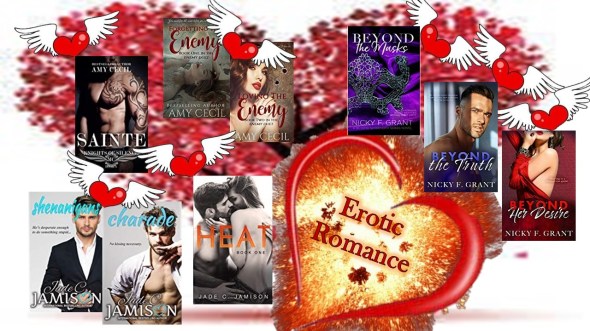
Why is Saint Valentine’s Day in February? Where I live, February is a cold month, not associated with love and warmth. So, Writing to be Read is turning up the heat this month by taking a look at erotic romance. Now, I’m not talking about erotica, which in my opinion is just sex for the sake of sex with no real story line and love has nothing to do with it, nor do plots. These stories can be rank and raunchy and downright smutty, but they are not erotic romance. (For more about the differences between romance, erotic romance and erotica see this article on The Productive Indie Fiction Writer.) I enjoy sex scenes like the best of them, but I’m also a sucker for the happily ever after.
Erotic romance features both romance and sex, and ranges in temperature from steamy to hot to sizzling. The romance story line usually carries the story, but the sexual elements keep the pages turning. This month we’re going to meet some erotic romance authors and take a look at some of their works. My “Chatting with the Pros” author guest will be romance author Amy Cecil, whose contemporary romance stories get pretty steamy, and guests for the supporting interviews are erotic romance authors Nicky F. Grant and Jade C. Jamison. I’ll also be reviewing Sainte, the last book in Amy Cecil’s Knights of Silence MC series, and Heat book 1, a prequel short to Heat: The Complete Series, by Jade C. Jamison.
Just as authors each have their different heat levels in which they like to write, as readers we all have our own temperature preferences, too. Let me know how hot you like it, to read or to write, in the comments. Then, join me as we turn up the heat and start warming things up with a look at erotic romance in February on Writing to be Read!
Like this post? Let me know in the comments. You can be sure not to miss any of Writing to be Read’s great content by subscribe to e-mail or following on WordPress. If you found this content helpful or entertaining, please share.




















Words to Live By – Sex, Love, Warfare, and Death
Posted: March 4, 2020 | Author: Jeff Bowles | Filed under: Commentary, Editorial, Fiction, News Media, Nonfiction, Opinion, Words to Live By, Writing | Tags: News Media, Story telling, Words to Live By, Writing, Writing to be Read | 1 CommentThe first Wednesday of every month, writer Jeff Bowles muses on life, creativity, and our collective destinies as makers of cool stuff. You’re a writer, but have you ever thought about how or why? Here are some words to live by.
Sex, Love, Warfare, and Death
People will fool you if you let them. Consumers especially. Consider the old marketing adage coined by Steve Jobs, “A lot of the time, people don’t know what they want until you show it to them.” Every single morning, especially with the elections coming up, I turn on the news to get a glimpse of my world. The media skews reality so badly it sometimes seems pathological, but hey, let’s face it, if I really wanted raw unbiased information, I wouldn’t get it from CNN, Fox News, or MSNBC.
Coronavirus is about to go pandemic. That’s scary, which means the news will deliver it to me at accelerated intervals. Donald Trump tweeted something nasty again—big surprise there—and I’ll hear about it at the top of the hour, every hour. A new celebrity sex scandal? I eat those up, because, well, I’m a human being and gossip about sex somehow makes me feel like an active participant. It really isn’t the media’s fault, of course. They only sell what I’m willing to buy. Whatever else it may have become in the modern era, the news business has always understood our psychology far better than we do.
No matter how old we get, how wizened, educated, experienced, or jaded, there are but a few key elements we demand like clockwork from our stories: sex, love, warfare, and death. The news is a storytelling racket, after all, no different from books, movies, or anything else worth binging till our eyes bleed. Broadcasting the truth (or something designed to look like a reasonable facsimile thereof) is supposed to carry with it an added degree of responsibility, but if you find yourself screaming at the anchorman for his disastrous manipulation of the facts, don’t blame his boss or parent company. We are who we are. Humans possess a higher mind, higher aspirations and beliefs, altruism, compassion, faith, family unity, a virtuous sense of community. But we have a lower mind, too, a famously inconvenient and uncompromising wilderness of dim subconscious junk, and any storyteller worth her salt knows to engage us there first and foremost.
Think about your favorite stories. Every single one of them, I’ll bet, contains some degree of sex, love, warfare, or death. Now, your all-time top ten may not include all four at once, and maybe one or two of those elements, more or less to the point, is dressed up to resemble something else entirely. But they are there. 50 Shades of Grey wasn’t a pop culture phenomenon because it was a good book, and War and Peace would’ve sold far fewer copies historically if Tolstoy had simply called it Peace. I know what you’re thinking. This is all pretty cynical, Jeff. Surely people aren’t so basic as that. Why yes we are, and don’t call me Shirley. Anyway, it’s not cynicism. It just might be helpful to know what you’re up against before you decide to tell your next story.
Here’s what you’re up against. You are a human being attempting to entertain, enlighten, provoke, or otherwise affect on an emotional level other human beings, a species of meat-bodied, highly intelligent yet conflicted primates with a long, glorious history of blood for blood, sex for pleasure, and a penchant for looking for love in all the wrong places. Just so you know I’m not biased, I also believe each of us has a soul and a sovereign and divine spiritual destiny. To my mind, we’re a perfectly perfected, haphazard merger of things both high and low. It’s just that sometimes higher things can seem lowly and lower things can get us really, really, really, awesomely freaking high. There’s no shame in it, at least there shouldn’t be. You’re a warm body and an isolate personality. You get lonely sometimes, have to eat, sleep, and contend with day-to-day living. I also happen to believe in God and the unified consciousness of all things. Good thing, too. It helps to remember my mantras while I’m stuck in traffic, barely suppressing the urge to hop out and punch the guy sexting his girlfriend in the Hyundai next to me.
Have you ever read a really boring novel and thought, there needs to be more conflict, more romance, just a touch more daring and danger? I have, I do, all the time, especially when I’m reading something written by a beginner. Novice writers often confuse circumstance for story. These things aren’t mathematical, you aren’t working an equation, and outlining your latest plot to within an inch of its life will only render the storytelling equivalent of procedural asphyxiation. If artificial intelligence ever takes over the world, it won’t be writing stories. Not good ones, anyway.
Because we’re not synthetic lifeforms, you may every so often encounter people with beating hearts, barely controlled primal urges, a whole host of neuroses (both subtle and extravagant), and oh yeah, a crippling sense of self-doubt and self-limitation, stemming from one very basic fact: we’re all going to die, and there’s not a single thing any of us can do about it.
We care about sex because the survival of our species depends on it. We care about love and tragedy because they tend to define our most guarded, significant moments. And when it comes to warfare, we’ve all gotten a taste. What’s the difference between arguing with your neighbor for playing his music too loud and desiring to invade a foreign country because you don’t like the way they’ve been eying your stuff? A matter of degree is no matter at all, as it turns out. The trouble with reality as we know it is that we as individuals are just so damn, well, individualized. Relating to others in empathetic and wholly loving terms sometimes requires feats of superhuman strength, especially because I’m so terribly separate from you, and you’re so terribly separate from me, and I have my own needs, desires, limitations, and personal wounds to contend with.
But that doesn’t mean we’re alone. We aren’t, not one of us. It also doesn’t mean the stories we tell, the stories we love, have to be manufactured to meet primal criteria and primal criteria alone. The warmth and splendor of our experience is only equal to the depths of despair and loneliness we may encounter. That’s just the way it is. Life is a roller-coaster ride, and truth be told, we wouldn’t have it any other way. As The Beatles put it, in the end, the love you take is equal to the love you make. How much love have you made recently? Was it worth writing about? If so, why the hell are you reading some stupid blog post? Jot it down. Hurry! Hurry! Before it disowns you and moves to upstate Antarctica!
Sometimes fiction writers neglect their own experience in favor of concocting synthetic lives, synthetic characters, synthetic prose. I imagine to some the old chestnut, write what you know, seems like a bad idea. It isn’t. You’ll have to trust me on this. Your experience is equally significant as mine, as hers, as his, which is to say, both significant and insignificant as dirt. But that’s okay. In fact, it’s the way things are supposed to be. In the course of any given lifetime, fortunes will change hands, lovers will dispose us or face our disposal, babies will cry, enemies and friends will be made, laughs will be had, tragedies endured, and at the end of it all, we’ll have to give the whole shebang back and pretend it was some kind of season finale to a sleeper hit show the network neglected to renew. It seems unfair, but immortality is reserved for vampires, Highlanders, homogenous national virtues, and other mythical beasts. It is precisely our temporal nature that enables the existence of storytelling in the first place. The people who remind us of our limits, who console us, make us feel understood, the ones who tempt us or frighten us or leave us hanging, we call them storytellers, and we honor their place in our lives.
Every single day is story unfolding, and every individual you encounter is a supreme co-author of yours. It is entirely possible to acknowledge these things about ourselves, these dark and dirty, foible-filled things, and to still enjoy the hell out of each waking moment. More than possible. Perhaps mandatory, because hating your life is just a way of saying you love it with all your heart. The real miracle, the fact that any of us are here at all, necessitates our uncompromising need to build the biggest, most luxurious sandcastles, and then to watch helplessly as the tide swallows them whole. This is the essence of storytelling. It’s the essence of life. All things must pass. All things must pass away. Just remember that the next time you sit down to write. You’d better entertain me, wow me, seduce me, or otherwise completely jack up my mood, because if you don’t, I’m putting your book down and turning on the news.
Oh look, Trump just tweeted about Coronavirus, Joe Biden, the Chinese economy, Russian election meddling, Nancy Pelosi, Roger Stone, his persecution at the hands of our political system, and he managed to use the term fake news a total of seven times. That’s got to be some kind of record. What a storyteller! Guess I’m watching CNN all morning again.
It’s in the bloodstream, you see, always was and always will be. And thank goodness for that. No need to make America great again, Mr. President. Or the rest of the human race, for that matter. We’re all pretty great already. I mean, we invented War and Peace and 50 Shades of Grey, and we haven’t even learned to conquer death yet. Bet there’s a good story in there somewhere. You should totally write it, dude, before someone else beats you to it.
Talk at you next month, everybody! Have a good one. 🙂
Jeff Bowles is a science fiction and horror writer from the mountains of Colorado. The best of his outrageous and imaginative short stories are collected in Godling and Other Paint Stories, Fear and Loathing in Las Cruces, and Brave New Multiverse. He has published work in magazines and anthologies like PodCastle, Tales from the Canyons of the Damned, the Threepenny Review, Nashville Review, and Dark Moon Digest. Jeff earned his Master of Fine Arts degree in creative writing at Western State Colorado University. He currently lives in the high-altitude Pikes Peak region, where he dreams strange dreams and spends far too much time under the stars. Jeff’s new novel, God’s Body: Book One – The Fall, is available on Amazon now!
Check out Jeff Bowles Central on YouTube – Movies – Video Games – Music – So Much More!
Want to be sure not to miss any of Jeff’s “Words to Live By” segments? Subscribe to Writing to be Read for e-mail notifications whenever new content is posted or follow WtbR on WordPress. If you found this useful or just entertaining, please share.
Share this: