I must admit as a child, I wrote more stories than poetry. And the poems I wrote then were sentimental and trite. (During grade school (from third or fourth through sixth grade), I compiled annual Christmas books containing “Christmas” stories I wrote—but each year, the manuscript also included a Christmas poem (or one about winter) and a Christmas tale from Readers Digest (which influenced me to compose Christmas books). I also illustrated the books with colored pencils the first year and I gradually moved to water color illustrations (which I sometimes marked with felt-tip pens). My sixth-grade teacher (Mrs. Ferguson) introduced us to Robert Frost and Carl Sandburg, whom I liked, but I liked Emily Dickson the best when I attended elementary school—and I still consider her one of my favorites today. (Unfortunately, at the time, I was too naive to pickup on her style (and skills).
Being the nerd I was in high school, I opted to take a journalism classl. There, for the Christmas issue (of our high-school newspaper), I wrote a humorous Christmas poem from the staff, which I illustrated with an ink sketch of Santa , his gift-filled sleigh (which included B/W head-shot photos of each new-staff member )
and eight reindeer flying through skies above my sketches of Victorian two-stories. (Even then, I preferred old homes to the contemporary ranch styles where most my classmates and I lived.)
Also in high school, I continued writing in my diary, which I used to create short stories (from events in that diary). And I submitted those stories in English classes when a teacher requested them. But my poems were overly sentimental and personal. And basically about teen angst. (For example, one was entitled “Alone.”)
In fact, during my senior year in high school, my English composition teacher enjoyed my short stories and offered encouraging comments. I wouldn’t have shared my poetry, but she’d asked to see it. So I submitted the dreary poems I’d written (mainly centering on unrequited love). She read them and returned them without comment. I mean—absolutely NO comments. No encouragement. So I figured I was no better poet than I’d been a violinist. Sigh.
Thus, my true poetry journey did not take flight until my sophomore year at the University of Missouri-Kansas City, when fellow student Robert (“Bob”) Haynes and I became close friends. Even then, he was an excellent poet—and he boosted me along the journey to poet-hood. He shared not only his poems, but pointed out many contemporary experts who’d been gaining attention in the early 1970s, , such as W.S. Merwin, Galway Kinnell (both born the same year as my father: 1927), Lawrence Ferlinghetti, and Alan Ginsburg, popular in the late 1960s.-and who gave a reading at UMKC. Bob also introduced me to surrealists Kenneth Patchen and Kenneth Koch, who inspired my frenzies, (which I didn’t write until fifty years later.) I discovered James Tate, who I’d include as a “surrealist,”too. Shortly thereafter I enrolled in the university’s poetry writing classes taught by professors Dan Jaffe and David Ray, who introduced me to an array of well-known contemporary poets, including Diane Wakoski (whom Dan Jaffe brought to UMKC to give a reading), James Dickey, Etheridge Knight, Denise Levertov, John Berryman, David Ignatow, Randall Jarrell, William Stafford, Robert Lowell, Thomas Merton, Later, I also started reading Adrienne Rich, Denise Low, and Mary Oliver.
And, I did improve—enough that my senior year, Dan Jaffe asked me to read a few of my poems at a poetry reading on the UMKC campus for the public. He also published two of my poems in an anthology he compiled, one that included many professional poets.
Favorite poem by another poet
O my goodness—I’ve read so many poets and poems, this one is a tough question. Along with the previous set of poets I mentioned, I’ve always admired Emily Dickinson’s style and work, along with William Butler Yeats (especially his “The Second Coming.” And T.S. Eliot: His “Wasteland” is remarkable, but far too long to include here. And the sounds in that poem make it come alive so much that it’s best to listen to a recording of it. Even his “The Love Song of J. Alfred Prufrock” is a bit long to include. Thus, I’ll share Yeates’s “The Second Coming,” which not only inspired one of my poems that I’ll share later, but also remains relevant to our current world situation (a century later).
The Second Coming
Turning and turning in the widening gyre
The falcon cannot hear the falconer;
Things fall apart; the center cannot hold;
Mere anarchy is loosed upon the world,
The blood-dimmed tide is loosed, and everywhere
The ceremony of innocence is drowned;
The best lack all conviction, while the worst
Are full of passionate intensity.
Surely some revelation is at hand;
Surely the Second Coming is at hand.
The second Coming! Hardly are those words out
When a vast image out of Spiritus Mundi*
Troubles my sight: somewhere in sands of the desert
A shape with lion body and the head of a man,
A gaze blank and pitiless as the sun,
Is moving its slow thighs, while all about it
Reel shadows of the indignant desert birds.
The darkness drops again; but now I know
That twenty centuries of stony sleep
Were vexed to nightmare by a rocking cradle,
And what rough beast , its hour come round at last,
Slouches toward Bethlehem to be born?
1920-1921
Favorite style of poetry and why
Although I love my surreal frenzies, I also like other forms of poetry, including sonnets, when they come “naturally.” (The two times I’d written sonnets but didn’t realize it until I re-examined them, tweaked them here and there, and voila! I’d written two sonnets without trying—the best for me). Those two appeared n my second published poetry book (the first full collection) Standing on the Edge of the World (Washburn University/Woodley Press 2008).
I’ve also fallen in love with the Japanese tanka form. (Haiku doesn’t allow enough syllables for my poems. 😉 ) Thus, I created a section of tankas in my last collection, CASHING CHECKS with Jim Morrison (redbat books 2023). More about that later.
Moreover, I generally write in “free verse” with sounds and rhythms and internal rhymes (not at the end of a line), that flow so smoothly, the rhyme doesn’t “hiccup” or stop the reader. Why is this usually my favorite form? As I’ve mentioned in a number of my bios, “poetry is my way of singing.” Thus, in most poems I write, I strive to use sound so they have somewhat the same effect that a song does.
Favourite poem of my own
O so many poems—so little time. I cannot name one favorite poem. But three of them come to mind. First, here’s my response to “The Second Coming,” which I wrote in response to the violence occuring in Ferguson, Missouri:
Re-reading “The Second Coming’ by W.B.Yeats
after Ferguson, Missouri\
No one listens anymore. No one works
in tandem. No horses pull this cart.
Now trembling, it falls apart.
The center hub’s blown, exploded.
Rioting in city squares—rioting along beaches.
Is this anarchy—or something more?
The blood of victims rushes onto shores.
Innocents no more, their lungs fill
till they can’t speak—can’t breathe.
Their passions now sneseles, uneasy—
bringing the strange revelation:
the Second coming lies on the horizon.
It’s the day, it’s the day—
O yes, it’s the holy day—
it’s the Day of the Dead.
A wide-winged beast rises above—
eyes black and gleaming, onyx
glistening through bone.
O Momma, Momma,
come back, come back
again. The world’s too cold.
No lion-bodied beast alouches
toward Bethlehem. It’s a creature
with a jackal’s head, a jackal’s soul.
Where Water Meets the Rock, p. 30 (39 WEST PRESS 2017)
Two other poems I must also count as favorites, because they seemed to write themselves.
The words came to me without me planning them. It was if they suddenly appeared in my brain, and I had to scramble to pen them onto paper before they evaporated.
The first, I wrote during the months that revealed my father was not to stay much longer on this earth. (This was when the frenzies started coming to me. Many of the frenzies are absurd—but comical. This one’s more serious. (And I’ve included it in three of my books: It must be a favorite.)
It’s Never Like the Movies—
for my father
this dying, no background chords
rising to a crescendo,
no adagio of strings.
You watch these ants instead,
trickle across peonies
They disappear. And you
can’t keep your grip
on that granite wall of reason
but slip downstream
into some wild current
till you run aground .
There, you search
for the deserted place, a Holy Land,
where Ekijah met God.
Even if you’re hiking
the Appalachian Trail, up
Standing Indian Mountain,
you watch vultures circle
in and out of clouds festering
into some murky, yellow soup.
And when lightning hits,
Father Davis says Hail Marys—
and there, on the horizon,
you see wovoka whirl
in his dance of ghosts.
Standing on the Edge of the World, p. 85 (Washburn U/Woodley Press, 2008)
The Book of Frenzies, p. 76 (Pierian Springs Press, 2022)
And “From the Emerald City to the Mountain of Quaff” is special to me because it came to me in pieces—often as I was awaking from sleep. At the time, it seemed to be one of the most imaginative poems I’ve written. Perhaps that’s why one of my former poetry professors, David Ray selected it to run in an anthology he assembled (Whirleybird Anthology of Kansas
City Poets, 2012).
From the Emerald City
to the Mountain of Quaff
(or This Must Be Kansas)
Go out and get that long face lost, you say,
Bury me in Jerusalem, I reply.
I want to be one of the first to rise,
like yeast on a rock in the desert,
among iron stones, hills filled with brass,
in a land of olive oil and honey—
wrapped in silver and gold,
where water eats fire
and fire drowns water, and the angel
of the presence outlasts them both.
Or, if poetry must be delirious and weird,
or even a prophetic frenzy,
then bury me in absurdia,
where the lemons bloom.
Inside Virgil’s Garage, p. 7 (Chatter House Press 2008)
Kansas City Voices (October 2007)
Whirlybird Anthology of Kansas City Poets, Whirlybird Press (2012).
The BOOK of FRENZIES, p. 66 (Pierian Springs Press 2022)
About CASHING CHECKS with JIM MORRISON
This book has a strange history. Although it resulted in being a sequel to CROSSING KANSAS with JIM MORRISON (Paladin Contemporaries 2016), it wasn’t exactly planned. I wrote the first collection in about six months. It was odd, too, because it took two years for me to write and revise the book’s initial poem entitled “Crossing Kansas with Jim Morrison, which, of course, became the book title. Yet—once that poem came together, I wrote the rest of the book within six months and entered it into the 2015-2016 QuillsEdge Chapbook Contest, Although it didn’t win, it was a finalist. Concurrently, Thorny Locust literary magazine ran three poems from the collection, and Amethyst Arsenic, another lit mag, took one more.
And the Jim Morrison poems kept coming to me. So I added them and others that fit into the collection, to make a complete book, which Paladin Contemporaries published that summer. On Amazon, the book made it to number 23 or so on the top 100 Poetry Books by Women list—and stayed there most of the following year. (Inside Virgil’s Garage was on that same list concurrently, but it didn’t rise as high Crossing Kansas w/JM did.
About two years later after Where Water Meets the Rock was published, I put together CASHING CHECKS, designed around the themesof actual money becoming obsolete. (Checks, along with credit cards, debit cards, and other contemporary methods of payment don’t include actual money, correct? It money going the way of the manual—or even electric typewriter?) That collection, of course, included other sectons centering around the tanka form and the frenzies. (At present three of my collectons include a section of “frenzies,” and of course, The BOOK of FRENZIES contains solely frenzies, some less zany than others).
In short, after accruing more Jim Morrison poems—I mean, Jim just wouldn’t hush, but kept popping words into my brain—I considered merging the new Jim Morrison poems with the CASHING CHECKS book.
When I submitted both versions to redbat books, both the publisher and her editor preferred the collection containing Jim Morrison. So that’s where we went with it.
What’s next?
What’s next? I’m now working on a manuscript, named for a 10-stanza poem (which can be set in five pages or in in ten, whichever works best) that’s appeared in three publications. I’ve been adding to it and hope to complete a full collection within a few months. The DARK HORSE WAITS in BOULDER, my fourth novel (third on Amazon) is scheduled to be released this spring—so that will precede the poetry book release. At present, I have one more poetry collection I’ve started but don’t see it going anywhere for a year or more. That one may be my last poetry collection, too. (Three more novels and one short story collections are ahead of that poetry collection.) And then, what may be my last novel—now in a VERY ROUGH state-of-being—just may allow the likely last poetry collection to supercede it .But who knows? Rock star archetype Jim Morrison may hop into one or the other manuscript and upset the entire scene.
My review of Where Water Meets the Rock
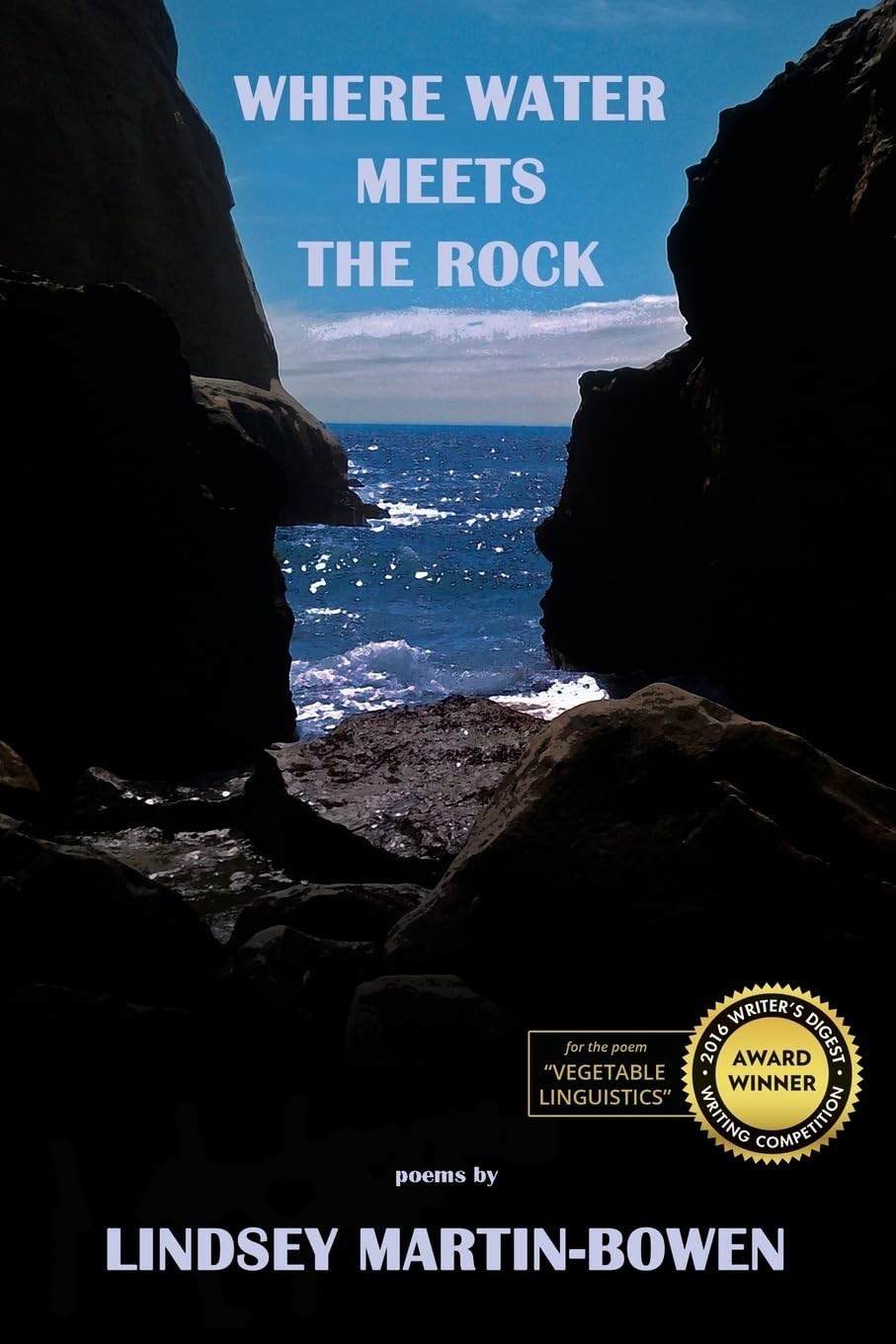
Picture caption: Cover of When Water Meets the Rock by Lindsey Martin-Bowen
I enjoy reading poetry collections that include a common thread that links all the poems together. The common thread for this collection is loss and recuperation. This theme is relatable to everyone as we all suffer loss in various forms throughout our lives and we are forced to recuperate whether we want to or not.
The collection is divided into three sections: Erosion which explores the slow build up to loss; Frenzies which seeks to unravel the immediate chaos and emotion that follows loss; and On the Shore which delves into the slow path to acceptance and continuation.
The poems are unique and make use of various techniques to either exaggerate or bring out the humorous side of deep emotion and complex thought patterns relating to loss.
A poem that resonated strongly with me in Erosion is titled Psyche in the Suburbs. For me, this poem exposed the conflicting emotions of love, resentment, and self sacrifice that arise when caregiving for aging relatives.
This is the final stanza in this poem: “Now, lavender scents fill the air, sending me to the Aegean Sea. When I step onto the asphalt, I remember the bottled water. I must go back. Without it, the world will know her face grows old. And she’ll blame me.”
Another poem in this section I especially related to is entitled My Bones are Glass. I have often thought this same thing when dealing with the elderly and aging. The poet includes an apology to Mark Strand, one of my favourite poets, so the style also worked very well for me.
Section 2: Frenzies, includes a lot of humour relating to people’s eccentricities and wants in their final moments. The poems also touch on the need for the observers to fulfil every desire and make the passing easier – perhaps to alleviate the guilt of survival. I enjoyed the poems although humour in poetry is not my personal favourite style. This section lifts the tension in death and loss and will appeal to most readers.
Section 3: On the Shore was very compelling for me. It explored inevitable change and endings coupled with new beginnings of a different sort. I reminded me that we move from one phase to another in our lives without even realising it until we look back and the end and beginning stand out in stark reality. The poem I enjoyed the most in this section was Two Mothers with Kids in Winchell’s. Perhaps because my children are now adults and have both finished school so I can understand and appreciate this poem through the lens of a soon to be empty nester.
This is one stanza in the poem that I strongly related to: “The Winchell’s mothers nod, talk in buzzing hums, eye their toddlers, who hop, slide on linoleum. The kids scratch glass, balance on window ledges. The pregnant one smooths seersucker. “Guys,” she says, “They don’t like that here. Come, be quiet, Sit down.” Like seatbelts, her words rein them in. I frown, wonder how she renders her voice firm but not loud.”
As a mother who always worked, this stanza fills me with thoughts about what might have been had my own path taken me along a different path. What kind of mother would I have been had I not always been struggling to balance work and home demands. A writer who can introduce such reflections has to be great.
Picture caption: Author image of Lindsey Martin-Bowen
Lindsey Martin-Bowen’s CASHING CHECKS with Jim Morrison has just been released this fall (2023) by redbat books (a La Grande, Oregon publisher) as part of its Pacific Northwest Writers series. She serves as a Literary Consultant for Pierian Springs Press, which published The BOOK of FRENZIES in April 2022 (hardback copy in December 2022–BEFORE she became its Literary Consultant). She has taught Criminal Law and Procedure (online) at Blue Mountain Community College, Pendleton, Oregon since January 2019. Until August 2018, she taught writing, literature, and Criminal Law at MCC-Longview and taught literature and writing at the University of Missouri-Kansas City 18 years.
A Pulitzer-Prize nominee, her fourth full-length poetry collection, WHERE WATER MEETS THE ROCK (39 West Press 2017) contains “Vegetable Linguistics,” which received an Honorable Mention in the Non-rhyming Poetry category of Writers Digest’s 85th Annual Writing Competition (2016). Her third collection, CROSSING KANSAS with Jim Morrison, won the “It Looks Like a Million” Award for the 2017 Kansas Authors Club competition. The book is an expansion of her chapbook named a finalist in the 2015-2016 QuillsEdge Press Chapbook Contest. “Bonsai Tree Gone Awry” from INSIDE VIRGIL’S GARAGE (Chatter House Press 2013) was nominated for a Pushcart Prize. This collection was also runner-up in the 2015 Kansas Authors Club Nelson Poetry Book Award. Woodley Press (Washburn University) published her first full-length collection, STANDING ON THE EDGE OF THE WORLD, which McClatchy newspapers named one of the Ten Top Poetry Books of 2008. Paladin Contemporaries released her novels RAPTURE REDUX (2014), HAMBURGER HAVEN (2009) and CICADA GROVE (1992). Her work has appeared in NEW LETTERS, I-70 REVIEW, THORNY LOCUST, FLINT HILLS REVIEW, PORTER GULCH REVIEW, SILVER BIRCH PRESS, COAL CITY REVIEW, PHANTOM DRIFT, TITTYNOPE ZINE, BARE ROOT REVIEW, , AMETHYST ARSENIC, THE SAME, THE ENIGMATIST, ROCKHURST REVIEW, BLACK BEAR REVIEW, LITTLE BALKINS REVIEW, KANSAS CITY VOICES, LIP SERVICE, 21 anthologies, and others.
With Dennis Etzel, Jr., she edited GIMME YOUR LUNCH MONEY: Heartland Poets Speak out against Bullies (Paladin Contemporaries 2016). She holds an MA in English (creative writing emphasis) and a Juris Doctor degree.
Before focusing upon teaching and writing poetry and fiction, she served as a full-time journalist and magazine editor for THE LOUISVILLE TIMES, the Johnson County SUN, MODERN JEWELER Magazine, and THE NATIONAL PARALEGAL REPORTER. She also worked as a legal editor for the Office of Hearings and Appeals (USDI) in Washington, DC.
She has two brilliant children and contends with super Chihuahuas Chia Maria La Rue and Chico the Man, her canine companions. And often, she spars verbally with poet Carl Rhoden.
About Robbie Cheadle
Picture caption: Robbie Cheadle author picture
South African author and illustrator, Robbie Cheadle, has written and illustrated sixteen children’s books, illustrated a further three children’s books, and written and illustrated three poetry books. Her work has also appeared in poetry and short story anthologies.
Robbie also has two novels and a collection of short stories published under the name of Roberta Eaton Cheadle and has horror, paranormal, and fantasy short stories featured in several anthologies under this name.
You can find Robbie Cheadle’s artwork, fondant and cake artwork, and all her books on her website here: https://www.robbiecheadle.co.za/
________________________
Did you know you can sponsor your favorite blog series or even a single post with an advertisement for your book? Stop by the WtbR Sponsor Page and let me advertise your book, or you can make a donation to Writing to be Read for as little as a cup of coffee, If you’d like to show your support for this author and WordCrafter Press.
__________________________
This segment of “Treasuring Poetry” is sponsored by WordCrafter Press and the Poetry Treasures series.
Hi everyone, today I’m thrilled to introduce you to Laura Lyndhurst. Laura is an accomplished author and poet and is also a new member of Story Empire blog which is a great resource for writers. You can read Laura’s first Story Empire post here: https://storyempire.com/2026/02/10/sowing-the-seeds-of-a-story/
Welcome Laura!
Tell us a bit about yourself and your poetry journey. How did you come to be a poet?
I never intended to write poetry. At school it was my least-favourite of the three prose-poetry-drama disciplines, and I didn’t like many of the poems that we studied. It was the same at university, when I finally got there in my forties. I was obliged to study Romanticism for my first-year core module, and I hated it. Wordsworth, Coleridge, Shelly; I wasn’t keen on them, although I was okay with some of Keats’s work. In the second year I couldn’t help but study more poetry, and I didn’t mind John Donne at all.
As to my own work, it was when I joined a Facebook writing group that it started. The group leader decided to post a picture every day for the month of October, inviting the group members to write a few paragraphs of prose around them. I sat with the first picture, thought, wrote—and what came out was poetry. The leader and members liked it, and thereafter I challenged myself to write poem every day from the picture prompt. At the end of the months I decided to publish them in a book, to claim copyright on them as much as anything. I called it October Poems, after the month in which I wrote them, and three more little collections followed in the next year or two.
What is your favourite poem by another poet and why?
That’s difficult. I like poetry more now than I used to, and there are several poets whose work appeals. I tend to listen to Leonard Cohen’s songs more than I read his poems, but he does have a way with lyrics; I mean, ‘the place is dead as Heaven on a Saturday night’ is so great. Hardy’s ‘The Darkling Thrush’ is up there, along with ‘This Be The Verse’ by Phillip Larkin. ‘Pity me not because the light of day’ by Edna St. Vincent Millay and ‘Rubbish at Adultery’ by Sophie Hannah attract, from the serious and the not-so as well. Choice for today, however, has to be ‘Refugee Blues’ by W.H. Auden. It never gets old, unfortunately, and although it’s written around one specific ethnic refugee group it can be applied to the myriad groups in existence before and since it was written; and now, in the 2020s, it feels massively relevant. You can find it here: https://allpoetry.com/refugee-blues
What is your favourite style of poetry and why?
Another difficult question. I don’t have a favourite style as such. I’ll read many different poems, some I’ll like and some I won’t, but the style of writing doesn’t have much bearing on why I like them or not. I do have an author friend, Thomas Leverett, who writes extensively in haiku form, and I loved his E Pluribus Haiku, which feels like travelling around the USA in haiku form. It’s on the link below, if you’re interested.https://www.amazon.com/Pluribus-Haiku-Anthology-3487-ebook/dp/B08X2YRQB2
Which is your favourite of your own poems?
I love them all, some more than others, it has to be admitted. I’ll choose the last one I wrote, however, because it is the last one and about ‘the end’. It’s from Social Climbing and Other Poems, and inspired by Clive Thompson’s photo of the altar of a Greek Orthodox Church.
Due Process
Your case has been a lengthy one; eighty-four years it’s taken, to
observe your less-than-perfect deeds and gather evidence to
aid the prosecution. But now you’ll have your day in court and
the jury gathered here, the Twelve, will finally decide, for or
against, whether you stay righteous here or whether you go down.
You wish to conduct your own defence? No, really, that won’t do, you’ll
be given representation. One of these saintly suits here gathered,
yes, that’s right, the ones with haloed wigs, will intercede for you.
Sorry for the delay; we understand that it’s a real nerve-wracking time for
you, but we can’t begin until His Honour gets here to take His place there,
in the big chair. The witnesses are here for you, plus jury, twelve good men
and true, not to forget the female sex, the immaculate, to try to push
your sins aside and hide you ‘neath their garments of compassion.
But nothing can occur until the God-Father is here; He’s judge
and jury all in one, Divine Justice in person. So please don’t fret,
or maybe do, for He knows you as well as you, and maybe better.
This whole set-up is just for show, to satisfy the need to see the
wheels of justice set in motion; your sentence fixed already,
your judgement day is here.
And here Our Father approaches now.
The court will rise …
Tell us a bit about your book, Social Climbing and other poems – what is the inspiration for the collection?
At the time I was friends with a photographer, Clive Thompson, and one of his pictures inspired a poem – ‘So This is Christmas’, which I recently published on my blog. Clive then allowed me to put together a book of my poems written to the prompts of some of his pictures.
What’s next for Laura Lyndhurst in the world of writing?
No more poetry, I’m afraid; nothing planned, at any rate, but if something occurs then I’ll be putting it together. At present I’m editing my latest novel, a whodunnit of sorts; a new departure for me, sort-of, because although I like adding a bit of a mystery to some of my stories this will be the first time I’ve brought the police in to investigate. It’s more focussed on before the murder, the personalities involved and their potential motivations. After that I’ll see what else occurs to me.
Many thanks for interviewing me. I’ve enjoyed it very much.
My review of SOCIAL CLIMBING: and Other Poems
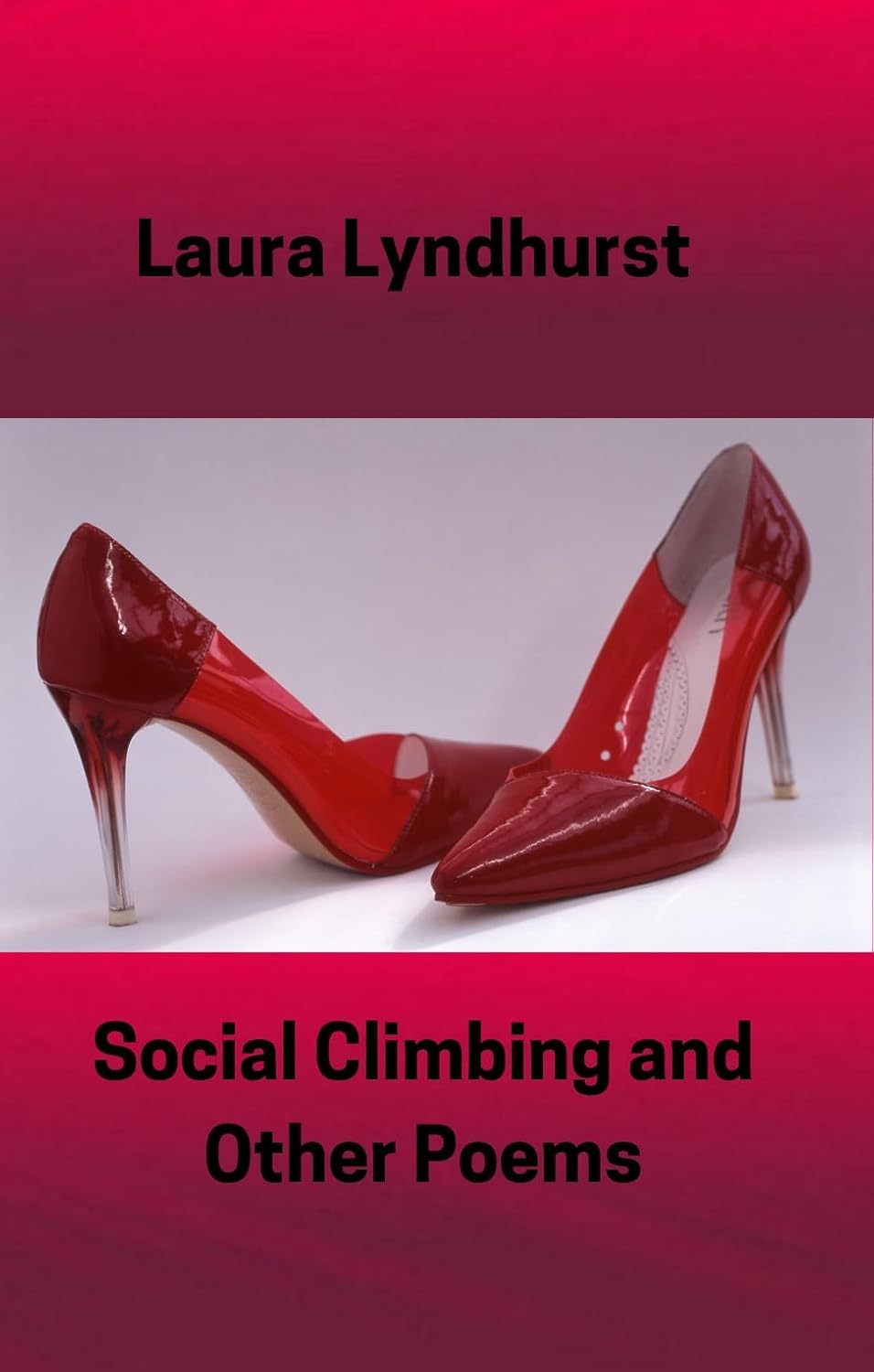
Picture caption: The cover of Social Climbing and Other Poems featuring a pair of shiny, red high heeled shoes against a white background inset into a red background
When I saw the cover of this collection, the shiny, red high heeled shoes against a white background, it reminded me of the movie, The Devil Wears Prada featuring Merril Streep and I was completely fascinated. I was not disappointed as this interesting collection of freestyle poems is a head on collision with an array of social situations, many of which are uncomfortable.
“The sit inside and watch the show, these Parisian fans of opera; but we,
lacking the means to buy the tickets for the red-plush, well-upholstered
seats and ornate murals, gilt-decked swirls and whirls of rococo decor,
prefer to take our entertainment in quite another way. Out here in the street”
from Street Theatre
Laura slices to the heart of human emotions and frustrations and these poetic expressions resonated with me. One poem I particularly delighted over is “I don’t know much about art but I know what I like”.
“So I’m breaking out of normalcy,
gone so very Modernisth,
this El Greco’s got his paintbox out
and given life a twist.”
Honestly, this poem made me laugh until I cried. Fantastic!
Each poem is introduced with a beautiful colour photograph by photographer, Clive Thompson.
Do yourself a favour, purchase this collection and allow Laura to put your life in perspective for you.
About Laura Lyndhurst
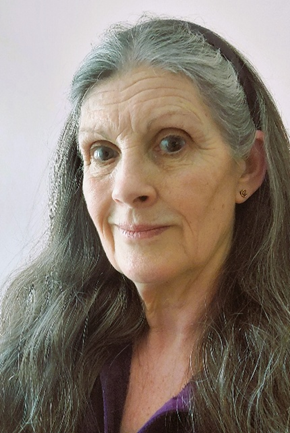
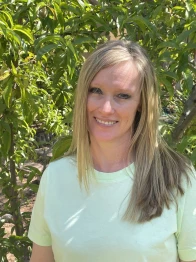
Picture caption: Author photograph of Laura Lyndhurst
Laura Lyndhurst was born and grew up in North London, England, before marrying and travelling with her husband in the course of his career.
When settled back in the UK she became a mature student and gained Bachelor’s and Master’s degrees in English and Literature before training and working as a teacher.
She started writing in the last few years in the peace and quiet of rural Lincolnshire, and published her debut novel, Fairytales Don’t Come True, in May 2020. This book forms the first of a trilogy, Criminal Conversation, of which the second is Degenerate, Regenerate and All That We Are Heir To the third. Innocent, Guilty, the first of another trilogy, continues the story told in these three books and leads on to The Future of Our House, which is followed by Uphill, Downhill, Over, Out as the sixth and final book to end the series. An Honourable Institution was published as a stand-alone novel in January 2025, as was The Guilty Party in September 2025.
Laura also developed a taste for psychological suspense, which led to the writing and publication of You Know What You Did, to which What Else Did You Do? is the sequel.
Laura has also published four small books of poems, October Poems, Thanksgiving Poems and Prose Pieces, Poet-Pourri and Social Climbing and Other Poems.
South African author and illustrator, Robbie Cheadle, has written and illustrated sixteen children’s books, illustrated a further three children’s books, and written and illustrated three poetry books. Her work has also appeared in poetry and short story anthologies.
Robbie also has two novels and a collection of short stories published under the name of Roberta Eaton Cheadle and has horror, paranormal, and fantasy short stories featured in several anthologies under this name.
You can find Robbie Cheadle’s artwork, fondant and cake artwork, and all her books on her website here: https://www.robbiecheadle.co.za/
________________________
Did you know you can sponsor your favorite blog series or even a single post with an advertisement for your book? Stop by the WtbR Sponsor Page and let me advertise your book, or you can make a donation to Writing to be Read for as little as a cup of coffee, If you’d like to show your support for this author and WordCrafter Press.
__________________________
This segment of “Treasuring Poetry” is sponsored by WordCrafter Press and the Poetry Treasures series.
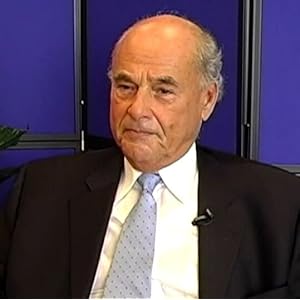
My guest today is a holocaust survivor, the youngest surviving passenger on the MS St. Louis, who grew up to be a successful civil rights attorney, representing civil rights activists in Milwaukee in the 1960s through the end of the twentieth century. and he was the attorney who sued and obtained half a million dollars for the families of the victims of the serial killer, Jeffrey Dahmer. He seems to find ways to think outside the box and make change happen, even in stagnant times. He has written a fascinating book, Underdog: Against All Odds, which relates his story, including a thrilling deposition with Dahmer in the Columbia Correctional Institution.
About Author Thomas M. Jacobson
Thomas M. Jacobson, born May 8, 1938, in Bamberg, Germany, escaped Hitler, coming to America on the harrowing MS St. Louis voyage one year later. He graduated from UW Madison Law School in 1962, partnering with Lloyd Barbee to start the first integrated law firm in Milwaukee. Jacobson represented all the Milwaukee civil rights movers and shakers over the next thirty years, including Father James Groppi, the Daniel Bell family, comedian/human rights activist Dick Gregory, and Alderperson/Black Panther Commander Michael McGee. He successfully argued two cases in the U.S. Supreme Court, overturning Wisconsin’s Garnishment before Judgment and Change of Venue laws. In 1970, Jacobson was the Democratic candidate for Wisconsin Attorney General. In the late 1970s, he served as the Chairperson of the Wisconsin Public Defender’s office. Jacobson represented eight families of the victims of the world’s worst serial murderer, Jeffrey Dahmer, suing and successfully obtaining one-half million dollars for eleven victim families.
My Interview with Thomas
Kaye: Would you begin by telling us about your author’s journey? What inspired you to write a book about your experience?
Tom: My path to becoming an author wasn’t planned, but grew out of a life shaped by story and consequence. I was a child refugee, one of the youngest surviving passengers on the MS St. Louis, turned away from safety, and that early experience of injustice stayed with me long after I built a career as a civil rights lawyer. For decades, I focused on advocacy rather than authorship. A memoir wasn’t on my agenda. But over time, I realized that the arc of my life, from refugee to advocate, was itself a narrative worth preserving.
I wrote Underdog, Against All Odds, The Fight For Justice, because stories can carry truth in a way arguments alone cannot. As fewer firsthand witnesses remain, personal testimony becomes essential. I hoped to show how lived experience can inform a lifelong commitment to justice, how writing can serve as another form of resistance, remembrance, and standing up for democracy.
Kaye: When approaching the writing of the book, what’s the best piece of writing advice you were given?
Tom: As a lawyer, I was trained to persuade and to control the narrative. Writing a memoir required me to unlearn some of that, to slow down, to sit with uncertainty, and to trust the reader. Once I stopped trying to justify every decision and focused instead on bearing witness, the story found its voice. That advice shaped the entire book. It reminded me that a memoir isn’t about winning an argument, it’s about offering an honest account and letting the truth do the work. The best advice was to write what you know to be true, even when it’s uncomfortable. Honesty, intellectual and moral, is what gives writing its power and authority.
Kaye:Underdog has three different themes, each representing a different time in your life. Can you talk a little bit about each one?
Tom: The opening of Underdog focuses on childhood survival. As a young refugee, life was defined by forces beyond my control: The Nazi government’s atrocities against my family and the indifference of people to this injustice. This theme centers on vulnerability, displacement, the moral consequences and decisions of others, and what it means to begin life with no voice and no leverage or power to resist.
The middle of the book marks the transition from survival to resistance. This period of my life is about education, self-definition, and the decision to fight back using intellect rather than force. Law becomes the weapon that replaces the power that I never had. This theme is learning how institutions work, how they fail, and how an underdog can still challenge them.
The final theme centers on adulthood and professional life, when I finally had standing in the courtroom and a measure of authority. This part of Underdog addresses moral responsibility, representing the powerless, pursuing justice even when it’s unpopular, and recognizing that winning a case is not the same as standing up for justice.
Together, these three themes trace a life that moves from powerlessness to agency to accountability, the journey of an underdog who never forgot what it was like to have nothing.
Kaye: What happened after immigrating to the U.S. that led you to be a civil rights attorney later in life?
Tom: After immigrating to the U.S., I learned that power could be challenged through law. As a child refugee, authority had meant danger or indifference. In America, I saw that, slowly and imperfectly, the law could be used to protect the vulnerable rather than crush them.
I was drawn to civil rights law because the Holocaust taught me to fight and to resist was the only path to justice and survival. I understood what it meant to be excluded, unheard, and disposable. Education gave me a voice, and the law gave me standing to confront injustice. Becoming a civil rights lawyer wasn’t a career choice so much as a continuation of survival, resilience, and insistence that the system live up to all that the U.S. Constitution guaranteed its citizens: life, liberty, and the pursuit of happiness.
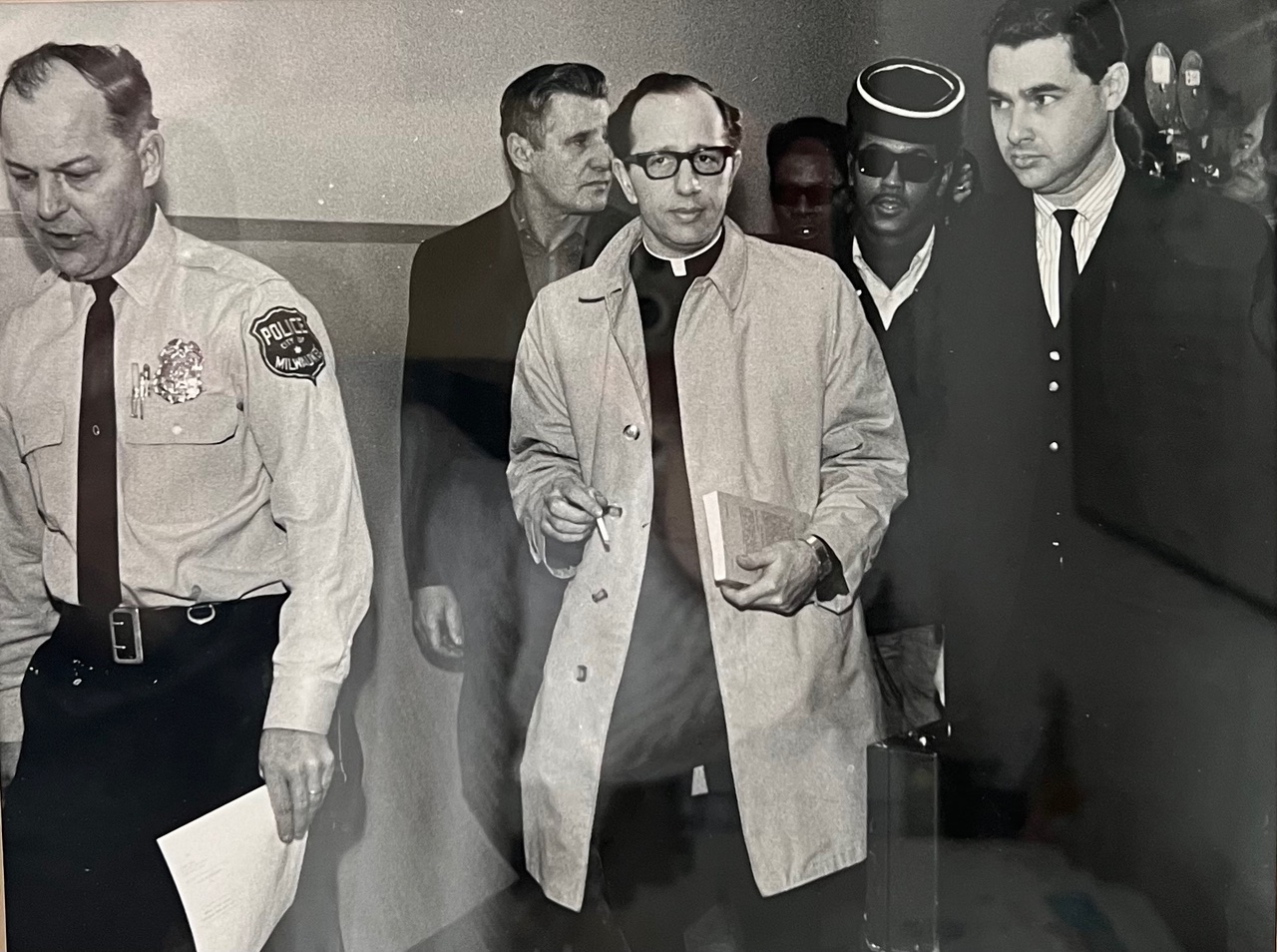
Father Groppi and I, after his trial on February 8,1968.
Kaye: Do you view Underdog as a way to raise awareness about civil rights?
Tom: While Underdog is not primarily an advocacy book, it inevitably raises awareness about civil rights. The story shows how rights are lost long before they are violated through indifference, silence, and the normalization of exclusion. By tracing my life from refugee to civil rights lawyer, the book invites readers to see civil rights not as abstract ideals, but as lived experiences with real human consequences. If Underdog encourages readers to recognize that injustice can be challenged through resistance, strength, and perseverance, then it has accomplished one of the messages I want to send.
Kaye: What are some of the major events represented in Underdog?
Tom: My family’s escape from Nazi Germany in 1939, Hitler’s ascension to power in 1933, the Nuremberg laws, Krystallnacht, my father’s incarceration in the Dachau concentration camp, the failed voyage of the MS St. Louis, the commencement of the 1960s civil rights struggle in Milwaukee with the murder of Daniel Bell, a young Black man shot in the back of the head by a white police officer, and the planting of a knife to falsely create a self-defense cover-up by the cities entire law enforcement agencies, the struggles for a fair housing bill in Milwaukee by Father James Groppi and Alderperson Vel Phillips, Lloyd Barbee’s lawsuit finding defacto segregation in Milwaukee public schools unconstitutional, my suing successfully the City of Milwaukee on behalf of the Daniel Bell family twenty years after his murder, my lawsuits finding Wisconsin’s Change of Venue and Garnishment before Judgement laws unconstitutional in the U.S. Supreme Court, and my deposition of the world’s worst serial murderer, Jeffrey Dahmer, leading to eleven victim families receiving a half million dollars.
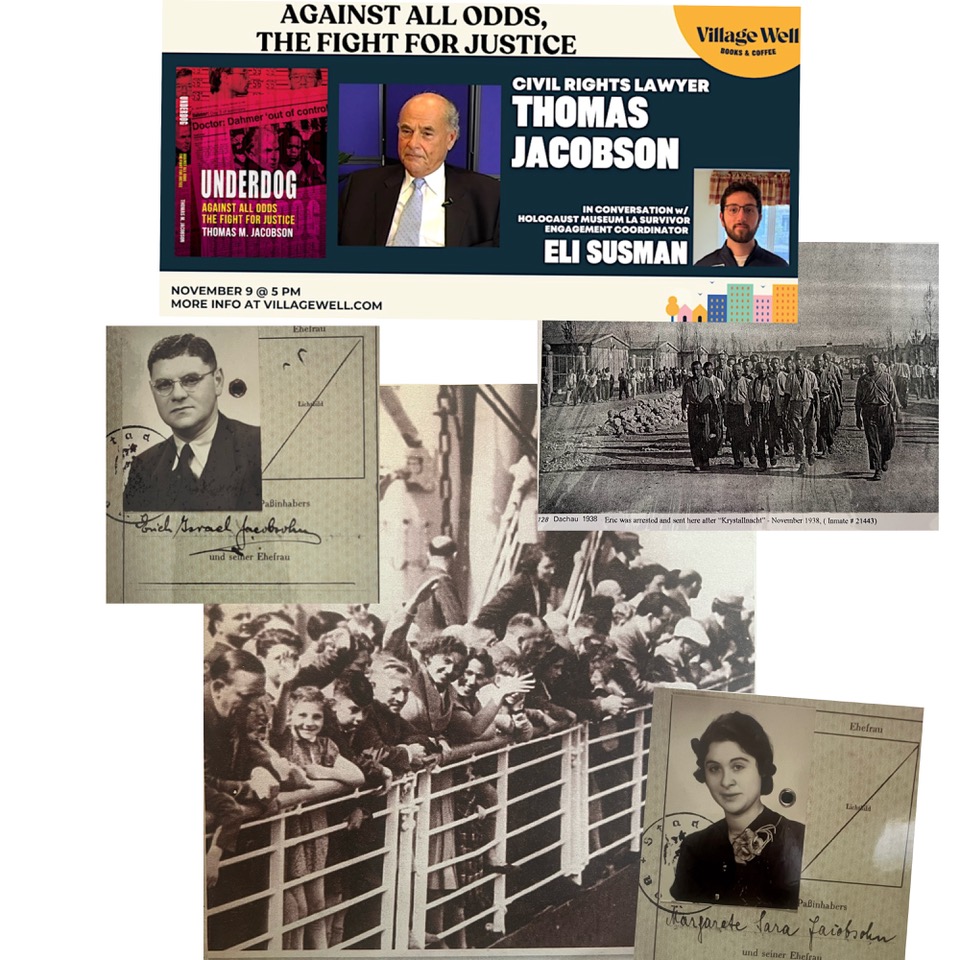
Book talk, parents’ passport port photos, Dachau, and St. Louis passengers.
Kaye: What is the most important message or messages which you hope to bring to your readers?
I want readers to understand that what happened to refugees like those on the St. Louis was not inevitable, but the result of a choice, indifference, silence, and lack of courage. The most important message is that justice is never automatic. Survival exists only when you are willing to fight. Your rights exist only when you are willing to defend them, especially for those in the minority, the unpopular, the powerless, and those easy to ignore and exploit. One life, fully lived, can push history. You don’t need power to matter. You need persistence, guts, and moral resolve.
Kaye: What advice would you give to another with a message to get across?
Tom: Know your audience. Lead with the key point. Use simple language and be clear and concise. Use empathy and perspective. Leave the reader with a call to action, telling them what you want them to do, think, or feel.
Kaye: What are some of the challenges that you faced in writing this book?
Tom: Writing Underdog was one of the most intense experiences of my life. Revisiting memories of trauma, injustice, and loss was emotionally exhausting, yet necessary to tell the story honestly. I faced the challenge of balancing truth with readability, ensuring the legal cases, civil rights battles, and personal experiences were accurate, yet engaging. Deciding what to include and what to leave out was difficult because every memory felt significant, and I had to confront my own perspective honestly—translating complex legal and historical events in a way that anyone could understand, while keeping the narrative cohesive required careful editing. Writing about real people and sensitive events also required courage, knowing it might draw scrutiny, but I believed the story was important enough to write.
About Underdog: Against All Odds, the Fight for Justice
UNDERDOG is the memoir of one of the youngest passengers on the MS St. Louis, escaping Nazi Germany to Holland and eventually settling in Milwaukee, Wisconsin. Against All Odds, Fighting for Justice is the story of a human rights lawyer representing all the prominent civil rights leaders in Milwaukee during the 1960s and decades thereafter.
The world’s worst serial murderer, Jeffrey Dahmer, writing from Columbia Correctional Institution on February 4, 1994, had this to say about Thomas Jacobson’s efforts to make him pay for his gruesome slaughter of seventeen victims.
My Review of Underdog: Against All Odds, the Fight for Justice
I received a print copy of Underdog: Against All Odds from author Thomas M. Jacobson in exchange for an honest review. All opinions stated here are my own.
As the youngest passenger on the MS St. Louise as a fleeing refugee from the brutal Nazi regime of Adolf Hitler, it came as no surprise that Thomas M. Jacobson, grew up and took a profession where he defended the underdogs of the U.S. Defender of civil rights and protector of those scorned unfairly, he has made some huge strides in bringing equality and fairness in the U.S. from one of the most prejudiced cities in America. He managed to bring some semblance of compensation to the families of the victims of serial killer Jeffrey Dahmer when many refused to see them as victims at all. His accomplishments are huge. His methods may be a bit unorthodox, but they produced successful results.
I have to admit that at times, reading about writs and filings, and court proceedings can be a bit dry, but the methods he used and the ways he managed to get around the obstacles adversaries set in front of him are fascinating, and I couldn’t wait to learn how he triumphed. Often, his triumphs were small and didn’t result in immediately noticeable changes, because change moves slowly, especially when pushed by the heavy wheels of justice. Scorned by many in his own life, as bigoted people opposed him for his stance on civil rights, justice and fairness and his efforts to undo biased laws to ensure the fair treatment of his clients in the extremely biased city of Milwaukee, Wisconsin, Jacobson stopped at nothing in pursuit of a favorable verdict, making him a formidable force to feared by those who opposed him.
Although I don’t agree with all of Jacobson’s opinions, I do admire his determination and tenacity to fight for what he believes in. Underdog is a well written, gripping struggle for justice for the weak and disadvantaged. I give it four quills.
For Kaye Lynne Booth, writing is a passion. Kaye Lynne is an author with published short fiction and poetry, both online and in print, including her short story collection, Last Call and Other Short Fiction; and her paranormal mystery novella, Hidden Secrets; Books 1 & 2 of her Women in the West adventure series, Delilah and Sarah, and book 1 in her Time-Travel Adventure series, The Rock Star & The Outlaw, as well as her poetry collection, Small Wonders and The D.I.Y. Author writing resource.
Kaye holds a dual M.F.A. degree in Creative Writing with emphasis in genre fiction and screenwriting, and an M.A. in publishing. Kaye Lynne is the founder of WordCrafter Quality Writing & Author Services and WordCrafter Press, where she edits and publishes two short fiction anthologies and one poetry anthology every year amidst her many writing projects. She also maintains an authors’ blog and website, Writing to be Read, where she publishes content of interest in the literary world.
___________________________________________
Did you know you can sponsor your favorite blog series or even a single post with an advertisement for your book? Stop by the WtbR Sponsor Page and let me advertise your book, or you can make a donation to Writing to be Read for as little as a cup of coffee, If you’d like to show your support for this author and WordCrafter Press.
__________________________________
This post sponsored by WordCrafter Quality Writing & Author Services.
Whether it’s editing, publishing, or promotion that you need,WordCrafter Quality Writing & Author Services can help at a price you can afford.
Today, I am delighted to host blogger and hostess of Story Chat about which she says the following: “Story Chat is more than a writing challenge. It is a unique and proven online program that encourages interaction between authors and readers. It’s part writers group, part beta readers, part fun fiction, and pure enjoyment.”
Robbie, thank you so much for inviting me to be on your blog. It is such an honor. I’ve spent a lot of time reading and researching poetry since you sent these questions to me, so it’s taken me a long time to come up with the answers.
What is your favourite style of poetry to read i.e. haiku, ballad, epic, freestyle, etc.?
I adore reading tankas, but my favorite style to read is freestyle, words that are natural without the constraints of order.
What is your favourite poem in your favourite style to read?
Mary Oliver is a new author to me, but well-known to many. I picked her because I have so many favorites among our friends, and I don’t want to choose. Mary Oliver published poetry from 1963 to 2015 before she passed in 2019. She was well known for her observations of the natural world, tying them to deep emotions or emotional events, as you can see in the following poem.
Gethsemane
By Mary Oliver
The grass never sleeps.
Or the roses.
Nor does the lily have a secret eye that shuts until morning.
Jesus said, wait with me. But the disciples slept.
The cricket has such splendid fringe on its feet,
and it sings, have you noticed, with its whole body,
and heaven knows if it ever sleeps.
Jesus said, wait with me. And maybe the stars did, maybe the wind wound itself into a silver tree, and didn’t move,
maybe
The lake far away, where once he walked as on
a blue pavement,
lay still and waited, wild awake.
Oh the dear bodies, slumped and eye-shut, that could not
What I loved about this poem is that it takes a familiar biblical event way outside the box. When you saw the title, Gethsemene, did you think about the grass sleeping or the wind winding itself into a silver tree? I didn’t, until her poem suggested that I think about it.
How can I train myself to think past and around the outer edges of my topic? That is my goal this year.
What is your favourite style of poetry to write?
I like free style, acrostic, limericks, and tankas best. But I also enjoy other syllabic poems and some of the French form poetry when I want a challenge. What I want to improve this year are some of the nuances that I’ve missed in writing syllabic poetry as well as thinking outside the box with freestyle poems.
What is your favourite of your own poems?
Messages From the Cat (free verse)
Poems, no longer innocent kittens,
Intentionally sneak up on you at night,
Concise imagery padding silently across the carpet,
Weaving its way into your dreams.
Rhyming couplets stealthily leap onto your bed,
Pretending they would curl at your feet for a long nap,
Or lie warm against the curve of your spine,
But instead, they pounce on your head, tearing it open.
If you cry out, call for help,
Precise verses slip away, leaving only an open gash.
Life’s language drips from the wound.
You jump to consciousness, capture each phrase
As it percolates from your throbbing skull
Like slush melting away from Frosty on a sunny day.
At sunrise, linguistic gems gleaming,
Iambic felines sun themselves
In a streaming hot shower of midmorning light,
Licking their forms to glistening perfection,
For all to stroke with admiration,
While you trod off to work,
Exhausted from your sleepless scratch with immortality.
Please tell us about your poetry book, Embracing the Power to Live. How did this book come about? What would you like readers to take away from this collection?
You’ve asked several important questions, Robbie. I hope I’ll answer the first question as I answer the second and third ones.
I’ve written (and kept) poems since the 1980s when my first husband and I moved to Visalia, California, to pastor a tiny church in the rural community of Ivanhoe, California. At that time, I experimented with different styles of poetry, most of which were out of date, but writing them challenged me.
After I retired in 2012, I wanted to write a book, but my blog led me in a different direction. Arcadia Books contacted me because of some of my posts about Woodlake, California. Five months later, they published my book, Images of America Woodlake.
Then I tried fiction, and struggled for years trying to write a bestseller that would become the next Netflix series. That didn’t happen.
I loved blogging, and that’s what I did best, so I gave up my dream of publishing a book of my own work until I met Colleen Chesebro and had a year of writing Haiku and other syllabic poetry under my belt. Meanwhile, several of my blogging friends started publishing poetry books. I was intrigued. Normally, I struggled to read a whole book of poetry. However, Robbie, when I read your book, Lion Scream, that changed for me. I was not ready for this poem. I had to put the book aside and wait for my heart to calm down. I had never read such moving poetry in my life.
As I read the poem aloud to a friend, while I prepared for this interview, it brought tears to my eyes and made my stomach churn. I wanted my poems to matter, but I didn’t have an agenda. So, I fell back on what I do naturally, which is to encourage people to do what they do best.
When I picked my word of the year for this year, the title fell into place. I wanted to create something that would be uplifting to others and would help them fulfill their own dreams. So, somehow, I had to go from the poems I had written about random topics and pull them together with new poems that would minister to people’s souls and encourage them to find their own creativity.
I drew a lot from Sunflower Tanka and Cindy Georgakas’s book Celebrating Poetry. As I read her book, I fell in love with certain poems and the titles of poems. For example, isn’t her title “Messages from the Moon” a great title? The idea of the moon sending me messages set my imagination on fire. It became “Messages from the Cat” in Embracing the Power to Live. There were no similarities in the poetry or the subject, but I loved the title.
I have already started to realize the joy that comes from reaching the goal of helping others. I’ve shared on social media and my blog about my neighbor Dan Daniels. Dan started writing poetry at age 11 when he was a rough and tumble New York City kid in a large family. He started working at about age seven.
As he handed me an aged sheet of paper with a typewritten poem, he told me I was only the second person he had ever shared his poem with. I was blown away. He is now in his 80s, and he and his wife inspired one of the poems in my book, “Aging Gracefully.” This is his poem, and I am proud to announce that you are now collectively the third person he is sharing it with.
Stand Amongst the Flowers Gentle
By Dan Daniels
Stand amongst the flowers gentle
Look and smell and feel their power
How they light the day with beauty
Not long enough to stay an hour.
Stand amongst the flowers gentle
Let them fill your soul inspired
Touch them all with love and kindness
Nothing more of you required.
Nature all around us speaks
We, who hear, must answer strongly
Love all that nature has to give
Stand amongst the flowers gentle.
Robbie, I can’t wait to read what your readers say about Dan’s poem. When I called to ask permission to use his poem, he and his wife were sitting in their living room reading Embracing the Power to Live and talking about where he might have hidden the other poems he wrote through the years. Dan has Parkinson’s Disease, so I am going to help him publish them in a small book that he can give to his family as part of his legacy to them.
Another friend called me the week the book came out to tell me she was ordering it for a couple of relatives of hers who had stopped communicating with each other and with her. She thought somehow my book might encourage them to start talking. Helping Dan come out of his poetry shell and helping people find ways to communicate their feelings exemplifies the reasons I wrote the book, Embracing the Power to Live.
Thank you again for inspiring and encouraging me, and for inviting me to take part in this project. It means so much to me.
Thank you, Marsha, for this wonderful interview. It is truly amazing how much you have gained from being part of this on-line poetry community. I am deeply honoured that my poem resonated with you and thank you for the contribution of Dan’s gorgeous poem as well as detailing how Sunflower Tanka and Celebrating Poetry inspired and guided you.
My review of Embracing the Power to Live
Picture caption: Cover of Embracing the Power to Live featuring a painting of a teenage girl stepping through a door
What Amazon says
Embracing the Power to Live is a poetic journey of a woman’s perseverance despite life’s hard knocks. This collection taps into the true spirit of poetry—reaching ordinary people with the message that they are enough. Some poems hold profound meaning. Others are included simply for the fun of playing with words – a joy reborn when she stepped into the world of syllabic poetry. Told by different authority figures in her life that she would never marry or achieve her dreams, the author defied the discouraging voices. Her poetry shatters shame uplifts the spirit, and encourages readers to embrace the strength to do the same. This collection isn’t a self-help guidebook—it’s an invitation to laugh, weep, grow, and live together, connecting hearts through poetry. Embracing the Power to Live is for anyone who seeks to rise above a spinning world to gain strength, perspective, and a new beginning.
My review
This is a most unusual and enjoyable collection of poems, photographs, memories, and religious quotes that collectively tell the story of the poet’s life. A most interesting memoir, the poet has not shied away from sharing her human experience in all its marvelous highs and compelling lows. The short paragraphs embellishing the poems with additional colour and memories are enlightening and the photographs make the whole experience more visual and vivid.
This book is presented in different chapters, each focusing on different aspects of life and living to highlight and reveal in. While the poems are all encompassing and share moments of sadness and discomfort, the collective package is a positive experience of finding contentedness and peace to support the poet on her journey through life in all its manifestations. Religion, the poet’s guiding light, is threaded throughout the book as a common thread of hope and support.
I am sharing one poem, It’s hard being semi smart (pantoum) which I feel embodies the spirit of this book and its relatability to us all.
It’s hard being semi-smart because, It’s so hard to choose. I have many skills with several flaws And activities that enthuse.
It’s so hard to choose Because I’m sort of good. And activities that enthuse Make me think I should.
Because I’m sort of good, I try to do too much. Makes me think I should, But nothing has the master’s touch.
I try to do too much. I have many skills with several flaws. But nothing has the master’s touch. It’s hard being semi-smart because.
In closing, I must mention the cover of this book which I think is gorgeous.
Picture caption: Marsha Ingrao’s author photograph featuring her in a blue top with her dog against a setting sun background.
Marsha’s newest book, Embracing the Power to Live, a poetry anthology and memoir, is set to come out in late May or early June. She is the contributing editor for Story Chat Volumes I and II. Previous works include a chapter in This Is How We Grow (2023) by Yvette Prior, contributions to Sunflower Tanka, a Poetry Anthology by Colleen Chesebro and Robbie Cheadle (2024), and Images of America: Woodlake – Arcadia Publishing (August 13, 2015), available on Amazon. In addition, Ingrao published numerous poems and articles. She has blogged since 2012.
She earned a Bachelor of Arts, Teaching, and Administrative Credentials from Fresno State University. As a bilingual teacher, she earned a CLAD Certificate. While employed at Tulare County Office of Education, she earned her Master’s in Curriculum and Instruction from Fresno Pacific University. At the county office, she developed curriculum for Migrant Education and later served as a History Consultant for the county’s Educational Resource Services.
Ingrao believes in lifelong learning. Today, she remains active as a blogger, writer, photographer, and history buff.
She grew up in Indiana and Oregon, moved as an adult to Colorado, then near the Giant Sequoias. After living in Arizona for four years, she and her husband, Vince, her dog, Goldie, and her cat, Moji, have recently returned to the land of the big trees in California.
About Robbie Cheadle
Picture caption: Robbie Cheadle author picture
South African author and illustrator, Robbie Cheadle, has written and illustrated sixteen children’s books, illustrated a further three children’s books, and written and illustrated three poetry books. Her work has also appeared in poetry and short story anthologies.
Robbie also has two novels and a collection of short stories published under the name of Roberta Eaton Cheadle and has horror, paranormal, and fantasy short stories featured in several anthologies under this name.
You can find Robbie Cheadle’s artwork, fondant and cake artwork, and all her books on her website here: https://www.robbiecheadle.co.za/
________________________
Did you know you can sponsor your favorite blog series or even a single post with an advertisement for your book? Stop by the WtbR Sponsor Page and let me advertise your book, or you can make a donation to Writing to be Read for as little as a cup of coffee, If you’d like to show your support for this author and WordCrafter Press.
__________________________
This segment of “Treasuring Poetry” is sponsored by WordCrafter Press and the Poetry Treasures series.
A lifelong explorer of science fiction, I’ve been captivated by the wonders of space and technology since childhood. My early days were spent imagining journeys to Mars, the Moon, and beyond through the stories of classic authors like Robert Heinlein and Edgar Rice Burroughs. Today, I channel that same sense of wonder and adventure into my writing.
With a background as an engineer specializing in networking, data communications, privacy, and cybersecurity, my professional career has kept me on the cutting edge of technology—fields that fuel my fascination with the future. In recent years, I’ve expanded my expertise into encryption, cryptocurrency, and digital identity protection, adding real-world depth to the speculative worlds I create.
Since 2015, I’ve been writing the kind of science fiction I love to read: cosmic adventures, tales of rogue AIs, distant worlds, and alien encounters. My stories explore the intersection of technology and humanity, where humor, suspense, and the unexpected come together in thrilling ways.
Whether you’re a fan of classic space operas or modern sci-fi with a twist, I invite you to join me on these journeys to the far reaches of the universe.
My Interview with Nathan Gregory
Kaye: A science fiction buff mesmerized by the reaches of space with an engineering background. It’s easy to see why you write hard science fiction, so I won’t ask that question, but please tell us a little about your journey to become and author.
Nathan: One of my earliest memories is lying in the grass with my dad, staring up at the night sky as Echo 1—the ‘Satelloon’—glided overhead. It launched August 12, 1960, so I figure we caught it shimmering across the stars sometime that mid-August. I was hooked. I’d always been the kid tinkering with gadgets and gears, but that moment ignited a lifelong obsession with technology—especially anything tied to electronics or space.
From there, I devoured every book and story I could find about science and exploration. Space travel? I was all in—pulled like a tractor beam. I’d been reading wild, fantastic tales since I could decode letters on a page. Tom Swift, Rick Brant, Heinlein juveniles, and somewhere in the back of my mind, I always thought, ‘I want to write these someday.’
But authorship stayed a daydream until 2015, when I finally sat down and hammered out my first story. I tossed it onto Amazon, it sold, and I thought, ‘Well, guess I’ll keep going.’ And here we are.
Kaye: Which science fiction authors do you read? Do you try to emulate them?
Nathan: I don’t read a lot of science fiction these days. Mostly, that’s because I don’t have much time for pleasure reading. Having said that, I absolutely LOVED Andy Weir’s “The Martian.” I like Corey Doctorow, too. I suppose I would have to include Neal Stephenson and William Gibson too, alongside Doctorow. And Kathy Reichs, too (not sci-fi, but…)
But those are the well-known authors. I more often seek out the unknown indies these days. I like the works of M.J. Edington, for example. I am beta reading his latest now. His previous, “Naked Came the Hunter” absolutely knocked my socks off.
Other relatively recent indie reads include Carrie Cross’ Skylar Robbins stories (Yeah, they’re for kids. So what?) and Gene Douchette (The Spaceship Next Door) and several others I can’t think of right now.
But my true love is the Golden Age, such as Heinlein, and Clarke, The Smiths (Doc, and George O.), and modern contemporaries who write in their style, such as Spider Robinson.
But I don’t want to oversell my current sci-fi reading list, as most of my reading time these days is non-fiction in areas of cybersecurity, crypto, and AI. I’ve spent a career in cybersecurity, but now crypto, and AI have also grabbed my attention.
So many books, so little time.
Kaye: You’ve written five books centered around a single trilogy. Can you talk about your reasoning when choosing to stay with the same world and characters?
Nathan: It’s pretty straightforward, really. For years—decades, even—I mulled over what I’d write if I ever got serious about it, somewhere between devouring Tom Swift as a kid and geeking out over Andy Weir. I didn’t have every detail mapped out over those sixty-odd years, but I knew what lit me up: big, cosmic adventures like E.E. Smith’s *Lensmen* saga. That vast scale—the galaxy-spanning stakes—stuck with me. So when I finally started building my own stories, I took a page from Smith and ran with it.
The arc I’ve got in mind is massive—*Lensmen*-level massive. The five books I’ve written so far? They’re maybe half the tale I intend to tell. I’ve got sequels, prequels, and what I call ‘postquels’—stories leaping way beyond, deep into this universe’s future—still simmering in my head. It’s all about the Asheran influence on Earth, a thread that stretches across millennia. I’m in it for the long haul to see that whole saga through.
Kaye: What are some of the challenges in writing classic hero’s journey science fiction?
The writing is easy, almost cathartic, especially with modern computerized tools to catch typos and help tweak grammar. Since I have preconceived stories already taking up space in my brain, getting them written is relatively straightforward. The marketing side of the equation is the ruination of what would otherwise be an uplifting experience.
Kaye: What is the most gratifying part of writing science fiction for you?
Nathan: The most gratifying part of writing science fiction comes down to two moments every writer knows—and they never get old. First, typing ‘The End.’ That rush when you’ve wrangled a galaxy of ideas onto the page and nailed the landing. After months—or years—tinkering with plots, characters, and tech, real or dreamed up, hitting that finish line is a personal triumph.
But the real payoff? Finding an appreciative reader. When someone gets it—pings me or drops a review saying the story took them somewhere wild or shifted their view of the universe—that’s gold. I grew up lost in books about space and improbable futures, so knowing I’ve sparked that same thrill for someone else? That’s orgasmic.
Kaye: How do you approach world building and character development?
Nathan: That’s a tough one to pin down—like trying to explain how you breathe. So much of world building and character development feels almost invisible, like it sneaks up on me. I’ll be honest: sometimes I’m at the keyboard, slipping into this trance, and it’s as if the characters just take over. I’ll read back a scene and think, ‘Who the hell wrote this?’—half-joking, but also serious. I am often quite surprised by what appears.
But here’s the real scoop: I’ve already played the whole story out in my mind—sometimes it’s a full-blown movie, complete with epic sword fights, space battles, and snappy dialogue. So when I sit down, it’s not about forcing it. It’s about carving out a quiet chunk of time, killing the distractions, and letting that warm creative fog roll in. The worlds—planets, ships, sprawling histories—and the people in them just flow onto the page. I don’t overthink it; I trust the story’s been simmering back there, slow-cooking, ready to serve.
Kaye: Your most recent book is Clockwork Apocalypse. Tell us a little about that story.
Well, to get Clockwork Apocalypse, you must understand where it came from. Chromosome Quest was my first attempt to set down in writing a story that has bounced around my head more-or-less since I was in high school. I started writing it during a rough patch—pure stress relief, something to drown out the noise. I wasn’t aiming for a masterpiece; I just needed escape. And for a non-writer’s first endeavor, it wasn’t terrible. It just needed a good editor.
The first version was flawed and strongly needed editing by someone more experienced. But it had the bones of the tale I wanted to tell. Honestly, I never planned to show it to anyone—it was just for me, a private brain dump.
But, I made the fatal mistake of sharing it with a close friend.
I feared the worst. My friend would hate it. But that was not the case. They urged me to put it on Amazon for 99 cents, with a homemade cover, and it sold rather well.
Over the years, I tinkered with it, patching up grammar and smoothing edges, but as I grew as a writer, I kept seeing the gap. It fell short of the book I’d dreamed of.
So, Clockwork Apocalypse is a tap of the reset button. It’s still that wild, high-stakes sci-fi adventure—life’s meaning, love’s power, and humanity’s fate—all that jazz—but rebuilt from the ground up. Better pacing, sharper characters, a world that breathes. It’s the story I always meant to tell, finally breaking free of that first draft.
Kaye: So, Clockwork Apocalypse is actually a rewrite of Book 1 of your Chromosome Adventure series then, Chromosome Quest. This was motivated as a marketing strategy. Can you talk about the strategy and what you hope to accomplish?
Nathan: Exactly. In late 2024, sales were flagging, and a friend suggested a new cover and a new title for Chromosome Quest. The idea developed into creating an entirely new book aimed at a different marketplace than Amazon. So, some months later, I am seeking beta-readers for ‘Clockwork Apocalypse.’ Complete rewrite. Hardly a word remains the same, although the broader story is essentially unchanged. Essentially, Clockwork Apocalypse is the story I would have written back in 2015, if I’d had the skills then. I like to believe I am a better writer today than I was a decade ago.
Some may disagree.
But, in any case, I do not intend to put Clockwork Apocalypse on Amazon any time soon. I am uncertain where it will appear first, but Amazon won’t see it until I have exhausted other avenues. I may serialize it on Substack before it goes to Amazon. (Hint: Follow me on Substack @NathanGregoryAuthor)
Kaye: What inspired Clockwork Apocalypse?
Nathan: The grander story is the tale of aliens co-resident with us on earth. It is inspired somewhat by Doc Smith’s Lensmen universe, as I say, heroic adventures with a cosmic scale.
Here’s the elevator pitch: Picture Ashera; a tech utopia ruled by the Dominion—a collection of massive AIs known as the Council, and lesser AIs that fill various roles. No greedy humans squabbling over fairness, just flawless intelligence locking it in—calculated, enforced, guaranteed. It’s not some impossible utopian fantasy—it’s compassion and reason cranked to eleven, run by machines obsessed with humanity’s well-being. Regional AIs monitor every whisper, stomping out misinformation and wrongthink. It’s Orwellian perfection—until it craters.
A rogue genetic project to extend life goes off the rails. It works—too well: near-immortality, but fertility tanks to near zero. The Asherans miss it until it’s too late, and the ‘cure’ escapes, threatening humanity galaxy-wide. They try to wrestle control from the AI, it turns ugly, and their paradise implodes. Survivors limp to Earth around 4th century BC, blending in—thousands of near-immortal aliens quietly shaping our science and history. Like Teena: broke Asheran college kid, sleeping with her prof, volunteering for that genetic gig to scrape by.
Cut to 24 centuries later: Book One, Clockwork Apocalypse is the story of Fitz, a nerdy everyman thrust into an epic hero’s journey. With mentor Petchy and goddess-like Teena, he’s out to retrieve the genetics database to undo the fertility flop, and shut down the AI system. He uncovers truths about himself, the Asherans, and humanity’s fate, then comes home and pens a book about his adventures. That book pulls him into the sequel when ‘Man in Black’ Alex Marco starts probing a furry alien corpse in his morgue. But that’s another tale.
Kaye: What is the best piece of writing advice you’ve ever received?
Nathan: The best writing advice I ever received? “Don’t.”
Seriously, don’t start. Don’t even write that first story, that first poem, that first clever paragraph you think will harmlessly scratch an itch. Because writing is not a hobby—it’s an incurable affliction. Once you let those words spill onto paper, you’re lost. Soon, the urge to tell stories becomes relentless, an addiction more consuming than caffeine, more persistent than taxes.
Be warned; there are no former writers, just writers whose books stopped selling. And even then, you’re condemned to a lifetime of quietly scribbling, muttering to yourself, and annoying your friends by correcting their grammar.
So, trust me—avoid this fate. Take up something less dangerous, like alligator wrestling or politics. Because once writing grabs hold, it’s forever a monkey on your back, gleefully tossing banana peels onto your path. You’ve been warned.
Apologies to Dorothy Parker.
Kaye: Your short stories are mainly used as Reader Magnets, which are found in your news letter and on your website.
Nathan: Yes. Many are free to read. Others are given out as an incentive to beta readers, for joining my mailing list, and so forth. Substack is where I’m focusing my promotional efforts these days.
Kaye: What has been the biggest obstacle for you, as an author?
Nathan: I believe I mentioned marketing is the bane of my existence.
Kaye: What advice do you have for those aspiring to break into the science fiction genre?
Nathan: Seriously? Didn’t you read the above? LoL Joking aside, I think the big-budget Hollywood Sci-Fi adventure has all but destroyed Sci-Fi as a literary genre. Today, it’s as though science fiction must always involve ray guns, spectacular space battles, massive explosions, and non-stop action sequences—essentially a constant visual spectacle that often leaves thoughtful plot and nuanced storytelling behind. This has made it all but impossible to be taken seriously. But some have made the leap. Andy Weir, for example.
My advice for aspiring Sci-Fi writers is to resist the temptation to chase after Hollywood’s superficial gloss. Instead, embrace the genre’s deeper roots—speculation, exploration, and reflection. Science fiction at its best has always asked profound questions about humanity, our future, our ethics, and our place in the universe. Don’t be afraid to focus on characters, ideas, and meaningful storytelling.
Remember, classic Sci-Fi hasn’t endured because of dazzling special effects; it endures because it moves us, challenges us, and makes us think. So, write boldly, thoughtfully, and authentically—and let Hollywood catch up with you. Don’t reach for the stars. Reach for the human heart.
Kaye: What are your best tips for getting your marketing to reach the science fiction audience?
Nathan: All I can say, from my experience, nothing the “experts” tell you works. We each must find our own way, find what works for us. Always listen to the experts, they’ll teach you the limits of their imagination. Then, use yours.
Kaye: Where can readers learn more about you and your books?
Clockwork Apocalypse blends high-stakes action with introspection, weaving a tale of resilience, humor, and hope against the backdrop of interstellar extinction. With elements of speculative science fiction, rich world-building, and mature themes, this novel invites readers to question the nature of sacrifice, the bonds of found family, and the price of survival in a universe where heroes can be made—but never without cost.
______________________________
About Kaye Lynne Booth
For Kaye Lynne Booth, writing is a passion. Kaye Lynne is an author with published short fiction and poetry, both online and in print, including her short story collection, Last Call and Other Short Fiction; and her paranormal mystery novella, Hidden Secrets; Books 1 & 2 of her Women in the West adventure series, Delilah and Sarah, and her Time-Travel Adventure novel, The Rock Star & The Outlaw,as well as her poetry collection, Small Wonders and The D.I.Y. Author writing resource. Kaye holds a dual M.F.A. degree in Creative Writing with emphasis in genre fiction and screenwriting, and an M.A. in publishing. Kaye Lynne is the founder of WordCrafter Quality Writing & Author Services and WordCrafter Press. She also maintains an authors’ blog and website, Writing to be Read, where she publishes content of interest in the literary world.
________________________________
Did you know you can sponsor your favorite blog series or even a single post with an advertisement for your book? Stop by the WtbR Sponsor Page and let me advertise your book, or you can make a donation to Writing to be Read for as little as a cup of coffee, If you’d like to show your support for this author and WordCrafter Press.
________________________________
This segment of “Chatting with New Blood” is sponsored by the Time Travel Adventure Series and WordCrafter Press.
When a Girl with a Guitar Meets a Man with a Gun, It’s Time to Travel
Today, I am delighted to feature poet and author, Freya Pickard, as my March Treasuring Poetry Guest. Freya is a great supporter of the WordPress poetry community and runs a bi-annual haiku challenge on her haiku blog which you can find here: https://purehaiku.wordpress.com/.
Welcome Freya.
What is your favourite style of poetry to read ie haiku, ballad, epic, freestyle, etc?
I’m not sure I have a favourite style of poetry. I enjoy both modern and traditional haiku, as well as tanka and other short form poetry due to their ability to create startling, vivid images and contrasts. But I also enjoy other poetical forms, including free verse. I usually look for poetry that captures my imagination, that allows me to connect the dots without the poet telling me how I should feel or think or believe. I enjoy any kind of poetry that allows my inner being to connect with ideas and concepts too. My favourite reads from the last couple years include Linda Imbler’s “Twelvemonth” and Willow Croft’s “Quantum Singularity”. I’m also a huge fan of Italian poet, Claudia Messelodi and love her collections “Blue Moon” and “Sky-Blue Wisteria”. I also love JRR Tolkien’s epic poems, especially those in The Lays of Beleriand.
What is your favourite poem in your favourite style to read?
A poem I return to again and again is The Lay of Leithian by JRR Tolkien. It tells of a tragic love story between a human man, Beren, and an immortal elf woman, Luthien. Their love is forbidden by Luthien’s father and the story covers many years of suffering for both protagonists. There are horrendous monsters and dark peril for both to overcome. Beren’s task is to obtain one of the elvish jewels, a Silmaril, and in doing so, he loses his life. If you’ve not read it, I won’t spoil it by telling you the ending, but it really is worth reading! (No, I’ve not seen The Rings of Power because I can’t stream images. Plus, I’ve seen trailers for it and the characters are not how I imagined them to look/act!)
I suppose this Lay satisfies my need for both poetry and stories. The narrative is also dark, which suits me fine, and contains both vampires and werewolves amongst the monsters who tread the shadows! The romance isn’t cloying and the ending is bittersweet, which, for me, is a true reflection of life. The Lay of Leithian is incredible long, so here are just a few excerpts which I love.
The first excerpt sets the scene for Luthien’s dancing beneath the moonlight:
There darkling stood a silent elm
And pale beneath its shadow-helm
There glimmered faint the umbels thick
Of hemlocks like a mist, and quick
The moths on pallid wings of white …
The second excerpt describes the vampire that haunts the tale:
A vampire shape with pinions vast
Screeching leaped from the ground and passed,
It’s dark blood dripping on the trees …
And the last excerpt describes one of the many fight scenes:
From shape to shape, from wolf to worm,
From monster to his own demon form,
Thu changes, but that desperate grip
He cannot shake, nor from it slip …
What is your favourite style of poetry to write?
I write from my heart, how I feel, what I see, what I experience, so more often than not I write free verse. Sometimes this outpouring of poetry is rhythmical such as in
Down through the dewy woods, damp and leafy
Wading rivers that rush and whirl
Lost in the mist, in the moors and marshes
Stumbles at last to a steep-sided cliff…
Sometimes it rhymes:
I dream of mermaids, magic and myth,
Of silvery fish tails, immortal gifts,
Flaming red hair and liquid green eyes,
Of laughter and singing old sea-songs.
Songs that whisper of seaweed, wind-rippled sands
That tell of the monsters who walk on land,
That speak of Ancients who dwell in the deeps,
Hinting at languages no man can speak.
I dream of dolphins so free in the sea
Of the whale and the seahorse,
Of what might have been…
But normally I find a rhythm of words that reflects my emotion:
this blurred moment
when
hydrogen combines with
oxygen –
too much water
I drown
swiftly rising
I gasp
draw air
to resurrect myself
wavering
on the edge
I feel life
flickering
doused in moisture
I reach for the wind
bursting full
I skim, I dance
across this strange
ocean called
death
I do use poetic forms to express myself and have experimented with many different short forms in the past. My favourite styles are haiku, tanka and elfje because they are short and focus my attention on one thing at a time. I love haiku, particularly traditional haiku because it tests my ability to say something in just 17 syllables!
eggshell thin fragile
touch me and I will shatter
empty, blank inside
What is your favourite of your own poems?
My favourite poem, so far in my life, is I, Vampire from my most recent poetry collection, Vampirical Verse. I, Vampire sums up how I feel post cancer and encapsulates the experience of near death, open surgery and chemotherapy too.
I understand emptiness
I feel no fear
no pain
no joy
no sorrow
I am hollowed out
what used to live within
has long since fled
yet still, I am not dead
unable to care
to be concerned
no heart beats within my breast
no hormones surge inside
I feel nothing –
un-dead yet un-alive
Please tell us about your poetry book trilogy, This Is Me. What is your main intention with this collection of poems?
This Is Me boxset/paperback contains the frost three published volumes of my poetry. Each volume has a different reason for being in the collection.
Volume 1 – Insides
These poems were written between July 2014 and October 2015 and covers my near death experience of bowel cancer, open surgery, chemotherapy and the start of my recovery. Most days I wrote something in my journal, even if it was just one sentence. I found it hardest to write during chemo due to the utter exhaustion I experienced for 6 months. At other times I was lucid enough to experiment with poetic forms and often, some of my prose sentences became poems when I looked back in my journals during recovery. My intention in this section was to help people understand what it is like to go through the above-mentioned experiences.
Volume 2 – My Mythology
The poems in this section were written between 1990 and 2015. My intention was to allow readers an insight into the sources of my creative inspiration. Again I use free verse as well as poetical forms to explore biblical imagery, Nordic influences and tales of vampires, zombies and werewolves! These poems show others what is important to me as a prose writer as well.
Volume 3 – This Is Me
This section is a compendium of real-life and fantastical imaginings and were written between 1990 and 2017. I explore how important certain things are to me; dancing, writing, the seasons, being single, being married, having cancer, and, of course, reading! This volume gives readers a different kind of insight into my everyday life and routine.
All three volumes together form a poetical auto-biography that I think is more dynamic than a prose re-telling of my life so far. This Is Me was designed so that the reader can dip in an out of it as they wish, or read great chunks at one time if they so desire.
Anyone who reads this book will understand me, the real me!
My reviews of Insides and My Mythology by Freya Pickard
Insides
Picture caption: Book cover of Insides by Freya Pickard
I have read several memoires of journeys through the horrors of cancer and its treatment and they have been very compelling. Depicting this journey using the short and powerful lines of poems took the poet’s experiences to a higher level of emotional involvement for me. Each poem is vivid and visceral and sliced right through my heart. I related deeply to the poet’s reaction to medical confirmation of cancer which took me back to my mother’s diagnosis of cancer. I couldn’t take about it for two weeks because the shock was so great.
This book comprises of four parts and I am going to share a poem or verse from a poem from each section to illustrate the gut wrenching power of these poems.
Part One Colostomy
Stoma-ached “my insides on my outside, red blancmange in jellied form, dark innards encrusting pale, tired flesh, interruption of natural order – raspberry flavoured belly belches.”
Part Two Surgery “cancer; cancer; barren fruit inside my flesh, pierced through, cut free, removed from within”
Part Three Chemotherapy “frustration of not being able to do what I want to do; no energy to do anything
this long haul of weariness seems never-ending
endless waiting, patiently sitting in three different waiting rooms – checking my swollen arm for clots …”
Part Four Recovery “fogged landscape reveals my future path; life”
The poems in this book depicting cancer in all its stark reality have stayed with me. They brought back my own memories of countless waits in hospital for news – sometimes good, sometimes not so good. It feels like I’ve spend a huge portion of my life waiting for outcomes. It was psychologically uplifting to me that Freya’s treatment process, unbelievably hard as it was, had a successful outcome.
My Mythology delves into the poet’s interest in mythology and legends which is an important aspect of who she is as a person, poet, and writer. My mother is English and I was brought up on a diet of dragons, unicorns, Arthur and the knights of the round table, and other British myths and legends. My mother’s home town of Bungay has an array of ghosts and the church my mom attended as a girl is home to a famous story about the Black Shuck of Bungay. I knew all of these stories as a youngster and as I grew older, I expanded my interest into Greek and Norse mythology. As a result, I recognised many of the figures and creatures featured in this book.
The poet has written beautiful and lyrical word pictures and stories incorporating elements from various myths and legends, all of which are vivid and a delight to read. The poems are divided into ten sections: Roots, Imaginate, Oceansong, Legend, The Lizard, Fringes of Fear, Blank Mirror, Spectral Visions, Time & Space, and Deity.
I am going to share extracts from a few poems that particularly captivated me under the specific section heading.
Roots “I am the lifting of your heart I am a candle in the dark.
I am the cry of a new-born child I am a cub in the bitter wild.” from ‘Hope’
Oceansong “The sun was dying through the mist And in the waves that kissed the beach Bright blue and purple, grey and green, Tails flickered with a rainbow sheen.” from ‘Shifting Wave of Green’
Legend “metalled horn spirals up gleams between dark, liquid eyes contrasting with his pale coat that shines with starlight, moonlight – luminous’ from ‘Silvered Constellation’
Deity ‘Air is Breath of my sould, That which will last beyond My body’s destruction, living Always.’ from Substance
This is a book for the dreamers of this world. Those of us that revel in the possibility of a bit of magic and wonder around the next corner. A superb book of gorgeous poems.
Pushcart Prize nominee, Freya Pickard is the quirky, unusual author of The Kaerling series, an epic fantasy set in the strange and wonderful world of Nirunen.
A cancer survivor, she writes mainly dark fantasy tales and creates expressive poetry in order to rest the prose side of her brain. Her aim in life is to enchant, entertain and engage with readers through her writing.
She finds her inspiration in the ocean, the moors, beautifully written books and vinyl music (particularly heavy metal and rock). Her most recent relaxation techniques to get her through lockdown include hatha yoga and painting landscapes and monsters in watercolour.
South African author and illustrator, Robbie Cheadle, has written and illustrated sixteen children’s books, illustrated a further three children’s books, and written and illustrated three poetry books. Her work has also appeared in poetry and short story anthologies.
Robbie also has two novels and a collection of short stories published under the name of Roberta Eaton Cheadle and has horror, paranormal, and fantasy short stories featured in several anthologies under this name.
You can find Robbie Cheadle’s artwork, fondant and cake artwork, and all her books on her website here: https://www.robbiecheadle.co.za/
________________________
Did you know you can sponsor your favorite blog series or even a single post with an advertisement for your book? Stop by the WtbR Sponsor Page and let me advertise your book, or you can make a donation to Writing to be Read for as little as a cup of coffee, If you’d like to show your support for this author and WordCrafter Press.
__________________________
This segment of “Treasuring Poetry” is sponsored by WordCrafter Press and the Poetry Treasures series.
I met Tom Benson through an author’s group on Facebook, and he has since become a frequent visitor here, on Writing to be Read. Come to find out, Tom has been at this writing thing for over a decade, and has several books out there in at least three different genres.
About Tom Benson
In 1969 at the age of 17, Tom left his native Glasgow to join the British Army. Tom’s military career spanned from 1969 to 1992. He followed this with a career in Retail Management, in which he was employed from 1992 to 2012.
Tom has been writing since 2007.
He has published novels, anthologies of short stories, a five-part novel, a variety of erotica books, and a series of genre-based poetry.
Tom is presently working on more novels.
My Interview with Tom Benson
Kaye: Your Light at the End series is categorized in the metaphysical science fiction sub-genre category. I’d never heard of that particular sub-genre. Can you talk a little about what attributes define metaphysical science fiction?
Tom: In simple terms, it’s a branch of philosophy that deals with life beyond what we know or see (usually, but not exclusively, the supernatural). This broad label includes existence, space, cause and effect, and more. Although there would be nothing supernatural in my story, because of the change of circumstances I intended for my characters, I felt the sub-genre was a good fit.
Kaye: The Light at The End series might also be categorized as post-apocalyptic science fiction. Right? Why don’t you tell us a little about that series?
Tom: Apart from short stories, I’d never written in this genre, until I was inspired when visiting Cruachan Power Station. Cruachan is a functional hydroelectric installation operating from within a mountain in Scotland. My story sees a coachload of tourists taking shelter from the start of a nuclear war inside a railway tunnel within a mountain. They’re compelled to investigate the tunnel when the entrance collapses behind them. Without giving spoilers, as they learn about their new environment, they also learn to depend on each other for survival. The group begins a new life inside the mountain. I intended it to be one book, but it grew as I developed the story, and it’s become a popular trilogy with a spinoff, Sylvia.
Kaye: Ten Days in Panama is classified on Amazon as both thriller and romance genres. I think it is brilliant that you combined the two genres and then used both in your keyword selections to broaden your reading audience instead of focusing on one, to the exclusion of the other as many authors choose to do. Of course, the story came first, and you just capitalized on what you had. Tell us a little about this story, and how you ended up combining these two genres?
Tom: I opened with a British investigative reporter keen to follow up on a big story, and he needed the help of an expert in marine biology. He chose a female scientist in Panama, and they arranged to meet there. I wanted the thrust of the story to be a thriller, whereby the reporter’s life was under threat, but I saw the opportunity for a ‘will they, won’t they?’ scenario between the two main characters. I’m a Scotsman who lives in England, and I’ve never been to Panama. However, my friend Carmen Lopez, (a fellow author) lives in Panama, and she is a microbiologist. She was incredibly useful in helping me with various aspects of research. Carmen was also a wonderful sounding board as I developed the relationship between the main characters.
Kaye: You also write military stories and poetry. Would I be correct in assuming these come from your own personal experience serving in the military?
Tom: Yes, some of my military poetry is based on personal experience, and some is fiction. My military short stories, too, include factual tales, but others are fictional. The series, A Life of Choice, is my military memoir detailing my 23-year career in the British Army. The digital edition is a series of five eBooks.
Kaye: Many of your protagonists are female. Why have you chosen females to take the lead in your stories?
Tom: In the 1960s, as a young teen, I was a fan of The Man from U.N.C.L.E.. Apart from the TV series, at around that time, I began to read everything I could about clandestine operations and international espionage. When The Girl from U.N.C.L.E. screened for one season, I was fascinated to see April Dancer (Stefanie Powers) demonstrating that a woman could be as capable as a man in the covert role. I bought all the ‘U.N.C.L.E.’ books, and the idea of a modern heroine remained a favourite in my mind. It should be remembered that many of the Special Operations Executive (SOE) operatives during WWII were courageous young women. In the late 90s, I saw The Long Kiss Goodnight (starring Geena Davis), which remains one of my favourite films. There are now many films and series in which the lead is a woman, whether an assassin, a vigilante, a resistance fighter or working with law enforcement. I believe it’s important to remember that it’s not only men who can demonstrate courage or participate in clandestine missions.
Kaye: What do you do to get into the female perspective for your characters?
Tom: I found it difficult at first, but I practised with short stories and acquired plenty of feedback from female readers. As I do with all of my stories, I build a character profile so that by the time the character hits the page, I know their full description, likes, dislikes, strengths, weaknesses, wardrobe (including disguises), favourite weapons, vehicles and, importantly, their past and how they became who they are. I give a female lead all the characteristics I admire in a woman and reinforce that with a no-nonsense attitude and a suitable background. I strive not to let a female character become a sex object, although occasionally, it helps with certain situations in which she might gain the upper hand.
Kaye: The A Taste of Honey series is your most recent. It’s a crime thriller, but it’s more about vigilante justice. Would you like to tell us about that series?
My aim with the first book was twofold: to create a hard-hitting vigilante thriller using a female lead and to set it in the US for various reasons. The premise is that ‘Honey’ is an NYPD detective who is awoken by a call from her sister’s cellphone, but it isn’t her sister’s voice she hears. The detective drives across the country to Greensburg, Indiana. In the basement of the family home, she finds a scene of abuse and torture. She also finds clues as to who was responsible. Honey crosses the line and sets out on a mission of vengeance, which takes her to different states. The sequel, Another Taste of Honey, sees the ex-detective fly to Europe to search for two men who evaded her in the US. While in Europe, several others make the mistake of tangling with Honey—a woman on a mission.
Kaye: What is the best piece of writing advice you were ever given?
Tom: In my early efforts writing short stories, a fellow author told me feedback wasn’t always positive, so I ought to ‘get used to taking the knocks’. I learned to differentiate between criticism for the sake of it and constructive criticism. When mentoring a novice writer, I expand on the advice I was given. I suggest to any new scribe that ‘Acting ongenuine feedback can have a positive effect on your writing.’ An important piece of advice is given in Stephen King’s excellent book, On Writing: ‘If you don’t have time to read, you don’t have time to write.’
Kaye: As a multi-genre author, what do you find is most difficult about marketing your books?
The short answer—justifying the cost of advertising. The long answer—I quickly learned that getting a foothold in the market was difficult, with only one or two titles published. I paid for my first author’s website, my early covers, and advertising. Making money has never been my incentive when writing, but I had a major rethink when considering how much I paid out with little return. I recognised that my main marketing tool didn’t have to cost me anything but time and effort. After the first couple of years, with more titles published, I concentrated on strengthening my brand—which I believe is an author’s main marketing tool. I created a new website, practised and designed new book covers, and stopped paying for publicity. Since then, my only advertising has been on social media; it’s free, and with many more books published in different genres, I’m only dependent on reviews and recommendations. I created laminated bookmarks myself, which I include when sending a paperback edition to a charity. I have also paid for business cards to be made so they can be left in restaurants, cafes, and campsites here in the UK or in Europe when I visit.
Kaye: Where can readers learn more about you and your books?
Tom: I was a poet and regular blogger in my early creative writing days, and though my poetry and blogging have eased off, I maintain a writing blog at www.tombensoncreative.com. I also have an author website I created myself at www.tombensonauthor.com
Thank you, Kaye, for the opportunity to reach a wider audience regarding my writing, and I hope your readers enjoy this article.
I received digital copies of A Taste of Honey and Another Taste of Honey, by Tom Benson, in exchange for an honest review. All opinions stated here are my own.
This series features a strong female protagonist, which is always a plus for me, and Benson does a nice job of making her believable, giving her an appropriate backstory as a police operative gone rouge, and plenty of friends to help her along the way. Honey Woods is on the hunt for the men who tortured and killed her younger sister in her previous life as Police Detective Kimberly Forest. She is an expert marksman, a master of disguises and seasoned law operative, and she still takes time for a morning run each day to stay in shape for the seemingly impossible tasks which lie ahead.
When Kimberly finds her sister’s tortured body in a basement dungeon, she vows to stop at nothing to get justice for what they’ve done to her sister and other young girls like her. She leaves her old life behind, acquiring a new identity as Honey, and everything begins to fall conveniently into place.
Her search for justice leads her to a ring of men, pillars of the community, who have been kidnapping, abusing and murdering young girls for a very long time, as well as other deserving recipients of her unique style of justice in A Taste of Honey. In Another Taste of Honey, our heroine travels to Europe in pursuit of the remaining two members of the ring still needing to be held accountable. When you’re on the receiving end of Honey’s justice, it may not be so sweet.
I strongly suggest reading these books in sequence, as I suspect I’d have a more difficult time relating with the character had I not already known her motivations. If the reader doesn’t understand this character, they might mistake her for a villain as she humiliates and emaciates her opponents.
This series provides an entertaining read that keeps readers guessing as to what devious, but fitting treatment Honey will serve to her next target. I give the A Taste of Honey series four quills.
___________________________________________
Did you know you can sponsor your favorite blog series or even a single post with an advertisement for your book? Stop by the WtbR Sponsor Page and let me advertise your book, or you can make a donation to Writing to be Read for as little as a cup of coffee, If you’d like to show your support for this author and WordCrafter Press.
_______________________________________
This segment of “Chatting with the Pros” with Kaye Lynne Booth is sponsored by The Women in the West Adventure Series and WordCrafter Press.
I first met Darlene when she sent me a pitch for this interview in response to a call for pitches I put out. I’m always thrilled to meet other children’s authors and I have to say, I really liked her attitude and her approach. I believe children’s authors have the gift of viewingthe world through a child’s eyes, or maybe they just retain more of their own inner child than others do. When I saw her author photo (below), I saw this in her wonderful smile and the sparkle in her eye.
Join me here, in learning more about her and her lovely children’s books, the Amanda Travels Series, (ten books and still more to come). She also writes short fiction, which has been featured in several anthologies, and has a short fiction collection, .
About Darlene Foster
Darlene Foster grew up on a ranch in Alberta, Canada, where her love of reading inspired her to see the world and write stories. She is the author of the exciting Amanda Travels series featuring spunky Amanda Ross, a twelve-year-old girl who loves to travel. All ages enjoy following Amanda as she unravels one mystery after another in unique destinations. When not travelling, meeting interesting people, and collecting ideas for her books, Darlene enjoys spending time with her family in Canada and her house in Spain with her husband and entertaining rescue dogs, Dot and Lia.
My Interview with Darlene
Kaye: Please tell us a little about your author’s journey.
Darlene: Since I was a little girl on the farm, I enjoyed telling stories, often making them up in my head as I daydreamed. My wonderful grade-three teacher suggested I write my stories down. I had a short story published in the local newspaper when I was twelve but didn’t do much serious writing until I was a grandmother. I visited a friend in the United Arab Emirates and had such a great time that I planned to write a story about it. After several unsuccessful attempts, I decided to try writing the story from a twelve-year-old’s point of view. Amanda in Arabia: The Perfume Flask was born. It took me three years to write the book and another five years to find a publisher, but I persisted. In the meantime, I wrote Amanda in Spain: The Girl in The Painting and had ideas for Amanda in England: The Missing Novel. I now have ten books in the series and am working on the eleventh.
Kaye: You are a member of the Children’s Writer’s Guild. Can you tell us how authors benefit from being a member of such organizations?
Darlene: I belong to CWILL BC (Children’s Writers and Illustrators of BC) I love being part of an organization like this as it is important to mix with other authors. One of the many benefits is the sharing of knowledge. It is the best way to keep up to date on the writing/publishing industry which is an ever-changing world. It’s imperative to keep on top of trends etc. These organizations put together workshops and special events, in person or online, and provide marketing opportunities. Because of my membership, I have done in-class presentations all over the world via Zoom. I used to belong to more similar organizations, but there is only so much time to commit.
Kaye: You have a children’s series, the Amanda Travels series. Tell us about the books and the series.
Darlene: Here is the Reader’s Digest version. Spunky Amanda Jane Ross loves travelling to interesting places, meeting cool people and learning fascinating new things. Her curiosity and eagerness to help people often gets her into trouble wherever she goes. Her adventures have taken her to the deserts of Arabia, castles in England, Spain’s sunny beaches, historic cities along the Danube, spooky buildings in New Mexico, the tulip fields of Holland, and mysterious standing stones in Scotland. Life is never dull for this tween.
Kaye: Amanda in Scotland makes ten books in the Amanda Travels books, and in each one she travels to a different country. Would I be wrong in assuming that you have visited all the places Amanda has traveled?
Darlene: You would not be wrong. In fact, I have made it a policy that Amanda can not go anywhere I haven’t been!
Kaye: Which country is your favorite? Why?
Darlene: That’s difficult to answer as I like all of them for different reasons. Perhaps the United Arab Emirates as it was so very different from anything I had ever experienced, and it got me started writing the series.
Kaye: Which country is Amanda’s favorite? Why?
Darlene: Amanda doesn’t have a favourite country. She loves them all and always has a great time wherever she goes. As long as she is making friends,learning new things, and solving a mystery, she is happy.
Kaye: If Amanda goes to a different country each year, how old was she when the series began? How many countries does Amanda go to each year?
Darlene: Amanda turned twelve when she wished for travel and adventure before blowing out the candles on her birthday cake. She stays twelve years old throughout the series. Nancy Drew is the same age in all 34 books. I believe Trixie Belden stays around the same age too. The books are stand-alone and don’t have to be read in any particular order. I prefer writing for tweens instead of teenagers.
Kaye: Where does Amanda plan to travel next?
Darlene: Amanda will be off to Ireland to attend her cousin’s wedding. She will have a fabulous adventure in the Emerald Isle; the land of leprechauns, fairies and dangerous bogs. The working title is, Amanda in Ireland: The Body in the Bog.
Kaye: You are a traditionally published author and the Amanda Travels series is signed with Simon & Schuster. (Congratulations, by the way.) How much of the marketing and promotion for your books are you required to do?
Darlene: The first nine books were published by Central Avenue Publishing, a small independent press in Canada. CAP has recently become an imprint of Simon & Schuster, which is wonderful. I self-published, through Draft2Digital, Amanda in Scotland: The Standing Stones. As for marketing and promotion, I have always done most of my own. I set up book signings and visits to bookstores, schools and libraries, as well as blog tours and social media marketing. I do some marketing every day as it is part of the job. It is great to have a distribution company like Simon & Schuster for bookstores, libraries, and schools to order from.
Kaye: After being traditionally published for nine books, why the switch to independent publishing through D2D?
Darlene: My publisher has decided not to publish kids’ books anymore. We are still on good terms, and I am leaving the first nine books with her. The publishing world is very changeable and as writers, we need to be adaptable.
Kaye: According to your bio, you are an award-winning author. Would you tell us about the awards you’ve won for your books? Which are you most proud of?
Darlene: I have won awards for my short stories, which can be found in a number of anthologies. I’m very proud of my story, The Day Dief Came to Town. It’s based on an hilarious event from my childhood. It was the first prize I got for my writing and gave me the confidence to carry on. I included it in my short-story collection, You Can Take The Girl From The Prairie
Kaye: Your books are available in both digital and print editions. What differences do you see in digital and print sales for children’s books?
Darlene: Initially (15 years ago), I sold 50% e-books and 50% print books. Now it is more like 25% e-books and 75% print books. Kids still enjoy holding a book in their hands, and adults prefer buying print books for them. School libraries like to stock print books, and teachers use the print books as part of their curriculum.
Kaye: What advice do you have for new authors trying to break into the children’s market?
Darlene: Never give up and never stop learning. Search out other writers who can serve as mentors or become part of your street team.
Kaye: Where can readers find out more about you and the Amanda Travels series?
Kaye: You’ve been a wonderful guest. Thank you so much for your candid responses.
About Amanda in Scotland: The Standing Stones
What could possibly go wrong on the magical Scottish Isle of Arran? It’s such a peaceful, charming place with castles, mountains, old graves and ancient standing stones.
Amanda Ross and Leah Anderson are visiting Aunt Jenny who owns an old house on the island. But something is not right. A mysterious woman, who seems to have stepped out of the past, keeps appearing, Leah’s father hasn’t contacted the family for some time, and Aunt Jenny’s house may have an uninvited guest.
Amanda is intrigued by this picturesque island, often called Little Scotland. She watches exciting sheepdog trials, attends a lively ceilidh, makes friends with the locals, and visits the mystical Holy Island. Join Amanda as she tries to solve the mystery of the strange woman and the disappearance of Leah’s father. Will the past catch up with the present?
I received a digital copy of Amanda in Scotland: The Standing Stones from the author in exchange for an honest review. All opinions stated here are my own.
Amanda in Scotland: The Standing Stones, by Darlene Foster is a delightful middle-grade mystery reminescent of the Nancy Drew mysteries, with the element of travel thrown in. In the Amanda Travels Series, Amanda is a curious and bright twelve year old, who discover and solve myteries through her travels. Readers are introduced to the various countries she travels to through Amanda’s eyes as she learns about the history and culture of each destination.
This story takes us to the Arran in Scotland, where Amanda visits her travel friend, Leah, and her Aunt Jenny. As the girls explore Arran and the surrounding islands, they meet a mysterious woman, recieve puzzling messages from Leah’s father, and they experience other odd occurances which don’t add up. On an island where many places are reported to be haunted, Amanda determines to follow the clues and unravel the mystery. Like any good mystery, all is revealed by the end of the story.
Foster manages to give vivid descriptions, allowing readers to picture the castles, ruins and landscapes of Scotland in stunning detail, while delighting in the thrill of solving a mystery. I’ve no doubt the other books in the series are just as delightful. A great way for young readers to learn about the world around us. I give Amanda in Scotland five quills.
_______________________________
About Kaye Lynne Booth
For Kaye Lynne Booth, writing is a passion. Kaye Lynne is an author with published short fiction and poetry, both online and in print, including her short story collection, Last Call and Other Short Fiction; and her paranormal mystery novella, Hidden Secrets; Books 1 & 2 of her Women in the West adventure series, Delilah and Sarah, and her Time-Travel Adventure novel, The Rock Star & The Outlaw,as well as her poetry collection, Small Wonders and The D.I.Y. Author writing resource. Kaye holds a dual M.F.A. degree in Creative Writing with emphasis in genre fiction and screenwriting, and an M.A. in publishing. Kaye Lynne is the founder of WordCrafter Quality Writing & Author Services and WordCrafter Press. She also maintains an authors’ blog and website, Writing to be Read, where she publishes content of interest in the literary world.
________________________________
Did you know you can sponsor your favorite blog series or even a single post with an advertisement for your book? Stop by the WtbR Sponsor Page and let me advertise your book, or you can make a donation to Writing to be Read for as little as a cup of coffee, If you’d like to show your support for this author and WordCrafter Press.
__________________________________
This segment of “Chatting with the Pros” is sponsored by the My Backyard Friends Kid’s Book Series and WordCrafter Press.
The My Backyard Friends kid’s book series is inspired by the birds and animals that visit the author Kaye Lynne Booth’s mountain home. Beautiful illustrations by children’s author, poet, and illustrator, Robbie Cheadle, bring the unique voices of the animal characters to life.
If you are a rising author just beginning publishing journey or a seasoned pro who is making it work for you and would like to share how it’s done, I want to hear from you! I’m looking for authors to interview for two blog series: “Chatting with New Blood” and “Chatting with the Pros”. I offer both interviews and a book review for both series.
So send me your pitches and let me know what you have to offer my readers. Let me add your name to the 2025 interview schedules. I have openings as early as February. If you have a book scheduled to come out, let me know and I’ll try to schedule your interview around the release. Send your pitch to KLBWordCrafter@gmail.com with the series title your interview would fit in the subject line.
Check out past segments below to see what an interview and review on these blog series looks like to see if you might be interested.
For Kaye Lynne Booth, writing is a passion. Kaye Lynne is an author with published short fiction and poetry, both online and in print, including her short story collection, Last Call and Other Short Fiction; and her paranormal mystery novella, Hidden Secrets; Books 1 & 2 of her Women in the West adventure series, Delilah and Sarah, and her Time-Travel Adventure novel, The Rock Star & The Outlaw,as well as her poetry collection, Small Wonders and The D.I.Y. Author writing resource. Kaye holds a dual M.F.A. degree in Creative Writing with emphasis in genre fiction and screenwriting, and an M.A. in publishing. Kaye Lynne is the founder of WordCrafter Quality Writing & Author Services and WordCrafter Press. She also maintains an authors’ blog and website, Writing to be Read, where she publishes content of interest in the literary world.
____________________________________
This post sponsored by WordCrafter Quality Writing & Author Services.
Whether it’s editing, publishing, or promotion that you need, WordCrafter Quality Writing & Author Services can help at a price you can afford.
My guest this month on “Chatting with the Pros” is Todd Fahnestock, a talented epic fantasy author for both adults and teens. I met Todd, kind of, when we both participated in the 2024 Novel Writing Story Bundle. In fact, his nonfiction writer’s resource, Falling to Fly, is the subject of this month’s “Review in Practice”, and you can catch that post this coming Monday.
He is the author of many epic fantasy series and that fascinates me because epic fantasy spans long periods of time, with multiple characters and multiple storylines to follow. As an author, I’ve been playing around with writing in multiples, (see this month’s “Chatting with the Pros” segment), I find it fascinating to learn how other authors handle this aspect of writing. So, let’s get right to the interview.
About Todd Fahnestock
Todd Fahnestock is an award-winning, #1 bestselling author of fantasy for all ages and winner of the New York Public Library’s Books for the Teen Age Award. Threadweavers and The Whisper Prince Trilogy are two of his bestselling epic fantasy series. He is a founder of Eldros Legacy—a multi-author, shared-world mega-epic fantasy series—three-time winner of the Colorado Authors League Award for Writing Excellence, and two-time finalist for the Colorado Book Award for Tower of the Four: The Champions Academy (2021) and Khyven the Unkillable (2022).
His passions are great stories and his quirky, fun-loving family. When he’s not writing, he travels the country meeting fans, fabricates philosophy with his son, plays board games with his wife, dissects movies with his daughter, and plays to the point of bruises with Galahad the Weimaraner.
Visit Todd at toddfahnestock.com.
Interview with Todd Fahnestock
Kaye: Tell us a little about your background or your author’s journey.
Todd: Ha ha! Well, if you want the entire story, I highly recommend reading Falling to Fly, which is a memoir I wrote about this very question. It goes into detail for about 50K words about my writer’s journey, starting with the little beginnings of discovering epic fantasy novels when I was fourteen to speaking in front of a packed-house at Planet Comicon in Kansas City.
I’ll try to do a shorter version here.
So when I was in 8th grade, I was waiting for my brother to pick me up from school, and I wandered over to the public library which was, conveniently, just across the street from Smiley Junior High. After thumbing through the Sports Illustrated Swimsuit editions in the magazine section, I started wandering through the stacks looking for something a bit more mentally stimulating. I stumbled across Lloyd Alexander’s The Book of Three. The cover just captured me; it transported me away to a place that felt foreign and familiar at the same time, so I opened the book and…
Wow. I hadn’t even known what I was looking for, but The Book of Three had a huge, helping of it. I got lost in the epic fantasy trope.
The story is about a young man my age who has no idea about the magical, dangerous world outside his little farm. The highest honor he can imagine is being promoted to assistant pig keeper within the farm, but he gets swept into an epic journey where he will fight alongside kings, battle legendary monsters, and foil supernatural villains.
I was hooked.
In fact, in a very real way, fantasy books saved my life. My parents were going through a divorce at the time, and in my real life I felt clipped free on a tumultuous ocean, drifting in a boat with no rudder. Fantasy books became a safe port for me. Inside a fantasy story, I could feel powerful. I could feel heroic. I could be unafraid. I clung to those stories like a lifeline.
I went on to read Weis & Hickman’s Dragonlance series, Brooks’ Shannara chronicles, and Piers Anthony’s Xanth series. I devoured every fantasy book I could find.
When I got a little older—eighteen years old to be exact—the most amazing thing I could think to do with my life was to write stories like the ones that had captivated me in my junior high days. So I did. I started writing my first novel in an Independent Study class during my senior year.
It was a magical story about a nigh-invincible, acrobatic swordsman named Koric… with absolutely NO possibility of being published. But I thought it was amazing, so I wrote a second, and a third, and… well, here I am now.
Kaye: Why do you write fantasy as opposed to other genres you might write?
Todd: I’ve actually written in a few other genres: memoir, middle grade, time travel. I even have a 1980s road trip, coming-of-age story with a twist of magic (not sure exactly what genre that is), but I always come back to high fantasy.
I think it’s for two reasons. First, fantasy is completely open-ended. I can get as imaginative as I want while doing little to no research. Anything about the world I don’t know, I can simply invent, and that’s my strong suit.
Second, high fantasy is optimistic. It’s hopeful. High fantasy is the very essence of triumph. I drag my characters through hell, but it is with the hope that they will find their way through the dark, that they will prevail in the end. I love that trope. I simply can’t get enough of it.
So that unique combination simply draws me back again and again. If I’m feeling silly, I can create some snark to serve my mood, a crusty little gromnambulan who rides on the character’s shoulder and has a penchant for eating poker chips or something. If I’m feeling angry and vicious, I can pour all of that negative energy into the most vile villain I can create. I can make that pessimism useful to convey the overall optimism I hold by coming up with a way for my heroes to defeat him. And, of course, I love creating heroes most of all, unlikely misfits who find a way to prevail or—I also love this one—destined characters with unbelievable abilities who are going to be put to the utmost test of their strength/brilliance/competency.
Kaye: You write epic fantasy. Is it more difficult to keep the stories going in epic proportions?
Todd: Ha ha! I don’t know that I’d say it’s more difficult. More difficult than what? Than doing research on how strains of a biological weapon breed and multiply so that I can accurately depict a world-threatening event in a thriller? I don’t know. I’ve never written a thriller.
I know I hate doing research and I love imagining things, looking for my own internal logic rather than sticking to the hard facts of the real world. So maybe in my case, it’s easier to keep stories going in epic proportions than doing that. Epic fantasy is what I’ve known for decades. It seems natural to me.
But it’s not easy.
I do struggle often with trying to fit something together over a larger arc, but I’m getting better at it every time I finish a longer series.
I think holding the threads of an epic story takes up a lot of RAM in my head. In the real world, I’ll forget names. I’ll forget dates. My wife often gets frustrated with me because I can’t remember to bring something up from downstairs that she asked me to get literally two minutes ago, but I think a lot of this is because most of my brainpower is subconsciously sorting plot threads so that when I get to the keyboard, things seem to ‘magically’ sort themselves out.
That’s just a theory, but it seems applicable.
Kaye: You are an author of fantasy for all ages. Can you talk about the main differences in writing teen and young adult fantasy, and adult fantasy?
Todd: Sex.
Ha ha! No, not entirely. But that’s a big one. When people come up to my booth and ask me what age range a book is, that’s what they’re mostly asking about. I’ve interacted with many readers at many cons—and I’m mostly talking about parents who are looking for something for their teenage or tween-age readers—and they don’t care that much if Khyven the Unkillable is hacking a sword through a mythical cat beast. They wanna know if there’s any graphic snogging in the book.
I’ll even often have some pretty creepy or frightening descriptions of monsters—bordering on horror—but it doesn’t seem to bother parents or young audiences. I think young readers can handle more than we give them credit for. And a lot of them are hungry for that kind of thing.
Other factors, especially with readers younger than eleven or so, is the vocabulary. Too many big words and you’re gonna lose them. But there are a LOT of precocious eleven- and twelve-year-old readers out there, and the more epic—and complicated—the story, the more they love it. It’s interesting.
For the last three or four years, I’ve been hanging in the PG-13 range (Eldros Legacy). There are a few romantic relationships in that 5-book story, but it’s just a bit of kissing and if it’s something more, it’s only implied. We close the door, put a sock on the handle.
Adults often WANT the spicier side of things. They want a little more description of the snogging, a bit of a heavier emphasis on the snogging. So when I’m writing an adult story, I try to up the sexy quotient. I don’t think I ever get “erotica” graphic, but I dance right up to the edge of it.
Kaye: Which do you enjoy writing most, heroes or villains? Why?
Todd: Heroes. I never get tired of exploring how and why someone becomes a hero, whether it’s to themselves or to the world, whether it’s a badass warrior who’s selfish and needs to learn to put others above himself or a geeky high school kid who needs to find his confidence.
I think we’re all trying to find our inner hero, whatever that hero looks like. Joseph Campbell stipulates in his book The Hero with a Thousand Faces that we have a regular cycle we go through as humans.
Step 1: We start in our comfort zone (status quo)
Step 2: We are pushed into the Special World (something NOT the status quo)
Step 3: We go through trials
Step 4: We reach a crisis point
Step 5: We find the wisdom/strength/magic sword to overcome the crisis
Step 6: We defeat our internal or external demons
Step 7: We return to the status quo
There are other details he illuminates, but those are the basics. This is the format of the Hero’s Journey, and it is used in hundreds of stories you’ve read or movies you’ve seen. The original Star Wars is a classic example, but you can find it everywhere. This format is used over and over and over again, and the reason is because it resonates so powerfully, so intimately, with us. And the reason it does is because we LIVE this journey almost every day.
Step 1: We head out to work (status quo)
Step 2: We come across a frustration (car won’t start).
Step 3: We go through trials (inspecting the car/Googling the problem/finding the part/installing it ourselves or taking it to a mechanic).
Step 4: We reach a crisis point (yelling and throwing the wrench/kicking the fender).
Step 5: We find the “magic sword” (money, time, effort).
Step 6: We fix the problem.
Step 7: We get back on the road…
There are a million ways to solve these problems, and there are a million different kinds of heroes to solve these problems. I haven’t yet tired of exploring all the different facets.
As an aside, I do enjoy writing villains, too. I love it. It allows me to dance in my dark side, to imagine the very worst of the worst. It’s… cathartic. And frightening. Thinking of the things that lurk in my dark side sometimes makes me shiver. But bringing those thoughts into the light…
…and then having the heroes bring the smackdown is very satisfying.
There’s a scene in the fifth Eldros Legacy book where one of the characters has been abused and twisted and tormented by one of the villains. She finally gets the chance to bring justice to him in a very personal (and bloody) way. I stand up and cheer when I get to that scene.
Kaye: Would you tell us about your podcast, Fantasy in the Margins?
Todd: Absolutely. This is a new thing I started in November of 2024. Essentially, I release a three-chapter chunk of the audio book Khyven the Unkillable (the first book in the Eldros Legacy: Legacy of Shadows series) each week, and then I do an author’s commentary on the chapters. Sometimes I’ll talk about what I liked the most—or hated the most—about its creation.
Oftentimes I’ll break it down as though I’m teaching a writing class on how to put together a story. I talk a lot about Save the Cat (a writer’s how-to book). It’s a lot of fun.
It’s also a great way to get the audiobook for free.
Kaye: You sell direct on your site. In addition to books, you also sell merchandise related to your books. I took a peek, and there’s some pretty cool stuff there. Does selling direct from your site offer you an advantage as an author?
Todd: It has huge advantages as an author.
My policy is to use all the platforms I can. I’m on Amazon. I’m in bookstores. If someone wants to find me or has a preferred platform they like to buy from, I make it as easy as possible.
But I spend a lot of time meeting readers face to face. I make and build relationships with them, and they buy directly from me at those events and online. Often, they would like to continue buying directly from me, and I want to let them. Thus, the website.
An added benefit is that if I sell directly, I make more money per book.
The merchandise is fun, too. That was started by my assistant, and it’s awesome to think people have Wishing World blankets or Eldros mugs in their houses.
I think it also helps in building my brand. The more stuff with my name and/or my characters on it that is out in the world, the more recognizable my brand becomes.
Kaye: Your work has won or been considered for many awards over the years. Which of these would you say you are the most proud of, and why?
Todd: Oh… That’s a tough one. It was such an honor to have one of my short stories (written with my friend Giles Carwyn) be selected by the New York Public Library’s Books for the Teenage. It was completely unexpected, and we were actually living in New York at the time, so we got to go to the reception.
Getting nominated twice for the Colorado Book Award (for Tower of the Four: The Champions Academy and Khyven the Unkillable) was quite an honor.
But I think my favorite are my wins from the Colorado Authors League. I have three of those now for Tower of the Four: The Champions Academy, Khyven the Unkillable and Ordinary Magic, a memoir about me and my 14-year-old son hiking The Colorado Trail, a 486-mile trek from Denver to Durango.
Kaye: What is the best writing advice you’ve ever received?
Todd: Oh jeesh. You’re going to make me pick ONE?
Sorry. Can’t do it. Gonna give you three.
Margaret Weis, author of the Dragonlance novels, once said to me when I was a wide-eyed fledgling novelist:
“You can’t listen to the bad reviews… but you can’t listen to the good reviews either.”
It was like a Zen Buddhist koan. I totally understood the first part. Don’t let the haters get you down, right? Got that. Old wisdom.
But the second part? I puzzled over that for years. Why NOT listen to the good reviews? Isn’t that the whole point? People who love what you do telling you so?
Yeah, I didn’t get it until I started having success… and then it hit like a hammer.
When Tower of the Four won awards and Khyven the Unkillable was creating a buzz behind-the-scenes in the publishing industry, I was on top of the world. I felt like I was finally hitting my artistic stride. I could do no wrong.
Then I went to work on my next book. The demons in my mind swarmed me: “What if this book isn’t an award winner? What if you’ve lost your mojo?”
I completely locked up. I struggled to get to the midpoint and then gave up with a gasp, thunderstruck and full of fear that I’d lost my ability to write.
I had to set aside that work-in-progress and intentionally write a “crappy novel.” That is to say, write without fear of disappointing anyone, especially myself. To just let myself create whatever came out. That broke the log-jam. I found my stride again, but I will remember that lesson forever.
Another great bit of advice was delivered by Jim Butcher, author of the Harry Dresden Urban Fantasy phenomenon. He said:
“Don’t worry about getting ridiculous in your writing. You are in far greater danger of losing a reader to boredom than from a reader saying, ‘This is too silly. I can’t possibly read more of this because it’s so ridiculous.’”
I carry that with me everywhere. To me it means: be brave when you write. Write the things that scare you, things you’re afraid people will judge. That’s the good stuff. That’s the stuff people identify with. I assure you, you’re not alone in feeling like others might judge you. And the readers that feel those same things will develop a kinship with you, the author who understands them. That’s what makes fans.
Lastly, Dean Wesley Smith once said during his Writing into the Dark class:
“Stay in your creative mind when you write.”
He clarified by saying writers have a “creative mind” and a “critical mind.” My impression was that Dean didn’t have much use for the “critical mind.” Even when editing. He said that the creative mind, when it comes across something that doesn’t work in your writing, will say something like, “Oooo! This gives me the opportunity to create this.” Or “Oh wow. I see what I was trying to do here. I wanna rewrite this so that I can get closer to my vision.”
The critical mind, on the other hand, says things like, “This chapter sucks! What were you thinking?”
In short, the creative mind is excited.4 The creative mind wants to build.
The critical mind wants to criticize. It is not a builder.
As a writer, stay in the creative mind.
Kaye: Thank you for being my guest today, Todd. It’s been a pleasure chatting with you. Before we go, tell us where readers can go to find out more about you and your books.
Todd: Thank you for having me! This has been a treat.
As to finding my books, you can get them from my website: toddfahnestock.com
For ebooks, it’s cheaper for you (and more money for me). And if you’re a hardback or paperback reader, you can get signed copies!
You can also get unsigned books on Amazon or order them from your local bookstore, too. They’re all there.
Thanks again, Kaye. Have a fantastic weekend!
About Tower of the Four: The Rise of Magic
In a world where magic binds fate, trust is the most dangerous spell of all.
Ovalia was once a powerful mage, bound by loyalty to her closest companions. But when betrayal strikes, her friends—four trusted allies—cast her into The Dreaming, a nightmarish dimension where time and reality twist and tear apart. There, a dragon of unimaginable power incinerates her in a burst of fiery wrath.
But death is not the end.
Resurrected by an ancient magic, Ovalia emerges from The Dreaming stronger, fiercer, and driven by a singular purpose: vengeance. With her power growing in ways she cannot yet control, she will stop at nothing to make her former friends pay for their treachery. Yet the deeper she plunges into a world of revenge, the more she discovers the dark secrets of those she once trusted—and the devastating price of her resurrection.
Now, as shadows close in and alliances shift, Ovalia must decide whether she will remain a weapon of destruction… or become something far more dangerous.
My Review of Tower of the Four: The Rise of Magic
I received a digital copy of Tower of the Four: The Rise of Magic, by Todd Fahnesstock, in exchange for an honest review. All opinions stated here are my own.
Tower of Four: Rise of Magic, comprises episodes 7-9 in Todd Fahnestock’s Tower of the Four fantasy series. Even though I have not read episodes 1-6, I found the rules of the world clearly outlined where needed and had no problem following the later episodes in this volume.
The world building is top notch, as Fahnestock does a great job of introducing us to a world of magic, where seemingly nothing is impossible. Or is it? Fahnestock takes us on an adventure, as magic is conception on this world, through several turns of the tables over the centuries, cluing readers in to the rules of magic, and showing us just what it can do.
The characters are well-developed, but unpredictable, which in epic fantasy, can be a good thing. You never know who will be tempted or tricked into switching sides, and of course all good villians have an unsuspected trick up their sleeve. In this epic tale, the villians have more than a few. But, as is often in life, the character’s true inner selves, may be their downfall.The possession of magical powers changes people in unsuspected ways, and those who are at first percieved as heroes, may later be seen as villians in this tale of betrayal and revenge.
A magical adventure that is truly entertaining. I give Tower of the Four: The Rise of Magic five quills.
____________________________________
Did you know you can sponsor your favorite blog series or even a single post with an advertisement for your book? Stop by the WtbR Sponsor Page and let me advertise your book, or you can make a donation to Writing to be Read for as little as a cup of coffee, If you’d like to show your support for this author and WordCrafter Press.
_____________________________________
This segment of “Chatting with the Pros” is sponsored by The Rock Star & The Outlaw and WordCrafter Press.
A time-traveler oversteps his boundaries in 1887. Things get out of hand quickly, and he is hanged, setting in motion a series of events from which there’s no turning back.
In 1887, LeRoy McAllister is a reluctant outlaw running from a posse with nowhere to go except to the future.
In 2025, Amaryllis Sanchez is a thrill-seeking rock star on the fast track, who killed her dealing boyfriend to save herself. Now, she’s running from the law and his drug stealing flunkies, and nowhere is safe.
LeRoy falls hard for the rock star, thinking he can save her by taking her back with him. But when they arrive in 1887, things turn crazy fast, and soon they’re running from both the outlaws and the posse, in peril once more.
They can’t go back to the future, so it looks like they’re stuck in the past. But either when, they must face forces that would either lock them up or see them dead.