Wrapping up the WordCrafter “Tales From the Hanging Tree” Book Blog Tour
Posted: September 13, 2024 Filed under: Anthology, Blog Tour, Book Release, Books, Dark fiction, Fiction, Giveaways, Guest Post, Horror, Paranormal, WordCrafter Book Blog Tours, WordCrafter Press | Tags: Anthology, Blog Tour, Books, Fantasy, Science Fiction 10 Comments
Tour Schedule
Monday Sept. 9 – Writing to be Read – Reading Excerpt by Joseph Carrabis & Guest Sylva Fae
Tuesday Sept. 10 – Roberta Writes – Guest Kaye Lynne Booth
Wednesday Sept. 11 – Carla Reads – Guest C.R. Johansson
Thursday Sept. 12 – Undawnted – Guest Paul Kane
Friday Sept. 13 – Writing to be Read – Reading Excerpt by Dl Mullan & Guest Matt Usher
The Giveaway
Follow the tour and leave a comment at each stop you visit to let us know you were there and earn an entry in the giveaway for a free digital copy of Tales From the Hanging Tree.
About Tales From the Hanging Tree
Tales from the Hanging Tree is a wonderfully dark, themed anthology which revolves around an ephemeral and timeless hanging tree that absorbs the memories of all hanging victims. This WordCrafter Press anthology was created by invitation only and includes stories from authors Kaye Lynne Booth, Paul Kane, DL Mullan, C.R. Johansson, Joseph Carrabis, Sylva Fae, and Matt Usher.
Book Trailer
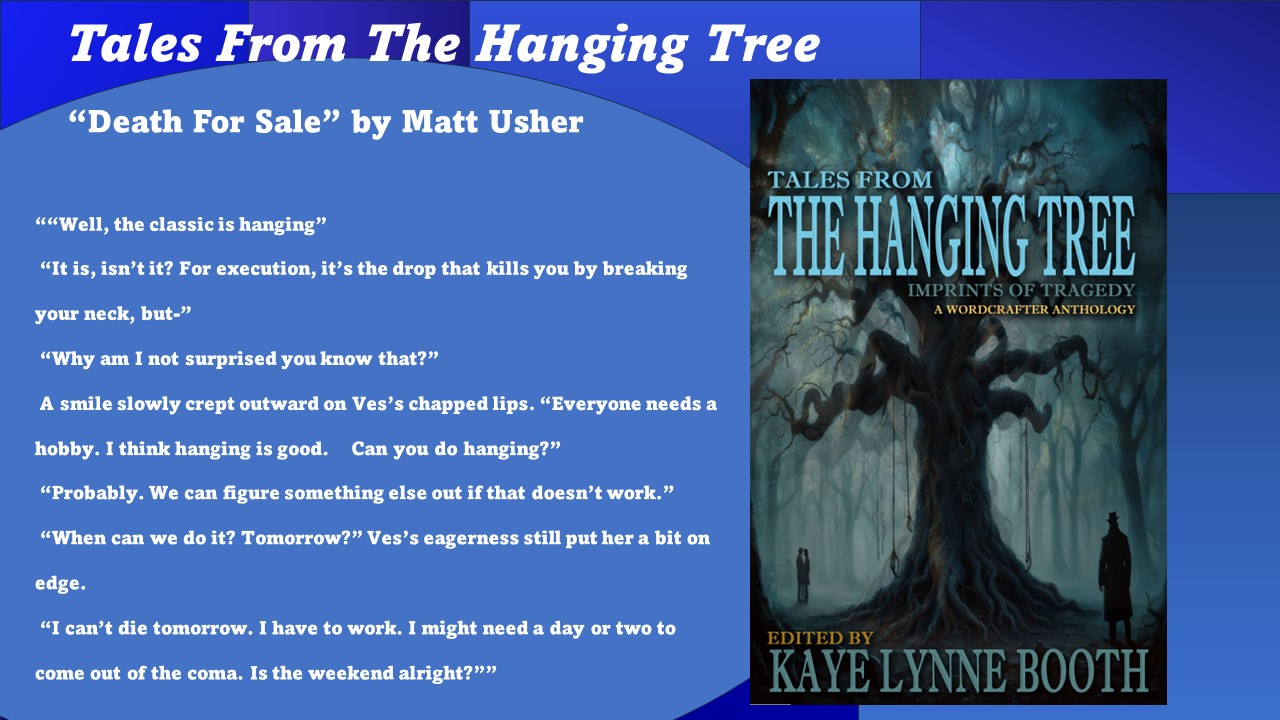
Inspiration for Death for Sale, by Matt Usher
Hanging is harder than it looks. In media, you’re more likely to find your average strangulation hanging. This belies a long history of hanging development. Strangulation is more of an amateur, homespun kind of hanging. Many works in this collection consider this to great effect. Others prefer the cleaner solutions. They both have their appeal.
The history of hanging, dating back to at least Homer, converges in different nations to a common point of development. An odd form of mercy: you see, there’s the short drop, the medium drop, and the long drop of the famed “long drop, short stop”. This is because the merciful version of the art of hanging causes death by cervical fracture long before the patient can enjoy asphyxia. Cleaner that way. No risk of having to watch the hanged make a drama out of the proceedings.
The body’s weight does all the work, leaving the executioner to the simple task of pulling a lever. The English, masters of execution that they were, with a long, long history of hanging innocents, had it down to an exact science. The solution is to make a table that compares the soon to be departed’s height and weight to an array of possible drop distances. This was, of course, to avoid the chances of decapitation with a too-long drop, or a drawn-out death by a too-short one. Jolly humanism at its finest. Wouldn’t want to cause a mess. Unless you happen to fall athwart the long history of botched hangings. But hey, you can’t get it right all the time.
You’ll find plenty to learn about the history and morbid dynamics of hanging in this collection. In my own contribution that takes place in the near future, despite everything I’ve said, I’ve opted for a traditional death by strangulation. It just has that particular frisson. Makes your skin crawl. Others have plumped for the quick and painless style. Why be shy about it when you’re spoiled for choice? So much for the how of hanging; this anthology explores why. Even the Hanging Tree has its reasons.
About Matt Usher
Matt Usher is an agender creature in the big city. Before this, they had no other fiction publications. They write as a critic at Compulsive Reader. They cherish a love of the music of language and a polycule who are the dearest people in their life.
They are the strange sort of being that makes spreadsheets for fun. This is often in service of automatic calculations and data storage for traditional roleplaying games, their most important hobby. Collaborative creativity is one of their most valued things.
They play bass and trumpet, like pro wrestling, and write extremely nerdy poetry. They are immensely neurodivergent and rather queer.

Excerpt from “12 Angry Dead”, by DL Mullan
About DL Mullan
DL Mullan holds a Master of Arts in Teaching and Learning with Technology. Her lecture, Spacescapes: Where Photography Ends; Imagination Begins, debuted at the Phoenix Astronomy Society, which then led to her Sally Ride Festival lecture invitations. Her presentation, Bridging the Gap between Technology and Women, won her accolades at a community college’s Student Success Conference. She has been a panelist at speculative fiction, science fiction, and other regional conventions. Her digital exhibition pieces have won awards at convention art shows, as well as garnered her Second Premium at the Arizona State Fair. Currently, Ms. Mullan’s artistic renditions are seen on book covers, blog sites, and various merchandise. As an independent publisher, she uses her technical background to innovate the way she perceives the creative arts.

As a writer, DL Mullan loves to stretch her imagination and the elasticity of genres. She writes complex multigenre stories in digestible and entertaining forms, be it poetry, short fiction, or novels. Her science, history, mythology, and paranormal research background is woven into her writings, especially in Undawnted’s Legacy Universe. Ms. Mullan’s creative endeavors are available in digital and print collections, from academia to commercial anthologies. She is also an award-winning poet.
Be sure to subscribe to her newsletters and follow her on social media. For further information, visit her at http://www.undawnted.com.

_____________________________________________
That wraps up this stop and the WordCrafter Tales From the Hanging Tree Book Blog Tour. Thank you all for hanging around with us, and thanks to the contributors of the anthology for all their promotional efforts for this tour. Be sure to use the schedule above to go back and visit any stops that you missed, and don’t forget to comment so I know you were there and can enter you in the drawing for the giveaway. I’ll leave this open through the weekend and announce the winners in this month’s “WordCrafter News” on Monday, the 30th, so be watching for that. After all, you might be a winner!
____________________________________
Book your WordCrafter Book Blog Tour today!
Share this:

Day 4 of the WordCrafter “Tales From the Hanging Tree” Book Blog Tour
Posted: September 12, 2024 Filed under: Anthology, Blog Tour, Book Promotion, Book Release, Books, Dark fiction, Fiction, Giveaways, Guest Post, Short Fiction, Stories, WordCrafter Book Blog Tours | Tags: "The Hanging Men", Anthology, Dark fiction, Paul Kane, Tales from the Hanging Tree, WordCrafter Book Blog Tours 2 CommentsToday we’re all ‘hanging around’ over at Undawnted for Day 4 of the WordCrafter Tales of the Hanging Tree Book Blog Tour with a guest post by contributing author Paul Kane about his story, “The Hanging Men”. Join us. (Please leave any comments here on Writing to be Read, as Undawnted is not comment enabled.)
http://www.undawnted.com/2024/09/paul-kanes-hanging-men-from.html
Share this:

Tales From the Hanging Tree Stories Now Featured on Joseph Carrabis: “Death for Sale”
Posted: September 11, 2024 Filed under: Anthology, Book Promotion, Dark fiction | Tags: "Death for Sale", Dark fiction, Joseph Carrabis, Matt Usher, Tales from the Hanging Tree 5 Comments
Share this:

Tales From the Hanging Tree Stories Now Featured on Joseph Carrabis: “Therion’s Heart”
Posted: September 9, 2024 Filed under: Anthology, Book Promotion, Dark fiction | Tags: "Therion's Heart", C.R. Johansson, Dark fiction, Joseph Carrabis, Tales from the Hanging Tree Leave a commentShare this:

Welcome to the WordCrafter “Tales From the Hanging Tree” Book Blog Tour
Posted: September 9, 2024 Filed under: Anthology, Audio Excerpt, Blog Tour, Books, Dark fiction, Ghost Stories, Guest Post, WordCrafter Book Blog Tours, WordCrafter Press | Tags: Anthology, C.R. Johansson, DL Mullan, Joseph Carrabis, Kaye Lynne Booth, Matt Usher, Paul Kane, Sylva Fae, Tales from the Hanging Tree, WordCrafter Book Blog Tours, WordCrafter Press 7 CommentsWelcome to the opening day of the WordCrafter Tales From the Hanging Tree Book Blog Tour. We have a great tour planned, with guest posts and readings from contributing authors, and a great giveaway where you could win a free digital copy of this dark fiction anthology.
Tour Schedule
Monday Sept. 9 – Writing to be Read – Reading Excerpt by Joseph Carrabis & Guest Sylva Fae
Tuesday Sept. 10 – Roberta Writes – Guest Kaye Lynne Booth
Wednesday Sept. 11 – Carla Reads – Guest C.R. Johansson
Thursday Sept. 12 – Undawnted – Guest Paul Kane
Friday Sept. 13 – Writing to be Read – Reading Excerpt by DL Mullan & Guest Matt Usher
The Giveaway
Follow the tour and leave a comment at each stop you visit to let us know you were there and earn an entry in the giveaway for a free digital copy of Tales From the Hanging Tree.
About Tales From the Hanging Tree

There exists a tree that is timeless, spanning across all dimensions, which absorbs every life as those who are hanged as they die… and it remembers every one. The stories within are a select few of the Tales From the Hanging Tree.
Tales from the Hanging Tree is a wonderfully dark, themed anthology which revolves around an ephemeral and timeless hanging tree that absorbs the memories of all hanging victims. This WordCrafter Press anthology was created by invitation only and includes stories from authors Kaye Lynne Booth, Paul Kane, DL Mullan, C.R. Johansson, Joseph Carrabis, Sylva Fae, and Matt Usher.
Reading from “Mercy”, by Joseph Carrabis
About Joseph Carrabis
Joseph Carrabis told stories to anyone who would listen starting in childhood, wrote his first stories in grade school, and started getting paid for his writing in 1978. He’s been everything from a long-haul trucker to a Chief Research Scientist and holds patents covering mathematics, anthropology, neuroscience, and linguistics. After patenting a technology which he created in his basement and creating an international company, he retired from corporate life and now he spends his time writing fiction based on his experiences. His work appears regularly in several anthologies and his own published novels. You can learn more about him at https://josephcarrabis.com.

Inspiration for “The Devil’s Mark” by Sylva Fae
I am an author from Lancashire, England, and my maiden name was Jan Southworth – both of these facts are quite relevant to finding inspiration for the story.
Salmesbury Hall, a beautiful stately home in Lancashire, in the north of England, was originally built for the Southworth family, (one of the oldest families in the country) who resided there between 1325 and 1678. The house has a chequered past, which includes religious persecution, betrayal, witchcraft and murder. From being a young child, I was fascinated to read the history of my ancestors, the lords and ladies, saints and witches, but in particular about the women accused of witchcraft.
Jane Southworth was one of three women tried for maleficium, causing harm by witchcraft, in the Lancashire Witch Trials of 1612. The family was split at the Reformation, with one half staying Roman Catholic and the other half, including Jane and her husband, converting to the Protestant Church. There were strong disagreements, and when Jane’s husband was disinherited, her father-in-law spread rumours of her being a witch. Later, Jane and two others, were accused of witchcraft by a child named Grace Sowerbutts. Grace gave evidence at trial of witnessing the women shapeshifting into dogs, meeting with demonic creatures in the woods at night and murdering and eating a child. The accused women beseeched Grace to tell of who had coached her, and when cross-examined, it came out that she had been told what to say by Sir Christopher Southworth, a Jesuit priest. Thankfully, the evidence was thrown out and the women were acquitted, but sadly this was not always the case.
The themes of innocent women being accused of witchcraft, merely because they were deemed different or troublesome, seemed the perfect basis for the Hanging Tree anthology story. My story is purely fictional, but uses research taken from real trials and the ridiculous reasons some of these women were accused of witchcraft. I also like to see justice served, but you’ll have to read the story to find out how this happens in The Devil’s Mark.

About Sylva Fae
Sylva Fae is a married mum of three from Lancashire, England. She grew up in a rambling old farmhouse with an artistic family and an adopted bunch of dysfunctional animals. Her earliest memories are of bedtime stories snuggled up close to Mum to see the pictures. It was a magical time, those last special moments before dozing off to sleep would feed dreams of faraway lands and mystical beings. She spent twenty plus years teaching literacy to adults with learning difficulties and disabilities and now lives in Cheshire, juggling being a mum, writing children’s stories and keeping up with the crazy antics of their naughty rabbits.

Sylva and her family own a small woodland and escape there at every possible opportunity. Adventures in their own enchanted woodland, hunting for fairies and stomping in puddles, originally inspired Sylva to write stories for her girls. Whether it’s sat at the campfire in her own woods, or pottering around the beautiful local countryside, Sylva now finds her story inspiration being out in nature.
Sylva published her first children’s book Rainbow Monsters, in 2017. She has since published seventeen other children’s picture books, three chapter books, five illustrated anthologies, and has several short stories published in other anthologies. Three of her books have won Best in Category for children’s books at the Chanticleer International Book Awards and she’s won ten Reader’s Choice Awards. In addition to writing her own, Sylva has ghost written several books, and is an editor and writer for Connections eMagazine.
Links
Amazon author.to/SylvaFae
Facebook https://www.facebook.com/SylvaFae
TikTok @sylvafae54
Instagram @sylvafae
_______________________________
That wraps up today’s stop on the WordCrafter Tales From the Hanging Tree Book Blog Tour. Follow the tour through links in the schedule above and leave a comment for a chance to win a free digital copy of the book. Tomorrow we’ll be over at Roberta Writes, where I will be Robbie Cheadle’s guest. So be sure to join us there, where I’ll share my inspiration for this dark anthology.
__________________________
Book your WordCrafter Book Blog Tour today!
Share this:

Tales From the Hanging Tree Stories Now Featured on Joseph Carrabis: “The Hanging Men”
Posted: September 7, 2024 Filed under: Anthology, Book Promotion, Dark fiction | Tags: Dark fiction, Joseph Carrabis, Paul Kane, Tales from the Hanging Tree, The HAnging MEn 4 CommentsShare this:

Tales From the Hanging Tree Available for Pre-Order
Posted: September 5, 2024 Filed under: Anthology, Book Promotion, Book Release, Books, Dark Fantasy, Dark fiction, Horror, WordCrafter Press | Tags: C.R. Johansson, Dark fiction, DL Mullan, Joseph Carrabis, Kaye Lynne Booth, Matt Usher, Paul Kane, Sylva Fae, Tales from the Hanging Tree, WordCrafter Press 1 CommentThere exists a tree that is timeless, spanning across all dimensions, which absorbs every life as those who are hanged as they die… and it remembers every one. The stories within are a select few of the Tales From the Hanging Tree.
Stories by Kaye Lynne Booth, Paul Kane, DL Mullan, C.R. Johannson, Joseph Carrabis, Sylva Fae, and Matt Usher.
To release on September 10, 2024. Available for pre-order now: https://books2read.com/Hanging-Tree
______________________________
And don’t miss the WordCrafter Tales From the Hanging Tree Book Blog Tour September 9 – 13. Find out more right here, on Writing to be Read.
______________________________
This post is sponsored by WordCrafter Press.

This post is sponsored by WordCrafter Press.
Share this:

Writer’s Corner: Writing Short Fiction
Posted: September 2, 2024 Filed under: Anthology, Books, Short Fiction, Stories, WordCrafter, WordCrafter Press, Writer's Corner, Writing | Tags: Anthologies, Kaye Lynne Booth, Short Fiction, Writer's Corner, Writing Tips, Writing to be Read Leave a comment
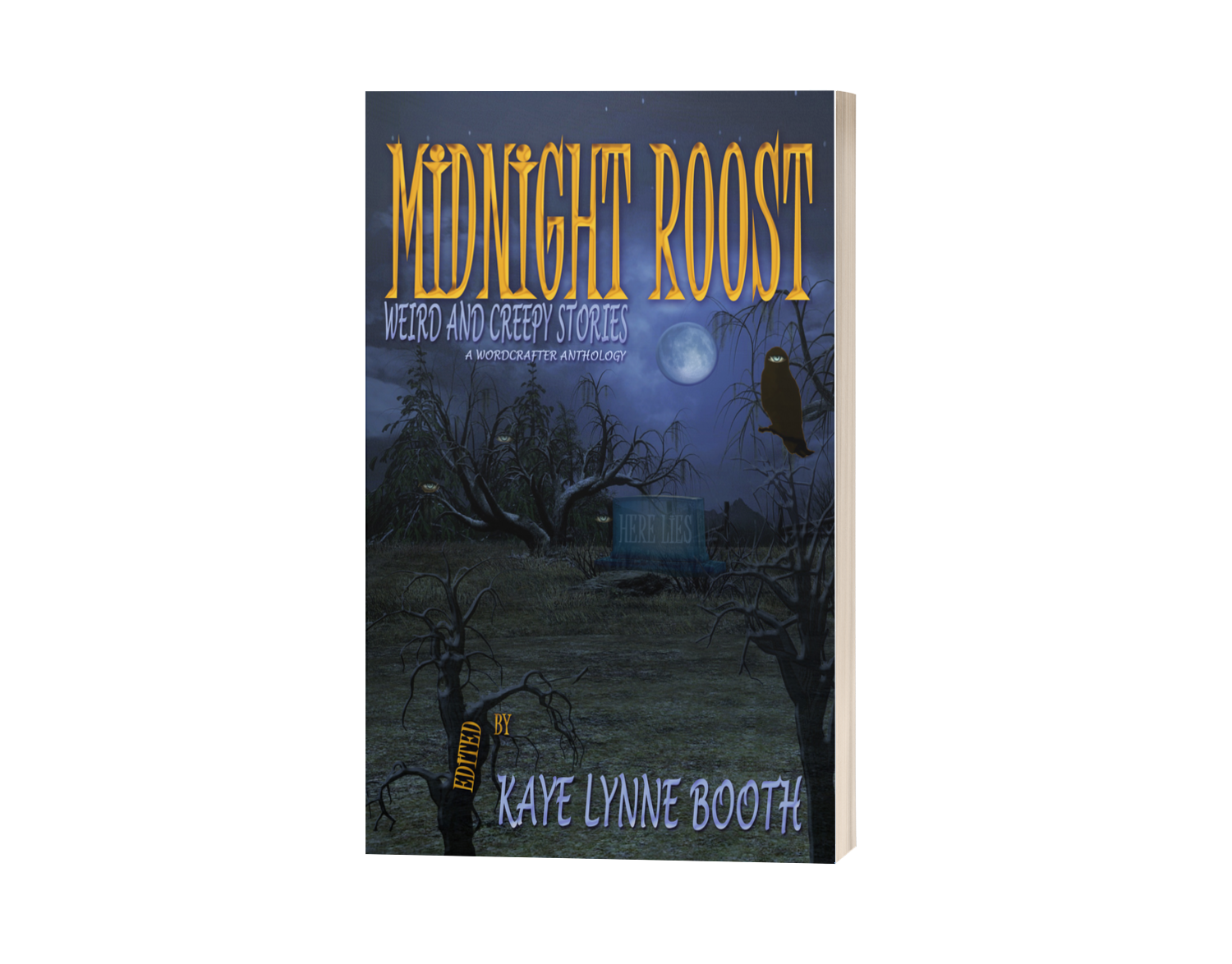
WordCrafter Press runs an annual short fiction contest and publishes a resulting anthology. It began back in 2019, with a short fiction contest which resulted in the Whispers of the Past paranormal anthology. That anthology ended up with nine stories, by seven different authors for a total of 107 pages. Last year’s (2023) dark fiction anthology, Midnight Roost: Weird and Creepy Stories, was a combination of contest entries and submissions by invitation, included twenty-three stories, by twenty different authors for a total of 403 pages. So, the annual anthology has grown in both scope and quality over the years.
To date, WordCrafter Press has a paranormal and a multi-genre (fantasy, science fiction, paranormal,and horror) anthology trilogy, (which is made up of both contest entries and submissions by invitation), and I’m currently building a dark fiction triology, as well.


This year’s dark fiction anthology, Midnight Gardens, will be spectacular as Book 2 of the WordCrafter Midnight Anthology Series, partnering up with last year’s Midnight Roost.


Writing short fiction is different than writing novel length works in many ways. Although short stories still require most of the same story elements as longer tales do, writers of short fiction must deal with them in a condensed format. There is no room for wasted or unnecessary words.
Likenesses with Short and Long Fiction
Like longer fiction, many of the story elements are still required to make a good story. Both formats need:
- A good hook to draw the reader into the story: For longer fiction, this can be accomplished in the first few paragraphs, or maybe even the first page, but for short fiction, it must be accomplished quickly, within the first paragraph, or even with the first sentence.
- An inciting incident: The inciting incident occurs at the beginning of the story and usually involves the main character making a choice which propells him into the tale and gets things moving. This is usually what makes the reader care about the character and what will happen next, making them keep reading.
- Well developed and interesting characters: With short fiction, this can be tricky because you don’t have a lot of time in which to build character. I make my short fiction characters dynamic and colorful to make them stand out from the page and bring them to life for my readers quickly. No matter the length of the work, the author should always know way more about the character than they will ever use in the story. A character which is alive in the author’s mind first and foremost, making it easier to bring them to life for the reader. (I discuss several methods of character development in my “Writer’s Corner” post from September 2023, “Developing Characters with Depth”.)
- Meaningful dialog: In short fiction, every word must count, so there is no room for everyday chit-chat. Every piece of dialog must serve a purpose. It is possible to let the reader see every nuance of your characters through the dialog consisting of both outer and inner dialog, as well as subtext, or unspoken body language, which can be used to emphasize or contradict spoken dialog. (I talk more about the use of subtext in my April 2024 “Writer’s Corner” post, “Visceral Character Portrayal”.)
- Descriptive details: Use one or more senses to describe the setting and set the scene for readers, allowing them to experience the setting or location through the character’s eyes, ears, nose, mouth and skin.
- Conflict and tension: Conflict can be either internal or external, or ideally, both, but it must force the character to make a choice and take action. Tension is created by events which involve opposing forces within the character (internal), between the character and opposing characters or forces beyond the character’s control (external). Obstacles are often placed in the way of resolving the conflict, making it even harder and increasing the tension even more.
- A satisfying resolution: All conflicts should be resolved at the end of the story in a manner that will satisfy readers and not leave them feeling cheated. This can happen in any number of ways, but the conflicts that we’ve spent the last few pages building up to must be resolved in a manner that is logical and believable for the reader. Things don’t have to be all fixed, but we at least need an inkling that things have changed and are now headed in the right direction.
Differences with Short and Long Fiction
- The right point of view and tense for the story: Many longer tales are told in the third person, past tense, which serves them well. Because we want to move through a short story rather quickly, we may need the story to move along at a faster clip. Often, this can be accomplished in short fiction by using a first person, present tense, giving the tale an intensified sense of immediacy, making short fiction better suited to this approach than for longer fiction.
- Quick build up to climax or turning point in the story: This is what the reader has been waiting for, the climatic moment that will change everything from this point out. It could be an epiphany where the character realizes what must be done, or maybe he knew it all along and this is the moment when he decides to do it, but it should bring about some sort of resolution. In short fiction, you don’t have the luxury of a slow build, making it necessary to ratchet up the tension quickly and get to this point directly.
- Descriptive dialog tags: For longer fiction, I was taught to stick to basic dialog tags, such as “said”, “asked”, “replied”, and maybe, “cried”, and then, use descriptors to illustrate the mood and tone, and raise emotion in and connect with readers. However, I have found that more descriptive dialog tags such as “smirked”, or “bellowed” are quite acceptable and even preferable for setting the scene with a minimal amount of words. I’m also beginning to see the value in leaving out the dialog tags all together where it is clear who the speaker is, to help keep the word count down by cutting out unnecessary words.
My Tips for Writing Short Fiction
- Begin close to the end. The beginning of the story illustrates what was and the ending illustrates how things have changed or at least, the direction in which they are now headed. A trick used in screenwriting is to mirror the ending at the beginning, and then go back in time to show how we got to that point. So the first and last scenes act like bookends to your story. By mirroring your first and last paragraphs, this technique can also work well with short fiction, where there is limited space in which to tell your tale.
- Each character should get their own paragraph containing dialog and subtext to show how the dialog is being delivered and making it clear to readers who is saying and doing what. When you switch characters, you switch to a new paragraph, (but not to a new point of view).
- Include enough setting description to let readers get a visual image in their minds, but only include those details that will add to the story or help progress the plot, moving the story forward.
- Choose a single point of view and stick with it. In short fiction, there isn’t enough room to develop multiple characters, so put us into one character’s head and leave us there.
- From an editor’s perspective, (one who reads through and edits a lot of short fiction), please format your manuscript in standard manuscript format, with title and author name centered at the top of page, in a legible 12 pt. font, double spaced. And most importantly, follow submission guidelines!
Advantages of Anthologies
So, why do I go to all the trouble of reading through all these submissions, compiling and editing, formatting and publishing all these anthologies?
I’ll tell you. It takes a lot less time to write a short story than it does a novel, so publishing two or more per year allows me to get my name out there on more books each year. And it’s mutually beneficial to all contributors, as they are able to claim the book for their own author pages, so they are getting more books out there, too. It’s a win-win.
Plus, if all the contributors help with promotion, broadcasting to their readers about the book, you get the results of a much wider reach with your marketing, which means we sell more books. WordCrafter antholgies pay out with a royalty split, so the more books we sell, the more we all make. Again, win-win.
If you’d like to get a story into a WordCrafter anthology, watch for the call for submissions for next year’s contest in October, after the release of Midnight Garden on October 8. I’m putting it out early this year, (I usually do it right at the beginning of each year), and may be changing the submission deadline, so even if you have submitted to past contests, be sure to keep an eye out for the call. I will also be announcing the title for next year’ s anthology and cover reveal. (For now, I can tell you that it will be the third volume in the Midnight Anthology Trilogy, so it will be more dark fiction).
About Kaye Lynne Booth
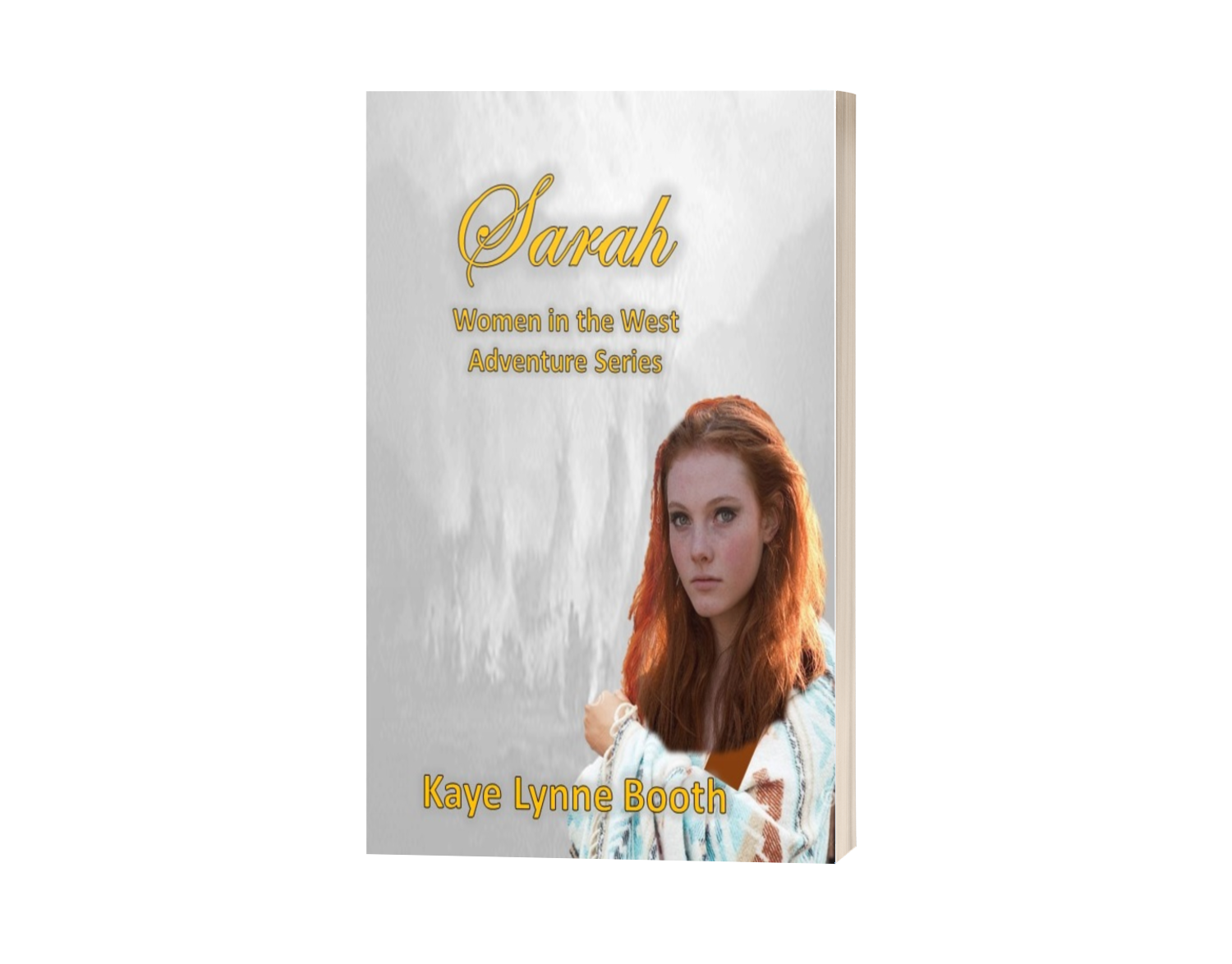
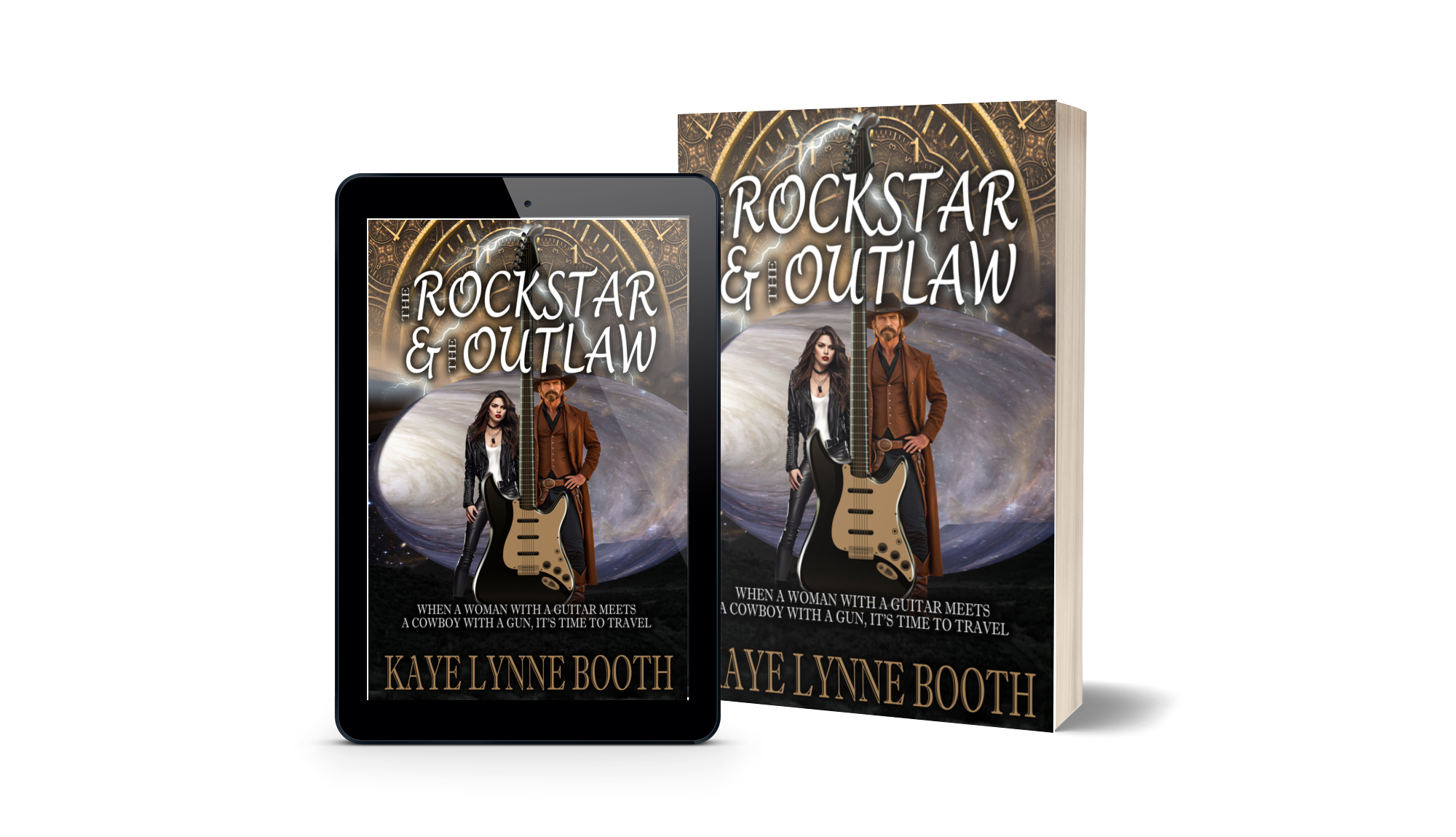
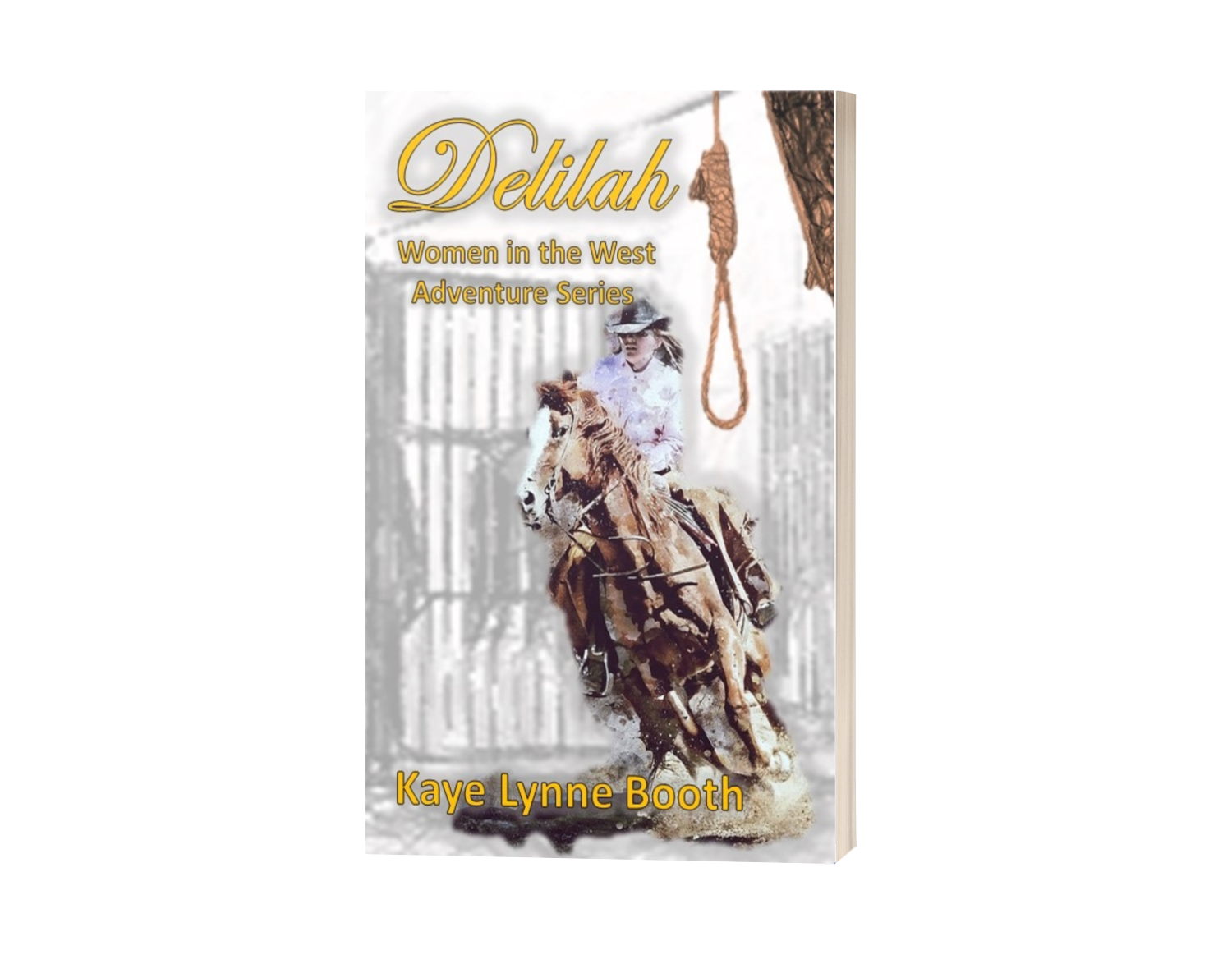
For Kaye Lynne Booth, writing is a passion. Kaye Lynne is an author with published short fiction and poetry, both online and in print, including her short story collection, Last Call and Other Short Fiction; and her paranormal mystery novella, Hidden Secrets; Books 1 & 2 of her Women in the West adventure series, Delilah and Sarah, and her Time-Travel Adventure novel, The Rock Star & The Outlaw. Kaye holds a dual M.F.A. degree in Creative Writing with emphasis in genre fiction and screenwriting, and an M.A. in publishing. Kaye Lynne is the founder of WordCrafter Quality Writing & Author Services and WordCrafter Press. She also maintains an authors’ blog and website, Writing to be Read, where she publishes content of interest in the literary world.

________________________________
Want to be sure not to miss any of Kaye’s “Writer’s Corner” segments? Subscribe to Writing to be Read for e-mail notifications whenever new content is posted or follow WtbR on WordPress. If you find it useful, interesting, or just entertaining, please share.
________________________________
This post is sponsored by The D.I.Y. Author and WordCrafter Press.
Being an author today is more than just writing the book. Authors in this digital age have more opportunities than ever before. Whether you pursue independent or traditional publishing models, or a combination of the two, being an author involves not only writing, but often, the publishing and marketing of the book.
In this writer’s reference guide, multi-genre author and independent publisher, Kaye Lynne Booth shares her knowledge and experiences and the tools, books, references and sites to help you learn the business of being an author.
Topics Include:
Becoming Prolific
Writing Tools
Outlining
Making Quality a Priority
Publishing Models & Trends
Marketing Your Book
Book Covers & Blurbs
Book Events—In Person & Virtual
And more…
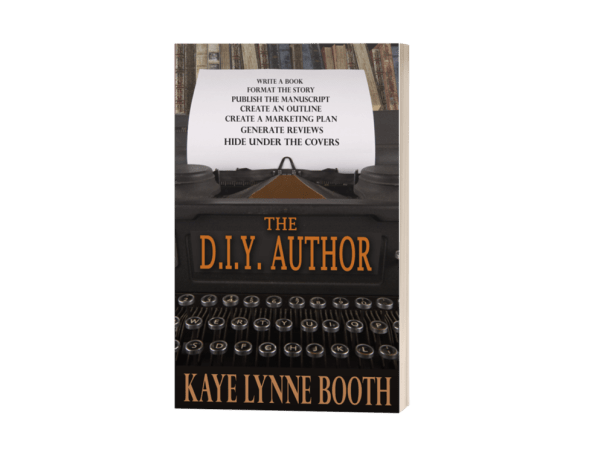
Purchase your copy today: https://books2read.com/The-DIY-Author
Share this:

WordCrafter News: September Release
Posted: August 26, 2024 Filed under: Anthology, Blog Tour, Book Release, Books, Dark fiction, Fiction, Short Fiction, Stories, WordCrafter Book Blog Tours, WordCrafter News, WordCrafter Press 2 Comments
Tales From the Hanging Tree: Imprints of Tragedy
To be released September 10. Join us for the book blog tour September 9-13 and help us launch this anthology right.
Seven authors bring you eight deliciously dark tales. Featuring the short fiction of Kaye Lynne Booth, Paul Kane, DL Mullan, C.R. Johansson, Joseph Carrabis, Sylva Fae, and Matt Usher.

If trees could talk…
An ephemeral tree with its roots buried in the fabric of time absorbs the memories and emotions of all hanging victims. Within these bindings, you’ll find their tragically dark tales of be bigotry and bias, curses and deception.
Warning: There are no happy endings.
Share this:

2024 WordCrafter Dark Fiction Anthology: Title & Cover Reveal
Posted: August 12, 2024 Filed under: Anthology, Books, Dark fiction, Short Fiction, Stories, WordCrafter Press | Tags: Anthology, Midnight Anthology Series, Midnight Garden, Midnight Roost, WordCrafter Press 4 CommentsI am pleased to announce that the 2024 WordCrafter Dark Fiction Anthology will be released in October under the title Midnight Garden: Where Dark Tales Grow, and bearing the fantastic cover above, designed by Sonoran Dawn Studios. Midnight Garden will be joined by last year’s anthology, Midnight Roost: Weird & Creepy Stories, and next year’s anthology, Midnight Oil: Stories to Fuel Your Nightmares, to make up the Midnight Anthology Series from WordCrafter Press.
Midnight Garden features 21 fabulously dark stories – the works of seventeen talented authors, including Paul Kane, El Rodman, DL Mullan, Joseph Carrabis, Robbie Cheadle, Denise Aparo, Jon Shannon, Paul Martz, Zack Elafy, Robb T. White, Abe Margel, Julie Jones, Molly Ertel, Peter McKay, Kaye Lynne Booth, Daneka Scrimshaw, and the winning story in the 2024 WordCrafter Short Fiction Contest, “The Seagull Man”, by M.J. Mallon
___________________________
This post is sponsored by Midnight Roost: Weird and Creepy Stories, book 1 in the Midnight Anthology Series from WordCrafter Press.
On Sale Now.

Get your copy today: https://books2read.com/MidnightRoost