#Blogtour – The Click of a Pebble by Barbara Spencer Day 3
Posted: February 24, 2021 Filed under: Uncategorized Leave a commentFor Day #3 of “The Click of a Pebble” Book Blog Tour finds us at “Robbie’s Inspiration” , with an intriguing guest post from author Barbara Spencer about magical realism and how “The Click of a Pebble” came into being. Join us there and learn more about this wonderful fantasy novel.


Today I am delighted to welcome talented author, Barbara Spencer, to Robbie’s Inspiration for Day 3 of her The Click of a Pebble book tour hosted by WordCrafter Blog Tours.
You can find Day 1 here: https://writingtoberead.com/2021/02/22/welcome-to-wordcrafters-the-click-of-a-pebble-book-blog-tour/
You can find Day 2 here: https://pattysworlds.com/2021/02/23/wordcrafters-the-click-of-a-pebble-book-blog-tour-writing-to-be-read-day-two/
The Series: Children of Zeus
‘Where Historical Fiction and Fantasy Collide’
After a decade or more writing for children and young adults, I pretty much know my way around a children’s book. A couple of years ago, deciding I need a new challenge, I turned my attention to writing magical realism for adults.
But what is magical realism and how does it differ from fantasy? I think of fantasy as being set in a mythological world in which there are rules but maybe not the rules we subscribe to in our humdrum human world…
View original post 791 more words
Share this:

WordCrafter’s “The Click of a Pebble” Book Blog Tour | Writing to be Read Day Two
Posted: February 23, 2021 Filed under: Uncategorized 2 CommentsDay #2 of “The Click of a Pebble” Book Blog Tour brings us Patty Fletcher’s review on “Patty’s World”. I hope you’ll join us there to learn more about this wonderful novel.
Share this:

Welcome to WordCrafter’s “The Click of a Pebble” Book Blog Tour
Posted: February 22, 2021 Filed under: Blog Tour, Book Promotion, Books, Fantasy, WordCrafter Book Blog Tours, Writing to be Read, Young Adult | Tags: Barbara Spencer, The Children of Zues, The Click of a Pebble, WordCrafter Book Blog Tours, Writing to be Read, Young Adult Fantasy 8 Comments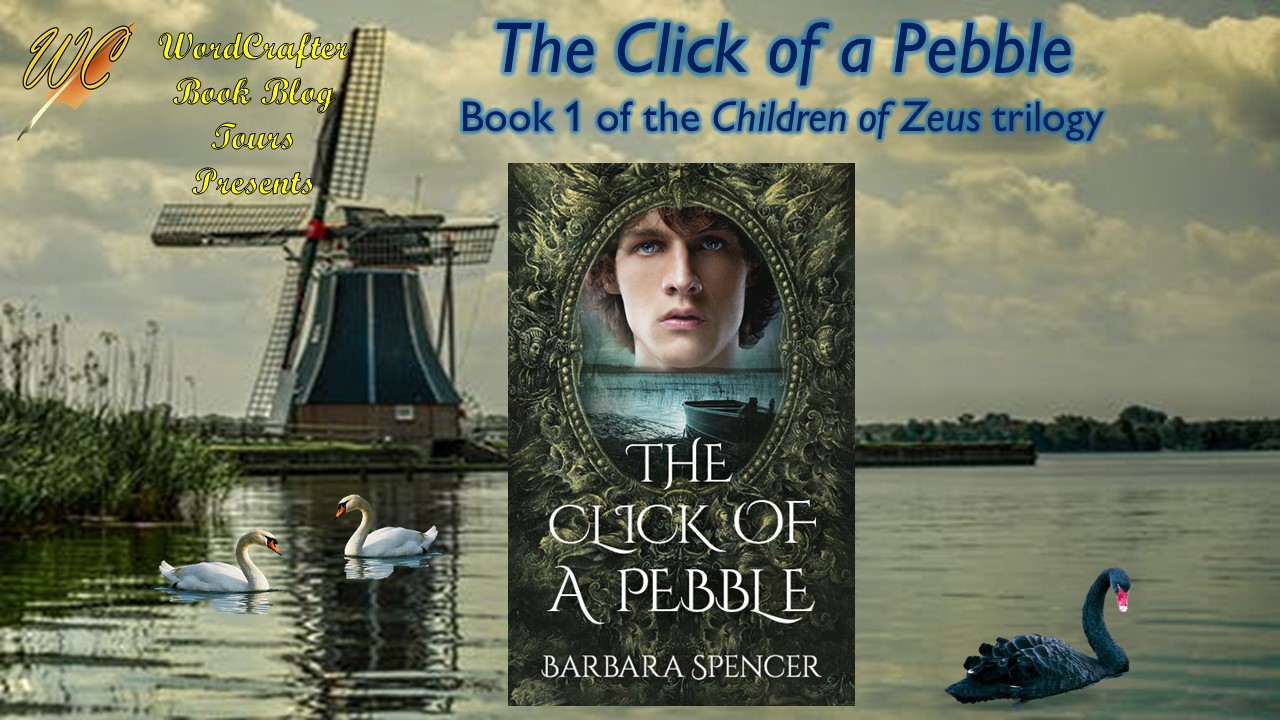
When I picked up The Click of a Pebble to review for this tour, I wasn’t sure what to expect. The cover was ellegant, yet a bit mysterious, which had a certain appeal for me, and the title doesn’t give anything away, although it does add to the sense of mystery. I wanted to know more about this story. Only after I’d begun to read, did I understand why the author, Barbara Spencer, had chosen that particular title, and why it was the perfect introduction to this touching coming of age story.
Known as swan-people for their ability to shape-shift not only into the swanlike form of the carinatae, but also the celeste, the winged shape of Zeus himself. The children of Zeus although peace-loving, have always been forced to live apart from humans, persecuted almost to extinction.
Three children survive the latest massacre: Yöst, Zande, the son of the Black and destined to be the clan’s next leader, and a small girl, Tatania, who insists on being called TaTa.
This is their story.
The Children of Zues trilogy, of which The Click of a Pebble is book 1, is a delightful coming of age fantasy, which I was soon emmersed in. It’s about the carinatae, or Swan People, decendents of Zues, who live among and pass themselves off as humans. When I started reading, I didn’t know what carinatae meant, or where this wonderful myth came from, but it didn’t take long for my curiosity to peak, and I wanted to know more.

So, I began to explore the internet to see what I could learn. Wikipedia defines carinatae as, “Carinatae is the group of all birds and their extinct relatives to possess a keel, or “carina”, on the underside of the breastbone used to anchor large flight muscles.” (https://en.wikipedia.org/wiki/Carinatae). This makes sense, since swans are then carinatae. But, I still wasn’t familiar with this particular myth, so I set about brushing up on my Greek mythology. The only mytholgy I found that dealt with swans in any way, was the story of Zues and Leda, which seemed to fit in with Spencer’s story.

When visiting the author’s blog site, Two Sides to Every Story, I learned that this myth was indeed at the heart of The Children of Zues trilogy, which is a prequel to The Year the Swans Came. This information excited me, because what it means is that Barbara Spencer has created a new set of mythologies from the old myths that we are all familiar with. Wow! Isn’t it fabulous that as authors, we can actually do things like that? And Spencer has done an excellent job of pulling threads from the original myth and weaving them into a mythology all her own. Now that is what being an author is all about!
It is my pleasure to present the The Click of a Pebble Book Blog Tour this week. Our wonderful blog hosts have lined up a greast tour for us, with reviews on Patty’s World and Writing to be Read, and an author spotlight on This is My Truth Now, and hear from the author,, on Roberta Write’s, and finishing off the tour on Barbara Spencer’s blog site, Pictures from the Kitchen. I hope you will join us and follow the tour to learn more about Barbara Spencer and The Click of a Pebble.

___________________________________________________________________________________________
Book your WordCrafter Book Blog Tour today!
Share this:

#Blogtour Day 5 – My review of Feral Tenderness by Arthur Rosch
Posted: February 19, 2021 Filed under: Uncategorized 1 CommentJoin us over at the Roberta Writes blog for Day #5 of the Feral Tenderness Book Blog Tour, where Robbie Cheadle offers a review of this collection of poetry and photograhs by Arthur Rosch.

What Amazon says
A lifetime of poetry and photography gives a unique view of life, nature, the world, and the universe.
My review
Feral Tenderness is an extraordinary collection of poems that strike right to the heart of human conditioning, frailty, and behaviours. Through reading these poems you will be removing the rosy coloured spectacles through which you have watched life until now, and will be exposed to the raw reality of human existence, both with its fatal flaws and also in its bountifulness and excesses.
The poet uses words to spear his reader and force contemplation of certain realities. There are unforgettable and powerful lines that will lurk in your subconscious to be drawn out and examined when you are confronted with certain emotions and situations. Some of my favourite of these lines are as follows:
“The glue that holds shut
the eyelids of your sightless soul
can be dissolved”
View original post 351 more words
Share this:

Loving Art
Posted: February 18, 2021 Filed under: Uncategorized Leave a commentWe’re a little tardy in getting the Day #2 stop out to you. We lost it temporarily. So for Day #2 of the “Feral Tenderness” Book Blog Tour, you’ll find us over at Pictures from the Kitchen Window, with Barbara Spencer as she brings us an interview with author and poet, Arthur Rosch. Please drop by and join in the fun.

Arthur Rosch – poet extraordinaire.
I haven’t met Arthur Rosch. He is from California and me, from a tiny corner of the UK. Never mind about that – just look at the image above! Wow! If that doesn’t get you reading what will? It certainly did me and when I remember the fun I had hosting guests on my site – although they were all authors – I thought it was time I undertook a new journey and one likely to prove equally an inspiration.
A journey with poetry.
Philistine is the word I would use to describe my knowledge of poetry but other words come to mind too – total envy plus a heartfelt wish that I could manipulate words in such a way that a line of maybe five words has the same relevance as an entire page in a book.
And so my own journey begins with…
View original post 1,310 more words
Share this:

#Booktour – Feral Tenderness, a book of poetry by Arthur Rosch
Posted: February 17, 2021 Filed under: Uncategorized Leave a commentOn Day Three of the “Feral Tenderness” Book Blog Tour and we’re over at Robbie’s Inspiration with a post from the author, Arthur Rosch about the realization of a dream. Join us.
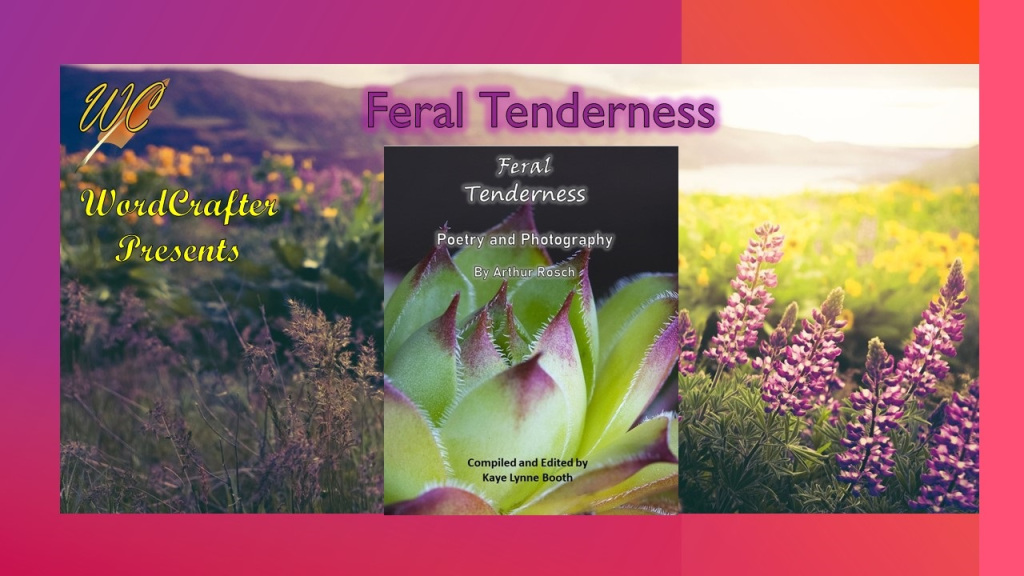
A lifetime of poetry and photography gives a unique view of life, nature, the world, and the universe
Today, I am delighted to welcome poet and author, Arthur Rosch, to Robbie’s Inspiration with his new poetry book, Feral Tenderness.
Fulfillment of a dream
This book, Feral Tenderness, is the fulfillment of a dream. This volume has both poems and photographs. It unites two of my four creative media into a single opus. You may ask, (please) “What are your other two media”? I dabble, (I say modestly) in music and dance.
One night in 2002, I was performing at a venue near my home. I was reading poetry and playing drums. The drums were to accompany another poet who enjoyed my mallet work, the throb of tribal call and response. Two of my thick black notebooks of poetry lay at the lip of the stage. When I finished…
View original post 803 more words
Share this:

Welcome to the First Blog Stop on the Feral Tenderness Book Blog Tour
Posted: February 15, 2021 Filed under: Blog Tour, Book Promotion, Books, Poetry, Review | Tags: Arthur Rosch, Feral Tenderness, Photography, Poetry, Poetry Collection, WordCrafter Book Blog Tours 3 Comments
I first met Arthur Rosch online. That was back in 2008, when I was just dipping my toes in the as yet uncertain waters of the internet, and although I didn’t have any idea what I was doing, I started my own social network called “Writer’s World”. Art stumbled onto the “Writer’s World” network somehow and he’s been loyal follower and supporter, and over the years I’ve come to respect him and his writing, and also to call him a friend and valued team member for Writing to be Read.

I’m introducing Arthur Rosch here today because he has a great new poetry and photography collection out, Feral Tenderness. I’m excited about it because I had a hand in editing, compiling and publishing Arthur’s book through WordCrafter Press. Art writes poetry that remains down to earth and real, while hanging out with universal truths. It’s true that some of his ideas may be a little wild, but so are the ideas of many writers. Maybe writing is a safe outlet for all of our crazy thoughts and that’s what motivates us to put words to paper, or screen, as the case may be.
His biography, from the back of his wonderful new release reads:
“Arthur Rosch is a mid-westerner, who became a Californian as a young man. A lover of jazz, poetry, painting and photography, and writing, as well as a passion for astronomy, photography, history, psychology and the weird puzzle of human experience. After receiving Playboy Magazine’s Best Short Story Award for a comic view of a planet where there are six genders, he was immersed in circles that could have taken him to the top, but it was short lived. Arthur found himself reeling, struggling with depression and addiction on the streets for almost a decade, and repairing and rediscovering himself was a defining event in his life, nurturing his literary soul…. “
All of the above is true. These are all truths about Arthur Rosch, yet they are surface level truths; truths that the author chose to share with the world at large, in the back of his book. Let me introduce you the Arthur Rosch, the author who I know.
Art is an undiscovered talent, who once was near the threshold of discovery, only to plummet back down into the depths of reality. But he never let go of the dream, although at times it altered its shape and appearance. He is a literary craftsman and wordsmith, whose words can be found on his blog, Write Out of My Head, on my blog, Writing to be Read, in his books, and various other places online.
Stepping into the world of Arthur Rosch can be a surreal experience, as it was for me when I reviewed his science fiction novel, The Gods of the Gift, because he is a talented craftsman of the written word. Quite a different effect was achieved with Confessions of an Honest Man, a tragic tale of familial dysfunctionalism, mental illness, drug addiction and emotional abuse that has the ability to make the reader suspend disbelief and feel for the main character beyond the conclusion of the book. And his humor shines through his words and is sure to leave readers chuckling in his memoir about life in an R.V., The Road Has Eyes.
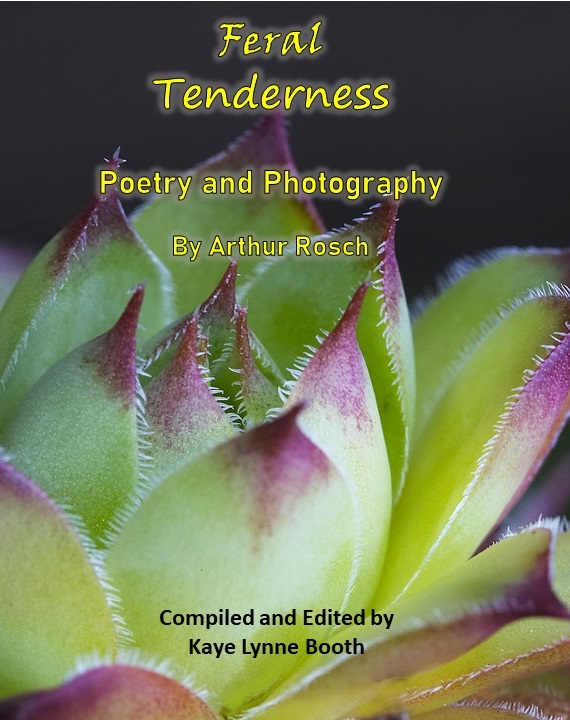
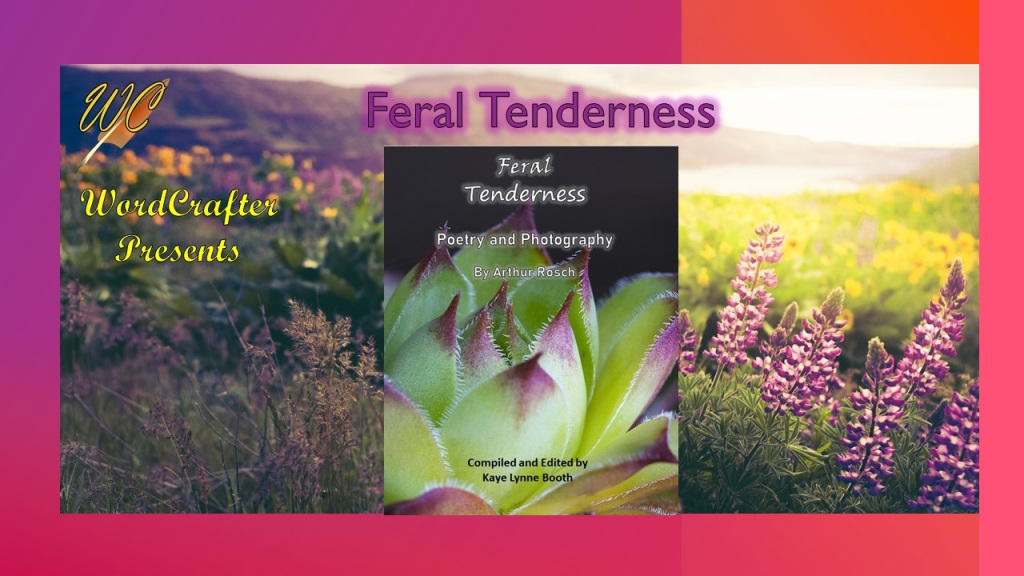
His poetry has this same ability to evoke desired images and emotions from within the reader. His photography captures views seen with a unique and unusual eye. The cover for Feral Tenderness was created from one of his photographs, and others are interspersed among the poetry throughout the book, making it an extra special treat for readers.
I do hope you’ve enjoyed this introduction enough to make you want to get to know more about Arthur Rosch and his poetry and photography, by following this tour. We’ve got two interviews with Arthur, and a review of the book coming later in the week, plus some author generated content that promises to be interesting. Stay with us and visit each blog stop as the tour progresses, with a closing post on Art’s blog, Write Out Of My Head, on Sunday. Please join us. You can purchase Feral Tenderness in digital and print on Amazon.
_______________________________________________________________________________________
Like this post? Let me know in the comments. You can be sure not to miss any of Writing to be Read’s great content by subscribe to e-mail or following on WordPress. If you found this content helpful or entertaining, please share.
Share this:

The Santa Claus Stories: Where the legend begins
Posted: February 8, 2021 Filed under: Book Review, Books, Children's Books, Classics, Fantasy, Fiction | Tags: Book Review, Christmas, Classic Literature, L. Frank Baum, Santa Claus, Writing to be Read Leave a comment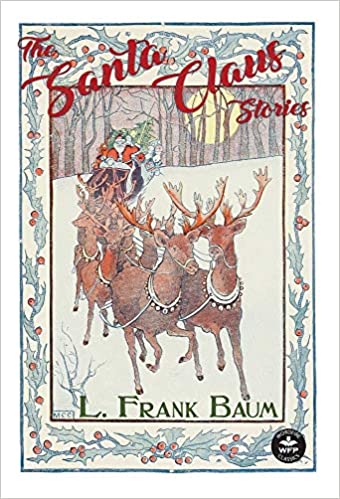
I love reading origin stories, which set the groundwork for all like stories which come after. Although the legend grows and changes down through the years with each retelling. The legend of Santa Claus is one that I hold near and dear to my heart, and I truly enjoyed allowing The Santa Claus Stories of L. Frank Baum take me back to where it all began.
Did you ever wonder where Santa Claus comes from, or how he got to be Santa Claus? Ever wonder how he came to deliver toys to children all around the world? Or why he only delivers one night out of the year? Or why he wears red? Or why he comes down the chimney? Or where his magic comes from? The Santa Claus Stories of L. Frank Baum answer those questions and more. And I’m guessing that not many people today are aware that Santa Claus was in attendance for Princess Ozma’s birthday party in the land of Oz, along with Dorothy and Toto, the scarecrow, the lion man, the tin man, and many other of Baum’s colorful and memorable characters.
The literary value of classic stories such as these is beyond my abilities to describe. Although I feel unqualified to rate classic gems, such as this one, these stories left me with a good feeling inside. Here is born the true spirit of Christmas and you can see the origins of the Santa Claus legend offered here in many contemporary Santa Claus stories. In Baum’s telling, his reindeer don’t fly, but they do wear bells, and magic is in the air, as Santa toils to make all of the toys for the children year round by himself. Over the years things have changed a bit, but I think the magic is still in our hearts, if we look for it.
__________________________________________________________________________________________________________________
Kaye Lynne Booth does honest book reviews on Writing to be Read in exchange for ARCs. Have a book you’d like reviewed? Contact Kaye at kayebooth(at)yahoo(dot)com.
Share this:

Review of the Spirits of the West Western Paranormal Anthology by Patty L. Fletcher: Blog Tour Day 7
Posted: February 7, 2021 Filed under: Uncategorized Leave a commentJoin us as we wrap up the “Spirits of the West” book blog tour with a review by Patty Fletcher over at “Patty’s World”.



















Feral Tenderness – Just My Opinion
Posted: February 18, 2021 | Author: kayelynnebooth | Filed under: Blog Tour, Book Promotion, Books, Commentary, Cover Art, Excerpt, Opinion, Poetry, Promotion, Visual Media, WordCrafter Book Blog Tours | Tags: Arthur Rosch, Collection, Feral Tenderness, Photography, Poetry, WordCrafter Book Blog Tours, Writing to be Read | 2 CommentsFeral Tenderness, by Arthur Rosch, is a poetry and photography collection like no other I’ve ever encountered. I can say this with confidence, because I am the editor and compiler for this book, however it exempts me from posting my opinions of this collection on Amazon. But Writing to be Read is my blog, so I’d like to tell you about this interesting and unique collection of creativity here, taking into account that the author is a friend of mine, so the opinions expressed are likely to be biased. Be that as it may, I’m proud to associate myself with this work of creativity, a collection of poetry and photography worth more than just a casual glance. Arthur’s works need to be savored, like a fine wine, simmered over, like a sweet glaze, and appreciated for their unique and delectable flavors.
As I’ve mentioned on several occassions, Arthur Rosch sees the world in a unique way. Through his creative endeavors, those who care to look are allowed a glimpse of things through his eyes. His photography is amazing. The images that he captures with his lense say so much in a single moment. His poetry, on the other hand, is often a lengthy, social commentary on higher powers, human behavior, or the world at large. Yet, even his short poems seem to have a lot to say.
To illustrate my meaning, the following poem is minimal, yet it speaks volumes. It is my favorite of Arthur’s short snippits of poetry and the only one for which a true companion photo was also available from his photo library for inclusion in the collection.
Dewdrops
Dewdrops on spiderwebs:
sit lightly with life
Another of Arthur’s profound poems, “Stars“, declares, in part, (I did mention that some of his poems are rather lengthy, too much so to be reprinted here in full),
” …Stars know what they are.
Stars are alive and individual,
quirky with personality,
often pulsing and drawing
gravity blood, gas and heat,
combining with other stars
combining and mating with other
stars and forming unions of
higher imaginations
in order to serve the Master of Stars… “
Another poem is an expression of nature, as seen through Arthur’s eyes. This one is one of my personal favorites.
Hunted By The Hawk
Make joy from stones.
Make wit from mud,
make humor from blood.
The tiny finch flies crazily,
for the sheer fun of it,
though it knows, each morning,
that it’s hunted by the hawk.
We too, each morning,
are hunted by the hawk.
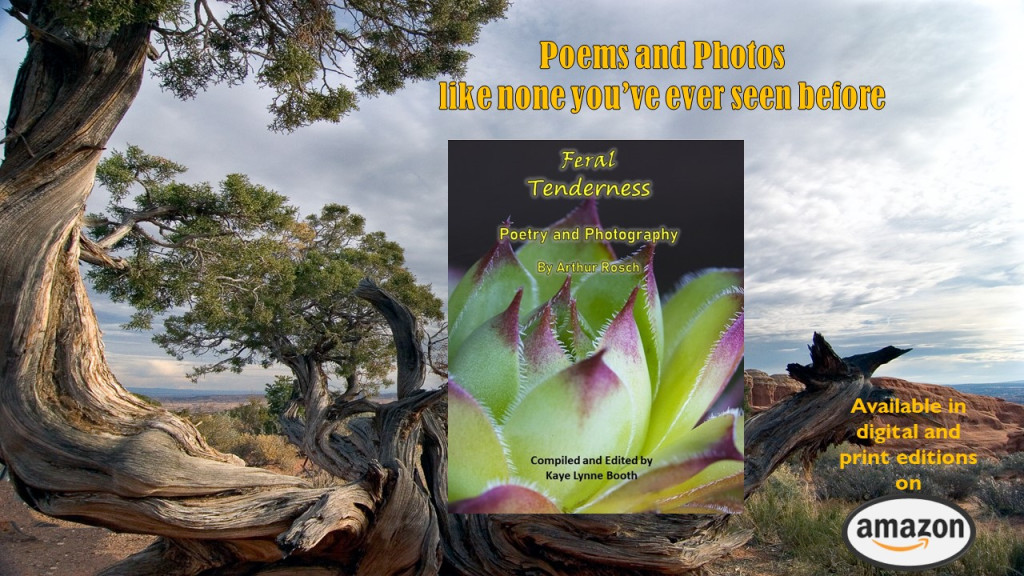
The cover image for Feral Tenderness also came from Arthur’s photo library. With this photo, I was able to create an awesome cover design, if I do say so myself. We created cover images using several of Arthur’s photos, but in the end, this one grabbed both author’s and publisher’s hearts.
The poetry and photos featured in this collection are so varied in subject matter and tone, that several book promotions with very different appeals seemed applicable to me. I used one of Arthur’s photographs for the background of one of them. Can you guess which one? Let me know in the comments which you like better.
Like this post? Let me know in the comments. You can be sure not to miss any of Writing to be Read’s great content by subscribe to e-mail or following on WordPress. If you found this content helpful or entertaining, please share.
Share this: