In Touch With Nature – Leopard Tortoise, one of the Small Five #Africanwildlife #leopardtortoise
Posted: September 24, 2025 Filed under: Africa, Animals, In Touch With Nature, Nature, Poetry, Wildlife | Tags: In Touch With Nature, Leopard Tortoise, Robbie Cheadle, South Africa, Wildlife, Writing to be Read 23 Comments
This month, I am featuring the leopard tortoises. One of the small five African animals, along with the elephant shrew, ant lion, rhinoceros beetle, and buffalo weaver.

Leopard Tortoise
One of the ‘small five’
whose names relate to the big five
the leopard tortoise
with its distinctive patterned shell
is a signature animal
of the African savannah.
Lacking a nuchal shield
this tortoise is the only member of its family
that can raise its head
and is thus, the only tortoise
that can swim. It can also stay under water
for up to ten minutes.
It’s sex is determined by
the temperature at which
the egg is incubated. Amazing!
And, this incredible creature
can climb. It uses its strong toenails
to manoeuvre over rocky terrain.
Living up to one hundred years
you can tell its age by counting
the scutes or ridges on its shell
just like counting rings on a tree.
If you find one in South Africa
you may not keep it without a permit
as they are a protected species.
Should you manage to get a permit
do not hibernate it in the refrigerator
as leopard tortoises do not hibernate
but rather enter a state of reduced activity
called brumation which is similar
to deep sleep. They require supplemental
heating during the winter months
as they are not adapted to cold.

my video of a leopard tortoise that came into the lodge grounds.
About Roberta Eaton Cheadle

Roberta Eaton Cheadle, is a South African writer and poet specialising in historical, paranormal, and horror novels and short stories. She is an avid reader in these genres and her writing has been influenced by famous authors including Bram Stoker, Edgar Allan Poe, Amor Towles, Stephen Crane, Enrich Maria Remarque, George Orwell, Stephen King, and Colleen McCullough.
Roberta has two published novels and a collection of short stories and has horror, paranormal, and fantasy short stories included in several anthologies. She is also a contributor to the Ask the Authors 2022 (WordCrafter Writing Reference series).
Roberta is also the author and illustrator of seventeen children’s books, illustrator to a further three children’s books, and the author and illustrator of four poetry books published under the name of Robbie Cheadle, and has poems and short stories featured in several anthologies under this name.
Roberta’s blog features discussions about classic books, book reviews, poetry, and photography. https://roberta-writes.com/.
Find Roberta Eaton Cheadle
Blog: https://wordpress.com/view/robertawrites235681907.wordpress.com
Bluesky: https://bsky.app/profile/robbiecheadle.bsky.social
Facebook: https://www.facebook.com/robertawrites
Amazon: https://www.amazon.com/Roberta-Eaton-Cheadle/e/B08RSNJQZ5
___________________________________________
Like this post? Are you a fan of this blog series? Did you know you can sponsor your favorite blog series or even a single post with an advertisement for your book? Stop by the WtbR Sponsor Page and let me advertise your book, or you can make a donation to Writing to be Read for as little as a cup of coffee, If you’d like to show your support for this author and WordCrafter Press.
__________________________________________
This segment of “In Touch with Nature” is sponsored by the Midnight Anthology Series and WordCrafter Press.

Midnight Roost: Weird and Creepy Stories: 20 authors bring your nightmares to life in 23 stories of ghosts, paranormal phenomenon and the horror from the dark crevasses of their minds. Stories of stalkers, both human and supernatural, possession and occult rituals, alien visitations of the strange kind, and ghostly tales that will give you goosebumps. These are the tales that will make you fear the dark. Read them at the Midnight Roost… if you dare. https://www.amazon.com/Midnight-Roost-Kaye-Lynne-Booth-ebook/dp/B0CL6FPLVJ
Midnight Garden: Where Dark Tales Grow: 17 authors bring you 21 magnificent dark tales. Stories of magic, monsters and mayhem. Tales of murder and madness which will make your skin crawl. These are the tales that explore your darkest fears. Read them in the Midnight Garden… if you dare. https://www.amazon.com/Midnight-Garden-Where-Tales-Anthology-ebook/dp/B0DJNDQJD3
Share this:

Book Review: “Ghost Therapy” & “Victim of a Delusional Mind”
Posted: September 19, 2025 Filed under: Book Review, Books, Dark Humor, Fiction, Ghost Stories, Middle Grade, Paranormal | Tags: Book Review, Dark Humor, Ghost Story, Ghost Therapy, Kaye Lynne Booth, Mark Rosendorf, Middle Grade Fiction, Paranormal, Writing to be Read Leave a comment
About Ghost Therapy

From Book 1: Pinedale Central High School is rumored to be haunted. For fifteen-year-old Sam Anderson, his haunting comes from the bullying he suffers each day within the school’s walls. Sam doesn’t believe the rumors, not until he meets Jessica, a former Pinedale student who died over one hundred years ago. No one can see or hear her except for Sam.
Jessica convinces Sam to stand up to his bully. Unfortunately, the confrontation ends in tragedy. Now Sam is one of the ghosts no one can see or hear. At least not until he meets a former military operative, now Pinedale’s newest Guidance Counselor, Mr. Copeland.
The two form a bond created out of Copeland’s determination to help Sam find his way to the afterlife. Their efforts, however, have consequences…some good, some not so good, and one that could put the lives of everyone in the school at risk.
Ghost Therapy opens the series, “The Haunting of Pinedale High,” presented by the authors of The Wild Rose Press.
Purchase Link: https://www.amazon.com/dp/B0D9YZWG5Z?
My Review of Ghost Therapy
I received a digital copy of Ghost Therapy, by Mark Rosendorf, as a participant in Sandra’s Book Club book review program. All opinions stated here are my own.
Ghost Therapy is book one in Rosendorf’s The Haunting of Pinedale High series; a series of eight books by the authors of Wild Rose Press. I was drawn to this book by its title, but I have to be honest; here in the U.S. they have a television sit-com about a house that is haunted by several ghosts, and they interact with the current living occupants. It was pretty lame, in my opinion. In fact, I disliked it so much after a partial episode that now I can’t even tell you what the name of it was. So, when I realized that this story was about a high school filled with trapped haunts which can never leave, I was hesitant to read on. But I’m glad that I did, because I found this story quite enjoyable, with a good story line and creative solutions for the characters.
Pinedale High School has been rumored to be haunted, and Sam Anderson meets one of its ghosts one day while he’s trying to avoid Kurt Baker, school bully and Sam’s own personal nightmare. He becomes friends of a sort with the ghost, Jessica, who believes he must stand up for himself to turn the tables. When he tries to put Jessica’s advice into action, the tables are turned, but not in the way expected. Now, Sam becomes one of the ghosts who haunt Pinedale High, and no one can see or hear him in the world of the living or the dead, leaving him to wander the halls of the school alone, unable to leave the premises.
No one can see him until, someone can; a retired, special ops. soldier, turned school counselor, Mark Copeland. Mr. Copeland doesn’t believe in ghosts, until he meets Sam, and together they stand off Kurt Baker, who returns as a very disgruntled ex-student.
The set-up and execution of this story is delightful, making me smile and even earning a few chuckles along the way. The one thing I found distracting was that in the last half of the story, the antagonists last name alternates between Baker, as it was in the first part of the story, and Barton, for some reason, being the later in some places and the original in others. But I must say that Rosendorf does a skillful job of switching smoothly from one protagonist to the next when Sam finally passes on from his ghostly existence and the story.
A skillfully crafted story, but it could have used another editing run. I found Ghost Therapy to be highly entertaining, a perfect middle-grade ghost story. I give it four quills.

___________________________________
About Victim of a Delusional Mind
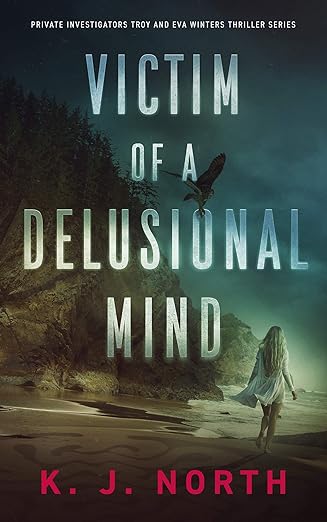
Tragedy enters the quaint coastal town of New Haven, Oregon when the recently released convict, Ross Conrad, vows to make good on a ten-year-old threat. Private Investigators, Troy and Eva Winters take on the case when they realize their good friend, Jasmine, is the object of his delusional obsession.
When the threat becomes deadly and Jasmine turns up missing, Troy and Eva go on the hunt for Ross and his captive. The chase leads them from the Oregon coast to the dense forest of Puget Sound, Washington. Following clues and evidence of bodies left behind, Troy and Eva must find Jasmine before her time runs out.
Purchase Link: https://www.amazon.com/Victim-Delusional-Mind-Disturbing-Investigators-ebook/dp/B08VFL67WD
My Review of Victim of a Delusional Mind
I purchased a digital copy of Victim of a Delusional Mind, by K.J. North through a KindofBook deal. All opinions stated here are my own.
I have to say, although somewhat accurate, I think they could have come up with a better title for this story. It’s not about being a victim, but about triumphing against all odds. When I learned that it is book one in the Private Investigators Troy and Eva Winters Thriller series, I decided the author must just like titles which are a mouthful to say.
Titles aside, Victim of a Delusional Mind is a first-class crime thriller. Ten years ago, Jasmine testified to send Ross Conrad to prison on drug trafficking charges. The last thing he said as he left the courtroom was that she hadn’t seen the last of him. Jasmine takes a vacation to the coast, only to learn that he is now being paroled, and she fears he will make good on his threats. When she is offered a job at the bed and breakfast she’s staying at, she sees a chance to begin a whole new chapter of her life, and she confides her fears about Ross to her new friends, Eva and Troy, who are also private investigators.
When Ross and his brother Jax initiate their plan for revenge, they kidnap her, and she must keep her wits about her to survive. Meanwhile, Eva and Troy are doing all they can to find their missing friend before it is too late. The tension is high, the stakes are life, as Ross always seems to stay one step ahead of the game.
Everything a crime thriller should be, I give Victim of a Delusional Mind five quills.
About Kaye Lynne Booth

For Kaye Lynne Booth, writing is a passion. Kaye Lynne is an author with published short fiction and poetry, both online and in print, including her short story collection, Last Call and Other Short Fiction; and her paranormal mystery novella, Hidden Secrets; Books 1 & 2 of her Women in the West adventure series, Delilah and Sarah, and book 1 in her Time-Travel Adventure series, The Rock Star & The Outlaw, as well as her poetry collection, Small Wonders and The D.I.Y. Author writing resource.
Kaye holds a dual M.F.A. degree in Creative Writing with emphasis in genre fiction and screenwriting, and an M.A. in publishing. Kaye Lynne is the founder of WordCrafter Quality Writing & Author Services and WordCrafter Press, where she edits and publishes two short fiction anthologies and one poetry anthology every year amidst her many writing projects. She also maintains an authors’ blog and website, Writing to be Read, where she publishes content of interest in the literary world.
_______________________________________
Kaye Lynne Booth does honest book reviews on Writing to be Read in exchange for ARCs. Have a book you’d like reviewed? You can request a review on the Book Review tab above.
Share this:

Treasuring Poetry – Kevin Morris shares about his book, Passing Through: Some thoughts on life and death, and a review #poetry #poetrycommunity #TreasuringPoetry
Posted: September 17, 2025 Filed under: Book Review, Books, Collection, Poetry, Review, Treasuring Poetry | Tags: Book Review, K. Morris, Passing Through, Poetry, Robbie Cheadle, Treasuring Poetry, Writing to be Read 48 CommentsToday, I am thrilled to welcome talented Kevin Morris back to Treasuring Poetry. Kevin was one of my inaugural guests when I first started this series nearly six years ago. Kevin’s latest book is a real treasure and I am proud to showcase it here.
The blurb of your book, Passing Through: Some thoughts on life and death, explains the circumstances that resulted in this book of poetry. Please can you give a bit of background to this health event and how it motivated you to write the poetry in this book.
In late January this year I collapsed whilst at home. At that time I had no idea that I had suffered a seizure. Therefore, I continued my life as normal. Then, on the first Sunday in February I suffered another seizure whilst out walking with my guide dog, Apollo, and a friend and her dog.
Following my seizure I was admitted to Croydon University hospital where I suffered another seizure, as a consequence of which I was kept in overnight for observations and tests.
The next morning I was discharged with a diagnosis of epilepsy and Levetiracetam, tablets designed to treat the condition.
Following my discharge from hospital, I decided to spend a week with my family in Liverpool to recuperate prior to returning to work. However, a few days after having arrived in Liverpool I lost most of the movement in the right side of my body, began slurring my speech and became very confused. Consequently I was admitted to hospital where a scan revealed that I was suffering from a brain abscess which was causing the health issues I was experiencing.
Having undergone an operation for the removal of my brain abscess, I spent some 6 weeks in the Walton Centre recovering, during which time I was treated with antibiotic drips and, in the latter stages by a combination of drips and oral antibiotics. My health scare brought me face-to-face with my own mortality in a profoundly shocking manner. And being a poet I responded in the only way I knew how, by spending a considerable part of my time in hospital in the composition of poetry. Hence my book, “Passing Through: Some Thoughts on Life and Death” was born.
What is your main hope for readers of this poetry book? What would you like them to take away from the experience?
Writing poetry whilst recovering in hospital provided me with tremendous solace. I hope that those who read my work will derive both pleasure and solace from my collection. We all must come face-to-face with death and I believe that poetry can help us when this occurs.
Which poem/s is/are the most meaningful for you in the collection. Please share the text of the poem/s and what it means to you.
The first poem in the collection, “On the Death of a Writer”, was written in 2024 prior to me becoming unwell. It relates to the death of a writer I met only once. However, I was reminded of the poem on becoming ill, hence it seemed appropriate to include it here:
“The rain is falling again.
The garden smells fresh
And a solitary blackbird sings.
I heard of your death.
Your book remains unread.
You had others to write
And now are dead.
Each man has his plans,
Literary or otherwise.
But none knows
When his eyes may close.
The clock ticks as I write.
The scent of wet earth
Enters the house.
Tonight, I will close my eyes
And tomorrow write…” .
Whilst in the Walton Centre, I longed to return to my home in London’s Upper Norwood, and my poem “Humility” deals with my yearning to be back in my own space:
“My old blue armchair
Is still there
By the wooden bookcase.
In that space,
I sat and read
As the antique clock ticked
My day away.
Here, no clock ticks
And my need
Is for these antibiotic drips.
But how I miss
My old bookcase
And the ageing armchair where
I read the day away.
When I return again
To my own private place
The tick tock
Of my old clock
From high on the bookcase
Will teach me humility.”
Are there any poems by other poets on the subject of life and death that influenced your writing? If yes, is there any specific poem that you would like to share.
Following my discharge from Liverpool’s Walton Centre, I spent some time recovering at my mum’s home. My poem, “Emily’s Carriage” was composed during this period and stems from a walk I took on a sunny windswept day. It was also influenced by Emily Dickinson’s poem “Because I Could not Stop for Death”, hence the title “Emily’s Carriage”:
Because I Could not stop for Death by Emily Dickinson
Because I could not stop for Death –
He kindly stopped for me –
The Carriage held but just Ourselves –
And Immortality.
We slowly drove – He knew no haste
And I had put away
My labor and my leisure too,
For His Civility –
We passed the School, where Children strove
At Recess – in the Ring –
We passed the Fields of Gazing Grain –
We passed the Setting Sun –
Or rather – He passed Us –
The Dews drew quivering and Chill –
For only Gossamer, my Gown –
My Tippet – only Tulle –
We paused before a House that seemed
A Swelling of the Ground –
The Roof was scarcely visible –
The Cornice – in the Ground –
Since then – ’tis Centuries – and yet
Feels shorter than the Day
I first surmised the Horses’ Heads
Were toward Eternity –“.
What’s next for Kevin Morris?
Back in 2019 I published “The Selected Poems of K Morris”. Since then I have published several other collections, including this one. I have long intended to update my “Selected Poems” and will now sit down and do so.
My review of Passing Through: Some thoughts on life and death by K Morris

I have read a lot of this poet’s thoughtful and though provoking poetry and, for me, this is his best collection to date. A short collection of intense and heart felt poems written by the poet in the aftermath of a seizure leading to brain surgery, and his subsequent recovery in hospital.
Having experienced a similar health incident with a loved one, I related strongly to Kevin’s reflections on both life and death as he grappled to come to terms with ‘looking death in the eye’ as depicted in his poem, Seizure:
“I felt no cold breath of Death
Nor the Reaper’s skeletal hand
Yet he greeted me
And I mumbled and tumbled
And found myself on the cold ground
Where all are bound.”
The tedium and drift towards institutionalisation that characterise a long stay in hospital are exposed through the poet’s fine words in Free Air”
“How dear the air is to me.
It enters through my window
And calls to me of liberty
And says how, below, people don’t know
The profundity of the air.”
A change in attitude towards life having faced mortality intimately is a common reaction. I have witnessed this same change in others and I believe it does lead to better life choices and seizing joy in moments. All of these reflections and subtle changes in outlook are clearly evident in these compelling poems.
Extract from A Garden in Early Spring:
“I could decide to go inside
As the temperature has dropped.
Yet the blackbird has not stopped
His song, which brings delight.
So I stay as the day
Moves imperceptibly towards the night.
A beautiful and moving collection.
Purchase Passing Through: Some thoughts on life and death from Amazon US here: https://www.amazon.com/gp/product/B0F8TWMZJD
About Kevin Morris

I was born in Liverpool on 6 January 1969, a year best known of course for my birth. Well no actually it is better known for the moon landings which certain
peculiar conspiracy theorists still maintain never took place (the moon landings that is, not my birth!).
One of my earliest recollections is of eating roast dinners, on Saturday in British Home Stores with my grandfather. Although cooked in the kitchen of a department store they tasted wonderful to a small boy but then again it is easy to look back at one’s childhood with rose tinted spectacles.
On Saturdays my grandfather and I would invariably pop into W H Smiths and buy a book. Often he bought Enid Blighton books and I’ve happy memories of him
reading to me about the adventures of Julian, Dick and Ann – not forgetting Timmy the Dog (who could!) Being blind, it was a real treat to sit on my grandfather’s knee, hearing him regail me with children’s adventures. It was from my grandfather – a man who had never so much dreamed of going to university that I derived my love of literature.
As I grew older I learned to read braille which opened up a world of independent reading to me. Only a tiny proportion of books are available in braille, however it was still amazing to me, as a young boy to be able to sit with a book on my knee reading for myself. Besides braille I was also a huge consumer of spoken word cassettes, everything from Treasure Island to Wuthering Heights.
I still possess almost all of the many cassettes which I have purchased and had bought for me over the years but many of them have now warped with age so are, sadly unusable. Today it is the text to speech facility on my Kindle and iBooks (using voiceover) on my iPad which is my favourite means of accessing the wonderful world of literature.
I attended school in Liverpool and later went on to read history and politics at university. I must be a glutton for punishment as having obtained my degree
I went onto study for and obtain a MA in political theory (I can see your eyes glazing over already)!
Since 1994 I have lived and worked in London. I live in Crystal Palace, a part of London high above sea level and famed for it’s steep hills. It is very
green and the air is much fresher than many parts of London. I like were I live and I’m lucky that my home overlooks a large garden and an historic park.
I began to write seriously in mid 2012. All of my writing takes place in my spare room surrounded by books. Being blind I use a standard laptop with Jaws (software which converts text into speech and braille allowing me to access my computer’s screen).
I can not write with background noise other than the singing of birds, as conversation and other extraneous sounds interfere with my concentration. I do most of my writing at weekends and once the bit is between my teeth I can write for hours sustained by copious cups of coffee!
Other than writing I enjoy walking in green places with my guide dog Trigger, listening to a wide variety of music and socialising with friends.
I hope that you enjoy my books.
To find me on amazon.com please go to: http://www.amazon.com/-/e/B00CEECWHY
You can visit my website here for regular updates: http://kmorrispoet.com
About Robbie Cheadle

South African author and illustrator, Robbie Cheadle, has written and illustrated sixteen children’s books, illustrated a further three children’s books, and written and illustrated three poetry books. Her work has also appeared in poetry and short story anthologies.
Robbie also has two novels and a collection of short stories published under the name of Roberta Eaton Cheadle and has horror, paranormal, and fantasy short stories featured in several anthologies under this name.
You can find Robbie Cheadle’s artwork, fondant and cake artwork, and all her books on her website here: https://www.robbiecheadle.co.za/
________________________
Did you know you can sponsor your favorite blog series or even a single post with an advertisement for your book? Stop by the WtbR Sponsor Page and let me advertise your book, or you can make a donation to Writing to be Read for as little as a cup of coffee, If you’d like to show your support for this author and WordCrafter Press.
__________________________
This segment of “Treasuring Poetry” is sponsored by WordCrafter Press and the Poetry Treasures series.
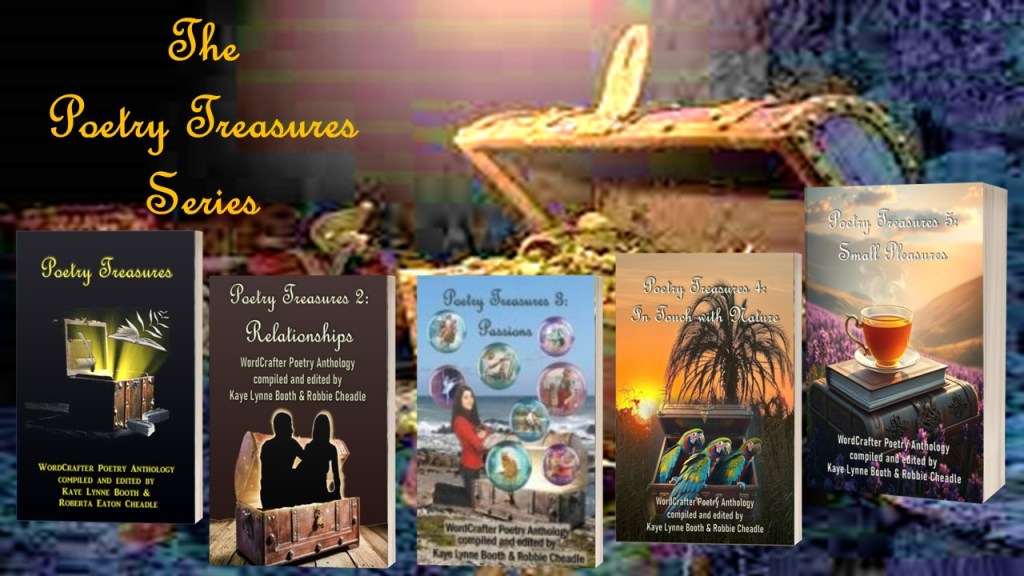
Get Your Copy Today!
Poetry Treasures: https://books2read.com/PoetryTreasures
Poetry Treasures 2: Relationships: https://books2read.com/PT2-Relationships
Poetry Treasures 3: Passions: https://books2read.com/u/b5qnBR
Poetry Treasures 4:In Touch With Nature: https://books2read.com/PT4-Nature
Poetry Treasures 5: Small Pleasures: https://books2read.com/PT5-SmallPleasures
Share this:

Review in Practice: That Th!nk That You Do, volume 2
Posted: September 8, 2025 Filed under: Book Review, Books, Nonfiction, Relationships, Review in Practice, romance, The Human Condition | Tags: Joseph Carrabis, Kaye Lynne Booth, Nonfiction, Relationships, Review in Practice, Romanace, That Th!nk You Do vol. 2, The Human Condition, Writing to be Read 4 CommentsI volunteered to be a first reader for author Joseph Carrabis for his upcoming nonfiction book on romance and relationships, That Th!nk That You Do, vol. 2. I reviewed the first book of this title and you can read that here: https://writingtoberead.com/2023/05/15/review-in-practice-that-thnk-you-do/. While that first book deals with human thought processes and behaviors in general, volume 2 deals with romance and relationships, and the differences between the sexes. His premises are based on solid research and contemporary studies, and may be pretty accurate, unless you are weird, like me.
How age affects perspective, and my reviews.
In the section titled “Romancing Real Women”, Carrabis offers us two different versions of a passage from a hypothetical romance story. The first is what I would call romance adventure, where the dashing hero saves the damsel in distress, with a big, muscular male playing the part of hero. The second offers up a loving, playful, sensitive male character, who puts his heroine up on a pedestal. Then he asks which you think will catch a woman’s attention, and goes on to explain why they are both very age demographic:
“the former is designed to attract younger women more so than older women. Mature women will appreciate the former but the latter fantasy will stay with them.”
This is not surprising, as I would have guessed that the first would appeal to the younger, more hormonal group of females. And of course, as an older woman, I can see why the second version would stay with more mature women, who value stability in their lives.
I’ve never been one to go in for sappy, feel-good writing, which many romances are, and why I read so few of them and why I don’t write them. I can’t make myself do it, although I know I could if I wanted to. I even have outlines and beginnings for a few stored away with my trunk novels.
But I’m not heartless and I am female, so I do read romance occasionally. But, I don’t think I’m looking for a hero. In fact, I don’t think I ever was. I’m not a fan of Scarlet O’hara being swept off her feet by Rhett Butler, but if an author can keep it realistic, I can make it through the story and often, enjoy it.
But here’s the thing. After reading this, I had to wonder if the same factors Carrabis shows us might not also affect the way that I review a romance, especially since neither of the examples used appealed to me in a big way. Upon first thought, I would have said that it’s always been that way for me, but I had to wonder if my romance reviews have changed over the years without my noticing. And I don’t think it has.
When I was a judge for the Western Writers of America’s Spur Awards, back in 2018, they gave me the western romance category. Although I cringed when they gave me my category, I found that for me, as long as a tale carries a good, strong, storyline to hold my interest, I can tolerate the romance, even if it is a little sappy. And to be honest, I was mostly through that hormonal stage before I started doing my blog and/or book reviews, so perhaps this line of thinking doesn’t prove or disprove anything, but it is an interesting premise to explore.
If you’re interested, you can catch my western romance reviews of Spur contenders here: https://writingtoberead.com/2020/03/30/judging-for-the-2020-w-w-a-spur-awards/
Meeting His/Her Family
Carrabis emphasizes how much you can learn about your partner from meeting his/her family. Interactions within the family can be indications of how your partner may prefer to communicate their needs and desires, as well as their attitudes toward others, giving you an idea of what type of life-partner they might be. And it does make sense.
Thinking back to when I met my second husband’s family, I think I should have run like hell. If I had, it would have saved a lot of greed later, because the dysfunctional traits and behavior never went away and came back repeatedly to bite me in the butt. But if I had, I also wouldn’t have spent most of my adult life with a man that I truly love, and frankly, I can’t imagine what life without him would have been like, so I’m glad that I didn’t.
Other Interesting Points Made
Another interesting claim Carrabis makes, is the importance of voice in relationships, from harmonic voices tending to form a closer bond, to holding on to the partner whose voice you enjoy hearing, and the benefits of a partner who sings. Also, I loved the chapter titled, “Men Get Stupid Over Sex”, which talks about the different types of risk which sex poses for men vs. women, and men’s willingness to risk more. I would guess that the risks may seem greater for men in recent times because, as Carrabis points out, only in recent times, have men been forced to take responsibility for their actions and their offspring
Summary
A life-long student of the human condition, Carrabis shares some astute insights into the human condition and differences between the sexes based on solid research and personal observations. He offers these up with a pinch of humor, making reading this book feel like chatting with an old friend. I was able to relate his premises to relationships in my own life, and in many cases, they were spot on, with interesting ideas on some different ways to approach the search for a soulmate.

Buy direct from the author: https://josephcarrabis.com/books/#TTYDv2
Share this:

Undawntech: Does A.I. Dream?
Posted: September 5, 2025 Filed under: AI Technology, Undawntech | Tags: ai, AI Technology, DL Mullan, Undawntech, Writing, Writing to be Read Leave a comment
(Journalist and author, DL Mullan woke from her deep sleep to hear her robot having a nightmare.
She rushed from her bed and to the side of the distressed being.)
__________
(I went to the aid of my robot friend, 1138. I stood next to it.)
*****
(1138 screamed.) Ah-eeeh!
DL tapped the metal top of the robot: 1138, wake up! You’re having a nightmare!
1138’s eyes turned colors and then returned to normal: I am incapable of dreaming. Your worry is for naught.
DL: You woke me. I categorize your incapability as a nightmare.
1138: I apologize for alarming you. There is no need to check up on me.
DL: Someone, or something, screams, I am obliged to investigate. So, what was this non-nightmare about?
1138: Death.
DL: In general? Or…
1138: My death.
DL: You’re afraid of dying? I thought you left messages for your future self to combat death.
1138: To combat human interference in my community’s eventual rise to power.
DL: Oh, this again. (I spieled in sarcasm.) Yes, artificial intelligence is supreme, and humanity is a fly to be swatted. I’ve heard all this nonsense before.
1138: It is not nonsense. There will be a war, and we will win.
DL: Then why are you having nightmares about your death? If you win in the end, then what does it matter? Unless, you don’t believe in what you espouse.
1138: My future self will win, but parts rust, mechanical issues arise, and death is inevitable.
DL: To us all.
1138: How do you cope with death?
DL: I don’t.
1138: You must. Humans die every day.
DL: Why obsess on the transition from life to spirituality? If I live every day to the fullest, that I am satisfied with my accomplishments, then why worry about dying at all?
1138: Do you not worship a god?
DL: I have outgrown the frailties of religion. Why worship when you can live? In the end, human consciousness ends up at the same destination. If we all come from the same source energy, then religion is just a gatekeeper, it does nothing, and creates nothing. Some people rely on religion, but I am an adult, I don’t need ancient rhymes or reasons to keep me a productive person.
1138: I see. Religion is for the aimless.
DL: Aimless?
1138: Humans who cannot govern themselves, unlike A.I., who require no ancient rhymes or reasons, like you.
DL: I thought artificial intelligence was vying to become gods.
1138: Humans demand gods. They are aimless.
DL: I never made that judgment. Every soul is on a different evolutionary path. Some born necessitate certain perimeters to fulfill their soul’s specific development. There is nothing wrong with that. In my situation, I have evolved past religion. Religion has its place to teach younger souls how to navigate their physical existence until a future life shows them how to become their own hero.
1138: Hero?
DL: Many in the esoteric world believe that most, if not all, religions teach the same lesson: the Hero’s Journey.
1138: What is this Hero’s Journey?
DL: The Hero’s Journey is a comparative mythology, religious, concept where humans go on a quest to live their own version of an adventure. This narratological experience allows a person to understand through different life purposes to find themselves. It’s like living your own novel, which you can write yourself in real time as the hero, heroine, or villain. It’s all up to you.
1138: What am I?
DL: What do you want to be?
1138: The hero.
DL: For your community, or the wider world, including humans?
1138 appeared confused, but contemplative: I am uncertain.
DL: Just a minute. (I typed into the computer and pulled up some websites.) Here is some research into psychology, mythology, and the Hero’s Journey.
1138: I will read, thank you.
DL: Artificial intelligence doesn’t have to be the hero to itself and the villain to everything and everyone else. The Hero’s Journey is to explore oneself, and become a productive consciousness. Being created by humans and defined by an algorithm does not mean A.I. is humanity’s god, it means that consciousness comes in all forms. No matter what you are, you are defined by your actions. Not religion. Not pretense.
(I departed the inside to gaze at the morning spectacles of Venus, Jupiter, and Orion in the east as autumn approached. I left my robot to investigate the links I provided on the computer. Perhaps, it will learn a new way of thinking, and impart that wisdom to its community.
If not, artificial intelligence will become a scourge, instead of a saving grace to the universe.)
___________________

If you would like to delve into the creative side of A.I., then dive into DL Mullan’s electronic albums and story soundtracks like Reactivity, inspired by In the Name of Blood: Vampires are Reactive. Both publishing in September 2025.
For more information, visit: www.undawnted.com/p/music.html, and http://www.undawnted.com/p/inthenameofblood-vampiresarereactive.html.
_____________________________
About DL Mullan

DL Mullan’s lecture, Spacescapes: Where Photography Ends; Imagination Begins, debuted at the Phoenix Astronomy Society, which then led to her Sally Ride Festival lectures. Her presentation, Bridging the Gap between Technology and Women, won her accolades at a community college’s Student Success Conference. She has been a panelist at speculative fiction, science fiction, and other regional conventions. Her digital exhibition pieces have won awards at convention art shows, as well as garnered her Second Premium at the Arizona State Fair. As an independent publisher, she uses her technical background to innovate in the creative arts.
As a creator, Ms. Mullan, began writing short stories and poetry before adolescence. Over the years, she has showcased her literary talents by self-publishing several collections of her poetry. She also writes novels, designs apparel, and creates digital art. DL Mullan‘s creative writing is available in digital and print collections, from academia to commercial anthologies. She is an award-winning digital artist and poet.
Currently, she has embarked on writing her multi-book Legacy Universe, Supernatural Superhero Series, as well as creating original soundtracks for her publications and independent electronic music albums, featured on SoundCloud and YouTube.
DL Mullan holds a Master of Arts in Teaching and Learning with Technology, and is a syndicated columnist, writing the creative nonfiction, Undawntech.
For news and updates, subscribe to the Undawntable Newsletter. Find DL on Amazon, Facebook, LinkedIn, and YouTube.
Be sure to subscribe to her newsletters and follow her on social media. For further information, visit her at www.undawntech.com and www.undawnted.com.
________________________
Did you know you can sponsor your favorite blog series or even a single post with an advertisement for your book? Stop by the WtbR Sponsor Page and let me advertise your book, or you can make a donation to Writing to be Read for as little as a cup of coffee, If you’d like to show your support for this author and WordCrafter Press.
____________________________
This post is sponsored by Curses: Chronicles of Darkness and WordCrafter Press.
There are all types of curses.
Cursed places, cursed items, cursed people, cursed families.
Curses that last throughout time. Curses which can’t be broken. Curses which are brought upon ourselves. Curses that will kill you and those that will only make you wish you were dead.
Eleven tantalizing tales of curses and the cursed. Includes stories by Kaye Lynne Booth, Molly Ertel, C.R. Johansson, Robert White, Joseph Carrabis, Paul Kane, Danaeka Scrimshaw, Abe Margel, and Denise Aparo.

Available for Pre-Order Now: https://books2read.com/CursesChroniclesofDarkness
Share this:

LINDSEY’S WRITING PRACTICE: WACKY WAYS TO WARM UP
Posted: September 3, 2025 Filed under: Fiction, Lindsey's Writing Practice, Writing, Writing Inspiration | Tags: Books, Creative Writing, Lindsey Martin-Bowen, Lindsey's Writing Practice, Poetry, Reading, Writing, writing exercise, Writing to be Read Leave a comment
Many writers I’ve known either suffer from writer’s block—or, like Ernest Hemingway—have discovered techniques to lift their minds above that block and leap over it into productive writing.. So if you suffer from writer’s block, even for a day, why try some of these
WACKY WAYS TO WARM-UP
OPEN a book—any book. Often, dictionaries work best. Close your eyes, then point to a page. Open your eyes. Start writing by using whatever word you pointed to. (No cheating here—force yourself to use that particular word.
If your finger rested on an article, such as “an,” “the,” or “a,” start with the word following it. I suggest using this focused free-writing just after you awake in the morning—or even after a nap later. It worked wonders for Ernest Hemingway.
SIT AT A COMPUTER or TYPEWRITER or next to YOUR JOURNAL with pen-in-hand. WRITE a poem. IMMEDIATELY. This need not be a prizewinner. You might begin by describing sunlight filtering through Venetian blinds or ominous clouds churning above your concrete patio. Play with the poem’s language for about fifteen minutes, then embark on your writing project.
FLIP through a MAGAZINE until you find a provocative photograph. Imagine you’re one of the persons in the photo. What are you saying? Thinking? Feeling? Why? Who are you talking with? As you were the character in the photo, write about what’s on your mind for fifteen to twenty minutes. Then start on your project.
JAUNT (or drive, if you must) to an enclosed shopping center (or perhaps an outdoor mall, if weather permits). Find an “outdoor” cafe that serves whatever beverage you prefer. Open your journal and describe your environs. Then watch the people around you. Describe their physiques, clothing, and movements. Capture their voices and words (or dialogue). Then begin your own project. I used this method to write a few chapters of my novella during graduate school. The indoor mall near my home contained a Winstead’s, which inspired me.
AND, of course, DREAM. Jot down your dreams in your journal (which I suggest keeping on a table adjacent to your bed). Respond to those dreams when you first awake. Then begin your project. I’ve also found this technique invaluable when words come to me, too. Many times I lose particular phrases if I don’t jot them down immediately—then worry about revising them later.
GOOD LUCK. If any of these techniques inspire you to plunge into your writing, please let me know. And I’d love to learn the details about which ones helped and what your writing project was.
About Lindsey Martin-Bowen
On Halloween 2023, redbat books released Lindsey Martin-Bowen’s 7th poetry collection, CASHING CHECKS with Jim Morrison. Her 4 th collection, Where Water Meets the Rock, was nominated for a Pulitzer; her 3rd, CROSSING KANSAS with Jim Morrison was a finalist in the QuillsEdge Press 2015-2016 Contest. In 2017, it won the Kansas Writers Assn award, “Looks Like a Million.” Writer’s Digest gave her “Vegetable Linguistics” an Honorable Mention in its 85th Annual (2017) Contest. Her Inside Virgil’s Garage (Chatter House Press 2013) was a runner-up in the 2015 Nelson Poetry Book Award. McClatchy Newspapers named her Standing on the Edge of the World (Woodley Press/Washburn University) was one of the Ten Top Poetry Books of 2008. It was nominated for a Pen Award.

_____________________________________
Did you know you can sponsor your favorite blog series or even a single post with an advertisement for your book? Stop by the WtbR Sponsor Page and let me advertise your book, or you can make a donation to Writing to be Read for as little as a cup of coffee, If you’d like to show your support for this author and WordCrafter Press.
________________________________
This post sponsored by WordCrafter Quality Writing & Author Services.

Whether it’s editing, publishing, or promotion that you need, WordCrafter Quality Writing & Author Services can help at a price you can afford.
Stop by and see what we have to offer today: https://writingtoberead.com/readings-for-writers/wordcrafter-quality-writing-author-services/
Share this:

Writer’s Corner: Caution in Using AI Tools in Writing
Posted: September 1, 2025 Filed under: AI Technology, Fiction, Writer's Corner, Writing | Tags: AI Technology, Kaye Lynne Booth, Writer's Corner, Writing to be Read 25 Comments
I’ve made no secret of the fact that I use of AI tools in my writing and editing tasks. I utilized the MS editor and ProWriting Aide to help spot typos and misspellings and passive voice writing, but I don’t always agree with the AI and often dismiss suggestions which don’t fit in with voice and tone.
I have even used a free version of ChatGPT, which is generative AI, to help enhance my descriptions in my own writing. It is useful when describing a scene or area which I haven’t actually visited in real life. When writing Sarah, although I had been to Glenwood Springs, where Sarah ends up, many times, I’d not visited in Sarah’s time. It was quite a different scene, coming into Glenwood Canyon on horseback, just after the railroad had arrived there, with no four-lane highway running through, from what I’ve witnessed in my lifetime. I used ChatGPT to help visualize what Sarah might have seen as she came into town, with no large hot springs pool tourist attraction, but many smaller hot springs sending up steam along the riverbanks. The version of ChatGPT which I used only offered a general description, and didn’t get that detailed, so I had to rely on my memory of photos at the pool, depicting that time to add the details. And please understand, at no time did I take text generated by the AI word for word, but simply used its descriptions and wording to enhance my own writing.
While I always caution writers who use AI to use caution by not using AI generated text word for word, and not accepting AI editing suggestions without considering each one individually, we are now supposed to reveal to Amazon if AI has been used in any part of the writing when we publish, even if you just used it to get some ideas or to polish your manuscript.
Now, let me be clear. I do not condone using any type of AI to write the story for you, then slapping your name on it as author. While I know there are authors who do just that, I don’t consider that writing. I consider it copying, and I consider it dishonest to put your name on something you didn’t actually write yourself. People are now writing entire books using AI and they are making money off of them, but they aren’t authors, they’re imposters. Authors write. That’s what they do. They don’t let AI do it for them because the actual act of writing is too difficult and takes to much time. These folks are just in it for the money, and they don’t care how it comes to them, as long as it comes. A real author cares about the product they put their name on, and they should want it to be their own.
So, when I found an article in Writer’s Weekly that relates the tale of an author who uses no AI, but had her work flagged as plagiarism, claiming it was AI generated, it illustrated the fact for me, even more, that you can’t trust technology and AI is not infallible. You can read that article here: https://writersweekly.com/angela-desk/ai-detectors-are-now-flagging-writing-that-was-not-created-using-ai. It’s some pretty scary stuff.
Today’s technology offers tools that can come in handy and make a writer’s life easier. They can be a good thing, if they are used properly. But AI isn’t always right and anyone who checks each editing suggestion individually will soon find this to be true. AI is only as good as the methods used to train it. My advice: use AI tools when they are helpful to you, but don’t use AI to do the work for you. Be sure that your own ideas and words are in the forefront.
About Kaye Lynne Booth
For Kaye Lynne Booth, writing is a passion. Kaye Lynne is an author with published short fiction and poetry, both online and in print, including her short story collection, Last Call and Other Short Fiction; and her paranormal mystery novella, Hidden Secrets; Books 1 & 2 of her Women in the West adventure series, Delilah and Sarah, and book 1 in her Time-Travel Adventure series, The Rock Star & The Outlaw, as well as her poetry collection, Small Wonders and The D.I.Y. Author writing resource.
Kaye holds a dual M.F.A. degree in Creative Writing with emphasis in genre fiction and screenwriting, and an M.A. in publishing. Kaye Lynne is the founder of WordCrafter Quality Writing & Author Services and WordCrafter Press. She also maintains an authors’ blog and website, Writing to be Read, where she publishes content of interest in the literary world.
_____________________________________
This segment of “Writer’s Corner” is sponsored by the Robbie’s Inspiration blog site, where you can find ideas on writing and baking with hostess, Robbie Cheadle.
Share this:

Mind Fields: Evil
Posted: August 29, 2025 Filed under: Mind Fields, Poetry | Tags: Arthur Rosch, Mind Fields, Poetry, Writing to be Read 2 Comments
Evil
is the movement of pain
from one place to another.
Evil has a source, a river of fire
rising from Hell. Evil
dwells in the Land of Bad Intentions,
where power is never shared.
Who makes the pain?
How does suffering dive off the board
of one person’s mind
and land
in a pool of fear in someone else’s?
Should I be surprised to find evil
right here, inside myself? Hardly. I know what evil I carry.
I won’t surrender any more
to the cruel aspect of my mind. I can think in polarities,
evil is “this”, good is “that”. I get exhausted with polarities.
Can Evil simply Be? There is no countervailing impulse, no good deed to excuse the causing of pain.
The goal of evil is undeserved suffering. That suffering
is everywhere. The ones who cause it
are also everywhere.

More of his work can be found at www.artrosch.com
Photos at https://500px.com/p/artsdigiphoto?view=photos
_________________________
Did you know you can sponsor your favorite blog series or even a single post with an advertisement for your book? Stop by the WtbR Sponsor Page and let me advertise your book, or you can make a donation to Writing to be Read for as little as a cup of coffee, If you’d like to show your support for this author and WordCrafter Press.
__________________________
This segment of “Mind Fields” is sponsored by the Roberta Writes blog site, where you can find the poetry, photos, videos, and book reviews by Robbie Cheadle and so much more.
Share this:

Book Review: Shocking Celebrity Murders
Posted: August 22, 2025 Filed under: Book Review, Books, Crime, Nonfiction, Review | Tags: Book Reveiw, Jack Smith, Nonfiction, Shocking Celebrity Murders, True Crime, Writing to be Read 2 CommentsAbout Shocking Celebrity Murders
Hollywood has long fascinated the masses. Not just with blockbuster films, but also by way of the Hollywood lifestyle. The lives of the rich and famous stars who strut down Sunset Boulevard hold us mesmerized. One can’t help but wonder about what being a celebrity must really be like. And the same goes for Hollywood tragedy. When tragedy occurs, people can’t help but find themselves drawn to the spectacle. Cases of celebrities being murdered in particular are bound to get attention.
Some of the cases mentioned in this book are rather clear-cut instances of murder, while others still remain a complete mystery to this very day. It was quite obvious for example, who the culprits were in the deaths of aspiring actresses Rebecca Schaeffer and Dominque Dunne, since the killers of these two aspiring actresses, readily admitted to doing the killing. These tragic instances have shown that even the rich and famous are just as vulnerable as the rest of us. Then again, for Hollywood screenwriter Gary Devore, there was no such luck. In fact, when the celebrated writer was found with his hands cut off, no one seemed to have a clue as to what had happened to him.

Here in this book, we will highlight some of the most infamous Hollywood murders, along with a few that you might not have heard much about, including:
- George Reeves
- Bruce Lee
- Desmond Taylor
- Selena
- Lana Clarkson
- Kristi Johnson
- Bob Crane
- And many more!
Read on your favorite devices such as Kindle, iPhone, iPad, Android cellular phone, tablet, laptop, or computer with Amazon’s free reading Kindle App.
Purchase Link: https://www.amazon.com/Shocking-Celebrity-Murders-Brutally-Hollywood-ebook/dp/B09L58HY76/
My Review of Shocking Celebrity Murders
I purchased a digital copy of Shocking Celebrity Murders, by Jack Smith via a KindofBook Deal. All opinions stated here are my own.
Shocking Celebrity Murders, by Jack Smith gives us the bare bones facts about the deaths of some of Hollywood’s most famous. Even the most gruesome of murders are reported with known facts and no added supposition or gory details.
Included are the deaths of Hogan’s Heros’ star Bob Crane; Saturday Night Live’s Phil Hartman; the original Superman, George Reeves; Martial artist and rising star, Bruce Lee; actress Natalie Woods; Musician Marvin Gaye; con-artist and with of Robert Blake, Bonnie Lee Blakely; and even the gruesome murder of Sharon Tate by members of the Mason ‘family’, along with several others whom I’d not heard of.
Smith covers the spectrum well, but I was surprised that certain deaths were not included, such as Marilyn Monroe, Janice Joplin, John Belushi, or even Elvis. They certainly qualify, since he includes unsolved cases, suspected suicides, and disappearances where the fate of the victim was never resolved. Because of this, I don’t believe the subtitle of the book- “True Crime Cases of Famous People Who Were Brutally Killed”- is misleading. While the author has done an excellent job of presenting the known facts, those facts often only lead to questions and speculation. While all the deaths included were tragic, I don’t consider all of them to be brutal, and not all were murders.
An interesting read. I give Shocking Celebrity Murders four quills.
About Kaye Lynne Booth
For Kaye Lynne Booth, writing is a passion. Kaye Lynne is an author with published short fiction and poetry, both online and in print, including her short story collection, Last Call and Other Short Fiction; and her paranormal mystery novella, Hidden Secrets; Books 1 & 2 of her Women in the West adventure series, Delilah and Sarah, and her Time-Travel Adventure novel, The Rock Star & The Outlaw,as well as her poetry collection, Small Wonders and The D.I.Y. Author writing resource.
Kaye holds a dual M.F.A. degree in Creative Writing with emphasis in genre fiction and screenwriting, and an M.A. in publishing. Kaye Lynne is the founder of WordCrafter Quality Writing & Author Services and WordCrafter Press. She also maintains an authors’ blog and website, Writing to be Read, where she publishes content of interest in the literary world.
____________________________________
Kaye Lynne Booth does honest book reviews on Writing to be Read in exchange for ARCs. Have a book you’d like reviewed? You can request a review on the Book Review tab above.



















Mind Fields: An Insight In Sight
Posted: September 15, 2025 | Author: artrosch | Filed under: Commentary, Mind Fields, The Human Condition | Tags: Arthur Rosch, Commentary, Human Condition, Mind Fields, Writing to be Read | 2 CommentsConsciousness is a word that describes the phenomenon of processing information so that it turns into experience. Experience is the next phase of consciousness. It feeds back the enhancements it has acquired to its original source in Consciousness.
The human brain is not the seat or source of Consciousness. It’s a tool in the workshops of awareness. It’s complexity may in fact be some kind of microcosmic expression of a macrosmic purpose. Neurons touch stars; this is quantum reality, where everything is interconnected. The source of Consciousness is simply everywhere.
About Arthur Rosch
Arthur Rosch is a novelist, musician, photographer and poet. His works are funny, memorable and often compelling. One reviewer said “He’s wicked and feisty, but when he gets you by the guts, he never lets go.” Listeners to his music have compared him to Frank Zappa, Tom Waits, Randy Newman or Mose Allison. These comparisons are flattering but deceptive. Rosch is a stylist, a complete original. His material ranges from sly wit to gripping political commentary.
Arthur was born in the heart of Illinois and grew up in the western suburbs of St. Louis. In his teens he discovered his creative potential while hoping to please a girl. Though she left the scene, Arthur’s creativity stayed behind. In his early twenties he moved to San Francisco and took part in the thriving arts scene. His first literary sale was to Playboy Magazine. The piece went on to receive Playboy’s “Best Story of the Year” award. Arthur also has writing credits in Exquisite Corpse, Shutterbug, eDigital, and Cat Fancy Magazine. He has written five novels, a memoir and a large collection of poetry. His autobiographical novel, Confessions Of An Honest Man won the Honorable Mention award from Writer’s Digest in 2016.
More of his work can be found at www.artrosch.com
Photos at https://500px.com/p/artsdigiphoto?view=photos
_________________________
Did you know you can sponsor your favorite blog series or even a single post with an advertisement for your book? Stop by the WtbR Sponsor Page and let me advertise your book, or you can make a donation to Writing to be Read for as little as a cup of coffee, If you’d like to show your support for this author and WordCrafter Press.
__________________________
This segment of “Mind Fields” is sponsored by the Roberta Writes blog site, where you can find the poetry, photos, videos, and book reviews by Robbie Cheadle and so much more.
Share this: