Last month’s prompt for a story with a legendary monster did not recieve any responses, so again, there is nothing to vote on. I will however post my entry below, in which my legendary monster is a shape shifter, and in this tale, he happens to be the good guy instead of the villian. I’d be happy to hear any feedback any of you have on it, even though you can’t vote. But first, let’s take a look at this month’s prompt to get those creative juices flowing.
This Month’s Prompt
This month, I want you all to write a ghost story where the ghost is the protagonist and is frustrated by the limitations of ghostlyness which keeps them from resolving a problem unfolding in the physical plane.
This prompt, by definition will be a parnormal story, but you can still cross it with any genre, so tell me the story that you want to tell.
The Rules
Remember, your story can be any genre, so you can get creative. Publish the results on your blog and send the link to me by the last day of the month. Be sure to label them with #WtbRStoryChallenge. Or, if you don’t have a blog, you can send the results directly to me at kayebooth@yahoo.com, and I will publish them or the links back to your blog the following month along with the writing prompt for the next month.
Stick to the rules and after 30 minutes of writing stop. You can finish the story if you like. I hope you do. But you need only submit that 30 minute piece for this challenge. I’ll be writing right along with you. I know the prompt ahead of time, but I won’t begin writing until it has posted. Be sure to have your entry to me by the last day of the month, so I can share them all for readers to vote on.
Another good thing about this not being a live event is you will have the opportunity to edit for grammar, spelling, and punctuation before submitting, and I do want it to be the best you’ve got, of course.
My Last Month’s Submission
Untitled Paranormal Romance
By Kaye Lynne Booth
When Elliot returns to camp, he finds Arabella missing and his sister sitting on the forest floor, he loses focus, almost shifting involuntarily. He quickly gets himself under control, although he can still feel the eagle, restless within him.
Where is she, Diedre? He says the words in his head, knowing his twin doesn’t need him to speak the words aloud. He scans the area as if the girl were somewhere in the clearing, and he might have just overlooked her. It was his job to return her safely to her father. She was his responsibility.
The wizard, Magnus, took her. His sister replies telepathically, as she shakes leaves, pine needles, and other forest debris from her long, blondish-brown hair, brushing through it with her fingers to get whatever won’t let go. He must have shielded himself before he waltzed in here to snatch her, because I couldn’t touch him, even after I let the cougar out.
“How long ago?” he asks aloud, too sharply. “Which way?”
“Long enough for me to return to my human form and catch my breath,” she says, pointing off to the right. “You’ll have no trouble tracking him. He left bloody prints in his wake.”
He cocks his head, giving her a puzzled look.
“From the girl,” she says. “He pulled her inside the shield with him. She grabbed hold of a stick from the fire as he grabbed her. She was doing her best to do some damage as he dragged her away. I think she fought him even harder than she fought you, when you announced that you intended to return her to her father.”
Without another word, he is off in the direction she indicated.
He follows the bloody tracks without stopping for two days, the eagle’s strength and spirit allowing him to endure without food or water, never tiring, through both day and night. It is up to him to get the girl back, no matter the cost. This night, the trail ends at the edge of a sheer cliff, plummeting down hundreds of feet until the land below is drenched in shadows, and darkness so thick that even the eagle’s eyes can’t cut through it. Bloody smears along the cliff face below, like those he has followed here, let him know his adversary climbed down the cliff face with the girl.
Elliot feels the eagle stir, excited, anxious to be loosed, expanding within him. A ragged seam splits the flesh along his spine as he spreads his arms to accept the eagle’s wings, rising into the air. Now, the wings are his, as he extends them, as long as his human form is tall, the wind catching them from below, carrying him off the cliff and out over the land. He descends downward faster than if he were falling, and the cliff face blurs in his vision as he flaps eagle’s wings, his wings, with long, hard strokes, applying his momentum upward. He glides in, lighting on top of a tall pine, affording him a view of the valley below and the entire face of the cliff, as the sun pokes its face over the horizon.
Perched more than a hundred feet above the valley floor, the eagle sees movement from a cave in the face of the cliff. Upon further inspection, he’s found what he seeks: the wizard and his captive prisoner.
Magnus stands at the edge of the cave, staring up into the sun, oblivious to his presence, while Arabella sits on a large rock only a stone’s throw away. She is covered in dirt and dark splotches hint at bruises beneath the filth. She must have fought him every inch of the way. If he tilts his eagle head just right, he can see the sun glinting off the shield surrounding the cave. He needs a distraction to get the wizard to drop the shield long enough for him to get the girl.
______________________________________
This post is sponsored by Midnight Roost: Weird and Creepy Stories and WordCrafter Press.
20 authors bring your nightmares to life in 23 stories of ghosts, paranormal phenomenon and the horror from the dark crevasses of their minds. Stories of stalkers, both human and supernatural, possession and occult rituals, alien visitations of the strange kind, and ghostly tales that will give you goosebumps. These are the tales that will make you fear the dark. Read them at the Midnight Roost… if you dare.
Day 7 of the WordCrafter Midnight Roost Book Blog Tour brings us to Marje Mallon’s Kyrosmagica blog with a guest post from Sonia Pipkin about her dark fairy tale, “Once Upon a Time”, and a reading from Roberta Eaton Cheadle from her story, “The Behemoth”. Click on the link to join us and comment to enter the giveaway for a free digital copy of Midnight Roost: Weird and Creepy Stories.
The Shona people are part of the Bantu ethnic group native to Southern Africa. The primary home of the Shona is Zimbabwe, where they are the majority ethnic group, as well as Mozambique and South Africa.
There are five major Shona language groupings/dialects as follows: Karanga, Zezuru, Korekore, Manyika, and Ndau.
Creation story
The Shona creation story goes as follows:
“God (Mwari) created the first man, Mwedzi (the moon) in a great depth of water. Mwedzi became lonely and yearned to live on land. Despite Mwari’s warnings, he insisted on being released to the earth. Once there, he found that the earth was indeed a lonely and desolate place and begged Mwari for a partner. Mwari sent him morning star (Hweva / Massassi) and the couple gave birth to all the vegetation on earth. After a period of two years, the lovers were separated, leaving Mwedzi desolate once again. He petitioned for another wife and was given evening star (Morongo / Venekatsvimborume) and together they gave birth to the herbivores and birds of the earth and then to boys and girls. Morongo also gave birth to wild animals and reptiles but then created a great sin when she mated with a snake. This snake eventually bit Mwedzi and made him ill. His illness marked the dawn of all human suffering.
The spirits of the ancestors are called Vadzimu and they are very concerned about their living family and their welfare. The most important Vadzimu are those of a person’s father, mother, grandmother and grandfather. If a message is to be passed on to Mwari, the spirit of the father is called upon to pass the message back to his father and so on until it reaches the ears of the deity himself. A Vadzimu of a chief is more powerful that that of a commoner as the ancestor spirit retains the position that the person held in life.
A Ngozi is the vengeful spirit of a person who was harmed during his life by any one of his close relatives. A Ngozi returns after death seeking retribution. A Ngozi is always dangerous and if the presence of one is suspected, his victim is banished from his family clan to do penance for a period of one to two years. On his return, he must offer a goat to the Ngozi in order to bring about a reconciliation.
The Mashaves are spirits of foreigners or of wanderers who died far away from their family clans and did not receive a proper burial. As a result, Mashaves are destined to roam restlessly through the bush until they find a living host in which to reside. If the host is unwilling to accept the Mashave, then s/he will become ill and a diviner is needed to transfer the spirit into the body an an animal and then drive the animal into the wilderness.
Alternatively, if the host accepts the Mashave, the sickness leaves immediately and the individual is initiated via a special ceremony into a cult made up of groups whose members possess similar Mashaves. These cult groups possess special skills imparted to them by the Mashaves such as midwifery and herbal lore.
Spirits in Stone: Sculpture
The art of sculpture has been practiced by the Shona since the 11th century. The first sculptures were based on ancient birds, which eventually became the national emblem of Zimbabwe.
Serpentine stones us used for the sculpture of Shona cult figures. This stone is sedimentary and comes in a variety of hardness’s and colours. Shona sculpturing is a means of expressing the relationship between the physical and the spiritual worlds and is used as a way of exploring legends, ancestry, beliefs and the human condition.
Since independence in 1980, Zimbabwe has become well known for its stone sculpture.
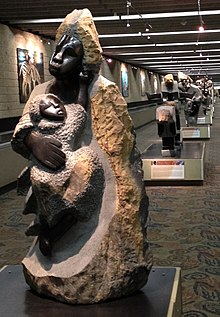
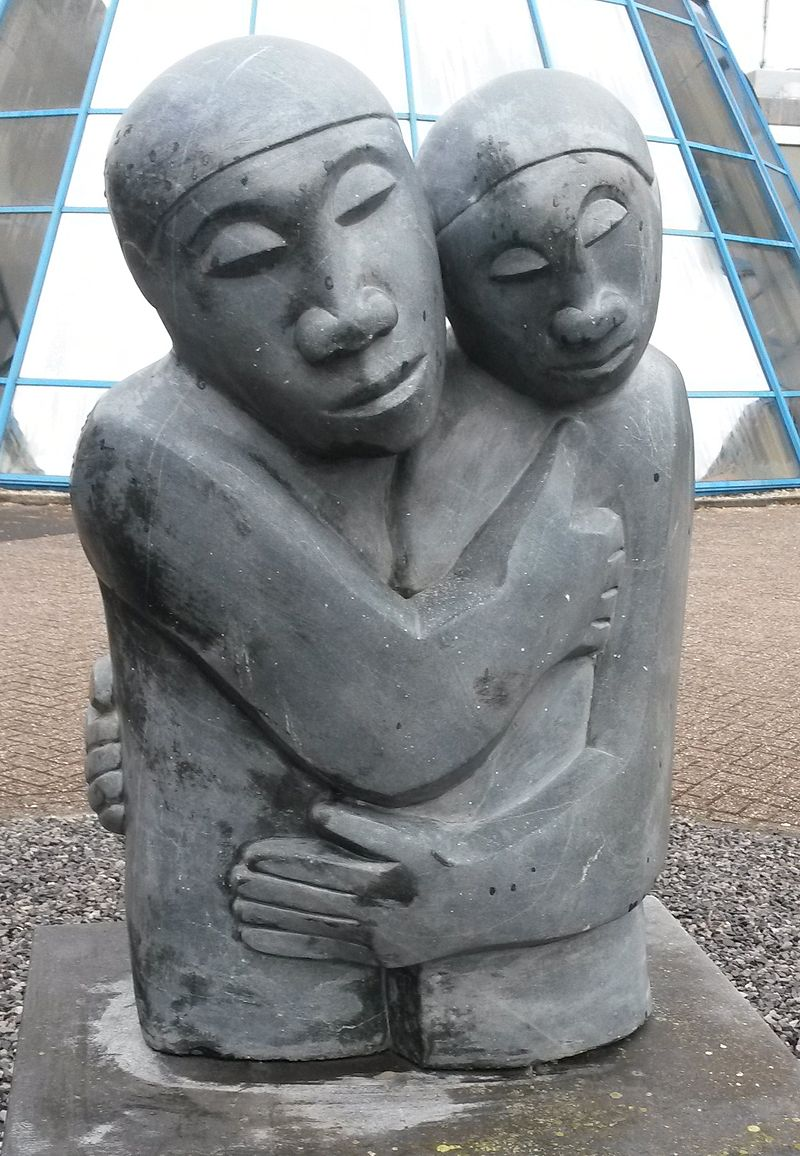
Zimbabwe Sculpture: a Tradition in Stone, Atlanta, USA, at Hartsfield-Jackson Atlanta International Airport between concourses T and AReconciliation by Amos Supuni
About Roberta Eaton Cheadle
Roberta Eaton Cheadle is a South African writer and poet specialising in historical, paranormal, and horror novels and short stories. She is an avid reader in these genres and her writing has been influenced by famous authors including Bram Stoker, Edgar Allan Poe, Amor Towles, Stephen Crane, Enrich Maria Remarque, George Orwell, Stephen King, and Colleen McCullough.
Roberta has short stories and poems in several anthologies and has 2 published novels, Through the Nethergate, a historical supernatural fantasy, and A Ghost and His Gold, a historical paranormal novel set in South Africa.
Roberta has 11 children’s books published under the name Robbie Cheadle.
Roberta was educated at the University of South Africa where she achieved a Bachelor of Accounting Science in 1996 and a Honours Bachelor of Accounting Science in 1997. She was admitted as a member of The South African Institute of Chartered Accountants in 2000.
Roberta has worked in corporate finance from 2001 until the present date and has written 7 publications relating to investing in Africa. She has won several awards over her 20-year career in the category of Transactional Support Services.
Want to be sure not to miss any of Robbie’s “Dark Origins” segments? Subscribe to Writing to be Read for e-mail notifications whenever new content is posted or follow WtbR on WordPress. If you found it interesting or entertaining, please share.
This month, I will be sharing information about Zulu beadwork and the messages contained therein as well as a traditional story.
Zulu beadwork
The Zulu people of South Africa have a rich tradition of beadwork. Originally, bone, small horns, shells and small pieces of polished wood and stone were pierced to make beads that were strung together as necklaces and belts.
When the Zulus started trading with the Europeans at the end of the 18th century, glass and ceramic beads were introduced into their beadwork.
Traditionally, both men and women wore beaded belts called umutsha to which a piece of cloth was attached to cover the pubic area. The belts have conical brass buttons that fasten the belt at both ends.
The colours and designs incorporated into Zulu beadwork hold specific meanings. Red beads, for example, signifies intense and jealous passion or eyes that are red from watching for a loved one to return. Yellow signifies contentment, pink or green for poverty or coolness, white for faithfulness and purity and black to indicate a desire to be married.
The main shape used in traditional Zulu beadwork is the triangle where the three corners represent Father, Mother, and Child. The triangle is also used to indicate gender and marital status, for example, if the tip points upwards it represents an unmarried girl. If the tip points downwards, it means an unmarried boy.
Zulu beadwork is used to make traditional dolls and jewelry as well as beaded ostrich eggs and bead coasters.
In summary, beads are an integral part of African history and culture. The serve as a form of money, indicate wealth, are spiritual talismans and form coded messages for the recipient.
Traditional Zulu music:
The South African pre-battle Haka:
Reading of a traditional Zulu story
My reading of The Chief’s Daughter and the Cannibal, a traditional Zulu story from Myths and Legends of Southern Africa by Penny Miller:
About Roberta Eaton Cheadle
Roberta Eaton Cheadle is a South African writer and poet specialising in historical, paranormal, and horror novels and short stories. She is an avid reader in these genres and her writing has been influenced by famous authors including Bram Stoker, Edgar Allan Poe, Amor Towles, Stephen Crane, Enrich Maria Remarque, George Orwell, Stephen King, and Colleen McCullough.
Roberta has short stories and poems in several anthologies and has 2 published novels, Through the Nethergate, a historical supernatural fantasy, and A Ghost and His Gold, a historical paranormal novel set in South Africa.
Roberta has 9 children’s books published under the name Robbie Cheadle.
Roberta was educated at the University of South Africa where she achieved a Bachelor of Accounting Science in 1996 and a Honours Bachelor of Accounting Science in 1997. She was admitted as a member of The South African Institute of Chartered Accountants in 2000.
Roberta has worked in corporate finance from 2001 until the present date and has written 7 publications relating to investing in Africa. She has won several awards over her 20-year career in the category of Transactional Support Services.
Want to be sure not to miss any of Robbie’s “Dark Origins” segments? Subscribe to Writing to be Read for e-mail notifications whenever new content is posted or follow WtbR on WordPress. If you found it interesting or entertaining, please share.