Ex-St. Paul cop Rushmore McKenzie has more time, and more money, than he knows what to do with. In fact, when he’s willing to admit it to himself (and he usually isn’t), Mac is downright bored. Until he decides to do a favor for a friend facing a family tragedy: Nine-year-old Stacy Carlson has been diagnosed with leukemia, and the only one with the matching bone marrow that can save her is her older sister, Jamie. Trouble is, Jamie ran away from home years ago.
Mac begins combing the backstreets of the Twin Cities, tracking down Jamie’s last known associates. He starts with the expected pimps and drug dealers, but the path leads surprisingly to some of the Cities’ most respected businessmen, as well as a few characters far more unsavory than the street hustlers he anticipated. As bullets fly and bodies drop, Mac persists, only to find that what he’s looking for, and why, are not exactly what he’d imagined.
David Housewright’s uncanny ability to turn the Twin Cities into an exotic, brooding backdrop for noir fiction, and his winning, witty hero Rushmore McKenzie, serve as a wicked one-two punch in A Hard Ticket Home, a series debut that reinforces Housewright’s well-earned reputation as one of crime fiction’s stars.
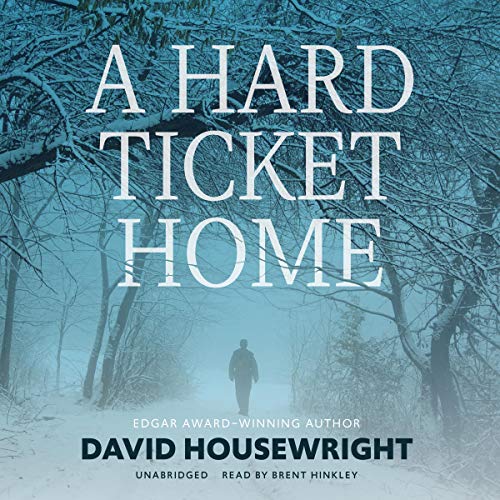
I listened to the audio book A Hard Ticket Home, written by David Housewright and narrated by Brent Hinkley. This book is a cross between your typical detective story and a cozy mystery, with distinctive characters. Hinkley sets the perfect tone, giving it kind of a Mickey Spillane feel, which is perfect for the genre and the story.
Rushmore McKenzie isn’t a cop anymore. He’s a billionaire, but even though he doesn’t need the money, he makes a hobby of playing P.I. When he’s called upon to find the long lost sister, Jamie, of none year old Stacy Carlson, in order to find a possible bone marrow doner and save Stacy’s life, he steps into more than he bargained for. Just as he locates Jamie, she is murdered in hideous fashion, and he finds himself on the middle of a murder mystery as he tries desperately to find Jamie’s missing son, who might be the only one left who could save Stacy’s life. But Mac has drawn attention in his investigation, and now someone is trying to kill him, too.
Filled with twists and turns that keep readers guessing, I give A Hard Ticket Home five quills.
__________________________
Kaye Lynne Booth does honest book reviews on Writing to be Read in exchange for ARCs. Have a book you’d like reviewed? You can request a review here.
She was a warrior forged from flame, a slayer of mighty dragons, until one final quest changed everything
Rayna had been hunting dragons since the day one burned her family to ash. Her skills, enhanced by a massive broadsword, made her a legendary dragonslayer. Marred by a mysterious stigmata labeled “the dragon’s curse” she was both revered and feared as she hunted down the dragons across Atharia.
Rayna thought she’d slain them all. But when the royal house sought the slayer they told her of another. One more dragon plagued the land…the very same beast which burned Rayna’s home years before. Fueled by vengeance Rayna takes up the quest to fulfill her life’s purpose and purge the beasts from the world. But as she gets closer to the kill, Rayna learns a bitter truth that will drastically alter her path and turn the hunter into the hunted.
Painful, pivotal memories surface as Rayna races to find the culprit behind the mayhem, recover a lost child, and get to the real target to set things right.
Rayna the Dragonslayer is the first in an exciting dragon fantasy adventure series A Time of Dragons. It’s a symphony of sword & sorcery, high fantasy, and a heroic quest that is like The Mandalorian merging with Game of Thrones.
A tough female protagonist is what drew me to pick up Rayna, by Cynthia Vespia. (Plus, it has a kick butt cover.) I’ve talked a bit about making strong female protagonists believable and relatable, and Ms. Vespia did not disappoint. Rayna is strong, agile and tough enough to slay dragons, which I hear can be rather tricky. She is portrayed as being physically and mentally strong, yet still emotionally vulnerable, which makes her relatable for just about everyone. Though tough and hard, Rayna also reveals a side that is very human, one perhaps even she didn’t know was there. Rayna is one heroine who I look forward to reading more about.
Dragon slaying in a land of castles and Kings, with lots of sword play and a bit of magic thrown in makes this tale a must for high fantasy lovers. I give Rayna five quills.
A paranormal women’s fiction (PWF) that’ll have you walking on air!
Luella Campbell is having the weirdest day ever. Getting fired from her job at the sunscreen factory for no good reason is bad enough, but when a mysterious dog brings a tempest into her former workplace, Luella’s life is completely upended by the sudden gift of wild and windy magical powers.
With the help of her ride-or-die best friends, her motorcycle-riding mother, and a romantic blast from the past, Luella must find a way to make ends meet while unlocking the mysteries of her newfound magic…and the secrets hidden in the picturesque town of Sparkle Beach.
Sometimes, an empty nest means it’s your turn to fly.
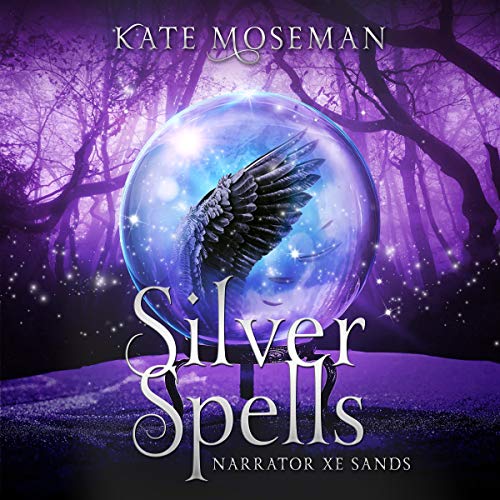
I listened to the audio book, Silver Spells, by Kate Moseman and narrated by Xe Sands. The soft, pleasant lilt of Sands’ voice made this story easy listening, and the characters weren’t too varied, but remained distinguishable. Moseman’s tale is well crafted. Although some events may seem to occur a bit too conviently, in the end, everything falls into place nicely.
After many years of loyal service to Sun Tan Queen, Luella Campbell is fired with no reason, she dumps her boyfriend, and her life is changing in some really big ways. Among the normal changes, like a new place to live, new friends and a new boyfriend are some a little less normal, like flying dogs which are invisible to all but a select few, the acquisition of a new pair of wings, and friends who develop mysterious powers… Her world has been turned upside down. Why these things are happening, she doesn’t know, but she’s determined to get to the bottom of it.
A fun and entertaining read. I give Silver Spells five quills.
______________________
Kaye Lynne Booth does honest book reviews on Writing to be Read in exchange for ARCs. Have a book you’d like reviewed? You can request a review here.
Nobody expects to lose a child but when it happens what can we do? In the sea of grief that seizes the soul how can we swim against the tide? But when that loss is compounded in each minute of every day, what do we do then?
Slings and Arrows is a story about the consequences of a moment, a moment, which separates a mother and daughter in ways impossible to imagine.
It charts their parallel lives, each suffering, one knowing, one not.
It is brutally honest; an account filled with bewilderment, guilt, anger and pain yet it also holds the key to hope. That whatever happens, the bonds of love can never be broken.
My Review: Slings & Arrows
Having lost a child of my own, it is not surprising that Slings & Arrows, by Julie Elizabeth Powell drew my interest. I have to say that I was not disappointed. The details of the loss of my son are very different from Ms. Powell’s loss of her daughter, but she offers up her story in a straight forward manner, with a brutal honesty which couldn’t help but touch my heart. Tears filled my eyes as I read Powell’s words time and again, as she is torn by conflicting emotions as she awaited her daughter’s body following a spirit which it appeared had departed.
Slings & Arrows is a brutally honest depiction of the stress, confusion, loss and grief which comes with watching a loved one slowly waste away long after their ‘life’ has ended. Kudos to Powell for baring her soul so openly in this tale of a loss that lingered on for years, consuming everything she has to give, and taking all that she has left. A tragic tale which hits close to home for me. I give Slings & Arrows five quills.
About Gone
Is Charley crazy, delusional or dead?
Follow her amazing, emotional journey and emerge into the battle with her nemesis – herself.
This inspirational fantasy will take you into realms otherwise unknown, turning your world upside down while you’ll be wondering what is real and what is not. It’s an adventure, a mystery and an imaginative fairytale for adults.
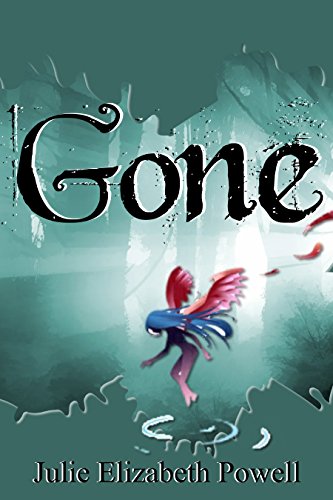
Gone, by Julie Elizabeth Powell, is a journey searching for answers to the unanswerable question of where we go when we are gone from here. Powell offers one possible scenario in a crazy world where her character, Charley, meets Jenny, the daughter that she lost and hopes she has the answers Charley has been looking for. To learn whether or not Jenny has those answers, you’ll have to tag along and visit this sometimes confusing, often surprising place and find out for yourself.
Having read Powell’s first book, Slings & Arrows, which is a heart-wrenching memoir where she bares her sole over the loss of her daughter and the time leading up to her death, when she was alive and suffering, it is difficult not to relate to the experiences in this fictional tale, as a way to find answers for Powell herself. Where we go when we’re gone from here is an age-old question, one we will all have to face, but Powell goes beyind that, in trying to answer “Why?” I hope Powell found at least some of the answers she was looking for in the writing. I think the answers are different for everyone, but it was fun to take the journey. I give Gone four quills.
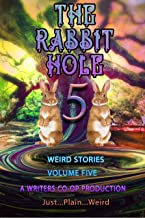
It’s no exageration when The Rabbit Hole – Weird Stories #5, compiled and edited by Tom Wolosz, Curtis Bausse and GD Deckard is described as “Just plain weird”. The stories contained in this volume, produced by the Writer’s Co Op, are all reprints that are just a bit quirky and different.
Welcome to the Rabbit Hole. On our fifth excursion into the warren of the odd, 37 authors lead us down their own little burrows of strangeness: an army of penguins, music that cures, aliens that communicate through old cartoons, images of the future that save, unwanted visions of the now, and, oh yes, it is raining lawyers. All have one thing in common, they are just…plain…weird.
Weird can be funny, weird can be sad, weird can be thoughtful, weird can be mad, but the one thing in common is that weird shares experiences you have, thankfully, never had.
Just be careful, all little bunnies are not nice, but they are memorable.
Stories by: Pete Barnstrom, Lori M. Myers, Richard Zaric, James Rumpel, Rhonda Eikamp, Joseph Carrabis, Leslie Muzingo, H. Donovan Lyón, GD Deckard, Lesley Bungay, S.E. Reed, Alexis Cunningham, Taija Morgan, Matt Nagin, Carl E. Reed, Stefan Markos, Anna Ross, Jon Zelazny, Marie Anderson and Tom Chmura, Richard Hough, Joseph Farley, D. A. Becher, David M. Donachie, Sally Basmajian, Bobby Rollins, Anthony Regolino, Robin Pond, Christina Hoag, John Haas, Joshua Williams, Jodi Rizzotto, Louis Evans, David Castlewitz, Tom Howard, Ira Nayman, and Tom Wolosz. Cover image adapted from an original design by Ian Bristow
My Review
I requested a copy of this anthology because the colorful cover caught my eye, and I’m a big Alice in Wonderland fan who never turns down a chance to explore a rabbit hole.Some of my favorites include:
“The Touch Stand”, by Lori M. Myers, which hits close to home as it reminds us all about things once taken for granted, which are no longer acceptable in a post-pandemic world.
“Don Quitamo”, by Joseph Carabis, which is a delightful tale of high adventure between father and son.
“James Thurber Saves the Day”, by Leslie Muzingo, which makes strong statements about censorship and classic stories in a very brief space.
“Future Shadows” by Lesley Bungay, which explores the ‘gift’ ot the ‘curse’ of premonitions, when there’s more to the choice of saving your sight than you would think.
“Definitely Dead”, by S.E.Reed, which proves that some recipes should not be improvised after trying to make a bad smelling tonic more pallateable.
“Sweet Summer Swimming”, by Alexis Cunningham, which puts a new twist on a relaxing day at the beach.
“The Blue Ghost”, by Taija Morgan, which is a delightfully frieghtening urban legend, very cool and very well executed.
This is a odd and different anthology, reminiscent of Weird Tales, and some of these stories are definitely weird. But the variety featured guarantees something for everyone, and you are sure to find stories here that will both entertain and amuse. I give The Rabbit Hole #5 five quills.
Content for Everyone is a must-read for creative entrepreneurs looking to improve the usability and accessibility of their website, email and social media content.
With over a billion people living with some form of disability worldwide, it’s more important than ever to make sure your content is accessible. In this easy-to-follow practical guide, you’ll learn techniques to make your content more accessible, without needing any in-depth technical knowledge. From adding meaningful alternative text to images, to choosing colors with enough contrast for easy readability, to adding captions to your videos and more, Content for Everyone has everything you need to reach a wider audience and improve the user experience for everyone.
Don’t miss out on the opportunity to improve your content and reach more people.
We all want to be inclusive, right? Of course, we do.
But how do we, as authors and creatives do that? Many authors don’t have the first clue as to how to do that. I know I didn’t.
Content for Everyone, by Jeff Adams and Michele Luchini is a book which tells you how to make your website content more accessible to a huge audience who many authors overlook or bypass. Adams and Luchini talk about how we can create more accessible content for visual or hearing impaired readers on our websites, in emails and newsletters, in blogposts and in social media posts. They talk about ways in which we can reach a much wider audience by making our content inclusive for readers regardless of whatever adaptive technoloy they’re using, or whatever device is their preference for consuming content.
With the right amount of time and effort, websites and digital communications can be made accessible to those with disabilities or use adaptive technology in accessing digital content. But it requires work and/or money to make that happen, and many authors probably wonder why they should go to the trouble.
I’m here to tell you why. When you make your website or your books accessible to those with disabilities and impairments, you are reaching out to a whole new audience with your writing. It is a large community, “with millions of impaired or disabled readers, who would read if they could access the content” (Patty Fletcher, email March 24, 2023), and it makes good sense to make your content inclusive to these potential readers. Awareness of the large audience of potential readers who are visually impaired was the main reason that I sat up and paid attention when I heard about this book.
Content for Everyone deals with how to make digital content accessible. There are many things we can do to make our content more accessible including providing the right contrast for visually impaired individuals, or even the proper use of headers. It’s no secret that I’m a bit old fashioned and I’m not always aware of the incricate details of the tech I use, although I am always learning. Content for Everyone discusses many ways in which you can make your content accessible to those with disabilities, who must use adaptive technology in order to access online and digital content. Some of these areas wouldn’t seem to be problematic to those of us without disabilities, but they are for individuals who are impaired.
Although all of this is a lot of work, Adams and Lucchini offer up individual steps which can be performed singularly, instead of trying to undertake the enormous task of accessiblility as a whole, which could be daunting. Picking one area of accessibility at a time seems to make the goal more attainable. I found that I hadn’t been using my headings correctly, and this is something that I never dreamed made any difference to anyone. But it does make a difference to those using adaptive technology, such as screen readers. after finishing the book, the first thing I did, was to go and change all the headers on my upcoming blog posts. Then, I went through and fixed them all through my blog site. It’s not anything a sighted person would probably notice, but for someone who uses a screen reader, it can make a difference as they try to navigate my site. Knowing that it makes a difference to some people, and knowing that by making it accessible, I will be widening my potential reader audience considerably, makes my decision to use headings correctly from now on seem a small step to take.
Something else which I’ve been working on since reading this book is adding the alt text for the screen reader crowd. Doing this is not hard, and should be done when you set the image in the post, but it does take extra time. I work with several visually impaired authors who use screen readers, so I know this audience is quite large. This is a simple thing to do, which really doesn’t take much time if you do it as you go. My site is image heavy, with lots of book covers, so it may take some time to add alternate text to the visuals which are already there. Even though it does take time and effort, the increase in portential readers from taking a few simple steps is so great that I have to ask, why would you not want to take this step to ensure that your content is accessible to more potential readers?
I am so pleased to be able to work with the wonderful authors within the visually impaired and print disabled community. It would be a shame to not be able to include their content within the WordCrafter tribe because of inaccessibility. And it would be a shame to have them miss out on WordCrafter content because they can’t access it. As Poetry Treasures 3 comes out this month, I’m pleased to be able to say it is the first book I have ever published with alternate text for each image. It’s just a small step in making Wordcrafter Press books more accessible to all.
You can learn more about these authors and their book, as well as learning a few things you may not know about accessibility in their interviews on the Stark Reflections podcast (episode 294), and on The Creative Penn podcast (March 13, 2023).
National Library Services
My grandmother was blind, and as a little girl, I often listened to her “talking books” with her and didn’t think much about it. I’m not sure, but I am thinking that those little cassette tapes that used to come to her in the mail, were sent by the National Library Services for the Blind and Print Disabled Library of Congress was behind them, even then. Yep. The visually impaired were doing “audio books” before they were even a thing. Today’s audio has caome a long way from those talking books on cassette, and there are now many adaptive technologies available to make books accessible to visually impaired and print disabled readers. And it makes sense for authors to tap into this audience by enrolling their their books in the NLS programs that are available. You can find out more about the National Library Services here.
Author Patty Fletcher encourages authors to enroll their books in the National Library Services to make them accessible to those who are visually impaired or print disabled to widen your audience and make many overlooked readers happy. She recomends that you read “That All May Read: Technological Innovations Extend Reach of National Library” by Wendy Maloney and then, if you are interested in making your books accessible, email nlscollections@loc.gov to find out how.
What is Accessibility and Assistive Devices?
“To know what accessibility is, one must first know what assistive technology is.”
Author Patty Fletcher
You can find out more about accessibility, what it is, and why we need it in our content. Patty Fletcher shares the following articles, which talk about assistive technology, how it works, and why it is important:
The subject is vast, and this book and the above articles are a good place to start.
Patty Fletcher is a visually impaired author and member of the American Council for the Blind, which is a large community of visual and print disabled readers. Patty’s goal is to bridge “the great chasm which separates the disAbled from the non-disAbled.” Toward that end, Patty is organizing a virtual event to help authors understand what adaptive technologies there are and steps we can take to adapt our websites, digital correspondence and books to be inclusive of these potential readers. Please reach out to myself or Patty if you would like to participate in this event.
For Kaye Lynne Booth, writing is a passion. Kaye Lynne is an author with published short fiction and poetry, both online and in print, including her short story collection, Last Call and Other Short Fiction; and her paranormal mystery novella, Hidden Secrets. Kaye holds a dual M.F.A. degree in Creative Writing with emphasis in genre fiction and screenwriting, and an M.A. in publishing. Kaye Lynne is the founder of WordCrafter Quality Writing & Author Services and WordCrafter Press. She also maintains an authors’ blog and website, Writing to be Read, where she publishes content of interest in the literary world.
Want exclusive content? Join Kaye Lynne Booth & WordCrafter Press Readers’ Group for WordCrafter Press book & event news, including the awesome releases of author Kaye Lynne Booth. She won’t flood your inbox, she NEVER sells her list, and you might get a freebie occasionally. Get a free digital copy of her short story collection, Last Call and Other Short Fiction, just for joining.
THERE’S NO ESCAPING THE EVIL THAT RISES WITHIN OUR OWN HEARTS.
On a work trip to Los Angeles, Michael Andrews stumbles upon the rising underground movement of the Proud Fighters for America, a white-supremacist group hell-bent not only on vanquishing any outside their predefined definitions of the one pure race, but also on leveraging long-buried paranormal experiments conducted by Nazi Germany to create an army of super soldiers.
But this group isn’t confined to the west coast. Their numbers have also spread to New York, Michael’s home stomping grounds.
Michael has to determine if a mysterious woman he is falling in love with who has ties to the PFA and a unique paranormal ability of her own can be trusted, and if the two of them, along with another supernatural creature and an occult scholar, are enough to take down the growing legion of evil.
FEARS AND FRIGHTS combines the complete texts of the two-book story arc that unrolls in the novels FEAR AND LONGING IN LOS ANGELES and FRIGHT NIGHTS, BIG CITY into a single digital bundle.
I listened to the audio book, Bundle of Fears and Frights, by Mark Leslie, and narrated by Scott Overton. As he has through the whole series, Scott Overton does a smashing job of bringing Leslie’s characters to life.
This is a two book bundle which includes Fear and Longing in Los Angeles and Fright Nights, Big City, which are, I believe, books 2 & 3 in Lefebvre’s Canadian Werewolf series. Together, they make nine hours of audio book entertainment, and characters which you can’t help but invest into.
My first thoughts when learning about book 1, Canadian Werewolf in New York, was that it might be similar to the movie, American Werewolf in London, which I enjoyed enough to watch two or three times. My second thought was that the werewolf thing has been soooo overdone, as have vampires, and zombies. As it turned out, Lefebvre’s werewolf different from that movie in several ways. And his character, Michael Andrews is not like any other werewolf that I’ve heard of. I mean, how can you not like a werewolf superhero? Not a role you’d expect to see a werewolf in, right? No, I find Lefebvre’s werewolf to be fresh and original, and I’ve never regretted picking up that first audio book, which was also narrated by Scott Overton. You can read my review of that book here.
Bundle of Fear and Frights takes Lefebvre’s werewolf to Las Angeles and back to New York, in his human form as Michael Andrews, of course, to battle a white supremacists domestic terrorist group. As a human, Michael is vulnerable like the rest of us, and he’s trying to come to terms with the loss of his true love, Gail, and move on to a new chapter in his life.
In Fear and Longing in Las Angeles, Michael finds a new love interest, Lex, but his supernaturally enhanced wolf senses and strengths offer advantages, and he can never walk away from someone in need. He just can’t seem to help himself. Before he knows it, he also finds himself battling the PFA, a domestic terrorist group involved in the occult, which has supernatural powers to rival his own wolf senses and strength. All, while trying to navigate his love life and his writing career. To make matters worse, strange things are happening with his wolf senses, which he doesn’t fully understand, but he grasps at the chance to once again have a normal life with Lex.
In Fright Nights, Big City, he’s back in New York with Lex, but trouble follows them, or at least, the PFA does. In L.A., Michael had decided to walk away and let the professionals deal with them, but now, in New York, it looks like they have no choice but to try and stop them from carrying out their evil plot to take over the city. Together with Lex, his new girl, and Gail, the girl he can’t seem to get over, they battle occult forces of evil to save the city, and themselves.
Mark Leslie’s Michael Andrews is one of the most likeable werewolves I’ve ever met. I love that he weilds his enhanced powers like a superhero, because of his compassion for others, which is a very human trait. I give a Bundle of Fears and Frights five quills.
Blood Tingling Tales, by Steve Hudgins are anything but blood tingling. Although some of these stories had the potential to be truly creepy, there was way too much telling and not nearly enough showing. These tales remind me of the ones we used to tell around the campfires or on sleepovers as kids, with not enough detail to be truly frightening or freaky.
While entertaining enough, the stories included in Blood Tingling Tales we’re not very scary. I give them three quills.
After being moved against her will to New York City and losing her father in the span of a year, the aspiring screenwriter dreams of escaping back to small-town Ohio where she can attend college and go back to some version of normal-if only she could afford it.
Enter Hollywood teen heartthrob Rowan Adler, an overnight celebrity thanks to the viral streaming sensation in which he stars. Ever-reckless Rowan is bored, sheltered, and desperate to escape the limelight.
The lives of the two teenagers collide one fateful autumn night when Josie finds an escaped Rowan asleep in the middle of the greasy burger shack where she works, leading her to wonder: How much would this exclusive sell for?
What follows is an absurd, heartfelt, romantic twenty-four-hour descent into chaos. The unlikely pair slowly learn what it means to embrace the plot twists life throws their way and how sometimes, getting lost is the only way to find out what you really want.
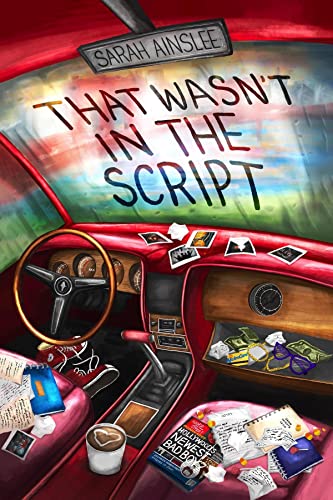
That Wasn’t in the Script, by Sarah Ainsley is a delightful coming of age romance with enough turns and twists to keep the pages turning at a rapid rate. This story is about being young, and growing up, and self-discovery, and having fun doing it.
Josie is stuck in a rut. She doesn’t realize that her life is about to go off the rails when she decides to help out a boy who she thinks is her classmate. But in a few short hours, her life will change drastically as she follows Rowan, a reckless teenaged heartthrob through New York City on a quest intended to give her the future she longs for. As they go through a night filled with wild new experiences, she finds she doesn’t want to benefit from Rowan’s celebrity, but perhaps she wants something else even more.
A teenaged romance with a big dose of reality and just the right amount of humor. I give That Wasn’t in the Script five quills.
Today, I am delighted to welcome author and poet, Patricia Furstenberg, as my March Treasuring Poetry guest.
Why do you write poetry?
To me, writing poetry is like being a flâneuse of the literary world.
The history and meaning of flâneuse (with its masculine form, flâneur) derive from the turn of the century, late 19th to early 20th. It defines those men and women who had the time, the inclination, the passion (and the finances, back then) to wonder along the streets of a big city and to observe and be a part of the daily city life. Those who enjoyed taking in the city.
It was after this past holiday, when my family and I covered about 200km on the streets of Romania, in Bucharest and Sibiu, that I learned this expression, flâneuse.
Writing poetry is my reaction to being a flâneuse in a city of words. Writing poetry is like strolling among literary creations, classical or modern (buildings made of words if you wish) and taking in their beauty and rhythm. A turn of the word here, a phrase there, they blend with the breeze, the song of bird, or the memories of my youth (like dappled shadows) – creating poetry.
Do you think poetry is still a relevant form of expressing ideas in our modern world? If yes, why?
Absolutely. Poetry permanently sheds a light on the world; it helps us see our everyday life through a different perspective. It adds colour to a world monotonous in its everyday violence. It also highlights, thus helping us remember, the forgotten beauty of life.
Poetry also creates bridges that unite us, past distances (and I mean social distances) or any other barriers. Poetry is that one constant in times of change. Because poetry helps us understand our emotions and communicate them. It helps us make sense of an uncertain future or of a tumultuous past. Poetry translates, by use of imagery that what – at first – is hard to comprehend and it appears scrambled.
Which poem by any other poet that you’ve read, do you relate to the most and why?
So many times I asked myself this question and the answer varied, but more often it was Robert Frost’s “The Road Not Taken” the poem I most relate with.
The Road Not Taken
Two roads diverged in a yellow wood,
And sorry I could not travel both
And be one traveler, long I stood
And looked down one as far as I could
To where it bent in the undergrowth;
Then took the other, as just as fair,
And having perhaps the better claim,
Because it was grassy and wanted wear;
Though as for that the passing there
Had worn them really about the same,
And both that morning equally lay
In leaves no step had trodden black.
Oh, I kept the first for another day!
Yet knowing how way leads on to way,
I doubted if I should ever come back.
I shall be telling this with a sigh
Somewhere ages and ages hence:
Two roads diverged in a wood, and I—
I took the one less traveled by,
And that has made all the difference.
Life, the simple act of living and of leading a happy and fulfilled family life, are such a tremendous gift – but we tend to take it for granted. I think that contemplating the road that brought us here, as well as the ones followed by our ancestors, is a valuable exercise.
“The Road Not Taken” by Robert Frost is about the choices and the opportunities we encounter in life. But unlike Frost’s poem, I believe that it isn’t the regret over the roads not taken that should overshadow our future, but the excitement for further choices, born out of our past decisions. Life is a continuous maze, and a beautiful and exciting one.
Which of your own poems is your favourite and why?
I enjoyed following the antics of the puppies depicted in my poetry book “as Good as Gold”. There were times when I would write and laugh. When I grew up in Romania we would live in an apartment so we shared some pretty close living quarters with our dog. Whoever looked after a puppy will remember that, at the beginning, they hardly sleep through the night.
While writing “As Good as Gold” I enjoyed mentally watching a puppy conversing with the moon, or meeting an owl (during night-time, of course) for the very first time. Writing from experience… Today I look fondly on those memories. Thus, my favourite poem is “Why, Rain?” where we follow a puppy on his first encounter with a surprise storm during what starts like a perfect summer day, just right for some nature exploration.
Is writing poetry easy for you compared to prose or do you do a lot of editing and revision of your poems?
I enjoy writing poetry for its free form and lack of constraints. Poetry allows my thoughts to roam unrestrained. For me, writing poetry is like finding shapes in the clouds – they can be anything and I won’t be wrong in writing them as such. The reader, in turn, can interpret them the way she sees them and none will be wrong for taking that what her / his heart chose to see.
Writing prose asks for much more structure, although I enjoy it just as much. Writing prose is like building a house.
Poetry is like writing a song. Sometimes you hum it for a long time before you get the melody out on paper just the way you heard it in your mind. Prose is more like writing a symphony. Just as rewarding, perhaps more demanding. Prose will confer a whole set of ideas, where poetry will distil the thought to a perfect, silky thread.
What mode (blog, books, YouTube, podcasts) do you find the most effective for sharing your poems with poetry lovers and readers?
As an independent author with self-published poetry books as well as poems published in various poetry anthologies I find that, today, readers show a fear of commitment towards poetry. I discovered that publishing my poems on my blog or into an online literary magazine I can reach a wider audience than publishing a poetry book.
My review of As Good as Gold, A dog’s life in poems by Patricia Furstenberg
As Good as Gold: A Dog’s Life in Poems is a delightful and uplifting collection of poems about domestic dogs and puppies. Each poem is accompanied by a lovely photograph of the dog through whose eyes the poems is written. I liked that the poems were told from the perspective of the dogs and I thought the freestyle form of poetry suited this book well as each poem is a mini story or adventure.
The writing style is conversational and relaxed. The following few extracts give a feel for the style of the poetry:
“Puppy tiptoes, Takes a peek. Sniffs carefully … What IS that squeak?”
“It’s oval, it bounces, it floats away, It’s pink like his tongue, it wants to play! “I’m coming!” barks pup and off he goes. Down the hill the pink shape flows And puppy follows suit. It’s just within his reach,”
For cat lovers, there are also a few poems told from the perspective of our feline friends and I loved those especially, as I am a cat owner.
I think this book is a lovely way of teaching children about animals as pets and the writing is appropriate for both children and adults, all of whom will adore the antics and curiosity displayed by the dogs, especially the puppies.
Writer and poet Patricia Furstenberg authored 18 books to date. Patricia grew up in Bucharest and was brought up listening to the legends and folktales of Romania’s past. She came to writing through reading, her passion for books being something she inherited from her parents. Her writing career followed a sinuous road that passed through a Medical Degree, practicing medicine, extensive traveling, and it also produced a happy marriage and two children. The recurrent motives in her writing are unconditional love and war, while Patricia’s keen interest for history and dogs brought her writing, through a perfect loop, to her native Romania. Today Patricia writes fiction and poetry. Her poems were published in anthologies by Green Ink Poetry, The Poem Magazine, and Lothlórien Poetry Journal as well as in over thirty online literary journals
Award-winning, bestselling author, Robbie Cheadle, has published thirteen children’s book and two poetry books. Her work has also appeared in poetry and short story anthologies.
Robbie also has two novels published under the name of Roberta Eaton Cheadle and has horror, paranormal, and fantasy short stories featured in several anthologies under this name.
The ten Sir Chocolate children’s picture books, co-authored by Robbie and Michael Cheadle, are written in sweet, short rhymes which are easy for young children to follow and are illustrated with pictures of delicious cakes and cake decorations. Each book also includes simple recipes or biscuit art directions which children can make under adult supervision.