Discouragement or Motivation?
Posted: May 5, 2016 Filed under: Western, Writing | Tags: agents, Delilah, publishers, Rejection, Western, Writing 6 Comments
I finished the final draft of Delilah last month. Normally, in anticipation of its completion, I would scour my Writer’s Market in search of publishers and/or agents that might be in the market for a western novel with a tough, spunky female protagonist and make a list of places to send it out to. But, I pitched Delilah to a publisher I felt would be a perfect fit for this manuscript last summer at the Write the Rockies Conference in Gunnison, and got an invitation to send the manuscript when it was completed. That in itself was amazing, because you usually don’t pitch a manuscript that isn’t complete, but I was doing the pitch for practice, and I actually felt like I’d bungled it pretty badly. My perception of my performance must have been wrong, because the invitation to query was forthcoming.
At any rate, I didn’t make the usual list of submissions for Delilah, because I knew where she was going, and I just knew this publisher was going to make an offer. Instead, I spent my time preparing for submission. I wrote a synopsis and query letter, and prepared a brief excerpt to include. So, as soon as the final revisions were completed, I sent off my query.
I also sent a query to an agent I thought might be good to represent me, using Delilah to entice them. I sent it off on April 21, and on April 29 I received the rejection. Man that was fast. I found it disheartening. I know I have to expect rejections, probably a lot of them, and I’ve had many on other works which I’ve been shopping. In my graduate classes at Western State, they warned us to expect them, and taught us to use them as motivation to get it back out to the next perspective publisher or agent. And, you know, that’s exactly what I’ve done regarding all the other works I’ve sent out. So, why is this rejection any different?
I think it was the speed with which I received this rejection, barely a week, which took me aback. You wait for responses from publishers and agents for weeks, sometimes even months. That’s why you send out simultaneous submissions whenever possible. Get your work read by as many possible avenues of publication as possible. It’s common practice, although some calls for submissions specify that they do not accept simultaneous submissions. (If you think about it, it’s pretty selfish of a publisher to do this, expecting to allow them to consider your work exclusively, when it takes so long for them to respond.) This rejection came from an agent, not a publisher, but I wasn’t expecting a reply so quickly. I didn’t feel like they’d even had time to read what I’d submitted.
I’ve worked on Delilah on and off for four years. I could have finished her sooner, but with school and my freelancing, and holding down a full time job, I wasn’t able to work on her, like I did on my thesis, which I wrote in full within six months, (but that’s another story, for another day). Actually, I had a completed draft of Delilah in that amount of time, but the revisions turned it into a whole other story. It’s true. The final manuscript of Delilah tells a different story than the one I set out to tell originally. I have enough cut scenes from the first draft to almost make up another whole book, which I might do, if Delilah finds a home and does well.
So the question remains, why have I not sent Delilah out to more than one publisher? Why do I have this certainty within me that she will find a home with this one publishing house that I submitted to first? I know this isn’t a realistic expectation and I’m probably setting myself up for disappointment. I do. So, why don’t I treat this novel like my other works? And why did the first rejection from an agent hit me so hard? Maybe because I have put so much of my heart into Delilah, but I think you have to put your heart into any work of creativity in order for it to be truly good. I don’t know what’s so special about this novel, but I know Delilah is special. I feel it. If I find a publisher for her, you can read it and then, you’ll know it, too.
Share this:

“Wild West Ghosts” may turn readers into believers
Posted: February 13, 2016 Filed under: Book Review, Opinion, Western | Tags: Book Review, Books 2 Comments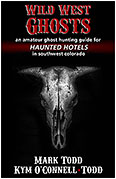
Wild West Ghosts, by Mark Todd and Kym O’Connell Todd may turn some readers into believers. The cover describes the book as “an amateur ghost hunting guide for HAUNTED HOTELS in southwest Colorado”, but it is so much more. Wild West Ghosts might be more accurately described as a travel guide for ghost hunters, outdoors enthusiasts, tourists and history buffs alike.
In addition to the detailed instructions provided for amateur ghost hunters, which lay out the methodology and equipment which the Todds used to achieve their results, and accounts of the local ghost lore of each area, they’ve included vivid site descriptions and colorful area histories which add an old west flavor. In addition, an outline of contemporary area attractions for each site is provided for visitors looking for more than ghosts on their vacation, including highlights of the area, Annual Festivals and events, and cultural and recreational opportunities.
By design, the locations chosen are a bit off the beaten path. The southwestern Colorado locations visited include Creede, Crested Butte, Cripple Creek, Del Norte, Delta, Fairplay, Gunnison, Norwood, Ouray, Paonia, South Fork, and Twin Lakes. For each location is provided with an account of the Todds visit, including details of any strange or ghostly phenomena they encountered either on their spirit box or EMF meter. Many accounts include ethereal conversations they were unaware of at the sites, which were discovered only after they were able to play back audio-only recordings. Their experiences are related in conversational tone, with professional manner and a dash of humor.
For those on a spirit quest, ghost hunting instructions are given in simple, easy to understand terms, ideal for first time ghost hunters. The authors thoughtfully included an account of their test run, made to familiarize themselves with the equipment, along with the lessons that they learned, so those thinking of trying their hand at the ghost hunting thing need not make the same mistakes. Related photos and maps locating each site have also been included to enhance both reading and ghost hunting experiences.
Mark Todd and Kym O’Connell Todd are partners in life, as well as in writing. They reside in the Gunnison area, where Mark teaches creative writing at Western State Colorado University. Their previous works as a team include the humorous, quirky Silverville Saga: Little Greed Men, All Plucked Up and the Majick Outhouse, which all revolve around a fictional Colorado mountain town and keeps readers chuckling to the last pages. To learn more about the Todds and their writing, visit their website, Write in the Thick of Things.
I give Wild West Ghosts five quills. 
Share this:

Time Flies
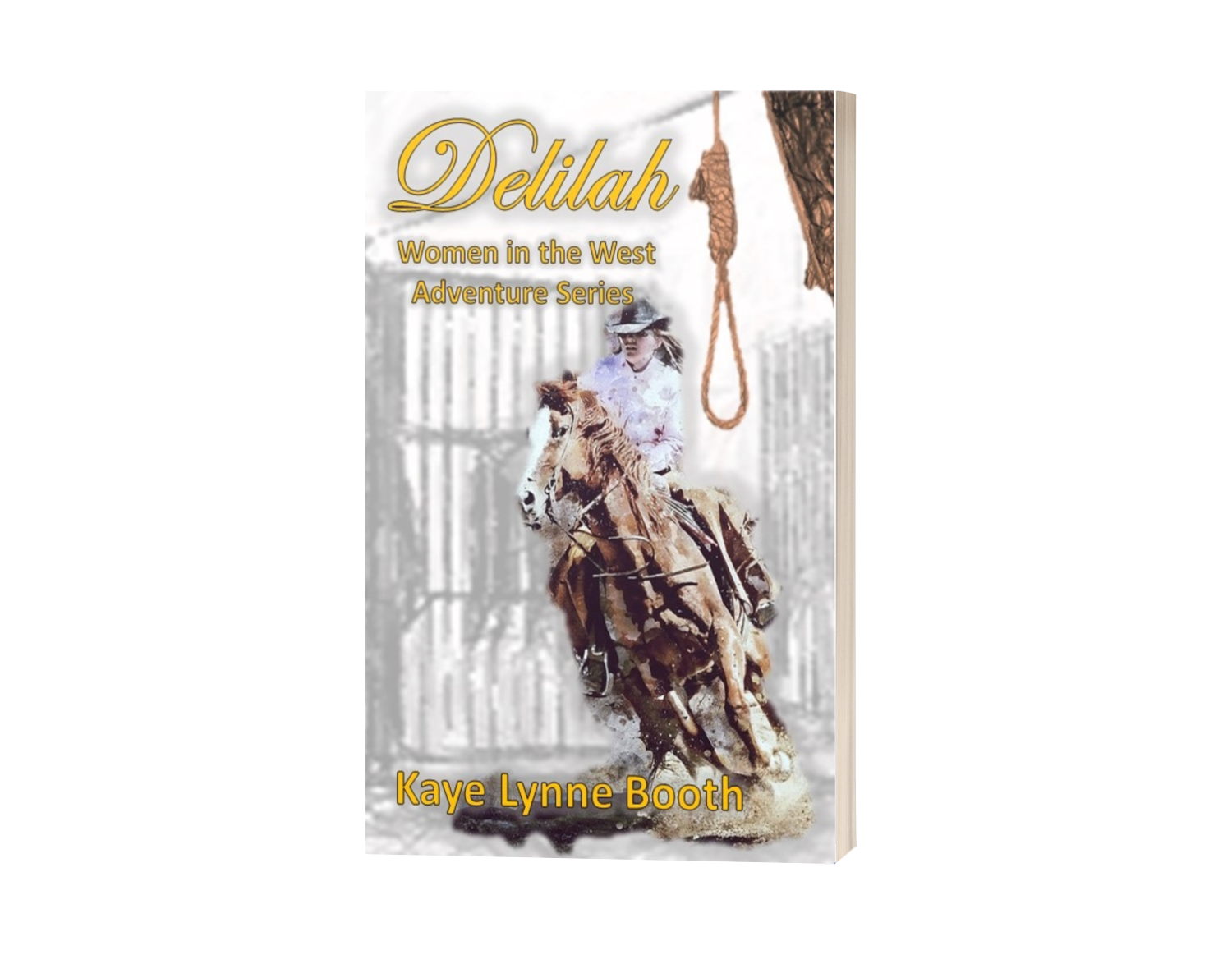
Posted: January 12, 2014 Filed under: Fantasy, Fiction, Mystery, Western, Writing | Tags: Books, Fantasy, Fiction, mystery, New Year, Western, Writing Leave a comment Wow! It’s 2014 and I just realized how long it’s been since I published here, I’ve been busy earning my degree, along with the many other demands that life places on all of us. But hard work and dedication pays off. In fact, since I began the MFA program at Western State Colorado University, I’ve produced rough drafts for two novels, which I’m now working on revising. The first is a western, Delilah, and the second is a middle grade mystery, The Adventures of Ann and Kinzi. I’m currently working on a mythological fiction/fantasy/science fiction novel, with the working title, A Playground for the Gods, which I’m considering using as my thesis.
Delilah is a tough young woman who grew up on the Colorado frontier. On her way home to the San Luis Valley, she’s brutally raped and left for dead, sending her on a quest for vengeance. Her hunt for her tormentors leads her to the Colorado mining town of Leadville, where the colorful inhabitants work their way into Delilah’s heart and give her hope for a future she’d thought lost along with her innocence. Now she must stay alive and protect her new-found friends as she faces the many dangers of the western wilderness and the outlaw elements of the growing new Colorado territory.
The Adventures of Ann and Kinzi is the story of two young girls growing up during the depression. Their shared love of animals and the fact that they’ve both lost their mothers are the common ground on which cements their friendship. When strange things start happening at the McViddie farm, where they care for the horses, and one of their classmates disappears, Ann and Kinzi set out to solve the mystery and save their friend, but they must do it without being caught by the kidnapper themselves.
In A Playground for the Gods, Inanna is the goddess of love and war on a quest to save humanity. The foolish judgement of men and their misuse of the technology the gods have provided have brought them to the brink of self-destruction and convinced the gods that humanity is not ready to receive the secrets of long life and powers that would make them godlike. They’re preparing to find a new planet on which they hope to find a new species to bestow their gifts upon. Inanna must prove that humans are worthy of their godly gifts, and convince them not to leave humanity in such a mess.
That’s it. That’s my excuse for neglecting this Writing to be Read blog. Now all I can do is ask forgiveness from my readers and offer the promise that if they stick with me, I promise to blog on a regular basis in the coming year. I don’t foresee that I will abandon novel-writing, but I do plan to try to organize my time better, so I’ll be able to commit to at least two or three posts a month. I hope you will all join me for the journey.
I’d also welcome any feedback on which of the above stories capture your interest and why. Comments are always appreciated.












Acceptance or Rejection – Which do You Prefer?
Posted: June 27, 2016 | Author: kayelynnebooth | Filed under: Commentary, Fiction, Opinion, Promotion, Publishing, Western, Writing | Tags: Acceptance, Creative Fiction, Fiction, Flash Fiction, I Had to Do It, Kaye Lynne Booth, Rejection, Western, Writing | 1 CommentI could go into another post about rejections. Lord knows, I’ve gotten plenty. But I’ve always been one to see the glass half-full side, rather than half-empty, focusing on the positive side to everything, so I think I’d rather talk today about acceptances. I don’t think anyone will disagree when I say acceptances are much better than rejections. You don’t have to be a writer to figure that one out.
You don’t get them as often as rejections, but they’re a lot more satisfying. But there’s a reason I want to write a post on acceptances. If you follow me on Facebook, or Twitter, or Google+, you may have seen my very recent post announcing that my flash fiction western story, I Had to Do It, has been picked up by Zetetic: A Record of Unusual Inquiry.
It’s true this isn’t a big paying publication. I’m certainly not going to get rich from this one little 850 word story. Flash fiction never pays a lot. There’s simply not enough words to make the pennies add up to much, even with higher paying publications. But, I was still elated when I received the acceptance, because my story found a home and people will now read it, and because it is still one more publishing credit for me. I can’t explain the rushing feeling of excitement and pride that small note from the editors brought me. I think most of all, it was thrilling to know that someone else really liked my writing. It was a affirmation of my own belief that my writing really is pretty good.
That probably sounds silly to those who have not yet received an acceptance. (Never fear. It will come.) But we writers are an odd lot, and we are filled with fears and self-doubt. Filled with it. Most of the time we can keep these elements of our inner beings at bay by simply pecking away at the keyboard or filling up sheets of notebook paper, but every once in a while we let our guards down and that’s when they strike. The fear and self-doubt simmer in us, just down below the surface, until they see an opportunity, a weakness, and then they reach up and grab a handful of us and don’t let go.
I think just about every writer worries that the only person in the whole world that really thinks their writing is good is themselves. Friends and family don’t count because they may be saying they like it so as not to hurt your feelings. When you receive an acceptance, any acceptance, it tells you other people do like your writing, and motivates you to get busy writing more.
It’s a good feeling. One I think every writer needs to experience. It can’t happen unless you submit relentlessly and write, write, write. That’s my advice. Write your heart out and then submit like crazy, and never, ever give up. The notes that say, “yes”, make it worth surviving all the ones that said, “no”. So what are you waiting for? Get writing!
Like this post? Subscribe to Writing to be Read for e-mail notifications whenever new content is posted.
Share this: