Review in Practice: “Mastering Amazon Descriptions” & “How to Write Fiction Sales Copy”
Posted: February 14, 2022 Filed under: Advertising, book marketing, Book Promotion, Copywriting, Fiction, Hooks, Writing | Tags: Book Review, Brian D. Meeks, Dean Wesley Smith, How to Write Fiction Sales Copy, Review in Practice, Writing to be Read 6 Comments
It’s not enough to just write the book.
Today’s author must be both writer and marketer. Authors in the the world of digital media and the rise of independent publishing are responsible for not only writing the book, but selling it, too. Even authors who are traditionally published are often responsible for a good portion of the promotional efforts.
These days, everyone knows that people can and do judge books by their covers. Most authors emphasize the importance of a a good book cover in selling books, but they’re talking about more than just the image and text on the front. Perhaps as important as that front cover, is the book’s description or blurb, found on the back cover for print books, or in your ebook’s meta-data.
A good book description’s job is to capture reader interest and make them want to know more,. Whether we’re talking about the hook of the first line, which must make you read on to the next sentence and then the next, or about the description as a whole, which must hook the reader, making them want to buy the book to learn the rest of the story, the book description is one of the most powerful tools we have at our disposal to sell books. According to Brian D. Meeks, a good book description has three elements: a powerful hook, engaging copy, and visually appealing formatting.
Mastering Amazon Descriptions
In Mastering Amazon Descriptions, Brian D. Meeks offers a formulaic plan for writing book descriptions that will sell books, including examples of description re-writes for books in varied genres. Although these descriptions are specified as Amazon descriptions, I’m sure this technique will work equally well with Kobo, or Barnes & Nobel, or even the Apple Store. By the time you’ve read through this book, you’ll be writing back cover copy like a pro, because Meeks’ method is simple enough that almost anyone can do it.
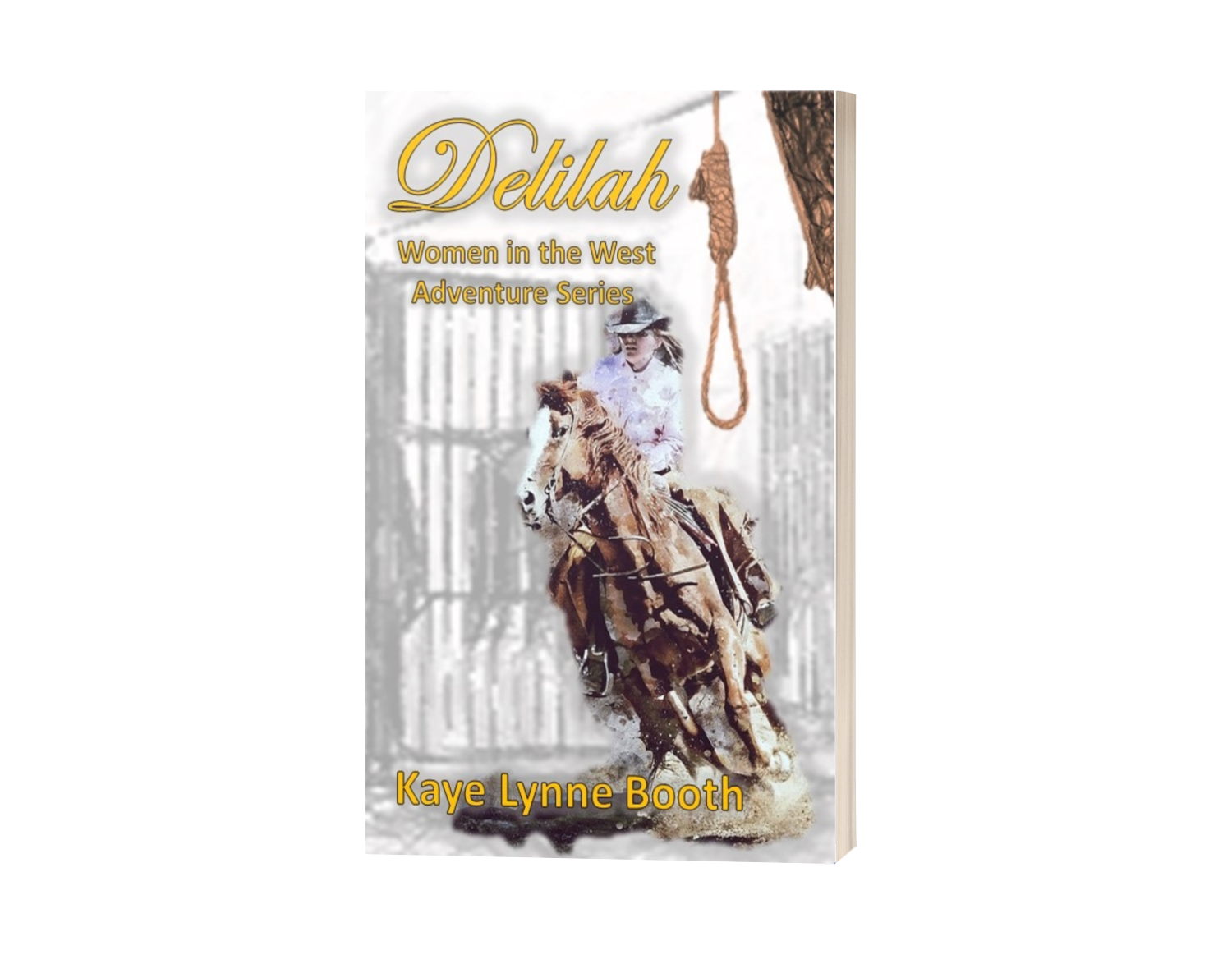
To prove it, I’ll share with you the re-write I did of the description for Delilah, which I am preparing for its re-release in the coming year.
Here is the original description:
“Brutally raped and left for dead, her fourteen-year-old ward abducted, Delilah’s homecoming from prison quickly turns into a quest for vengeance. Tough and gritty, sheer will and determination take her to the Colorado mining town of Leadville in her hunt for her attackers and the girl, Sarah. Somehow along the way, the colorful inhabitants of Leadville work their way into Delilah’s heart, giving her a chance for a future she thought she’d lost along with her innocence.”
Here is the description I wrote for the re-release before I read Mastering Amazon Descriptions:
Delilah is a woman haunted by her past. Her homecoming from prison quickly turns into a quest for vengeance when she is brutally raped and left for dead, and her fourteen-year-old ward is abducted. Sheer will and determination take this tough and gritty heroine up against wild beasts of the forest, Indians and outlaws to the Colorado mining town of Leadville, where the colorful inhabitants work their way into Delilah’s heart, offering a chance for a future she thought she’d lost along with her innocence.
Now, here is the description I wrote using Brian D. Meeks’ method:
Haunted by her past.
Raped and left for dead; her fourteen-year-old ward abducted.
Sheer will and determination take this tough and gritty heroine up against wild beasts of the forest, Indians and outlaws.
Can the colorful inhabitants of Leadville work their way into Delilah’s heart, offering a chance for a future she thought she’d lost along with her innocence?
I don’t think anyone would argue that this last description is an improvement. It has a better hook, shorter sentences, and leaves the potential reader with a question to make them want to learn more and read the book.
How to Write Fiction Sales Copy

How to Write Fictin Sales Copy, by Dean Wesley Smith offers three different formulas for writing back cover blurbs and sales copy, which are aimed toward a wide distribution, and several different approaches. Smith is an old pro in this writing game and he’s good at what he does, (which is write). While his methods are not as formulaic and are not specific to Amazon, they are never-the-less effective in posing unspoken questions about the book and making readers want to know more. Smith also offers 32 actual story blurbs as examples in multiple genres.
To experiment with one of Dean Wesley Smith’s techniques, I thought I’d try to rewrite the blurb for my paranormal mystery novella, which is riddled with what Smith calls “The Author Problem”, which results from too many passive verbs and too much focus on the plot. My description doesn’t have a lot of passive voice, but it does focus on the plot too much, revealing more than necessary, which is a common author error. The idea behind the blurb is to give potential readers just enough to pique their interest and make them want to purchase the book. If you reveal too much of the plot, there’s no reason to buy.
Cassie is nervous about her return to her ancestral lands with her boyfriend Tony for more reasons than one. She hasn’t been up in these mountains since the unexplained drowning of her parents. And her parents aren’t the only ones who have died or mysteriously disappeared in the area. Cassie doesn’t really believe the old legends passed down from her Native American ancestors, but she harbors no desire to become the keeper of her tribal legacy or the protector of the gold that goes with it. In fact, she plans to tell her Grandmother to pass the legacy to someone else, perhaps her cousin Miranda, who has been searching for the treasure for years. Cassie wants nothing to do with it now that she carries Tony’s baby in her womb. When Cassie forces herself to go out on the lake that took the lives of her parents and she discovers a cave which holds the treasure of her people, she must admit that the legacy is real, which means the curse that guards the treasure and threatens the males of her tribe must also be real. When Miranda’s boyfriend, Jake disappears on the lake, Cassie must find a way to stop the curse, before Tony becomes the next victim.
So here is my attempt at a rewrite, using Smith’s basic blurb pattern, beginning with a character summary that “nails the genre if possible”.
Cassie wants nothing to do with the legacy her grandmother wants to hand down to her. She doesn’t believe in all those Native American legends anyway.
She and Tony plan to be married and start a family. They’re only returning to her ancestral lands now to tell her grandmother to pass the tribal legacy on to someone else, along with the cursed gold that goes with it.
When she forces herself to go out on the lake where her parents drowned, she discovers the cave which holds the tribal treasure and the lake takes another life. Now Cassie must rethink all that she believes. If the treasure is real, could the curse be real, too?
Can Cassie find a way to stop it before Tony becomes the next victim?
If you love paranormal mysteries, pick up a copy of “Hidden Secrets”.
Which one of these descriptions would make you more likely to buy the book? You can see what a difference a few simple changes can make.
Authors must be able to write sales copy, as well as fiction or nonfiction, because stories don’t sell themselves. On The 6 Figure Authors podcast suggest that if a book isn’t selling well, the first things to look at are cover art and blurb. We see here with the examples I provided, what a difference changing up the blurb can make. I recommend both Mastering Amazon Descriptions, and How to Write Fiction Sales Copy to any author who wants to polish their blurb writing skills and improve their sales copy.
Share this:

Writer’s Corner: Lessons for submitting to short fiction markets
Posted: December 27, 2021 Filed under: Anthology, book marketing, Short Fiction, Stories, Writer's Corner, Writing | Tags: Anthologies, Short Fiction, Submissions, WordCrafter Press 11 Comments
Short fiction doesn’t sell well. – That’s what I keep hearing. Anthologies are hard sells. So why would you even write short fiction, if it is so difficult to sell?
What many authors need to realize, is that while an anthology may be harder to sell than a novel, when you have work featured in an anthology, it is a project involving many authors, each with their own following which they bring to the table, creating a much bigger marketing network than you would have for a novel. Being a part of an anthology expands your marketing reach exponentially by the number of authors involved, which could actually make the marketing and promotion of the anthology easier and allow marketing to a much larger audience.
For the past few months I’ve been exploring short fiction and short fiction markets from the other side of things, as I worked to compile two separate anthologies. My solo project for my masters in publishing is The Best of Weird Tales 1926-27, which meant reading twenty-four issues of Weird Tales and selecting what I felt were the best stories to represent the publication, then compiling them into a single collection. It had to be a careful selection process, because much of what was socially acceptable in 1926 & 27, is far from acceptable in 2021.
The other project required for my degree involves being on the editorial team for the Mirror, Mirror anthology. You may have seen the call for submissions posted here on writing to be Read back in July. And there’s a chance that you even submitted to it, since we had over 600 submissions. That’s a lot of short stories to read. But I learned some valuable lessons from the experience:
- It pays to get your submission in early. The early submissions get fresh eyes and open mind. But those submitted closer to the deadline, are seen by eyes that are tired by minds that have read so-o-o many stories, many of which are similar in theme or concept, if you wrote to the submission guidelines.
- Follow the submission guidelines. This experience drove home to me how important this one really is. Going into this, my instructor and mentor, Kevin J. Anderson drilled in the importance of following the submission guidelines and took great care to make them clear in the call for submissions. It called for proper manuscript formatting, something every author should be familiar with, but just in case, he also included a link to a site that defined and explained what proper manuscript formatting is, and still we got manuscripts that were not formatted properly. Toward the end, I know improperly formatted manuscripts got set aside without a full read, because it hurt my tired old eyes too much, so this is really an important one, but many authors just didn’t get it. Publishers don’t want to work with authors who cannot follow simple instructions and format their manuscript properly or follow the guidelines, because this hints that they might be a pain to work with.
- Only submit a story that fits what the call is looking for. I was surprised how many stories we got that didn’t have a mirror in them at all; not even a compact for the character to check their make-up. Who sends a story without mirrors to an anthology titled Mirror, Mirror that requests a mirror be central to the story. I’m told that last year someone submitted Christmas cards for the call for submissions for Unmasked, last year’s anthology, which may evoke a chuckle when you hear it, but for editors overwhelmed with submissions, reading through a story that doesn’t even come close to meeting the guidelines or match the theme, it feels like a big waste of time. Editors have feelings, too. Be kind and only submit stories that meet the theme and guidelines, instead of trying to cram your story into a frame that doesn’t really match.
- In today’s market, busy editors are looking for something that is close to being publishable as is, so be sure your manuscript is polished. I feel like I shouldn’t have to state this one, but with as many seemingly unedited submissions, I guess it needs to be said. I was expecting it toward the end, when authors were rushing to meet the deadline, but even early on there were manuscripts that were riddled with misspellings and typos. Many of these may have been good stories, some even written to guidelines, but they were passed by because they would have required too much editing to ready them for publication. It would have required more time than my class of student editors would be able to give. So, I strongly urge having another set of eyes give a critical look over all stories prior to submission. Turning in a clean manuscript will strengthen the chances of your submission being accepted, or at least read clear through for a fair evaluation.
- Choosing favorites is much harder than I thought it would be. We were cautioned that last year’s anthology received over 500 submissions, with more than 100 received in the last week of submissions. Mirror, Mirror received over 600 and so many of them were truly excellent stories that choosing the few that we had the budget for was really difficult, especially since not everyone had the same favorites. In the end, we ended up with a heck of a selection of stories for this anthology. I think it will be great!
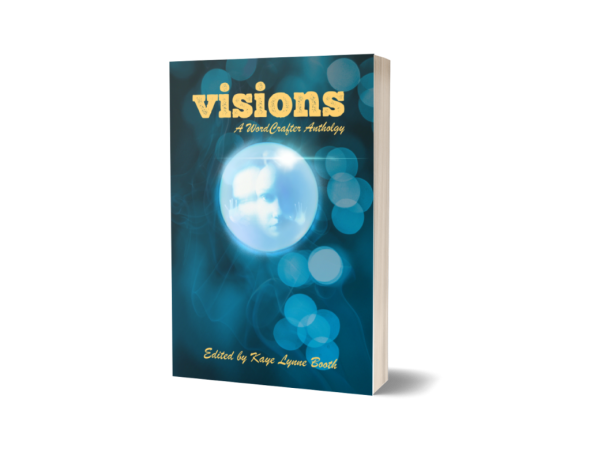
Although all of my personal favorites couldn’t be included, I did find a way to make 2022 a great year for anthologies at WordCrafter Press, with two by invitation only anthologies in addition to the annual short fiction contest and anthology. I gave you a sneak preview for the submission call for the annual anthology, which will be titled Visions, here. The official call for submissions will be posted in January, so stay tuned.
___________________________________________________________________________________________________
Like this post? Let me know in the comments. You can be sure not to miss any of Writing to be Read’s great content by subscribing to e-mail or following on WordPress. If you found this content helpful or entertaining, please share.
Share this:

Halloween Special: 3 Days Only
Posted: October 29, 2021 Filed under: book marketing, Book Promotion, Books, Fiction, Ghost Stories, Paranormal, Stories | Tags: Anthology, Halloween, Paranormal, Short Fiction, Short Stories, Where Spirits Linger, WordCrafter Press 6 Comments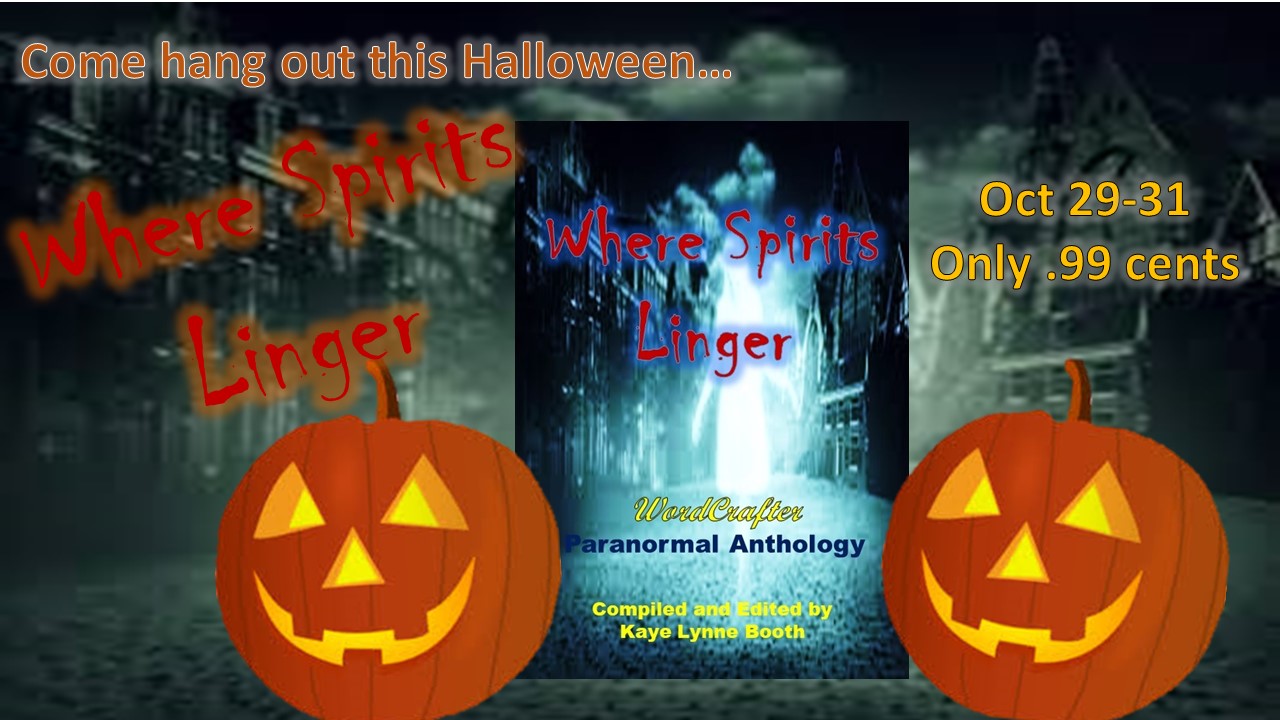
Covid 19 brought changes to the way we do many things, including how we celebrate Halloween. Many folks may not be comfortable being exposed to children in costume coming to their door. Many parents may not be comfortable letting their children go door-to-door this year. I know of neighborhood residents who have gotten together to allow trick-or-treating only within a close-knit group, where everyone knows everyone else and they are all vacinated, and I’ve seen more haunted houses this year than ever before.
One thing that hasn’t changed though, is the love of a good ghost story or two on Halloween night. That’s why this weekend only, you can get a digital copy of Where Spirits Linger, this year’s WordCrafter paranormal anthology, to draw your ghost stories from. You’ll be captivated with the lingering spirits in these short stories, including the winning story from the 2021 WordCrafter Paranormal Short Fiction Contest, “Olde-Tyme Village”, by Christa Planko. Work from other authors which is also included in this short fiction collection: Roberta Eaton Cheadle’s ghost with an agenda in “Listen to Instructions”, my own ghosts who want to care and be cared for in “The People Upstairs”, S.L. Kretsmer’s ghost who wants to be remembered in a positive light in “The Final Portrait”, Stevie Turner’s ghost who wants revenge in “David’s Revenge”, and you’re sure to get a chuckle from Enid Holden’s ghosts in “The Chosen Few”.
Don’t miss out on these great ghost stories this Halloween. Only .99 cents starting today through Halloween. Celebrate your Halloween Where Spirits Linger. Click the link below to have your digital copy delivered right to your reading device of choice.

https://books2read.com/u/mYGyNG
___________________________________________________________________________________________________
Like this post? Let me know in the comments. You can be sure not to miss any of Writing to be Read’s great content by subscribing to e-mail or following on WordPress. If you found this content helpful or entertaining, please share.
Share this:

Day 5 of the WordCrafter “Where Spirits Linger” Book Blog Tour
Posted: September 24, 2021 Filed under: book marketing, Book Promotion, Book Review, Books, Giveaways, Guest Post, Paranormal, WordCrafter Book Blog Tours | Tags: Book Review, Christa Planko, Enid Holden, Kaye Lynne Booth, Paranormal, Roberta Eaton Cheadle, S.L. Kretschmer, Short Fiction, Short Stories, Stevie Turner, Where Spirits Linger, WordCrafter Book Blog Tours Leave a comment
For Day 5 of the WordCrafter Where Spirits Linger Book Blog Tour brings us a guest post by contributing author, Stevie Turner about her story, “David’s Revenge”, on Zigler’s News and a review by Victoria Zigler. Please join us to learn more about this author and her story. Leave a comment and earn a chance to win a free digital copy of Where Spirits Linger.
https://ziglernews.blogspot.com/2021/09/where-spirits-linger-wordcrafter-book.html
_____________________________________________________________________________________________
Book your WordCrafter Book Blog Tour today!
Share this:

Welcome to the WordCrafter “After the Fires of Day” Book Blog Tour
Posted: September 6, 2021 Filed under: Blog Tour, book marketing, Book Promotion, Book Review, Books, Poetry | Tags: After the Fires of Day, Alphonse de Lamartine, Cendrine Marrouat, Haiku, Kahlil Gibran, Poetry, Poetry Collection, WordCrafter Book Blog Tours 12 Comments
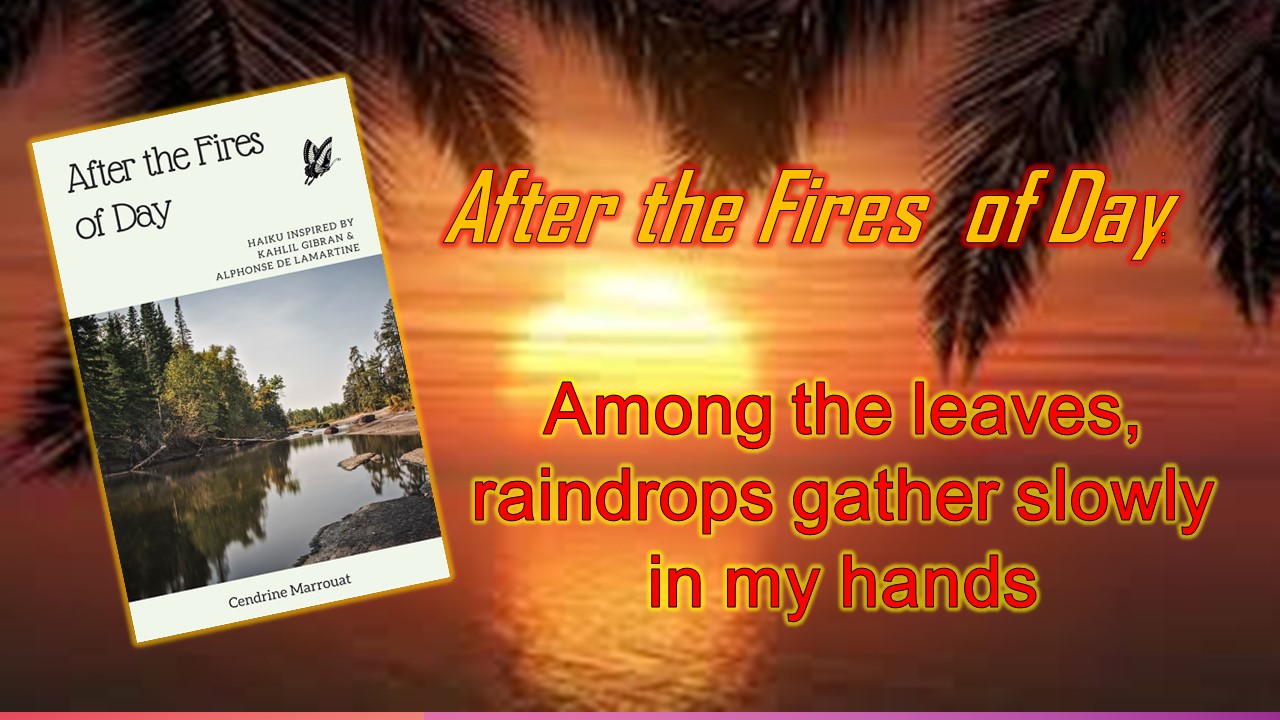
To start off the WordCrafter After the Fires of Day Book Blog Tour, we’ve got an interview with poet and author Cendrine Marrouat and a review of her wonderful poetry collection and tribute to the inspiring poets, After the Fires of Day: Haiku Inspired by Kahlil Gibran & Alphonse de Lamartine. I hope you will all follow the tour this week and visit each of the tour stops to learn more about this inspired this inspired poet who is herself inspiring.

Cendrine Marrouat is a French-born Canadian photographer, poet, and the multi-genre author of more than 30 books. In 2019, she founded the PoArtMo Collective and co-founded Auroras & Blossoms with David Ellis. A year later, they launched PoArtMo (Positive Art Month and Positive Art Moves) and created the Kindku and Pareiku, two forms of poetry.
Cendrine is also the creator of the Sixku, the Flashku, and the Reminigram. Cendrine writes both in French and English and has worked in many different fields in her 17-year career, including translation, language instruction, journalism, art reviews, and social media.
My Interview with author and poet, Cendrine Marrouat
Kaye: What inspired you to create After the Fires of Day: Haiku Inspired by Kahlil Gibran & Alphonse de Lamartine?
Cendrine: My love for the haiku and my passion for the beautiful words of Kahlil Gibran and Alphonse de Lamartine.
I had always wanted to release something similar to After the Fires of Day. I had many ideas. However, a project like this, which pays homage to two literary giants, was tricky and required a thoughtful approach.
At the beginning of my career, I tried to emulate Gibran’s style—to no avail. But it was not a useless pursuit. It taught me important lessons about my own style and how to incorporate emotions in my work.
Emotions is actually the keyword here. In the late 2010s, I had this idea: An author always leaves a part of themselves, their “energy”, in their works. So why not “borrow” that and go from there?
It’s what I did for After the Fires of Day.
Kaye: Why do you think the haiku is such a powerful poetry form?
Cendrine: Many people limit the haiku to its syllable count. Words are treated like an afterthought, when they are actually the most important element of the poem. In North America, the haiku is misunderstood by the general public.
The haiku freezes a scene in time while implicitly revealing its author’s innermost feelings at that precise moment. It is an intimate, albeit complex form of poetry that speaks to the human experience in more ways than one.
To write a memorable haiku, you need to understand: the importance of conciseness and simple language; and how to leverage the seasonal reference (‘kigo’) and “cutting word” (‘kireji’) to evoke a specific mood.
Kaye: What made you choose Kahlil Gibran and Alphonse de Lamartine as sources of inspiration for After the Fires of Day? And for the people who have never read them, is there a specific book or piece of writing you would recommend?
Cendrine: I chose them because everything in their bodies of work inspires me. Their styles and the flow of their words tug at my creative heartstrings and make me want to write.
The Prophet is the best introduction to Gibran’s work. As far as Lamartine is concerned, you should start with his most famous poem, The Lake.
For the people interested in learning more about Gibran and Lamartine, they can visit my blog. I recently ran a mini-series of posts on each writer.

My Review

After the Fires of Day: Haiku Inspired by Kahlil Gibran and Alphonse de Lamartine is both a tribute of admiration to two wonderful poets and a collection of Haikus by Cendrine Marrouat, the expressions of her own unique voice and style of Haiku, in which their inspirations can be seen.
I was familiar with Kahlil Gibran’s work, but Alphonse de Lamartine was new to me. I am thankful to Cendrine Marrouat for the introduction to this poet. The poetic words of Marrouat’s beautiful Haikus bring me back to when I was introduced to the Haiku poetry, in the fourth grade. At that time, I felt that the sheer simplicity of the Haiku was lovely, although my fourth-grade mind didn’t yet understand that it was the ability of the words to capture and conjure a moment in nature so exquisitely that sent so much awe flowing through me.
I’ve included my favorite poem from this collection below. I think this Haiku speaks to me because my son, Michael, was born and died in September and since his death, September has always been a hard month for me to face. Marrouat’s Haiku allows me to look at the month of September with more positivity. The vivid imagery reminds me of what it is like to wait in anticipation of cooler days and fall colors.
Valley sits in gold,
Reflections in water
Welcome September.
While reading the Haiku poetry of Cendrine Marrouat, I couldn’t help but smile as her words summoned vivid images in my mind, which is exactly what a quality haiku should do. I give After the Fires of Day: Haiku Inspired by Kahlil Gibran and Alphonse de Lamartine five quills.

Book your WordCrafter Book Blog Tour today!
Share this:

Updates & Reminders
Posted: August 30, 2021 Filed under: Anthology, book marketing, Book Promotion, Books, Fiction, Paranormal, Promotion, Stories, WordCrafter, WordCrafter Press, Writing | Tags: Anthologies, Call for submissions, Mirror Mirror, Paranormal, Short Fiction, Short Stories, Submission Guidelines, Where Spirits Linger, WordCrafter Press, WordFire Press 2 Comments
Update – Where Spirits Linger
The 2021 WordCrafter paranormal anthology Where Spirits Linger is scheduled for release on September 20th, and is now available for pre-order. Featuring original paranormal tales by Kaye Lynne Booth, Roberta Eaton Cheadle, Stevie Turner, Enid Holden S.L. Kretschmer, and Christa Planko, author of the winning story in the 2021 WordCrafter Paranormal Short Fiction Contest. It will be available in both print and digital formats, so be sure and order your copy today.
____________________________________________________________________________________________________________
Reminder – Open for Submissions

Submissions open today for the WordFire Press Mirror, Mirror anthology. This is a paid writing gig, so be sure to get your story in for consideration. For those of you who missed the submission call, you can learn more and read submission guidelines in my oroginal post.
To increase the chance of being accepted, I recommend reading the newly released, Slushpile Memories: How NOT to Get Rejected, by Kevin J. Anderson. It is written as a guide for authors submitting their work to publishers in the hopes that their work will be accepted and published, offering tips and advice to avoid the fateful rejection slip. The major points that came through were to me from this helpful guide were to be professional at all times, and to READ AND FOLLOW THE SUBMISSION GUIDELINES. I know from the preparation that I’ve been given for being a slushpile reader that these can and will be crucial factors in submitting a story that will make the final cut, so take heed as you prepare your submission.
Submissions will be open through October, so there is plenty of time to write and polish your submission. Click on the link to the submission guidelines above and read them over. It’s a theme that you can have a lot of fun with. Send us your best stuff.
___________________________________________________________________________________________________________
Like this post? Let me know in the comments. You can be sure not to miss any of Writing to be Read’s great content by subscribing to e-mail or following on WordPress. If you found this content helpful or entertaining, please share.
Share this:

Day 5 of the WordCrafter “Behind Closed Doors” Book Blog Tour
Posted: August 27, 2021 Filed under: Blog Tour, book marketing, Book Promotion, Book Review, Books, Guest Post, Poetry, Review, WordCrafter Book Blog Tours | Tags: Behind Closed Doors, Poetry, Poetry Collection, Robbie Cheadle, WordCrafter Book Blog Tours Leave a comment
We’re wrapping up the WordCrafter Behind Closed Doors Book Blog Tour over at Zigler’s News with a guest post by poet and author Robbie Cheadle and a review by Victoria Zigler. Please join us to learn a bit more about the author and her book.
http://ziglernews.blogspot.com/2021/08/behind-closed-doors-collection-of.html
______________________________________________________________________________________
Book your WordCrafter Book Blog Tour today!
Share this:

Day 4 – WordCrafter “Behind Closed Doors” Book Blog Tour
Posted: August 26, 2021 Filed under: Blog Tour, Book Covers, book marketing, Book Promotion, Book Review, Books, Guest Post, Poetry, WordCrafter Book Blog Tours | Tags: Behind Closed Doors, Book Review, Poetry, Poetry Collection, Robbie Cheadle, WordCrafter Book Blog Tours 1 CommentDay 4 of the WordCrafter Behind Closed Doors Book Blog Tour finds us over at Miriam Hurdle’s Showers of Blessings blog site with a guest post by author and poet Robbie Cheadle and a lovely review of Robbie’s latest book, Behind Closed Doors, a collection of unusual poetry. Drop in and learn more about this fascinating poetry collection and its author.
_____________________________________________________________________________________________________
Book your WordCrafter Book Blog Tour today!
Share this:

Day 3- WordCrafter “Behind Closed Doors” Book Blog Tour
Posted: August 25, 2021 Filed under: book marketing, Book Promotion, Books, Guest Post, Poetry, WordCrafter Book Blog Tours | Tags: Behind Closed Doors, Poetry, Poetry Collection, Robbie Cheadle, WordCrafter Book Blog Tours 2 CommentsFor Day 3 of the WordCrafter Behind Closed Doors Book Blog Tour we’re over at This is My Truth Now with James Cudney and a guest post from author and poet, Robbie Cheadle and a wonderful review of Behind Closed Doors. Please join us to learn more about this author and her wonderful poetry collection.
Share this:

Day 2 – WordCrafter “Behind Closed Doors” Book Blog Tour
Posted: August 24, 2021 Filed under: Blog Tour, book marketing, Book Promotion, Book Review, Books, Guest Post, Poetry, Review, WordCrafter Book Blog Tours | Tags: Behind Closed Doors, Poetry, Poetry Collection, Robbie Cheadle, WordCrafter Book Blog Tours 12 CommentsDay 2 of the WordCrafter Behind Closed Doors Book Blog Tour brings us another wonderful guest post by author and poet Robbie Cheadle and a review by DL Mullen. After you enjoy the guest post below, please pop on over to DL Mullen’s Undawnted blog site to check out her review:
http://www.undawnted.com/2021/08/wordcrafter-blog-tour-robbie-cheadles.html
Behind Closed Doors, a collection of unusual poems blog tour – Day 2
Do you want it enough? is a freestyle poem I wrote while contemplating why it is that some people and/or poets are prolific and manage to get a number of books, short stories and/or poems published while others don’t. It is not a question of talent generally, as many writers and poets who don’t publish their work are incredibly talented.
So what holds some writers and poets back?
This poem captured my ultimate view that it depends on the determination, resilience, and drive of the person in question. Publishing a book or any other work is a massive effort and requires numerous re-writes and edits. Once that process is complete, there is still the typesetting and final proofing phase to undergo before you can hit the publish button.
I also believe that there must be an acceptance that a piece of work will never be completely perfect. I have realised that I must accept a 96% perfection level in order to get a book finalised for printing and publishing. No matter how hard I try or how many times I read my work and get other people to read it and edit it for me, I always find a few typos and punctuations after the book has gone live. That is that nature of writing and is almost impossible to avoid. The fact that I detect typos and errors in traditionally published books gives me some comfort in this respect.
These ideas of mine resulted in the following poem.
Do you want it enough?
You tell me you want
Your time in the sun
To dance in the light
That reflects off your fame
Do you really want it?
Do you want it enough?
To give up the good things
Like relaxation and rest
Sleeping late in your bed
Toasty and warm
Are you sufficiently mesmerised
By the task to hand
To trade pleasure for work?
And sit in your office,
Juggling ideas and possibilities,
While your friends watch movies,
Eat out, drink, and socialise
Spending their weekends
Having a jolly good time
Can you be disciplined and sit
At a computer for hours
Tapping out words
While creating worlds
Actions and events
That form themselves into stories?
Will you watch
The world passing by
Through the glass of your window?
While you pursue the fantasy
You hope to achieve,
Knowing there are no guarantees
Few things in this life
Come without paying a price
And the tag accompanying fame
And its bedfellow fortune
Is always high
Taxing time and good health
With no assured return
Are you ready to exchange
Your freedom and pleasure
For the discipline required
To chase that elusive light?
If you prefer to listen to me reading this poem, you can find it on my Youtube Channel here: https://www.youtube.com/watch?v=wEXJnzzMYZo
What are your thoughts on perfection in publishing and the road to publication? Let me know in the comments.
Book blurb

What goes on behind closed doors: in the boardroom, after death, in the home, during lockdown, and in nature? This collection of poems, ranging from rhyming verse to twisted nursery rhymes, captures the emotions and thoughts people hide behind the masks they present to the world.
What thoughts are hidden
Behind her immobile face
Quite expressionless
Eyes cold and indifferent
Scrutinising me – hawk like
This book includes some of Robbie Cheadle’s spectacular fondant art and cakes.
Robbie Cheadle author bio

Robbie Cheadle is a South African children’s author and poet with 9 children’s books and 1 poetry book.
The 7 Sir Chocolate children’s picture books, co-authored by Robbie and Michael Cheadle, are written in sweet, short rhymes which are easy for young children to follow and are illustrated with pictures of delicious cakes and cake decorations. Each book also includes simple recipes or biscuit art directions which children can make under adult supervision.
Robbie has also published 2 books for older children which incorporate recipes that are relevant to the storylines.
Robbie has 2 adult novels in the paranormal historical and supernatural fantasy genres published under the name Roberta Eaton Cheadle. She also has short stories in the horror and paranormal genre and poems included in several anthologies.
Robbie writes a monthly series for https://writingtoberead.com called Growing Bookworms. This series discusses different topics relating to the benefits of reading to children.
Robbie has a blog, https://robbiesinspiration.wordpress.com/ where she shares book reviews, recipes, author interviews, and poetry.
Social Media Robbie Cheadle
Robbie Cheadle
Website
https://www.robbiecheadle.co.za/
Blog
Robbie’s inspiration
TSL Books Author Page
Goodreads
https://www.goodreads.com/author/show/15584446.Robbie_Cheadle
Purchase links
Amazon US: https://www.amazon.com/gp/product/B09BBR94NC
Amazon UK: https://www.amazon.co.uk/Behind-Closed-Doors-Robbie-Cheadle/dp/B099C8R3T4
____________________________________________________________________________________________________________
If you missed the Day 1 post yesterday, you can still catch it here: https://writingtoberead.com/2021/08/23/welcome-to-the-wordcrafter-behind-closed-doors-book-blog-tour/
Book your WordCrafter Book Blog Tour today!