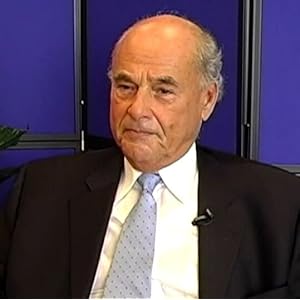
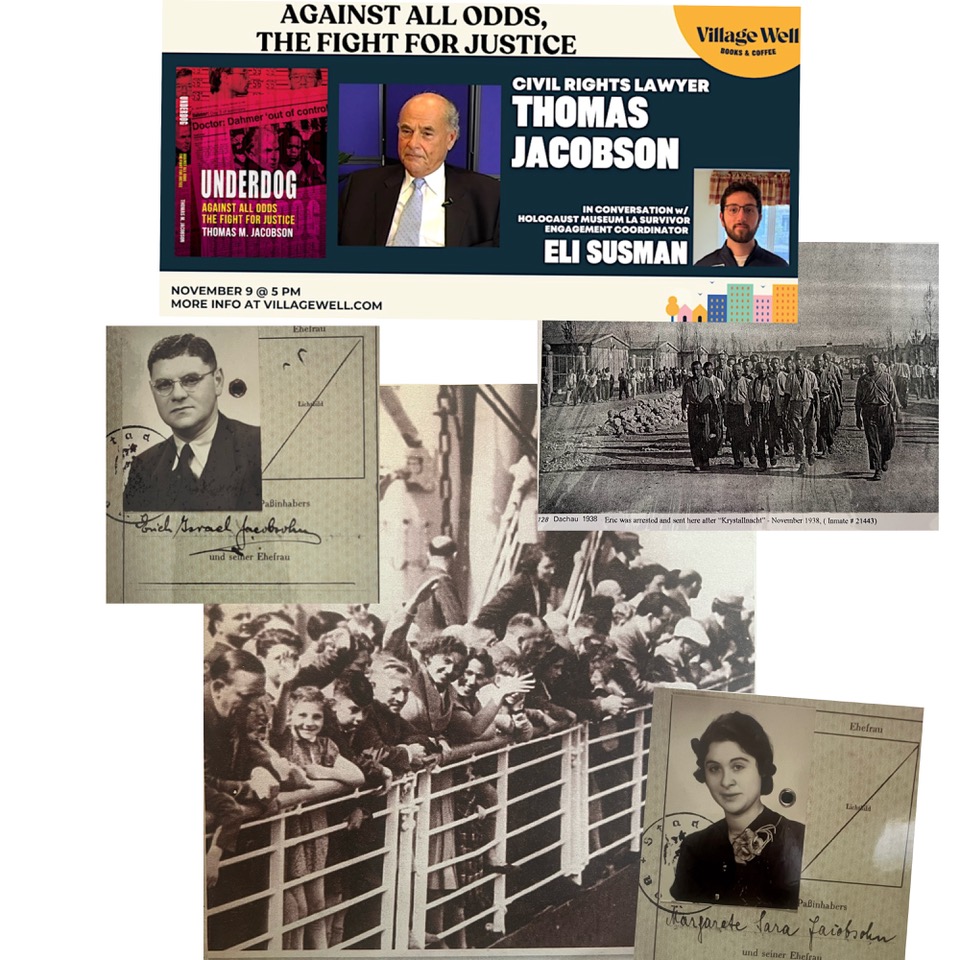
My guest today is a holocaust survivor, the youngest surviving passenger on the MS St. Louis, who grew up to be a successful civil rights attorney, representing civil rights activists in Milwaukee in the 1960s through the end of the twentieth century. and he was the attorney who sued and obtained half a million dollars for the families of the victims of the serial killer, Jeffrey Dahmer. He seems to find ways to think outside the box and make change happen, even in stagnant times. He has written a fascinating book, Underdog: Against All Odds, which relates his story, including a thrilling deposition with Dahmer in the Columbia Correctional Institution.
About Author Thomas M. Jacobson
Thomas M. Jacobson, born May 8, 1938, in Bamberg, Germany, escaped Hitler, coming to America on the harrowing MS St. Louis voyage one year later. He graduated from UW Madison Law School in 1962, partnering with Lloyd Barbee to start the first integrated law firm in Milwaukee. Jacobson represented all the Milwaukee civil rights movers and shakers over the next thirty years, including Father James Groppi, the Daniel Bell family, comedian/human rights activist Dick Gregory, and Alderperson/Black Panther Commander Michael McGee. He successfully argued two cases in the U.S. Supreme Court, overturning Wisconsin’s Garnishment before Judgment and Change of Venue laws. In 1970, Jacobson was the Democratic candidate for Wisconsin Attorney General. In the late 1970s, he served as the Chairperson of the Wisconsin Public Defender’s office. Jacobson represented eight families of the victims of the world’s worst serial murderer, Jeffrey Dahmer, suing and successfully obtaining one-half million dollars for eleven victim families.
My Interview with Thomas
Kaye: Would you begin by telling us about your author’s journey? What inspired you to write a book about your experience?
Tom: My path to becoming an author wasn’t planned, but grew out of a life shaped by story and consequence. I was a child refugee, one of the youngest surviving passengers on the MS St. Louis, turned away from safety, and that early experience of injustice stayed with me long after I built a career as a civil rights lawyer. For decades, I focused on advocacy rather than authorship. A memoir wasn’t on my agenda. But over time, I realized that the arc of my life, from refugee to advocate, was itself a narrative worth preserving.
I wrote Underdog, Against All Odds, The Fight For Justice, because stories can carry truth in a way arguments alone cannot. As fewer firsthand witnesses remain, personal testimony becomes essential. I hoped to show how lived experience can inform a lifelong commitment to justice, how writing can serve as another form of resistance, remembrance, and standing up for democracy.
Kaye: When approaching the writing of the book, what’s the best piece of writing advice you were given?
Tom: As a lawyer, I was trained to persuade and to control the narrative. Writing a memoir required me to unlearn some of that, to slow down, to sit with uncertainty, and to trust the reader. Once I stopped trying to justify every decision and focused instead on bearing witness, the story found its voice. That advice shaped the entire book. It reminded me that a memoir isn’t about winning an argument, it’s about offering an honest account and letting the truth do the work. The best advice was to write what you know to be true, even when it’s uncomfortable. Honesty, intellectual and moral, is what gives writing its power and authority.
Kaye:Underdog has three different themes, each representing a different time in your life. Can you talk a little bit about each one?
Tom: The opening of Underdog focuses on childhood survival. As a young refugee, life was defined by forces beyond my control: The Nazi government’s atrocities against my family and the indifference of people to this injustice. This theme centers on vulnerability, displacement, the moral consequences and decisions of others, and what it means to begin life with no voice and no leverage or power to resist.
The middle of the book marks the transition from survival to resistance. This period of my life is about education, self-definition, and the decision to fight back using intellect rather than force. Law becomes the weapon that replaces the power that I never had. This theme is learning how institutions work, how they fail, and how an underdog can still challenge them.
The final theme centers on adulthood and professional life, when I finally had standing in the courtroom and a measure of authority. This part of Underdog addresses moral responsibility, representing the powerless, pursuing justice even when it’s unpopular, and recognizing that winning a case is not the same as standing up for justice.
Together, these three themes trace a life that moves from powerlessness to agency to accountability, the journey of an underdog who never forgot what it was like to have nothing.
Kaye: What happened after immigrating to the U.S. that led you to be a civil rights attorney later in life?
Tom: After immigrating to the U.S., I learned that power could be challenged through law. As a child refugee, authority had meant danger or indifference. In America, I saw that, slowly and imperfectly, the law could be used to protect the vulnerable rather than crush them.
I was drawn to civil rights law because the Holocaust taught me to fight and to resist was the only path to justice and survival. I understood what it meant to be excluded, unheard, and disposable. Education gave me a voice, and the law gave me standing to confront injustice. Becoming a civil rights lawyer wasn’t a career choice so much as a continuation of survival, resilience, and insistence that the system live up to all that the U.S. Constitution guaranteed its citizens: life, liberty, and the pursuit of happiness.
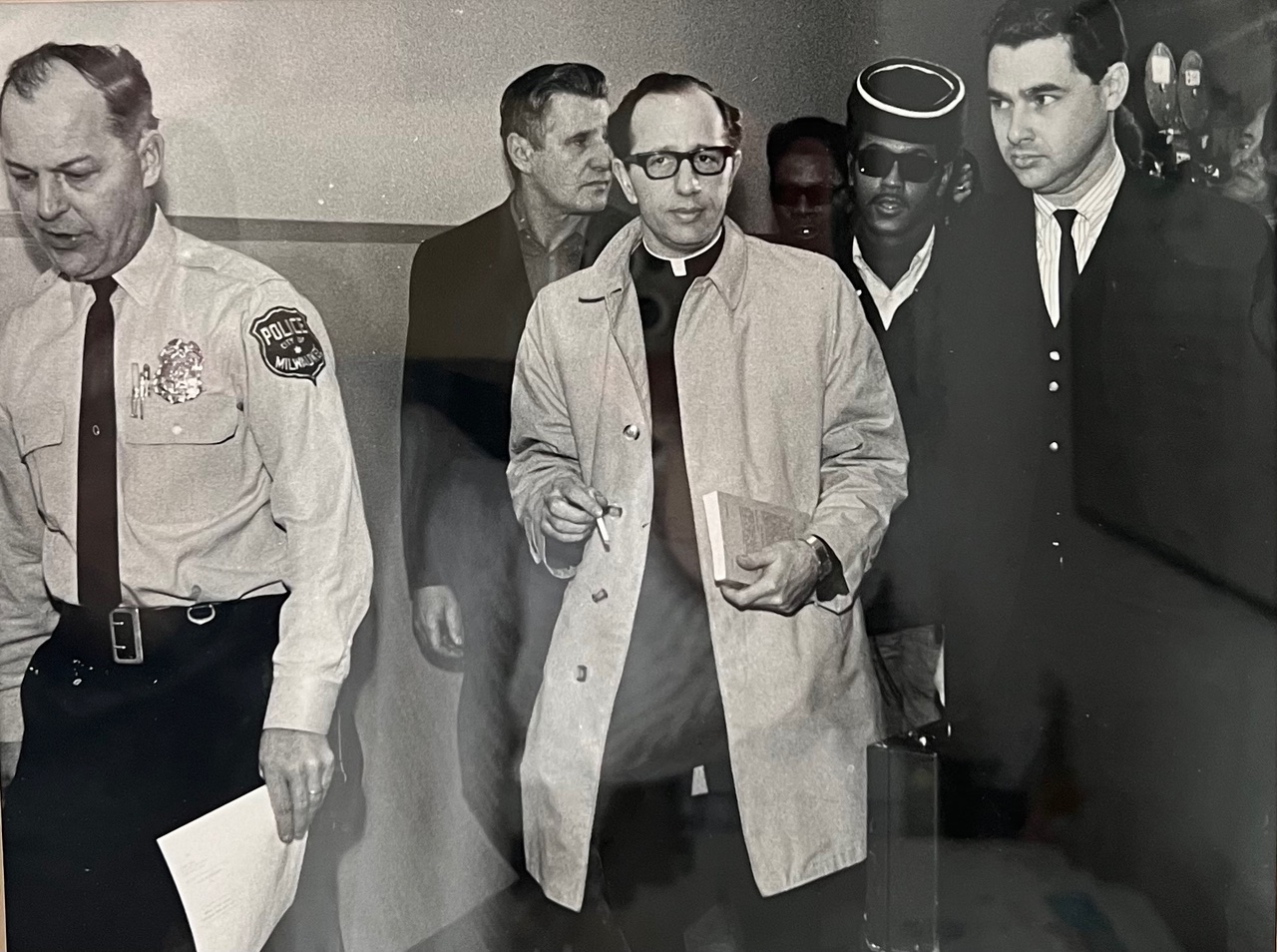
Father Groppi and I, after his trial on February 8,1968.
Kaye: Do you view Underdog as a way to raise awareness about civil rights?
Tom: While Underdog is not primarily an advocacy book, it inevitably raises awareness about civil rights. The story shows how rights are lost long before they are violated through indifference, silence, and the normalization of exclusion. By tracing my life from refugee to civil rights lawyer, the book invites readers to see civil rights not as abstract ideals, but as lived experiences with real human consequences. If Underdog encourages readers to recognize that injustice can be challenged through resistance, strength, and perseverance, then it has accomplished one of the messages I want to send.
Kaye: What are some of the major events represented in Underdog?
Tom: My family’s escape from Nazi Germany in 1939, Hitler’s ascension to power in 1933, the Nuremberg laws, Krystallnacht, my father’s incarceration in the Dachau concentration camp, the failed voyage of the MS St. Louis, the commencement of the 1960s civil rights struggle in Milwaukee with the murder of Daniel Bell, a young Black man shot in the back of the head by a white police officer, and the planting of a knife to falsely create a self-defense cover-up by the cities entire law enforcement agencies, the struggles for a fair housing bill in Milwaukee by Father James Groppi and Alderperson Vel Phillips, Lloyd Barbee’s lawsuit finding defacto segregation in Milwaukee public schools unconstitutional, my suing successfully the City of Milwaukee on behalf of the Daniel Bell family twenty years after his murder, my lawsuits finding Wisconsin’s Change of Venue and Garnishment before Judgement laws unconstitutional in the U.S. Supreme Court, and my deposition of the world’s worst serial murderer, Jeffrey Dahmer, leading to eleven victim families receiving a half million dollars.
Book talk, parents’ passport port photos, Dachau, and St. Louis passengers.
Kaye: What is the most important message or messages which you hope to bring to your readers?
I want readers to understand that what happened to refugees like those on the St. Louis was not inevitable, but the result of a choice, indifference, silence, and lack of courage. The most important message is that justice is never automatic. Survival exists only when you are willing to fight. Your rights exist only when you are willing to defend them, especially for those in the minority, the unpopular, the powerless, and those easy to ignore and exploit. One life, fully lived, can push history. You don’t need power to matter. You need persistence, guts, and moral resolve.
Kaye: What advice would you give to another with a message to get across?
Tom: Know your audience. Lead with the key point. Use simple language and be clear and concise. Use empathy and perspective. Leave the reader with a call to action, telling them what you want them to do, think, or feel.
Kaye: What are some of the challenges that you faced in writing this book?
Tom: Writing Underdog was one of the most intense experiences of my life. Revisiting memories of trauma, injustice, and loss was emotionally exhausting, yet necessary to tell the story honestly. I faced the challenge of balancing truth with readability, ensuring the legal cases, civil rights battles, and personal experiences were accurate, yet engaging. Deciding what to include and what to leave out was difficult because every memory felt significant, and I had to confront my own perspective honestly—translating complex legal and historical events in a way that anyone could understand, while keeping the narrative cohesive required careful editing. Writing about real people and sensitive events also required courage, knowing it might draw scrutiny, but I believed the story was important enough to write.
About Underdog: Against All Odds, the Fight for Justice
UNDERDOG is the memoir of one of the youngest passengers on the MS St. Louis, escaping Nazi Germany to Holland and eventually settling in Milwaukee, Wisconsin. Against All Odds, Fighting for Justice is the story of a human rights lawyer representing all the prominent civil rights leaders in Milwaukee during the 1960s and decades thereafter.
The world’s worst serial murderer, Jeffrey Dahmer, writing from Columbia Correctional Institution on February 4, 1994, had this to say about Thomas Jacobson’s efforts to make him pay for his gruesome slaughter of seventeen victims.
My Review of Underdog: Against All Odds, the Fight for Justice
I received a print copy of Underdog: Against All Odds from author Thomas M. Jacobson in exchange for an honest review. All opinions stated here are my own.
As the youngest passenger on the MS St. Louise as a fleeing refugee from the brutal Nazi regime of Adolf Hitler, it came as no surprise that Thomas M. Jacobson, grew up and took a profession where he defended the underdogs of the U.S. Defender of civil rights and protector of those scorned unfairly, he has made some huge strides in bringing equality and fairness in the U.S. from one of the most prejudiced cities in America. He managed to bring some semblance of compensation to the families of the victims of serial killer Jeffrey Dahmer when many refused to see them as victims at all. His accomplishments are huge. His methods may be a bit unorthodox, but they produced successful results.
I have to admit that at times, reading about writs and filings, and court proceedings can be a bit dry, but the methods he used and the ways he managed to get around the obstacles adversaries set in front of him are fascinating, and I couldn’t wait to learn how he triumphed. Often, his triumphs were small and didn’t result in immediately noticeable changes, because change moves slowly, especially when pushed by the heavy wheels of justice. Scorned by many in his own life, as bigoted people opposed him for his stance on civil rights, justice and fairness and his efforts to undo biased laws to ensure the fair treatment of his clients in the extremely biased city of Milwaukee, Wisconsin, Jacobson stopped at nothing in pursuit of a favorable verdict, making him a formidable force to feared by those who opposed him.
Although I don’t agree with all of Jacobson’s opinions, I do admire his determination and tenacity to fight for what he believes in. Underdog is a well written, gripping struggle for justice for the weak and disadvantaged. I give it four quills.
For Kaye Lynne Booth, writing is a passion. Kaye Lynne is an author with published short fiction and poetry, both online and in print, including her short story collection, Last Call and Other Short Fiction; and her paranormal mystery novella, Hidden Secrets; Books 1 & 2 of her Women in the West adventure series, Delilah and Sarah, and book 1 in her Time-Travel Adventure series, The Rock Star & The Outlaw, as well as her poetry collection, Small Wonders and The D.I.Y. Author writing resource.
Kaye holds a dual M.F.A. degree in Creative Writing with emphasis in genre fiction and screenwriting, and an M.A. in publishing. Kaye Lynne is the founder of WordCrafter Quality Writing & Author Services and WordCrafter Press, where she edits and publishes two short fiction anthologies and one poetry anthology every year amidst her many writing projects. She also maintains an authors’ blog and website, Writing to be Read, where she publishes content of interest in the literary world.
___________________________________________
Did you know you can sponsor your favorite blog series or even a single post with an advertisement for your book? Stop by the WtbR Sponsor Page and let me advertise your book, or you can make a donation to Writing to be Read for as little as a cup of coffee, If you’d like to show your support for this author and WordCrafter Press.
__________________________________
This post sponsored by WordCrafter Quality Writing & Author Services.
Whether it’s editing, publishing, or promotion that you need,WordCrafter Quality Writing & Author Services can help at a price you can afford.
You can join us over at Book Places for Day 4 of the WordCrafter The Ones Who Stayed With Me Book Blog Tour, where Nurse Sammy offers one last chapter excerpt reading. (Then tomorrow, we’ll wrap up with an interview and a couple reviews, right here on Writing to be Read.) I do hope you’ll join us.
For Day 3 of the WordCrafter The Ones Who Stayed With Me Book Blog Tour, we’re over at Undawnted where Nurse Sammy offers another chapter excerpt and host DL Mullan shares her review of this lovely memoir. Join us in sending off The Ones Who Stayed With Me and get in on the giveaway. Undawnted doesn’t take comments, but you can comment on this stop here.
Today’s tour stop is over at Roberta Writes on the WordCrafter The Ones Who Stayed With Me Book Blog Tour with another chapter excerpt reading by the author, Nurse Sammy. Please join us in sending off this unique collection of stories that will open your eyes and touch your heart.
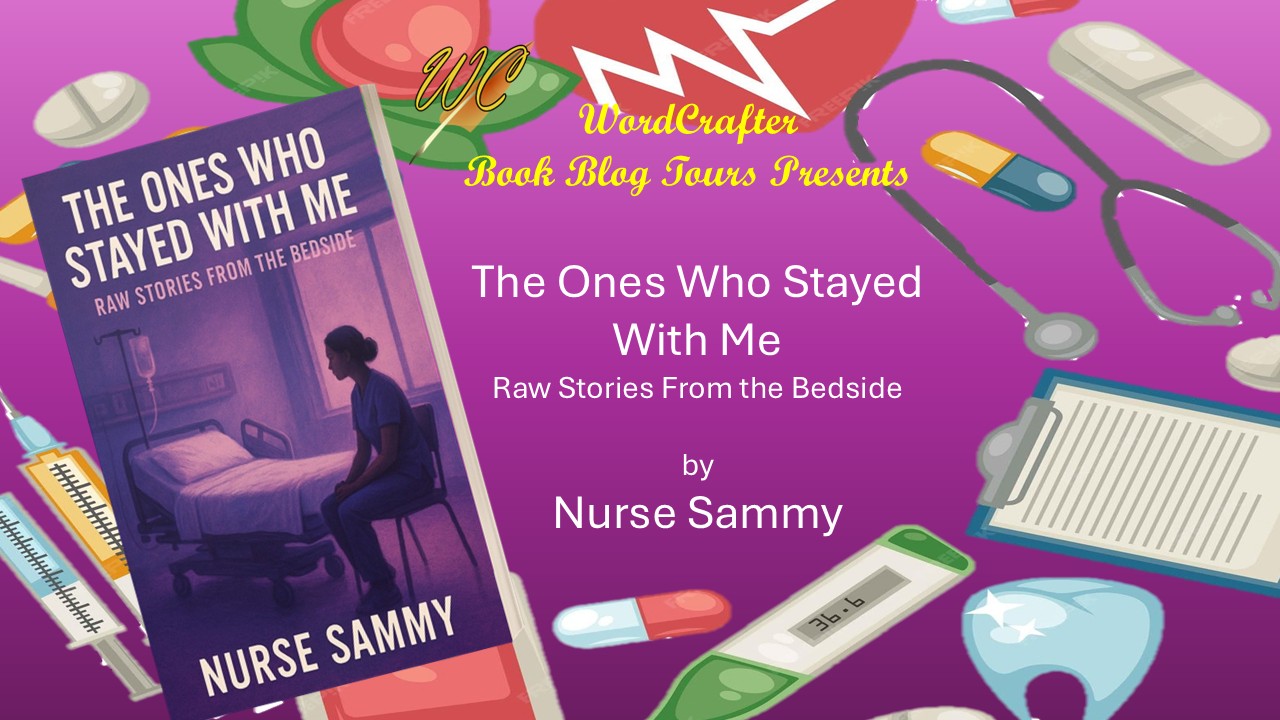
Tomorrow, January 13th, is the release day for a fabulous new memoir-ish collection of personal essays, stories that will make you laugh and some that will make you cry, written by a debut author, Nurse Sammy. Whether you are in the health care industry, or just curious for a glimpse behind the scenes, The Ones Who Stayed With Me will educate and entertain. Her open and honest voice will draw you in and capture your heart.
Join Us
Today is the opening day for the WordCrafter The Ones Who Stayed With Me Book Blog Tour, where we’re sending Nurse Sammy’s book off right, with chapter excerpt readings by the author at each stop, except the last. That one is reserved for a delightful interview with Nurse Sammy, right here, on Writing to be Read. There’s a great giveaway, where your comment at each stop offers a chance to win a free digital copy of the book, too.
For all the details and today’s reading, please drop in on today’s tour stop, on one of three different blogs:
A huge welcome to Barbara Harris Leonard, editor of MasticardoresUSA, and talented poet, to Treasuring Poetry.
What is your favourite style of poetry to read i.e. haiku, ballad, epic, freestyle, etc?
I’ve studied different poetic forms but generally read freestyle poetry, especially Anne Sexton, Sylvia Plath, Elizabeth Bishop, and so many more. I also enjoy the more formal classic poetry and other modern poets like Frost, Sandburg, and others. A favorite poet of mine is Emily Dickinson. I’ve written poems in the manner of Dickinson. Overall, however, the majority of poems I have read and written have been free verse.
What is your favourite poem in your favourite style to read?
The first poem that comes to mind is Elizabeth Bishop’s poem “The Fish”. Here it is from poets.org. The description is exquisite, and the story is powerful. She catches a prize fish, admires him, and finds that the fish has been caught five prior times. After examining his wounds—the old hooks and broken fish-lines scabbed over in his mouth—she releases the fish. The imagery throughout the poem is stunning. The old fish is embattled and exhausted, not even resisting the catch. He represents something ancient and universal. He is more than a fish; he is history (“beard of wisdom”) and war as she describes his “weaponlike” lower lip and cutting gills. “The Fish” is a poem written with the skill I strive to have as a poet.
I caught a tremendous fish and held him beside the boat half out of water, with my hook fast in a corner of his mouth. He didn’t fight. He hadn’t fought at all. He hung a grunting weight, battered and venerable and homely. Here and there his brown skin hung in strips like ancient wallpaper, and its pattern of darker brown was like wallpaper: shapes like full-blown roses stained and lost through age. He was speckled with barnacles, fine rosettes of lime, and infested with tiny white sea-lice, and underneath two or three rags of green weed hung down. While his gills were breathing in the terrible oxygen —the frightening gills, fresh and crisp with blood, that can cut so badly— I thought of the coarse white flesh packed in like feathers, the big bones and the little bones, the dramatic reds and blacks of his shiny entrails, and the pink swim-bladder like a big peony. I looked into his eyes which were far larger than mine but shallower, and yellowed, the irises backed and packed with tarnished tinfoil seen through the lenses of old scratched isinglass. They shifted a little, but not to return my stare. —It was more like the tipping of an object toward the light. I admired his sullen face, the mechanism of his jaw, and then I saw that from his lower lip —if you could call it a lip— grim, wet, and weaponlike, hung five old pieces of fish-line, or four and a wire leader with the swivel still attached, with all their five big hooks grown firmly in his mouth. A green line, frayed at the end where he broke it, two heavier lines, and a fine black thread still crimped from the strain and snap when it broke and he got away. Like medals with their ribbons frayed and wavering, a five-haired beard of wisdom trailing from his aching jaw. I stared and stared and victory filled up the little rented boat, from the pool of bilge where oil had spread a rainbow around the rusted engine to the bailer rusted orange, the sun-cracked thwarts, the oarlocks on their strings, the gunnels—until everything was rainbow, rainbow, rainbow! And I let the fish go.
What is your favourite style of poetry to write? Why?
I like free style poetry, mainly narrative and persona poems. Sometimes poetic forms feel restrictive because mastering the form becomes more important than the message of the poem. However, I feel practicing with forms enables a poet to mature in many ways. As I’m writing free style, I use many poetic devices, such as alliteration, slant rhyme, assonance, meter, and others. With free style, for me, some challenges include where to place the line breaks and group the imagery into stanzas. How the poem is organized can affect the meaning. I like the potential for ambiguity in free verse poems.
In “The Fish”, the last three lines are ambiguous. What does “rainbow” refer to? Epiphany? Was the fish a Rainbow trout? Maybe both interpretations apply. But the em dash is important. It interrupts the description of the fish to state an insight “—until everything”. The line break allows the reader to recall everything that was just said and speculate on more things. The repetition of “rainbow” three times insists there is insight. Pay attention. Rainbows are multi-colored, much like the fish. Rainbows presents diversity, inclusivity, and friendship. It’s no wonder she freed the fish.
the gunnels—until everything was rainbow, rainbow, rainbow! And I let the fish go.
Formal poetry can also have ambiguity and surprise. It’s just that I feel I have more freedom to play with the lines and stanzas in free verse poems.
What is your favourite of your own poems in your favourite style?
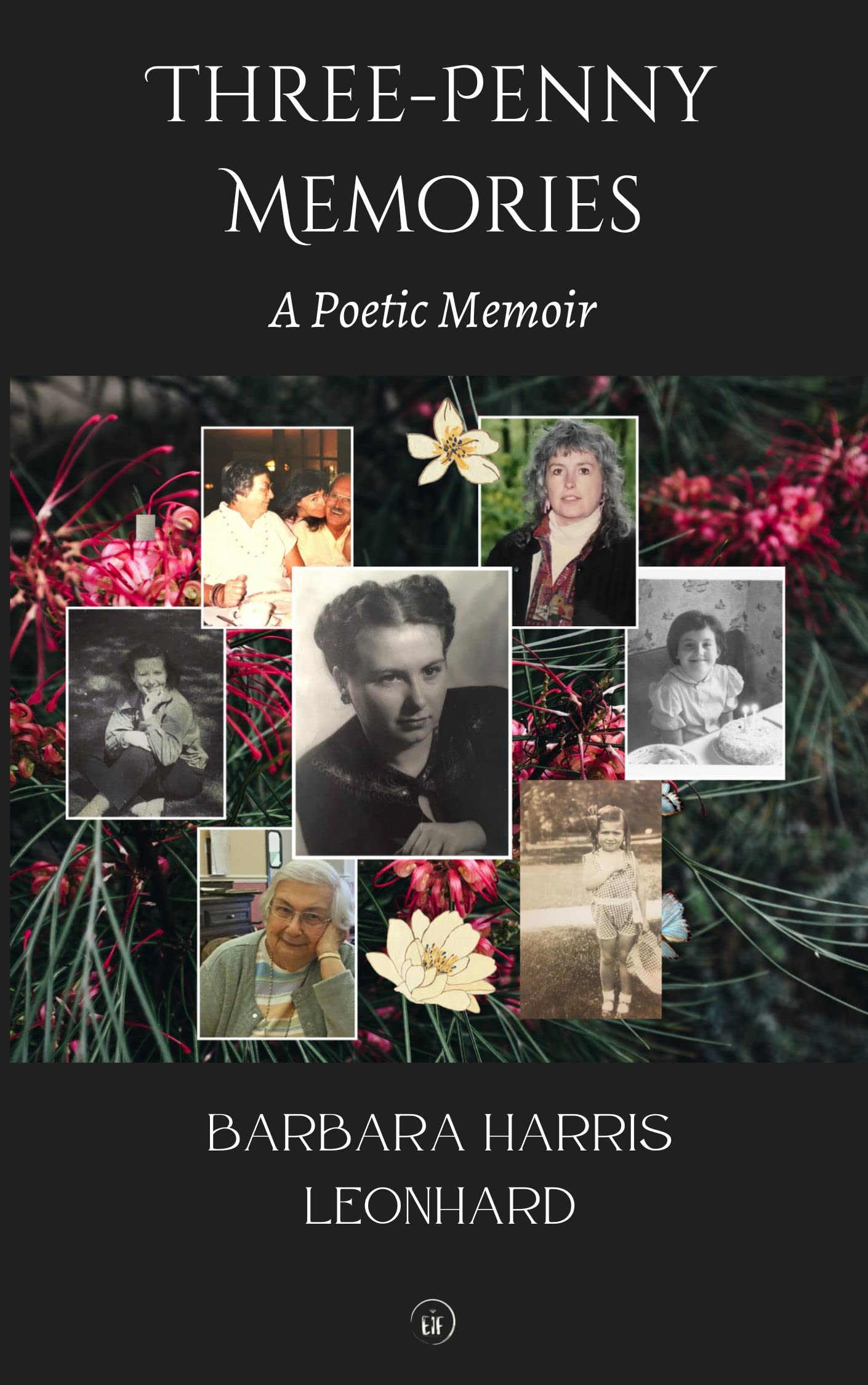
In my book Three-Penny Memories: A Poetic Memoir, my poems are free style. I have several favorites, but “Marie Kondo Cleans My Purse at Starbucks” received recognition from Spillwords Press. It won Publication of the Month in Jan/Feb 2022. In this poem, I am carrying the grief from Mom’s decline due to Alzheimer’s and her death. I am burdened by the memories. Marie Kondo, who is famous for her books on how to declutter your house, offers to help clean my purse (let go of that which no longer serves me). As this poem is about healing from loss, it is in the last section of my book, “Echo”.
Marie Kondo Cleans My Purse at Starbucks
Konmari sees me at Starbucks,
my purse spilling over at the counter.
“May I help?”
She gathers me up
like I’m antique lace
washed too many times.
Before she begins, she whispers,
“Hello, the House,
I am safe. May I enter?”
She pokes through my purse,
pulling out the deck of cards
Mom once carried in her own purse.
A heavy bag of Mom’s pennies
to redeem for cash.
Her checkbook.
The messy old calendar
that listed her appointments
alongside my own.
The quilt she made me,
now falling apart. A cookbook
compiled in her own hand.
Konmari extracts other artifacts,
laying them gently on lined up tables.
People gather. My eyes bleed.
The extra-large pair of panties
Mom made me wear to Sunday school.
The wash, still not done.
A half-used bottle of Diethylstilbestrol,
she was prescribed to prevent spotting
when I was in vitro.
The tricycle she rode
around town at age three
because her mother never watched her.
My cancer scares, scattered
on the bottom of the purse
like cookie crumbs.
The scabs inflicted
by her compression stockings
I failed to wash one last time.
The clump of tissue
I miscarried, swaddled
in an inner pocket.
Her hysterectomy scar.
My hysterectomy scar.
Entwined on a spool.
My t-shaped uterus,
clenching a half-used packet
of Puffs Plus.
A dogeared photo of Mom.
A mirror reflecting
who I want to be.
Konmari has me
hold each item
one last time, saying,
“Thank you, tiny soul,
for sharing your life. I am
grateful.”
She teaches me
how to fold joy
three times.
How to throw out
what I can
no longer carry.
One strategy I appreciate about poetry, whether is is formal or free style, is the use of metaphor. In Bishops’s poem “The Fish”, the fish represents our history and ancient wisdom. Like the fish, we have all fought off death physically or spiritually. We are warriors who build muscle and bear wounds from our life battles. The fish holds our stories, and Bishop is masterful as she extends the metaphor to a universal level.
In my poem, I used the purse as a metaphor of my soul. In the book, Mom’s purse appears in several poems because her purse held her memories: her driver’s license (identity), her checkbook (finances), her comb (beauty), photos (family) and so on. Because I had to become Mom’s brain and hold her business along with mine, the purse took on significance as a brain, or a place to hold her life alongside my own. Grief work, for me, was a process of emptying the purse of all the attachments that no longer served me. And who could help declutter better than Marie Kondo? And revealing your wounds can be embarrassing, so why not do that at Starbucks? This choice gives a dream-like quality to the poem. It is surreal to carry your mother’s tricycle in your purse! Imagine all the nightmares of suddenly appearing naked on the first day of school or other important places. All my baggage is laid out on tables for everyone to see as though viewing a dead body. It’s no wonder “my eyes bleed”.
How do you promote your poetry and poetry books?
Connections sell books, so I’ve increased my online presence (Twitter/X, Mastodon, Linked-in, Instagram, Facebook, Threads, etc). I advertise my publications on social media. My position as Editor for MasticadoresUSA enables me to promote writers and get exposure. I also do interviews and readings online as well as readings, author showcases, and open mics in my hometown, Columbia, Missouri, and now other places in Missouri. I’ve gifted books to libraries. This past summer, 2023, Three-Penny Memories: A Poetic Memoir was chosen among other books for the summer reading program at our local library. My book sells on Amazon and is distributed everywhere, but I have also put it in independent bookstores in my hometown and in St. Louis, Missouri. I continue to publish poems mainly. I’ve started an account on Medium and am republishing poems there when the copyrights revert back to me. I sponsor Zoom poetry meetups and Zoom poetry critique sessions for the Columbia Writers Guild, a Chapter of the Missouri Writers Guild (https://ccmwg.org/ ) and The Garden of Neuro Institute (https://gardenofneuro.com/). I’ve developed relationships with other poets and have reviewed their books. I publish the reviews on MasticadoresUSA, my blog extraordinarysunshineweaver.blog, and Medium.
Thank you, Barbara, for being a wonderful guest.
My review of Three-Penny Memories: A Poetic Memoir by Barbara Harris Leonhard
This collection of poems is a deep dive into the love between a mother and daughter. The collection takes the reader on a journey of the poet’s life and the development of the relationship with her mother. She covers her own life threatening illness and the subsequent incapacity and recovery process, as well as her later discovery of the poet’s inability to carry a child to term due to her mother’s ingestion of Diethylstilbestrol (DES) during her own pregnancy. How ironic that the poet’s mother took this drug to ensure the health of her own pregnancy and it resulted in childlessness for her own daughter. Life is full of bitter irony.
Throughout all the trials and tribulations of her life, the poet’s love for her mother burns like a flame, as does her mother’s love for her. And then came Alzheimer’s, the destroyer. The part of the book and the poet’s internal conflict and wrestle with her own feelings was close to my heart. Dementia and Alzheimer’s change people, turns them into someone you don’t know. Someone who doesn’t know you, someone who endlessly demands, complains, and makes bitter comments. In between, there are moments of normalcy and during those times, love returns in a rush, along with accompanying guilt for the conflicting emotions of the bad times.
This book captures the ebb and flow of human love and emotion exactly. It does not examine it, rather it describes and defines it.
A few stanzas from poems that stood out for me:
“One day says – out of nowhere – shattering words out of her scattered mind “You’re still childless? Don’t know why! I dropped seven!” From Mom’s DES Baby: The Hardest Pill to Swallow
“Mom, flat and detached My fear. That she’s gone. Now for good.” From Fool’s Gold
“How will she manage the mysterious passage? This woman with no memories,
no way to find the path, recall a friend, her mother, recognise the welcoming
Angel of Death?” From Departing from Gate 3
The collection is incredibly revealing and emotional, and exceptional read.
I’m a retired Instructor of English as a Second Language. Although I have been writing since I was age 8, after retiring in 2017, I have had more time to devote to writing. My WordPress site is extraordinarysunshineweaver.blog. My work appears in online and print literary magazines, journals, and anthologies, and my poetry has won awards and recognition. My debut poetry collection, Three-Penny Memories: A Poetic Memoir (EIF (Experiments in Fiction, 2022), which is about my relationship with my mother, who suffered from Alzheimer’s, achieved best-seller status on Amazon. Also, on Spillwords, I was voted Author of the Month of October 2021, nominated Author of the Year for 2021, and recognized as a Spillwords Socialite of the Year in 2021. I enjoy bringing writers together and have been sponsoring open mics on Zoom. I live in the Midwest of the United States with my husband, Dierik, and our cat, Jasper. Dierik and I enjoy long drives to the wetlands to count the deer.
Award-winning, bestselling author, Robbie Cheadle, has published fourteen children’s books and two poetry books. Her work also features in several poetry and short story anthologies.
Robbie also has two novels published under the name of Roberta Eaton Cheadle and has horror, paranormal, and fantasy short stories featured in several anthologies under this name.
The eleven Sir Chocolate children’s picture books, co-authored by Robbie and Michael Cheadle, are written in sweet, short rhymes which are easy for young children to follow and are illustrated with pictures of delicious cakes and cake decorations. Each book also includes simple recipes or biscuit art directions which children can make under adult supervision.
Robbie and Michael Cheadle have recently launched a new series of children’s books called Southern African Safari Adventures. The first book, Neema the Misfit Giraffe is now available from Amazon.
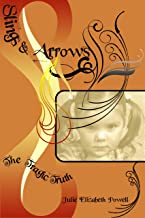
Nobody expects to lose a child but when it happens what can we do? In the sea of grief that seizes the soul how can we swim against the tide? But when that loss is compounded in each minute of every day, what do we do then?
Slings and Arrows is a story about the consequences of a moment, a moment, which separates a mother and daughter in ways impossible to imagine.
It charts their parallel lives, each suffering, one knowing, one not.
It is brutally honest; an account filled with bewilderment, guilt, anger and pain yet it also holds the key to hope. That whatever happens, the bonds of love can never be broken.
My Review: Slings & Arrows
Having lost a child of my own, it is not surprising that Slings & Arrows, by Julie Elizabeth Powell drew my interest. I have to say that I was not disappointed. The details of the loss of my son are very different from Ms. Powell’s loss of her daughter, but she offers up her story in a straight forward manner, with a brutal honesty which couldn’t help but touch my heart. Tears filled my eyes as I read Powell’s words time and again, as she is torn by conflicting emotions as she awaited her daughter’s body following a spirit which it appeared had departed.
Slings & Arrows is a brutally honest depiction of the stress, confusion, loss and grief which comes with watching a loved one slowly waste away long after their ‘life’ has ended. Kudos to Powell for baring her soul so openly in this tale of a loss that lingered on for years, consuming everything she has to give, and taking all that she has left. A tragic tale which hits close to home for me. I give Slings & Arrows five quills.
About Gone
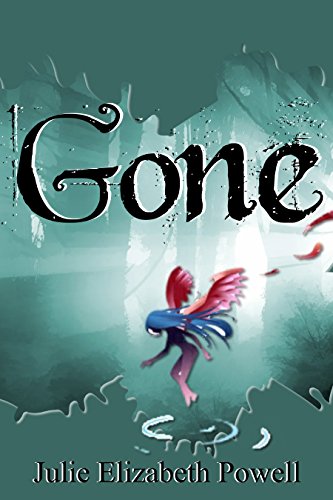
Is Charley crazy, delusional or dead?
Follow her amazing, emotional journey and emerge into the battle with her nemesis – herself.
This inspirational fantasy will take you into realms otherwise unknown, turning your world upside down while you’ll be wondering what is real and what is not. It’s an adventure, a mystery and an imaginative fairytale for adults.
Gone, by Julie Elizabeth Powell, is a journey searching for answers to the unanswerable question of where we go when we are gone from here. Powell offers one possible scenario in a crazy world where her character, Charley, meets Jenny, the daughter that she lost and hopes she has the answers Charley has been looking for. To learn whether or not Jenny has those answers, you’ll have to tag along and visit this sometimes confusing, often surprising place and find out for yourself.
Having read Powell’s first book, Slings & Arrows, which is a heart-wrenching memoir where she bares her sole over the loss of her daughter and the time leading up to her death, when she was alive and suffering, it is difficult not to relate to the experiences in this fictional tale, as a way to find answers for Powell herself. Where we go when we’re gone from here is an age-old question, one we will all have to face, but Powell goes beyind that, in trying to answer “Why?” I hope Powell found at least some of the answers she was looking for in the writing. I think the answers are different for everyone, but it was fun to take the journey. I give Gone four quills.
The first time I grasped that I was deeply crazy was when I began to eat huge amounts of food. I indulged especially in sweets. If I were to make a pie chart of my life (and refrain from eating it), I’m sure it would show huge chunks of time in the bulimia/anorexia’ zone. The worst of my food disorders followed me through adolescence; years seventeen through twenty two. I was a “student” out in the world, trying to maneuver by being on college campuses.
I had a sneaky way of being anorexic. I deluded myself into thinking that this was a spiritual discipline. Macrobiotics. It would get me high, exalt me spiritually. By eating small portions of brown rice and onions, chickpeas in barley, I was the paragon of yogic discipline. This was who I wanted myself to be. I got skinny. I weighed 125. On top of this I was taking LSD, DMT and smoking weed. I was deep into my purpose, my destiny of becoming a musician of salvation and a figure of reverence. I hope you can hear the self mockery in my tone.
Then I came to a breaking point. After a year of eating a strict Macrobiotic diet I had such a craving for a peanut butter and jelly sandwich that I bought the ingredients and took them back to my hidey hole. “What are you doing?” I asked myself. “This is a self betrayal, this is the opposite of Macrobiotic discipline. You asshole, what a failure you are!” So I ate it. Then I ate something else sweet and gooey. Then I couldn’t stop eating every kind of junk food on the planet. I had been like a coiled spring ready to bounce. Boing!
I was so ashamed of myself. This was 1967, before eating disorders had been invented. I was a pioneer. My bulimia wasn’t the pukey kind. It was the Exercise Freakishly type of bulimia, the one where on alternate days I would purge with sweat and effort, then follow with a day of relentless eating: an entire apple pie, backed up by a half gallon of ice cream. After that came the cookies, and so forth. One day exercising. One day binge eating. Back and forth, one followed the other, for more than a year. It was insane and I knew it. I got so unhealthy that I could pull out hands full of my own hair! I looked for help. I went to the college shrink. I was desperate. He said, “I don’t know what’s happening to you and I can’t help you.”
Ironically, I lost weight. My waist was a twenty nine or thirty. I was not a registered student any more, I had dropped out. I was living in a vacant student’s quarter, avoiding the security guys and bedding down with a pad and sleeping bag. I got money from my dad. I worked as a stable boy at a local horse ranch. I had my drums stashed at the university’s music building in a practice room. I practiced there for hours every day, getting high by all means and experimenting with the limits of my technique. That was the point of not attending classes. I let my dad pay for semesters at Western Reserve and then I would slip down to Antioch College in Yellow Springs from Cleveland and hang out with people who talked to trees. I practiced with relentless vigor, working through the famous “Stick Control” book and listening to Coltrane records.
Wait a minute. I’m conflating two different periods of time. It doesn’t matter. That’s the way memory works. It’s all narrative but sometimes the pages are out of order. I find myself more objective about my life as I get older. My life has been so bizarre that it qualifies as the stuff of novels. That poor guy (that is, myself) didn’t know what lay ahead. He thought that if he took enough acid, did yoga and meditation, ate rice and played the drums then he would launch himself into nirvana. It’s not a bad plan, really. The problem was that I was fractured psychologically, harboring behaviors that would shame me again and again. They would almost kill me.
These were adolescent ordeals, but they were precursors to my future. In 1967 my eighteen year old self dreamed of cosmic unity while the biggest thing that lay ahead of me was heroin addiction. I interrogated my psyche by reading Jung and Freud. After that came years of therapy. I was determined to save myself.
It took a long time, but none of it can be repudiated. I am lucky to be alive and well.
I’m still slightly food disordered. I control, compensate, manage. Mostly I exercise and pray.
Arthur Rosch is a novelist, musician, photographer and poet. His works are funny, memorable and often compelling. One reviewer said “He’s wicked and feisty, but when he gets you by the guts, he never lets go.” Listeners to his music have compared him to Frank Zappa, Tom Waits, Randy Newman or Mose Allison. These comparisons are flattering but deceptive. Rosch is a stylist, a complete original. His material ranges from sly wit to gripping political commentary.
Arthur was born in the heart of Illinois and grew up in the western suburbs of St. Louis. In his teens he discovered his creative potential while hoping to please a girl. Though she left the scene, Arthur’s creativity stayed behind. In his early twenties he moved to San Francisco and took part in the thriving arts scene. His first literary sale was to Playboy Magazine. The piece went on to receive Playboy’s “Best Story of the Year” award. Arthur also has writing credits in Exquisite Corpse, Shutterbug, eDigital, and Cat Fancy Magazine. He has written five novels, a memoir and a large collection of poetry. His autobiographical novel, “Confessions Of An Honest Man” won the Honorable Mention award from Writer’s Digest in 2016.
Want to be sure not to miss any of Art’s “Mind Fields” segments? Subscribe to Writing to be Read for e-mail notifications whenever new content is posted or follow WtbR on WordPress. If you find it interesting or just entertaining, please share.
My author guest today on “Chatting with the Pros” is someone who focuses on helping fellow authors to find and harness their positive inner energies and let them shine through, both in their writing and in their lives. She has written memoirs, poetry, written and/or compiled writing resource books, and she offers workshops focused on healing and transformation through memoir writing. Her works have won numerous awards, including Best Book Award, Feathered Quill Book Award, Mom’s Choice Award, Eric Hoffer Award, and Allbooks Review Editor’s Choice Award. Please help me welcome creative nonfiction author, Diana Raab, PhD.
Kaye: You have a PhD in Psychology with a research focus on the healing and transformative powers of memoir writing. Can you explain briefly what those powers are?
Diana: My research examined how pivotal experiences encouraged individuals to write memoirs as a way to transform, grow, and become empowered. I interviewed esteemed writers about the role writing their memoirs had in their lives. Poet Kim Stafford said that writing his memoir transformed him, in that it helped him come to a new understanding about his brother’s suicide. Another writer said that the writing experience relieved him from the pain of his past. And another writer who lost a son said that writing helped her look at life in a much larger context and also helped to keep her son “alive.” Writer Maxine Kingston said that she was transformed by penning her memoir because she was finally able to tell the stories from her past, which for a long time had been a secret. Thus, in most cases, the writers were liberated from the demons of their pasts.
Kaye: How can writing facilitate transformation and empowerment?
Diana: Transformation is a dramatic change in one’s physical or psychological well-being. It’s about becoming more aware of and facing our thoughts, feelings, and experiences. Writing down our feelings can lead to self-realization and a sense of empowerment, because we’re moving our feelings from inside of us and onto the page; and like therapy, it can help us work through our challenges. Writing can also be transformative because it helps us gain a better understanding of ourselves. With that understanding comes deeper reflection, and consequently a more profound sense of harmony.
Kaye: What is your biggest challenge of being a writer?
Diana: That’s a great question. In my earlier years, while raising children, my biggest challenge was carving out the time to write. These days, I would say that my biggest challenge as a writer is finding inspiration.
Kaye: What time of day do you prefer to do your writing? Why?
Diana: When I was younger, I used to love writing in the wee hours of the night, but now that I’m older, my preference is to write early in the morning. That’s when my mind and thought processes are most clear. I like writing just after my morning meditation, as sometimes thoughts emerge during this time that can move me into a highly creative and inspirational zone.
Kaye: Besides writing, what are your favorite things to do?
Diana: I love being with my adult children (ages 36, 34, and 30) and playing with my grandchildren; and I love hiking and going for beach walks. I meditate every day, and like most writers, I love to read. I also love cooking, especially soups and desserts. I love doing needlepoint, a craft I learned from my maternal grandmother, Regina, who committed suicide when I was ten. She was my caretaker, and this was a huge loss for me. Her story is the basis of my first memoir, Regina’s Closet: Finding My Grandmother’s Secret Journal.
Kaye: How does memoir writing differ from other writing forms? Don’t most forms of writing “unleash the true voice of the inner self”?
Diana: I don’t believe that most forms of writing “unleash the true voice of the inner self.” It might start out that way when writing fiction, but soon the imagination comes into play. Memoir writing is a first-person account chronicling a slice of life, not an entire life. It is a subjective recollection from one’s own perspective. Typically, there is a theme or thread running through a memoir. What sets a memoir apart from other forms of nonfiction is that it weaves the story as it happened, but also includes reflection. It’s much more than a journalistic telling. Compelling memoirs definitely unleash the true inner self.
Kaye: Tell me about your writing workshops. What can I expect to come away with if I take a workshop with you?
Diana: What you will come away with will depend on the nature of the particular workshop. Each one is different, depending on its focus. I usually revise my workshop format accordingly. For example, I’ve taught high-risk youth, bereaved adults, hospice workers, and those battling with drug addiction. My regular workshops are related to memoir writing, where participants of different writing levels come together to work on their personal stories.
I limit these groups to ten individuals so that I can offer individualized coaching. Participants learn by hearing my comments about their memoirs, and we also discuss published memoirs. They’re grateful to hear about all the tidbits of information I’ve gathered during my 40-year writing career. I stress the idea that writing is a process, and like any other process, patience is necessary. Those who take my workshops say that they leave them feeling very inspired to continue their memoir-writing journeys.
Kaye: What lessons do you want readers to walk away with from reading Writing for Bliss: A Seven-Step Plan for Telling Your Story and Transforming Your Life?
Diana: There are many lessons within those pages, as I weave my story into a how-to book on personal writing. I want readers to understand the transformative powers of memoir writing and be aware that writing is a journey. I stress the idea of truly enjoying that journey and not becoming focused on the destination. People have called Writing for Bliss “instructive, inspiring, healing, and a blueprint for writing for healing and transforming your life.”
Kaye: You put together a book project that was quite innovative with Writers and Their Notebooks. I thought it was a really cool idea, and apparently others did too, since it became a Best Books award finalist with USA Book News. In fact, I’d bet there is an abundance of valuable information for aspiring authors. What inspired you to compile an anthology of author essays about the value of an author’s notebook?
Diana: As I mention in the Preface, “As artists have sketchbooks, writers have notebooks.” My inspiration for creating this anthology originated from my own experience and the joy that journaling has brought into my own life. For more than five decades, journaling had helped ground and center me. My passion began with my mother giving me a Kahlil Gibran journal when I was ten to help me cope with my grandmother’s suicide.
This book is a celebration of well-published writers who use their notebooks to inspire, record, and document anything and everything that nurtures or sparks their creative energy. Many of the essays in the collection are confessional in nature. This year celebrates the book’s tenth anniversary. The project is even more meaningful for me now, as many of the writers in the anthology have passed away, such as Sue Grafton and Michael Steinberg.
Kaye: Another valuable anthology which you put together is Writers on the Edge, a collection of 22 authors being brutally honest about their own battles with addiction. Was it difficult to get so many authors to open up?
Diana: Great question. Addiction is defined as the obsession and compulsion to self-destruct. Author James Brown and I co-compiled this anthology because of our passion for the subject. We contacted writers who we thought would be interested in writing about their journaling practices. We were honored when Jerry Stahl agreed to write the foreword. A number of authors said that they didn’t know if they could write so intimately and honestly, but they did. Some had never written nonfiction before, so it was a huge challenge for them, but in the end, they felt a huge sense of satisfaction. As we said in the preface, “These battles are not fought alone, and perhaps these stories will also provide insight and hope to all those and their loved ones struggling with some form of addiction and its inevitable consequences.”
Kaye: You’ve written two memoirs yourself. Why did you choose to share with others your inner thoughts and feelings during a difficult time in your own life, with Healing with Words: A Writer’s Cancer Journey?
Diana: After my first cancer diagnosis in 2001, I decided, as a gift to myself, to enroll in graduate school for my MFA in writing. My two memoirs were a part of my creative thesis. In actuality, I had no intention of writing a memoir about my cancer journey. I was the type of person who believed that I got breast cancer, had a mastectomy and reconstruction, was healed, and that it was over and I’d be okay. I didn’t want my cancer diagnoses to define me.
During my recovery, I did a lot of journaling, but with no intention to publish a book on the subject. Five years later, to my surprise, I was diagnosed with multiple myeloma, an incurable form of bone marrow cancer. Supposedly, it’s not connected to breast cancer. I was devastated, but the silver lining was being told that I had smoldering myeloma and wouldn’t yet need treatment, just regular blood work.
My friends and colleagues encouraged me to write about my cancer journey because they thought it would help others. To make the book a little different and more universal, I decided to create a self-help memoir where I provided journaling opportunities for readers to share their own cancer journeys.
Kaye: You won the Mom’s choice award for your first memoir was Regina’s Closet: Finding My Grandmother’s Secret Journal. What kind of revelations does it contain?
Diana: During the writing process, I learned a lot about my grandmother. I began writing the book about the time of my first cancer diagnosis. I wanted to study my grandmother’s life to see if she’d committed suicide in 1964 because of cancer, but that wasn’t the case. I learned that at the time of her death, she was very depressed, and her doctor had given her a prescription for Valium, which she eventually overdosed on. By studying my grandmother’s life, I learned that she held on to the demons of her past, such as being orphaned during World War I and marrying an abusive man. All this inner turmoil eventually got to her, so she took her own life.
Kaye: Imagine a future where you no longer write. What would you do?
Diana: I don’t want to think about it. I love writing, whether it’s journaling; or writing poems, articles, letters, or blogs. It’s where I find my peace.
Kaye: What is next for Diana Raab? What can your readers and authors look forward to in the future?
Diana: Last year I turned 65 and felt that there was a huge shift in my vision. While I’ve always practiced mindfulness, I find that I’ve been living more in the moment. Also, in recent years, I’ve lost a number of loved ones, which is another reminder to enjoy the present. Thinking a little farther ahead, I hope to give more workshops and maybe create some short inspirational books. I’m currently working on my fifth book of poetry. I also have an unfinished novel that has been sitting in my drawer. Maybe one day I’ll be inspired to get back into it, or perhaps I’ll become inspired to write a children’s book for my grandchildren. Time will tell!
I want to extend my thanks to Diana Raab for joining us today and sharing with us. I have to agree with her philosophies, as I’ve experienced the healing powers of writing in my own life. I believe many of us have. If you’d like more information about Diana, her books, projects and events at her website: dianaraab.com.
You can catch the monthly segment “Chatting with the Pros” on the third Monday of every month in 2020, or you can be sure not to any of the great content on Writing to be Read by signing up by email or following on WordPress. Please share content you find interesting or useful.
Nonfiction is the stuff texts books are made of, the straight-out boring stuff that puts you to sleep, right? Not necessarily. Texts books don’t have to be boring. Nonfiction that is written creatively can capture the reader’s interest or immerse them into true life stories. From memoir, to self-help and how-to books, and yes, even text books can be highly entertaining.
True life circumstances and facts determine the story in nonfiction, yet nonfiction authors are faced with the same challenges as fiction authors to bring the characters and setting to life in the readers mind, or portray the information they wish to relate in a manner which readers can relate to. Both fiction and nonfiction authors strive to grab readers attention, now, in this digital age more so than ever before. But there are differences, as well.
To start off 2020, we’re going to delve into creative nonfiction in January. We have a pretty good sampling on the different forms that creative nonfiction might take. My author guest on “Chatting with the Pros” is bestselling author and memoirist, Diana Raab, who believes in the healing powers of writing. I will also be interviewing an author team, Mark Todd and Kym O’Connell Todd, who wrote Wild West Ghosts, one of the most informative and entertaining how-to books I’ve read. I will also be reviewing a true crime book, Missing: Murder Suspected, by Austin Stone, edited by his son Ed after his father’s passing, and a book on writing, On Being a Dictator, by Kevin J. Anderson and Martin Shoemaker. I do hope you will join us and help get Writing to be Read off to a good start for the year ahead.
For additional samplings of creative nonfiction see the following interviews and reviews:
Like this post? Let me know in the comments. You can be sure not to miss any of Writing to be Read’s great content by subscribe to e-mail or following on WordPress. If you found this content helpful or entertaining, please share.











 Diana: I love being with my adult children (ages 36, 34, and 30) and playing with my grandchildren; and I love hiking and going for beach walks. I meditate every day, and like most writers, I love to read. I also love cooking, especially soups and desserts. I love doing needlepoint, a craft I learned from my maternal grandmother, Regina, who committed suicide when I was ten. She was my caretaker, and this was a huge loss for me. Her story is the basis of my first memoir, Regina’s Closet: Finding My Grandmother’s Secret Journal.

 Kaye: You put together a book project that was quite innovative with Writers and Their Notebooks. I thought it was a really cool idea, and apparently others did too, since it became a Best Books award finalist with USA Book News. In fact, I’d bet there is an abundance of valuable information for aspiring authors. What inspired you to compile an anthology of author essays about the value of an author’s notebook?
 Kaye: Another valuable anthology which you put together is Writers on the Edge, a collection of 22 authors being brutally honest about their own battles with addiction. Was it difficult to get so many authors to open up?
 Kaye: You’ve written two memoirs yourself. Why did you choose to share with others your inner thoughts and feelings during a difficult time in your own life, with Healing with Words: A Writer’s Cancer Journey?