What’s a Nice Girl Like Me Doing Writing in a Genre Like This?
Posted: July 11, 2016 Filed under: Books, Fiction, Stories, Western, Writing | Tags: Delilah, I Had to Do It, Kaye Lynne Booth, Western, Writing 2 Comments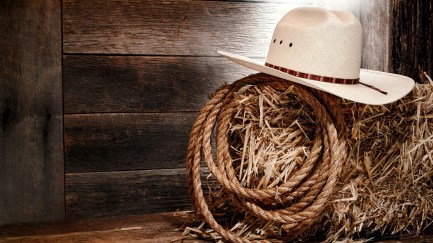
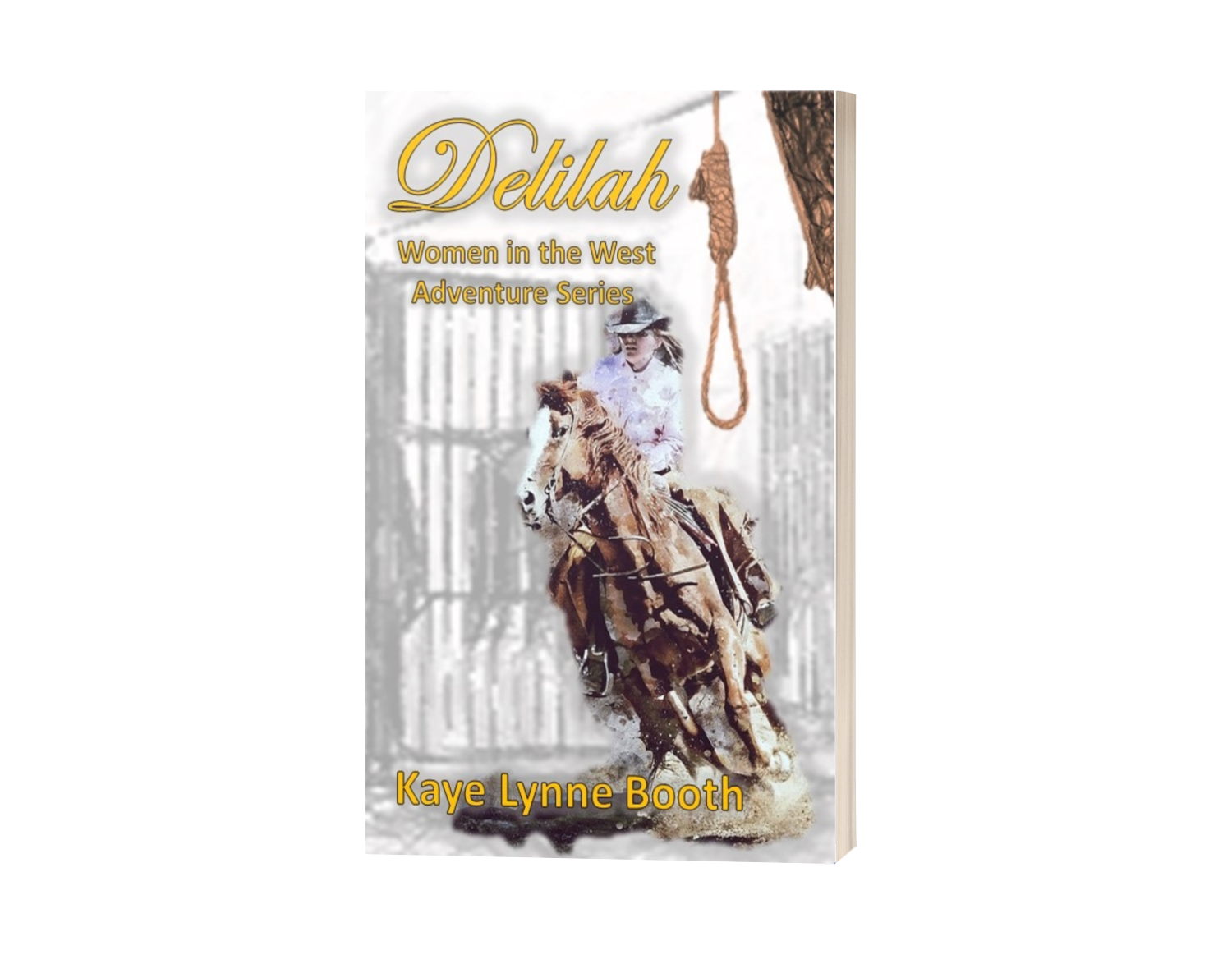
I recently sold I Had to Do It, a flash fiction story of the western flavor, to Zetetic: A Record of Unusual Inquiry. And of course, my regular readers know I’ve written a western novel, Delilah, as well, for which I’m diligently seeking a publisher at present. It might seem that I am leaning toward becoming a western writer, and I’ll admit, I do enjoy writing western.
But I’m an eclectic kind of gal by nature. My palate savors many cuisines, although I’m partial to Oriental and Latino foods. I listen to various genres of music, being heavy on the rock, but also enjoying metal, hip hop, country, pop, and even classical. I watch a wide range of movie genres, as well. On that same note, I read most of the genres, and seek opportunities to try genres that are new to me, but horror has always been my favorite. In fact, in 2012, when I began my M.F.A. in Creative Writing program at Western State Colorado University, western was one of the few genres which I hadn’t read.
In that first class, the first thing my instructor asked was, “In what genre do you usually write?” I considered the short stories I had written to date, many of which, I wasn’t sure what genre they fell into. The only experience I’d had with western was 850 words worth, I Had to Do It, and it hadn’t sold. But the idea was for us to write outside of our comfort zones, and western was the genre I was assigned for my first excerpt.
I’m not sure why I didn’t think I would like writing westerns. I’m a native of Colorado and proud of that, but I’ve never been a cowgirl per se. I enjoy western films. Clint Eastwood spaghetti westerns are the best, but Butch Cassidy and the Sundance Kid, and The Quick and the Dead are right up there, too. But as I said, I hadn’t really read much in the western genre. But then, I wrote the excerpt for Delilah. After that first semester, revising my excerpt according to the feedback from my instructor and my cohorts, I started thinking that I might not be too bad at writing in the western genre. Three years and several rewrites later, Delilah is a story I’m rather proud of. The rejections do sting a bit, but I’m confident that if I endeavor to persevere and keep submitting it, eventually it will land with the right publisher, and it will be accepted. And if not, well, there’s always independent publishing. Delilah is a good story, and it’s well written, and I want very much to be able to share it with the world. One way or another, I will get the book published.
And yes, there will probably be other westerns in my future. I seem to have a knack for it, at least, so I’ve been told. I already have an idea for a western romance, although romance is another genre I never thought I’d find myself writing. I guess we’ll see.
Like this post? Subscribe to Writing to be Read for e-mail notifications whenever new content is posted.
Share this:

Hybrid Publishers – What are they all about?
Posted: June 6, 2016 Filed under: Books, Publishing, Writing | Tags: Books, Delilah, Hybrid Publishers, Publishing, Writing 5 Comments
After the publisher I was so sure would take Delilah, didn’t, I did what I was taught in my M.F.A. classes and turned around and sent out another query to another publisher. I didn’t want to leave it sitting idle, so I turned around and sent it out again the same day to the first publisher I found that looked like they might be interested in a Western with a female protagonist. In a little over three weeks, I received a request for the full manuscript and was, of course, elated. The thing is, this publishing house isn’t one of the big 5, or even a small independent publisher, but a hybrid publisher.
We had discussed briefly hybrid publishers in one of my classes on the business of writing, but as I am now faced with the possibility of being offered a contract by one such entity, I felt it might be a good idea to delve a little deeper in order to understand what publishing through a hybrid publisher might entail.
I had a hard time finding anything recent on the subject, with most articles dating back between 2012 and 2014. It seems the term “hybrid publisher” can mean either an author who has works published both traditionally and self-published, or a publishing house that “splices” together elements of self-publishing and small press traditional publishing in any number of ways, according to published indie author and blogger, A.K. Taylor, in her August 6th, 2012 article on The Newbie Author’s Guide, “Rise of the Hybrid Publisher”. For our purposes here, we are talking about hybrid publishing houses rather than hybrid authors, although if they accept Delilah, and I accept their terms, I may someday be one of the later, as well.
According to Brooke Warner, publisher of She Writes Press, in her April 9, 2015 article on The Blog at HuffPost Books, “Hybrid Publishing: Getting a Handle on the New Middle Ground”, hybrid contracts are nothing new, they just aren’t widespread knowledge. Many traditional and independent publishers have been cutting hybrid deals where the author pays all or part of the publishing costs up front for years. What Warner calls partnership publishing allows authors to pay up front for publishing costs and receive a high percentage of the royalties, while the publishing house offers traditional distribution and qualify to submit books to traditional review channels to aide in marketing and drive sales.
Hybrid publishing work in much the same way. I found that there are several hybrid publishing houses out there. All offer some combination of traditional publishing services and benefits of self-publishing. According to Taylor’s article, there are certain things all hybrid publishers have in common:
- Author is involved in the whole publishing & marketing processes.
- Publisher offers traditional publishing and traditional marketing channels
- Royalties from 50 -100% (considerably higher than royalties offered by most traditional publishers)
- Quality craftsmanship
- Shorter contract duration (1-5 years) than traditional publishers, and then rights revert back to author
All hybrid publishers have some type of submission process, but some offer a traditional-type publishing contract, with only a small advance, if any, while others require authors to pay all or part of the publishing expenses up front. I suspected this would be dependent on whether they are a P.O.D. publisher, (publish on demand), or do a traditional print run, although according to the former publisher of Writer’s Digest, Jane Friedman, there are hybrid publishing houses who do not require the author to pay up-front expenses, although the do provide a traditional print run, and even traditional marketing services. In her Publishers Weekly article, May 15, 2015, “Not All Hybrid Publishers are Created Equal: How Authors Should Evaluate Their Choices”, she states that the services offered, as well as royalties and costs vary. It’s important to be sure that the publishing route you choose is going to produce a high quality product.
The publishing house that is considering Delilah may go either way once they have assessed my manuscript, assuming of course that they love it and can’t wait to offer me a contract. They may opt to offer me a contract similar to a traditional contract with no up-front cost to me, or they might chose to offer me a contract more like a self-publishing contract, requiring I pay all or part of the publishing expenses out of pocket.
As far as I could determine, when considering a contract with a hybrid publisher the following five areas should be kept in mind when determining whether the publishing house is right for you. These are the areas I will look at if I am offered a contract for Delilah.
- Speed of Publishing Process – I’m not a patient person, so quick results are appealing to me. I backed out of a contract with a P.O.D. publisher for one of my children’s books, after five years with no results. I like to make things happen and be able to see my hard work come to fruition, preferably before I’m dead.
- Type of Income/Out of Pocket Expense – I’m a starving artist, so of course, an advance would be preferable to covering the publishing expenses out of pocket. The cost was one reason I have shied away from self-publishing models. The idea of larger percentages in royalties is also appealing.
- Traditional print run or P.O.D. – I like the idea of the traditional print run, because it allows the author access to copies for review or to have on hand at signings and other writing events. With P.O.D. publishing, that stuff can get expensive. Plus the above mentioned experience with P.O.D. publishing has made me leery of it.
- Editing services – I believe one thing that gives self-published authors a bad rep are the authors who don’t think they need to have their manuscripts professionally edited before publishing, therefore putting out a poor quality book. Every book should be well edited before publishing, so I feel having editing services available could be invaluable.
- Marketing and promotional services – This is an area where I’m not great at. I’m a writer, not a sales person, although if I believe in something, I usually have good results when selling it, and I do believe in my writing. None-the-less, this is not one of my strong points, so I would take all the help I can get.
It appears that today’s author has three publishing choices, which is two more than author of the past had. More choices means more opportunity for success. In a January 8, 2014 Forbes article, “How Hybrid Publishers Innovate to Succeed”, David Vinjamuri gave this breakdown of the differences between traditional publishing, independent or self-publishing, and hybrid publishing.
- Traditional publishers pay big advances, but move like sea turtles on land. Extremely long process. You have to move at their pace, (a year or more from acceptance).
- Self-publishers/Independent publishers – Large royalties, P.O.D. Author pays all publishing costs up front.
- Hybrid Publishers – Better royalties than traditional publishing, but not as good as self-publishing. Much faster publishing process than traditional publishers, (4 to 6 weeks). Although generally do not pay large advances, many don’t require any money up front from the author. Hybrid publishers pay few if any salaries.
Every author dreams of being traditionally published, but traditional publishing is tough. You have to have thick skin and be able to handle repeated rejections. The only thing I have against self-publishing is the expense. I write to make money, and I have to sell something before I have money to spend. Hybrid publishing seems to me like it might be the best of both worlds and definitely something to consider.
During my M.F.A. courses, I wrote with the belief that I would find a traditional publisher for my work. Although we briefly discussed hybrid publishing and self-publishing, both were glossed over, leaving the impression that they weren’t really options for professional writers. But now that I’m faced with trying to get my work out there, I’m learning that they might be options I should consider. (I’ve already experimented with self-publishing with my short story, Last Call, in e-Book format on Amazon, but haven’t seen a lot of results from it.)
Many of the students in my classes were young, in their twenties and thirties. They may have time to build a career and wait to be discovered, but I am fifty-two years old. I don’t have all that time. I want to make my writing work for me while I’m still alive to enjoy it. So, if this publisher does come back with an offer for Delilah, I’ll consider it. You bet I will. Now I have enough knowledge about hybrid publishers to make an informed decision. Wish me luck.
Like this post? Subscribe to Writing to be Read for e-mail notifications whenever new content is posted.
Share this:

Discouragement or Motivation?
Posted: May 5, 2016 Filed under: Western, Writing | Tags: agents, Delilah, publishers, Rejection, Western, Writing 6 Comments
I finished the final draft of Delilah last month. Normally, in anticipation of its completion, I would scour my Writer’s Market in search of publishers and/or agents that might be in the market for a western novel with a tough, spunky female protagonist and make a list of places to send it out to. But, I pitched Delilah to a publisher I felt would be a perfect fit for this manuscript last summer at the Write the Rockies Conference in Gunnison, and got an invitation to send the manuscript when it was completed. That in itself was amazing, because you usually don’t pitch a manuscript that isn’t complete, but I was doing the pitch for practice, and I actually felt like I’d bungled it pretty badly. My perception of my performance must have been wrong, because the invitation to query was forthcoming.
At any rate, I didn’t make the usual list of submissions for Delilah, because I knew where she was going, and I just knew this publisher was going to make an offer. Instead, I spent my time preparing for submission. I wrote a synopsis and query letter, and prepared a brief excerpt to include. So, as soon as the final revisions were completed, I sent off my query.
I also sent a query to an agent I thought might be good to represent me, using Delilah to entice them. I sent it off on April 21, and on April 29 I received the rejection. Man that was fast. I found it disheartening. I know I have to expect rejections, probably a lot of them, and I’ve had many on other works which I’ve been shopping. In my graduate classes at Western State, they warned us to expect them, and taught us to use them as motivation to get it back out to the next perspective publisher or agent. And, you know, that’s exactly what I’ve done regarding all the other works I’ve sent out. So, why is this rejection any different?
I think it was the speed with which I received this rejection, barely a week, which took me aback. You wait for responses from publishers and agents for weeks, sometimes even months. That’s why you send out simultaneous submissions whenever possible. Get your work read by as many possible avenues of publication as possible. It’s common practice, although some calls for submissions specify that they do not accept simultaneous submissions. (If you think about it, it’s pretty selfish of a publisher to do this, expecting to allow them to consider your work exclusively, when it takes so long for them to respond.) This rejection came from an agent, not a publisher, but I wasn’t expecting a reply so quickly. I didn’t feel like they’d even had time to read what I’d submitted.
I’ve worked on Delilah on and off for four years. I could have finished her sooner, but with school and my freelancing, and holding down a full time job, I wasn’t able to work on her, like I did on my thesis, which I wrote in full within six months, (but that’s another story, for another day). Actually, I had a completed draft of Delilah in that amount of time, but the revisions turned it into a whole other story. It’s true. The final manuscript of Delilah tells a different story than the one I set out to tell originally. I have enough cut scenes from the first draft to almost make up another whole book, which I might do, if Delilah finds a home and does well.
So the question remains, why have I not sent Delilah out to more than one publisher? Why do I have this certainty within me that she will find a home with this one publishing house that I submitted to first? I know this isn’t a realistic expectation and I’m probably setting myself up for disappointment. I do. So, why don’t I treat this novel like my other works? And why did the first rejection from an agent hit me so hard? Maybe because I have put so much of my heart into Delilah, but I think you have to put your heart into any work of creativity in order for it to be truly good. I don’t know what’s so special about this novel, but I know Delilah is special. I feel it. If I find a publisher for her, you can read it and then, you’ll know it, too.
Share this:

A Closer Look at My Own Writing Process
Posted: January 6, 2013 Filed under: Fiction, Writing | Tags: Delilah, Fiction, Writing, Writing Process Leave a comment Since I’ve been seeking my MFA through Western State University, my posts here have been dwindling. On top of my school work, I’ve been writing a western novel and I’m close to having it completed, but this also has put a strain the limits of my writing time, not to mention several curveballs that life has thrown at me recently. However, I’m learning some really neat things about my own writing process that can be shared here, so perhaps my readers will forgive me for slacking off a bit.
In my Craft & Practice I class, my instructor, Barbara Chepaitis, guided us in analyzing our own writing process and taught us about the different types of writing processes. This is a subject I’d never thought much about before. While some writing processes are very structured, with outlines and plot lines and story arcs, others are more organic, just letting the words flow to the page, and still others are somewhere in between. While I’ve done outlines for my nonfiction writing process, I’ve tended to be more organic in my fiction writing process. I just sit down and start writing and see what comes about.
That’s what I did with the western novel I’ve been diligently working on. Delilah started as a character driven story, when I was assigned to do a western excerpt for my class this summer. I created the character of Delilah for the excerpt and it built itself one scene at a time as the character showed me what happened next. It’s been a fun journey since trouble seems to have a way of finding Delilah, but as I neared the finish line, I needed to make sure that my plot and all of my sub-plots wrapped up neatly. I didn’t want to inadvertently leave any loose ends. So, I found it necessary to plot it out and take a look at my story arcs, one for the plot and one for each sub-plot, to make sure they all had a beginning, a middle and an end, and see how they interrelated with each other.
In doing this, I was surprised to see how many different story arcs my story actually has. After drawing out the main plotline, I drew a story arc in a different color for each of my different sub-plots and ended up with eight different story arcs, including the main arc. Every motivation or relationship that Delilah has, creates a different sub-plot with a story arc of its own. Like a good stew, where each separate ingredient mixes its own flavor into the pot to create that delicious stew taste, each separate story arc adds to the flavor of my story. Below is a picture of what I came out with.
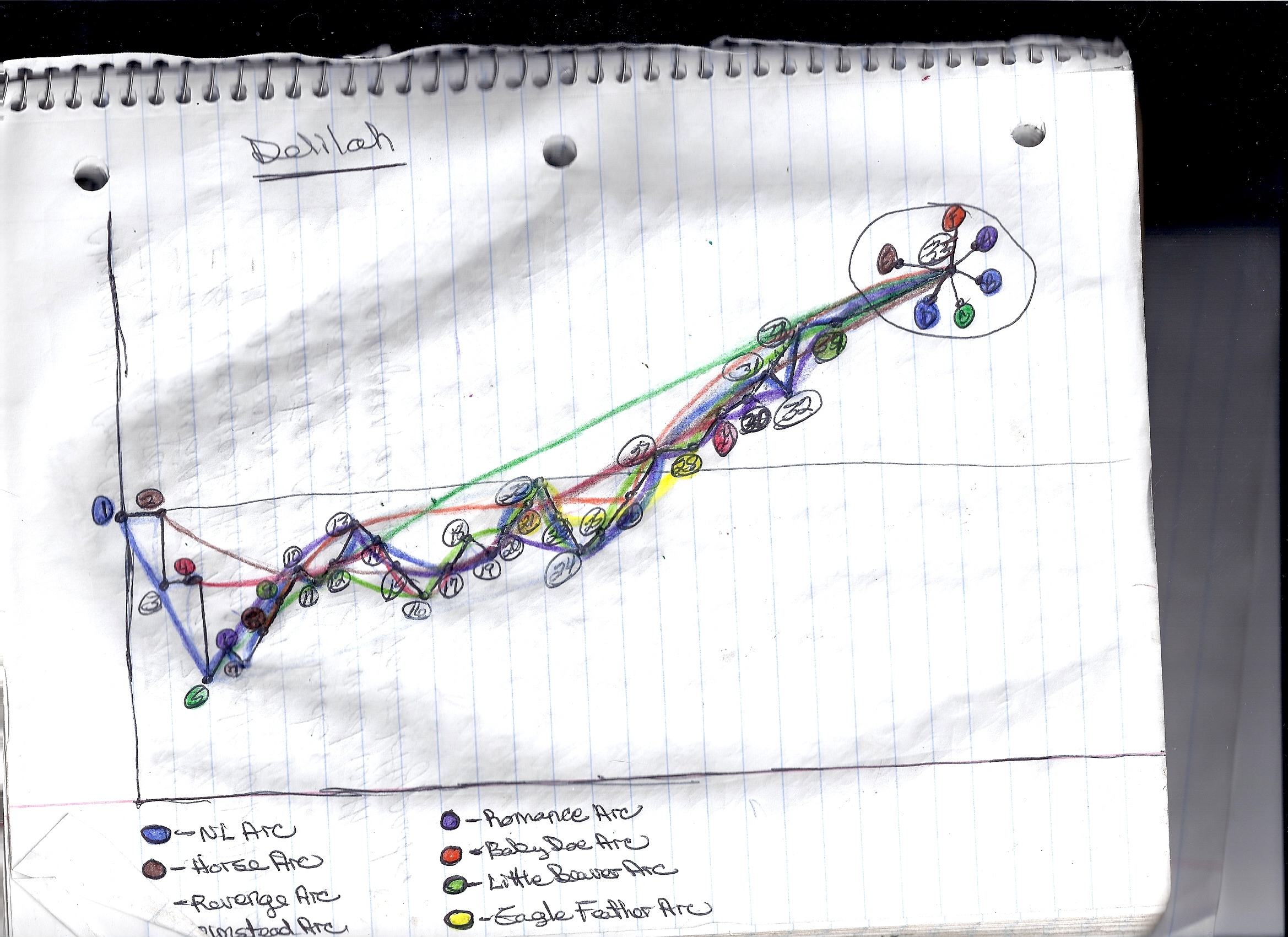
This enabled me to see where things were missing and envision how it will all come together in the end. It has required me to revise some parts of my story, but I can see the value in doing this. The different colors represent the individual story arcs and the colored circles represent the plot points where each one begins and ends. The main story arc includes every plot point, while the sub-plots start at different plot points, further into the story and some end before the main story ends, while at least five of them are tied in together and conclude at the end, along with the main plot. This is what I think a good story should do, so I am pleased with the results. Now that I have discovered how it all ends, all that’s left to do is to write it.
My instructor, Barb did not try to tell us that one process was better than another and she encouraged us to explore different processes to see what worked for us and what didn’t. I’ve discovered that my process needs to be both structured and organic. I’ve never tried the structured approach to fiction before, so with my next novel, which is an action/adventure story, I’ve started with the plotting. In fact, I already have the main plot line of the major events drawn out. Although this story is based on a character, Betty Lou Dutton, that I created and used for two scenes in Barb’s class, this approach will be a basic reversal of my usual process. As I write, I may find that more story arcs need to be added, although I already know there will be at least four sub-plots, it will be interesting to see how well this turns out. Wish me luck.