“Godling and Other Paint Stories”: Contemplate the Meanings
Posted: September 23, 2016 Filed under: Book Review, Books, Fiction, Stories | Tags: Book Review, Books, Creative Fiction, Fiction, Godling, Jeff Bowles 3 Comments
Godling and Other Paint Stories, by Jeff Bowles, is a collection of six short stories all thematically tied together by a very thin thread of paint, or more specifically, colors. In the ingenious mind behind these stories, it probably doesn’t seem far-fetched that paints would be self-aware, or that dogs could evolve into thinking talking animals with human-looking lips, but your average reader will take a look at these stories and say, “Wow!” But one thing these stories will make readers do, is ponder possibilities, because frankly, as an author with a God-thing going on, Bowles conceives of some really heavy concepts, the kind that really make you think.
The collection starts out with Godling, a science fiction tale of a God machine, which gave up its humanity for love, and may, or may not, be able to reunite to become whole once more. (With short stories, you really can’t have spoiler alerts, because they give away the whole thing, so you’ll have to read the story to find out what happens.)
Next is Traffic Patterns, a tale of a sentient traffic light that is granted godhood, for a time. And, Making Paint as a Means of Impermanence is filled with some truly disturbing images of how an attempt to gain immortality turns into an ever renewing ritual to maintain an impermeable existence. Wild Dogs of Buffalo is a canine Godfather, excuse me, I meant Dog Father. Anyway, I love it. It’s a truly entertaining read.
God, the Little Artist – An artist’s heaven. This is not the first time that author Bowles has killed God off in his stories. The main character is Mr. Williams. As in Robin? That’s what I kept picturing in my mind as I read this story. Robin Williams talking to the large baby God whose time is running out, as if perhaps God ages backward. When I’d finished, all I could think was Robin Williams as God. Now that’s scary. But, maybe it’s just me. (No spoiler alerts. Again read the story.)
Dr. Julianus Techt’s 5 Easy Steps to Building a Better You is an instruction manual on how to sell your soul in order to improve on God’s handiwork, which is you. Only Jeff Bowles would create such a story. As you read these stories, when you come to this last, do not… I repeat, DO NOT try this at home.
Godling and Other Paint Stories will be released on Amazon on September 25th, 2016. I highly recommend you grab a copy. Overall, this collection of short stories are all easy, enjoyable reads, which will give reader’s brains lots of food for thought. They are strange and unusual, but Jeff’s writing talent is such that it doesn’t take much to suspend your disbelief. I give Godling and Other Paint Stories five quills.

Kaye Lynne Booth does honest book reviews on Writing to be Read, and she never charges for them. Have a book you’d like reviewed? Contact Kaye at kayebooth(at)yahoo(dot)com.
Share this:

You’d have to be crazy to want this “Dream Job”
Posted: September 9, 2016 Filed under: Book Review, Books, Fiction | Tags: Book Review, Dream Job, Janet Garber 3 Comments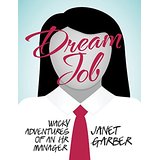
Dream Job: Wacky Adventures of an HR Manager, by Janet Garber, is a quirky romance with a light rhythm which readers fall into easily, moving the story along at a mellow clip. Although at times the dialog seems a bit stilted, Garber’s characters are just peculiar enough to make it work.
Melie Khol is great at solving everyone’s problems except her own, holding others off at a distance. Her “dream job” is really more of a nightmare – dealing with disgruntled employees, investigating allegations of bad behavior in the office, and disciplining culprits of the worst offenses. Melie handles all the unlikely events that occur in her wacky workplace as if they were just a matter of course, but even the best HR Manager has her limits.
She thinks she’s looking for love, or at least companionship, or… okay, maybe just descent sex, but like most of us homo-sapiens, she’s fooling herself. Melie knows her life is lacking something, but she’s not going to find it in the man from her daily subway commute, who she calls Ponytail Man because she finds his hair attractive, and who turns out to be a slug. She thinks She thinks she might find it with Ted, the guy she spends weekends in the country with, but he says he doesn’t do relationships.
As she ponders her non-relationship with Ted, problems at work keep her hopping. Melie has a big secret that could be her undoing if revealed in the ongoing company-wide background checks, her boss is murdered and everyone is suspect, including her, her new supervisor is sexually harassing her, and demands are flying at her from every direction. It all unfolds in a final meltdown of hilarious proportions and a happily ever after worthy of any good romance novel.
Dream Job will keep you smiling and perhaps even invoke a few chuckles. A thoroughly entertaining read. I give Dream Job: Wacky Adventures of an HR Manager five quills. 
Share this:

“Victorian”: A Ghostly Story Packed Full of Secrets
Posted: September 2, 2016 Filed under: Book Review, Books, Speculative Fiction, Young Adult | Tags: Book Review, Books, Fiction, Ghosts, Jordan Elizabeth, Review, Secrets, Victorian, Young Adult 1 Comment
Victorian, by Jordan Elizabeth, is a truly unique YA story featuring not one, but two young girls, Celeste and Weronica, who each have a dark secret hidden in the past that keeps them closed off to others. When they both get jobs at a historical fair in a strange old village which harbors secrets of its own, things turn interesting, as each one learns to trust again with the help of the fair’s colorful cast of characters and the ghosts of the past.
Elizabeth’s characters are realistic and believable. Weronica acts as if she’s self assured, but worries more about what others think of her than she lets on. She shares only enough to keep curiosity at bay, keeping her ghosts close and the secrets they hold even closer. Celeste really just wants to belong, but fear that her secret will be revealed causes her to hold others at bay. Her ghosts are really those of the historic village, but they hold the key to unlocking her secrets, as well as unraveling the mysterious past of the village.
This well-crafted story builds just the right amount of suspense to keep the pages turning, as it alternates between the two co-protagonist’s points of view. The story line is easy to follow, the village setting becoming a character in and of itself. Victorian is well worth the read.
I give Victorian four quills. 
Share this:

“A Shot in the Dark” is a Wild Ride
Posted: August 26, 2016 Filed under: Action/Adventure, Book Review, Books, Fantasy | Tags: A Shot in the Dark, Action, Book Review, Books, Fantasy, Fiction, Jesse James Dawson, K. A. Stewart, Review 1 Comment
It’s not every day we have a demon hunter for a friend. Not unless you are a friend of Jesse James Dawson, that is. In A Shot in the Dark, by K. A. Stewart, an annual weekend camping trip turns into a fight for survival for Jesse and his friends. Jesse must wager everything, including his soul as he faces off with an old adversary, full of new and improved deadly surprises in the remote Colorado mountain retreat.
A Shot in the Dark is an action filled story dealing in matters, not only of life and death, but of heaven and hell. In dealing with questions of good and evil, the answers aren’t always black and white, but often lie somewhere in the gray. Now the only question is, will Jesse’s friends still be his friends if they live through this supernatural wilderness adventure.
Stewart’s likable characters and unusual villains make settling in for this demon hunting tale quite enjoyable. Antagonist Jesse James Dawson and his friends pull out all the stops, combining traditional weaponry, magic and religion to battle the minions of the underworld, but can he bring all his friends home safely?
As the second book in Stewart’s Jesse James Dawson series, I give A Shot in the Dark three quills.

Share this:

“Keepers of the Forest” Plot Draws Readers In
Posted: August 5, 2016 Filed under: Book Review, Books, Fiction, Uncategorized | Tags: Book Review, Books, Creative Fiction, Fiction, James McNally, Keepers of the Forest 3 Comments
Keepers of the Forest, by James McNally has a good plot and interesting characters. When Chris is chosen by Crispus Attuck Brown to be the Chosen One, a summer spent with Scott and Chris’ aunt and uncle takes an unexpected turn, and Chris’ swim instructor, Brian is the only who realizes something is amiss. Brian must find a way to save the two brothers and foil Brown’s evil plot to destroy the world.
Brian is a young man who is afraid of commitment and perhaps drinks a little too much. He befriends a young boy, Chris, who is a sweet kid that falls into unfortunate circumstance and becomes the victim of an evil plot. Other players on the good guy’s team are Chris’s older brother, Scott, an angry teen who works through his own issues and story arc, and Brian’s bartender friend, Nancy who has her stuff together and acts as support for Brian as he works through his personal issues and becomes the hero. One of the most colorful characters unfortunately, has only a supporting role and isn’t really involved in any of the action. Nancy’s aunt, Leah, the balding swim instructor with cancer is a strong character, and I would have liked to see more of her.
The villain, Crispus Attuck Brown is an interesting chap, who believes he can bring about the second coming of the Dryad, and he’s gathering the Keepers of the Forest to that end. I think if we’d seen more of how bad he is sooner, it would’ve helped us to fear him more. At his side is an ex-hooker named Sherry, who is a misguided pawn in Brown’s game until she removes the blinders and realizes what is really going on around her. The big guy, Mason, is the muscle for the operation. He is feared because of his size, but is shown to have a soft heart. The crew is rounded out by two gay ex-cons, Ted and Vincent, who are cold blooded killers, who kill because they like it and almost seem more to be feared than Brown.
I had a couple of problems with Keepers of the Forest. First, McNally does a bit of head hopping, which makes it confusing to the reader as to whose P.O.V. we are in at times. And second, the characters all have such clear insight into their own motivations that they can self-analyze and express exactly what they are feeling and their motivations verbally. There isn’t a lot of subtext, and real people just don’t do that.
***************************SPOILER ALERT********************************
The other thing that just didn’t sit quite right with me, was the fact that the good guys save the day, but they are lead to the solution by Sherry, after she comes to the realization that her beliefs in Brown are faulty. Brian becomes a passive protagonist, in a way, because although he has a part in saving the boys, the rescue is led by a member of the opposing side, turned defector and he just does what he is told. For me, all the characters have the potential to be really great characters, but most of them fall short of what they could be.
I give Keepers of the Forest three quills. 
Share this:

“Hollywood Game Plan” Prepares Upcoming Screenwriters to Hit the Ground Running
Posted: July 22, 2016 Filed under: Book Review, Books, Nonfiction, Screenwriting | Tags: Book Review, Carole Kirschner, Hollywood, Hollywood Game Plan, Review, Screenwriting 2 Comments
More than any other industry, the film making arena is a world where connections are everything and success may depend on who you know. Breaking in takes persistence, determination, and maybe even a dash of creativity. Oh, and talent helps, too.
Hollywood Game Plan, by Carole Kirschner, is a must read for anyone trying to break in to the entertainment business. This book gives you the lowdown on what jobs there are in both the creative and the production areas and tells what it takes to land each position, all the way to the top of the Industry.
Much of the advice found within its pages, basic things like being on time, working hard, dressing appropriately, or listening and following directions, could apply to any industry. But, it also contains tips and tricks that are Industry specific to the world of film making, and pays heed to the rules of Hollywood etiquette, which should never be broken unless you’re trying to commit career suicide. From how to use your Industry contacts to move your way up the ladder, to when it is appropriate to seek out advice or assistance from higher-ups. Among the list of cardinal rules not to be broken are:
- Start at the bottom and work your way up – everybody has to pay their dues.
- Be willing to do any chore your boss requires, even the most menial, or most nerve racking, tasks with a smile.
- Never talk badly about an employer, even if he’s the boss form hell.
- You’re going to get fired. Everyone gets fired. Don’t take it personal. Move on.
- Be nice to people. You never know who may turn out to be a future boss.
- Network, network, network. Keep a record of contacts and follow-up appropriately on all.
- Work for free, if you can afford to, and do the best job possible. You never know where it could lead.
- Work harder than anyone else and anticipate your employer’s needs.
Hollywood Game Plan helps you create a solid plan for launching your career as a screenwriter, even if you must begin in a job other than the one you aspire to. This book outlines the step by step approach to laying the groundwork for your new career, from honing your resume and crafting a solid cover letter, to landing that first job, making preparations to make the move to L.A., to working your way up the Hollywood creative or production ladders, and into your dream job.
I give Hollywood Game Plan four quills. 
Kaye Lynne Booth does honest book reviews on Writing to be Read, and she never charges for them. Have a book you’d like reviewed? Contact Kaye at kayebooth(at)yahoo(dot)com.
Share this:

“Simplified Writing 101” Makes Academic Writing Seem… Simple
Posted: July 8, 2016 Filed under: Book Review, Books, Nonfiction, Writing | Tags: Book Review, Erin Brown Conroy, Simplified Writing, Writing 2 Comments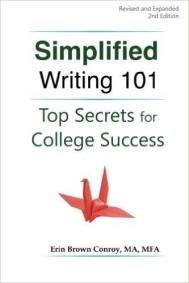
The guidelines set forth in Simplified Writing 101: Top Secrets for College Success, by Erin Brown Conroy, pave the way to good academic writing that will improve grades on college assignments. This book is not your usual writing tutorial. Most academic writing tutorials are dry and boring, just laying out the “rules” as law, and making readers struggle to get through the material. Brown Conroy’s relaxed writing style sets readers at ease, perhaps allowing for better retention of the information. It’s like an old friend or respected cohort sharing bits of wisdom, imparting knowledge in easy to understand language that won’t put readers off.
Simplified Writing 101 contains writing advice that can be expanded beyond Academia. Section 1 covers word choice. The list of words to avoid to make your writing clear and concise in the first three chapters aren’t just for academic writing, where one wants to sound professional, or at least knowledgeable. This list contains words that are vague or unnecessary, or that turn the readers off, pushing them away, causing them to reject the message without giving it a fair chance. It is based on sound writing principles, which can be equally applied to copywriting, where the aim is to persuade, or literary writing, where the goal is to enchant and entertain. They could even be applied to screenwriting, where, as in poetry, every word counts. Also in this section is a chapter on properly citing sources, making word choices and mastering a higher vocabulary found in well-written academic papers.
Section 2 covers structure and form, offering a closer look at well-crafted sentences. The chapters in this section cover fragments, run-on sentences, how to create rhythm by varying sentence length, and active vs. passive writing.
It also discusses the rhythm of your words and suggests that they should sing on the page. She uses an analogy with sports for those who are not musically inclined to ensure her point is understood, (using clear and concise writing, of course). Although I am not musical, nor am I a boxer, I easily understood the concept of varying sentence length and why it should be practiced. When Brown Conroy writes about active vs. passive writing, her suggestions are not limited to Academia. Active writing can be used in all types of writing to grab and hold readers’ attention.
Section 3 covers paragraphs. After learning how to create the building blocks, sentences, we’re ready to move on to the core foundation of your paper. The chapters in this section cover how to make your sentences work for you, how to keep your paragraphs focused, linear writing, how to lead your reader with well-structured sentences, how to achieve closure for each paragraph, and finishes up with connectives, transitions and connectors.
No tutorial on writing would be complete without instruction in punctuation, so that is what we find in Sections 4 and 5. Simplified Writing 101 gives the subject thorough coverage, including when and when not to use a comma, punctuating compound sentences and lists, misuse of exclamation points, how many spaces following end punctuation, use of quotations, how to use punctuation to control pacing in your writing, hyphens, en-dashes and em-dashes, semi-colons, and colons. A whole chapter is devoted to an inside look at how professors go about grading papers and the little mistakes, such as grammar and punctuation, which add up to a loss of points and bring down grades.
Grammar is found in Section 6, noting words that must go together, writing in the proper tense and correct person, and contractions. It also talks about commonly misused or mistaken words, and sticky pairs, or pairs of words that must be found together and using words that indicate tense. And Section 7 covers how to narrow your topic, creating your research question, create an outline, using your thesis statement into a blueprint for your paper. This section also includes a four step process to creating a first draft, found in Chapter 36 with multiple methods for planning, how to draft efficiently, revise for the best word arrangement, and edit for basic errors and mechanics.
Logically, Simplified Writing 101 provides sections on revision and completing the final product, to help students know what to do once that first draft is complete. In Section 8, Brown Conroy explores writing with style, the basics of good writing, and how to answer readers’ questions before they can ask them. Section 9 covers the creation of the final draft, including ways to avoid procrastination, doing as many rewrites as it takes, what to check and rewrite in academic papers, finding an editor or getting feedback, assignment submissions and email communications in Academia, and making professional connections.
A valuable reference, Simplified Writing 101 provides lists of different types of words, such as common connectives or conjunctive adverbs, and separates them into groups, depending on which type of writing they are appropriate for: academic use, mid-range academic use, or non-academic use. Each list is also separated into what job each group of words does, or what purpose they serve. There is also a list of common mistakes, the little things that drop down points and lower grades: use of brackets; dates; times; quotations and double quotations; use of slashes; proper capitalization; and rules of abbreviation, and a list of rules for writing numbers. These lists are nice because they provide an easy-to-use reference, in case memory fails us, which it is certain to do sometime during all of our writing careers, so they may come in very handy.
Simplified Writing 101 is the writing tutorial I wish I’d had as an undergraduate. As it was, I struggled through English classes, not really understanding, but Brown Conroy makes writing guidelines and rules crystal clear, and it all seems so simple. Use it as an introductory writing guide or keep it as a reference, but this tutorial is a must have for your personal library. It will see you through your academic career and beyond.
I give Simplified Writing 101 an A+, er, I mean, five quills. 
Simplified Writing 101: Secrets for College Success can be purchased in both hard copy and ebook.
Kaye Lynne Booth does honest book reviews on Writing to be Read, and she never charges for them. Have a book you’d like reviewed? Contact Kaye at kayebooth(at)yahoo(dot)com.
Share this:

Chronology is full of surprises
Posted: June 24, 2016 Filed under: Book Review, Books, Fantasy, Fiction, Horror, Science Fiction, Speculative Fiction, Steampunk, Stories | Tags: Anthology, Book Review, Books, Creative Fiction, Fantasy, Fiction, horror, Review, Speculative Fiction, Steampunk, Writing 3 Comments
I’ve just had the pleasure of reviewing a new anthology of short fiction put out by Curiosity Quills Press. When asked if I’d like to review Chronology, I had the impression that it was a steampunk anthology, which is a genre I’m newly discovering. Some of the stories in this collection do have steampunk elements, such as Wind Up Hearts, the steampunk-ish romance that is sure to break readers’ hearts, by Bram Stoker Award finalist, Stan Swanson, or Flight of the Pegasus by Dr. Darin Kennedy. There’s also That Which is Hidden, a haunted steampunk-ish werewolf romance, by Julie Frost. But, I was pleasantly surprised to find the stories in Chronology to be a diverse mixture of speculative fiction.
Some are futuristic, leaning more toward science fiction, such as the apocalyptic Afterparty by Mark Woodring, Limited Liability, a futuristic outer space story by Matthew Graybosch or Gookie Visits Her Moma by G. Miki Hayden, an alternate universe science fiction story about a space bounty hunter whose current bounty takes her back to her home planet. Many others are more in the fantasy realm, such as Draconic King, by award winning author, James Wymore, or Yours Until the Ink Dries, a true faerie tale, as a young outcast girl discovers her true identity in her drawings, by Y.A. author Jordan Elizabeth. And then there are those stories that fall into the mythical realm, such as Strange Flesh, a well-crafted story of mythical creatures by Katie Young, or Wampus Cat, a tale of Appalachian legends come true by international bestselling author Scott Nicholson.
Still, others have a horror element or two, such as The Lair, a story of a cursed treasure hunt in jungle swamps, by best-selling independent author, Tony Healey, or Lava, a spectral love story by New York Times bestselling author, Piers Anthony, or In the Clutches of the Mummy Prince, by B.C. Johnson, which was not very scary. Also I had trouble relating with the main character in Johnson’s story, who wasn’t very likeable. There is also The Comeback, the weirdest zombie romance I’ve ever heard of, told from the zombie’s POV, by techno-thriller and MG fantasy author, Tara Tyler, and Inmate #85298, a chilling death row tale, by author and screenwriter, Andy Rausch.
Of course, there are also those stories that weren’t so easy to classify, including White Chapel, which sheds new light on the story of Jack the Ripper, by author, editor and podcast co-host, Andrew Buckley, or Signs Unseen, the story of a small town race war, by J.P. Moyahan, or Bait and Witch, a troublesome witch story by speculative fiction author, J.P. Sloan. There is also The Bull, by novelist and short story writer, J.R. Rain, which turns a Minotaur into a superhero, and The Unattended Life, a reminder to stop and smell the roses by J.E. Anckorn, and an intriguing airship romance, Above the Clouds, by Richard Roberts.
Yes, it is a big book, about 530 pages, but it is definitely a good read. In addition to the stories mentioned above there are the three I enjoyed the most, which I saved to tell you about in more detail. The following stories stuck out in my mind the most, but not in any particular order.
The Room Below, by novelist Wilbert Stanton is a horror story worthy of Lovecraft, or King. This story about a stay in a mental institution that puts One Flew Over the Cuckoo’s Nest to shame. It held my attention and kept me on the edge of my seat, and had a surprising, yet satisfying ending.
The Colorado King, by Nathan Yocum is a story in which survival is the name of the game as a father and daughter travel over post-apocalyptic badlands in search of kin and refuge, bringing with it some very hard lessons. This well-crafted tale grabs readers’ attention and doesn’t let go, yet it leaves readers feeling like there should be more, probably due to the fact that it is an excerpt. I’m guessing that it is from Yocum’s novel, The Zona.
And finally, Innocent Deception, by Matthew Cox is a well-crafted story which has a surprising reveal in its final pages. The daughter of a pharmaceutical company’s CEO is kidnapped and held for ransom, but the plan falls apart when the mother doesn’t want the kid back.
Overall, I give Chronology 3 Quills. 
Kaye Lynne Booth does honest book reviews on Writing to be Read, and she never charges for them. Have a book you’d like reviewed? Contact Kaye at kayebooth(at)yahoo(dot)com.
Share this:

“Walks Along the Ditch” takes readers along on a walk through later life
Posted: June 10, 2016 Filed under: Book Review, Books, Poetry, Screenwriting, Writing | Tags: Bill Tremblay, Book Review, Books, Poetry, Review, Writing 1 Comment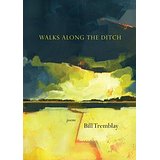
Walks Along the Ditch, by Bill Tremblay, is reflective poetry collection themed on the everyday awe found in nature and the world around us. Tremblay masterfully crafts simile and metaphor to form vivid word pictures that fill the mind’s eye and cause readers to contemplate the human condition and our natural environment, such as the vision he creates in his poem, Blue Heron.
“…It flaps its wings, one-thousand one,
one-thousand two, its pitch is changed,
its back-flaps open like Fred Astaire’s vest
on a mirrored floor. Settled, its crest
shaken out, the Ichabod steps slow
on his stalks with ganglionic grace
toward bull rushes gathering clouds
like a weaver at her shuttle, then
darting his long yellow chopsticks,
pulls a wriggling crawfish out,
cracking its shell, guzzling the meat
down its sink-catch throat…”
This collection of poems are calming and meditative, stirring new consideration of things familiar and known, but perhaps not often noticed. The artistry of his descriptions is no more apparent than in two lines from his poem, Before Dawn, “…Dawn light trills its piccolos. / Huge back ghosts become watermelon pink foothills…” It’s a new turn for Tremblay, whose moving narrative poetry of the past, such as The Magician’s Hat, a historical poetic collection around the life of Mexico’s muralist, David Alfaro Siqueiros, has commented on historical events, persons and eras. Walks Along the Ditch marks growth of Tremblay’s talent and takes his word craft to another plane.
I give Walks Along the Ditch four quills. 
Kaye Lynne Booth does honest book reviews on Writing to be Read, and she never charges for them. Have a book you’d like reviewed? Contact Kaye at kayebooth(at)yahoo(dot)com.
Share this:

“Confessions of an Honest Man” plays a boogie on the heart strings of readers
Posted: June 3, 2016 Filed under: Book Review, Fiction | Tags: Arthur Rosch, Book Review, Books, Confessions of an Honest Man, Fiction 7 Comments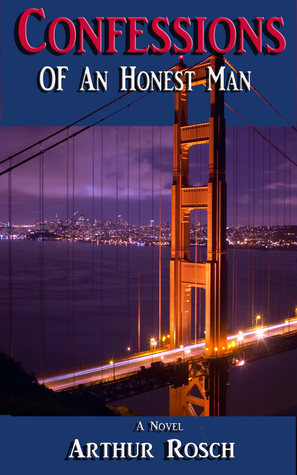
From the 1960’s to present day, Confessions of an Honest Man, by Arthur Rosch follows young jazz musician through the streets of New York and San Francisco through the jazz circuit of bars and clubs with famous musicians such as John “Avian” Coltrane and Zoot Prestige. It follows Aaron through the struggling childhood where he has to fight for anything that matters to him to become first, a mildly successful jazz musician, then a washed up heroin addict, into a recovering addict trying to straighten out the mess that his life had become, and miraculously overnight, a very successful jazz musician through a turn of fate. Aaron Kantro has some help along the way as he learns to love and be loved. He is guided by his mentor and fellow jazz musician, Zoot Prestige, then from a little dog, named Diz, who was for a while, his only friend and companion, as well as Zoot’s spirit once he passes and the spirits of others whom he has known in life.
It is a thought provoking story of a family afflicted by abuse, mental illness, depression and drug addiction. It’s the story of what can happen when we chose to defy the odds stacked against us and struggle to survive, and maybe even thrive, if we’re lucky. It is the story of Aaron Kantros, a boy who fell in love at a very young age, and his emotionally abusive mother, who was an abused child herself, his father, struggling to hold all of their lives together without a clue of how to achieve his goal, his younger brother, filled with anger and resentment, and his two sisters, illustrating their very different, individual methods of coping.
Confessions of an Honest Man is not just about the characters. It’s about a time, an era, where there is very little knowledge about, or help for dysfunctional families and doctors freely handed out whatever pills they thought might make your problem go away, and if those pills caused other problems? An era in which you looked after your own and people didn’t look too closely at one another. An era of racial biases, sexual biases, hypocrisies and prejudices. An era of jazz in its purest form.
Confessions of an Honest Man is written with compelling honesty and soul. He creates characters that are so real and relatable, that the disclaimer, “All characters are fictional”, is necessary because Rosch makes it easy for us to believe that they lived. He captures the essence of time and place, creating events with vivid clarity within the mind’s eye. This story will move readers with emotion, touching hearts and stirring the empathy in all of us. I give Confessions of an Honest Man five quills. 
Other books by Arthur Rosch include The Road Has Eyes – An RV, a Relationship and a Wild Ride, and The Gods of the Gift.
Kaye Lynne Booth does honest book reviews on Writing to be Read, and she never charges for them. Have a book you’d like reviewed? Contact Kaye at kayebooth(at)yahoo(dot)com.