I am very excited to welcome talented artist, poet, and author, Dave Williams to “Treasuring Poetry”. Dave is discussing his thoughts on poetry and I’ve reviewed his unique poetry book Gasp! Poetry!
What is your favourite style of poetry to read i.e. haiku, ballad, epic, freestyle, etc?
Freestyle. I like playful poetry, and poetry that causes me to think of stuff in different ways than my status quo. Also, I’m a big fan of short poetry about nature. Doesn’t have to be haiku. Poems that focus on one aspect of nature, be that a particular animal or plant or season. This kind of poetry is like a seed for me to meditate over that aspect of nature.
What is your favourite poem in your favourite style to read?
My favorite poem by another writer is “maggie and milly and molly and may” by E. E. Cummings. I love it because it’s lively and frisky and profound. And because it reminds me of growing up near the Atlantic Ocean. And because one of my daughters is named Molly (with a capital M, not lowercase like in the poem — although she’s welcome to be creative with the capitalization of her name if she likes).
What is your favourite style of poetry to write? Why?
I enjoy writing freestyle the most. Limericks and haiku can be fun to write by following their rules. But I typically go with freestyle because I don’t have to worry about rhymes or syllables or meter.
What is your favourite of your own poems?
A tough question, Robbie! One poem of mine doesn’t jump out as a favorite. I looked through Gasp! Poetry! to find one to include here. I chuckled over several poems, but the poem that clicks with me right now isn’t aimed at humor. Rather, it feels hopeful:
Chickadee
Seeing an eagle,
the chickadee
aspired to greatness:
soaring high in the
Great Blue
Yet he could not
transform into that epic bird
In her son’s sullenness,
mama chickadee asked
the elders to offer wisdom
They told him
there’s a quiet dignity
in being a chickadee
and that
warmed his heart.
Your poetry collection Gasp! Poetry! has a most unusual name and blurb. Please tell us a bit about this book, what the poems are about, and what your intentions were will the collection.
The cover tries to warn people who have no interest in poetry. The title and cover illustration pretend what such a person’s reaction might be to a poetry book. They might throw up their hands and shriek, “Gasp! Poetry!” Then they’d run for the safety of a Non-Poetry Zone. Where, after catching their breath, they might tell other people how close they got to a poetry book and how terrifying it was. The cover uses drama for humor (hopefully).
Some poems in the book aim for silliness, while others are serious. The topics are assorted. One short poem is about a monkey taking a bath. One long poem is about how Scheherazade told a thousand tales to avoid being murdered. If you’ve followed my blog for a while, chances are good that you’ve read poems from this collection.
My intention was to package a bunch of poems on my blog, and ones that haven’t been published there yet. I hoped to entertain readers who like playfulness and absurdity in poems.
You write both novels and poetry. Which do you prefer?
Novels. Even when short, they’re more immersive than poems — which are like sketches to me (since I don’t write epic poems). I enjoy pondering possible plot paths of novels, as well as possible backgrounds of characters. It’s akin to reading a book and being immersed in the story. But with novel writing, the story can unfurl in various, potential directions. Joy is in exploring and shaping the story. So is frustration. But it’s worth the frustration when the book is finished.
My review of Gasp! Poetry!
Picture caption: Cover of Gasp! Poetry! featuring a hand drawn circle man with his arms thrown upwards in anguish.
The amusing title of this poetry collection by Dave Williams is indicative of the nature of the poetry. All of the poems are clever, slightly dark, and poke fun at humans and humanity in general. In other words, these poems are brilliant and hugely entertaining.
Is a Poem about Grains of Sand on a Beach Too Pretentious? “I wondered that question, lying on a floral beach towel, a speck in a crowd of swimsuited people – all of us were lumps of cookie dough glazed with sunscreen and coconut oil baking in this oven.” The short extract above is a great example of Dave dark humour in relation to human behaviours and his engaging descriptions.
Valor is a great example of the poet’s quick and clever mind and attitudes towards adversity: “”You’re not sharp enough?” “Get some sides!”
Yells were hurled from the crowd of octagons at the little circle. “You look ridiculous!”
The circle puffed up with valor, said “I am what I am,” refused to conform, then rolled defiantly towards home.”
This was my favourite poem in the book. I really enjoyed the personification of shapes and it reminded me of Flatland by Edward Abbott Abbott.
There is some wonderful life wisdom encased in these freestyle poems. A short extract from Ocean Inside which captivated my mind: “Meanwhile I work against the urge to liquefy myself and pour myself into the container others have sculpted for me”
Having gone through my own teenage years and watched three sisters and two sons go through theirs, I am acutely aware of how very real this pack mentality is with young people. Sometimes, people never manage to escape its grip and find their own path in life.
If you enjoy dark humour, excellent poetry, and life truths, you will love this engaging and entertaining collection.
Picture caption: Author photograph of Dave Williams
Surely many people are named “Dave Williams” and this particular Dave is a redheaded one who enjoys writing speculative fiction, drawing, and reading. He lives in Maryland with his wonderful wife, two inspirational daughters, and two cats (a lazy one and a playful one).
South African author and illustrator, Robbie Cheadle, has written and illustrated sixteen children’s books, illustrated a further three children’s books, and written and illustrated three poetry books. Her work has also appeared in poetry and short story anthologies.
Robbie also has two novels and a collection of short stories published under the name of Roberta Eaton Cheadle and has horror, paranormal, and fantasy short stories featured in several anthologies under this name.
You can find Robbie Cheadle’s artwork, fondant and cake artwork, and all her books on her website here: https://www.robbiecheadle.co.za/
________________________
Did you know you can sponsor your favorite blog series or even a single post with an advertisement for your book? Stop by the WtbR Sponsor Page and let me advertise your book, or you can make a donation to Writing to be Read for as little as a cup of coffee, If you’d like to show your support for this author and WordCrafter Press.
__________________________
This segment of “Treasuring Poetry” is sponsored by WordCrafter Press and the Poetry Treasures series.
The theme for this collection, “Into the Light,” was influenced by how a young sunflower bud always faces the sun. This sun tracking is called heliotropism.
It is believed that sunflowers participate in heliotropism because they possess an internal clock similar to humans. This internal clock enables the plant to maximize its growth and absorb optimal energy.
The buds are heliotropic until the end of the bud stage. Upon reaching maturity, the sunflower ceases to follow the sun.
The combination of sunflowers as an emblem, and “Into the Light” as a theme is intended to throw shards of brightness out into the world. By actively seeking out happiness and sharing love and light, we can make this planet a better place for all its people and creatures.
golden sunflowers
watch Apollo’s chariot
move across the sky
from dawn’s first light to sunset
forever seeking the light
by Colleen M. Chesebro
Picture caption: Cover of Sunflower Tanka featuring a sunflower turned towards the sun on a pale pink background. Shards of light spill across the cover.
Blurb
Sunflower Tanka, edited by Robbie Cheadle & Colleen M. Chesebro, is an annual anthology of contemporary tanka, tanka prose, & experimental tanka from a broad mix of new and established poetic voices from across the world.
Our theme, “Into the Light,” draws inspiration from the way a young sunflower bud constantly turns to face the sun. Poets delved into the realms of death, love, and the natural world, capturing their human experiences in the timeless form of syllabic poetry.
Contributors to the first edition of the Sunflower Tanka: Suzanne Brace, Yvette Calleiro, Kay Castenada, Luanne Castle, Robbie Cheadle, Colleen M. Chesebro, E.A. Colquitt, Melissa Davilio, Destiny, Tamiko Dooley, Lisa Fox, Cindy Georgakas, Chris Hall, Franci Hoffman, Marsha Ingrao, Jude Itakali, JulesPaige, Kenneth, MJ Mallon, Brenda Marie, Selma Martin, Michelle Ayon Navajas, Lisa Nelson, D. Wallace Peach, Freya Pickard, Dawn Pisturino, Gwen M. Plano, Jennifer Russo, Aishwarya Saby, Reena Saxena, Merril D. Smith, Nicole Smith, Ivor Steven, Ben Tonkin, Trilce Marsh Vazquez, Cheryl Wood.
A few examples of the poetry in this book
All the poems in this book are gorgeous, so I have just randomly selected three pieces to share here:
echoes of despair
hushed as tears fail haunted eyes
silence expresses
a quiet faiths’ grip on hope
firm through darkened horizons
Tanka By Destiny
***
ash and dust reclaim
from flames of passion or shame
born this, raised as that
do butterflies from cocoons
ditch all that was, for petals?
Extract from Intertwined Essence (garland tanka) by Jude Itakali
***
within the forest there’s a glen where children play under a white light where mystical faeries flit around, happy and free
Tanka by Ivor Steven
Jacaranda Blue
As a photographer and painter, I am always trying to capture light in my work. This series of three photographs of my painting, Jacaranda Blue, was intended to demonstrate how this painting captures light in different ways.
This painting is dedicated to my amazingly artistic blogging friend, Resa McConaghy, who recently shared a most extraordinary series of articles about The Painted House. You can find the last article, with links to all the rest, here: https://graffitiluxandmurals.com/2024/11/24/exterior/. In addition to her amazing photography, Resa creates the most incredible art gowns out of recycled materials. Click on Resa’s name to discover more about her gowns.
This is a short extract from my poem Jacaranda Blue, a rensaku, inspired by this painting and included in Sunflower Tanka:
dressed for a spring ball
frocks of filmy organza
Jacaranda blue
delicate forms gently swaying in softly flowing fabric
Sunflower Tanka Video
Did you know you can sponsor your favorite blog series or even a single post with an advertisement for your book? Stop by the WtbR Sponsor Page and let me advertise your book, or you can make a donation to Writing to be Read for as little as a cup of coffee, If you’d like to show your support for this author and WordCrafter Press.
About Robbie Cheadle
South African author and illustrator, Robbie Cheadle, has written and illustrated sixteen children’s books, illustrated a further three children’s books, and written and illustrated three poetry books. Her work has also appeared in poetry and short story anthologies.
Robbie also has two novels and a collection of short stories published under the name of Roberta Eaton Cheadle and has horror, paranormal, and fantasy short stories featured in several anthologies under this name.
You can find Robbie Cheadle’s artwork, fondant and cake artwork, and all her books on her website here: https://www.robbiecheadle.co.za/
___________________________
This segment of “Treasuring Poetry” is sponsored by WordCrafter Press and the Poetry Treasures series.
Today, I am delighted to welcome talented poet, Dawn Pisturino, as my October Treasuring Poetry guest. Dawn has a Halloween collection of micro poems which I’ve reviewed below.
What is your favourite style of poetry to read i.e. haiku, ballad, epic, freestyle, etc?
I like any style of poetry to read, but my favorite is the sonnet. William Shakespeare and Elizabeth Barrett Browning excelled in this art form that elevates the mind and captures the soul.
What is your favourite poem in your favourite style to read?
My favorite sonnet is the classic love poem by Elizabeth Barrett Browning from her collection, Sonnets from the Portuguese. “Portuguese” was Robert Browning’s pet name for his wife. Her sonnets are so expertly written and articulate such deep love and passion! They are delightful to read and reflect the nature of true romantic love between two people—the abiding love that most people dream about but rarely find.
Sonnet XLIII
How do I love thee? Let me count the ways.
I love thee to the depth and breadth and height
My soul can reach, when feeling out of sight
For the ends of Being and ideal Grace.
I love thee to the level of everyday’s
Most quiet need, by sun and candle-light.
I love thee freely, as men strive for Right;
I love thee purely, as they turn from Praise.
I love thee with the passion put to use
In my old griefs, and with my childhood’s faith.
I love thee with a love I seemed to lose
With my lost saints, – I love thee with the breath,
Smiles, tears, of all my life! – and, if God choose, 2
I shall but love thee better after death.
What is your favourite style of poetry to write? Why?
It’s easier to write in free verse and let the words and emotions flow. Writing in a tight form, like a sonnet or haiku, requires discipline, creativity, and a more extensive vocabulary.
What is your favourite of your own poems?
“Ariel’s Song” is my favorite poem because it was written for my daughter when she was quite small. It reflects our life when we lived in the San Francisco Bay Area.
Ariel’s Song
Ariel sings a lusty song
Of ships upon the sea,
And ere the night is very long,
Her spell is cast on me.
She spins a web of intrigue,
She tells a tale of woe;
And when the sun is waxing big,
I do not want to go, –
No, I do not want to go.
But she folds her wings together
And whispers my release;
For her stories last forever
And her songs will never cease.
Then, she rises from the window,
Winging high into the light,
And I’m left alone in shadow
As she disappears from sight.
Tell us a bit about your latest collection of haiku, Haiku for the Midnight Hour. What inspired you to write this collection? Is Halloween a favourite celebration of yours?
Halloween is one of my favorite holidays. I have fond childhood memories of picking fresh pumpkins from the garden, buying cider from the local apple stand, bobbing for apples at my best friend’s house, and going trick-or-treating with my little brother. Early in the year, I thought about writing a dark haiku collection and decided to finish it in time for Halloween. It was a fun project. I wrote twisted, dark limericks for Underneath the Juniper Tree that were quite popular with readers of all ages. I thought it would be fun to do the same with haiku. Purists may not like non-traditional haiku about monsters, aliens, demons, voodoo gods, and other dark themes, but I’m hoping it will be an interesting introduction to haiku for adults, teens, and young adults.
My review of Haiku for the Midnight Hour
Picture caption: Cover of Haiku for the Midnight Hour featuring a raven in a graveyard perched on a human skull
This is an entertaining collection of micro poems that revolve around the themes of Halloween and ghostly happenings. The micro poems are collected under common themes with headings, for example, Wee Folk and Crystal Balls.
While most of the micro poems deal with the paranormal, there are several that deal with Family and dark events in the home. On such example is Aunt Jane, as follows:
“aunt jane – locked away in the attic for years – rocks back and forth in chains”
The poems are clever and darkly humorous. Two of my favourites are as follows:
Jack and the Giant “jack climbed the beanstalk with curious intention a giant backlash”
Purgatory “purgatory and punishment clean souls tarnished by sinful doings”
If you enjoy clever and dark theme micro poems, this is the book for you.
Picture caption: Author photograph of Dawn Pisturino from Amazon.com
Dawn Pisturino is a retired nurse in Arizona whose international publishing credits include poems, short stories, and articles. Her first poetry book, Ariel’s Song: Published Poems, 1987 – 2023, debuted with five-star reviews. Her short chapbook, Lunar Gazing Haiku, became a #1 Amazon New Release in six categories. Her newest release, Haiku for the Midnight Hour, achieved #1 Amazon New Release status in three categories. She is a member of Mystery Writers of America, PEN America, and the Arizona Authors Association.
South African author and illustrator, Robbie Cheadle, has written and illustrated sixteen children’s books, illustrated a further three children’s books, and written and illustrated three poetry books. Her work has also appeared in poetry and short story anthologies.
Robbie also has two novels and a collection of short stories published under the name of Roberta Eaton Cheadle and has horror, paranormal, and fantasy short stories featured in several anthologies under this name.
You can find Robbie Cheadle’s artwork, fondant and cake artwork, and all her books on her website here: https://www.robbiecheadle.co.za/
________________________________________
Want to be sure not to miss any of Robbie’s “Treasuring Poetry” segments? Subscribe to Writing to be Read for e-mail notifications whenever new content is posted or follow WtbR on WordPress. If you found it interesting or entertaining, please share.
______________________________________
This segment of “Treasuring Poetry” is sponsored by WordCrafter Press and the Poetry Treasures series.
Today, I am delighted to welcome David from The Skeptic’s Kaddish blog and mastermind of the W3 poetry prompts as my September Treasuring Poetry guest.
What is your favourite style of poetry to read?
This is a tough question because I enjoy reading a wide range of poetry. However, I find myself most often moved by elegantly crafted free verse. When free verse is written in a way that feels truly poetic and draws me in, I’m deeply impressed. This isn’t always the case with free verse; anyone can break a series of words into lines, but not everyone can do so in a way that captivates.
What is your favourite poem in your favourite style to read?
These are fantastic questions, Robbie! Do most people actually have an answer for this one? It’s difficult to choose!
If I may, I’d like to share a poem I deeply enjoy, although I wouldn’t call it my absolute favorite. Honestly, I’m not sure I have a single favorite poem.
‘The Performers’
by Robert Hayden
Easily, almost matter-of-factly they step,
two minor Wallendas, with pail and squeegee along
the wintery ledge, hook their harness to the wall
and leaning back into a seven-story angle of space
begin washing the office windows. I
am up there too until straps break
and iron paper apple of iron I fall
through plate glass wind onto stalagmites below.
***
But I am safely at my desk again by the time
the hairline walkers, high-edge
balancers end their center-ring routine
and crawl inside. A rough day, I remark,
for such a risky business. Many thanks.
Thank you, sir, one of the men replies.
***
What I love most about this poem is how Hayden imagines himself as one of the window washers and then returns from his reverie in the second stanza. I find it incredibly relatable—both the relationship between the office worker and the cleaners, and the act of daydreaming. I also admire how Hayden captures the interaction between himself and the workers, imbuing them with both respect and dignity.
What is your favourite style of poetry to write? Why?
I’ve experimented with many different forms of poetry, but over the past few years, I’ve gravitated towards the sijo. Two reasons stand out:
First, I prefer writing shorter verses. I’m wary of longer poems because each additional word risks derailing my intent. Second, while the Korean sijo is technically a syllabic form, it also offers flexibility since the syllable count is ranged, not fixed.
What is your favourite of your own poems?
Oy vey!
My nine-year-old daughter often asks me what my favorite food or book is, and she gets frustrated when I tell her I like different things in different ways. That’s exactly how I feel about my own poems!
Given today’s political climate, I’ll share one that resonates with how I’ve been feeling recently. It’s a garland shadorma, a form created by Sylvia Cognac on WordPress. It consists of seven shadorma stanzas, with each of the first six stanzas borrowing one line from the final verse. Here it is:
Ancient homeland, or: Each hoary stone
it’s the flag, I know. that’s okay. I prefer to remain true to my identity despite the haters.
I know them. they’d prefer that I surrender my people’s claim to our ancient homeland to assuage their guilt.
our roots here predate all others… reject it if you will, but the truth speaks for itself through each hoary stone.
some fancy us colonizers, wish we’d leave… ‘see?’ they’d gloat, ‘their connection to this land was not authentic.’
our prayers for home never ceased. so, no. no- I won’t be another Jew who forsakes his forebears’ story.
our foes have convinced themselves that we can be scared away, but we’ve had just One Land in Jewish history.
it’s the flag- they’d prefer that I reject it; ‘see?’ they’d gloat, ‘another Jew who forsakes Jewish history.’
Tell us a bit about the posts you wrote after your father’s death. What inspired you to write them? What do they mean to you?
Looking back, as much as I dislike clichés, I realize I had no choice but to write those posts.
From the outset, I knew I would recite the Kaddish daily for my father after his unexpected death. No one else in my family was able or willing to take on that responsibility. Yet, after a few weeks, I began to feel that I was simply going through the motions. It felt empty, especially considering that I was performing a ritual in honor of a man who had no respect for rote religious practice.
It’s been over five years since I wrote the final post in that series, where I grappled with this very question. Everything I wrote back then remains true, but now I see that the act of writing those posts was also the beginning of my coming to terms with the truth about my faith. It marked the start of my acceptance that I don’t believe in a traditional concept of God, nor in the inherently enduring relevance of religious doctrine and ritual.
Although I finished the Kaddish series that year, I’ve never stopped contemplating its philosophical implications. They continue to challenge me daily. I once thought that returning to synagogue to recite the Kaddish would bring me closer to my religious community. Instead, it distanced me further because I didn’t simply perform the ritual—I transformed it into a journey of deep self-reflection.
This process ultimately led me to start writing poetry. Revisiting my love of creative writing—something I hadn’t engaged in since high school—reconnected me to my own critically thinking inner voice, a voice I hadn’t fully acknowledged before… And that’s the voice that now flows through my poetry.
My Kaddish Year
David has written a fascinating memoir in the form of 51 blog posts about his year of mourning following the passing of his father. This year is called Kaddish or The Mourner’s Kaddish in Judaism and involves saying a hymn of praises about God for your deceased parent. I know a bit about the Jewish faith because one of my good friends is Jewish. I have attended hair cutting ceremonies and bar mitsvahs as well as some other celebrations. I have not experienced anything to do with the passing of a family member so the Kaddish was new to me.
I am still busy reading David’s thought provoking posts about this period of his life but what I have read to date is very interesting. It has opened my eyes and understanding to a lot of Jewish traditions and religious rituals that I had no idea about and which I think are very worthwhile. The concept of worshipping for a whole year after the passing of a parent in the company of other community members who are experiencing exactly the same grief and anguish seems like a very helpful and supportive idea to me. My experience of death has been a lot of support for the griever up until the funeral and then very little. The griever is left along to manage as best he/she can at the worst time which is after the funeral is over and the permanency of the new circumstances sink in.
David’s post are not limited to the Kaddish, they expand into a lot of thought about life, death, religion, individuality in worship and believes and many other topics. It is worth reading and considering. Follow the link below to read the 51 post comprising David’s My Kaddish Year.
Picture caption: Author photograph of David Bogomolny
David Bogomolny was born in Jerusalem to parents who made Aliyah from the USSR in the mid-70’s. He grew up in America and returned to Israel as an adult. He works as a grant writer for the Jewish Agency for Israel. He and his wife and daughter live in Jerusalem.
He began writing the ‘Skeptic’s Kaddish for the Atheist’ in Jerusalem, Israel, 30 days after burying his father in South Brunswick, New Jersey, USA. His series was originally published on the Times of Israel blogs.
South African author and illustrator, Robbie Cheadle, has written and illustrated sixteen children’s books, illustrated a further three children’s books, and written and illustrated three poetry books. Her work has also appeared in poetry and short story anthologies.
Robbie also has two novels and a collection of short stories published under the name of Roberta Eaton Cheadle and has horror, paranormal, and fantasy short stories featured in several anthologies under this name.
You can find Robbie Cheadle’s artwork, fondant and cake artwork, and all her books on her website here: https://www.robbiecheadle.co.za/
________________________________________
Want to be sure not to miss any of Robbie’s “Treasuring Poetry” segments? Subscribe to Writing to be Read for e-mail notifications whenever new content is posted or follow WtbR on WordPress. If you found it interesting or entertaining, please share.
______________________________________
This segment of “Treasuring Poetry” is sponsored by WordCrafter Press and the Poetry Treasures series.
Today, I am delighted to welcome talented poet and author, Elizabeth Gauffreau, as my Treasuring Poetry guest.
What is your favourite style of poetry to read i.e. haiku, ballad, epic, freestyle, etc?
My favorite style of poetry to read is free verse, although recently I’ve become quite taken with the duplex and the pantoum. I also enjoy reading persona poems, such as T.S. Eliot’s “The Love Song of J. Alfred Prufrock,” which has been a long-time favorite of mine. In addition, I enjoy narrative poems such as George Franklin’s Angel of Sorrow poems. (Travels of the Angel of Sorrow and What the Angel Saw, What the Saint Refused)
What is your favourite poem in your favourite style to read?
Because I’ve been reading more poetry collections in the past several years than I ever have before, it’s hard to pick just one favorite poem. I’m going to go with Patricia Smith’s “Now He’s an Etching.”
The poem is written in iambic pentameter, which is definitely not my favorite poetry form. However, Smith uses it so skillfully, I didn’t even notice the meter until someone pointed it out to me.
I strongly encourage readers to listen to Smith read the poem herself to get the full experience of it. https://poets.org/poem/now-hes-etching (Click on the blue speaker icon on the right side of the screen.)
Now He’s an Etching
of the sluggish, coolly vengeful way
a southern body falters. Muscles whine
with toiling, browning teeth go tilt and splay,
then tremulous and gone. The serpentine
and slapdash landscape of his mouth is maze
for blue until the heart—so sparsely blessed,
lethargic in its fatty cloak—OKs
that surge of Tallahatchie through his chest,
and Lordy, hear that awful moan unlatch?
Behind the mic, he’s drowning in that great
migration uniform of sharkskin patched
with prayer and dust. His cramped feet palpitate
in alligator kickers, needle-toed,
so tight he feels the thudding blood, so tight
they make it way too easy to unload
his woe. The drunken drummer misses right
on time, the speakers sputter static, but
our bluesman gravels anyhow—The moon
won’t even rise for me tonight / now what’s
a brokedown man gon’ do? That wretched croon
delights the urban wanderers, intent
on loving on this perfect underwhelm
of Negro, jinxed and catastrophic, bent
into his hurting halves. Inside the realm
of pain as pageant, woozy revelers raise
their plastic cups of fizz and watered rye
to toast the warbler of decay, whose dazed
and dwindling lyric craves its moonlit sky.
“Now He’s an Etching” made such an impression on me that I actually sent a “fan girl” message to Patricia Smith (to which she responded graciously with “thank you”). Then I wrote a puente in response to her poem. (I’ve sent it out to literary magazines in hopes of getting it published.)
I would be remiss if I didn’t include Smith’s commentary on her poem:
About this Poem
“I mourn the elders. I mourn the black bluesmen and women who could only move sanely through their hours with the help of heartbreak. I miss their stout southern stature, bodies resolute with a recollected woe. I ache for the gut gravel of lyric, the knowledge that my crooner is truly suffering, and that she or he has decided to allow us to suffer too. But many of the elders still with us have become millennial playthings, one of the many ‘woke’ things to sample and add to the cultural resume. Hopefully, this poem springs from that space.”
—Patricia Smith
Your new poetry book, Simple Pleasures, comprises of haiku. Is that your favourite form of poetry? Why?
No, it isn’t. My go-to is free verse. In this instance, though, haiku was the best form to convey the experiences I wanted to share with readers.
What is your favourite of your poems in Simple Pleasures?
I’m going to go with this one because it was inspired by the Green Mountains of Vermont, which is where my heart is.
back in the valley
peeling fence to lean on
Green Mountains steadfast
Tell us a bit about Simple Pleasures. What inspired the book? How did you choose the title and cover?
My husband and I were on a scenic drive to escape the awful mess the world is in, and a haiku just popped into my head. So I wrote it down (fiddled with it, of course) and took a picture of the scene which inspired it. My husband and I had fun going on the hunt for the wild haiku together, so we kept at it for a year, until I had enough poems and photographs for a collection and had covered all four seasons. Now that the book is finished, I miss those hunts!
The title Simple Pleasures refers to the simple pleasures of life, which never fail to restore my equilibrium in difficult times. The subtitle, Haiku from the Place Just Right, refers to the Shaker hymn “Simple Gifts,” which was part of my childhood, probably from church camp. Simple pleasures and simple gifts are synonymous to me, so the title and the subtitle seemed just right!
As far as the cover went, I wanted something that would show up clearly in an online thumbnail, which is why I went with a saturated color for the background. The branch of flowering crabapple spoke to me as having a haiku feel to it in its simplicity.
My review of Simple Pleasures: Haiku from the Place Just Right
Picture caption: Cover of Simple Pleasures featuring a spray of pink blossoms against a dark blue background
Simple Pleasures is a collection of delightful haiku written about a variety of different places that have moved the poet to write due to their beauty, family connection, or historical meaning. Each poem is accompanied by a gorgeous colour photograph (I read the ebook). As a South African, I found this book to be a wonderful visual and literary tour of Vermont, New Hampshire, and Maine.
One of my favourite poems in the collection is as follows: “grey heavens, grey sea goldenrod out of context lighthouse bears witness”
This short collection of 53 poems will fill your heart with joy.
Picture caption: Elizabeth Gauffreau author photograph
Elizabeth Gauffreau writes fiction and poetry with a strong connection to family and place. Her work has been widely published in literary magazines, as well as several themed anthologies. Her short story “Henrietta’s Saving Grace” was awarded the 2022 Ben Nyberg prize for fiction by Choeofpleirn Press.
Liz has published a novel, TELLING SONNY: THE STORY OF A GIRL WHO LOVED THE VAUDEVILLE SHOW, and a collection of photopoetry, GRIEF SONGS: POEMS OF LOVE & REMEMBRANCE. Her latest release is also photopoetry: SIMPLE PLEASURES:HAIKU FROM THE PLACE JUST RIGHT. She is currently working on a novel, THE WEIGHT OF SNOW AND REGRET, based on the closing of the last poor farm in Vermont in 1968.
Liz’s professional background is in nontraditional higher education, including academic advising, classroom and online teaching, curriculum development, and program administration. She received the Granite State College Distinguished Faculty Award for Excellence in Teaching in 2018.
Liz lives in Nottingham, New Hampshire with her husband.
About Robbie Cheadle
South African author and illustrator, Robbie Cheadle, has written and illustrated sixteen children’s books, illustrated a further three children’s books, and written and illustrated three poetry books. Her work has also appeared in poetry and short story anthologies.
Robbie also has two novels and a collection of short stories published under the name of Roberta Eaton Cheadle and has horror, paranormal, and fantasy short stories featured in several anthologies under this name.
You can find Robbie Cheadle’s artwork, fondant and cake artwork, and all her books on her website here: https://www.robbiecheadle.co.za/
_____________________________________________
Want to be sure not to miss any of Robbie’s “Treasuring Poetry” segments? Subscribe to Writing to be Read for e-mail notifications whenever new content is posted or follow WtbR on WordPress. If you found it interesting or entertaining, please share.
_______________________________________________
This segment of “Treasuring Poetry” is sponsored by WordCrafter Press and the Poetry Treasures series.
This month, I am delighted to introduced talented author and poet, Gwen M. Plano, as my Treasuring Poetry guest.
What is your favourite style of poetry to read, i.e. haiku, ballad, epic, freestyle, etc?
I enjoy all forms of poetry. If a poem gives me pause by how it transforms the ordinary into the extraordinary, or if it illuminates a mystery, then I’m captivated. Pablo Neruda and Maya Angelou are two of my favorites, and they both write freestyle. But I also love syllabic poetry. Matsuo Basho’s The Old Pond is breathtaking:
An old silent pond
A frog jumps into the pond
Splash! Silence again.
What is your favourite poem in your favourite style to read?
In the 1980s, I discovered T.S. Eliot and his Four Quartets. Written in freestyle, the lengthy poems address the deep questions of life. I’ve probably read the poems a dozen times. The last quartet, Little Gidding, is my favorite. It’s too long to include in this post, but Section IV offers a glimpse of Eliot’s spiritual depth:
The dove descending breaks the air
With flame of incandescent terror
Of which the tongues declare
The one discharge from sin and error.
The only hope, or else despair
Lies in the choice of pyre or pyre—
To be redeemed from fire by fire.
Who then devised the torment? Love.
Love is the unfamiliar Name
Behind the hands that wove
The intolerable shirt of flame
Which human power cannot remove.
We only live, only suspire
Consumed by either fire or fire.
What is your favourite style of poetry to write? Why?
When I write spontaneously and from my heart, the poetry is freestyle. I don’t think about the structure of the poem; rather, I’m focused on the story it tells. If I were to choose a favorite style, it would be freestyle.
Every week, though, I participate in poet Colleen Chesebro’s syllabic poetry prompts. I’ve learned tremendously through her example and instruction. Importantly, I’ve come to love syllabic poetry.
What is your favourite of your own poems in your favourite style?
I’ve two poems that I particularly like, and I can’t decide which one is my favorite. One reflects on grief, and the other focuses on writers. Both are written in freestyle, and the first includes rhyme.
The Old Pier
Picture caption: The Old Pier by Gwen M. Plano
The Old Pier
Remember when we danced in the moonlight? I was your princess, and you were my knight. Remember the star you said was mine alone? Brilliant and pulsing, it was our secret cosmic stone.
Now I hold your ashes and not your embrace, and I weep with every memory trace. I walk the old pier and hope I will see you standing there, waiting for me.
But ashes to ashes is as day is to night a harsh, inevitable part of life’s hike. My tears are lost in the water below. Maybe they’ll find you if I can just let go.
The Author
Picture caption: The author by Gwen M. Plano
The Author
I search for you,
writer unknown,
each page a port of departure.
Through hurdles, fears, and
the dreams you disclose,
I wander.
A word laid bare,
a phrase that lingers,
a plot that captures or awakens,
your footsteps stealth on paper trails,
the scent of you,
I savor.
The web you spin,
entraps and cradles,
while entangled characters wrestle.
Through the give and take of life and love,
the glimpses of you,
I follow.
At last, I see,
my muse, my tease,
behind the hes and shes you’ve crafted,
a warrior or tender lover – the storyteller,
YOU, now revealed, I honor.
Tell us a bit about your fiction writing and your latest book, The Soul Whisperers Decision. What is the book about? What inspired the book?
Picture caption: the cover of The Soul Whisperer’s Decision by Gwen M. Plano
Much like my poetry, writing fiction is a journey. I write when something gnaws at my soul. It often begins with scenes and questions, and just as often, I don’t know where the story will take me. I am both the writer and the reader.
The Soul Whisperer’s Decision begins with a tragedy. A father loses his little children in a car accident that almost kills his wife as well. The young man is a veteran, and he is pulled back into his struggle with Post-Traumatic Stress Disorder. The story follows this veteran through the pain of loss to the eventual rediscovery of hope.
What inspired this story? For a decade, I worked with Marines and soldiers from all service branches, returning from Iraq and Afghanistan. I was an administrator at a college located near military bases. I soon discovered that most of those who were boots-on-the-ground suffered from PTSD in addition to physical injuries. By choice, my work shifted to serving those who had served all of us.
Over the years, I’ve heard people scoff at PTSD as though it is a sign of weakness. These individuals never served and have no idea what these brave men and women experienced. In my novel and my WIP, I attempt to illuminate that experience.
The Soul Whisperer’s Decision also includes a nurse who has a Near Death Experience. Her choice of remaining in the heavenly realm or returning to her life shapes the story’s direction. Since the 1980s, I’ve studied NDEs and have spoken with some who have medically died. It is an experience that is personal and close to my heart.
My review of The Soul Whisperer’s Decision
This beautifully written and emotional book is ultimately about making choices when life presents us with devastating obstacles on our path. For various reasons, this topic is close to my heart and I related heavily to the main character, Sarah, who, following a devastating car accident, needed to make the ultimate decision about whether to fight for life or let go. To make this decision harder, Sarah lost both her small children in the accident. I have watched loved ones making this choice and the decision to live is a hard one when months of rehabilitation and pain lie ahead.
While Sarah is fighting for her life in hospital, her husband, Jack, a Vietnam veteran, faces mental collapse when his post traumatic stress disorder rears its ugly head. Jack is devastated by the loss of his little ones and flawed by the uncertainty as to his wife’s recovery. Jack must also make a choice about whether to face the pain and try to rebuild his life or whether to end his suffering.
The sensitive and yet realistic manner in which the author deals with the trauma and the emotional and mental reactions of her two central characters demonstrates a deep understanding of people and the human condition. This relatively short novel will have you examining your own life and considering how you would react in the same circumstances. There is a lot of subtle guidance woven throughout this book and it is essentially, a very uplifting read. I strongly recommend this excellent book.
Gwen M. Plano, aka Gwendolyn M. Plano, grew up in Southern California and spent most of her professional life in higher education. She taught and served as an administrator in colleges in Japan, New York, Connecticut, and California. Gwen’s academic background is in theology and counseling. Recently retired, she now lives in the high desert of Arizona, where she writes, gardens, and travels with her husband.
Gwen’s first book is an acclaimed memoir, Letting Go into Perfect Love. Her second book, The Contract between heaven and earth, is a thriller fiction novel, co-authored by John W. Howell. It has received multiple awards and is an Amazon Best Seller. The Choice, the unexpected heroes is the sequel to The Contract. It is also a thriller, involving the attempt of an unfriendly nation to take over the world. The third book in the series, The Culmination, a new beginning is an action-packed military thriller that spans the globe and involves multiple Heads of State and the threat of World War III. Only love can change the fate of humanity.
When Gwen is not writing, she’s often in the beautiful Red Rocks of Sedona, where she finds inspiration.
About Robbie Cheadle
South African author and illustrator, Robbie Cheadle, has written and illustrated sixteen children’s books, illustrated a further three children’s books, and written and illustrated three poetry books. Her work has also appeared in poetry and short story anthologies.
Robbie also has two novels and a collection of short stories published under the name of Roberta Eaton Cheadle and has horror, paranormal, and fantasy short stories featured in several anthologies under this name.
You can find Robbie Cheadle’s artwork, fondant and cake artwork, and all her books on her website here: https://www.robbiecheadle.co.za/
_____________________________________________
Want to be sure not to miss any of Robbie’s “Treasuring Poetry” segments? Subscribe to Writing to be Read for e-mail notifications whenever new content is posted or follow WtbR on WordPress. If you found it interesting or entertaining, please share.
_______________________________________________
This segment of “Treasuring Poetry” is sponsored by WordCrafter Press and the Poetry Treasures series.
Today, I am delighted to welcome talented poet and author, Michelle Ayon Navajas, as my June Treasuring Poetry guest. Michelle is also the editor of Hotel by Masticadores. Welcome Michelle!
What is your favourite style of poetry to read i.e. haiku, ballad, epic, freestyle, etc?
I love to read freestyle and ballad.
What is your favourite poem in your favourite style to read?
I love to repeatedly read Annabel Lee. Though technically, it’s not a ballad, but I trust that Edgar Allan Poe referred to it as one, because like a ballad, the poem uses repetition of words and phrases purposely to create its mournful effect.
Annabel Lee by Edgar Allan Poe
It was many and many a year ago,
In a kingdom by the sea,
That a maiden there lived whom you may know
By the name of Annabel Lee;
And this maiden she lived with no other thought
Than to love and be loved by me.
I was a child and she was a child,
In this kingdom by the sea,
But we loved with a love that was more than love—
I and my Annabel Lee—
With a love that the wingèd seraphs of Heaven
Coveted her and me.
And this was the reason that, long ago,
In this kingdom by the sea,
A wind blew out of a cloud, chilling
My beautiful Annabel Lee;
So that her highborn kinsmen came
And bore her away from me,
To shut her up in a sepulchre
In this kingdom by the sea.
The angels, not half so happy in Heaven,
Went envying her and me—
Yes!—that was the reason (as all men know,
In this kingdom by the sea)
That the wind came out of the cloud by night,
Chilling and killing my Annabel Lee.
But our love it was stronger by far than the love
Of those who were older than we—
Of many far wiser than we—
And neither the angels in Heaven above
Nor the demons down under the sea
Can ever dissever my soul from the soul
Of the beautiful Annabel Lee;
For the moon never beams, without bringing me dreams
Of the beautiful Annabel Lee;
And the stars never rise, but I feel the bright eyes
Of the beautiful Annabel Lee;
And so, all the night-tide, I lie down by the side
Of my darling—my darling—my life and my bride,
In her sepulchre there by the sea—
In her tomb by the sounding sea.
What is your favourite style of poetry to write? Why?
I love freestyle and ballad poetry because they offer a unique freedom of expression and emotion. Freestyle allows for spontaneous creativity, while ballads provide a structured yet melodious form to convey deep feelings and stories. Both forms can be deeply personal and evocative, resonating with the human experience in different ways.
What is your favourite of your own poems in your favourite style?
“What If Snowflakes Don’t Fall In Winter?”
What if snowflakes don’t fall in winter? and fresh buds don’t bloom in spring? or summer doesn’t need sunshine?
nor leaves don’t fall in autumn?
Will you remember how we used to be?
the love we shared gently like snowflakes falling smoothly in winter out of thin air unannounced, unnoticed unspoken yet blissful
the dreams we dream, hopes we hope like spring awakening the earth bringing heaps of sunshine after the cold, gloomy winter
the laughter we gave out like sunshine on a summer day rhyming along as the birds singing passionately hot, vibrant, and crisp
the memories we created like leaves falling flawlessly in the autumn breeze, with cooling temperatures and darkening nights
What if snowflakes don’t fall in winter? and fresh buds don’t bloom in spring? or summer doesn’t need sunshine? nor leaves don’t fall in autumn?
Will you still love me tenderly?
How do you promote your poetry and your poetry books?
Promoting my poetry books involved a mix of traditional and modern strategies:
Social Media: I utilized platforms like Instagram, Twitter, and Facebook to share snippets, and behind-the-scenes insights, and engage with my audience.
Book Readings/Events: I join readings at local bookstores, libraries, or cafes. I also join virtual events which can also reach a wider audience.
Collaborations: I partner with other poets, artists, or influencers for cross-promotion.
Press Releases: I send out press releases to local newspapers, literary magazines, and online platforms.
Book Reviews: I solicit reviews from book bloggers, literary magazines, and online reviewers.
Online Presence: I maintain a blog where readers can learn more about me and my work.
Book Signings: I join book signings at bookstores, festivals, or community events.
Book Trailers: I create short videos or trailers featuring excerpts from my book.
Email Marketing: I build an email list and send newsletters with updates, exclusive content, and offers.
But remember, consistency and engagement are key to building a loyal readership.
Hotel by Masticadores
Michelle is the editor of Hotel by Masticadores “Hotel of Broken Hearts”.
Hotel was born from a conversation within the masticadores Editors. Barbara Leonhard (USA), Miriam Costa (Brazil) and j re crivello (Barcelona-Spain), understand that all of us, at some point in life, would like to write a letter to: an ex-love, or a deceased relative, or remember that landscape or house that sheltered us in a stage of our life.
For this reason, we have created Hotel, an ephemeral tool that we put at the service of readers and writers. The only rule is a maximum of 600 words (in Word) and that the texts and images be accepted by the Editorial Board. That being said, Hotel will appear in Spanish and English.
You can send your collaborations to fleminglabwork@gmail.com
Hotel also publishes poetry and book reviews.
My review of Locker by Michelle
Picture caption: Book cover of Locker by Michelle Ayon Navajas featuring a red school locker against a red background.
What Amazon says
We can close our eyes to reality and pretend things didn’t happen the way they happened. Fiction is the closest to escaping what’s true and painful. This collection of over fifty poetic flash fiction stories will push the boundaries of our reality. It will make us discern things for ourselves and will lead us to understand our true nature better.
Each is a stand-alone story you can read anytime, anywhere, without the need to finish the entire book. But, as soon as you flip to the last page, you will realize there is more to these poetic flash fiction stories than simply a collection of poetic tales.
My review of Locker
Locker is a deeply emotional and heartfelt collection of flash fiction. Each piece revolves around the central themes of love and secrecy. The title, Locker, refers to a school locker where students store their personal items. These comprise of a mixture of practical, everyday items and also their personal secrets. Love notes, drawings, and books are all articles that are stored in lockers.
Each piece of flash fiction draws on this concept of opening our own ‘mental’ lockers and looking through the memories stored there. Some are wonderful, bright flashes of happy joy in our lives, and others are sad or traumatic. All mould us into the people we are and are vital components of our life paths.
As with our own memories, some of these stories are wonderfully uplifting: the moment when we fall in love and everything in our world is perfect. Others cover losses of love interests, miscarriages, and even situations where love changes to abuse.
The author is a talented and well known poet and the writing style of her short stories is lyrical and poetic. The language is a treat for lovers of the written word and evokes intense feelings.
I highly recommend this beautiful and intense book to all lovers of character driven stories.
Picture caption: Poet and author photograph of Michelle Ayon Navajas
Michelle Ayon Navajas (born June 23, 1976) is a Filipino poet, writer, and educator. She is a Best-Selling international Poet known for her books reaching the #1 spot within days of their release. Her 8th poetry book, “I Am In Itself Poetry In The Dark,” went straight to the top of both the best-sellers list and new releases on Amazon on short notice. Her 7th poetry book, “It Ain’t Winning If Without You,” went straight to the best-sellers list on Amazon in less than 24 hours of release by pre-orders alone and eventually became the number Poetry Book on Amazon India on its actual release day, soon after the book rose to the best- sellers list as well in all other Amazon Markets worldwide.
Currently, Michelle holds the title of having 4 books published in a row to have made it to Amazon’s Best-Sellers List (“I Will Love You Forever, Too,” “After Rain Skies, 2nd Edition,” “It Ain’t Winning If Without You,” and “I Am In Itself Poetry In The Dark”) and 3 books on Amazon’s #1Hot New Releases/New Releases (“I Will Love You Forever, Too,” “It Ain’t Winning If Without You,” and “I Am In Itself Poetry In The Dark”.)
Her poetry appeared in several international literary magazines and anthologies such as Spillwords NYC, MasticadoresUsa, and MasticadoresIndia. Her poems “Holding Hands” was voted as Spillwords Publication of the Month for November 2021 and “Love Happens” was voted as Spillwords Publication of the Month for December 2022.
She is also part of the award-winning ensemble of authors in two Poetry Anthologies, that are both Amazon Best-Sellers: Hidden In Childhood and Wounds I Healed.
Graduated with a Master of Education majoring in English in the Philippines (University of San Agustin, Iloilo City). Michelle was a former college professor, teaching literature, speech & oral communication, creative writing, drama, and theatre arts. She is also a graduate of Mass Communications major in Journalism (Centro Escolar University, Manila).
Michelle is active in her writing profession and works as a freelance creative writer.
Want to be sure not to miss any of Robbie’s “Treasuring Poetry” segments? Subscribe to Writing to be Read for e-mail notifications whenever new content is posted or follow WtbR on WordPress. If you found it interesting or entertaining, please share.
I like freestyle. This is the style of most of the poems I have learned about at school and it is my favourite style to write. I like the freedom and lack of specific structure of freestyle poetry. It must have rhythm, but other than that, there are few restrictions with freestyle poetry.
What is your favourite poem in your favourite style to read?
Eating Poetry by Mark Strand was introduced to me this year by my English teacher. At first, I didn’t really understand the poem but after reading it a few times, it captured my imagination. I like the surreal and unusual style of this poem.
Eating Poetry by Mark Strand
Ink runs from the corners of my mouth.
There is no happiness like mine.
I have been eating poetry.
***
The librarian does not believe what she sees.
Her eyes are sad
and she walks with her hands in her dress.
***
The poems are gone.
The light is dim.
The dogs are on the basement stairs and coming up.
***
Their eyeballs roll,
their blond legs burn like brush.
The poor librarian begins to stamp her feet and weep.
***
She does not understand.
When I get on my knees and lick her hand,
she screams.
***
I am a new man.
I snarl at her and bark.
I romp with joy in the bookish dark.
Do you like listening to poetry?
I don’t listen to poetry outside of school. I do love music and I think that songs are a form of poetry. The poems are just set to music. I love music and I’m learning to play the electric guitar.
This is my favourite song:
What is your favourite of your own poems in your favourite style?
I have nine poems published in Square Peg in a Round Hole, poetry, art & creativity by Robbie Cheadle. I have written a few poems subsequently, but not that many as I am studying art at school. It takes up a lot of my time. I like my poem, Devil’s Thoughts in the collection because the setting is one of my photographs. I enjoy photographing roads and cloud formations.
Picture caption: Devil’s Thoughts extract from Square Peg in a Round Hole
Devil’s Thoughts by Michael Cheadle
Panic and pain
Consume everything
I attempt to speak up
Trying again and again
To call for help
The only response
Is the devil’s reply
Shouting loudly
“Come to me, I can stop it all.
I can make you smile.”
The temptation
I endeavour to resist
The world may be crumbling
It is an endless pit
But it is a road I must traverse
About Square Peg in a Round Hole, poetry, art & creativity by Robbie Cheadle
Picture caption: front cover of Square Peg in a Round Hole featuring various forms of artworks by Robbie Cheadle
How to stay positive in a negative world!
Square Peg in a Round Hole is a collection of poetry, art, and photography. The section, Life, demonstrates the author’s perceptions of life in a fast-moving world filled with work, ill-health, and other demands. The other sections illustrate how the poet makes use of writing poetry, creating art, and photography to keep smiling.
A 5-star Amazon review for Square Peg in a Round Hole
Gwendolyn Plano says:
This collection of poetry, photography, paintings, and reflections grabbed my attention immediately. So much so that I devoured it in one sitting. The questions raised, the sorrows expressed, the hopes shared — all resonated with my own. For example, the tanka ‘Voice of Reason’ addresses current situations:
Leaders have the power To direct others’ footsteps Don’t blindly follow Like a lemming to the sea Let the voice of reason speak
This is a book worth savoring. The author’s brilliance is everywhere present. As an added dimension, Michael Cheadle’s heartbreaking poems bring the collection to a close. Bravo to both Robbie and Michael!
About Michael Cheadle
Picture caption: gravatar for Michael Cheadle. A boy asleep in bed with his headphones and cell phone. Cake art by Robbie Cheadle
Michael Cheadle is a student in Johannesburg, South Africa. Together with Robbie Cheadle, Michael has co-authored eleven books in the Sir Chocolate books series, the first book in the Southern African Safari Adventures series, and Haunted Halloween Holiday.
Michael also has nine poems and a charcoal artwork in a poetry collection, Square Peg in a Round Hole.
Award-winning, bestselling author, Robbie Cheadle, has published fourteen children’s books and three poetry books. Her work also features in several poetry and short story anthologies.
Robbie also has two novels published under the name of Roberta Eaton Cheadle and has horror, paranormal, and fantasy short stories featured in several anthologies under this name.
The eleven Sir Chocolate children’s picture books, co-authored by Robbie and Michael Cheadle, are written in sweet, short rhymes which are easy for young children to follow and are illustrated with pictures of delicious cakes and cake decorations. Each book also includes simple recipes or biscuit art directions which children can make under adult supervision.
Robbie and Michael Cheadle have recently launched a new series of children’s books called Southern African Safari Adventures. The first book, Neema the Misfit Giraffe is now available from Amazon.
Want to be sure not to miss any of Robbie’s “Treasuring Poetry” segments? Subscribe to Writing to be Read for e-mail notifications whenever new content is posted or follow WtbR on WordPress. If you found it interesting or entertaining, please share.
My April Treasuring Poetry guest is talented and prolific poet, Ivor Steven. Please enjoy his thoughts about poetry and some of his favourite poems.
What is your favourite style of poetry to read?
Oh, there are so many styles of poetry that I like. In my personal library I have poetry books by Leonard Cohen, William B Yeats, Walt Whitman, Emily Dickinson, John Keats, Henry Lawson, Banjo Paterson, and Rupi Kaur, and of course numerous other local poets. My selections are of a range of styles and very eclectic, however, my favourite poetry style is rhythmical freestyle poems.
What is your favourite poem in your favourite style to read?
Since I was a teenager, I have been an avid follower of Leonard Cohen’s writings, and he has had a huge influence on the way I draft my poems. One of my favourite poems of his is “Avalanche”.
“Avalanche“ Well, I stepped into an avalanche, it covered up my soul; when I am not this hunchback that you see, I sleep beneath the golden hill. You who wish to conquer pain, you must learn, learn to serve me well. You strike my side by accident as you go down for your gold. The cripple here that you clothe, and feed is neither starved nor cold; he does not ask for your company, not at the centre, the centre of the world.
When I am on a pedestal, you did not raise me there. Your laws do not compel me to kneel grotesque and bare. I myself am the pedestal for this ugly hump at which you stare.
You who wish to conquer pain, you must learn what makes me kind; the crumbs of love that you offer me, they’re the crumbs I’ve left behind. Your pain is no credential here, it’s just the shadow, shadow of my wound.
I have begun to long for you, I who have no greed; I have begun to ask for you, I who have no need. You say you’ve gone away from me, but I can feel you when you breathe.
Do not dress in those rags for me, I know you are not poor; you don’t love me quite so fiercely now when you know that you are not sure, it is your turn, beloved, it is your flesh that I wear.
What is your favourite style of poetry to write? Why?
I must say I like writing Haiku, Tanka, musettes, and other forms of short poems. However, I only started writing poetry after I had suffered a semiserious stroke in 2000. During my rehab, the speech therapist encouraged me to write rhyming words to help regain my cognitive abilities. I developed a knack for rhyming words and from there my writing knowledge gradually expanded. With my restricted thought process, the rhythmical Freestyle Poems were an uncomplicated style for me to follow and I kept improving on my newfound journey into the world of poetry.
What is your favourite of your own poems in your favourite style?
Oh gosh, I have written nearly two thousand poems over the past twenty years, my favourite one is from my first book “Tullawalla”, I wrote the poem in Philadelphia while visiting my cousins in 2019. The trip to America was only two months after my 2nd and 3rd strokes, and the journey was truly a “dream come true”.
Dreams of The Heart
I cannot walk the continents Like the intrepid Marco Polo But my feet have felt the sands of time Pass between my toes
I have not sailed the high seas Like the courageous Christopher Columbus But my body has bathed In an ocean full of kind hearts I am yet to fly in space Like the brave Neil Armstrong But I have reached for the stars And touched my soul’s dreams
How do you promote your poetry and poetry books?
I promote my poetry and books via my WordPress website, and social media sites: Instagram. Facebook. Thread, and a new website Medium. Also, I am an appointed writer for the online Coffee House Writers magazine (America), and they allow me to promote my Books on their members chat-site. I am a member the Geelong Writers Inc, who have Monthly social gatherings where I can sell my books. I frequent several local cafes, at which I am allowed to display and sell my books. I regularly attend local Arts Markets and I have had Book Stalls at nearby book festivals, the most recent being the prestigious Clunes Booktown Festival. >> Clunes Booktown Festival – For the love of story
Until Eyes Hear Sound is a wonderful collection full of impactful poems about numerous important issues humanity faces as a collective, as well as the beauty of our natural world.
The book is divided up into ten chapters as follows: Little Creatures and Birds; Planet Earth, Nature and Existence; The New World? The Same Universe; Observations – “Until Eyes Hear Sound”; War! Without Peace?; Memories and Rhymes; Poetry in Slow Motion; Humour, Fantasy, Faeries, and Weird; and Short Poems, Haiku, Senryu, Tanka, and Others. Each section shares a smaller collection of poems that highlight the best and worst of that category. The poems are written in a mixture of freestyle and rhyming verse and are easy to read and vivid in their description.
The following are a few lines from some of the poems I related to the most in the collection:
“Raw rain is tumbling across town Mother Nature’s roaring sound Amplifies her tears slapping the ground As her dark clouds wrinkle into a frown” from She Knows
“Behind every mask there is a weathered face Behind every face old lines survive in place Behind every place memories live with grace” from My World, My Thoughts
“arriving via the cemetery gate holding her flowers hands quivering heart quickens …
“leaving via the cemetery path renewing goodbyes crying silently breathing slowly” from Arriving and Leaving, Visiting Her. This was my favourite poem in the collection.
A beautiful collection.
About Robbie Cheadle
Award-winning, bestselling author, Robbie Cheadle, has published fourteen children’s books and three poetry books. Her work also features in several poetry and short story anthologies.
Robbie also has two novels published under the name of Roberta Eaton Cheadle and has horror, paranormal, and fantasy short stories featured in several anthologies under this name.
The eleven Sir Chocolate children’s picture books, co-authored by Robbie and Michael Cheadle, are written in sweet, short rhymes which are easy for young children to follow and are illustrated with pictures of delicious cakes and cake decorations. Each book also includes simple recipes or biscuit art directions which children can make under adult supervision.
Robbie and Michael Cheadle have recently launched a new series of children’s books called Southern African Safari Adventures. The first book, Neema the Misfit Giraffe is now available from Amazon.
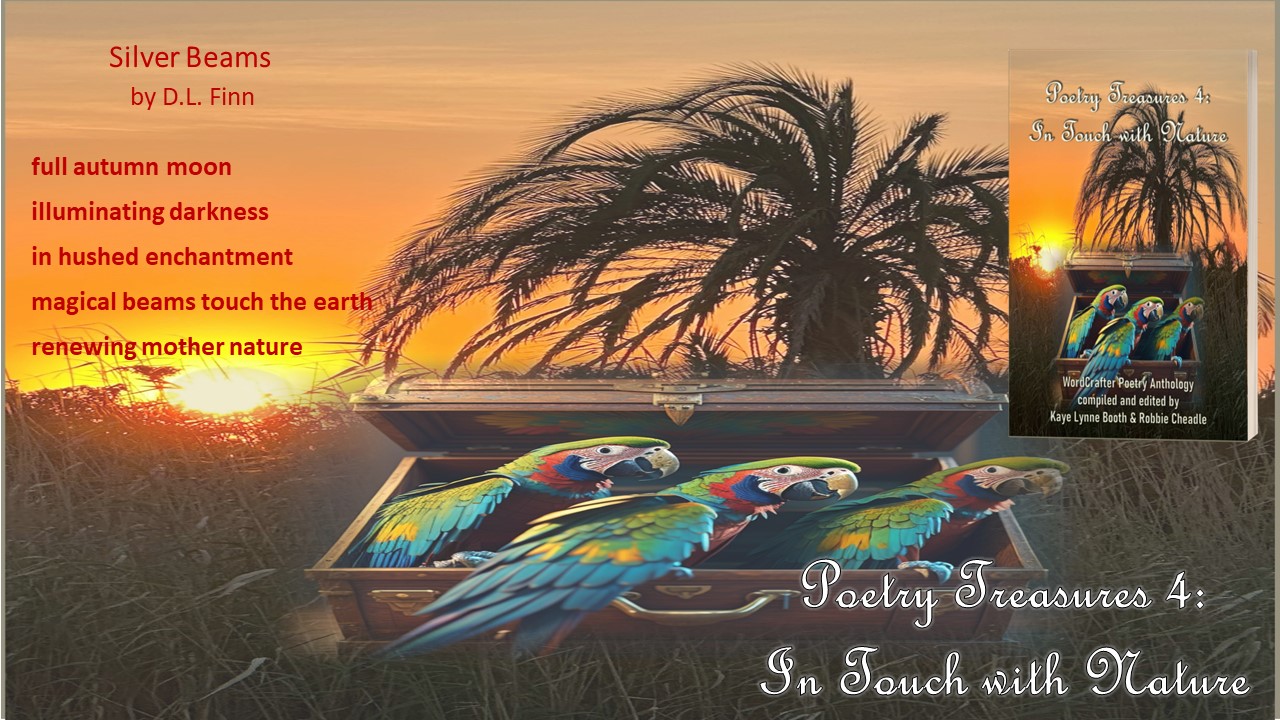
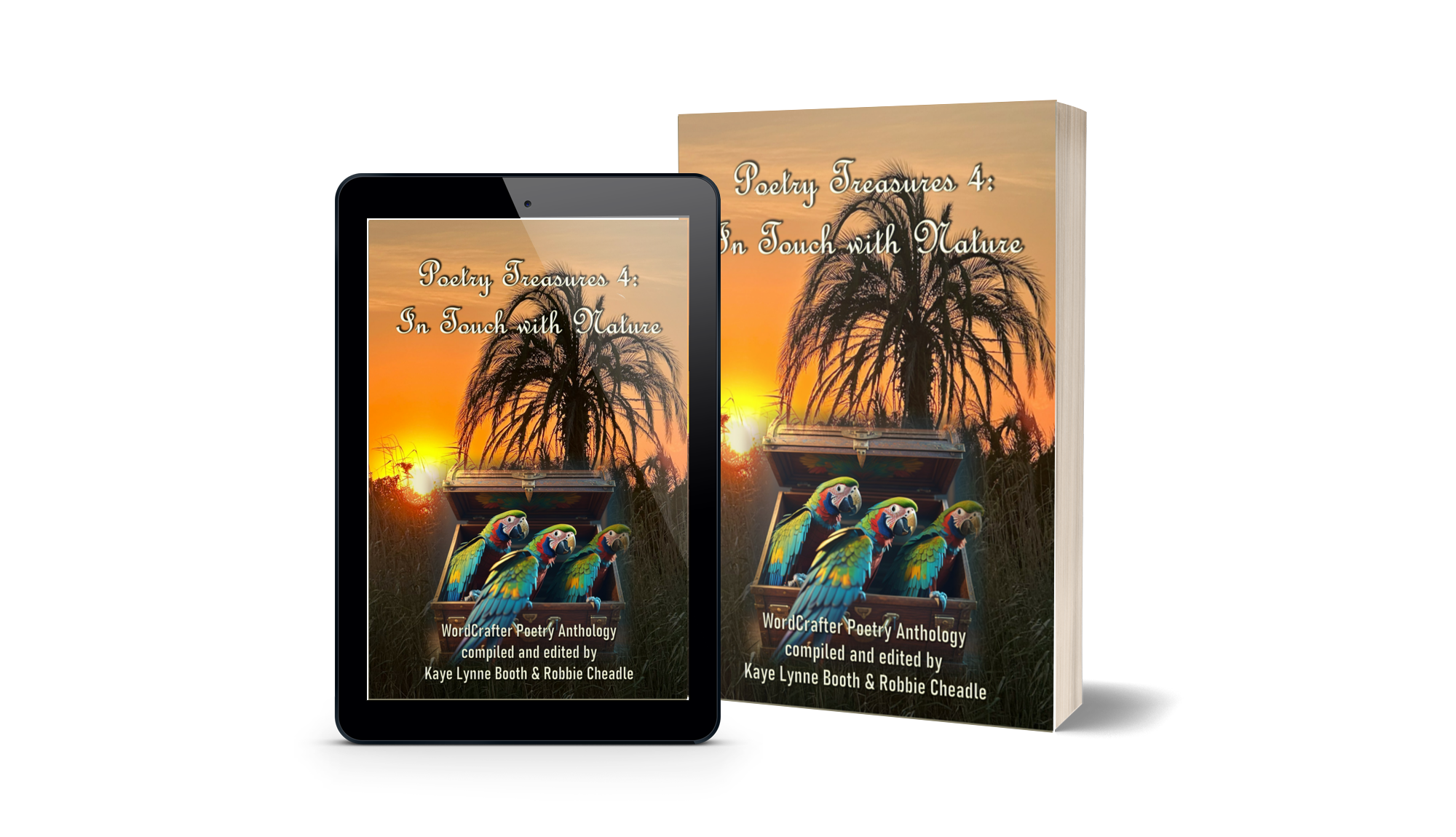
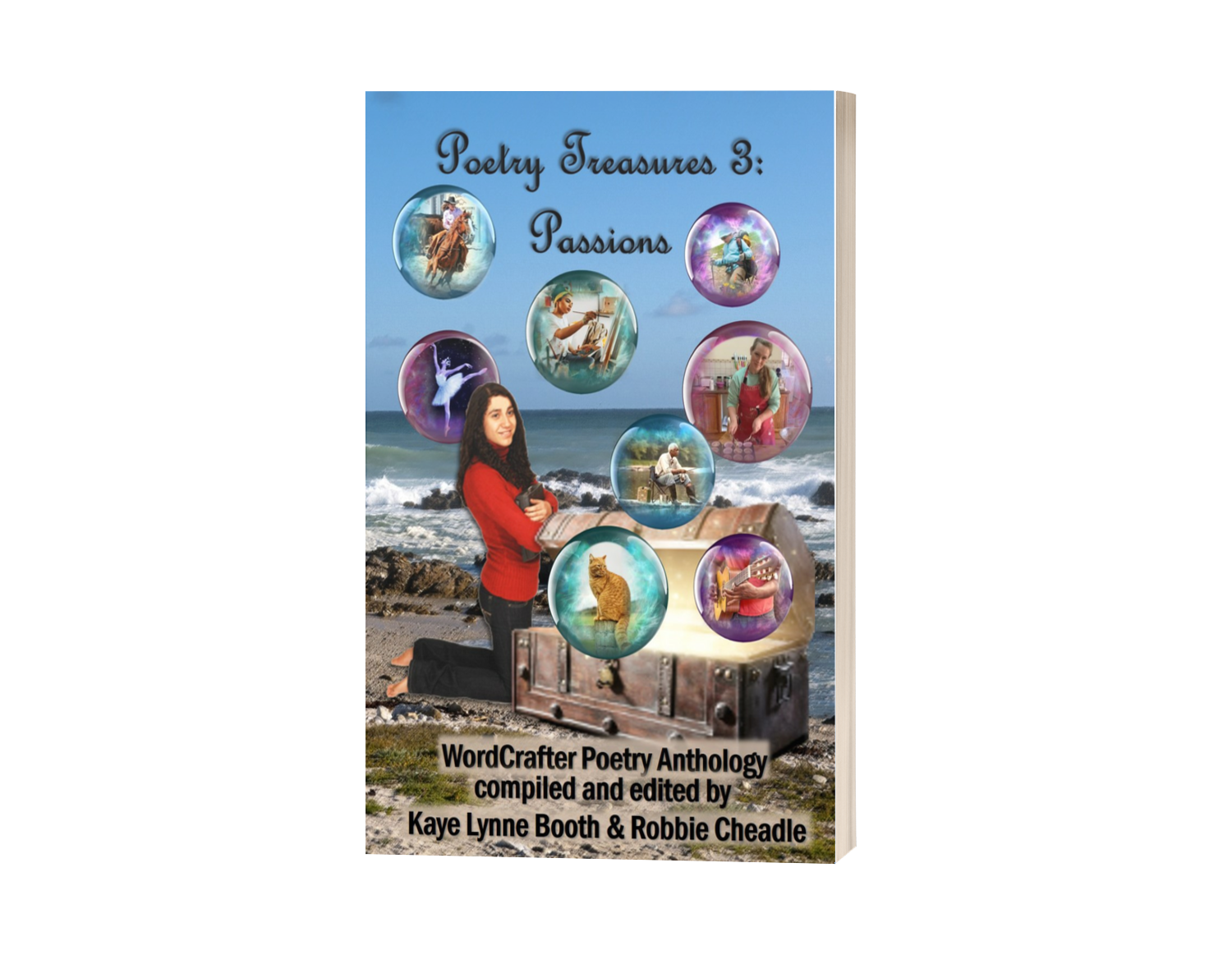
It’s day 1 of the WordCrafter Poetry Treasures 4 Book Blog Tour, and today we have contributing poet D.L. Finn with a reading of her poem, “The Island”. Stick with the tour for the rest of the week for readings and guest posts from contributing authors Andrew McDowell, Patricia Furstenberg, Merril D. Smith, Selma Martin and Robbie Cheadle, an interview with contributing author Emily Gmitter, and a review on Carla Loves to Read. If you leave a comment at each stop, you’ll be entered in our great giveaway.
Giveaway
Leave a comment for a chance to win one of three free copies of
Poetry Treasures 4: In Touch with Nature.
Leave a comment at each stop for additional chances.
Winners chosen by random drawing.
You can keep up with the tour through the links in the schedule below, but they won’t work until each stop goes live.
Mon. April 8 – Writing to be Read – Reading by D.L. Finn
Sat. April 13 – Carla Reads– Review/ Reading by Robbie Cheadle
Book Trailer
Book Trailer for Poetry Treasures 4: In Touch with Nature – created by Robbie Cheadle
About the Anthology
This volume of the Poetry Treasures series is a special one for me because it is the first volume to feature my works. I am proud to be featured along side such talented poets as Colleen Chesebro, D.L. Finn, Frank Prem, and Robbie Cheadle who I have gotten to know and I am familiar with their works. In addition, I got to work woth many creative poets who were new to me, introduced through Robbie’s “Treasuring Poetry” series right along with the series readers. These include Andrew McDowell, Patricia Furstenberg, Emily Gmitter, Marcia Meara, Selma Martin, Luanne Castle, and Merril D. Smith. Without their contributions and willingness to pitch in with the promotions, there would be no anthology. I have so enjoyed working with this group of poets, who have stuggled to meet tight deadlines and put up with my confusions as I shuffled through emails to & from hosts and contributors, and contributors who were also acting as hosts as I put this blog tour together. A big thanks goes out to them for all their efforts and hard work.
The quality of poetry in this volume makes it a poetry treasure to be sure, and I’ve had several contributors thank me for all my hard work. It has been a labor of love. But although I co-edited and did the final formatting, this is really Robbie’s baby, and without all of her hard work, this project wouldn’t be. The anthology was born from Robbie’s “Treasuring Poetry” blog series, and it is Robbie who invited the guests to submit their work, compiled and organized them all into a coherent manuscript, and did the first round of editing. Somehow, she fit all that into her very busy life, and it is she who should be commended, not I.
This is my blog post, my addition to the tour as a contributing author, as well as editor of the project. I will not burden you with my photo and bio, which you, my readers, see with every post I make. Instead I will get right to the main attraction for this stop and move on to a reading by contributing author D.L. Finn.
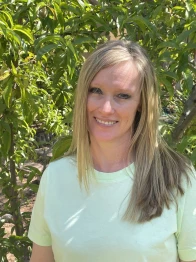
Introduction of D.L. Finn
Author of children’s books, adult fiction and poetry, D.L. Finn is a multi-talented Califirnia author. Her Haibun and syllabic poetry draw vivid pictures in the mind and I am pleased to feature her works within this volume of Poetry Treasures. She shares with us today a reading of her poem, “The Island”.
Reading of “The Island”, by D.L. Finn
About D.L. Finn
D. L. Finn is an independent California local who encourages everyone to embrace their inner child. She was born and raised in the foggy Bay Area, but in 1990 she relocated with her husband, kids, dogs, and cats to Nevada City, in the Sierra foothills. She immersed herself in reading all types of books but especially loved romance, horror, and fantasy. She always treasured creating her own reality on paper. Finally, surrounded by towering pines, oaks, and cedars, her creativity was nurtured until it bloomed. Her creations include children’s books, adult fiction, and poetry. She continues on her adventure with an open invitation to all readers to join her.
That wraps up today’s stop. Don’t forget to leave a comment and enter the giveaway for a free copy of this lovely poetry collection. Tomorrow will find us over at Colleen Chesebro, Author & Poet with a guest post by contributing poet, Merril D. Smith. Join us and don’t forget to leave a comment for another chance to win a free digital copy of Poetry Treasures 4: In Touch with Nature.