Review in Practice: Million Dollar Outlines
Posted: August 14, 2023 Filed under: Book Review, Books, Nonfiction, Outlining, Plot, Review, Review in Practice, Writing | Tags: David Farland, Million Dollar Outlines, Nonfiction, Plotting, Review in Practice, Writing, Writing to be Read Leave a comment
Outline your novel for success, taught by a master writer and instructor.
Bestselling author David Farland taught dozens of writers who went on to staggering literary success, including such #1 New York Times Bestsellers as Brandon Mull (Fablehaven), Brandon Sanderson (Wheel of Time), James Dashner (The Maze Runner) and Stephenie Mayer (Twilight).
Dave was an award-winning, international best-selling author with over 50 novels in print, and a tireless mentor and instructor of new writers. His book Million Dollar Outlines is a seminal work teaching authors how to create a blueprint for a novel that can lead to bestseller success.
In this book, Dave teaches how to analyze an audience and outline a novel to appeal to a wide readership. The secrets found in his unconventional approach will help you understand why so many of his authors went on to prominence.
David Farland was hailed as “The wizard of storytelling” and one of the best writing instructors in the field for many years. Dave passed away in January 2022, but WordFire Press is pleased to bring this vital resource back to a wider readership.
Purchase Link: https://www.amazon.com/Million-Dollar-Outlines-Writing-ebook/
What I love about books on the craft of writing, is that they get my mind working as I automatically try to apply the techniques I’m reading about to my current W.I.P., and it often takes my writing in new directions which I hadn’t imagined before. Million Dollar Outlines, by David Farland did this for me with, not one, but two books which I am currently working on. As all my Delilah Kickstarter campaign backers know, I am actively working on the research and outline for Sarah, Book 2 in my Women in the West adventure series, and this is the book I intended to try out Farlands methods with, but I found some of his advice needed to be applied to a story which I’m just finishing up.
By reading through the elements that Farland believed should go into your outline, I discovered some things that I knew my western time-travel romance adventure novel, The Rock Star & The Outlaw needed, but had neglected to consider as I flew through the writing during NaNoWriMo last year. If you were with me then, you will know that I had a partial working outline, which changed as events in my story veered from the path I had prepared, but mostly my fingers just flew over the keys at every opportunity, and I adjusted my outline accordingly, so there was little time to think about the purpose that each scene or chapter served besides moving my story from point A to point B. (Which is why, this year, I plan to be better prepared and I’m currently working on the outline for Sarah, so that I have a fully developed outline when November roles around.) So as I read this very informative book, which is packed chock full of useful writing advice, I saw places where the Rock Star story is lacking, and even though I’m well past the outlining stage with this book, I went back and did the checks to be sure my story was hitting all the proper beats, and it wasn’t. That’s why took the time for a developmental edit and do the revisions, and now, it is.
Of course, I also used this book to improve my outlining technique with Sarah, which was my original lol intent, keeping in mind that Million Dollar Outlines is a book aimed at outlining to increase productivity. In order to do that, Farland begins by asking, and answering, questions such as ” Why do we read or crave stories?”, or “What is a story and how does it work?”. Then he has you take a look at the shape of your story.
With Sarah, I already knew that the shape of her story would be similar to that of Delilah, because they are both in the same series. Delilah was my first novel and a huge experiment where I tried many different methods and styles, but my method of creating a partial outline and revising as I go seems to have stuck with me with The Rock Star & The Outlaw, so I had planned to stick with it on Sarah.
According to Farland’s theory, that will no doubt make Sarah linear in style with numerous obstacles and hurtles to overcome along the way, because like Delilah, Sarah will embark on a hero’s journey as an unwilling traveler turned heroine. I use this method because it offers me some direction to get the story started, but also allows flexibility because my stories rarely end up going where I start out thinking they are headed.
Next, Farland has us look at the potential for a best selling story and how to analyze your audience to better create stories that readers will like. This is not something which I would normally think about when outlining, but it is something that every author should think about if the end goal is to sell what we write, and what better time to think about this step, than during the outlining process?
Farland also talks about the elements of story, such as setting, characters, conflict and treatment. Normally, I write out a scene out starting with the character interaction which moves the story forward, then I go back and fill in the descriptions to bring the setting to life, so his suggestion to develop the settings in the outlining process, would be a very different approach for me. By outlining in this way, I can see the potential to have most of the pieces to my story in place in my outline where I could almost pluck them from the outline and place them into the story, like pieces to a jigsaw puzzle.
Regarding characters, had a good start with Sarah because her character was at least partially developed in Delilah. In addition, I had a pretty good idea of who my supporting characters were going to be, and their parts in the story because they are either historical characters, which I took certain liberties with. So, all I had to do with them was to develop them more, giving each a physical description and a part in the book. In addition to Sarah, members of her Ute Indian family also made brief appearances in Delilah, so they just needed to be fleshed out a bit. And then there are the two characters who two of my supporters in the Delilah Kickstarter campaign got the privilege of naming which needed to be fully developed.
Once I knew who my characters were and the role that each would play, I had a basic outline of events written out, because you can’t know what role a character will play until you figure out what they do in the story. But this is my list of main/supporting characters.
- Sarah – protagonist – red hair and freckles – 17 – raised in bordello, traveled with Delilah until she was abducted and sold to the Utes, who treated her well & she was happy with. She strives for self-reliance and learns healing from the old Ute woman, Flies like a Heron, becoming a valuable member of the tribe.
- Three Hawks – love interest – Sarah’s Ute husband- kind to Sarah, but brave warrior- son on tribal elder, will one day be chief.- traded many horses for Sarah and fights to keep her.
- Flies Like a Heron – healer & mentor – kind old woman & wife of Ute shaman, Raven Wings – teaches Sarah healing ways
- Owoz Crebo – Antagonist – lone Sioux warrior who visits Ute camp guised as a friend, but steals away with Sarah in the night – an outcast of his own tribe – old & scarred
- Lillian Alura Bennett – Temptress – red haired Irish Woman who runs boarding house/ bordello in Glenwood Springs – was orphaned and became a ‘crib girl’, then worked her up until she made a spot for herself in one of the better houses, the bought out the madame – kind offers Sarah a room in exchange for her domestic services.
- Kate Elder – mentor – historical character – independent prostitute, on her own since young, companion to Henry ‘Doc’ Holliday – came to Glenwood Springs in his last days & cared for him, kind of ‘the woman behind the man’s – kind, helps Sarah, takes care of Doc
This is my list of settings which will need to developed. I’ve done a lot of research on the history of Glenwood Springs, but the rest must come from within my own head, but a few back woods excursions may be in order to get a feel for the terrain.
- Ute camp – already partially developed from Delilah.
- Cliffs where Indian battle takes place
- Mountains between Telluride and Glenwood Springs
- Glenwood Springs, 1887 – a. Glenwood Hotel/ Docs room & Fictional boarding house
Farland goes on to offer up plotting tools, which can be used in the construction of your story to hit the emotional beats that will grasp your readers and won’t let go. He suggests tools such as timebombs, dilemmas, crucibles, reversals, revelations, twists, motivations, mystery, romance, varying emotions, gads, braiding conflicts, varying conflicts, identity conflicts, centering, doubling, haunting, tripling, stacking, growth, duality, the third alternative, the rule of threes, spectacles, adding a thematic line, placing your world in jeopardy, or creating an epic. I’ve used a few of these, such as the rule of threes, twists, revalations, and reversals, but others were new to me. I bet you see a few tools in the list above which could use some explanation. I know there were for me.
We all know what a twist is, when the story suddenly takes off in an unexpected direction, or a revelation, where your characters reveal something about themselves which bears on their actions in the story. The Rule of Threes says that you should call something that you want readers to notice three different times throughout the story, if you want it to stick in your readers head. I’ve used that one in every story that I’ve written. Doubling, tripling and haunting are all methods of doing just that. Some, like placing the world in jeopardy, may work better for certain genres more than others, but it is always a good way to raise the stakes in the story. I used this one in my science fantasy series, still in progress, Playground for the Gods, which centers on a group of beings who destroyed their own planet and come to Earth to make their new home, but some members threaten to repeat their peoples mistakes and destroy Earth as well. This particular tale is also an epic, so there’s another plotting tool used to create story.
Then, Farland goes on to discuss the plotting process, talking about what makes a good beginning, middle and end and incorporating it all into your outline. I’m busy working right now, incorporating some of Dave Farlands suggestions into my outline for Sarah.
I have a more detailed outline right now for Sarah than I ever had for any story, and it still looks like it will be too short. I’ll have to go back and see what other plotting tools I may I want to ascertain that book 2 in my Women in the West series will be even better than book 1.
Will it be a million dollar outline? Not in the sense in which Farland was using it. He used his outlines to sell his stories to publishers and producers. For Sarah, I am both author and producer, but maybe the story will sell enough copies to make a million. I’ll just have to wait and see. I hope you’ll stick around until Sarah comes out in 2024 to see the end results, too.
____________________________________

For Kaye Lynne Booth, writing is a passion. Kaye Lynne is an author with published short fiction and poetry, both online and in print, including her short story collection, Last Call and Other Short Fiction; and her paranormal mystery novella, Hidden Secrets; and book 1 of her Women in the West adventure series, Delilah. Kaye holds a dual M.F.A. degree in Creative Writing with emphasis in genre fiction and screenwriting, and an M.A. in publishing. Kaye Lynne is the founder of WordCrafter Quality Writing & Author Services and WordCrafter Press. She also maintains an authors’ blog and website, Writing to be Read, where she publishes content of interest in the literary world.
____________________________________________
Want exclusive content? Join Kaye Lynne Booth & WordCrafter Press Readers’ Group for WordCrafter Press book & event news, including the awesome releases of author Kaye Lynne Booth. She won’t flood your inbox, she NEVER sells her list, and you might get a freebie occasionally. Get a free digital copy of her short story collection, Last Call and Other Short Fiction, just for joining.
Share this:

Review in Practice: Million Dollar Productivity
Posted: July 10, 2023 Filed under: Book Review, Books, Nonfiction, Review, Review in Practice, Writing, writing advice, Writing Business, Writing Tips | Tags: Book Review, Kaye Lynne Booth, Kevin J. Anderson, Million Dollar Productivity, Nonfiction, Review in Practice, Writing, writing advice, Writing Tips, Writing to be Read 10 Comments
I have to tell you, Kevin J. Anderson is the most prolific writer I know, but there are others. I met many of these incredibly productive authors through my studies under Kevin J. Anderson. I think they all hang out together. And honestly, when I first began to see what KJA does, putting out at least five novels a year, plus co-authoring books and screenplays adapted from his books, run WordFire Press, orchestrate his SuperStars Seminars every February and his classes at Western Colorado State University, and go to numerous Cons and writing seminars throughout each year, all I could say was, “Wow!”
Million Dollar Productivity, by Kevin J. Anderson is the book where he reveals all the tips and tricks which make him into the most prolific writer I know. So, when I received a digital copy of Million Dollar Productivity, for the 9th Stretch goal met in KJA’s Dragon Business Kickstarter Campaign last January, I had to give it a read. (I had already read the companion reward book for this stretch goal, On Being a Dictator. You can read my review here.) As I had suspected, I already knew and practiced many of the tips given in this book. After all, I studied under the author. But there were others that I either didn’t know about or hadn’t tried.
One of the ones I think have been most helpful to me was to set goals and stick to them. In class, we were required to create business plans and set goals for the coming year. I began to employ this strategy in the fall of 2021, a year in which I had published two anthologies, one poetry and one short fiction, and nothing else. When I am listening to people in the business who are telling me that you need to have a large inventory of IP (intellectual propeties), be prolific enough to put out several books each year, and have multiple streams of income to make a sustainable living from your writing, and looking at the couple of books per year that I was putting out, I knew I was going to have to do better, and I planned accordingly. I found that making a plan and setting some goals which keeps me moving in a forward progression.
As a result, in 2022, I published five anthologies: Ask the Authors 2022, Poetry Treasures 2: Relationships, Once Upon an Ever After, Refracted Reflections, and Visions. Anthologies probably aren’t as helpful as novels would be, but it was a start. In 2023, I will publish two anthologies, Poetry Treasures 3: Passions and Midnight Roost, plus two books of my own, Delilah and The Rock Star & the Outlaw, and of course, my debut poetry collection, Small Wonders. And I’ve already begun to plan out the books I intend to publish in the coming year. You have to admit, four to five books per year is an improvement on the one or two per year that I was producing previously, so that one suggestion, which is offered in this book, helped to make me a more prolific publisher.
Working on different projects at the same time is another tip which I have found helpful, although this is something that I have done for several years, but it is included in Million Dollar Productivity, and it is an effective strategy for getting a lot accomplished. I’m not talking about multi-tasking, but more like time-sharing – you work on your latest manuscript for a time, but when you seem to tire of it, you set it down and go work on the editing for the anthology you’re working on, and when you get tired of that, answer a few emails and then back to writing, for instance. Of course, KJA suggests an approach that is a little less haphazard, but it’s good advice none-the-less. He also points out other modes of writing, which can be used in various places.
Letting the first draft be bad and edit, goes hand-in-hand with knowing the difference between writing and editing, tips which most writers have heard many times in their writing careers, but that doesn’t make them any less true. These are both tips that I will have to work at incorporating into my writer’s toolbox. I am notorious for editing as I go, which takes extra time, but turns out a top quality draft with little editing required.
This book is filled with lots of writing tips and advice for busy authors who want to increase their productivity. These are the strategies that worked for the author, Kevin J. Anderson, and they could work for me or you. Whether you’re a full time author or one who writes on the side while working at some other job for your livlihood, this book will have something helpful for you. It’s one of those books I will have to go back and visit time and again.
_________________________________________________________________
For Kaye Lynne Booth, writing is a passion. Kaye Lynne is an author with published short fiction and poetry, both online and in print, including her short story collection, Last Call and Other Short Fiction; and her paranormal mystery novella, Hidden Secrets; and book 1 of her Women in the West adventure series, Delilah. Kaye holds a dual M.F.A. degree in Creative Writing with emphasis in genre fiction and screenwriting, and an M.A. in publishing. Kaye Lynne is the founder of WordCrafter Quality Writing & Author Services and WordCrafter Press. She also maintains an authors’ blog and website, Writing to be Read, where she publishes content of interest in the literary world.
____________________________________________________________________
Want exclusive content? Join Kaye Lynne Booth & WordCrafter Press Readers’ Group for WordCrafter Press book & event news, including the awesome releases of author Kaye Lynne Booth. She won’t flood your inbox, she NEVER sells her list, and you might get a freebie occasionally. Get a free digital copy of her short story collection, Last Call and Other Short Fiction, just for joining.
Share this:

Review in Practice: That Th!nk You Do
Posted: May 15, 2023 Filed under: Book Review, Books, Nonfiction, Review, Review in Practice | Tags: Human Brain, Joseph Carrabis, Nonfiction, Review in Practice, That Th!nk You Do, The Human Condition, Writing to be Read 8 Comments
If you ever wonder about how to think like an expert, the difference between your inner critic and the actor within, your ability to be heard, the value of being a musician, how to protect yourself from liars or how to overcome fears, you will find answers in this book.
Through each chapter there is a magic wand taking you into an area of life that you may have experienced yourself or it will be something new to consider. There is synthesis between the known and unknown, the seen and unseen, the mental and the physical, the desires of the heart and the aspirations of the spirit; and the overall theme of we are all just trying to make it from one day to the next with joy, peace, and happiness.
Joseph gives his own insights throughout the pages of what he believes are the backbone of our life experiences – both the great and the not so great. He leaves it up to the reader to discern what is true for them. You will find yourself wanting to explore more of each of his analysis of life’s nuggets, many of which we create ourselves through questions, desires for specific outcomes and the need to be heard.
Purchase Link: https://www.amazon.com/That-Th-You-Do-Healthy/dp/0984140379/
It happened that I read this innovative book at just the time in my life when I really needed it. My job of eight years had just come to an abrupt end, and I was trying to figure out how I was going to carry on and where I would go from here. It felt as if my life was over, as if I were balancing precariously on a ledge, on the verge of toppling over, with no where to go but down. Okay. I know that seems a bit melodramatic, but that’s what it felt like.
That Th!nk You Do, by Joseph Carribis takes a look at human thought processes, explanations for why we do what we do, and techniques for dealing with life’s challenges. I have to admit that this book offered several ‘Aha!’ moments for me. Carribis offers unique insight into human behavior, and compassionate advice for handling the curve balls life throws at you. He is not a professional health expert, but an intelligent guy with some good ideas, which may or may not work for you, but probably worth a try.
This book showed me new ways to chase away self-doubt, overcome fear and worry about what the future holds, and set some goals for myself to work towards. Of course, I’ve been working toward taking my writing business full time as means of making my living for many years, but facing the fact that now I was at a point where I needed to make it all work was really scary. If I couldn’t, I didn’t know what I would. If I didn’t find a way to pay my bills and fast, I knew I would topple from that ledge and it would be all down hill from there.
Everybody has those times when they let self-doubt creep in, or allow their own fears to bring about inaction. It happens to all of us. That Th!nk You Do holds some insightful solutions which just might help. If nothin g else, it made me look at the situation a bit differently. Joseph Carribis may not be a professional, but he offers some great insights and suggestions that can benefit us all.
______________________________________________________________

For Kaye Lynne Booth, writing is a passion. Kaye Lynne is an author with published short fiction and poetry, both online and in print, including her short story collection, Last Call and Other Short Fiction; and her paranormal mystery novella, Hidden Secrets. Kaye holds a dual M.F.A. degree in Creative Writing with emphasis in genre fiction and screenwriting, and an M.A. in publishing. Kaye Lynne is the founder of WordCrafter Quality Writing & Author Services and WordCrafter Press. She also maintains an authors’ blog and website, Writing to be Read, where she publishes content of interest in the literary world.
______________________________________________________________________
Want exclusive content? Join Kaye Lynne Booth & WordCrafter Press Readers’ Group for WordCrafter Press book & event news, including the awesome releases of author Kaye Lynne Booth. She won’t flood your inbox, she NEVER sells her list, and you might get a freebie occasionally. Get a free digital copy of her short story collection, Last Call and Other Short Fiction, just for joining.
Share this:

Review in Practice: Booked to the Gills
Posted: September 30, 2022 Filed under: Book Release, Book Review, Books, Nonfiction, Review, Review in Practice, Writing, Writing Tips | Tags: Aisley Oliphant, Booked to the Gills, Kaye Lynne Booth, Nonfiction, Review in Practice, Writing Challenge, Writing to be Read 4 Comments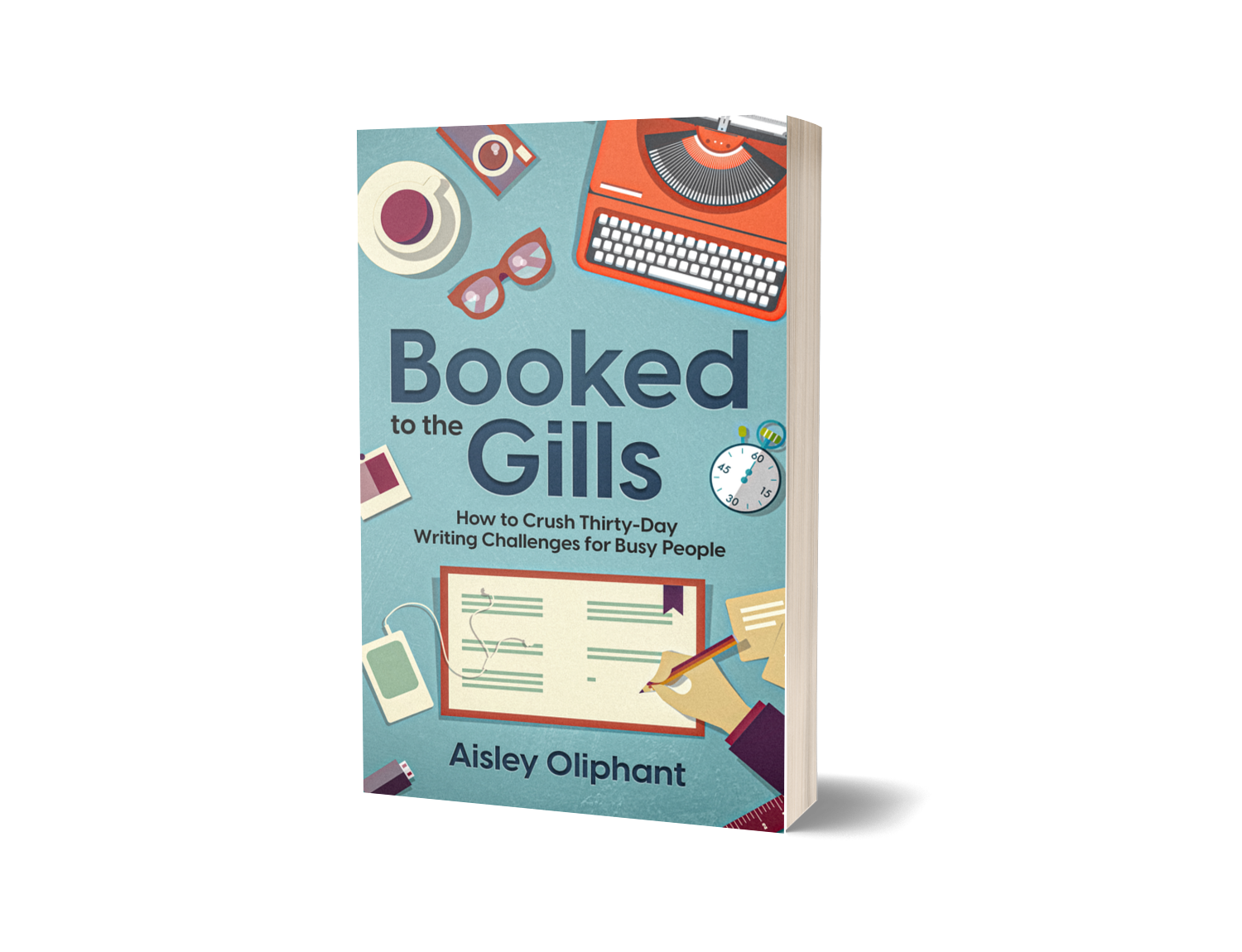
Purchase links: Barnes & Noble Amazon
Booked to the Gills by Aisley Oliphant is designed to help those participating in the National Novel Writing Month challenge to write 50,000 words in thirty days. Many writers who would like to be more prolific may find the advice and strategies outlined in this book to be quite helpful. In fact, many of the time management tips, such as time blocking, can come in handy for any writer who juggles several projects along with a day job, and relationships with family and friends, and ‘me time’.
For many of us, that ‘ me time’ is what is forfeited when things get to hectic. And the author openly admits that she has not a fun person to be around during previous NaNoWriMo challenges. For others, relationships might be strained when family and friends are put on the back burner and writing takes the forefront. And the author openly admits that she has not been a fun person to be around during previous NaNoWriMo challenges. This book is packed full of strategies to salvage relationships and keep your sanity, while still cranking up the word count.
Topics which are covered include time management, setting boundaries, adjusting wordcounts, prioritizing…
I have mentioned before that I am not a prolific writer. Authors such as Kevin J. Anderson, who can crank out right or ten books in a year, totally blow me away. But in these pages are strategies which will certainly be useful in increasing my writing output and helping me be a more productive writer, as well as giving me organizational tools that will be helpful in managing the numerous writing and publishing projects which I always seem to have going.
I attempted the NaNoWriMo challenge once, back in 2010, and failed miserably. When I picked up this book, doing this challenge was the furthest thing from my mind, but thinking about putting some of the strategies in Booked to the Gills to the test, I’m thinking it might be worth another try this year.
_______________________________________________________________________
Join Kaye Lynne Booth & WordCrafter Press Readers’ Group for WordCrafter Press book & event news, including the awesome releases of author Kaye Lynne Booth. Get a free digital copy of her short story collection, Last Call and Other Short Fiction, as a sampling of her works just for joining.
Share this:

Review in Practice: Fearless Author
Posted: September 5, 2022 Filed under: Book Promotion, Book Review, Books, Nonfiction, Review, Review in Practice, Self-Publishing | Tags: Ashley Emma, Fearless Author, Kaye Lynne Booth, Nonfiction, Review in Practice, Self-Publishing, Writing to be Read 7 Comments
Fearless Author, by Ashley Emma, is a self-publishingbook launch Plan and checklist, which was not as valuable to me as I had hoped, because nowhere did it say that this was an Amazon author exclusively, so I did not realize what I was getting. Don’t get me wrong. This was a free book, so I’ve wasted nothing but my time, and it was not a total waste. For those who don’t understand why the advice of an exclusive author might be of lesser value to a wide author, such as myself, let me paint a word picture of the state of the independent publishing industry currently, as I see it.
In order to be a KDP author and have your books featured in Kindle Unlimited, Amazon requires an author to download directly to thier site, (you can’t use a third party aggregator to publish your book and they demand exclusivity. Kindle Unlimited can be a substatial income stream for authors, because page reads add up to comprable sales, and some authors, in genres with voracious readers, earn more from page reads than they do from actual sales. I can see why some authors might feel that to be a fair trade for exclusivity, but that exclusivity means that you can’t sell your book anywhere else, including on your own website. That’s why I chose to publish wide. I didn’t want to give up that much control over my books. It is up to me where my books will be sold, which allows me more opportunities to reach more potential readers.
And tactics like rapid release, or free or .99 cent first in series, may not be as effective with other distributors as they are on Amazon, because other distributors don’t use the same algorythyms that Amazon does. For example, Ms. Emma recommends utilizing Amazon’s free days, which are only available to KDP exclusive authors. That is why I didn’t find Ashley Emma’s Fearless Author to be of more value. While her advice for launching and taking a book quickly up to bestseller status may be quite valuable to an Amazon author, but many options are only available to exclusive authors.
All of that to say that Fearless Author might have been more helpful by indicating in the description the fact that Ashley Emma is an Amazon author, offering useful tip to be used with KDP and Kindle Unlimited. At least then I would have known what to expect when I downloaded the free book. There were some tactics which could be of value to all authors, even those who publish wide, like myself.
The lesson learned from this experience: the importance of accurate book descriptions which don’t mislead potential readers. Although I may use some of the advice found in Fearless Author, I would probably not download more of Ashley Emma’s books, even though I might find portions of it useful and I found no fault with her writing.
_______________________________________________________________________

For Kaye Lynne Booth, writing is a passion. Kaye Lynne is an author with published short fiction and poetry, both online and in print, including her short story collection, Last Call and Other Short Fiction; and her paranormal mystery novella, Hidden Secrets. Kaye holds a dual M.F.A. degree in Creative Writing with emphasis in genre fiction and screenwriting, and an M.A. in publishing. Kaye Lynne is the founder of WordCrafter Quality Writing & Author Services and WordCrafter Press. She also maintains an authors’ blog and website, Writing to be Read, where she publishes content of interest in the literary world.
________________________________________________________________________
Join Kaye Lynne Booth & WordCrafter Press Readers’ Group for WordCrafter Press book & event news, including the awesome releases of author Kaye Lynne Booth. Get a free digital copy of her short story collection, Last Call and Other Short Fiction, as a sampling of her works just for joining.
Share this:

Review in Practice: Newsletters – Bonuses & Reader Magnets, Frequency and Auto-Responders
Posted: August 1, 2022 Filed under: book marketing, Book Promotion, Book Review, marketing, Newsletter, Review in Practice | Tags: Kaye Lynne Booth, newsletters, Reader Magnets, Reader Platform, Review in Practice, Writing to be Read 5 CommentsOne aspect of book marketing I’ve been delving into is newsletters, or reader’s groups, if you prefer. It sounds a lot better to say, “Join my Reader’s Group” than it does to say, Subscribe to my Newsletter”. This is a suggestion that Andrea Pearson of the Six Figure Author Podcast offers, and I like it. Andrea Pearson is like the newsletter queen, marketing her own books through her newsletter successfully and teaching others how to do the same. She offers courses on Newsletter marketing among others through her website, and I’ve been fortunate enough to have taken the basic course, and I also have her Publish Strong box set. You can read my “Review in Practice” for that set here.
Other things that Andrea recommends is emailing frequently, like once a week, and I believe Kevin J. Anderson also follows this practice. To me this sounds like a lot. I feel like I would have to really like an author to not be annoyed to receive emails that frequently from them. After signing up for KJAs newsletter and receiving his auto-sequence, I found that it was kind of cool, and because some of them included newsletter bonuses of free books, I didn’t mind receiving those frequent emails at all.
But, let’s face it. We’re all not as prolific as KJA, or even as prolific as Andrea Pearson. Especially if you’re just starting out, you may be lucky if you can produce a book a year. I realized a while back that I wasn’t prolific and wrote a post about that here. Just as you need a hook for your stories to make readers want to read more, you also need a sales hook in your newsletter to make them want to read other things which you’ve written so you can grow your fanbase and email list. If you don’t write fast enough to produce several books a year, and if you don’t have a big backlist to draw from, don’t overlook the value of a good short story. While it’s true that short fiction is tougher to sell than novels, when it comes to newsletter magnets, short fiction can be an author’s friend.
In order to better understand how to make a newsletter work for me, I’ve subscribed to the newsletters of several big name authors to see how they set up their reader magnets and auto-sequences.

The Case of the Vanishing Boy is a short mystery story by Kristine Kathryn Rush that I received for free for signing up for the WMG Grab a Book and Chill newsletter; what indie authors call a reader magnet, designed to draw in new readers. ‘They’ say short fiction is harder to sell, whether we’re talking single stories, collections or anthologies. As a creator of anthologies, I believe ‘they’ are right. But short fiction can be great to use for newsletter bonuses, and/or reader magnets. This little mystery story was just the right length for me to enjoy and to made me feel as if I’d received a good value in exchange for my email address
Kristine Kathryn Rusch and her husband Dean Wesley Smith are both hybrid authors who have been in this business for many years and are both masters of short fiction, so receiving this story really was a treat. It was a fun mystery that could be read in one sitting. It’s hard not to give away spoilers on short stories, and for mysteries, spoilers could mean death. So instead of giving the whole brief plot away, let me just say that it was a fun mystery that could be read in one sitting. It was well-written and entertaining, stirring up questions throughout and providing a satisfying ending, just as a mystery story should.

A much darker read is He Meant No Harm, by Dean Wesley Smith, which serves as a second reader magnet for the WMG Grab a Book and Chill newsletter. I guess they figure at least one of the two books will appeal to you. Again, I’m not obligated to review, but did enjoy this brief trip down memory lane with the protagonist, although it left me walking away with a very different feeling from the one I had after reading the Rusch story, so perhaps they are onto something by offering two very different stories. This story was very brief, so my complaint here was that I was disappointed that there wasn’t more to it, (but that might just be me). It did have a full story arc, I just would have liked to have a bit more before it ended, so I guess I felt a little cheated.
I can’t say that about the reader magnet for the WMG Newsletter, The Rusch Reader: A Newsletter Exclusive, however. Just the opposite in fact. This collection of short fiction provides a delectable sampling from Kristine Katherine Rusch’s various short fiction series and spans across her genres, of which there are many, written under various pen names, as well as her own. The Rusch Reader is a book length collection of short fiction, all well-written and entertaining, all quite enjoyable to read, some which were downright memorable. And when you read as much short fiction as I do, that’s saying a lot. But the thing that adds the most value for me was the last sample book, which wasn’t a story at all, but a short non-fiction book on how to negotiate, which is invaluable for authors everywhere. Signing up for the newsletter is the only way you can acquire this fantastic collection, a sampling that may turn you into a die-hard Rusch reader, you must subscribe to Kristine Katherine Rusch’s newsletter, which makes it a great reader magnet and well worth giving up my email address.
For signing up for the Kevin J. Anderson reader group, I received a copy of one of his Dan Shamble Novels, Working Stiff, which I had previously read and reviewed in his Zomnibus. (You can read my review here.) His Dan Shamble books are always entertaining and fun to read, so this is an excellent choice for a reader magnate. Although it is not typical of his science fiction or fantasy series, but it is a way to get readers to take a look at what else he has available.
His second email in his auto sequence delivers a link to listen to his Clockwork Lives audiobook for free, which is pretty cool and making me feel even more value delivered.

His second email in his auto sequence delivers a link to listen to an audio reading by KJA of “The Percussor’s Tale” from the Clockwork Lives steampunk novel, written with Rush drummer Neil Peart, for free. This is pretty cool and making me feel even more value delivered.
The fifth email in his auto-responder offers another free book, The Kevin J. Anderson Complete Booklist and Reader’s Guide. What a clever way to make things easy for his readers. I’m impressed.
The sixth offers another free ebook, Blindfold. Which all leads into an offer to join his “KJA Special Forces” street team in the eighth email to be delivered over a month’s time from when I subscribed.
Previously, I had let my newsletter fall to the wayside for more than a year, but this research endeavor has convinced me that my Newsletter is one of my most valuable marketing tools. The subscribers are added to your email list, providing you with a direct way to engage with your readers, and you own that, not some third party middleman.
When I went back into my Mailchimp account, I found that they’d made a lot of changes and I had difficulty finding my way around and locating my past newsletter campaigns. I have since revived my newsletter, but I’m still struggling to figure out the auto-responder and other technological stuff. I’ll get it eventually. For now, I’m emailing monthly and figuring it all out as I go. I’ve managed to change my reader magnet, so when you join, you receive a free copy of my short story collection, Last Call & Other Short Fiction, and set up a Book Funnel link to deliver it, (I think – If you decide to join, I’d appreciate feedback to let me know if it is working properly).
My subscribers are not growing very fast, but I figure that will come in time, too. Different genre books target different reading audiences, so it’s more difficult to market as a multi-genre author, but with time, I’ll figure that one out, too. My newsletter journey is just beginning. If you’d like to join my new reader’s group to receive updates on new releases from WordCrafter Press, myself and others, as well as upcoming writing events, you can join here: https://mailchi.mp/64aa2261e702/klb-wc-newsletter. You’ll receive a copy of my short story collection just for joining. I do hope you’ll all come along for the ride.
_______________________________________________________________
For Kaye Lynne Booth, writing is a passion. Kaye Lynne is an author with published short fiction and poetry, both online and in print, including her short story collection, Last Call and Other Short Fiction; and her paranormal mystery novella, Hidden Secrets. Kaye holds a dual M.F.A. degree in Creative Writing with emphasis in genre fiction and screenwriting, and an M.A. in publishing. Kaye Lynne is the founder of WordCrafter Quality Writing & Author Services and WordCrafter Press. She also maintains an authors’ blog and website, Writing to be Read, where she publishes content of interest in the literary world.
_______________________________________________________________
Join Kaye Lynne Booth & WordCrafter Press Readers’ Group for WordCrafter Press book & event news, including the awesome releases of author Kaye Lynne Booth. Get a free digital copy of her short story collection, Last Call and Other Short Fiction, as a sampling of her works just for joining.
Share this:

Review in Practice: Self-Publish Strong Books 1-4
Posted: May 23, 2022 Filed under: book marketing, Book Promotion, Books, Branding, Newsletter, Nonfiction, Review, Review in Practice, Writing, Writing Reference, Writing Tips | Tags: Book Review, Kaye Lynne Booth, Review in Practice, Rock Solid Newsletter, Self-Publish Strong, Writing to be Read 18 Comments
Let me just start by saying that I’m a big fan of Andrea Pearson, the author of these books. I listened to her on the Six Figure Authors podcast, along with her two co-hosts, Lindsay Barker and Joe Lallo, all through the fall and spring semesters. So, when I found out we were going to be using Rock Solid Newsletter in our class, I jumped at the opportunity to buy the whole set, even though I only needed the one book for class. Which is just to say, that I knew these books would have lots of valuable information for me as an author before I ever cracked them open, and indeed they did.
In Book 1, Rock Solid Book, Andrea offers tips for making sure you have a book that readers will want to read. Book 2, Rock Solid Platform, gives advice on finding and acquiring fans who will read just about anything you write. Book 3, Rock Solid Promotion, discusses book marketing, protons and deals that sell. And finally, in Book 4, Rock Solid Newsletter, she tells how to set up your newsletter and automation sequence and clean your newsletter email list, so you know you have true fans who want to hear about you and your books, which increases your open and click rates and is more effective at selling books.
Self-Publish Strong Books 1-4 is filled with valuable information for independent authors, which I’m using to improve and grow my newsletter list, which is soon to become my readers’ group, and set up promotions for all of my 2022 releases. Andrea Pearson offers tips, advice and good strategies for producing a quality book which readers will buy, getting the word out about your books and finding readers who will buy them.
What she doesn’t do in Rock Solid Newsletter, is to instruct on the technical set-up of the newsletter, because each newsletter platform is different. I don’t hold that against the book though, as these books are not instruction manuals, but instead, they offer strategies to leverage your books into a better selling position. I managed to change my reader magnet and my welcome email so it will be delivered as intended. (I think,. I still need to test it.) And that’s where I’m stuck, because I don’t understand the technicalities of setting up an automation sequence, but I know I need to set one up. I may have to find someone to help me on that one. So, although I haven’t put all of the advice offered in Publish Strong Books 1-4 to use yet, I’m well on my way.
You can get your copy of Self-Publish Strong Books 1-4 here:
https://www.amazon.com/Self-Publish-Strong-Books-1-4-How-ebook/dp/B06X3W91BV
Or they can be purchased individually here: http://selfpublishstrong.com/books/
___________________________________________________________________________________

Kaye Lynne Booth lives, works, and plays in the mountains of Colorado. With a dual emphasis M.F.A. in Creative Writing and a M.A. in Publishing, writing is more than a passion. It’s a way of life. She’s a multi-genre author, who finds inspiration from the nature around her, and her love of the old west, and other odd and quirky things which might surprise you.
She has short stories featured in the following anthologies: The Collapsar Directive (“If You’re Happy and You Know It”); Relationship Add Vice (“The Devil Made Her Do It”); Nightmareland (“The Haunting in Carol’s Woods”); Whispers of the Past (“The Woman in the Water”); Spirits of the West (“Don’t Eat the Pickled Eggs”); and Where Spirits Linger (“The People Upstairs”). Her paranormal mystery novella, Hidden Secrets, and her short story collection, Last Call, are both available in both digital and print editions at most of your favorite book distributors.
When not writing, she keeps up her author’s blog, Writing to be Read, where she posts reflections on her own writing, author interviews and book reviews, along with writing tips and inspirational posts from fellow writers. In addition to creating her own imprint in WordCrafter Press, she offers quality author services, such as editing, social media & book promotion, and online writing courses through WordCrafter Quality Writing & Author Services. As well as serving as judge for the Western Writers of America and sitting on the editorial team for Western State Colorado University and WordFire Press for the Gilded Glass anthology and editing Weird Tales: The Best of the Early Years 1926-27, under Jonathan Maberry.
In her spare time, she is bird watching, or hiking, or just soaking up some of that Colorado sunshine.
_____________________________________________________________________________
Sign up for the Kaye Lynne Booth & WordCrafter Press Readers’ Group for and book event news for WordCrafter Press books, including the awesome releases of author Kaye Lynne Booth. Get a free digital copy of Kaye Lynne Booth’s paranormal mystery novella, Hidden Secrets, just for subscribing.
Share this:

Review in Practice – Word Craft: Prose & Poetry
Posted: December 31, 2021 Filed under: Book Review, Books, Poetry, Review in Practice, Teaching Writing | Tags: Book Review, Poetry, Review in Practice, Sally Cronin, Syllabic Poetry, Word Craft: Prose & Poetry, Writing to be Read 5 Comments
Word Craft: Prose & Poetry, by Colleen Chesebro is an insightful and helpful instructional book for those who wish to learn more about writing syllabic poetry and prose. The first section covers Japenese syllabic poetry forms and American syllabic poetry forms are covered in section two. The author outlines the rules and inspirations for each form, and provides plenty of examples to help you get the idea.
Hiaku has been one of my favorite forms of poetry to read since it was introduced to me in the fourth grade. However, my fourth grade teacher didn’t really explain this poetry form in a way that my fourth grade mind could really grasp, so I’ve never felt very accomplished in writing Haiku. In Word Craft, Colleen Chesebro was able to explain the art of this form of poetry in a manner which my aged mind was able to grasp, giving me a much better handle on what I’m trying to do with this form of poetry. Haiku is much more than just putting the right number of syllables in each line. Haiku is written to evoke images and emotion in a succinct way. I was surprised to learn that the syllabic rules for Haiku are not set in stone, and can be varied. Below is a Haiku which I wrote after reading the chapters on this poetry form.
Spring skies let rain pour
Wings stretch, ruffling wet feathers
small Hummingbird preens
While I know poets who write Tanka poetry, which combines poetry and prose,I’ve never understood what they were doing with these poems. Although I can’t say that I’ve mastered the Tanka, I think I do understand it better, but I will need a lot of practice before I write something in Tanka or Tanka prose poem that I feel worthy of sharing.
I also had some experience in writing Hiabun, which is a combination of poetry and prose similar to Tanka Prose Poetry, but I never really understood the purpose of this form of poetry. You would think this would be the easiest form of poetry in this book for me to write, as the inspiration can come from anything and it can be in any point-of-view and any tense that you wish to write in, but I still have a hard time grasping the how of this poetry form. Fortunately, Colleen Chesebro includes many examples of each poetry style and I have no doubt that, with patience and practice I will eventually get a handle on the Haibun.
Forms of Japanese poetry that I wasn’t familiar with in this book include Senryu, which is similar in form to a Hiaku but differs in subject matter; Haiga, which uses either Haiku or Senryu and combines three art forms, imagry, poetry and calligraphy; and Gogyohka, which is based on the Tanka, but you do not count syllables, with one phrase to a line and a line-break after each breath. I found the Renga, which is design to be written by two poets, interactively, , kind of like a poetic conversation, to be in intriguing poetry form.
This is my first attempt at a Senryu poem.
Hot tea steams
on chill summer morn
wake up call
For me, the forms of American syllabic poetry were more difficult, perhaps because they tend to be longer. In the second portion of the book, Sally Cronin includes explanation and instruction and examples for Cinquains of all types, Etherees, Nonets, and Shadormas. I made several unsuccessful attempts at the basic types of each of these poetry forms, but they are much harder than they look. My hat is off to Cronin and anyone else that can meld their syllables with seeming ease.
I took a challenge on Teagan Riordain Genevieve’s blog and for that I wrote a Shadorma poem, which I published here, on Writing to be Read. You can see my example of a Shadorma here, but I don’t know if it is any good. It really was harder than I thought it would be.
If you like syllabic poetry, either Japanese or American, and would like to try your hand at it, I highly recommend the instruction of Word Craft: Prose & Poetry, by Sally Cronin. This book introduced me to new forms, as well as delving deeper into forms I was familiar with. I give it five quills.

________________________________________________________________________________________________________
Like this post? Let me know in the comments. You can be sure not to miss any of Writing to be Read’s great content by subscribing to e-mail or following on WordPress. If you found this content helpful or entertaining, please share.
Share this:

Review in Practice – Slushpile Memories: How Not to Get Rejected
Posted: October 4, 2021 Filed under: Anthology, Book Review, Books, Fiction, Review, Review in Practice, Stories, Writing | Tags: Anthology, Kaye Lynne Booth, Kevin J. Anderson, Mirror Mirror, Review in Practice, Slush Pile Memories, Writing to be Read 6 Comments
Introducing a new blog series
For those of you that don’t know, I am currently embarked on a journey to earn my masters degree in publishing at Western State Colorado University. Some of you may know this because I mentioned it when I posted the submission guidelines for the Mirror, Mirror anthology that we are putting together for our class thesis project. I was really excited about sharing this paid writing opportunity with all of you and I hope many of you will craft out a story that fits the guidelines and submit it. I was recently reminded that the submission deadline is just two weeks away, so get those stories in.
With work and school and trying to write, I’ve been struggling just to get my Monday blog post out. I’ve been blogging here on Writing to be Read since 2010 and it is important to me and hopefully to my readers, so I can justify feeling a need not to drop the ball here even though I’m extremely busy. My solution, which I thought was rather smart, was to create a new blog series, “Review in Practice”, where you can join me through book reviews that reflect lessons taken from books I read as I work to improve my craft and learn the publishing industry. In this way, the books I need to read in order to learn and improve will do double duty as I share them with you here. These reviews will offer my opinion of the book, and also tell you about my experience with it and share what I have learned. I do hope you will join me.
My Review
Reading Slush Pile Memories: How Not to Get Rejected, by New York Times Bestselling author, Kevin J. Anderson helped to prepare me for the onslaught that is already flooding the submissions box, because it offered me a better idea of what lay ahead. But, this book was written for authors, to give them an idea of what editors are looking for and improve the chances that your submission will read and accepted. It is a brief book, which doesn’t take long to read and the lessons contained within could prove invaluable. As I have begun working my own way through this year’s slush pile, I’ve already learned that the experiences contained within Slush Pile Memories: How Not to Get Rejected is spot on.
Of course there’s never any guarantees of acceptance, but there are ways to increase the odds. Kevin J. Anderson relates his own experiences from the last two anthologies the graduate publishing program at Western put together. (Yes, he is really my professor. How cool is that?) If you are thinking of submitting a story to Mirror, Mirror or any other anthology, Slush Pile Memories: How Not to Get Rejected is a must read. I give it five quills.
Like this post? Let me know in the comments. You can be sure not to miss any of Writing to be Read’s great content by subscribing to e-mail or following on WordPress. If you found this content helpful or entertaining, please share.




















