“Not My Father’s House”:A work of historical fiction true to western genre
Posted: October 30, 2019 Filed under: Book Review, Books, Fiction, Historical Fiction, Western, Women's Fiction | Tags: Book Review, Historic Fiction, Loretta Miles Tollefson, New Mexico, Not My Father's House, Western, Women's Fiction, Writing to be Read 5 Comments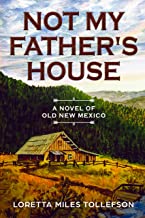
Historical fiction has almost as many flavors as there are time periods to write about. Not My Father’s House, by Loretta Miles Tollefson is an historical novel with a western flavor that leaves the reader smacking their lips for more. A true frontier wilderness tale, Tollefson takes true events and places from the annals of the wild backwoods of old New Mexico territory and crafts a tale of the struggles and hardships of frontier life in the untamed mountain wilderness.
Suzanna is a young bride of mixed blood, soon to be a mother when she moves from her father’s home in the village of Don Fernando de Taos, venturing into the backwoods of New Mexico territory to make a home of her own and raise her family with her husband Gerald and their friend Ramon. She knew she’d have to battle the elements and critters in the untamed mountain valley, but she never expected to have to battle with herself when cabin fever sets in each winter. Nor did she ever imagine that her biggest threat in the wilds would come from a predator that stalks her on two legs instead of four.
A story of female strength and courage in a time when the lands were still wild. Not My Father’s House is a finely crafted story in the western tradition. I give it five quills.
Kaye Lynne Booth does honest book reviews on Writing to be Read in exchange for ARCs. Have a book you’d like reviewed? Contact Kaye at kayebooth(at)yahoo(dot)com.
Share this:

Lost Village of Delta
Posted: October 16, 2019 Filed under: Books, Fantasy, Fiction, Historical Fiction, Historical Inspiration, Writing, Writing for a YA Audience, Young Adult | Tags: Books, Delta, Fantasy, Historical Fiction, Historical Inspiration, Inspiration, Jordan Elizabeth, Writing for a YA Audience, Writing to be Read 3 Comments
My earliest years were spent in Westernville, NY. Right down the street was the beautiful Lake Delta, a place we visited frequently. My parents and I played on the beach. We walked the trails through the woods. One day my father mentioned that when he used to fly his plan over Lake Delta, he could see the foundations beneath the water. That puzzled me – why would there be foundations down there? Were they like the shell fossils we found in our backyard sometimes?

Photo by Lisa Fotios on Pexels.com
He explained that a village used to be there, but it was flooded to create the lake. My imagination went wild. He also told me that my grandmother’s house on the farm where we lived was moved from the lost village. That amazed me, and gave me my first glimpse at history. My fascination with Lake Delta continued, but we moved to a neighboring village and didn’t visit the state park as often.
One day, the Westernville Town Clerk, Mary Centro, spoke at my hometown about Delta. My mother and I attended the lecture, and we were enthralled. I wanted to write a story at once, but I didn’t know where to take it.
My parents moved back to Westernville and I met with the town clerk to discuss Lake Delta in more detail. She told me about walking the land while the lake is low and finding treasures washed up on shore. The next year, my parents and I walked the lake, but we didn’t find anything. Again, I felt the need to write about the lost village of Delta, but I didn’t know who my main character would be yet.
The town clerk wrote two non-fiction books about Delta and my dad bought copies. While visiting my parents, I looked through them, and then did some research online. I learned that one house hadn’t been torn down the first time they flooded the land. It wasn’t until later, when the water receded, that they demolished it.
That was my story. A little magic seeped into the tale, and Lottie came to life. You can read about Lottie in DELTA, my first historic fiction novella that is appropriate for teens and adults.

About the real Delta…

Photo by eberhard grossgasteiger on Pexels.com
New York State decided it was time to expand the Erie Canal. Many of the ports along the canal were no longer being used, because shipping goods by train became the more popular method. Shipping by train was cheaper than shipping via canal. It wasn’t just the price, though, that encouraged manufactures to choose train travel. The modern barges that were needed to ship the goods couldn’t go on the Erie Canal, which was too small and far too shallow. The water level of the Erie Canal tended to fluctuate. By expanding the Erie Canal, the ports would flourish once again. Many farmers were excited by this. They would be able to transport their goods to cities elsewhere in New York State. Expanding the canal required the use of five reservoirs. These reservoirs would provide enough water to keep the level of the canal even. New York State chose Delta because they would only need to build one dam.
The village of Delta rested inside of a deep valley. This made the perfect bowl-shape to fill with water from the Mohawk River nearby. Flooding Delta meant that privately owned land would need to be seized by the government. Everyone living on that land would need to move elsewhere.
In 1903, surveyors arrived in Delta to measure the land and create maps. In 1908, New York State officially authorized that Delta would be cleared to make way for the reservoir. Blue evacuation notices were presented to the village’s five-hundred residents, forcing them to relocate. One hundred buildings were torn down and destroyed. Some, however, were dismantled and moved to other towns in the area, where they were rebuilt. People moved away and their village became a reservoir. The dam was completed in October 1912. Water first went over in May of 1916.
Despite the great expenses incurred in the relocation of the Black River Canal, it closed in 1921.

Jordan Elizabeth is a fantasy author who is obsessed with history and ghosts. You can connect with Jordan via her website, JordanElizabethBooks.com. The photo above shows Jordan on the shores of Lake Delta. You can often find she and her son enjoying the beach.
Want to be sure not to miss any of Jordan’s Writing for a YA Audience segments? Subscribe to Writing to be Read for e-mail notifications whenever new content is posted or follow WtbR on WordPress.
Share this:

Seeking out Christian fiction in September
Posted: September 23, 2019 Filed under: Books, Christian fiction, Fiction, Historical Fiction, Inspirational, romance, Western, Writing | Tags: Christian fiction, Inspiration, Writing to be Read 5 Comments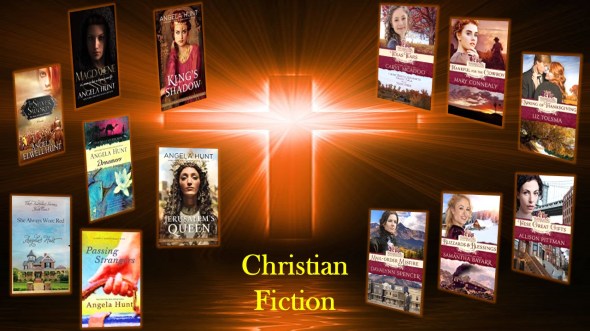
In his 2012 Relevant article, “Where Did Good Christian Fiction Go?“, Micah Levi Conkling claims that Christian fiction has been marred by the Left Behind series and Amish fiction, and is very difficult to find. So, in September, we’ve been seeking out Christian fiction to see if Conklin’s claims are true. Is there really no good Christian fiction out there anymore?
To start off, I want to define what Christian fiction really is. It’s not really a genre. Not really, because as you’ve seen if you have joined me in my search, Christian fiction comes in many genres. The two books I reviewed from the Thanksgiving Books & Blessings collection, Texas Tears and Mail-Order Misfire, are both western romances, and I also had the pleasure of interviewing the author of each, Caryl McAdoo and Davalynn Spencer respectively. My “Chatting with the Pros” author guest, Angela Hunt writes historical fiction, historical romance, heart-warming tales of love and friendship, and children’s books that can all be classified as Christian fiction.
Christian fiction is really a category that other genres fall under. The aforementioned Left Behind series might fall under the science fantasy genre, given it’s futuristic, alternative universe setting. As Christian novels can be so varied, let’s take a look at what they have on common like the portrayal of Christian lifestyles, and an underlying message of a loving God. A book in virtually any genre could be considered Christian fiction if it has these two components, even if the message is subtle and remains in the background of the story. According to the Christy Awards website, the award is “designed to nurture and encourage creativity and quality in the writing and publishing of fiction written from a Christian worldview and showcase the diversity of genres.”
In spite of Conklin’s claims, not all Christian stories boldly shove the message of God down the readers throat. (Many children, and adults as well, turn tail and run from a story that give a hard push to moralistic messages, as is discussed in this month’s “Growing Bookworms” post.) I think the message in good Christian fiction is delivered subtly, in small doses, giving the reader the option to take it or leave it while still being able to enjoy the story.)
Christian fiction really has a bad rep in some circles, where any story with no sex, no violence, no cursing, and no vice, it is believed that the reading of which might be comparable to eating white rice with no seasonings. Christian fiction, from my view, is a tale which portrays Christian beliefs and values in its character’s lifestyles. I think the historical may even be flavored a little more heavily with this, because in days of past Christian lifestyles were more prominent. That could explain why historicals and westerns, like those we’ve looked at here lend themselves so readily to the Christian aspects. I’m guessing that it would more difficult, although not impossible, to work Christian aspects into a futuristic work of science fiction or fantasy, but I have seen them worked into thrillers and mysteries, and they are easily worked into contemporary romance.
Most Christian fiction stories that I’ve read are heart-warming and inspirational, and I’ve walked away with a warm feeling at the story’s end, as if there might actually be hope left for this world, or for love, or humanity, depending on the individual story. In short, Christian fiction works are stories which are written for Christian readers. But you don’t have to be searching for something with Christian undertones to enjoy one if you come across one. A good, well-written Christian story lets the characters carry the reader through without being preachy and moralistic. The power of God shines through in the character’s lives.
Share this:

Into the Catskills
Posted: September 18, 2019 Filed under: Books, Fiction, Historical Fiction, Historical Inspiration, Post-Apocalyptic, Writing, Writing for a YA Audience, Young Adult | Tags: Bunker Boy, Historical Fiction, Historical Inspiration, Inspiration, Jordan Elizabeth, Post-Apocalyptic, Writing for a YA Audience, Writing to be Read Leave a comment
I’m a huge history lover, so anything old has always sparked my interest. I imagine that an old building can tell me the secrets of the past. If I walk through its ancient doors, I’ll be transported back in time. I’ll be able to experience everything that came before.
It hasn’t yet, but I’m still hoping.
One day I was bored, probably tired from work, and decided to look at abandoned buildings online. I was scrolling through Pinterest and voila, there was a beautiful, crumbling resort. The image showed an old pool. Vines crept up broken windows and ferns fought their way through cracked cement. It was beautiful and haunting. I clicked to learn more, and discovered it was a resort from the Catskills.

Photo by Pixabay on Pexels.com
In their heyday (1920s through the 1960s), the Catskill Mountains were home to numerous fancy resorts. People came from all over to experience the thrill of the mountains. Many New Yorkers left the city to experience the calm of the country. The popular movie, Dirty Dancing, takes place at a resort in the Catskills.
Overtime, interest waned. From articles I read online, it seems that the readily people could travel on airplanes to distant wonderlands, the less they wanted to travel upstate. There are still some resorts left and I hope to vacation there someday. I must admit, though, the abandoned resorts fascinate me more than the ones still standing.

Photo by Pixabay on Pexels.com
While looking at more pictures of those abandoned resorts, a story idea came to me. The world ends and the remains of civilization are holed up inside a crumbling hotel. Thus was born my post-apocalyptic novella, BUNKER BOY. If you decide to read it, let me know what you think! I’d love to know if it has inspired you, too, to check out the old memories of the Catskills.
Jordan Elizabeth is a young adult fantasy author. She is most likely gazing at something in awe, something she will soon include in one of her novels. You can connect with Jordan via her website, JordanElizabethBooks.com.
Want to be sure not to miss any of Jordan’s Writing for a YA Audience segments? Subscribe to Writing to be Read for e-mail notifications whenever new content is posted or follow WtbR on WordPress.
Share this:

“Mail-Order Misfire”: Christian romance from the 2019 “Thanksgiving Books & Blessings” collection
Posted: September 6, 2019 Filed under: Book Review, Books, Christian fiction, Fiction, Historical Fiction, Historical Romance, romance, Western | Tags: Book Review, Christian fiction, Davalynn Spencer, Mail Order Misfire, Western, western romance, Writing to be Read 2 Comments
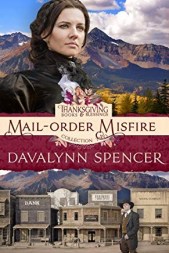
Mail-Order Misfire, by Davalynn Spencer is a Christian western romance that will touch your heart. The story is well-crafted and entertaining, with well-developed characters that you can invest in, and setting details accurate to time period for authenticity. You’ve got to love young Gracie as she takes on the role of matchmaker for her unsuspecting father. It expertly portrays the Christian values of the historic west with a flare that draws you into the story and won’t let go.
Etta Collier is recently widowed and desperately looking for a way to get out from under the predatory banker who wants to claim all that her William left behind in this world, including her! A well-intended letter from young Gracie Stidham requesting a mail-order bride for her father and mother for herself, provides the only answer in sight, so she packs a bag and leaves her previous life behind, setting off for Lockton, Colorado with hope in her heart, as well as a fear of what might lie ahead. The results are a true love story as Etta, Gracie and her father Burn, who is both the preacher and the sheriff, come to terms with the rather awkward situation her arrival stirs and learn to love one another.
Mail-Order Misfire is a thoroughly engaging western romance that emphasizes Christian values without being ‘preachy’ in the least. An well-crafted example of Christian fiction that I give five quills.

Mail-Order Misfire is book two of the newly released Thanksgiving Books & Blessings Collection, available now on Amazon.
Share this:

Interview with Christian Romance author Davalynn Spencer
Posted: September 2, 2019 Filed under: Author Profile, Books, Christian fiction, Fiction, Historical Fiction, Interview, romance, Western | Tags: Author Interview, Christian fiction, Davalynn Spencer, Mail Order Misfire, romance, Thanksgiving Books and Blessings, Western, western romance, Writing to be Read 5 Comments
September’s theme on Writing to be Read is Christian fiction. To start things off today, it’s my pleasure to interview western Christian romance author Davalynn Spencer. Her writing career came as a journalist covering the rodeo circuit, after marrying a man who made a living as a rodeo bullfighter and following the rodeo circuit became a way of life for her. Her son has followed in his father’s foot steps, so she has two guys out in the arena facing off with the bulls, and she has become an award winning author with seventeen published books. She is also one of the authors with a book in the newly released Thanksgiving Books and Blessings collection. Be sure to catch my review of her contribution, Mail Order Misfire on Friday. But for now, let’s welcome her and find out what the writing world is like from her unique point of view.
 Kaye: Your book Mail-Order Misfire is a part of the Thanksgiving Books & Blessings collection. What can you tell me about that book?
Davalynn’s son in the arena
Blog: https://davalynnspencer.com/subscribe/
Website: https://www.davalynnspencer.com
Facebook: https://www.facebook.com/AuthorDavalynnSpencer
BookBub https://www.bookbub.com/profile/davalynn-spencer
Twitter: https://twitter.com/davalynnspencer
Goodreads: https://www.goodreads.com/author/show/5051432.Davalynn_Spencer
Pinterest: https://pinterest.com/davalynnspencer/boards/
Amazon Author: https://amazon.com/author/davalynnspencer
CAN: http://christianauthorsnetwork.com/davalynn-spencer/
Instagram: https://www.instagram.com/davalynnspencer/
Like this post? Let me know in the comments. You can be sure not to miss any of Writing to be Read’s great content by subscribe to e-mail or following on WordPress.
Share this:

Writing for a YA Audience: Author Photo Shoot
Posted: June 19, 2019 Filed under: Books, Fantasy, Fiction, Historical Fiction, Writing for a YA Audience, Young Adult | Tags: Fantasy, Fanya in the Underworld, Jordan Elizabeth, Writing for a YA Audience, YA, Young Adult, Young Adult Fiction Leave a comment
I’ve done a few photo shoots for my author pictures, and they are always so much fun. I get to feel like a model. For FANYA IN THE UNDERWORLD, we decided to do things a little differently. Aaron Siddall illustrated the book and I wrote it; we both brainstormed the concepts. Because this was a joint collaboration, we decided to have a joint photo.

A good friend of ours, Monica Reid Keba, met with us at the Utica Train Station, known as Union Station. The building is beautiful, with marble pillars and chandeliers. Stepping inside is a little like going back in time. Many of the fixtures are original from the construction in 1914. I have a special fondness for the waiting room benches. Not only do they incorporate the heating system, but they are gorgeous to look at. The station was designed by Allen Stem and Alfred Fellheimer. In case you aren’t familiar with those names, they are the architects who designed New York City’s Grand Central Station.

Aaron Siddall and I posed on the benches, beneath the chandeliers, and outside. The autumn day was crisp, with a light drizzle in the air. I hiked up my skirt and scaled the side of an old trolley car. We also explored the park next door. The train station is located in the historic Bagg’s Square neighborhood. The quaint park, surrounded by a stone fence, is home to the site of a log cabin known as Bagg’s Tavern. This log cabin saw esteemed guests such as George Washington and Ulysses S. Grant.

If you are ever in the area and love visiting historic sites, check out the train station and Bagg’s Tavern. Your eyes won’t be disappointed by the sites.

Jordan Elizabeth is a young adult fantasy author. She is most likely gazing at something in awe, something she will soon include in one of her novels. You can connect with Jordan – and point her in the direction of some paranormal activity – via her website, JordanElizabethBooks.com.
Want to be sure not to miss any of Jordan’s Writing for a YA Audience segments? Subscribe to Writing to be Read for e-mail notifications whenever new content is posted or follow WtbR on WordPress.
Share this:

A Roundup of Westerns in May
Posted: May 27, 2019 Filed under: Fiction, Historical Fiction, romance, Western, Writing | Tags: Christian western romance, Paranormal western, Western, western adventure, western fantasy, western fiction, Western genre, western romance, Writing to be Read 8 Comments
When I began seeking my M.F.A. in Creative Writing, back in 2012, I would have said that the western was a dying breed. Even as I tried my hand at writing a western novel, with Delilah, I didn’t think the book would get very far. I figured publishers didn’t want to put out westerns anymore, because they were looking for books that would sell. I thought the only readers westerns had were old men who’d grown up on Louis L’Amour and Zane Grey. I didn’t believe there was an audience for western any longer.
Today, I have to say that I was wrong, since there seem to be new western authors popping up all the time and a good portion of them are female. In fact, the genre seems to be expanding, rather than dying out. I’ve made the acquaintence of several who I did not previously know as a result of my research for this month’s genre theme. That first assignment eventually grew into the first book I was able to get published, but when I began to write Delilah, I looked at westerns as a male realm where a female author might find difficulty being accepted. Now, I’m seeing a lot more female authors of the genre than was previously the case and I am pleasantly surprised.
But I don’t think this is because publishers are eagarly scooping up western novels. A majority of western authors with books in the marketplace are self-published authors. I think western authors must self-publish first and prove themselves before publishers are willing to take a chance on the genre these days.
For a look at a new twist on classic historic western fiction, you can check out my review of Not Just Any Man, by Loretta Miles Tollefson. Like all good things, the western genre has had to change with the times to survive. Many authors are finding a selling point by combining western with other more popular genres, like romance. If you look, you’ll find that a good portion of today’s westerns fall into the category of western romance, although romance isn’t the only genre authors have combined with western. I’ve read a few paranormal westerns, as well. For an example, you can read my review of Joanne Sundell’s, A Slip on Golden Stairs. There are even a few science fiction westerns out there, as well as western dark fantasy, such as Chance Damnation, by DeAnna Knippling, which I reviewed earlier in the month, or check out my 2016 review of Chris Barili’s Hell’s Butcher series, which both feature supernatural elements.
I’d also venture to say that the number of westerns featuring tough female protagonists would tip the scales if measured against those featuring male heros in today’s westerns. It seems the cowgirl is determined to take her place in history, even though old cowboys never really die. But, all western heroines are not cowgirls. Western heroines may take the form of pioneer women tough enough to brave the western frontier and win, or a homesteading wife who loses her husband to one of the many threats that come with living in a harsh landscape and must survive in a brutal landsacpe and fend for herself, or prostitutes who lived lives of servitude and put up with indignities not spoken about in polite company in order to survive an isolated existence, or young girls full of dreams to see the world who are looking to escape and determined to do whatever it takes to achieve them. They aren’t all Calamity Jane, but they are each tough and bold and gritty in their own ways.
But don’t take my word for it. Maybe the western genre hasn’t changed as much as I think. You can find out what other western authors think by checking out this month’s interviews. My “Chatting with the Pros” author guest was western adventure author Scott Harris, and I also interviewed Christian western romance author Patricia PacJac Carroll, and western author Juliette Douglas. And if you’re interested in further discovery, you can check out my January interview with western author Loretta Miles Tollefson.

As for myself, I’m working on the rewrite of the first 45,000 pages in the second book in my frontier western saga, Delilah: The Homecoming. I know you’re not supposed to edit until you’ve finished the first draft, but that’s what happens sometimes. Your character walks up and smacks you and says, “Where the heck are you taking me?”, and you realize the story has taken a wrong turn somewhere along the way. But I’m getting her back on track now. While Lois L’Amour is the reason I love reading westerns, Delilah and the other colorful characters featured in these books are the reason that I love writing them.
It’s been a great western round-up and I hope you’ll all join me in June, when will be riding the thriller train and looking at ways to give readers the thrills and chills they crave. My “Chatting with the Pros” author guest will be thriller author John Nicholls, and I’ll be interviewing author Dan Alatorre and reviewing his new thriller, “The Gamma Sequence”. My second thriller review is yet to be determined, so it will be a surprise. I hope you’ll drop in and see what’s in store.
Like this post? Let me know in the comments. You can be sure not to miss any of Writing to be Read’s great content by subscribe to e-mail or following on WordPress.
Share this:

Chatting with the Pros: Interview with western author Scott Harris
Posted: May 20, 2019 Filed under: Chatting with the Pros, Fiction, Historical Fiction, Interview, Western, Writing | Tags: Brock Clemons Series, CAZ series, Chatting with the Pros, Scott Harris, Shotgun Willy series, Six Gun Partners, Western, Writing to be Read 8 Comments
Today my author guest on “Chatting with the Pros” is a successful western author, who also happens to write his own blog, which ranked in the top 10 western blogs by Feedspot. He has written many western novels and numerous western short stories. His Brock Clemons Series was a finalist in the Western Fictioners Peacemakers Award and is ranked as a top selling series by his publisher, (and mine, as it happens), Dusty Saddle Publishing. According to his website, he grew up on Louis L’Amour. When it comes to the western genre, he really knows his stuff. Please help me welcome western novelist Scott Harris.

Kaye: What is most challenging about writing western for you?
Scott: Since I am still working full-time running my company, finding the time to write is the most challenging thing. I usually write in the morning and have to drag myself from the keyboard to go to work. I’m hoping retirement fixes that.
Kaye: You have three books out in the Brock Clemons series? What can you tell me about that series?
 Scott: There are actually eight books in the series. The six novels (in order) are: Coyote Courage, Coyote Creek, Coyote Canyon, Mojave Massacre, Battle on the Plateau and Ambush at Red Rock Canyon. Additionally, there are two collections of short stories based on the Brock Clemons characters: Tales From Dry Springs and Tales From the Grand Canyon.
Brock was my first series, so it holds a special place in my heart. The characters are more complex than those in my subsequent series, which makes writing the stories more difficult and more rewarding. I will come back to these characters, but probably not for a year or two.
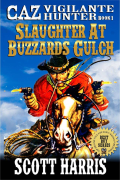 Kaye: What can you tell me about your CAZ: Vigilante Hunter series?
Scott: This series is pretty much the antithesis of the Brock series. It is six books (Slaughter at Buzzard’s Gulch, Never Shoot A Woman, The McKnight Massacre, Fire From Hell, Hell on Devil’s Mountain and A Whore’s Life) about a man named Caz (no last name) who travels the West searching for and killing evil men who have evaded justice. The series was an absolute blast to write.
Kaye: When writing for a series, do you outline the whole series from the start, or do you add books as you go? Are the books stand alone, or do the follow a chronological path which should be read in order?
Scott: I am on my 3rd series now (Stagecoach Willy) and I’m in the middle of the 2nd book. I have no idea where the next books are going to go and won’t think about the 3rd book until I finish this one. As a matter of fact, I do not outline my books at all. When I finish a chapter, I have no more of an idea of what the next chapter holds than the reader will. I know that’s different than most writers, but for me, it keeps the writing fresh.
For the most part, the Caz books can be read as stand alone, there is very little crossover from book to book. The Brock series is different and benefits by being read in order.
 Kaye: The most recent book in the Brock Clemons series is Coyote Canyon. Can you tell me a little about that book?
Scott: Coyote Canyon came out early last year and was the 3rd book in the Brock series. The series can be thought of as two different trilogies (Dry Springs and Grand Canyon), so in that sense Coyote Canyon was the last in a trilogy. It was a fun book to write because it wrapped up Brock and his families time in Dry Springs and set the stage for them to move to the Grand Canyon.
Kaye: In addition to your western novels, you have also contributed to several western anthologies. Do you prefer writing book length works or short fiction? Why?
Scott: I think that depends on my mood. My short stories range from 500 words to 5,000 words and sometimes I have an idea that I think is powerful, but requires no more than a short story. It can be freeing to write shorts without having to worry about the continuity that novels require.
On the other hand my novels (Brock averages about 50,000 words per book and Caz closer to 30,000 words) allow me to explore ideas and characters in depth. I would hate to be limited to one or the other.
 Kaye: You wrote a collection of short stories together with your son, Justin. How did that work? Did you write each story as a collaboration or did you each contribute stories of your own? Was it a good experience? Would you do it again?
Scott: We wrote our own stories, though we talk 2-3 times per week about what we’re working on. He is my best story editor and muse. It was a great experience and we’re working on some things together right now. He’s also about halfway done with his first novel.
Kaye: What is the most fun about writing western for you?
Scott: Coming up and with sharing my ideas. It is really exciting to be able to create stories and characters and then do with them what you will. I have learned that it doesn’t take long before the character takes over and I find myself saying “He/She would never do/say that”
Hearing from readers that they like my work is tremendously rewarding. And I’m just old fashioned enough to still love seeing my books in actual print, with paper, ink and a cover.
Kaye: Your blog recently received the Feedspot award, ranking it up there with the top 20 western blogs out there. I believe your blog was actually ranked in the top 10. Would you like to talk a little about that?
Scott: It was flattering, of course. I try to write posts that are honest and candid. I share my troubles and mistakes (at least with regards to writing) and I believe that resonates with people. I love getting feedback from readers. I am absolutely certain that I learn as much, if not more, from my readers than they do from me.

Kaye: Since you write one of the top western blogs, and have been a fan of westerns since an early age, what do you see when you look at the genre today? Do you find more male or female western authors? Do you find the genre dominated by independently published authors? Do you find it trending more toward western romance these days?
Scott: The genre certainly leans toward being male dominated, but it’s changing and more and more women are getting involved, which is great. Certainly the 3-4 huge names dominate the book stores and it’s tough for most of us to get any shelf space. But, Amazon opens the world for independent writers and gives many of us a chance to find an audience. Can’t ask for more than that.
I have noticed the western romance genre getting more notice and attention. It’ll be interesting to see if that continues.
Kaye: Where do you see the western genre going in the future?
Scott: Wherever we want to take it, or maybe more realistically, wherever the readers want us to take it. There are plenty of different genres sitting under the Western umbrella, so it’s up to us to write some great books and pull in readers – new and old – and at the same time, we need to listen to what the readers are telling us.
 Kaye: What is in store for the future for Scott Harris? Does Brock or Caz have more stories in store for them? You are working on the second book in the Shotgun Willy series? Tell me about that series, if you would.
Scott: I’m done with Brock and Caz for now. I am working on the 2nd book in the Stagecoach Willy series. Willy is a stagecoach driver and keeps stumbling into trouble and then I need to write him out of it. He has a sense of humor, which is fun to write and has a partner, Ten, that he’s been staging with for years. When I finish the 6th book, I plan to do a “capstone” book that brings Brock, Caz and Willy together in one grand book.
Kaye: What do you like to do when you’re not writing?
Scott: Spend as much time as possible with my wife, Randi, my son, Justin and my daughter Samantha and her husband Devin. Randi and I travel quite a bit, try to take one RV trip per month. Next month is a 3 week trip to South Bend to watch our daughter graduate from Notre Dame Law School.
Next year, we’re retiring and moving to Tennessee. Very much looking forward to it.
I want to thank Scott for chatting with me here and sharing some of his expertise in the western genre. I very much enjoyed this and hope all of my readers have, too. You can learn more about Scott Harris on his blog and website, or on his Amazon author page. Join me next month on “Chatting with the Pros”, when my guest author will be hardboiled crime fiction novelist Jim Nesbit. I hope to see all of you then.
Like this post? Let me know in the comments. You can be sure not to miss any of Writing to be Read’s great content by subscribe to e-mail or following on WordPress.
Share this:

Interview with western romance author Juliette Douglas
Posted: May 13, 2019 Filed under: Fiction, Historical Fiction, Interview, Western, Writing | Tags: Author Interview, Author Profile, Freckled Venom, Juliette Douglas, Western, Writing to be Read 2 Comments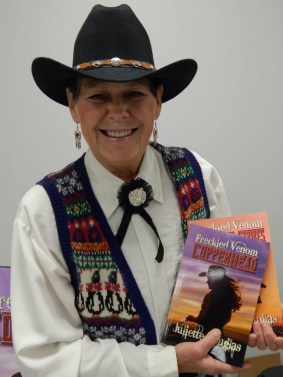
I’m pleased to be chatting today with a prolific author who has burst onto the western scene in a relatively short amount of time. Her debut novel, Freckled Venom, was a Laramie award winner, and she recently signed on with Delilah‘s publisher, Dusty Saddle Publishing. The amazing part is she manages churn out all of her many books, while still holding down a traditional job outside the home, as well. Let’s see if she has any secrets to share. Please welcome western author Juliette Douglas.
Kaye: Your website says you are a new voice in the western genre, but it seems like you have written a lot of books. How long have you been writing western?
Juliette: I was a new voice 5 years ago, as I tend to have more grit in my novels then most women western writers.
I was 1st published in 2013, but the publisher was awful so ditched them and became indie and re-issued my books with new covers and re-edited interiors in 2014. So that’s when I like to say I’ve been published.
Kaye: What did you write before westerns?
Juliette: I have never written a thing before in my life. So I guess you could say I’m a late bloomer.
Kaye: Do you think it is more difficult for a woman to author a western novel and make a success of it?
Juliette: No I don’t. When I began to promote my novels at local events, I sold more to men then women. Since then I have all ages who read my books.
I personally feel it’s easy for me to write strong female characters in an old western setting then to write a contemporary western.
I love history, so it’s a good match for me. I’ve been blessed with my success. I know I am up against many good male western writers who have been around much longer then I have, but I’m making strides.
Kaye: What’s the biggest challenge in writing westerns for you?
Juliette: Making sure the things I want to happen are in the right time frame, I use the weapons for that era etc. For example: smokeless gunpowder did not appear until the 1890s.
Kaye: Your female characters are bold and brassy in a genre where women are typically portrayed as damsels in distress needing rescued by a big strong man. How do you write your heroines in a way that makes them believable, yet allows them to remain independent?
Juliette: I try to put myself into the situation. How would I feel, behave, emotions I might hide or display. Would I be angry or decide these are the cards I was dealt and how would I go about living my life with these secrets or circumstances thrown at me. Women who carved out a future for themselves in the old west had to be some of the strongest I have ever read about and I try to portray that with my characters.
Kaye: What can you share about your Freckled Venom Series?
Juliette: It was a great experience for me as a writer. I loved how my characters took over and I was just the messenger typing out their words and feelings.
 The Freckled Venom Series is very different then most western novels out there because it has a gun toting rugged female who bounty hunts instead of the usual male filled westerns. I’ve reversed the roles you might say.
In Freckled Venom Skeletons I tried something different. I had two points of view going on. One from the children’s POV and then the adults and it worked very well.
There will be many more stories in the FV Series. This summer I will have Freckled Venom Vixen The Early Years and for Christmas, Plum Dickens of a Christmas. A reunion of sorts with all the characters brought together in this book.
Kaye: What do you consider to be the single most important element in a western?
Juliette: Good storylines & plots. Plenty of action and hair-raising adventures.
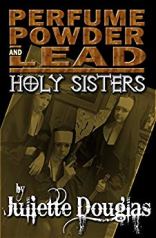 Kaye: Would you talk a little about Perfume, Powder and Lead: Holy Sisters?
Juliette: Hahaha…This was one of the most fun books I have written. The idea is so absurd that this would have happened, but a possibility in those days.
Three soiled doves are tired of that life and set out to the gold fields, but they need money to get there. They stumble across nuns killed by raiders, and the girls change their habits, so to speak and make plans to rob a bank dressed as nuns.
But there are deeper elements also allowing the reader to form a bond with these girls.
It’s raw, it’s gritty and it’s not for everyone to read.
Kaye: Are there any of your books which you’d classify as western romances?
Juliette: I have the teasing potential of romance in most of my novels and my readers seem to like that.
Kaye: One of your most recent releases, Bed of Conspiracy, sounds to me like an
historic thriller involving political conspiracy, assassination plots and cloak
and dagger action, all set during the Grant administration? Was it difficult for
you to stray outside of the western genre?
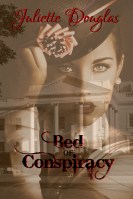 Juliette: Oh man, I had wanted to do this story for 3 years before I finally found time to write it.
Loved writing this one! Set in 1876 it wasn’t hard for me at all. I loved weaving actual events into the story. Looking at maps of Washington DC from 1876 to learn the layout of the city to include actual street names and places scattered about in the fictional story. It has ended up being one of my most popular novels and due to the high interest has spawned a series. Next one titled: Death Deals the Hand, A Ross & Sam Adventure.
Kaye: Where do you find inspiration for your stories?
Juliette: Every where. Everyday stories and situations that can be transported back in time to the old west!
Kaye: What’s the most fun about writing westerns?
Juliette: Everything!
Kaye: The first book in your Freckled Venom series was also your debut novel, Copperhead, which you won a Laramie Award. What is the Laramie Award and how does one receive it?
Juliette: The Laramie Award is the western division of the Chanticleer awards. I submitted Copperhead on a whim and won over very stiff competition.
For 2019 I will be entering Bed of Conspiracy in the Laramie Awards Adventure & Caper category. Will see what happens!
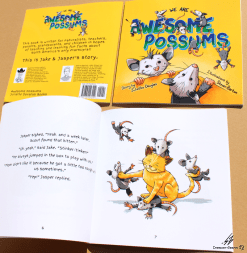
They also have a category for children’s books and I will be entering my 1st Children’s book: We Are Awesome Possums.
Kaye: Would you recommend aspiring authors attempt the western genre? Why or why not?
Juliette: You need to know the history of the old west for sure. There are still many untold stories out there to share, but it takes hard work to come up with a fresh idea with the old tales that would be marketable.
The American Old West is our history, no one else can claim it. It speaks to the hearts of men, women and children across the world. It is America’s claim.
Kaye: If you could have lunch with any author, alive or dead, who would it be? Why?
Juliette: Louie L’Amore. A fascinating man. His stories are based on a lot of his own actual experiences. It would be neat to visit and talk with him.
I want to thank Juliette for sharing with us today. It has been an absolute pleasure. You can learn more about Juliette Douglas and her work on her Facebook Author page or her Amazon Author page. I’m proud to share a publisher with Juliette. I hope you will join me next week on “Chatting with the Pros”, when my author guest will be another Dusty Saddle author, Scott Harris. I hope to see you then.
Like this post? Let me know in the comments. You can be sure not to miss any of Writing to be Read’s great content by subscribe to e-mail or following on WordPress.




















