Growing Bookworms – Sir Chocolate Saves Easter #SirChocolateStory #Childrensfiction
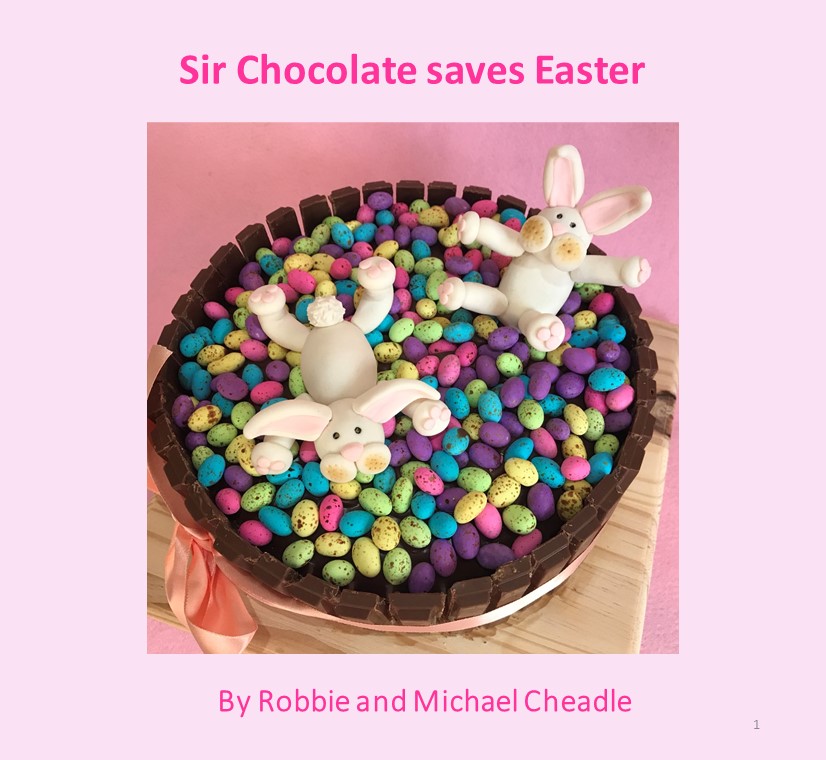
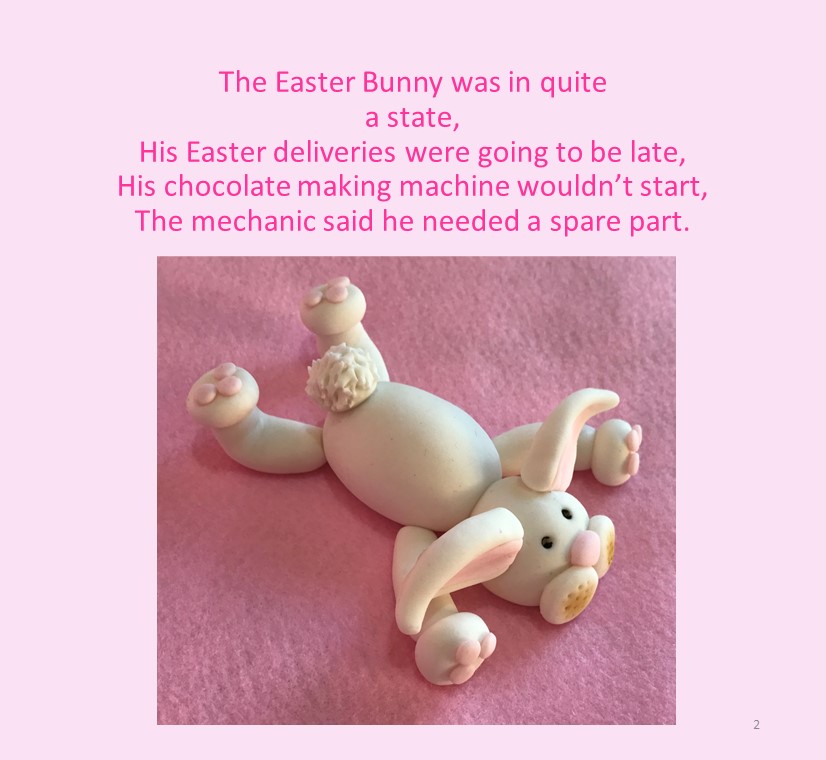
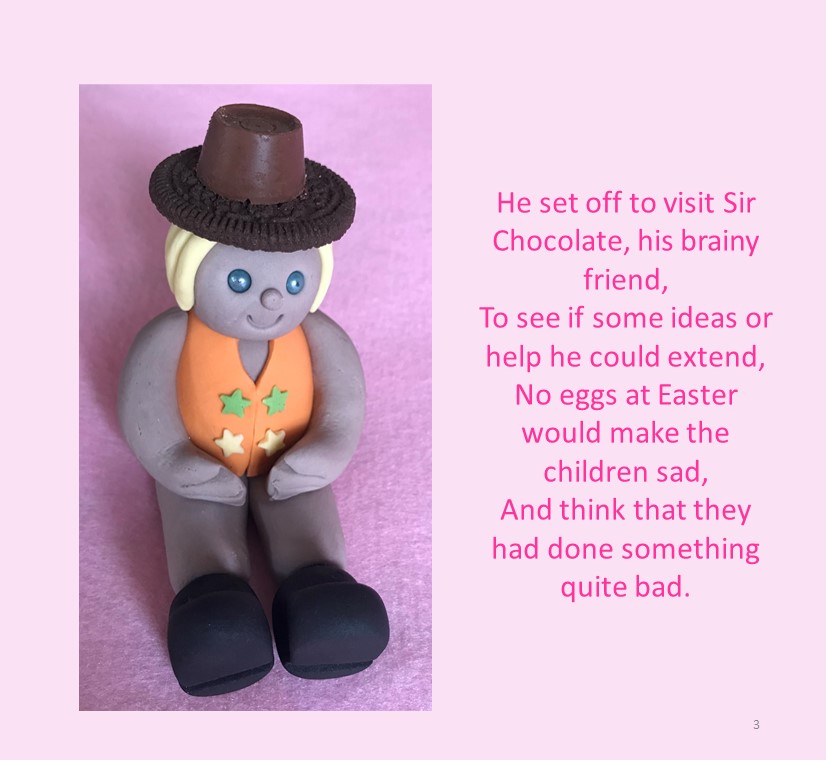
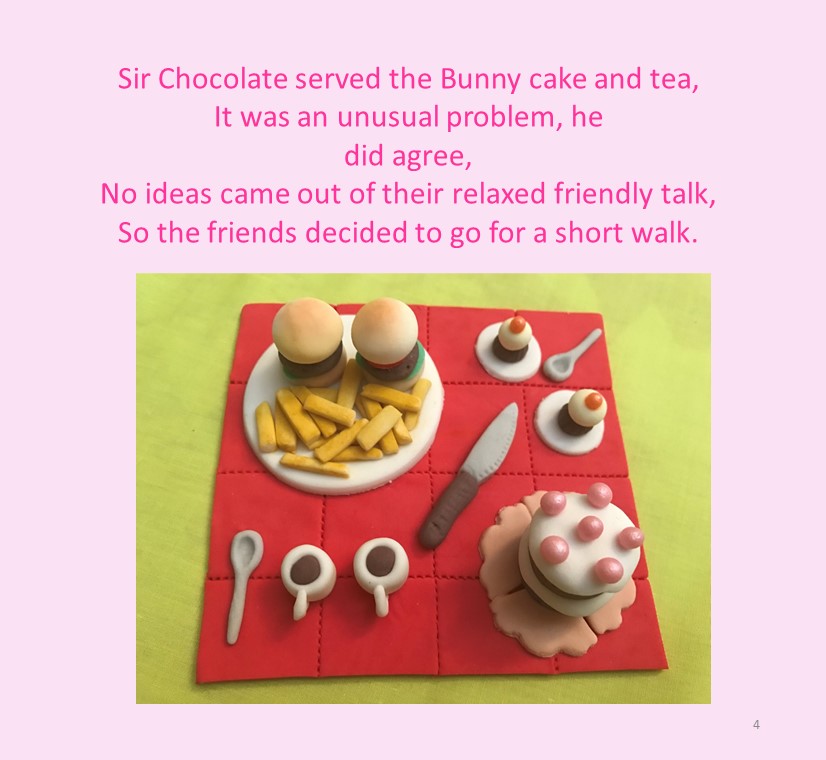
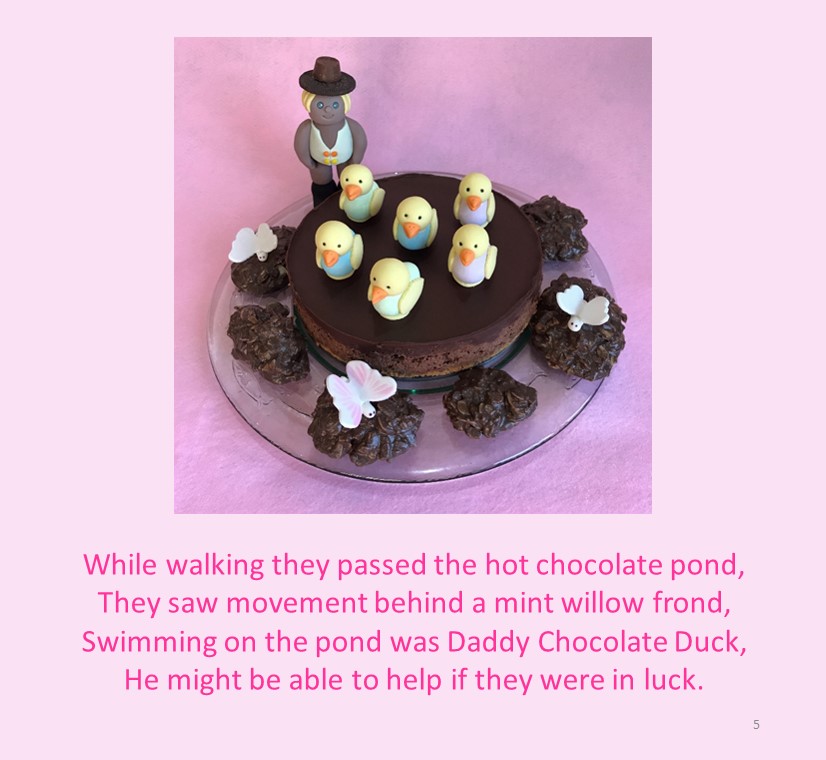
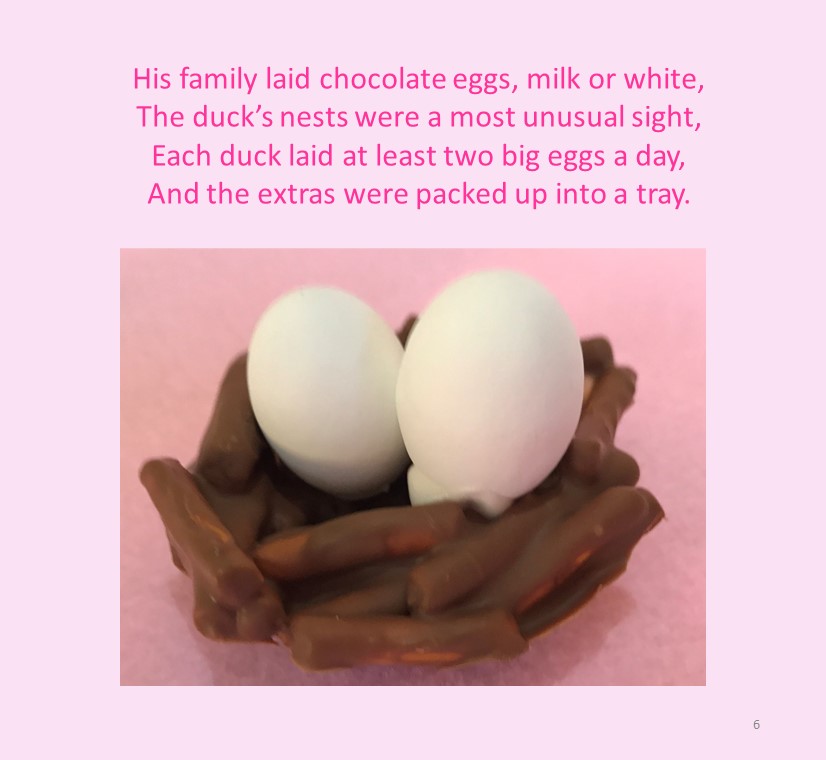
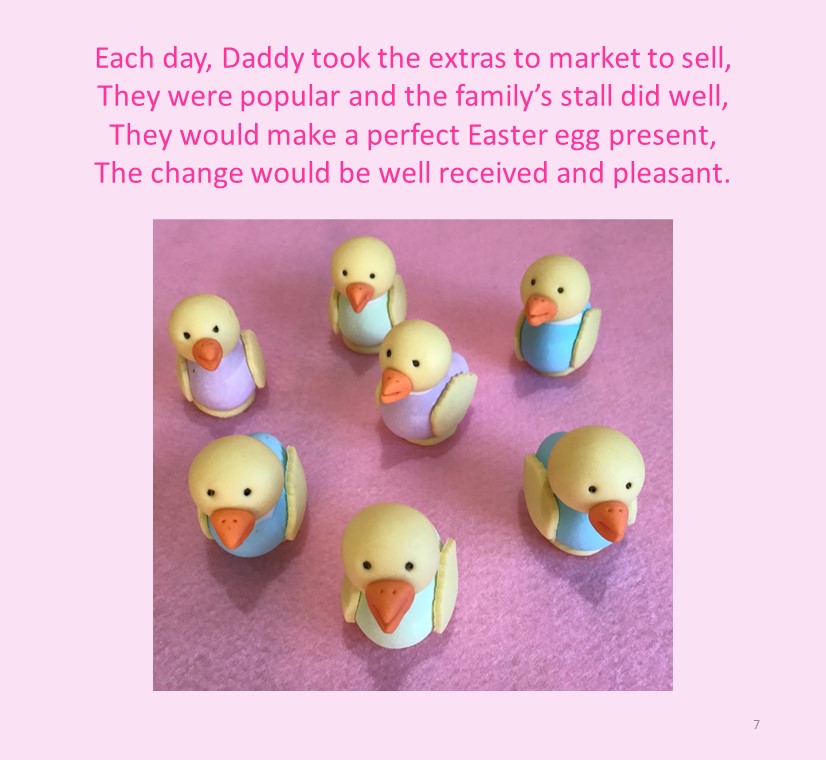
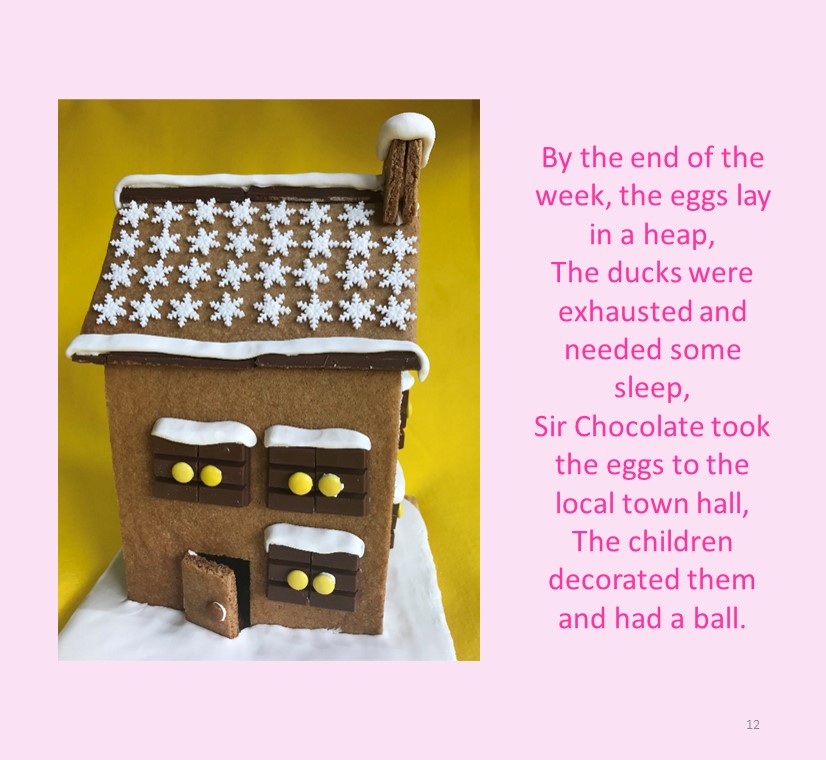
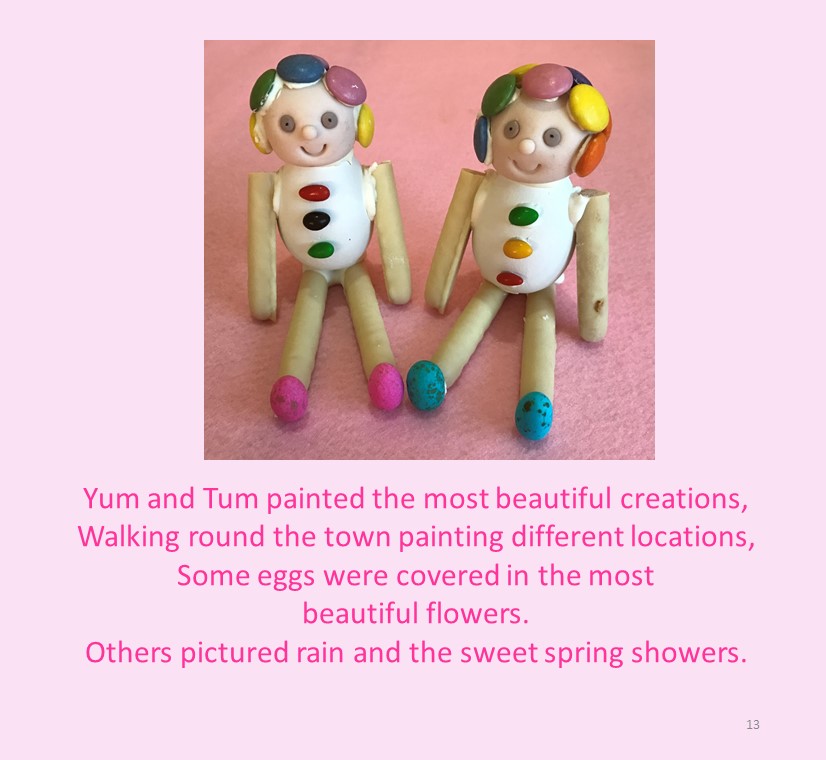
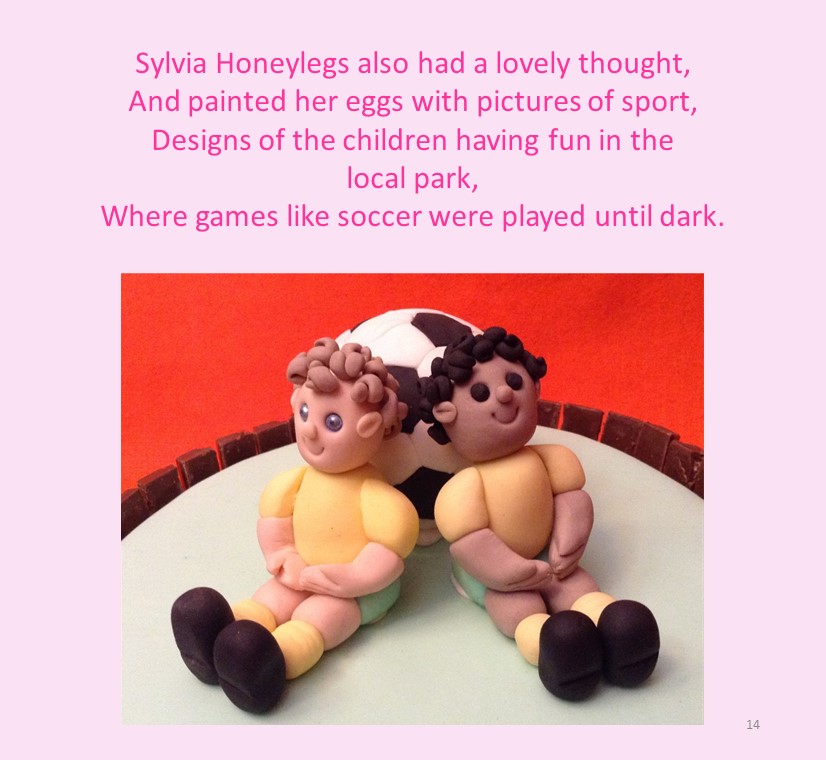
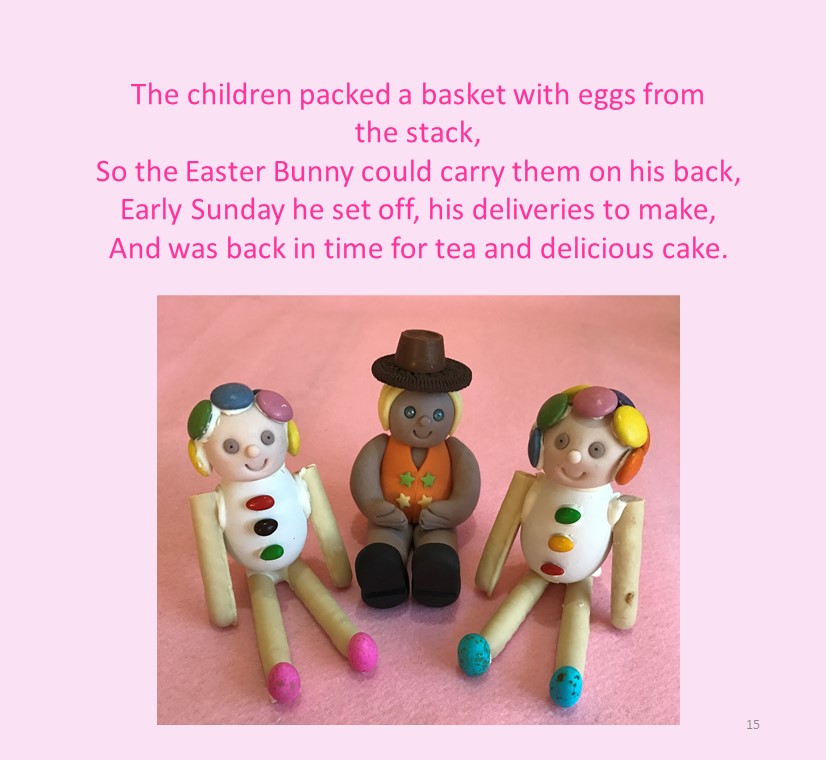
Posted: April 13, 2022 Filed under: Uncategorized 30 CommentsEaster is around the corner and it is a time for spending time with family. If you are Christian, it is also an important religious holiday. I thought it would be nice to share a Sir Chocolate story with you today. It’s called Sir Chocolate Saves Easter and you can download it as a PDF here: https://robbiesinspiration.wordpress.com/free-story-sir-chocolate-saves-easter/
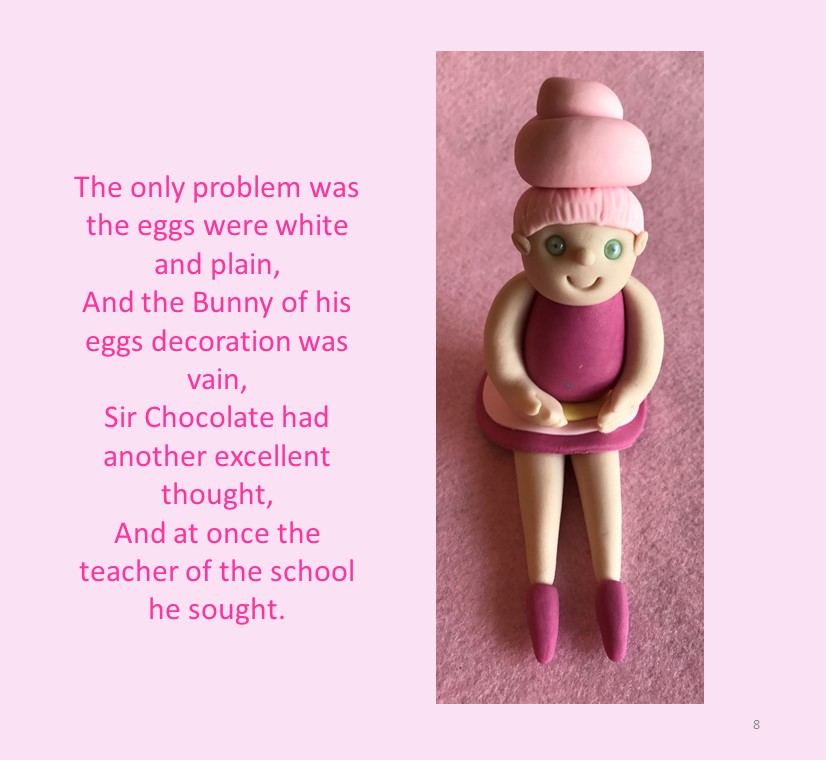
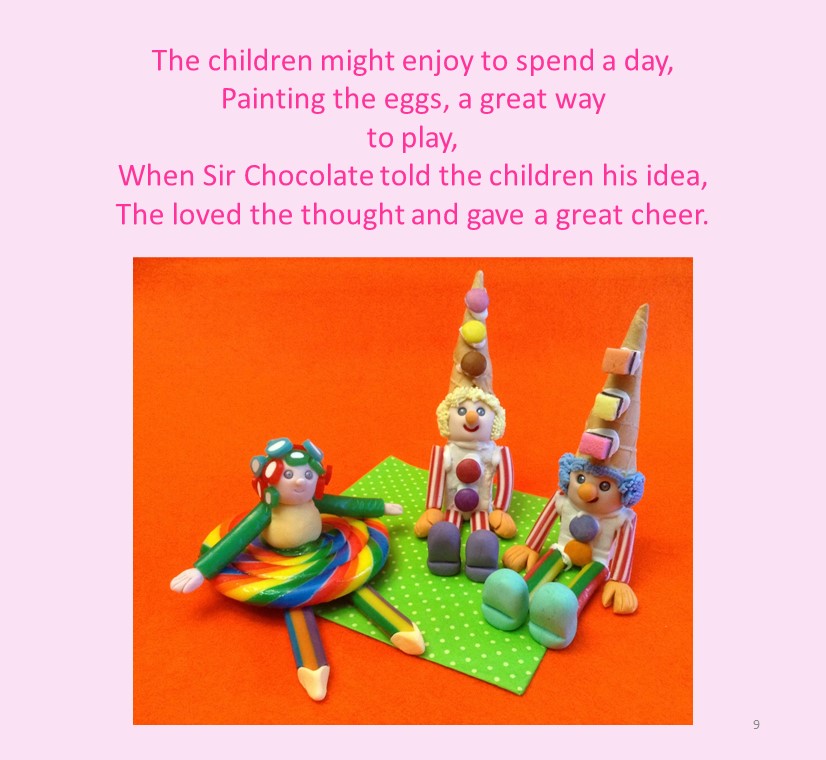
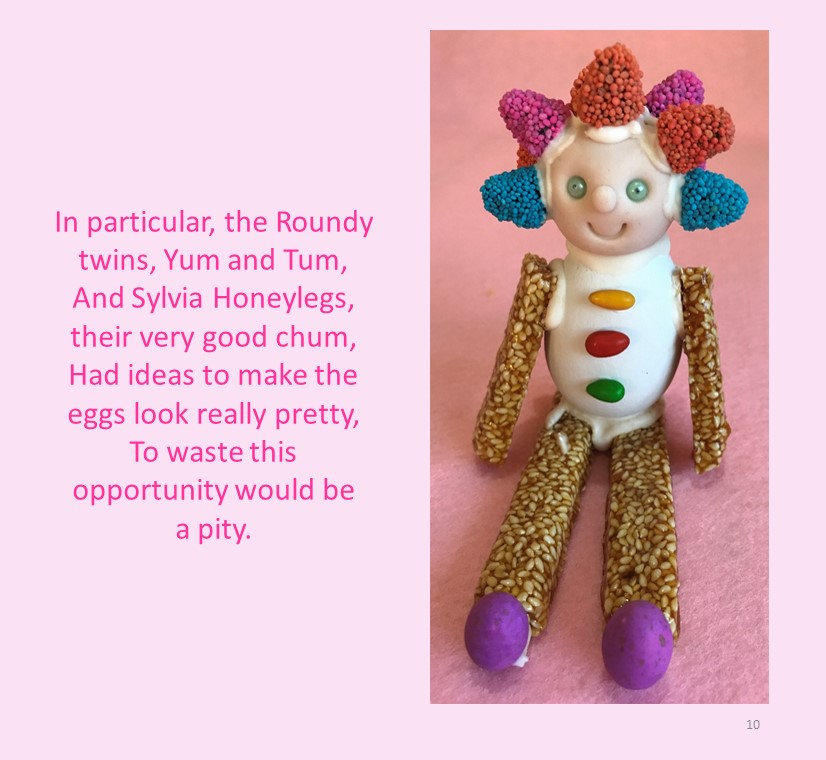
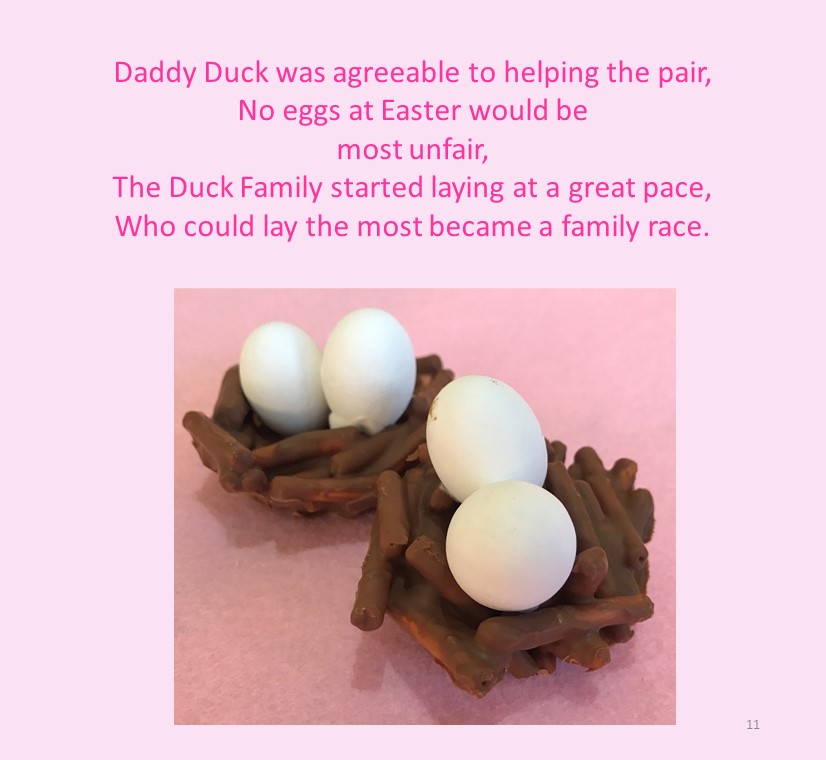
Fun Easter activity
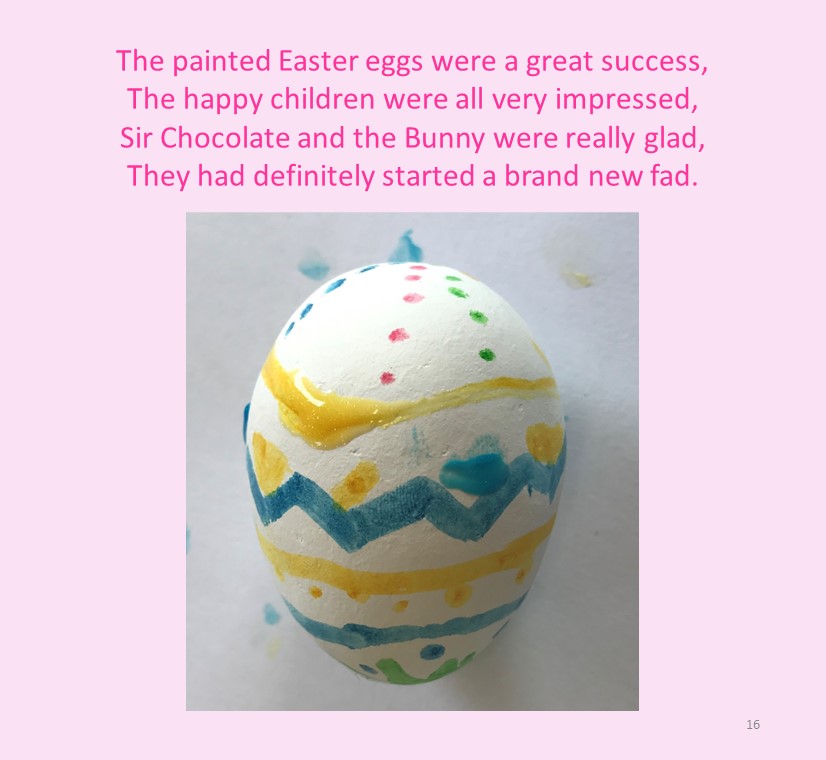
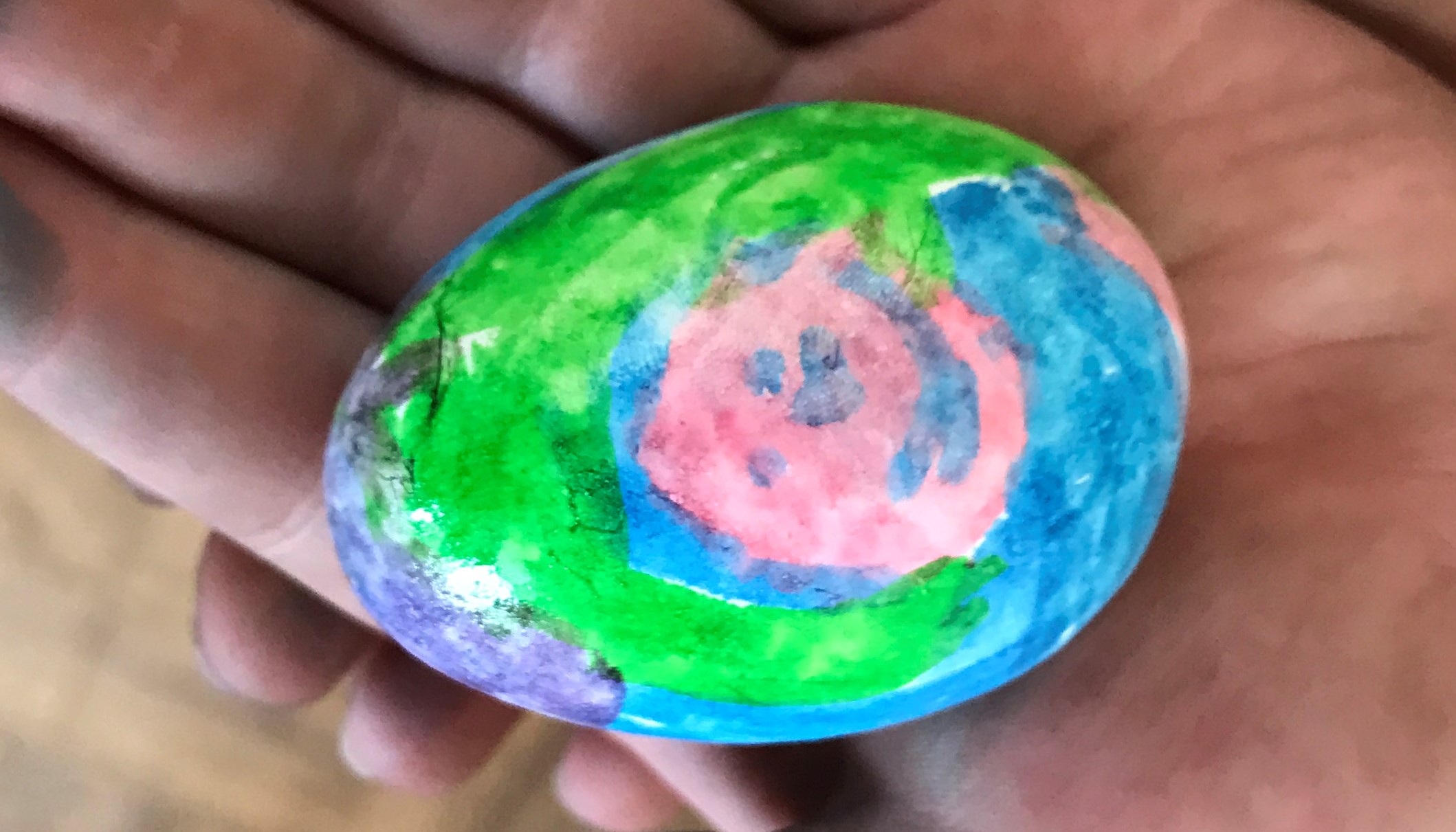
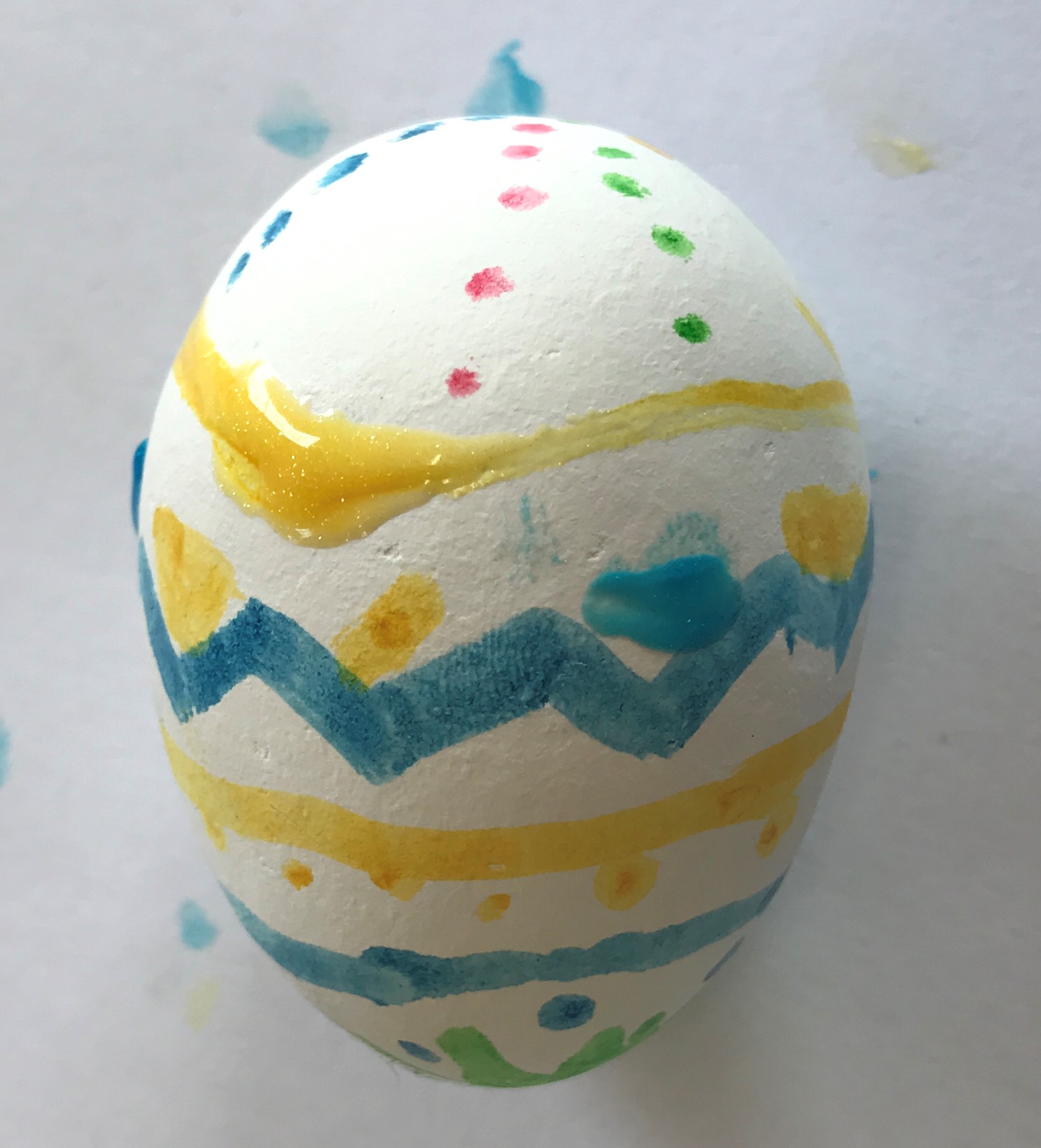
Painting Easter eggs with food colouring is great fun. I used the white candy coated ‘hens’ eggs for this activity and liquid food colouring. Be careful to use aprons as the food colouring stains. Here are the Easter eggs some of the children in my Sunday School painted a few years ago.

About Robbie Cheadle

Robbie Cheadle is a South African children’s author and poet with 9 children’s books and 2 poetry books.
The 7 Sir Chocolate children’s picture books, co-authored by Robbie and Michael Cheadle, are written in sweet, short rhymes which are easy for young children to follow and are illustrated with pictures of delicious cakes and cake decorations. Each book also includes simple recipes or biscuit art directions which children can make under adult supervision.
Robbie has also published 2 books for older children which incorporate recipes that are relevant to the storylines.
Robbie has 2 adult novels in the paranormal historical and supernatural fantasy genres published under the name Roberta Eaton Cheadle. She also has short stories in the horror and paranormal genre and poems included in several anthologies.
Robbie writes a monthly series for https://writingtoberead.com called Growing Bookworms. This series discusses different topics relating to the benefits of reading to children.
Robbie has a blog, https://robbiesinspiration.wordpress.com/ where she shares book reviews, recipes, author interviews, and poetry.
Find Robbie Cheadle
Blog: https://www.robbiecheadle.co.za/
Blog: robbiesinspiration.wordpress.com
Twitter: BakeandWrite
Instagram: Robbie Cheadle – Instagram
Facebook: Sir Chocolate Books
______________________________________________________________________________________________
Want to be sure not to miss any of Robbie’s “Growing Bookworms” segments? Subscribe to Writing to be Read for e-mail notifications whenever new content is posted or follow WtbR on WordPress. If you found it interesting or entertaining, please share.
Share this:

Treasuring Poetry: Meet poet and author Abbie Taylor
Posted: March 16, 2022 Filed under: Book Review, Books, Interview, Poetry, Review, Treasuring Poetry | Tags: Abbie Taylor, Author Interview, Book Review, How to Make a Better Musetrap, Poetry, Robbie Cheadle, The Red Dress, Treasuring Poetry, Writing to be Read 47 Comments
Today, I am delighted to introduce poet and author, Abbie Taylor, to discuss her favourite poems and poetry in general.
Which of your own poems is your favourite?
“The Bedroom” is one of those red herring poems that makes you think it’s about one thing, then turns out to be about another. It illustrates how much my late husband Bill depended on me after suffering two strokes that paralyzed his left side. It’s my favorite because even today, almost ten years after his passing, I’m amazed that I was able to meet his needs for six years after his strokes, despite my limited vision. Here’s the poem:
The Bedroom
At three in the morning,
I’m mildly aroused
by the gentle touch of his hand.
He only has one good arm and leg
but still knows how to please me.
As he strokes me,
and I breathe the scent of his sweat,
I purr with anticipation.
The mood is shattered
when he whispers, “I need to pee.”
What inspired you to write this particular poem?
Every night, after I brought Bill home from the skilled nursing facility, where he recuperated after his strokes, he woke me at least once, sometimes more than once, during the night, because he needed assistance to sit on the side of the bed and use a urinal. He was never demanding during this time. He gently woke me by rubbing my back and shoulders. Once I was fully awake, he said, I need to pee.” After he heard me read the poem during a public event, when he woke me, he would say, “What does your poem say I have to do?” Eventually, he was able to use the urinal in bed without sitting up first. So, all I had to do was get up and empty the urinal periodically, which made life a lot easier.
What are your plans for your poetry going forward?
I don’t have any definite plans. I’ve put together several collections but haven’t had much time to do anything with them. I imagine I’ll eventually publish them.
What is your favourite poem?
I’m assuming you want to know about my favorite poem by another author. Well, that would be “The Lanyard” by Billy Collins. Here it is, along with a link to a video of him reading it.
The Lanyard
BY BILLY COLLINS
The other day I was ricocheting slowly
off the blue walls of this room,
moving as if underwater from typewriter to piano,
from bookshelf to an envelope lying on the floor,
when I found myself in the L section of the dictionary
where my eyes fell upon the word lanyard.
No cookie nibbled by a French novelist
could send one into the past more suddenly—
a past where I sat at a workbench at a camp
by a deep Adirondack lake
learning how to braid long thin plastic strips
into a lanyard, a gift for my mother.
I had never seen anyone use a lanyard
or wear one, if that’s what you did with them,
but that did not keep me from crossing
strand over strand again and again
until I had made a boxy
red and white lanyard for my mother.
She gave me life and milk from her breasts,
and I gave her a lanyard.
She nursed me in many a sick room,
lifted spoons of medicine to my lips,
laid cold face-cloths on my forehead,
and then led me out into the airy light
and taught me to walk and swim,
and I, in turn, presented her with a lanyard.
Here are thousands of meals, she said,
and here is clothing and a good education.
And here is your lanyard, I replied,
which I made with a little help from a counselor.
Here is a breathing body and a beating heart,
strong legs, bones and teeth,
and two clear eyes to read the world, she whispered,
and here, I said, is the lanyard I made at camp.
And here, I wish to say to her now,
is a smaller gift—not the worn truth
that you can never repay your mother,
but the rueful admission that when she took
the two-tone lanyard from my hand,
I was as sure as a boy could be
that this useless, worthless thing I wove
out of boredom would be enough to make us even.
Why do you like this poem?
In a humorous way, it emphasizes the idea that our mothers do so much for us but we feel we don’t do enough for them.
About Abbie Taylor

Abbie Johnson Taylor is the author of three novels, two poetry collections, and a memoir. Her work has appeared in The Avocet and Magnets and Ladders. She lives in Sheridan, Wyoming, where, for six years, she cared for her totally blind late husband who was partially paralyzed by two strokes soon after they were married. Before that, she worked for fifteen years as a music therapist in nursing homes and other senior facilities. During that time, she also facilitated a support group for blind and visually impaired adults, taught Braille, and served on the advisory board to a state trust fund providing adaptive equipment to blind and visually impaired children and adults.
Contact Abbie Taylor
Website: https://www.abbiejohnsontaylor.com
Blog: https://abbiescorner.wordpress.com
Facebook: https://www.facebook.com/Abbies-Corner-of-the-World-988391584616528/
Amazon: https://www.amazon.com/Abbie-Johnson-Taylor/e/B00GDM1BWK/#nav-tophttp://
My review of The Red Dress by Abbie Taylor

The Red Dress is a lovely novel about a woman, Eve Sawyer, who has become a best selling author and has a devoted husband and three children, but who has never been able to move on from an unfortunate incident in her younger years when, in a fit of embarrassed irritation, she gave away the red dress that her mother had made for her to wear to her prom. Although Eve was goaded by her selfish roommate, Charlene, into giving her the dress, her mother has never forgiven her for this transgression and it has impacted heavily on their relationship. Her mother is now suffering from dementia and is being cared for in a home for the elderly, but she still remembers that Eve gave away this dress and holds it against Eve.
Eve wore the dress to her prom and she associated the dress with bad memories as her date had disappeared with her best friend, Adele, and she had found them in a compromising position in the back of his father’s car. Eve cuts Adele out of her life and has not contacted her in many years, even though Adele had returned to their home town to raise her son, conceived on the night of the prom.
The story starts with Eve receiving a Facebook request to connect with her old roommate, Charlene. She accepts the request, although she had doubts because she didn’t like Charlene. Before long, her daughter, Ashley, is in touch with Charlene’s daughter, Brenda, and the situation is irreversible. Eve is having her own problems with overwork and issues with her older daughter, Julie, who feels neglected as a result. Her husband is also irritated with her because he feels she favours their younger daughter and son and is harsh with Julie.
This is a story that tackles the themes of working mothers, unresolved grudges and situations from the past, raising teenage children, forgiveness, terminal illness, and death. The author does a good job of sharing Eve’s frustration at her mother and older daughter, irritation at Charlene for the trouble she has caused her, and hurt at Adele’s betrayal of their friendship.
Eve has to confront her negative emotions to resolve these lingering troublesome relationship issues from her past and move on with her future.
I enjoyed the character of Eve and found her to be realistic and relatable. Her situation vividly establishes the difficulties that can result from unsettled emotional problems from the past and juggling work and motherhood.
I enjoyed this story and would recommend it to readers of family dramas.
What Amazon says
When Eve went to her high school senior prom, she wore a red dress that her mother had made for her. That night, after dancing with the boy of her dreams, she caught him in the act with her best friend. Months later, Eve, a freshman in college, is bullied into giving the dress to her roommate. After her mother finds out, their relationship is never the same again. Twenty-five years later, Eve, a bestselling author, is happily married with three children. Although her mother suffers from dementia, she still remembers, and Eve still harbors the guilt for giving the dress away. When she receives a Facebook friend request from her old college roommate and an invitation to her twenty-five-year high school class reunion, then meets her former best friend by chance, she must confront the past in order to face the future.
Purchase The Red Dress
My review of How to Build a Better Mousetrap: Recollections and Reflections of a Family Caregiver (Poetry)

How to Build a Better Mousetrap is a memorable book of poetry which covers two distinct time periods in the author’s life.
Part 1: On Being a Family Caregiver, revolves around the poet’s role as caregiver to her husband following his having two strokes, a year apart, and becoming partially paralysed.
The second section section of the book comprises of Part 2: Recollections, Part 3: Reflections and Part 4: In the End which describes through the medium of freestyle poetry, the various states of the poet’s life from her early childhood through to her old age. There is little mention throughout the book of the author’s visual impairment, but I am aware of it as I have previously read an anthology, Understanding edited by Stevie Turner, that disclosed this information.
The poetry in this book is compelling and quite fascinating in its honesty as the poet ventures to express feelings and emotions that many people might seek to hide. It is refreshing to read expressions of helplessness and even the occasional anger and resentment towards a set of circumstances that have so drastically and unexpectedly impacted on the poet’s life. These emotions are overwhelmed by the poet’s clear devotion and love for her partner.
These verses from three different poems in this collection illustrate this internal conflict:
“In the beginning, you knew all about me
which buttons to push,
how to hook me up,
install programs, fix problems.
Now, you hesitate,
push the wrong buttons.
When I don’t give you the desired response,
you beat my keyboard, proclaim I don’t work.”
From Before and After
“I open my eyes,
gaze upon his sweet sleeping face,
long to hold, kiss him,
caress his hair, his cheek.”
from Awakening
“I’ll never tell you you’re stupid
when you forget something or don’t understand.
I’ll never tell you you’re lazy
when you sit at the kitchen table in your wheelchair
while I fix dinner, clean up.
I’ll never tell you you’re a baby
when I must do most things for you.”
from Things I’ll Never Tell You
What Amazon says
In January of 2006, Abbie Johnson Taylors husband suffered a stroke that left him paralyzed on his left side. After months of therapy in a nursing facility, he returned home in September of that year. Although he still had little use of his left arm and leg, it was hoped that through outpatient therapy, he would eventually walk again. In January of 2007, he suffered a second stroke that wasnt as severe, but it was enough to impact his recovery. In August of that year, his therapy was discontinued because he showed no progress. He has never walked since.
The first five poems tell the story of how Taylor found her husband when he suffered his first stroke, detail events in the first few months afterward, and describe Taylor and her husbands reactions. The rest of the poems in the first part were inspired by Taylors experiences while caring for her husband. Covering such topics as dressing, feeding, toileting, their relationship, and his computer, they often provide a humorous outlook. Some poems are from the husbands point of view. Poems in the next two parts cover childhood memories and other topics. The last section of poems was inspired by Taylors fifteen years of experience as a registered music therapist in a nursing home before marrying her husband.
Purchase How to Build a Better Mousetrap: Recollections and Reflections of a Family Caregiver
About Robbie Cheadle
Robbie Cheadle is a South African children’s author and poet with 9 children’s books and 2 poetry books.
The 7 Sir Chocolate children’s picture books, co-authored by Robbie and Michael Cheadle, are written in sweet, short rhymes which are easy for young children to follow and are illustrated with pictures of delicious cakes and cake decorations. Each book also includes simple recipes or biscuit art directions which children can make under adult supervision.
Robbie has also published 2 books for older children which incorporate recipes that are relevant to the storylines.
Robbie has 2 adult novels in the paranormal historical and supernatural fantasy genres published under the name Roberta Eaton Cheadle. She also has short stories in the horror and paranormal genre and poems included in several anthologies.
Robbie writes a monthly series for https://writingtoberead.com called Growing Bookworms. This series discusses different topics relating to the benefits of reading to children.
Robbie has a blog, https://robbiesinspiration.wordpress.com/ where she shares book reviews, recipes, author interviews, and poetry.
Find Robbie Cheadle
Blog: https://www.robbiecheadle.co.za/
Blog: robbiesinspiration.wordpress.com
Twitter: BakeandWrite
Instagram: Robbie Cheadle – Instagram
Facebook: Sir Chocolate Books
______________________________________________________________________________________________
Want to be sure not to miss any of Robbie’s “Treasuring Poetry” segments? Subscribe to Writing to be Read for e-mail notifications whenever new content is posted or follow WtbR on WordPress. If you found it interesting or entertaining, please share.
Share this:

Growing bookworms – Audio books that teach children about music
Posted: March 9, 2022 Filed under: Children's Books, Fairy Tales, Fiction, Growing Bookworms, music | Tags: Growing Bookworms, Musical Stories, Petr and the Wolf, Robbie Cheadle, Sparky's Magic Piano, Storytelling, Writing to be Read 50 Comments
Peter and the Wolf

When I was a little girl in the pre-preparatory school, one of my favourite music lessons was when our teacher played the audio book of Peter and the Wolf. I loved the story about Peter who needed to protect his pets from a hungry wolf. Most of all, I loved the sounds of the musical instruments that accompanied the story. Each character in the story has its own musical instrument and each sound is perfectly suited to the character. Our teacher used this story to teach us about the different musical instruments, which family of instrument it belonged to, and the sound it made.
Peter is played by the violin (string instrument family), the bird is played by the flute (woodwind family), the duck is played by the oboe (woodwind family), the cat is played by the clarinet (woodwind family), the grandfather is played by the bassoon (woodwind family), the wolf is played by the French horn (brass family), and the hunters are played by the timpani (percussion family). I have never forgotten the names, sound, or family of any of these instruments. In fact, I loved the cat (clarinet) so much, I literally forced Greg to play this instrument for two years. I took advantage of his devotion to me and the fact he always liked to please me. I came to realise this wasn’t fair of me and allowed him to give it up in grade 6. Greg never took to the clarinet.
The purposes of Peter and the Wolf, created by Sergei Prokofiev, are as follows:
- the teach children how to identify a variety of musical instruments, instrument families and instrumental themes;
- the demonstrate how music can convey different emotions; and
- to extend a story through the use of movement, story sequencing, and musical art.
Peter and the Wolf is approximately 30 minutes long and you can listen to it here:
Sparky’s Magic Piano
My parents noticed my enthusiasm for music and my Dad bought me a Sparky record when I was about 9 years old. I listened to this record over and over again.
There were four stories on the record, as follows:
- Sparky and the Talking Train;
- Sparky’s Magic Piano;
- Sparky’s Magic Eco; and
- Sparky’s Magic Baton.
Of these four, two had a strong musical theme, namely, Sparky’s Magic Piano and Sparky’s Magic Baton.
In Sparky’s Magic Piano, the most famous of the Sparky stories, Sparky is a young boy who does not like practicing the piano. One day, when he is frustrated with practicing, the piano talks to Sparky and tells him he will show him how wonderful it is to play the piano well. Sparky then proceeds to amaze his mother and piano teacher, and then the larger world with his amazing piano playing.
Wikipedia says that these are the piano works which appear in Sparky’s Magic Piano in the order in which they appear in the story:
- Léonard Gautier – The Secret
- Chopin – Waltz in E minor, Opus posth.
- Chopin – Etude in C minor (“Revolutionary”), Opus 10 number 12
- Rimsky-Korsakov (adapted from the arrangement by J. Strimer) – The Flight of the Bumblebee (electronically played at double speed)
- Chopin – Etude in C sharp minor, Opus 10 number 4
- Liszt – Hungarian Rhapsody no. 2, in C sharp minor (excerpt from the end of the piece, arranged for piano and orchestra)
- Beethoven – Piano Sonata number 14 (“Moonlight”) in C sharp minor, Opus 27 number 2 (excerpt from the 1st mvt, arranged for piano and orchestra)
- Chopin – Waltz in C sharp minor, Opus 64 number 2 (excerpt)
- Rachmaninov – Prelude in C Sharp Minor (truncated, and arranged for piano and orchestra)
- Mendelssohn – “The Spinning Song” (from Song Without Words), Opus 67 number 4 (announced by Sparky, but the piano refuses to play it, so the music is not heard)
You can listen to the version of Sparky’s Magic Piano I loved here:
Do you know either of these stories? Let me know in the comments.
About Robbie Cheadle
Robbie Cheadle is a South African children’s author and poet with 9 children’s books and 2 poetry books.
The 7 Sir Chocolate children’s picture books, co-authored by Robbie and Michael Cheadle, are written in sweet, short rhymes which are easy for young children to follow and are illustrated with pictures of delicious cakes and cake decorations. Each book also includes simple recipes or biscuit art directions which children can make under adult supervision.
Robbie has also published 2 books for older children which incorporate recipes that are relevant to the storylines.
Robbie has 2 adult novels in the paranormal historical and supernatural fantasy genres published under the name Roberta Eaton Cheadle. She also has short stories in the horror and paranormal genre and poems included in several anthologies.
Robbie writes a monthly series for https://writingtoberead.com called Growing Bookworms. This series discusses different topics relating to the benefits of reading to children.
Robbie has a blog, https://robbiesinspiration.wordpress.com/ where she shares book reviews, recipes, author interviews, and poetry.
Find Robbie Cheadle
Blog: https://www.robbiecheadle.co.za/
Blog: robbiesinspiration.wordpress.com
Twitter: BakeandWrite
Instagram: Robbie Cheadle – Instagram
Facebook: Sir Chocolate Books
______________________________________________________________________________________________
Want to be sure not to miss any of Robbie’s “Growing Bookworms” segments? Subscribe to Writing to be Read for e-mail notifications whenever new content is posted or follow WtbR on WordPress. If you found it interesting or entertaining, please share.
Share this:

Treasuring Poetry – Meet poet and artist, Smitha Vishwanath
Posted: February 16, 2022 Filed under: Book Review, Books, Interview, Poetry, Review, Treasuring Poetry, Writing | Tags: Author Interview, Book Review, Roads: A Journey with Verses, Robbie Cheadle, Smitha Vishwanath, Treasuring Poetry, Writing to be Read 48 Comments
Which of your own poems is your favorite?
There are quite a few poems I like – some for the flow, some for the imagery and some for the memories they bring back with them, there’s one poem that has stood the test of time. It’s a poem I penned when my girls were one and three respectively. Seventeen years later, the girls have grown – each into young ladies with a distinct personality, but it’s beautiful how the description of them in the poem still holds true. It’s special because this poem is one thing that the girls agree about.
Tender Moments
I sneak silently into the room
A quick peak I take of my budding blooms
Their breathing soft – rises and falls, a melodious rhapsody
To the soothing sound of a Spanish symphony
Their countenance silken smooth; serene
Tugs my heart, an enticing scene
Each distinctly different, yet subtly the same
Contrasting as night and day; asleep, they look- Oh! So tame
Their striking silhouette, in the mellow moonlit night
Slightly stirring, they curl; enraptured I gaze at the sight
One’s creamy-white skin peeps from the warm woollen quilt above
And the other’s little chocolaty toe pushes its way from below
One, strong and athletic; the other, dainty and petite
Poles apart in every way; a miracle I behold, a divine treat
The window slightly ajar, lets in the wintry wind
Blowing their untied tresses over their satiny skin; I lean
O’er their tender frames, and sweep the bouncy, brown curls away
And the silk-smooth strands of the other, as in deep slumber they lay
Both unique, both special, both a part of me
Peas in a Pod, they are and shall forever be
What inspired you to write this poem?
I had walked into the children’s room one night, sometime in 2008; the girls were asleep. The curtains were drawn, and the moonlight cast a soft glow on them. I looked at them and I scribbled a version of the poem in my diary. However, it was only later, in 2017, that I reworked on the poem and published it on my blog for the NaPoWriMo prompt, ‘Write a poem that explicitly incorporates alliteration,’ on 12th April.
What are your plans for your poetry going forward?
I co-authored a poetry book ‘Roads- A Journey with Verses’ which was published in 2018. My poems have been published in various journals since then, but I haven’t got to publishing a solo book as yet. I’d like to do that, but I have a lot of starting trouble, and so, it’s taken me longer than I expected, to do it. Hopefully, I can do it this year.
What is your favorite poem?
It’s difficult to choose a favorite. I have quite a few that never fail to speak to me. However, if I have to choose it will be Emily Dickinson’s ‘Hope is a thing with feathers’ (copied from the poetry foundation)
“Hope” is the thing with feathers by Emily Dickinson
“Hope” is the thing with feathers –
That perches in the soul –
And sings the tune without the words –
And never stops – at all –
And sweetest – in the Gale – is heard –
And sore must be the storm –
That could abash the little Bird
That kept so many warm –
I’ve heard it in the chillest land –
And on the strangest Sea –
Yet – never – in Extremity,
It asked a crumb – of me.
Why do you like this poem?
No matter how many times I read it I can not help being in awe of the choice of words, the simplicity and most importantly, how easily and perfectly ‘hope’ is described. Every line in the poem is a gem and anyone who has ever experienced ‘hope’ will vouch for it.
Roads: A journey with verses
![ROADS : A Journey with Verses by [Vandana Bhasin, Smitha Vishwanath]](https://m.media-amazon.com/images/I/41bPyRdgWkL._SY346_.jpg)
What Amazon says
“Roads” is a poetic rendezvous that takes the reader on a panoramic journey, making one pause, ponder and celebrate life.
The book is a light, alluring read that instantly strikes a chord and elevates one’s spirits. A trove of 60 poems, it is quilled with beads of nine virtues: Courage, Wisdom, Serenity, Love, Hope, Strength, Joy, Compassion and Gratitude. The verses encapsulate life’s ebbs and flows while prompting the reader to enjoy its simple pleasures.
“Roads” is a book that you would want to keep on your bedside, for a quiet read before retiring for the night or for the morning wisdom to seize the day. With poems revolving around emotions that each of us experiences, “Roads” very easily develops a personal connect with the reader that is defiantly refreshing.
“Roads” is a journey with verses. Take it on yours.
My review
Roads: A Journey With Verses is a beautiful book of mainly freestyle poetry written by Smitha Vishwanath and Vandana Bhasin. I have read and enjoyed a lot of poetry on Smitha’s blog in the past, but this was my first introduction to Vandana’s poetry.
I thought this was a wonderful combination of work by two talented poets and I enjoyed the different styles of writing by the two contributors. Smitha writes delicately beautiful poems in which her messages are subtly shrouded as if within a loving cocoon of words. Vandana’s writing is more strident and forthright, but I enjoyed her style equally and her strong messages for women’s rights moved me greatly.
This book is divided into sections as follows: Courage, Wisdom, Serenity; Love, Strength, Compassion and Joy, Hope, Gratitude. Each section is divided into subsections setting out an arrange of delightful poems in each subcategory. Each subsection is introduced with a short introductory verse which conveys its meaning for the poets and each poem is introduced with a paragraph setting out the the meaning and purpose of the specific poem to the writer. I really enjoyed reading about the inspiration and meaning behind each poem.
A selection of my favourite verses from this book are as follows:
From the sub-section Strength –
Believe in yourself by Vandana Bhasin
“They’ll laugh at you, and even ridicule you
They’ll even endeavor to enervate your spirits
But let the force of their dissuasion empower your faith
and the sound of their derision echo your beliefs
Believe in yourself, even when none believes in you.”
From the sub-section Compassion –
Help! She’s calling by Smitha Vishwanath
“Her eyes shone a tear, her lips quivered with
fear; down her face ran a scar, like a spear.
Her leg bruised, her hand bleeding, she felt a
shooting pain.”
From the sub-section Joy –
Tender moments by Smitha Vishwanath
“Their countenance silken smooth; serene
Tugs my heart, an enticing scene
Distinctly different, yet subtly the same –
Contrasting as night and day; asleep, they look
– Oh! So tame
Their striking silhouette, in the mellow moonlit night
Slightly stirring, they curl; enraptured, I gaze at the sight
One’s creamy-white skin peeps form the warm woolen quilt above
And the other’s little chocolaty toe pushes its way from below
One, strong and athletic; the other, dainty and petite
Pole apart in every way; a miracle I behold, a divine treat.
From the sub-section Hope –
Wings of freedom by Vandana Bhasin
“Wings of freedom are all I need
I want to live and not just breathe
I want to fly high like a bird
I want to dream big, not chase the world”
Purchase Roads: A Journey with verse
About Smitha Vishwanath

Smitha Vishwanath is your quintessential ‘bored banker’ turned writer. After a rewarding career in Banking in the Middle East where she worked for leading banks in senior positions, she quit and moved to India in July 2018 with her husband who had been transferred to the country on an International assignment. Therein began her writing journey.
‘Roads’ is the first book she has co-authored. Having lived and studied in different countries and different states within India and worked with different cultures, Smitha understands that ‘change’ and ‘ups and downs’ are very much a part of life. It is this experience that reflects in her poems and her writing which are filled with positivity, acceptance and willingness to change for the better.
She also writes regularly through her blog : https://lifeateacher.wordpress.com
Smitha’s art
Smitha is also a wonderful painter. I wrote a blog post about one of her painting that I have hanging in my bedroom here: https://robbiesinspiration.wordpress.com/2021/07/10/a-new-painting/
You can find more of Smitha’s artwork here: https://www.spacesbysmithav.com/
About Robbie Cheadle
Robbie Cheadle is a South African children’s author and poet with 9 children’s books and 2 poetry books.
The 7 Sir Chocolate children’s picture books, co-authored by Robbie and Michael Cheadle, are written in sweet, short rhymes which are easy for young children to follow and are illustrated with pictures of delicious cakes and cake decorations. Each book also includes simple recipes or biscuit art directions which children can make under adult supervision.
Robbie has also published 2 books for older children which incorporate recipes that are relevant to the storylines.
Robbie has 2 adult novels in the paranormal historical and supernatural fantasy genres published under the name Roberta Eaton Cheadle. She also has short stories in the horror and paranormal genre and poems included in several anthologies.
Robbie writes a monthly series for https://writingtoberead.com called Growing Bookworms. This series discusses different topics relating to the benefits of reading to children.
Robbie has a blog, https://robbiesinspiration.wordpress.com/ where she shares book reviews, recipes, author interviews, and poetry.
Find Robbie Cheadle
Blog: https://www.robbiecheadle.co.za/
Blog: robbiesinspiration.wordpress.com
Twitter: BakeandWrite
Instagram: Robbie Cheadle – Instagram
Facebook: Sir Chocolate Books
______________________________________________________________________________________________
Want to be sure not to miss any of Robbie’s “Treasuring Poetry” segments? Subscribe to Writing to be Read for e-mail notifications whenever new content is posted or follow WtbR on WordPress. If you found it interesting or entertaining, please share.
Share this:

Growing Bookworms – Letting Go!
Posted: February 9, 2022 Filed under: Growing Bookworms, Parenting | Tags: Growing Bookworms, Parenting, Robbie Cheadle, Writing to be Read 83 CommentsI’m going to start today’s post with a short, hopefully amusing, story about my taking my oldest son to get his university access card last week. By way of background, the relevant entrance for this task is on a busy street with no parking. The area is also not a good one, so hanging about on the street in front of the entrance is not particularly appealing. Another thing to note is there have been a spate of kidnappings of older teens and young men recently in South Africa.
“I think that Greg should go on his own to fetch his University card,” I say to Terence. “He won’t want his mother with him. I will embarrass him.”
“No,” Terence says with authority, “Parents go with.”
Hmmm, I think. You attended this university thirty years ago, things might have changed.
There is no arguing with this man who is over the moon that his son has achieved a scholarship to study a BSc Computer Science at “his” university. Thirty years has disappeared in a trice and Terence is back in full University mode. You’d think he was going and not Greg.
At 8.30am on the appointed morning, a determined Terence drops Greg and I off on the street in front of the entrance, waves cheerfully, and heads off to work, which is fortunately close by.
We go to security. Greg calls a number and is granted access. I call the same number and am not allowed in. I notice a few other parents outside the security gate.
“You just go on your own,” I say. “I’ll wait for you here.”
Off Greg goes and I am stuck standing on the street in this undesirable area. There are two security guards and a few other waiting mom’s so I don’t panic. One lady is very nice and makes conversation while we wait.
Ten minutes later, Greg texts me: I don’t know where to go.
I message back: Come back to the gate and the security guard will tell you where to go. I saw her telling another boy.
Greg does not come back to the gate. There is complete cyber silence
Another ten minutes pass and he texts: I’ve found it and I’m waiting in the queue.
Happiness! He’s doing this on his own [as he should] and I’m confident we’ve come early and he won’t take long. I feel an idiot waiting outside the barred gate like an unwelcome guest. Other arriving students stare at me suspiciously.
The time drags. One hour passes and my back is aching. I don’t like standing here on the street. I feel agitated. I text Greg: How much longer?
He replies: I’m getting on a bus and going somewhere else.
I text him: where are you going?
He replies: I don’t know.
Complete cyber silence.
I text him – no reply.
I call him – no reply.
I decide he has been enticed into a bus by kidnappers and is on his way to Nigeria to be forced into male prostitution.
I have a panic attack and call him six times.
No reply.
I phone Terence at work and tell him our son has potentially been kidnapped.
Terence knows me. He doesn’t say anything. He gets into his white car and charges to the rescue.
Terence arrives and I jump into the car and burst into tears.
Greg sends a text: I’m getting my card.
I tell Terence that the kidnappers are responding to messages on Greg’s phone so they can throw us off the scent and cross the border.
Terence is undecided: Should he take me to the closest mental institution or try to find Greg.
Greg texts: I’m finished. Can you fetch me from Alpha Campus.
***
It was very funny. Afterwards. Of course, I broke a major rule of “letting your child go.” Stay in the moment rather than imagining the worse-case scenario. Catch yourself if you are catastrophizing a situation.
Letting go is more about letting go of our own fears and anxieties as parents. It is adjusting to the idea that you are no longer in control of your child and they are now making their own choices and decisions. It also means they are responsible for any fallout from those decisions.
I blame my anxiety about my children on their collective 32 operations, chronic health problems, and the two home invasions I have been involved in. I have trust and anxiety issues, but I still need to get a grip and accept that my son is now an adult. Even Michael, needs some freedom and to be given wings.
Some other advice to parents who struggle to let go is as follows:
- Stop trying to raise a “happy” child. Accept that making decisions and choices is going to result in mistakes and the resultant misery these bring. People need these experiences to grow and learn.
- Empower your child over time by giving them some power of less important decisions as they get older. If they refuse to study for an important test, let them fail. You can’t shelter your child from all the difficulties in life and they need to learn to prioritize.
- Set boundaries and follow through on punishments if your child fails to comply. If you tell him/her to be home by 10pm and he gets home at 11pm, ground him. He needs to learn about consequences for actions.
- Have respect for your child and his/her ability to handle situations as they grow up. Have faith in the values and ethics you have instilled in them.
Did you struggle to let go when it come to your children? Let me know in the comments.
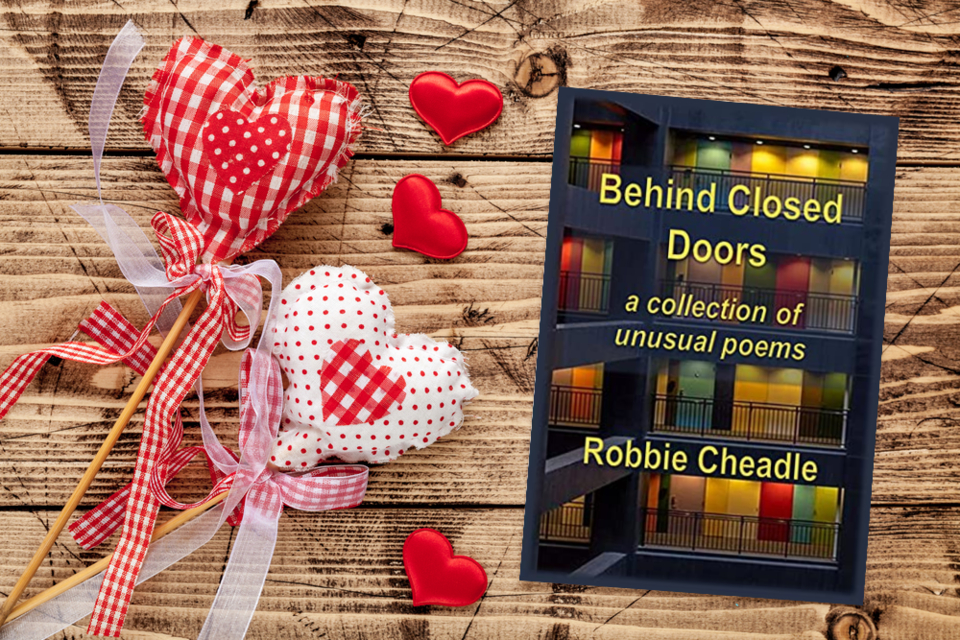
To round this post off, I am sharing a poem I wrote about letting go. It is included in my book, Behind Closed Doors.
He walks away by Robbie Cheadle
From the first day
he took a tentative step
on uncertain chubby legs
attached to adventurous feet
he moved away from her
embracing with enthusiasm
the mysterious outside world
She watched over him tenderly
as he learned about life
discovered the joy of friendship
and the heartbreak of loss
embarked on his academic journey
exploiting his strengths and
overcoming his weaknesses
and during all this time
mom was always enough
her smile healed all wounds
her kiss cured all pain
but she knew in her heart
that this investment of hers
was ultimately for another
a nameless faceless other
who would eventually take her place
she was preparing him to leave
and find his place in this world
His independence draws ever closer
her smile no longer enough
as he jostles for position
in the heartless world of men
her kiss no longer wanted
as he seeks the lips of the other
It’s heart wrenching to let go
knowing he must suffer pain
before he finds his enduring love
encounter setbacks and loss
before success and satisfaction
but it’s the duty of a mother
to set her son loose
to fly alone
About Robbie Cheadle
Robbie Cheadle is a South African children’s author and poet with 9 children’s books and 2 poetry books.
The 7 Sir Chocolate children’s picture books, co-authored by Robbie and Michael Cheadle, are written in sweet, short rhymes which are easy for young children to follow and are illustrated with pictures of delicious cakes and cake decorations. Each book also includes simple recipes or biscuit art directions which children can make under adult supervision.
Robbie has also published 2 books for older children which incorporate recipes that are relevant to the storylines.
Robbie has 2 adult novels in the paranormal historical and supernatural fantasy genres published under the name Roberta Eaton Cheadle. She also has short stories in the horror and paranormal genre and poems included in several anthologies.
Robbie writes a monthly series for https://writingtoberead.com called Growing Bookworms. This series discusses different topics relating to the benefits of reading to children.
Robbie has a blog, https://robbiesinspiration.wordpress.com/ where she shares book reviews, recipes, author interviews, and poetry.
Find Robbie Cheadle
Blog: https://www.robbiecheadle.co.za/
Blog: robbiesinspiration.wordpress.com
Twitter: BakeandWrite
Instagram: Robbie Cheadle – Instagram
Facebook: Sir Chocolate Books
______________________________________________________________________________________________
Want to be sure not to miss any of Robbie’s “Growing Bookworms” segments? Subscribe to Writing to be Read for e-mail notifications whenever new content is posted or follow WtbR on WordPress. If you found it interesting or entertaining, please share.
Share this:

Treasuring Poetry 2022 – Robbie Cheadle discusses the War Poets
Posted: January 19, 2022 Filed under: Historical Fiction, Historical Inspiration, Poetry, Treasuring Poetry, Writing | Tags: Poetry, Robbie Cheadle, Siegfried Sassoon, Treasuring Poetry, Vera Brittain, Walt Page, Writing to be Read 50 CommentsThe poet I was hoping to feature today, Walt Page, has been unwell and was unable to participate. I decided that I would share a beautiful poem of Walt’s today called Sometimes When it Rains. Walt told me I was the inspiration for this poem and I love it.

Sometimes when it rains
Sometimes when it rains
she loves to go walking
snuggled inside
her warm rain jacket
Walking in the rain
is a sanctuary for her
a time when she can
create her poetry
it is her time alone
to be inspired
she loves being with her family
and she loves creating her poetry
those of us who follow her poetry
are blessed with her friendship
we know she is probably out walking
and we look forward to her new poems
~The Tennessee Poet~
©Walt Page 2020 All Rights Reserved
Walt is currently on a sabbatical from writing poetry, but he has years of wonderful poetry available to readers of his blog here: https://waltswritingsonlife.wordpress.com/
For the past 14 months, I have been deeply down a WW1 hole, reading book after book about this devastating and world-changing war.
My interest in books about WW1 is due partly to my general fascination with war and partly as research for my work in progress, The Soldier and the Radium Girl, a novel set in the USA and France from 1917 to October 1939.
My interest in war poetry was sparked by Sally Cronin from Smorgasbord Blog Magazine who shares poems by the war poets during the week leading up to Remembrance Day.
This year, Sally shared poems by two specific war poets which interested me so much, I read up about them and subsequently read one of each of their works.
Siegfried Sassoon

This is what Wikipedia says about Siegfried Sassoon:
“Siegfried Loraine Sassoon CBE MC (8 September 1886 – 1 September 1967) was an English war poet, writer, and soldier. Decorated for bravery on the Western Front, he became one of the leading poets of the First World War. His poetry both described the horrors of the trenches and satirised the patriotic pretensions of those who, in Sassoon’s view, were responsible for a jingoism-fuelled war. Sassoon became a focal point for dissent within the armed forces when he made a lone protest against the continuation of the war in his “Soldier’s Declaration” of 1917, culminating in his admission to a military psychiatric hospital; this resulted in his forming a friendship with Wilfred Owen, who was greatly influenced by him. Sassoon later won acclaim for his prose work, notably his three-volume fictionalised autobiography, collectively known as the “Sherston trilogy”.”
Siegfried Sassoon features as a main character in Regeneration by Pat Barkers. I had just finished this book when I read Sally’s post about him: https://smorgasbordinvitation.wordpress.com/2021/11/11/smorgasbord-blog-magazine-poetry-rewind-in-remembrance-the-war-poets-siegfried-loraine-sassoon-cbe-mc-by-sally-cronin/
You can read my review of Regeneration here: https://www.goodreads.com/review/show/4354087186
I elected to read The War Poems by Siegfried Sassoon available from Amazon here: https://www.amazon.com/gp/product/0571202659/

Over the past few years, I have read the odd poem by Siegfried Sassoon and found them to be very moving. These poetic encounters were usually on Poppy Day when the world commemorates both WW1 and WW2. Although I had a high level appreciation of this war and knew about trenches and a little of the horror, I had never studied WW1 or read much about it outside of these Poppy Day poems.
Over the course of the last 14 months, I have been extensively researching WW1 and have read a number of books detailing life for both the soldiers in France and for the civilian populations at home. My research has covered the British, French, South African, and American perspectives of WW1. These books, which included All Quiet on the Western Front by Erich Maria Remarque, Farewell to Arms by Ernest Hemmingway, Testament of Youth by Vera Brittain, and Regeneration by Pat Barker, really opened my eyes about the dreadful conditions in the trenches, the filth, the rats, the dead bodies, and the fear, as well as the heartbreak of losing a generation of young men. As a result of all this reading and my immersement in life during this time of worldwide conflict, my appreciation and understanding of Sassoon’s war poetry grow and I decided to read it all.
Reading this book was an excellent investment of my time and energy. Siegried Sassoon’s words are powerful and hard-hitting, striking right to the core of the war time experiences of these young men – their hopes and dreams dying around them along with their friends and leaders. This is a book that all youngers should read, after being given some context to WW1, so that this time can be remembered and timeous steps taken to prevent a re-occurrence at any future date. Remembering history and the mistakes of mankind, are best weapons against complacency.
The poem that moved me the most in this collection was The death-bed. You can listen to me reading it here:
Vera Brittain

What Wikipedia says about Vera Brittain:
“Vera Mary Brittain (29 December 1893 – 29 March 1970) was an English Voluntary Aid Detachment (VAD) nurse, writer, feminist, socialist[1] and pacifist. Her best-selling 1933 memoir Testament of Youth recounted her experiences during the First World War and the beginning of her journey towards pacifism.”
You can read more about Vera Brittain here: https://en.wikipedia.org/wiki/Vera_Brittain
I recently read Vera’s memoir Testament of Youth and posted by review to Roberta Writes here: https://robertawrites235681907.wordpress.com/2022/01/19/roberta-writes-book-review-testament-of-youth-by-vera-brittain/
In conclusion
Finally, I am sharing one of my poems about a different kind of silent war. One that can still be contained and prevented from destroying our planet through carbon emissions and overuse of plastic if we reign it in. A compromise can be reached between profits and sustainability.
The Corporate Giant
It rears upwards
into the blue sky,
a monstrosity
of reflective glass, and
shiny stainless steel
towering over
the ant-sized people
who scurry about
in its imposing shadow.
***
An emotionless giant
it is bereft of a soul,
It feeds on small businesses
corner cafes, fruit and nut shops
independent butcheries, bakeries,
confectionaries and cake shops.
Even book sellers and
small stationers
are swallowed whole
disappearing into the gaping maw
of the corporate giant.
***
It shreds and ingests
taking the sustenance it seeks
spitting out the bones
independence and individuality
creativity and the unique
mere entrails, unwanted and discarded.
***
It stamps on difference
in its pursuit of profits
imperfections and blemishes
an unacceptable blight
on a perfect track record.
***
What remains will finally
emerge as a mirror
reflecting the sameness
uniformity and consistency
it holds so dear.
***
Providing its market
with the conformity
and rigidness
that has taken over
and turned the world grey.
About Robbie Cheadle
Robbie Cheadle is a South African children’s author and poet with 9 children’s books and 2 poetry books.
The 7 Sir Chocolate children’s picture books, co-authored by Robbie and Michael Cheadle, are written in sweet, short rhymes which are easy for young children to follow and are illustrated with pictures of delicious cakes and cake decorations. Each book also includes simple recipes or biscuit art directions which children can make under adult supervision.
Robbie has also published 2 books for older children which incorporate recipes that are relevant to the storylines.
Robbie has 2 adult novels in the paranormal historical and supernatural fantasy genres published under the name Roberta Eaton Cheadle. She also has short stories in the horror and paranormal genre and poems included in several anthologies.
Robbie writes a monthly series for https://writingtoberead.com called Growing Bookworms. This series discusses different topics relating to the benefits of reading to children.
Robbie has a blog, https://robbiesinspiration.wordpress.com/ where she shares book reviews, recipes, author interviews, and poetry.
Find Robbie Cheadle
Blog: https://www.robbiecheadle.co.za/
Blog: robbiesinspiration.wordpress.com
Twitter: BakeandWrite
Instagram: Robbie Cheadle – Instagram
Facebook: Sir Chocolate Books
______________________________________________________________________________________________
Want to be sure not to miss any of Robbie’s “Treasuring Poetry” segments? Subscribe to Writing to be Read for e-mail notifications whenever new content is posted or follow WtbR on WordPress. If you found it interesting or entertaining, please share.
Share this:

Growing Bookworms: Books to help children cope with change
Posted: January 12, 2022 Filed under: Books, Children's Books, Growing Bookworms, Reading | Tags: Children's Books, Coping Skills, Growing Bookworms, Reading, Teaching Life Skills, Writing to be Read 69 CommentsWelcome to the first post of 2022 in the Growing Bookworms series.
A lot of people and children face change at the beginning of a new calendar year. In the Southern Hemisphere, children change grades and sometimes schools. Parents often change jobs and this can trigger changes to homes, schools, cities, and even countries.
Adults are better equipped to cope with change because they have more experience of life than children. Adults have already transitioned from junior school to high school and then often on to a tertiary education institution. Most adults have looked for, and gained, employment and have moved from their parents home to their own dwelling. Some adults have moved jobs and homes numerous times. As a result of the many life changes most adults have faced, they have learned strategies to help them cope with the anxieties and concerns that arise from major life changes.
Children often have not faced big changes in their lives before and can be frightened and intimidated by anticipated changes to their routines and friendships. Most children thrive on predictability and repetition.
Reading books to children about child characters who have faced and successfully managed big life changes can be reassuring and give some context to change. Books can also be conversation starters for children and enable them to verbalise their worries and anxieties.
The following three books are popular chapter books for children that centre around successful adaption to change.
The Secret Garden by Francis Hodgson Burnett
![The Secret Garden :illustrated Edition by [Frances Hodgson Burnett]](https://m.media-amazon.com/images/I/51e-cGecPaL.jpg)
What Amazon says
When orphaned Mary Lennox comes to live at her uncle’s great house on the Yorkshire Moors, she finds it full of secrets. The mansion has nearly one hundred rooms, and her uncle keeps himself locked up. And at night, she hears the sound of crying down one of the long corridors.
The gardens surrounding the large property are Mary’s only escape. Then, Mary discovers a secret garden, surrounded by walls and locked with a missing key. With the help of two unexpected companions, Mary discovers a way in—and becomes determined to bring the garden back to life.
Purchase link: https://www.amazon.com/Secret-Garden-Frances-Hodgson-Burnett-ebook/dp/B09Q3QQ4NQ
A short extract relevant to change:
“When she opened her eyes in the morning it was because a young housemaid had come into her room to light the fire and was kneeling on the hearth-rug raking out the cinders noisily. Mary lay and watched her for a few moments and then began to look about the room. She had never seen a room at all like it and thought it curious and gloomy. The walls were covered with tapestry with a forest scene embroidered on it. There were fantastically dressed people under the trees and in the distance there was a glimpse of the turrets of a castle. There were hunters and horses and dogs and ladies. Mary felt as if she were in the forest with them. Out of a deep window she could see a great climbing stretch of land which seemed to have no trees on it, and to look rather like an endless, dull, purplish sea.
“What is that?” she said, pointing out of the window.
Martha, the young housemaid, who had just risen to her feet, looked and pointed also. “That there?” she said.
“Yes.”
“That’s th’ moor,” with a good-natured grin. “Does tha’ like it?”
“No,” answered Mary. “I hate it.”
“That’s because tha’rt not used to it,” Martha said, going back to her hearth. “Tha’ thinks it’s too big an’ bare now. But tha’ will like it.”
“Do you?” inquired Mary.
“Aye, that I do,” answered Martha, cheerfully polishing away at the grate. “I just love it. It’s none bare. It’s covered wi’ growin’ things as smells sweet. It’s fair lovely in spring an’ summer when th’ gorse an’ broom an’ heather’s in flower. It smells o’ honey an’ there’s such a lot o’ fresh air—an’ th’ sky looks so high an’ th’ bees an’ skylarks makes such a nice noise hummin’ an’ singin’. Eh! I wouldn’t live away from th’ moor for anythin’.”
Mary listened to her with a grave, puzzled expression. The native servants she had been used to in India were not in the least like this. They were obsequious and servile and did not presume to talk to their masters as if they were their equals. They made salaams and called them “protector of the poor” and names of that sort. Indian servants were commanded to do things, not asked. It was not the custom to say “please” and “thank you” and Mary had always slapped her Ayah in the face when she was angry. She wondered a little what this girl would do if one slapped her in the face. She was a round, rosy, good-natured-looking creature, but she had a sturdy way which made Mistress Mary wonder if she might not even slap back—if the person who slapped her was only a little girl.”
The Railway Children by E. Nesbit
![The Railway Children Illustrated by [E. Nesbit]](https://m.media-amazon.com/images/I/510qoeODteL.jpg)
What Goodreads says
In this much-loved children’s classic first published in 1906, the comfortable lives of three well-mannered siblings are greatly altered when, one evening, two men arrive at the house and take their father away. With the family’s fortunes considerably reduced in his absence, the children and their mother are forced to live in a simple country cottage near a railway station. There the young trio—Roberta, Peter, and young Phyllis—befriend the porter and station master.
The youngsters’ days are filled with adventure and excitement, including their successful attempt to avert a horrible train disaster; but the mysterious disappearance of their father continues to haunt them.
The solution to that painful puzzle and many other details and events of the children’s lives come to vivid life in this perennial favorite, a story that has captivated generations of readers and, more recently, delighted television and movie audiences. In this inexpensive, unabridged edition, it will charm a whole new audience of young readers with its warmth and appeal.
Amazon Purchase link: https://www.amazon.com/dp/B09Q3GZSRF
A short extract relevant to change:
This is a short reading of a paragraph pertinent to change in this delightful children’s book:
Little House on the Prairie by Laura Ingalls Wilder

What Amazon says
The adventures continue for Laura Ingalls and her family as they leave their little house in the Big Woods of Wisconsin and set out for the big skies of the Kansas Territory. They travel for many days in their covered wagon until they find the best spot to build their house. Soon they are planting and plowing, hunting wild ducks and turkeys, and gathering grass for their cows. Just when they begin to feel settled, they are caught in the middle of a dangerous conflict.
The nine Little House books are inspired by Laura’s own childhood and have been cherished by generations of readers as both a unique glimpse into America’s frontier history and as heartwarming, unforgettable stories.
Purchase link: https://www.amazon.com/Little-House-Prairie-Ingalls-Wilder-ebook/dp/B01C2LYEOC
Reading of Chapter 1 of Little House on the Prairie by Jennie
Jennie has been teaching pre-school for over thirty years. You can find her blog here: https://jenniefitzkee.com/2022/01/08/the-morning-after-the-snow-memories-of-a-classic-childrens-book/
About Robbie Cheadle
Robbie Cheadle is a South African children’s author and poet with 9 children’s books and 2 poetry books.
The 7 Sir Chocolate children’s picture books, co-authored by Robbie and Michael Cheadle, are written in sweet, short rhymes which are easy for young children to follow and are illustrated with pictures of delicious cakes and cake decorations. Each book also includes simple recipes or biscuit art directions which children can make under adult supervision.
Robbie has also published 2 books for older children which incorporate recipes that are relevant to the storylines.
Robbie has 2 adult novels in the paranormal historical and supernatural fantasy genres published under the name Roberta Eaton Cheadle. She also has short stories in the horror and paranormal genre and poems included in several anthologies.
Robbie writes a monthly series for https://writingtoberead.com called Growing Bookworms. This series discusses different topics relating to the benefits of reading to children.
Robbie has a blog, https://robbiesinspiration.wordpress.com/ where she shares book reviews, recipes, author interviews, and poetry.
Find Robbie Cheadle
Blog: https://www.robbiecheadle.co.za/
Blog: robbiesinspiration.wordpress.com
Twitter: BakeandWrite
Instagram: Robbie Cheadle – Instagram
Facebook: Sir Chocolate Books
______________________________________________________________________________________________
Want to be sure not to miss any of Robbie’s “Growing Bookworms” segments? Subscribe to Writing to be Read for e-mail notifications whenever new content is posted or follow WtbR on WordPress. If you found it interesting or entertaining, please share.
Share this:

Treasuring Poetry – An introduction to Word Weaving #1: A Word Craft Journal of Syllabic Verse edited and compiled by Colleen Chesebro and Jules Paige
Posted: December 18, 2021 Filed under: Anthology, Book Review, Books, Interview, Poetry, Treasuring Poetry, Writing | Tags: Anthology, Colleen Chesebro, Interview, Poetry, Robbie Cheadle, Treasuring Poetry, Word Weaving#1: A Word Craft Journal of Syllabic Verse, Writing to be Read 78 Comments
Today, I am delighted to introduce you to Word Weaving #1: A Word Craft Journal of Syllabic Verse, The Moons of Autumn, a delightful collaboration of syllabic poems by a variety of poets, edited and compiled by Colleen Chesebro and Jules Paige.
By way of background, Colleen Chesebro has run a weekly syllabic poetry challenge on her blog, Word Craft: Poetry and Prose for years. She has been a guiding light to the poetry community, sharing her knowledge about the many different forms of syllabic poetry and encouraging poets to experiment and all learn together.

What inspired you to put together a poetry anthology, is it a once off or will there be others?
My inspiration for the syllabic poetry journal came about when I realized that many of the poets who joined in my weekly challenge did not have the ways or means to publish their own books of poetry. I envisioned a yearly journal filled with creative syllabic forms. I’m not aware of another journal that presents both Japanese and American versions of syllabic poetry. This is a different concept and I think it has paid off.
Also, to note, the poet’s retained ownership of the poems submitted to the journal. All rights reverted to the respective author/artist upon publication. All we asked, was if their work was republished, we appreciated a mention that the Word Weaving Poetry Journal was the first place of publication.
While I planned this journal, I realized I wanted to host a poetry contest on wordcraftpoetry.com with paid prizes. It was logical to use the royalties from the sale of the Word Weaving Journal to pay for the prizes. As for another journal… I’ll let you know after the poetry contest in 2022. I’m aiming for the month of June for the contest on wordcraftpoetry.com. I’ll reevaluate at that time.
Which poem in the anthology touched you the most? Please provide the test of the poem and the author
This is a hard question to answer. My co-editor, Jules Paige and I first selected our favorites. We deliberated for some time over the poems… they were all so good! In the end we selected Ken Gierke’s gogyohka poem:
warmth of a pale light
found as clouds part
rewarded
while seeking the moon
on a cool autumn night
© Ken Gierke
We both felt this gogyohka best illustrated the concept of the “Moons of Autumn.” At the end of the Journal, Jules and I shared our three favorite poems by D. L. Finn, Merril D. Smith, and Ken Gierke.
If I had to go in deeper, my next favorite would be D. Wallace Peach’s tanka prose Idyll. The imagery in this poem is one of my favorites.
“Moon-spun”
November’s moon spins upon the tip of a white fir. Her fairy light whispers across the glades where alders part their leafless fingers into spindly shadows. The night glow sends the trolls trudging into the deep forest, brittle twigs crunching beneath their knobby feet. With nothing to fear, the deer lie down in a silver meadow. Old owl watches the coyotes croon to autumn’s stark beauty as they whiff the delicate scent of the coming snow.
a moon’s enchantment
befalls the northern forest
her magical light
banishes luring prowlers
inviting the night to sing
© D. Wallace Peach
What attracts you to syllabic poetry as opposed to other forms like freestyle and rhyming verse?
Syllabic poetry, especially the Japanese forms with their brevity of words, fills a special place in my heart. Not only do I like writing these forms, but I also enjoy reading what others have written. There is a simple beauty in haiku that I don’t find in other forms. Written mindfully, haiku are small poems with large meaning. It’s those a-ha moments of connection, I find the most pleasing.
For example:
summer clouds—
kayakers floating
the river
© Colleen M. Chesebro
In this haiku, I worked on imagery. The idea was to connect emotions by associating two or more images together in strange and unusual ways. It’s not as easy as it sounds. I find it is always best to look for alike or contrasting images to feature in my poem.
I targeted the “summer (my kigo) clouds” and the “kayakers floating the river,” as a summer activity. Clouds float – kayakers float, which are alike images.
A haiku should present an event in an image. It should SHOW us what happened without telling us about it or what emotion to feel. In the haiku above, what emotions do you feel?
Haiku poems share a specific event or observation. Haiku are not generalities, and we never use a simile or metaphor. Most haiku are written in seventeen onji (Japanese sounds) which equates to around twelve syllables (3, 5, 3). Most rhyming poetry doesn’t give me the same emotional impact as the simple haiku does. Although, I do enjoy creating some of the syllabic forms that use rhyme and meter.
What advice can you give people setting out on the path of writing poetry?
Poetry is about expression and creativity. Poets should write poetry daily. If you don’t practice, how can you perfect your craft? I write my poetry on my author blog at colleenchesebro.com and in a handwritten journal.
It’s best to get involved in a poetry community with poetry challenges where you can stretch your wings and try new things like we do on wordcraftpoetry.com. If you can’t find a challenge you like, start your own! Learning how to comment, critique, and write about the work of another poet is crucial to your own poetic journey.
Write more poetry! Find what forms bring you the most joy to write. Write them! Then, learn everything you can about that type of poetry.
Submit your poetry to literary journals and contests. I’ve had more poetry rejected than accepted, but that hasn’t stopped me yet.
What are your plans for Word Craft: Prose & Poetry going forward?
Wordcraftpoetry.com will continue to be a safe place to write syllabic poetry. We’re in our fifth year of the #TankaTuesday Poetry Challenge. Each week, I strive to make the challenges interesting. In 2022, we will have a few new prompts to freshen up our creativity. I will continue to feature a poet and their poem almost every week. Depending on the challenge week, the poet will choose the prompt for the next month’s challenge. It’s important to me to involve the poets in the challenges. That is what community is all about. Stay tuned. Who knows what I’ll think of next!
Thanks so much, Robbie for featuring me and the Word Weaving Journal on Treasuring Poetry.

Author biography
Colleen M. Chesebro is a Michigan Poet who loves crafting syllabic poetry, flash fiction, and creative fiction and nonfiction. She sponsors a weekly poetry challenge, called #TankaTuesday, on wordcraftpoetry.com where participants learn how to write traditional and current forms of syllabic poetry.
Along with JulesPaige, Colleen is also a co-editor of “Word Weaving, a Word Craft Journal of Syllabic Verse,” at wordweavingpoetryjournal.com. The debut issue of the journal published October 2021, with a kindle and print version of the journal.
Colleen’s syllabic poetry has appeared in various other online publications. Recently, she created the Double Ennead, a 99-syllable poetry form for the Carrot Ranch literary community at carrotranch.com. She hosts a challenge as a guest of the Saloon, every third Monday of the month.
Colleen’s poetry has poetry in various anthologies and journals including “Hedgerow-a journal of small poems,” and “Poetry Treasures,” a collection of poetry from the poet/author guests of Robbie Cheadle on the “Treasuring Poetry” blog series on “Writing to be Read” in 2020.
Colleen published “Word Craft: Prose & Poetry, The Art of Crafting Syllabic Poetry,” which illustrates how to write various syllabic poetry forms used in her Tanka Tuesday challenges; and a collection of poetry, flash fiction, and short stories called, “Fairies, Myths & Magic: A Summer Celebration,” dedicated to the Summer Solstice. She contributed a short story called “The Changeling,” in the “Ghostly Rites Anthology 2020,” published by Plaisted Publishing House.
Find Colleen Chesebro
Find Colleen at Word Craft: Prose & Poetry at wordcraftpoetry.com.
Find Colleen’s author blog at colleenchesebro.com.
Find Colleen’s pagan blog at awitchsbrew.wordpress.com
My review of Word Weaving #1: A Word Craft Journal of Syllabic Verse
This book, edited and collated by talented poets Colleen Chesebro and Jules Paige, is a delightful collection of meaningful poems by a variety of different contributors. The theme of the book is Harvest Moon and each poem gives insight into the meaning of this expression to the particular poet. Some poems are practical and some are ethereal, yet others are colourful and then there are the silvery ones, but they all share the common feature of being beautiful.
The poems in the book demonstrate as wide a variety of styles as there are contributors, with a common thread of all being syllabic. I came across a number of forms that were new to me, including senryu, haiga, and gogyohka among otehrs. There are also the more familiar syllabic forms such as haiku, tanka, haibun, tanka prose, etheree, nonet, shadorma, and cinquain.
My favourite poem in this collection is written by Kerfe Roig. I like it because it is filled with mystery and delight:
“who is this Other
come to greet me
glittering shadowed
behind and before
a changeling of light”
All the poems are gorgeous and this collection is a most worthwhile read for poetry lovers.
What Amazon says
Word Weaving is a yearly poetry journal, and for our first issue, we bring you poetry crafted from a broad mix of new and established voices across the spectrum of Japanese and American syllabic poetry forms. Enjoy this collection of poems that celebrate the Moons of Autumn.Contributing Poets:
Annette Rochelle Aben, Mona Bedi, Nancy Brady, Colleen M. Chesebro, Goutam Dutta, Bill Engleson, Elizabeth F., Andreea Finichiu, D.L. Finn, Jeff Flesch, Ken Gierke, Franci Hoffman, Thom Kerr, Sujata Khanna, Ruth Klein, Jules Paige, D. Wallace Peach, Gwen M. Plano, M. J. Mallon, R.V. Mitchell, Elaine Patricia Morris, Lisa Smith Nelson, Pat Raffington, Susmita Ramani, Kerfe Roig, Aishwarya Saby, Akhila Siva, Merril D. Smith, Willow Willers, and Cheryl Wood.
About Robbie Cheadle
Robbie Cheadle is a South African children’s author and poet with 9 children’s books and 2 poetry books.
The 7 Sir Chocolate children’s picture books, co-authored by Robbie and Michael Cheadle, are written in sweet, short rhymes which are easy for young children to follow and are illustrated with pictures of delicious cakes and cake decorations. Each book also includes simple recipes or biscuit art directions which children can make under adult supervision.
Robbie has also published 2 books for older children which incorporate recipes that are relevant to the storylines.
Robbie has 2 adult novels in the paranormal historical and supernatural fantasy genres published under the name Roberta Eaton Cheadle. She also has short stories in the horror and paranormal genre and poems included in several anthologies.
Robbie writes a monthly series for https://writingtoberead.com called Growing Bookworms. This series discusses different topics relating to the benefits of reading to children.
Robbie has a blog, https://robbiesinspiration.wordpress.com/ where she shares book reviews, recipes, author interviews, and poetry.
Find Robbie Cheadle
Blog: https://www.robbiecheadle.co.za/
Blog: robbiesinspiration.wordpress.com
Twitter: BakeandWrite
Instagram: Robbie Cheadle – Instagram
Facebook: Sir Chocolate Books
______________________________________________________________________________________________
Want to be sure not to miss any of Robbie’s “Treasuring Poetry” segments? Subscribe to Writing to be Read for e-mail notifications whenever new content is posted or follow WtbR on WordPress. If you found it interesting or entertaining, please share.
Share this:

Growing Bookworms – Teaching children about charity
Posted: December 8, 2021 Filed under: Books, Children's Books, Education, Inspirational | Tags: Charity, Giving, Growing Bookworms, Parenting, Robbie Cheadle, Teaching, Writing to be Read 51 Comments
Christmas is just around the corner and many people are gearing up for holidays, family gatherings, presents, and lots of delicious food. Of course, not everyone is in this privileged position and there are millions of people who will not have any of these things.
I thought December would be a good time to write about teaching children about charity.
People who care about earth and the people and animals we share it with want to raise generous children who understand the importance of charity and giving back to society. It is a good idea to raise the concept of charity with our children early on and this can be done in a way that doesn’t scare them or make them fearful.
From a young age, I told my children that while there are many children whose families are wealthier than we are and who have more than we do, there are millions of children who have far less. We discussed children that have lost their parents and who are living in orphanages or as foster children. We spoke about schools that give children a hot meal at lunch time and I explained that for some of those children it is the only meal they get in a 24-hour period.
I tried to involve my boys in my own charity activities which included making up packs of groceries for needy pensioners, donating books to underprivileged schools, and giving used clothing to various charities.
When children are part of activities that help others who are less fortunate than they are, it gives them a sense of perspective about their own good fortune to have a nice home, food to eat, and schooling. As they get older, they will also learn to appreciate a loving and supportive family. Being generous helps children learn to appreciate what they have and be more grateful. It makes them feel useful and fosters empathy.
My children have both grown into caring and empathetic young men who see a need and are willing to put their own money and time behind helping other people.
Quote from Michael: “Children need to learn about charity because people have to work together to create a good environment.”
Every Christmas, my sons and I undertake 10 hours of community service each. Michael is auto-immune so we do their hours from the safety of our own home and, as Michael and I like to bake, our activities often involve these activities.
Last year we, the boys and I, made 150 goodie bags for the elderly residence of a local old age home. My nephews helped with this activity and the four boys baked and iced 80 gingerbread boys. I made 70 slices of shortbread and each bag contained a baked good, some chocolates, and a Christmas joke.


This year, we baked two beer-box cakes for a Christmas party for an underprivileged school. We had fun adding the sprinkles.

We are also making 150 Christmas crackers filled with three delicious chocolates for the old age home. So far we have made 40.

These are all fun activities to do with children, you can invite the kids in the neighbourhood or your nephews and nieces, and they bring a lot of joy to the recipients.
Another way of teaching children about giving and generosity is through reading to them.
I will never forget the scene from Little Women when Marmee asks her four daughters if they will give their Christmas breakfast away to a poor family:
“‘Merry Christmas, little daughters! I’m glad you began at once, and hope you will keep on. But I want to say one word before we sit down. Not far away from here lies a poor woman with a little newborn baby. Six children are huddled into one bed to keep from freezing, for they have no fire. There is nothing to eat over there; and the oldest boy came to tell me they were suffering hunger and cold. My girls, will you give them your breakfast as a Christmas present?’
They were all unusually hungry, having waited nearly an hour, and for a minute no one spoke; only a minute, for Jo exclaimed impetuously,—
‘I’m so glad you came before we began!’
‘May I go and help carry the things to the poor little children?’ asked Beth, eagerly.
‘I shall take the cream and the muffins,’ added Amy, heroically giving up the articles she most liked.”
This is just one of many wonderful books that teach children about sharing, giving and the real meaning of Christmas.
Another, one of my personal favourites, is How the Grinch Stole Christmas by Dr Seuss.
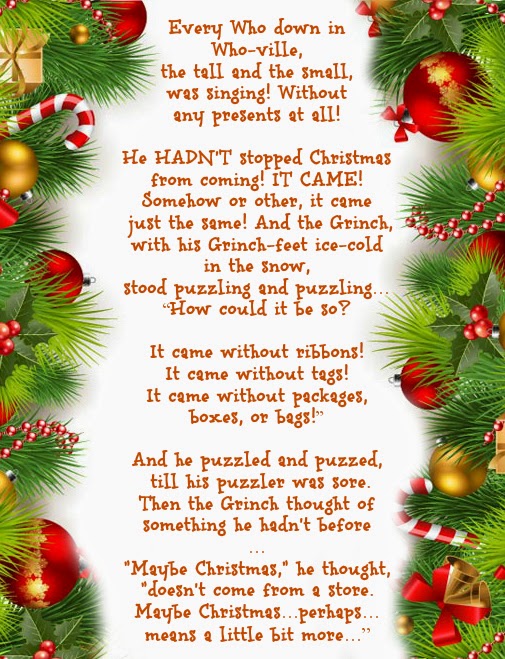
I must admit that every time I read that quote I get goosebumps.
This is the last Growing Bookworms post for 2021. If you celebrate, I wish you and your families a wonderful Christmas and all the best for the New Year. If you don’t celebrate Christmas, have a happy holiday period.
About Robbie Cheadle
Robbie Cheadle is a South African children’s author and poet with 9 children’s books and 2 poetry books.
The 7 Sir Chocolate children’s picture books, co-authored by Robbie and Michael Cheadle, are written in sweet, short rhymes which are easy for young children to follow and are illustrated with pictures of delicious cakes and cake decorations. Each book also includes simple recipes or biscuit art directions which children can make under adult supervision.
Robbie has also published 2 books for older children which incorporate recipes that are relevant to the storylines.
Robbie has 2 adult novels in the paranormal historical and supernatural fantasy genres published under the name Roberta Eaton Cheadle. She also has short stories in the horror and paranormal genre and poems included in several anthologies.
Robbie writes a monthly series for https://writingtoberead.com called Growing Bookworms. This series discusses different topics relating to the benefits of reading to children.
Robbie has a blog, https://robbiesinspiration.wordpress.com/ where she shares book reviews, recipes, author interviews, and poetry.
Find Robbie Cheadle
Blog: https://www.robbiecheadle.co.za/
Blog: robbiesinspiration.wordpress.com
Twitter: BakeandWrite
Instagram: Robbie Cheadle – Instagram
Facebook: Sir Chocolate Books
______________________________________________________________________________________________
Want to be sure not to miss any of Robbie’s “Growing Bookworms” segments? Subscribe to Writing to be Read for e-mail notifications whenever new content is posted or follow WtbR on WordPress. If you found it interesting or entertaining, please share.
Share this:

Treasuring Poetry – Meet poet, Lauren Scott, and a review
Posted: November 13, 2021 Filed under: Uncategorized 68 CommentsToday, I am delighted to introduce poet and blogger, Lauren Scott. I met Lauren recently through another blogging friend and I am delighted by her beautiful poetry and posts about hiking adventures with her husband.
Take it away, Lauren.
Which of your own poems is your favorite?
I narrowed it down to two favorites: “Simple Existence” and “To My Babies.”
Simple Existence
I stare at this page, milk white as the
blanketed ground in winter’s staging.
Where are the syllables?
***
I fear they have flown to faraway places,
across desert dunes and boundless oceans
and might not return so that I may tell him
(again) how irreplaceable he is.
***
Instead, I’ll touch his lips with mine
and steady myself in the arms of a man
who is satisfied with my simple existence.
To My Babies
You are a new bloom in our family garden,
too little to understand the deepest emotions.
Cradled in my warmth, I watch your tiny lips
form a smile, so unaware of reality’s sharp edges.
Your laugh, my melody. Your cries, my lament.
I am your buffer, guarding you from shadows.
I delight in each change as you evolve into your true self.
For all tomorrows, you will be in my heart
as time prepares you to fly, to realize your own life
What inspired you to write these particular poems?
My husband and I have been married for almost 33 years. He is literally my best friend, so our relationship has provided an abundance of writing inspiration. “Simple Existence” is a favorite because it exemplifies my absolute love for him, as well as his unconditional love for me that harbors no expectations to change me in any way. I can’t ask for anything more. After two years of marriage, we began to grow our family.
Our daughter was born first, and our son was born three years later. Becoming a mother was another euphoric experience. I wrote “To My Babies” when our children were infants, and even though they’re now adults, they are my life as much as my husband is. My words in this poem aren’t meant to be complex, but it is their depth and my emotions that I strive to underscore, sentiments only a parent will understand. Family is beyond precious to me, and therefore, the words flow effortlessly.
Which genre of poetry do you enjoy writing the most and why?
I enjoy writing Free Verse the most because there are no restrictions or rules. I simply let the words fall and arrange to my liking.
Which genre of poetry do you enjoy reading the most?
Free Verse is also my favorite genre of poetry to read, but I aspire to learn from reading other forms, as well.
What is your favorite poem?
Mary Oliver is one of my favorite poets, and “Storage” is a poem that stands out no matter how often I flip through the pages of her book, Felicity. This poem continuously delivers the same effect, resonating with me as I grow older. “Things” just don’t matter. Family matters. Friends matter. The relationships in my life are what I hold close to my heart. And making room in our hearts for more Love and reveling in Nature’s gifts, well, what could be worth more?
Storage
When I moved from one house to another
there were many things I had no room
for. What does one do? I rented a storage
space. And filled it. Years passed.
Occasionally I went there and looked in,
but nothing happened, not a single
twinge of the heart.
As I grew older the things I cared
about grew fewer, but were more
important. So one day I undid the lock
and called the trash man. He took
everything.
I felt like the little donkey when
his burden is finally lifted. Things!
Burn them, burn them! Make a beautiful
fire! More room in your heart for love,
for the trees! For the birds who own
nothing – the reason they can fly.
More than coffee: Memories in verse and prose by Lauren Scott
My review
This lovely book is a mix of a memoir about the author/poet’s life with some beautiful freestyle poems included after each prose section to enhance the emotion and moments shared. The memoirs are relatable and cover delightful memories of family brought back through inherited items and stories shared by family members as well as the author’s own life experiences including achievements, romance, parental love, and overcoming fears. The author’s personality and humour comes through strongly in her writing and poetry, as well as her joy and pleasure in the simple things in life.
My favourite poem in this collection and the one that summarised for me the spirit and essence of this book is Fulfilled.
Fulfilled
Let me drink from the gaze in your eyes
Eyes that have me wildly mesmerized
Mesmerized under their vivid piercing spell
Spell which only you many cast over me
Me, with a heart madly in love
Love, a whirlwind of euphoric emotions so true
True in not only our hearts, but in our minds
Minds, fully aware of their endless thoughts
Thoughts so amorous of us entwined
Entwined in each other’s arms eternally,
Eternally, still to few seconds for our time together.
I recommend this book to people who enjoy basking in the bright rays of happiness in life.
Purchase More than Coffee: Memories in verse and prose
About Lauren Scott

Lauren is a writer of poetry and short memoirs who lives in Northern California with her husband of almost thirty-three years, Matthew, and their energetic canine, Copper; they have two grown children. She has authored two collections of poetry: New Day, New Dreams and Finding a Balance. Her recent book, More than Coffee, a memoir in verse and prose, was published in September of this year. This collection of poems and stories paints a picture of young dreams and fears from the early woes of childhood and teen years into adulthood where these dreams and fears transform.
Her writing projects are sometimes serious – drawn from painful subjects and raw emotions – or they spotlight her silly side – pulled from humorous moments captured in photographs. Lauren is inspired to write from her love of nature and the marvelous wild world that surrounds her: the smell of the woods, the sound of a babbling brook, and the chorus of birds singing. Recent backpacking trips with her husband along the California coast and Sierra Nevada mountains have stirred up thoughts to pen about love, lost friendship, family, and the possibility that anything can happen. Hikes along the Paper Mill Creek remind her that life is fragile. From trout hatchlings to swallowtail butterflies, Lauren marvels at how the world is interconnected and every living thing matters. She hopes her readers will find a little nugget of delight, comfort, or understanding in her poetry and stories – some detail that resonates with them beyond her words.
Find Lauren Scot
baydreamerwrites.com
Lauren Scott Amazon Author page
About Robbie Cheadle
Robbie Cheadle is a South African children’s author and poet with 9 children’s books and 2 poetry books.
The 7 Sir Chocolate children’s picture books, co-authored by Robbie and Michael Cheadle, are written in sweet, short rhymes which are easy for young children to follow and are illustrated with pictures of delicious cakes and cake decorations. Each book also includes simple recipes or biscuit art directions which children can make under adult supervision.
Robbie has also published 2 books for older children which incorporate recipes that are relevant to the storylines.
Robbie has 2 adult novels in the paranormal historical and supernatural fantasy genres published under the name Roberta Eaton Cheadle. She also has short stories in the horror and paranormal genre and poems included in several anthologies.
Robbie writes a monthly series for https://writingtoberead.com called Growing Bookworms. This series discusses different topics relating to the benefits of reading to children.
Robbie has a blog, https://robbiesinspiration.wordpress.com/ where she shares book reviews, recipes, author interviews, and poetry.
Find Robbie Cheadle
Blog: https://www.robbiecheadle.co.za/
Blog: robbiesinspiration.wordpress.com
Twitter: BakeandWrite
Instagram: Robbie Cheadle – Instagram
Facebook: Sir Chocolate Books
______________________________________________________________________________________________
Want to be sure not to miss any of Robbie’s “Treasuring Poetry” segments? Subscribe to Writing to be Read for e-mail notifications whenever new content is posted or follow WtbR on WordPress. If you found it interesting or entertaining, please share.