Posted: March 11, 2019 | Author: kayelynnebooth | Filed under: Blog Content, Dark Fantasy, Fantasy, Fiction, Science Fantasy, Science Fiction, World Building, Writing | Tags: Fantasy, sci-fi, Science Fantasy, Science Fiction, Writing to be Read |
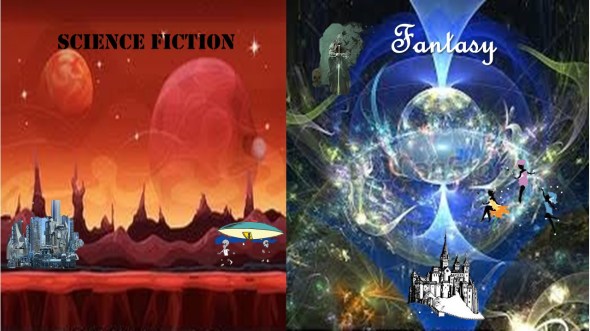
In March, Writing to be Read celebrates science fiction and fantasy, and everything in between. Science fiction springs from imaginings of what ifs, regarding technological advancements and futuristc worlds and universes, while fantasy fiction involves impossible or improbable events usually involving magic, or magical creatures or objects grounded in myths, legends and folklore of old. Both of these genres takes us to fantasical places and awe readers with amazing feats of courage, and good usually overpowers evil. Both entertain us, and are often addicting. In the current book market, there are many books which fall into a genre that is somewhere in between.
There are more subgenres for both of these genres than a person is able to count, including stories which feature elements of both. When I wrote my thesis proposal for what will one day be my science fantasy series, Playground for the Gods, I was told there was no genre for a story with both science fiction and fantasy elements. But in fact, there is such a genre as science fantasy, and there are many books out there today that fall into it. I recently reviewed one featuring alien life forms and a powerful magic object, Rogue Crystal, by Jordan Elizabeth in last Friday’s post.
As mentioned above, Playground for the Gods was originally proposed as my thesis story. It is a tale of aliens, Atlans, who come to pre-historic Earth when their planet is destroyed, and act as gods and godesses, forming human beliefs about devine matters, and creating the fondation for myths and legends of ancient history. The character names were all chosen from ancient summerian names, and many of the subplots parrellel those same myths and legends, adding new twists. In order to maintain the appearance of gods, they use their advanced technologies to appear magical and all powerful, each one wielding the ability to fall into different personas throughout time, providing basis for all world myths and religions around the globe.
It’s a lot of story, and many said it was too big and couldn’t be done, so I broke it down into four novels, which follow the Atlan through earth’s history to present day, and perhaps even beyond Book 1: The Great Primordial Battle tells the tale of the Atlans arrival on Earth. and tells how the heroine, Innana tries to stop the same Atlans who caused the destruction of their home planet from detroying their new home, as well. All whhile working to find a cure for her sister, Ereshkigal’s wasting desiese which is eating her up from the inside out. This story is curently with my beta reader, although I was hoping she’d have it back to me by now, so I could share my excitement, because it is very close to being publication ready.
Among the great science fiction authors we find familiar names: Isaac Asimov, Ray Bradbury, and Edgar Rice Burroughs. More recently, we have Robin Wayne Bailey, Richard Bachman, who we all now know is Stephen King, Dean Koontz, John Scalzi and Kevin J. Anderson. (Don’t forget to catch my interview with Kevin J. Anderson next Monday on “Chatting with the Pros”. You won’t want to miss it.) Fantasy authrs who may come to mind are J.R.R. Tolkien, George R. Martin, J.K. Rowling, R.A. Salvator, Ray Bradbury, Stephen King, and Kevin J. Anderson. As you can see, there is some crossover of authors from one genre to the other; there are authors who write in both.
This month, in additon to my interview with K.J.A. and my review of Rogue Crystal, I also have my review of Kevin J. Anderson’s Selected Stories: Science Fiction Volume 2, and an interview with fantasy author Laurel McHargue. I do hope you’ll drop by.
P.S. Be sure to check out my science fiction time travel short, Last Call, and my dystopian short, “If You’re Happy and You Know It” in the Collapsar Directive science fiction anthology (Zombie Prirates Publishing).
Like this post? Subscribe to Writing to be Read for e-mail notifications whenever new content is posted or follow WtbR on WordPress.
Posted: March 8, 2019 | Author: kayelynnebooth | Filed under: Book Review, Books, Dark Fantasy, Fiction, Science Fantasy, Science Fiction | Tags: Book Review, Jordan Elizabeth, Rogue Crystal, Science Fantasy, Writing to be Read |

Rogue Crystal, by Jordan Elizabeth is a futuristic science fantasy adventure novel featuring magic weilding aliens and an unsuspecting heroine, who may be the key to saving the world, with several surprise twists along the way. Both science fiction and fantasy fans will enjoy this story, as it has elements from both genres.
Avery thought a trip to Scarya, a secret rendevous with her boyfriend diguised as a journey to the country of her ancestral origins for her parents benefit, would be a great time. But when her cousin’s archeology team uncovers a sword which draws her to it and then disappears, things begin to get a little freaky. Suddenly, it seems that everyone is after her and she doesn’t know who to trust. Except for DeClan, her boyfriend and long time sweetheart, whom she trusts explicitely. But something isn’t right. His uncnny ability to show up just when needed and his unconditional acceptance of what Avery tells him, no matter how strange or unusual makes the reader wonder if he might not be what he appears to be, as they uncover a centuries old family history of alien origins and a struggle to save the world. While all this is a little unsettling, it’s nothing compared to Avery’s surprise when she learns that she holds the crystal which holds the power to destroy the world.
This story combines elements of science fiction and fantasy into a well crafted adventure which fans of both genres can enjoy. I give Rogue Crystal four quills.

Kaye Lynne Booth does honest book reviews on Writing to be Read in exchange for ARCs. Have a book you’d like reviewed? Contact Kaye at kayebooth(at)yahoo(dot)com.
Posted: March 4, 2019 | Author: kayelynnebooth | Filed under: Books, Dark Fantasy, Fairy Tales, Fantasy, Fiction, Interview, Writing | Tags: Adult Fairytales, Author Interview, Author Profile, Fantasy, Laurel McHargue, Writing to be Read |
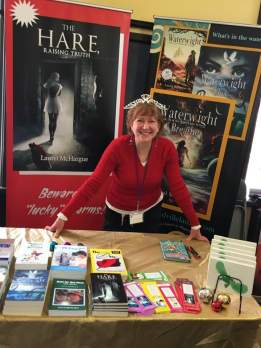
I’m talking today with fantasy author Laurel McHargue, a woman with a lot of energy. She’s written eight books including her Waterwight fantasy series and an adult fairytale, The Hare, Raising Truth, she hosts her own podcast, Alligator Preserves, is a former teacher and active community member, networks and promotes her works online, and finds time attend writing events for face to face interactions with her fans and potential new readers, as well as other authors. Even through email the positive energy radiates from this author. I could give you a lengthy fanfare on how impressed I am with this lady, but I think it’s better to let you see for yourselves. So, without further ado, please welcome Laurel Mchargue.
Kaye: Would you talk about your author’s journey? How did you come to come to be a writer?
Laurel: When I was quite young, I learned I could get attention by telling stories. As the fourth of five girls, I was low on the proverbial totem pole when it came to feeling important, so I had to be creative. I think my wild dreams helped, though eventually, my parents would roll their eyes when I’d come down in the morning with an “unbelievable” dream I’d just have to share. Who knew a dream would launch my first fantasy series? I didn’t then, but hey, I was just a kid!
Fast forward through a lifetime of unique experiences that people were curious about—I was frequently told, “You should really write about that!”—and I finally made the decision to make writing my career. I always did well in classes that required writing, and there were teachers along the way who encouraged me greatly.
I think I always knew I’d write stories someday, but until I made the commitment, it was always a “someday” kind of dream.
Kaye: What can you tell me about your YA fantasy series, Waterwight, and specifically about your Waterwight Breathe which will be released on March 15th?
Laurel: Waterwight started with a dream in which I was running away from bad guys through a dilapidated town, and I came up against a large body of water. The only way across it was to fly, and so I flew. Halfway across, however, I doubted my ability to make it to the other side and started to fall. A flying frog appeared and said, “Grab hold!” and I grasped his leg. He got me to the other side and then died in my arms. The dream had other elements I was able to use in my story as well. Anyway, I shared the dream with my author friend Carol Bellhouse (because I wasn’t living at home anymore!) and she told me I needed to write a story around it.
At the time, I’d never written fantasy, and the thought of turning a dream into a story thrilled and terrified me! Over the course of a year my story unfolded chapter by chapter, and by the time I got to the end, I wasn’t ready to leave my characters. I knew there was more for them to do, and there were questions I needed to answer. So, Waterwight Flux answers questions, develops characters, and sets up more challenges for Celeste, the orphaned protagonist.
I chose to write Waterwight Breathe, the final book, in first person present tense perspective after reading The Hunger Games. I love the immediacy of the thoughts and actions, and having the last book narrated by the protagonist seemed like the perfect way to end the series. I know it’s unconventional to have different points of view in the same series, but my life decisions have frequently been unconventional, and I have no regrets!
 Waterwight Breathe is available on March 15th, and it might be my favorite work yet. I couldn’t wait to get to the ending, the only part of the book I actually planned!
Kaye: You received three CIPA EVVY awards for the first book in the series. That’s quite an accomplishment. What is it about this book that makes it EVVY Award worthy?
Laurel: The CIPA EVVY awards are highly competitive, and each book is evaluated with a rubric—not against other submissions. The judges look at everything from cover design to editing to plot and character development. Waterwight is a fantasy adventure with mythical and mystical elements and a female protagonist; it received praise from Kirkus Reviews and many readers. I’d like to think those readers and the EVVY Awards judges felt compelled to keep reading at the end of each chapter. I had fun ending most of my chapters with cliffhangers!
The first book is also divided into three parts, so readers get to see what’s happening from different perspectives in each part. As a bonus, and because I’m a former English teacher, I added a synonym glossary and questions for discussion in the back of each book in the series. I don’t dumb down my prose for YA readers.
I used 99designs.com for my cover design and couldn’t be happier! The same artist created my covers for all three books in the series. Also, I paid a professional proofreader to ensure there weren’t any annoying typos or misspellings.
Kaye: Your novel Miss? is based on your own experience as a first-year teacher and earned the IndieReader Approved Award. Tell me about this book.
Laurel: I’m incredibly fortunate to have friends who are authors too. In 2012, one of those friends, Stephanie Spong, challenged me to do NaNoWriMo with her. I had never heard of such a beast! Well, being the competitive individual I’ve been told I am, I looked into it, and after thinking the 30-day personal challenge was ludicrous, I signed up on October 31st!
This was about six years after my first year of teaching 7th grade English in a doomed middle school. As a resigned Army Major, I honestly thought teaching 7th grade Language Arts would be a breeze. Oh…Em…Gee! I was very wrong.
Because I couldn’t believe what I was experiencing each day, at the end of the day I’d create a bullet-point list of everything that happened. I walked into NaNoWriMo with a year’s worth of those bullet points and had all the material I needed to write my first novel.
I remember telling my students, “Someday, I’m going to write a book about you all!” I said it as a humorous threat, and every class would be filled with hands going up and exclamations of, “Oh, Miss! Can I be in it?”
Although I couldn’t put all 130 students in “Miss?”, I meshed together many of them and included actual events from that year. I say it’s “loosely fictionalized” because of that, and because I added some romance and a scary situation that didn’t actually happen, but could have.
Kaye: Could you talk about your adult fairytale, The Hare, Raising Truth?
Laurel: The same friend who challenged me to NaNoWriMo challenged me to a 3-Day Novel Writing Contest! Stephanie Spong discovered the contest and really wanted to do it, so what choice did I have? (smiley face).
I sent my husband away for Labor Day Weekend (official contest dates), stocked my house with food and beverages, and set up little workout stations around the house. Stephanie came to my house ready to write for 72 hours and we agreed on rules: She could have the dining room, I had the “Red room” (that may have influenced my writing!), and no talking unless we happened to bump into one another in the kitchen.
We were very good girls!
As I enjoy challenging myself with different genres (and contests with crazy time limits), I decided to try something completely different for this contest. “I’m going to write it in 2nd person perspective,” I told Stephanie, and she warned me about the difficulty. Bonus, I thought. I also thought I’d write something light and funny.
Something happened, however, when I heard Rod Serling’s voice from The Twilight Zone in my head (in the Red room). My story turned darkly comedic quite fast, and there was nothing I could do about it . . . I had to see where it would take me.
I completed The Hare, Raising Truth—a Grimm’s Fairy Tale/Twilight Zone mashup—in about 38 hours. It’s novella length, and it was an absolute blast to write. My husband read it when he returned from his banishment and said it’s the best thing I’ve written so far, and I’ve had many people ask, “How did you get into the head of a horny teenage boy so well?”
Well…it wasn’t that difficult!
Kaye: You have a podcast called Alligator Preserves. What is that about?
Laurel: I started my podcast Alligator Preserves—which is about storytelling and the human condition—for several reasons. I wanted to be able to narrate my own books, so my husband set me up with the equipment I’d need to do that (even after I banished him that Labor Day weekend!). Also, friends had suggested that many of my blog posts should be recorded, since blog posts tend to get buried and lost once they’re posted. I wanted to be able to “tell” stories as well as write them.
When I started recording, I realized I had a great set-up for interviewing other people who’ve “done things” too, so I started asking racers and Reiki practitioners and authors and challenge seekers if they’d like to share their stories. The response was overwhelming, and now I have a hard time figuring out how to fit them all into my own schedule while still having time to do my writing.
Recently, I’ve gone to a pay-for-service model for anyone with a book or product they’d like to promote. Creating a podcast with another person is a lot of work. I value the time I spend reading and researching (prior to the interview) and editing and posting to social media (post recording). I provide all the links to the audio and video I create to my interviewee for use on their social media as well. For authors, it’s another plank to add to their author platform!
Kaye: What is the biggest challenge of writing fantasy?
Laurel: I can visualize scenes in my head so clearly, and most of them are fast-paced. The challenge is in slowing down my writing to help readers see what I’m seeing. Also, sometimes my writing is dream-like, and I have to find ways to convey that not-quite-real feeling.
That’s how multiple drafts help. I may blast through several chapters, totally believing that I’m conveying what my mind is seeing, and then I’ll have someone read them and they’ll say, “Huh? What just happened here? I don’t get it”!
My challenge is usually in adding more to a scene rather than deleting. There’s always more an author can do to make their writing sing more clearly!
Kaye: What’s the most fun part of writing for you?
Laurel: I think many authors might say that writing “The End” upon completing a project is the most fun, and I won’t lie—a happy dance always follows—but really, the fun is in the little surprises that happen along the way. It’s the unexpected character that pops into my head while I’m walking the dog or the funny thing a character will say. I’m more of a “pantser” than a “planner,” so I’m surprised all the time!
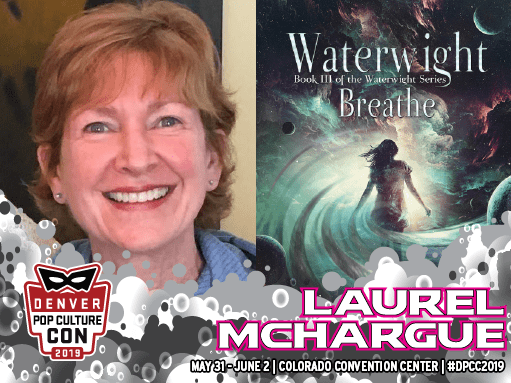
Sharing my work and having a fan say, “Wow! I loved that!” is another obvious fun part, but that’s after the writing is published. I brought my work to the 2018 Denver Comic Con and was blown away by the interaction I experienced with readers. I’ll attend the 2019 Denver Pop Culture Con (new name) this year with my completed trilogy and a new graphic novel! Now, that will be fun!
Kaye: Fantasy isn’t the only genre that you write in, and you hope to explore as many genres as possible throughout your writing career. What is your favorite genre to date?
Laurel: I’m horrible when it comes to “what’s your favorite” questions, but I’d have to say that I’m really enjoying short stories right now. I’ve entered several “flash fiction” contests with very short time limits, and being able to complete a project in a week or less exhilarates me!
I’m putting together a short story collection now. I’ve promised my Patreon patrons a new short story every month (which I narrate on my podcast Alligator Preserves) and when I’ve created enough, I’ll publish them and acknowledge my partons.
That said, many of my fans tell me they love my nonfiction blog posts. Once Waterwight Breathe is launched, my next big project will be a nonfiction piece based on my dad’s WWII letters. I hope to have a draft completed by the end of 2019!
Kaye: Where does your inspiration come from?
As Neil Gaiman said when asked where he got his ideas, “I make them up . . . out of my head.” (http://www.neilgaiman.com/Cool_Stuff/Essays/Essays_By_Neil/Where_do_you_get_your_ideas%253F). But how does inspiration get into my head? It gets there from every sensory experience throughout my days and from the Technicolor dreams I’ve had since I was a child. Someone said dreams are your brain’s way of dealing with all the things bombarding your senses during the day, and when I remember my dreams, I can often link them to something that has happened, or something that’s been “on my mind.”
Real people and creatures inspire my characters as much as imaginary ones (and who says the bizarre creatures in my dreams aren’t “real”?). Old Man Massive, the mountain spirit in my Waterwight trilogy, was inspired by an outcropping of stone on Mt. Massive that looks like an old, bearded man. Names and superpowers were inspired by real people I’ve known or met while writing the series. Zoya, my tragic octopus, was inspired by a paddleboarding experience on Twin Lakes, as was Noor, my fire-breathing dragonfly. The whole series started with a crazy dream I shared with a friend. I see and find inspiration all around me.
People have asked me where I get my imagination from, and all I can say is that it must be a gift from the universe! It’s certainly not a “thing” you can buy, and I’m not even sure it’s a “thing” you can learn. I consider myself quite fortunate that I was born with an imaginative brain.
 Kaye: What do you do when you’re not writing?
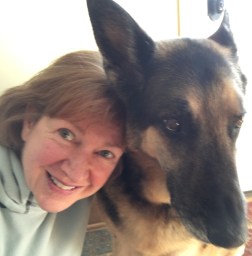
Laurel: When I’m not writing, I’m thinking about writing or I’m marketing my writing (sure wish I could clone myself for that task) or I’m reading or I’m recording a podcast episode or I’m cooking a yummy dinner or I’m brushing a pillow’s worth of hair from my German Shepherd or I’m cleaning out my sock drawer (because, where do all those socks come from?) or I’m swimming (several mornings per week, and not very fast) or I’m chatting with my friends or with one of my four sisters or I’m worrying about my sons (because I’m a mother) or I’m wondering how the day has passed so quickly. And other things, too.
Kaye: Hunting for Red Meat is a collection of memoir-style essays based on your own adventures hunting elk. When did you get the idea to make them a published collection?
Laurel: Several friends have told me how much they enjoy my blog posts, and one of them, Erin Sue Grantham (who also hunts), suggested I put them into a book. When I looked at putting them all in a book, I was overwhelmed by how many stories I had, and realized a book containing them all would be too big. So I thought about segregating them into topic areas.
After three years of hunting (and never filling a tag), I had plenty of hunting blog posts, so I decided to start there. Our oldest son, Nick, suggested it would be a “blook” a blog book, and I had fun coming up with the title.
I really thought I’d have a lot more sales by now with a title starting with “Hunt for Red…,” but alas, no. I honestly think many readers would enjoy it as it’s far more of an appreciation of the majesty of the wild outdoors than it is about hunting. I share my awe and my suffering, my adrenaline and my poetic moments.
My next “Blook” will probably be about our camping adventures.
Kaye: You have also published two books on Haiku. Do you have a special love for that poetry form? What is it that draws you to it?
Laurel: I love Haiku because—like a short story—they finish quickly. You have only seventeen syllables to play with, and it’s like completing a puzzle. Five-seven-five. That’s it.
Teaching grades 7-12 also gave me an appreciation for Haiku. When the word “poetry” comes from a teacher’s mouth, it’s generally followed by groans. Once a student learns how to count out syllables, though, and fit them into a “puzzle,” or a “math challenge,” for those more inclined toward that side of the brain, poetry suddenly becomes fun.
I was always amazed by the final products my students would create, boys as well as girls, and what fun it was to watch them tap on desktops or count on fingers while figuring out the syllabic pattern.
Haikus Can Amuse: 366 Haiku Starters “happened” after I dropped my cell phone into the ocean. Cell phones don’t like salt water. Anyway, I had a few weeks to kill before getting a new phone (I was away on vacation when it happened), and it was Leap Year, so I figured, why not come up with 366 first lines! I put that together as a gift journal for people who like filling in blanks and journaling just a little bit.
Hai CLASS ku is a spinoff of my cell-phone-debacle book, and it’s designed as a classroom workbook with a semester’s worth of haiku first lines (90) and space to draw a sketch and write a bit about inspiration. It’s also a great tool for substitute teachers.
Kaye: Which author or poet, dead or alive, would you love to have lunch with? Why?
Laurel: Dead? Steinbeck. Why? Because I love his writing. Alive? Margaret Atwood. Why? Because I love her writing. So many tremendous authors, so, so, so little life to experience them all.
I want to thank Laurel for joining me and sharing a little about experiences and her work. You can learn more about both at the links below.
SoundCloud (Alligator Preserves podcast): https://soundcloud.com/user-564361489
iTunes link: https://itunes.apple.com/us/podcast/alligator-preserves/id1337322865?mt=2
Stitcher permanent show link: http://www.stitcher.com/s?fid=165314&refid=stpr
(this link is optimized for mobile and Twitter posts)
Amazon Author page: https://www.amazon.com/Laurel-McHargue/e/B00INB9OO6
Blog link: http://leadvillelaurel.com/
Facebook: https://www.facebook.com/LeadvilleLaurel
Twitter: https://twitter.com/LeadvilleLaurel
Instagram: https://www.instagram.com/leadvillelaurel/
LinkedIn: Laurel (Bernier) McHargue
Like this post? Subscribe to Writing to be Read for e-mail notifications whenever new content is posted or follow WtbR on WordPress.
Posted: March 1, 2019 | Author: kayelynnebooth | Filed under: Book Review, Books, Fiction, Science Fiction, Stories | Tags: Book Review, Kevin J. Anderson, Science Fiction, Selected Stories: Science Fiction Volume 2, Short Fiction, Short Stories, Short Story Collection, Writing to be Read |
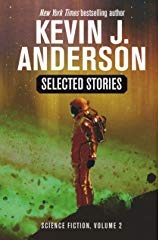
Selected Stories: Science Fiction Volume 2, by Kevin J. Anderson a collection short science fiction stories from a master story teller. This collection is comprised of short fiction created throughout his long and profitable career as an author, and the nice thing about this collection is that Anderson has included a brief introduction to each one, giving a brief glimpse into each story’s inspiration.
Experiments gone awry, time travelers, inescapable planetary prisons, hot, but frightening alien sex tales, giant robots, the ultimate population control; they are all here, in this collection. The stories in this collection are skillfully crafted Anderson twists on the science fiction themes we know and love. Also included is an excerpt from one of Anderson’s early novels, Hopscotch. “Club Masquerade” explores the concept of body switching and takes it in some extreme directions.
Kevin J. Anderson is a master storyteller, and every story in this collection is imaginative and entertaining. I give Selected Stories: Science Fiction Volume 2 five quills.
Kaye Lynne Booth does honest book reviews on Writing to be Read in exchange for ARCs. Have a book you’d like reviewed? Contact Kaye at kayebooth(at)yahoo(dot)com.
t
Posted: February 25, 2019 | Author: kayelynnebooth | Filed under: Biographies, Biography, Books, Commentary, Creative Nonfiction, His Name Was Michael, Memoir, Nature writing, Nonfiction, Self-Help, Travel, Writing, Writing to be Read | Tags: Biography, Creative Nonfiction, Diaries, How-to books, Journalism, Memoir, Nature Guides, Nonfiction, Self-Help, Travel Books, Travel Memoir, Writing to be Read |

Our monthly theme for February on Writing to be Read was, you guessed it – nonfiction. So, what tipped you off? Was it the great interview I did with nature author Susan J. Tweit? Or maybe the nonfiction revues of How to become a Published Author and Letters of May? Or perhaps it was the “Chatting with the Pros” interview of nonfiction author Mark Shaw? Whatever it was that gave it away, I’m here to tell you that these few posts on nonfiction don’t even scratch the surface of what the genre of nonfiction encompasses.
There are many subgenres of nonfiction, just as there are many subgenres under each of the genres of fiction. When someone asks what type of book your fiction novel is, we are quick to catetgorize it as a paranormal mystery, a historical romance, or a science fiction thriller. For some reason, we don’t seem to think about nonfiction the same way we do fiction and when someone asks what type of book your memoir is, or your travel diary, or your self-help book, we tend to lump it in with all the rest in nonfiction. Why this is, I don’t know, but I find that it is the case, time and time again.
The fact is, not all nonfiction books are alike and there are many categories or subgenres that fall within the nonfiction realm. Mark Shaw writes biographies and creative nonfiction tales that are very different from the memoirs, illustrated travel books and nature guides of Susan J. Tweit. Other types of nonfiction that are hard to define are books like Mark Todd and Kym O’Connell Todd’s Wild West Ghosts, which chronicles their ghost hunting experiences and offers advice on how you can be a ghost hunter too. Or Hollywood Game Plan by Carole Kirshner, which is a how-to guide for anyone wanting to break into the screenwriting world. These books are all nonfiction, but they are all very different types of books.
According to wikipedia the genres of nonfiction are biographies, autobiographies, memoirs, commentaries, creative nonfiction, critiques, essays, owners manuals, journalism, personal narratives, reference books, self-help books, speeches, and text books. I would add to that spiritual texts, encyclopedias, documentaries, how-to books, cookbooks, diaries and anthologies such as the one found in Letters of May, which is a collection of writings and artwork illustrating the world of those afflicted with mental illness. I’m sure there are others, but as you can see the list is quite extensive.
Nonfiction books may or may not be aimed to entertain, but the primary purpose, no matter the type of nonfiction book, is to inform. This may account for the fact that my reviews of nonfiction books receive more views in general, than most of my fiction reviews. A fact that I found to be surprising when I uncovered it while looking over the data for this blog. My theory is that readers turn more quickly to books they may find useful than they do to those with entertainment as their sole purpose.

My reasons for interest in nonfiction and all it’s many forms stems from preparation for my journey to write my own memoir, telling the story of my son’s death and my life without him, His Name Was Michael. My bi-monthly blog series which will chronicle that writing process, “The Making of a Memoir“, came out with the first segment in February, too. It was a good month for it to come out, as it also fits in with the nonfiction theme. I hope you’ll join us again next month, when the theme will be science fiction and fantasy.
Be sure to join me next month when we will explore science fiction and fantasy, with guest author Kevin J. Anderson on “Chatting with the Pros” on March 18th, as well as a review of his Selected Stories: Science Fiction Volume 2, and Jordan Elizabeth’s Rogue Crystal.
Update: In Friday’s post I talked about the changes coming for Writing to be Read. One more change that I just recieved confirmation of, and I’m pleased to announce: Art Rosch will also be posting one movie review a month, on the forth Friday of the month, in “Art’s Visual Media Review”.
Like this post? Subscribe to Writing to be Read for e-mail notifications whenever new content is posted or follow WtbR on WordPress.
Posted: February 22, 2019 | Author: kayelynnebooth | Filed under: Blog Content, Book Review, Chatting with the Pros, Fiction, Film Review, Interview, Nonfiction, Paranormal, WordCrafter Press, Writing, Writing Contest | Tags: Book Reviews, Chatting with the Pros, Film Review, Jeff Bowles, WordCrafter, WordCrafter Press, Writing to be Read |

The entries are rolling in for the paranormal fiction contest and each one must be read. Stories good enough to recieve invitations to the anthology will also need to be edited. In order to accomodate a time budget for all this contest judging and anthology compilation activities in addition to my other life responsibilities, you can expect to see a few changes in the Friday Reviews.
One good change is we’ll be seeing more of Jeff Bowles. Last week he stepped in with a movie review of Glass that was brutally honest, but captivating. That review was so well recieved that he’s agreed to share a movie review with us on the third Monday of every month. His review of Glass was knowledgeable of the genre and written well enough to be mistakeing for one of the top critiques. If book reviews are hugs for authors, then Writing to be Read wants to hug the film industry, too. If you want to keep up on many of the latest movies, be sure to catch Jeff’s Movie Review (working title) each month.
I also plan to make two reviews each month instead of four, for books in the genre to go along with the monthly theme set by the genre the “Chatting with the Pros” guest author for the month. In February my guest author was nonfiction author Mark Shaw, so the February theme was nonfiction. My supporting author interview was with nature writer Susan J. Tweit and my supporting post was about my own nonfiction endeavor with the first post in my new bi-monthly series, “The Making of a Memoir“. My reviews were both of nonfiction books of different sub-genres: Mark Shaw’s How to Become a Published Author and a compilation of poetry artwork and writings about mental illness, the Letters of May anthology.

March’s theme will be science fiction and fantasy, and the “Chatting with the Pros” guest author will be national and international best selling author Kevin J. Anderson. He’s written more best sellers than there is room to list here and I’m thrilled to have him on Writing to be Read. My supporting post will be about my science fantasy series, Playground for the Gods. I’m still searching for a author for my supporting interview, but my reviews will be for Kevin J. Anderson’s Selected Stories and Jordan Elizabeth’s Rogue Crystal. If you want to be sure not to miss any of these great science fiction and fantasy segments, be sure to sign up to email or follow on WordPress to get notification of new content.

Before I wrap this up, let me just remind you all that there is still time to submit your short story to the WordCrafter paranormal fiction contest. The deadline is April 1, so don’t drag your feet on this one. The entry fee is $5 and the winner will recive a $25 Amazon gift card and a guaranteed place in the WordCrafter Press paranormal short fiction. Email your submissions to kayebooth (at) yahoo (dot) com and I’ll send you confirmation instructions for submitting your entry fee.
Your submission can be any genre, but your story does have to include a paranormal element, so get those stories in. Other entries may be included in the anthology by special invitation, and all anthology authors will recieve a small royalty share if the book makes any money. You can get the full submission guidelines here: https://kayelynnebooth.wordpress.com/2019/01/28/short-fiction-contest-paranormal-stories-sought/
I do hope you’ll all join me in the exciting changes ahead. I’m always interested in reader feedback, so leave a comment and let me know what you’d like to see on Writing to be Read.
Want to keep up to new content so you never miss a post? Subscribe to Writing to be Read for e-mail notifications whenever new content is posted or follow WtbR on WordPress.
Posted: February 18, 2019 | Author: kayelynnebooth | Filed under: Author Profile, Biographies, Books, Chatting with the Pros, Creative Nonfiction, Nonfiction, Writing, Writing to be Read | Tags: Biographies, Chatting with the Pros, Creative Nonfiction, Mark Shaw, Nonfiction, Writing to be Read |

In February, Writing to be Read is taking at look at nonfiction authors and their works. I’m pleased to say that my guest on Chatting with the Pros this month is nonfiction author Mark Shaw. Mark has been a traditionally published author for many years, following a successful career in journalism. He’s written biographies on sports greats, priests, accused criminals in high profile cases, as well as books about golf and pilots, and writing instruction. Today, he champions those for whom justice has not been served, his most recent book being Denial of Justice, which outlines the events surrounding the and deaths of J.F.K., Lee Harvey Oswald, Jack Ruby and Dorothy Kilgallen, which is a sequel to The Reporter Who Knew Too Much, which is Kilgallen’s story, and both books have been optioned for visual media and a script is currently being developed. Let’s welcome him and see what he has to say.

Kaye: Could you share a brief history of your author’s journey for those who are not familiar with you or your work? How did you get to where you are today?
Mark: It’s difficult for me to even believe that Denial of Justice was my 27th book. I never had any experience with writing, no classes, no workshops, etc. when I first wrote a book about Mike Tyson’s rape trial in 1992. What I fell in love with was the research, the writing process, and the chance to make people stop and think about important historical issues. That’s what keeps me going, looking for subjects now that deal with justice and injustice.
Kaye: In your books, you use your investigative reporting skills to dig deep and reveal little or unknown facts until you can tell the whole tale. Many of your books have brought some surprising details to the public eye. How do you choose the subjects for your books?
Mark: I like to say the book ideas come to me. Most of the time, I get an idea for a book at 3 a.m. and quickly write down a thought about it on some note cards I keep by my bed. All of my book titles have come that way as well. Writers need to keep their eyes open, many book ideas float right in front of us if we pay attention.
Kaye: After the story of Dorothy Kilgallen, The Reporter Who Knew Too Much, had a great reception and is now being prepared to be told through visual media. Was any of this a surprise to you, or did you think this story might be a best seller as you were writing it?
Mark: I had no idea Dorothy’s name was still magic, that a book about her would touch so many reader’s emotions and become a bestseller. I’ve heard from people around the world about the book, still do today, two-plus years after the book was published. It’s been amazing experience for sure.
Kaye: You recently released Denial of Justice, which digs even deeper into Dorothy’s story. How did you know there was more to be found regarding her story?
Mark: Those readers I mention sent me tips about new information about Dorothy’s life and times and her death and a file I kept just kept getting thicker until I realized there was a second book for those who read the first one and did not. Now I feel as if I have told the complete story about her although some new information still comes my way.
Kaye: As mentioned above, the Dorothy Kilgallen story in The Reporter Who Knew Too Much is going to be portrayed on the screen. Are there plans to include Denial of Justice to be portrayed visually or perhaps be included in the screen version already planned?
Mark: Both books were optioned for the big or little screen.
Kaye: How is that going so far?
Mark: There is no filming yet of The Reporter Who Knew Too Much. It is still in the development phase with a script being completed. I am quite excited about Dorothy’s story being on the big or small screen since if that happens, more and more people will know about this remarkable woman. I like to say a book is like a written megaphone to the world but a film or TV series reaches even more people.
Kaye: In addition to several books which revolve around J.F.K. and his circles, you’ve also written about sports icons such as Larry Bird, Jack Nicklaus, Pete Dye and Don Larson. You’ve told the tales of suffering and discrimination during the holocaust, and you’ve written the biography of a priest, books on golfing and a how-to book on writing. What motivates you to write the stories that you write?
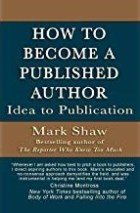 Mark: Again, the chance to make people stop and think, although some books have been more for entertainment purposes. Regardless, my books have a controversial slant to them, and that is important, something aspiring authors should seek to achieve. In my book about the publishing process that I use when aspiring authors hire me as a consultant, How to Become a Published Author: Idea to Publication, this is the type of practical advice I provide based on all of my
 experience.
Kaye: Have you ever written a book of fiction?
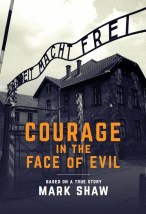 Mark: Yes, Courage in the Face of Evil is based on a true story, a Holocaust diary that is both disturbing and inspirational in nature, but I had to add certain elements that cause it to enter the world of fiction. I have also created a crime series called Vicker Punch: Lawyer on the Brink that is fiction, but based on my years as a criminal defense lawyer handling murder cases, and a book that is a sequel to a famous work of fiction.
Kaye: How do you see writing nonfiction differing from fiction in the publishing arena?
Mark: Fiction is much more fun, let the imagination loose without worrying about footnotes, etc. Just let it go and let the characters tell whatever the story is they want to tell. This said, for a first time author, getting fiction published these days is much more difficult that non-fiction since with fiction the star of the book is the author while with non-fiction the star of the book is the story.
Kaye: What is the biggest challenge in writing nonfiction for you?
Mark: How to tell the story once I have done all of my research.
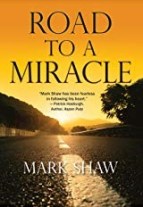 Kaye: Tell me a little about Road to a Miracle? The book is listed on Amazon for $57.73. I have to wonder what type of book rates a price like that?
 Mark: That’s nuts, and there are other editions of the book at a much less cost. The book is my road through the amazing life I have been blessed to live to the point of finding a daughter and two grandchildren I never knew existed a few years ago. Truly a miracle.
Kaye: I believe your stories are successful because they all hit emotional chords in your readers. How do you portray the emotional elements of your story so that they will touch your readers?
Mark: I tell writers I work with to be certain, whether fiction or non-fiction, to show the reader what’s happening, not tell them. That’s how the emotion comes through, how the reader connects with the story. Remember, a book is like a conversation with the reader but the author is not there so the emotion must be shown not told.
Kaye: In How to Become a Published Author, you talk about the importance of titles and subtitles. How do you come up with titles and subtitles for your books? How important are subtitles?
Mark: The book ideas come to me and the titles in the middle of the night when whatever spirit it is that is guiding my life, whispers in my ear. I quickly write down the idea on note cards I keep by my bed.
Many good books and movies have never seen the light of day due to bad titles. They need to be catchy, like TRWKTM, Denial of Justice, Miscarriage of Justice, The Poison Patriarch, etc. Don’t have too much experience with books based on true stories or fiction but Courage in the Face of Evil is striking as is Victor Punch: Lawyer on the Brink.
Re subtitles, not as important as titles but add to the description of the book. Again, I’m quite proud of the subtitles for my books. They certainly add to the allure of the story.
Kaye: Many of your books are collaborations. Is it difficult to write a book with someone else? Why collaborate? What are the pros and cons?
Mark: No, during the early part of my getting some footing as a writer, I had collaborations, but no more. This said, working with someone famous to tell their story is a good way to show writing skill and the ability to tell a good story. That’s key to establishing a reputation, as is writing biographies if a writer wants to enter the world of non-fiction.
Kaye: You were a criminal defense attorney and legal analyst for the news media covering the Mike Tyson, O.J. Simpson and Kobe Bryant cases, and you have a book about Tyson, Falsely Accused. Are there books about O.J. and Koby in the future? If not, what separates Tyson out from the others?
Mark: Injustice is the key word for the Tyson book since he did not get a fair trial. That thread has been woven through almost every book I’ve written in the last ten years or so, Miscarriage of Justice, Beneath the Mask of Holiness, Melvin Belli: King of the Courtroom, The Poison Patriarch, TRWKTM and now Denial of Justice, which relates actually to four people, JFK, Oswald, Jack Ruby and Dorothy Kilgallen. All were denied justice.
Kaye: What’s in the future for Mark Shaw?
Mark: Only the good Lord knows but I am truly the most blessed man on the face of the earth and for sure, I want to help as many writers as possible become published, to realize their publishing dreams.
I want to thank Mark for sharing with us today. He’s given us some insight into the world of a nonfiction author. You can learn more about Mark or his books at the links below.
You can catch the monthly segment “Chatting with the Pros” on the third Monday of every month in 2019, or you can be sure not to any of the great content on Writing to be Read by signing up by email or following on WordPress.
Posted: February 11, 2019 | Author: kayelynnebooth | Filed under: Books, His Name Was Michael, Memoir, Writing, Writing to be Read | Tags: His Name Was Michael, Memoir, Pre-writing, research, The Making of a Memoir, Writing, Writing to be Read |

His Name Was Michael
I’m starting this bi-monthly blog series, The Making of a Memoir, which will chronicle my journey as I write my memoir of my teenage son’s suicide and my life without him, breaking down the memoir process into stages. I am sharing thios process for several reasons. One, Michael’s story deserves to be told. It needs to be told. Two, telling my own story may act as a catharthis and help me to resolve my own unresolved issues surrounding Mike’s death. Three, commiting to bi-monthly accountability to you, my readers and fellow authors, forces me to create and meet deadlines, assuring that I make adequate progress on the book. It is too easy to make excuses and avoid the emotionally difficult tasks if I’m accountable only to myself. And four, I believe there are those of you out there who are interested in the methodology behind creating memoir.
Before I can begin writing the my memoir telling the story of my son’s death and the story of my own journey to find closure and my need to be sure that he will always be remembered, I must know what it is that I want to say, and have some idea of how I want to present it. After Michael’s death, I went through his writings and artwork, I went through every picture of him over and over and over. I listened to his music. And I cried and cried, and I thought I would never stop. It never has. At least not completely, but I did gain control over it by putting all his things away, to be dealt with at a later time. I knew I needed to tell his story then, but I wasn’t ready. Not then.
I actually made several false starts at writing his story at different times, I wrote poetry, some of it semi-epic, but the emotional wounds were still fresh. I was angry and overcome by grief, and I wanted by son back. I wasn’t able to portray what I was feeling with the depth of emotions I was experiencing. I had to set it all aside and heal some before I could undertake this immense task.
In addition, I wasn’t a skilled enough writer to undertake it at that point. I’ve since earned my M.F.A. in Creative Writing, published three books, and have short fiction and poetry featured in several publications and anthologies. Does that make me an expert now? No. But it has taken me down that path, and certainly I know more about writing books and my writing skills are much improved. I believe that I’m ready now to undertake the writing of my son’s story and my own.
There is no doubt in my mind that this book will be the most difficult book I could ever attempt to write. It is difficult because there is so much emotional investment in this book for me. I’ve collected and saved a mass of materials which may or may not end up in this memoir, but it first must be sorted and compiled. This is a difficult task because of the emotions attached to every piece of material I’ve collected and with the memories associated with each one. Michael has been gone from my life for a decade, but the compilation of these materials still must be taken slowly, a little at a time.
On the other hand, emotional investment in the author lends authenticity to the story and that, according to some, leads to best seller material that people want to read. If you go by that thinking, the more difficult the book is to write, the better it will be. You can let me know if I’m right after you’ve read it.
I thought I had the title. His Name Was Michael: How I lost my son to teen suicide. The title, “His Name Was Michael”, is perfect, for it reflects the feelings I had as time passed and others went on with their lives. Sometimes, I felt that everyone had forgotten about him except my husband and I. A title that would make people remember is a must, and I think it does that. But the subtitle, “How I lost my son to teen suicide”, although clearly and concisely telling the reader what the story is about, it doesn’t roll off my tongue smoothly when I say it aloud. I came up with the idea of replacing it with “No Happy Endings”, and although it states a truth about this story, the potential reader picking it up off the shelf or spotting it online, might pass it over because it sounds depressing and doesn’t really tell them what the book is about. At this point, I have to wonder if a subtitle is even necessary. Comments on Facebook reflect the idea that the title is strongest without any subtitle. So, I am rethinking the title and I’m open to suggestions or thoughts in the comments.
There is still much to do in addition to compiling material and deciding on a title, before I can begin the actual writing of the story, pre-writing tasks, if you will. There are still more materials to gather and research to be done. I know you may be wondering what there is to research. Don’t I know my own story? After all I lived it. But the fact is there is research to be done on every book. On this one, I need to know things like statistics on teen suicide, and I need resources for warning signs of suicide and other information on the subject. I may not use everything I dig up, but I will have it available if I decide that it has a place in this book. I believe it does but I haven’t worked out how I want to present it. There is so much that I want to say, but not all of it belongs. Finding my voice for this book will mean finding my true voice.
There are several people I need to interview, people who I haven’t seen since Michael died, people who have something valuable to contribute to his story. I must learn to control the emotional whirpool that surfaces when I anticipate these contacts, the memories connected, cause turmoil within me. But, I know his story must be told, and to tell it in the manner it deserves, and so, I must contain my emotions and silence the memories in order to what must be done. The very act of doing this very difficult task for the sake of his story will become a part of my own, for it is my story, as well.
There must be at least a vague outline, which is now begining to take shape in my head. I believe I know how I want to begin the story and the structure I need to use. The next step will be to get it down in print, so I have a clear direction in which I want the story to go which I can refer back to to ensure that I stay on track. Outlines are a valuable tool in giving any story direction and making sure it doesn’t veer off into left field and lose the storyline and the way I’ve chosen to structure this particular story demands that guidance.
I’m starting this blog series, The Making of a Memoir, which will break down the memoir process into stages, for two reasons. One, Michael’s story deserves to be told. It needs to be told. Two, telling my own story may act as a catharthis and help me to resolve my own unresolved issues surrounding Mike’s death. And three, commiting to bi-monthly accountability to you, my readers and fellow authors, forces me to create and meet deadlines, assuring that I make adequate progress on the book. It is too easy to make excuses and avoid the emotionally difficult tasks if I’m accountable only to myself.
Since I hope to get this memoir published traditionally, I will also need a book proposal, a query letter and somewhere around the first three to five chapters for that. We’ll cover that in the April segment The Making of a Memoir: Stage 2: Selling the story. I do hope you will join me on my journey.
Like this post? Subscribe to Writing to be Read for e-mail notifications whenever new content is posted or follow WtbR on WordPress.
Posted: February 8, 2019 | Author: kayelynnebooth | Filed under: Book Review, Books, Nonfiction | Tags: Book Review, Letters of May, Mental Health, Mental Illness, Writing to be Read |

Letters of May is, to my knowledge, a unique collection of writings, poetry and artwork which offer glimpses of mental illness from an inner perspective. I can see how someone afflicted with any of the mental illnesses addressed within it’s pages might be grateful to find others who relate with them and the knowledge that they are not alone. These authors have vowed to fight against the stigma of mental illness and share of themselves openly.
For someone who is not afflicted, they offer opportunities to step into the authors shoes and see the world as they do. For the authors and others who are afflicted, dealing with their mental illness is a way of life, encountered on a daily basis. For me, they were a learning experience, identifying some things, but also exploring worlds foreign to my experiences.
These pages might be empowering to some, and enlightening to others. This collection was compiled with the intention of raising awareness of mental illness. Their message above all else: Those with mental health issues are more than their illness. They are still human beings and deserve to be treated with dignity and understanding. This book has much to offer all readers. I give Letters of May five quills.

Kaye Lynne Booth does honest book reviews on Writing to be Read in exchange for ARCs. Have a book you’d like reviewed? Contact Kaye at kayebooth(at)yahoo(dot)com.
Posted: February 4, 2019 | Author: kayelynnebooth | Filed under: Author Profile, Books, Interview, Memoir, Nature writing, Nonfiction, Teaching Writing, Uncategorized, Writing | Tags: Author Interview, Connections, Memoir, Nature Guides, Nature writing, Susan J. Tweit, Travel Books, Writing to be Read |

My guest today is an author, nature lover and plant ecologist. Her books include memoirs, beautifully illustrated travel books, nature guides, and even children’s books, but they all have strong ties with nature. Her books reveal connections with nature and life that have not been pondered or may have been overlooked in our everyday lives. Her books have won the ForeWord Book of the Year, the Colorado Book Award, and she is a five time recipient of Colorado Author’s League Award. With a background in science and plant ecology, she expertly weaves her natural environment into her writings, illustrating how all things interact and connect. Let me introduce creative nonfiction author, Susan J. Tweit.
Kaye: You are a female author who champions the natural environment. Do you identify most as a feminist, a naturalist or an environmentalist?
Susan: All of the above. I grew up in a family of naturalists and scientists; restoring everyday nature is my way of leaving the world a better place. And I work in two fields where women are still second-class citizens in so many ways: science and writing. So am a feminist just be participating in those fields as a woman.
Kaye: On your website you claim that you taught yourself to write after you realized that you enjoyed the stories told by the data more than you did doing the research. How does one teach oneself to write?
Susan: I don’t know how other people teach themselves to write creatively, but for me, as a scientist trained to eschew personal opinions and emotions, and to be extremely parsimonious with descriptive adverbs and adjectives, I found my writing voice in reading the works of writers whose works I admire. I read Ann Zwinger and Terry Tempest Williams, Barry Lopez and Kim Stafford, Brenda Peterson and Linda Hogan, Leslie Marmon Silko and Denise Chávez, Robert Pyle and Gary Paul Nabhan, Sharman Apt Russell and Barbara Kingsolver, and so many others.
As I read, I thought about the mechanics of how each writer told their stories (whether fiction or essays), how they introduced subjects and characters, where they got personal and where they stepped back, how they described landscape and culture, how they used words and language… I tried out techniques and styles until I found my own voice, which has continued to evolve through twelve books and hundreds of essays, articles, and columns for newspapers and magazines.
Kaye: Connections are a common theme in many of your works. Can you talk a little about those?
Susan: As a plant ecologist, I am fascinated by the relationships and interrelationships that form community, whether the human community, or what I call “the community of the land,” the interwoven communities of species—from tiny microbes to gigantic redwood trees—that make life on Earth possible. Who loves who, who eats who, who sleeps with or pollinates who, who can’t stand who… All of those relationships weave the fabric of Life with a capital L. Without them we would not exist, and we have so much to learn about the connections that are vital to this planet. I just collaborated with science illustrator Samantha Peters on “Natural Partners,” a feature for WILDFLOWER Magazine on plants and the animals they rely on. It’s up on the internet here: https://www.wildflower.org/magazine/fauna/natural-partners (The print version took the cover of the magazine, and it’s really gorgeous!)
Kaye: Writing seems to be a way of life for you, and your love for nature is woven into almost everything you do. You have a background as a plant biologist and most of your books offer a perspective on nature and the environment, and you call your books love letters “to the earth and its living web of lives”. If you could convey one message to your readers, what would it be?
Susan: Get outside and get to know nature nearby. Learn even a handful of your neighbors in the world of plants and animals and you’ll never be bored. Nature is vital to our health and wellbeing—it’s the best antidote to stress I know of, the closest source of inspiration and renewal, and it doesn’t require a prescription or training. And it’s free!
Kaye: Besides writing and ecological restoration projects, what are your favorite things to do?
Susan: I’m an outdoors person, so I love taking long walks in the arroyo near my home, hiking with friends, and setting out on long road trips to see this amazing continent. At home, I tend a small garden of native wildflowers and other plants chosen to provide habitat for songbirds and pollinators, cook elaborate dinners for family and friends, and read. I’m an omnivorous reader, which leads into your next questions…
Kaye: You’ve written three memoirs about your life experiences. What makes an experience worthy to become a memoir?
Susan: Memoir is a way of distilling what our own lives and experiences have to offer others. What makes an experience worthy of memoir is partly whether we can find a way of telling the story that is compelling to others (that is, to a wider audience than our close friends and family!). It might be that we lived through a critical part of history, or our personal journey is exceptional in some way, or simply that we figure out how to relate our very ordinary story in a way that offers some universal wisdom about being human. Both of my published memoirs—Walking Nature Home; and Barren, Wild, and Worthless: Living in the Chihuahuan Desert—taught me about how to tell a story, how show the way we grow and change over time, and how to pick and choose telling detail. Each one presented different challenges, and the memoir I am working on now is challenging me in new ways. Telling my personal story may be my greatest learning experience as a writer!
Kaye: Would you tell us about your Write & Retreat Workshops?
Susan: They are an immersion in writing, in learning place and story, and in the inner work that is the source of our creativity. Each one includes hands-on writing and workshop time, as well as time to retreat and nurture our inner selves. Each one is set in some extraordinary place chosen to inspire us, with time spend exploring that place. I don’t have any W&R workshops planned this year, but next year I may offer one set near Yellowstone National Park, that place of wildness and wonders.
Kaye: You are a member of Story Circle Network, Women Writing the Westand Colorado Author’s League. How are these organizations beneficial to you as a writer?
Susan: I am also a member of Wyoming Writers. Belonging to at least one professional writing organization is critical to writing: they offer education, resources, and, most importantly. community. Writing is an inherently solitary activity: pulling words from deep within, honing them into stories, and then offering the work of our hearts to the world is perilous. Finding a community of fellow sufferers… uh, writers, is essential to maintaining our sanity, growing in the craft, and getting published.
Kaye: What is the one thing in your writing career that is the most unusual or unique thing you’ve done so far?
Susan: Besides leaving behind a paycheck, benefits, and job security to chase words and stories? Hmm… It’s hard to choose just one. Kayaking with sea turtles in the Sea of Cortez off Baja California? Learning about how to blow up dams to restore a river and its salmon run? Dancing with a Native American community to celebrate the return of those salmon? Watching a grizzly bear mom teach her twin cubs how to dig and eat spring-beauty bulbs in a meadow in Yellowstone National Park? Walking alone through some of the wildest country in the Lower 48 states, carrying all I needed on my back to listen to myself? Tending my husband and the love of my life through his death from brain cancer and then figuring out how to write how to survive loss? Seeing monarch butterflies return to a restored patch of urban nature? I’ve been fortunate to experience miracles and wonders all along the way.
Kaye: What are you working on now? What can readers expect in the future from Susan J. Tweit?
Susan: I’m working on The Climate Victory Garden, a book about how gardens can help grow The Green New Deal and slow climate change. It’s another chapter in my life-long quest to leave this world in better shape than I found it by restoring nature nearby and our connection to the green and living world.
Many thanks to Susan for sharing with us today. You can learn more about Susan J.Tweit and her work by visiting the following links:
Amazon Author page: https://www.amazon.com/Susan-J.-Tweit/e/B000AQ53RY/ref=sr_ntt_srch_lnk_1?qid=1547778739&sr=1-1
Website: http://susanjtweit.com/
Join us next Monday, when I’ll begin a new bi-monthly blog series, “His Name Was Michael”, which will chronicle the stages of writing a memoir as I work through them for my own memoir of the same name, telling the story of my son’s death and my own grief process. This first post will talk about the prewriting stage for memoir.
Like this post? Subscribe to Writing to be Read for e-mail notifications whenever new content is posted or follow WtbR on WordPress.










February: Taking a look at nonfiction
Posted: February 25, 2019 | Author: kayelynnebooth | Filed under: Biographies, Biography, Books, Commentary, Creative Nonfiction, His Name Was Michael, Memoir, Nature writing, Nonfiction, Self-Help, Travel, Writing, Writing to be Read | Tags: Biography, Creative Nonfiction, Diaries, How-to books, Journalism, Memoir, Nature Guides, Nonfiction, Self-Help, Travel Books, Travel Memoir, Writing to be Read | Leave a commentOur monthly theme for February on Writing to be Read was, you guessed it – nonfiction. So, what tipped you off? Was it the great interview I did with nature author Susan J. Tweit? Or maybe the nonfiction revues of How to become a Published Author and Letters of May? Or perhaps it was the “Chatting with the Pros” interview of nonfiction author Mark Shaw? Whatever it was that gave it away, I’m here to tell you that these few posts on nonfiction don’t even scratch the surface of what the genre of nonfiction encompasses.
There are many subgenres of nonfiction, just as there are many subgenres under each of the genres of fiction. When someone asks what type of book your fiction novel is, we are quick to catetgorize it as a paranormal mystery, a historical romance, or a science fiction thriller. For some reason, we don’t seem to think about nonfiction the same way we do fiction and when someone asks what type of book your memoir is, or your travel diary, or your self-help book, we tend to lump it in with all the rest in nonfiction. Why this is, I don’t know, but I find that it is the case, time and time again.
The fact is, not all nonfiction books are alike and there are many categories or subgenres that fall within the nonfiction realm. Mark Shaw writes biographies and creative nonfiction tales that are very different from the memoirs, illustrated travel books and nature guides of Susan J. Tweit. Other types of nonfiction that are hard to define are books like Mark Todd and Kym O’Connell Todd’s Wild West Ghosts, which chronicles their ghost hunting experiences and offers advice on how you can be a ghost hunter too. Or Hollywood Game Plan by Carole Kirshner, which is a how-to guide for anyone wanting to break into the screenwriting world. These books are all nonfiction, but they are all very different types of books.
According to wikipedia the genres of nonfiction are biographies, autobiographies, memoirs, commentaries, creative nonfiction, critiques, essays, owners manuals, journalism, personal narratives, reference books, self-help books, speeches, and text books. I would add to that spiritual texts, encyclopedias, documentaries, how-to books, cookbooks, diaries and anthologies such as the one found in Letters of May, which is a collection of writings and artwork illustrating the world of those afflicted with mental illness. I’m sure there are others, but as you can see the list is quite extensive.
Nonfiction books may or may not be aimed to entertain, but the primary purpose, no matter the type of nonfiction book, is to inform. This may account for the fact that my reviews of nonfiction books receive more views in general, than most of my fiction reviews. A fact that I found to be surprising when I uncovered it while looking over the data for this blog. My theory is that readers turn more quickly to books they may find useful than they do to those with entertainment as their sole purpose.
My reasons for interest in nonfiction and all it’s many forms stems from preparation for my journey to write my own memoir, telling the story of my son’s death and my life without him, His Name Was Michael. My bi-monthly blog series which will chronicle that writing process, “The Making of a Memoir“, came out with the first segment in February, too. It was a good month for it to come out, as it also fits in with the nonfiction theme. I hope you’ll join us again next month, when the theme will be science fiction and fantasy.
Be sure to join me next month when we will explore science fiction and fantasy, with guest author Kevin J. Anderson on “Chatting with the Pros” on March 18th, as well as a review of his Selected Stories: Science Fiction Volume 2, and Jordan Elizabeth’s Rogue Crystal.
Update: In Friday’s post I talked about the changes coming for Writing to be Read. One more change that I just recieved confirmation of, and I’m pleased to announce: Art Rosch will also be posting one movie review a month, on the forth Friday of the month, in “Art’s Visual Media Review”.
Like this post? Subscribe to Writing to be Read for e-mail notifications whenever new content is posted or follow WtbR on WordPress.
Share this: